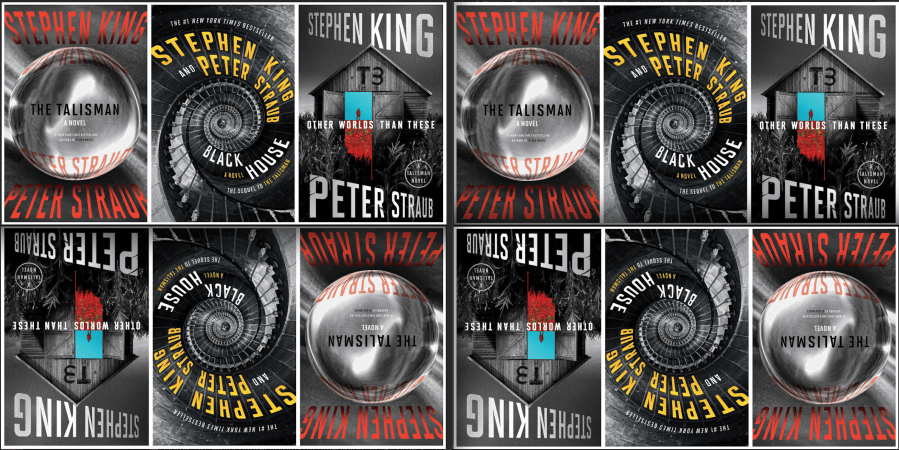
It is two days before the release of King’s latest book, Other Worlds Than These, the third book in the trilogy whose first two books, The Talisman (1984) and Black House (2001), he co-wrote with Peter Straub. Straub died in 2022 but had sent King some ideas about the third book (King mentioned as long ago as 2016 that the third Talisman book was in progress).
Two days ago, the New York Times published an interview with King in which he discussed his process of “channeling” Peter Straub, and when the interviewer asked what that meant, King described rereading some of Straub’s old work, noting that he himself is a “literary forger”–a fact that would be well known to King fans. King also mentions something that he had before in previous interviews about their process writing the first two books–that they were deliberately trying to sound like each other so that readers wouldn’t know who wrote which parts.
I could never really tell who wrote what (occasional lines might prompt a guess), and I wouldn’t mind taking a crack at the King archives to look at drafts and start to answer that question, though I suppose that would violate their wishes. But when King mentioned in this interview that the major difference between him and Straub was that King liked rock ‘n’ roll while Straub liked jazz, I thought I might know who wrote a particular section of Black House.
That their taste in music is the one thing they don’t have in common is also funny in light of King referring to having gotten “the band back together” with the two of them.

It is kind of hilarious that he has positioned himself so that three signifiers of the Muschietti IT adaptations are visible, the red balloon on his shirt, the red balloon in the background, and the Bill Skarsgård Pennywise that appears to be a cup. I guess he’s a fan.
For context (and full spoilers!), The Talisman is about twelve-year-old Jack Sawyer going on a cross-country mission to obtain the mystical object of the Talisman in order to heal his mother Lily’s cancer. He is led to this mission by an old magical Black man who shows him how to flip into the parallel universe of “the Territories.” (Can I guess who wrote that part?) Speedy gets introduced in the very first chapter, and according to a 2021 Kingcast episode on The Talisman, King claimed he and Straub sat down together to write the beginning before going their separate ways and swapping pages back and forth with one writing forward from what the other had sent. (The article here also mentions this process.) So maybe they were sitting together at the same computer (or typewriter) to draft chapter 1, but I can still guess whose idea the magical Black man was as the impetus for the entire plot.
If this process for the most part obscured who wrote what, what’s clear is that two writers, when one of them is Stephen King, are going to write a book that is a lot longer than it needs to be. As Jack crosses from the East Coast to the West Coast, he flips back and forth to the Territories along the way, usually to escape something bad in one place or the other and usually to find the situation in the parallel world just as bad. Jack works for a period at a seedy bar with an abusive owner, and then, once he picks up a friendly werewolf friend, they get stuck at an abusive orphanage run by a sham preacher. The werewolf friend, named Wolf, sacrifices himself to get Jack out of there, at which point Jack goes to the prep school where his friend Richard is a student–Richard is the son of the novel’s villain, Morgan Sloat, Jack’s dead father’s former business partner. Jack is in Illinois by this point–about halfway across the country, though we’re more than halfway through the book. Progress is expedited by them hopping a train through the “Blasted Lands” that will be a lot like a sequence in the third Dark Tower book, The Waste Lands, some years later. King has only written the first Dark Tower book at this point, so when the titular Talisman turns out to be “the nexus of all possible worlds,” one wonders how much of a conception he had that this was what the Dark Tower itself was supposed to be. When they get to the West Coast, Jack has to go through a “black hotel” to retrieve the Talisman, and once he does, has a confrontation with Morgan Sloat (slash Morgan’s “twinner” from the Territories) on the beach outside. Morgan tries to destroy the Talisman with fire from his magic lightning rod but the Talisman spits the fire back and kills him. Jack gets the Talisman back to his mother on the East Coast and heals her. It’s probably also important to note that his mother’s “twinner” is the queen of the Territories and so is also dying, as Jack sees early on when he visits the Territories, so the mission to save his mother is really more significant for saving this queen.
In Black House, Jack, now an adult, is a successful homicide detective in Los Angeles. Because of touching the Talisman, he is extremely successful at everything he does. But he’s repressed his memories of the Territories and his childhood experiences there, and when they’re triggered by a particular image that reminds him of Speedy lying dead on the beach near the end of The Talisman (though it turned out Speedy was not actually dead), he is so shaken he goes into early retirement in a small town in Wisconsin where he had helped bust a serial killer some time before. When a new serial killer starts killing children there, everyone wants Jack to help, but for a long time he refuses and continues to try to repress his trauma, until Speedy returns in his dream and encourages (i.e., yells at) him to. It turns out the killer, aka “the Fisherman,” aka Charles Burnside, has the ability to flip back and forth to the Territories and is abducting children who might serve as “breakers” of the beams of the Dark Tower, and has abducted one who might be the most powerful breaker ever, a boy named Ty. Burnside’s house is the titular “Black House” which is a portal to the Territories. Jack befriends a biker gang of former English majors known as the “Thunder 5” who help him on the case of finding Ty, and when they get close to Black House, they start getting sick and one is bitten by a huge demonic dog. This bite poisons him to death, and on his deathbed he gives Jack a magic word, “d’yamba.” Jack uses this word to summon a bunch of magic bees before they go back and enter Black House, and they are guided by the queen bee through a bunch of weird funhouse rooms. Burnside is about to seemingly rape Ty on the Territories side before handing him over to “Mr. Munshun,” a minion of the Crimson King, but in the process of killing Jack’s friend Henry, Burnside incurred a wound that enables Ty to be able to get the upper hand and kill him. Jack and the others find him and they go to confront Mr. Munshun, aka Lord Malshun. Jack has brought an autographed baseball bat with him that Ty’s father gave him for Ty, and Jack shoots magic light from it to kill Malshun. This happens in view of the big building where the enslaved-child breakers are working to break a beam, and Jack tells Ty to “break it,” i.e., break the breaking structure, which Ty does in short order, and all the children come out of the portal back into Wisconsin, puzzling the world with their inexplicable presence. At a press conference afterward, the wife of the original serial killer Jack busted in Wisconsin shoots him in the throat. The others get him to the Territories side, which is his only hope of survival, and we learn that Jack will survive and will die if he goes back to his original side. Fortunately he’s fallen in love with the new Territories queen, Sophie.
Having summarized the important narrative events of Black House, Jack’s friend Henry is barely mentioned, but he is actually in the novel quite a bit. Which brings me to the part I now think Straub must have written: when Henry, as “Symphonic Stan,” one of the multiple personas that he adopts in his capacity as a radio DJ, is DJing for a party at a nursing home where Burnside is a resident, and playing the type of music that Straub apparently appreciates more than King, like Benny Goodman. When Jack is listening to jazz on the radio in his car with Henry’s nephew Dale, Dale says Jack and Henry should be friends because Henry is “‘like an encyclopedia of weird music,’” and then we get, “Jack did not take up the assumption that jazz was weird. Maybe it was.” Henry and Jack’s relationship is an important emotional core in the novel (their bond feels much more developed than Jack’s with Sophie) but narratively Henry ultimately doesn’t do much. Sure, he deals the Fisherman what ultimately turns out to be a fatal wound, but that he later figures out the Fisherman’s identity specifically because of when he was playing the jazz music at the nursing home party turns out to basically be irrelevant. As soon as he figures it out, the Fisherman is already standing outside his door ready to kill him. Henry manages to record a warning revealing the Fisherman’s identity before he dies, placing him as a resident at the nursing home, but Burnside makes it back to the nursing home and kills more people there before Jack hears the recorded message and cops get there, so it doesn’t seem like this warning accomplishes much.
Despite this narrative issue, reading King’s interview as he’s about to publish the third novel after Straub’s death is making me think that there’s a parallel here in their relationship. King is Jack and Straub is Henry, now dead, but communicating with King from beyond the grave as King “channels” him. I hope that what Straub is communicating turns out to be more narratively relevant than Henry’s beyond-the-grave message. Though now that I think about it, it seems possible Straub wrote the part where Henry records the message and then King wrote the next part where Burnside goes on a rampage anyway and the message stops nothing. I’d be willing to bet King wrote that particular rampage based on its over-the-top creative usage of hedge clippers. Unless that was Straub imitating something he knew King would do…
Reading these books was a fairly standard experience of reading King for me–mostly compulsively readable despite a lot of cringe moments and absurdity. I do think they were a little less compulsively readable for me than usual, especially The Talisman. I listened to the audio, both books read by Frank Muller. Muller is a “superstar” audiobook reader, but honestly I strongly dislike his reading. The voices he did for the Wolf character and for Speedy were so obnoxious to me the first time I read it I wasn’t sure I’d be able to reread it. I’d say some of my dislike of the way he does the voices might stem from the way King wrote them, but Muller read the first half of the Dark Tower series book while George Guidall read the second half, and I vastly prefer Guidall’s reading. The reason Muller didn’t read the second half was because of a terrible motorcycle accident he had in 2001, dying from complications from his injuries a few years later. Being aware of this fact made it fairly tragic to listen to Muller narrate the scene where the bikers get sick near Black House and one falls off his motorcycle. Black House was published in September 2001, just a couple of days after 9/11, and Muller had his motorcycle accident not even two months later in November.
Probably my biggest complaint is a kind of inverse between the two novels: The Talisman is so long with so many seemingly pointless pit stops that by the time the climactic confrontation with Morgan Sloat happens, that too was so long I zoned out for most of it. (That Jack taunts Morgan by calling him “Bloat” instead of Sloat in this confrontation was symbolically fitting.) Black House was also absurdly long, but the climax was so rushed it felt ridiculous, a feeling that was also probably heightened because the book was so long. Maybe the lesson is that if your book is too long people are going to hate the ending no matter how long or short the climax is, which could be a reason King gets so much shit for his endings in general. For Black House, Burnside is the main villain for most of it, even though we know he’s working for other entities, and I was okay with the pacing of his death scene. Probably the problem is this doesn’t constitute the climactic confrontation because Burnside is working for other people, so then we have to have another confrontation after his death with a character we haven’t even actually seen before, Lord Malshun. Jack kills him in two seconds with his magical baseball bat that interestingly recalls Morgan’s use of his lightning rod in The Talisman climax.
But then the part that pisses me off the most happens: when Jack tells Ty to break the breaking structure and Ty does, in all of–again–two seconds. We’ve been told Ty is a super powerful psychic entity a few times, but not once have we actually been shown it. We get a scene of Ty in his “normal” life before he’s abducted early on and nowhere in this scene is his having any kind of psychic power even hinted at. The only thing it sets up is that Ty is a baseball fan and that’s why Ty’s father gives Jack the bat later. So we’ve never seen Ty even cognizant that he has this huge power, but apparently on a dime he’s able to wield it very precisely on a large scale with absolutely no problems (no breaker children killed or threatened in the process). It felt pretty dumb.
The other most annoying part of Black House was Jack’s love story with Sophie. He falls in love with her at first sight despite–or perhaps because–she has no discernible personality. She’s also the queen, which means she should somehow be related to his mother’s twinner, which would make this seemingly incestuous somehow, but that’s never addressed…. The novel ends with him with Sophie since he’s stuck in the Territories now, so presumably she’ll show up in the third book. (I’m taking bets about whether she’s just going to be neatly excised and has died in the interim. … Aaaaand shortly after writing that I got to the part in the interview where King is describing some stuff in the new book and refers to Jack’s “late wife.” I KNEW IT.)
Another annoying element in Black House is the character of the reporter Wendell Green. There are some elements of “copaganda” happening in this novel by virtue of Jack being a superstar police officer. Some of that might be undermined by a lot of the small-town Wisconsin cops being depicted as incompetent, but when you throw Wendell Green into the equation, it becomes problematic. Wendell is a real slimeball–and this, ironically, might be one of the strongest narrative elements of the book; I hated him as a person within the story for being a bad person because he was convincingly written as a bad person, and I hated the character because of the larger implications of this particular character being a bad person. He’s a slimeball because he wants to get a big payday news “scoop” at any cost, like getting a photo of one of the murdered children’s bodies. And he sneaks around police barricades to do this. And he thinks he’s witnessed Jack tampering with evidence and thinks he’s doing some kind of larger justice by trying to report on it (though we can also tell he’s just trying to convince himself of this motivation when his real motivation is always just his own ego and money). We know of course that Jack would never tamper with evidence, so when Jack and cop co. break Wendell’s camera, that’s written as the good and just thing to have done. Which means the narrative is essentially communicating the idea that the media is stupid and should just let cops do their job without any interference or oversight.
On the other hand, there was a scene in The Talisman that did the opposite and villainized a cop who picked up Jack and Wolf when he saw them on the road and took them to the evil orphanage. Not only did the cop act like a dick in the scene and physically abuse Wolf, we learn that he’s getting kickbacks for bringing kids to the evil orphanage.
The New York Times interview reveals that the serial killer Charles Starkweather is a significant element of inspiration for the new book, which makes it sound like it has a pretty big likeness to the narrative of Black House in revolving around a serial killer. I’ll be curious how different it turns out to be, how the Dark Tower elements will play out this time, and if this book will feel as unnecessarily long as the first two.
King tries to downplay, somewhat, any metaphysical meaning to his “channeling” Straub, but even as he describes it seems to undermine it:
When I started to write “Other Worlds Than These,” I said to myself, Peter, help me start this book. Starting a book is sometimes the most difficult part of all. It kind of pulls you along after that. But when you start, where do you put your foot down? It’s kind of like stepping on a conveyor belt. I’m sitting at this desk and saying, How would you start this book, Peter? And he says to me in my mind, and I’m not talking about a ghost here, I’m talking about summoning the idea of Peter Straub, I had an image that I wanted to start with of Jack Sawyer standing on a balustrade looking down at a city on pink terraces going down to an ocean. And I thought to myself, Yes, but how am I going to say that? How am I going to start that? And Peter said, You’re going to say, “Right here and now, as an old friend used to say,” and immediately I said, That’s the way to start. And I did, and everything followed.
From here.
I mean, come on, the layers here: Peter said you’re going to say as an old friend used to say… The passage would ostensibly be referring to the character Wolf, who was essentially The Talisman’s emotional parallel to Henry in terms of being Jack’s closest friend, and in terms of having died. Peter told King to start the new book by symbolically invoking Peter himself.
And it must be noted that it’s not “the idea of Peter Straub” printed on the cover of the new book as co-author, which would technically be the co-author as King frames it. The co-author is Peter Straub. From beyond the grave.
-SCR

