The Writing on the Wall Carries Critterations, Shitterations, and Vomitterations, Oh My
I am still trapped in the rabbit hole of the Kingian Laughing Place. Exploring Stephen King’s The Girl Who Loved Tom Gordon for Part V of this all-consuming series “The Laughing Place is a Rabbit Hole to Disney’s Animal KINGdom” has turned out to be a real quagmire. Consider this Part V.II, continuing the exploration of how, as the initial post put it, “Tom Gordon illuminates that the spirit of the Overlook merges toxic fan love with the Africanist presence in this novel’s thematic cocktail mixed at the nexus of fandom, religion, addiction, and media/advertising, all predicated on constructions that blur the distinction between (or merging of) real and imagined.”
Key words: cycle, sign, signature, place, stereotype, merge, laughter, lost, uncle, trickster, trap, explode/explosion, baseball, pitch, radio, fandom, bridge, (toxic) nostalgia, contain, mainstream, construction, contradiction, (im)perfection, addiction, movement, dancing, racial hierarchy, fluid duality, blurred lines, transmedia dissipation
Note: All boldface in quoted passages is mine.
Do I contradict myself?
Walt Whitman, “Song of Myself,” Leaves of Grass (1855).
Very well then . . . . I contradict myself;
I am large . . . . I contain multitudes.
And we know that Heaven is a real place
The Louvin Brothers, “Satan is Real” (1959).
Where joy shall never end
But sinner friend, if you’re here today
Satan is real too
And hell is a real place
A place of everlasting punishment
Jesus take me to a higher place
Mudhoney, “In ‘n’ Out of Grace,” Superfuzz Bigmuff (1988).
…
Oh god, How I love to hate
Slidin’ in n out of grace
Save me lord, fuck the rest
Slidin’ in n out of grace yeah
I saw the sign and it opened up my eyes
Ace of Base, “The Sign,” The Sign (1993).
“You look lost.”
Colonel Tom Parker to Elvis Presley in Elvis (2022).
Place the Face: The Mud Mask
I might not have gotten caught in the trap of the Laughing Place rabbit hole in the first…place, were it not for a particular presentation in the high-school class I taught in the fall of 2021 using Carrie as a lens to examine the horror genre. Most of the student presentations weren’t about King’s work explicitly/exclusively (though The Shining inevitably came up in a couple of others), but one student explored how King played with the concept of the supernatural in The Girl Who Loved Tom Gordon. I love The Girl Who Loved Tom Gordon, and though at the time I had not quite reached this novel in my chronological King reading, I jumped ahead and read it again. I was struck by the dated pop-culture references in Tom Gordon (including an audiobook read by Anne Heche, R.I.P.), a King trademark but seeming excessive here even for him–including a reference from the perspective of this nine-year-old girl in 1999 to mud on her face making her look like…a minstrel. This stuck out to me even more so having just been rereading Carrie, in which a mud mask on someone’s face is likened to…a minstrel. The significance of mud being the substance that draws the comparison reinforces the significance of the physical sense of place in our country’s racial and musical history:
Today, Memphis prides itself on being the birthplace of this peculiarly American music, having been officially proclaimed the “Home of the Blues” by an act of Congress in 1977. “The roots of the blues,” it has been said, “are deep in the Memphis mud.”
Louis Cantor, Dewey and Elvis: The Life and Times of a Rock ‘n’ Roll Deejay (2005).
The year the “Home of the Blues” is declared is the same year Elvis dies and the Overlook Hotel explodes, symbolically scattering his culturally appropriating spirit with it…
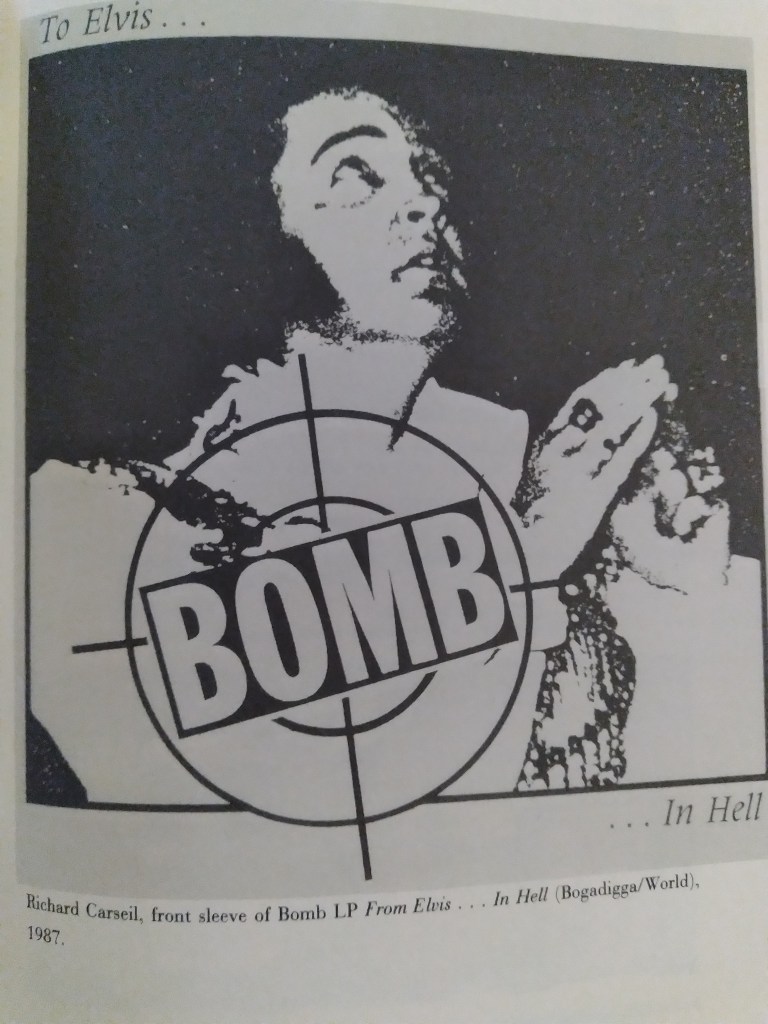
Jack, thinking he has hallucinated their movement, sees with relief that each has returned to its original location: ‘The lions, rooted into place, stood beside the path’ (S[hining], 197). Likewise, the word ‘topiary’ enacts the mobility of language…. Embedded in the etymology of the word ‘topiary’, meaning ‘Gardening. Consisting in clipping and trimming shrubs’, lies the Greek root topoi, ‘place’.36 The word ‘topiary’, like the hedge lion, is literally ‘rooted into place’ and yet uncannily mobile, suggestively ambiguous.
John Sears, Stephen King’s Gothic (2011).
In Carrie, the mud-minstrel comparison passage is in an omniscient point of view and could be justified as part of the collective town of Chamberlain’s racist perspective we saw at play in Sue’s projection of their racism, a projection we assume to be not entirely off-base. The mud-minstrel comparison passage in Tom Gordon purports to be taking up Trisha’s internal perspective, begging the question: in what world would a nine-year-old who drinks Surge and listens to the Spice Girls and Chumbawumba think that anything looked like a minstrel, one that is implicitly the blackface version?
In the world of the KINGdom. Which is really just our world on steroids…or high on a piece of that Overlook-Elvis spirit, that spirit that reveals that American music, like its media, is black and white and re(a)d all over…

In King’s world imagination and laughter are the most powerful weapons against any evil.
Heidi Strengell, Dissecting Stephen King: From the Gothic to Literary Naturalism (2005).

I’m going to contradict Strengell on this one, sort of…mainly due to laughter often being a source of evil in the King canon. The way these “weapons” become problematic pretty much exactly echoes the way that Uncle Tom’s Cabin becomes problematic as a weapon against abolition.
Trisha makes the mud-minstrel comparison in one of the quintessential ways that the Kingdom evokes the real world–through pop culture references:
Then she scooped up mud and began to apply it—not just on the bites this time but all over, from the round collar of her 36 GORDON shirt right up to the roots of her hair. As she did it she thought of an I Love Lucy episode she’d seen on Nick at Nite, Lucy and Ethel at the beauty parlor, both of them wearing these funky 1958 mudpacks, and Desi had come in and looked from one woman to the other and he had said, “Hey Loocy, jwich one are jew?” and the audience had howled. She probably looked like that, but Trisha didn’t care. There was no audience out here, no laugh-track, either, and she couldn’t stand to be bitten anymore. It would drive her crazy if she was.
She applied mud for five minutes, finishing with a couple of careful dabs to the eyelids, then bent over to look at her reflection. What she saw in the relatively still water by the bank was a minstrel-show mudgirl by moonlight. Her face was a pasty gray, like a face on a vase pulled out of some archeological dig. Above it her hair stood up in a filthy spout. Her eyes were white and wet and frightened. She didn’t look funny, like Lucy and Ethel getting their beauty treatments. She looked dead. Dead and badly inbarned, or whatever they called it.
Speaking to the face in the water, Trisha intoned: “Then Little Black Sambo said, ‘Please, tigers, do not take my fine new clothes.’ ”
But that wasn’t funny, either.
Stephen King, The Girl Who Loved Tom Gordon (1999).
Of course, there is a difference between mud masks and characters in blackface, as recent-ish controversies about the sitcoms Golden Girls and It’s Always Sunny in Philadelphia show, with the latter having characters intentionally impersonating people of different races for the sake of humor, and the former having characters wearing mud masks that don’t become racially associated until one says to a Black character, “‘This is mud on our faces. We’re not really Black.'” That racial association could be offensive if it implied that a Black person is dumb enough to mistake mud for real skin, but the actual implication seems to be that the White character is the dumb one for thinking the Black person would be this dumb. Roxane Gay tweeted the removal of the episode was “just so dumb,” with others concurring the removal was “counterproductive” since it featured two Black actresses and the Twitter user Raevin pointing out,
“Yeah, these companies and media platforms are trivializing the situation by sending the message that our demand for justice is as petty as removing episodes of the Golden Girls off a streaming platform. This is a calculated effort to cheapen our message.”
Francesca Gariano, “Hulu criticized for pulling ‘Golden Girls’ mud mask episode: It’s ‘not blackface’” (June 28, 2020).
Tricky.
Then there’s the second reference the mud mask calls up for Trisha: Little Black Sambo. Such is the reach of the mass-media landscape that in the late-nineteen-nineties consciousness of this nine-year-old is a children’s book from 1899 and a 1950s sitcom (the period of Elvis ascendant).
There is a character named Sambo in Uncle Tom’s Cabin who is a slave alongside Tom; this Sambo’s narrative function is to present a challenge to Tom in remaining “faithful” to his religious beliefs (which amounts to keeping him faithful to the institution of slavery) by persecuting him in service of the malevolent white master Legree when Tom refuses to beat his fellow slaves as ordered. Sambo almost breaks Tom’s sprit, but Tom’s faith and resilience are restored by a beatific vision of Jesus:
“What the devil’s got into Tom?” Legree said to Sambo. “A while ago he was all down in the mouth, and now he’s peart as a cricket.”
“Dunno, Mas’r; gwine to run off, mebbe.”
“Like to see him try that,” said Legree, with a savage grin, “wouldn’t we, Sambo?”
“Guess we would! Haw! haw! ho!” said the sooty gnome, laughing obsequiously.
“Lord, de fun! To see him stickin’ in de mud,—chasin’ and tarin’ through de bushes, dogs a holdin’ on to him! Lord, I laughed fit to split, dat ar time we cotched Molly….”
…“But now, Sambo, you look sharp. If the n*****’s got anything of this sort going, trip him up.”
“Mas’r, let me lone for dat,” said Sambo, “I’ll tree de coon. Ho, ho, ho!”
Harriet Beecher Stowe, Uncle Tom’s Cabin (1852).
Since UTC was published in 1852, it seems this character could possibly be the inspiration for the title character of the text Trisha is explicitly referencing, the children’s book The Story of Little Black Sambo by Helen Bannerman published in 1899. Like that of its forebear, perception of Bannerman’s text has shifted over time:
Critics of the time observed that Bannerman presents one of the first black heroes in children’s literature and regarded the book as positively portraying black characters in both the text and pictures, especially in comparison to books of that era that depicted black people as simple and uncivilised.[1] However, it became an object of allegations of racism in the mid-20th century due to the names of the characters being racial slurs for dark-skinned people, and the fact that the illustrations were, as Langston Hughes expressed it, in the pickaninny style.
From here.
This shows one problem introduced by media practice of syndication, a facet of transmedia dissipation–passing on old/outdated values to younger generations. Hughes may have indicted the Little Black Sambo illustrations, but he may have done the opposite for conceptions of Elvis’s authenticity:
Presley’s absorption of black qualities seemed so thorough that Langston Hughes wondered whether he had emerged out of the “same sea” as other black blues and jazz performers. The sole difference, he claimed, was that “some water has chlorine in it and some doesn’t.”152
Michael Bertrand, Race, Rock, and Elvis (2000).
King also places a Little Black Sambo reference at the nexus of faith, addiction, name and place embodied by the character Father Callahan from ‘Salem’s Lot (1975) when this character returns in the fifth book of the Dark Tower series, Wolves of the Calla:
Are they all names he will later encounter in the Calla, or is that just a booze-hallucination? For that matter, what is he to make of his own name, which is so close to that of the place where he finishes up? Calla, Callahan. Calla, Callahan. Sometimes, when he’s long getting to sleep in his pleasant rectory bed, the two names chase each other in his head like the tigers in Little Black Sambo.
Stephen King, Wolves of the Calla (2003).
I am the king of the jungle
Rufus Thomas, Jr./Elvis Presley, “Tiger Man” (1953/1968).
They call me the tiger man
Like both the Uncle Tom character and the Lucy character in the first mud-mask referent–and like the Tom Gordon construction-character–Sambo is apparently based on a “real” person–maybe:
Englishman Richard Ligon may have made up the stories in A True and Exact History of the Island of Barbadoes, published in 1657. Led by Sambo, a group of slaves disclose a plot for a slave revolt. They refuse their master’s rewards. A confused master asks why, Ligon narrates. It was “but an act of Justice,” Sambo says, according to Ligon. Their duty. They are “sufficiently” rewarded “in the Act.”
Ibram X. Kendi, How to Be an Antiracist (2019).
Slavery was justified in Sambo’s narrative, because some Black people believed they were supposed to be enslaved.
This Sambo is Kendi’s second example of “the recorded history of Black racists,” and the description of this Sambo is consistent with the characterization of the Sambo character in Uncle Tom’s Cabin. The figure of Sambo has also been connected to Uncle Remus, who offers a gentler example of a Black figure that “believed they were supposed to be enslaved”:
In according Harris his literary merit, it is not unfair to assert that his contribution to the Sambo image was substantial. His Uncle Remus strengthened and reinforced the stereotype. Consider, first, the storyteller: a gentle, white-haired, cherub-faced man displaying no outward rancor or animosity as he spins stories before entranced youngsters on the niceties of plantation life and of the struggles of a weaker cunning animal against more vicious ones. The reader of the tales, argued a Harris biographer, “scarcely thinks of Uncle Remus as a slave,” because he comes through as “an independent and realistic figure, revealing his humor and his knowledge of human nature.” But he had indeed been a slave, and, even more, as the author noted, “If he had an instinctive desire to be free, he gave no outward indication of it, and his personal difficulties came upon him in freedom, not in slavery.”18 Little wonder Harris summed up his storyteller’s slave experiences in the introduction to the tales by declaring that Uncle Remus had “nothing but pleasant memories of the discipline of slavery.”19
Joseph Boskin, Sambo: The Rise and Demise of an American Jester (1988).
Regarding the final idea of Harris’s that Boskin notes here, the more logical response would be not blank-slate Trisha’s channeling of Austin Powers’ tag line “‘Yeah, baby,'” but that of Powers’ counterpoint, Dr. Evil:

Harris tried hard to convince himself that Uncle Remus was a full-fledged, dyed-in-the-denim Uncle Tom—he describes the “venerable sable patron” as an ex-slave “who has nothing but pleasant memories of the discipline of slavery.” But Harris could not completely exorcise the menace in the Meek. How often Remus steps out of his clown-role to deliver unmistakeable judgments on class, caste, and race!
Bernard Wolfe, “Uncle Remus and the Malevolent Rabbit:’Takes a Limber-Toe Gemmun fer ter Jump Jim Crow'” (1949).
In Ralph Ellison’s Invisible Man (1952), a Sambo construction will become critical to the title character’s defining epiphany that he’s invisible after he sees a former member of what purports to be the anti-racist movement he’s a part of hocking paper Sambo dolls, which seem to embody the “jester” Sambo iteration rather than Stowe’s more militant version:
It was some kind of toy and I glanced at the crowd’s fascinated eyes and down again, seeing it clearly this time. I’d seen nothing like it before. A grinning doll of orange-and-black tissue paper with thin flat cardboard disks forming its head and feet and which some mysterious mechanism was causing to move up and down in a loose-jointed, shoulder-shaking, infuriatingly sensuous motion, a dance that was completely detached from the black, mask-like face. …
He’ll make you laugh, he’ll make you sigh, si-igh.
Ralph Ellison, Invisible Man (1952).
He’ll make you want to dance, and dance —
Here you are, ladies and gentlemen, Sambo,
The dancing doll.
…
He’ll keep you entertained. He’ll make you weep sweet —
Tears from laughing.
Shake him, shake him, you cannot break him
For he’s Sambo, the dancing, Sambo, the prancing,
Sambo, the entrancing, Sambo Boogie Woogie paper doll.
The Sambo doll is a literal paper construction, symbolically reinforcing the Sambo stereotype as a construction of the white imagination, with the “paper” part of the construction reinforcing Morrison’s point about how literature, which amounts to words on paper, facilitates the dissemination of such constructions of the type on display when Ellison’s title character is derogatorily called “Sambo” by a white man in an earlier scene–the same scene where “shine” is used as a slur parallel to “Sambo” in the only instance of such usage I have seen to date corroborating what a King biographer presents as the reason King had to adjust his original title for The Shining:
[King] based the title on a song by John Lennon and the Plastic Ono Band called “Instant Karma,” with a refrain that went “We all shine on.” But he had to change the title to The Shining after the publisher said that shine was a negative term for African-American.
Lisa Rogak, Haunted Heart: The Life and Times of Stephen King (2009).
In his article “It Lurks Beneath the Fold,” Carl Sederholm has written specifically about the pop-up book adaptation of Tom Gordon released the same year as Faithful (2004). His analysis that its interactive paper constructions reinforce the reader’s active role in the making of a text’s meaning could be read as an allegorical defense of the textual interaction constituted by appropriation. Since the pop-up adaptation also amounts to adapting the novel into a children’s book, this offers a further confluence between Tom Gordon and Bannerman’s Little Black Sambo, as well as the adaptations of Stowe’s Uncle Tom’s Cabin including not only a children’s book version, but multiple stage adaptations whose cultural significance has been debated:
The figure [of Uncle Tom] has also undergone an enormous physical transformation, from the broad-shouldered “behemoth,” as the novel’s Marie St. Clare describes Tom when she first sees him, to a doddering, white-haired geriatric with a cane. Critics have long pondered this dramatic change, wondering “how a book whose avowed and successful purpose was to champion an oppressed people came to stand as a major symbol of that oppression.”11 The most convenient, if largely unexplored, explanation has been that the transformation was the result of the myriad theatrical adaptations of Uncle Tom’s Cabin staged virtually without pause from 1852 through the 1930s and appearing intermittently ever since.12 These adaptations, critics have almost universally assumed, turned Stowe’s Christ-like hero into a submissive old fool.13
The contemporary force of the Uncle Tom slur has veiled the complicated story of this figure and thus of an important through-line of American racial politics. The dominant narrative of the Uncle Tom’s Cabin dramas holds that they quickly lost their progressive political power, becoming a debased, retrograde spectacle of happy plantation scenes and minstrel comedy. … This explanation posits an Uncle Tom figure created, like Aunt Jemima, entirely “in the fantasy world of whiteness, the only place where they were possible.”15…
I argue that the figure’s derogatory meaning did not emerge on the stage, where in fact black audiences received the Uncle Tom’s Cabin dramas as works with radical political potential some years into the twentieth century. Rather, Uncle Tom became a slur within the black political rhetoric of the 1910s because the figure encapsulated a traumatic slavery past that reverberated through twentieth-century American race relations. Developing in the context of unjust and inhumane structures of oppression, this transformation was shaped by demographic, educational, cultural, and political shifts that made a younger generation of New Negroes increasingly assertive in its resistance to Jim Crow as well as more disparaging of the “old Negroes” who came before them. Uncle Tom, I suggest, is as much a product of black discourse as of the white imagination, a figure drawn upon and shaped by fundamental debates within the black community over who should represent the race and how it should be represented.
Adena Spingarn, Uncle Tom: From Martyr to Traitor (2018).
It’s ironic that some of the constructions that are supposed to pop up in the Tom Gordon adaptation, at least in my version, remain flat in a seeming construction malfunction. The image replicating the “minstrel mudgirl” version of Trisha is primarily visible in reflection:
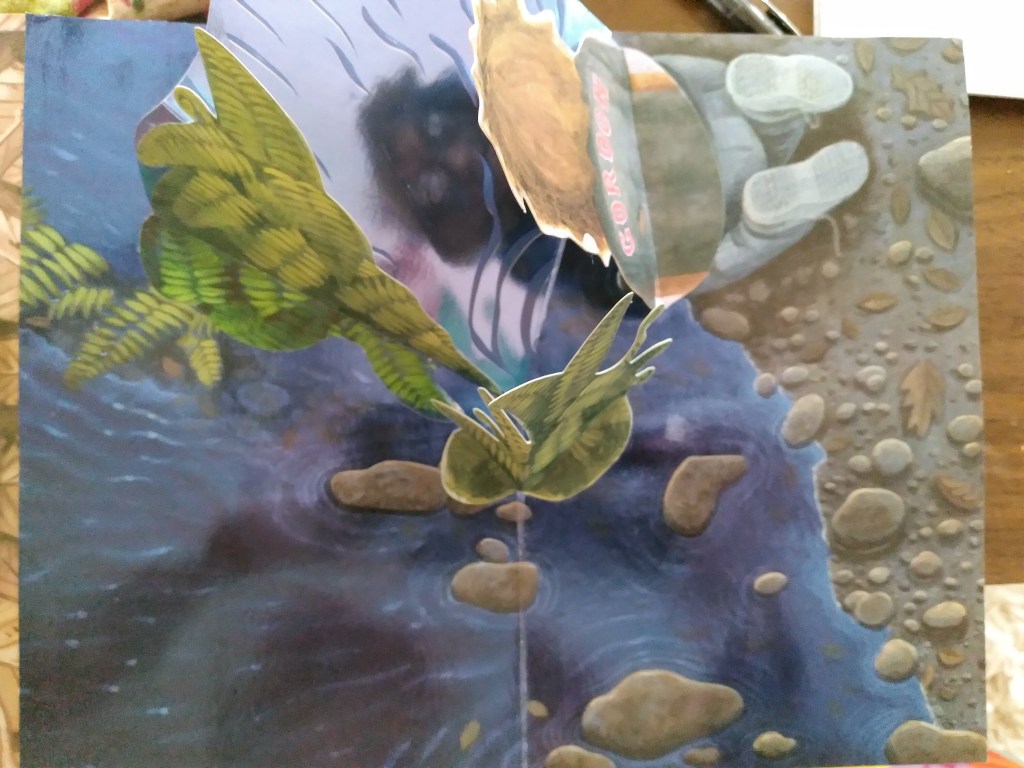
But it can be manipulated (in my version):
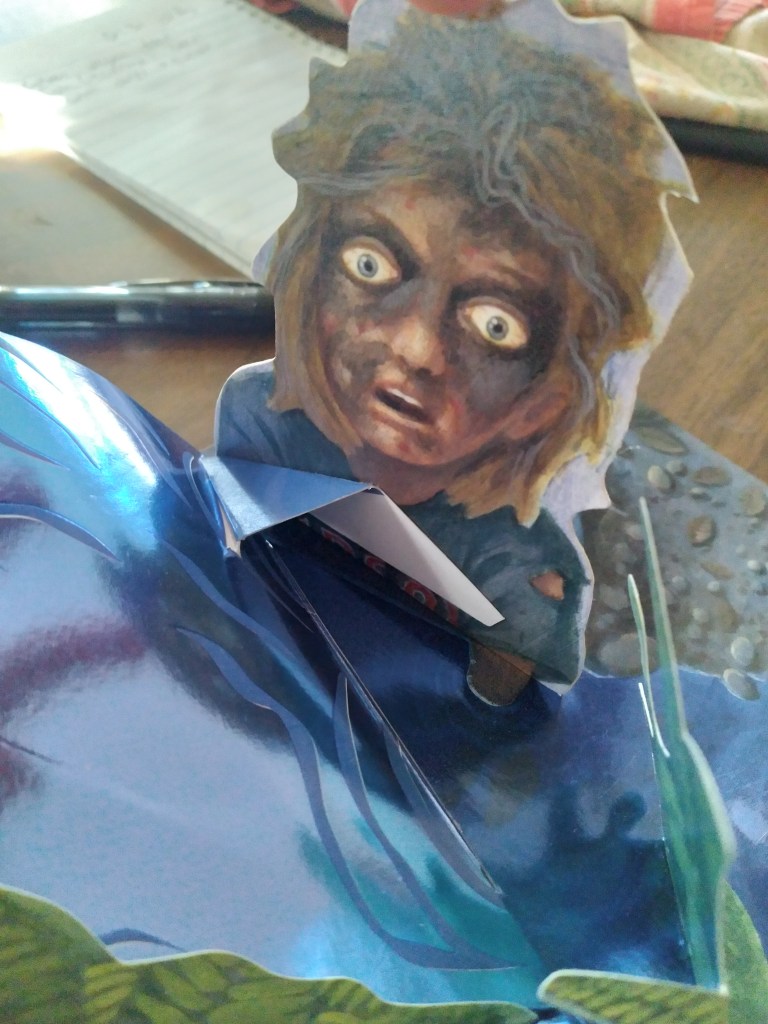
In the novel’s minstrel-referencing passage we see the racist stereotypes that have the roots of their dissemination in blackface minstrel performances again explicitly linked to laughter in the text, laughter associated with insanity, or “bad laughter”:
Her feet were completely numb by the time she stepped out of the stream; her backside was also pretty numb, but at least she was clean again. She put on her underwear and her pants and was just doing the snap on the jeans when her stomach clenched again. Trisha took two big steps back to the trees, clutched the same one, and vomited again. This time there seemed to be nothing solid in it at all; it was like ejecting two cups of hot water. She leaned forward and put her forehead against the pine tree’s sticky bark. For just a moment she could imagine a sign on it, like the kind people hung over the doors of their lakeside and seaside camps: TRISHA’S PUKIN’ PLACE. That made her laugh again, but it was bad laughter.
Stephen King, The Girl Who Loved Tom Gordon (1999).
Here Trisha’s sickness after she drinks contaminated water manifests a combination of a shitteration with vomitterations–literal iterations of these, a juxtaposition that renders laughter itself a symbolic vomitteration. This concept of “bad laughter” will be explicitly linked in the text to insanity, but implicitly, unconsciously, it describes the mocking function of laughter expressed in the blackface minstrel context that the buried Remus Laughing Place reference indicates the presence of.
Trisha strikes me as blank slate (or blank wall) in the way she almost exclusively perceives things only in reference to other things–either something in pop culture, or something somebody else her said, including her parents, brother, teachers, and her best friend, the last of which is nicknamed “Pepsi.” Pepsi is the only one besides Tom Gordon that Trisha actively imagines accompanying her through the woods. In the above passage, blank-slate Trisha doesn’t seem to understand the source of the “pukin’ place” reference, and were it not for the Uncle Remus rabbit hole the Carrie trigger moment blows open, I wouldn’t have known either.
In Invisible Man, the title character’s aforementioned titular epiphany will be facilitated by the epiphany that what he thought were two apparently opposite sides of an (ideological) battle are actually the same, and this epiphany (which we’ll see is strongly echoed by Tom Gordon‘s climactic face-off) is characterized by what amounts to vomitterations:
It was a joke, an absurd joke. And now I looked around a corner of my mind and saw Jack and Norton and Emerson merge into one single white figure. They were very much the same, each attempting to force his picture of reality upon me and neither giving a hoot in hell for how things looked to me. I was simply a material, a natural resource to be used. I had switched from the arrogant absurdity of Norton and Emerson to that of Jack and the Brotherhood, and it all came out the same — except I now recognized my invisibility. … I’d overcome them with yeses, undermine them with grins, I’d agree them to death and destruction. Yes, and I’d let them swallow me until they vomited or burst wide open. Let them gag on what they refused to see. Let them choke on it. … Oh, I’d yes them, but wouldn’t I yes them! I’d yes them till they puked and rolled in it.
Ralph Ellison, Invisible Man (1952).
Which is more evidence that the Laughing Place is the Pukin’ Place is the place where meaning collapses, which in Tom Gordon is constituted by how meaning has been, to use Ellison’s phrase, “detached from the black, mask-like face” iterated in Trisha’s mud mask.
And which makes the vomitteration at the beginning of Pitch Perfect when a character projectile pukes while singing an apparently clichéd acappella version of Ace of Base’s “The Sign”–and a later scene where another character makes a snow-angel in vomit–pitch perfect.

The vomitteration concept expressed in the imagined sign of Trisha’s “Pukin’ Place” and its association with “bad laughter” fits with Trisha’s blank-slate nature characterized by her constant references, a microcosm of how King himself regurgitates, or vomitterates, the same narratives, primarily about a ka-tet quartet facing a force of Evil. Put another way, King suffers from narrative cyclical vomiting syndrome, and while the gif above may be gross, it’s an apt symbol of the racial (and often racist) themes underlying this Kingian syndrome. A snow-cum-vomit-angel is also an apt symbol for the Tom Gordon construction (a symptom of the broader Kingian syndrome): as a pseudo guardian angel to Trisha, this construction is a figurative snow angel, if “snowing” is a version of “whitewashing.”
Quite often in his regurgitated narratives, King invokes the archetype of the Bad Place:
And the fact that many haunted houses are shunned and get the reputation of being Bad Places might be due to the fact that the strongest emotions are the primitive ones—rage and hate and fear.
Stephen King, Danse Macabre (1981).
Here King is referring the purely physical sense of place, but we can consider the covert/trickster sense of the Laughing Place, that which merges physical/literal and figurative place, to be an archetypal Bad Place.
Then there’s King’s writing literally linked to vomit:
Tabby had long ago gotten used to sleeping alone night after night, padding down the magnificent mahogany staircase in their twenty-four-room restored Victorian mansion each morning only to find her husband passed out in a puddle of vomit in his office.
Lisa Rogak, Haunted Heart: The Life and Times of Stephen King (2009).
And figuratively linked to vomit: the site of Trisha’s Pukin’ Place reference is located at the nexus of literal shitteration and literal vomitteration alike as she gets sick from both ends from something she’s consumed; in On Writing, King reveals a formative writing experience for him at the nexus of figurative shitterations and vomitterations located at the site of his high-school newspaper, which he created his own version of with a title spoofing that of The Village Voice:
I created a satiric high school newspaper of my own …. What resulted was a four-sheet which I called The Village Vomit. The boxed motto in the upper lefthand corner was not “All the News That’s Fit to Print” but “All the Shit That Will Stick.” That piece of dimwit humor got me into the only real trouble of my high school career.
Stephen King, On Writing: A Memoir of the Craft (2000).
He gets in “real trouble” for making fun of his teachers (via nicknames), iterating the negative mocking/bullying function of laughter associated with the Laughing Place.
Trisha regurgitates pop-culture references…
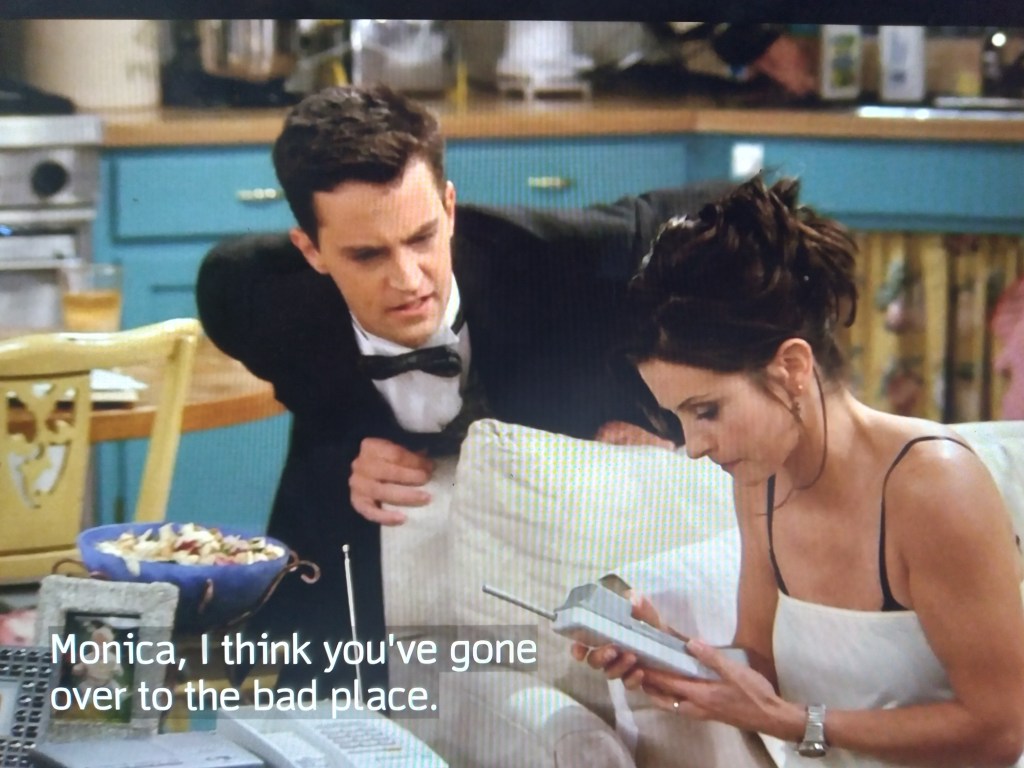
…which King himself is an apparently bottomless fount of:
Once they got past the first couple of awkward rehearsals and started to hang out, [Kathi Kamen] Goldmark noticed the breadth of Steve’s knowledge of popular culture. “He knows about everything,” she said. “You can’t mention a song or artist or a book that he’s not familiar with. Name a song and he’ll quote the lyrics. It doesn’t matter if it was a recent hit or something from thirty years ago, he’ll know it.”
Lisa Rogak, Haunted Heart: The Life and Times of Stephen King (2009).
“The King men seem able not only to read and write and allude faster than the rest of us — they seem to watch TV faster, listen to music faster, to defy the physics of consumption,” says Joshua Ferris, a novelist and close friend of Owen [King]’s.
Susan Dominus, “Stephen King’s Family Business” (July 31, 2013).
Like me, Trisha is of a generation where referents are, like her parents, divorced from their original sources (or where the signified is divorced from the signifier). One symptom of this is knowing things from Simpsons references rather than the other way around (like how I didn’t get who the show’s Dr. Nick was based on until I saw Elvis). This generational problem has accreted: on a recent Kingcast episode, horror director Roxanne Benjamin notes that some kids called the title font of her new film There’s Something Wrong with the Children the “Stranger Things font,” when this derives from the iconic Stephen King covers font, and one of the hosts responds that he heard a kid say the 2017 IT was ripping off Stranger Things.
There’s something wrong with the children, indeed.
Trisha, in her blankness, is essentially a wall that pop culture writes upon. Through the juxtaposition of the “Pukin’ Place” sign with “bad laughter,” laughter itself is rendered a sort of vomitteration, and is another marker of the Remus influence, a reference to his Laughing Place and the “bad laughter” that’s a version of his “laughter fit to kill,” enacting its Song of the South function of trickery and mocking.
Another vomitteration connects signs and fandom, in this case via the band One Direction:
Directioners, Tiffany argues, are projection artists, and she highlights their outré handiwork: deep-fried memes, “crackling with yellow-white noise and blurred like the edges of a CGI ghost”; a physical shrine where Harry Styles, the group’s breakout star, once vomited on the side of the road. In an affecting chapter, Tiffany makes a pilgrimage to Los Angeles to find the shrine herself. But its creator, confused by how many people construed her marker as “crazy or malicious”—she’d wanted only to send up the lust and boredom that would lead someone to memorialize puke—had taken it down. The sign, she tells Tiffany, “was more a joke about my life” than about Harry’s.
Katy Waldman, “How Fans Created the Voice of the Internet” (June 28, 2022).
The “relentless blankness” idea this writer attributes to One Direction–that they are a blank slate for their fans to project onto–is echoed by popular constructions of Elvis, which is to say the myth rather than the man:
Elvis Presley made history; this is a book about how, when he died, many people found themselves caught up in the adventure of remaking his history, which is to say their own.
Greil Marcus, Dead Elvis: Chronicle of a Cultural Obsession (1991).
Elvis was able to succeed in part because he was a very charismatic singer and performer, which masked the battling inner-tensions and contradictions of both the man and his music.
…He was a rocker who could sing ballads, a sexually liberated performing artist who was a political conservative, a musical pioneer and a boy who stole the blues, a sinner and a saint. Elvis—both the man and his music—crossed seemingly impenetrable lines of racial, societal, and generational divides that allowed him to saturate into the culture to be all things to all people. He was an enormous figure onto whom people could project what they wanted to see. Which is to say that people used him as a screen onto which they projected themselves.
Eric Wolfson, Elvis Presley’s From Elvis in Memphis: 150 (33 1/3) (2021).
Which is another way of saying, “Mirror, mirror, on the wall,” or:
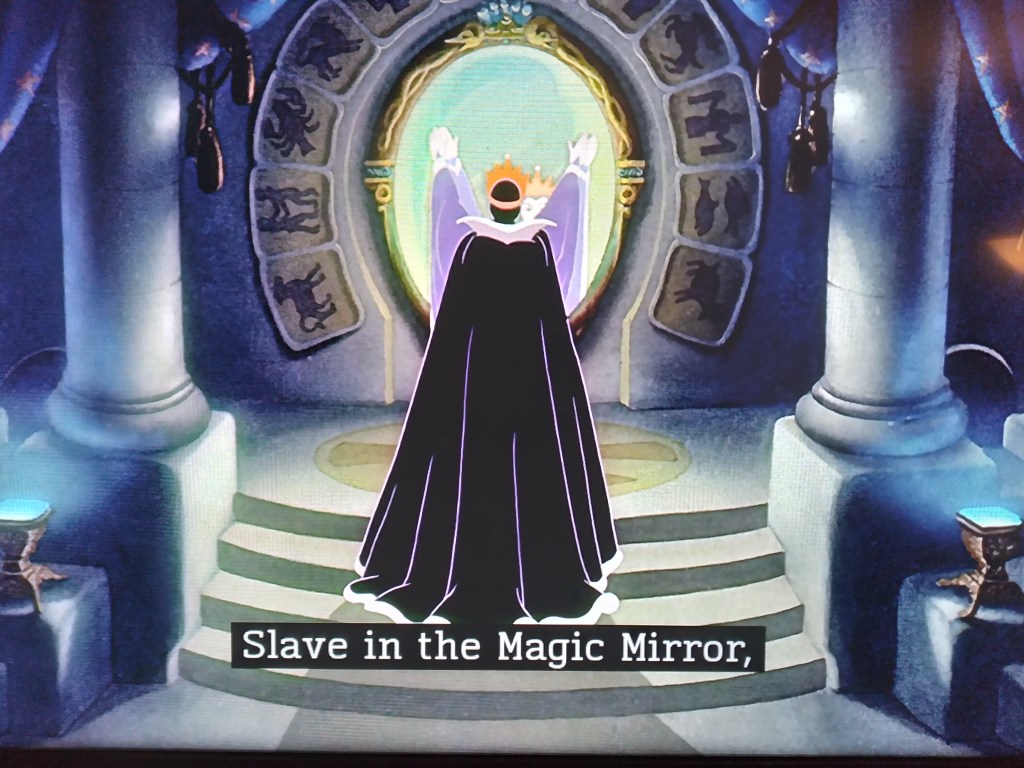
In the revel of The Last Temptation [of Elvis: Songs from His Movies], Elvis becomes a magic mirror, then a lost reflection.
Greil Marcus, Dead Elvis: A Chronicle of a Cultural Obsession (1991).
“Relentless blankness” also encapsulates Trisha’s blank-slate nature, which in turn echoes descriptions of Annie Wilkes going “blank” in Misery that I argued in Part IV are possible evidence of her manifesting the spirit of the Overlook Hotel, potentially rendering this “relentless blankness” a version of what Toni Morrison designates “impenetrable whiteness.” It also echoes a description King himself offers to Magistrale’s question about the “merging of horror and humor” as “apparently oppositional elements” discussed in Part I:
“When the human intellect reaches a blank wall, sometimes the only thing left is laughter.”
TONY MAGISTRALE, HOLLYWOOD’S STEPHEN KING (2003).
And the blank wall at Fenway Park is called The Monster…
The Monster designation is relatively new. For most of its history it was simply called “The Wall“.
From here.
The Wall is a monster… King’s formulation of the “blank wall” essentially describes Julia Kristeva’s designation of the abject as “the place where meaning collapses.”

The Kingian Laughing Place, built upon Joel Chandler Harris’s construction of same, is such a place.
For the Love of…
One similarity Tom Gordon bears to Misery is the ambiguity of the supernatural elements, though the possibility of the supernatural is much more pronounced in the former.
Elvis himself bore hallmarks of the supernatural:
There was always something supernatural about him. Elvis was a force of nature. Other than that he was just a turd. A big dumb hillbilly a couple points smarter than his mule who wandered out from behind his plow one day to cut a record for his sainted mother and never came back, which he probably woulda forgot to even if he hadn’t’ve been whisked up. Why shouldn’t one physical corpus be capable of containing these two seeming polarities simultaneously? Especially if it’s from outer space. Without even trying to or knowing he was doing it, Elvis caused more trouble, raised more hellfired ruckus than the Beatles, Stones and Sex Pistols all put together.
Lester Bangs, Psychotic Reactions and Carburetor Dung: The Work of a Legendary Critic: Rock’N’Roll as Literature and Literature as Rock ‘N’Roll (1987).
In keeping with the overlap between the supernatural and the divine that we’ll see Elvis evinces, one plot summary of Tom Gordon shows the supernatural monster is a deity:
[Trisha] fights real menaces such as hunger, dehydration, and pneumonia but also feels like she is being stalked by the God of the Lost; a wasp-faced, evil entity. The pitcher, Tom Gordon, seems to appear to her and help guide her throughout the story.
Meg Hafdahl and Kelly Florence, The Science of Stephen King: The Truth Behind Pennywise, Jack Torrance, Carrie, Cujo, and More Iconic Characters from the Master of Horror (The Science of Series) (2020).
This description also shows that the overarching premise iterates blackface in a way similar to The Shining‘s; as noted in Part III, that novel’s “premise essentially recapitulates/reiterates/reenacts a form of blackface: it is a monster that wears a human face.” Not only that, being a “wasp-faced, evil entity” echoes a more specific manifestation of an Overlook entity in The Shining: “Heavy-bodied wasps crawled sluggishly over her face.” Part III also notes the placement of the black-and-white image of the face of Jesus at the critical turning point where the Overlook entity pivots from white-supremacist to Africanist.

Which brings us to Tom Gordon‘s construction of deities, the “God of the Lost” mentioned here, and the concept of “the Subaudible”; in the flashback conversation that Trisha recalls having with her father about this idea, they are both eating sugar (ice cream), and her father calls her “sugar.”
She couldn’t remember ever discussing spiritual matters with her mother, but she had asked her father not a month ago if he believed in God. They had been out behind his little place in Malden, eating ice cream cones…
“God,” Dad had said, seeming to taste the word like some new ice cream flavor—Vanilla with God instead of Vanilla with Jimmies. “What brought that on, sugar?”
…
“God,” Larry McFarland had said, licking his ice cream. “God, now, God . . .” He thought awhile longer. … At last he said, “I’ll tell you what I believe in. I believe in the Subaudible.”
…
“Pree-cisely, sugar, subaudible. I don’t believe in any actual thinking God that marks the fall of every bird in Australia or every bug in India, a God that records all of our sins in a big golden book and judges us when we die—I don’t want to believe in a God who would deliberately create bad people and then deliberately send them to roast in a hell He created—but I believe there has to be something.”
Stephen King, The Girl Who Loved Tom Gordon (1999).
Having no direct corollary in any myth, Trisha’s father’s concept demonstrates the ability of an individual to construct their own deity, or concept of one. The imperfection of her father’s construction specifically is revealed when Trisha encounters a trio of robed deities–or their emissaries–and the one representing the Subaudible (who for some reason takes the form of her science teacher instead of her father) says he can’t help her:
“He can’t help you,” Bork the Dork said. “There’s a lot going on today. There’s been an earthquake in Japan, for instance, a bad one. As a rule he doesn’t intervene in human affairs, anyway…”
Stephen King, The Girl Who Loved Tom Gordon (1999).
As it happens, the character of Aunt Chloe, Uncle Tom’s wife, conflates sugary confections and perfections:
I an’t afraid to put my cake, nor pies nother, ’long side no perfectioner’s.
“Confectioner’s, Chloe.”
“Law sakes, Missis! ’tan’t no odds;—words is so curis, can’t never get ’em right!”
Harriet Beecher Stowe, Uncle Tom’s Cabin (1852).

The book Advanced Elvis Course by C.A. Conrad links constructions of deities to constructions of fandom in its motif of likening Elvis to Jesus.
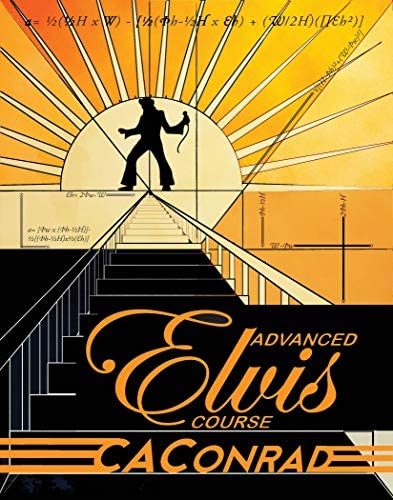
The Jesus comparison is one others have made as well:
Through this music, Elvis resurrected himself—at the age of thirty-three, no less—as a prodigal son who found his way home.
Eric Wolfson, Elvis Presley’s From Elvis in Memphis: 150 (33 1/3) (2021).
Wolfson’s quote calls attention to the “Jesus age,” and in a book that’s part of a series that happens to invoke the same number:
33+1⁄3 (Thirty-Three and a Third) is a series of books, each about a single music album.[1] The series title refers to the rotation speed of a vinyl LP, 33+1⁄3 RPM.[2]
From here.
Another song for the potential soundtrack of Conrad’s construction of Elvis as Jesus, released the same year as Misery (1987)…
It’s often said that Elvis made thirty-one movies in thirteen years (31 in 13), but the number of movies Roger Ebert cites in the 1994 anthology The King is Dead: Tales of Elvis Postmortem is 33 movies, which seems to mean Ebert is counting the two documentaries Elvis was in before he died (That’s the Way It Is in 1970 and Elvis on Tour in 1972) in addition to his 31 fictional movies. These movies are often but not always autobiographical: Elvis playing a character who’s a singer in his movies is the equivalent of Stephen King featuring an English teacher/writer as the protagonist in his fiction (King also pitches to #33 in his Fever Pitch cameo). And the inversion of 31, the time span of the period Elvis movies were made (which seems more semantically accurate than saying “the period Elvis was making these movies”), 13, is King’s least favorite number–for him, the opposite of 19, the age King was when he started writing his magnum opus Dark Tower series, and the age Elvis was when he made his first record.
The address of the real-life Stanley Hotel that the Overlook Hotel is based on: 333 E Wonderview Ave, Estes Park, CO 80517.
[Herman] Melville was 26 when his first, and had been dead for 33 years when his last, books were published.
From here.
The Jesus age number also reveals that the apparently oppositional elements of Christianity and pornography are united in being owned by the same media company:
The ONLY place left to go is Pornography and the Bible – the sexual imagination and the Christian imagination. The pornographic imagination is a fairly literal embrace of the limitless possibilities of the animation imagination. Porn Star Lolo Ferrari, before she died at age 37 from complications from multiple plastic surgeries said, “I hate reality; I want to be completely artificial.” Jessica Rabbit, another Disney product, puts it this way: “I’m not bad; I’m just drawn that way.” Which is why it’s slightly unsettling to learn that Disney is going to be purchasing 21st Century Fox. If you Google Search “Who owns the copyright to the NIV Bible?” this 2008 answer comes up:
“Zondervan is a subsidiary of HarperCollins, which is owned by News Corp, which is owned by Rupert Murdoch. He is one of the biggest producers of worldwide pornography on the planet. And his company, Zondervan, holds the exclusive publishing rights to the New International Version Bible.”17
Under these conditions, Disney will go from controlling one‐sixth to controlling one‐third of the media, or roughly 33% of everything you see, hear, watch, listen to, and do in the mediasphere.
Read Mercer Schuchardt, “Colonizing the Geography of the Imagination: Media, Mind and the Magic Kingdom,” Disney and Philosophy: Truth, Trust, and a Little Bit of Pixie Dust (2019).
A more worrying movement was the concept of Elvis as the godlike figure at the head of a new religion, the alternative Jesus, if you like. What had made followers think he might be super-human? Caught in a Trap will reveal that he was all too human.
Spencer Leigh, Elvis Presley: Caught in a Trap (2017).
Leigh seems to miss the point Conrad addresses, by way of a quote from Elvis himself: “‘The audience is the other half of me.'”
The beginning of all faith must be like this: Thought silly enough by outsiders to be ignored, and in that special place left to us, we weave the most healing magic, and understand in this beginning, how our collective force creates an egg of warmth, a cycle of radiation that can enter any one of us at any time with a simple focus on that egg, and bend the force, and only for the good, and love. I don’t even believe Elvis guides us really. To me it’s something we can bend and focus with the power many of us are coming to know we have. Elvis existed on this planet for reasons far beyond the dreams of Hollywood and record promotions. Our lives after His death have grown, not as a parasitic force on His grave, no not at all, in fact, my point is that Elvis, the man, is not even who is important, but what is important is the power of Elvis that we create, for it is we who create Him, and not the other way around.
C.A. Conrad, Advanced Elvis Course (2009).
…I feel you don’t have an entertainer without an audience. I feel that they are completely inter-related. Some sense of his effect on his audience is as much a part of the drama as the entertainer himself.
Ann Moses quoting Denis Sanders in “Yes, I Was in an Elvis Movie!” Rock’s Backpages (November 23, 2012).
Which echoes the concrete positive effects religious faith can have regardless of the material reality of the deity in question. The audience constructs the entertainer in turn. (Elvis’s own personal faith is significant enough to warrant a full book on it, and a Medium essay offers a comparison between 2Pac and Jesus.)
A couple of Conrad’s passages resonate with the Subaudible concept more specifically:
ME: I’m trying to tell you you’re afraid of the vibration of Elvis.
KEN: That’s bullshit!”
C.A. Conrad, Advanced Elvis Course (2009).
and
MAISY: No dead moo cow on our fried peanut butter banana sandwich? Praise Jesus!
ME: Praise Elvis!
MAISY: Oh, I guess that’s what I meant. I get them two mixed up all the time.
ME: You said your vibrator’s name is Elvis.
MAISY: Oh Conrad! I never mix them up when I’m doin’ that! You can be sure!
C.A. Conrad, Advanced Elvis Course (2009).
There is a “Church of Elvis” in Tupelo, Mississippi, and a blog called Our Daily Elvis that has coined the term “Presleytarians.” Apparently the “Our Daily Elvis” phrase originates from the book Elvis Presley Boulevard: From Sea to Shining Sea, Almost (1987) by Mark Winegardner, which, like Conrad’s, is more about Elvis’s impact–“how embedded Elvis Presley is in American culture”–than Elvis himself, as Winegardner takes a road trip with a friend and encounters Elvis everywhere: “They discover that no matter where they go in the U.S., they encounter Elvis Presley in some form: ‘Give us this day our daily Elvis.'” The Daily Elvis blog refers to this as a “mantra chant,” and Conrad presents in his text the “Elvis Mantra,” reinforcing the central conceit that underwrites Elvis-as-deity, love–which, lest we forget, is a concept included in the title of The Girl Who Loved Tom Gordon, but Conrad inverts the fan love:
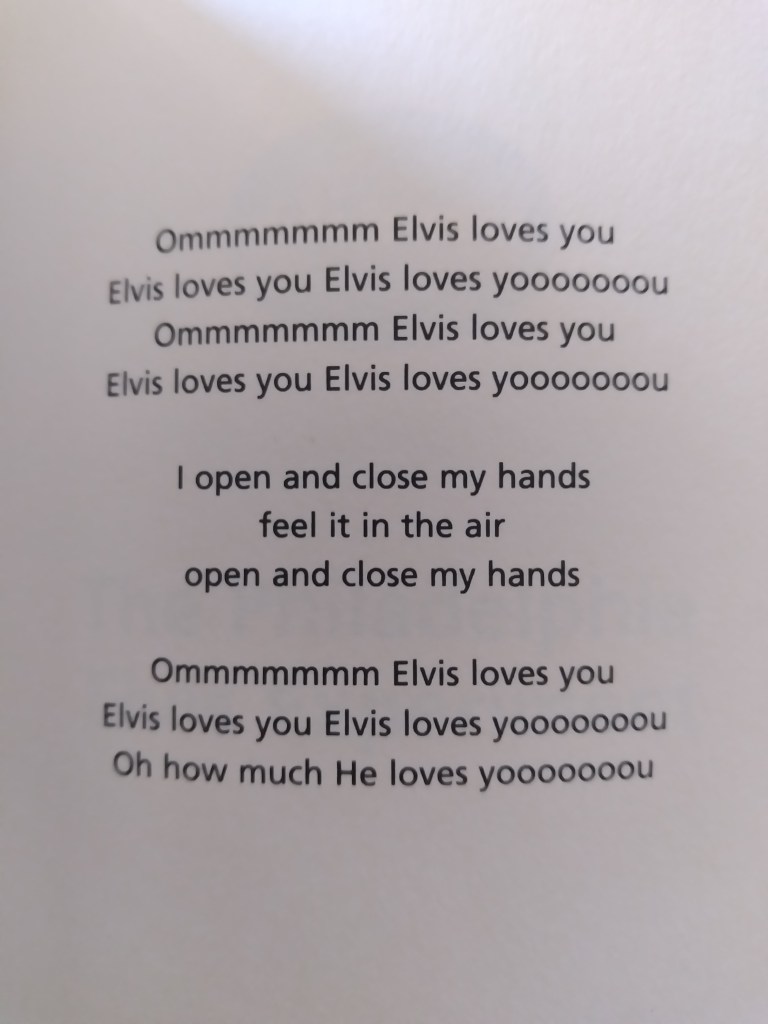
Conrad’s book is structured in three parts, and this alone comprises the second part, “The Elvis Mantra Chapter.” Which means this page is essentially the conduit between the two main parts, the first developing the Elvis-as-Jesus motif and set in Memphis when Conrad is visiting Graceland, and the other developing a less common motif, Elvis-as-Ben Franklin, set in Conrad’s home city of Philadelphia after his Graceland visit. This neatly represents, or thematically posits, that Elvis constitutes or encapsulates America’s separation of church and state, which is potentially one of the defining contradictions of the collective American character. This contradiction is foundational to Uncle Tom’s Cabin: Stowe repeatedly presents “Christian love” as the antidote to the state institution of slavery, but changing a federal/state law based on religious motivation is a violation of the separation of church and state.
The church-state elements have never been separate, as King also emphasizes with the Randall Flagg-Nadine Cross axis in The Stand. I used to think America’s other founding paradox/contradiction, instituting slavery while claiming a founding principle is “all men are created equal,” was nullifying or voiding, as potentially symbolized by the product of Randall Flagg and Nadine Cross’s union, a demon baby killed by its own mother before she bears it, in the process killing herself (a rare pro-choice moment in the canon of King, who called The Girl Who Loved Tom Gordon “the result of an unplanned pregnancy”?). But as with narrative, contradictions generate a tension that moves us, that drives us forward. Even if only to our own destruction.
The language of Conrad’s mantra incorporates an instruction for physical movement in addition to verbal articulation: “open and close my hands,” which reinforces the symbolic movement between the two parts of his book, Elvis-as-church and Elvis-as-state, and does so in a way that replicates how the American character moves between these two sides, movement that requires the sides to be connected rather than separated. They’re not two different things, but two different parts of the same thing. This is America’s fluid duality. And it’s echoed by the fluid movement between the body and mind of an individual that Thandeka aims to achieve as discussed in Part IV–the “psyche-soma” as the “mind-body continuum,” movement along which becomes blocked by trauma, while flow between these is the ideal state. Not separation–or segregation–but, per the Civil Rights MOVEMENT, integration. (Or: merging.) This is the key to the successful literary function of universal archetypes: encapsulating a universal, collective human experience in a single unique individual. Per Jung, and Whitman, if the collective contains the individual, it’s not a contradiction that the individual contains the collective. (Per Whitman connecting this to sports, specifically baseball, does that mean there is an “I” in “team”?) This potentially becomes an issue for sports fans when, like Trisha, their fandom of an individual player might be greater than their love of the collective team, and in the case of Tom Gordon, traded to the Red Sox’s biggest rivals, an even bigger issue–after Gordon became a Yankee, would Trisha stay loyal to him, or to the team? In Faithful, King supports his own grandson’s loyalty to the individual player when his favorite Red…Sock is traded to the Chicago Cubs, but would he be as supportive if this player had been traded to the Yankees?
“God, if You can’t be a Red Sox fan, be a Tom Gordon fan,” she said. “Can you do that much, at least? Can you be that much?”
Stephen King, The Girl Who Loved Tom Gordon (1999).
America’s church-state fluid duality is echoed in Wesley Morris’s emphasis on “belief” in his explanation of why “black music is American music” in the 1619 Project’s “The Birth of American Music”:
Because this is the sound of a people who, for decades and centuries, have been denied freedom. And yet what you respond to in black music is the ultimate expression of a belief in that freedom, the belief that the struggle is worth it, that the pain begets joy, and that that joy you’re experiencing is not only contagious, it’s necessary and urgent and irresistible. Black music is American music. Because as Americans, we say we believe in freedom. And that’s what we tell the world. And the power of black music is that it’s the ultimate expression of that belief in American freedom.
FROM HERE.
America’s fluid duality is also echoed in the integration of religion with objects/subjects of fandom, such as baseball (players) or Elvis:
It may be helpful to think of Elvis religion–and many other cafeteria religions [i.e., picking and choosing elements of different religions]–as a recreational religion. In contrast to established churchs’ [sic] segregation of what Mircea Eliade calls the sacred and profane, recreational religions are more holistic, more integrated as a function of lifestyle: the infusion of religious fervor and faith into the pursuit of an avocation one intensely enjoys. In this sense, the practice of a recreational religion like Elvism can be compared to dedicated participation in a hobby, with ritual gatherings of hobbyists brought together by their shared avocation and their own language, codes of dress, and behavior, in which one acquires authority and/or seniority by mastering ascending levels of esoteric knowledge.
John Strausbaugh, E: Reflections on the Birth of the Elvis Faith (1995).
But what it comes down to in the end, for me, is the excitement I get when I open a new King book and know that I have several hundred [] unread pages in front of me. That is pure joy.
Hans–Åke Lilja, “Being a Stephen King Fan: Not Easy but Oh So Rewarding!” Stephen King, American Master: A Creepy Corpus of Facts about Stephen King & His Work, ed. Stephen Spignesi (2018).
Strausbaugh continues:
This meshing of faith and fun can certainly be confusing; we’re more accustomed to a strict separation of the sacred and profane, of church and state.
John Strausbaugh, E: Reflections on the Birth of the Elvis Faith (1995).
Religion has the Jungian appeal of integrating the (alienated) American individual into the collective:
Media technology is miraculous not only because it can connect people across radically disparate spaces (like a forest and a ballpark), but also because it vicariously connects an alienated individual to an entire culture. It miraculously constructs a social relationship that does not exist in reality.
Michael A. Arnzen, “Childhood and Media Literacy in The Girl Who Loved Tom Gordon,” New York Review of Science Fiction 14.8 (2002).
(It might be worth noting that Arnzen’s analysis predates the advent of social media; perhaps it’s evidence that Tom Gordon anticipates its advent.)
The church v. state opposition was a contradiction Elvis contained:
Young Elvis, for instance, peering through a crack in a shack, spies a couple of dancers, writhing and perspiring to the lusty wail of the blues; he then runs to a nearby tent, sneaks inside, and enters a Black revivalist meeting, which gives him the Pentecostal shakes. The proximity of the two locations is frankly ludicrous, but it allows Luhrmann to hammer home his point: the Presley sound was forged in a double ardor, sacred and profane. You don’t say.
Anthony Lane, “How ‘Elvis’ Plays the King” (June 24, 2022).
The concept of the mantra in general, a version of a refrain, reinforces the importance and significance of repetition, as does Conrad’s emphasis on another concept associated with religion, ritual, emphasizing physical repetition. This merging of the written/verbal and the physical is at the heart of the “(soma)tic poetry” genre Conrad has engineered. Conrad’s interest in the somatic, or the bodily, might explain his interest in Elvis (or vice versa): Elvis was a bodily cipher of music.
Conrad’s three-part structure representing (how Elvis represents) the American character is itself mirrored in a medley Elvis was partial to, “American Trilogy,” which is the first thing we see Elvis singing in Baz’s film (specifically “The Battle Hymn”):
– “Dixie” is a popular folk song about the American South.
– “The Battle Hymn of the Republic” is a Union Army marching anthem during the American Civil War.
– “All My Trials” is a Bahamian lullaby related to African American spirituals and widely used by folk music revivalists.
From here.
America represented by not two but three parties: Confederate South, Union North, and the African Americans that were the object/subject of the war that divided them. One way to potentially integrate or resolve the legacy/curse of the contradictory perspectives of the two parties of the North and South over this third party is to consider that it’s an acceptance of imperfection that informs character, that imperfection defines, provides the essence of character.
“But don’t hold back anything in an effort to make it quote unquote perfect.”
…He loved perfect imperfection, he insisted. And he cited his recordings to prove it—the inspired accident was what you were always looking for, so long as it didn’t drown out what you were trying to get across.
Peter Guralnick, Sam Phillips: The Man Who Invented Rock n Roll (2014).
This ideal that motivated Sam Phillips’ production aesthetic would seem to derive from his lessons on the country (and its contradictions) on the whole based on an anecdote from one of his English teachers:
I said that some adjectives could not be compared because of their meaning, and as an example I used the word perfect, saying that if something were perfect it could not be more perfect or most perfect. At this moment, your hand shot up and you said, “But Mrs. Lanier, what about “a more perfect union”?
Peter Guralnick, Sam Phillips: The Man Who Invented Rock n Roll (2014).
This grammatically imperfect phrase underscores the contradiction/paradox/imperfection at the heart of American identity, with this concept of imperfection also potentially helpful to apply to the debate of the separation of art and artist that resonates with the separation of church and state (i.e., they can’t actually be separated).
A rare art collection featuring some of the most famous cartoon characters in American history has been acquired by Rice University’s Comic Art Teaching and Study Workshop (CATS) within the School of Humanities’ Department of Visual and Dramatic Arts.
…“It’s a great help for the students to realize that the people they admire were just people too — they might produce something great, but they’re not perfect. It’s good to knock the pedestal down a little bit,” he said.
Schaefer Edwards, “Comic Art Teaching & Study Workshop receives original comic art gift worth six figures” (Dec. 5, 2022).
“Comic art” embodies nexus of humor and animation..
For Carl Perkins and the rest of the rockabilly heroes, the liberation of the new music must have been a bit like a white foray into darktown, a combination of blackface minstrel show and night riding–romantic as hell, a little dangerous, a little ridiculous. At the start, Elvis sounded black to those who heard him; when they called him the Hillbilly Cat, they meant the white Negro.
Greil Marcus, “Elvis: Presliad,” Mystery Train: Images of America in Rock ‘N’ Roll Music (1975).
Which invokes a critteration, reminiscent of the TOMcat…
King’s animated avatar on The Simpsons, for which he provided his own voice, reads Ben Franklin through a horror lens:
Marge: Mr. King, what tale of horror and the macabre are you working on now?
Stephen King: Oh, I don’t feel like writing horror right now.
Marge: Oh, that’s too bad.
Stephen King: I’m working on a biography of Benjamin Franklin. He’s a fascinating man. He discovered electricity and used it to torture small animals and green mountain men.
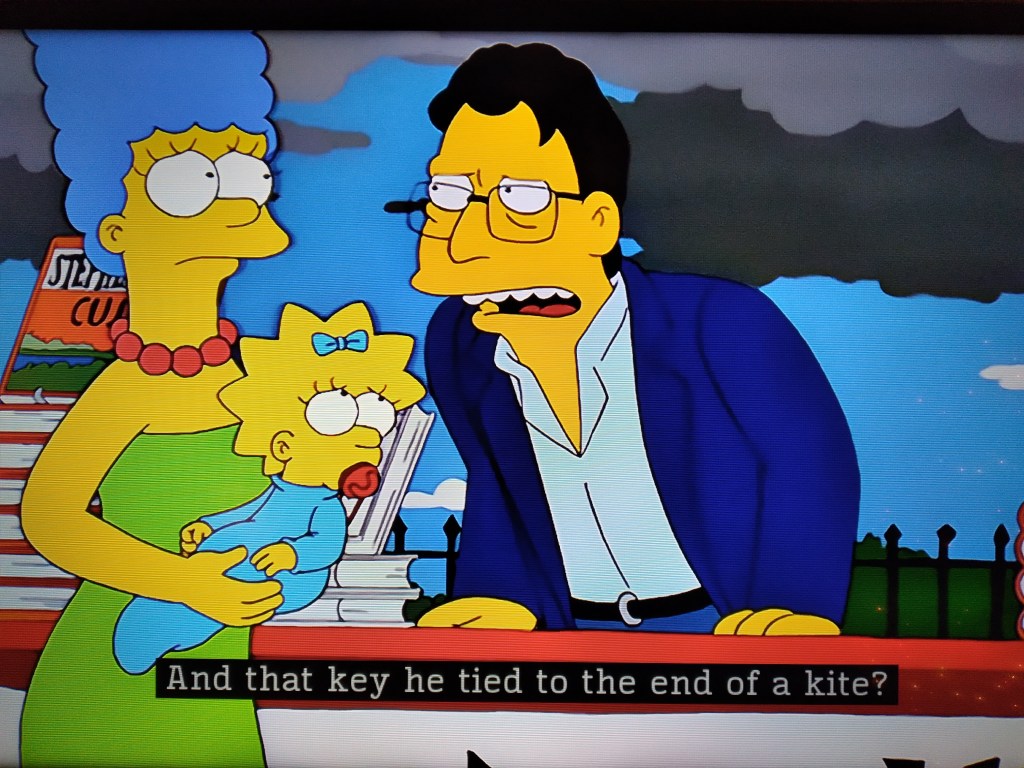
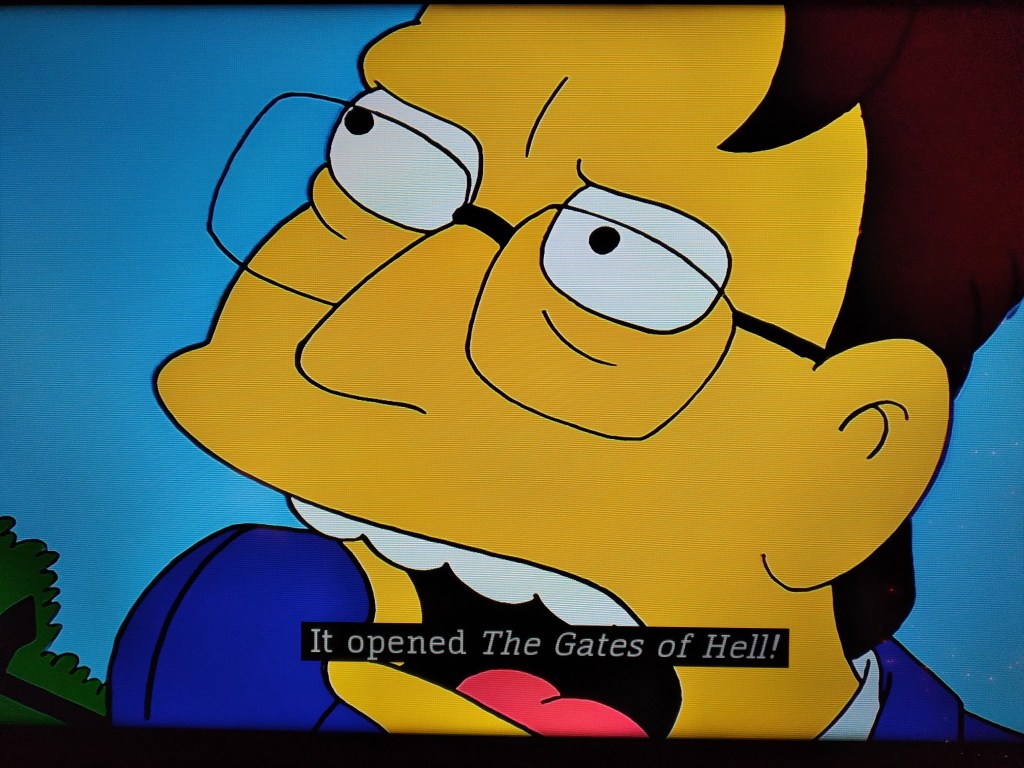
The book covers visible on King’s table throughout this scene are his old classics: Carrie, The Shining, and Cujo–even though, in theory, Tom Gordon and Hearts in Atlantis are what should have been on his promotional table in 2000….
-SCR


Pingback: Shits & Crits: The Tom Gordon Sub-Odyssey Continues, #2 – Long Live The King
Pingback: Shits & Crits: The Girl Who Loved Tom Gordon Sub-Odyssey Face-Off – Long Live The King