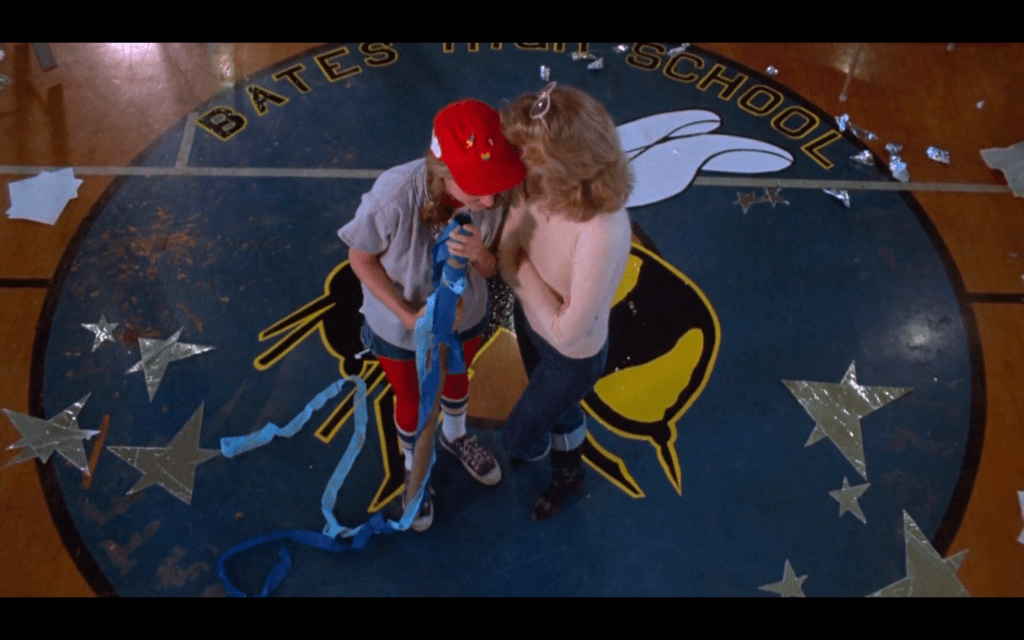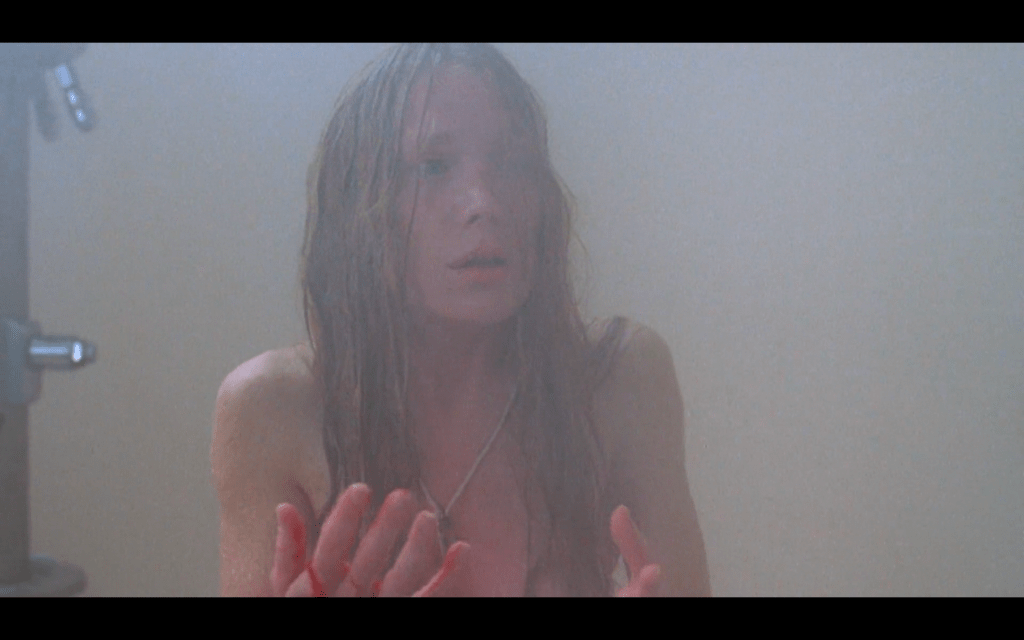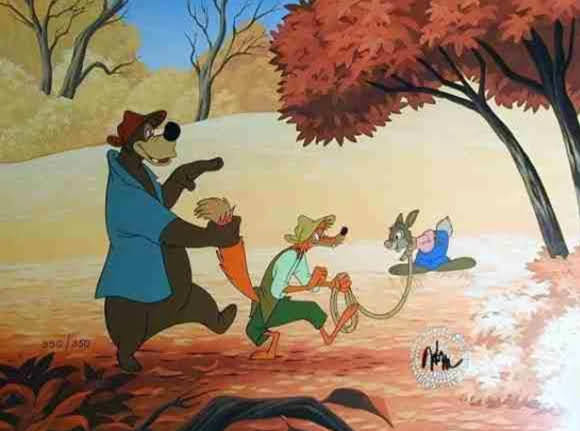
The Laughing Place is a Rabbit Hole to Disney’s Animal KINGdom, Part III: The Shining

The Writing on the Wall Carries Critterations and Shitterations

Well, you ain’t never caught a rabbit / And you ain’t no friend of mine

Big Mama Thornton, “Hound Dog” (1953); Elvis Presley, “Hound Dog” (1956).

(This inhuman place makes human monsters.)

Stephen King, The Shining (1977).

Well, since my baby left me / Well, I’ve found a new place to dwell

Elvis Presley, “Heartbreak Hotel” (1956).

He was reminded of the 3-D movies he’d seen as a kid. If you looked at the screen without the special glasses, you saw a double image—the sort of thing he was feeling now. But when you put the glasses on, it made sense.” (boldface mine)

Stephen King, The Shining (1977).

I mean, these were some of the astutest people I’ve ever known, and they were in [most] cases almost totally overlooked, except as a beast of burden—but even at that age, I recognized that: Hey! The backs of these people aren’t broken, they [can] find it in their souls to live a life that is not going to take the joy of living away. (boldface mine)

Peter Guralnick, Sam Phillips: The Man Who Invented Rock n Roll (2014).

The Shadow Has Exploded

I concluded Part II of this discussion with Bryan Fuller’s question: “Is Christine the Overlook ghost on wheels?” Wheels are an apt symbol of the previously mentioned Thermidor Effect, which in turn pretty much exactly replicates/describes my experience of attempting to read through the Kingverse chronologically—one step forward, two steps back is how the wheel rotates.

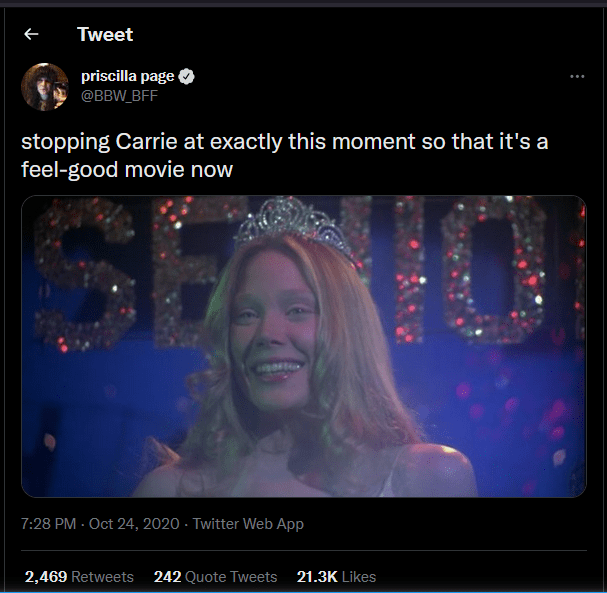
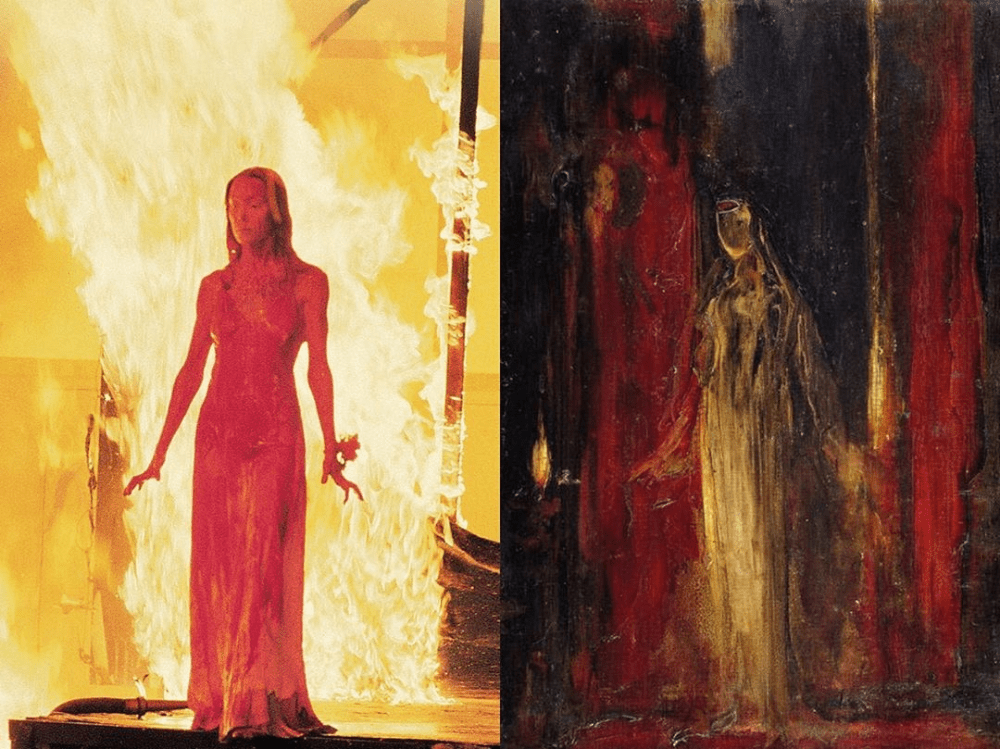
Bryan Fuller is a noteworthy figure in the Kingdom for having written the teleplay of the ’02 television miniseries version of Carrie, an adaptation that no one really seems to want to remember, but one that indicates he’s done a closer study than most on this foundational King canon text.

Fuller’s version is in keeping with King’s fidelity trend in television adaptations of his own work–the 1997 television miniseries version of The Shining that King himself wrote to fix what he hated about Kubrick’s version (ironically, since Kubrick’s remains pretty much definitively the most influential adaptation of his work) is a quintessential example, though King did make some changes, like the exchange that confirms for Hallorann Danny’s shining abilities:
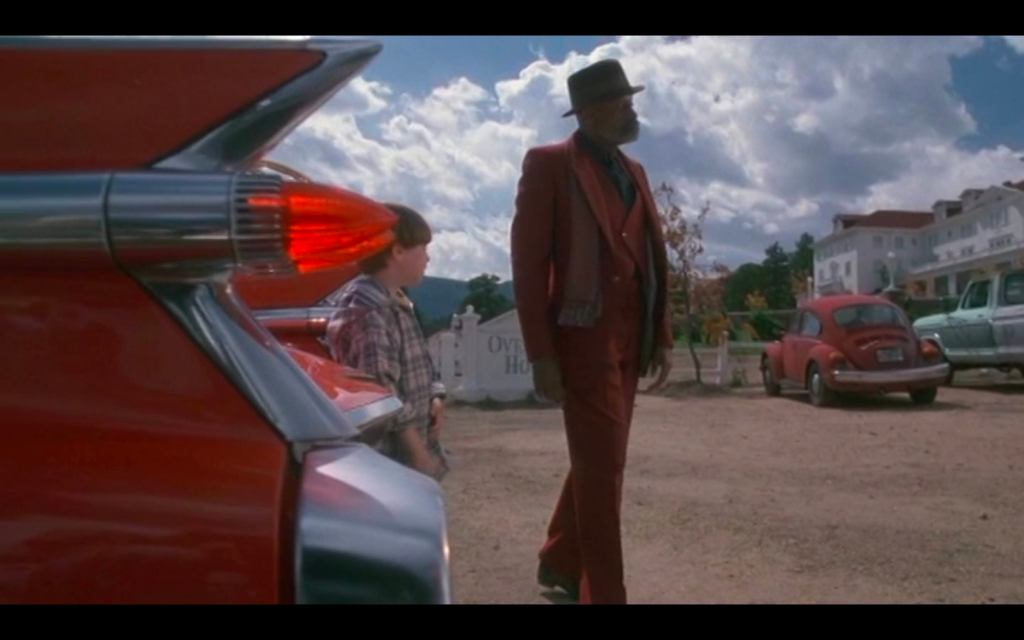
The Shining (1997).

Hallorann: [out loud] “My Bessie… Ain’t she sweet?” [in head] “Sweet as honey from the bee.”

Danny: [out loud] “Sweet as honey from the bee.”

The Shining (1997).

Fuller is also apparently directing a new adaptation of Christine, that vehicular entity which, in his ’03 interview with Magistrale, King explicates at the site of the intersection of horror and humor, and consumption:

When I wrote Christine I wanted LeBay to be funny in a twisted sort of way. He’s the same blend of horror and humor that you find in the car itself. Christine is a vampire machine; as it feeds on more and more victims, the car becomes more vital, younger. … The whole concept is supposed to be amusing but scary at the same time.

Tony Magistrale, Hollywood’s Stephen King (2003).

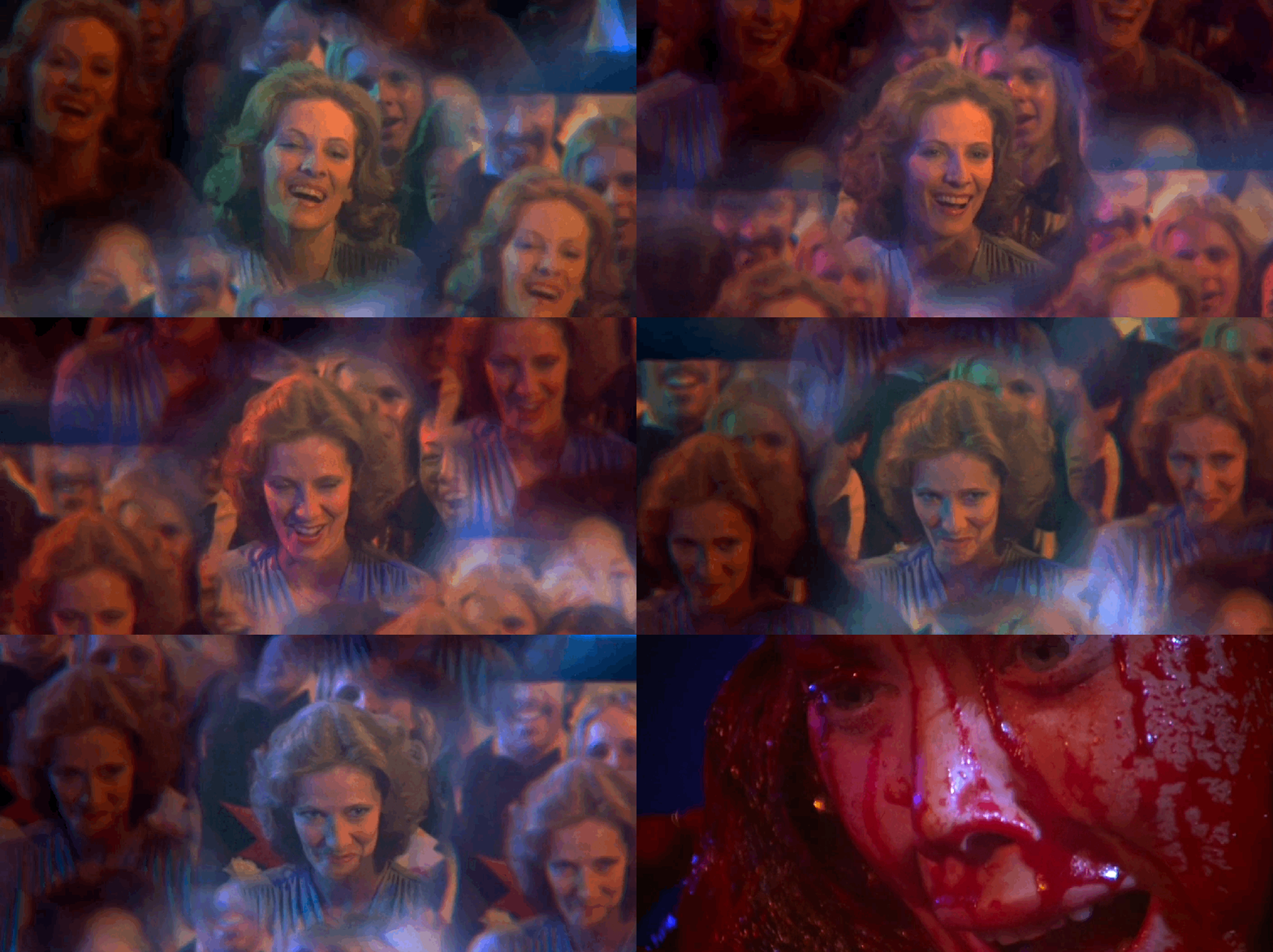
In his version of Carrie, Fuller restores a couple of the major elements from the novel that Brian De Palma changed in his 1976 adaptation–namely, the epistolary structure that allows for a retrospective reflection of and attempted accounting for Carrie’s destruction via the device of a detective’s interrogation, and showing Carrie stopping her mother’s heart when she kills her. But there is a pretty major change in Fuller’s version: it turns out Carrie is still alive, and that Sue helped her escape.

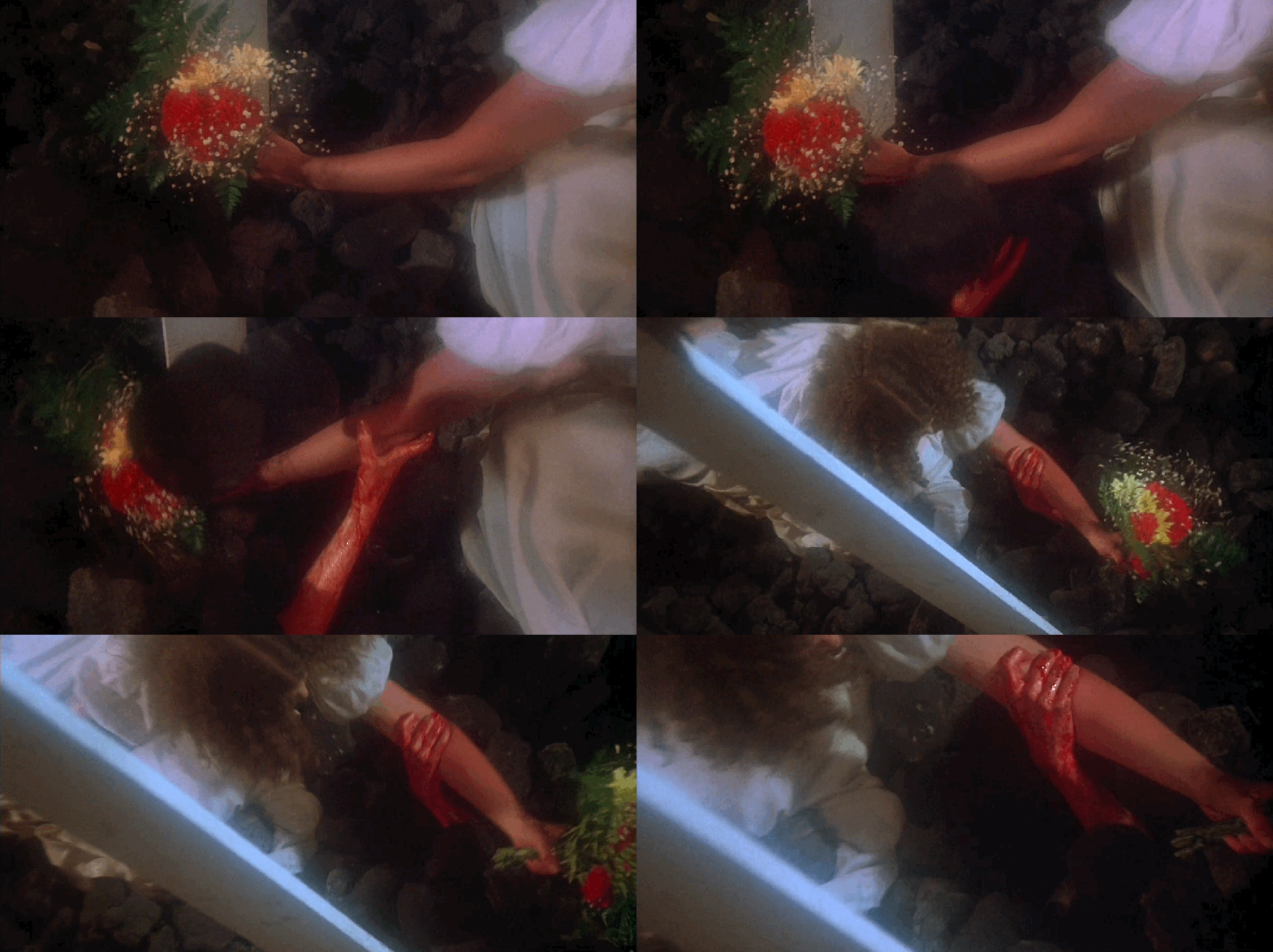
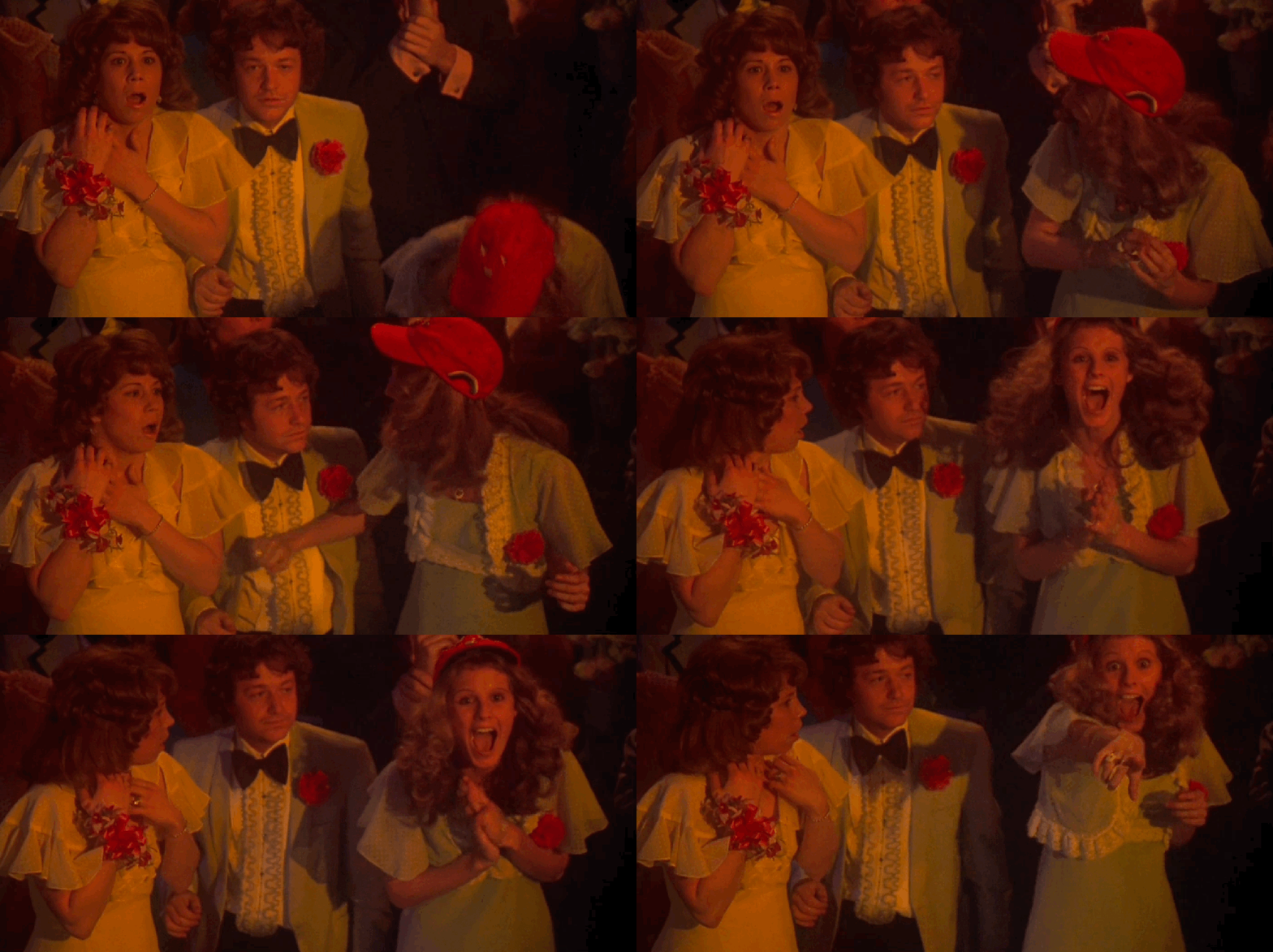
But what really “escapes,” figuratively, in the novel version of Carrie, is the “shadow” from the text-within-the-text The Shadow Exploded, the shadow that is a manifestation of Toni Morrison’s Africanist presence and that Carrie’s trigger moment reveals to be inextricable to the history of American music and how this history enacts and underwrites the history of America itself.

Royal Labor Pains

The novel Black House (2001), which King co-wrote with Peter Straub, refers to Albert Goldman’s 1981 book on Elvis Presley as a “trash tome,” but “trash has its place,” as King notes about his mother’s influence on his qualification of literature in the afterword to ‘Salem’s Lot (1975), in which he essentially explicates that novel’s nature as a mashup between Dracula and Peyton Place. Without conceptions of “trash,” it seems rock ‘n’ roll would not exist…

“Sam would come in and say, ‘That’s it, that’s what I want.’” And the band, or the blues singer, would be totally taken aback and say, “But that’s trash, Mr. Phillips.” And he would say, “That’s what I want.”

Peter Guralnick, Sam Phillips: The Man Who Invented Rock n Roll (2014).

Goldman’s tome opens with a worthwhile reflection on the American preoccupation with royalty, or as he puts it, “the trappings of royalty.”
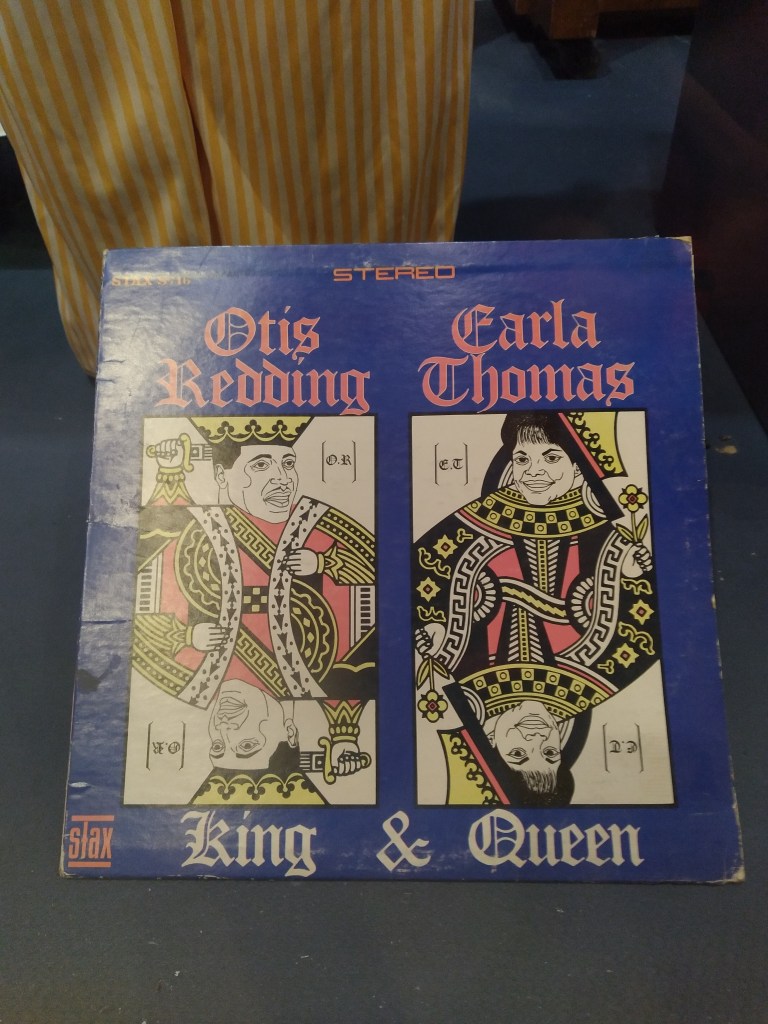
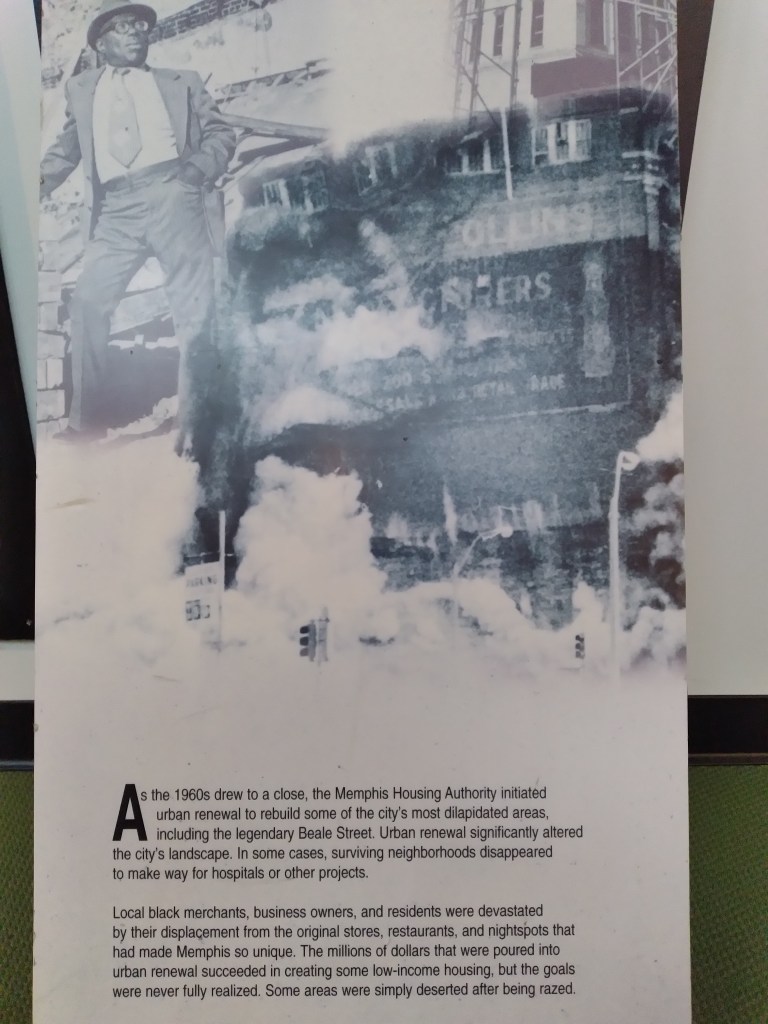
At the Rock N Soul Museum in Memphis, TN.

Goldman’s reading opens the door to a key to a map of American musical royalty. We like to mint kings, as we’ve done in music:
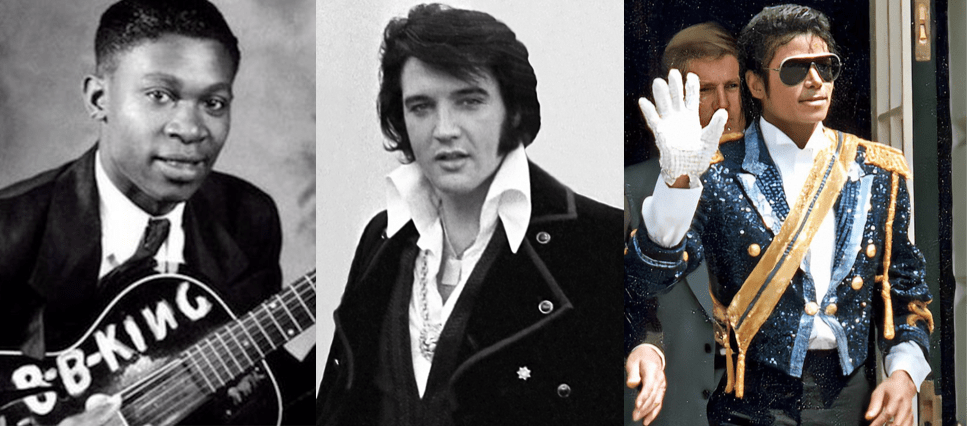
The King of the Blues, the King of Rock ‘n’ Roll, and the King of Pop, respectively.

The King of Pop bears a white glove, identified in Nicholas Sammond’s study on the history of animation as a sign of the minstrel…

As well as their relations…
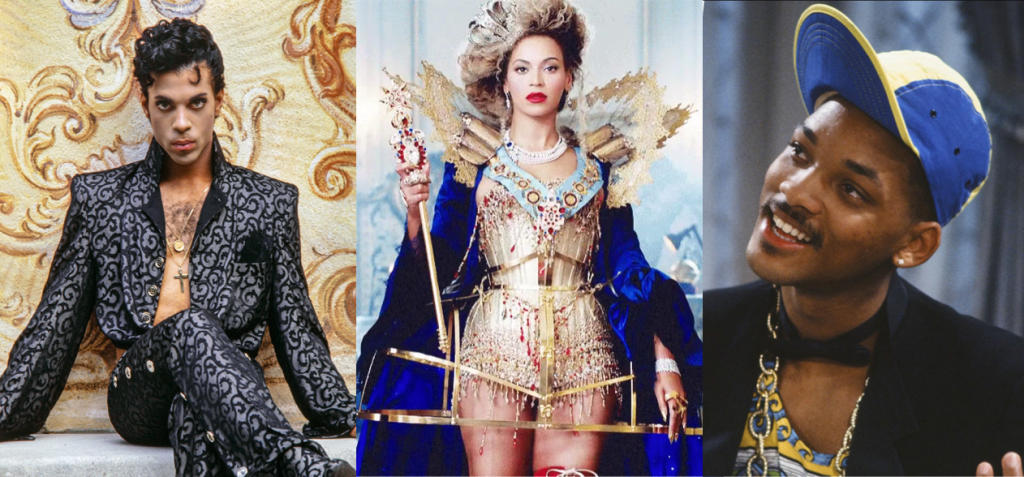
The Artist Formerly Known as Prince, Queen Bey, and the Fresh Prince, respectively.

There are also other things we treat as kings….

The idea that a fetus is not just a full human but a superior and kinglike one—a being whose survival is so paramount that another person can be legally compelled to accept harm, ruin, or death to insure it—is a recent invention. (boldface mine)

Jia Tolentino, “Is Abortion Sacred?” (July 16, 2022).

Baz Luhrmann’s recent Elvis biopic also pivots around three kings:
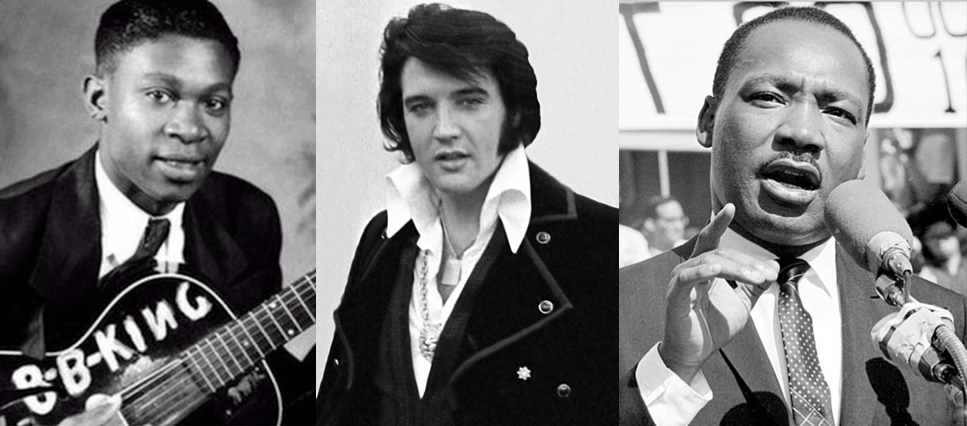
B.B. King, Elvis Presley, and Martin Luther King, Jr.

This is fitting for a couple of reasons. One would be the three acts both Elvis’s career (and hence Baz’s film) neatly divides itself into:

Like Gaul, the career is divided into three parts: Memphis Elvis (the singer), Hollywood Elvis (the movie star), and Vegas Elvis (the sacred monster).

Mark Feeney, “Elvis Movies,” American Scholar 70.1 (2001).

Another reason is that Elvis liked to watch three screens at a time, as his Graceland basement reveals–sadly not one of the parts of his house recreated for the film, and sadly not one I got a decent picture of when I visited this past December:

Elvis’s basement rec room with mirrored ceiling at Graceland.

Others have taken better pics:

From here.

Graceland is an important place…

Bruce Springsteen explicates the state of grace as a place in an Elvis documentary:

Graceland. Just the name of it itself pulled directly out of gospel tradition. It’s an idealized home, the perfect symbol of someone who’s come up from the bottom and–and enjoyed the best the country has to offer. It was a huge moment for Elvis to walk through those doors and call that place his home.

Elvis Presley: The Searcher (2018).

Later in The Searcher, after post-Hollywood Elvis is returning to his musical roots, Springsteen notes that “you can take the boy out of Memphis, but you can’t take Memphis out of the boy.”

This figurative sense of place is echoed in a description of an Uncle Remus-like figure in the biography of legendary Memphis record producer Sam Phillips:

“[Uncle Silas] liked to sit in the kitchen and put me on his knee, grab me by my bony shoulder and say, ‘Samuel, you’re going to grow up and be a great man someday.’ I mean, I was just a sickly kid—physically, I don’t know, maybe mentally, too—but somehow, as much as I didn’t believe him, I did believe him. Because he sounded so confident. And he was a great storyteller—but [what I got from his stories] is that, number one, you must have a belief in things that are unknown to you, that what you see and hear is really not all that important, except for the moment. I mean, Africa was just another way of him pointing to the things that were all over and available to us one way or another. Africa was a state of mind that he hoped everybody could see and be a part of or participate in.” Most of all, rather than moralize, he just tried to teach the sickly little boy, as much by example as anything else, “how to live and be happy, no matter what came along, [that] even when you’re feeling bad, you’re feeling good.”

Peter Guralnick, Sam Phillips: The Man Who Invented Rock n Roll (2014).

Sam Phillips is the founder of Elvis’s initial record label, Sun Records in Memphis, and is credited with creating rock ‘n’ roll in an oft-repeated labor metaphor that implicitly likens him to a midwife:
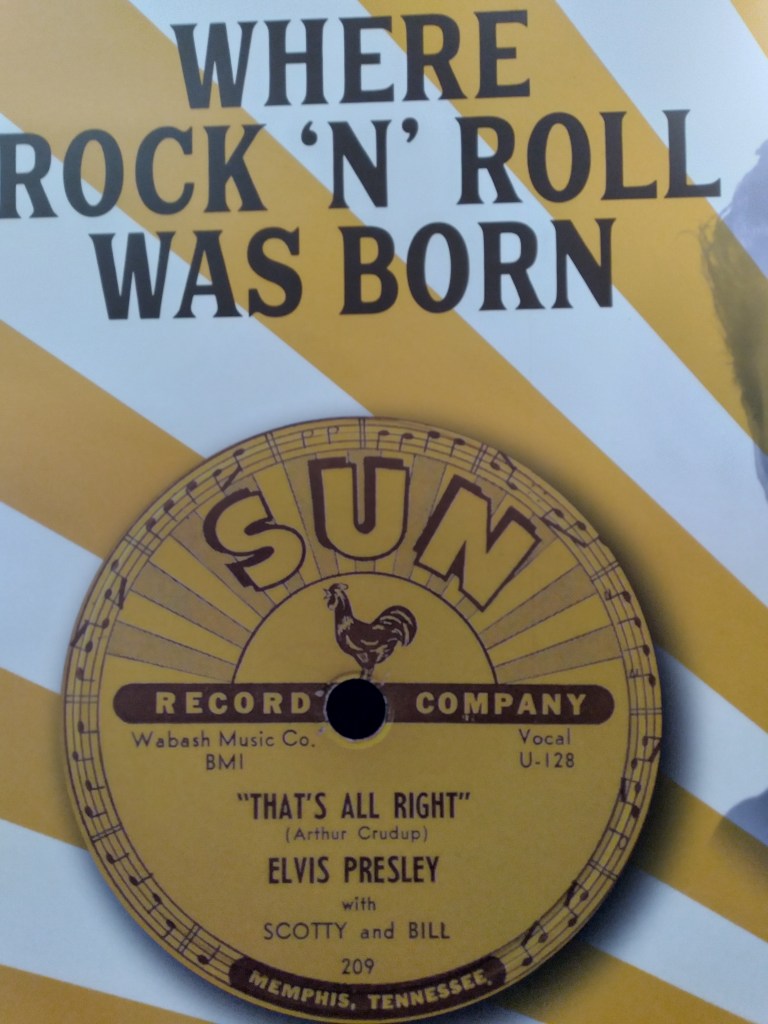
Writing on the wall at an exhibit at the Graceland complex in Memphis, TN.

(The B-Side of Elvis’s first single “That’s All Right” is a cover of a bluegrass song (a white genre), so if the A-Side is shown by Baz to be a mashup of blues and gospel, this morphs into a “‘three-way’ appeal” as record-store owner Ruben Cherry put it, of pop-hillbilly-r&b, or blues-gospel-bluegrass.)

As a child of the media, I have been pleased to have attended the healthy birth of rock and roll, and to have seen it grow up fast and healthy . . . but I was also in attendance, during my younger years, at the deathbed of radio as a strong fictional medium.

Stephen King, Danse Macabre (1981).

The birth of rock ‘n’ roll is contingent on the circumstances created by post-WWII culture, the pivotal shift into which is embodied in the history buried in the basement scrapbook of The Shining‘s Overlook Hotel…

For many critical historians, that moment in August 1945 delineates Modernism from a postmodern era that was violently born out of it.

Tony Magistrale and Michael Blouin, Stephen King and American History (2020).

A rooster (or a cock) is the critter Phillips chose as the centerpiece of his label’s design, inadvertently evoking its deeper function: cock rock is the foundation of the patriarchy. Or, to use one of my buzzwords, cock rock underwrites the patriarchy, as well as underwrites the expression of the patriarchy in the KINGdom.

The Sun Records label’s color scheme also potentially evokes the mascot of Phillips’ alma mater Coffee High School:
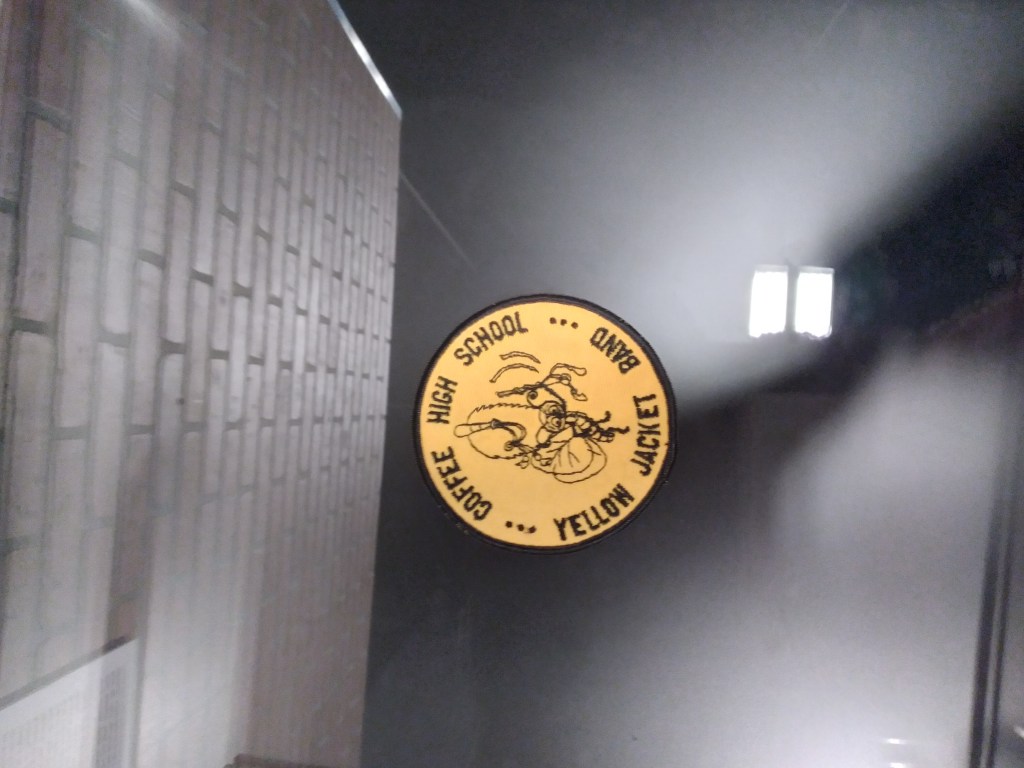
The yellow jacket at Graceland…not a bee, not a wasp, not a hornet, but another stinging insect.

It’s also intriguing that the midwife of Rock ‘n’ Roll apparently became so due to the influence of that magical Black uncle…

The story of Uncle Silas is at the epicenter of everything that Sam Phillips ever believed both about himself and the “common man,” in that most uncommon narrative that became the lodestar for his life. It was not sympathy for this old black man’s plight that drew him to Silas Payne—far from it, Sam Phillips always insisted. Rather, it was admiration for those same qualities of imagination, creativity, and invincible determination that he had first noted in the black fieldworkers on his father’s farm—that and the kind of emotional freedom, the unqualified generosity and kindness that he himself would have most liked to be able to achieve.there was something almost magical about Uncle Silas, with the hundreds of chickens he kept out back, every one of whom he could distinguish by name, and the Bible stories he rhymed up, the songs he sang, the stories he told of an Africa he had never known, with battercake trees and a Molasses River that took a twelve-year-old boy away to a world in which he was freed from all the emotional and physical bonds by which he felt so constricted in his day-to-day existence.

Peter Guralnick, Sam Phillips: The Man Who Invented Rock n Roll (2014).

So that cock logo might well derive from Uncle Silas’s influence…in which the Black man helps free the white boy in a way that in addition to bearing resemblance to Uncle Remus will resemble the function of B.B. King’s character in Baz’s flick, in which Elvis is shown to be cut from the same cloth as B.B. when they converse in the famed Beale Street Lansky Brothers clothing store about Elvis’s upcoming television appearance on the Milton Berle show, with B.B. referring to the host as “Uncle Miltie” as the pair examine themselves in the mirror…
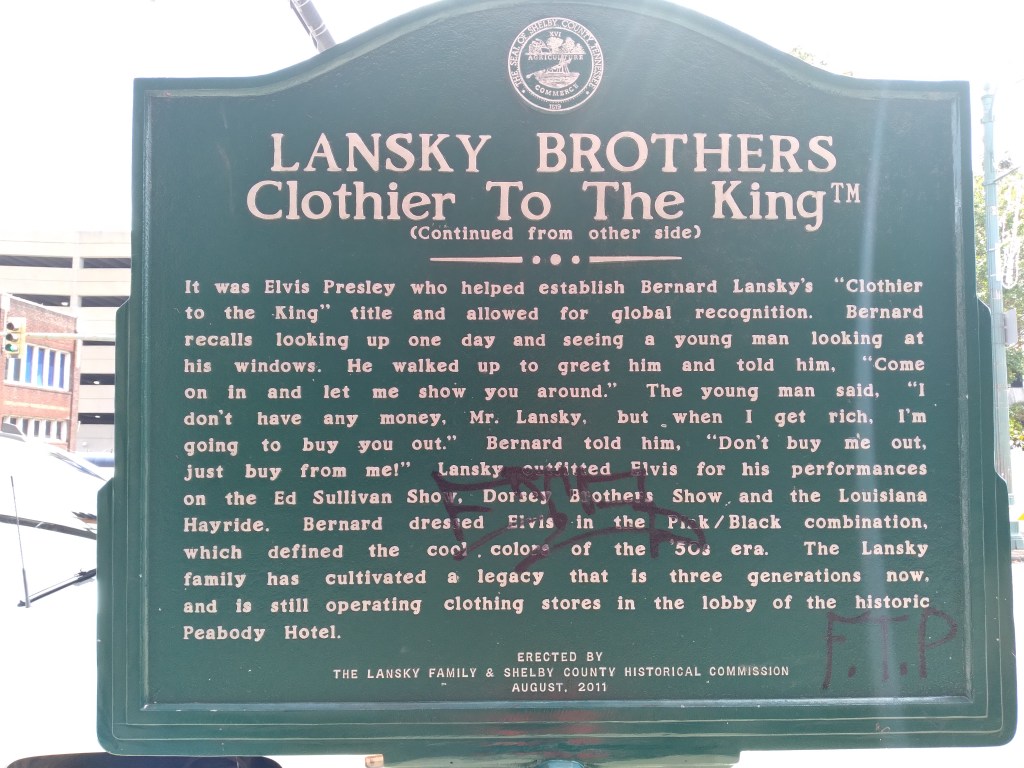
B.B. is an important presence but still disappointingly functions as a magical Black bestie for Elvis, offering a version of “freedom” to the white man by having his own record label and touring wherever he wants as a corollary for the restrictions Elvis ends up with when he allows Colonel Tom Parker to take over all of his business enterprises.

Another example of Baz’s B.B. function is when Elvis shows up at the Beale Street club where B.B. plays, distraught about how to navigate the backlash against him, and, echoing the language of the place of that state of mind passed down from Uncle Silas that “even when you’re feeling bad, you’re feeling good,” B.B. advises:

“If you’re sad and you want to be sad, you’re at the right place. If you’re happy and you want to be happy, guess what? You’re at the right place.”

Elvis (2022).

But is he? Confronting the film’s imagery of Beale Street itself, it is striking for being NYC-like in its teeming pedestrian traffic, striking for the image of Elvis as a lone white person navigating an exclusively African American population.
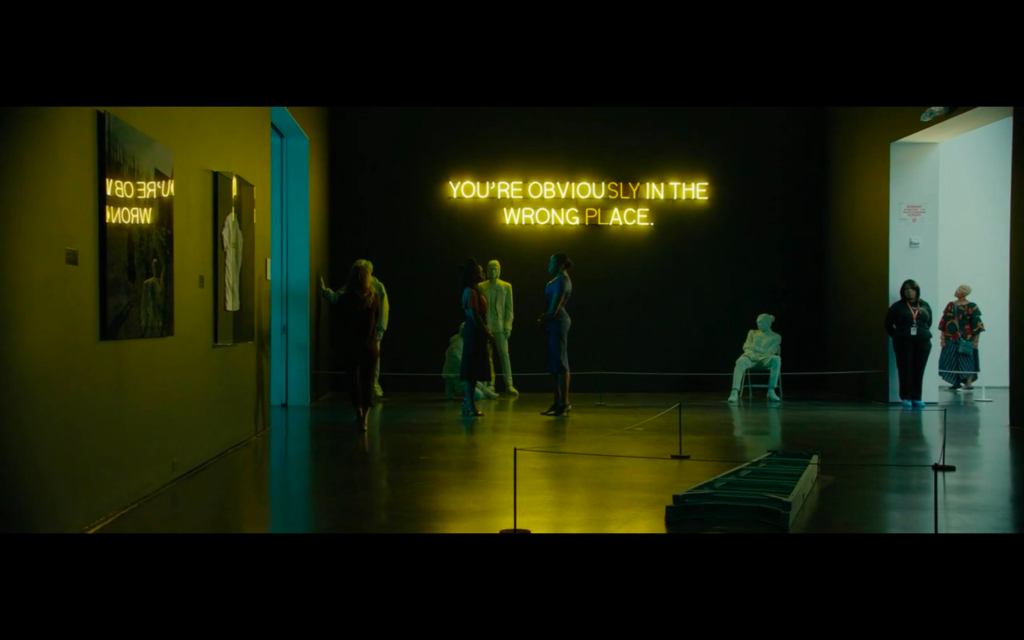
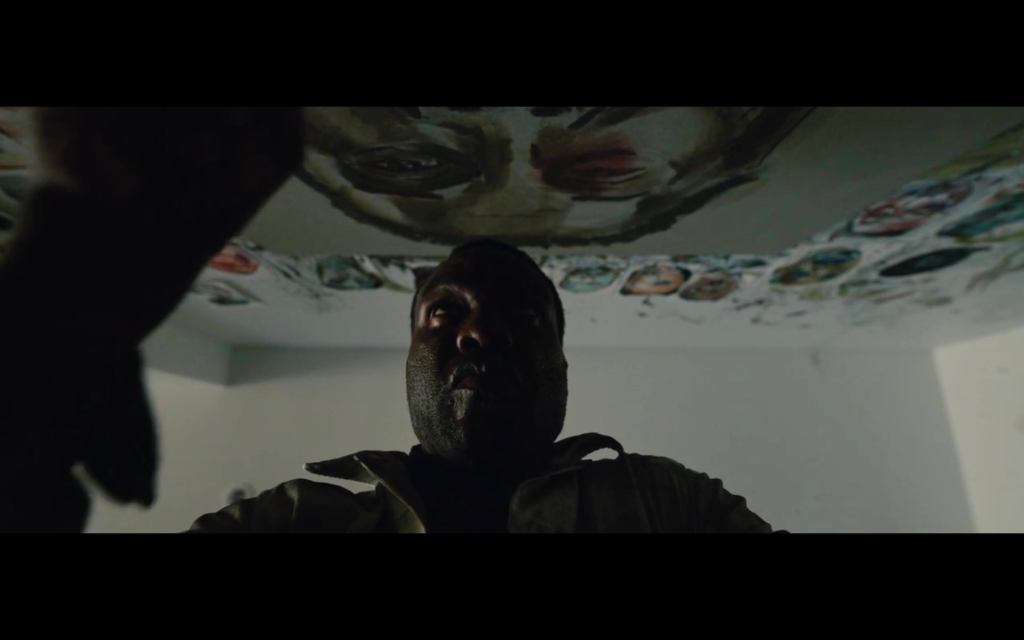
Writing on the wall in Candyman (2021).

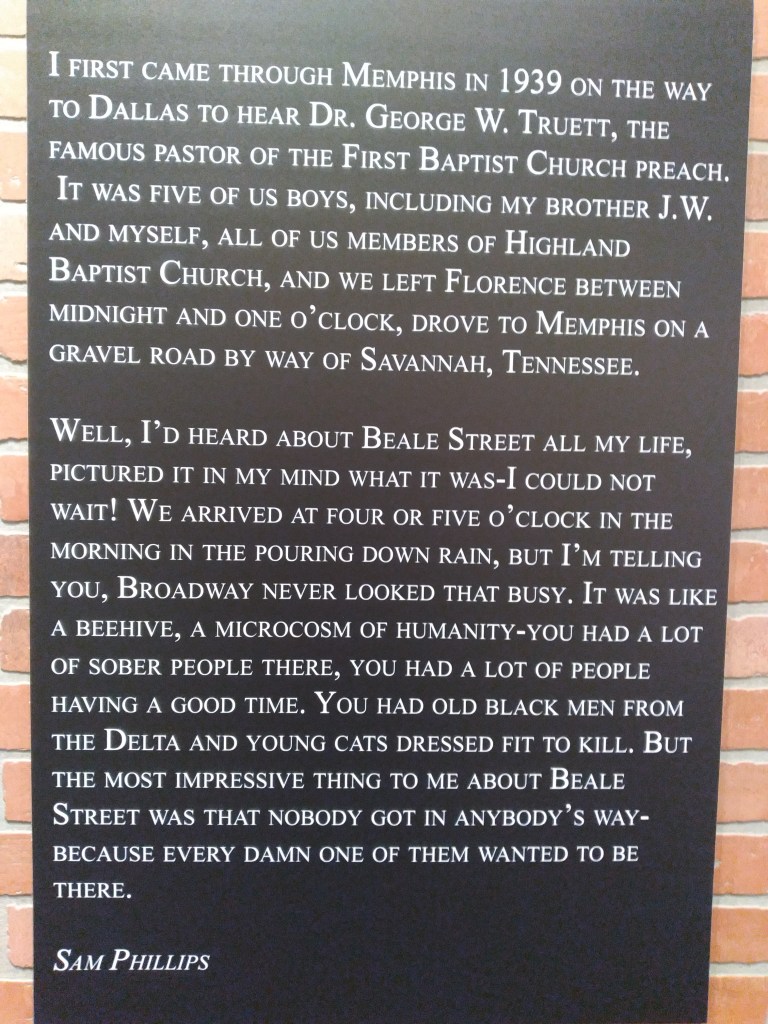
Striking the more so in light of Sam Phillips’ own description of his initial encounter of this place when he first visited Memphis in 1939:

Well, I’d heard about Beale Street all my life, pictured it in my mind what it was—I could not wait! We arrived at four or five o’clock in the morning in pouring-down rain, but I’m telling you, Broadway never looked that busy. It was like a beehive, a microcosm of humanity—you had a lot of sober people there, you had a lot of people having a good time. You had old black men from the Delta and young cats dressed fit to kill. But the most impressive thing to me about Beale Street was that nobody got in anybody’s way—because every damn one of them wanted to be right there. Beale Street represented for me, even at that age, something that I hoped to see for all people. That sense of absolute freedom, that sense of no direction but the greatest direction in the world, of being able to feel, I’m a part of this somehow.

Peter Guralnick, Sam Phillips: The Man Who Invented Rock n Roll (2014).

This quote was deemed significant enough for inclusion in the Sun Records section of one of the Graceland exhibits:
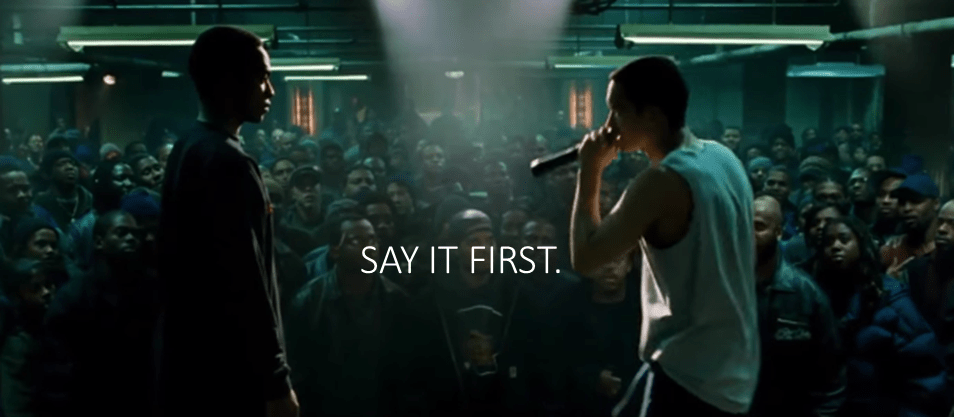
The idea of being part of something larger than oneself is part and parcel of hive symbolism for the individual v. collective, with traditional American narratives of the West manifesting/championing/fostering the former, as in the conclusion of Eminem’s 2002 semiautobiopic 8 Mile:

This time, however, he echoes the Western hero who, in splendid isolation, rides off into the sunset.

Roy Grundmann, “White Man’s Burden: Eminem’s Movie Debut in 8 Mile,” Cinéaste, Vol. 28, No. 2 (2003), p. 33. 

One critic invokes hive-metaphor language to describe one of the scenes in Baz’s Elvis:

When Elvis passes through Black crowds in Memphis’s Beale Street, they lovingly swarm him for autographs.

Richard Brody, “‘Elvis’ Is a Wikipedia Entry Directed by Baz Luhrmann” (June 27, 2022).

This image evokes a description in Goldman’s biography of Elvis at age sixteen:

The onset of Elvis’s emotional crisis was signaled by the appearance of recurrent nightmares. These dreams were so powerful that they resembled states of absolute possession or even the condition of being spellbound. Night after night… he would imagine that he was being attacked by a mob of angry men. They would circle him ominously as he hurled at them defiant challenges. Then a violent struggle would commence. (79)

The primary image presented by Elvis’s nightmares is the familiar paranoid delusion of the one against the many.

Albert Goldman, Elvis (1981).

Stephen King also experienced a recurrent nightmare:

In another dream—this is one which has recurred at times of stress over the last ten years—I am writing a novel in an old house where a homicidal madwoman is reputed to be on the prowl. I’m working in a third-floor room that’s very hot. A door on the far side of the room communicates with the attic, and I know—I know—she’s in there, and that sooner or later the sound of my typewriter will cause her to come after me (perhaps she’s a critic for the Times Book Review). At any rate, she finally comes through the door like a horrid jack from a child’s box, all gray hair and crazed eyes, raving and wielding a meat-ax. And when I run, I discover that somehow the house has exploded outward—it’s gotten ever so much bigger—and I’m totally lost.

Stephen King, Danse Macabre (1981).

Elvis’s being “lost” is another of the motifs in Baz’s depiction…Is there a mind meld going on reminiscent of that titular device in The Shining?

“By the light of day … Beale Street might not have looked so glamorous, but it was shining with the hopes and aspirations and beliefs of all the people who thronged to its sights”

Peter Guralnick, Sam Phillips: The Man Who Invented Rock n Roll (2014).

And then there’s Paul Simon’s invocation of the literal place of Graceland (in which state becomes synecdoche for nation…) evoking a larger figurative one….

The Mississippi Delta
Was shining like a national guitar
I am following the river
Down the highway
Through the cradle of the Civil War

I’m going to Graceland, Graceland
Memphis, Tennessee

Paul Simon, “Graceland” (1986).

The musical appropriation that occurred in the making of Simon’s Graceland album, which he recorded in South Africa, is intriguingly documented in Under African Skies (2011) (in her collection Florida exploring literal and figurative place-states, Lauren Groff’s “Ghosts and Empties” derives from “Graceland” lyrics in one example of the shrapnel of Elvis’s explosive influence). Are Simon’s “ghosts” and “shining” references (in conjunction with his dating Shelley Duvall right before she filmed The Shining), qualify as strong enough evidence to be invoking The Shining?

Regardless, the “national guitar” Simon conjures renders the guitar a symbol, opening the door to explore other “semiotic levels” (per Magistrale) such a symbol might operate on, like the weaponization of music (such as in the covert history of the national anthem as premeditated partisan propaganda) … a tool/weapon to prop up an illusion of freedom… and also evoked in the guitar as “axe,” which is, of course, Kubrick’s Jack Torrance’s weapon of choice. (The guitar, more specifically its neck, also becomes a weapon–inadvertently–in a 1986 Twilight Zone episode penned by George R.R. Martin in which Elvis’s twin kills him.) King’s Jack Torrance’s weapon of choice is the roque mallet, which will evoke a Disney influence (by way of Lewis Carroll) via the underwriting influence of Alice in Wonderland on King’s novel that I am eventually getting to below…but not quite yet.

The Singer-Gunslinger

B.B. King reads the label of “rock ‘n’ roll” itself as racially coded distinction:

B.B. spoke diplomatically of the rock ’n’ roll revolution as it unfolded. Decades later, in a moment of candor, he would dismiss the genre as “just more white people doing blues that used different progressions”: “Elvis was doing Big Boy Crudup’s tunes, and they were calling that rock and roll. And I thought it was a way of saying, ‘He’s not black.’”

Daniel de Visé, King of the Blues: The Rise and Reign of B.B. King (2021) (here).

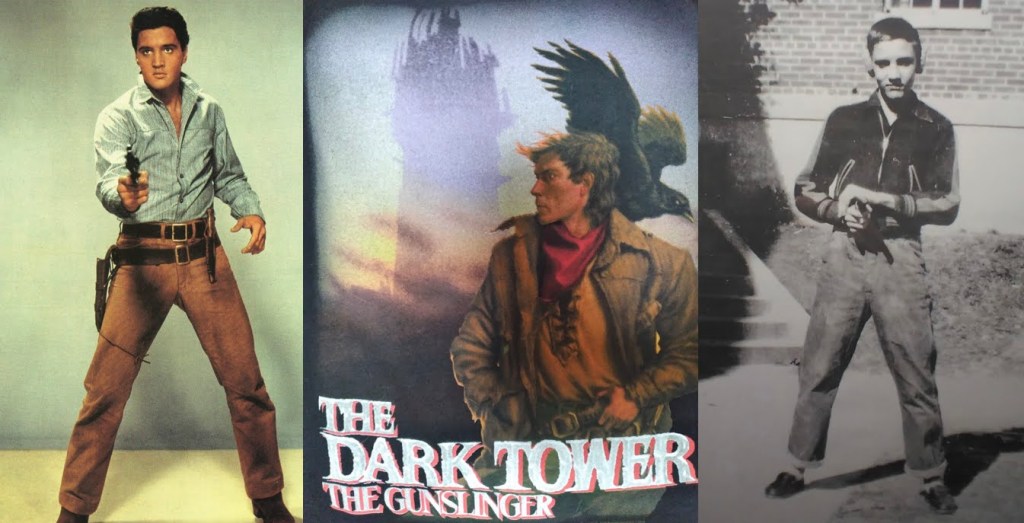
Elvis potentially underwrites the center of the Gunslinger Song Cycle by being a figure that explodes the color line with his music…

[Sam Phillips] had sensed in Elvis a kindred spirit almost from the start. … It was almost subversive what they had done, sneaking around through the music. They had gone out into this no man’s land, “where the earth meets the sky,” as Sam always liked to put it, without so much as a map or a compass … Together they had “knocked the shit out of the color line.”

Peter Guralnick, Sam Phillips: The Man Who Invented Rock n Roll (2014).

…and then becoming a crossover Hollywood star; his first “dramatic” role is in a Western, playing a “gunslinger” character with a white father and a Native American mother.
Baz’s film emphasizes that the backlash against Elvis when his popularity explodes in 1956 is a predominantly race-based fear, starting with the emphasis that Elvis’s first single is a mashup of two Black genres, Blues and Gospel, and the emphasis on Black sexuality latent in the Blues genre. A fear of Black sexuality, or of Black people because of their more open sexuality, is an implicit fear of their reproduction…

Baz’s biopic invokes a motif of literal signs, and Elvis himself is a sort of sign, refracted out of personhood into reproduced images, as Andy Warhol evinces:
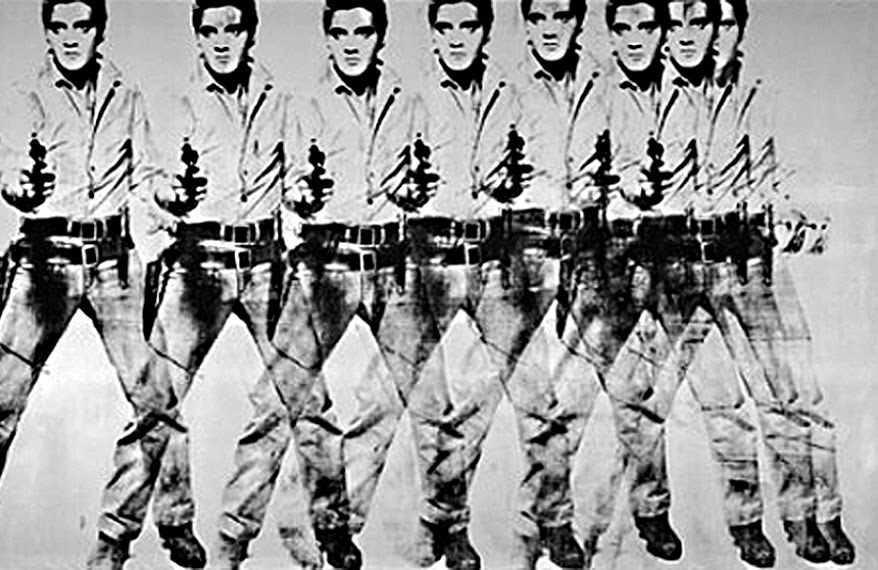
Eight Elvises by Andy Warhol.

Eight is a sideways infinity sign

At the time of his death in 1977, Elvis Presley’s was the second most commonly reproduced image in the world. The first was Mickey Mouse.

Albert Goldman, Elvis (1981).

Alongside Disney’s, Elvis’s influence (and via that, the influences on him) essentially refracts infinitely. Baz notes in text at the film’s conclusion that “His influence on music and culture lives on.” Long live the King…Elvis died (reportedly) in 1977, the same year The Shining was published, and so the same year the presence embodied in its Overlook Hotel explodes to reverberate throughout the rest of the KINGdom.

Does Elvis himself, referred to as an “atomic-powered singer,” embody this explosive presence and what it symbolizes?
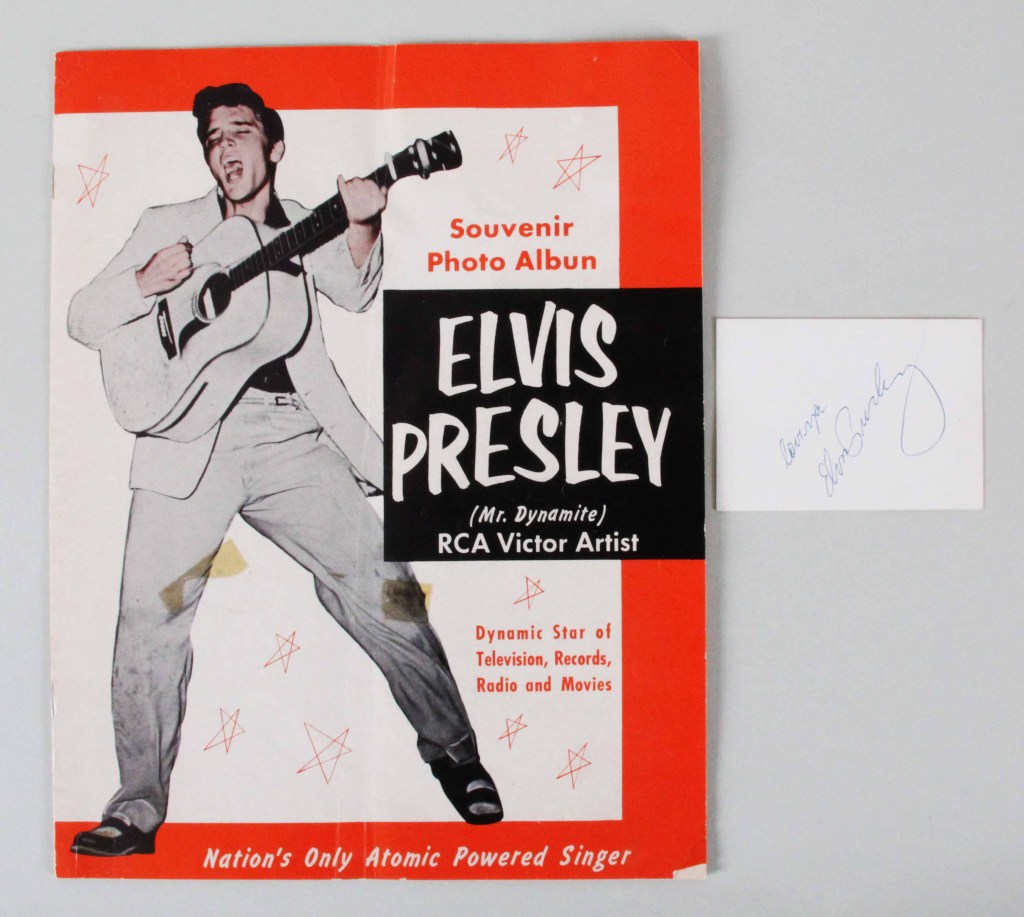
From here.

On The Shining, one critic notes about what another critic notes:

Roger Luckhurst, who has written so convincingly on trauma and torture, describes “the scenes around the events inside Room 237 [to be] the enigmatic core of the whole film” (57) … Luckhurst notes in talking of the twins‚ “can they really be Grady’s daughters, who Ullmann states were eight and ten years old? Might they not signify something else, subliminally encoded? Of course! All ghosts are signs of broken story, and bear witness to silent wrongs” (47). Here I believe The Shining, as is appropriate for a film genre-challenger like Kubrick, fights the common trope of ghosts like, say, Hamlet’s father, those spirits who wish to give a story of a contemptible crime, a free transgressor, and a plea that his son avenge him and kill his uncle. (boldface mine)

Danel Olsen, “‘Cut You Up Into Little Pieces’: Ghosts & Violence in Kubrick’s The Shining,” Violence in the Films of Stephen King (ed. Magistrale and Blouin, 2021).
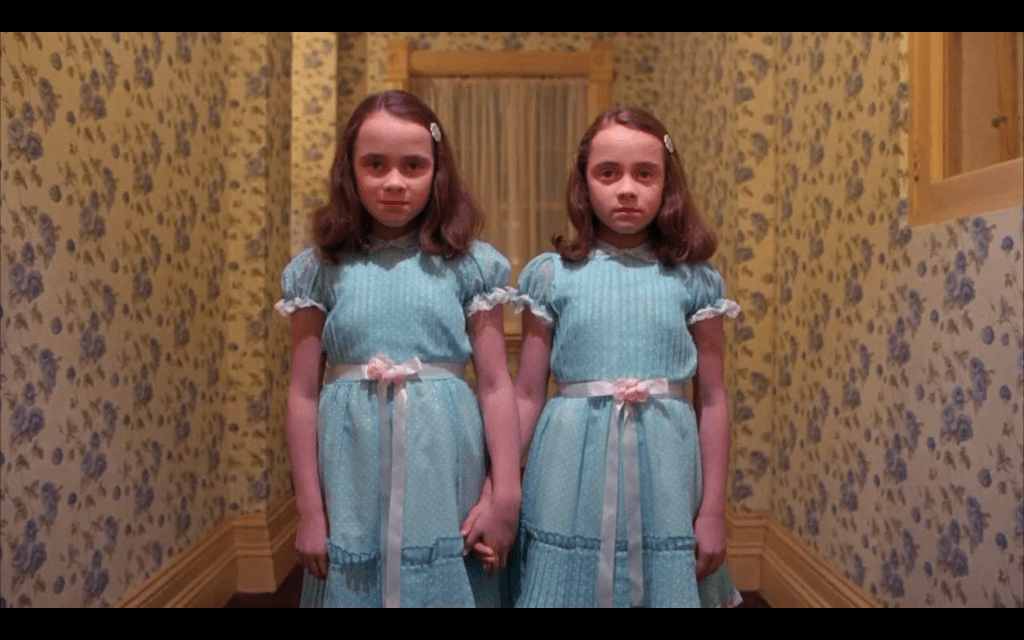
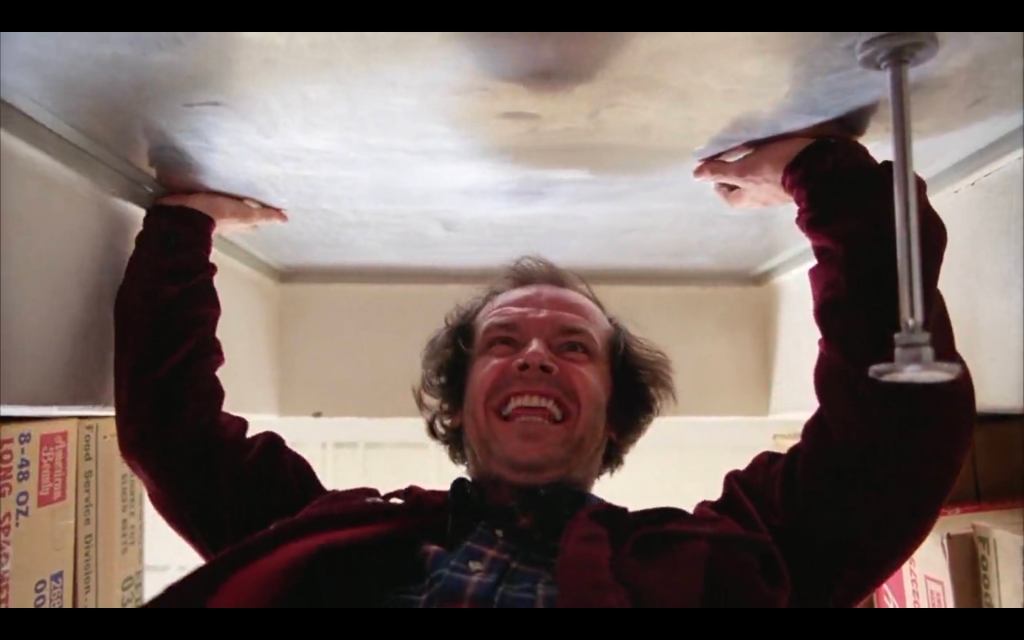
The Shining (1980).

This is the first shot of the twins shown in the movie, which flashes very quickly in Danny’s first horrific vision (which he has via talking to his finger/Tony in the mirror) of the blood pouring from the elevators early on before the nuclear trio of the Torrance family leaves for the Overlook Hotel. Thus the twins are instantly and irrevocably linked to an expression of this place as a horrific entity.

Would/should twins potentially find this expression offensive? I haven’t done the official academic research to support this, but it seems like twins have the potential to evoke horror via representing some kind of reproduction of the self that is unsettling for the way it violates selfhood…if there can be two of the same person, that somehow has the potential to diminish the value of my individual, distinct selfhood–though such horror really bespeaks larger cultural conditioning of valuing the individual over the collective: the “splendid isolation” factor, which through the producing influence of Sam Phillips will be disseminated through rock ‘n’ roll, as Phillips is:

a father who was different from anybody else’s father that they knew, a father who, in the little time they got to spend with him, emphasized over and over, to their own occasional bewilderment, the importance of being yourself, the imperative to be a rebel without becoming an outcast, to always choose individualism over conformity. (boldface mine)

Peter Guralnick, Sam Phillips: The Man Who Invented Rock n Roll (2014).

(Noticing the prominence of Alice in Wonderland in The Shining that will be discussed below, I’m also wondering if King derived the creepy twins from Tweedledee and Tweedledum…)

The one thing he was not prepared to scrimp on was the sign that would announce the presence of the Memphis Recording Service to the world—well, two identical neon signs, actually, one for each of the plateglass windows on either side of the door.

Peter Guralnick, Sam Phillips: The Man Who Invented Rock n Roll (2014).
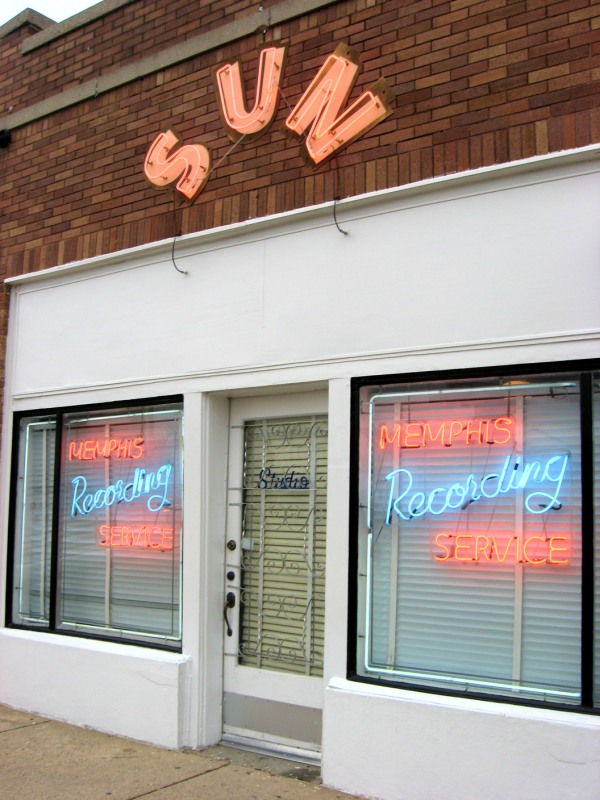
Twin signs. From here.

Elvis himself was a twin whose brother Jesse died at birth, which I learned on the Graceland tour’s recorded narration by John Stamos, aka Uncle Jesse from Full House, whose character is named for Elvis’s twin and whose character’s love of Elvis derives from John Stamos’s irl-love of Elvis. What Elvis’s twin’s ghost is a sign of is that Elvis became divested with “the strength of two men.”

And Andy Warhol dated two different twins, Jed and Jon, respectively…he creepily liked ’em younger, just like Elvis…
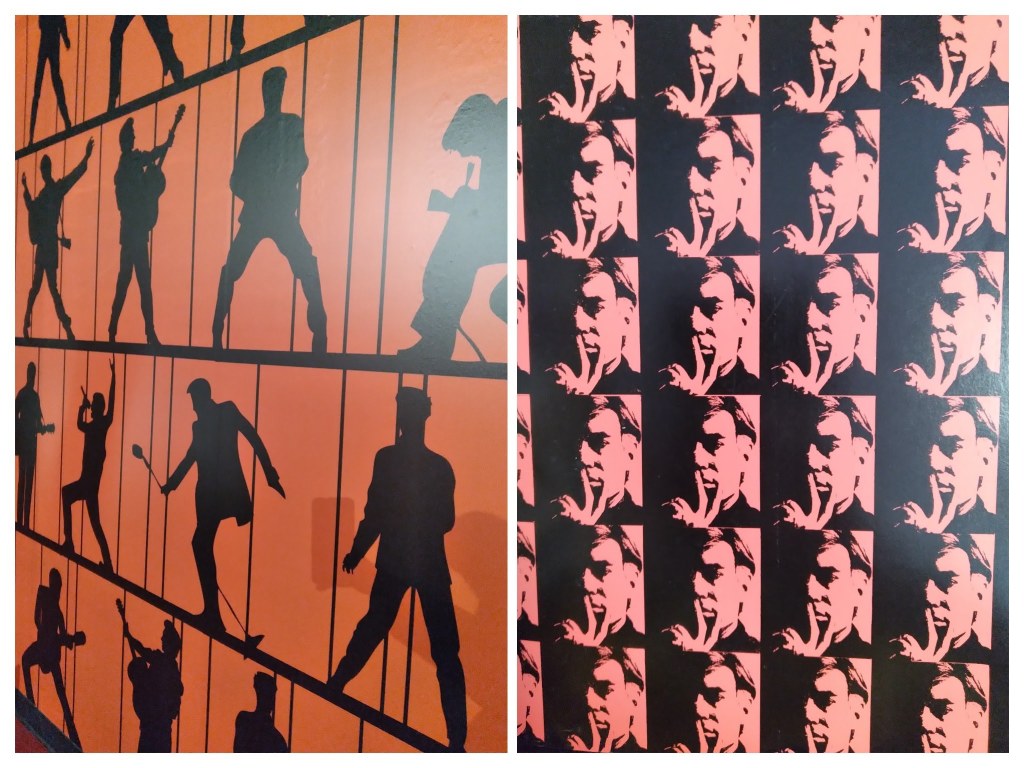
twin shadows…

The story of Memphis’s music history is inextricably linked to movies the way Elvis’s career was–a centerpiece of the Memphis Music Hall of Fame is the twin Oscars won by Memphis artists for Best Original Song for the films Shaft and Hustle and Flow.

The Rock N Soul Museum near Beale Street also covers the “persistent legend” of blues guitarist Robert Johnson:
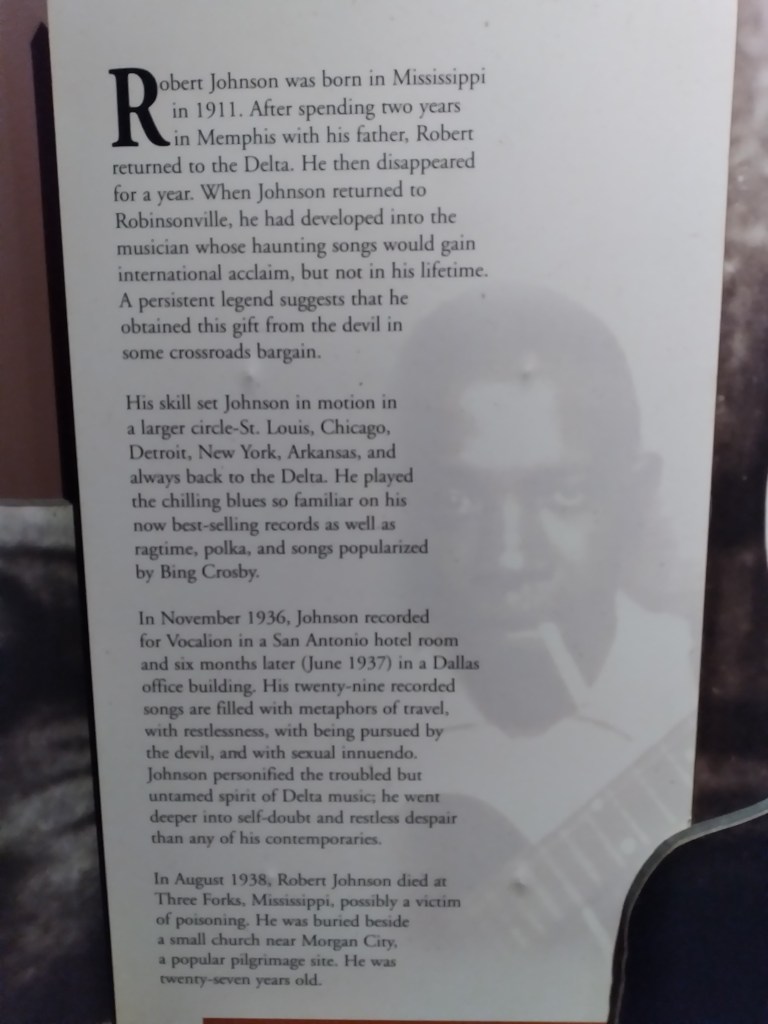
That Johnson, with his “haunting songs,” supposedly died of poisoning becomes part of a musical “curse” that explodes from a site at the intersection of literal and figurative place, that of the “crossroads,” which I hadn’t considered having a literal corollary until my brother recently told me that he’d gone on a pilgrimage, not to the site of Johnson’s Morgan City grave, but to the crossroads invoked in the 1996 Bone Thugs-n-Harmony single “Tha Crossroads.” Hint: the song appears to be about the crossroads of the Robert Johnson legend:

This song is definitely paying homage to the late and great Robert Johnson. Legend has it he sold his soul to the devil in exchange for guitar playing skills at the crossroads (insersection of hwy 49 and hwy 61 in Clarksdale Miss.). The legend also claims he was a terrible guitar player until making his pact. After the pact, he became a legend. Johnson claims that when he went to the crossroads he “never felt lonely”. … This is also stated in BTNH”s hook in “The Crossroads”. Keep in mind RJ was a blues legend and is often considered the father of rock and roll during the 1930’s. Just my 2 cents!

Joe from Lewisville, Tx (here).

The musical curse is that of the “27 Club,” meteorically talented musicians who have, like Johnson, died at age 27. There’s a moment in Baz’s flick when the Colonel is hearing Elvis’s “That’s All Right” single for the first time where the track slows down in apparent homage to DJ Screw, and the radio DJ voiceover says they’re going to play the track “for the 27th time,” a phrase that then starts repeating on a loop. The film’s narrative is that in Elvis’s deal for the Colonel to manage him–made, symbolically, on a ferris wheel–Elvis has, like Johnson in the legend, essentially sold his soul to the devil. There are many reasons the Colonel’s management of Elvis could be considered thus (it would eventually be deemed “financial abuse” in a court of law), with a major one being that his agreed-upon cut of Elvis-generated income would be HALF. Fifty percent is pretty exorbitant compared to the traditional ten percent this management role is more associated with.

(Stephen King also experienced contractual mismanagement of income proportion with his initial publisher, Doubleday.)

Like King’s (Stephen’s), that self-identified “child of the media,” Elvis’s history is the history of media development (and the technology that media is necessarily disseminated through) writ large–Elvis’s “atomic powered” identity, his true plutonium, is an array of media modes to ensure global dissemination, which becomes concurrent with domination–identified on the poster above that brands him thus: he is the “dynamic star of television, records, radio and movies.” Like Disney is also taking advantage of at the time, these different modes allow for “transmedia dissipation,” and as the Colonel claims to invent merchandise and put Elvis’s “face on every conceivable object,” Elvis’s mother’s protest to her son that “you’re losing yourself” takes on a disturbing resonance. Elvis, in selling his soul, goes from being a 3-D person to a 2-D image.

For his deal with the devil Elvis was not cursed to die at 27, like other members of that haunted club such as Jimi Hendrix, Amy Winehouse, Kurt Cobain and Janis Joplin whose portraits Elvis’s shares ceiling space with…
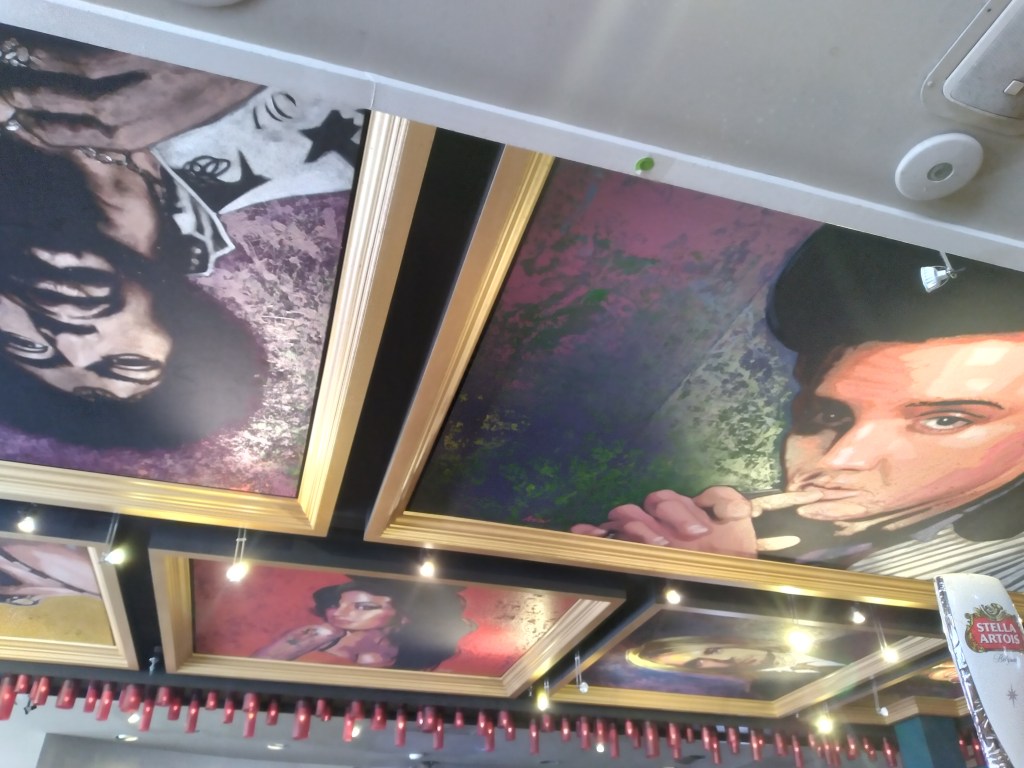
Above the bar of the Hard Rock Cafe on Beale Street in Memphis, TN.

But two years ago this month, Elvis’s only (maritally legitimate) grandson joined this club in what seems very possibly the product of bearing the burden of the King’s legacy. (Elvis himself died at age 42, which commentators in Room 237 (2012) have pointed out is a number that appears prominently in Kubrick’s version of The Shining.)

As part of the development of the theme of the Colonel being the devil, Las Vegas is rendered in Elvis as nothing less than a Hellscape in a truly Kingian fashion–the sweeping shots up the facade of the International Hotel to Elvis’s penthouse at the top felt like I was watching the Randall Flagg’s Vegas sequences in The Stand. The wheel-like ouroboros of consumption Vegas represents is evoked via emphasis on two of the Colonel’s favorite gambling devices, the roulette wheel and the slot machine. We’re informed at the film’s end that the Colonel spent the final years of his life “pouring” his fortune into the slot machines of the casino that had paid him that fortune to keep Elvis in residence there at the International Hotel. In this way Elvis’s first major-label single, “Heartbreak Hotel,” offers further (highly circumstantial) evidence that Elvis is part and parcel of the Africanist presence (carried over from Carrie) that explodes from the Overlook Hotel at the end of The Shining: Elvis offers a similar “index of the post-WWII American character,” as Jack describes the Overlook being in King’s novel:

“I had an idea of writing about the Overlook, yes. I do. I think this place forms an index of the whole post–World War II American character.” (boldface mine)

Stephen King, The Shining (1977).

An inextricable element of Elvis’s character embodies the type of “fluid duality” of Carrie White in the trigger moment the (Overlook’s) shadow explodes out of:

When you examine Elvis’s life in detail, however, you find countless instances of contradictory behavior that appear to spring out of a personality that was unconsciously dichotomous.

…It must not be thought that once the Bad Elvis started to emerge the Good Elvis began to recede. Quite the contrary: Both characters developed apace, alternating, like the faces on a turning coin. (84)

Basic to [Elvis’s ideal] pattern was the perfect positioning of his polar twins. Elvis the Bad acquired the classic punk look and began his evolution toward that Snarling Darling who would become eventually the greatest hero of rock ‘n’ roll. Elvis the Good moved off at this time in precisely the opposite direction. He elected to become a lay priest, a gospel singer, a dancer before the Lord. (p87, boldface mine)

Albert Goldman, Elvis (1981).

The symbolic concept of twins generally embodies “duality,” and one framework for duality that King likes to fall back on in his own critical analyses is Apollonian v. Dionysian–basically, rational v. emotional. These seem more like binaries that would qualify as symbolic “polar twins” than horror and humor per se, which would both likely be deemed more emotional, but they evoke the duality concept by being “seemingly oppositional elements,” as Magistrale puts it. King also locates Kubrick’s work at the site of a horror-humor nexus (that embodied in the Kingian “Laughing Place”–which is an “inhuman place that makes human monsters” as manifest in The Overlook in The Shining)–though notably omitting The Shining among his examples:

…an interesting borderline that I want to point out but not step over—this is the point at which the country of the horror film touches the country of the black comedy. Stanley Kubrick has been a resident of this borderline area for quite some time. A perfectly good case could be made for [Dr. Strangelove, A Clockwork Orange,] and for 2001: A Space Odyssey as a political horror film with an inhuman monster (“Please don’t turn me off,” the murderous computer HAL 9000 begs as the Jupiter probe’s one remaining crewman pulls its memory modules one by one) that ends its cybernetic life by singing “A Bicycle Built for Two.”

Stephen King, Danse Macabre (1981).

Chopped and Screwed

Elvis’s imprisonment in his Vegas residency by what Baz’s flick underscores is a “father figure” anticipates the parallel Vegas imprisonment of Britney Spears by her father…which Baz underscores in a mashup of Spears’ “Toxic” with Elvis’s “Viva Las Vegas.”
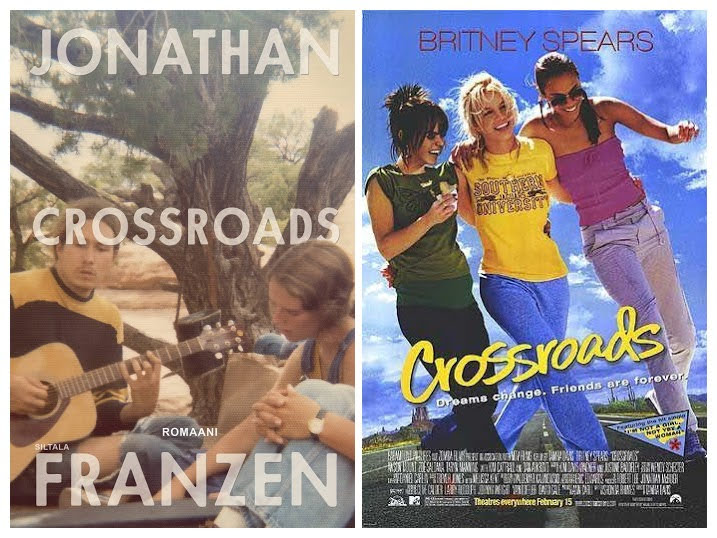
So it turns out that one of the prominent literal signs in Baz’s biopic…
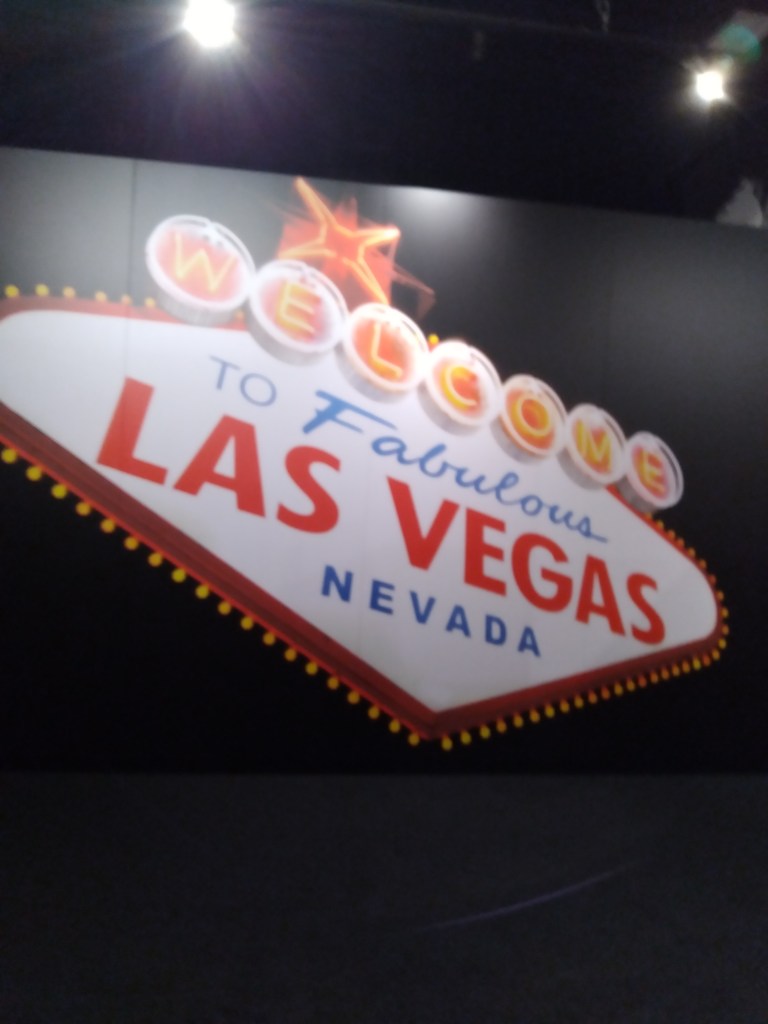
Exhibit at Graceland in Memphis, TN.

…is a sign of the devil. It’s funny to me that people would call the Colonel’s character “enigmatic” in Baz’s film portrayal because he’s basically unequivocally the devil. Tom Hanks’ version of the Colonel is even compared to South Park‘s Eric Cartman in one Reddit thread…
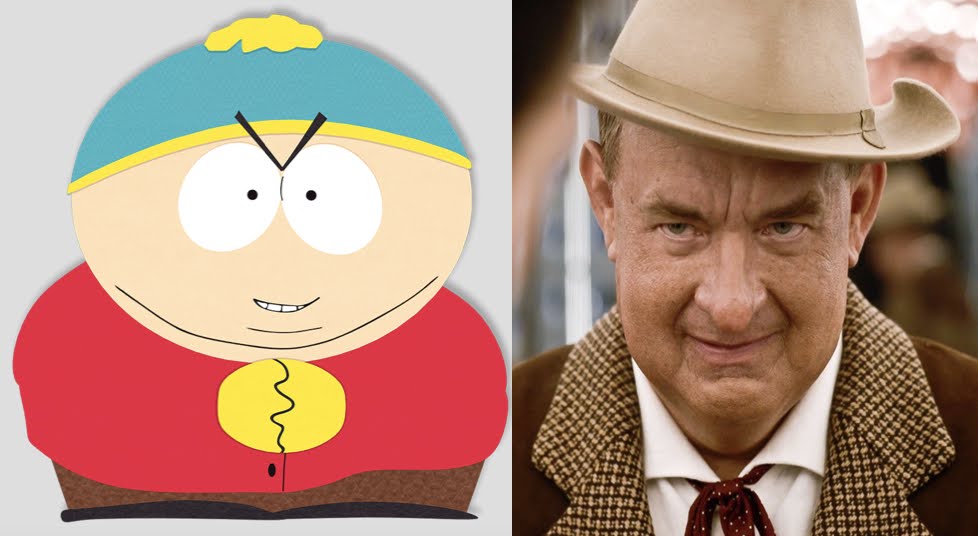
Eric Cartman and Tom Hanks as Colonel Tom Parker.

…and Eric Cartman is one of the most unequivocally evil/corrupted characters ever created. His name is an anagram for CRTN AMERICA. Eric Cartman is the embodiment of “Cartoon America”–that is, he’s the ethos of America embodied (or more specifically, the ugly underbelly that constitutes its psyche), which only a cartoon character could fully capture; it has to be “larger than life” because the spirit of a country is necessarily too large to be encapsulated in an individual physical body, unless that individual body is capable of transcending the boundaries of a “real” physical human body, a capability granted by the genre of animation. (Or maybe his name could also be “Carton America,” embodying America’s fast-food consumption…)

And what, ironically, is Elvis’s name an anagram of? “Evils.” And if you were wondering what the “B.B.” in B.B. King STANDs for…

Riley King…had quickly become more broadly identified by a less product-oriented label, first as the Singing Black Boy, then as the Singing Blues Boy, then as the Boy from Beale Street, until, finally, he was recognized simply as Bee Bee—transmitted to the world at large on his records as “B.B.”—King. (boldface mine)

Peter Guralnick, Sam Phillips: The Man Who Invented Rock n Roll (2014).

So we have three minstrel figures…
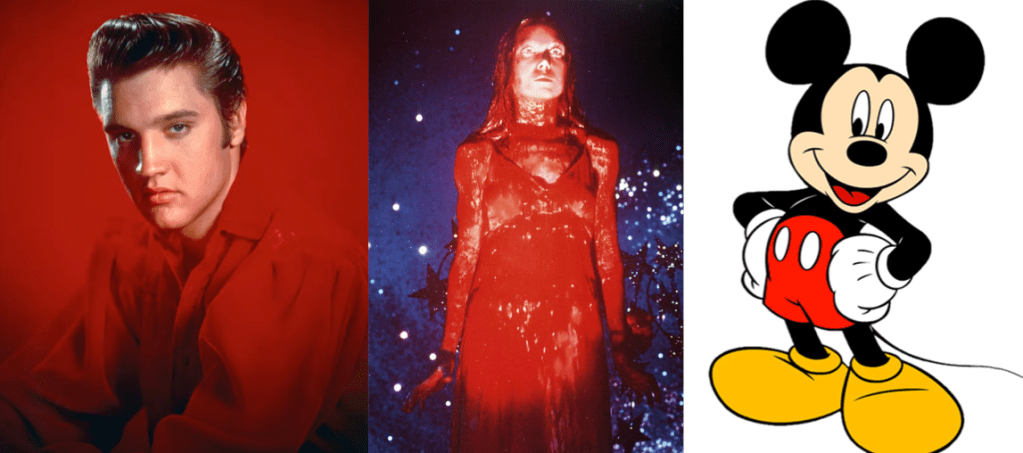
And if the media-savvy mass-disseminator of Elvis’s image (i.e., the Colonel) is a grotesque villain as he’s portrayed with just cause in Baz’s biopic, that would imply that the mass-disseminator he’s on par with (i.e., Disney) is also a grotesque villain…

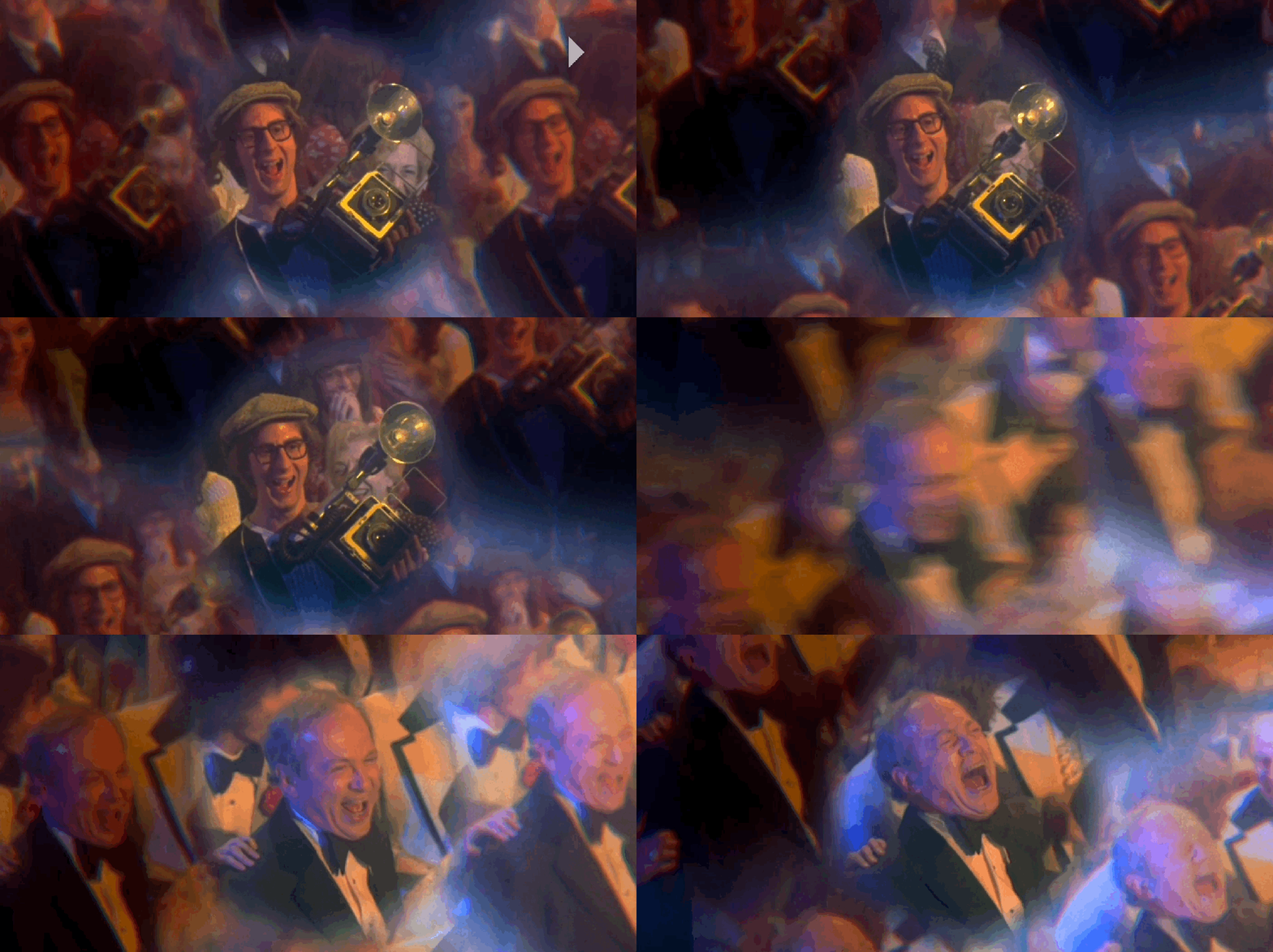
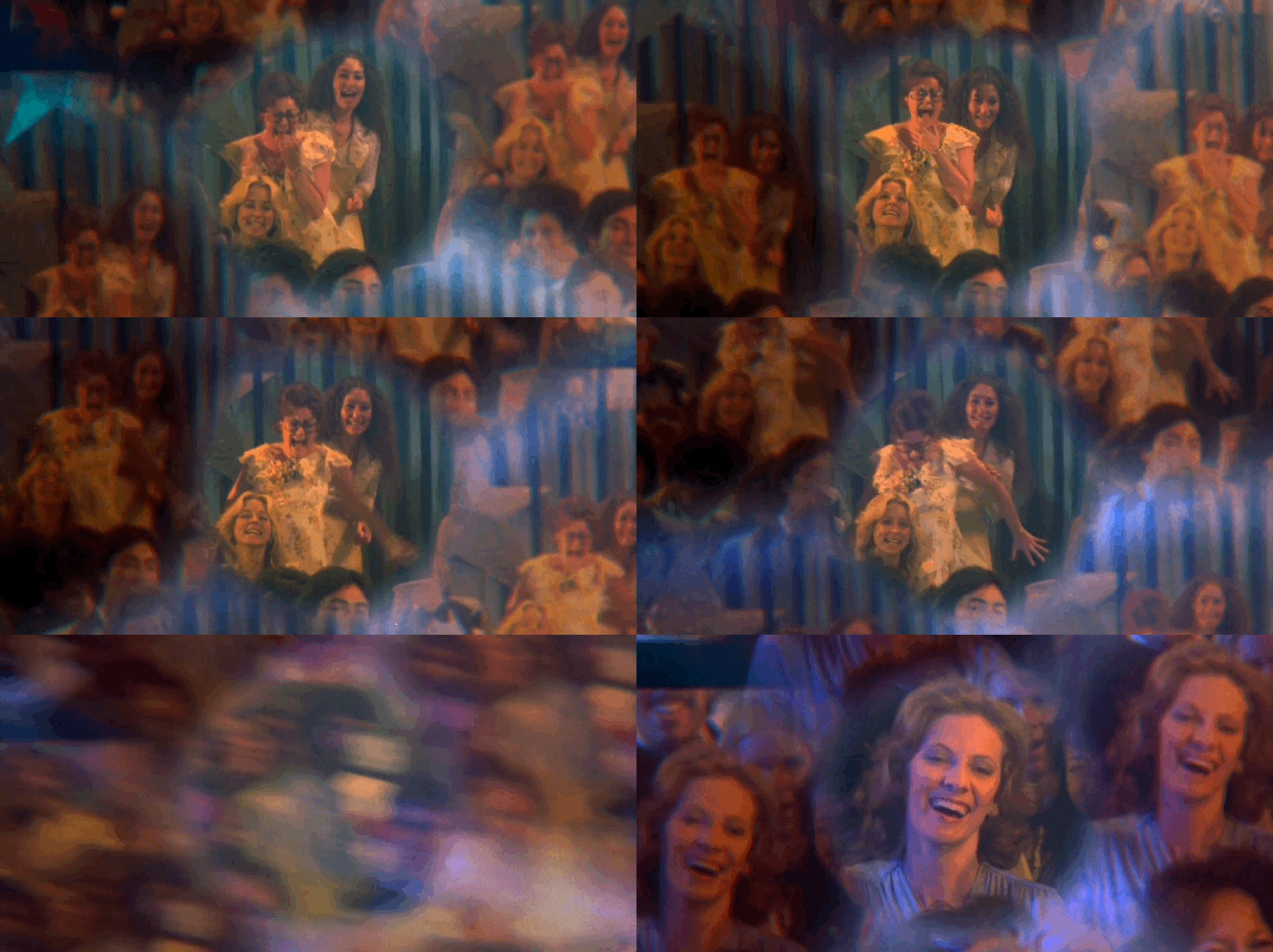
I’d argue Baz’s film also evidences the influence of De Palma’s Carrie (1976) via his liberal (but strategic) use of the split screen, which at one point explodes into innovative combinations of those De Palma shots I mentioned last time, the split screen and kaleidoscope–Baz chops and screws the screen not unlike some of the places he chops and screws the timeline.

But it was the triple-split screen that might be the most thematically impactful, specifically composed of young Elvis juxtaposed with older Elvis juxtaposed with Arthur Crudup, the Black blues artist who initially recorded Elvis’s breakout 1954 single “That’s All Right.” (Elvis recorded this breakout single at the age of nineteen, a number that becomes significant in King’s Dark Tower series seemingly because King himself started work on what would become that series at the age of nineteen.) Some cranky critics consider such cinematographic showmanship to be more style than substance:

“Elvis” is a cold, arm’s-length, de-psychologized, intimacy-deprived view of Presley that Luhrmann microwaves with quick cuts, montages of multiple images arrayed side by side, tricky lighting, huge sets, crowd scenes, and, above all, the frenetic onstage impersonation of Elvis that its star, Austin Butler, delivers.

Richard Brody, “‘Elvis’ Is a Wikipedia Entry Directed by Baz Luhrmann” (June 27, 2022).

This review says more about Brody than it does about Baz, with the irony that he sounds about as out of touch as the critics who wanted to throw Elvis in jail for the way he moved back in 1956. There’s a point made by Baz’s visual composition of the passage/evolution of a (musical) text through time that visually renders the history “buried” in music. Jordan Peele’s new movie appears to highlight the role and history of Blackness in cinematic movement, which in Memphis is linked to music history…
Twin Kings

Elvis and Stephen could be considered twin Kings based on a number of likenesses.
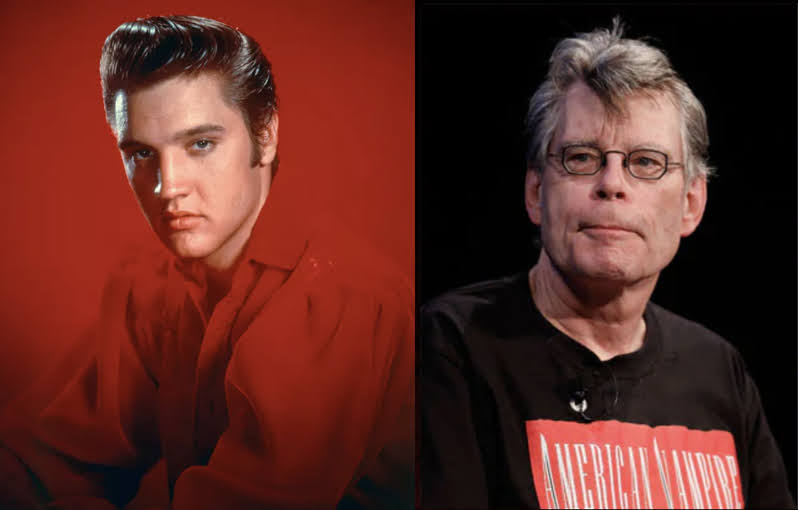
Both are icons in respective fields. Both reflect the American patriarchy. Both had close relationships with their mothers who died when both Kings were still relatively young, in their 20s. Both have relationships with Hollywood as a product of their primary career field. Both suffered from addiction. Both had recurring nightmares, and both had/have distinctive custom themed gates at the entrance of their estates (Stephen King’s gates were erected in 1982, the same year Graceland’s gates opened for public tours).
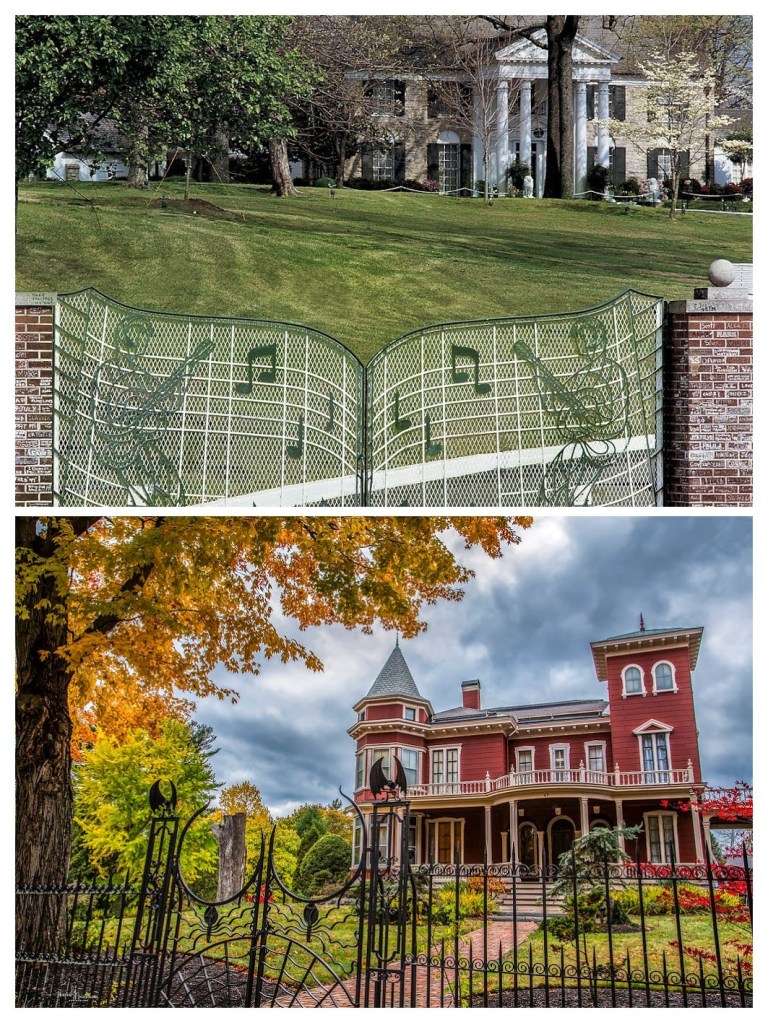
Elvis’s Graceland estate in Memphis, TN (top); King’s estate in Bangor, ME (bottom).

But the most significant parallel might be in how these twin Kings evince a stance indicative of the colorblindness that underwrites/facilitates our culture’s ongoing systemic racism…
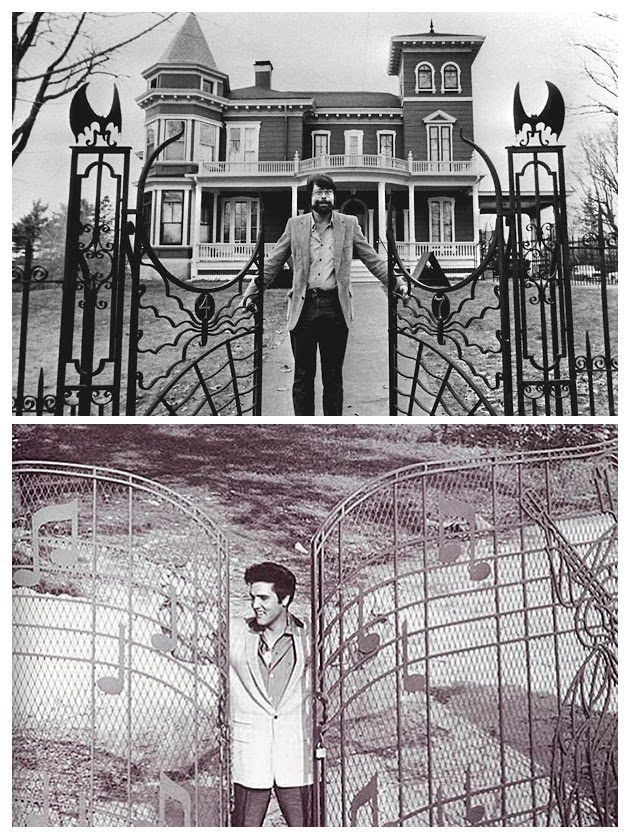
The Gatekeepers. Top: Stephen King opens the new gates to his bat-guarded Victorian home in this November 1982 photograph. BANGOR DAILY NEWS PHOTO BY CARROLL HALL. Bottom: Elvis at his new gates in 1957.

This stance obscures the existence of racism by way of being well-meaning. Elvis doesn’t understand why people would be upset at his way of moving/performing when Black people have always been doing it that way:

“…Them critics don’t like to see nobody win doing any kind of music they don’t know nuthin’ about. The colored folk been singing it and playing it just the way I’m doin’ now, man, for more years than I know. Nobody paid it no mind till I goosed it up.” (81)

Elvis quoted in Albert Goldman, Elvis (1981).

With this stance, Elvis evinces an ignorance of the racism that underlies this reaction to him, a white man, moving the way Black people do. When a white man moves in the “Black style,” he starts to erase a marker of the distinction between black and white that threatens the white-supremacist order. This aspect is aptly captured in the This is Elvis (1981) documentary in footage of a white man articulating his problem with Elvis’s type of music while standing next to a certain sign:
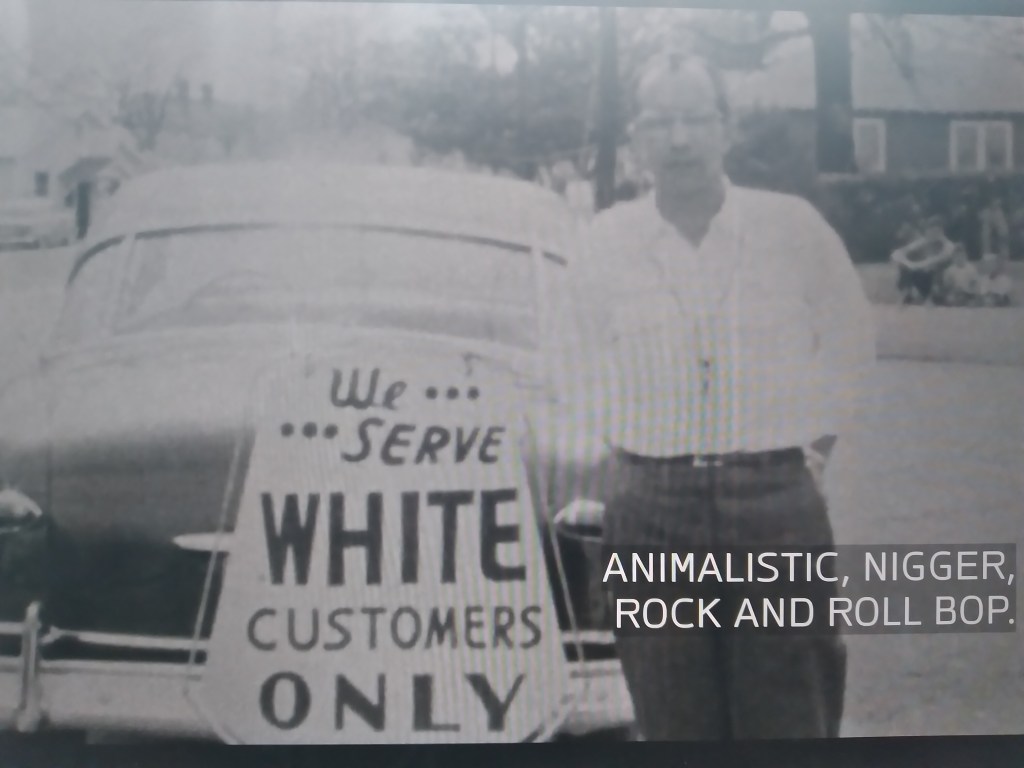
footage from the 50s in This Is Elvis (1981).

And is reminiscent of another likeness Eminem could have included on his Elvis soundtrack number “The King and I”:

…Eminem’s overbearing presence takes from rap more than it gives: it erases rap’s history before the film can reference it, overlooking or simply ignoring many of rap’s historical and cultural details. (boldface mine)

Roy Grundmann, “White Man’s Burden: Eminem’s Movie Debut in 8 Mile,” Cinéaste, Vol. 28, No. 2 (2003), p. 33. 

Historical erasure is a theme that provides one of the confluences between The Shining and Candyman

The Shining (1980).
Candyman (2021).

The idea of playing the HAND you’re dealt in life…

“Perfect imperfection” was [Sam Phillips’] watchword—both in life and in art—in other words, take the hand you’re dealt and then make something of it.

Peter Guralnick, Sam Phillips: The Man Who Invented Rock n Roll (2014).

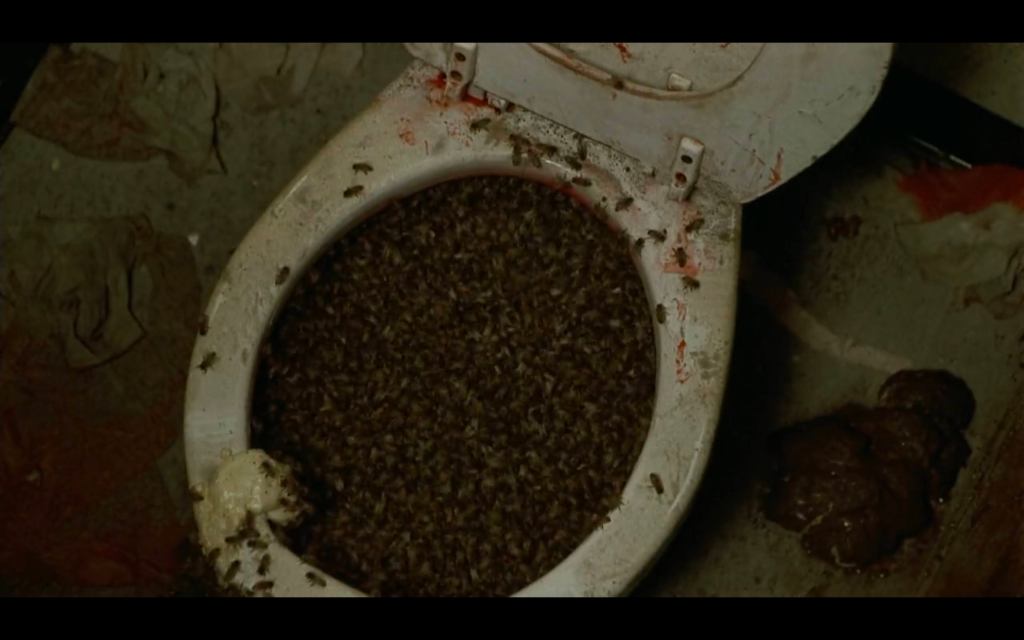
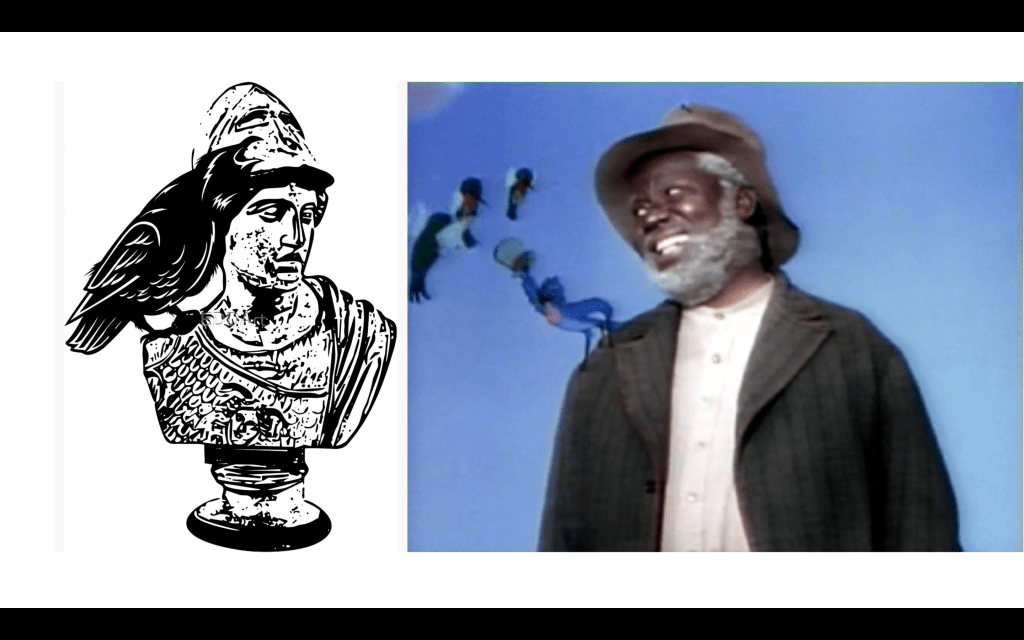
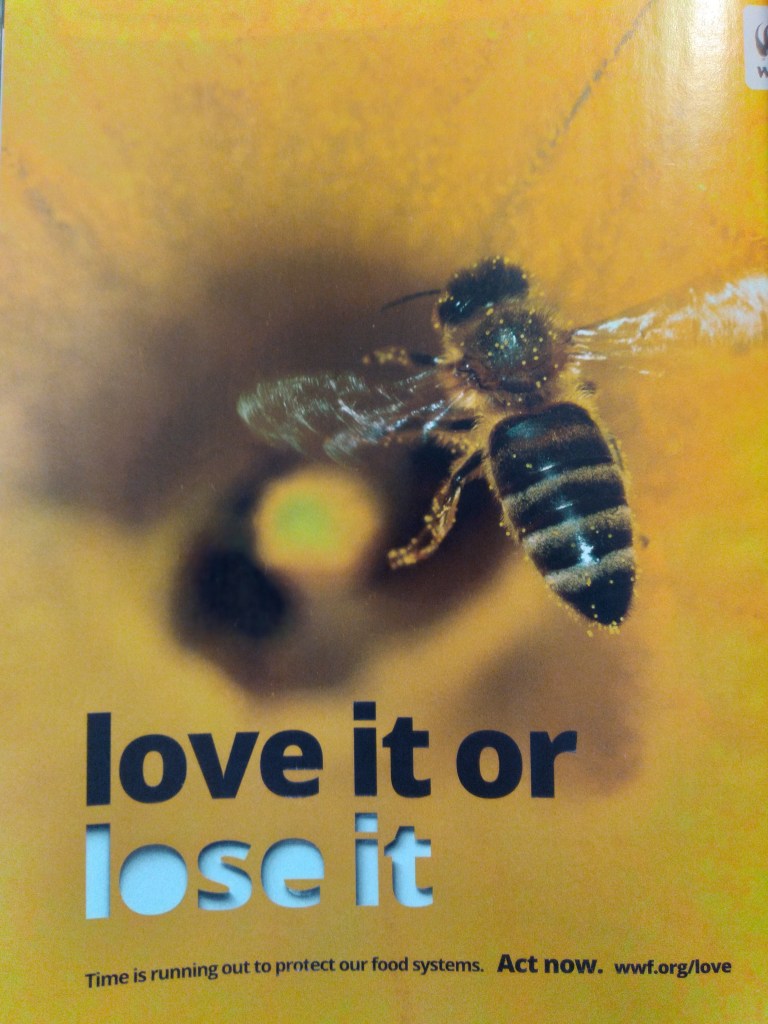
…echoes the concept of colorblindness as a sort of false narrative erasing white privilege, and, in invoking playing cards, will relate to the underwriting connection between Alice in Wonderland and The Shining, that text which presents us with our first example of that well-documented phenomenon of King’s well-meaning but still racist depictions of Black characters, the “Magical Negro.” Jordan Peele outlines the quintessential examples of this Kingian trope in a setup to a Shining spoof on Key and Peele in the episode “Michael Jackson Halloween” (October 31, 2012), during which Peele identifies the insects that come out of John Coffey’s mouth–a symbol of people’s evil nature/horrible pain sucked out of them–as BEES…
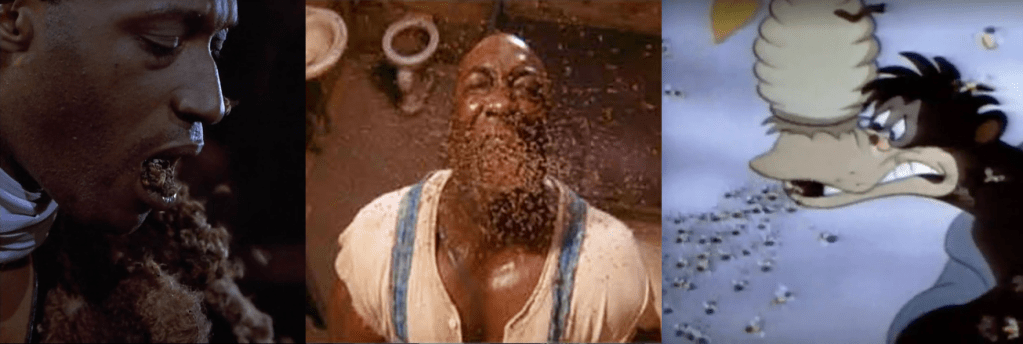
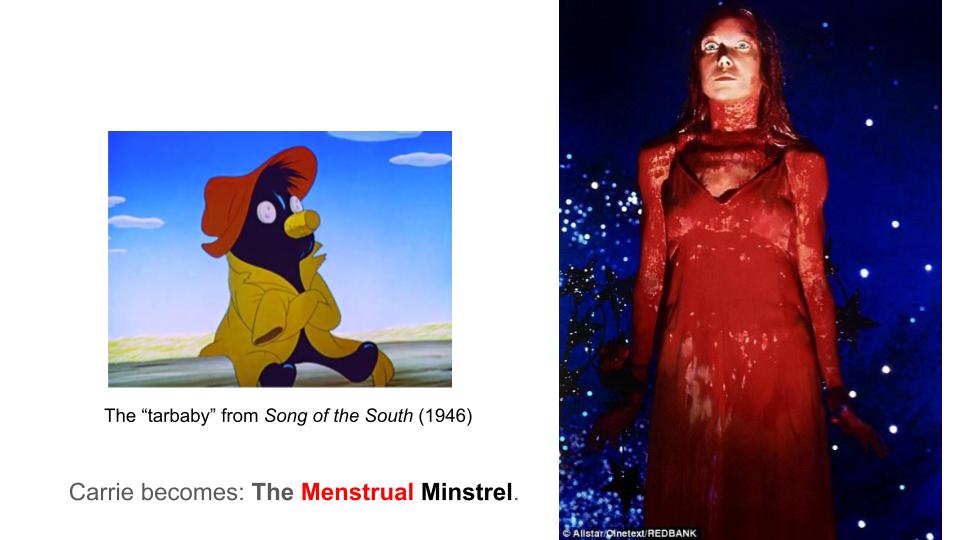
The ’92 Candyman, ’99 John Coffey, and ’46 Brer Bear

And in King’s The Shining, we’re going to meet the bee’s evil twin: the wasp.

OverlooKing the Rabbit Hole

The Shining is another text in which the Disney influence on King is palpable in King–though it’s arguable if the motif that emerges related to Alice in Wonderland is more based on the Disney version or Lewis Carroll’s source text. What is clear is that the influence of Alice on our culture is pretty major: Jefferson Airplane’s “White Rabbit,” Go Ask Alice (1971), Susan Sontag’s play Alice in Bed (1991), and The Matrix (1999) all invoke it.

The function of the hedge animals in The Shining are an interesting critteration through the lens of Sarah Nilsen’s “creatureliness” aspect: here are inanimate facsimiles of animals that become horrific when they start acting like “real” animals (i.e., become animate). It turns out that technically these hedge animals are, arguably, the device that underwrites The Shining‘s entire plot–i.e., a necessitating element or starting point without which the rest of the narrative cannot unfold, as is the white rabbit that Alice follows down the hole. (To which Jack Torrance’s first published story, “Concerning the Black Holes,” might constitute a racialized connection; in The Shining, the Rabbit Hole is a Black Hole.)

We learn that the hedge animals are the reason Jack Torrance gets the job as Overlook Hotel caretaker because…

“Those animals were what made Uncle Al think of me for the job,” Jack told him. “He knew that when I was in college I used to work for a landscaping company. That’s a business that fixes people’s lawns and bushes and hedges. I used to trim a lady’s topiary.”

[he and Wendy laugh about this…]

“They weren’t animals, Danny,” Jack said when he had control of himself. “They were playing cards. Spades and hearts and clubs and diamonds. But the hedges grow, you see—”

(They creep, Watson had said … no, not the hedges, the boiler. You have to watch it all the time or you and your fambly will end up on the fuckin moon.)”

Stephen King, The Shining (1977).

Here we see that an Uncle figure, Uncle Al, is the underwriter of Jack’s caretaker job–underwriter in the traditional, financial sense of the term–and thus the generative underwriter of the novel’s entire plot. His name could be an homage to the figure of Alice, who’s been invoked directly in the text by this point, and playing cards are a big motif in Alice in Wonderland, with the Red Queen’s playing-card soldiers (i.e., animate playing cards).
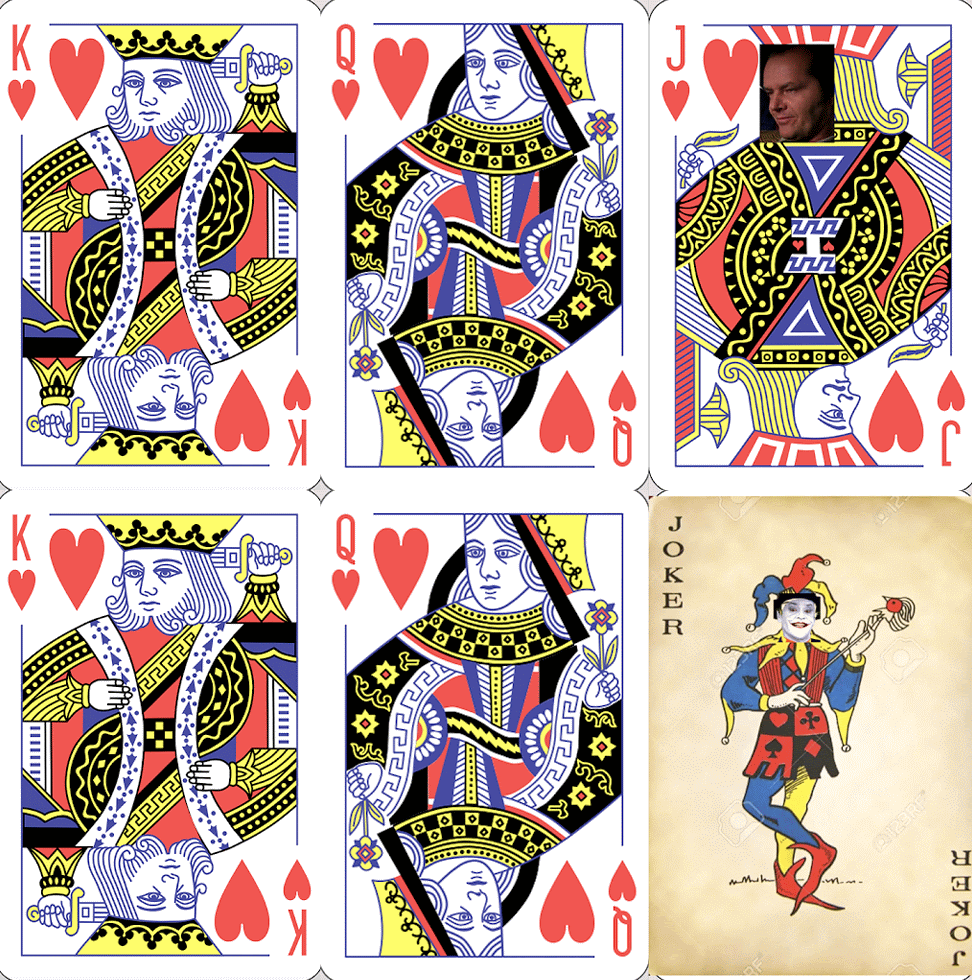
Further, that Jack conflates the hedges with the boiler becomes significant in light of the latter’s climactic explosion and the “shadow exploded” concept…

He walked over to the rabbit and pushed the button on the handle of the clippers. It hummed into quiet life.

“Hi, Br’er Rabbit,” Jack said. “How are you today? A little off the top and get some of the extra off your ears? Fine. Say, did you hear the one about the traveling salesman and the old lady with a pet poodle?”

His voice sounded unnatural and stupid in his ears, and he stopped. It occurred to him that he didn’t care much for these hedge animals. It had always seemed slightly perverted to him to clip and torture a plain old hedge into something that it wasn’t. (boldface mine)

Stephen King, The Shining (1977).

Animating the inanimate is a relatively common device to evoke horror. Kubrick famously changed the hedge animals in the novel to the hedge maze in the film, which he seems to have done by way of observation of the prominence of Alice in Wonderland in the source text…
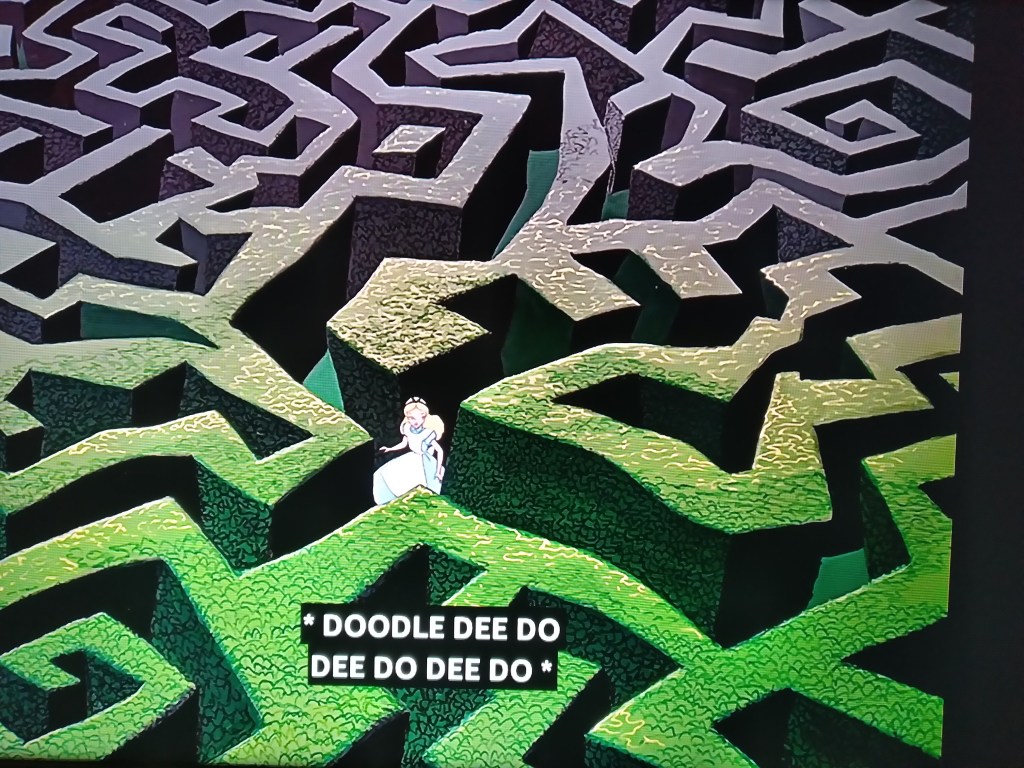
Disney’s Alice in Wonderland (1951).

And there’s bee imagery associated with the Red Queen via the pattern of her black-and-yellow garb…
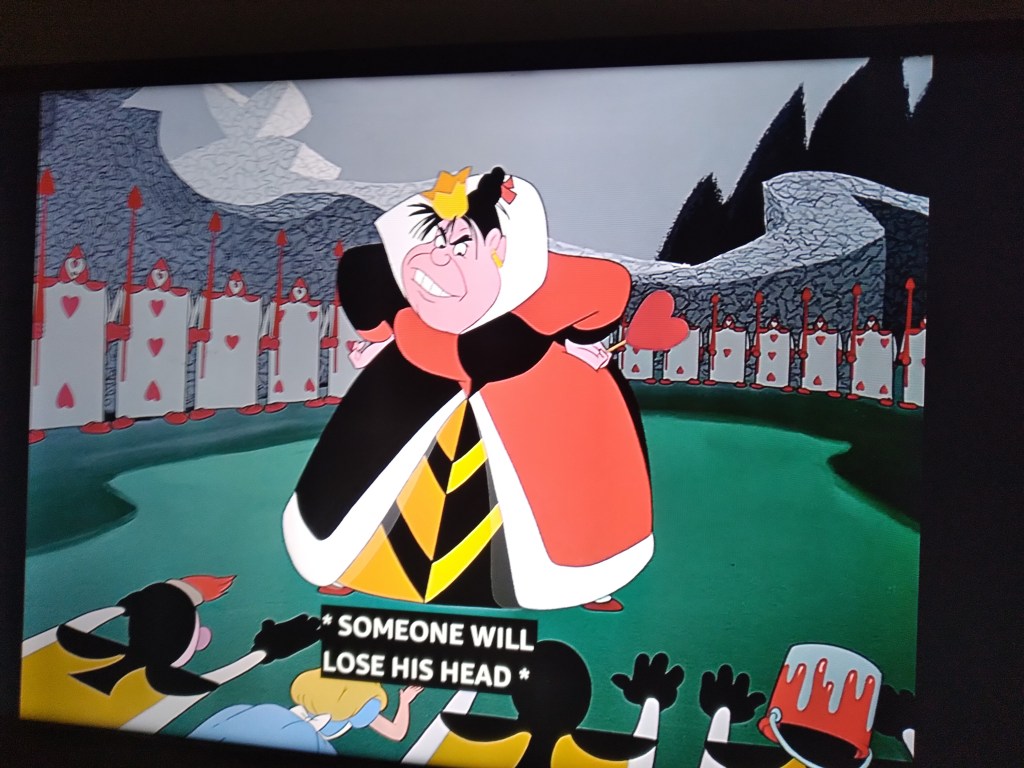
Disney’s Alice in Wonderland (1951): the evil Queen Bee evokes the horrors of the matriarchy.

The Queen Bee, which Chris Hargensen is also an example of a “type” of as defined in Rosalind Wiseman’s 2002 study (with her book on these teen types being the basis for Mean Girls (2004)), a type that is by definition evil. This then imparts that a matriarchy would be horrific, thus reinforcing the patriarchy.
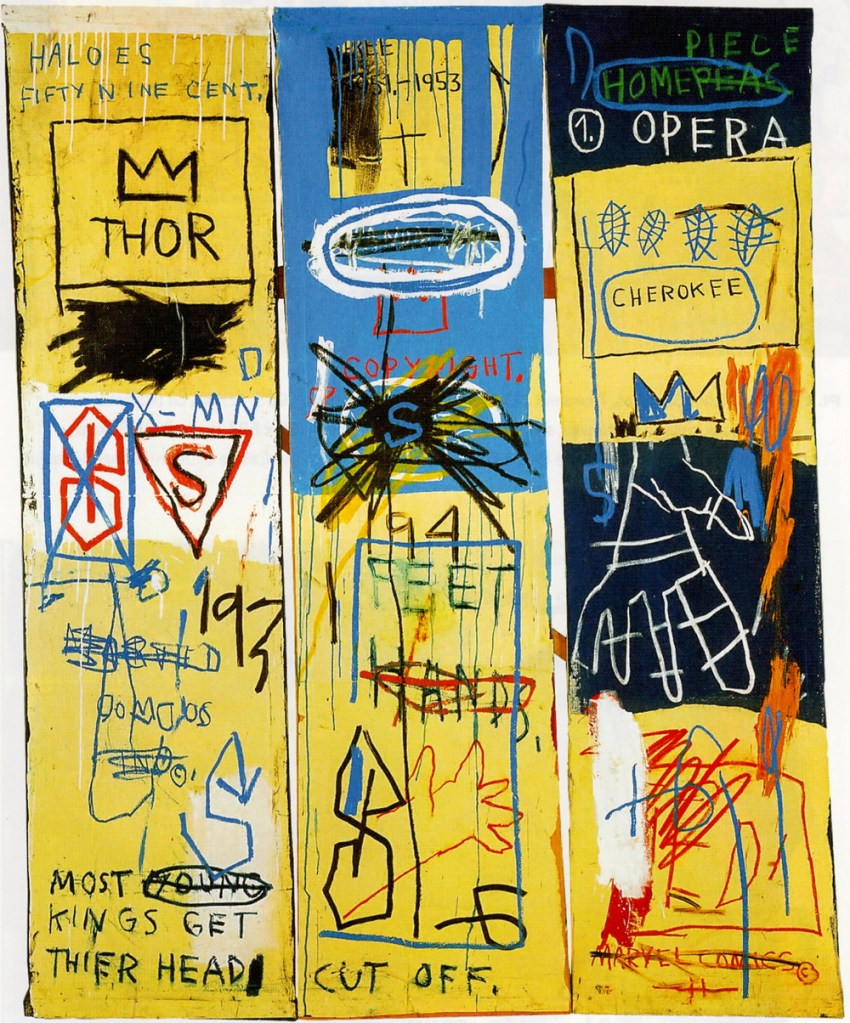
Charles the First by Jean-Michel Basquiat (1982).

It’s also interesting that in Disney texts, queens are evil while princesses are the ideal…

Via animal comparisons/creatureliness/critterations, overlapping themes of “laboring bodies” surface here again via rhetorical justifications/contortions of who is and is not a “person/human” that resonate with the abortion debate (white people had to rhetorically dehumanize those they wanted to enslave, i.e., “slaves” are not considered human the same way one side of the abortion debate does not consider fetuses “human”). These hedge animals manifest the evil spirit/ghost of the Overlook itself when they start to come “alive,” but before they do, a different “critter” (according to Orwell’s animal-defining paradigm in Animal Farm from Part I) manifests the Overlook ghost: wasps, or “wall wasps” as Jack refers to them at one point.

Wasps are invoked as a symbol of savagery underlying civilized veneers, and are shown to manifest powers to manipulate psychologically via being vehicle that reveals Jack’s backstory, and to manipulate physically by being the first undeniable physical manifestation of a supernatural element when wasps come back from the dead, but still an ambiguous/deniable one via the possible explanation that the “poison” Jack uses on them is defective. As the wasps manifest the Overlook ghost by haunting Jack via his personal history, they also, in this same capacity, as I previously discussed here, reveal the lack of individual characterization that King’s first “Magical Negro” figure, Dick Hallorann, gets. (I also noticed looking at the wasps this time around that the wasps in Jack’s childhood memory are in a nest up in an apple tree, while the wasps that Hallorann’s childhood memory are in a ground nest.)

I initially thought that in manifesting as a sign of the novel’s “evil” presence of the Overlook ghost(s), this same presence figured in the wasps would manifest “signs” of being an Africanist presence, but then the wasps actually seem a sign of something else:

Jack enters most fully into the ghostworld of the Roaring Twenties (instead of his son and wife, too), as Magistrale evinces, because Jack most wants what the 1920s offers adult male WASPS: booze, flappers, unquestioned freedom, and an embarrassment of riches without an embarrassment of one’s (retreating) ethics. (boldface mine)

Danel Olsen, “‘Cut You Up Into Little Pieces’: Ghosts & Violence in Kubrick’s The Shining,” Violence in the Films of Stephen King (ed. Magistrale and Blouin, 2021).

It makes perfect sense: wasps as a sign of a white-supremacist presence: such a satisfying sibilance.

The mallet (which Kubrick changes to an ax)…
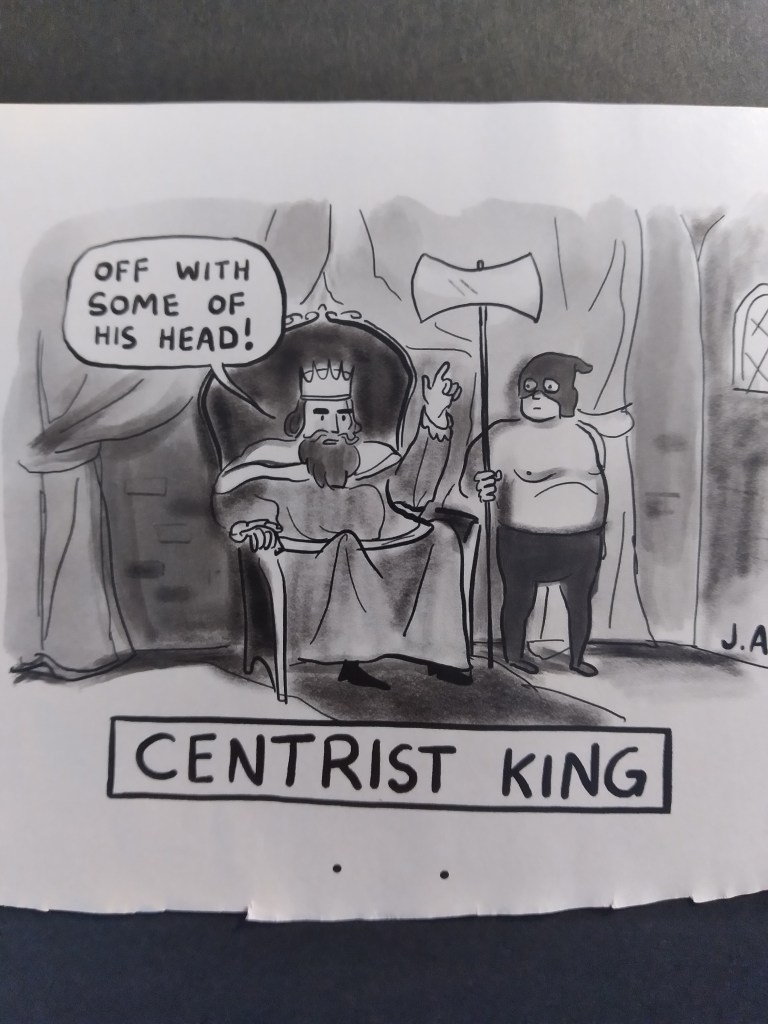
…appears to be another sign of the presence of Alice in Wonderland via the croquet in that text. The mallet does not function in the sense of a traditional weapon therein, nor does a traditional weapon of force exist so much as a manipulation of rules. This is only one aspect of the rhetorical manipulation Alice comments on…if not Disney:

Well before Kafka and George Orwell, who dismantled the mechanisms of Fascism and Communism, Lewis Carroll exposed the mainspring of totalitarian powers: manipulating language, twisting words to make them signify the opposite of what they mean in order to grab and manipulate minds. (boldface mine)

Bruckner, Pascal, and Nathan J. Bracher. “On Alice in Wonderland.” South Central Review, vol. 38, no. 2-3, 2021.

Such manipulation of language is also a major hallmark of legal rhetoric…the pattern in the Alice stories of characters harping on literal meanings brought to mind the semantic manipulations of Bill Clinton during his impeachment interrogations (“it depends on what the meaning of ‘is’ is”). Such legal-language wrangling lurks in a particular description of wasps in the novel:

A few wasps were crawling sluggishly over the paper terrain of their property, but they were not trying to fly. From the inside of the nest, the black and alien place, came a never-to-be-forgotten sound: a low, somnolent buzz, like the sound of high-tension wires.

Stephen King, The Shining (1977).

WASPs exert power via property ownership via manipulations of legal rhetoric manifest on the paper of “official” documentation, violence enacted via paper, implicit rather than explicit force.

So the wasps represent/manifest the ghost of the Overlook Hotel, and “the hotel represents the successful epitome of white male domination over all other races and women” as Tony Magistrale and Michael J. Blouin put it in their 2020 study, Stephen King and American History (pp. 90-91, boldface mine). The wasps as a sign of a white-supremacist presence fits with the excessive racial slurs the Overlook ghost projects in Hallorann’s mind to try to deter him from coming to help.

This white-supremacist presence should, in theory, be oppositional to the Africanist presence that’s become associated with the bee–so, wasp v. bee. Yet by Orwell’s Animal Farm paradigm, wasps and bees should manifest versions of the same thing/presence rather than opposing forces. But bees manifesting an Africanist presence by way of being a “laboring body” that produces honey led me to google whether wasps also made honey:

NO. Wasps steal honey in large amounts if they can get access to a bee-hive but usually they are carnivores, feeding on larvae and small insects. They have powerful jaws to chew up chitinous insects. A most unpleasant sight is to see a wasp neatly cut a honey bee in half and fly away with the abdomen section, leaving the poor bee’s head and thorax still alive and walking about. Wasps do not in fact store anything. Their paper-like combs are only used to rear wasp larvae.

From here.

Jack himself also specifies a distinction between bees and wasps in their ability to inflict harm:

Wasps don’t leave them in. That’s bees. They have barbed stingers. Wasp stingers are smooth. That’s what makes them so dangerous. They can sting again and again.” (boldface mine)

Stephen King, The Shining (1977).

And if there was any doubt the wasps are linked to the haunted Overlook presence:

…he didn’t like the Overlook so well anymore, as if it wasn’t wasps that had stung his son, … but the hotel itself. (boldface mine)

Stephen King, The Shining (1977).

There’s a fluid duality across this bee-wasp symbolism in stinging ability as well in being aligned by way of the Orwellian paradigm, but opposed by way of certain biological distinctions. There’s also a fluid duality within the wasp itself in being a more personal/individually relevant symbol (for Jack Torrance) or general symbol (Overlook/imperialism). (In a 2020 podcast on King’s The Stand, The Company of the Mad, Jason Sechrest notes that he interpreted the wasps as symbolic of Jack’s anger, but then he potentially undermines this reading in which this symbolism is limited to Jack’s individual character when he points out that in The Stand, the dog Kojack also is described as having wasps in his head in a similar way.)

In The Shining, King evokes Jack’s individual anger most vividly in conjunction with the sport of football:

Football had provided a partial safety valve, although [Jack] remembered perfectly well that he had spent almost every minute of every game in a state of high piss-off, taking every opposing block and tackle personally. He had been a fine player, making All-Conference in his junior and senior years, and he knew perfectly well that he had his own bad temper to thank … or to blame. He had not enjoyed football. Every game was a grudge match.

Stephen King, The Shining (1977).

Much has been made of a certain sweater of Danny’s in Kubrick’s version…
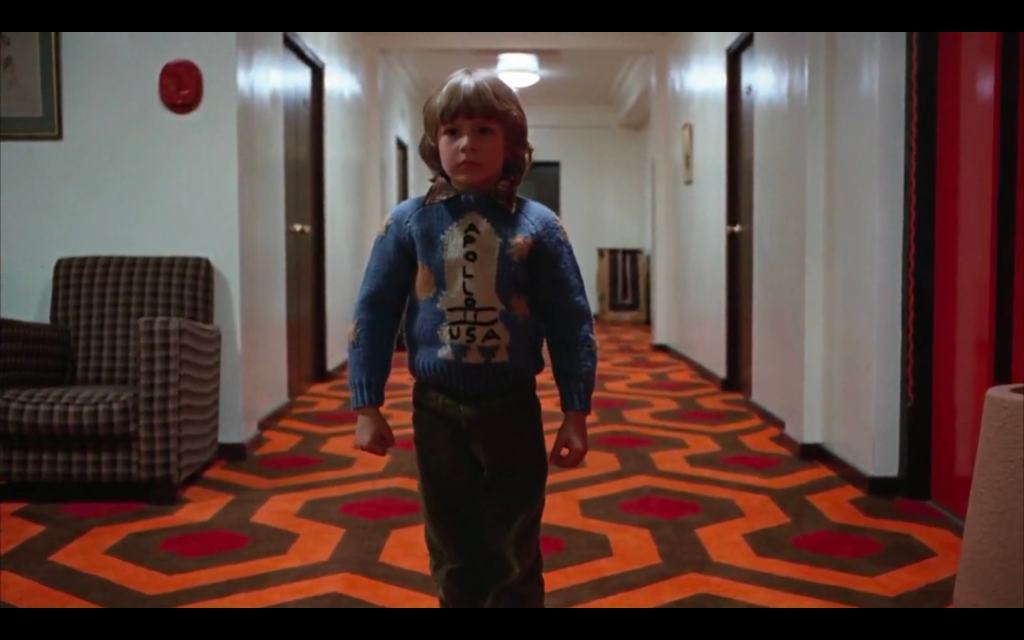
The Shining (1980).

But in light of the relevance of football to Jack’s anger in the source text, perhaps this one is also important:
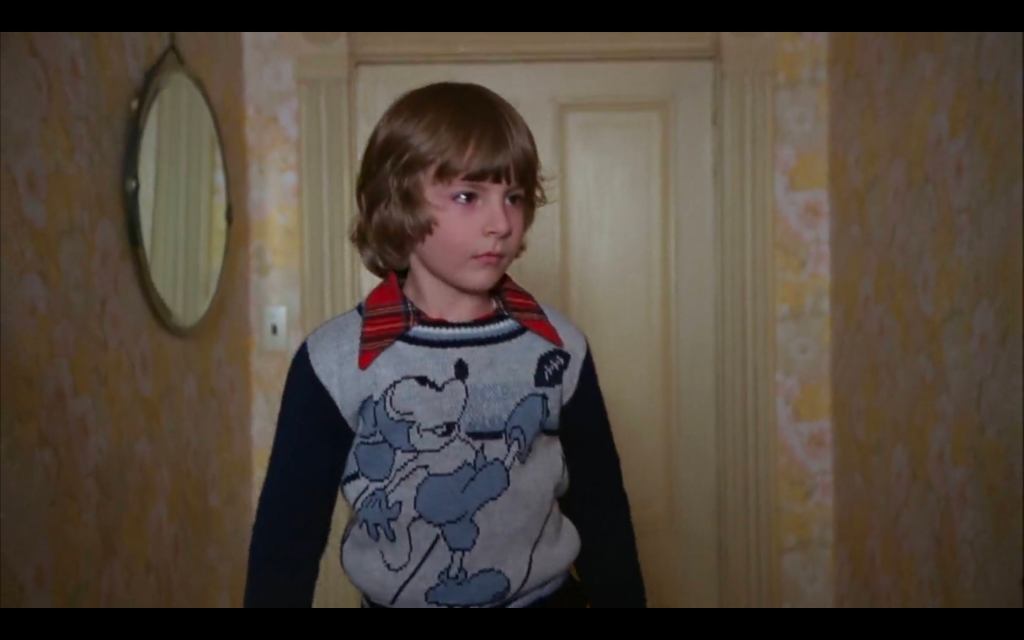
The Shining (1980).

Then the wasps start to manifest their own fluid duality in another way. It turns out there is a species of wasps that don’t sting, not “wall wasps,” but “gall wasps,” as I learned from a recent article in my alumni magazine about the discovery of a new type of this species of non-stinging wasp on the Rice campus outside of its graduate-student pub, a pub that is named for a Norse god that will now become the namesake for these wasps as well, with the headline in the print magazine reading “Cheers to the Valhalla Wasp,” and a description that notes it “spends 11 months of the year locked in a crypt.”

A new species of the gall…a different type of wasp (from here).

This is not the first time a new gall species of wasp has been discovered at Rice (an earlier article documents the parasitic tendencies of this species in terms out of a horror movie), but as the latter discovery was unfolding, I was also in the process of discovering a new type of wasp: one that’s capable of mutating. This type transmutes from white-supremacist to Africanist, thereby embodying how this binary exists in all single/individual bodies, as one is predicated on the other, and thus symbolizing, per Morrison, the inextricability of the Africanist presence to the white-supremacist one.

The transmutation in The Shining‘s wasp references occurs in chapter 33, “The Snowmobile,” which comes right before chapter 34, “The Hedges.” (So the snowmobile becomes the vehicle for the transmutation.) If Jack undergoes a transition in the process of being possessed by the Overlook, transitioning from loyalty to his family unit to loyalty to the forces of the hotel, the wasp symbolism transitions with him. Early on, while Jack is still loyal to his family, he initially encounters the wasps as an entity that pose a threat to the family, one that does enact harm by stinging Danny’s hand. In enacting this harm, the wasps are aligned with or carrying out the (evil white-supremacist) will of the Overlook. By chapter 33, Jack’s loyalties are passing the tipping point so that he’s no longer loyal to his family but now to the hotel. And in this chapter, the snowmobile is extensively compared to a wasp:

The snowmobile sat almost in the middle of the equipment shed, a fairly new one, and Jack didn’t care for its looks at all. Bombardier Ski-Doo was written on the side of the engine cowling facing him in black letters which had been raked backward, presumably to connote speed. The protruding skis were also black. There was black piping to the right and left of the cowling, what they would call racing stripes on a sports car. But the actual paintjob was a bright, sneering yellow, and that was what he didn’t like about it. Sitting there in its shaft of morning sun, yellow body and black piping, black skis, and black upholstered open cockpit, it looked like a monstrous mechanized wasp. When it was running it would sound like that, too. Whining and buzzing and ready to sting. But then, what else should it look like? It wasn’t flying under false colors, at least. Because after it had done its job, they were going to be hurting plenty. All of them. By spring the Torrance family would be hurting so badly that what those wasps had done to Danny’s hand would look like a mother’s kisses.

…It was a disgusting thing, really. You almost expected to see a long, limber stinger protruding from the rear of it.

Stephen King, The Shining, 1977.

Now this wasp-like entity does not pose a threat to the family as the wasps did previously, but rather a hope for the family in the snowmobile-wasp being a means of escape–thus the wasp is now associated not with a threat to the family, but has transmuted to being associated with a threat to the Overlook. Instead of doing the Overlook’s harmful bidding, the figurative wasp now manifests a threat to the Overlook’s will, so the wasps are now opposed to the white-supremacist spirit of the hotel, which means they can be read as manifesting its opposite, an Africanist presence.

Which brings us to another sign of the white-supremacist presence: snow. Morrison notes that no writer is more important to “American Africanism” than Edgar Allen Poe, and Poe is arguably as important a literary underwriter of The Shining as Alice in Wonderland, via a direct epigraph; the novel could be considered a mashup of Alice in Wonderland and Poe’s “The Masque of the Red Death.” (And King could be considered a mashup artist not unlike that which Baz’s construction of Elvis reveals both Baz and Elvis to be.)

Snow would count as what Morrison uses a couple of variations in term for: “figurations of impenetrable whiteness,” “images of impenetrable whiteness,” and “images of blinding whiteness.” Snow would seem to manifest a white-supremacist presence in its threat to blot out all in whiteness. (Baz also echoes these themes of snow as a sign of a white-supremacist presence in his treatment of the Colonel as a villainous “snowman,” with the term being synonymous for “conman.”) In keeping with the Overlook ghost being a white-supremacist presence by virtue of its historical ghosts and evils being the byproducts of the white-supremacist capitalist patriarchy, the snow is a means through which the Overlook can trap its occupants. (Snow will play a similar negative threatening role in Misery, whose importance will be even more significant in underwriting that novel’s plot than The Shining‘s, and in keeping with the fact that both of the plots in which the snow plays a significant role take place in the same geographical vicinity of Sidewinder, CO.)

If The Shining offers ample evidence of Poe’s ample influence on King, it’s just the tip of the iceberg, as it were. In the ’03 Hollywood’s Stephen King interview, Magistrale asks King about the influence of the “Poepictures” on his work, quoting a term King uses in On Writing and asking whether the film adaptations of Poe’s stories or the written stories themselves had more of an influence on him; King claims the latter, though noting The Masque of the Red Death is the best of the Poepictures, as well as the influence of the images of their “scare moments,” noting in particular the concluding image of The Pit and the Pendulum, which resonates with the Carrie trigger moment in being an image whose evocativeness is contingent on the way eyes look:

All you see are the horrified eyes of Barbara Steele gazing out through a small opening in the contraption that encases her.

Tony Magistrale, Hollywood’s Stephen King (2003), p11.

King further reveals a preoccupation with the way eyes look in a discussion of The Creature from the Black Lagoon (1954) via an image also associated with some of the recurring elements in this ongoing discussion of the Kingian Laughing Place (mud and walls):

…the image that remains forever after is of the creature slowly and patiently walling its victims into the Black Lagoon; even now I can see it peering over that growing wall of mud and sticks.

Its eyes. Its ancient eyes.

Stephen King, Danse Macabre (1981).

This brings us to another major tenet of The Shining‘s plot and themes, the idea/refrain that “the pictures in a book…couldn’t hurt you.” This is Hallorann’s claim to Danny about the hotel’s ghosts, and of course, Hallorann turns out to be very wrong about this. But the general idea resonates with the opening of Carroll’s first book on Alice:

Alice was beginning to get very tired of sitting by her sister on the bank, and of having nothing to do: once or twice she had peeped into the book her sister was reading, but it had no pictures or conversations in it, “and what is the use of a book,” thought Alice, “without pictures or conversations?”

Lewis Carroll, Alice’s Adventures in Wonderland (1865).

This is an idea Disney also emphasizes in its opening, changing the interaction from being with Alice’s sister to being with her tutor, who is trying to use a book to teach Alice lessons. It’s also part and parcel of an idea I emphasize in my composition classes when I have students rhetorically analyze visual texts, in particular the ethics of visual texts, with the overall lesson being, as The Shining demonstrates, that the pictures in a book could hurt you.

When we analyze the ethics of visual texts, I emphasize that this amounts to analyzing the ethics of the overall message(s) the text is imparting to its viewers. I have to warn the students, by way of the repetition of a refrain, not to fall into the TRAP of stopping short at evaluating the ethics of the actions of the characters themselves (that is, just because a character in the text does something unethical, that does not necessarily/automatically make the overall text itself unethical). In Through the Looking Glass, Carroll’s sequel to the original Alice’s Adventures in Wonderland, there is a specific category of “messenger”: “those queer Anglo-Saxon Messengers.” These messengers impart an “attitude” that Carroll’s text conflates with physical gesture:

“But he’s coming very slowly—and what curious attitudes he goes into!” (For the messenger kept skipping up and down, and wriggling like an eel, as he came along, with his great hands spread out like fans on each side.)

“Not at all,” said the King. “He’s an Anglo-Saxon Messenger—and those are Anglo-Saxon attitudes. He only does them when he’s happy. …”

…the King said, introducing Alice in the hope of turning off the Messenger’s attention from himself—but it was no use—the Anglo-Saxon attitudes only got more extraordinary every moment, while the great eyes rolled wildly from side to side. (boldface mine)

Lewis Carroll, Through the Looking Glass (1872).

WASP alert…the snowmobile sequence in chapter 33 has a weird potentially Protestant emphasis when part of what constitutes this as a critical turning point for Jack is his looking at the hotel and thinking its windows LOOK LIKE EYES, and this facilitates the epiphany that in turn facilitates Jack’s transition in loyalties, specifically the epiphany “that it was all true”–i.e., that the Overlook’s ghosts are indeed “real.” This epiphany is underscored by a memory digression in which Jack recalls “a certain black-and-white picture he remembered seeing as a child, in catechism class” presented by a nun:

The class had looked at it blankly, seeing nothing but a jumble of whites and blacks, senseless and patternless. Then one of the children in the third row had gasped, “It’s Jesus!” …

…What had only been a meaningless sprawl had suddenly been transformed into a stark black-and-white etching of the face of Christ-Our-Lord. … The face of Christ had been in the picture all along. All along. (boldface mine)

Stephen King, The Shining (1977).

This objective correlative for the Overlook ghost(s) really being there “all along,” which the novel’s narrative bears out as “true,” or “real,” thus seems to reinforce that Jesus is “real/true” in a similar way–except it’s not actually Jesus himself that’s really there, but, Magritte-like, only a picture of him. So this sequence could be read as underscoring not a Protestant deity as “real,” but only the belief in it as such (while at the same time iterating a biblical Genesis narrative of the gaining of world-changing knowledge). The passage also underscores a fluidity underlying what should be the opposite of fluid, the “black-and-white picture,” since “black-and-white” is supposed to mean clear-cut–yet more often, it’s muddy, concealing more beneath the surface encountered initially.

The Keys to the Kingdom

It’s dramatic irony that Danny is the one who is told the ghosts can’t hurt him, when he himself is specifically the “key” to their gaining the ability to do so. Though as we’ll see, the Overlook Hotel, or its ghost(s), in addition to the bee, is also a key to the Africanist presence that explodes through the King canon…

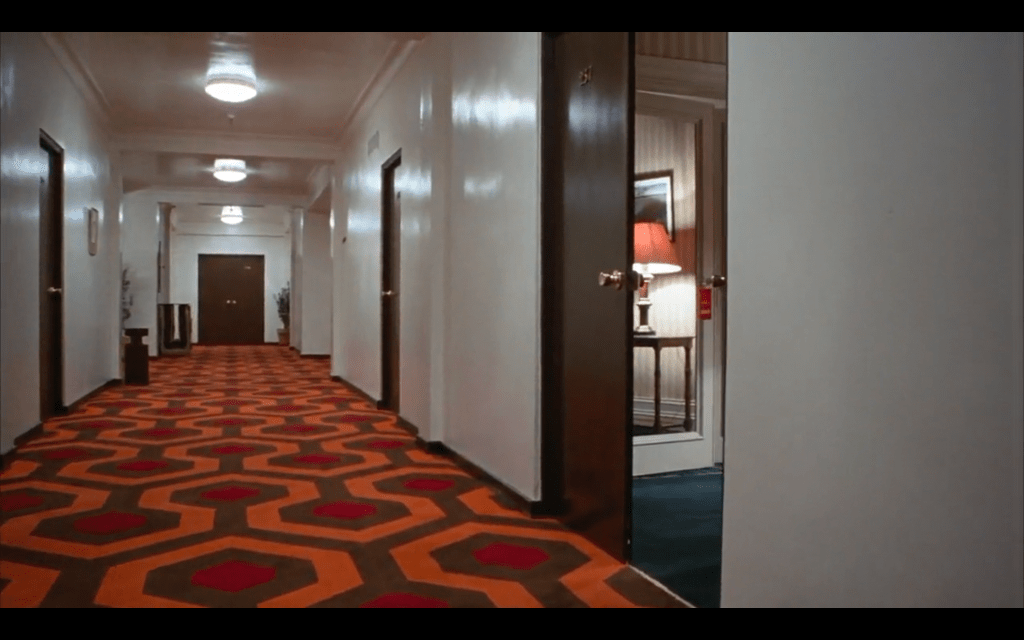
Danny uses a literal key to get into Room 217; in the movie with Room 237 it would appear a ghost uses a key to open its door, since Danny discovers it already opened:
The Shining (1980).

This is interesting in light of King’s debate of should you open the door or not in chapter 5 of Danse Macabre:

I think both Wise and Lovecraft before him understood that to open the door, in ninety-nine cases out of a hundred, is to destroy the unified, dreamlike effect of the best horror. “I can deal with that,” the audience says to itself, settling back, and bang! you just lost the ballgame in the bottom of the ninth.

My own disapproval of this method—we’ll let the door bulge but we’ll never open it—comes from the belief that it is playing to tie rather than to win. There is (or may be), after all, that hundredth case, and there is the whole concept of suspension of disbelief. Consequently, I’d rather yank the door open at some point during the festivities; I’d rather turn my hole cards face-up. And if the audience screams with laughter rather than terror, if they see the zipper running up the monster’s back, then you just gotta go back to the drawing board and try it again.

Stephen King, Danse Macabre (1981).

Room 217 (and 237) is where Danny is first demonstrably harmed by one of the ghosts (if you don’t count the wasps in the novel/miniseries). In the novel’s buildup to Danny finally using the key to enter the room, the Overlook is manifesting a voice in his head (rendered in King’s signature parentheticals), one that “was as if [it] had come from outside, insectile, buzzing, softly cajoling,” and one that prominently adopts the voice of the Red Queen in Alice in Wonderland and her off-with-his-head refrain as Danny turns the key in the lock while trying to convince himself the ghosts can’t hurt him since what he had seen in the “Presidential Sweet” had disappeared. (Another image-reference Danny associates with what’s behind the closed door of the room is Bluebeard, which echoes the off-with-his-head decapitation motif when it turns out Bluebeard’s former wives’ heads are behind the door. The losing-your-head idea literally and viscerally evokes the horror of losing your head (i.e., mind) figuratively.)

Both Kubrick and King do show what’s behind the door of Room 217/237, and Kubrick goes a bit farther with that bulge in the door…
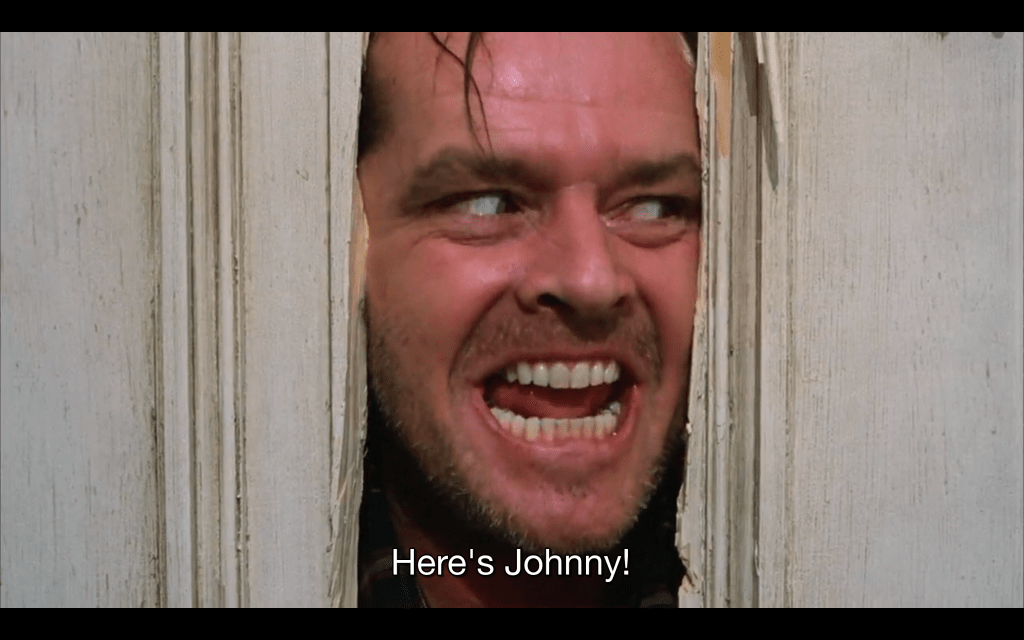
The Shining (1980).

This is the bathroom door, the same door Danny lipsticks the “Redrum” on and the third of three bathrooms in which significant scenes occur.

The theme of real v. imagined emphasized by the haunting entities in The Shining‘s plot is underscored by the treatment of geographical place in the novel…
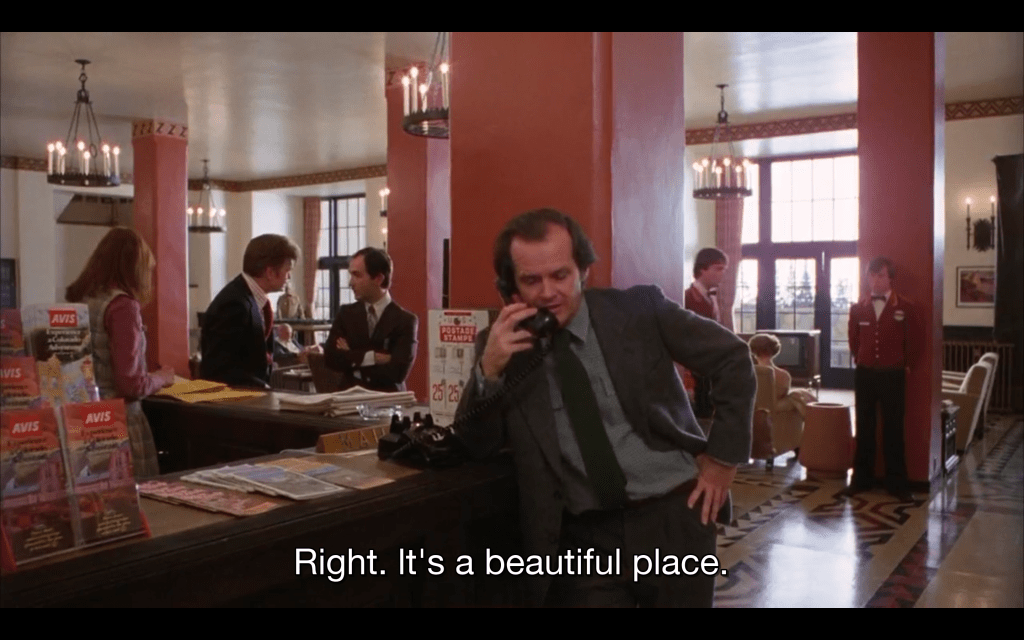
The Shining (1980).

…with the Overlook apparently positioned between the the fictional town of Sidewinder and the real town of Estes Park:

“I guess I know well enough where that is,” he said. “Mister, you’ll never get up to the old Overlook. Roads between Estes Park and Sidewinder is bloody damn hell.”

Stephen King, The Shining (1977).
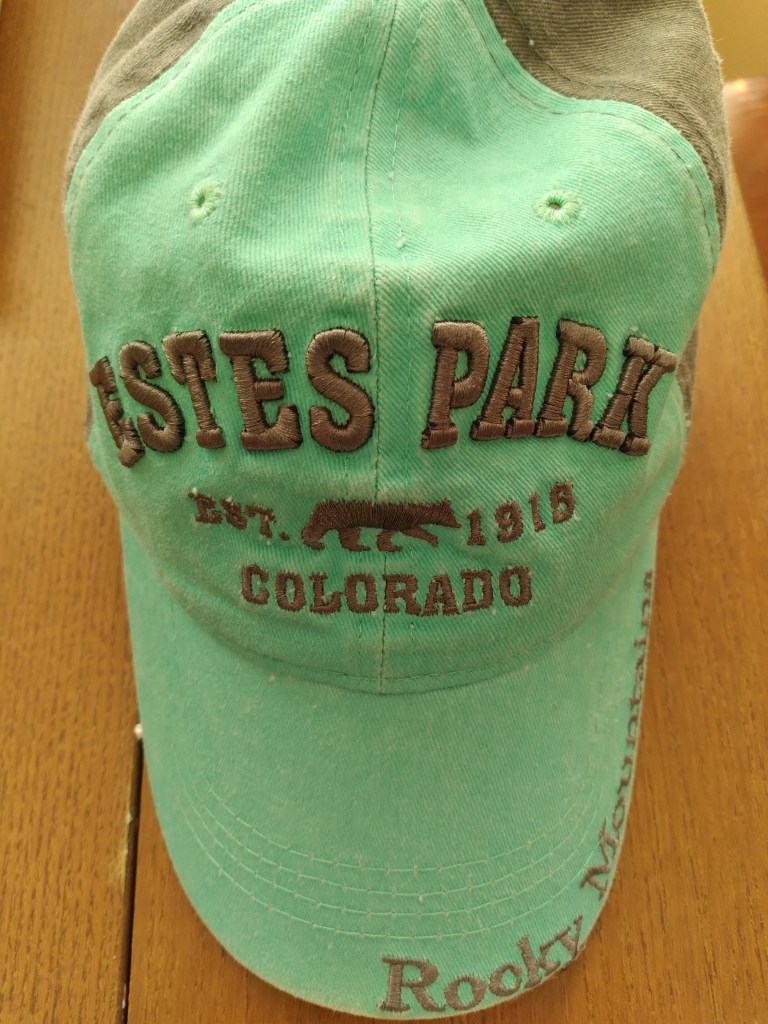
One of the scrapbook articles that evokes the Overlook via a critteration emphasizes the key theme:

The Overlook Hotel, a white elephant that has been run lucklessly by almost a dozen different groups and individuals since it first opened its doors in 1910, is now being operated as a security-jacketed “key club,” ostensibly for unwinding businessmen. The question is, what business are the Overlook’s key holders really in?

Stephen King, The Shining (1977).
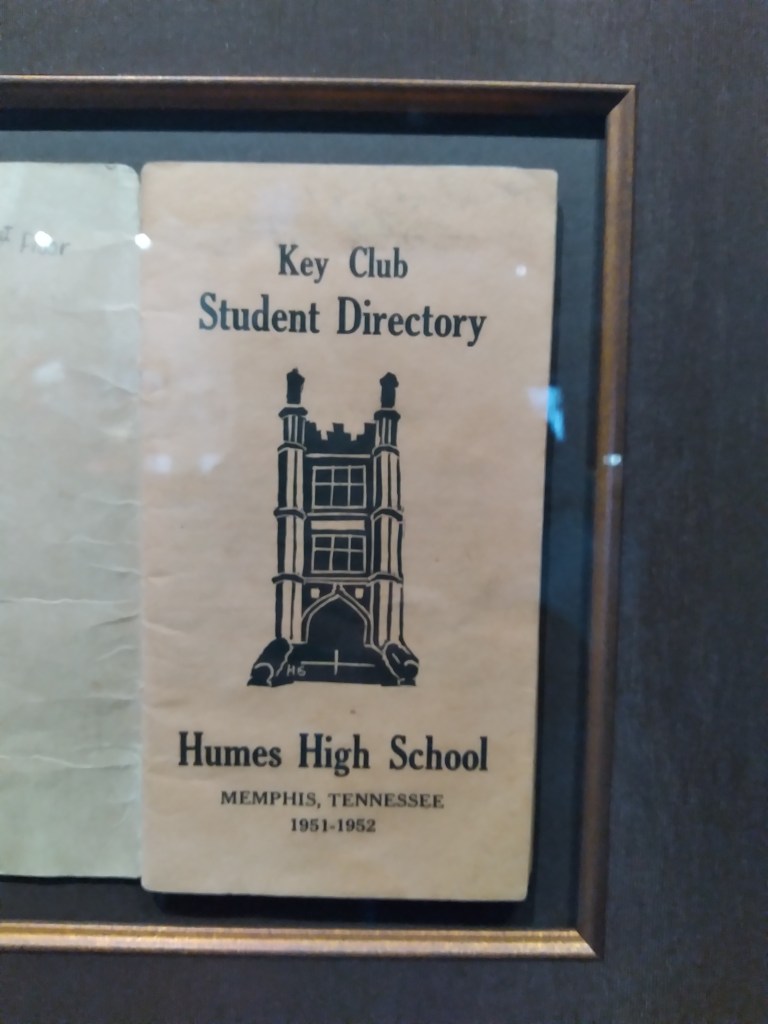
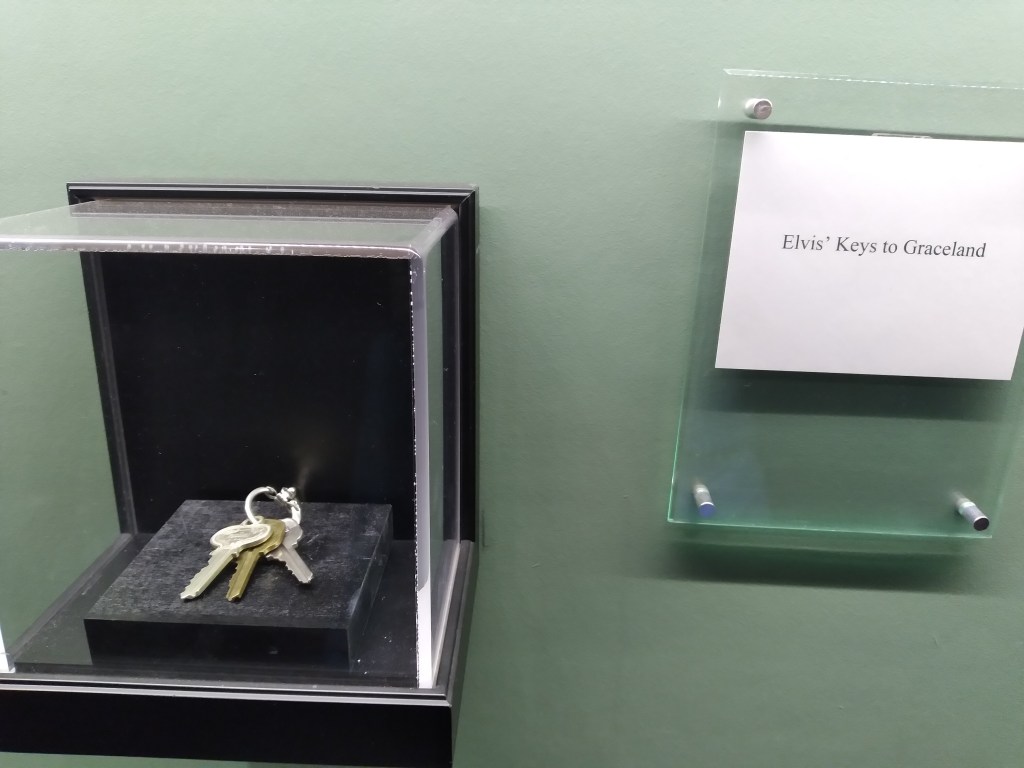
Elvis’s high school key club directory at Graceland.

“Poisonous Inspiration”

Associations with positive and negative iterations of “poison” also mark the fluid duality of the bee-wasp symbolism, which we will see more of in future parts on Misery and The Girl Who Loved Tom Gordon. The earliest memory of his that King describes in On Writing involves a fantasy of being a circus ringmaster demonstrating his strength by lifting a cinderblock that’s hiding something…

Unknown to me, wasps had constructed a small nest in the lower half of the cinderblock. One of them, perhaps pissed off at being relocated, flew out and stung me on the ear. The pain was brilliant, like a poisonous inspiration. (boldface mine)

Stephen King, On Writing: A Memoir of the Craft (2000).

This is not unlike the “muddy insights” he credits Magistrale crediting him with… It turns out this “poisonous inspiration” is part and parcel of the Africanist presence that will explode out of the trigger moment in Carrie, through the Overlook ghost in The Shining, and on through Misery (to be discussed in Part IV) and The Girl Who Loved Tom Gordon (Part V). Another major marker, or sign, of the fluid duality across the bee-wasp symbolism in King’s oeuvre is that Misery will refer to bees as “poisonous” while Tom Gordon will refer to wasps as “poisonous.” And one thing that’s famously “poisonous,” and a reference point for Carrie herself in her trigger moment, is Snow White’s apple:

They were still all beautiful and there was still enchantment and wonder, but she had crossed a line and now the fairy tale was green with corruption and evil. In this one she would bite a poison apple, be attacked by trolls, be eaten by tigers.

They were laughing at her again. (boldface mine)

Stephen King, Carrie (1974).

This means in the trigger moment in the novel that is doubly rendered, once in Norma’s perspective and once in Carrie’s, both invoke Disney texts as reference points. In his nonfiction treatise on horror Danse Macabre, King discusses Snow White specifically in a chapter that further reveals Disney’s extensive influence on him:

…in Snow White and Sleeping Beauty, one with her enticingly red poisoned apple (and what small child is not taught early to fear the idea of POISON?)…”

Stephen King, Danse Macabre (1981).

and

I took Joe and my daughter Naomi to their first movie, a reissue of Snow White and the Seven Dwarves. There is a scene in that film where, after Snow White has taken a bite from the poisoned apple, the dwarves take her into the forest, weeping copiously. Half the audience of little kids was also in tears; the lower lips of the other half were trembling. The set identification in that case was strong enough so that I was also surprised into tears. I hated myself for being so blatantly manipulated, but manipulated I was, and there I sat, blubbering into my beard over a bunch of cartoon characters. But it wasn’t Disney that manipulated me; I did it myself.

Stephen King, Danse Macabre (1981).

I’ll beg to differ on that one. (Also, the movie‘s title is not spelled “Dwarves,” but “Dwarfs.”)

Here King is discussing the consumption of a visual text depicting the consumption of food, a type of consumption that Alice in Wonderland is also preoccupied with via Alice’s movements between parts of Wonderland necessitated by her eating or drinking something in order to (physically) change herself, which, since this is all Alice’s own dream, reflects a preoccupation of the character of Alice herself:

“What did they live on?” said Alice, who always took a great interest in questions of eating and drinking.

Lewis Carroll, Alice’s Adventures in Wonderland (1865).

Consumption of visual texts and consumption of food (of a sort) are conflated in both King’s and Kubrick’s Shinings when the Torrance family discusses the Donner party on their initial drive to the Overlook:
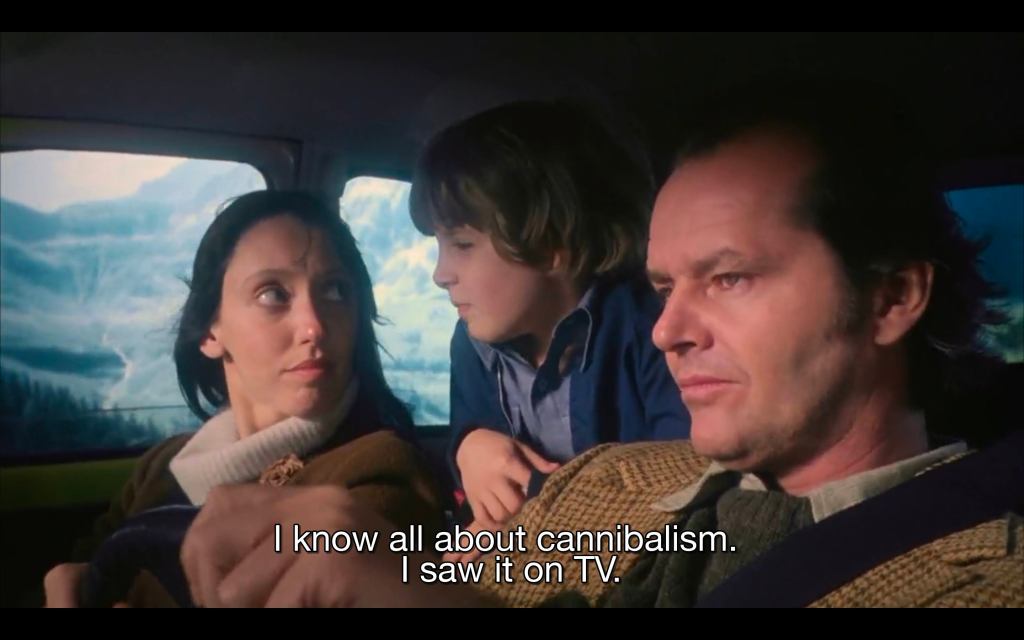
The Shining (1980).

Is our consumption of visual texts toxic…? What seems potentially toxic is how so many problematic visual texts can be excused as “products of their time” but then via Disney’s re-issue strategy are shown to people who are not of that time, and so become a means for the (problematic) values of one generation to be passed down to another in a way that might potentially hinder progress…

Now the snow was covering the shingles. It was covering everything.

A green witchlight glowed into being on the front of the building, flickered, and became a giant, grinning skull over two crossed bones.

Poison,” Tony said from the floating darkness. “Poison.”

Other signs flickered past [Danny’s] eyes, some in green letters… (boldface mine)

Stephen King, The Shining (1977).

King comments directly on a different aspect of Disney’s re-issue strategy:

Yet it is the parents, of course, who continue to underwrite the Disney procedure of release and rerelease, often discovering goosebumps on their own arms as they rediscover what terrified them as children . . . because what the good horror film (or horror sequence in what may be billed a “comedy” or an “animated cartoon“) does above all else is to knock the adult props out from under us and tumble us back down the slide info childhood. And there our own shadow may once again become that of a mean dog, a gaping mouth, or a beckoning dark figure.

*In one of my favorite Arthur C. Clarke stories, this actually happens. In this vignette, aliens from space land on earth after the Big One has finally gone down. As the story closes, the best brains of this alien culture are trying to figure out the meaning of a film they have found and learned how to play back. The film ends with the words A Walt Disney Production. I have moments when I really believe that there would be no better epitaph for the human race, or for a world where the only sentient being absolutely guaranteed of immortality is not Hitler, Charlemagne, Albert Schweitzer, or even Jesus Christ-but is, instead, Richard M. Nixon, whose name is engraved on a plaque placed on the airless surface of the moon.

Stephen King, Danse Macabre (1981).

I have discussed the Nixon/Watergate legacy’s presence in The Shining–which it turns out is part and parcel of the Africanist-presence-associated symbolic shadow exploding from it throughout the rest of King’s canon–here.
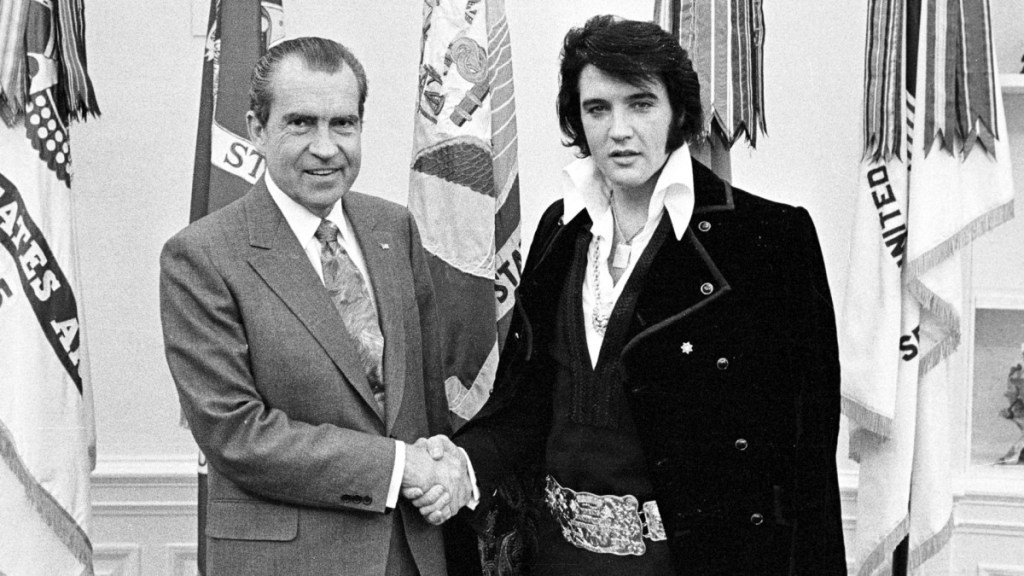
From here.

Kubrick invokes a Snow White reference in his film…
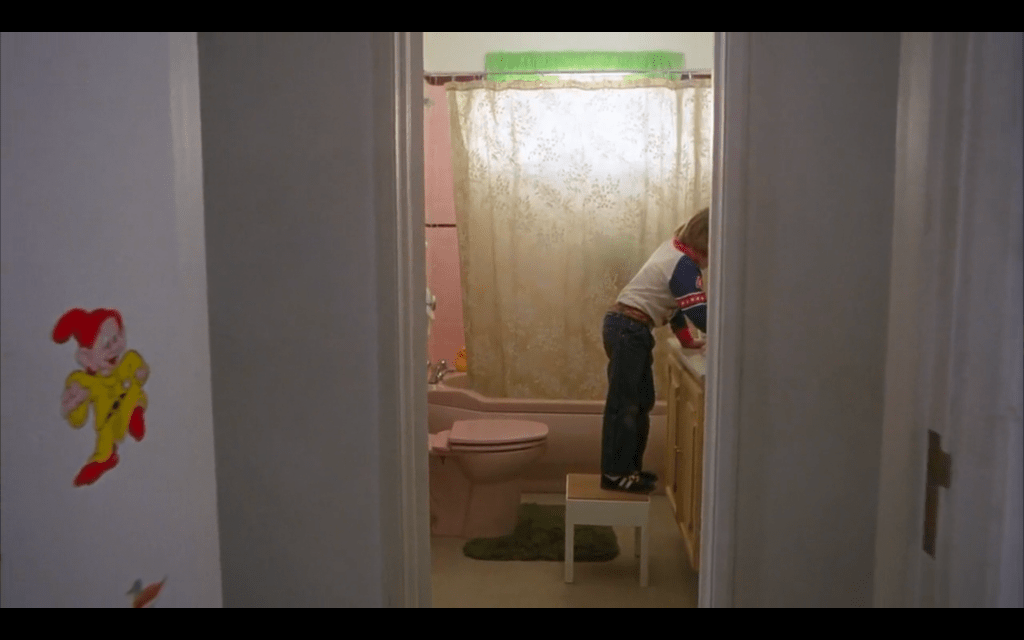
The Shining (1980).

After Danny has his first vision of the elevators gushing blood, a sticker of Dopey the Dwarf (3) on his bedroom door disappears: “Before,” Cocks says, “Danny had no idea about the world. And now, he knows. He’s no longer a dope about things.”

Bilge Ebiri, “Four Theories on The Shining From the New Documentary Room 237” MAR. 17, 2013 (here).

Here you can also see the color scheme of clothing that Wendy and Danny are frequently shown in together, a visual cue of their unity against Jack/the Overlook.
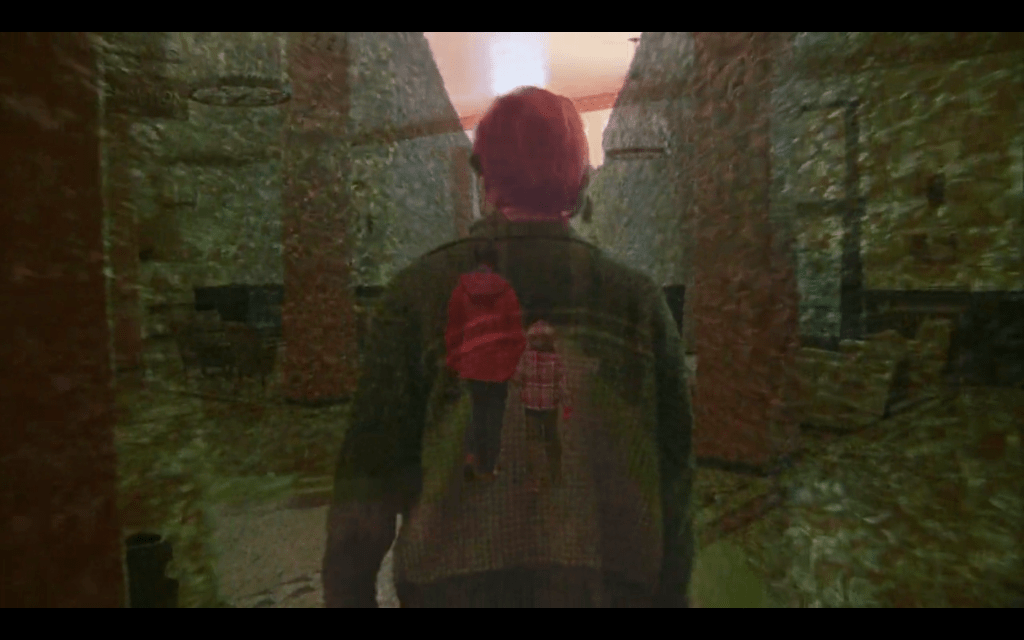
The Shining (1980).

Via the Overlook ghost’s possession of Jack, his mind is effectively poisoned against his family. Part of the poison he consumes is the narrative of History in the scrapbook from the Overlook’s basement, which, in is keeping with the cannibalism themes:

In The Shining, then, Jack’s impulse to organize, to make meaning out of such gory madness, is itself a crucial component of the violent acts that he chronicles. Caretakers like Jack (or [Pet Sematary‘s Louis] Creed) practice abject servility to the mighty tide of American History and, in turn, find themselves consumed by its relentless, cannibalizing force. (boldface mine)

Tony Magistrale and Michael Blouin, Stephen King and American History (2020).

The “gory madness” referred to in this passage is American History itself, which to me is another way of saying The Shining portrays American History as black and white and re(a)d all over (reified by the film’s tide of elevator blood), as the newspaper clippings in the scrapbook themselves are. Magistrale implicates WASPs in this bloody history:

Located near the center of America geographically, the Overlook is also a testament to the triumph of white Protestant male capitalism–and its ability to exploit the labor and land of others to strengthen its own position. (boldface mine)

Tony Magistrale, Stephen King: America’s Storyteller (2010), p104.

The way this WASPy system achieves this is encoded in the most prominent writing on the wall in The Shining…except it’s actually on a (bathroom) door….
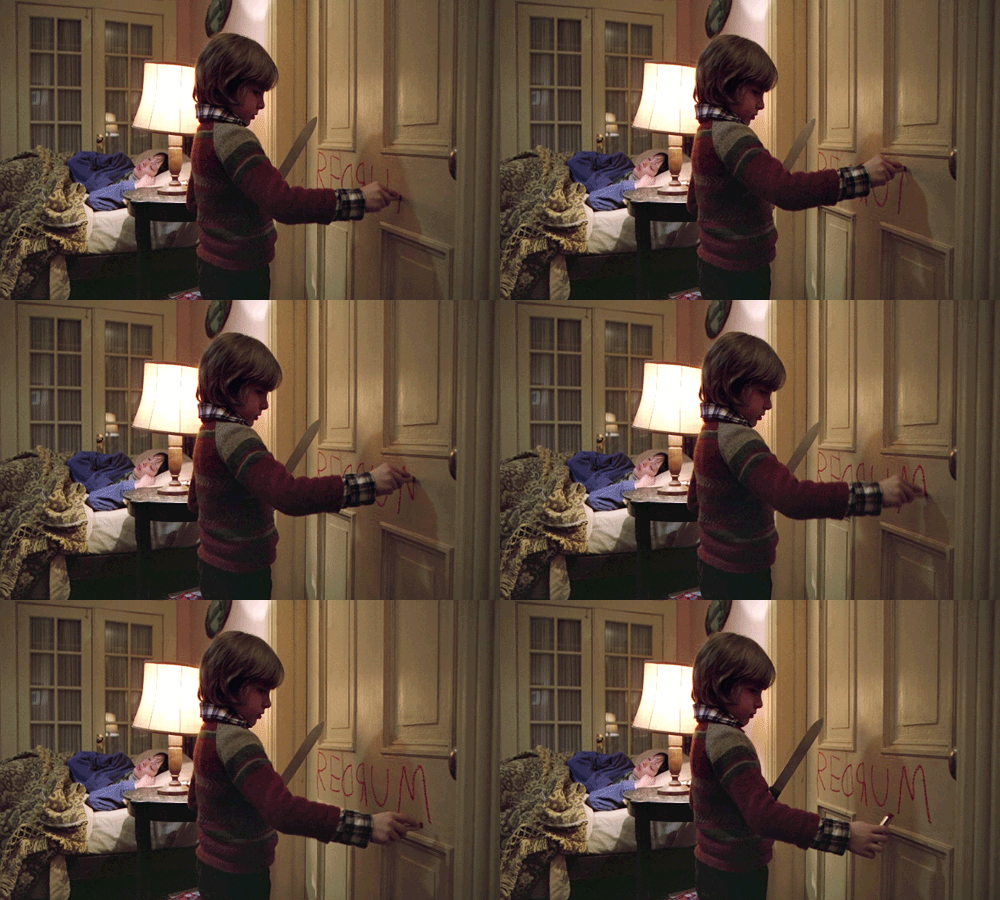
The Shining (1980).

…that has to be properly “read” in a mirror, mirror on the wall…
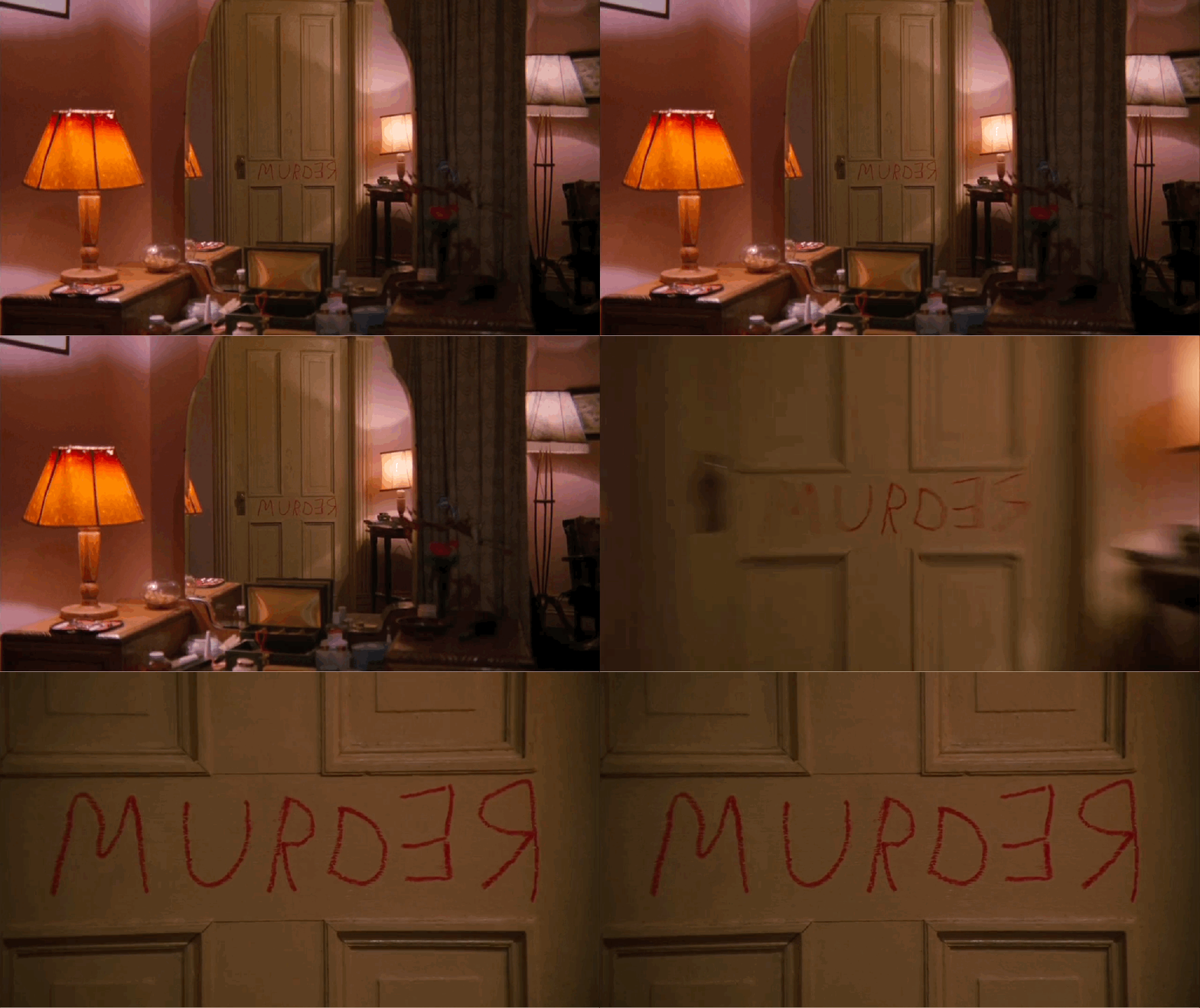
The Shining (1980).

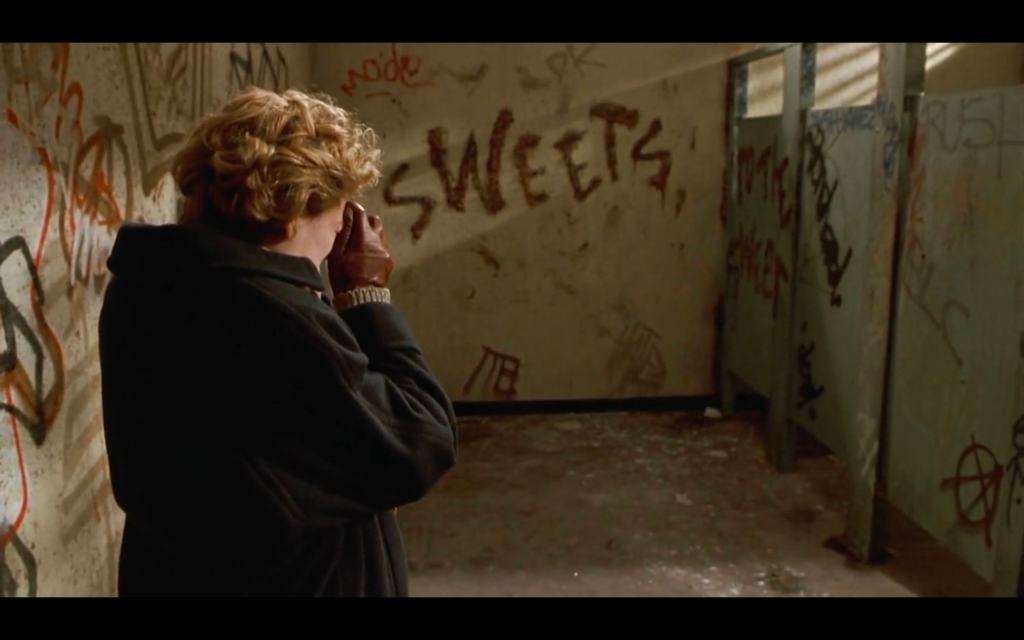
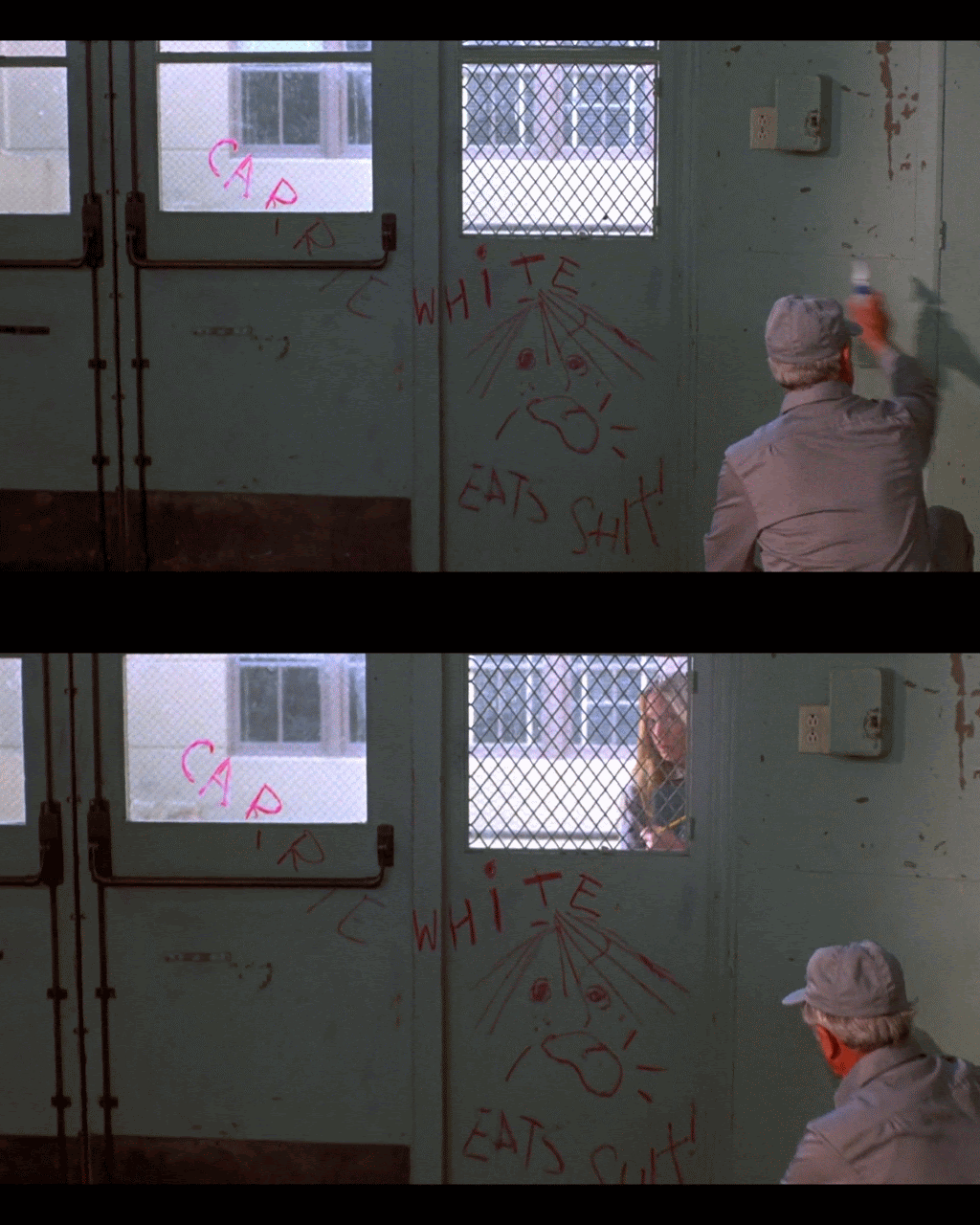
The writing on the wall as a symbol of a rhetorical construction, as it is in the case of “Carrie White eats shit” and as Candyman manifests when he claims “I am the writing on the wall,” is itself a version of a symbolic mirror. The Candyman is summoned through mirrors specifically, further implying/emphasizing that mirrors are symbolic writing on the wall–that is, that our constructions of others are actually subverted constructions of ourselves; we–our worldviews and biases–are reflected in our projections. (Jack only sees the Room 237 woman as a rotting corpse when he sees her in the mirror.)

So it is that a critic’s criticism of a novelist/filmmaker is actually a mirror, saying more about the critic than about the content criticized, or about the creators of that content. Just like visual texts themselves are mirrors of our culture capable of both reflecting it, but in that process of reflection, also shaping it.

Magistrale’s logic that…

So central is the scrapbook to King’s narrative that it appears at a critical junction in the book and is the exclusive subject of its own chapter (18)… (boldface mine)

Tony Magistrale, Stephen King: America’s Storyteller (2010), p107.

…reinforces the importance of two of my earlier discussion points that get their own chapters, the hedges and the snowmobile (the latter qualifying as a “critical junction” via Jack’s epiphany that “it was all true”). Magistrale also notes that:

In Kubrick’s film, the scrapbook occupies a much more subdued position… But its presence is notable in scenes that feature Jack at his typewriter.

Tony Magistrale, Stephen King: America’s Storyteller (2010), p107.
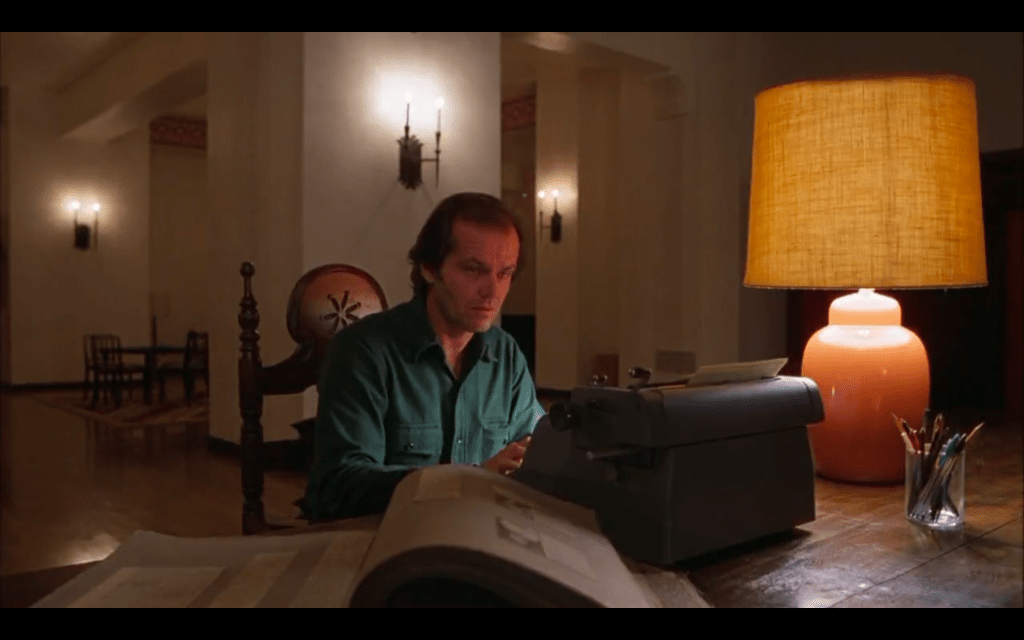
The Shining (1980).

But in the novel:

…Jack finds himself alone in the basement of the hotel searching for “good places to set [rodent] traps, although he didn’t plan to do that for another month–I want them all to be home from vacation, he had told Wendy” (154). It is highly ironic that Torrance plans such a strategy against the vermin living in the basement, for it is clear that it is actually the hotel itself that has set the trap… (boldface mine)

Tony Magistrale, Stephen King: America’s Storyteller (2010), pp109-110.

According to Magistrale’s analysis, “the scrapbook documents the Overlook’s rebirth” and facilitates Jack’s bond with the Overlook as a “place” by way of its “secret history” that echoes Jack’s own history of secret-keeping, becoming part of a larger Kingian pattern in which:

…his male protagonists use the silence of secrets–that is, the deliberate omission of language–to exclude women from narrative action and empowerment.

Perhaps it is this very preclusion of women that makes the keeping of secrets so dangerous and ultimately self-destructive for the men who elect to maintain them. For their adherence pushes King’s males toward isolation and into a state that forfeits the familial bond so sacred in King’s universe. Although it is true that these men derive a certain level of perverse power from the concealed knowledge they possess, secret knowledge in King is always forbidden knowledge. (boldface mine)

Tony Magistrale, Stephen King: America’s Storyteller (2010), p116.

This concept of “forbidden knowledge” echoes the epistemic exchange of the apple in Genesis, a premise that posits this exchange as poisonous in a way that is recapitulated in the Snow White narrative, which, as it happens, is a typical example of a parallel that further demonstrates Disney’s influence on King:

Steven Watts has noted, “Disney carried out of boyhood a great fondness for a big family full of warmth and happiness, a feeling largely shaped by his own family’s lack of such qualities” (14), with reference to the strained relations between Disney and his father and the difficult times the children experienced under his stern paternalism. An emphasis on the family as a source of social cohesion would lead Disney to what Watts called “the Disney Doctrine: a notion that the nuclear family, with its attendant rituals of marriage, parenthood, emotional and spiritual instruction, and consumption, was the centerpiece of the American way of life” (326). (boldface mine)

The narrative impulse and urge of the entire film is toward family stability and social cohesion. Given Disney’s attitude and belief system, this happened naturally and inevitably and would happen again in many more films to come.

M. Thomas Inge, “Walt Disney’s Snow White: Art, Adaptation, and Ideology,” Journal of Popular Film and Television 32(3) (2004), p141.

Despite killing the patriarch in a literal explosion (the same explosion through which the shadow of the Overlook escapes into his future work), King fails to explode the concept of the nuclear family bond passed through this narrative. (Does the language “nuclear family” imply instability/an inherently explosive nature?) But Donald Barthelme made a valiant effort to do so in his postmodern novel Snow White (1967), which I’ve discussed here, and which invokes the concept of a “failure of imagination”–Snow White’s reason for why she cohabitates with the dwarfs–that potentially implicates Disney’s failure in conceiving a more diverse family framework as well as the failure of King, who’s deployed similar phrasing against criticism of his own failures in this regard.

While King did not experience the “stern paternalism” Disney personally did because his father left altogether, that absence creates a parallel with Disney’s in his childhood experience being outside the traditional family bond conception influencing his emphasis on this aspect, which is not then unrelated to assuming the role of a major cultural storyteller (or “Uncle”).

The role of the nuclear family unit in King’s work is also interesting in light of the fact that King’s father apparently started another family after leaving the one he started with King’s mother, from which King has four half-siblings. On the PBS show Finding Your Roots in 2014, Henry Louis Gates, Jr., perhaps most famous in academic circles for his book (on critterations) The Signifying Monkey: A Theory of Afro-American Criticism (1988), reviewed records with Stephen King (here) showing that King’s father had unofficially changed his surname from “Pollock” to “King” at some point while he was in the Merchant Marines; Gates concludes that “…the origin of the surname ‘King’ remains a mystery.”

The importance of family to Elvis is a mainstay in Baz’s Elvis in both theme and plot: early on we see the Colonel spying on Elvis and his family in their pre-performance huddle, with his mother saying they’re family, which is “the most important thing.” Thereafter the Colonel uses this as a manipulative wedge to control Elvis–very successfully. (That nuclear family is part of the emotional expression inherent in the blues/soul/gospel music Elvis was influenced by is emphasized by two singers who are portrayed in the film, Big Mama Thornton and Sister Rosetta Tharpe.)
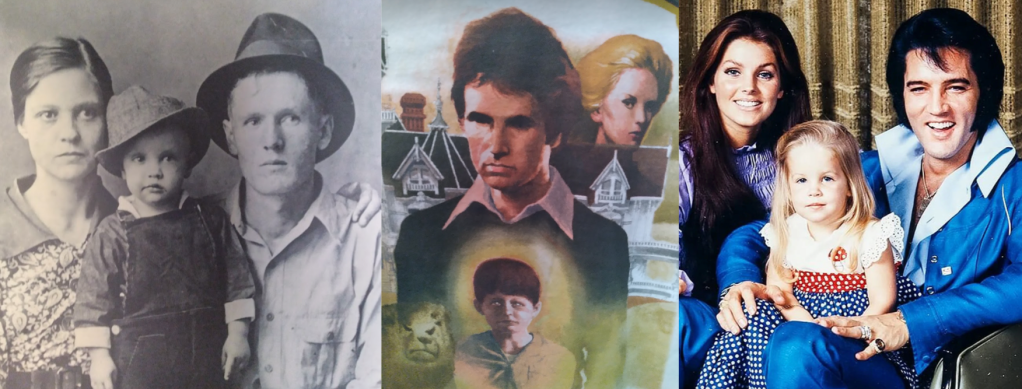
Left: Vernon, Gladys & Elvis Presley; Center: Jack, Wendy & Danny Torrance from The Shining first ed. cover; Right: Elvis, Priscilla, and Lisa Marie Presley.

As discussed in Part II, Sarah E. Turner reads Carrie as rendering but not promoting either side of the abortion debate, but Magistrale’s observation of this larger pattern in King’s work of emphasizing the sacredness of the “familial bond” is potential evidence of the cultural movement backward we’ve just experienced via the Dobbs decision, with the irony, or one of them, being that King himself would disavow this decision and the political system that’s fostered it, but his work’s promotion of the importance of the traditional family unit would undermine this.

The social scientist Silvia Federici has argued, in her book “Caliban and the Witch,” that church and state waged deliberate campaigns to force women to give birth, in service of the emerging capitalist economy.

Jia Tolentino, “Is Abortion Sacred?” (July 16, 2022).

The concept of secret, forbidden knowledge is also evoked in Elvis in relation to metaphorical cannibalism and sexuality when the Colonel appraises the reaction to the first performance of Elvis he experiences by noting that Elvis appears to one girl as “forbidden fruit” and that she “could have eaten him alive.”

Articulate, Recapitulate

Via the Overlook ghost’s possession of Jack that the scrapbook initiates, The Shining‘s premise essentially recapitulates/reiterates/reenacts a form of blackface: it is a monster that wears a human face…which might also have implications for the critical placement of the black-and-white image of Jesus’s face.

It came around the corner. In a way, what Danny felt was relief. It was not his father. The mask of face and body had been ripped and shredded and made into a bad joke. (boldface mine)

Stephen King, The Shining (1977).

This blackface-recapitualation is reinforced in the climactic confrontation when Danny in part defeats the monster by way of articulating its nature as a “false face.” At one point, wasps actually compose this symbolic blackface the same way the pig blood does in Carrie:

A door opened with a thin screeing sound behind him.

A decayed woman in a rotten silk gown pranced out, her yellowed and splitting fingers dressed with verdigris-caked rings. Heavy-bodied wasps crawled sluggishly over her face.

“Come in,” she whispered to him, grinning with black lips. “Come in and we will daance the taaaango …”

False face!!” he hissed. “Not real!” She drew back from him in alarm, and in the act of drawing back she faded and was gone. (boldface mine)

Stephen King, The Shining (1977).

Though according to the original racist “logic” of the blackface minstrel performances, a monster wearing a human face would be a form of inverse blackface, which then is a form or version–or ITeration–of the whiteface clown makeup that Pennywise wears… or that of another ka-tet quartet of implicitly white-power rockers…
Do the letters stand for “Keep It Simple Stupid” or “Knights in Satan’s Service”? (From here.)

Or kind of like this reverse appropriation of Mickey Mouse…
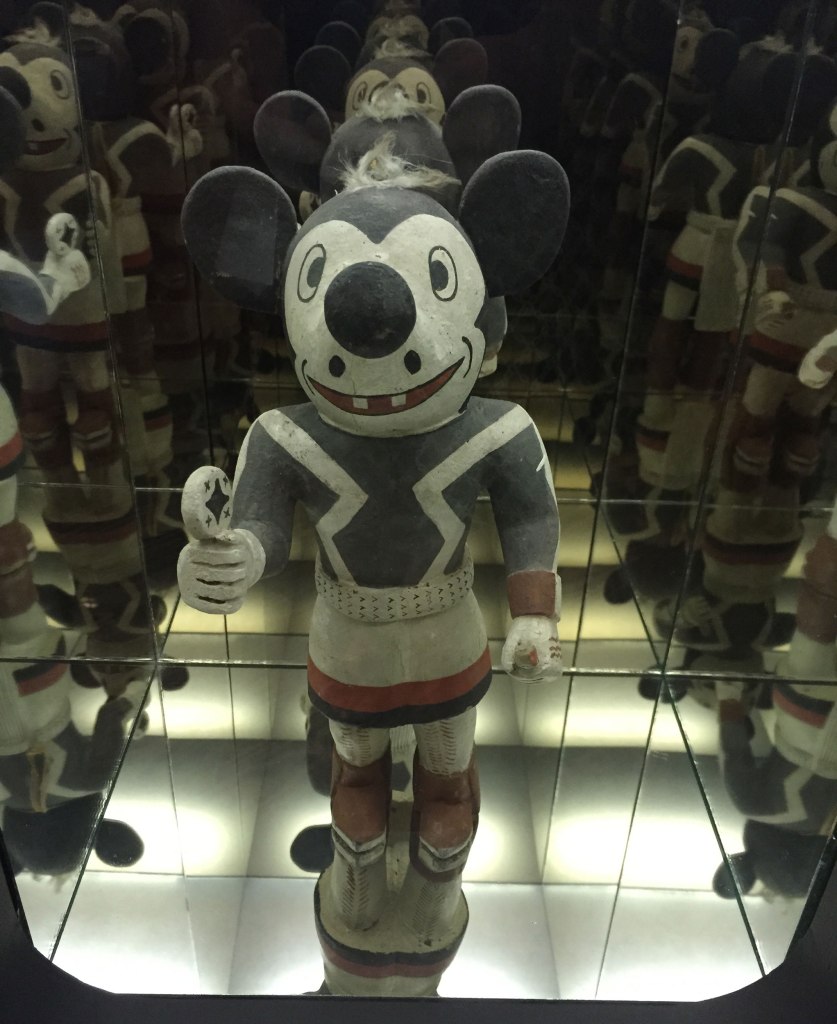
From here.

Is the refrain to Danny that “You will remember what your father forgot”–in reference to the boiler’s potential to explode and destroy everything–the white man’s burden carried over from Carrie?
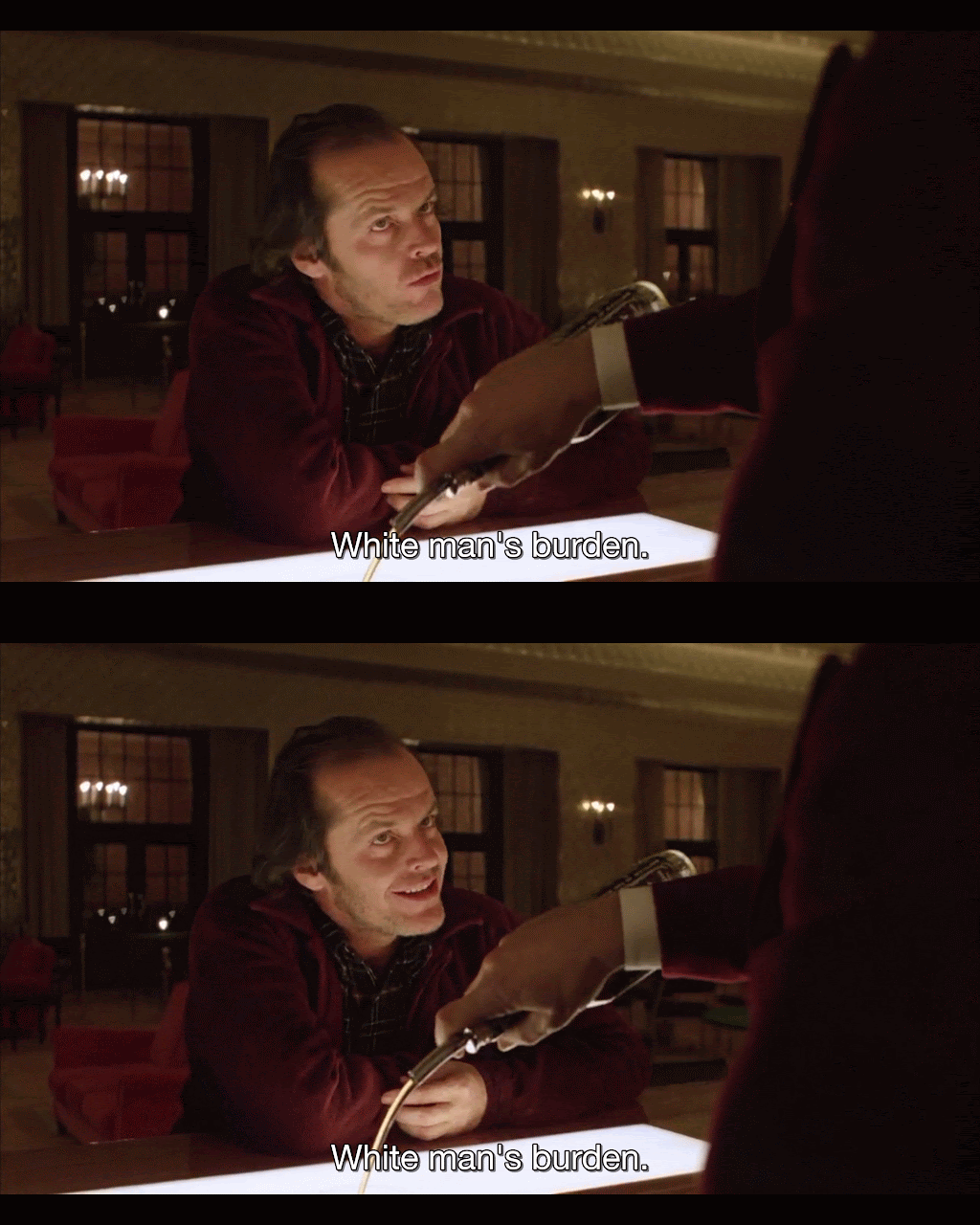
The Shining (1980).

It is basically “the white man’s burden” to be the WASP–“the hotel represents the successful epitome of white male domination over all other races and women” as noted that Tony Magistrale and Michael J. Blouin put it: that success is the burden, because it creates the pressure to maintain that success. And it’s a lot of work to maintain your authorit-eye over that many territories…
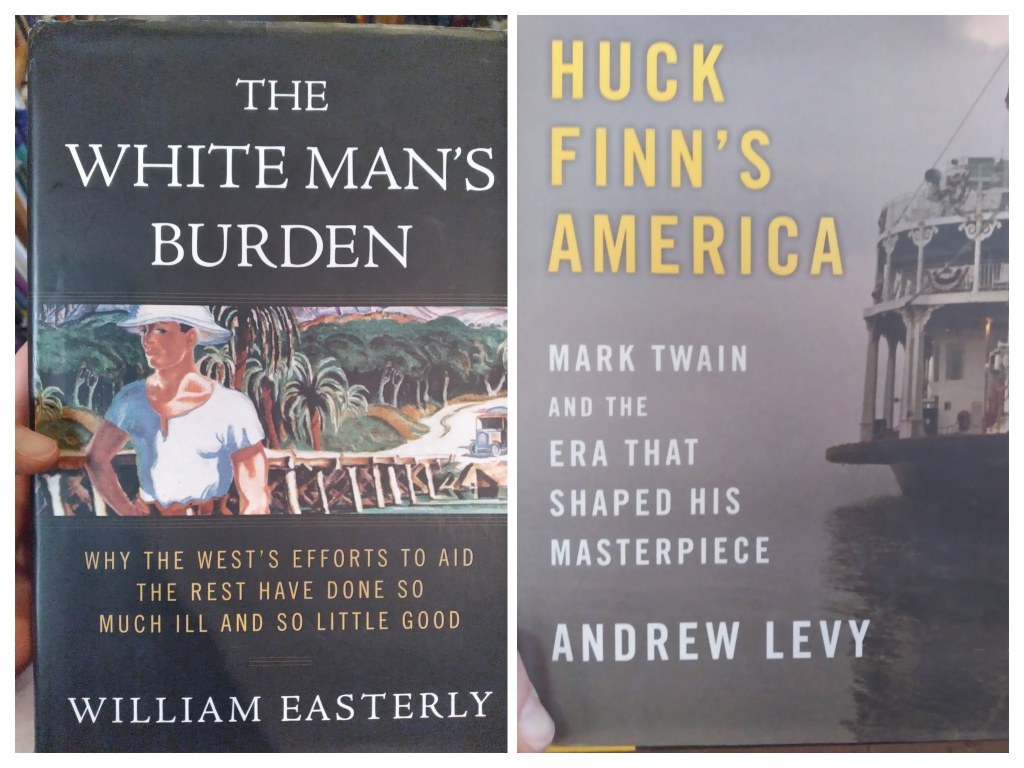
The shadow of the Africanist presence has exploded through American pop culture via the domination of Mickey Mouse the (secret) minstrel, as well as through the history of American music perpetuated by the minstrel-trickster figure of Elvis. “I know you are lost. Burdened,” the Colonel tells Elvis in a hall of mirrors, which segues into the ferris-wheel “this can all be yours” deal-with-the-devil sequence. Elvis says he’s “ready to fly,” but once he takes off, he’ll never be able to land again, as the character himself articulates in the final words he speaks in the film. Baz evokes thematic cycles with a motif of spinning wheels that transpose into each other: a ferris wheel into a 45, a roulette wheel into a driving car’s tire. Thus we might read what Magistrale calls the scrapbook’s “record of evil” (109) as inherently connected to musical records, as are referenced in Danny’s initial Tony-induced vision of what will happen at the Overlook:

Pictures torn off the walls. A record player

(?Mommy’s record player?)

overturned on the floor. Her records, Grieg, Handel, the Beatles, Art Garfunkel, Bach, Liszt, thrown everywhere. Broken into jagged black pie wedges.

Stephen King, The Shining (1977).

Like wedges of Don McLean’s “American Pie”…

Another way musical (history) themes are implicitly present in The Shining intersects with one of its major critterations, Overlook owner Horace Derwent’s patsy Roger, the “AC/DC” “dogman” (previously discussed here). I mentioned that this dogman treatment creates interesting implications for King identifying his favorite bands–which he’s noted he listens to as he’s writing–as AC/DC, Guns ‘n’ Roses, and Metallica. In light of one writer essentially implicating the likes of these as white-power bands…

[Eldridge] Cleaver believed that the younger generation of whites would be wooed away from their omnipotent administrator fathers by African-American dance and music. Whites began to dance better, but that didn’t make them more humanistic. Rock and roll made billions for white artists and became the entertainment at white-power rallies and accompanied the black-hating lyrics of Axl Rose.

Ishmael Reed, preface to Eldridge Cleaver’s Soul on Ice (1999).

…this might imply an explanation for some of the undermining white-supremacist undertones so prevalent in King’s work.

It is a theme of Orwell’s Animal Farm that music has the power to indoctrinate/be propagandized, via the recurring anthem of the animals, “Beasts of England,” described as “a stirring tune, something between ‘Clementine’ and ‘La Cucaracha’.” The other major historical discovery I’ve made since entering the Matrix of the Kingdom at the beginning of 2020, akin to the discovery of Mickey Mouse’s blackface minstrel nature and parallel to it in manifesting a historical erasure narrative, is about “The Star-Spangled Banner”:

In the Journal of the Early Republic, historian William Coleman argues that the “standard accounts” of the Star-Spangled Banner’s origin focus on Francis Scott Key’s individual composition of it in a “single moment of patriotic inspiration,” that this account “obscure[s] his connection” to the Federalist tradition, and that “the partisan political aspects of ‘The Star Spangled Banner’ have largely been overlooked precisely because the song was (and continues to be) so successful at presenting its specific vision of national unity as a universal model for American patriotism” (601-02 emphasis mine); (note this article is from 2015). These “standard accounts” thus themselves function as an erasure narrative, downplaying the Banner’s “political history” and the use of music in general “as a way of convincing the public to unify through common consent to government power” (602), as Coleman puts it. 

From here.

In Orwell’s Animal Farm, the concept of heaven is also rendered a rhetorical construction, that of a mountain:

In Sugarcandy Mountain it was Sunday seven days a week, clover was in season all the year round, and lump sugar and linseed cake grew on the hedges. (boldface mine)

George Orwell, Animal Farm (1945).

A symbolic mountain, independent of the literal mountain the Overlook Hotel is on (which is never named), also appears in The Shining:

Martin Luther King had told them not long before the bullet took him down to his martyr’s grave that he had been to the mountain. Dick could not claim that. No mountain, but he had reached a sunny plateau after years of struggle. He had good friends. 

…Was he going to chance the end of that—the end of him—for three white people he didn’t even know? (boldface mine)

Stephen King, The Shining (1977).

The answer is yes, because he’s a “Magical Negro,” and the asking of the question is supposed to articulate and thereby address the problem of the trope. That is, to “say it” is to solve the problem. But articulation of the issue is not enough to alleviate/circumvent it, which is a trap King falls into repeatedly…to “say it” is only the beginning of the problem…
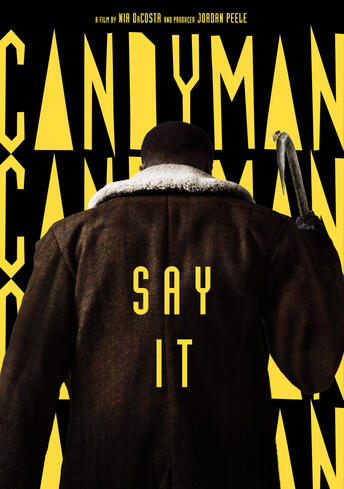
Candyman (2021).

Rap’s defense goes along the lines of, ‘We don’t create hatred-we simply rearticulate what’s already out there.’ (boldface mine)

Roy Grundmann, “White Man’s Burden: Eminem’s Movie Debut in 8 Mile,” Cinéaste, Vol. 28, No. 2 (2003), p. 33. 

One critic draws a parallel between the consumption of alcohol and the consumption of blood in a process of articulation:

If Jack Daniels signals the earthly waters of oblivion and release and forgiveness for Jack Torrance, the fresh blood of the Overlook’s visitors announces memories, actions, and feelings to the ghostly denizens of that hotel—and they know what is going to happen in the end to Jack and to Wendy and Danny. We recall from chapter seven of Freud’s The Interpretation of Dreams that the dead sipping blood in dreams and in The Odyssey are trying to recall who they were and who they were connected to and what they were doing—and blood allows them to articulate all this. (boldface mine)

Danel Olsen, “‘Cut You Up Into Little Pieces’: Ghosts & Violence in Kubrick’s The Shining,” Violence in the Films of Stephen King (ed. Magistrale and Blouin, 2021).

This same critic traces a lineage of animated and comedic Shining parodies:

The interest here is to offer some more unusual and less often cited reasons for The Shining to have such long reach in its terror—around the world and across generations and throughout media from cartoons like those obligatory riffs appearing on The Simpsons, Bojack Horseman, South Park, and Bob’s Burgers (the episode “The Belching: A Masterpiece of Modern Burger” being my favorite) to a clutch of Pixar Movies either directed, produced, or co-written by Lee Unkrich [Caretaker of TheOverlookHotel.com] or comedy skits like those of Key & Peele (Peele of Get Out fame) to commercials for Mountain Dew–No Sugar featuring Bryan Cranston, a terrified woman in a bathroom, an axe, and a flood of sickly green soda splashing out of the elevators and drowning the cameras. That does not begin to catalog all the filmic nods to The Shining in recent films of race, gender, or class-isolation, like, respectively, Get Out, Sorry to Bother You, and Passengers.

Danel Olsen, “‘Cut You Up Into Little Pieces’: Ghosts & Violence in Kubrick’s The Shining,” Violence in the Films of Stephen King (ed. Magistrale and Blouin, 2021).

I still don’t know where Olsen got this Bob’s Burgers title; when you google it, the only result that comes up is Olsen’s quote of it above, and the name of the episode in which Bob’s Burgers spoofs The Shining is their second episode ever, “Crawl Space” (January 16, 2011), with Bob becoming delirious after he gets trapped in the walls. But the South Park spoof, in the episode “A Nightmare on FaceTime” (October 24, 2012) is worth mentioning for its commentary on modes of media dissemination: the Overlook Hotel is rendered a Blockbuster Video store that Randy Marsh purchases, convinced it’s a cash cow. Spoiler: he’s wrong.
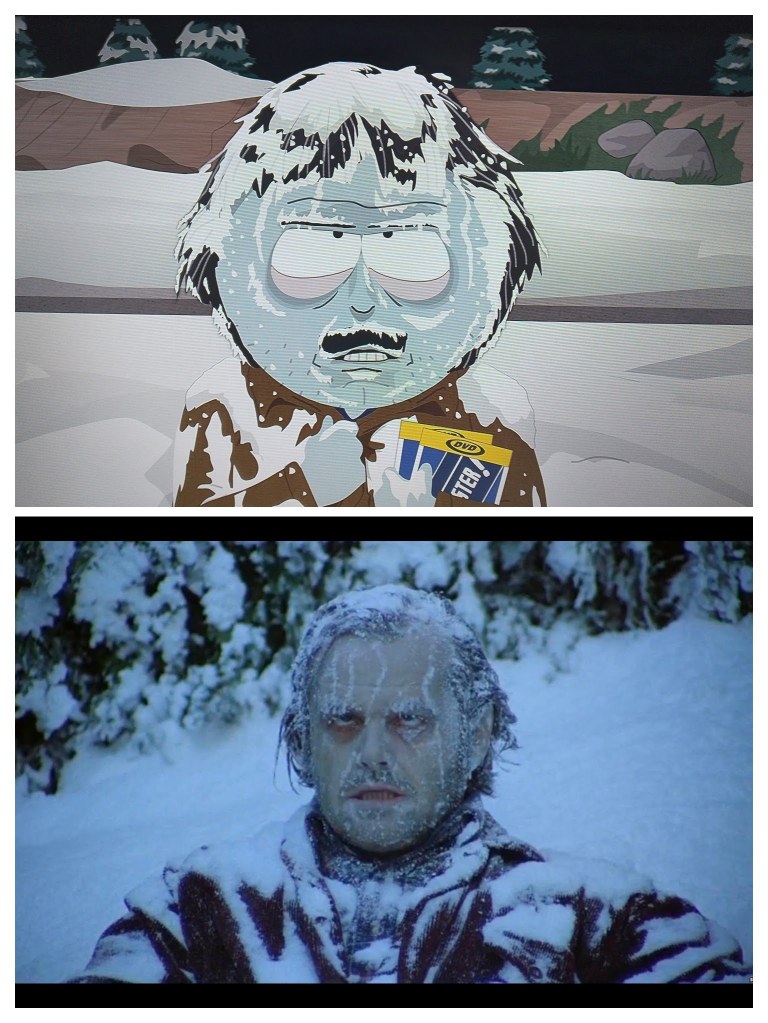
Speaking of cartoon animation…what’s in Danny’s name? Something that Kubrick carries over from the novel and that becomes even more significant in light of its relevance to the title of The Shining‘s sequel, Doctor Sleep (2013):
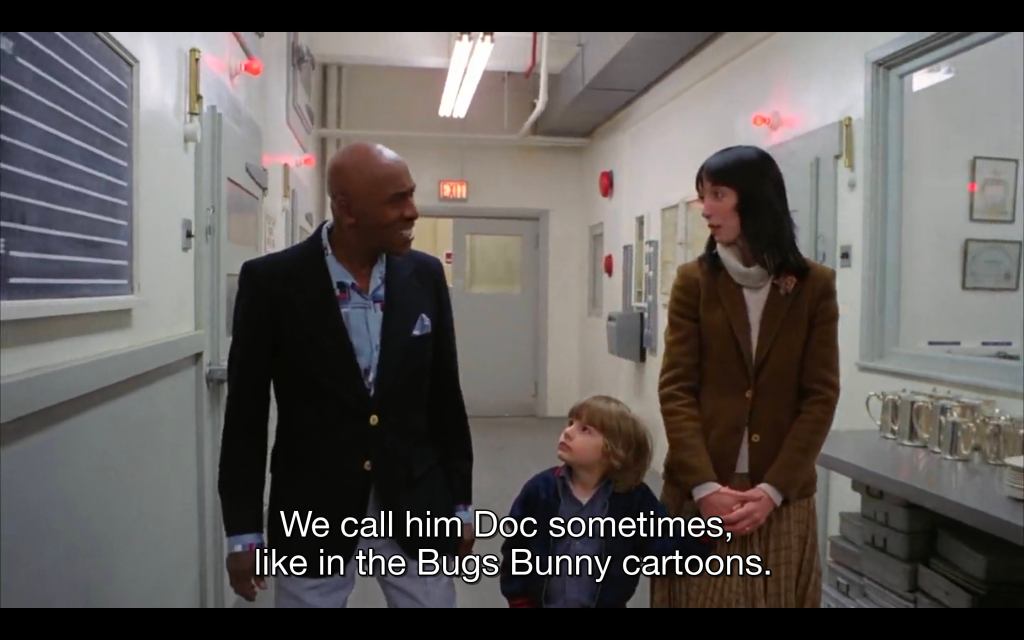
The Shining (1980).

Apparently there’s been a white male pissing contest over credit for the creation of Bugs Bunny, with a man named Bob Clampett vying for credit alongside a couple of the other of the posse of original white male Looney Tunes directors. Clampett is notable for being the director of the Snow White parody Coal Black and de Sebben Dwarfs (1943) which is one of the Warner Bros. “Censored Eleven” cartoons deemed, like Disney’s Song of the South, too offensive in their depiction of ethnic stereotypes to be distributed. This is a little ironic considering that another one of these Eleven that Clampett is credited with was apparently selected for another distinction:

Clampett’s Tin Pan Alley Cats (1943) was chosen by the Library of Congress as a “prime example of the music and mores of our times” and a print was buried in a time capsule in Washington, D.C. so future generations might see it.

From here.

It’s interesting that “Looney Tunes” is a reference to “toons,” short for “cartoons,” being synonymous with “tunes,” as though a reference to their roots in (blackface) musical performance, though apparently this moniker is Disney’s fault:

The Looney Tunes name was inspired by Walt Disney‘s musical cartoon series, Silly Symphonies.[4]

From here.
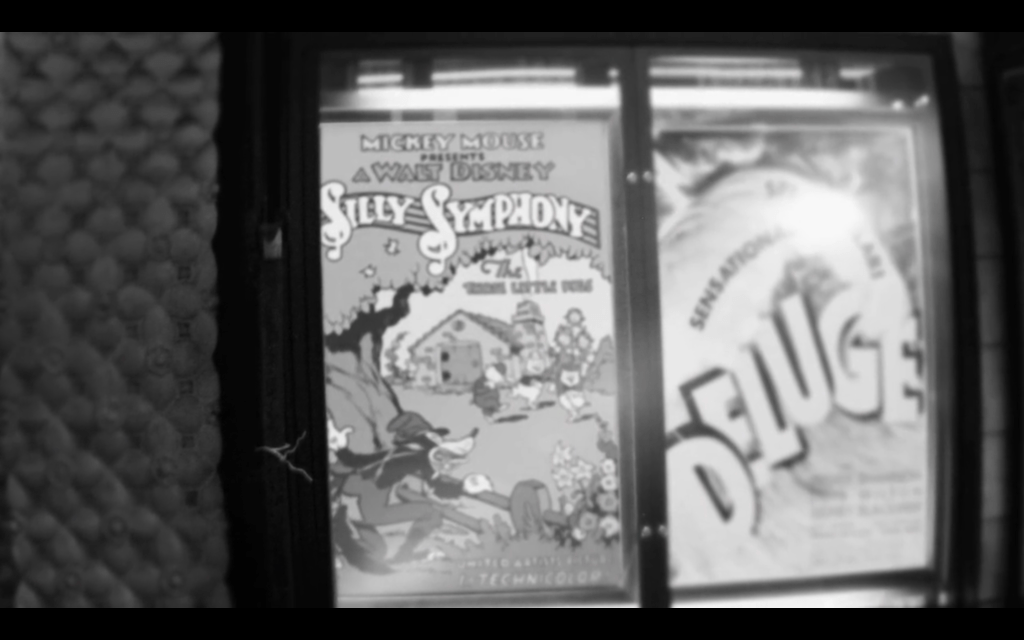
Room 237 (2012).

Which Room 237 notes is the source of Jack’s “Three Little Pigs” riff before he chops down the bathroom door…
A shadowy confluence between Bob Clampett and Walt Disney.

Nicholas Sammond implicates Looney Tunes and Song of the South alongside each other and among others, and, implicitly, the Thermidor Effect:

There is no doubt that animation went through rapid and significant technological and formal changes during the first fifty years of its development, yet assuming that this development has been unreservedly progressive—that the fading of explicit links to minstrelsy in American commercial cartoons necessarily indicates a gradual improvement in animation’s articulation of racial formations—risks producing a narrative that glosses over profound and significant discontinuities in the form. Rather than becoming less racist as live minstrelsy faded, American commercial animation engaged in an intensification of racist imagery in its depiction of music generally and swing music in particular, as in racially problematic cartoons such as many of the Warner Bros. Merrie Melodies and Looney Tunes, in George Pal’s stop-action Puppetoons (1932–1947), and in Disney’s combination of live action and animation Song of the South (Jackson and Foster, 1946). Likewise, an implicitly progressive narrative occludes the ways popular commercial animation actively participated in (rather than simply reflected) the racial formations of the day through its circulation of fantastic embodiments of dominant notions about the relationship between blackness and whiteness in the United States. Cartoons created visual correlates that associated African Americans with slavery, the jungle, and animals, literalizing and animating long-standing stereotypes.

NICHOLAS SAMMOND, BIRTH OF AN INDUSTRY: BLACKFACE MINSTRELSY AND THE RISE OF AMERICAN ANIMATION (2015).

Olsen’s thesis boils down to the sentence that follows the reference-cataloguing passage above:

I contend it is the way violence emerges in The Shining that aids the film’s longevity and relevance for viewers and for filmmakers.

Danel Olsen, “‘Cut You Up Into Little Pieces’: Ghosts & Violence in Kubrick’s The Shining,” Violence in the Films of Stephen King (ed. Magistrale and Blouin, 2021).

His argument proceeds to defend that “the way violence emerges” is a product of the process of the ghosts becoming “realer” which the “fresh blood” of the Torrances enables them to do. And it’s Jack’s alcoholism (and his not unrelated anger) that makes him susceptible to the ghosts’ (rhetorical) manipulations.

These themes of addiction “demons” manifest a kind of circular “logic”: Jack gets far enough gone to consume ghost alcohol in the empty bar, then returns later to find it full of ghost people which are a sign of the haunted presence of the hotel getting stronger specifically because he consumed the ghost alcohol…
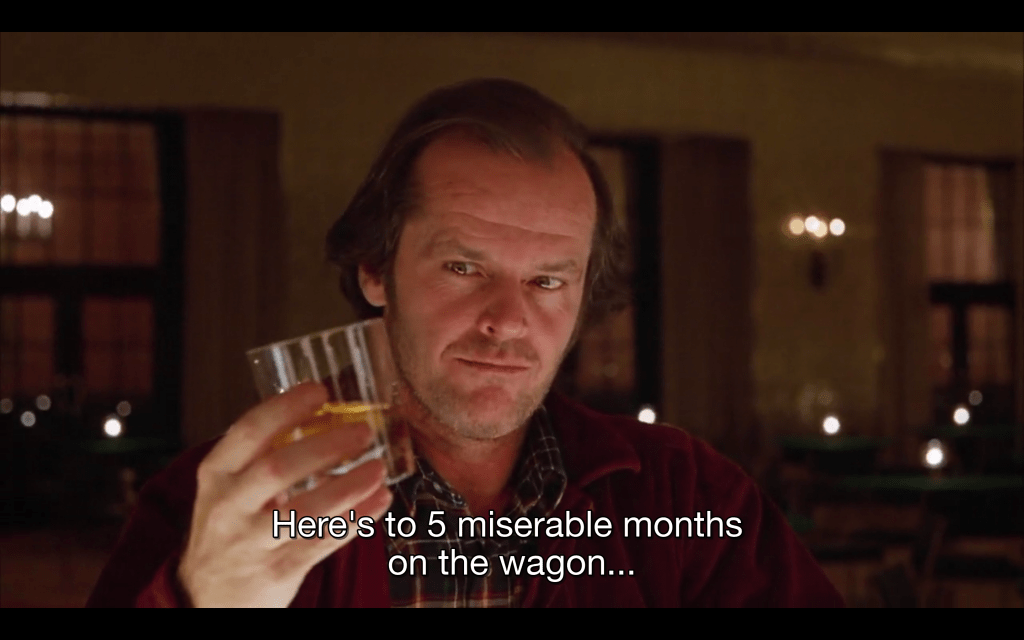
The Shining (1980).

A thought of Wendy’s in relation to Jack’s hurting Danny (an action inextricably linked to his drinking) evokes the Thermidor effect:

“What happened, doc?” she asked, although she was sure she knew. Jack had hit him. Well, of course. That came next, didn’t it? The wheels of progress; sooner or later they took you back to where you started from.”

Stephen King, The Shining (1977).

And the Indian face Danny sees behind a wheel that evinces this wheel of progress connects to the thematic idea of Jack donning the Overlook ghost’s “false face” amounting to an iteration of blackface:

Things were missing. Worse still, things had been added, things you couldn’t quite see, like in one of those pictures that said CAN YOU SEE THE INDIANS? And if you strained and squinted, you could see some of them—the thing you had taken for a cactus at first glance was really a brave with a knife clamped in his teeth, and there were others hiding in the rocks, and you could even see one of their evil, merciless faces peering through the spokes of a covered wagon wheel. (boldface mine)

Stephen King, The Shining (1977).

The DONNER PARTY was traveling in covered-wagon times, and turned cannibalistic in order to survive, as Jack notes:
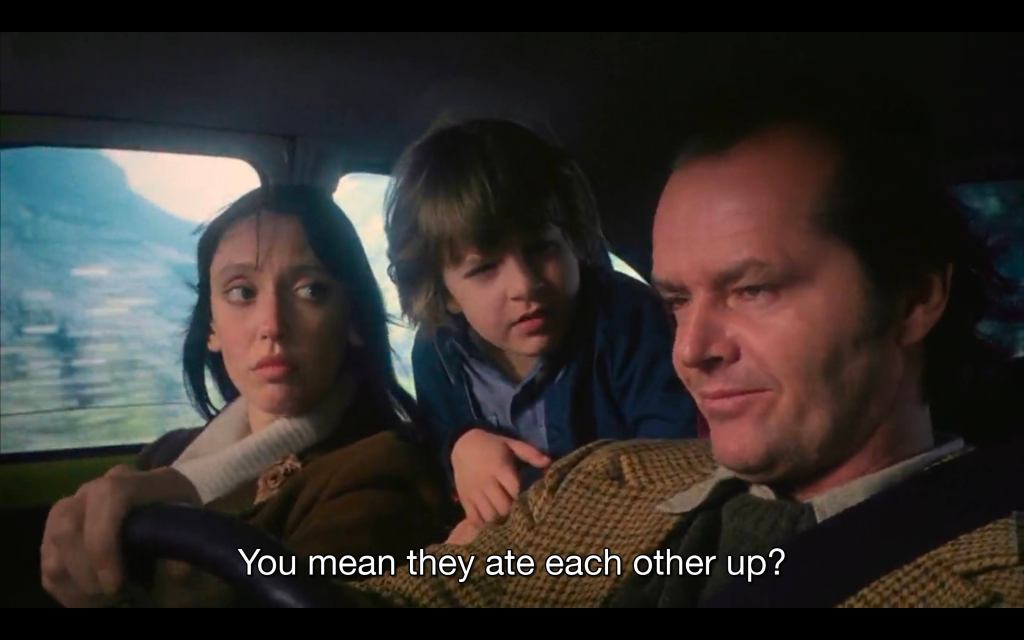
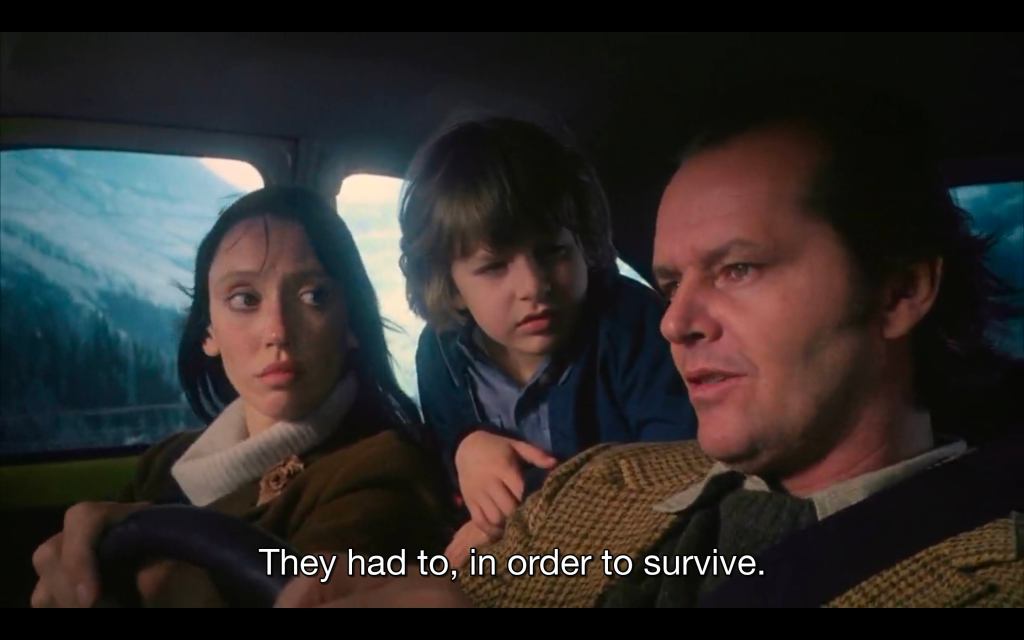
The Shining (1980).

In an interview from last fall, King notes that one of his favorite of his own works is the story “Survivor Type“; this hails from the collection Skeleton Crew (1985); it is about a guy stranded on a deserted island who has to cannibalize himself–which might be, essentially, what King is doing in and with his own work at this point?

A Skeleton Crew review quotes King describing his inspiration for “Survivor Type” by way of a shitteration:

…Mr. King explains: ”I got to thinking about cannibalism one day . . . and my muse once more evacuated its magic bowels on my head. I know how gross that sounds, but it’s the best metaphor I know.” Freud would have gone crazy – and so would Mr. King’s readers, if he did not distance himself from his material through humor, self-awareness and irony.

From here.

Via cannibalism, the Donner party became no longer whole human beings but pieces of food, an idea Kubrick surely includes to resonate with the quote Olsen takes for the title of his essay, a quote that is not in the novel, “cut you up into little pieces” (since the Alice-derived mallet in the novel can’t execute this labor like the film’s axe).
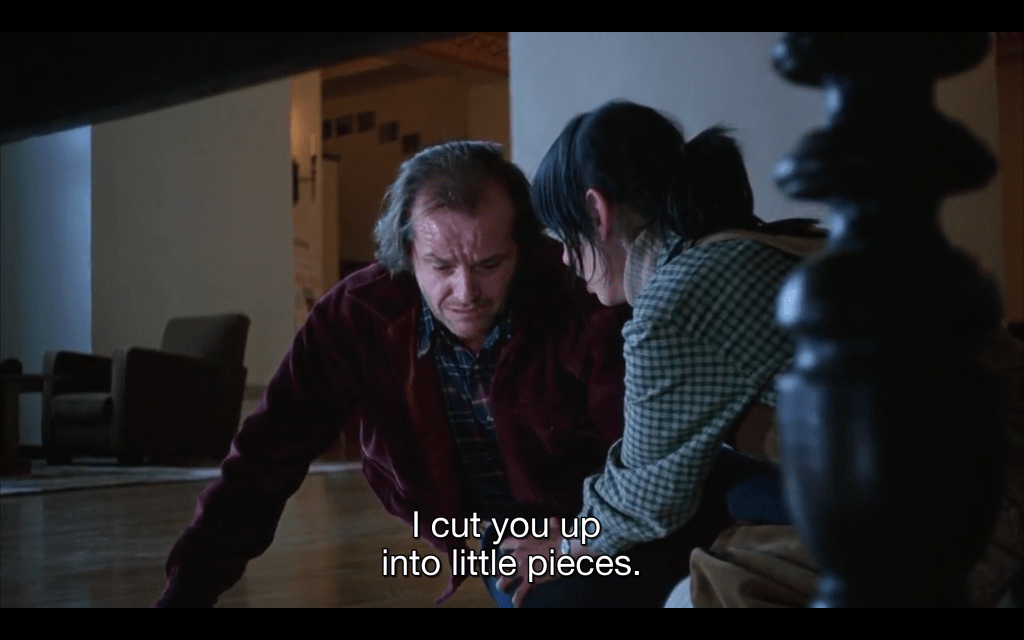
Jack’s dream in The Shining (1980).

This links violence to “pieces” like those in a jigsaw puzzle, or the pieces of a behind-closed-doors historical narrative in the basement scrapbook, through whose

…juicy moments from the hotel’s past especially designed to intrigue a writer’s imagination, [Jack] is absorbed into the structuralist method, into piecing together the hotel’s History “like pieces in a jigsaw“…, Jack feels emboldened in his quest due to his sudden conviction that there must be a “mystic connection” that ties together the stray bits of information scattered in the belly of the building.

Tony Magistrale and Michael J. Blouin, Stephen King and American History (2020).

Magistrale and Blouin consider this conception that pieces can be made into a whole part of an American “curse”:

In this way, The Shining intentionally critiques a structuralist account of American History prevalent in the immediate aftermath of the world wars. Jack’s proposed neat-and-tidy chronicle of the hotel–dependent as it is upon the illusion of omnipotence, the bird’s-eye view from History’s “overlook,” nestled in Colorado in the middle of the American landscape–is revealed to be part and parcel of a curse that has enthralled generations of American citizens.

Tony Magistrale and Michael J. Blouin, Stephen King and American History (2020).

The way that this critique occurs in this analysis is that:

…Jack is compelled to imagine that the chronology of his own life synthesizes perfectly with the hotel’s bloody marching orders, and that he and this metonymic building are, in fact, “simpatico”…

Tony Magistrale and Michael J. Blouin, Stephen King and American History (2020).

Which, figured another way, is Jack synthesizing himself with the larger collective of the hotel in a way that echoes the bee and its hive, and this giving Jack the illusion of a “bird’s-eye view” echoes Cristopher Hollingsworth’s take in his Poetics of the Hive academic study that connects the hive metaphor in literature to the forbidden (Edenic) knowledge in the scrapbook:

[Nietzsche] begins The Genealogy of Morals with an invitation to join the collective. Tellingly, he uses the Hive to make this appeal. More forcefully than in Virgil’s picture of Carthage, Nietzsche assumes that we are by nature citizens of the Hive: ‘‘We knowers are unknown to ourselves, and for good reason: how can we ever hope to find what we have never looked for? There is a sound adage which runs: ‘Where a man’s treasure lies, there lies his heart.’ Our treasure lies in the beehives of our knowledge. We are perpetually on our way thither, being by nature winged insects and honey gatherers of the mind. The only thing that lies close to our hearts is the desire to bring something home to the hive’’ (149). The Hive’s pictorial space is bipolar; its emotional associations follow suit. Community attracts, but it also repels. To know a social order as a whole is an act of simplification that extends to all of its elements. Yes, to see the whole, the city, the future from afar is to long for it, to wish, as it were, to join the masons raising its walls. However, to see in this way is also to stand apart and above, to be superior. To see a human group thus is to be privileged with the big picture, to be beyond and thereby relieved of the problems of cooperative becoming, of history, of a shared present and a future complicated by others. (boldface mine)

Cristopher Hollingsworth, Poetics of the Hive: Insect Metaphor in Literature (2001).

This is significant for the difference in Jack’s remembered wasps’ nest being up in an apple tree (even if it’s in the “lower branches”) while Dick’s remembered wasps’ nest is in the ground–Jack’s position is “privileged with the big[ger] picture.”

Thus seeing through the symbolism of the bee is a way to see a buried history of systemic racism and white privilege, evinced in the imagery of the 2021 Candyman credits…
The eye of the bee in the shadow in Candyman (2021).

And being “privileged with the big[ger] picture” might also have implications for external perspective shots…
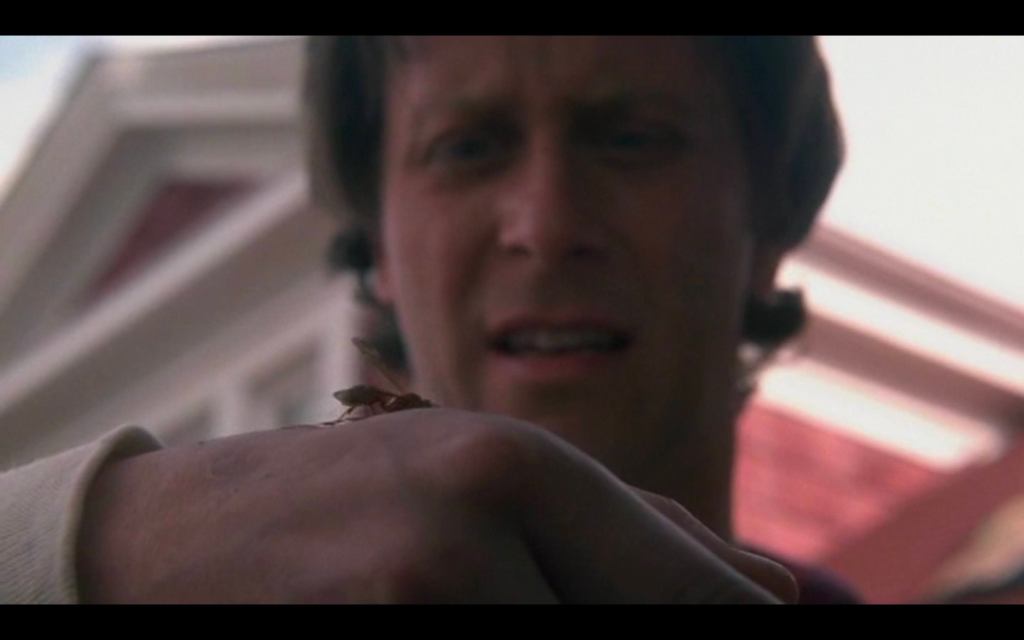
Wasp on the hand in The Shining (1997).

v. internal perspective shots…

Bee sting on the hand in Candyman (2021).

As implications necessarily arise from the point of view or “gaze” in visual texts, the Alice in Wonderland Queen’s off-with-his-head refrain might recall the implicit violence latent in media headlines that may or may not be describing explicit violence; one newspaper headline on display in Baz’s Elvis is “Elvis the Pelvis Belongs in the Jungle,” which:

1) essentially cuts Elvis “up into little pieces” by figuring him as–by reducing him to–a body part, enacting what Coco Fuscol calls “symbolic violence” and reinforcing the 3-D to 2-D flattening process engendered in the infinite reproduction of his image as an inherently violent process,

and 2) recalls a racialized critteration/creatureliness association of the jungle with Blackness via the negative association with savage animals that I pointed out the critic Henry Louis Gates, Jr. pointing out in a previous post… Elvis continued to develop the motif (or “own” it, as it were) both by covering the song “Tiger Man” (including the lyrics “I’m the king of the jungle, they call me the tiger man”) and by decorating the “Jungle Room” at Graceland, and King’s Overlook’s carpet is repeatedly described as evoking the “jungle.” One point King’s carpet is “the black-and-blue-twined carpets,” which recalls an early (the first from Danny’s perspective) description of Hallorann as “this black giant in blue serge,” shortly after the introductory and more general description of him as:

…a tall black man with a modest afro that was beginning to powder white. He had a soft southern accent and he laughed a lot, disclosing teeth too white

Stephen King, The Shining (1977).

Then there’s the carpet in Kubrick’s version…which is in a liminal space, a horror-evoking device one of my students used Kubrick’s Overlook hallway as an example of in their presentation on the concept, going on to compare this physical liminal space to the psychological liminal space of Carrie’s state of mind in her trigger moment. By thus doing this student has blown my mind by reinforcing the reading of “the shadow exploded” as manifest in Carrie’s trigger moment being present in the Overlook, out of which it will explode again… it also links bullying to the Kingian(/American) Laughing Place. The Overlook could be considered a sort of metaphysical-historical liminal space…one that we keep cycling around and around…a cycle that might be reinforced by a detail pointed out in Room 237–the pattern in the carpet in the scene where Danny goes in Room 237 changes directions:
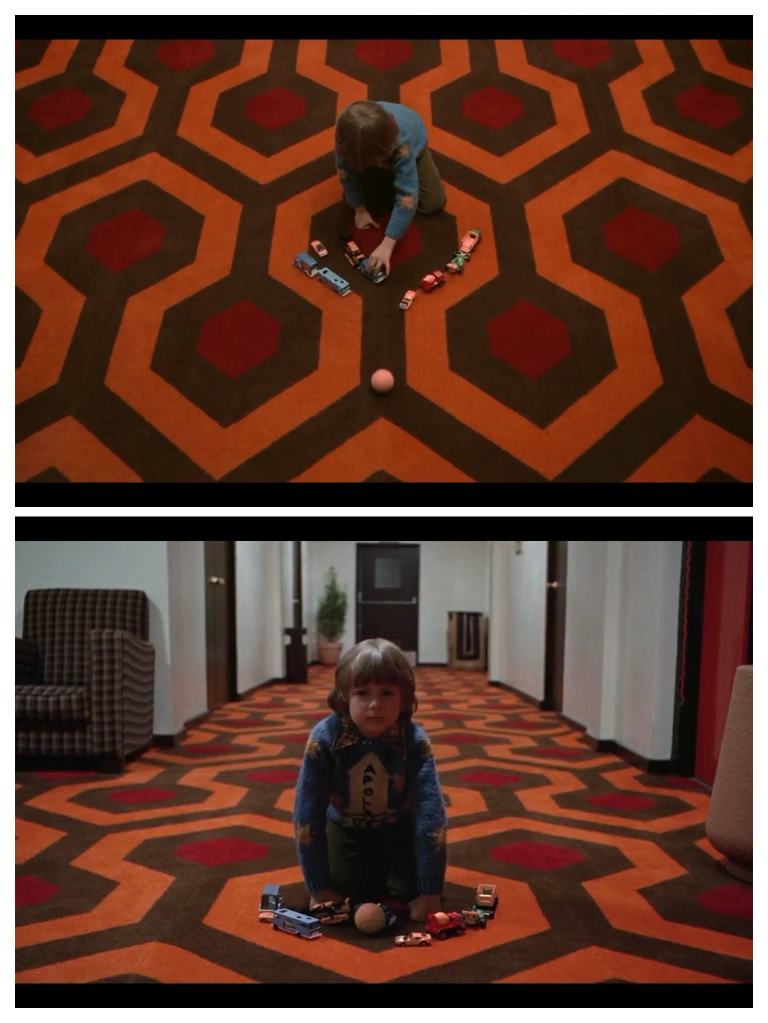
The Shining (1980). (The change is most noticeable in the brown line the ball travels down toward Danny in the top shot being absent in bottom shot.)

Jerome Charyn’s novel The Tar Baby was published that year of Roe v. Wade, 1973 (as was Donald Bogle’s landmark study Toms, Coons, Mulattoes, Mammies and Bucks: An Interpretative History of Blacks in Films). The titular Tar Baby is a publication, (highlighting the more general nature of the “tar baby” as a construction) and a “polyphonic narrative” not unlike Carrie (I usually refer to this aspect as “epistolary,” as King himself refers to Carrie in On Writing, but that technically refers to letters and not other genres), but The Tar Baby is an even more fragmented narrative with replications of advertisements alongside its newspaper/magazine stories.

The tar baby of Old India was seldom a baby at all; it might be a grown man, an old woman, or a monkey, depending on the text, and was often made of wax (or wood chips, blood, feathers, and soft coal). The tar baby performed a thousand functions: votive, seer, voluptuary, scarecrow, caretaker, shaman, murderer, savior, stud, moralist, viper, broom. Hence in one version from Hemachandra’s Paricistaparvan, a band of rowdy monkeys fighting over a lone female wastes itself and the she-monkey in its blind attacks; the oldest monkey, wilier than the rest, manages to survive; it ruts the dead female, then sits exhausted on a rock. The rock happens to ooze with bitumen, and the thirsty monkey, dumbed by its fighting and rutting, licks the bitumen, imagining it to be rusty water. A farmer passing the rock sees the bituminous monkey, swears it’s a devil, and clubs it to death. …

The Cherokee, the Zulu, and the Mpongwe of Nassau, among others, also adopted the tar baby; again, these tar babies were complicated, multi-layered beings (dead warriors encased in the hardened blood of their enemies, adulterous wives who were feathered and left in caves, false prophets who lived among cattle and caked themselves with dung to emphasize their disgrace); and in suggesting The Tar Baby Review to Korn, I was hoping for a subtle, varied magazine that would further the tar baby legend, reflect the voices and faces of Galapagos, and encourage indigenous art; instead, Korn…turned The Tar Baby into a flabby, corrupted image of himself. (pp189-190, boldface mine)

Jerome Charyn, The Tar Baby (1973).

That is, the Tar Baby as a publication becomes a mirror of one man… It’s no coincidence that tar babies would sometimes be made of wax and Charyn names the main character in this text Anatole Waxman-Weissman, the hyphenated addition to “waxman” imparting that this construction as a man(-baby) is only one part of his identity…

‘The time has come,’ the Walrus said,
    ‘To talk of many things:
Of shoes—and ships—and sealing-wax
    Of cabbages—and kings

Lewis Carroll, Through the Looking Glass (1872).

Then, like Alice through the looking glass, I stepped through a door still bearing a desiccated Christmas wreath, and that’s when everything got awesome. Graceland’s formal rooms are all white carpet and gold trimmings and mirrors — walls and walls of mirrors. 

Margaret Renkl, “Graceland, At Last” (Jan. 6, 2018).

Which makes Elvis himself simpatico with Graceland…

Marion said Elvis was like a mirror, with everyone seeing in him what they wanted to see, but Sam saw in him the very person that he himself was but rarely showed. Where Elvis appeared unsure, tongue-tied, incapable of expressing himself, Sam saw in him the same kind of burning ambition that had driven Sam from the start, he was only lacking the ability to verbalize it.

Peter Guralnick, Sam Phillips: The Man Who Invented Rock n Roll (2014).

That is, to articulate it… And the facade of Graceland evokes a Song-of-the-South-type plantation-fantasy of whiteness…
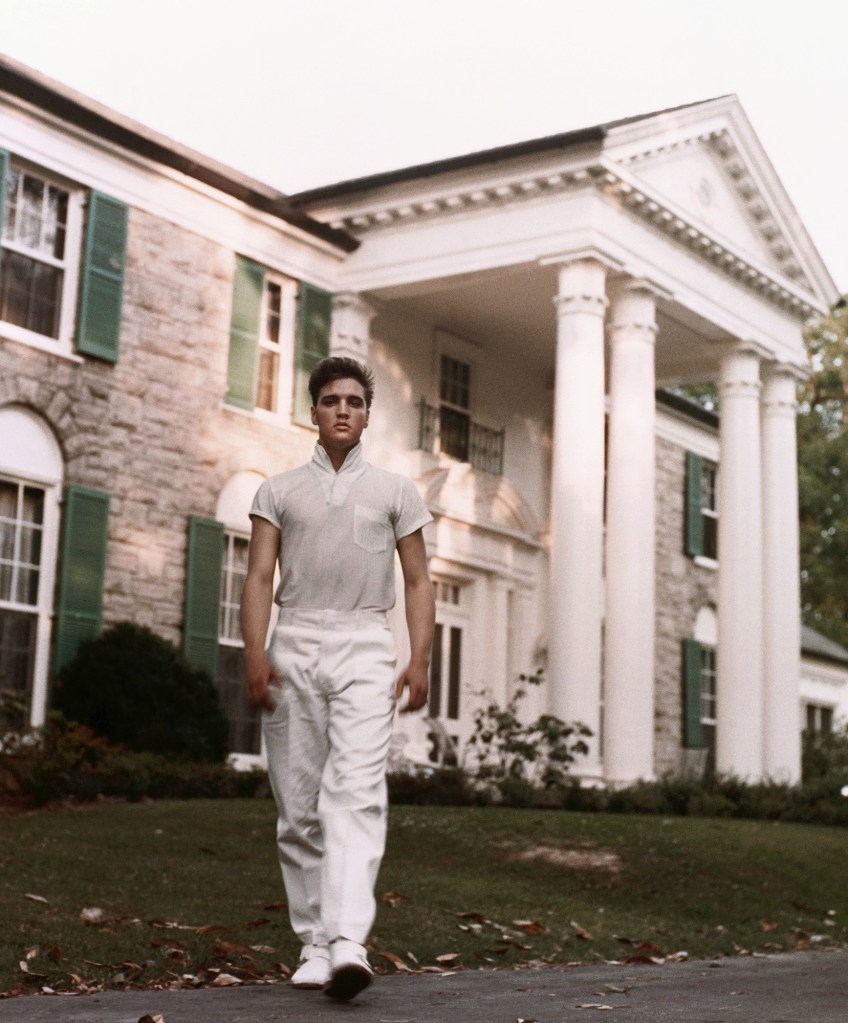
MEMPHIS, TN – CIRCA 1957: Rock and roll singer Elvis Presley strolls the grounds of his Graceland estate in circa 1957. (Photo by Michael Ochs Archives/Getty Images, here)

…one King specifically explodes at the end of Firestarter, essentially blowing up the “cradle of the Civil War”?
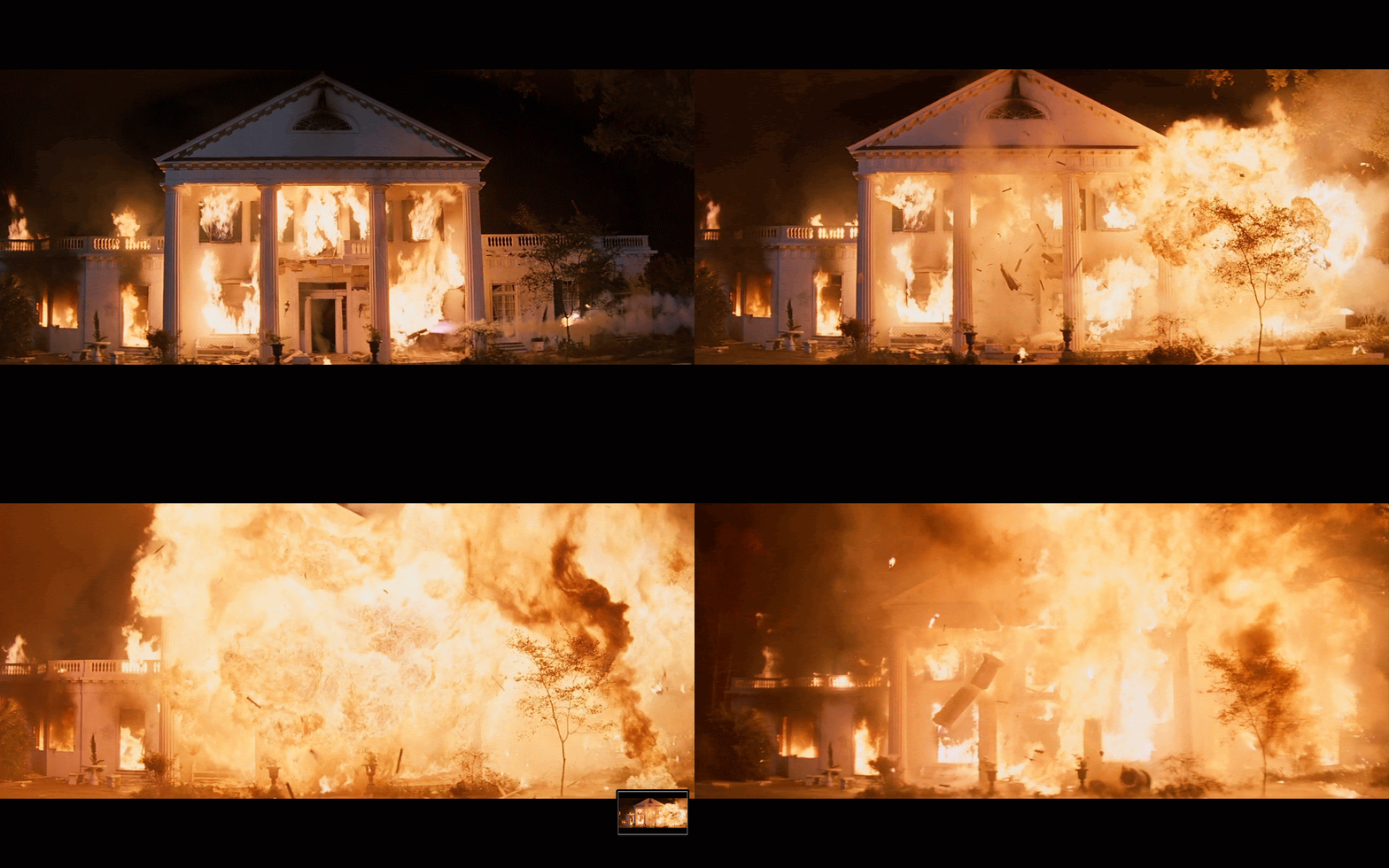
Firestarter (1984).

The postmodernist/New Historicist deconstruction/fragmentation into which The Shining (axe-/mallet-)smashes American History, largely via the newspaper accounts in the basement scrapbook, has implications for what academic Jason Sperb calls Disney’s “transmedia dissipation” strategy, which strips problematic textual elements from their original context seemingly in service of stripping the problems. But this strategy is itself problematic, because you’re not removing the problem: you’re just hiding it via covert racism. Olsen’s essay’s title of Kubrick’s “cut you up into little pieces” quote essentially describes and embodies the symbolic violence wrought via the erasures manifest in Disney’s transmedia dissipation strategy (if not the generational re-issue strategy issue). The violence implicit in necessarily dissociating mediation, of the refraction into a media image, is echoed in Baz’s split-screen extravaganza to capture Elvis’s 70s touring, a frenetic pace that indicates its own inability to be sustained.

So one can essentially track the Africanist presence that “explodes” in Carrie’s trigger moment through the entity of the Overlook ghost that then itself explodes when the boiler does at the end of King’s novel. Of course we know that “exploded” is not the same thing as “destroyed,” as signs of the Overlook’s presence will manifest again in King’s oeuvre–and will do so well before The Shining‘s 2013 sequel Doctor Sleep. The next post will tackle the manifestation of this presence in Misery (1987) and the one after that The Girl Who Loved Tom Gordon (1999), but at the conclusion of this part it’s worth noting how it continues to manifest in 2022: a new show called Shining Vale offers a comedic play on The Shining, with the wife and husband played, respectively, by Courtney Cox and Greg Kinnear, aka 2020 Stand‘s vaping Glen Bateman.
The show amounts to a rewriting of the patriarchal order often reinforced (unintentionally) in King’s work by making the Jack Torrance writer figure a woman. Wonders never cease.

-SCR
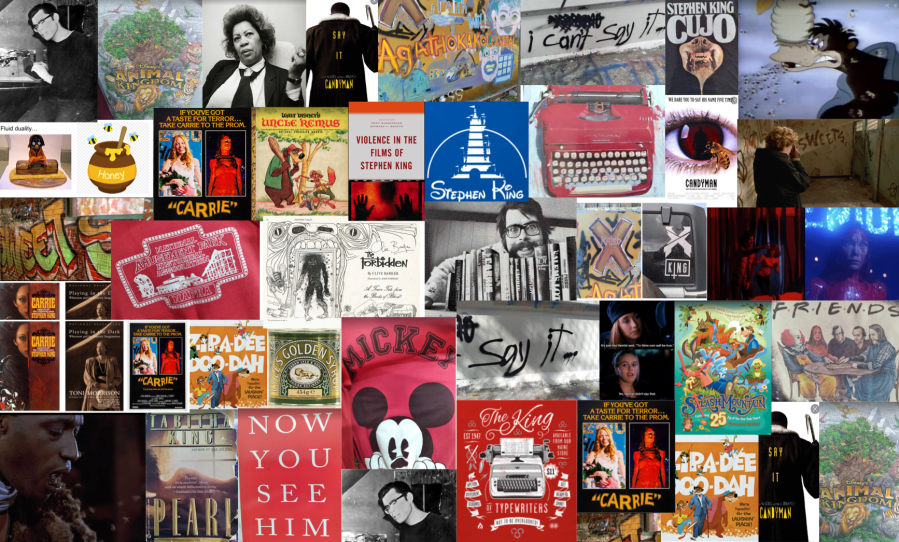
The Laughing Place is a Rabbit Hole to Disney’s Animal KINGdom, Part II: Carrie

The Writing on the Wall Carries Critterations & Shitterations

Carrie White eats shit.

Stephen King. Carrie (1974).

“ ‘Hip-deep in pigshit’? Man, you are absolutely on the money. I have been hip-deep in pigshit, not to mention chest-deep and even chin-deep in pigshit, most of my life.”

Stephen King & Peter Straub, Black House (2001).

wish in one hand, shit in the other, see which one fills up first—these phrases and others like them aren’t for the drawing-room, but they are striking and pungent.

Stephen King, On Writing: A Memoir of the Craft (2000).

It does not end happily with all of united once more, chastened and disciplined, for life is not concerned with results, but only with Being and Becoming.

Mabel Dodge Luhan, Preface to Lorenzo in Taos (1932).

The question of who carries the shadow is central to the psychology of a culture, a group or pairing, an individual, or an analysis. Equally important is the response of the individual or group receiving a shadow projection.  

John Ensign, “Rappers and Ranters: Scapegoating and Shadow in the Film ‘8 Mile’ and in Seventeenth Century Heresy,” The San Francisco Jung Institute Library Journal, Vol. 24, No. 4 (November 2005), p.18. 

The Menstrual Minstrel

One review of Karina Longworth’s podcast season on Disney’s Song of the South notes:

…Every time I listen to another season of You Must Remember This, I’m always struck by how we seem to continuously loop back into the exact same struggles.

So, and I actually learned this term while researching the season, but some historians refer to what they call the “Thermidor Effect,” which basically means … that progress moves two steps forward, one step back. And so in times when we see progressive change, usually the culture will make a leap forward and then it’ll rubber-band and there will be a backlash.

From here.

As Jason Sperb tracks in his 2012 Song of the South study, this happened with the Reagan era after the Civil-Rights era, and it’s happening again now with the overturning of Roe v. Wade.

The Thermidor Effect also manifests historical erasure/revisionist narratives, as can be seen in the history of cartoon animation covertly carrying on the legacy of blackface minstrelsy as discussed in Part I via Nicholas Sammond’s study:

Cherished cartoon characters, such as Mickey Mouse and Felix the Cat, were conceived and developed using blackface minstrelsy’s visual and performative conventions: these characters are not like minstrels; they are minstrels. They play out the social, cultural, political, and racial anxieties and desires that link race to the laboring body, just as live minstrel show performers did.

From here.

The animated characters’ WHITE gloves are a vestigial relic of minstrelsy recycled for a new generation that didn’t overtly associate it with that, but the gloves are nonetheless a sign that still covertly encodes that history. Multiple generations have now imbibed racist images without realizing these images are racist.

While “laboring bodies,” as invoked by Sammond, are linked to race via describing the physical labor of people historically enslaved, this term can also describe maternal bodies in the labor of giving birth. So the fluid duality inherent in the figure of Carrie White is in embodying both of these types of “laboring body,” via the prominence of the period that signifies the ability to bear children (encoded in her first name), and in manifesting an Africanist presence via the blackface minstrel references.

This fluid duality might then be captured most concisely in identifying Carrie White as a MENSTRUAL MINSTREL.

Sarah E. Turner notes that in her review of De Palma’s Carrie, film critic Pauline Kael makes: 

references to menstruation and pregnancy albeit through a problematic, misogynistic lens: she calls the film ‘a menstrual joke—a film noir in red’ and refers to Carrie as seemingly ‘unborn—a fetus’ (Kael). Menstruation becomes a joke while Carrie is infantilized. (boldface mine)

Sarah E. Turner, “Stephen King’s Carrie: Victim No More?” in Violence in the Films of Stephen King (ed. Magistrale & Blouin, 2021).

To read Carrie as a “menstrual minstrel” is to read her as a version of a tar baby.

The Writing on the Wall: Shitterations

If a “critteration” is an iteration of a critter, then, it stands to reason, a “shitteration” is an iteration of shit. An “iteration” by concept can run the gamut between literal and figurative; an example of a literal shitteration would be a prominent element of the recent trial surrounding two Kingverse actors–Johnny Depp (who played Mort Rainey in Secret Window in 2004) and Amber Heard (who played Nadine Cross in The Stand 2020).

Another would be, as Simon Brown quotes in my previous post, King referring to “academic bullshit,” and another would be King’s direct response to Spike Lee’s criticism of The Green Mile‘s John Coffey being a “Magical Negro” in the interview with Tony Magistrale:

TM: According to [Spike] Lee: “You have this super Negro who has these powers, but these powers are used only for the white star of the film. He can’t use them on himself or his family to improve his situation.” How accurate is this criticism?

SK: It’s complete bullshit.

Tony Magistrale, Hollywood’s Stephen King (2003).

And via the “bull,” that’s a critteration-shitteration…

The ’92 Candyman backstory legend also manifests a “shitteration” when some of the literal writing on the wall is written in literal shit:

…which appears in concurrence with the bees that are a sign of the Candyman’s presence then manifesting in a shitteration….

Candyman (1992).

Like the South Park creators I’ve previously likened King to via using the example episode “Turd Burglars”–which turns out to be very appropriate for this discussion–King is quite fond of shitterations–a more academic term for which would be the scatological–to the point that they’re nothing less than a critical ingredient in the composition of the Kingdom, perhaps critical, especially to that critical Kingian nexus of horror and humor.

I reluctantly agreed to do the surgery myself. I think I did a fairly good job, for a writer who has been accused over and over again of having diarrhea of the word processor. (boldface mine)

Stephen King, preface to 1990 Uncut edition of The Stand (1978).

In his response to Magistrale’s humor/horror question discussed in Part I, we can see that King specifically associates shitterations with this horror-humor nexus when his go-to example is Christine‘s villain Roland LeBay, whose defining catchphrase is to call anyone who displeases him a “shitter”; when Arnie starts using this unique phrase, it becomes a sign of LeBay’s presence manifesting in him.

It was via The Green Mile (1996) that I realized a major element of the Kingdom most prominently developed via The Dark Tower series–the concept of ka–was itself a shitteration:

That night, when Brutal ran his check-round, Wharton was standing at the door of his cell. He waited until Brutal looked up at him, then slammed the heels of his hands into his bulging cheeks and shot a thick and amazingly long stream of chocolate sludge into Brutal’s face. He had crammed the entire Moon Pie into his trap, held it there until it liquefied, and then used it like chewing tobacco.

Wharton fell back on his bunk wearing a chocolate goatee, kicking his legs and screaming with laughter and pointing to Brutal, who was wearing a lot more than a goatee. “Li’l Black Sambo, yassuh, boss, yassuh, howdoo you do?” Wharton held his belly and howled. “Gosh, if it had only been ka-ka! I wish it had been! If I’d had me some of that—”

“You are ka-ka,” Brutal growled, “and I hope you got your bags packed, because you’re going back down to your favorite toilet.”

Stephen King, The Green Mile: The Complete Serial Novel, 1996. 

Since the word is spelled “caca” as it usually appears (with most if not all variations spelled with “c” instead of “k”), King seems to be making an in-joke by spelling it with the Dark Tower cosmology’s defining concept. In this Green Mile passage, we also see a shitteration linked to a major stereotypical trope mentioned on the “Magical Negro” wikipedia page:

Critics use the word “Negro” [in “Magical Negro”] because it is considered archaic in modern English. This underlines their message that a “magical black character” who goes around selflessly helping white people is a throwback to stereotypes such as the “Sambo” or “noble savage“.

From here.

Wharton is an unequivocally evil character in The Green Mile, rendering the use of “ka” for shit in this context as negative, but in Christine, ka-as-shit it takes on a more positive role when it’s a major function of the vehicle that the novel’s protagonist Dennis uses to defeat the evil titular vehicle:

‘What is she?’

Pomberton poked a Camel cigarette into his mouth and lit it with a quick flick of his horny thumbnail on the tip of a wooden match. ‘Kaka sucker,’ he said.

‘What? ‘

He grinned. ‘Twenty-thousand-gal on capacity, he said. ‘She’s a corker, is Petunia.’

‘I don’t get you.’ But I was starting to.

Her job was pumping out septic systems.

Stephen King, Christine (1983).

Cycling back to how these themes manifest in Carrie, let’s start with King’s take on the comedy of John Travolta’s performance specifically in his interview with Magistrale discussed in Part I:

What Billy Nolan and Christine Hargensen do to Carrie is both cruel and terrifying, but the two of them are also hilarious in the process. [Actor John] Travolta in particular is very funny

TONY MAGISTRALE, HOLLYWOOD’S STEPHEN KING (2003).

It’s noteworthy where Travolta diverges from the source material for his character to enhance the comedic element, specifically when he and Chris set up the pig blood buckets together (instead of Billy doing it by himself as he does in the novel). Here we see Chris repeat a label for him that he previously made clear he finds offensive when she calls him a “stupid shit,” and when she orders him to hurry up, he slips into a parody of the same language that essentially defines John Coffey, who refers to main character Paul Edgecombe as “boss” (which is ironically called attention to in Wharton’s invoking the stereotypical language Coffey himself uses in the above passage):

“Yes, ma’am! We’se doin the best we can, we really are, boss.”

Carrie, dir. Brian De Palma (1976).

(I probably would not have known exactly what Billy is parodying here, that it’s a visual text, were it not for a similar reference in another visual text I saw as a kid.)

In the novel, when Billy sets up the pig blood buckets alone, it’s noted that there is a witness of sorts:

A bust of Pallas, used in some ancient dramatic version of Poe’sThe Raven,” stared at Billy with blind, floating eyes …. (boldface mine)

Stephen King, Carrie (1974).

This reference becomes significant when read for Toni Morrison’s Africanist presence, as Morrison notes that “No early American writer is more important to the concept of American Africanism than Poe,” who frequently manifests “these images of blinding whiteness [that] seem to function as both antidote for and meditation on the shadow that is companion to this whiteness.” (boldface mine)

Visual imagery might also help cement a certain likeness…

The bust of Pallas with the raven; Uncle Remus in Song of the South (1946) with the bluebird.

In a previous post on Cujo I talked about Jonathan Franzen’s concept of “Consuming Narratives” from his 2001 novel The Corrections, derived from a scene therein of a professor teaching a class on “Consuming Narratives” and having a student challenge his (essentially rhetorical) analysis of a visual text.

“Excuse me,” Melissa said, “but that is just such bullshit.”

“What is bullshit?” Chip said.

“This whole class,” she said. “It’s just bullshit every week. …” (boldface mine)

Jonathan Franzen. The Corrections (2001).

The scene concludes (after the student articulates more specific criticisms of Chip’s criticism) by repeating the same critteration-shitteration about academic criticism that King has applied to it:

Melissa’s accusations had cut him to the quick. He’d never quite realized how seriously he’d taken his father’s injunction to do work that was “useful” to society. Criticizing a sick culture, even if the criticism accomplished nothing, had always felt like useful work. But if the supposed sickness wasn’t a sickness at all—if the great Materialist Order of technology and consumer appetite and medical science really was improving the lives of the formerly oppressed; if it was only straight white males like Chip who had a problem with this order—then there was no longer even the most abstract utility to his criticism. It was all, in Melissa’s word, bullshit. (boldface mine)

Jonathan Franzen. The Corrections (2001).

Like Remus’s bluebird or the bust of Pallas’s raven, I have a Chip on my shoulder about not so much the utility of criticism as the institutional systems by which it’s bound in our capitalist system. That such criticism is all just “academic bullshit,” as King himself as puts it, is also the root reason that, much like what happens to Julie in Julie and Julia (2009), Stephen King would hate my blog…

Chip may put it in a pompous way, but it’s hard to argue with his analysis of the visual text itself problematically seducing students with a narrative that purports to empower women for the ultimate purpose of consuming products.

When I read about the current state of the world…

In a single week in late June, the conservative Justices asserted their recently consolidated power by expanding gun rights, demolishing the right to abortion, blowing a hole in the wall between church and state, and curtailing the ability to combat climate change. (boldface mine)

Jeannie Suke Gersen, “The Supreme Court’s Conservatives Have Asserted Their Power,” The New Yorker, July 3, 2022.

…a refrain from another visual text rings in my head:

Zoolander (2001)

Consuming Carrie

A variation (or iteration) of a “consuming narrative” seems to surround the character of Carrie White via a shitteration, as constituted by the repetition (or refrain) of the idea that Carrie “eats shit.” This assertion appears twice in the novel–notably both times made not verbally, but in writing–first as graffiti on a grammar-school desk with just that phrase (very early, before the locker-room scene unfolds), and the second as graffiti on a junior-high desk that’s slightly more developed:

Roses are red, violets are blue, sugar is sweet, but Carrie White eats shit.

Stephen King. Carrie. 1974.

This reflects an “abject” horror tactic (“abject” being something that would be objectively horrifying to anyone/everyone):

The gibe “Carrie White eats shit” thus in fact paints Carrie as doubly abject, as it not only mockingly accuses her of ingesting bodily waste, already abject in itself, but also confounds the traditional functions of two distinct bodily orifices.

Victoria Madden, “‘We Found the Witch, May We Burn Her?’: Suburban Gothic, Witch-Hunting, and Anxiety-Induced Conformity in Stephen King’s Carrie,” The Journal of American Culture; Malden Vol. 40, Iss. 1,  (Mar 2017): 7-20.

But it might be more complex:

The abject and its emphasis on the body—on waste and fluids and expulsion—is not gothic in the sense that Madden argues, but instead may be read as a personification or manifestation of the future as envisioned by those opposed to the women’s right to choose. What this means, I would argue, is that the sociocultural concerns expressed and explored in Carrie are not those of the homogeneous suburban need to/fear of containing the ‘other’; instead, what Carrie is exploring is the impact of the 1973 Supreme Court Decision in Roe v. Wade.

Sarah E. Turner, “Stephen King’s Carrie: Victim No More?” in Violence in the Films of Stephen King (ed. Magistrale & Blouin, 2021).

This reading was intriguing when I first read it back in March. When I revisited it in May after a certain draft of a Supreme Court decision was leaked, it was mind-blowing, and since then, of course, it’s been overturned officially, leaving me and many others in a state of numb shock. Via Turner’s reading, this development has made reading Carrie, and in turn, King, more relevant than ever.

Turner essentially places the Roe v. Wade decision in 1973 as underwriting the success of the King canon when she places it as pivotal to the cultural climate that engendered the success of De Palma’s Carrie. For Turner, this answers the question of why King set Carrie a few years ahead of the year it was published; for us, it means now reading Carrie embodying not the horrifying potential of a woman’s right to choose, but that of a woman who does not have the right to choose.

Let us just take a moment to process that for basically the entire span of King’s career as a writer, almost fifty years, abortion has been legal (minus some complications at the state level, as in Texas, the one where I happen to live). If the Thermidor effect is supposed to be two steps forward, one step back, it feels like now we’ve gone at least twenty steps back. The current cultural climate renders not only Carrie relevant again, but all of the horror genre as a horrifyingly accurate representation of the world in which we live.

Turner’s reading of Carrie as an “abortion practitioner” requires for me a re-reading of a moment I might have misread initially: I did not, as Turner does, read Carrie as aborting Sue’s fetus in that moment near Carrie’s death when they have their telepathic exchange. Turner’s discussion also illuminates something else I’ve always struggled to understand–the “logic” behind the continued pursuit of criminalizing abortion again. Conservatives can claim Christianity as their motive all they want, but in the mouths of politicians that’s a bullshitteration of covert rhetoric for sure. If one thing qualifies as laughable, it’s the vociferous defense of fetuses when so many conservative imperatives have hung so many actual human beings not out to dry, but to DIE. Usually the ulterior motive of such political hypocrisy is directly connected to the capitalist incentive, and in the case of the abortion issue, I still struggle to understand how this particular predominant ulterior motive would be at work. Criminalizing abortion doesn’t seem like it would be good for the economy or as a means to line the puppet-masters’ pockets, so is it just for the sake of controlling women?

Apparently, the answer is yes:

Abortion then, a woman’s right to choose, was initially criminalized to ensure the male medical monopoly and to disenfranchise women who sought to practice medicine. That midwives and female healers became defined and persecuted as witches further underscores the desire to control the female body, and for many, this includes the right to choose.

Sarah E. Turner, “Stephen King’s Carrie: Victim No More?” in Violence in the Films of Stephen King (ed. Magistrale & Blouin, 2021).

Or the answer is almost yes… capitalist incentive is at work in this history of the medical industry:

The other side of the suppression of witches as healers was the creation of a new male medical profession, under the protection and patronage of the ruling classes.

Sarah E. Turner, “Stephen King’s Carrie: Victim No More?” in Violence in the Films of Stephen King (ed. Magistrale & Blouin, 2021).

Talk about unearthing a “buried history” of the term “witch.” Turner reads “competing visions” of Carrie as the subversive “witch/abortionist” figure offered in the novel v. film versions:

Both King and De Palma see Carrie as a threat, but King’s Carrie embodies the empowering but “threatening” potential of Roe v. Wade, while De Palma’s Carrie is an outlier, a threat to traditional femininity as defined and oppressed by the patriarchy. These two views set up the tension at the heart of this reading of Carrie that seeks to reclaim her—to move her from ostracized victim to subversive challenger.

Sarah E. Turner, “Stephen King’s Carrie: Victim No More?” in Violence in the Films of Stephen King (ed. Magistrale & Blouin, 2021).

Here Turner is offering a couple of other versions of Carrie manifesting what I’ve designated “fluid duality”: “witch/abortionist” being one version and “victim/challenger” another (though these overlap with each other as well as with my fluidly dual categories of “menstrual/minstrel”). Turner reads King’s version of Carrie as more nuanced, offering a meaningful cultural critique while De Palma’s Carrie merely titillates, though the narratives of both versions revolve around Carrie’s “power”–telekinesis, which per Turner in King’s version, can be read as dramatizing the figurative empowerment women gained over their bodies via the 1973 Roe v. Wade decision. Thus, what Carrie does with this empowerment plays out cultural fears and narratives surrounding what women will do with their new cultural empowerment, a nuance that De Palma, per Turner, fails to capture:

Ultimately, the reader of King’s text is left with a sense of ambiguity: King presents both sides of the abortion debate, albeit hyperbolically, but he does not dictate how to read them. He creates tension between mother and daughter that represents the duality of the debate around abortion and a woman’s right to choose. Margaret White is the hyperbolic manifestation of the religious right—an extreme King seems to reject even as he creates her; Carrie is the potentially monstrous implications of the Roe v. Wade decision: destructive, vindictive, unnatural, deadly. However, De Palma’s movie engenders no sense of ambiguity… Ending the film with Carrie’s hand reaching out from the grave to grab Sue’s arm, even though the moment is embedded within Sue’s nightmare, signals De Palma’s interpretation of Carrie as a monster, a hysterical woman who must be destroyed. (boldface mine)

Sarah E. Turner, “Stephen King’s Carrie: Victim No More?” in Violence in the Films of Stephen King (ed. Magistrale & Blouin, 2021).

That is, the hand is a sign…

Carrie (1976).

(Turner doesn’t mention this, but it’s worth noting that the plot of King’s Insomnia (1994) revolves around a pro-choice rally … and is also a Dark Tower entry perhaps most notable for marking the first appearance of the Crimson King.)

In the context of the influence of Disney’s problematic Happy Endings, Tony Magistrale mentions an academic take on my primary example in a previous discussion:

If Chelsea Quinn Yarbro is right in her interpretation of the Cinderella myth as a vehicle for programming women to accept their social role and obligation to Western culture (47-49), then Carrie’s classmates torture her to reaffirm their own unstable positioning as emerging women. (29)

Tony Magistrale, Hollywood’s Stephen King (2003) (citing “Cinderella’s Revenge–Twists on Fairy Tales and Mythic Themes in the Work of Stephen King” in Fear Itself: The Horror Fiction of Stephen King eds. Tim Underwood and Chuck Miller, 1982).

Carrie purports to subvert the Cinderella narrative, which as some have noted, would have ended at about this point if it was simply re-enacting it:

And the screenwriter of Song of the South, Maurice Rapf, was a Communist whose only other screenwriting credit is…CINDERELLA, which Karina Longworth in her podcast series on Song of the South notes provides a narrative that is sympathetic to the plight of exploited workers. So Rapf was a “red,” and as such he was eventually “blacklisted.” And Cinderella can be read as programming women for the patriarchy, or as fighting the power of the patriarchy by highlighting its exploitation.

At any rate, part of the reason Carrie‘s narrative can’t reasonably end at the Happy Place is specifically because of history–in this localized case, the history of Carrie being constructed as an outcast/other by her classmates. Despite Sue’s attempt to erase this construction by assimilating Carrie into their peer group, the assimilation is foredoomed by the pre-existing construction.

De Palma’s Carrie invokes the shit-eating abject construction of Carrie-as-outcast more directly by verbalizing it in its (added) opening scene, positioning the high-school girls in a gym-class volleyball match that precedes the infamous locker-room tampon-pelting scene. In her essay “The Queen Bee, the Prom Queen, and the Girl Next Door: Teen Hierarchical Structures in Carrie,” from The Films of Stephen King: From Carrie to Secret Window (2008), Alison M. Kelly applies Rosalind Wiseman’s 2002 criteria of different teen types to Carrie‘s characters, and analyzes De Palma’s opening in more detail to show that “[t]he female hierarchy in Carrie is immediately established in the opening scene: the P.E. volleyball game” (13). Namely, the scene establishes Chris as “Queen Bee” and Carrie as “Target”–or put another way, Chris as bully and Carrie as victim. The less-than-a-minute opening scene concludes with Chris growling at Carrie, “You eat shit.”

A bit later, when Ms. Collins (Ms. Desjardin in the book) is reprimanding the girls who harassed Carrie–telling them, twice, that it’s a “really shitty thing” they did, there’s a shot of Carrie looking in from outside, where she would be unable to see what the viewer can from the camera angle, the rather large graffiti reading “Carrie White eats shit” on the inside of the gym door/wall.

And of course we all know what will happen in this same gym later…in this shot, Carrie’s classmates’ construction of her is essentially shown to “underwrite” the destruction that will take place here; it’s the writing on the wall that in this moment literally positions Carrie as outsider.

Perhaps “you eat shit” was a common insult in the 70s–though it is still present, even prominent, in the ’02 and ’13 Carrie adaptations–but it’s the technical (abject) logic of it that strikes me as interesting: eat the waste product of your eating. A kind of ourouborous configuration…

“Houston’s largest mural brings attention to food insecurity”

Which a certain trial apparently also was…

The [Depp-Heard] trial, in short, turned the op-ed into an ouroboros: what was intended as a #MeToo testimonial about women being punished for naming their experiences became a post-#MeToo instrument for punishing a woman who named her experiences. (boldface mine)

Jessica Winter, “The Johnny Depp-Amber Heard Verdict is Chilling,” The New Yorker (June 2, 2022).

An ouroboros also visually replicates a circle, or cycle…of how we are consuming ourselves.

Last semester I read Carrie with a group of high-school students for an elective on horror writing, and after seeing Kelly’s essay, I was inspired to use it in a new way in my college composition classes. I’d already been using the figure of Carrie as an example of how to apply monster theory to the culture for one set of composition classes–applying the criteria of what makes a monster a monster laid out by Jeffrey Jerome Cohen’s monster theory essay in a way similar to how Kelly applies criteria from Wiseman’s categories for different teen types to the Carrie characters.

Via Kelly’s argument that the brief opening scene efficiently establishes a “female hierarchy”–more specifically, one with Carrie at the very bottom and Chris at the very top–Kelly provides a version of a “rhetorical analysis” of the opening scene compatible with the first major essay my composition students have to write about a visual text. But it’s Kelly’s inclusion and discussion of a specific screen shot from the scene as evidence to support her argument–a shot of the opening scene’s culmination in which Chris verbalizes (or more specifically, sneers) “you eat shit” at Carrie, cementing her “queen bee” status–that prompted me to use the essay as a model for what my students have to do in their first essay assignment.

“You eat shit.”

I’ve had students analyze pop-culture “visual texts” in their major essays for years, with the requirement that they have to discuss a specific screen shot(s) from the text they pick to support one of their points that in turn support their thesis. Kelly generates a numbered list of discussion points based on observations of the above screen shot that replicates a version of what our course textbook Writing Analytically calls the “Notice & Focus” exercise. (One observation I might make is that the stripes on the white socks of the girls visible walking away behind Chris are bee-like.)

Tony Magistrale also presents a screenshot-based discussion of De Palma’s opening scene in a less explicitly structured way, with this shot at the top of a chapter on “lost children” in King’s work:

From Hollywood’s Stephen King by Tony Magistrale (2003).

When I tried to grab a screen shot for a color version, I found that this exact angle weirdly does not seem to exist in full frame, with the closest being:

At any rate, Magistrale’s point is about how the shot treats Carrie:

As the camera zooms in on Carrie White and she is pushed deeper into the upper corner of the volleyball court by her unsupportive teammate, we note that the square shadow of a basketball backboard looms directly behind her. … [B]y the end of the scene she also stands inside the only shadow cast on the volleyball court’s surface. Boxed into a shadowed corner, swatted in the face for her athletic failings, and and told to “eat shit,” Carrie retreats alone into the girls’ locker room. (boldface mine)

Tony Magistrale, Hollywood’s Stephen King (2003).

Both versions of the screen shot provide evidence of the prominent use of shadows in relation to the figure of Carrie, which I can now use to support a point Magistrale is not actively making here, about how Carrie manifests an Africanist presence, not just in the trigger moment, but from the beginning. Magistrale proceeds to note:

…these initial images of Carrie portrayed in shadowy isolation and boxlike enclosures are restated in an effort to dramatize forcefully her own experience in high school as “a time of misery and resentment.” (boldface mine)

Tony Magistrale, Hollywood’s Stephen King (2003), p27.

With that last quote being from a 1999 speech of King’s describing his own high-school experience. Magistrale’s description of the trigger moment tracks the role of the laughter:

In response to this final indignity, Carrie goes ballistic. While none of the other promgoers is actually laughing at her plight, except for Chris’s vile friend and co-conspirator Norma (P.J. Soles), Carrie automatically perceives them from the perspective of her mother. Their imaginary laughter sparks Carrie’s telekinetic wrath, and in a scene inspired by the Old Testament, Carrie punishes everyone in Bates High School gymnasium–the innocent as well as the guilty. (boldface mine)

Tony Magistrale, Hollywood’s Stephen King (2003), p24.

This Old-Testament-style destruction is also likened to a Shakespeare text, something De Palma took from the source text, though Turner frames it slightly differently in her analysis of Carrie’s likeness to Lady Macbeth as integral to her reading “competing visions” of Carrie in the novel v. the film:

Brian De Palma has famously acknowledged his debt to Gustave Moreau’s 1851’s portrait of Lady Macbeth as the inspiration for the seminal shot of Carrie—drenched in pig’s blood and backlit by flames—as well as her posture and gait in the later parts of the film. And clearly at some level King had her in mind as well—as readers are told that Carrie was “unaware that she was scrubbing her bloodied hands against her dress like Lady Macbeth” after the destruction of the high school and town (140). And yet, the two men have competing visions of both Lady Macbeth and Carrie; for De Palma, the women are destructive, unnatural, a threat to the heteronormative patriarchal culture of their time. … Lady Macbeth, in her violation of the Elizabethan great chain of being, also acts to violate the king’s divinity and the rules of domestic hospitality by goading Macbeth into action. Shakespeare, like King with Carrie, may be critical of Lady Macbeth’s actions, but he creates a powerful woman whose actions insofar as they stand in defiance of traditional woman’s role bridled by patriarchal law and custom may be read as the precursor to Carrie as “witch/abortionist.” (boldface mine)

Sarah E. Turner, “Stephen King’s Carrie: Victim No More?” in Violence in the Films of Stephen King (ed. Magistrale & Blouin, 2021).
This image has an empty alt attribute; its file name is 8756d61b39aca4f806575bef71a13df5.png
From here.

Macbeth doesn’t have any prominent uncles, but it does emphasize the theme of the divine right of kings, which is an interesting theme to consider in light of the plot-significance of the tradition of prom king and queen in Carrie

It makes a certain kind of sense that Carrie would be triggered by an imaginary construction (i.e. Magistrale’s reading of “imaginary laughter”), since her being triggered is itself a response to the way she’s been constructed in the imagination of her classmates manifest in their writing on the wall–i.e., that she “eats shit.” It’s also worth noting that the way the laughter sequence unfolds in the novel is more protracted than the film version, including but not limited to how it’s rendered in different perspectives: first Norma’s, then Carrie’s. Interesting that it would be rendered first from the perspective of the character who is the only one to laugh at her in the film…

Also interesting how hard Norma hits the guy next to her who is not laughing, as if De Palma is punctuating the violence manifest in Norma’s laughter.

In the novel, Norma explains why they all laughed at Carrie via the Song of the South reference that has led me down this rabbit hole, and if we might think it’s possible that Norma, who in the novel is recounting this in her memoir, could be exaggerating about how many people were laughing to save face if she were in fact the only one who did laugh, we then get Carrie’s perspective, though this also has the potential to be skewed. So is it “imaginary laughter” that “sparks Carrie’s telekinetic wrath” in the novel? The moment of “imaginary laughter” in De Palma’s version is one of the times you can see him taking from but adjusting the source text, specifically these shots:

The key link between the film and novel versions is the “kaleidoscope” perspective, which brings us to the description of the trigger moment in the novel from Carrie’s point of view:

Carrie sat with her eyes closed and felt the black bulge of terror rising in her mind. Momma had been right, after all. They had taken her again, gulled her again, made her the butt again. The horror of it should have been monotonous, but it was not; they had gotten her up here, up here in front of the whole school, and had repeated the shower-room scene . . . only the voice had said

(my god that’s blood)

something too awful to be contemplated. If she opened her eyes and it was true, oh, what then? What then?

Someone began to laugh, a solitary, affrighted hyena sound, and she did open her eyes, opened them to see who it was and it was true, the final nightmare, she was red and dripping with it, they had drenched her in the very secretness of blood, in front of all of them and her thought

(oh . . . i . . . COVERED . . . with it)

was colored a ghastly purple with her revulsion and her shame. She could smell herself and it was the stink of blood, the awful wet, coppery smell. In a flickering kaleidoscope of images she saw the blood running thickly down her naked thighs, heard the constant beating of the shower on the tiles, felt the soft patter of tampons and napkins against her skin as voices exhorted her to plug it UP, tasted the plump, fulsome bitterness of horror. They had finally given her the shower they wanted.

A second voice joined the first, and was followed by a third—girl’s soprano giggle—a fourth, a fifth, six, a dozen, all of them, all laughing. Vic Mooney was laughing. She could see him. His face was utterly frozen, shocked, but that laughter issued forth just the same.

She sat quite still, letting the noise wash over her like surf. They were still all beautiful and there was still enchantment and wonder, but she had crossed a line and now the fairy tale was green with corruption and evil. In this one she would bite a poison apple, be attacked by trolls, be eaten by tigers.

They were laughing at her again.

Stephen King, Carrie (1974).

As Magistrale notes about De Palma’s version, Carrie is essentially seeing through her mother’s perspective when she experiences the “imaginary laughter,” reflected by her hearing her mother’s refrain in her head: “They’re all gonna laugh at you,” which is what we hear during the above “kaleidoscope” shots, and which is a line that does not appear in the book. But this depiction is all in keeping with the novel’s description of Carrie’s thought in this moment that “Momma had been right.” Carrie’s novel account does depart from Norma’s memoir’s in describing a “solitary” burst of laughter initially before more join in, though the solitary laugh is what causes her to then finally open her eyes, and according to Norma, it’s what Carrie looks like after she opens her eyes specifically–the pop eyes that, like white gloves, are another sign of a blackface minstrel’s presence–that makes, supposedly, everyone laugh. And Carrie’s perception of the laughter in general is called into question by the end of the above passage when Vic Mooney is described as laughing even though his face is “frozen”–a blatant contradiction. This plays out as the passage proceeds from there in Carrie’s perception of Miss Desjardin:

Miss Desjardin was running toward her, and Miss Desjardin’s face was filled with lying compassion. Carrie could see beneath the surface to where the real Miss Desjardin was giggling and chuckling with rancid old-maid ribaldry.

Stephen King, Carrie (1974).

So Carrie is even aware that the laughter she’s perceiving is not “real,” so a version of “imaginary laughter” is propelling her here–fear/paranoia of laughter, an outcome of her conditioning from her classmates’ construction of her–as she proceeds to use her power to hurl Miss Desjardin against the wall:

“Let me help you, dear. Oh I am so sor—”

She struck out at her

(flex)

and Miss Desjardin went flying to rattle off the wall at the side of the stage and fall into a heap.”

Stephen King, Carrie (1974).

Here Carrie turns a tool of her classmates’ construction of her into a weapon, that same tool, which was really also a version of a weapon in its capacity to enact harm (the wall, with writing on it) that De Palma previously emphasized as elemental in her classmates’ construction of her, and we see the tragedy of the fallout of what was written on that wall affecting an innocent party, though this also emphasizes the evil of what caused all this in the first place…laughter.

At this point in the novel, Carrie then leaves the gym and the building entirely, basically passing through a gauntlet of (imaginary) laughter along the way:

She went down [the steps] in great, awkward leaps, with the sound of the laughter flapping around her like black birds.

Then, darkness.

Stephen King, Carrie (1974).

She then lies on the school lawn outside mulling things over for a bit before she decides to use her power to teach them all a lesson and then returns to the gym to do so–so the film handles the sequence a little more efficiently.

Via Norma being the only one laughing (minus possibly one other guy in a fleeting shot that’s not a distorted kaleidoscope one), De Palma seems to have been attuned to the importance of Norma’s role in the trigger moment in the novel. Another observation for the Notice and Focus exercise about De Palma’s opening scene is that the girls are all in yellow and black uniforms–except one girl, whose shorts are red and who is wearing a matching red hat. This girl is Norma, who throughout the entire film is NEVER not wearing her red hat. She is still wearing it with her prom dress in the shot of her violently laughing above, and in one of the places De Palma deploys humor in the film, as she’s getting ready for prom:

Still wearing the red hat, sort of…

The scene that cuts directly to the shot above also has a character wearing a red hat:

The red hat is a sign of another “vile co-conspirator” of Chris’s (she is visible in the background at the center of the shot).

Given the role of conformity, something Norma conforms to via, per Kelly, being the teen type of the “sidekick” to Queen Bee Chris, it’s interesting that her clothes mark her as an outlier, which resonates with her being the only one whose laughter Carrie is not imagining in the film.

Chris and the laughter brings us back to the bees…

Per Kelly, Chris as “queen bee” constitutes the film’s “real horror,” and if, via Song of the South associating bees with The Laughing Place that manifests a similar merging of horror and humor as is enacted in the Carrie trigger moment, bees are associated with the Africanist presence, this means that Chris too potentially manifests an Africanist presence. Kelly notes as well the depiction of the school’s mascot in the film: “Bates High School’s colors [] are yellow and black and their mascot is the Stinger. According to art director Jack Fisk, ‘We didn’t want anything cuddly or too friendly’” (15). In the screen shot analysis from the opening scene, Kelly notes that the school gym uniform fits Chris but is too big on Carrie, meaning the unfriendly stinging atmosphere of the school is a better “fit” on Chris. Here’s a screen shot from a different scene that could also be used as evidence from the text to support this point:

Queen Bee and Sidekick conspiring…this (amazing) shot is angled so that Chris looks like both the wings and stinger (or bottom half with the stinger) are protruding from her body…

The potential viciousness of a “queen bee” is evoked in a more current pop-culture text, an episode of The Big Bang Theory from 2009 with what’s certainly in contention for the show’s most disgusting episode title, “The Dead Hooker Juxtaposition.” The titular “dead hooker” is derived from a new girl who moves into the apartment building where the main characters live and becomes a threat to Penny, at that point the show’s only main female role (the counterpoint to the typical all-male ka-tet quartet comprised by the rest of the main cast); this girl, like Penny, aspires to be an actress and is thrilled to land a role as a “hooker that gets killed.” At one point, Sheldon seems to be attempting to shed some light on the situation by invoking a metaphor, but it’s elemental (so to speak) to Sheldon’s character that he isn’t capable of this type of symbolic thinking; he takes most things literally in a way that seems to verge on the autistic (though this aspect of his quirkiness, much like his sexuality, is never named):

Sheldon: You know, Penny, there’s something that occurs in beehives you might find interesting. Occasionally, a new queen will arrive while the old queen is still in power. When this happens, the old queen must either locate to a new hive or engage in a battle to the death until only one queen remains.

Penny: What are you saying, that I’m threatened by Alicia? That I’m like the old queen of the hive and it’s just time for me to go?

Sheldon: I’m just talking about bees. They’re on the discovery channel. What are you talking about?

Penny: Bees. 

The Big Bang Theory 2.19, “The Dead Hooker Juxtaposition” (March 30, 2009).

What’s in a Name, Again

If “What’s in a name?” were a riddle, then one answer would be: letters.

The symbolism of bees and insects as used in literature is tracked extensively in the academic study Poetics of the Hive: Insect Metaphor in Literature by Cristopher Hollingsworth (2001); the introduction’s title “The Alphabet of the Bees” implicitly underscores the potential importance of a single letter in the context of shifting meaning.

Take, for example, the change of a single letter in the spelling of Chris’s last name–I noticed that in his Hollywood’s Stephen King analysis, Magistrale (or his copyeditor) spells her last name “Hargenson” instead of “Hargensen” as it appears in King’s text. Chris’s patriarchal lineage plays an explicit role in the book if not the movie when her lawyer-father barges into the principal’s office and demands Chris be allowed to attend the prom, and King portrays the principal in the localized context of the scene as a minor/momentary hero when he is not intimidated by litigious threats and does not change his mind about Chris being banned from the prom. But King potentially undermines himself (again) when the narrative necessitates/generates the possibility that if the lawyer-father Hargensen had succeeded in his rhetorical (white-privileged) manipulations, then none of the rest of the book (more specifically the horrible violence and death that unfolds in it) would have happened, because the punishment Chris was trying to avenge, that which was compelling her to carry out the pig-blood plot, would have been nullified. But the change in this single letter in the spelling led me to a new discovery; when I went to see how Chris’s last name was spelled in the film screenplay after confirming it was “Hargensen” in King’s text, I discovered this screenplay draft that is credited to both Lawrence D. Cohen, who has sole screenwriting credit for the final version, and Stephen King; this draft has two full scenes before the one the final version opens with. (And in this draft, “Hargensen” appears as it does in the novel.)

We saw the implications of King changing the initial of the last name of The Green Mile‘s John Coffey from “B” to “C”–which is itself a phrase that essentially tracks the Poetics of the Hive study’s thesis: the figure of the bee is the key to seeing: from bee to see.

The Hive topos’s primary office is to picture social order, to define by mutual contrast the human individual and the organized collective. This topos’s core is an imitation of a visual experience, that of surveying a group from a sovereign position. From this external position, the observer may apprehend the group as a whole, now simplified. The visual field is then divided into two antithetical regions, which (along with their contents) are interpretable according to a code of proximity and similitude. This process of interpretation then enables the observing consciousness to attribute otherness to the observed collective. And depending upon a collective’s degree of organization and its ethical alignment, it tends to be figured as either an angelic beehive or a demonic ant heap. (boldface mine)

Poetics of the Hive

As tracked by Hollingsworth across the history of literature, the bee symbolism, or hive symbolism–because the bees as a symbol are a “synecdoche” (pronounced sin-ech-duh-KEY), meaning one necessarily signals or stands in for the presence of a larger whole–gets quite complicated, evolving over time in its deployment to reflect how literature reflects the evolution of the culture.

It also defines human nature…

“Synchrony is a highly effective “biotechnology of group formation,” as neuroscientist Walter Freeman put it—but why would such a technology be necessary?

Because, says Jonathan Haidt, “human nature is 90 percent chimp and 10 percent bee.” Haidt, a psychologist at NYU’s Stern School of Business, notes that in the main, we are competitive, self-interested animals intent on pursuing our own ends. That’s the chimp part. But we can also be like bees—“ultrasocial” creatures who are able to think and act as one for the good of the group. Haidt argues for the existence in humans of a psychological trigger he calls the “hive switch.” When the hive switch is flipped, our minds shift from an individual focus to a group focus—from “I” mode to “we” mode. Getting this switch to turn on is the key to thinking together to get things done, to extending our individual minds with the groups to which we belong.

Annie Murphy Paul, The Extended Mind: The Power of Thinking Outside the Brain (2021).

That is, bees are the key to seeing outside of ourselves…

Another example of the significance of a single letter is the spelling of “lynchpin” v. that of “linchpin.” It is spelled the latter in a text edited jointly by Sarah E. Turner, the author of the Roe v. Wade essay on Carrie discussed above, and Sarah Nilssen, the author of the essay on Cujo and “creatureliness” discussed in Part 1:

What makes diversity work from a colorblind standpoint is that it ostensibly supports its main ideological linchpin—the claim that race no longer matters. (boldface mine)

The Colorblind Screen: Television in Post-Racial America, ed. Sarah Nilsen and Sarah Turner, New York
University Press, 2014.

The spelling of “linchpin” v. “lynhcpin” is explained in some detail here, which notes, among other things, that:

Lynchpin is a variant spelling of [linchpin]. It is used somewhat frequently, although it is nonstandard and incorrectly suggests an association with lynch. (boldface mine)

From here.

“Incorrectly” according to the word’s etymology in Old English, which would predate all of post-Columbus American history, but then the advent of a particular part of that American history once it does occur–i.e., the role of lynching, means that an association of “lynchpin” with lynching today is not so much “incorrect” as unavoidable, whether consciously or not. Turner and Nilssen don’t seem to acknowledge the irony of using the term “linchpin” in the context of the concept of “colorblindness,” i.e., the idea that racism no longer exists, this problematic erasure of racism as a means to perpetuate covert racism that aligns with Sperb’s study of Song of the South.

From one perspective, it seems potentially more respectful to spell this word with “i” instead of “y” so that it does not call to mind this horribly violent aspect of American history. Since the term does not officially derive from a tool used for lynching and thus derive from lynching itself and so is not associated with it in that most fundamentally integral way, it does not seem to technically be a form of erasure of the history of lynching itself. But I still wonder. Jason Sperb uses “linchpin” in his study on Song of the South, as does Simon Brown in his Screening Stephen King study, both published by University of Texas Press; Barker’s “The Forbidden”–the basis for Candyman and from a British publisher–uses “lynchpin.”

The ’92 Candyman film adds what was not in Barker’s source text–the backstory that the Candyman is the ghost of a Black man lynched by white men, who lynched him–after cutting his hand off–by way of painting him with honey and unleashing bees on him–so the bees become the weapon that carries out the lynching, and are ever present with the Candyman’s ghost as a sign of his presence, one that evokes horror, but also implicitly evokes that of America’s history of lynching; now the Candyman’s ghost deploys as a weapon (to inspire fear even if we don’t see him sic the bees on people) that which was used as a weapon against him–which is something he has in common with Carrie in how she deploys the wall (and how, as we’ll see shortly, she deploys something else that was used in her construction as an object of laughter).

The construction of bees: Untitled by Tom Friedman (2002). “A progression of handmade bees showing the step-by-step process of their making or unmaking, displayed on a wood shelf.”

This likeness between Carrie and the Candyman, as well as the Remus reference at the trigger moment, will add another “semiotic level” (i.e. symbolic level) to those Magistrale points out about a critical object:

Although she is naked throughout [the locker-room] scene, Carrie does wear a single key on a string around her neck. The key operates on several semiotic levels simultaneously. Since it appears to be the key to her gym locker, she apparently wears it around her neck so as not to lose it, and thus it signals Carrie’s emotional immaturity… Carrie’s key also reminds us of the fact that she is “locked up,” emotionally and physically; she has not been open to society, open to her own sexuality… As the key symbolizes that part of Carrie that has been padlocked up and contained, separated from the rest of the world, it thereby connects with the visual images of enclosure and confinement that are found throughout the film’s opening sequence. But the key may also be viewed as signaling the dramatic change that is about to occur to Carrie, for she holds the key to unlocking herself from the bondage of her past and the opportunity to view, however ephemerally, the possibilities of an emancipated future. (boldface mine)

Tony Magistrale, Hollywood’s Stephen King (2003), pp27-28.

By the end of this passage, Magistrale really starts using language that underscores Carrie’s manifesting an Africanist presence. And though this is not one of the “semiotic levels” of the key he points out, in light of the Song of the South reference at the trigger moment, the image of Carrie with the key around her neck–

Carrie (1976): Carrie with blood on her hands…

–recalls that of Brer Rabbit as he’s leading Brer Fox and Brer Bear to his Laughing Place:

Song of the South (1946): Brer Rabbit at his Laughing Place with a rope around his neck.

An important way the bee is a key to both Kingian semiotics and King’s general appeal to readers is in how, as Cris Hollingsworth puts it, the bee “imitates a particular visual experience,” which is what King’s prose does generally in a different context in his being a visual or “cinematic” writer and seems to be a major key to his success, both in the popular success of the books in and of themselves, but also in their potential for screen adaptations.

(And if we ask what is in the name of that original Disney minstrel, Mickey Mouse, we will find a key–MicKEY.)

The name of “Bates High” is a change from the “Ewan High” of the novel, an homage to the character Norman Bates from Alfred Hitchcock’s classic slasher Psycho (1960), which the name of Norma from the novel is an homage to also also, since Hitchcock is as much an influence on King as he is on De Palma (one of the influences critical to his development as a “cinematic” writer), and King frequently invokes variants of this name in Hitchcock’s honor, though you could argue it’s in honor of Robert Bloch’s novel as the source text. Bloch and Hitchcock alike would qualify as a synecdoche for the larger Hive of Horror, and the “Norman” name is also an homage to the general horror principle King extols in his study on the subject:

After all, when we discuss monstrosity, we are expressing our faith and belief in the norm and watching for the mutant. The writer of horror fiction is neither more nor less than an agent of the status quo.

Stephen King, Danse Macabre (1981).

How the name “Norma/Norman” encodes this agency (and how King uses it as carte blanche to demonize minorities) is articulated in Dreamcatcher (2001):

“Queerboy!” Jonesy yells, rubbing frantically at his mouth . . . but he’s starting to laugh, too. Pete’s an oddity—he’ll go along quietly for weeks at a time, Norman Normal, and then he’ll break out and do something nutso.

Stephen King. Dreamcatcher: A Novel (2001).

King inverts the name being a sign of the “normal” (while simultaneously reinforcing it as such) in Rose Madder (1995) when the evil abusive psycho cop villain husband of the titular character Rose is named Norman:

“That’s his for-real no-fooling name?”

“Yes.”

“As in Bates.”

“As in Bates.”

Stephen King, Rose Madder (1995).

One of the other talks in my PCA potpourri panel on King was by Amber Moon on Rose Madder; Moon’s argument that in it Norman fits the criteria of a stereotypical monster and Rose the criteria of a stereotypical “ideal victim” would support my broad thesis that King is a stereotypewriter, and her discussion of Norman’s monstrousness manifest in his dehumanization via being repeatedly likened to a bull offers an example of Kingian tics I’ve tracked–the use of the refrain, which in this case reinforces the bull-likening via the repetition of “Viva Ze Bool,” with this bull-likening being another example of a critteration, though this provides an example of the distinction between my “critteration” concept and Nilssen’s “creatureliness” concept–the creatureliness is animal-likening that’s explicitly scary, wild animal as savage monster, while the critteration is a likening to a cute non-threatening animal not intended to evoke fear but implicitly scary for manifesting some form of dehumanization and covering it up. Moon’s talk did remind me there is an intersection of creatureliness and critteration in Rose Madder when Norman snatches a rubber Ferdinand-the-Bull mask off a kid and dons it himself. Ferdinand the Bull is a critteration in the fully non-threatening sense that King’s novel subverts to manifest creatureliness. The character first appeared in the 1936 children’s book The Story of Ferdinand that was then adapted by Walt Disney into an animated short film in 1938, which means Moon’s talk can support more than just the broad argument of King-as-stereotypewriter: King-as-stereotypewriter specifically due to the influence of Walt Disney. There’s even a bee that plays a critical role in the plot and Ferdinand’s fate when it accidentally stings Ferdinand:

Horror as humor in Disney’s Ferdinand the Bull (1938): “…and he sat on a bumblebee!”

Stinging bees are invoked in Carrie when Carrie tries out this weaponized brand of harmful humor herself on no less significant a character than Norma herself: 

“You’re positively GLOWING. What’s your SECRET?”

“I’m Don MacLean’s secret lover,” Carrie said. Tommy sniggered and quickly smothered it.

Norma’s smile slipped a notch, and Carrie was amazed by her own wit—and audacity. That’s what you looked like when the joke was on you. As though a bee had stung your rear end. Carrie found she liked Norma to look that way.

Stephen King, Carrie (1974).

Carrie’s taste for enacting the same abuse she’s endured herself speaks to the cyclical/toxic nature of violence. (The blood on her hands by the end all occurs because of the blood on her hands at the beginning.) The “looked like” in this passage underscores the literary nature of bees as a visual signifier (as well as the strange circularity of Norma’s description of the trigger moment amounting to people laughing at what Carrie’s eyes looked like), but we also have an auditory signifier via the reference to singer Don McLean, probably most famous for the song “American Pie” from his 1971 album American Pie:

This offers a connection between consuming narratives via music, and the consumption of food.

“You haven’t touched your pie, Carrie.” Momma looked up from the tract she had been perusing while she drank her Constant Comment. “It’s homemade.”

“It makes me have pimples, Momma.”

“Your pimples are the Lord’s way of chastising you. Now eat your pie.”

Stephen King, Carrie (1974).

De Palma accentuates this moment with the set dressing, specifically a large image of The Last Supper visible above the dinner table intermittently illuminated by lightning and initially shown in close-up right before the above exchange, in which “pie” is changed to “apple cake,” perhaps invoking the original Biblical consuming narrative of Eve eating the apple, for, as Margaret emphasizes when she earlier exhorted Carrie to “‘say it,'” “‘Eve was weak.'” Or maybe it could (also) be a Snow-White reference in deference to Carrie comparing her trigger experience to Snow Whtie eating the poison apple in the novel.

Carrie’s Last Supper with her mother…

A concern about what she consumes causing pimples is something Carrie shares with Sue:

Hubie had genuine draft root beer, and he served it in huge, frosted 1890s mugs. She had been looking forward to tipping a long one while she read a paper novel and waited for Tommy—in spite of the havoc the root beers raised with her complexion, she was hooked.

Stephen King, Carrie (1974).

Of course, this is a common concern for teenagers (it will plague Arnie “Pizza-Face” Cunningham in Christine as well) in a horror trend that King tracks in his own study on the subject:

In many ways I see the horror films of the late fifties and early sixties—up until Psycho, let us say—as paeans to the congested pore.

Stephen King, Danse Macabre (1981).

Which, in invoking a “paean,” aka a song of praise, is a passage that merges this particular fear with music.

What’s in a Name: Momma Songs and Musical Curses

In a two-part essay from 2017 entitled “The Curses,” John Jeremiah Sullivan attempts to track the origin of the phrase “playing the blues” and what is supposedly the very first “‘blues song,'” discovering that it seems to be a song called “Curses” by Paul Dresser. In another example of the significance of a single letter, this Paul Dresser is the brother of Theodore Dreiser, author of, among other novels, Sister Carrie (1900), and whom Sullivan credits with “chang[ing] the course of American literature.”

Why the surname difference between brothers? After noting that Paul Dresser’s mother referred to herself as Pennsylvania Dutch, Sullivan notes:

that term “Dutch” being in this case not our surviving word meaning Hollanders but a corruption of “Deutsch” — Germans who had left the homeland

John Jeremiah Sullivan, “The Curses, Part II: The Curse of the Dreamer,” The Sewanee Review (2017).

Sullivan then goes on to note:

The pocket-biographical line is that Paul Dresser ‘changed his name’ from Dreiser, which it had been at birth, but that’s putting a complicated problem in a very simplistic way. Nobody, it seems, could ever decide how to spell the family name. Even back in Germany, it had been written several different ways (Dreysers, Dreeser, etc.), and the first time the boy’s name appears in print, in the 1860 census, it’s spelled Dresser, just as he later took to writing it. At least a few local businessmen knew them as the Dressers. It seems truest to say that anyone born into that family had surname options. Certainly, though, in the end, there was a difference. The rest of the family settled on Dreiser, and he went with Dresser. It helped that the variant sounded less German, because if ever a man was American, it was Paul Dresser. (boldface mine)

Sullivan also notes that Dresser was “one of the fattest men in America, and for a time its most successful songwriter” offering a parallel obliquely present in Carrie’s Don McLean joke between the consumption of music and the consumption of food–a parallel that is distinctly American.

In tracking the different accounts of the origin of the blues, Sullivan notes:

A feature of the blues origin narrative is that, at the center, one tends to find the teller.

John Jeremiah Sullivan, “The Curses, Part I: Ahjah is Coming,” The Sewanee Review (2017).

This might actually be a feature of all narratives…side note: Sullivan also wrote a 2011 piece for The New York Times about Disney World, or more specifically, being high at Disney World.

In keeping with the prominence of the period in Carrie, that which is often referred to as the “monthly curse,” Turner in her reading of Carrie as “witch/abortionist” also invokes the concept of curses:

Stamp Lindsey argues that “monstrosity is explicitly associated with menstruation and female sexuality . . . [but] menstruation and female sexuality here are inseparable from the ‘curse’ of supernatural power, more properly the domain of horror films” (36). Reading Carrie’s powers as a “curse” serves to disenfranchise Carrie herself; instead of taking charge of her life, she is “cursed” and thus must be saved…

Sarah E. Turner, “Stephen King’s Carrie: Victim No More?” in Violence in the Films of Stephen King (ed. Magistrale & Blouin, 2021).

That as a society we often refer to menstruation as a “curse” when it’s a sign of the potential for biological reproduction and therefore should be a positive sign of our capacity to endure as a species is itself a sign of the patriarchy…

At one level, the class response to Carrie’s panic when she begins to menstruate reflects how women are taught to hate their own bodies and particularly their periods—“plug it up” is more than just derisive mockery; it is the language of self-abjection. Societal taboos dictate that menstruation is “dirty”—something to hide—not something to publicize let alone celebrate.

Sarah E. Turner, “Stephen King’s Carrie: Victim No More?” in Violence in the Films of Stephen King (ed. Magistrale & Blouin, 2021).

The repetition of “Plug it up” constitutes what turns out to be a common Kingian device, the refrain, that might well derive from King’s love of music–he is a rhythm guitarist, after all…

King with the Rock Bottom Remainders in 1994 (from here)

…and rhythm in prose is often manifest in repetition. The “plug it up” phrase, in the context of the trigger moment scene, made me think of the phrase “plug it in,” which might be an old slogan for Glade air-freshener, but I thought of it because Carrie’s potential to enact harm in this scene, while obviously derived from her telekinetic powers, depends on what is in her immediate surroundings that she can weaponize; what she seizes on is the water in the pipes, and this causes a lot of damage and death due to the presence of electrical music equipment, as we see from Norma’s perspective:

I looked around and saw Josie Vreck holding onto one of the mike stands. He couldn’t let go. His eyes were bugging out and his hair was on end and it looked like he was dancing. His feet were sliding around in the water and smoke started to come out of his shirt.

Stephen King, Carrie (1974).

Laughed at for looking like a minstrel, Carrie has now turned Josie into one. We also see the musical equipment very fleetingly from Tommy’s perspective, which continues into the moments immediately following his death:

He was still sprawled on the stage when the fire originating in the electrical equipment of Josie and the Moonglows spread to the mural…

Stephen King, Carrie (1974).

And again from Carrie’s perspective (right after we see that she calculated the danger of unleashing the water because of the presence of all the “power cords”):

He caught hold of one of the microphone stands and was transfixed. Carrie watched, amazed, as his body went through a nearly motionless dance of electricity. His feet shuffled in the water, his hair stood up in spikes, and his mouth jerked open, like the mouth of a fish. He looked funny. She began to laugh.

(by christ then let them all look funny)

Stephen King, Carrie (1974).

This description could essentially function as one of a parody minstrel performance, and also recalls an earlier time Carrie invoked looking, or actually being, “funny,” in the Last Supper scene (an exchange that is rendered identically in the novel and film):

“Momma, please see that I have to start to . . . to try and get along with the world. I’m not like you. I’m funny—I mean, the kids think I’m funny. I don’t want to be. I want to try and be a whole person before it’s too late to—”

Mrs. White threw her tea in Carrie’s face.

Stephen King, Carrie (1974).

As noted by the “White Commission” in the novel:

One of the fictional texts excerpted within the novel, The Shadow Exploded, which, along with Norma’s memoir’s invoking the “Black Prom,” signifies that Carrie’s telekinetic powers manifest an Africanist presence, notes that:

The White Commission‘s stand on the trigger of the whole affair—two buckets of pig blood on a beam over the stage—seems to be overly weak and vacillating… (emphases mine)

Stephen King, Carrie (1974).

This passage identifies the two key ingredients to Carrie’s construction as Menstrual Minstrel–the pig blood renders the Menstrual and the stage renders the Minstrel. (And might foreshadow the significance of the “beam” in the Dark Tower series.)

As with the wall that she weaponized when she hurled Ms. Desjardin against it, the potential for destruction latent in the power cords, or live wires that Carrie realizes is another instance of her weaponizing what was weaponized against her in becoming an element of her construction-as-outcast in the imagination of her classmates, in this case a minstrel-critical element in its relation to music, a link that’s reinforced when the other explicit “minstrel” reference occurs–notably in an omniscient rather than localized to any one character’s perspective, and notably in parentheses–in a description of the townspeople emerging to witness the destruction that segues to one of these townspeople’s descriptions of trying to avoid the live wires:

They came in pajamas and curlers (Mrs. Dawson, she of the now-deceased son who had been a very funny fellow, came in a mudpack as if dressed for a minstrel show); they came to see what happened to their town, to see if it was indeed lying burned and bleeding. (boldface mine)

Stephen King, Carrie (1974).

It’s noteworthy that she doesn’t ever “laugh” while unleashing her powers on the student body in De Palma’s version, which would likely make her less sympathetic, but which does speak to the seemingly counterintuitive logic that those who have been bullied will bully others when given the chance rather than refrain from doing so due to their personal insight into the pain that bullying causes.

De Palma also localizes the destruction to the school instead of the whole town as occurs in the novel, but having recently visited Memphis (where I grew up), more specifically the “Rock n Soul” museum there just down the block from Beale Street, reputed birthplace of the blues, Carrie’s music-facilitated destruction of the larger township resonated for me with the understated yet devastating conclusion of the exhibit:

Beale Street now is something of a depressing tourist trap where you can buy souvenirs commemorating the Black musicians whose community was systematically destroyed; you can see a highly stylized version of it in its 1950s heyday in Baz Luhrmann’s new Elvis biopic.

Trapping the Trickster in the Shadow

So if I have argued that in the critical trigger moment, Carrie White is Black and White and re(a)d all over, enacting our Civil War legacy–by invoking blackface minstrelsy, Carrie’s critical trigger moment can also be read as showing that American music is Black and White and re(a)d all over, specifically by way of enacting it as a nexus of horror and humor and recapitulating its position as pivotal/foundational to American history.

Musical keys: black and white and red all over….

The stinging bees linked to the “Laughing Place” in the Song of the South text are integrally linked to the blackface minstrel dynamic of violence provoking laughter and vice versa in what iterates an endless (or snowballing) cycle predicated on vengeance and the fear of same.

The stinging bees are also linked to the violence latent in the subjectivity/fluidity of this cycle; as Brer Rabbit explains:

“I didn’t say it was your laughing place, I said it was my laughing place.”

Song of the South (1946).

This is not the punch line of a joke so much as the revelation of a “trick,” for Brer Rabbit embodies the trope of the critteration of the “trickster figure”:

…Brer Rabbit [] originated from the hare-trickster figure found in folktales in South, Central and East Africa…

Emily Zobel Marshall, “’Nothing but Pleasant Memories of the Discipline of Slavery’: The Trickster and the Dynamics of Racial Representation,” Marvels & Tales, Vol. 32, No. 1 (Spring 2018), p59. 

If Carrie is the tar baby (which evokes minstrel blackface), then she is the tool that’s constructed to trick the trickster, since the tar baby is supposed to be a trap for the trickster figure of Brer Rabbit. The trap works, but then Brer Rabbit is able to trick his way out of the trap. His deployment of the bees at his Laughing Place is also a trick carried out in response to being trapped. His tricks, then, are in vengeance, or even just as a practical means of escape. He only tricks in response to tricks (which often manifest as traps), so is Brer Rabbit really the trickster, or just constructed as one by tricksters with more power?

Emily Zobel Marshall offers a compare-contrast reading of the ancestor of Brer Rabbit with that of another mythological trickster figure, Anansi the spider (a figure King will deploy in IT (1986)), finding that the spider trickster historically doesn’t carry the uglier history that Brer Rabbit does:

…variances in cultural and political context have affected the interpretation of the tricksters and suggests that having “no [Joel Chandler] Harris for Anansi” was key to the continued sense of ownership felt by African decedents in the Anglophone Caribbean for Anansi, in contrast with the problematic racial representations the American Brer Rabbit still provokes. 

Emily Zobel Marshall, “’Nothing but Pleasant Memories of the Discipline of Slavery’: The Trickster and the Dynamics of Racial Representation,” Marvels & Tales, Vol. 32, No. 1 (Spring 2018), p59. 

Brer Rabbit is very much central to King’s continued “problematic racial representations,” and this figure’s weaponization of the bees at the site of his Laughing Place–a site which in the Disney version embodies an overlap/intersection between abstract/figurative and concrete/literal places–could be the key to the Kingian version of the Laughing Place as it expresses and relates to the American minstrel dynamic (i.e., blackface minstrelsy). That is, both the Stephen King canon and the history of American music/America itself via blackface minstrel performances iterate a HARMONY between HUMOR and HORROR in the way these two latter elements work together, or in “harmony,” to achieve a certain psychological effect, one of unease. Harmony to underscore/create discord. Which is potentially the answer to a question Magistrale posed quoted in Part I:

The merging of horror and humor characterizes some of the most memorable cinematic adaptations of your work. I’m thinking of films such as CarrieMiseryStand by Me. Why do these apparently oppositional elements appear to work so harmoniously with each other in these films? (p. 11, boldface mine)

TONY MAGISTRALE, HOLLYWOOD’S STEPHEN KING (2003). (From here.)

And bees are potentially the key to how King’s work recapitulates and is linked inextricably with the history of American music.

The fluidity of ownership manifest in Brer Rabbit’s Laughing Place reflects a fluidity of ownership in the history of American music that reflects the problematic nature of ownership in America in general, a problem directly descended/inherited from the institution of slavery.

Perhaps no figure embodies the nature of the theme of black v. white ownership in music than Elvis Presley. This shadowy duality is at play in John Carpenter’s Elvis (1979), in which Elvis speaks to his dead twin brother Jesse, embodied at one point by his own shadow on the wall:

John Carpenter’s Elvis (1979)

Like Mickey Mouse, you could argue Elvis is a minstrel.

Elvis, black and white and red all over in Viva Las Vegas (1964)

If Mickey Mouse and cartoon animation highlight how “animal” is the basis for “the name for movement in technology, animation” (as quoted from Laurel Schmuck in Part 1), Elvis, along with “The King of Daredevil Comedy,” Harold Lloyd:

…embodied unique places at the crossroads of a shifting culture and the meaning of physical performance. Each challenged the standards of what was possible and accepted within the moving image, becoming icons—and ultimately reflections—of their changing times.

From here.

The new Elvis movie revolves around the machinations and manipulations of Elvis’s manager Colonel Tom Parker, in the film a self-identified “snowman” in the sense of “snowing” = conning, or tricking people. Parker’s narration of the film is an attempt to exonerate himself by way of insisting he and Elvis were a team consisting of the “snowman and the showman.” The film undermines Parker’s claims (intentionally) at pretty much every point, a significant one being when Parker tells Elvis that he, Elvis, is a “trickster,” and Elvis insists “I’m no trickster,” with Parker insisting in turn, “Yes, you are. All showmen are snowmen.” We might then split hairs about whether part of the criteria of being a “trickster” is tricking with intent rather than only doing so inadvertently, but as Norma’s complex network of comparisons in the Carrie trigger moment shows, the figures of the trickster and minstrel are inextricably linked via the work of Harris and passed on and further problematized via Disney, so presenting the possibility that Elvis was a “trickster” necessarily invites the minstrel comparison. The prominence of the idea that Elvis was “caught in a trap” as he famously sings in “Suspicious Minds” (a theme Baz continues to emphasize in the new biopic) further reinforces a reading of Elvis as the trickster rabbit figure specifically, as it’s Brer Rabbit caught in the trap of the tar…

Though Brer Rabbit escaped and Elvis ultimately didn’t.

As many visual texts about Elvis, including Baz’s, like to visually emphasize, before he ascended to his throne as the King of Rock and Roll, Elvis once worked for Crown Electric Company:

Top: Elvis (1979); Bottom: The Twilight Zone, “The Once and Future King” (1986).

That is, Elvis worked with power cords. This was before his breakthrough as a recording artist and performer with the single (which, like all of his songs, was a cover of someone else’s, in this case blues singer Arthur “Big Boy” Crudup’s) “That’s All Right,” which could have been called “That’s All Right, Mama.” Elvis’s love for his mother is a major component of accounts of his life, so even if Elvis did not write this song (or again, any song) it is a true expression of feeling, one in keeping with an aspect of the blues revealed in Sullivan’s aforementioned history revolving around Paul Dresser, he who was first credited with “playing the blues,” and who was white, and who was a prolific songwriter in his own right:

Paul loved his mother to the point of awe. His entire songbook is shot through with his feelings for her. When dismissive twentieth century critics referred to the pop music of the 1890s as “mother songs,” they were thinking mainly of Dresser. He had used the phrase himself with pride.

John Jeremiah Sullivan, “The Curses, Part II: The Curse of the Dreamer,” The Sewanee Review (2017).

Eminem does not love his mother, but despite this major difference was able to find many similarities between himself and Elvis to list on a track for Baz’s Elvis soundtrack, “The King and I,” similarities that invoke Carrie-like themes by way of linking shitterations as wordplay to a critical aspect of the history of American music, its weaponization:

It seems obvious: one, he’s pale as me/ Second, we both been hailed as kings/ He used to rock the Jailhouse, and I used to rock The ShelterI stole black music, yeah, true, perhaps used it / As a tool to combat school kids / Kids came back on some bathroom shit / Now I call a hater a bidet / ’Cause they mad that they can’t do shit”. (boldface mine)

Eminem, “The King and I” (2022). (From here.)

(Another shitteration at a prominent musical crossroads would be Elvis’s infamous death on the toilet.)

Eminem, for the same reason as Elvis and that he explicitly articulates above when he states “I stole black music,” has also been designated a trickster:

[Eminem] appears to relish his role as a shadow figure, personified in the suitably named artistic persona, Slim Shady, a trickster traceable to such half-mythic figures as the bluesman’s Staggerlee. (boldface mine)  

John Ensign, “Rappers and Ranters: Scapegoating and Shadow in the Film ‘8 Mile’ and in Seventeenth Century Heresy,” The San Francisco Jung Institute Library Journal, Vol. 24, No. 4 (November 2005), pp.20-21. 

In his semiautobiopic 8 Mile (2003), Eminem’s alter ego is not Slim Shady but Bunny Rabbit, or “B. Rabbit.” His mother’s character in the movie claims this nickname derived from his buck teeth as a kid, and Ensign reads the role of his mother as critical in a way that resonates with the negative influence of Carrie’s mother:

Rabbit responds to threats and humiliations with defiance and violence. But beneath their defensive masculinity, he and his friends are caught in the world of the mother, a truth he alone has the temerity to utter. In this sense, the narrative fits the mythic pattern of the young male hero struggling to free himself from the enveloping and castrating feminine. (boldface mine) 

John Ensign, “Rappers and Ranters: Scapegoating and Shadow in the Film ‘8 Mile’ and in Seventeenth Century Heresy,” The San Francisco Jung Institute Library Journal, Vol. 24, No. 4 (November 2005), pp.22. 

Carrie can’t technically be “castrated” by her mother, but De Palma abjectifies a domestic implement, the one that will stab Carrie in the back, by seeming to highlight its castrating potential:

Carrie (1976).

One might be tempted to think the name “B. Rabbit” is a reference to his trickster figure status. (This idea might be complicated by one version of the script bearing an epigraph from John Updike’s novel Rabbit, Run (1960), indicating the character is named for Updike’s main character who is nicknamed Rabbit and who might represent every ugly aspect of the patriarchy at work in the western literary canon in being a glorification of a quintessential white male asshole.) Ensign describes the dynamic captured in 8 Mile in which Eminem as B. Rabbit “assumes a ‘double shadow'” whose vulnerabilities “become a source of power at the film’s conclusion when the protagonist publicly claims his limitations in an obscene diatribe, thereby reversing his powerless position and vanquishing his rival in a ‘rap battle'” (18), a description that recalls the Kingian dynamic, played out by Danny Torrance in the climax of The Shining, of defeating a monster by engaging in a specifically face-to-face verbal confrontation in which the protagonist articulates the truth of the monster’s evil nature (in keeping with this aspect, Eminem as B. Rabbit articulates his rival’s shortcomings in addition to his own).

From here.

Returning to this climactic moment again, Ensign notes:

This scene marks the apex of Rabbit’s progression over the course of the narrative, a process of shadow integration interpretable in terms of the scapegoat archetype. (boldface mine) 

John Ensign, “Rappers and Ranters: Scapegoating and Shadow in the Film ‘8 Mile’ and in Seventeenth Century Heresy,” The San Francisco Jung Institute Library Journal, Vol. 24, No. 4 (November 2005), pp.24. 

Ensign then tracks this archetype’s origins back to (the critteration of) the ritualistic sacrifice of literal goats. In Carrie, Miss Desjardin tells the principal that Carrie “has always been a group scapegoat,” while later, after Carrie is dead and so can no longer be the active scapegoat–or put another way, is a shadow that can conclusively not be integrated–Sue twice accuses the White Commission of making her, Sue, the scapegoat.

In another example of Carrie‘s cyclical resonance (or cyclical cyclical resonance), the Kingcast podcast did a recent episode on Carrie with director Scott Derrickson in which one of the hosts, Scott Wampler, rectified a point he’d made on an episode on Carrie two years earlier with director Karyn Kusama (whose film Jennifer’s Body (2009) one of the PVA students did their presentation on in our horror elective). In the earlier episode, Wampler told an anecdote about how King himself first saw De Palma’s Carrie screened on a double bill with the movie Sparkle (1976), a film with an all-Black cast (despite being written by Joel Schumacher, who is white) and so it turned out for the screening garnered an all-Black (except for King) audience. King was worried they wouldn’t like the movie, but when it turned out they did, he knew it would do well with mainstream audiences.

Sparkle is a musical movie (often cited as a prototype for Dreamgirls (2006)) about a talented girl group who struggles with the forces of exploitation surrounding them, even though the story ultimately belongs to the man who manages them, Stix, despite the movie’s title character being a woman (Sparkle only rises to the forefront after the group’s leader, Sister, succumbs to drug addiction). In the film’s climax, Sparkle and the group are performing at an important show while, elsewhere, Stix is stuck in the backseat of a car with a mobster holding a gun to his head who we understand is demanding to manage Sparkle and take a cut of their proceeds. Between shots of Sparkle triumphantly singing on stage in an elaborate red dress, Stix, sweat pouring down his face, shakes his head every time the mobster dry clicks the gun’s trigger at his temple. Ultimately Stix wins the standoff and for reasons that aren’t completely clear, is released with his management (and concurrent manhood) in tact.

Watching this, it was Sparkle’s red dress that was particularly arresting in the way it seems an inversion of the imagery of Carrie White in her trigger moment:

Carrie (1976); Sparkle (1976)

But in the more recent Carrie Kingcast episode, Wampler revealed he had done more research into the matter for a Fangoria article. Unable to substantiate the original claim about King first seeing Carrie alongside Sparkle, which was a statement made by the screenwriter in commentary on a DVD version, Wampler discovered Carrie was never screened with Sparkle but rather alongside “a sex comedy called Norman… Is That You?” about a Black father who finds out his son is gay and tries to change him. So the anecdote still goes that King did first see Carrie with a Black audience, and that, as Wampler puts it, “Black audiences were the first to embrace Stephen King.” (They also apparently saw a double bill of films heavily influenced by Norman Bates.) In response to this, the guest Scott Derrickson noted, by way of a shitteration, that horror as a genre has always been more appealing to Black and Latino audiences:

“Of course it’s going to be appealing to people who society has been shitting on for the entirety of the American experiment.”

From here.

Reading Carrie as an iteration of a demographic that’s been “shit on,” I was struck on a recent rereading by a confluence that occurs at the moment of Carrie’s death as telepathically experienced by Sue:

Sue was suddenly overwhelmed with terror, the worse because she could put no name to it: The bleeding freak on this oil-stained asphalt suddenly seemed meaningless and awful in its pain and dying

(o momma i’m scared momma MOMMA)

Sue tried to pull away, to disengage her mind, to allow Carrie at least the privacy of her dying, and was unable to. She felt that she was dying herself and did not want to see this preview of her own eventual end.

(carrie let me GO)

(Momma Momma Momma oooooooooooooo OOOOOOOOOO)”

Stephen King, Carrie (1974).

Listening to Sissy Spacek perform this for the audiobook version, I had to stop in my tracks: Carrie plaintively calling out for her mother in her death throes was an uncanny anticipation of George Floyd calling out for his mother with a knee on his neck.

As is this:

Bee Movie (2007).

Carrie as the Menstrual Minstrel, embodying a fluid duality across types of “laboring bodies,” also helped me realize that my first fiction teacher’s injunction against the word “flow” embodies a parallel duality that’s emblematic of the Updikean literary patriarchy. This teacher banned use of what he termed “the F-word,” claiming the idea that a story “flowed” was a common student fallback position in workshop critiques that was unconstructive in its vagueness. But banning this particular term also smacks of Turner’s discussion of the abjectification of menstruation as something dirty and unspeakable, rendering the ban misogynist. “Flow” is also a term associated with hip hop, marking its exclusion as racist as well.

The Stage Construction Crew

If the stage is an integral ingredient in Carrie’s construction as a minstrel, the Africanist presence underwrites the most prominent converging influences and actions of the three characters who get Carrie to the stage: Chris Hargensen, Sue Snell and Margaret White.

In addition to being the previously discussed “Queen Bee,” Chris manifests an Africanist presence via an explicitly racial comparison, that of “her lip puffed to negroid size” after she’s hit by her boyfriend Billy.

The text’s only invocation of the N-word slur appears in a passage where Sue is projecting a horrific vision of suburban conformity that she would like to avoid, and that she then goes on to try to avoid specifically through the gesture of getting Carrie to the prom, a gesture that marks her as anticonformist. Thus Sue, and through her the overall text (aka King as author of it), seem to be condemning this racism. Analyzing this passage the first time around, I couldn’t find a real-life referent for “Kleen Korners,” but in yet another example of the significance of a single letter, I have since heard that spellings that replace what should be a “C” with a “K” are implicitly racist, possibly due to the precedent of the Ku Klux “Klan”; indeed, the KKK is one of the original “racist associations.” The “Kleen” also thematically invokes racial cleansing parallel to the “whitewashing” Uncle Remus invokes. We see through Sue’s perspective how the identity of the town of Chamberlain itself is constituted by the Africanist presence, more specifically the fear of it. Sue’s actions of getting Carrie to the prom to assimilate her with her peers—i.e., conform with them—become an ironic rejection of conformity, undermining King’s apparent critique of the subdued yet virulent racism manifest in white suburban America—reinforced when Sue’s rebellion is doomed, her efforts to help Carrie thus reinforcing Carrie’s tarbaby function of being “a difficult problem, that is only aggravated by attempts to solve it” (Coates).

Sue could also be read as representing a modern version of white guilt for white privilege–if Carrie can be read as an Africanist presence, Sue’s manipulations to get her to prom could be read as symbolic of the original white subjugators who kidnapped people from Africa–Sue brings Carrie to the prom, aka America, and at first it seems like it’s worked out great until everything goes wrong; Carrie’s Africanist violence is vengeful in nature and engenders both the destruction of her captors/tormentors and herself; the scope of this destruction is so vast as to leave Sue the only survivor (in the movie; in the book Norma is also a survivor like Sue). In the movie’s final sequence, Sue floats in a (virginal) white gown toward Carrie’s black grave as we hear her mother tell someone that a doctor claims Sue is young enough that she will “forget all about it in time,” but then Carrie’s HAND reaches up from the grave to snatch hers, and even though this hand is not “real,” we see it is in the sense of having a material effect on Sue, the final shot of Sue shaking in her mother’s arms an unequivocal indication that Sue will essentially be haunted by this forever. (This is perhaps further underscored by being Sissy Spacek’s real hand.)

Signs of the Africanist presence permeate Margaret White’s construction of the religious fanaticism that in turn leads to Carrie’s construction as an outcast by her peers, from Margaret’s Poe-invoking insistence that “the raven was called sin” to the iconography in the closet she locks Carrie in:

…the Black Man sat on a huge flame-colored throne with a trident in one hand. His body was that of a man, but he had a spiked tail and the head of a jackal. (boldface mine)

Stephen King, Carrie (1974).

Black Man as beast man…as with Sue’s construction of Chamberlain’s constructed racism, layers of construction are present here: these are icons of Margaret’s constructed religion, and it is the Margaret-specific construction of religion, verging past fundamentalist to the outright demonic, that is critiqued as monstrous aberration.

Carrie (1976).

We can also see in one passage how De Palma took from this passage for the (new) opening scene:

Carrie always missing the ball, even in kickball, falling on her face in Modern Dance during their sophomore year and chipping a tooth, running into the net during volley-ball; wearing stockings that were always run, running, or about to run, always showing sweat stains under the arms of her blouses; even the time Chris Hargensen called up after school from the Kelly Fruit Company downtown and asked her if she knew that pig poop was spelled C-A-R-R-I-E: Suddenly all this and the critical mass was reached. (boldface mine)

Stephen King, Carrie (1974). 

Here Chris goes beyond the abjectification of Carrie eating shit to equating Carrie herself with shit–and not just any shit, but pig shit–thus, here we see a critteration shitteration. Significantly, the duality of this double-designation is positioned here as the “critical mass” that engenders Carrie’s tipping point–or trigger moment.

Critterations of Carrie: The Pig Blood

While Carrie in the trigger moment is rendered the Menstrual Minstrel from Norma’s perspective, she is also manifesting a critteration by way of the blood that’s likened to blackface being from a pig.

The pig: black and white and re(a)d all over…

In George Orwell’s Animal Farm (1945), the pig in particular embodies a duality when, emphasized as the most “clever” animal, a pair of pigs become the leaders of the new animal movement until one of the pigs, named Napoleon, banishes the other pig, named Snowball; Napoleon can only maintain his reign thereafter by blaming any problems on Snowball, rendering Snowball integral/crucial to Napoleon’s rule in a way that parallels the inextricability of the Africanist presence in constructions of hegemonic whiteness.

The pig becomes the most significant “critter” in Carrie, an integral element of her construction as the Menstrual Minstrel per the White Commission’s claim in the Shadow Exploded text within the novel that “the trigger of the whole affair” was “two buckets of pig blood on a beam over the stage,” a passage that identifies the underwriting (in the plot-generating sense) elements critical to rendering Carrie the “Menstrual Minstrel”–the stage for the latter and the blood for the former. It also invokes a key phrase that encodes the dehumanizing element of animal comparisons/critterations/creatureliness: “pig blood” as opposed to “pig‘s blood.” The phrase “pig’s blood” literally never appears in the novel; every time, and it is several times, it is “pig blood” (all boldface below mine):

Billy found he was slimed in pig blood to the forearms.

Pig blood. That was good. … It made everything solidify. Pig blood for a pig.”

Pig blood for a pig. Yes, that was good, all right.

…and a shadow of humor crossed his face. “Pig blood for a pig.”

…and got the two buckets of pig blood.

…the pig blood had began to clot and streak.

Pig blood for pigs, right?”

“Billy, did you . . . that pig blood . . . was it—”

We’ve seen how a single letter can make a big difference in shifting meaning; now we see, via the apostrophe, the potential significance of a marking no bigger than ant-sized. As with the lack of a possessive apostrophe in Disney‘S “Remus stories”…

…there is a subtext that reiterates the original form of cultural theft of minstrelsy–that it did not constitute “theft” because the people from that culture did not have the right to property–just like animals don’t. (The book spines recapitulate this idea as the backbone of our culture, more specifically of its systemic racism.)

It’s also interesting to consider the possessive constructions of the two of Magistrale’s major studies on King: Hollywood’s Stephen King (almost as if Stephen King is demonically possessed by Hollywood), and Stephen King: America’s Storyteller.

And possessive constructions in other contexts…

Luhrmann squeezes his name into the credits more times and more quickly than any other director I’ve seen, aided by the idiosyncrasies of contractual punctuation: it’s a Baz Luhrmann film, from a story by Baz Luhrmann and Jeremy Doner and a screenplay by Baz Luhrmann & Sam Bromell and Baz Luhrmann & Craig Pearce and Jeremy Doner, and it’s directed by Baz Luhrmann. 

Richard Brody, “’Elvis’ Is a Wikipedia Entry Directed by Baz Luhrmann,” The New Yorker (June 27, 2022).

I was going to call out Magistrale and Turner for incorrectly using the phrase “pig’s blood” instead of “pig blood” in their discussions of the novel, then noticed King himself does the same thing when he discusses Carrie in On Writing right next to the passage where he describes Sue getting her period rather than suffering a miscarriage/abortion as Turner interprets it:

When I read Carrie over prior to starting the second draft, I noticed there was blood at all three crucial points of the story: beginning (Carrie’s paranormal ability is apparently brought on by her first menstrual period), climax (the prank which sets Carrie off at the prom involves a bucket of pig’s blood—“pig’s blood for a pig,” Chris Hargensen tells her boyfriend), and end (Sue Snell, the girl who tries to help Carrie, discovers she is not pregnant as she had half-hoped and half-feared when she gets her own period). (boldface mine)

Stephen King, On Writing: A Memoir of the Craft (2000).

At least he spells “Hargensen” right… Billy vaguely credits Chris for the concept that pig blood is good for the prank, but we never see Chris actually tell him “pig’s blood for a pig” (or “pig blood for a pig”), and when he utters the phrase to her at one point she responds as if she doesn’t know what he’s talking about, obscuring the phrase’s source in a way that parallels the obscuring of credit at the heart of the origin of American music.

De Palma grants Chris a more direct role in carrying out the pig blood prank–i.e., heightens her Queen-Bee villainy (in a potentially misogynist way)–when she accompanies Billy and his friends, including the male counterpart-conspirator to Norma marked by the red hat, to the farm where he kills a pig. The aesthetics in this sequence seem to emphasize both animalism and animation at play (or at work?) in a villainous groupthink dynamic…

Carrie (1976)

In the film Chris also helps Billy set up the buckets on the beam above the stage, and is the one driving what is presumably Billy’s car (we see him drive it earlier in the film) with which she tries to kill Carrie and instead is killed in turn. Realizing that the novel identifies Chris’s full name as “Christine Hargensen,” I am now incubating a theory that Christine the haunted car in King’s Christine (1983) is haunted not by, or not just by, the ghost of Roland LeBay…

Carrie (1976).

And the segue to the next post on these themes in The Shining and Misery will be a question the television writer and producer Bryan Fuller posed as a guest in a Kingcast episode on Christine (appropriately, since Fuller is supposedly directing the upcoming remake of it):

“Is Christine the Overlook ghost on wheels?”

From here.

Or put another way, is Christine the Shadow Exploded…?

Carrie (1976).

-SCR
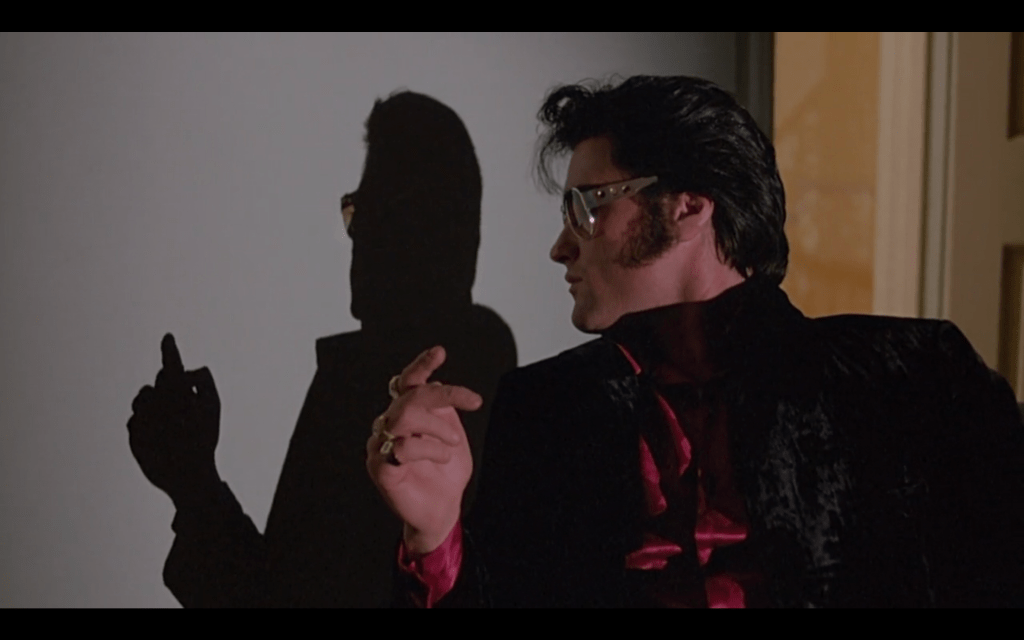
The Stand 2020: The Good, The Bad, and The Ugly (Part I)

On the audio commentary of his own adaptation for television of The Shining (1997), King comments that “the network giveth and the network taketh away.”


Brown, Simon. Screening Stephen King : Adaptation and the Horror Genre in Film and Television, University of Texas Press, 2018. p151.

Adapt It

It’s hard to isolate the most culturally significant element of the 2020 adaptation of what’s arguably one of Stephen King’s most important works: The Stand. Is it that the series adapting the narrative of a superflu killing off almost all of humanity wrapped production in early March of 2020, just as a global pandemic was declared? Is it that restaging this “epic” narrative of good v. evil that’s been reiterated (reincarnated?) several times gives us a chance to rectify past mistakes? Is it that “King’s eyes and prolific hands are all over this adaptation,” including episodes penned by King’s own son, Owen? Is it that King himself penned a “new” ending for the ninth and final “coda” episode?

A further point of interest for me is how the 2020 adaptation connects the gaps between where I am in my (attempted) chronological reading of King’s work and where I am in writing about it. Finishing the novel IT (1986) not long after watching the new Stand series is an almost cosmically charged experience, or at the least an illuminating one. Both of these novels of King’s play with and question the very concept of “chronology,” and could compete for King’s most ambitious work. (Elements of their cosmos will be further threaded together via The Dark Tower series.) Other connections between these texts (and their various iterations) include:

-The phrase “‘Be true. Stand,'” is used in the 2020 series but does not appear in the novel version of The Stand. The phrase appears repeatedly in IT.

-One of IT’s main characters, Ben Hanscom, is from Hemingford Home, Nebraska, the same place as The Stand‘s Mother Abagail. Hemingford Home becomes an actual nursing home in Colorado in the 2020 Stand adaptation, with King’s cameo reduced to an appearance in an advertisement for this home on a bus stop.

-Actor Owen Teague plays Patrick Hockstetter in It (2017) and It Chapter Two (2019), and Harold Lauder in the 2020 The Stand.

-For this year’s “Stephen King Area” of the 2021 Virtual PCA/ACA Conference, both of these novels have their own individual panels with multiple talks scheduled around them (“IT Lives!” and “Standing in a Pandemic,” respectively).

-A chapter in IT is called “The Circle Closes,” which is the title of the new epilogue King appended in the ’90 Uncut iteration of The Stand, which means this phrase (slash expression of one of King’s favorite metaphysical concepts) originates with IT. (“The Circle Closes” is also the title of the highly anticipated King-penned 2020 Stand coda episode, which Part III will…circle back to.).

I discussed in a previous post how King’s first Bachman novel, Rage, explores a link between Hollywood movies and gun violence not necessarily by depicting that violence itself, but by setting certain standards of masculinity which that violence becomes an expression of. Film critic Ann Hornaday has argued that this expression of toxic masculinity is a product of the fact that the vast majority of major studio films continue to be written and directed by white men. It has now been almost seven years since Hornaday posed this somehow controversial argument. I could read the 2020 adaptation of The Stand as evidence of the entertainment industry’s general response to this problem of representation in the interim, which would be to (attempt to) treat (some of) the symptoms of the disease rather than the disease itself.

To wit, a white man is still in charge of the latest iteration of the narrative, in this case via the showrunner Benjamin Cavell, apparently in fairly constant consultation with King himself both via email and by having Owen in the writers’ room. To alleviate if not necessarily the most grotesque but perhaps the most immediately obvious symptoms of this patriarchal disease (so as to limit comment on it and thus perpetuate its continued existence), the original white-man status of several characters is updated or “upgraded” (as Cavell puts it here) to represent more minorities than were in the source material. But in 2020’s iteration of The Stand, the attempts of the white-men-in-charge to make certain minority “upgrades” ultimately represent/express something less than progress.

Cavell’s description of another IT connection in a Vanity Fair interview exchange displays the general (white) bro culture that surrounds the new adaptation and how this ultimately amounts to an extension of the culture surrounding the source material:

We also get a little shot of a turtle statue in the window of the house, and I was trying to explain to my wife what the turtle signifies. I found myself unable to explain it. It’s a cosmic power mentioned in It, it’s a presence in The Dark Tower series … 

I was going to say, how did you approach that? Yeah. I tried to explain it to my wife. Well, you know, the world kind of rides on the back of a turtle. She’s like, “What?”

From here.

Wives just don’t get IT

Networking

King obviously has a long history of adaptations, which associate professor of film and television at Kingston University, Simon Brown, positions both as successful often as a product of other trends, but also a prevalent influence on media and visual narrative consumption trends in its own right. Which brings us to another connection between The Stand and IT–the format of their initial adaptations as (wildly successful) miniseries for primetime network television, specifically for ABC. What struck me about Brown’s analysis of the adaptation in this format was how IT airing in November of 1990 meant it was benefitting from the same network having aired the first season of Twin Peaks a few months earlier, which affected not so much its appeal to viewers as the network’s own “Standards and Practices”:

However, one of the long-standing taboos of Standards and Practices, raised in 1979 when CBS adapted Salem’s Lot, was the issue of placing children in danger.

Brown, Simon. Screening Stephen King : Adaptation and the Horror Genre in Film and Television, University of Texas Press, 2018. p158.

Child endangerment being a defining component of the IT narrative meant this “taboo” had to be “relaxed” for ABC to even consider the project (Brown 159). King’s influence on and through shifting standards like these is kind of stunning when you consider the scope of the viewership and populace it reaches, even if a lot of the “explicit detail” was still removed for these television versions (Brown 162). (Of course, if it hadn’t been King the networks were willing to show increasingly graphic violence and sex for, it would have been somebody else.) Brown proceeds to outline how the success of IT beget the success of The Stand, and how King miniseries adaptations thus became as integral to 90s network television as, per my own comparison, Seinfeld.

(On a peripheral note, my favorite part of Brown’s history is how when King “was offered by ABC the chance to do whatever he wanted,” he chose to retell The Shining in miniseries form, but Stanley Kubrick would only sell him the rights back if King agreed to stop complaining about Kubrick’s adaptation (168).)

As the passage excerpted above indirectly points out, the other major network King has an extended history with is CBS. Which brings us to the 2020 Stand‘s format, appropriately updated to not just “television miniseries” but “streaming television miniseries,” for a streaming service owned by CBS (which currently the Republicans would like you to boycott). This basically means King can have his cake and eat it too (or the best of both worlds, whichever cliche you prefer) in terms of maintaining network backing and getting to show graphic violence and sex. (I don’t advise watching 2020’s version while eating.) Simon Brown notes the “‘major reduction in snot'” in 1994’s version (162); in 2020 the snot and the tube neck are back with a vengeance. (It’s too bad Brown couldn’t wait a couple more years to publish his adaptation study, since it means his discussion is missing both the new The Stand and It Chapter Two (2019).)

A major company like CBS wields increasing influence with its attendant corporate mergers, which King apparently enjoys working with because of the access it provides to the maximum number of viewers:

[King’s] argument was that to work with a cable channel “would be like publishing a major novel with a small press. I have nothing at all against either small presses or cable TV, but if I work hard over a long period of time, I’d like a shot at the largest possible audience” (1999b, xii).

Brown, Simon. Screening Stephen King : Adaptation and the Horror Genre in Film and Television, University of Texas Press, 2018. p151.

Yet King’s working with these bastions of corporate power is probably enabling the continued growth and influence of the same corporations whose corruption of the culture he often seems to be attempting to critique, The Stand serving as a primary example of such narratives. So I suppose it shouldn’t be surprising that a) CBS installed a white man at the helm of this latest adaptation and that b) this white man’s adaptation fails to escape the patriarchy’s problematic permeation of the narrative on a number of explicit and implicit levels.

The Le Guin Test

One can learn a lot about dramatic efficiency by watching King adaptations. The changes they make to their source material may reflect changes in the culture at large, and, per the network discussion above, may also support a reading/message that supports the propagation of a culture that in turn propagates/perpetuates the network model of corporate power. The changes may also reflect the pitfalls of working as a lone novelist (one whose editors appear to be afraid of him).

Narratively, one of the first things I felt watching 2020’s version was the pacing: for the superflu part, they really clip right along, and present a generally scrambled chronology. (I definitely thought I would have been confused if I hadn’t read the book.) A potentially more significant narrative and thematic adjustment is how the series minimizes the government’s role in the apocalypse–most egregiously by 1) Flagg’s boot blocking the door that lets Campion out, and 2) Stu’s friendship with his captor Doctor Dietz and his added interaction with the somehow nobly depicted General Starkey. I could probably go with #1 (oversimplifying though it may be) if it hadn’t been in conjunction with #2, which was frankly gross. There’s a shadowy element at work in the form of some rando military guy who kills Dietz and tries to kill Stu but who Stu kills instead (in lieu of killing Dietz in the original) but the show itself intimates Starkey doesn’t know who this guy is working for, letting him off the hook.

Many of the adjustments to the original storylines are “good” in intensifying dramatic/narrative conflict, but in so doing these changes often (further) exacerbate the “bad” in creating (further) problems with the adaptation’s attempts at political correctness.

Matthew Salesses discusses an example of a similar issue in his recent book on the craft of fiction (which I discussed in a post on Firestarter):

Le Guin has great intentions with [A Wizard of Earthsea], not only to take power away from the idea that violent confrontation should provide the solution to conflict, but also to center characters of color. Ged is one of the first protagonists of color in white fantasy. On the other hand, Le Guin avoids the experience of being a person of color. She puts him in a world where his race causes him zero trouble. This is a moral stance. In fact, his main problem is himself, or perhaps a darker version of himself, and his main solution to his problem is himself. This is a moral stance. The novel, intentionally or not, puts forward the idea that everything is up to free will, even for people of color, and that what stands in a person’s way is his own darkness.

This isn’t Le Guin’s intention. Her intention was to upset traditional frameworks. She says so in her afterword. But conflict has consequences for meaning. It’s not just something you put in fiction to make a story compelling. Conflict presents a worldview.

Matthew Salesses, Craft in the Real World: Rethinking Fiction Writing and Workshopping. 2021.

In other words, if the character’s race changes and nothing else changes, that reflects a white supremacist text, one that is blind to systemic injustice in its failure to recognize the material impacts of same.

In The Stand, King’s conflict expresses a similar idea about “everything is up to free will,” at least per (preeminent) King scholar Tony Magistrale’s analysis:

In The Stand, more than any other King novel, free will and moral choice are solidly within the individual’s purview; all of the major characters in this book participate directly in determining their fates.


Tony Magistrale, “Free Will and Sexual Choice in The Stand,” Extrapolation, Vol. 34, No. 1, 1993. p30.

Magistrale’s phrasing implies race has no impact on such agency, when “the individual” whose “purview” free will is in would probably more accurately be designated “the white individual.” Which means, per Salesses, the narrative inherently fails what I’ll call the Le Guin Test (even if maybe it should be called the “Salesses Test”), if, as Magistrale points out, the very principle of this agency is essentially the backbone of the entire narrative:

The shape free will takes in this book directs the narrative itself: characters are tempted by Flagg’s promise of power and pleasure and join him in the west, or choose to align themselves with the Mother Abagail’s Free Zone society at Boulder.

Tony Magistrale, “Free Will and Sexual Choice in The Stand,” Extrapolation, Vol. 34, No. 1, 1993. p31.

If what counts as “society” has effectively collapsed then its “systemic” injustice must necessarily have collapsed along with it, yet one can’t help but think that for people of color, navigating a landscape essentially reconfigured into the Wild West might still be more fraught than for white people.

Perhaps it’s the very premise’s failure of the Le Guin Test that begets more failures on this front; for instance: that the titular “stand” is taken by four white men (Stu, Glen, Larry and Ralph), five if you count Nick Andros. In 2020, these five white men become two white men (Stu and Glen), a black man (Larry), a Native American woman (Ralph turned into Ray), and a Latino man (Nick). Sounds almost diverse enough, except that white men continue to maintain the majority, and also, what turn out to be mostly the most influential/substantive character roles.

Let’s start with Nick, a character who is deaf and mute. In an instance of upping the dramatic ante, Nick’s inadvertent barroom brawl from the original narrative leads him to also become blind in one eye, while in the book his eye injury heals. Yet this partial blindness doesn’t really lead to anything else of consequence dramatically, except maybe some thematic resonance with the upping of the drama/tension of the committee’s choice to send spies to New Vegas explicitly without Mother Abagail’s permission, which she then berates Nick alone for (repeating, as she is ironically wont to, that he is her “voice”). The eye loss is intimated to be part of the cost of Nick’s refusing Flagg, which is a new sequence this character gets that to me is emblematic of a pattern that repeats itself (looping like a circle…): this is supposed to be something that strengthens the representation of a now-minority character: now-Latino Nick is shown to be virtuous when he turns down Flagg’s offer to “fix him.” (Free will!) It’s like the writers think as long as they establish the minority character as “good” they’ve done enough work, but “good” is not the same thing as “human.” (This same near-angelic transcendence plays out when Nick gently sponges the face of the now-sick man who literally punched his eye out.)

In lieu of the backstory that does a lot of humanizing work for Nick in the novel about his bonding with the father-figure who taught him to read, we get some new information about the circumstances Nick grew up in. But, problematically, everything we learn about Nick’s past is uttered from Flagg’s mouth:

“Seems to me you got dealt a real shit hand, my friend. Mom came up from where, El Salvador? Crossed the border in the trunk of a car, to give her child the life she never had, and instead you end up deaf, and broke, pounding the pavement looking for day work. …”

I’d say that yes, Nick–or rather, his 2020 update–gets dealt perhaps the biggest “shit hand” in the form of his shallow one-dimensional representation. (What amounts to Frannie’s parallel individual “stand” against Flagg in the coda episode gets a bit more of a buildup by comparison.) We see no real character struggle on Nick’s part represented, only hear it told from the white man’s mouth. It’s like we’re supposed to extrapolate Nick’s struggle from his disabilities and immigrant status–which means, in essence, that those define his identity exclusively. Nick’s character also reminds us that some of the nuance Whoopi is claiming the new version adds to Mother Abagail’s character was already in the original–Mother Abagail was always mistaken in believing Nick was the one to lead the stand. And Nick has gotten the shaft/shit hand since the beginning, the least normative of the original five white men via his disabilities, and the only one to be killed off so abruptly.

In a sprawling narrative comprised of an ensemble cast like this one, you’re not going to be able to do equal justice to all in terms of development. But in picking the backstories to condense and sacrifice, the writers seem to have axed those mostly belonging to the characters whose updates include a shift to minority/non-white-man status. One of these, the minor character of the judge, is an example of this across-the-board issue. The narrative thread for this character, who’s become a (white) woman in 2020, is cut down to bare bones: we don’t see her (or at least notice her presence) until she is agreeing to be one of the three Vegas spies, see a flash of her on the road, and don’t see the original shootout scene from the novel in which the judge is killed, just Flagg seeing the bullet hole in her head after the fact. Plot-wise, this might arguably be all you “need” to see, but the condensing means the character’s overall importance is de-emphasized, linking the shift to a woman to a decrease in importance/status.

Next, Ray as Ralph, who gets an update in gender and race. Ralph as a character reflects the ensemble cast problem as King encountered it in the novel: despite being one of the four “good” guys to go to Vegas, he is never developed. Which makes choosing his role as one of the ones to update from white man problematic in the vein of the judge’s update–by picking the least important white-man character to update, you link the updated status to a certain lack of comparative importance. And the 2020 version doesn’t seem to develop Ray’s character any more than the original Ralph was. The character’s defining minority status is treated as a stereotype, evidencing another issue that recurs in the adaptation: its writers seem to think that naming the problem is akin to solving/addressing it, as in this exchange in episode 7 when the four have started their walk to Vegas and Larry wants to know how they’re going to find safe water. The men then all look at Ray:

Ray: What, you figured the Injun girl must know the ways of the earth, at least enough to find you water you won’t shit yourselves to death?

Others [overlapping]: Can you? Yeah.

Ray [pause, grins]: Of course.

Of course? Of course? This is basically saying of course she can because she’s Native American, which is another way of saying, of course the stereotype is true.

White Hand Man

The problems of narratively managing an ensemble cast are not strictly limited to those cast members (now) repped by minorities. By all appearances, Trashcan Man is still white in 2020, and he is probably shafted second most after Nick via the slashing of his backstory and consequent flattening of his character, and he arguably plays an even larger role in the outcome of the overall action. (I was definitely getting Gollum vibes from the couple of scenes his character did get.) He’s probably the only really shafted white man, though, unless you count the Kid, who was–thank God–excised entirely, his excision part of Trash’s excised backstory.

Then there’s Flagg’s right-hand man Lloyd, still a white man in 2020. Lloyd is hardly “shafted” by way of lack of screen time, but the opposite: his conflict is amped up, and he even gets to be redeemed this time around by actively standing up to Flagg. But some of his (mostly new?) characterization baffled me: Lloyd gazes rapturously at Flagg during their initial encounter, declaring Flagg “a beautiful fella” (an assessment many would probably agree with in this version). But then once in New Vegas, Lloyd apparently gets sexually involved with Julie Lawry (who is even more nymphomatically evil than in the original), but then is unable to perform with her–but only at the impetus of her mentioning Flagg’s name. Then there’s Lloyd’s flashy wardrobe, which includes animal-print ensembles that escalate into even more flamboyant color prints. When Lloyd pops out of the car that pulls up to apprehend the three remaining good guys in the desert, his “Hi, fellas” greeting felt like he was welcoming them to the set of Queer Eye for the Straight Guy. The idea of the “performance” of masculinity for this character is also emphasized by a new sequence in which Glen Bateman, instead of challenging Lloyd from the privacy of a prison cell, does so in front of a gallery of New Vegas citizens, prompting one to yell at Lloyd to shoot Glen–though after he does, the woman who yelled at him to do it laments that it was supposed to be a “show trial, not a snuff film.” At the end of the day it’s unclear if the writers know Lloyd’s gay or not…

King has shown resistance to the idea embodied by the Le Guin Test, the idea that “diversity” needs to be considered inasmuch as it actually has a material impact; as I’ve mentioned, Sarah E. Turner notes an interview exchange in which King accuses Tony Magistrale of an “imaginative failing” for suggesting a black character might have “wounds that are particular to his racial history” (144), and I posit that the accusation evidences King’s own “imaginative failing,” the blind spots that constitute an (unconscious) white supremacist worldview. The treatment of Larry Underwood’s character in his “upgrade” further evidences the adaptation extending this same problematic worldview, even through its very attempts to “fix” it. More in Part II.

-SCR