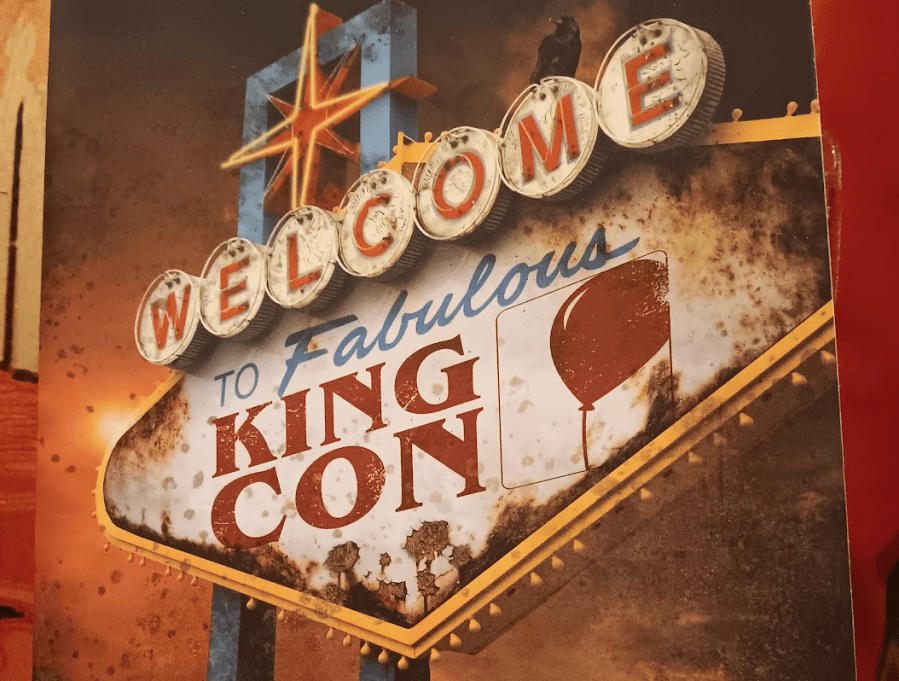
KingCon 2024, Part II: Collecting Culture

“You’re like an art collector, huh?” Dale said. “Did it take a long time to get all these paintings?”

“I don’t know enough to be a collector,” Jack said.

Stephen King and Peter Straub, Black House (2001).
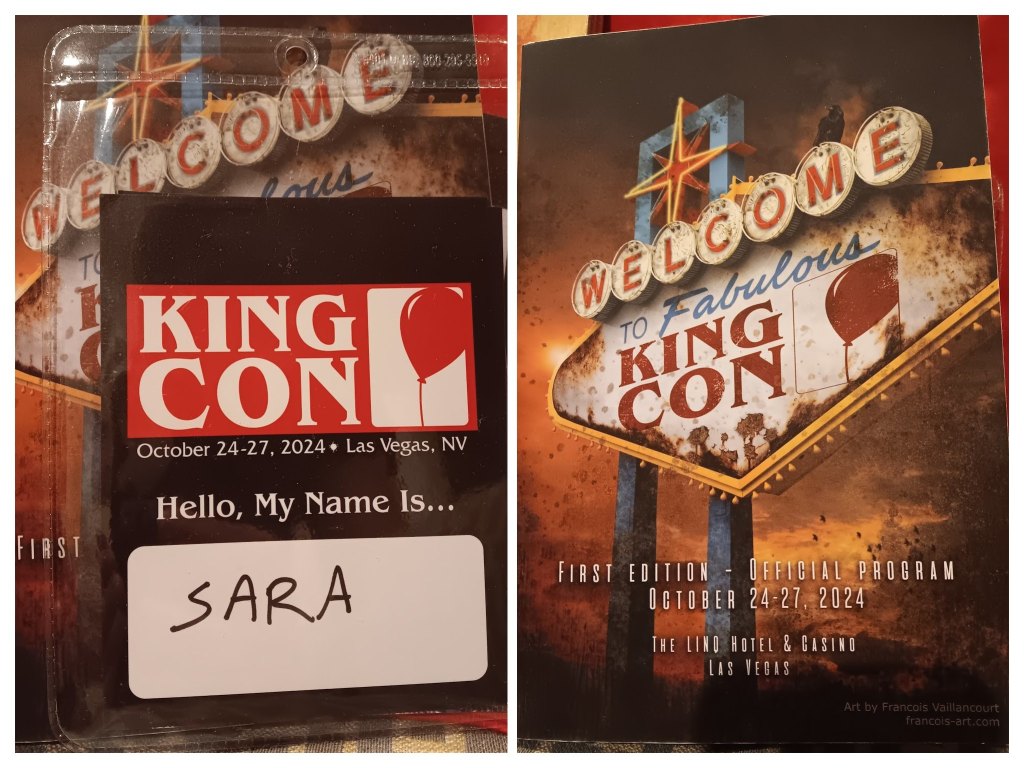
Intro

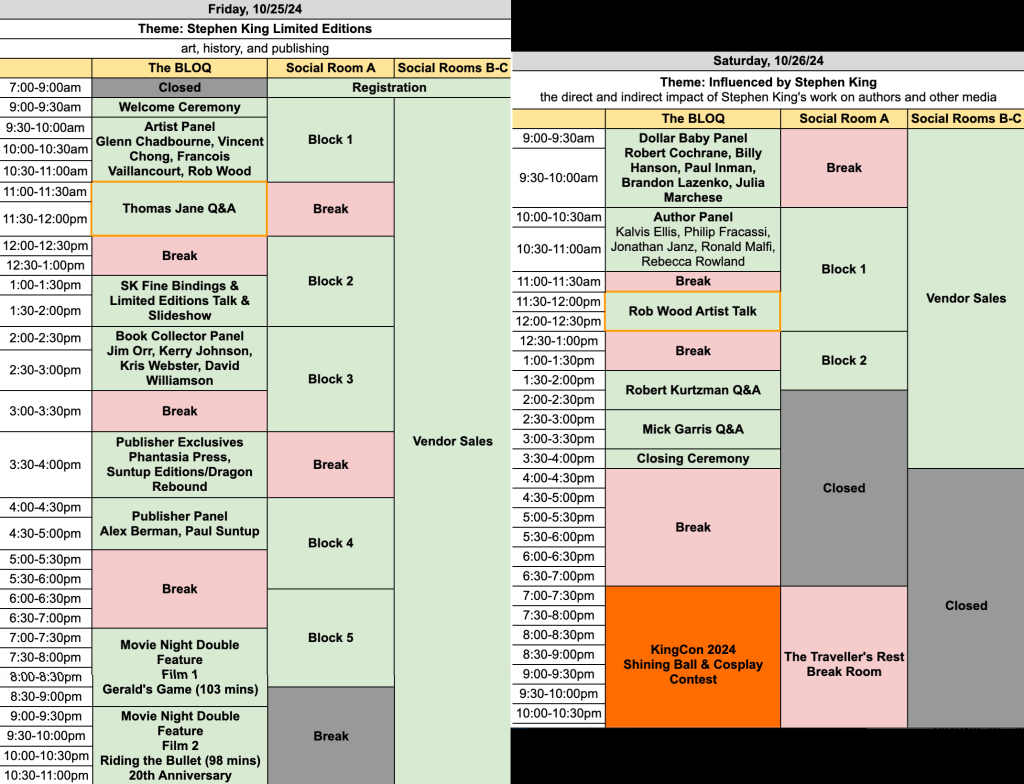
The two full days of KingCon were themed. Day 1 was “Stephen King Limited Editions: art, history, and publishing,” and day 2 was “Influenced by Stephen King: the direct and indirect impact of Stephen King’s work on authors and other media.” In a nutshell, day 1 was about collecting, and day 2 was about influence.
From here.

Thus we might take collecting and influence as the twin pillars of fandom. As an academic (in part), I will point out these pillars represent the dichotomy of fan as producer versus consumer–a production/consumption binary–that’s a central tenant of fan studies, as is the binary of fan versus academic. Fans attend “conventions” like KingCon; academics attend “conferences.”

Henry Jenkins, a “path-breaking” academic in this field, took the groundbreaking stance of writing about fans academically from the standpoint of actually being a fan himself in his seminal study Textual Poachers (1992), which itself mentions Misery. This study is now “canonical” in combating the depiction of fandom as “pathological” (so not just a “path-breaking” study, but a pathological-breaking one), as well as combating a representation of fans as a “negative other,” constituting a shift from “‘resistance to participation'” (quoting “Why Still Study Fans?,” the introduction to Fandom, Second Edition : Identities and Communities in a Mediated World [2017]). Michael Schulman’s New Yorker article “Superfans: A Love Story,” mentioned in my Tom Gordon discussion here and one of the main texts we read in my fandom class, necessarily invokes Textual Poachers and interviews King, reinforcing, as does the existence of KingCon itself, the prominence of King’s cultural position.

In this shifting stance, Jenkins effectively moves fandom studies from an external perspective to an internal one. Matt Hills’ academic study Fan Cultures (2002) points out that Jenkins’ internal view facilitates a positive view of fandom that’s basically the same thing as its seemingly opposite negative view of fandom:

The work of Jenkins and Bacon-Smith seems to embody two sides of the same coin: both refuse to let go of one-sided views of fandom. Jenkins sees Bacon-Smith as presenting a falsely negative view of fans (Jenkins in Tulloch and Jenkins 1995:203), while, in turn, she castigates his work for presenting a falsely positive view (Bacon-Smith 1992:282). And oddly enough, the ‘reality’ of fandom that each seeks to capture in broadly ethnographic terms may well exist between their respective moral positions.

Matt Hills, Fan Cultures (2002).

And another pair of scholars has coined a term for this internal academic perspective of fandom: “aca-fans”:

As Joli Jenson pointed out in 1992, there are significant similarities between fan behavior and academic behavior. In “Fandom as Pathology” she compares a Barry Manilow fan to a Joyce scholar. Both fans and scholars are passionate, acquisitive and seek as much information about their objects of interest as they can get, often down to minutiae that others might consider obsessive. This parallel has not been lost on aca-fans, who claim dual citizenship in the realms of fandom and academia. However, there are also clearly marked boundaries between the two groups. As much as the fan and the scholar resemble each other, we clearly approach and value them very differently. We are more likely to embrace the “aficionado” while distancing ourselves from the “fan”—or in this case, the Fanilow.

Katherine Larsen and Lynn Zubernis, Fandom At The Crossroads: Celebration, Shame and Fan/Producer Relationships (2012).

If the external influence of cultural attitudes shapes the internal world of the individual psyche, the shame and stigma associated with (intense) fandom derives from cultural attitudes that privilege logic over emotion:

Jenson observes:

The division between worthy and unworthy is based in an assumed dichotomy between reason and emotion. The reason-emotion dichotomy has many aspects. It describes a presumed difference between the educated and the uneducated, as well as between the upper and lower classes. It is a deeply rooted opposition (Jenson 1992, 21).

In the years since Jenson wrote this, it’s been assumed that we’ve gradually moved away from the image—both in academia and in the mainstream press—of fans as pathological, out of control, “other”. However, we have not come as far as we would like to think.

Katherine Larsen and Lynn Zubernis, Fandom At The Crossroads: Celebration, Shame and Fan/Producer Relationships (2012).

If logic v. emotion maps onto educated v. uneducated in external cultural attitudes, these two aspects are also often in conflict within us individually, a conflict exacerbated, obviously, by the external attitudes. As emotions researcher Brené Brown notes in her Atlas of the Heart special, “We like to think we are rational beings who occasionally have an emotion and flick it away and carry on being rational. But rather, we are emotional, feeling beings; who, on rare occasions, think.”

Larsen and Zubernis experienced “[t]he difficulty of balancing our dual identities as researchers and fans.” I can map two concepts from my own work onto these binaries: 1) the “fluid duality” between the seemingly oppositional sides of the climactic face-off in The Girl Who Loved Tom Gordon that are actually two different versions of the same thing; and 2) my Disneyization thesis about King’s personal conflict between brand (power from outside) versus writer (power from inside). Tom Gordon also evokes the double meaning in idea of “breaking” a path, which could mean creating a new path or the destruction of a path entirely, which would lead would to one becoming lost–lost in the funhouse or lost in the woods. For fandom, the former might be a more fitting metaphor since the object of fandom reflects the subject of one’s self.

The binary oppositions against which fandom could once be conceptualized as oppositional practice may be fast disappearing. Yet, as these examples illustrate, the more being a fan is commonplace and the more it is “just like being any other media user,” the more it matters; the more it shapes the identities and communities in our mediated world and with it the culture, social relations, economic models, and politics of our age.

“Why Still Study Fans?” Fandom, Second Edition: Identities and Communities in a Mediated World, eds. Cornel Sandvoss, Jonathan Gray and C. Lee Harrington (2017).

This academic anthology of fandom doesn’t address a distinction addressed elsewhere: that between “fanship” and “fandom,” which, according to one article, “are related, yet empirically distinct”: fandom is “the social component of fan identity,” while fanship is “the more individualistic component of fan identity.” Thus “attending fan events” such as KingCon qualifies as fandom rather than fanship. The authors of this study conclude that it’s fandom rather than fanship that is the greater indicator of psychological well-being. They break down fan engagement

into three categories, attending events, online engagement, and consuming media. We hypothesized that attending events, but not online engagement and media consumption, would mediate the association between fandom identification and wellbeing, given that attending events is the only of the three activities which involves face-to-face socializing, something which, in past research, was linked to well-being (Ray et al., 2018).

Stephen Reysen, Courtney N. Plante, Sharon E. Roberts & Kathleen C. Gerbasi, “Social Activities Mediate the Relation between Fandom Identification and Psychological Well-Being,” Leisure Sciences 46:5 (2024).

But fan scholar Cornel Sandvoss emphasizes the significance of an individual’s fandom identity being tied to a conception of belonging to a group even when not face-to-face. And there’s an overlap in these categories where KingCon attendees interact online on their Facebook page:

Still basking in the glow of KingCon, where I met so many of my people. The kinship among Constant Readers is truly special.

KingCon Facebook group member, December 13, 2024.

There’s also this idea that the individual and community aspects of fandom can’t be studied in tandem, which seems dumb:

In fan studies, we are at a crossroads given the ongoing debate between studying fans as individuals vs studying fandom as an imagined and imaginative community.

C. Lee Harrington, “Creativity and ageing in fandom,” Celebrity Studies 9:2 (2018).

Hills’ study opens by invoking the reductive binary at the center of fan studies in terms of good versus bad:

It is not just the imagined subjectivities of the ‘fan’ and the ‘academic’ which clash and imply different moral dualisms, i.e. different versions of ‘us’ (good) and ‘them’ (bad).My aim is to explore how cultural identities are performed not simply through a singular binary opposition such as fan/academic, but rather through a raft of overlapping and interlocking versions of ‘us’ and ‘them’.

Matt Hills, Fan Cultures (2002).

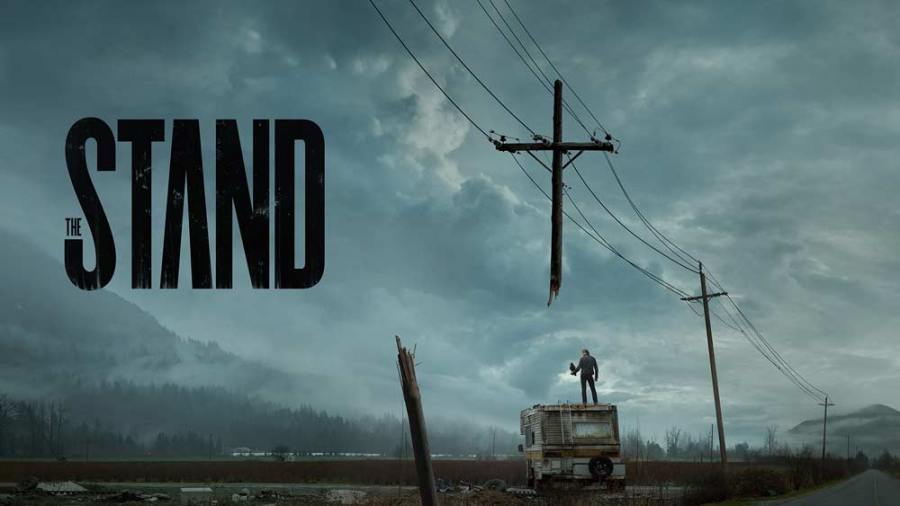
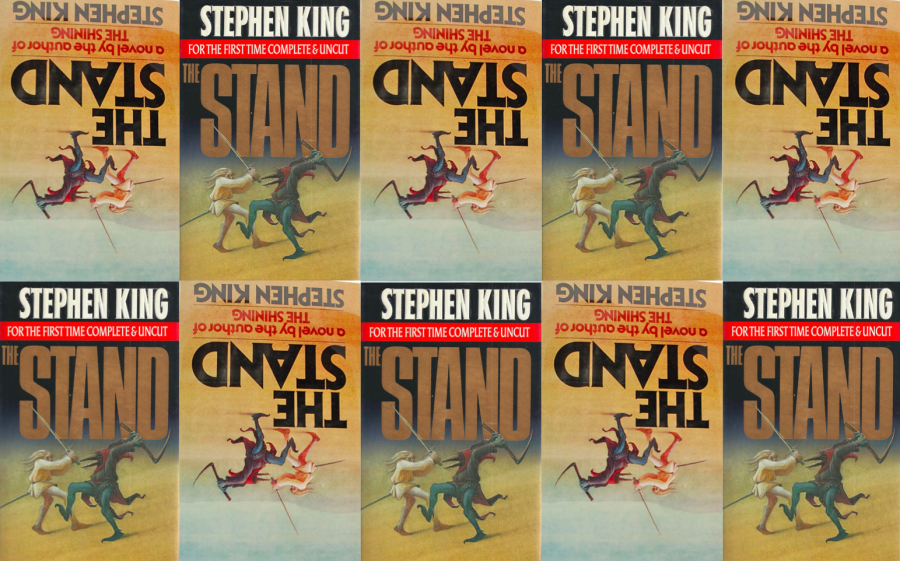
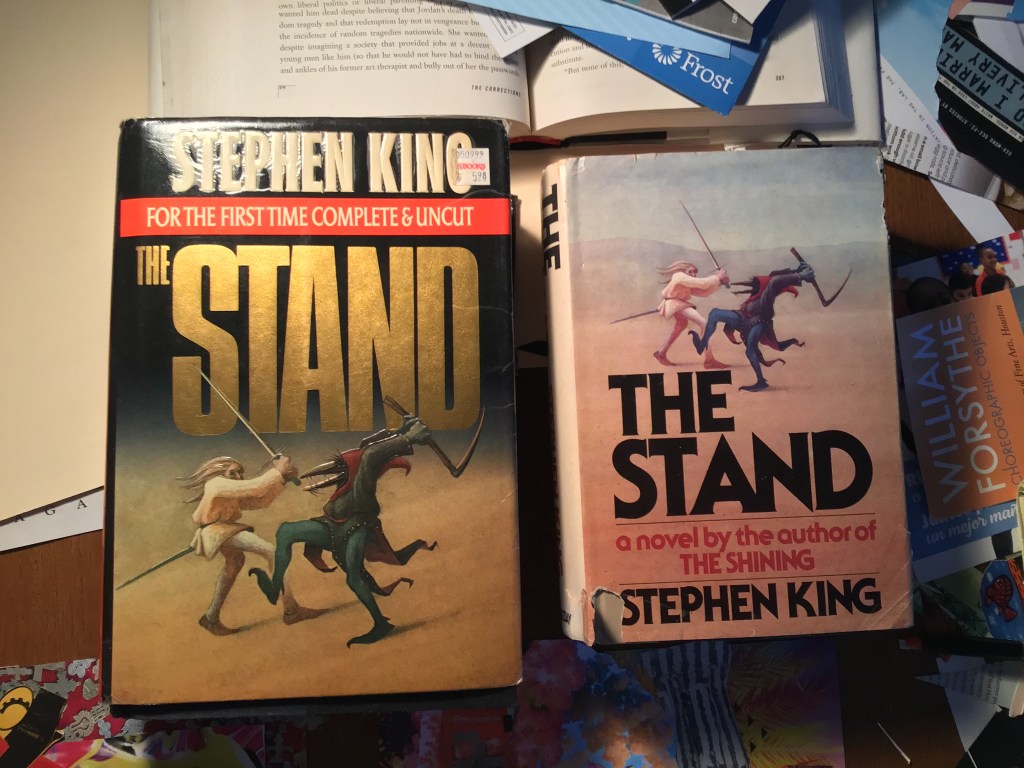
That The Stand might be the most emblematic of King’s works exploring good versus bad/evil again makes Vegas a fitting location for KingCon. Flagg collects the bad people and Mother Abagail collects the good people. That the KingCon location is where the evil people congregate might imply something less than savory about King fans by King’s own divine logic.

I am loving all these posts from people traveling from all over to meet in one location. Feels like we are living out The Stand.

KingCon Facebook group member, October 23, 2024.

The cover of Hills’ Fan Cultures is of a denim-jacket clad torso bearing different fan-related pins, which, If you’re in a Stand state of mind, evokes Randall Flagg and his “button on each breast of his denim jacket. On the right, a yellow smile-face. On the left, a pig wearing a policeman’s cap. The legend was written beneath in red letters which dripped to simulate blood: HOW’S YOUR PORK?” If Flagg is positioned squarely on the “evil” side of The Stand‘s good versus evil binary, these pins, contradictory emblems of peace and violence, represent how Flagg plays both sides, politically, in the interest of sowing maximum chaos. Both the pins actually represent different versions of the same side–both are anti government authority.
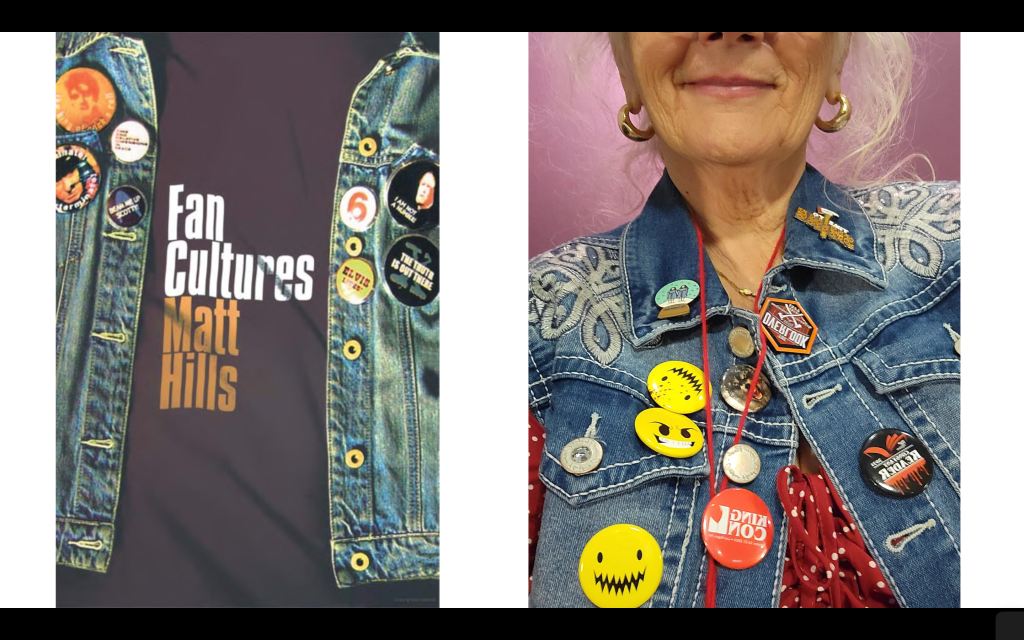
Similarly, the categories of fan and academic are different versions of the same thing:

Since neither fan nor academic identities are wholly constructed against one another, but are also built up through the relay of other identities such as the ‘consumer’, any sense of a singular cultural system of value is deferred yet further. Fans may secure a form of cultural power by opposing themselves to the bad subject of ‘the consumer’. Academics may well construct their identities along this same axis of othering, meaning that in this case both fans and academics may, regardless of other cultural differences, be linked through their shared marginalisation of ‘the consumer’ as Other.

Matt Hills, Fan Cultures (2002).

But are the categories of production and consumption different versions of the same thing? According to Jenkins, yes:

It might seem odd to suggest that Jenkins’s work on fandom participates in a moral dualism of ‘good’ fandom versus ‘bad’ consumption, especially since Jenkins has addressed television fan culture through what he concedes is a ‘counter-intuitive’ lens, beginning from the position that ‘[m]edia fans are consumers who also produce, readers who also write, spectators who also participate’ (1992b:208). This reads like a definite end to any fan-consumption opposition. However, Jenkins’s position is complicated by the fact that he revalues the fans’ intense consumption by allying this with the cultural values of production: they are ‘consumers who also produce’. But what of fans who may not be producers, or who may not be interested in writing their own fan fiction or filk songs? Surely we cannot assume that all fans are busily producing away? The attempt to extend ‘production’ to all fans culminates in John Fiske’s categories of ‘semiotic’ and ‘enunciative’ productivity (1992:37–9) in which reading a text and talking about it become cases of ‘productivity’.

Matt Hills, Fan Cultures (2002).

Yet Hills seems to contradict himself when he accuses Jenkins of problematically attempting to separate these categories:

Conventional logic, seeking to construct a sustainable opposition between the ‘fan’ and the ‘consumer’, falsifies the fan’s experience by positioning fan and consumer as separable cultural identities. This logic occurs in a number of theoretical models of fandom, particularly those offered up by Abercrombie and Longhurst (1998) and Jenkins (1992).

Matt Hills, Fan Cultures (2002).

Hills doesn’t invoke the term “prosumer” to designate these “‘consumers who also produce,'” but that would seem to be what they are.

It is precisely because being a fan is more than just participation, because it carries an affective and identificatory dimension, because it shapes and is shaped by the personal and interpersonal, that the concepts of “fan” and “fandom” continue to matter and differ vis-à-vis many other terms used in our discipline to describe prosumers, citizen journalists, activists, influencers, amateur content creators, etcetera.

“Why Still Study Fans?” Fandom, Second Edition: Identities and Communities in a Mediated World, eds. Cornel Sandvoss, Jonathan Gray and C. Lee Harrington (2017).

Consumption is a major theme in the Kingverse, with monsters that consume things like fear (Pennywise in IT), grief (the monster in The Outsider) or laughter (Dandelo in The Dark Tower). When Stephen King went on the Kingcast and Scott Wampler asked about the fan theory that these monsters might be related due to this consuming commonality, King’s response was “‘Get a life.'” Whether King knew it or not, this line is a fundamental expression of antiquated negative ideas about fandom. Jenkins’ Textual Poachers opens with a description of an infamous Saturday Night Live sketch from the 80s in which guest host William Shatner yells at a bunch of Trekkies to “’Get a life!’” This evokes a negative stereotypical conception of fans of wasting their time and their lives. Pop culture seems to have evolved past this conception–in The Big Bang Theory, fan nerds move to the mainstream–but King apparently hasn’t. So he would probably think it fitting that his fans congregated at the evil Flagg’s pole. Fans as villains.
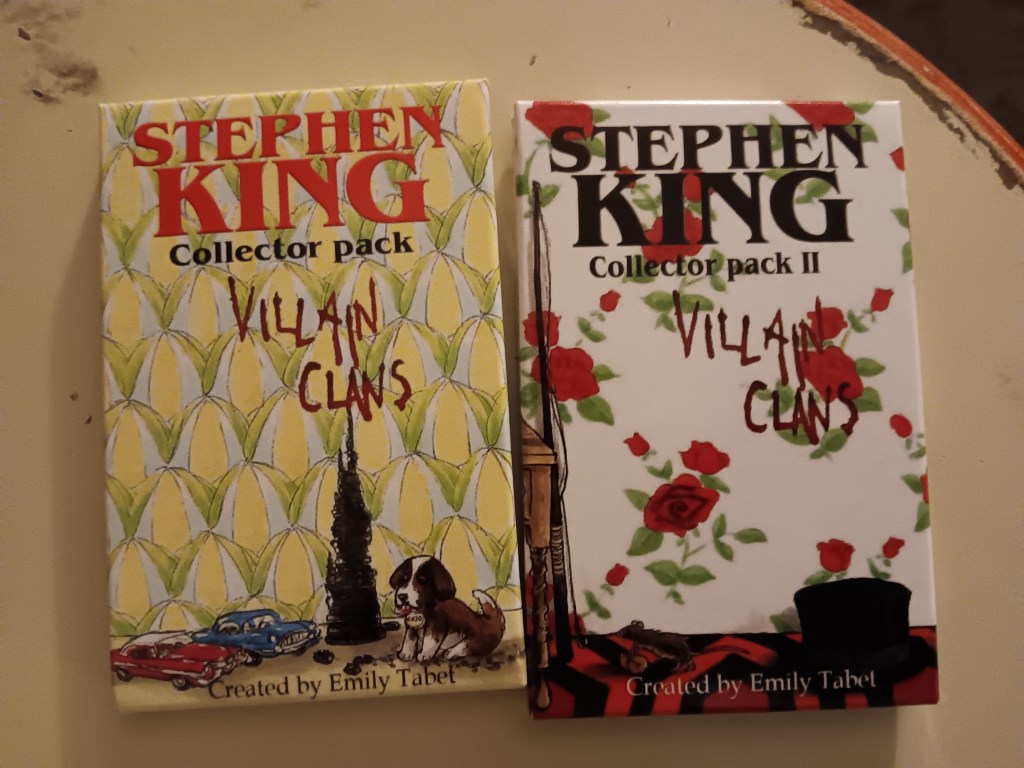
Available here.

Misery would support that King thinks fans are villains, while Tom Gordon would contradict that–which is where a distinction between pop culture/media fans and sports fans comes in, with King apparently biased toward the latter.

Hills seems to think calling “reading a text and talking about it” productive is stretching the term “productive” too far–i.e., he implies that it’s not actually productive. This reminds me of the mockery of academic criticism in my favorite non-King novel:

Criticizing a sick culture, even if the criticism accomplished nothing, had always felt like useful work.

Jonathan Franzen, The Corrections (2001).

Hills goes on to critique the “devaluation” of the concept of consumption in fan studies. To be a “good” fan is to produce something based on your consumption of the object of fandom; to be only a consumer without producing is “bad.” By this definition, this fan Luke Condon, who produced an album of Stephen King-inspired songs specifically for KingCon, would be “good” (and also a “prosumer”):
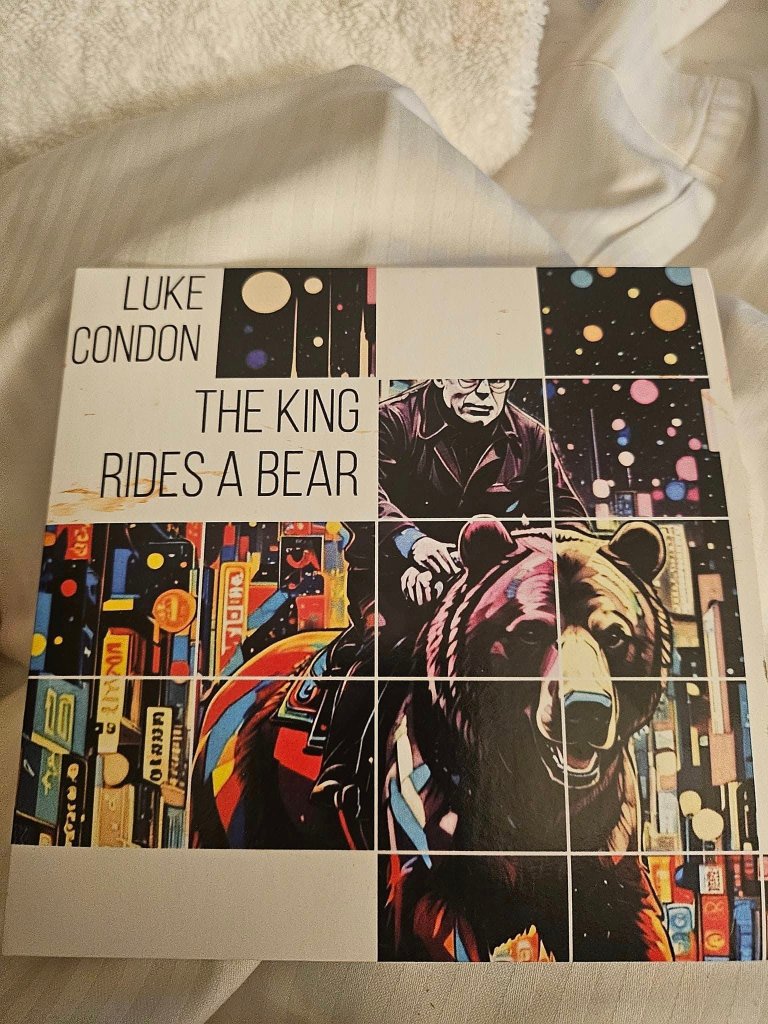
Limited edition CD made for King Con 2024 (here).

But what Hills doesn’t seem to address (or maybe I’m just unable to parse it out of the convoluted academic jargon) is that if you’re not a fan who’s producing content based on your consumption, then your value can derive from being a consumer for the produced content. After all, the value of produced content would be meaningless without a consumer to consume it–potentially the equivalent of does-a-tree-falling-in-the-woods-make-a-sound-if-no-one-is-around-to-hear-it conundrum: does Condon’s album make a sound if no one listens to it? (I guess we can’t know for sure, since I’m listening to it.)

And does the collecting day of the Con correlate primarily to fan consumption while the influence day correlates primarily to fan production? And how much do these categories overlap?

In producing based on his consumption, Condon has also created a commodity, which plays into another fandom binary of good versus bad, that of commodity versus community; as Hills puts it, one critic’s work “betray[s] an anxiety over the commodity-status of its contents, moving all too rapidly from the (‘bad’) fan-commodity to the (‘good’) fan-community.”

Which brings us to…

Collecting

In addition to getting its own full day of panels, collecting was also prominent in the room with vendors selling their wares. Since some of the horror authors who had a panel on the influence day were selling their books there as well, influence had a presence there, but in a mode that reinforced consuming/collecting, so that ultimately the presence of collecting felt more prominent at the Con than the influence side. This imbalance would seem fitting based on the fact that the event’s main organizer, Kris Webster, is a major collector and book dealer who discussed his collecting on a Kingcast bonus episode back in 2023.

As academics collect quotes to support their points, King fans collect books and artwork done for the books. Thus the wares in the vendor room ranged from limited edition books…
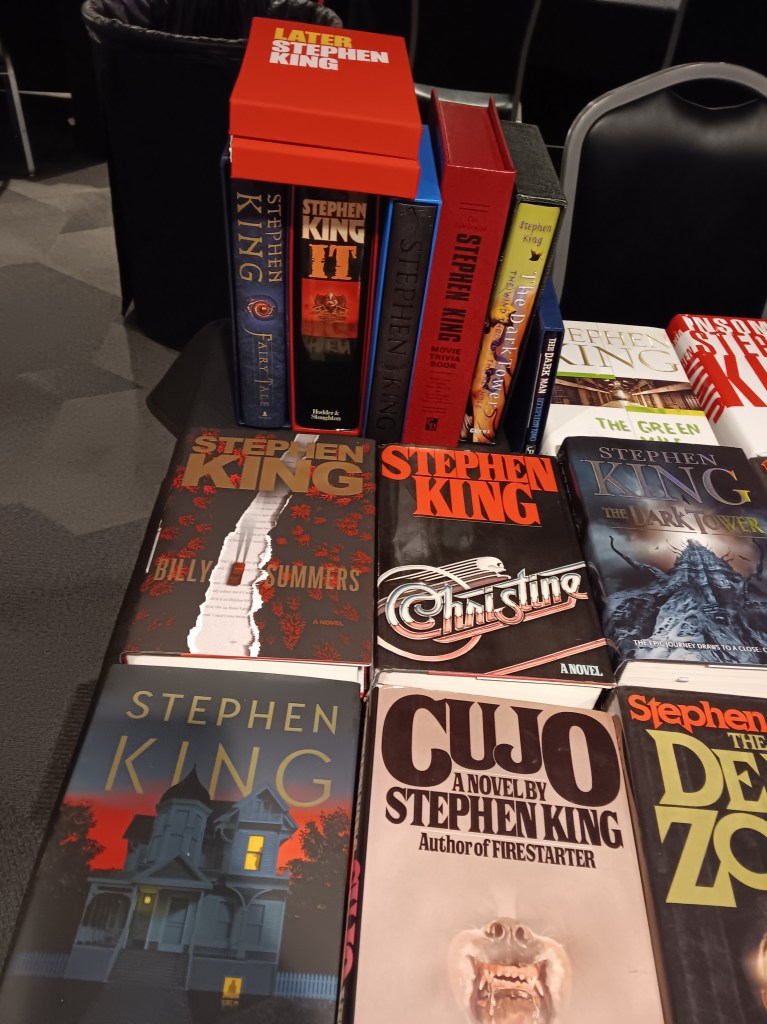
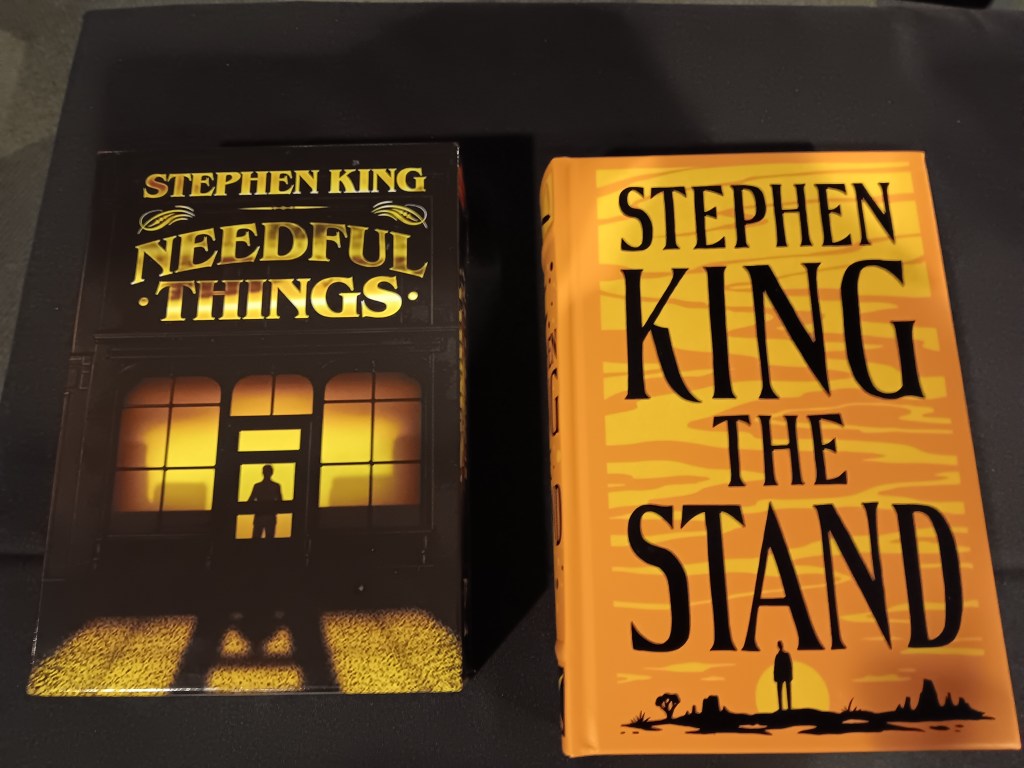
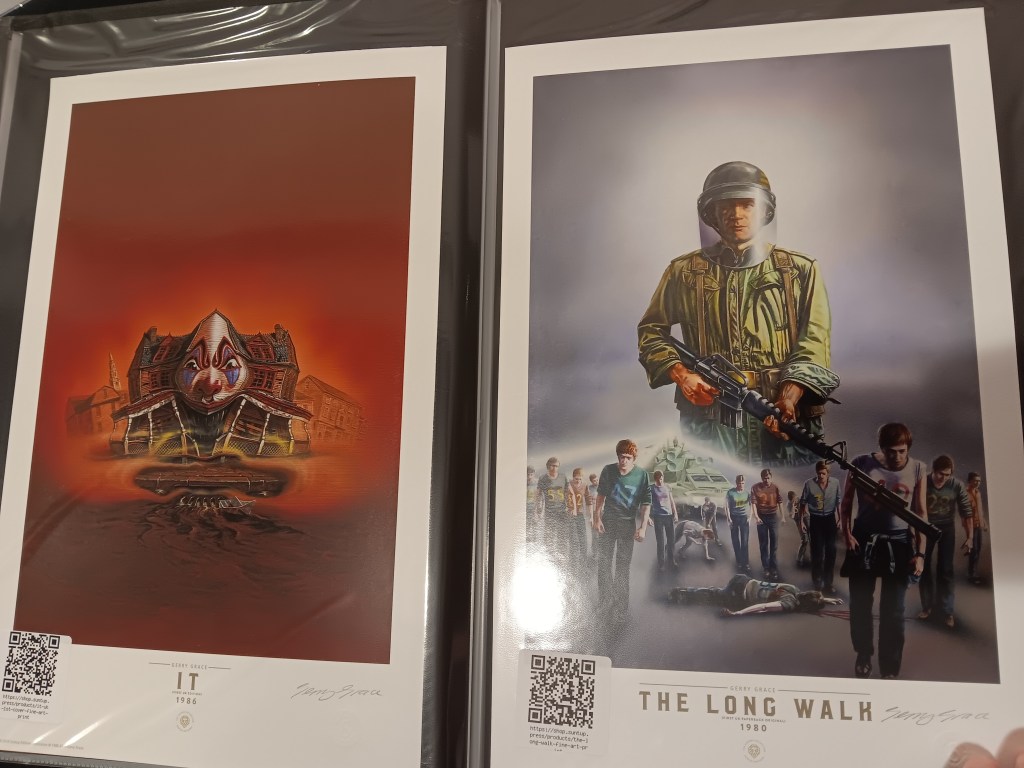
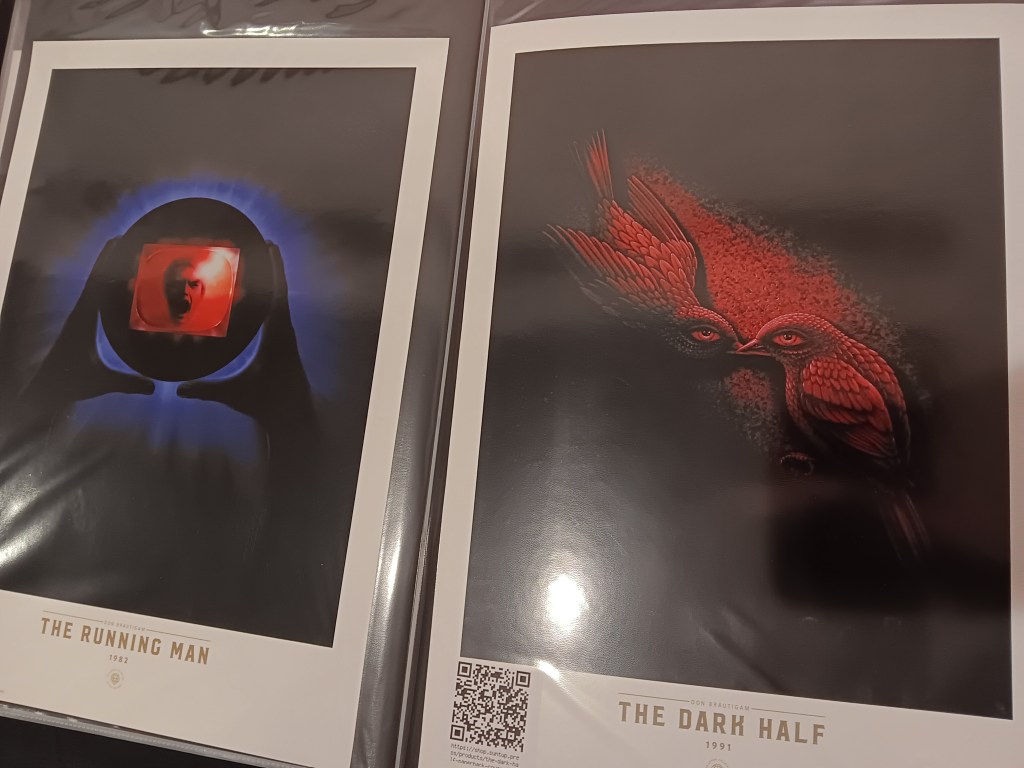
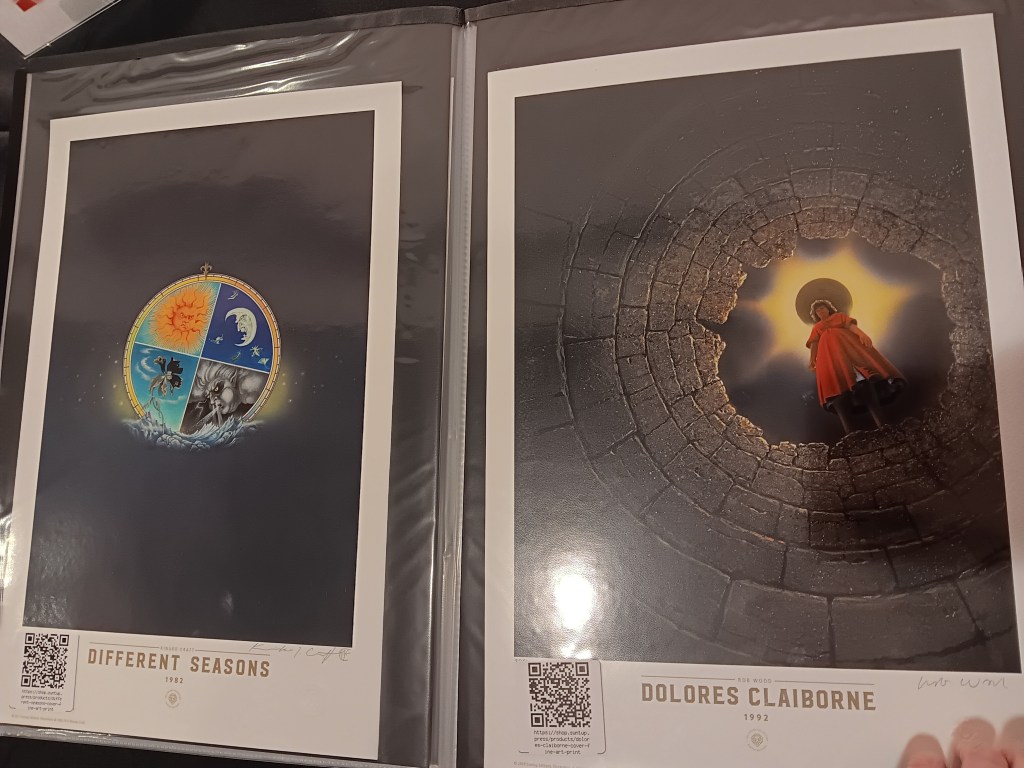
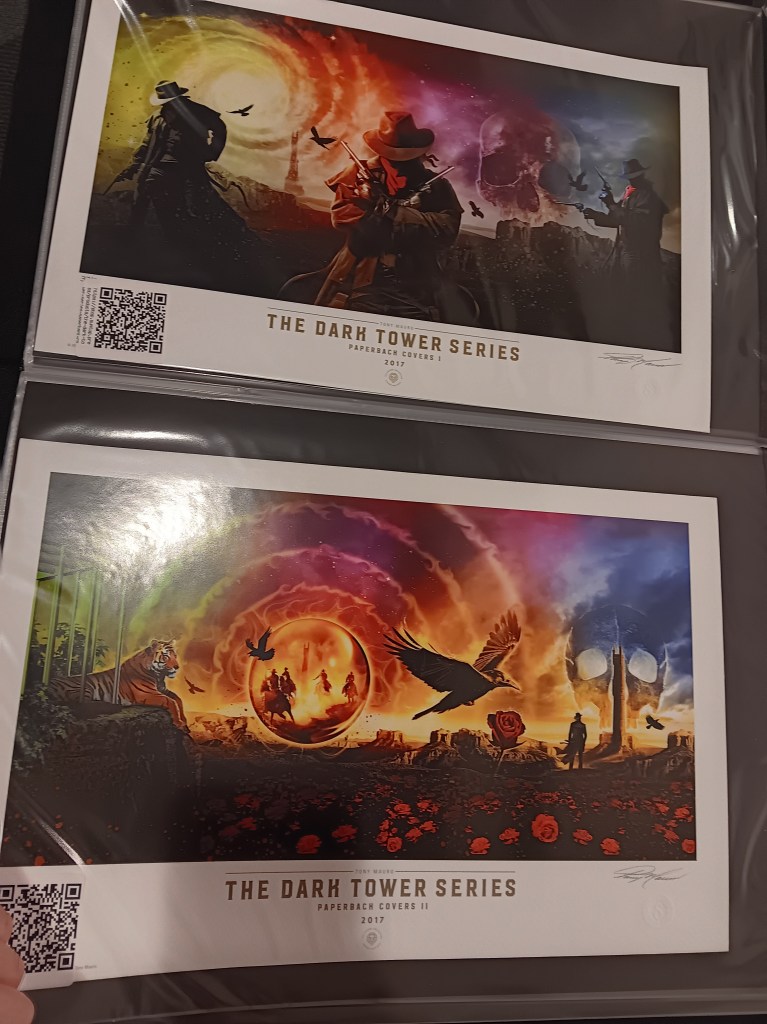
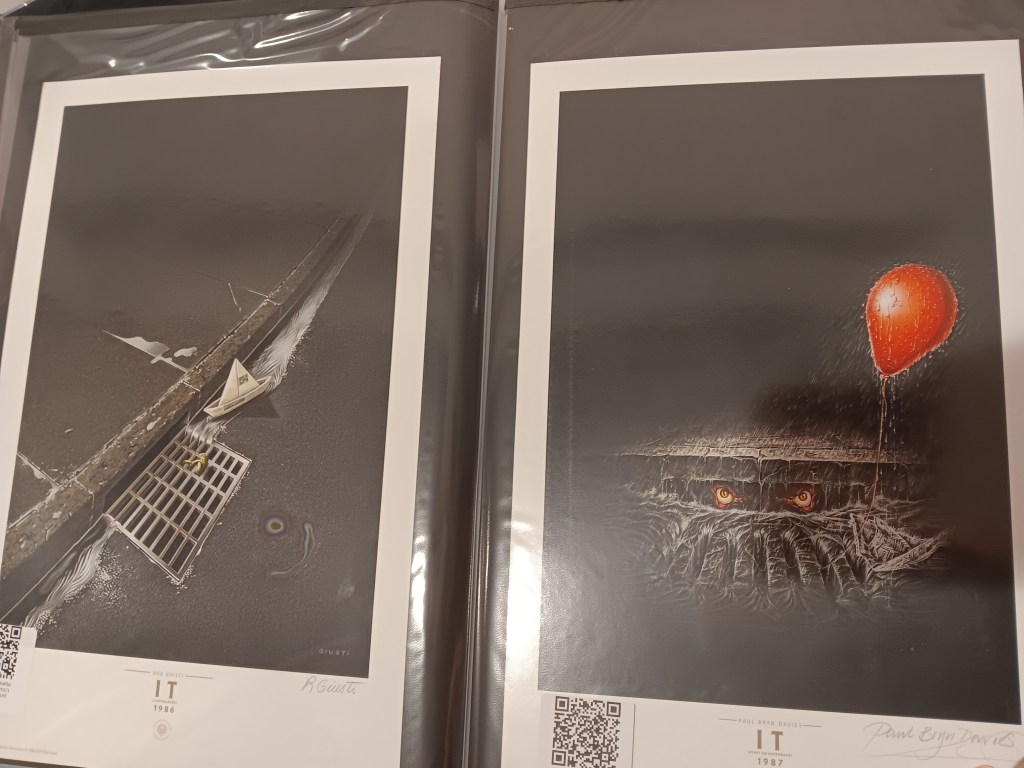
…to prints of book art…
…to the “Little Library” painted book covers.
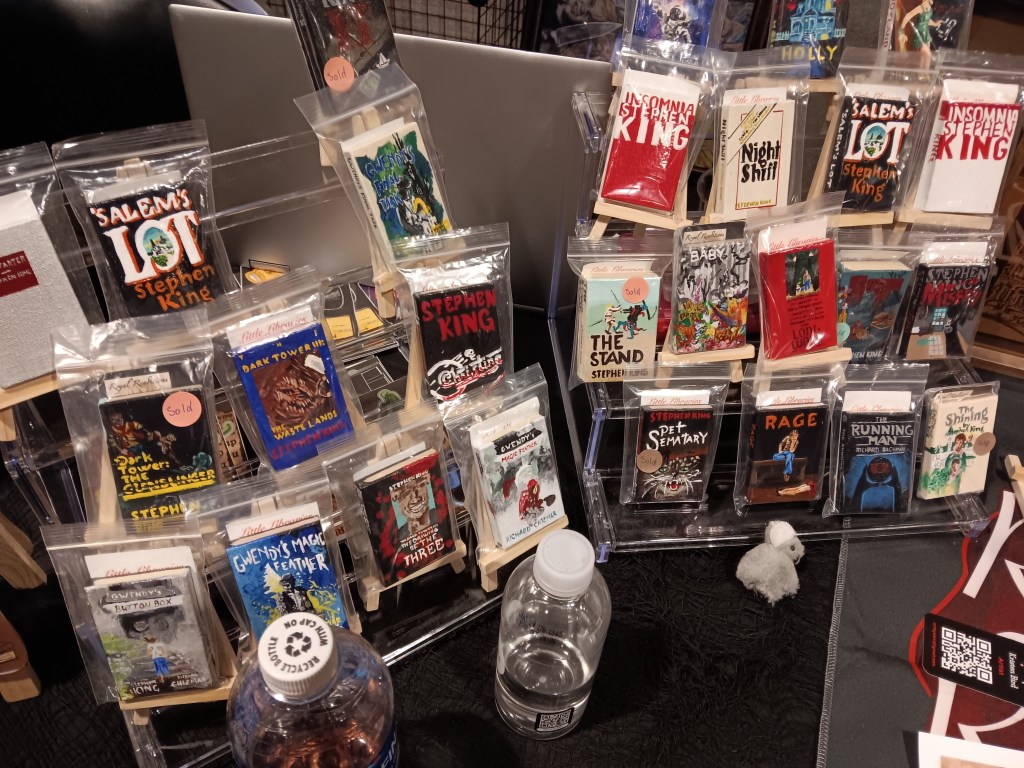
The covers of King’s books have probably been a not insignificant ingredient in his success, even if King himself would judge people for judging books by their covers:

“…I’d tell them that this man is a great writer,” [King] said. “But people would see the picture on the front with some lady with her cakes falling out of her blouse, and they would say, ‘It’s garbage.’ So I’d ask, ‘Have you read anything by this guy?’ The inevitable reply would be ‘No, all I gotta do is look at that book, and I know.’ This was my first experience with critics, in this case, my teachers at college.”

Lisa Rogak, Haunted Heart: The Life and Times of Stephen King (2009).

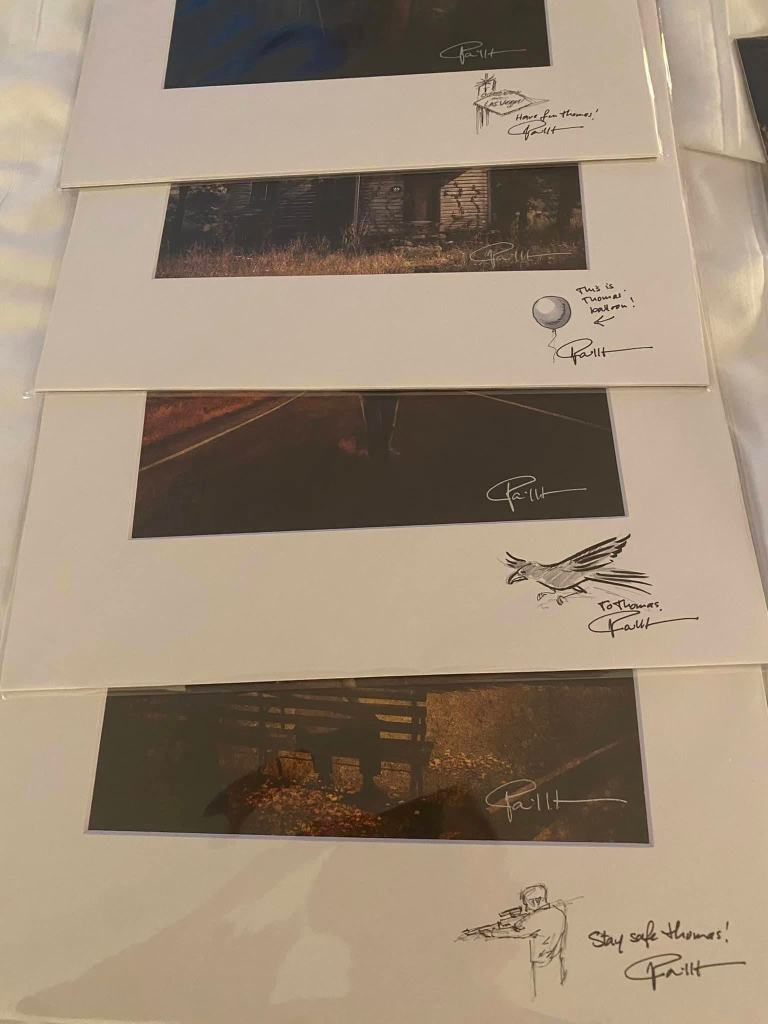
An early panel on the collecting day was of artists who have worked on covers and special editions of King’s work. I can’t say these illustrators or the horror authors in attendance selling and autographing their work were familiar names to me, but it quickly became apparent who was the most popular from the line to see him that snaked around the vendor room: the illustrator Francois Vaillancourt. This man has a lot of fans. (It makes sense, then, that Vaillancourt is the one who did the Con program’s cover art.) It was probably the space of the vendor room and standing in such lines that facilitated the face-to-face interaction with other fans that qualifies as “fandom,” the community aspect most conducive to psychological well-being, rather than individual “fanship.” From this perspective, standing in line doesn’t seem so bad. (It was in the line to see Vaillancourt, which I joined just to see what art he had for sale based on how popular he apparently was, that I met the one person I’m still in touch with from the Con.)

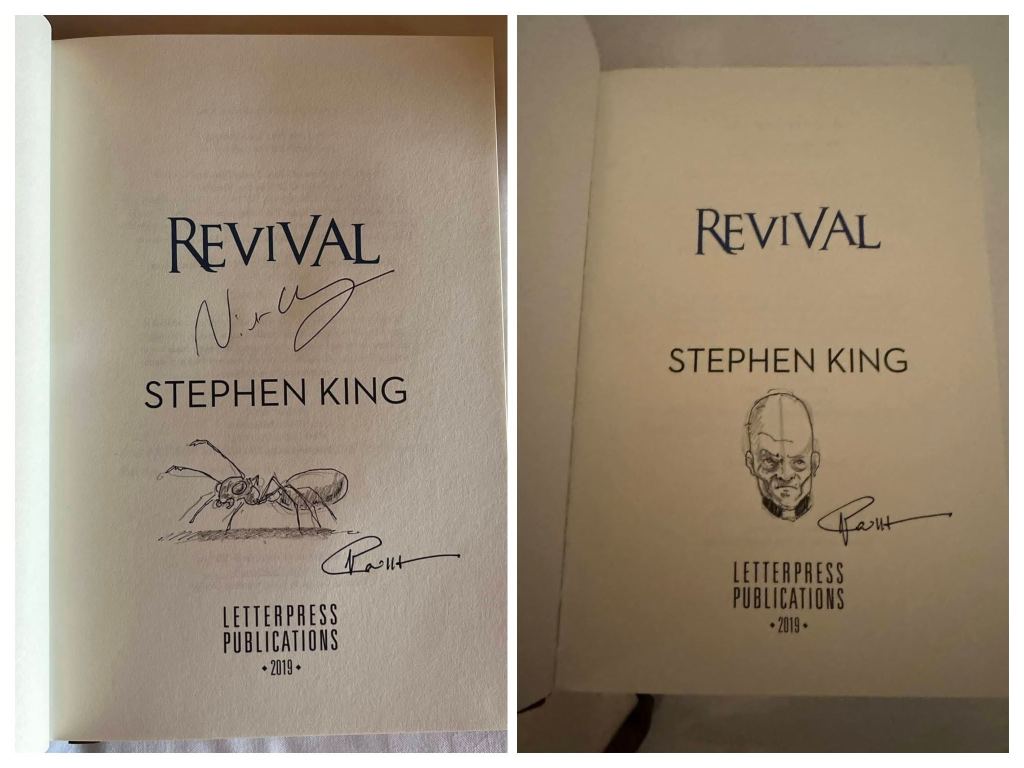
After everything was over, Vaillancourt posted a picture on the Con Facebook page of his hand in an ice bucket due to signing so many autographs. Because he wasn’t just signing–when illustrators autograph, they include illustrations:
The main takeaway from the Con’s first panel with Vaillancourt and the other illustrators whose work has adorned covers and/or special editions of King’s work, Glenn Chadbourne, Vincent Chong, and Rob Wood, was that they had to find a way to balance being true to the material while putting their own spin on it.
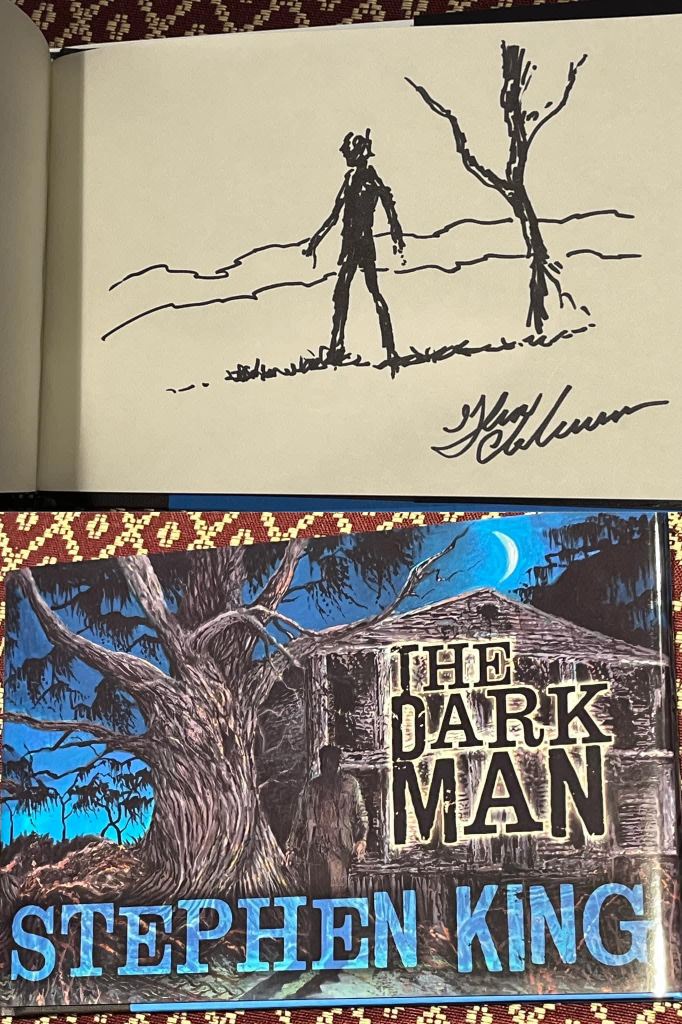
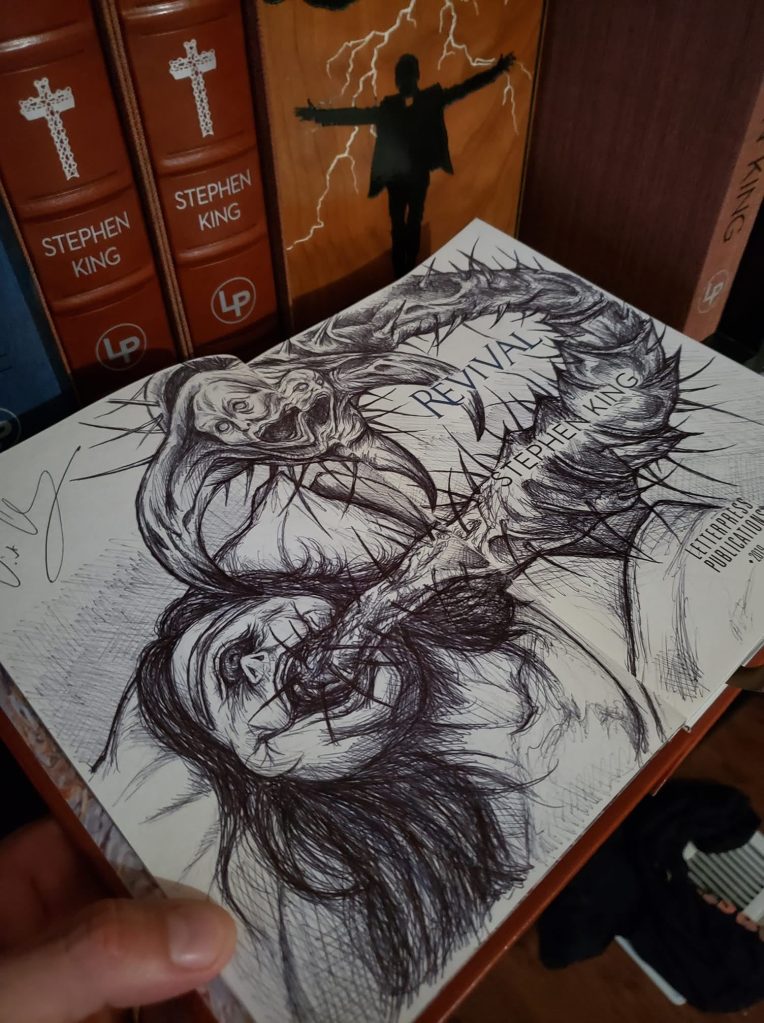
Chadbourne did the art for an edition of King’s epic poem The Dark Man
Chong and Vaillancourt provided art for a special edition of Revival by Letterpress Publications

I was also unfamiliar with the extent to which collecting limited editions from specialty small presses had permeated King fan culture. I have a basic collection of King hardbacks and paperbacks alike from used bookstores–mainly for the sake of the objects themselves rather than reading them, since I read via ebooks and audiobooks–but I resisted procuring a first edition of The Shining and the Secretary of Dreams volumes from Cemetery Dance Publications when I happened to come across them, since they each cost hundreds of dollars. I knew it would be dangerous for me to go down the path of leveling up to collecting first and special editions. It seems that once you start collecting seriously, there could never be an adequate state of completion, that you’d always be trying to chase down the next item, never satisfied. (On the collecting Kingcast episode, Webster referred to collecting as an addiction, and Wampler said during the period he was into collecting, it “consumed” him.)

On the other hand, I could also see a hardcore collector getting depressed if they theoretically did complete their collection (if completion is ever possible) and had nothing left to pursue to give their life meaning. And, if one was going to collect anything, special versions of books would at least theoretically bestow value on the act of reading. Though I’m still torn about this: when it comes to special editions, they’re not actually for reading, because they’re too valuable–you don’t even open them because you might crack their spines. (Of course, I did just admit to collecting books not for reading on a smaller scale, but they’re not so sacrosanct their spines can’t be cracked, and I do flip through them occasionally. I also like having hard copies of the covers, which I love to the extent that I collect t-shirts of them.)

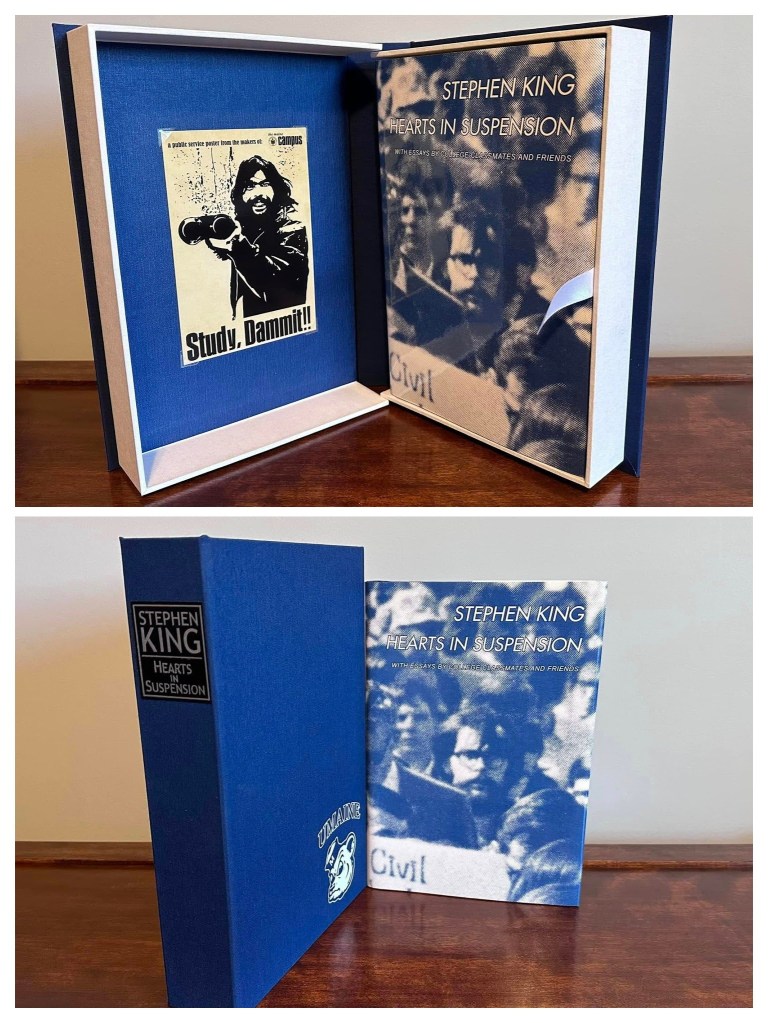
This makes protective cases for your special editions their own specialty collectible, as sold by vendor Kings Domain Designs:
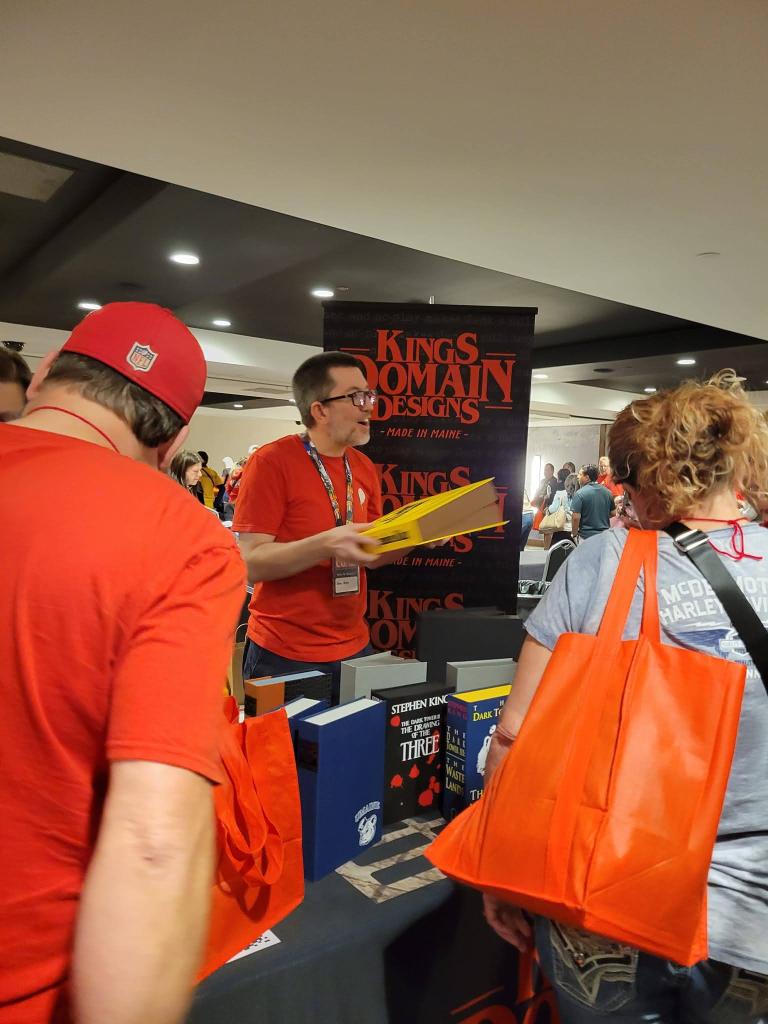
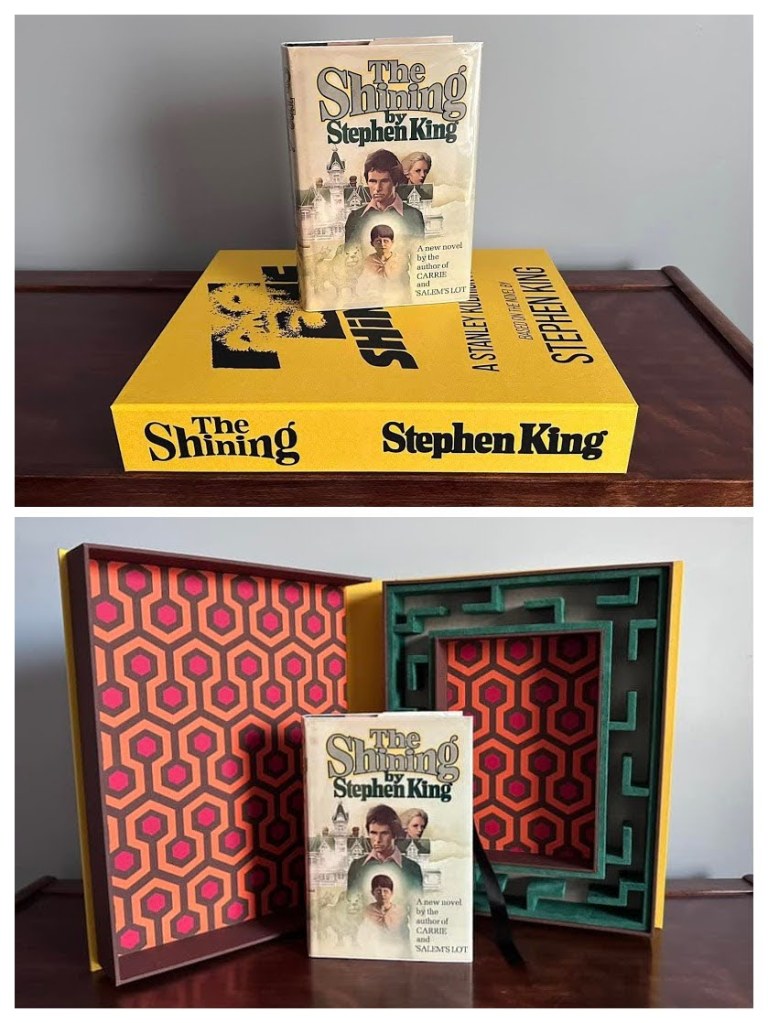
Copies of Hearts in Suspension were included in every ticket holder’s KingCon swag bag. Covers sold separately.

This mode of collecting reminds me of The Big Bang Theory episode “The Transporter Malfunction” where Sheldon and Leonard get collectors Star Trek toys they refuse to take out of the packaging, which Penny doesn’t understand, since she thinks the point of toys is to play with them. In Fan Cultures, Matt Hills touches on the concept of “affective play,” which “transgresses” another binary in fandom studies, that of “affect/cognition,” or, more or less, that between emotion and logic (“more or less” since academics like to split hairs about distinctions between “affect” and emotion). This is fitting since Sheldon uses the character of Spock more generally to mediate his own conflict between being a logical versus emotional being (see episode 9.7, “The Spock Resonance”). (Sheldon and his crew might be the most pop-culturally prominent fan-academic hybrids, except that their fields of academic study are not their objects of fandom or fandom itself.)

Hills cites another academic that specifically invokes Star Trek toys as an example:

Grossberg’s model of affect has perhaps been most usefully extended in Dan Fleming’s (1996) study, Powerplay: Toys as Popular Culture. Attempting to draw together cultural studies and psychoanalysis Fleming arrives at a view of ‘object relational interpellation’ (1996:199) which stresses the non-alignment of different planes of subject-positioning, namely the ‘object-relational’ and the ‘ideological’. He illustrates this notion through the series of Star Trek: The Next Generation figures produced by Playmates, considering the extent to which object-relational interpellation may not fall into ‘ideological interpellation’. Fleming’s argument hinges on the child’s developmental capacity to ‘play the other’ through playing with toy characters; it is this playful capacity for fluid identification and self-objectification which the ‘adult’ is deemed to lack in his or her absorption into more fixed subject positions.

Matt Hills, Fan Cultures (2002).

Hills emphasizes the importance of play as facilitated by fandom to move between internal and external worlds, or put another way, between fantasy and reality:

these texts can be used creatively by fans to manage tensions between inner and outer worlds. If any one of us became caught up purely in our inner world of fantasy then we would effectively become psychotic; if we had no sense of a vibrant inner world and felt entirely caught up in ‘external’ reality then, conversely, we would lack a sense of our own uniqueness and our own self (a sense which, I would suggest, is lived and experienced even by sociologists wanting to argue that this is an ideological/constructed effect of social structures). It is therefore of paramount importance for mental health that our inner and outer worlds do not stray too far from one another, and that they are kept separate but also interrelated. That fans are able to use media texts as part of this process does not suggest that these fans cannot tell fantasy from reality. Quite the reverse; it means that while maintaining this awareness fans are able to play with (and across) the boundaries between ‘fantasy’ and ‘reality’ (1995:134). As I have already mentioned, it is also important to realise that this process is ongoing and does not correspond to a childhood activity which adults are somehow not implicated in. All of us, throughout our lives, draw on cultural artefacts as ‘transitional objects’.

Matt Hills, Fan Cultures (2002).

The “transitional object” is that which facilitates the transition between inner and outer worlds, in this case the media text one is a fan of. This all again speaks to the allegorical power of the premise of IT, both in the nature of evil…

Is evil an external force with its own ontological existence (like the biblical figure of Satan) that actively seeks to corrupt and do harm, or is evil a more passive, internal privation—a sort of black hole of the soul? Is evil a spiritual reality or a fully human one? Is evil generated by social and environmental forces or is it genetic, ingrained in us from birth? … King himself has long wrestled with this problem. In a 2014 interview with Rolling Stone, King stated, “I believe in evil, but all my life I’ve gone back and forth about whether or not there’s an outside evil, whether or not there’s a force in the world that really wants to destroy us, from the inside out, individually and collectively. Or whether it all comes from inside and that it’s all part of genetics and environment” (Greene).

Gregory Stevenson, “Evil, Enchantment and the Magic of Faith in Stephen King’s IT,” The Many Lives of It: Essays on the Stephen King Horror Franchise, ed. Ron Riekki (2020).

…and the power of the imagination. Stevenson argues that IT reflects the historical shift in worldviews from mysticism/supernaturalism to the rational enlightenment to re-enchantment: the imaginative kids become the rational adults who have to find the power of childhood imagination again to defeat It. If fan = emotion-based and facilitates imagination while academic = logic-based, then by this plot, fandom is more venerated.

…the novel is actually more about the adults than the children. After all, despite the novel’s depiction of adults as blind and ineffectual in the face of evil and as devoid of faith and imagination due to an embrace of rationalism, it is, nonetheless, the adult Losers who ultimately defeat It.

They must move from mundanity back to magic by reclaiming their childhood faith and imagination.

Gregory Stevenson, “Evil, Enchantment and the Magic of Faith in Stephen King’s IT,” The Many Lives of It: Essays on the Stephen King Horror Franchise, ed. Ron Riekki (2020).

This breakdown reveals how much in common IT has with Peter Pan. Yet in terms of collecting culture, this remains ironic if you’re not supposed to literally interact with or play with the collected objects; it’s like that form of literal non-play facilitates the figurative affective play. The plot of “The Transporter Malfunction” might speak to this as well–Sheldon is swayed to open and literally play with the transporter toy, but when he does, he breaks it. This would seem to reinforce the idea that the collectors toy should not have been literally played with. A “transporter” seems a fitting metaphor for the “transitional object” concept that is the facilitator of the figurative play, and in the episode is the object of literal play–to break the literal toy is to break, or disrupt, the figurative concept. Again, on the whole reinforcing that it’s not literal play that facilitates the figurative play, but rather its opposite, no play, in line with the tenants of collecting culture.

If this is confusing, there are also mixed messages about whether “play” is good in Kubrick’s The Shining:
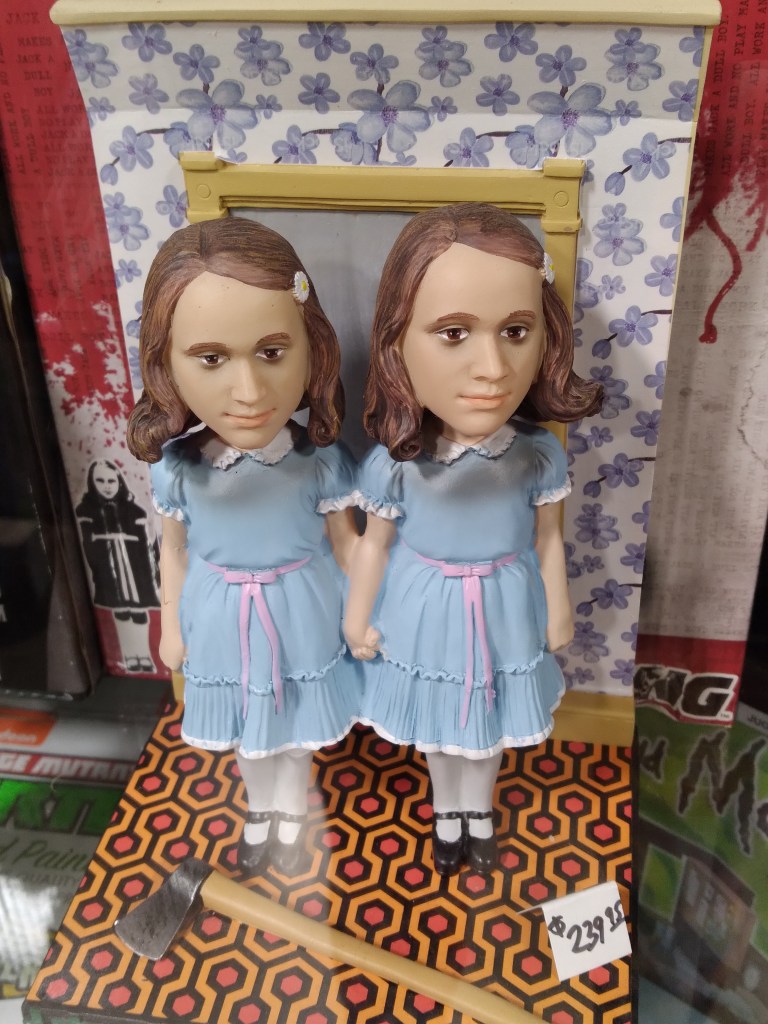
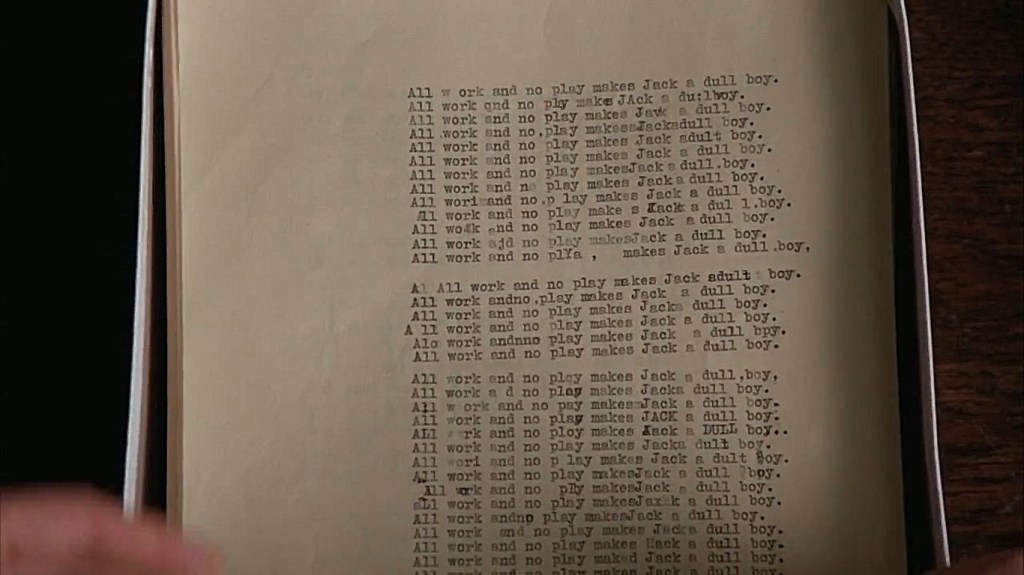
“Come play with us, Danny…” = play is bad/horrifying
“All work and no play makes Jack a dull boy” = play is good and no play is horrifying

This is actually a perfect example of the necessity and benefits of the type of play fandom facilitates.

The proverb “All work and no play makes Jack a dull boy” was first recorded in 1659, which meant that the lack of balance between work and relaxation would render a person dull and stunted from a holistic standpoint. It is interesting to note that the phrase is often followed by a lesser-known line discarded during its travel through time, which says: “All play and no work makes Jack a mere toy.” 

From here.

It’s also a play on words, because Jack is trying to write a play.

Also, if IT is a novel about adults integrally connected to their childhoods, reclaiming something critical from it, playing with toys seems like a natural way to do that. Traditional toys weren’t on sale at KingCon, but are elsewhere. I don’t remember what these Pennywises cost, but judging from the price tag on the twins above, toys for adults are expensive.

A souvenir shop in Austin: two different versions of the same thing.

And you can’t have Pennywise without Penny… George Beahm, my gateway to King when I read his book Stephen King: America’s Best-Loved Boogeyman (1998), and who has also written The Stephen King Companion (1989, updated in 1995 and 2015) has also authored a book on The Big Bang Theory.

In the larger context of their restrictive social world, which largely consists of fandom in its various guises, both real and imaginary, Leonard and Sheldon are the proverbial Lost Boys of Peter Pan’s Neverland: they lived in a magical world of their own where they never have to grow up, until Penny (in the guise of Wendy) drew them into the real world.

George Beahm, Unraveling the Mysteries of The Big Bang Theory (2014).

If It can be read as a version of Peter Pan, and The Big Bang Theory can be read as a version of Peter Pan, then The Big Bang Theory can be read as a version of It

Penny: Okay, you don’t have to be so smug about it. You know, you went to see that movie It because you thought it was about scary I.T. guys.

The Big Bang Theory 11.8, “The Tesla Recoil” (November 16, 2017).

(Emphasizing the significance of fandom to the show, Part 4 of Beahm’s book is called “Fandom” and includes the chapter “Getting Your Geek on In Public: A Convention Guide for Muggles.”)

IT, as well as the face-off in Tom Gordon, would also seem to symbolically capture what Hills has termed the “dialectic of value” in regards to fandom:

Through a reworking of Adorno in chapter 1, I focused on the fan’s ‘dialectic of value’ where fandom is both a product of ‘subjective’ processes (such as the fans’ attribution of personal significance to a text), and is also simultaneously a product of ‘objective’ processes (such as the text’s exchange value, or wider cultural values). Fan cultures, that is to say, are neither rooted in an ‘objective’ interpretive community or an ‘objective’ set of texts, but nor are they atomised collections of individuals whose ‘subjective’ passions and interests happen to overlap. Fan cultures are both found and created, and it is this inescapable tension …

Matt Hills, Fan Cultures (2002).

This distinction between subjective and objective evokes that between the individual and community/collective, taking us back to the “fanship” distinction that Reysen et al use to define the individual side of fandom. IT embodies this tension according to Michael Blouin’s chapter on IT in his Stephen King and American Politics study about how the book “oscillates” between the individual and collective, a discussion which also hearkens back to the Con’s organizers’ claim that the Con was an apolitical space. (One of the presentations in my fandom class at the high school was about the fandom of Trump.)

If, according to Hills, fandom is supposed to facilitate play and a healthy blurring between imagination and reality, something went wrong somewhere:

January 6th is another example of how fan practices and fans’ ability to play with culture becomes integrated into other social domains. The rioters on January 6th looked like they were playing; some were wearing costumes, filming themselves and posing for the media. It was incredibly serious and consequential, but as I was watching the events unfold in the news, I was also struck by the playful way the rioters engaged with their surroundings. I think one of the reasons why fans have significant cultural authority is precisely because of their ability to engage playfully with culture, through their practices.

Line Nybro Petersen, CarrieLynn D Reinhard, Anthony Dannar; Natalie Le Clue, “New territories for fan studies: The insurrection, QAnon, Donald Trump and fandom,” Journal of Research into New Media Technologies, Vol. 30(1) 313–328 (2024).

Blouin reads the Hegelian dialectic (thesis/antithesis/synthesis) into IT‘s oscillation between the poles of individual and community that line up with the poles in Hills’ fandom “dialectic of value”:

Determined by a fluid border that separates children from adults, IT ultimately confuses the communitarian and liberal binary. The communitarian Selznick admits that ‘a balance must be struck between the demands of society and the needs of individuals’ (43). The liberal Rawls sounds equally placatory, [] when he acknowledges that self-realisation is bound up in the basic structure of communities (452). In similar fashion, IT interweaves the positions that this chapter pantomimes – nebulous positions, it bears emphasising, that have never been convincingly bifurcated.6

a dialectical reading of the text re-situates its core divisions – child/adult; community/individual – within a metaphysical systemSuch a reading of course owes a massive debt to philosopher G. W. F. Hegel, the German idealist who, according to Steven B. Smith, seeks ‘to combine the liberal or enlightened belief in life, liberty, and the pursuit of happiness with the ancient Aristotelian conception of politics as a collective pursuit aimed at some idea of a public good’. On the one hand, Hegel understands the inchoate liberalism of his day to be too legalistic because its paper-thin concept of the subject does not adequately provide a sense of communal fulfilment; and yet, he continues, a prototypical communitarian logic frequently forecloses development of the self to perpetuate a toxic status quo. In reply, Hegel develops a potential third option: ‘Reason, community, and freedom are at last joined in a new and higher harmony . . .the integration of life’s opposing tendencies’ (Smith 8, 34).

Michael Blouin, Stephen King and American Politics (2021).

Blouin’s chapter on Human Capital in Rose Madder also captures the intersection of fandom and politics that Trump embodies:

We must note that as Rosie becomes involved ‘as a “producer” and “consumer” of the artwork’, she does not automatically enter into a political mindset simply because she feels released from under the thumb of disciplinarians. … And herein lies the trap of Rose Madder: the call to disconnect from someone else’s painting or prose, and then re-enter the artwork to maximise your own emotional response, is a kind of labour that dovetails easily with the sort of affective release/recapture demanded by the neo-liberal state. The surface of the painting serves as yet another interface, another ubiquitous screen to dictate late twentieth-century behaviour. ‘The interactive possibilities of the new tools [are] touted as empowering’, Jonathan Crary notes, because it appears as though consumers are consuming in a manner that fits their unique lifestyles. Through their interactive screen, prosumers like Rosie produce and consume a steady stream of content, but ‘what [is] celebrated as interactivity [is] more accurately the mobilization and habituation of the individual to an open-ended set of tasks and routines’ (83). To say it another way, while Rosie’s ‘active’ relationship with the screen of her painting may suggest a type of empowerment, the novel’s integration of ‘autonomous art’ and ‘circuits of capital’ does not genuinely transform her life in a meaningful sense.

Michael Blouin, Stephen King and American Politics (2021).

Since the “labour” Blouin invokes is essentially the labor of fandom, by his reading this labor often offers merely the illusion of empowerment under capitalism rather than actual empowerment.

In terms of the consumption constituted by book collecting, I ended up missing the Con panels with Phantasia Press and Suntup Editions as well as the panel on collecting with Webster. Someone who did attend told me they showcased an edition of The Regulators that looks like it has bullets passing through it. This is apparently considered a “Holy Grail” for King collectors, as touched on in the interview with its designer Joe Stefko on Suntup’s website here.

Stefko founded the publisher “Charnel House” to publish finely crafted editions:

JS: Charnel House is a play on Random House. A charnel house is where bodies were stored in times of plague. House being a publishing firm. I thought it was a cool idea. Robert Bloch, who couldn’t believe that it wasn’t used until I came along, told me at a convention, “Well, I’m glad someone around here has a sense of humor!”

From here.

Here we see the confluence of horror and humor again, that nexus at the heart of King’s canon, as well as a thematic link to The Stand in its connection to a plague.

I missed the collecting panels to go to a lunch Kingcast host Eric Vespe invited the show’s Patreon subscribers to via our Discord. We went to Guy Fieri’s restaurant in the Linq Hotel (host of the convention), to get their Trash Can Nachos in honor of Scott Wampler. Vespe mentioned there he was considering Anthony Breznican as the new Kingcast co-host, which was recently confirmed and publicly announced.
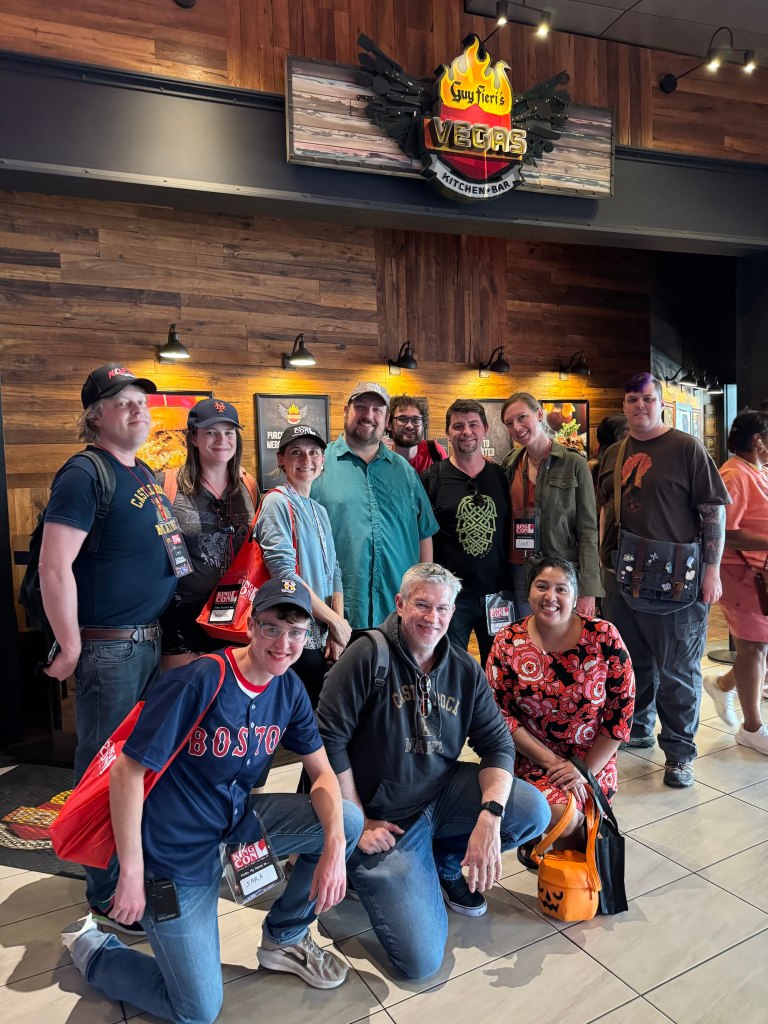
Kingcast crew with host Eric Vespe

Everyone at the lunch was in agreement we needed to be back to the main Con room for the slot where they had been hyping a major surprise giveaway (by random ticket number selection). This turned out to be a special edition of Duma Key designed to look like a painting on an easel that folds into a case.
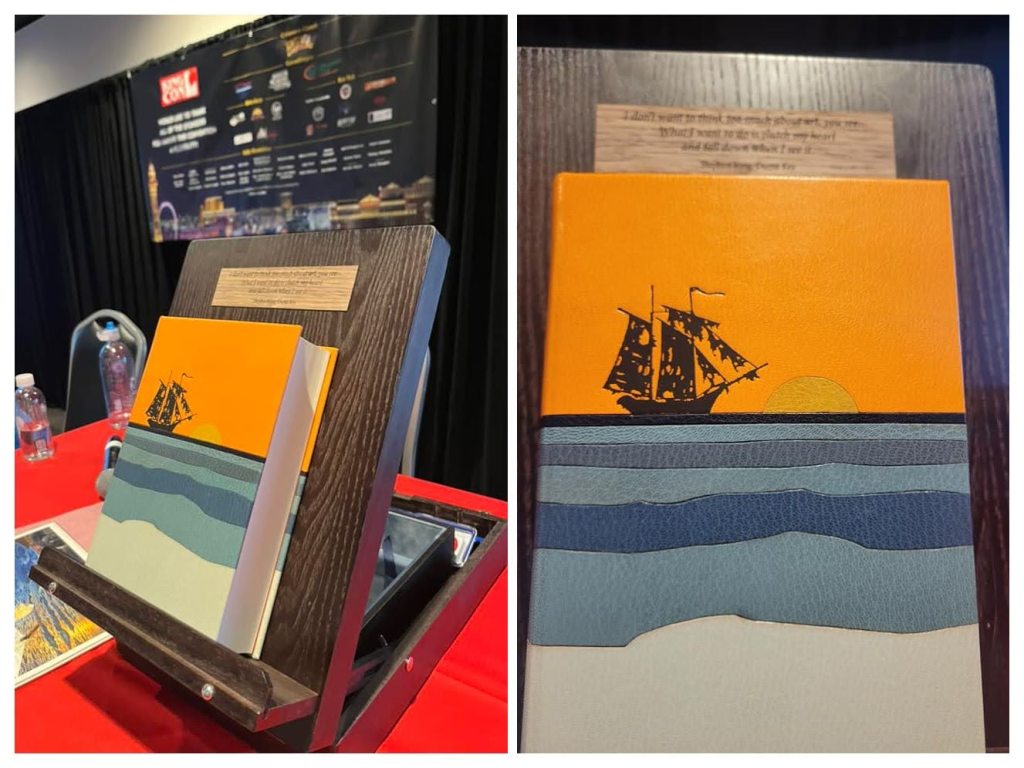
I don’t want to think too much about art, you see.
What I want to do is clutch my heart and fall down when I see it.
Stephen King, Duma Key

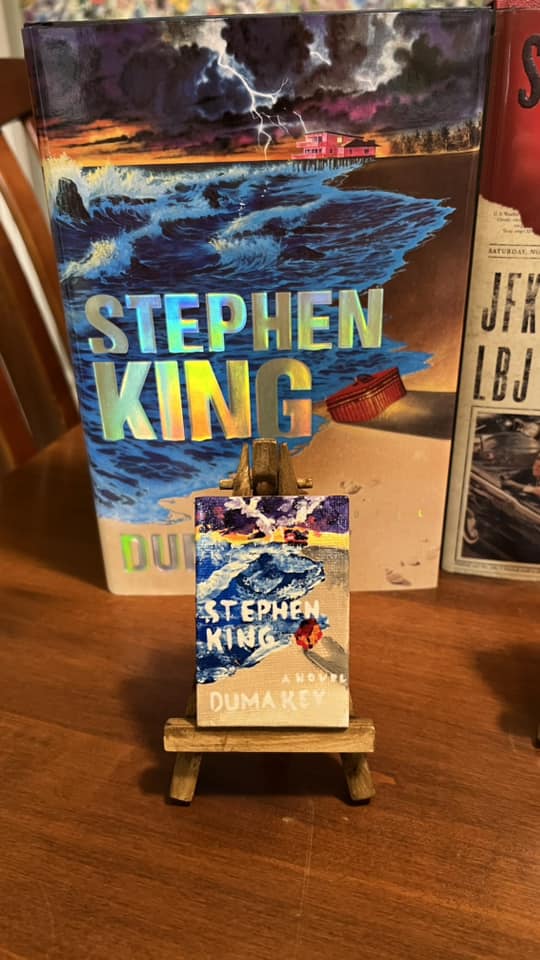
And artist Kristen Bird didn’t even know about this when she started making her Little Library books that she displays on little easels–which, of all the King books, would be most thematically appropriate for Duma Key.
I would have been more than happy to win any special edition, but particularly this Duma Key one, because it captures the confluence of the written and visual that fascinates me in King’s work. But I didn’t.

While King has signed plenty of special and limited editions himself to enhance their value, I can read a couple of indictments of collecting culture into King’s work. (One can read the most general indictment of it into the horror trope of “possession.”) In “A Good Marriage” (2010), Darcy’s husband, who she discovers is a serial killer, is also a coin collector who uses this as a pretense for traveling, giving him the opportunity to commit his crimes. But he also seems to actually collect coins for the sake of collecting them and not just for this pretense. It’s his getting drunk in celebration of finding the coin he’d sought the most that gives Darcy the opportunity to kill him. Live by the coin, die by the coin.

Then there’s the novel whose central premise is how we humans are overly susceptible to putting too much value on things to the point that it will be our undoing…
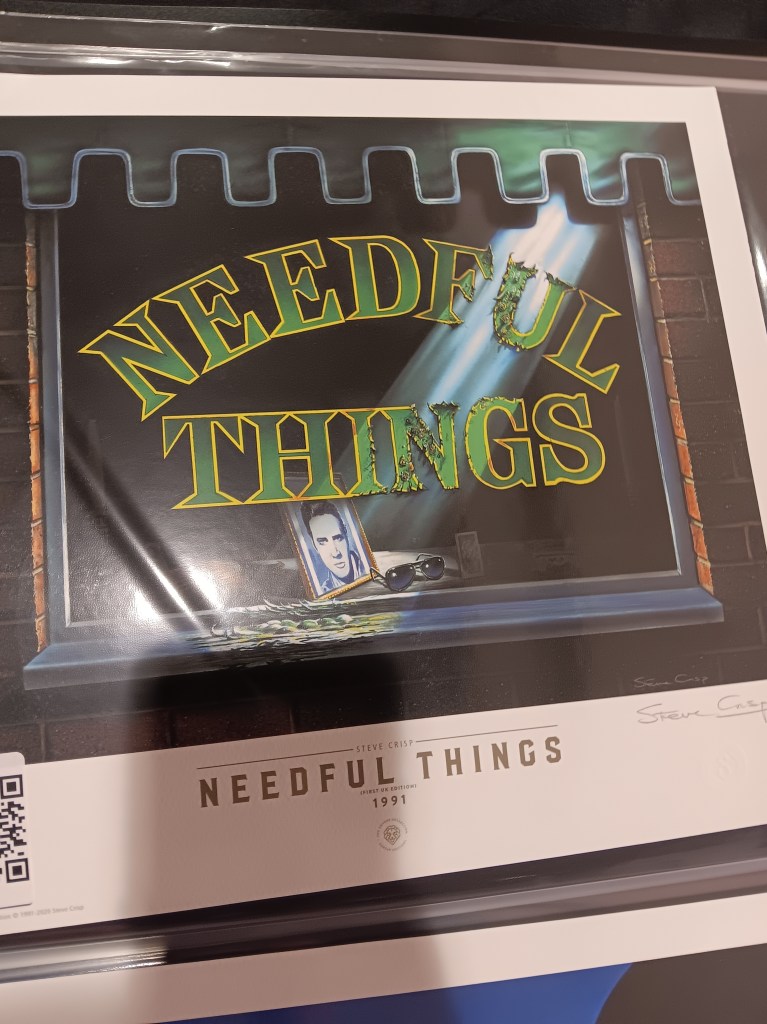
The British first edition cover art

I suppose it might violate the spirit of this indictment of collecting to wear one of my book cover t-shirts for it–or just proves the book’s point.
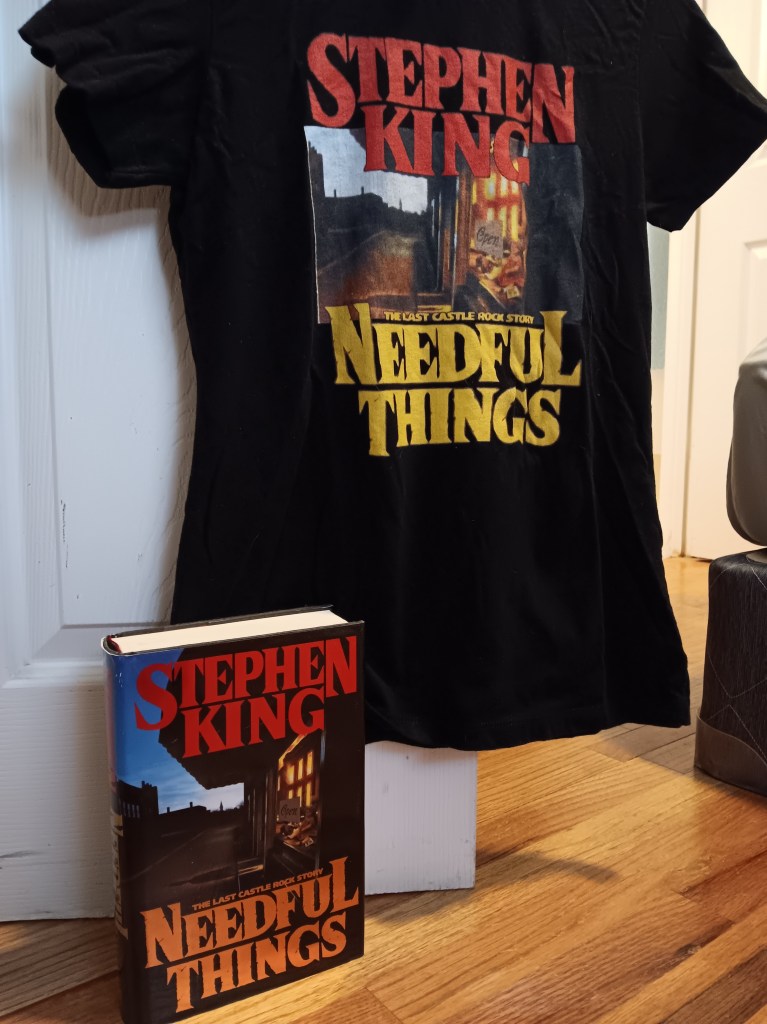
The illustrator Rob Wood did this American first edition cover art for Needful Things (1991), noting that the image of the street on the cover is actually from a picture of a street taken in Jonesborough, Tennessee. I loved this guy and his work, but I might prefer the UK edition cover of Needful because of its representation of “objects” of fandom in the double sense: Elvis himself is an “object” of fandom, and the sale of literal objects in the “Needful Things” shop, like Elvis’s sunglasses, facilitates, via collecting, access to fantasies about the figurative object of fandom.

Sandvoss (2005) rightly notes the methodological and ethical difficulties of asking fans to articulate their inner fantasies and desires. To date, only a few studies have done so. Vermorel and Vermorel (1992) interview fans who discuss their fantasies, but the researchers remain firmly in academic mode as they do so, investigating from the outside. Hinerman (1992) also analyzes fans’ Elvis fantasies from the outside, and perhaps relatedly, seems to include a disproportionate number of more extreme examples.

Katherine Larsen and Lynn Zubernis, Fandom At The Crossroads: Celebration, Shame and Fan/Producer Relationships (2012).

The fantasies of Elvis the female character in Needful Things has that are facilitated by her physical contact with his sunglasses would certainly qualify as one such “extreme example.” In keeping with King’s exploration of media v. sports fans in Misery and Tom Gordon, Needful Things addresses both types; alongside the Elvis fan character is a boy whose object of fandom is a baseball player and his baseball card. Thus here King seems to point out likenesses in these types of fandom rather than differences. And the general premise of the entire book is fandom blurring the line between fantasy and reality in the mode of the January 6th “players.”

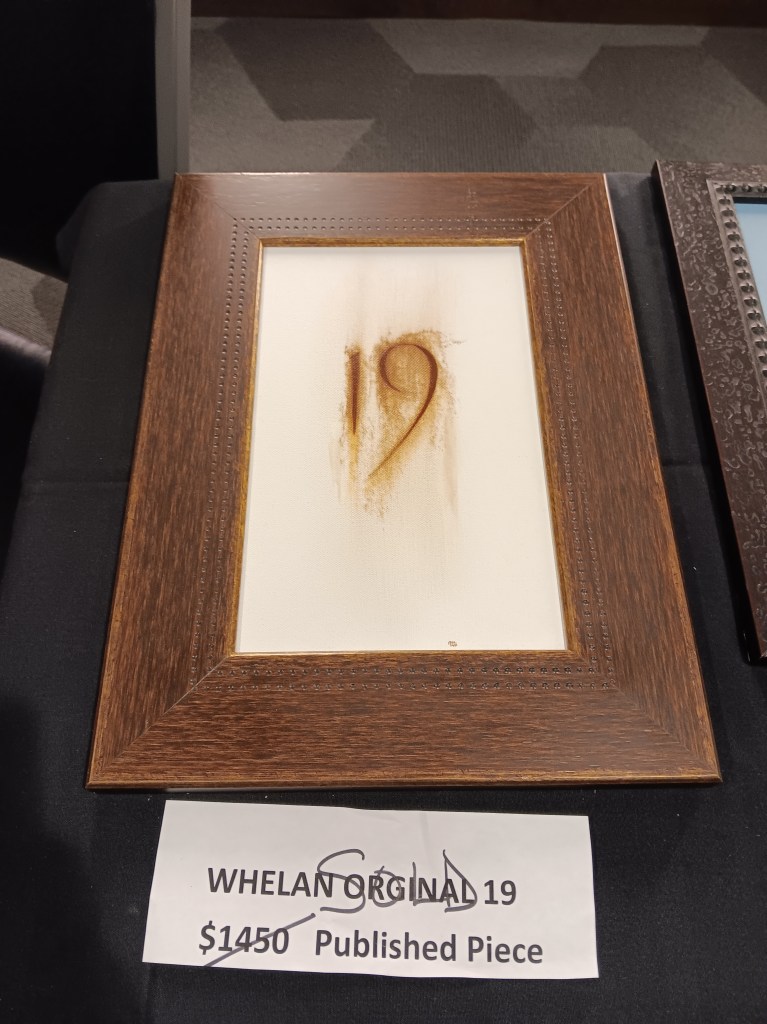
Rob Wood also did the covers for the 90s streak of Four Past Midnight (1990), Gerald’s Game (1992), Nightmares & Dreamscapes (1993), and Dolores Claiborne (1995). (His sketches for a potential cover for Insomnia (1994) that ultimately weren’t used for the book were up for auction at the Con.) Wood, who I think might be tied with someone else for who’s illustrated the most King covers, gave an individual lecture on his process with a slideshow that was especially enjoyable for me, because the Gerald’s Game cover indelibly imprinted itself on my psyche when, as a seven-year-old, I saw it on grocery store shelves upon its release.
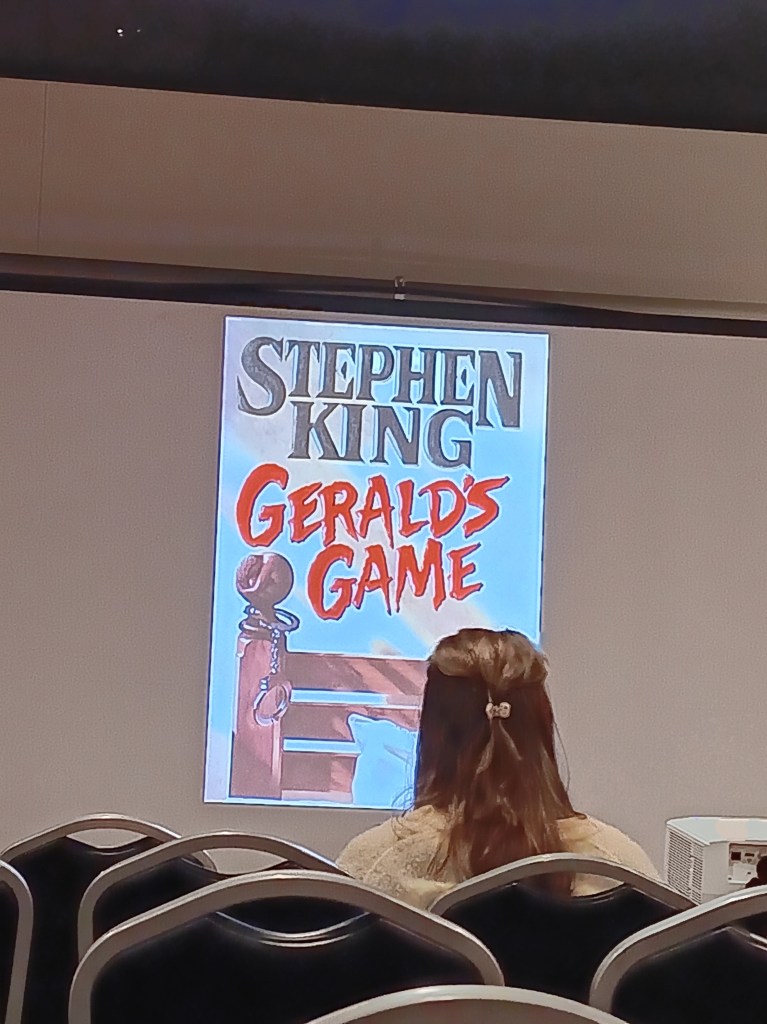
In earlier designs, Wood made a different version of the bedpost knob and wanted a window visible above the bed:
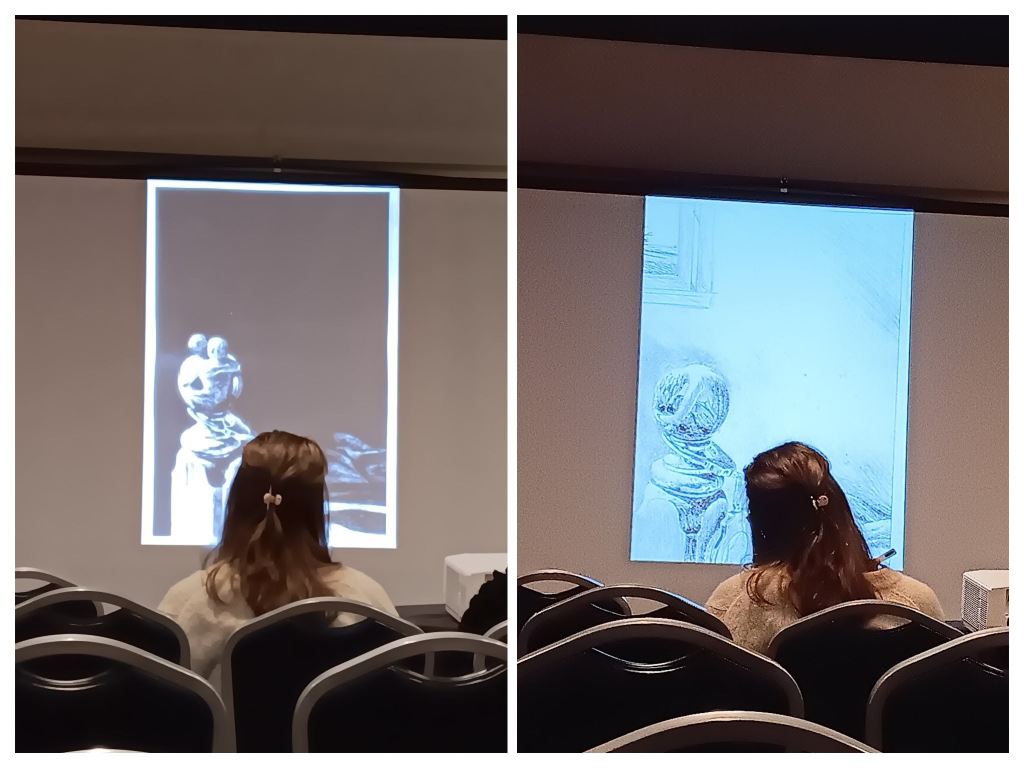
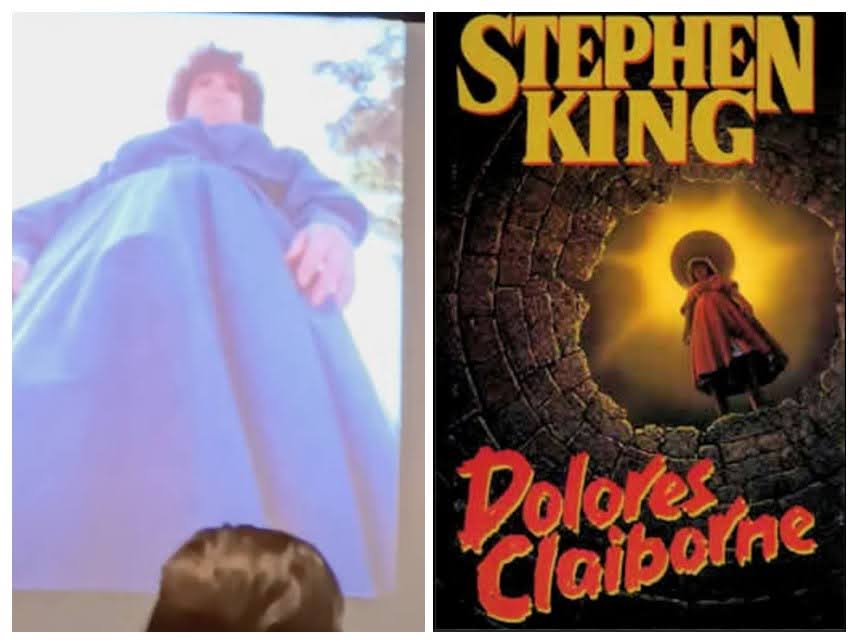
He insisted the publishers were wrong not to include the window and joked about how most of the artwork ended up being covered by King’s name anyway. He made clay models of both the two-person and single person bedpost knobs to do the sketches, and the two-person knob was a depiction of him and his wife. (He did not claim the two-person version was better and to me the one with the lone figure makes more sense for the story.) Wood also showed a video documenting his creation of the Dolores Claiborne cover showing that the woman on the cover is his wife. After creating the loose concept sketch of the woman looking down the well, he took pictures of his wife in the dress from the right angle to do the drawing from–with the final version of the art being an acrylic painting.
Wood was also sent copies of the corresponding manuscripts to read when he was assigned the covers that had editorial comments on them, so he could see what King had written that got changed (I imagine these would be worth a lot if he decided to sell them), and after reading these manuscripts he’d sketch a few different ideas.
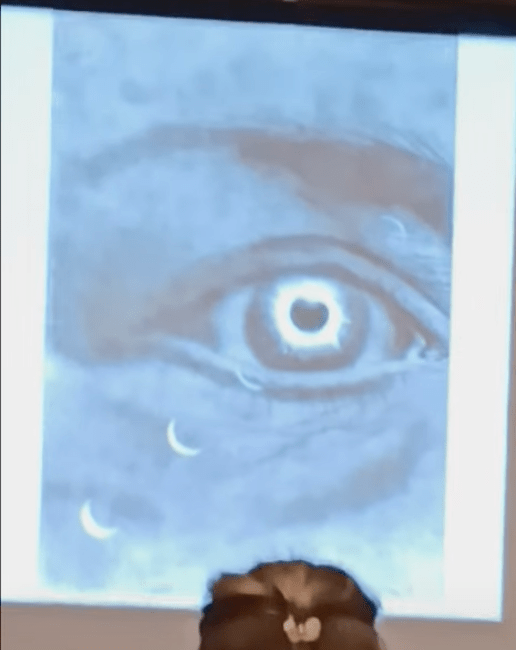
eclipse eye sketch for Dolores Claiborne cover

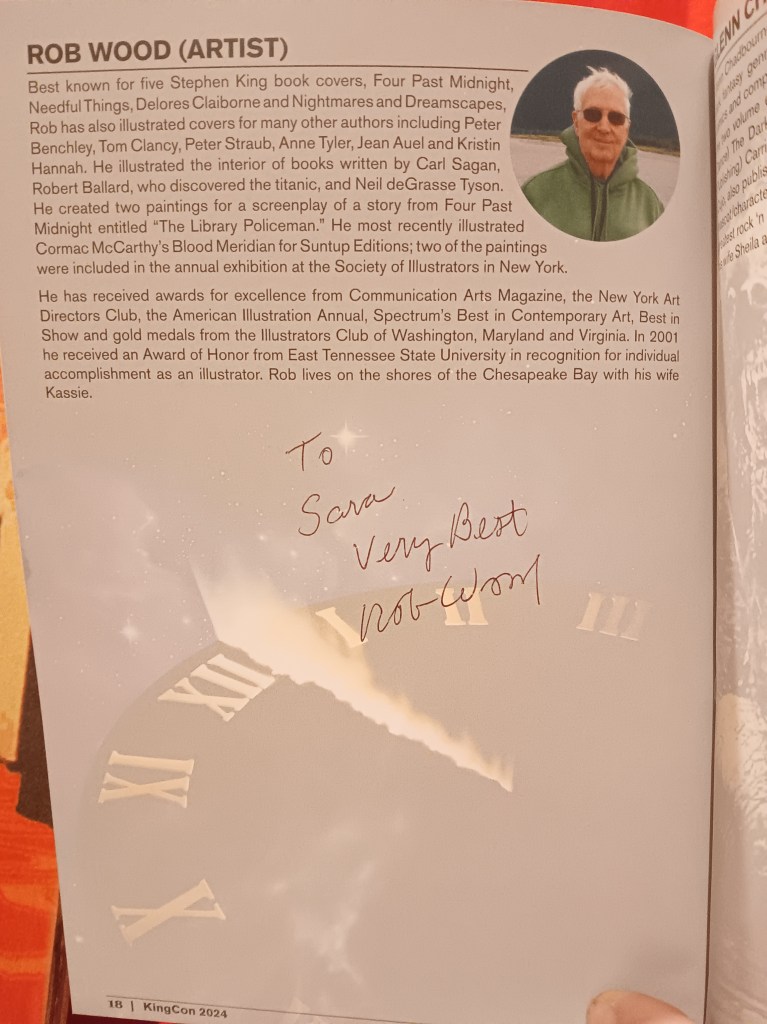
I was hesitant to get into the game of collecting autographs that I quickly came to understand was part of the point of such conventions, with the program allotting a specific page for each Con invitee, but I did get Wood’s:
As with Needful Things, another indictment of collecting culture can be found in a novel that King references in his indictment of toxic superfandom, Misery:

On two separate occasions in his 1987 novel Misery, Stephen King makes reference to John Fowles’s fine first novel, The Collector.16 King’s book is indebted to The Collector on a variety of levels, most obviously because it recreates Fowles’s plot: a lonely and misdirected individual, motivated not by a desire for money or sex but by a curious admixture of admiration and rage, kidnaps and torments an innocent artist. The differences that distinguish these parallel plots, however, are truly startling, as King inverts the Gothic male villain / chaste maiden prototype to which Fowles so deliberately adheres.

Tony Magistrale, Stephen King: The Second Decade, Danse Macabre to The Dark Half (1992).

Like Duma Key, and like the prominence of the visual in King’s work evidenced by the prominence of illustrators for it at the Con, The Collector offers interesting insights into the confluence between the written and the visual:

What I write isn’t natural. It’s like two people trying to keep up a conversation.

It’s the very opposite of drawing. You draw a line and you know at once whether it’s a good or a
bad line. But you write a line and it seems true and then you read it again later.

John Fowles, The Collector (1963).

The art student that the titular character abducts is of a higher class than he is and repeatedly berates his taste, including the fact that he collects butterflies, linking this to his motivation for her abduction in a way that doesn’t make collectors come off so well (reinforced by other passages in the course of his stalking her):

She closed the book. “Tell me about yourself. Tell me what you do in your free time.”

I’m an entomologist. I collect butterflies. 

“Of course,” she said. “I remember they said so in the paper. Now you’ve collected me.”

She seemed to think it was funny, so I said, in a manner of speaking.

“No, not in a manner of speaking. Literally. You’ve pinned me in this little room and you can come and gloat over me.”

I don’t think of it like that at all.

I said, if you asked me to stop collecting butterflies, I’d do it. I’d do anything you asked me.

“Except let me fly away.”

John Fowles, The Collector (1963).

One aspect of The Collector that King does not incorporate in Misery is that it goes into the perspectives of both the abductor and the abducted. In the abducted Miranda’s perspective, she thinks a lot about an older male artist, G.P., who eventually tried to get her into bed, and as her diary entries progress, it’s not her literal abductor that she comes under the sway of emotionally, but this other man who functions as a version of a figurative abductor. Thus, the rendering of her female perspective is problematic:

It is through Miranda’s fantasies and eventual acceptance of G.P.’s (and Fowles’) ideologies that Fowles exploits what appears on the surface to be a woman’s perspective. Miranda offers not an authentic woman’s standpoint, but a point of view reflective of internalized masculine ideologies. Within her diary, this male discourse functions abstractly, ideologically; within the novel as a whole, Fowles imposes masculine ideologies literally, as Miranda’s diary is confined within Clegg’s narrative, which “begins before Miranda’s and resumes after it, surrounding and containing her narrative as a counterpart to her captivity”.26

Brooke Lenz, “Objectification and Exploitation: Victimized Perspectives in The Collector,” John Fowles: Visionary and Voyeur (2008).

Clegg’s lack of sexual interest in Miranda is itself an indictment of collecting:

What she never understood was that with me it was having. Having her was enough. Nothing needed doing. I just wanted to have her, and safe at last.

John Fowles, The Collector (1963).

She is an object to him, yet the power dynamics are fascinating as Miranda considers herself superior to her abductor and claims she thinks of him as an object:

I took the photos that evening. Just ordinary, of her sitting reading. They came out quite well.

One day about then she did a picture of me, like returned the compliment.

From time to time she talked. Mostly personal remarks.

“You’re very difficult to get. You’re so featureless. Everything’s nondescript. I’m thinking of you
as an object, not as a person.”

“You’re the one imprisoned in a cellar,” she said.

John Fowles, The Collector (1963).

Here Miranda objectifies the abductor who has objectified her. But in the end, it’s the collector who comes out on top.

Clegg and G.P. are positioned as oppositional via their stances on collecting, but are really ultimately versions of the same thing in having abducted Miranda (if in different ways):

I know what I am to him. A butterfly he has always wanted to catch. I remember (the very first time I met him) G.P. saying that collectors were the worst animals of all. He meant art collectors, of course. I didn’t really understand, I thought he was just trying to shock Caroline—and me. But of course, he is right. They’re anti-life, anti-art, anti-everything.

John Fowles, The Collector (1963).

Miranda’s adopting this attitude about collecting from her aesthetic captor is part of the problematic aspect of her female subjectivity (or lack thereof)–this attitude reflects another indictment of collecting, in line with the indictment implied by Clegg’s abduction, that we’re supposed to sympathize/agree with, which means we’re not supposed to read Miranda’s adoption of this perspective as problematic.

While The Collector artfully examines the limitations of rigid points of view and attempts to incorporate the insights of a woman character, it exploits rather than explores a woman’s standpoint, and offers no alternative vision to the troubling pornographic objectification and fragmented disjunction of its characters’ socially conditioned interactions.

Brooke Lenz, “Objectification and Exploitation: Victimized Perspectives in The Collector,” John Fowles: Visionary and Voyeur (2008).

This problem with the novel was then transferred into the design of a special edition of it. When I was looking up Suntup Editions in prepping to talk to my fandom class about collecting culture, it happened that editions of The Collector were the first thing on their page. As with all of their editions of books, there are three different ones, the artist edition, the numbered edition, and the lettered edition–these listed in descending order of number of copies made and thus ascending order of price (fewer copies produced = more expensive).

The Lettered Edition of The Collector

It’s the Artist Edition that reproduces the objectification problem:

This is apparently the image that was on the cover of the novel’s first edition–a completely fetishistic and pornographic one. I can’t even with this…if it’s trying to make the point that it’s the creepy abductor that’s fetishizing Miranda, it’s completely falling into the trap of reproducing his fetishizing rather than meaningfully commenting on it. This cover would reflect the text as Lenz critiques it, Fowles the author objectifying Miranda instead of rendering an authentic female perspective. That this special edition is going to reproduce the fetishization again seems an indictment of collecting culture, if an unintentional one. Special editions as a fetish object.

The parallel between fetishized book and fetishized human played a significant role in King’s original conception of Misery:

By the time I had finished that first Brown’s Hotel [writing] session, in which Paul Sheldon wakes up to find himself Annie Wilkes’s prisoner, I thought I knew what was going to happen. Annie would demand that Paul write another novel about his plucky continuing character, Misery Chastain, one just for her. After first demurring, Paul would of course agree (a psychotic nurse, I thought, could be very persuasive). Annie would tell him she intended to sacrifice her beloved pig, Misery, to this project. Misery’s Return would, she’d say, consist of but one copy: a holographic manuscript bound in pigskin!

Here we’d fade out, I thought, and return to Annie’s remote Colorado retreat six or eight months later for the surprise ending.

Paul is gone, his sickroom turned into a shrine to Misery Chastain, but Misery the pig is still very much in evidence, grunting serenely away in her sty beside the barn. On the walls of the “Misery Room” are book covers, stills from the Misery movies, pictures of Paul Sheldon, perhaps a newspaper headline reading FAMED ROMANCE NOVELIST STILL MISSING. In the center of the room, carefully spotlighted, is a single book on a small table (a cherrywood table, of course, in honor of Mr. Kipling). It is the Annie Wilkes Edition of Misery’s Return. The binding is beautiful, and it should be; it is the skin of Paul Sheldon.

Stephen King, On Writing: A Memoir of the Craft (2000).

It happens that Suntup Editions also has the trifecta of special editions of Misery, with the Lettered Edition consisting of real Royal typewriter keys set into the cover:
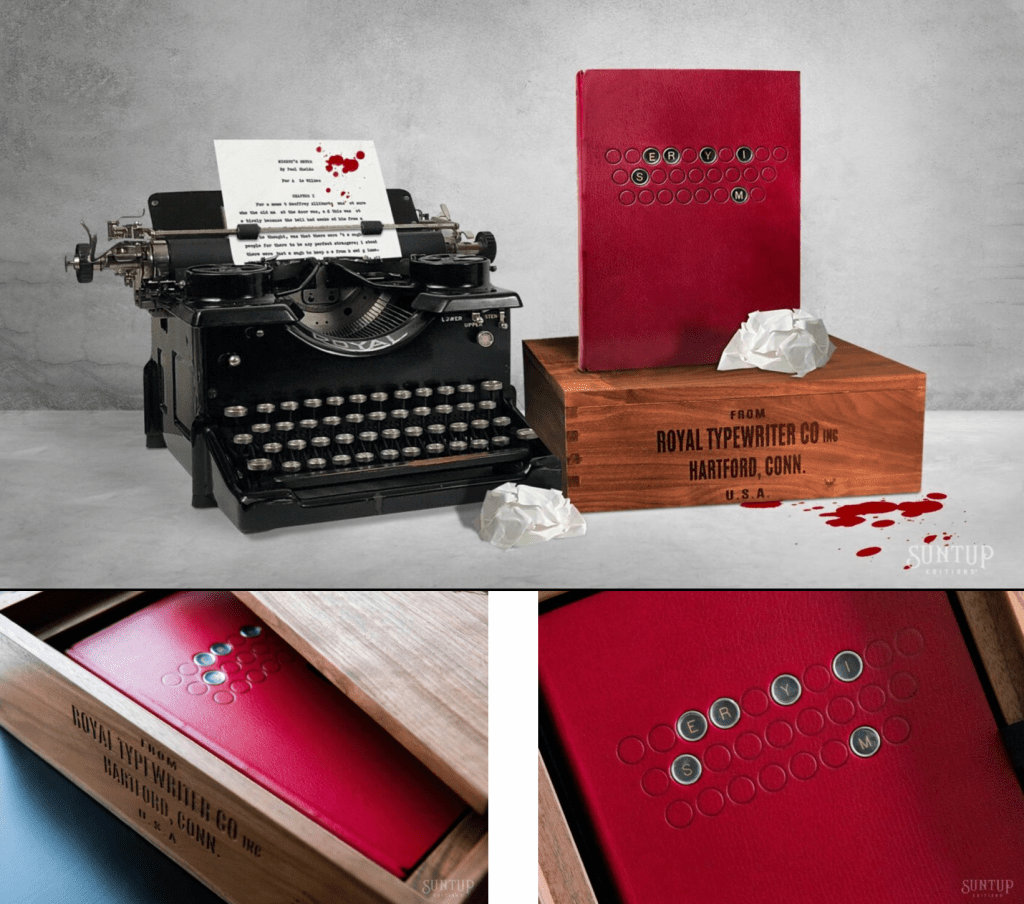
The Lettered Edition of Misery (here).

King has said Annie Wilkes was inspired by Mark David Chapman, who was inspired to assassinate John Lennon by The Catcher in the Rye in one of the most egregious instances of toxic fandom. Catcher makes a cameo in The Collector when Miranda gets Clegg to read it, and his lack of appreciation of it reinforces her low opinion of him. (On a side note, another major aspect of intertextuality in The Collector is Shakespeare’s The Tempest, via Miranda’s name and the fact that Clegg tells her his name is Ferdinand (it’s really Frederick) but she starts referring to him as Caliban, the villain of that play that also constitutes an Africanist presence. Gregory Phipps’ reading of Annie Wilkes as an Africanist presence in the form of the mammy stereotype would constitute what’s probably an unintentional aspect of Misery‘s intertextuality with The Collector. And Miranda’s fondness for Catcher further signifies her problematic indoctrination into the literary patriarchy reinforced by her feelings for her figurative abductor G.P.)

Matt Hills quotes Anthony Elliott writing about Mark David Chapman to identify in psychoanalytic terms how fandom has violence inherently built into it, which of course Annie Wilkes demonstrates:

[I]n the process of identifying with a celebrity, the fan unleashes a range of fantasies and desires and, through projective identification, transfers personal hopes and dreams onto the celebrity. In doing so, the fan actually experiences desired qualities of the self as being contained by the other, the celebrity. In psychoanalytic terms, this is a kind of splitting: the good or desired parts of the self are put into the other in order to protect this imagined goodness from bad or destructive parts of the self. There is, then, a curious sort of violence intrinsic to fandom…. The relation of fan and celebrity is troubled because violence is built into it.

Matt Hills quoting Anthony Elliott, Fan Cultures (2002).

This might also explain why King declined to attend a convention of people who might each avow that they are his number-one fan. King’s treatment of media fans v. sports fans in Misery v. Tom Gordon is a longer discussion, but it’s worth noting here that in the latter King renders sports fandom more in terms of media celebrity fandom–Trisha isn’t a Red Sox fan as much as she is a Tom Gordon fan, which also has implications for the the interplay between the individual and collective in fanship and fandom. The modes of fandom Trisha engages with in the present action of the novel are actually the fanship kind that Reysen et al clarify as the individual non-face-to-face kind. Trisha doesn’t come face-to-face with any fans in the novel; rather, she comes face-to-face with the evil bear-thing.

Since collecting emphasizes objects, or things, as valuable, I was reminded of a talk on the future of pop culture studies at the 2023 PCA conference that claimed the framework of pop culture studies was different from that of literary studies in terms of prioritizing “the thing” rather than theory. “The thing” didn’t have to be a literal thing to be studied, but could be something like, say, fandom. (And, by the above Tom Gordon logic with the evil bear-thing, is something King would again consider evil.)

Sleeping in the shade, waking up staring through the leaves at the cobalt blue sky, thinking how impossible things were to paint, how can some blue pigment ever mean the living blue
light of the sky. I suddenly felt I didn’t want to paint, painting was just showing off, the thing was to
experience and experience for ever more.

John Fowles, The Collector (1963).

Here Fowles seems to extend and connect the indictment of collecting to (ironically) an indictment of the mediation of art itself–if here explicitly in regards to painting, the indictment extends to the written word as well via the novel’s connecting of the two elsewhere–in a Magritte-like this-is-not-a-pipe type of way: collecting and art as equally dead compared to lived experience. Of course, this is Miranda’s perspective which Lenz points out is inherently flawed, so maybe this indictment doesn’t stand as strongly as the overall indictment of collecting in the novel does.

While the Duma Key special edition was a surprise giveaway, the biggest prize giveaway during the Con’s climactic costume ball had been promoted on the Con’s website: a signed The Stand “Coffin” edition. That it comes in a box replicating a coffin seems like it would be more thematically appropriate for the narrative of ‘Salem’s Lot, but that the biggest prize would be a version of The Stand makes sense for the Con’s Vegas setting. In keeping with that setting implicitly rendering the Con’s attendees evil and King’s other indictments of collecting, the biggest collectors’ giveaway replicating a coffin doesn’t exactly generate the most favorable implications for the practice of collecting–it would seem to metaphorically reinforce the themes about collecting being violent and deadly in The Collector (as would the bullet edition of The Regulators). It also echoes the nature of the box Sheldon won’t (initially) take the toy out of, especially if Toy Story taught us a toy is alive when you play with it. But, happily enough, the winner of the “Coffin” edition was someone who cosplayed as Randall Flagg for the ball, so it seems that he’ll appreciate it.
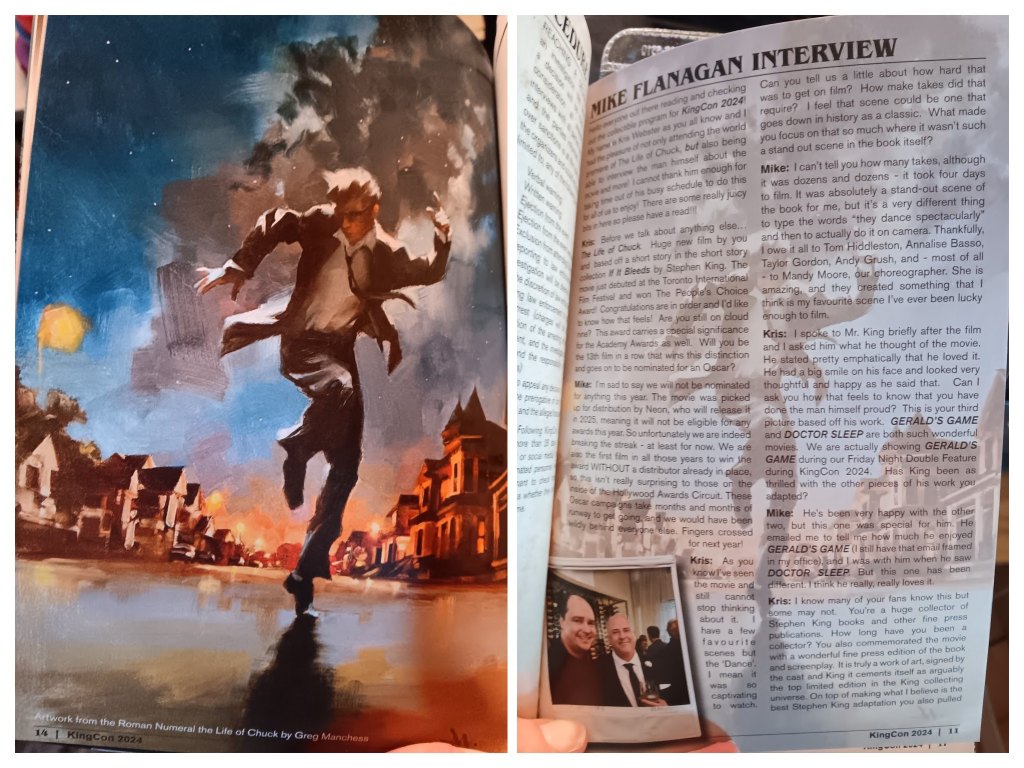
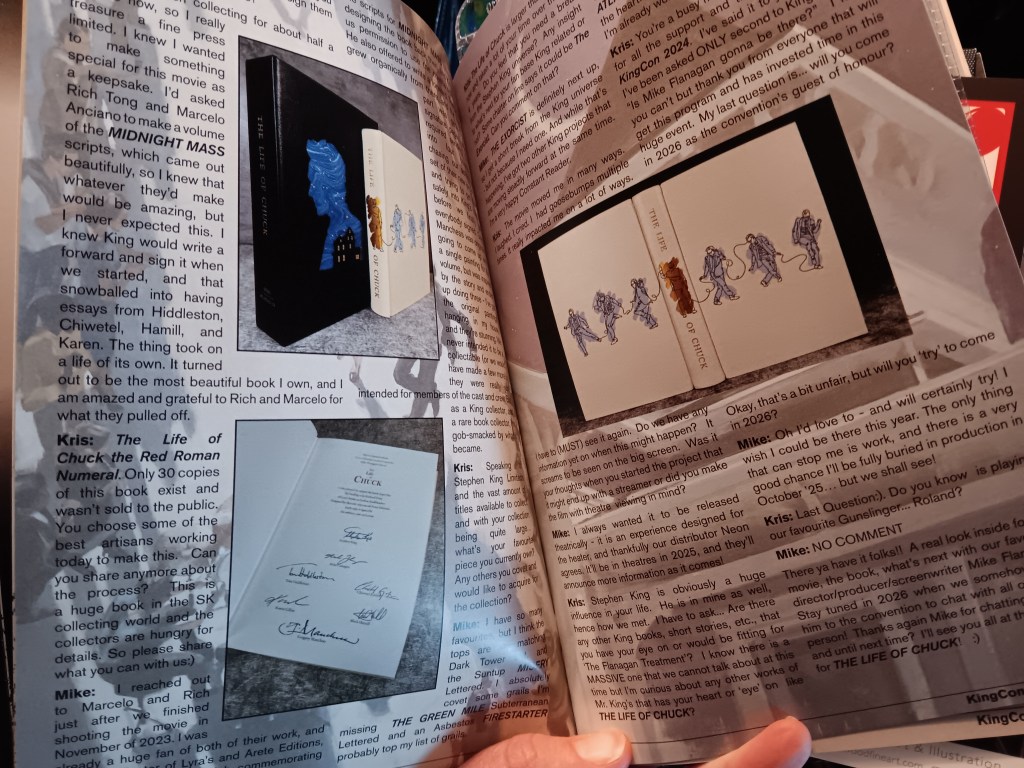
The overall prominence of collecting at the Con is reinforced by its program being designed as collectible (mine is #97), including things like an original short story from one of the horror authors in attendance (“Betrothed” by Philip Fracasi) and an interview with Mike Flanagan that includes a discussion of his collecting (he owns a copy of the aforementioned Lettered edition of Misery) and how he commissioned for The Life of Chuck “a wonderful fine press edition of the book and screenplay” signed by the film’s cast and by King.
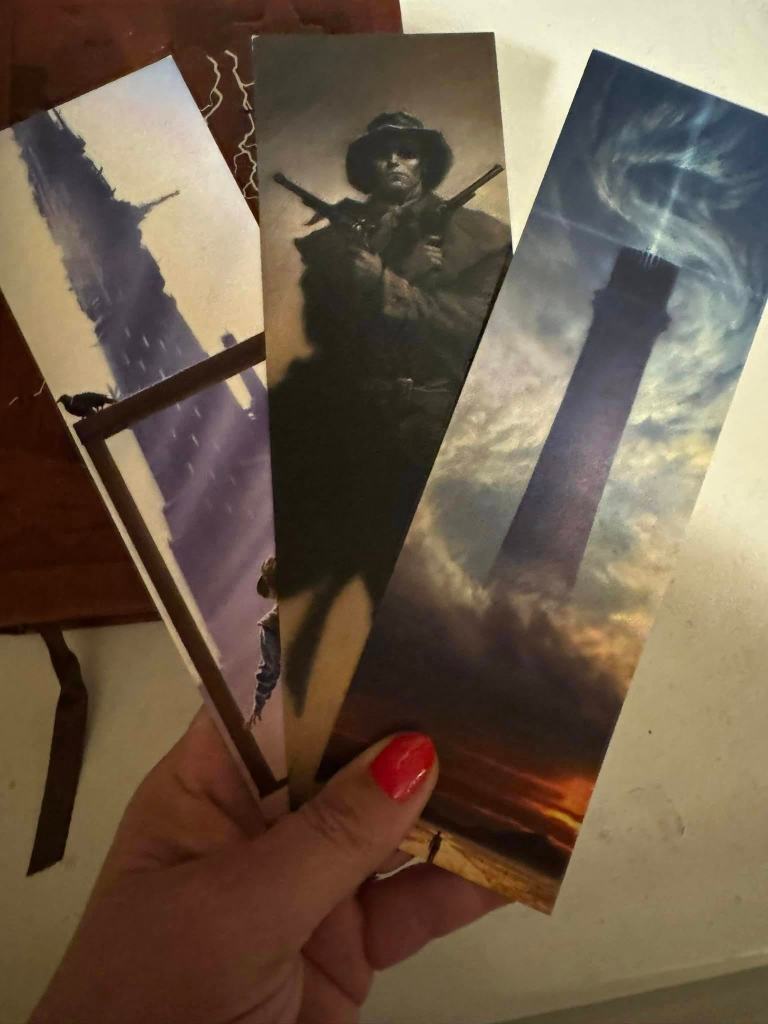
The Con organizers also included a bookmark in each swag bag that was one of a set of three collectible bookmarks with Dark Tower art on them–each bag had three of the same bookmark that you were supposed to try to trade with other attendees to collect all three different ones. This mode of collecting was a clever way to get attendees to interact and thus reinforce the psychological benefits of the face-to-face interaction facilitated by fandom rather than fanship.
Some felt compelled to frame these and other memorabilia they collected, a reminder that another form of play is disPLAY:
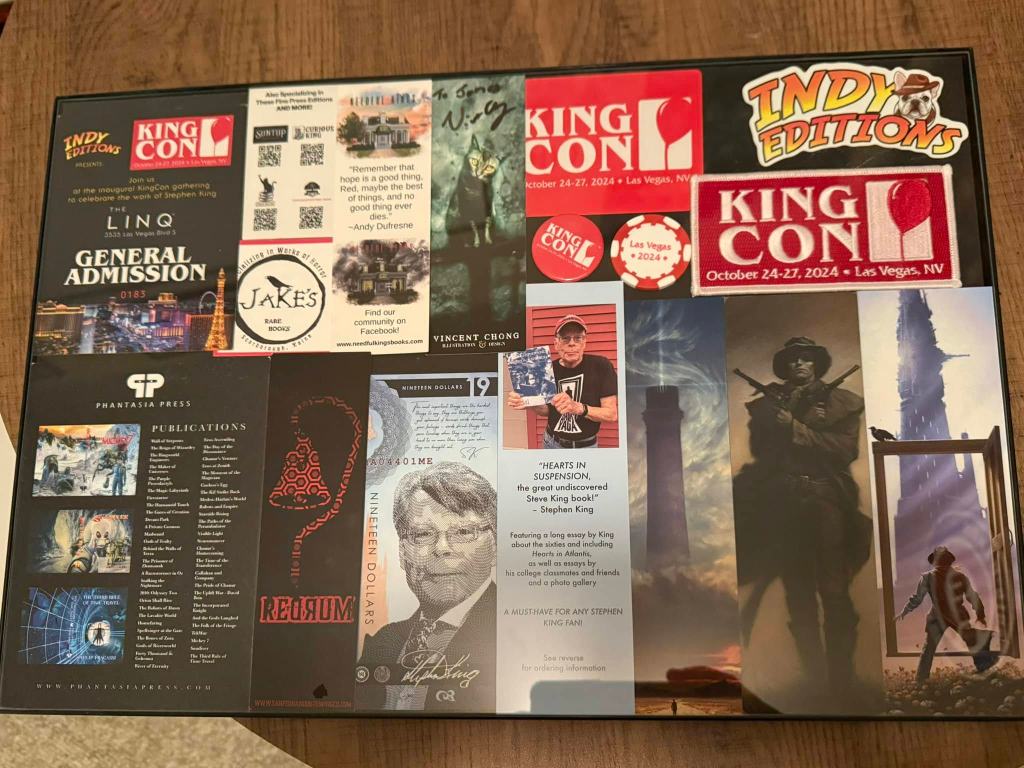
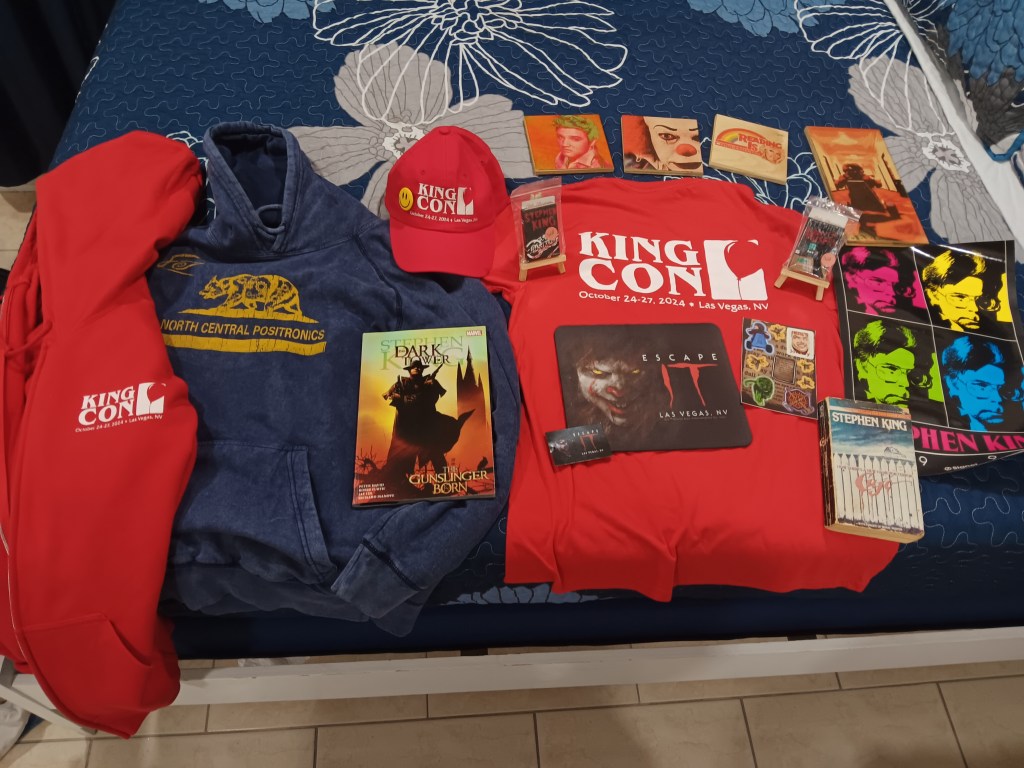
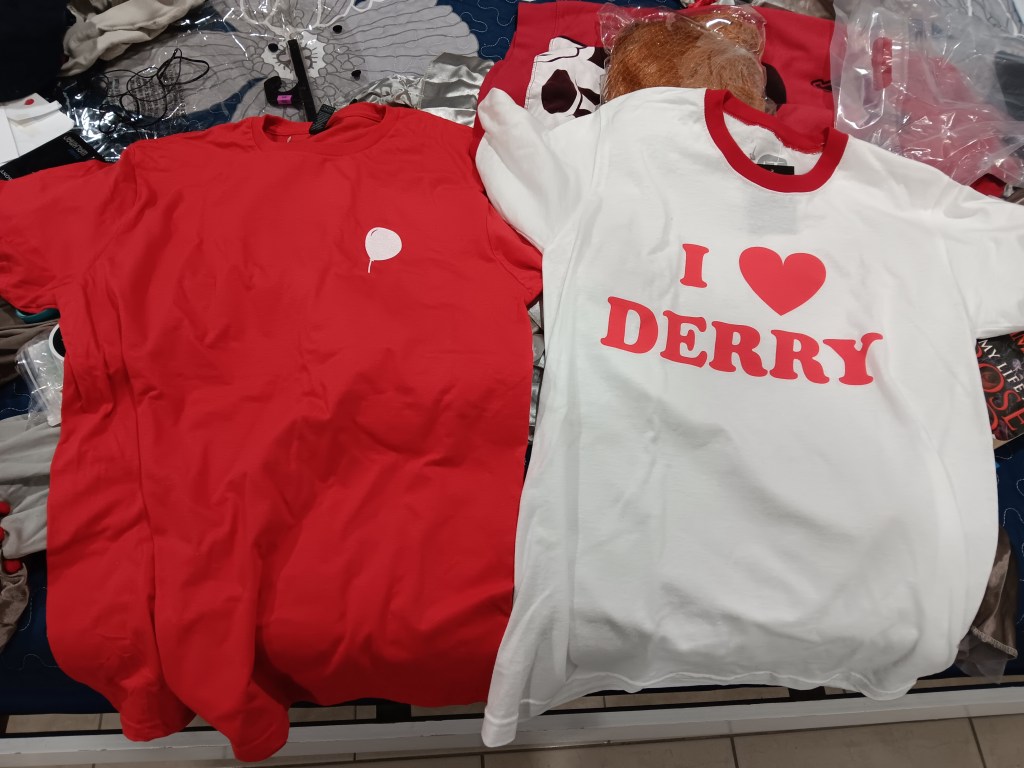
Though it’s not exactly the same as collecting, I am hardly immune to merch and am lucky I didn’t manage to exceed what I could fit in my carry-on suitcase.
Influence

If this section is significantly shorter than the one on collecting, that would be in part because some aspects of influence were covered in the previous post, while also, as noted, collecting was itself a more prominent aspect of the Con overall. Was collecting more prominent at the Con because it was organized by a collector, or does the fact that it was organized by a collector indicate that collecting is a more prominent aspect/characteristic of King fandom generally? Hard to say, but probably collecting is a more prominent feature of fan conventions generally and doesn’t indicate that collecting necessarily outweighs influence in the King fandom. Meaning, KingCon might have attracted the collector niche of the King fandom.

As with the overlap between fan and academic that Henry Jenkins introduced by writing about fandom academically from the inside rather than outside, we’ve seen the overlap between collecting and influence at play by way of Mike Flanagan, who both collects King artifacts and has been significantly influenced by King. As mentioned in the last post, he created a collectible poster for the Con’s screening of Gerald’s Game. That Flanagan, now gaining a fair lead in the race to become the most prominent King adapter, is a collector, and that he created a collectible to distribute at a screening that capped off the influence-themed day, are fitting representations of the overlap between consumption and production in fandom: if you are influenced by someone, you have consumed their content and then produced work affected by that consumption. So while collecting might align with consumption, influence doesn’t align as neatly with production–it’s prosumption. (Also, the premise of The Life of Chuck could allegorize the inner versus outer worlds that transitional/fannish objects are supposed to facilitate the healthy flow between…or maybe even its potential unhealthy aspects if you take into account (SPOILER) that its structure keeps the reader unaware that the setting of the world in the opening section is actually all inside Chuck’s head–an initially indistinguishable blurring of fantasy and reality, the categories that Hills claims fans can distinguish between.)

There’s no question that Flanagan is a King fan, but one doesn’t have to be an avowed fan to be influenced by someone artistically. Does King’s admission “thinking of Flannery O’Connor” at the end of his story “On Slide Inn Road” mean he’s an O’Connor “fan”? Would this story qualify as “fan fiction”? I’ve never seen O’Connor explicitly referenced elsewhere in King’s work, while the frequency of his Lord of the Rings references would seem to indicate his fandom of that. My fiction thesis advisor, Antonya Nelson, not only named one of her story collections Some Fun, quoting a line near the end of O’Connor’s “A Good Man is Hard to Find,” but had a bumper sticker on her car that read “I’d rather be reading Flannery O’Connor.” I’d say that means she’s an O’Connor “fan.” The merch tips the scales.

Another (intentional) indictment of collecting culture in The Collector is the money that it takes–that Lettered Edition cost $4950! And it sold out! It seems like only the Mike Flanagans of the world can afford this hobby.

In my opinion a lot of people who may seem happy now would do what I did or similar things if they had the money and the time. I mean, to give way to what they pretend now they shouldn’t. Power corrupts, a teacher I had always said. And Money is Power.

John Fowles, The Collector (1963).

If power corrupts, King seems relatively uncorrupted, and to have used his powers for good in promoting others, both writers and filmmakers. For the latter, his “Dollar Baby” program ran for decades, where he optioned the rights to his stories for a dollar to budding filmmakers. These short films, specifically not for profit by the program’s terms, are thus hard to find; it was a convention draw that they were playing continuously in one of the Con rooms. There was also a panel of Dollar Babies talking about their experience on the influence day. Unfortunately, the configuration of this matched that of the horror authors’ panel, a configuration influenced by King: a ka-tet quartet of men with one woman.
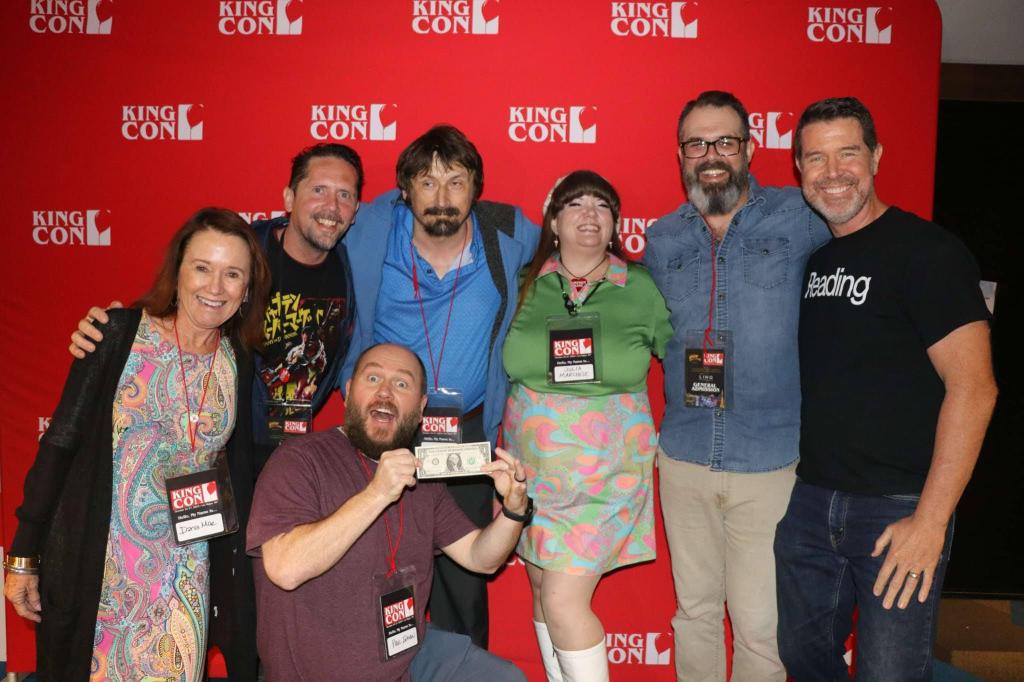
Dollar Babies..two women but only one was on the actual panel, Julia Marchese of The Losers Club podcast (in green).
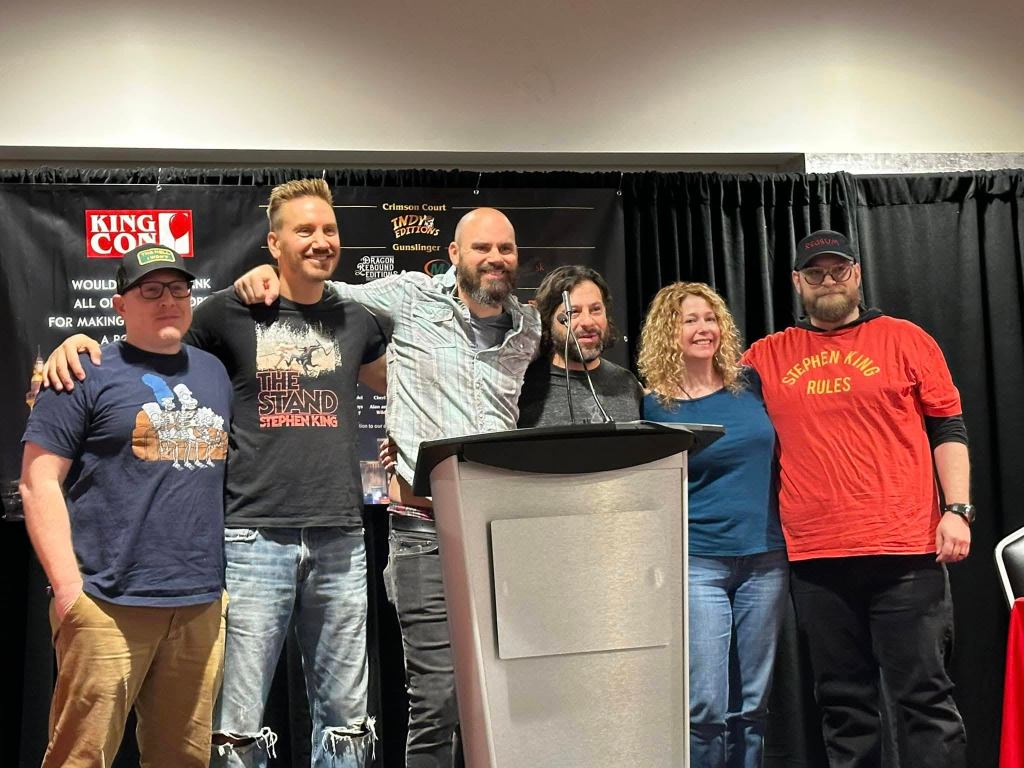
panel of authors influenced by King, two with shirts declaring their King fandom

The author panel was comprised of Philip Fracassi, Jonathan Janz, Ronald Malfi, Rebecca Rowland, and Kalvin Ellis (pictured above in that order, with the panel’s moderator between Janz and Malfi). Rowland mentioned having done a graduate thesis on King’s treatment of women back in the 90s (conclusion: they have to be monsters or victims of men, though she thinks things have improved since then with characters like Holly Gibney). Rowland acknowledged a path forged for female writers by writers like Anne Rice but noted that she didn’t identify with Rice’s work where characters started out magical/supernatural; rather she identified with King’s work because his stories start out grounded in the world of regular everyday people you can relate to. Ronnie had a jaw-dropping moment when he said he’d seen his brother drown when he was four-years-old and he wasn’t able to process that trauma until he read about Bill losing his brother in IT a few years later. Jonathan Janz also mentioned identifying with IT, with being an outcast for his weight as a child like Ben Hanscom. (It went without saying he must have also identified with adult Ben’s unlikely transformation into a career-successful heartthrob–he’s the tall one in The Stand shirt.)

Some of these writers, like Janz, are contributing to the upcoming anthology that must technically be classified as fan fiction, The End of the World As We Know It: Tales of Stephen King’s The Stand. Which might explain why Janz was wearing his The Stand t-shirt. Which, as I told him, I also own. Janz also mentioned being a creative writing teacher and not imposing word-count limits on his students’ work, a point that came up in my fiction workshop with my students this semester, providing my second jumping-off point for conversation with him.
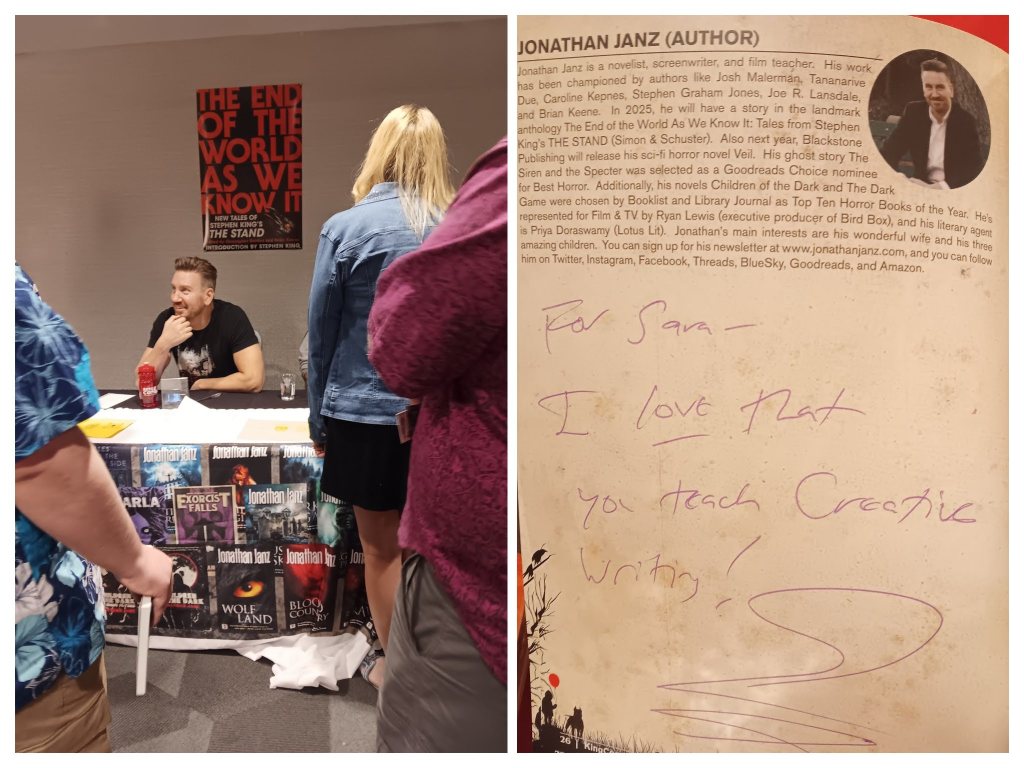
Janz’s table in the vendor room where he sold and signed

To make up for the Thomas Jane Q&A that was supposed to be on the first (collecting) day but got cancelled when Jane had to leave suddenly, the organizers set up an interview with Kingcast host Eric Vespe, though this ended up happening on the following (influence) day during what was originally slotted for a break, because when the organizers tried to call Vespe the day before to make Jane’s time slot, he was still asleep after staying up late to post the interview he’d done with Jane the first night to the Kingcast Patreon. This shuffling again speaks to how aspects of the King fandom don’t fit neatly into the collecting/influence categories.

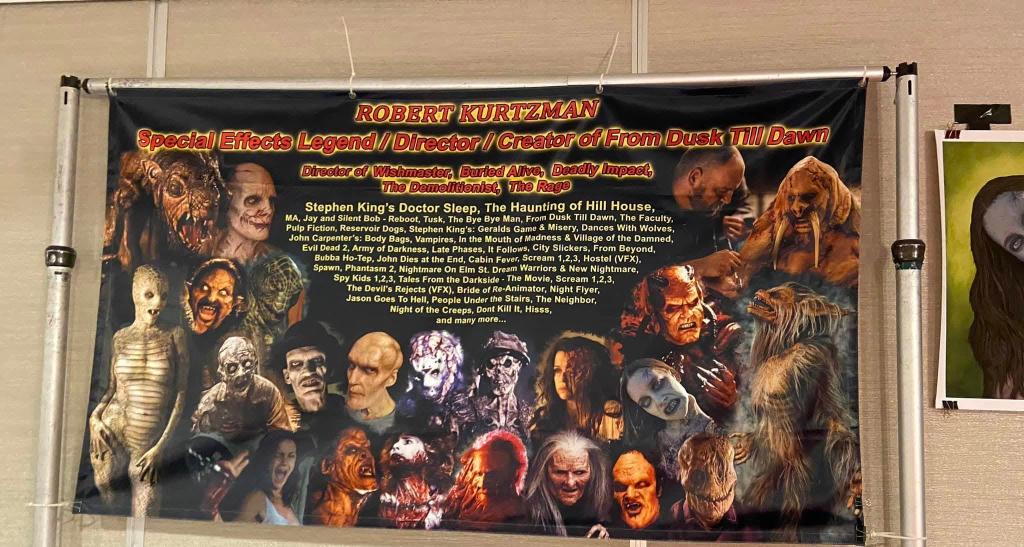
The other talks on the Influence day, which I missed to go visit antique stores in Vegas’s arts district, were a Q&A with Mick Garris and then with Robert Kurtzman, a special effects…specialist.
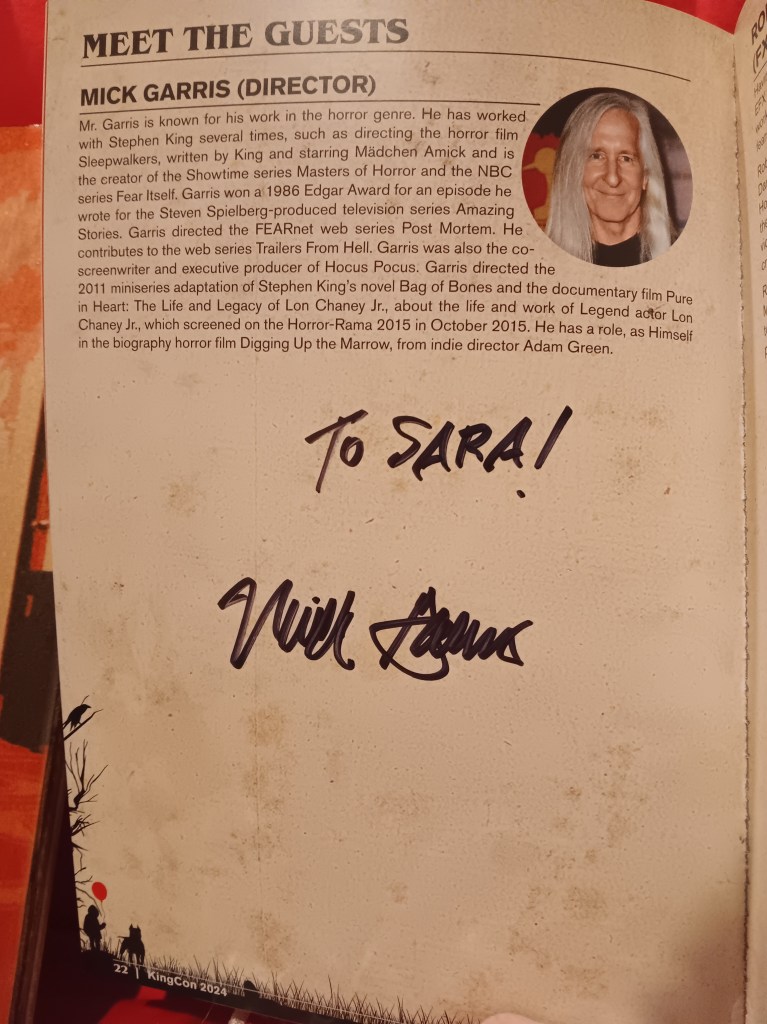
Garris might have been the biggest name at the Con, but I felt okay about missing his talk since I’d already heard an interview he’d done with the Kingcast. But, after standing in line behind some women getting him to sign their Sleepwalkers and Shining miniseries DVD cases, I did get his autograph:
When I came back from the arts district to meet with Vespe and the Kingcast group again for dinner, they were standing around talking to Garris, and told me afterward that he mentioned in his panel that his next King adaptation project is supposed to be “Fair Extension” (a novella alongside “A Good Marriage” in Full Dark No Stars [2010]).

At the end of the day, King is a prodigious producer of content precisely because he is a prodigious consumer; as I’ve quoted before in the post here,

“The King men seem able not only to read and write and allude faster than the rest of us — they seem to watch TV faster, listen to music faster, to defy the physics of consumption,” says Joshua Ferris, a novelist and close friend of Owen [King]’s. 

Susan Dominus, “Stephen King’s Family Business,” July 31, 2013.

King is a collector of culture, both pop and literary–which is itself another fluid binary, with King as its biggest conduit.

-SCR

The Running Man’s Dark Tower: A Park of Themes

I’m just sitting here watching the wheels go round and round
I really love to watch them roll
No longer riding on the merry-go-round

John Lennon and Yoko Ono, “Watching the Wheels,” 1980.

I have always tried to live in an ivory tower, but a tide of shit is beating at its walls, threatening to undermine it.

Julian Barnes, Flaubert’s Parrot, 1984.

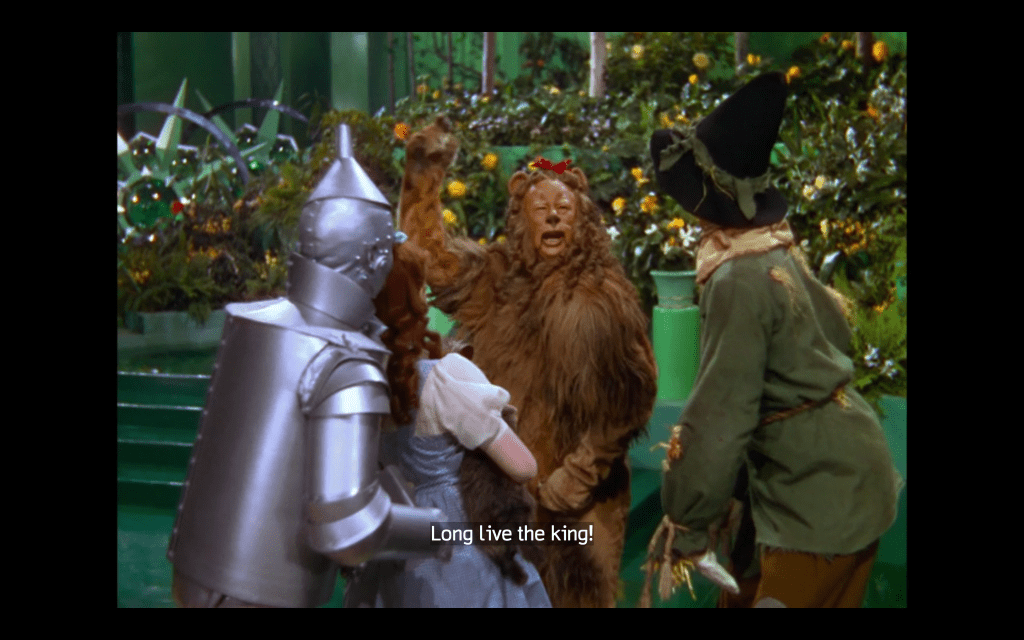
“—and there was this crazy remake called The Wiz, starring black people—”

“Really?” Susannah asked. She looked bemused. “What a peculiar concept.”

“—but the only one that really matters is the first one, I think,” Jake finished.

Stephen King, Wizard and Glass, 1997.

King’s Verse

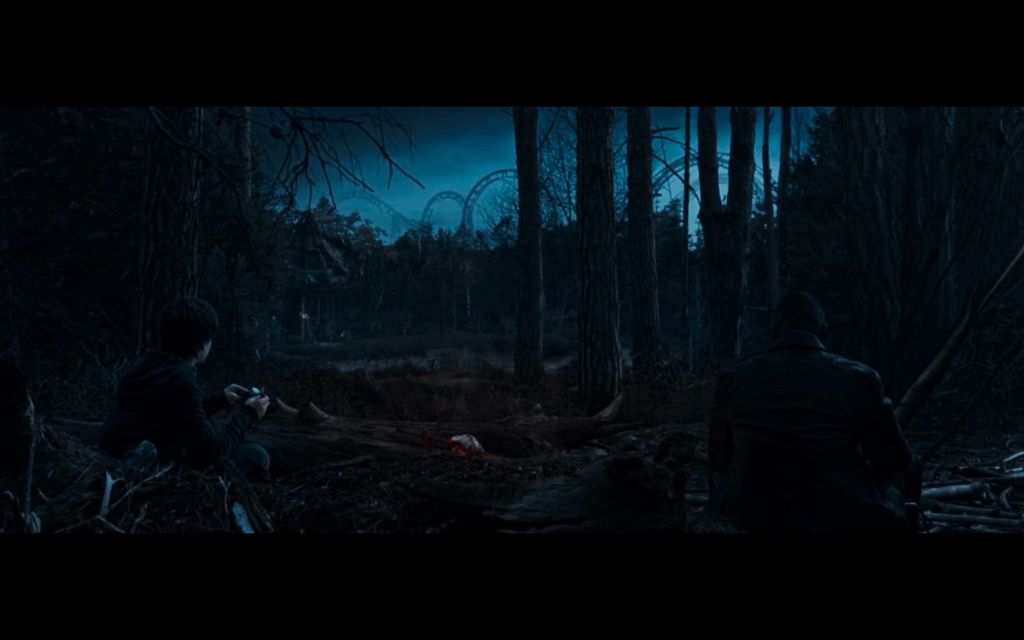
The opening credits of the Netflix series Cheer uses the song “Welcome to My World”; this initially aired in January of 2020, around the same time I started this project, for which this would have been an equally appropriate theme song. In a recent post, I discussed how King hints at the cosmology of his sprawling Dark Tower series with the Beatles’ song “Hey Jude”: when this song is part of an environment that feels like it’s supposed to be the 1800s, we realize something is off–this can’t really be the 1800s, and Roland the Gunslinger’s old-west world is actually in a future far ahead of our time: “Hey Jude” welcomes us into what turns out to be a world of worlds. In the film The Dark Tower from 2017, starring Idris Elba as Roland and Matthew McConaughey as Walter, aka the man in black, a different cue is used to hint at this cosmology (possibly due to the difficulty of obtaining Beatles’ rights?):

The Dark Tower (2017)

Jake: You have theme parks here. 

Roland: These ancient structures are from before the world moved on. No one knows what they are. 

Jake: [pause] They’re theme parks.

From The Dark Tower (2017).

I was initially reluctant to watch this movie, thinking it would have spoilers for the rest of the series, but after hearing the Kingcast hosts repeatedly trash it, with one noting that he’d reread the series before seeing the movie and doing so had turned out to be “pointless,” I couldn’t resist. The theme park exchange was of particular interest because I had of late been thinking that my ideal job, a more elaborate version of hosting a podcast on King, would be to work at a King theme park: King World. I had started to think this because of certain passages in a) Carrie, b) The Green Mile, and c) Misery.

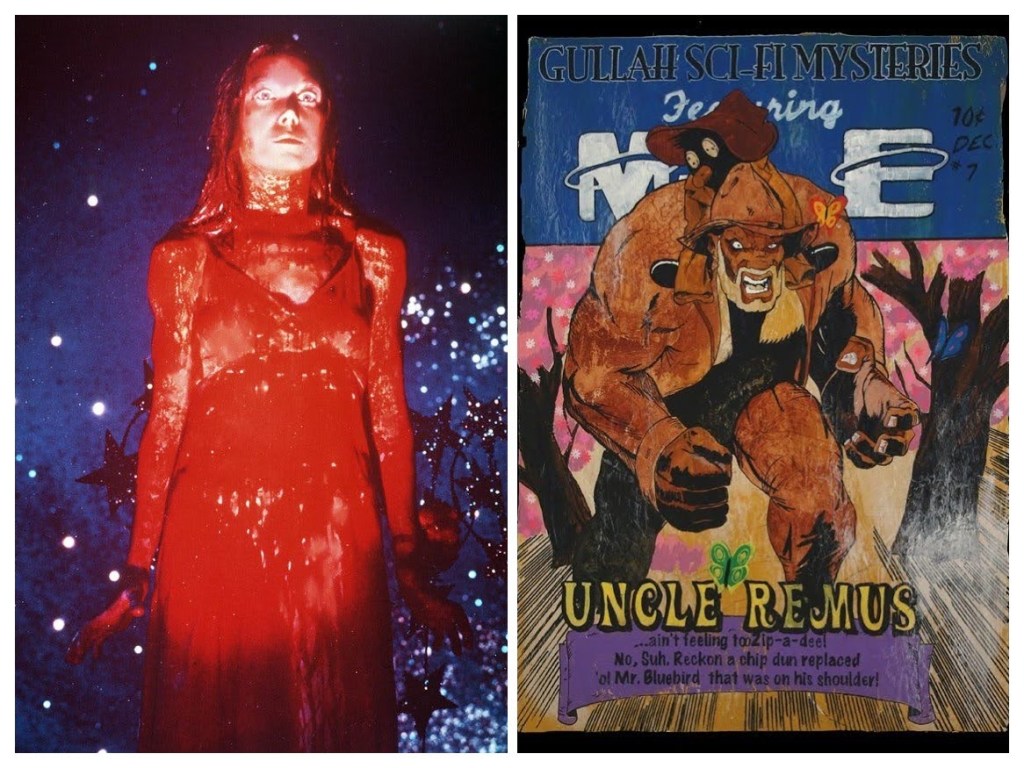
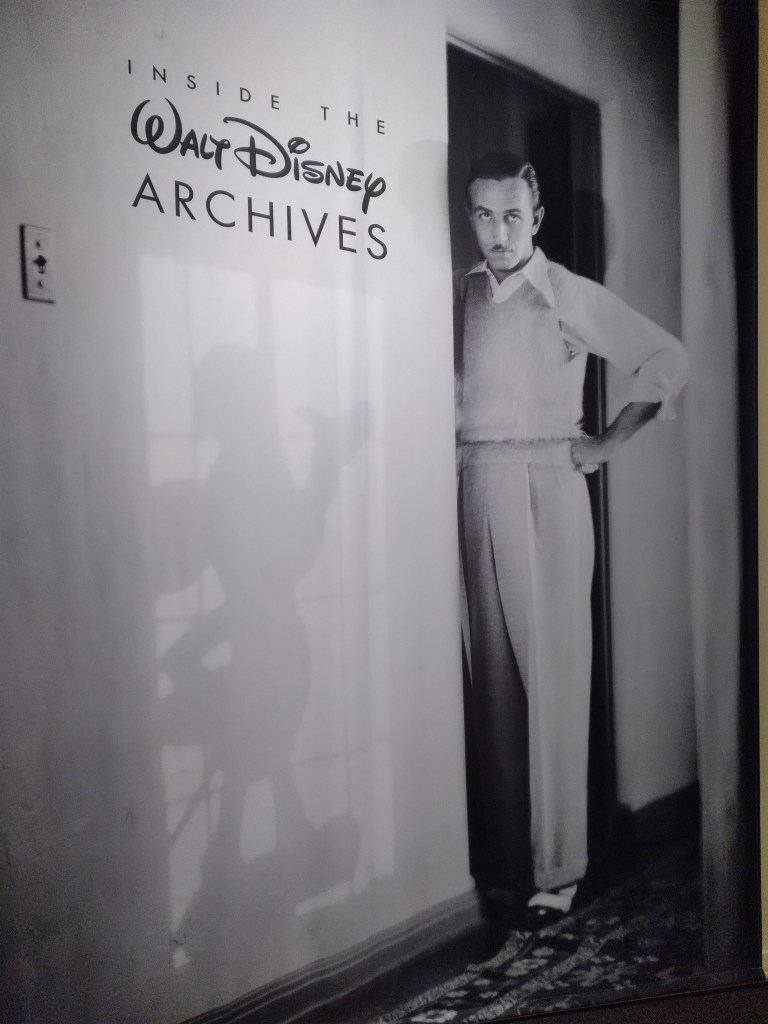
a) I’m writing a paper for an academic conference on the invocation of Disney in the critical moment in Carrie (1974) when Carrie is triggered to unleash holy hell after the blood dumps on her, hell she specifically unleashes not because of the blood itself, but because everyone starts laughing at her. The character Norma, whose perspective we initially see this moment in, explains why everyone starts laughing:

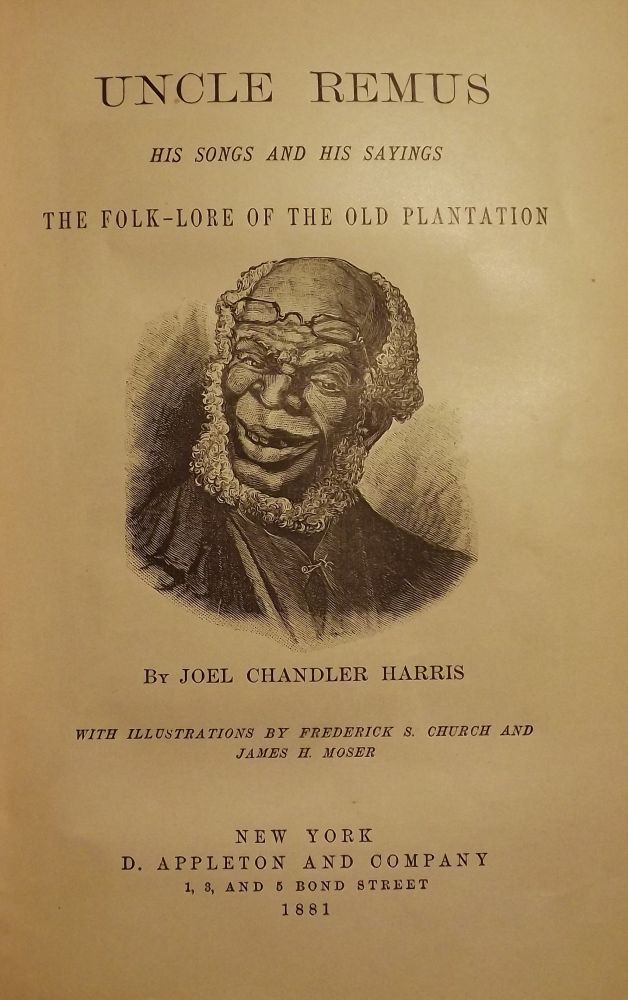
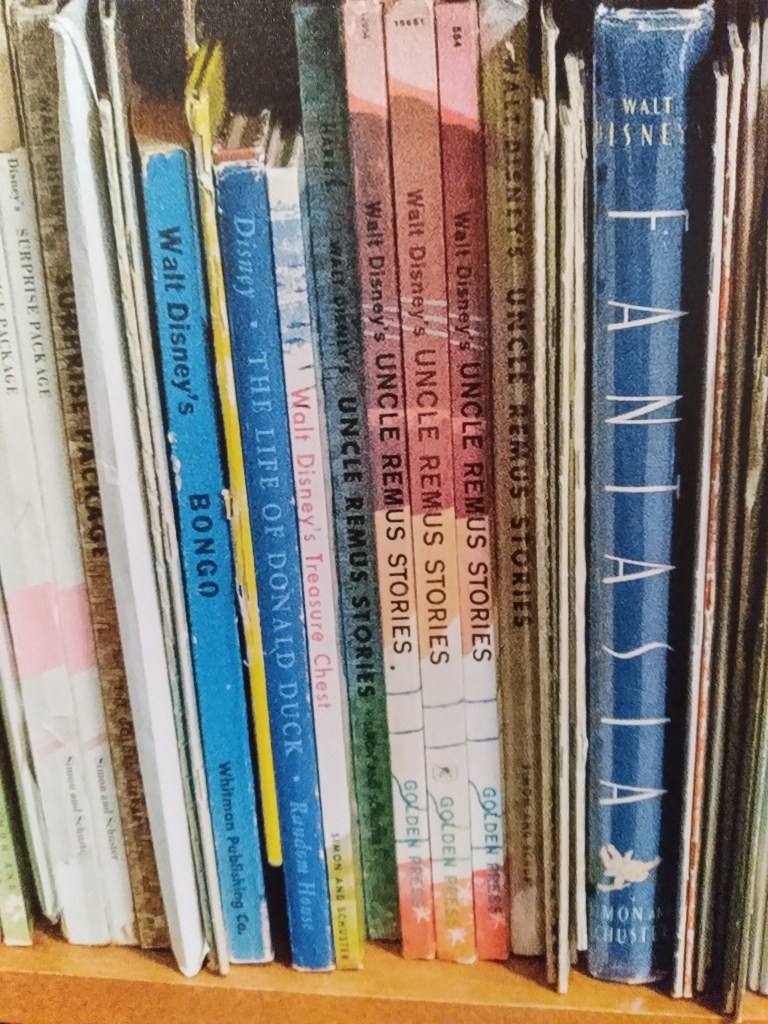
When I was a little girl I had a Walt Disney storybook called Song of the South, and it had that Uncle Remus story about the tarbaby in it. There was a picture of the tarbaby sitting in the middle of the road, looking like one of those old-time Negro minstrels with the blackface and great big white eyes. When Carrie opened her eyes it was like that. They were the only part of her that wasn’t completely red. And the light had gotten in them and made them glassy. God help me, but she looked for all the world like Eddie Cantor doing that pop-eyed act of his.

Stephen King. Carrie. 1974.

(If you need further evidence of how important the horrific function of laughter/humor is in this particular text and through it the importance of this function throughout King’s canon, one of the handful of iconic lines of dialog from King film adaptations that the Kingcast opens each episode with is Piper-Laurie-as-Margaret-White’s “They’re all gonna laugh at you!”)

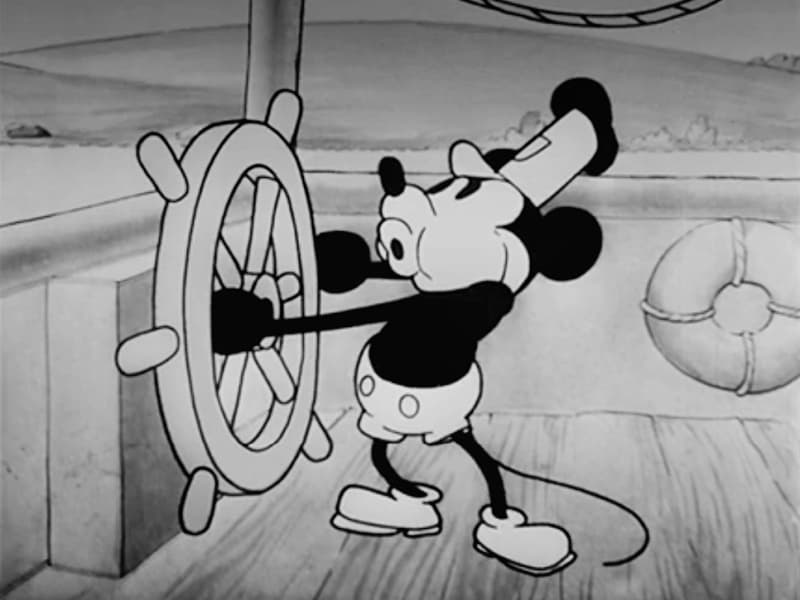
b) The influence of Walt Disney and his worlds is also prominently on display throughout King’s The Green Mile (1996), in which a pet mouse is initially named “Steamboat Willie” (the novel’s primary timeline is set only a couple of years after the initial Disney “Steamboat Willie” cartoon was released in 1928). One character convinces an inmate about to be put to death that they will send his pet mouse to “Mouseville”:

“What dis Mouseville?” Del asked, now frantic to know.

“A tourist attraction, like I told you,” Brutal said. “There’s, oh I dunno, a hundred or so mice there. Wouldn’t you say, Paul?”

“More like a hundred and fifty these days,” I said. “It’s a big success. I understand they’re thinking of opening one out in California and calling it Mouseville West, that’s how much business is booming. Trained mice are the coming thing with the smart set, I guess—I don’t understand it, myself.”

Del sat with the colored spool in his hand, looking at us, his own situation forgotten for the time being.
“They only take the smartest mice,” Brutal cautioned, “the ones that can do tricks.”

Stephen King. The Green Mile: The Complete Serial Novel. 1996.

This mouse is pivotal to the plot the way one could argue Disney has been to American pop culture…and the way the “Mouseville” story is fabricated to make Del feel better replicates Disney’s manipulation of fairy tales to change the grimmer aspects of their life lessons into hollow happy endings.

Further, how this manipulation ends up backfiring when Del finds out the truth then replicates how these hollow happy endings sow seeds of discontent with our own lives when they don’t work out so perfectly that drive us further into the cycle of consumption/destruction…

c) In Misery (1987), the main character, novelist Paul Sheldon, has created a popular romance series around the character of Misery Chastain:

He remembered getting two letters suggesting Misery theme parks, on the order of Disney World or Great Adventure. One of these letters had included a crude blueprint.

Stephen King. Misery. 1987.

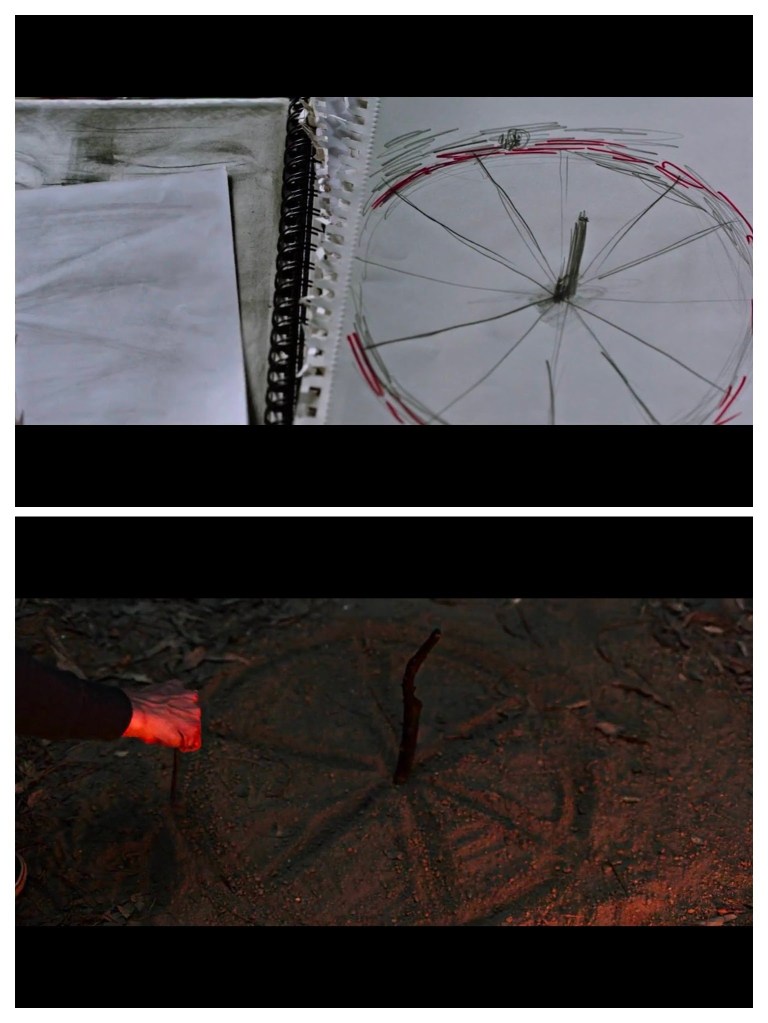
As I teach an elective on “world-building” this semester, I am especially attuned to the mechanics of “otherworldly” cosmologies. The Dark Tower movie–which I fully concur with the Kingcast hosts is generally terrible–offers a strange distillation of the series’ cosmology that did help me wrap my mind around it in new ways. Notably, just after Jake and Roland’s “theme park” exchange in the film, their conversation addresses the cosmology of the world of worlds even more directly (some might say, heavy-handedly). Before Jake crosses into Roland’s world through a portal, he has been drawing pictures, one of which he draws again for Roland in the sand:

The Dark Tower, 2017.

Jake: I just don’t know what this is. 

Roland: It’s a map. My father showed me a map like this once. Inside the circle is your world, and my world, and many others. No one knows how many. The Dark Tower stands at the center of all things, and it’s stood there from the beginning of time. And it sends out powerful energy that protects the universe, shields us from what’s outside it. …

Jake: What’s outside the universe?

Roland: Outside is endless darkness full of demons trying to get to us. Forces want to tear down the tower and let them in.

From The Dark Tower, 2017.

For emphasis, Roland picks up a tarantula and drops it outside the circle and they both watch it crawl in.

I know things I shouldn’t if I only knew the content of the first four books of the series that I’ve actually read: that Father Callahan from ‘Salem’s Lot is going to play a role at some point, that there’s going to be some kind of meta-reference to King himself as a character/entity. And of course Randall Flagg has made a brief appearance at the end of Book 3, with the superflu-apocalypse that occurred in The Stand invoked in Book 4, and Flagg makes cameos that are a bit more developed, though still fleeting, in Book 4. These intertextual references in conjunction with the distilled Dark Tower map contributed to a sort of Dark-Tower epiphany: its structure replicates the King canon itself, with the godhead of King-the-author at its epicenter–everything revolves around him, as he necessarily produces it. I was considering this right before reading King’s afterword to Book 4’s Wizard and Glass (1997), in which King notes:

I am coming to understand that Roland’s world (or worlds) actually contains all the others of my making; there is a place in Mid-World for Randall Flagg, Ralph Roberts, the wandering boys from The Eyes of the Dragon, even Father Callahan, the damned priest from ’Salem’s Lot, who rode out of New England on a Greyhound Bus and wound up dwelling on the border of a terrible Mid-World land called Thunderclap. This seems to be where they all finish up, and why not? Mid-World was here first, before all of them, dreaming under the blue gaze of Roland’s bombardier eyes.

Stephen King, Wizard and Glass. 1997.

Every spoke in this wheel is a different world is a different work of King’s, the cyclical nature I suppose in this sense excusing/justifying as cosmically significant the echoes across King’s many, many plots that are essentially the same thing happening over and over.

But these spokes are more than just works King has written himself (and probably far more numerous than on Jake’s rudimentary renderings, to the point where individual spokes might not even be discernible if these were “to scale”…). They’re also the works that influenced him, whose range across the pop-culture-literary-canon spectrum amount to King’s “secret sauce,” as discussed in the initial Dark Tower post on Book 1’s The Gunslinger. This goes back to what could be the most influential text on King, Lord of the Rings, but via Dracula, as King clarifies in his afterword to ‘Salem’s Lot:

When I discovered J. R. R. Tolkien’s Rings trilogy ten years later, I thought, “Shit, this is just a slightly sunnier version of Stoker’s Dracula, with Frodo playing Jonathan Harker, Gandalf playing Abraham Van Helsing, and Sauron playing the Count himself.”

Stephen King. ‘Salem’s Lot. 1975.

So it seems appropriate that a ‘Salem’s Lot character specifically will be returning… The above passage would seem to be a critical insight of King’s about the utility of telling the same story over and over, that the “secret sauce” is taking and using a template that’s worked for generations, specifically the “ka-tet” or “fellowship” narrative, which, with Dark Tower book 4’s Wizard and Glass, King also yokes The Wizard of Oz into the lineage of…

The Wizard of Oz (1939)

The king lives long through the continued passing down of the same narrative… King’s multiverse is a metaverse, I thought. Then I remembered that was what Facebook has renamed itself and/or its conglomerate of companies, and I shuddered.

From here.

Run, Forrest

My comprehension of King’s meta-multiverse was also facilitated by a particular Kingcast episode with guest Marc Bernardin, who chose to discuss The Running Man. Bernardin was one of the Hulu series Castle Rock writers, the show that leans on the “connective tissue” of Kingverse cosmology but introduces original characters and storylines to it; Bernardin articulated the general template of a King plot:

Stephen King is the great unheralded American writer, you know, nobody gives him credit for being the character writer that he is. I mean they always give him credit for the horror stuff, they always give him credit for the boo stuff, but when you look at Stephen King books, for the most part, they’re not mysteries. They are: here’s a bunch of people, and we’re going to introduce you to their lives, and then a bad thing is going to crash into their lives, and what do they do about it. And in order to make stories like that function, you need to build those lives of those characters so that we understand them, we can empathize with them, and know who they are, so when that giant mack truck of supernatural awfulness blindsides their lives, we know who they are and can respond to it.

From here.

Bernardin’s work on Castle Rock prompted the hosts to ask about his thoughts on the Dark Tower series, and I appreciated his response that he “appreciated” it more than he liked it. When they finally got to The Running Man, Bernardin had a reading of it that blew my mind: since its protagonist Ben Richards is essentially from the “projects,” Bernardin likes to think that Ben Richards is Black.

I was initially resistant to this reading, largely because I thought it gave King too much credit. There is much textual evidence to refute the idea that King intended to write a Black protagonist here, mainly through the characters that are identified and described as Black (such as the villainous Killian) in a way that seems to distinguish them from the point of view describing them–Richards’ (and in a way that’s often blatantly racist from Richards’ perspective). It is also Killian, CEO of the network airing The Running Man game show, being explicitly Black that made me resistant to reading Richards as Black–if the narrative were an allegory for the oppression and exploitation of Black Americans, why would a Black character be at the helm of the exploitative vehicle? (Then, of course, there are also the book covers that depict Richards with an illustration of a white man.)

I couldn’t really tell if Bernardin was saying he thought King had intentionally written Richards as Black or if he himself just liked to read it that way, though I guess his calling out King’s “blind spot” when it came to writing race should have been a clue it was the latter:

…maybe it’s because i’m interpreting things in the text that aren’t there, but in my interpretation of Ben Richards as an African American, one of the things I discovered on Castle Rock doing a deep dive there is that one of Stephen King’s big blind spots is writing race–and, and, it’s either magical negro, or magical negro, and that’s kind of it. 

From here.

When I Googled Bernardin and learned that he is Black, his reading made more sense as a reclamation reading, not a literal one. To my mind, a white guy reading Richards as Black would amount to more of a white apologist reading.

As a consequence of the suffering that protagonists experience at the hands of a state-corporate nexus that does not adequately address the rehabilitative needs of citizens, Bachman’s books articulate a politics of pure negation (a modality that plays a vital role in the decades to come) by tracking ‘protagonists who are sociologically so tightly determined and whose free will is so limited that they find violence and self-destruction as their only means to take a stand’ (Strengell 218).

Blouin, Michael J.. Stephen King and American Politics (Horror Studies) (p. 45). University of Wales Press. Kindle Edition.

That quote from Heidi Strengell could be read, via Bernardin, as describing the state of Black people in the American state specifically, as you could define white privilege as not being “sociologically so tightly determined” that your free will is necessarily diminished, and this strikes me as another way of framing my reading of the Bachman novels as deriving their horror from playing out a white male protagonist essentially being treated as a Black person (ultimately in a way that’s condescending toward Black people rather than creating sympathy with their plight).

In the world-building elective I’m teaching, theme parks have become a prominent…theme, since they constitute literal world-building, the construction of an immersive experience. And of course there’s one theme park to rule them all, the one King invokes in all of the above references to Carrie, The Green Mile, and Misery.

The academic Jason Sperb, focusing on Disney’s “most notorious film,” Song of the South (1946)–significantly, the one that Norma invokes in the critical Carrie moment–notes:

One of the main critiques often leveled at the Disney empire for decades has been its distortion of history.45 Disney’s romanticized view of its own past, as the self-appointed king of the golden age of Hollywood, is one thing. Yet more disturbing is its rewriting of American history in general. … Disney’s fondness for rewriting American history, often to the benefit of white, middle-class consumers, came to a head in the 1990s, when cultural critics, historians, and political activists successfully pressured the company to abandon plans for a history-themed amusement park in Virginia, to be called “Disney’s America.” In questionable taste, this endeavor would have awkwardly mixed Disney’s own idealization and whitewashing of history with the uglier history of the surrounding areas, which feature countless institutionalized reminders of the country’s violent colonial and Civil War legacies.

Jason Sperb, Disney’s Most Notorious Film: Race, Convergence, and the Hidden Histories of Song of the South. 2012.

A short story by fiction writer George Saunders, “CivilWarLand in Bad Decline,” helps illuminate this legacy, and in the specific context of “Disney’s America”‘s take on it. The first-person narrator of this story works at a theme park recreating the Civil War, working as a “verisimilitude inspector” with a “Historical Reconstruction Associate.” This would seem like a wacky enough premise on its own (potentially) when a gang of teen vandals starts wreaking havoc and the park becomes a site of violence in its own right rather than just re-enacting it, but then literal ghosts appear in the story to play a pivotal role as well. It’s really the final line of this story that emphasizes the true nature of this Civil-War legacy as the first-person narrator is killed by the ghost of a boy named Sam:

I see the man I could have been, and the man I was, and then everything is bright and new and keen with love and I sweep through Sam’s body, trying to change him, trying so hard, and feeling only hate and hate, solid as stone.

George Saunders. “CivilWarLand in Bad Decline.” 1992. 

Contrast this ending with another one of Saunders’, almost thirty years later:

From across the woods, as if by common accord, birds left their trees and darted upward. I joined them, flew among them, they did not recognize me as something apart from them, and I was happy, so happy, because for the first time in years, and forevermore, I had not killed, and never would.

George Saunders. “Escape from Spiderhead.” 2010. 

In the final lines of both of these stories, the same literal thing is happening: a white-male first-person narrator is dying and in so doing reflecting on his life. But the latter seems to transcend the hate of the (American) human condition, while the former is consumed by it. (I had to wonder if Saunders’ professional success in the intervening decades has softened his worldview, since the earlier story would have been written when he was still essentially an impoverished failure.)

Saunders’ introduction of the fantasy/supernatural element of ghosts in “CivilWarLand” is appropriate for the story’s figurative (and Kingian) theme: that we are haunted by the ghosts of our past. The legacy of America’s collective haunting is a major thematic preoccupation for Saunders, as realized in his long-anticipated first novel Lincoln in the Bardo (2017). Saunders has described his inspiration for this novel (which, also in a classic Kingian vein, revolves around a father-son narrative) essentially being an image of the Lincoln Memorial crossed with Michaelangelo’s La Pietà. This might not be surprising when you consider the final line of “CivilWarLand” with the comparison of hate being “solid as stone” connecting to another major fixture of the Civil War legacy: monuments.

This manifestation of a legacy extends beyond Civil-War-related Confederate monuments; my alma mater Rice University has recently convened “task forces” to address what should be done with a memorial of the school’s founder, William Marsh Rice, a slaveowner. This memorial statue has always been prominently positioned at the center of the main quad on campus, and the decision has been made not to get rid of it entirely, but to move it elsewhere. It’s still a part of our school’s history that should not just be erased, but it should no longer be positioned at the center of our school’s historical narrative.

From here.

This idea of narrative (re)centering reminded me of another running man, one from a classic movie that positioned a particular figure (played by America’s “dad” and/or “everyman” Tom Hanks) at the nexus of several American historical narratives, from Elvis’s signature dance moves (which it should be noted he took from Black people, not a little white boy) to Nixon’s impeachment. I recalled how this other running man got his name:

When I was a baby, Mama named me after the great Civil War hero General Nathan Bedford Forrest. She said we was related to him in some way. What he did was he started up this club called the Ku Klux Klan. They’d all dress up in their robes and their bed sheets and act like a bunch of ghosts or spooks or something. They’d even put bed sheets on their horses and ride around. And anyway, that’s how I got my name, Forrest Gump. Mama said the Forrest part was to remind me that sometimes we all do things that, well, just don’t make no sense.

Forrest Gump, 1994 (here).

This explanation would seem to render this Civil War General’s legacy as excusable, innocuous and justified…and putting this figure named after Forrest at the center of these classic American historical narratives would seem to symbolize the prominence of Forrest and his legacy to our current state–albeit inadvertently.

King’s plots often purport to promote the idea that we can only heal by facing our history, but these narratives seem to reinforce a theme that we’re still running away from it.

Whitewashing

Sperb accuses Disney of “the whitewashing of history,” using a term I had thought of before reading it in his work, specifically when I recently visited a “Walt Disney Archives” exhibit held at the Graceland Exhibition Center in Memphis (Graceland as in Elvis Presley’s Graceland, which now has enough appendages–such as this exhibition center–to qualify as its own theme park). I was visiting these archives specifically for any possible Song of the South materials because of the Carrie reference–but there were none.

If you want to talk about a model for a metaverse–i.e., interconnected narratives within narratives within narratives–then Song of the South is a solid one–“solid as stone,” you might say. Like many (most?) Disney movies, the story for this one is not original but was taken from elsewhere–from the “Uncle Remus” stories by Joel Chandler Harris, a white man who took folklore he overheard enslaved people sharing with one another on a Georgia plantation and then transcribed into books with his own name on them as author.

From here.

Harris tells tales of the “Uncle Remus” character–whose title might recall another infamous racially charged avuncular fictional fixture, Uncle Tom–telling tales. As visible on the title page above, these are not designated as his “stories,” but rather “his songs and his sayings.” The “songs” aspect–emphasized in the Disney adaptation’s appellation SONG of the South–underscores how this narrative replicates the role of the cultural appropriation of music in American history (which I’ve discussed in relation to King’s The Stand here and here), with all of American music tracing back to the white appropriation of Black songs from the plantations, manifest initially in the blackface minstrel performances in which white performers, following the example of Stephen Foster, were performing a version of “imagined blackness.”

Now we put up white draperies and pipe in Stephen Foster and provide at no charge a list of preachers of various denominations.

George Saunders. “CivilWarLand in Bad Decline.” 1992. 

The framing device of the Remus narrator offers another version of a performance of imagined blackness: “Joel Chandler Harris’s jolly slave, the eponymous minstrel-like narrator of several collections of African American folklore…the Remus re-popularized by Disney with Mr. Bluebird on his shoulder” (emphasis mine), as Kurt Mueller puts it in a 2010 issue of Gulf Coast discussing the recasting of this character by Houston-based artist Dawolu Jabari Anderson–specifically, as the “Avenging Uncle Remus”:

The Carrie trigger moment as described by Norma explicitly links Remus to musical minstrel performance by comparing Carrie to the “tarbaby” Remus describes in the Disney story and then by comparing that tarbaby image to “those old-time Negro minstrels with the blackface,” emphasizing this minstrel connection further via the real-life minstrel performer Eddie Cantor (whose Wikipedia page only designates as such implicitly by including him in the “Blackface minstrel performers” category).

This function of Remus is also essentially a figurative iteration of the magical Black man: his magic is to impart wisdom and life lessons in an innocuous way, a depiction of Black man that’s both nonthreatening and subservient–and ultimately dehumanizing. Remus’s tales centering around anthropomorphized animals is another iteration of Remus’s dehumanization, illuminating his function as a figure that purports to be human without being fully so, a facsimile of a human that’s necessarily less than human (and thus justifiably enslavable by actual humans). Disney ends up emphasizing this dehumanizing aspect even more by having the actor who plays Uncle Remus, James Baskett, voice more than one of the cartoon animals in Remus’s tales. Baskett also voiced the “Jim Crow” crow in Dumbo (1941), and he has the distinction of being the first person hired to act live for a Disney film, but this fact that is often presented as a “distinction” turns out to reinforce the film’s dehumanization of Black people through the Remus character–he is literally positioned on screen next to cartoons, a parallel that creates the impression, however subconscious, that this figure is also essentially a cartoon.

Though maybe you could try to argue that this cartoon-rendering of Remus could help us read the dialect of his dialog as cartoonish, i.e., unrealistic:

Remus: Dishyer’s de only home I knows. Was goin’ ter whitewash de walls, too, but not now. Time done run out.

Song of the South, 1946 (here).

In the second room of this Gracleand Walt Disney Archives exhibit, which according to the copy was a replication of the archives kept at the official studios in Burbank, CA, the far wall appeared to be covered by a floor-to-ceiling bookshelf that turned out to only a picture of same:

A picture of a picture of a wall of books…ceci n’est pas une…books.

Via the “‘s” visible on many of these spines, one can see a penchant for a certain framing of the possessive visible on these (faux) book spines, Disney’s assertion of ownership by way of the apostrophe, but the possessive is notably absent in the “Uncle Remus Stories” phrase itself–these aren’t “Remus’s” stories, they’re Disney’s….

Here the Remus stories are positioned next to Fantasia, in which the connection between music and narrative is focalized through the figure of the conductor-narrator, who in being a narrator is in that position similar to Remus:

Now, there are three kinds of music on this Fantasia program. First, there’s the kind that tells a definite story. Then there’s the kind, that while it has no specific plot, does paint a series of more or less definite pictures. Then there’s a third kind, music that exists simply for its own sake. … what we call absolute music. Even the title has no meaning beyond a description of the form of the music. What you will see on the screen is a picture of the various abstract images that might pass through your mind if you sat in a concert hall listening to this music. At first, you’re more or less conscious of the orchestra, so our picture opens with a series of impressions of the conductor and the players. Then the music begins to suggest other things to your imagination. They might be, oh, just masses of color. Or they may be cloud forms or great landscapes or vague shadows or geometrical objects floating in space. 

From Fantasia (here).

These “vague shadows” recall Toni Morrison’s concept of the Africanist presence, which, when I first applied this concept to Carrie, I described as “the white mainstream’s shadow self, implicitly a site of horror that whiteness can define itself in relation to.” One might read this presence into the image that greeted the viewer in the first room of the Archives…

Not from the Disney Archives.

This room also had another iteration of this presence in an image reminiscent of Joseph Conrad’s Heart of Darkness (1899), an imperialist narrative with the implied setting of the “economically important Congo River“:

“Displayed here are examples of concept art for used to [sic] ‘pitch’ the idea of Disneyland to prospective investors, lessees, licensees and sponsors.”

This appears to be a mockup of the “Jungle Cruise” ride that’s recently come under criticism for its problematic native-related imagery, which means it has something in common with the “Splash Mountain” ride that people were calling to be “re-themed” because its theme was from…Song of the South. Though the ride didn’t have imagery directly connected to the Remus character, it had other innocuous-seeming elements from the film (bluebirds, etc.), part of a strategy Jason Sperb articulates as a major part of his project:

This attention to the “paratexts”2—the additional texts and contexts surrounding a primary text—becomes especially acute when focused on a Disney film that has benefited from its parent company’s noted success in exploiting its theatrical properties across numerous forms of cross-media promotion and synergy. Song of the South is another beneficiary of what Christopher Anderson has dubbed Disney’s “centrifugal force . . . one that encouraged the consumption of further Disney texts, further Disney products, further Disney experiences.”3 In the seventy years since its debut, Song of the South footage, stories, music, and characters have reappeared in comic strips, spoken records, children’s books, television shows, toys, board games, musical albums, theme park attractions, VHS and DVD compilations, and even video games (including Xbox 360’s recent Kinect Disneyland Adventures, 2011). By conditioning the reception of the main text, these paratexts are fundamentally intertwined with it, thus problematizing the hierarchical distinction between the two. What I hope to add to this discussion is the powerful and often unconsidered role that paratexts have played historically and generationally in shifting perceptions of the full-length theatrical version. (p5).

Jason Sperb, Disney’s Most Notorious Film: Race, Convergence, and the Hidden Histories of Song of the South, 2012.

This analysis reveals something critical about the critical Carrie trigger moment–Norma doesn’t reference the movie Song of the South as her source for the “tarbaby” image, she references one of its “paratexts”: “I had a Walt Disney storybook called Song of the South…” (Though when one looks up what SoS-related storybooks Disney released, none of them are actually titled the exact same as the film itself.) Norma’s reference to the paratext tracks with the success of the paratext strategy for this particular property–Sperb’s research shows:

In 1972, Song of the South was the highest-grossing reissue from any company that year, ranking it sixteenth among all films.

Jason Sperb, Disney’s Most Notorious Film: Race, Convergence, and the Hidden Histories of Song of the South, 2012.

Norma’s use of the Remus character as a point of reference (in the critical trigger moment!) reveals how the re-release of this 1940s text influenced the perspective of the children of the 1970s.

Disney did relatively recently change the theme of the Splash Mountain ride to eradicate all Song of the South references, but the fact that they released a movie based on the Jungle Cruise ride, called Jungle Cruise, just last year seems an extension of this problematic strategy rather than a rectification of it. I made it through only half of the movie when I tried to watch it, but since it’s the depiction of the jungle “natives” that were the problem, it’s worth noting that every time over-the-top natives appear in the first half, their exaggerated costumes and actions are revealed to be a performance paid for and manipulated by the main character of the cruise skipper.

It’s also worth noting that the jungle is a prominent theme at Graceland itself due to Elvis having a themed “Jungle Room” in his Graceland mansion, showcased further by the “Jungle Room” bar across from the exhibit space in the Exhibition center. The critic Henry Louis Gates, Jr. points to the problematic association between the “jungle” and depictions of Blackness (as epitomized by Uncle Remus and potentially with Heart of Darkness as Ground Zero) by titling his introduction to issue 50.4 (2017) of the African American Review “Criticism in de Jungle,” in which he mentions the concept of the “text-milieu” in relation to the application of academic literary theory:

…what Geoffrey Hartman has perceptively termed their [literary works’] “text-milieu.”4 Theory, like words in a poem, does not “translate” in one-to-one relationship of reference. Indeed, I have found that in the “application” of a mode of reading to black texts, the critic, by definition, transforms the theory, and, I might add, transforms received readings of the text, into something different, a construct neither exactly “like” its antecedents nor entirely new.

Hartman’s definition of “text-milieu” (“how theory depends on a canon, on a limited group of texts, often culture-specific or national”) does not break down in the context of the black traditions; it must, however, be modified since the texts of the black canon occupy a rhetorical space in at least two canons, as does black literary theory. The sharing of texts in common does allow for enhanced dialogue, but the sharing of a more or less compatible critical approach also allows for a dialogue between two critics of two different canons whose knowledge of the other’s texts is less than ideal. The black text-milieu is extra-territorial.

Henry Louis Gates, Jr., “Criticism in de Jungle,” African American Review 50.4, Winter 2017.

Which reminds me of movie-Roland’s map and my idea that the titular concept of the “Dark Tower” is a play or inversion of the “ivory tower” of academia, an institution King has over the years evinced more than a little disdain for (as in Christine‘s invented institution “Horlicks College”).

But of course for Disney, a jungle cruise is where all of this started…

“Steamboat Willie,” 1928 (from here).

Happy Endings

We’d gotten to the happily-ever-after part of the fairy tale, as far as he was concerned; Cinderella comes home from the ball through a cash cloudburst.

Stephen King, Bag of Bones, 1998.

When viewed through the lens of the Civil-War legacy, the idea of “whitewashing” seems to me part and parcel of a cultural lust for fairy-tale “happy endings.” If Disney distorts history, its systematic appropriation–which they like to call “adaptations”–of existing narratives and the manipulation of those narratives’ darker elements into such happy endings is a natural extension of this.

A replica of a painting in the first room of the Graceland exhibit Disney Archives.

I thought of this fairy-tale distortion when watching the misery of Princess Diana’s “real-life” narrative play out in recent fictionalized retellings (The Crown with episode 3.4 about the Royal Wedding titled “Fairy Tale,” and last year’s film Spencer)–the life that everyone thought of as a real-life “fairy tale” turned out to be a living hell. This dynamic plays out again on Cheer via Gabi Butler, a figure whom all in her field emulate and idolize largely due to her omnipresence and image permeated on social media…products of what the show reveals to be an essentially slave-driven exploitation of her by her own parents. Not unlike Diana, Gabi Butler lives in the glass bubble of a pressure cooker.

The prominence of Disney’s fairy-tale narrative of Cinderella specifically can be seen in another intersection of music and narrative: opera. The majority of the Graceland Disney Archives consisted of costumes and props from different films, with several that I hadn’t realized were associated with Disney.

The dress Julia Roberts wears in the opera scene in Pretty Woman.

In Pretty Woman (1990), Edward Lewis (Richard Gere) takes Vivian Ward (Julia Roberts) to an opera where they see “La Traviata” in what amounts to a test of Vivian’s character by Edward, as explained by the latter:

“People’s reactions to opera the first time they see it is very dramatic. They either love it or they hate it. If they love it they will always love it. If they don’t, they may learn to appreciate it – but it will never become part of their soul.”

From here.

Needless to say, she passes this test–if not the Bechdel one.

In Moonstruck (1987), the two primary love interests, played by Cher and Nicolas Cage, go to the opera to see La Boheme, which the narrative of the film itself is a retelling of; Cage’s character doesn’t articulate the visit as an explicit test for Cher’s, but the scene otherwise plays out almost identically. There was another interesting detail connecting these two films:

From Moonstruck.

In Pretty Woman, as with the opera-as-test, the Cinderella connection is explicitly articulated (some have billed it as an “R-rated Cinderella“), by a character named Kit played by none other than the same actress who played Nadine Cross in the ’94 miniseries adaptation of The Stand, Laura San Giacomo:

Kit: It could work, it happens.

Vivian: I just want to know who it works out for. Give me one example of someone that we know that it happened for.

Kit: Name someone, you want me to name someone, you want me to like give you a name or something? … Oh god, the pressure of a name. [Rubs temples in intense concentration before throwing her hands up; she has the answer.]

Cinde-fuckin-rella.

From here.

And the red dress extends to Wizard-of-Oz-like red shoes:

INT. SHOE STORE — DAY
ANOTHER SALESMAN fits Vivian with a pair of red high heel shoes.
Edward sits next to her. He leans over and whispers to her.
EDWARD
Feel like Cinderella yet?
Vivian nods happily.

From here.

Happy endings indeed…

Frank Darabont’s adaptation of The Shawhank Redemption (1994), which, in my opinion, derives a lot of its emotional power from its score, adds a sequence that wasn’t in the original text when Andy Dufresne plays an opera record–Mozart’s “Le Nozze de Figaro”–over the prison loudspeakers in a moment that constitutes an explicit rebellion; this moment also reinforces the power of opera as a quintessential form of musical narrative, communicating something fundamental even without words discernible to the listener, as articulated in voiceover by the character Red:

I have no idea to this day what them two Italian ladies were singin’ about. Truth is, I don’t want to know. Some things are best left unsaid. I like to think they were singin’ about something so beautiful it can’t be expressed in words, and makes your heart ache because of it. I tell you, those voices soared. Higher and farther than anybody in a gray place dares to dream. It was like some beautiful bird flapped into our drab little cage and made these walls dissolve away…and for the briefest of moments — every last man at Shawshank felt free.

From here.

Andy does two weeks in solitary confinement for the stunt; when he emerges he tells his fellow convicts it was the easiest time he ever did because he had Mozart to keep him company. Red thinks Andy is speaking literally and asks if they really let him bring the record player down there. Andy tells him no, the music was in his head and in his heart, and gives a speech about a “place” constituted by music, a figurative rather than a literal place:

Andy: That’s the one thing they can’t confiscate, not ever. That’s the beauty of it. Haven’t you ever felt that way about music, Red?

Red: Played a mean harmonica as a younger man. Lost my taste for it. Didn’t make much sense on the inside.

Andy: Here’s where it makes most sense. We need it so we don’t forget.

Red: Forget?

Andy: That there are things in this world not carved out of gray stone. That there’s a small place inside of us they can never lock away, and that place is called hope.

From here.

What we end up with here is a white man lecturing a Black man on the importance of music as a means to both hope and to not forget, which, via slavery, is the precise origin of American music in the first place–enslaved people came up with music to help them cope with the desolation of enslavement and stay in touch with their humanity, and then white men took that music for the blackface minstrel performances that became the foundation for the rest of American music until Elvis made it palatable for a white man to play it without the blackface but was still essentially doing the same thing. That we tend to forget this makes Andy lecturing a Black man about the importance of remembering a little grating.

This figurative “place” of hope is reminiscent in a sense of “the laughing place”–a place that’s also figurative and that must also originate from slavery since it manifests from the voice of the Remus narrator. In Song of the South, Remus tells three different tales about Br’er Fox’s efforts to catch Br’er Rabbit with Br’er Bear usually inadvertently interfering; the second is the tale with the tar-baby figure entrapment that Norma refers to in the critical Carrie moment, and the third and final involves Br’er Rabbit convincing Br’er Bear that he has a “laughing place”–doing so via musical number and leading him into a thicket with a beehive that the bear stumbles into, leading the bees to attack and sting him.

There is no shortage of King making visual comparisons to white characters looking like they’re in minstrel blackface in his canon:

His cheeks and forehead were smeared with blueberry juice, and he looked like an extra in a minstrel show.

Stephen King, “The Body,” Different Seasons, 1982.

She applied mud for five minutes, finishing with a couple of careful dabs to the eyelids, then bent over to look at her reflection. What she saw in the relatively still water by the bank was a minstrel-show mudgirl by moonlight. Her face was a pasty gray, like a face on a vase pulled out of some archeological dig.

Stephen King, The Girl Who Loved Tom Gordon, 1999.

(The latter passage is of interest in conjunction to this minstrel-mask-like mud soothing a wasp sting and the function of wasps in relation to King’s first magical black man, Dick Hallorann in The Shining (1977) as I discussed here.)

But in what I’ve read so far of King’s canon, there’s only one other direct invocation of Uncle Remus besides Norma’s in Carrie (1974) (Tom Gordon refers to Little Black Sambo in conjunction with the above passage); the other Remus reference is in Misery (1987):

“I have a place I go when I feel like this. A place in the hills. Did you ever read the Uncle Remus stories, Paul?”

He nodded.

“Do you remember Brer Rabbit telling Brer Fox about his Laughing Place?”

“Yes.”

“That’s what I call my place upcountry. My Laughing Place. Remember how I said I was coming back from Sidewinder when I found you?”

He nodded.

“Well, that was a fib. I fibbed because I didn’t know you well then. I was really coming back from my Laughing Place. It has a sign over the door that says that. ANNIE’S LAUGHING PLACE, it says. Sometimes I do laugh when I go there.

“But mostly I just scream.”

Stephen King, Misery, 1987.

If this association with Annie Wilkes, one of King’s most infamous villains, doesn’t highlight a horrific undertone–or overtone–of the concept of “The Laughing Place” as the nexus of humor and horror, nothing will. An integral association between humor and horror and the Carrie trigger moment underscores via Norma’s explanation about how they had to laugh so they wouldn’t cry.

Annie Wilkes has strong feelings about the function of narrative in a more technical sense as well: when Paul tries to circumnavigate the plot development of Misery’s death to write Annie a new book about Misery, he sees Annie’s rage in full force for the first time as she explains to him, via the “Rocket Man” movies she used to go see as a kid, why he wrote “a cheat”:

“The new episode always started with the ending of the last one. They showed him going down the hill, they showed the cliff, they showed him banging on the car door, trying to open it. Then, just before the car got to the edge, the door banged open and out he flew onto the road! The car went over the cliff, and all the kids in the theater were cheering because Rocket Man got out, but I wasn’t cheering, Paul. I was mad! I started yelling, ‘That isn’t what happened last week! That isn’t what happened last week!’”

Stephen King, Misery, 1987.

This narrative “cheating” strikes me as akin to Disney’s cheating by means of simplifying complex narratives by slapping on their unrealistic happy endings. I realized reading Annie’s Rocket-Man rant that Disney’s The Rocketeer was also appropriating a pre-existing narrative from these Rocket Man stories…

Disney Archives at Graceland.

…before they even did RocketMan.

Apart from the invocation of Remus and his Laughing Place, Song of the South and Misery have another connection via a particular lace visual, in the former, one that induces other boys to laugh at the main character in a way not so dissimilar from the way Carrie’s classmates laugh at her:

“Look at that lace collar!” Song of the South, 1946.
Paul Sheldon’s pain meds in Rob Reiner’s Misery (1990), which he then uses to try to drug Annie during a pseudo-romantic dinner he convinces her to have with him…for which she wears:
…a lace collar.

The wheel of ka could be read as a hamster wheel, keeping us running toward that happy ending that we can never reach and that pretty lace collar more like a leash…

Song of the South, 1946

The Carrie trigger moment shows intersection of horror, humor, AND music, replicating the intersecting function of these in American history, and marking only the beginning of this thematic preoccupation for King. In their mocking laughter, Carrie’s classmates render her an “other” apart from their group that enables her to be read as a manifestation of the Africanist presence herself–in spite of her last name being White. In the trigger moment, Carrie is black and white and re(a)d all over, playing out a revenge cycle. I am in a way reading Carrie as “Black” in a similar but different way than Marc Bernardin reads Ben Richards as Black–but hopefully not in a white apologist way!

The current Running Man reboot in production is evidence of how King’s cyclical wheel cosmology applies to the adaptations of his work (it’s also retroactively fitting that in the 1987 original, the Running Man was played by Mr. Universe on a Day-Glo-limned set that might be considered to have a theme-park aesthetic). Rebooting It in 2017 jump-started another King Renaissance, which is somewhat ironic when The Dark Tower, the apotheosis of the King multiverse, was released the same year and a total bomb. (The cyclical interest in our historical preoccupations might also be underscored by the man playing the man in black who had his own renaissance in the form of the McConnaissance (one like King’s in being similarly unaffected by the badness of this movie), making the white-savior Civil War movie Free State of Jones, which he apparently uses as the basis of a film class he teaches for the University of Texas.)

The way that King takes other texts ranging across the low- and high-culture spectrum (his “secret sauce”) and regurgitates them into his own brand of cyclical repeating narrative actually turns out to be quite similar to the Disney model…similar as well in the way it often reinforces a patriarchal worldview…

…what does the map revolve around?

Salvador Dalí’s The Knight at the Tower (1932).

King’s construction of his metaverse has also inspired me to unveil the scrolaverse, my creative wheel in which Long Live the King is but one spoke. And the spoke of Flatten Them Into A Set is definitely influenced by the range of textual references King shoehorns into every text of his…

-SCR

The Stand 2020: The Good, The Bad, and The Ugly (Part I)

On the audio commentary of his own adaptation for television of The Shining (1997), King comments that “the network giveth and the network taketh away.”


Brown, Simon. Screening Stephen King : Adaptation and the Horror Genre in Film and Television, University of Texas Press, 2018. p151.

Adapt It

It’s hard to isolate the most culturally significant element of the 2020 adaptation of what’s arguably one of Stephen King’s most important works: The Stand. Is it that the series adapting the narrative of a superflu killing off almost all of humanity wrapped production in early March of 2020, just as a global pandemic was declared? Is it that restaging this “epic” narrative of good v. evil that’s been reiterated (reincarnated?) several times gives us a chance to rectify past mistakes? Is it that “King’s eyes and prolific hands are all over this adaptation,” including episodes penned by King’s own son, Owen? Is it that King himself penned a “new” ending for the ninth and final “coda” episode?

A further point of interest for me is how the 2020 adaptation connects the gaps between where I am in my (attempted) chronological reading of King’s work and where I am in writing about it. Finishing the novel IT (1986) not long after watching the new Stand series is an almost cosmically charged experience, or at the least an illuminating one. Both of these novels of King’s play with and question the very concept of “chronology,” and could compete for King’s most ambitious work. (Elements of their cosmos will be further threaded together via The Dark Tower series.) Other connections between these texts (and their various iterations) include:

-The phrase “‘Be true. Stand,'” is used in the 2020 series but does not appear in the novel version of The Stand. The phrase appears repeatedly in IT.

-One of IT’s main characters, Ben Hanscom, is from Hemingford Home, Nebraska, the same place as The Stand‘s Mother Abagail. Hemingford Home becomes an actual nursing home in Colorado in the 2020 Stand adaptation, with King’s cameo reduced to an appearance in an advertisement for this home on a bus stop.

-Actor Owen Teague plays Patrick Hockstetter in It (2017) and It Chapter Two (2019), and Harold Lauder in the 2020 The Stand.

-For this year’s “Stephen King Area” of the 2021 Virtual PCA/ACA Conference, both of these novels have their own individual panels with multiple talks scheduled around them (“IT Lives!” and “Standing in a Pandemic,” respectively).

-A chapter in IT is called “The Circle Closes,” which is the title of the new epilogue King appended in the ’90 Uncut iteration of The Stand, which means this phrase (slash expression of one of King’s favorite metaphysical concepts) originates with IT. (“The Circle Closes” is also the title of the highly anticipated King-penned 2020 Stand coda episode, which Part III will…circle back to.).

I discussed in a previous post how King’s first Bachman novel, Rage, explores a link between Hollywood movies and gun violence not necessarily by depicting that violence itself, but by setting certain standards of masculinity which that violence becomes an expression of. Film critic Ann Hornaday has argued that this expression of toxic masculinity is a product of the fact that the vast majority of major studio films continue to be written and directed by white men. It has now been almost seven years since Hornaday posed this somehow controversial argument. I could read the 2020 adaptation of The Stand as evidence of the entertainment industry’s general response to this problem of representation in the interim, which would be to (attempt to) treat (some of) the symptoms of the disease rather than the disease itself.

To wit, a white man is still in charge of the latest iteration of the narrative, in this case via the showrunner Benjamin Cavell, apparently in fairly constant consultation with King himself both via email and by having Owen in the writers’ room. To alleviate if not necessarily the most grotesque but perhaps the most immediately obvious symptoms of this patriarchal disease (so as to limit comment on it and thus perpetuate its continued existence), the original white-man status of several characters is updated or “upgraded” (as Cavell puts it here) to represent more minorities than were in the source material. But in 2020’s iteration of The Stand, the attempts of the white-men-in-charge to make certain minority “upgrades” ultimately represent/express something less than progress.

Cavell’s description of another IT connection in a Vanity Fair interview exchange displays the general (white) bro culture that surrounds the new adaptation and how this ultimately amounts to an extension of the culture surrounding the source material:

We also get a little shot of a turtle statue in the window of the house, and I was trying to explain to my wife what the turtle signifies. I found myself unable to explain it. It’s a cosmic power mentioned in It, it’s a presence in The Dark Tower series … 

I was going to say, how did you approach that? Yeah. I tried to explain it to my wife. Well, you know, the world kind of rides on the back of a turtle. She’s like, “What?”

From here.

Wives just don’t get IT

Networking

King obviously has a long history of adaptations, which associate professor of film and television at Kingston University, Simon Brown, positions both as successful often as a product of other trends, but also a prevalent influence on media and visual narrative consumption trends in its own right. Which brings us to another connection between The Stand and IT–the format of their initial adaptations as (wildly successful) miniseries for primetime network television, specifically for ABC. What struck me about Brown’s analysis of the adaptation in this format was how IT airing in November of 1990 meant it was benefitting from the same network having aired the first season of Twin Peaks a few months earlier, which affected not so much its appeal to viewers as the network’s own “Standards and Practices”:

However, one of the long-standing taboos of Standards and Practices, raised in 1979 when CBS adapted Salem’s Lot, was the issue of placing children in danger.

Brown, Simon. Screening Stephen King : Adaptation and the Horror Genre in Film and Television, University of Texas Press, 2018. p158.

Child endangerment being a defining component of the IT narrative meant this “taboo” had to be “relaxed” for ABC to even consider the project (Brown 159). King’s influence on and through shifting standards like these is kind of stunning when you consider the scope of the viewership and populace it reaches, even if a lot of the “explicit detail” was still removed for these television versions (Brown 162). (Of course, if it hadn’t been King the networks were willing to show increasingly graphic violence and sex for, it would have been somebody else.) Brown proceeds to outline how the success of IT beget the success of The Stand, and how King miniseries adaptations thus became as integral to 90s network television as, per my own comparison, Seinfeld.

(On a peripheral note, my favorite part of Brown’s history is how when King “was offered by ABC the chance to do whatever he wanted,” he chose to retell The Shining in miniseries form, but Stanley Kubrick would only sell him the rights back if King agreed to stop complaining about Kubrick’s adaptation (168).)

As the passage excerpted above indirectly points out, the other major network King has an extended history with is CBS. Which brings us to the 2020 Stand‘s format, appropriately updated to not just “television miniseries” but “streaming television miniseries,” for a streaming service owned by CBS (which currently the Republicans would like you to boycott). This basically means King can have his cake and eat it too (or the best of both worlds, whichever cliche you prefer) in terms of maintaining network backing and getting to show graphic violence and sex. (I don’t advise watching 2020’s version while eating.) Simon Brown notes the “‘major reduction in snot'” in 1994’s version (162); in 2020 the snot and the tube neck are back with a vengeance. (It’s too bad Brown couldn’t wait a couple more years to publish his adaptation study, since it means his discussion is missing both the new The Stand and It Chapter Two (2019).)

A major company like CBS wields increasing influence with its attendant corporate mergers, which King apparently enjoys working with because of the access it provides to the maximum number of viewers:

[King’s] argument was that to work with a cable channel “would be like publishing a major novel with a small press. I have nothing at all against either small presses or cable TV, but if I work hard over a long period of time, I’d like a shot at the largest possible audience” (1999b, xii).

Brown, Simon. Screening Stephen King : Adaptation and the Horror Genre in Film and Television, University of Texas Press, 2018. p151.

Yet King’s working with these bastions of corporate power is probably enabling the continued growth and influence of the same corporations whose corruption of the culture he often seems to be attempting to critique, The Stand serving as a primary example of such narratives. So I suppose it shouldn’t be surprising that a) CBS installed a white man at the helm of this latest adaptation and that b) this white man’s adaptation fails to escape the patriarchy’s problematic permeation of the narrative on a number of explicit and implicit levels.

The Le Guin Test

One can learn a lot about dramatic efficiency by watching King adaptations. The changes they make to their source material may reflect changes in the culture at large, and, per the network discussion above, may also support a reading/message that supports the propagation of a culture that in turn propagates/perpetuates the network model of corporate power. The changes may also reflect the pitfalls of working as a lone novelist (one whose editors appear to be afraid of him).

Narratively, one of the first things I felt watching 2020’s version was the pacing: for the superflu part, they really clip right along, and present a generally scrambled chronology. (I definitely thought I would have been confused if I hadn’t read the book.) A potentially more significant narrative and thematic adjustment is how the series minimizes the government’s role in the apocalypse–most egregiously by 1) Flagg’s boot blocking the door that lets Campion out, and 2) Stu’s friendship with his captor Doctor Dietz and his added interaction with the somehow nobly depicted General Starkey. I could probably go with #1 (oversimplifying though it may be) if it hadn’t been in conjunction with #2, which was frankly gross. There’s a shadowy element at work in the form of some rando military guy who kills Dietz and tries to kill Stu but who Stu kills instead (in lieu of killing Dietz in the original) but the show itself intimates Starkey doesn’t know who this guy is working for, letting him off the hook.

Many of the adjustments to the original storylines are “good” in intensifying dramatic/narrative conflict, but in so doing these changes often (further) exacerbate the “bad” in creating (further) problems with the adaptation’s attempts at political correctness.

Matthew Salesses discusses an example of a similar issue in his recent book on the craft of fiction (which I discussed in a post on Firestarter):

Le Guin has great intentions with [A Wizard of Earthsea], not only to take power away from the idea that violent confrontation should provide the solution to conflict, but also to center characters of color. Ged is one of the first protagonists of color in white fantasy. On the other hand, Le Guin avoids the experience of being a person of color. She puts him in a world where his race causes him zero trouble. This is a moral stance. In fact, his main problem is himself, or perhaps a darker version of himself, and his main solution to his problem is himself. This is a moral stance. The novel, intentionally or not, puts forward the idea that everything is up to free will, even for people of color, and that what stands in a person’s way is his own darkness.

This isn’t Le Guin’s intention. Her intention was to upset traditional frameworks. She says so in her afterword. But conflict has consequences for meaning. It’s not just something you put in fiction to make a story compelling. Conflict presents a worldview.

Matthew Salesses, Craft in the Real World: Rethinking Fiction Writing and Workshopping. 2021.

In other words, if the character’s race changes and nothing else changes, that reflects a white supremacist text, one that is blind to systemic injustice in its failure to recognize the material impacts of same.

In The Stand, King’s conflict expresses a similar idea about “everything is up to free will,” at least per (preeminent) King scholar Tony Magistrale’s analysis:

In The Stand, more than any other King novel, free will and moral choice are solidly within the individual’s purview; all of the major characters in this book participate directly in determining their fates.


Tony Magistrale, “Free Will and Sexual Choice in The Stand,” Extrapolation, Vol. 34, No. 1, 1993. p30.

Magistrale’s phrasing implies race has no impact on such agency, when “the individual” whose “purview” free will is in would probably more accurately be designated “the white individual.” Which means, per Salesses, the narrative inherently fails what I’ll call the Le Guin Test (even if maybe it should be called the “Salesses Test”), if, as Magistrale points out, the very principle of this agency is essentially the backbone of the entire narrative:

The shape free will takes in this book directs the narrative itself: characters are tempted by Flagg’s promise of power and pleasure and join him in the west, or choose to align themselves with the Mother Abagail’s Free Zone society at Boulder.

Tony Magistrale, “Free Will and Sexual Choice in The Stand,” Extrapolation, Vol. 34, No. 1, 1993. p31.

If what counts as “society” has effectively collapsed then its “systemic” injustice must necessarily have collapsed along with it, yet one can’t help but think that for people of color, navigating a landscape essentially reconfigured into the Wild West might still be more fraught than for white people.

Perhaps it’s the very premise’s failure of the Le Guin Test that begets more failures on this front; for instance: that the titular “stand” is taken by four white men (Stu, Glen, Larry and Ralph), five if you count Nick Andros. In 2020, these five white men become two white men (Stu and Glen), a black man (Larry), a Native American woman (Ralph turned into Ray), and a Latino man (Nick). Sounds almost diverse enough, except that white men continue to maintain the majority, and also, what turn out to be mostly the most influential/substantive character roles.

Let’s start with Nick, a character who is deaf and mute. In an instance of upping the dramatic ante, Nick’s inadvertent barroom brawl from the original narrative leads him to also become blind in one eye, while in the book his eye injury heals. Yet this partial blindness doesn’t really lead to anything else of consequence dramatically, except maybe some thematic resonance with the upping of the drama/tension of the committee’s choice to send spies to New Vegas explicitly without Mother Abagail’s permission, which she then berates Nick alone for (repeating, as she is ironically wont to, that he is her “voice”). The eye loss is intimated to be part of the cost of Nick’s refusing Flagg, which is a new sequence this character gets that to me is emblematic of a pattern that repeats itself (looping like a circle…): this is supposed to be something that strengthens the representation of a now-minority character: now-Latino Nick is shown to be virtuous when he turns down Flagg’s offer to “fix him.” (Free will!) It’s like the writers think as long as they establish the minority character as “good” they’ve done enough work, but “good” is not the same thing as “human.” (This same near-angelic transcendence plays out when Nick gently sponges the face of the now-sick man who literally punched his eye out.)

In lieu of the backstory that does a lot of humanizing work for Nick in the novel about his bonding with the father-figure who taught him to read, we get some new information about the circumstances Nick grew up in. But, problematically, everything we learn about Nick’s past is uttered from Flagg’s mouth:

“Seems to me you got dealt a real shit hand, my friend. Mom came up from where, El Salvador? Crossed the border in the trunk of a car, to give her child the life she never had, and instead you end up deaf, and broke, pounding the pavement looking for day work. …”

I’d say that yes, Nick–or rather, his 2020 update–gets dealt perhaps the biggest “shit hand” in the form of his shallow one-dimensional representation. (What amounts to Frannie’s parallel individual “stand” against Flagg in the coda episode gets a bit more of a buildup by comparison.) We see no real character struggle on Nick’s part represented, only hear it told from the white man’s mouth. It’s like we’re supposed to extrapolate Nick’s struggle from his disabilities and immigrant status–which means, in essence, that those define his identity exclusively. Nick’s character also reminds us that some of the nuance Whoopi is claiming the new version adds to Mother Abagail’s character was already in the original–Mother Abagail was always mistaken in believing Nick was the one to lead the stand. And Nick has gotten the shaft/shit hand since the beginning, the least normative of the original five white men via his disabilities, and the only one to be killed off so abruptly.

In a sprawling narrative comprised of an ensemble cast like this one, you’re not going to be able to do equal justice to all in terms of development. But in picking the backstories to condense and sacrifice, the writers seem to have axed those mostly belonging to the characters whose updates include a shift to minority/non-white-man status. One of these, the minor character of the judge, is an example of this across-the-board issue. The narrative thread for this character, who’s become a (white) woman in 2020, is cut down to bare bones: we don’t see her (or at least notice her presence) until she is agreeing to be one of the three Vegas spies, see a flash of her on the road, and don’t see the original shootout scene from the novel in which the judge is killed, just Flagg seeing the bullet hole in her head after the fact. Plot-wise, this might arguably be all you “need” to see, but the condensing means the character’s overall importance is de-emphasized, linking the shift to a woman to a decrease in importance/status.

Next, Ray as Ralph, who gets an update in gender and race. Ralph as a character reflects the ensemble cast problem as King encountered it in the novel: despite being one of the four “good” guys to go to Vegas, he is never developed. Which makes choosing his role as one of the ones to update from white man problematic in the vein of the judge’s update–by picking the least important white-man character to update, you link the updated status to a certain lack of comparative importance. And the 2020 version doesn’t seem to develop Ray’s character any more than the original Ralph was. The character’s defining minority status is treated as a stereotype, evidencing another issue that recurs in the adaptation: its writers seem to think that naming the problem is akin to solving/addressing it, as in this exchange in episode 7 when the four have started their walk to Vegas and Larry wants to know how they’re going to find safe water. The men then all look at Ray:

Ray: What, you figured the Injun girl must know the ways of the earth, at least enough to find you water you won’t shit yourselves to death?

Others [overlapping]: Can you? Yeah.

Ray [pause, grins]: Of course.

Of course? Of course? This is basically saying of course she can because she’s Native American, which is another way of saying, of course the stereotype is true.

White Hand Man

The problems of narratively managing an ensemble cast are not strictly limited to those cast members (now) repped by minorities. By all appearances, Trashcan Man is still white in 2020, and he is probably shafted second most after Nick via the slashing of his backstory and consequent flattening of his character, and he arguably plays an even larger role in the outcome of the overall action. (I was definitely getting Gollum vibes from the couple of scenes his character did get.) He’s probably the only really shafted white man, though, unless you count the Kid, who was–thank God–excised entirely, his excision part of Trash’s excised backstory.

Then there’s Flagg’s right-hand man Lloyd, still a white man in 2020. Lloyd is hardly “shafted” by way of lack of screen time, but the opposite: his conflict is amped up, and he even gets to be redeemed this time around by actively standing up to Flagg. But some of his (mostly new?) characterization baffled me: Lloyd gazes rapturously at Flagg during their initial encounter, declaring Flagg “a beautiful fella” (an assessment many would probably agree with in this version). But then once in New Vegas, Lloyd apparently gets sexually involved with Julie Lawry (who is even more nymphomatically evil than in the original), but then is unable to perform with her–but only at the impetus of her mentioning Flagg’s name. Then there’s Lloyd’s flashy wardrobe, which includes animal-print ensembles that escalate into even more flamboyant color prints. When Lloyd pops out of the car that pulls up to apprehend the three remaining good guys in the desert, his “Hi, fellas” greeting felt like he was welcoming them to the set of Queer Eye for the Straight Guy. The idea of the “performance” of masculinity for this character is also emphasized by a new sequence in which Glen Bateman, instead of challenging Lloyd from the privacy of a prison cell, does so in front of a gallery of New Vegas citizens, prompting one to yell at Lloyd to shoot Glen–though after he does, the woman who yelled at him to do it laments that it was supposed to be a “show trial, not a snuff film.” At the end of the day it’s unclear if the writers know Lloyd’s gay or not…

King has shown resistance to the idea embodied by the Le Guin Test, the idea that “diversity” needs to be considered inasmuch as it actually has a material impact; as I’ve mentioned, Sarah E. Turner notes an interview exchange in which King accuses Tony Magistrale of an “imaginative failing” for suggesting a black character might have “wounds that are particular to his racial history” (144), and I posit that the accusation evidences King’s own “imaginative failing,” the blind spots that constitute an (unconscious) white supremacist worldview. The treatment of Larry Underwood’s character in his “upgrade” further evidences the adaptation extending this same problematic worldview, even through its very attempts to “fix” it. More in Part II.

-SCR

The Stand: Appropriate This

“You’re a taker, Larry.”

The Stand. (Uncut edition.) Stephen King. 1990.

Diana Ross raised the consciousness of every white kid in America.

The Stand. (Uncut edition.) Stephen King. 1990.

“Take a story and give me, yes? Take a story and give me.”

“I know no monster of your sort.”

Black Leopard, Red Wolf (Dark Star Trilogy). Marlon James. 2019.

When I was a kid, eight or nine, the music I listened to consisted primarily of the “classic rock” my white boomer parents had grown up on, which by the early 90s was in regular rotation on radio stations nationwide. Bob Seger and the Beatles, Clapton and the Stones, Led Zeppelin and Three Dog Night. But one Christmas, while visiting family in Dallas, my cousin John introduced me to something a little more contemporary: Salt-N-Pepa’s “None of Your Business,” which, in my memory at least, he played on an incessant loop, trying to memorize all the words.

A month or two later, home in Memphis, I was in the back of a Cash America Pawn, where regular customers weren’t allowed. My father worked as an auditor for the chain, going around to its different locations–there were a lot–to take “inventory.” Sometimes he took me with him so I could look through the CDs that hadn’t been processed for sale out front yet, where the selection would be more picked over. At the triumphant moment my meticulous spine-scanning discovered Salt-N-Pepa’s Very Necessary, my dad’s inventory-taking had taken him out of the immediate vicinity. I popped the disc into a stereo sitting on one of the counters. Despite the song’s “explicit” nature, at that time its overriding sexual themes were entirely lost on me–much like Bob Dylan’s repeated suggestion in my then-favorite song, “Rainy Day Women,” for everyone to “get stoned”–and I suppose I may have turned the volume up a tad high. 

If I…wanna take a guy…home with me tonight…

Less than a minute in, an old white guy in a tie burst through the swinging door and, in one swift motion, brought his fist down like a gavel on the player’s spring-loaded opener. “This,” he snarled, brandishing the naked disc at me, “is garbage.” In my memory, he punctuated this declaration by snapping the CD in half, but I might be conflating this with the time my best friend’s father overheard us listening to TLC’s CrazySexyCool.

Either way, at some point in my history, a surly middle-aged white dude broke at least one record of a young Black female hip-hop trio voicing a manifestly sexual independence (of the current “WAP” variety) that was inherently fascinating to me, even if I had no idea what it meant at the time. In hindsight, this violent form of silencing seems a reaction to a perceived violation of white misogynist norms.

In The Stand, King seems to attempt to penetrate beyond the stereotypes of merely using his most significant Black character, Mother Abagail, as a plot device and Magical Black Woman by devoting a chunk of pages to her backstory and writing from her point of view, something he didn’t do with his previous Magical Black Figure, The Shining‘s Dick Hallorann (and which he also attempts to remedy in that novel’s 2013 sequel, Doctor Sleep). A pivotal scene in Abagail’s backstory shows her overcoming racism–in 1902, no less–by the sheer force of her musical talent in a way that expresses the potential of pop culture figures to make some kind of progress on the civil-rights front, but only if they conform to white norms and narratives. The depiction is basically the product of a good-intentioned white author whose belief that he’s not racist ends up leading to a racist representation even more insidious for masquerading as not being racist. This problematic dynamic is underscored by the treatment of music in the rest of the novel, which is tied to race in ways that inadvertently reveal another form of silencing the voice: stealing it.

“Oh Say Can You See”

According to my initial analysis of The Stand, Larry Underwood gets the most significant character development. His transition from hapless capitalist motivated primarily by self-interest–the “taker,” as his mother puts it–to ideally democratic leader motivated by the need to protect others seems to mirror the country’s necessary character development as engendered by the elimination of the majority of its population and infrastructure. Larry’s pre-pandemic occupation as a musician plays a critical role in his development, as well as illuminating the problematic foundation of the book’s treatment of race through the treatment of its aforementioned main Black character, Mother Abagail.

Larry’s career breakthrough comes from the release of his single, “Baby, Can You Dig Your Man”:

They were all pleased with the single, which was getting airplay in Detroit, Philadelphia, and Portland, Maine, already. It looked as if it was going to catch. It had won a late-night Battle of the Sounds contest for four nights running on one Detroit soul station. No one seemed to know that Larry Underwood was white.

The song is even played on “Soul Train.” Larry’s explicitly racist mother invokes the N-word to describe the sound of his voice on the track, and though that particular epithet does not make it into the 1994 prime-time miniseries adaptation, Larry’s teasing response does:

“That brown soun, she sho do get aroun,” Larry said, deepening his voice to Bill Withers level and smiling.

The idea of the “righteous man” in the song thematically reflects Larry’s journey to become pure enough to be the sacrifice and make the literal titular stand at the end, but ironically Larry doesn’t want anything to do with the song once the world ends: it represents to him his selfishness and irresponsibility. Post-pandemic, he actively conceals his status as the song’s singer when he and Frannie happen to overhear it together. The song describing who he’s supposed to become represents to him who he used to be…

What song represents what America used to be before King’s version of the superflu–and or Covid-19, take your pick–wiped it out? The book itself is pretty unequivocal about this when the Free Zone sings the “Star-Spangled Banner” at their first meeting–the one where they ratify America’s founding documents and retie the Gordian knot in a scene whose schmaltziness is probably only matched by the one where Tom and Stu sing “The First Noel” (thus cementing what starts to feel like a link between American and Christian propaganda…). This is one of three instances in which the Banner is sung in scene in the novel.

Fittingly if his arc represents the country’s, Larry is the first to sing the Banner in scene, in chapter 41:

He cleared his throat, spat, and hummed a little to find his pitch. He drew breath, very much aware of the light morning breeze on his naked chest and buttocks, and burst into song.

“Oh! say, can you see,
by the dawn’s early light,
What so proudly we hailed,
at the twilight’s last gleaming? …”

He sang it all the way through…

… Singing the old Star-Speckled Banana had turned him right on.

This happens moments before he discovers Rita’s corpse in the tent, her lack of response to his singing cluing him in to what becomes a pivotal moment in his character development (which, as I mentioned, more than one woman gets to die for).

In chapter 45, Mother Abagail sings the Banner in an extended flashback.

And in 1902 Abagail had played her guitar at the Grange Hall, and not in the minstrel show, either; she had played in the white folks’ talent show at the end of the year.

[pages later…]

She finished to another thunderous ovation and fresh cries of “Encore!” She remounted the stage, and when the crowd had quietened, she said: “Thank you all very much. I hope you won’t think I am bein forward if I ask to sing just one more song, which I have learned special but never ever expected to sing here. But it is just about the best song I know, on account of what President Lincoln and this country did for me and mine, even before I was born.”

They were very quiet now, listening closely. Her family sat stock still, all together near the left aisle, like a spot of blackberry jam on a white handkerchief.

“On account of what happened back in the middle of the States War,” she went steadily on, “my family was able to come here and live with the fine neighbors that we have.”

Then she played and sang “The Star-Spangled Banner,” and everyone stood up and listened, and some of the handkerchiefs came out again, and when she had finished, they applauded fit to raise the roof.

That was the proudest day of her life.

Where to even start…

Mother Abagail’s gratitude for Lincoln’s abolition of slavery might seem lovely to a lot of White readers, but it’s actually pretty sick (in a President-with-Covid type of way, not a Lil Wayne motherfucker-I’m-ill type of way). It’s another version of the revision of our country’s slavery narrative perpetrated by representing the Middle Passage as voluntary rather than violently coerced, which, as tracked in the title poem of Robin Coste Lewis’s 2015 collection Voyage of the Sable Venus, is an erasure narrative that exists in various forms Western art and literature. These false narratives specifically seem to displace responsibility, just as King does by rendering Abagail an idealized Black woman in the expression of her gratitude for abolition. The idea that Black people should be grateful to White people for abolishing slavery negates the fact that White people are at fault for initiating the institution of slavery in the first place. It’s like if I hit you with my car and expected you to fall over backwards thanking me for paying your hospital bills. An expectation of gratitude implies I did something for you that I didn’t have to, which would imply further that you now owe me something…erasing/negating my responsibility for the whole thing in the first place. Mother Abagail’s exhibiting this gratitude that erases White people’s responsibility is a White version of idealized Blackness. Abagail’s overtly “magical” qualities are not part of this flashback, but her gratitude here is about as realistic as her appearing in the dreams of hundreds (thousands?) of people she’s never met.

And while the world burns around us and my family lies slain around me, I am meant to thank you for your contribution to the cause.

A Letter to the Allies” by S.P., Poets & Writers September/October 2020

King and/or King defenders might point out that the racism of the White people in this time and place is vividly and realistically depicted (epithets and all) in this 1902 sequence–which would be in the service of Truth, as King puts it On Writing–but the more racist the Freemantles’ white neighbors are, the more absurd their applause/praise for Abagail here becomes. The implication that music is an equalizer, that white people could have overcome their extreme racism to recognize and acknowledge her talent/quality, is probably more a product of King’s time of writing than likely to have happened at the turn of the century.

The “blackberry jam” imagery is also especially problematic positioned in a Black person’s point of view; while jam doesn’t have a negative connotation on its own, positioned on the “white handkerchief” as it is here, the blackness implicitly becomes a stain, soiling the Whiteness.

None of the Banner’s lyrics are included in this scene of Abagail singing it, maybe because it would feel repetitive when some of the lyrics appeared previously in the scene when Larry sang it…but which is still to say that the White man gets to speak the sacred words on the page (or be represented so doing), while the Black woman doesn’t, because Larry sings it first chapter-wise, even though Abagail sings it chronologically several decades before he is even born–a demonstration of the narrative subconsciously favoring (and the general unearned privilege of) the White man.

The Free Zone meeting group Banner-singing scene is in chapter 53, offering a kind of narrative catharsis: here it’s sung by a group when we’ve seen it sung twice before this by individuals, reinforcing the characters’ immediate post-pandemic isolation. But the group song is filtered through Larry’s point of view, apparently so we can see  it trigger a memory of Rita’s death (which would be a loose interpretation of “necessary”), but in the gap between Fran’s saying the song’s first three words and other voices joining in to finish that initial familiar lyric, Larry feels a dark presence watching them, invoking a song by The Who to capture the feeling that indicates a possible overall tendency on Larry’s part toward white musical preferences, despite his appropriation of that “brown sound” that I’ll circle back to.

The object that is “The Star-Spangled Banner”‘s subject is of course as emblematic as this song itself, or the song wouldn’t be about it. Black artist David Hammons created his “African American Flag” in 1990, updating it with a version called “Oh say can you see” in 2017.

David HammonsAfrican-American Flag, 1990, dyed cotton.
©DAVID HAMMONS/COURTESY THE BROAD ART FOUNDATION (from here)
David Hammons’s “Oh say can you see,” from 2017, photographed at the artist’s studio in Yonkers. © David Hammons; photograph by Peter Butler for The New Yorker
(from here)

The changing of the original colors–with the only color appearing in both flags being red, presumably representing blood–represents the idea/fact that I mentioned in a previous post via an article by Jelani Cobb about White America and Black America being two overlapping but completely different countries, with the murder of George Floyd this past Memorial Day being a sort of flashpoint through which White America became more aware of Black America’s existence. The updated flag’s tattered nature as well as its title seem to further emphasize that idea, and the reorientation from horizontal to vertical seems to make this version of the flag more reminiscent of a hanging–or lynched–body.

A recent short story called “The Work of Art” centers around multiple layers of artistic reproductions of a pair of lynchings:

The photo of the lynching of Thomas Shipp and Abram Smith, I explained in jerky gchat rhythm, had been an index of an actual event. Those men had been brutalized and hung and burnt (had they been burnt? I googled: yes), and that violence had left its mark on a strip of film—real light had hit real people, then a real chemical composition of silver halide. That photograph had then been reproduced in the form of a postcard. Nearly a century later, Sonia Middleton had rendered that reproduction in an elite, organic medium: oil paint. Did this reversal of reproduction sanctify the event or displace it? The paint on her canvas had not touched those bodies, not even transitively. Worse, this lynching postcard had already been reproduced in art several times over now, by Abel Meeropol in his poem “Bitter Fruit,” which became Billie Holiday’s “Strange Fruit”; by Claudia Rankine in Citizen; by David Powers, whose 2007 mural, American Nocturne, which omitted the lynched bodies, had been protested and taken down, though you could still see it online, in digital photos, another form of mechanical reproduction, whose aura, because of JPEG degradation, is also always already fading . . .

“The Work of Art” by Namwali Serpell, Harper‘s September 2020

Kanye West has sampled Nina Simone’s cover of Billie Holiday’s “Strange Fruit” in a song that also appropriates apartheid as a metaphor for divorce. My familiarity with Kanye’s version is probably why this reference in The Stand leaped out at me:

So he leaned back sleepily, listened to the drowning sounds coming from his chest, and watched the wind blow his extra editions lazily up the road toward Rack’s Crossing. Some of them had caught in the overhanging trees, where they hung like strange fruit.

This character is a random white guy who, on the surface at least, is in no way thinking about or doing anything related to what should be (at least) the primary referents for the invocation of “strange fruit”–slavery, lynching. Here it almost feels like King has no idea of the phrase’s racial connotations and historical implications, and thinks he’s developed his own metaphor after he heard the phrase somewhere and it was buried in his subconscious but liberated from its original context. Which strikes me as another form of erasure. It’s been terrifying to see how prevalent White Supremacy still is as a movement/mindset in parts of this country, and how that element is still systematically revising/erasing narratives surrounding lynching.

This method of systematic erasure should be all that surprising if you look at the history…so look closer.

Take a look. A Saturday Night Live sketch, October 17, 2020.

David Hammons’ title of his updated African American flag highlights these ideas of perception that are embedded in the Banner. Oh say can you see that this is the state of Black America? That Black America exists as a separate and not equal entity? Hammons’ manipulation and recasting of this emblem reveals a sort of Kingian idea, a revelation of what’s concealed beneath the surface of our country’s patriotic rhetoric. The reaction to Colin Kaepernick’s taking a knee during the NFL pre-game anthems reinforces this: White America cares more about disrespect to a symbol (a symbol that represents/communicates a narrative about the false greatness of White America…) than about the senseless and systematic destruction of Black lives.

A statement made by the Louisville interim police chief in the wake of the recent decision not to charge Breonna Taylor’s murderers reeked of this twisted subversion of human life:

“Our hope is that people will lawfully and peacefully express themselves,” Schroeder said ahead of the decision. “We will not tolerate destruction of property.”

from here.

I talked in that previous post about how an idea expressed in The Stand–that no one is as afraid of theft as a thief–basically sums up this country’s defining and vigorous defense of property: White Europeans stole this land from indigenous people, and stole people from other countries to generate wealth from it. The rhetoric of our greatness as expressed by the flag and its matching anthem conceals that our current economy is an extension of our founding slave-based economy. What The Stand shows even more specifically is how the exploitation of black labor has permeated (contaminated?) the economy via the music industry.

King depicts this industry as almost-literally monstrous via a bit of dialogue, a producer who wants a piece of Larry once “Baby, Can You Dig Your Man” starts making the rounds:

Some crazy rat’s ass of an A & R man called three times in one day, telling him he had to get in to Record One, not now but yesterday, and record a remake of the McCoys’ “Hang On, Sloopy” as the follow-up. Monster! this moron kept shouting. Only follow-up that’s possible, Lar! (He had never met this guy and already he wasn’t even Larry but Lar.) It’ll be a monster! I mean a fucking monster!

Larry at last lost his patience and told the monster-shouter that, given a choice between recording “Hang On, Sloopy” and being tied down and receiving a Coca-Cola enema, he would pick the enema. Then he hung up.

This phrase “monster-shouter” is then used in a very different context after the superflu starts making the rounds:

The monster-shouter was somewhere off to Larry’s left this fine forenoon, perhaps in the Heckscher Playground. Maybe he would fall into the wading pool there and drown.

“Monsters coming!” the faint, hoarse voice cried. The overcast had broken this morning, and the day was bright and hot. …

“Monsters coming now!” The monster-shouter was a tall man who looked to be in his middle sixties. Larry had first heard him the night before, which he had spent in the Sherry-Netherland. With night lying over the unnaturally quiet city, the faint, howling voice had seemed sonorous and dark, the voice of a lunatic Jeremiah floating through the streets of Manhattan, echoing, rebounding, distorting. Larry, lying sleepless in a queen-sized double with every light in the suite blazing, had become irrationally convinced that the monster-shouter was coming for him, seeking him out, the way the creatures of his frequent bad dreams sometimes did.

The “monster-shouter” appears a couple more times, culminating in his turning up “stabbed repeatedly” “in a huge pool of his own blood,” something of a pivotal plot point for Larry when the sight of it traumatizes Rita to the point of making her a burden.

It’s quite ironic the way that Larry is depicted as being leeched off of in the wake of his single’s success, when his success is the product of his own leeching. The text acknowledges Larry’s leeching in the form of acknowledging that Larry’s single is imparting to his listeners and impression that he is Black, but it doesn’t actually seem to imply that imparting this impression is a form of leeching, or to really portray Larry’s being leeched off of as just desserts for his own leeching. I have the feeling that King is consciously depicting Larry’s mother as racist by having her react to the song the way she does, and that by doing so he’s trying to impart that Larry is in fact not racist: his mother has a problem with the way he sounds because of its racial associations, therefore she has a problem with the race his voice is associated with; Larry doesn’t have a problem with it and thus must not have a problem with that race. This is part of a larger pattern of a type of thinking exhibited by both author and character already demonstrated by the Mother Abagail Banner-singing scene: racist formulations masquerading as the opposite because their formulators can’t process/compute the racists implications (i.e. racists who don’t know their racist).

On the other hand, could Larry’s post-pandemic desire to escape the song parallel a desire to escape what the song represents on the deeper appropriation/exploitation level? Larry’s being presented as exploited by the label and fairweather-friend leeches who just want to smoke his “hospitality bowls” doesn’t seem to heighten his initial characterization as being that of exploiter, so it would seem to be on (King’s) subconscious level that Larry’s necessary-sacrifice death represents the necessity of killing the appropriation/revisionism of Other narratives that it turns out is the bedrock of our (popular) culture.

Inappropriation, Reappropration

In a 2010 appearance on The Colbert Report to promote his new book Reality Hunger, subtitled “A Manifesto,” David Shields says that he wants to “obliterate the laws surrounding appropriation,” part of his general defense of the art form of collage–taking pieces from others to form a whole that’s greater than the sum of its parts.

David Shields: The book is a call to arms though, to urge writers to—

Stephen Colbert: Steal other people’s writing.

David Shields: No. Ignore the laws regarding appropriation, obliterate the distinction between fiction and nonfiction, and to create new forms for the 21st century.

Stephen Colbert: So, could I create new forms for the 21st century if I ignore property rights and obliterate my neighbor’s front door? And just go in there and go, you know what would look good in my house? Your things.

David Shields appears on The Colbert Report to promote Reality Hunger, April 14, 2010

A decade later, Shields’ language as a white man seems more loaded–“call to arms,” “obliterate”–which Colbert’s pseudo-conservative response highlights the implicit violence of. The white man made up property laws to create a narrative of ownership over the land he stole in the first place, and now here’s a white man telling us he wants to obliterate the laws of ownership, invoking the right to bear arms as a means to do so….

On the surface maybe it seems progressive to have a white man stand up for getting rid of the white man’s law. But when I read a quote of Marlon James’ in reference to the narrative of The Lion King, Shields’ “call to arms” struck me differently:

For two years, [James] researched African history and mythology, constructing the foundation for a fantastical vision of the continent that would invert the monolithic “Africa” invented by the West. He drew on oral epics, like the Epic of Sundiata, which some people believe was the basis for “The Lion King,” though the filmmakers have called it an “original story,” while admitting some parallels with Shakespeare. (“I felt like these stories had been stolen from me,” James said at Comic Con. “People say that ‘The Lion King’ is based on ‘Hamlet.’ Please.”)

Why Marlon James Decided to Write An African ‘Game of Thrones,’” Jia Tolentino, The New Yorker, January 21, 2019

The “monolithic ‘Africa’ invented by the West” that Tolentino invokes here seems part and parcel of our country’s false narratives surrounding slavery. White people need to maintain an image/conception/perception of an “other” that justifies our historical enslavement of this “other” race, an emotional logic King presents himself as fully aware of in his story “I Am the Doorway” from Night Shift, a collection originally published almost concurrently with the original The Stand:

“… Find some gold or platinum. Better yet, find some nice, dumb little blue men for us to study and exploit and feel superior to. Anything. …”

“Feel superior to” implying that they wouldn’t actually be, and yet they need to be actually “dumb,” implying the people/races certain white people “feel superior to” actually do possess some degree of inferiority…

James’ above Lion King comment also highlights that obliterating the laws surrounding artistic (and implicitly also cultural) appropriation might sound like flying in the face of corporate co-opting of the creative, but this seeming artistic nobility provides a theoretical foundation for taking from those who have already been taken from. Take Disney:

The Walt Disney Company has drawn an astonishing catalog from the work of others: Snow White and the Seven Dwarfs, Fantasia, Pinocchio, Dumbo, Bambi, Song of the South, Cinderella, Alice in Wonderland, Robin Hood, Peter Pan, Lady and the Tramp, Mulan, Sleeping Beauty, The Sword in the Stone, The Jungle Book, and, alas, Treasure Planeta legacy of cultural sampling that Shakespeare, or De La Soul, could get behind. Yet Disney’s protectorate of lobbyists has policed the resulting cache of cultural materials as vigilantly as if it were Fort Knox—threatening legal action, for instance, against the artist Dennis Oppenheim for the use of Disney characters in a sculpture, and prohibiting the scholar Holly Crawford from using any Disney-related images (including artwork by Lichtenstein, Warhol, Oldenburg, and others)—in her monograph Attached to the Mouse: Disney and Contemporary Art.

Jonathan Lethem. “The Ecstasy of Influence.” Originally quoting Lawrence Lessig in Free Culture.

The 2020 musical film/visual album “Black is King” that Beyoncé made after her work voicing Nala in 2019’s live The Lion King purports “to create a full-length film that will tell the real story with the help of actual Africans instead of using lions and animation,” and, according to Wikipedia, was inspired by an act of uncredited cultural appropriation:

[Beyoncé] learnt about the story of Solomon Linda, the South African composer of the song “Mbube” who received no credit or royalties from the song being used as “The Lion Sleeps Tonight” in the original The Lion King.

From here.

Yet another example of Disney stealing…

Beyoncé’s project seems to restore this appropriated narrative back to its African roots. It is a gorgeous, stunning piece of work, but the film’s use of direct quotes from 2019’s The Lion King, while possibly in service of calling attention to the original appropriator, really seemed more like an advertisement–especially since if it really was trying to call out the original appropriator, Bey would be in cahoots with that original appropriator, having voiced Nala for the project. And if this project is restoring the narrative Disney stole back to its African roots, it’s making god knows how much money for Disney itself in the process. Disney making more money for calling itself out for the unethical ways it’s made all the money it already had…

In the course of this complicated project, Beyoncé updated David Hammons’ “African American Flag”:

A still from Beyoncé’s Black is King. (From here.)

And Beyoncé’s subtitle for the Lion-King-inspired album, “The Gift,” invokes themes of property just as the narrative of The Lion King itself does, as though she wants to remove the narrative’s commercial properties from this iteration. As jazz musician Dizzy Gillespie said, “You can’t steal a gift.” And yet she’s also selling it….

These are the types of contradictions we have to live with in a commercial culture. Another of a not dissimilar variety occurred to me watching Saturday Night Live again this fall: the show presents itself as a liberal mouthpiece, but it’s on the same network that’s basically responsible for Trump being President. (Alec Baldwin’s left-wing-on-the-surface Trump impression also might be doing more harm than good.)

On its recent season premiere, SNL tried to show it was hip to the new racial situation–that is, new awareness of the old situation–with a Black host and a Black musical guest, Chris Rock and Megan Thee Stallion. Both sampled quotes to comment directly on ongoing racial injustices, Rock ending his monologue by invoking James Baldwin invoking a philosophy that I’m noting at this point as recurrent in King (if specifically not in a consciously racial context):

“Not everything that is faced can be changed, but nothing can be changed until it is faced.”

From here.

The single Megan Thee Stallion performed, “Savage,” featuring her fellow native Houstonian Beyoncé (unfortunately not in attendance) offers an example of a marginalized/oppressed group reclaiming the language that has been used to oppress them–aka reappropriation. In her performance, she sampled Malcolm X (the same quote, it happens, that Beyoncé used in her 2018 Coachella performance).

Protect Black Women.” Megan Thee Stallion performs on Saturday Night Live the day after the nation learns President Trump has tested positive for Covid, October 3, 2020.

The designation of a marginalized/Other group as “savage” rather than “civilized” has been used as justification for subjugation and land/property theft via colonization for centuries now, as The Stand indicates by noting:

Music hath charms to soothe the savage beast.

This is in reference to Larry’s guitar-playing soothing the “savage” child Joe, who’s lost his language and is signified as an Other thus:

…those unsettling blue-gray eyes with their Chinese shape had been staring at her with mild savagery. He had pulled the knife back with a low growl. He didn’t talk.

The imperialist connotations of the term “savage” are explored most prominently in the ending newly added for the Uncut, in which Randall Flagg, rechristening himself “Russell Faraday,” shores up on a beach in the wake of his nuking. When he asks the spear-carrying men he discovers there if they speak four different European Romance languages (English, Spanish, French, and German), their lack of response leads him to conclude:

They are simple folk. Primitive; simple; unlettered. But I can use them. Yes, I can use them perfectly well.

Then he declares:

“I’ve come to teach you how to be civilized!”

On the surface this seems like King directly acknowledging how the concept of so-called “civilization” is used to perpetuate subjugation more savage than any of the marginalized groups dubbed thus. Yet the implications of another scene seem to undermine this:

At 9:16 P.M., EST, those still well enough to watch television in the Portland, Maine, area, tuned in WCSH-TV and watched with numbed horror as a huge black man, naked except for a pink leather loincloth and a Marine officer’s cap, obviously ill, performed a series of sixty-two public executions.

His colleagues, also black, also nearly naked, all wore loincloths and some badge of rank to show they had once belonged in the military. They were armed with automatic and semi-automatic weapons. …

The huge black man, who grinned a lot, showing amazingly even and white teeth in his coal-black face, was holding a .45 automatic pistol and standing beside a large glass drum.

This doubly designated “huge black man” then starts drawing names randomly for the executions in what one blogger interpreted as “black nationalists taking revenge on white supremacy one white person at a time live on tv.” But to me this phrasing smacks of the same mindset/logic that King himself seems to have about his racial depictions, another version of what’s reflected in his depiction of Abagail as the Magical Black Woman: the idea that this depiction of murderous black men is anti-white supremacy seems like an erasure/revisionist narrative obscuring (and inadvertently celebrating) its racist nature. While the actions this group of nearly-naked men take might be justifiable by a certain historical logic, this is basically a depiction of a particular race disintegrating into a fantasy of white fear of what black people would do if they gained any sort of leverage or power, a near-instant reversion to our conditioned visions of “savagery,” with the “coal-black” skin of the ringleader reflecting how white fear correlates directly with darkness of skin tone.

Not to mention they’re wearing loincloths, for Christ’s sweet sake.

Screwed Uppropriation

This month the “official” trailer came out for the upcoming adaptation of The Stand, which, in addition to using a Bob Marley song, revealed–lo and behold–that in this version, Larry Underwood is Black. This update mitigates a lot of the original complications with this character, appropriation-wise. Such as: in King’s text, Larry plays a lot of “blues,” but when I looked up the names of the artists of the songs he’s mentioned playing, almost all of them turn out to be white folk singers:

Larry began to pick out a rough melody on the guitar, an old blues he had picked up off an Elektra folk album as a teenager. Something originally done by Koerner, Ray, and Glover, he thought.

So he played Geoff Muldaur’s “Goin Downtown” and his own “Sally’s Fresno Blues”; he played “The Springhill Mine Disaster” and Arthur Crudup’s “That’s All Right, Mamma.” He switched to primitive rock and roll—“Milk Cow Blues,” “Jim Dandy,” “Twenty Flight Rock” (doing the boogie-woogie rhythm of the chorus as well as he could, although his fingers were getting slow and numb and painful by now), and finally a song he had always liked, “Endless Sleep,” originally done by Jody Reynolds.

Of the three musicians named as Larry’s influences here, only Arthur Crudup is Black. (The “Jim Dandy” number also appears in “The Woman in the Room” in Night Shift.) Yet the only specifically titled “Blues” number is specifically designated “his own,” blues being a traditionally Black musical tradition and also one a little freer with its conceptions of “ownership”:

In 1941, on his front porch, Muddy Waters recorded a song for the folklorist Alan Lomax. After singing the song, which he told Lomax was titled “Country Blues,” Waters described how he came to write it. “I made it on about the eighth of October ’38,” Waters said. “I was fixin’ a puncture on a car. I had been mistreated by a girl. I just felt blue, and the song fell into my mind and it come to me just like that and I started singing.” Then Lomax, who knew of the Robert Johnson recording called “Walkin’ Blues,” asked Waters if there were any other songs that used the same tune. “There’s been some blues played like that,” Waters replied. “This song comes from the cotton field and a boy once put a record out—Robert Johnson. He put it out as named ‘Walkin’ Blues.’ I heard the tune before I heard it on the record. I learned it from Son House.” In nearly one breath, Waters offers five accounts: his own active authorship: he “made it” on a specific date. Then the “passive” explanation: “it come to me just like that.” After Lomax raises the question of influence, Waters, without shame, misgivings, or trepidation, says that he heard a version by Johnson, but that his mentor, Son House, taught it to him. In the middle of that complex genealogy, Waters declares: “This song comes from the cotton field.”

Blues and jazz musicians have long been enabled by an “open source” culture, in which preexisting melodic fragments and larger musical frameworks are freely reworked.

Jonathan Lethem. “The Ecstasy of Influence.” Originally quoting Siva Vaidhyanathan, “Copyrights and Copywrongs” and Kembrew McLeod, “Freedom of Expression®”

Is Larry just participating in this sort of open-source sharing inherent to the genre, so that he cannot justifiably be accused of the sin of cultural appropriation? His Whiteness matters because of another aspect inherent to this genre: its origins and the race it originated with. As Muddy Waters notes in the above passage, this music goes back to the “cotton field”; the sharing is meant to be among the group who’s had everything else taken from them, whose sharing developed as a means to survive the White man’s exploitation (the ethic of sampling in hip hop seems like an extension of this racial-historical logic). Larry is from the exploiting group, the one that’s always done the taking, has no right to participate in this economy of sharing if he’s part of the economy of taking.

Larry does mentally refer to a black musician at one point:

It occurred to Larry that she was a lovely woman, and a snatch of song occurred to him, something by Chuck Berry: Nadine, honey is that you?

This passage strikes me as a tacit admission that he named the character after this song.

Nadine is a white character whose hair transitions to pure/solid white over the narrative due to her encounters with pure evil. She is almost used up and spit out by Flagg as he rapes her catatonic–after insisting she remain a “virgin” on a very technical basis up to that point–so that she can carry his son. But then she’s able to bait him into killing her and his unborn son. She doesn’t remain a fully exploited and helpless victim, patently does not fulfill the promise of her exploitation by virtue of her own agency. Yet in the context of this particular reading, “Nadine” is something else this narrative has “taken” from a Black musician. That Larry himself must be sacrificed to atone for these sins would seem to be symbolic of what really needs to happen to white appropriators…but Nadine taking her power back is her taking white power back, even if she is named for a Black musician’s song.

As a white child, my primary referent for Chuck Berry was Marty McFly playing his song “Johnny B. Goode” in Back to the Future (1985). Seeing the movie again recently, I was struck by one of those time-travel paradoxes that always nag at such narratives. This one has problematic implications on a deeper level:

I love Marty’s condescension when he tells the Black band “watch me for the changes, and try to keep up.” About a minute and a half in, we see the band member Marty replaced due to his injured hand make a phone call back stage: “Hey, Chuck, it’s Marvin….your cousin, Marvin Berry… you know that new sound you been looking for? Well listen to this!” And he holds the phone up so Chuck can hear Marty playing “Johnny B. Goode.”

As Larry implicitly points out in his reflection on Diana Ross (if anachronistically in the 1990 Uncut), pop music has been a significant means of “raising consciousness” and gaining respect for Black people, since, seemingly, in what King’s scene with Abagail at the non-minstrel talent show shows in grotesque parody, it’s a kind of showcase of raw implicit talent (which can then create monetary value). Chuck Berry’s pioneering of a genre is an example of such talent (even genius), but this narrative of him originally hearing the sound from Marty–a white man-boy–struck me as a form of erasure and/or revision of this narrative of Berry as an avatar of Black achievement (and thus inherent (monetary) value). This narrative presents Berry as a thief, (again) erasing the narrative that traditionally Black people are the ones who have been stolen/taken from. Of course, even for this narrative to work, Marty still necessarily had to have heard the song from Chuck in the first place to be able to play it for Chuck to hear here, and for that to be the case, Chuck could not originally have heard the song from Marty…but like the other time-travel paradoxes, the narrative is asking (if not demanding) the viewer overlook that detail. Which is a form of negating that detail, that detail in this case being the Black artist’s claim to the innovation of an entire genre still prevalent today.

DJ Screw pioneered a genre that had already been pioneered by and for Black people, blending voices from his own community rather than stealing them, “chopping and screwing” them and slowing them down, as though to listen more carefully to what they were saying. A recent article points out how app algorithms continue to obscure/erase the work and narratives of Black artists like DJ Screw, enabling a “whitewashing of black music” that’s a product of white supremacy while continuing to perpetuate it, and which is easy for white people to convince themselves is not a product of racism (if I like this Black musical style enough to use it myself–if I like it so much I’d even like to take credit for it myself–then I can’t be racist). So, the 2020 version of Larry Underwood’s musical “taking.”

I guess the white man sacrificing himself for (white) sins was only lip service…

-SCR

Stand Down

They fancied themselves free, and no one will ever be free so long as there are pestilences.

Albert Camus. The Plague. 1947.

People on all sides of the political equation make the mistake of seeing pestilence as punishment, with famous precedent in the black plague of the fourteenth century.

The Coronavirus, and Why Humans Feel a Need to Moralize Epidemics,” Adam Gopnik, March 11, 2020.

King notes in the preface to the Uncut edition of The Stand that he is “a writer who has been accused over and over again of having diarrhea of the word processor.” As his fame grew, so did readers’–and therefore publishers’–willingness to not just tolerate this so-called diarrhea, but to revel in it. So, the Uncut.

In the Uncut preface, King notes a couple of the major additions he specifically thought enriched this story: Frannie’s altercation with her conservative mother over her premarital pregnancy, and the Trashcan Man’s journey west to join the dark man. In my humble opinion, the former is a bit overwrought, but it’s a good setup for how something that seems like a problem in one context can become the potential salvation of mankind in another. As for the extra time with the Trashcan Man, I could have done without it. His journey alongside the Kid, who was cut from the original, seems designed to humanize the Trashcan Man and make him and his loyalty to Flagg sympathetic, but the backstory about his mother marrying the man who killed his father and then sent young Trash to an institution already does this work, and that childhood backstory is really what ends up being critical to the plot, since it’s a comment triggering a flashback to childhood bullying that causes Trash to start blowing up shit, which then leads to him trying to redeem himself by unearthing the A-bomb. King says he’s glad readers got to meet the Kid, but I don’t think I’ve yet read a more absurd caricature in the King catalogue (except for maybe the Rat Man who appears near The Stand‘s end, but he doesn’t get nearly as much airtime as the Kid).

I’ve said before that I don’t find narratives of pure good v. pure evil particularly compelling, and while the setup for the main conflict in this novel is basically that, King does complicate matters in the process of how things unfold such that I’m certainly not ready to dismiss it out of hand, even if the overtly Christian themes–King refers to it as a novel of “dark Christianity”–are more than a little annoying. The way the plot unfolds in this epic battle of good v. evil is not so much the good defeating the evil as the evil defeating itself. In this way its themes are reminiscent of a lot of what I talked about with The Shining, but in this plot much more overtly implicating the U.S. government. It’s almost like The Stand literalizes what The Shining treats allegorically.

To synopsize this epic narrative in a nutshell, when a biological weapon in the form of a superflu escapes a U.S. military base due to incompetence and kills 99% of the population, the survivors start having dreams about a dark (but Caucasian) man and a nice old (Black) lady. Those who choose to follow the dark man, aka Randall Flagg, primarily settle in Las Vegas, while those who follow the old lady, aka Mother Abagail, settle in Boulder, CO. As the latter form their new government and fear an eventual attack from Flagg’s side, they send three spies to Vegas to try to get intel on how soon that attack might come. Mother Abagail then decrees, on God’s authority, that Boulder’s four leading men (Stu, Larry, Glen, and Ralph) must go to Vegas to face the dark man openly instead of sneaking around and spying. On the way, Stu breaks his leg; the other three have to leave him behind and are then apprehended by Flagg’s men. Glen is killed in his jail cell after he mocks Flagg, while Ralph and Larry are taken to be pulled apart by a torture contraption in a gruesome public display to demonstrate Flagg’s power over the other side. When one of the Vegas people in the crowd to witness this display protests, Flagg flicks a “ball of electricity” at the protestor that burns his brain. Then one of Flagg’s people, the Trashcan Man, whom Flagg enlisted to hunt down weapons, shows up with an A-bomb that the electricity ball inadvertently detonates, killing everyone there. From his distant vantage in the desert, Stu sees the mushroom cloud; he ends up making it back to Boulder with the help of one of the spies, Tom Cullen, who is on his way back from Vegas. Fran’s baby survives, heralding the survival of the human race.

Of course 2020 is a special context in which to read The Stand‘s treatment of a flu pandemic. King has updated the timelines in this novel twice, shifting the year the flu hits from 1980 to ’85 in the paperback edition, and then to ’90 in the Uncut. Some have noted that simply changing the year doesn’t do enough to change the novel reading like it’s from the ’70s in a lot of its references and in how it exemplifies the “paranoia” of that period, which is in keeping with my reading of how the narrative extends/continues a lot of the themes in The Shining. The “evil” in the novel functions very much by way of covert ops in the Nixonian/CIA fashion, by which very means–namely secrecy–that evil ultimately destroys itself (or nearly does). The complication in The Stand arises when the “good guys” resort to the same covert means–namely, sending three “spies” to the West.

The deterministic Christian worldview played out by the plot is unambiguous, which characters themselves specifically point out in regards to the “psychic experience” of their similar dreams. That is to say, the text provides what amounts to proof that a supernatural/divine force is at play. Mother Abagail claims the four men she tells to go west have a choice about whether to go, but when the men protest that it would be a pointless suicide mission, she berates them for thinking God’s “plan” could be that simple (at which point she miraculously heals Fran’s injured back). This would seem to make the novel’s guiding philosophy the polar opposite of the existentialist random suffering evoked by Camus’ pandemic in The Plague, and yet, in spite of this and these novels’ supernatural v. natural treatment of pandemic subject matter, they share some illuminating similarities alongside the differences.

Cry Me A Conspiracy Theory

The all-pervasive “plague” in Camus’ context becomes symbolic of the specter of death itself and the great equalizer of the human condition–the inescapability of MORTALITY. In King’s context, the true underlying “plague” would seem to be government itself. The thematic treatment of nuclear fallout as emblematic of the self-destructive fallout of man’s (and it is pretty exclusively man‘s) will to dominion/knowledge/power resulting in cyclical self-destruction is reminiscent of Walter M. Miller’s 1960 novel A Canticle for Leibowitz. But King’s taking pains to depict a very specific cause of his novel’s pandemic is pretty anti-existentialist (and makes this novel’s mass appeal reminiscent of religion’s…) and in the location of that cause (aka the military), reflective of that ’70s mistrust of the government that stems from Watergate. The Stand, even more so in the Uncut version, takes great pains to depict the great pains the government takes to cover up their responsibility for the pandemic.

Now that we have a real pandemic on our hands, we might gauge whether King’s or Camus’ take on the experience rings truer. This is a subjective question based on individual experiences of Covid, but the depiction of the pandemic’s origin and its accuracy might be more objective. In Camus, plague appears randomly, vanishes randomly, and will reemerge somewhere else later, randomly. In King, the origin point is squarely in America, by America, for America, and the coverup is so egregiously gruesome that the government is as unequivocally as evil as Flagg himself. Not only does King’s pandemic start and spread in America, the military intentionally spreads it to other countries in order to cover up its American origin point:

“Cleveland has between eight and twenty men and women in the U.S.S.R. and between five and ten in each of the European satellite countries. Not even I know how many he has in Red China.” Starkey’s mouth was trembling again. “When you see Cleveland this afternoon, all you need tell him is Rome falls. You won’t forget?”

“No,” Len said. His lips felt curiously cold. “But do you really expect that they’ll do it? Those men and women?”

“Our people got those vials one week ago. They believe they contain radioactive particles to be charted by our Sky-Cruise satellites. That’s all they need to know, isn’t it, Len?”

This is (at least) a double indictment of the government’s nefarious nature: they’re willing to spread it further to hide that they started the spread in the first place, and they will achieve this spread by not telling the people who are spreading it what they’re actually doing. Covert all the way. And the post-pandemic rebirth of society will replay this cycle. The bottom line this narrative reinforces is that the conspiracy theories are true, and any mistrust of the government is not paranoia but entirely founded.

Covid, of course, started in China and spread here not so much due to explicitly malicious intent but more due to a globalized culture. In our current case, it’s not the virus that’s been weaponized so much as the idea of its weaponization that’s been weaponized: aka the conspiracy theory that covid was spread intentionally, not to mention the even more potentially harmful conspiracy theory that the virus is a hoax and doesn’t really exist. As I said in my analysis of how The Shining treats these themes (covert/secretive action = “dirty”), our current conspiracy-theory-riddled times–compounded by our conspiracy-theory-spewing President who wields a significant amount of his power through this rhetorical weapon–can be traced back to this ’70s period, and The Stand plays this out even more than The Shining does. Framed this way, I’m starting to wonder if The Stand‘s anti-government narrative reinforces a cultural mindset that Trump continues to manipulate to his advantage…

(Side note: Bob Woodward, a journalist who did a lot of the reporting exposing the Watergate scandal back in the day, just released Rage, his second book on Trump, and, as noted here, has a recording of Trump saying back in a February interview that he “wanted to always play it down,” the “it” here being Covid-19, even though he knew it was “more deadly than even your strenuous flus,” because he didn’t want to create a “panic.” Thus clarifying that he was actively deceiving the American people rather than being dumb enough himself to not recognize the situation’s seriousness, but doing so (supposedly) for the sake of their own protection. A blanket justification invoked by so-called intelligence agencies going decades back…)

The propensity to believe in conspiracy theories is driven by a psychological urge for explanation, a need to be able to pinpoint a responsible party for the bad things that happen, because, while it might seems counterintuitive or at the least ironic, apparently it’s easier to accept these horrible things if someone is at fault for them rather than if they just happen for no reason. (It seems to be a similar psychological urge that drives us to produce and consume narratives via novels.) In the figure of Randall Flagg, King has provided a handy scapegoat; according to The Stand‘s narrative logic, he can be blamed for the government being to blame for the end of civilization as we knew it. This is in keeping with Flagg being vaguely linked to a lot of the violence and unrest in the period’s recent history:

He remembered the civil rights marches of 1960 and 1961 better—the beatings, the night rides, the churches that had exploded as if some miracle inside them had grown too large to be contained. He remembered drifting down to New Orleans in 1962, and meeting a demented young man who was handing out tracts urging America to leave Cuba alone. That man had been a certain Mr. Oswald, and he had taken some of Oswald’s tracts and he still had a couple, very old and crumpled, in one of his many pockets. He had sat on a hundred different Committees of Responsibility. He had walked in demonstrations against the same dozen companies on a hundred different college campuses. He wrote the questions that most discomfited those in power when they came to lecture, but he never asked the questions himself; those power merchants might have seen his grinning, burning face as some cause for alarm and fled from the podium. Likewise he never spoke at rallies because the microphones would scream with hysterical feedback and circuits would blow. But he had written speeches for those who did speak, and on several occasions those speeches had ended in riots, overturned cars, student strike votes, and violent demonstrations. For a while in the early seventies he had been acquainted with a man named Donald DeFreeze, and had suggested that DeFreeze take the name Cinque. He had helped lay plans that resulted in the kidnapping of an heiress, and it had been he who suggested that the heiress be made crazy instead of simply ransomed.

Flagg is on all of the “Committees of Responsibility”–i.e., somehow inciting the country’s periods of unrest. He’s linked here to two major historical events that greatly interest (if not “obsess”) King–the JFK assassination (though simply taking one of Oswald’s tracts as described above wouldn’t seem to make him all that “responsible”), and the Patty Hearst kidnapping. In his treatise on horror, Danse Macabre (1981), King basically locates the Hearst kidnapping as the source of his idea in the first place when he describes the germ of his idea originating with a phrase he heard on a Colorado biblical radio station: “Once in every generation the plague will fall among them” combined with his musings about Patty Hearst and the SLA in the news at the time:

I sat there for another fifteen minutes or so, listening to the Eagles on my little cassette player, and then I wrote: Donald DeFreeze is a dark man. I did not mean that DeFreeze was black; it had suddenly occurred to me that, in the photos taken during the bank robbery in which Patty Hearst participated, you could barely see DeFreeze’s face. He was wearing a big badass hat, and what he looked like was mostly guesswork. I wrote A dark man with no face and then glanced up and saw that grisly little motto again: Once in every generation the plague will fall among them. And that was that.

Note: Donald DeFreeze was black, which is why I guess King felt the need to clarify that he did not mean racial blackness by the terminology “dark man.” I’ll be returning to King’s problematic conflations of the negatively connotated term “darkness” with race…

This allocation of blame feels both unrealistic and not, reflective of the ways our corporate/bureaucratic culture diffuses responsibility, “passing the buck,” as one expression puts it, and probably most directly addressed by one of Stu’s “doctors” at the Stovington disease control facility when Stu demands an explanation:

“Listen to me,” Deitz said. “I’m not responsible for you being here. Neither is Denninger, or the nurses who come in to take your blood pressure. If there was a responsible party it was Campion, but you can’t lay it all on him, either. He ran, but under the circumstances, you or I might have run, too. It was a technical slipup that allowed him to run. The situation exists. We are trying to cope with it, all of us. But that doesn’t make us responsible.”

“Then who is?”

“Nobody,” Deitz said, and smiled. “On this one the responsibility spreads in so many directions that it’s invisible. It was an accident. It could have happened in any number of other ways.”

(Note: The “Stovington” disease facility would seem to be a callback to The Shining, Stovington, Vermont being where the Torrance family lived before they moved to Boulder. Though in The Shining Stovington is intimated to only have the prep school Jack teaches at a nearby “IBM plant”…)

Since Deitz and Denninger are obvious villains, Dietz’s saying this itself becomes evidence that the claim isn’t true, which the reader already knows from other things they’ve been shown up to this point, since the reader is patently not in the position of Stu’s very limited perspective here. By adding the opening showing Campion’s escape from the base in the Uncut, King provides an even more definitive identification of the pandemic’s origin point. In this way the omniscient point of view in the novel seems to almost inadvertently reinforce the conspiracy-theory themes: a need/urge to believe in such theories evidences a need for certainty–a need that omniscience–not to mention religion–fulfills. Camus’ version would seem to more accurately reflect the uncertainty that in 2020 many of us are grappling with more directly. But ironically the fact that we’re grappling with uncertainty more directly then drives us to the comforts of certainty-laced narratives like The Stand–and some of us even further to the comforts of conspiracy theories…

I would have thought King was disavowing The Plague both philosophically and structurally in this novel if it weren’t for his own assessment in Danse Macabre:

In spite of its apocalyptic theme, The Stand is mostly a hopeful book that echoes Albert Camus’s remark that “happiness, too, is inevitable.”

But I didn’t catch any explicit references to Camus in the text of The Stand, and King tends to be fairly explicit with his references. By that metric, the text he’s using as more of a model is that of the quest from Tolkien’s Lord of the Rings, which he calls out in the preface of ‘Salem’s Lot as being cribbed from Dracula. He seems to acknowledge the debt by having his characters verbalize it:

“The beginning of a journey,” she said, and then so softly he wasn’t sure he’d heard her correctly: “The way leads ever on …”

“What?”

“It’s a line from Tolkien,” she said. “The Lord of the Rings. I’ve always thought of it as sort of a gateway to adventure.”

and:

She had a sudden horrible feeling that it was staring at her, that it was his eye with its contact lens of humanity removed, staring at her as the Eye of Sauron had stared at Frodo from the dark fastness of Barad-Dur, in Mordor, where the shadows lie.

These very specific LOTR references in the mouths of female characters in particular feel more than a little ridiculous, and such literary references are something of a (bad) Kingian habit. H.G. Wells is also more present on the layperson’s mind here than would probably be the case:

Still clutching the gun he whirled around again, and now it was not the soldiers in their sterile Andromeda Strain suits that he saw on the screen of his interior theater but the Morlocks from the Classic Comics version of H. G. Wells’s The Time Machine, humped and blind creatures coming out of their holes in the ground where engines ran on and on in the bowels of the earth.

and:

They camped a quarter of a mile over the line, beneath a water tower standing on tall steel legs like an H. G. Wells Martian.

and:

His white underpants were the brightest thing in the darkness; in fact, the boy’s skin was so dark that at first glance you almost thought the underpants were there alone, suspended in space, or else worn by H. G. Wells’s invisible man.

Maybe one character could be characterized by a particular interest in Wells, but these three passages are from three different characters’ points of view–Larry, Nick, and Nadine, respectively–which makes these references feel not like characterization but by the writer showing his hand by not differentiating the characters’ viewpoints enough.

The Hand of God

Some have accused The Stand‘s plot of being resolved by a deus ex machina, which would be generally in keeping with the Christian themes of there being an overarching divine plan rather than everything being simply random, but while “the hand of God” literally makes an appearance in the plot’s climax, it’s a little more nuanced than a completely random occurrence forcing the action to its final destination. The intersection of threads here is the product of evil, as specifically embodied in “dark man” Randall Flagg, destroying itself, which most prominently pivots on Flagg’s enlistment of the highly unstable Trashcan Man to unearth weapons. His instability leads to Trash blowing up many of the weapons Flagg planned to use against the Free Zone, which then leads to Trash trying to make it up by scrounging up an A-bomb. The reason the A-bomb ultimately detonates and destroys Vegas instead of the Free Zone is also a manifestation of Flagg destroying himself–it detonates specifically because of “the ball of electricity Flagg had flicked from the end of his finger,” the force that inadvertently swells into what’s referred to as “the hand of God.” The reason Flagg flicks this ball also plays out overt v. covert themes: after explicitly lying that the three Boulder men tried to sneak in under cover of night and that they were the ones responsible for the destruction Trashcan wrought, someone on Flagg’s side finally stands up to him for being so evil; in response, Flagg bores his head in with the electricity ball.

For a time, the “good” side falls prey to the apparent evil of the “old ways” in attempting to send spies to the other side, but then the avatar of “good,” aka Mother Abagail, aka the Magical Black Lady, corrects this mistake by sending the four men west with nothing but the clothes on their backs for an overt, direct, face-to-face confrontation, much in the manner that Danny confronts the Overlook ghost in the form of his father in The Shining‘s climax. The deus ex machina feeling some readers might get here could be due to the three Boulder men not actually doing very much once they get to Vegas, a feeling that it’s not action on their part that affects the outcome. But their presence there is crucial, because if they hadn’t shown up, Flagg wouldn’t have been compelled to have a public display of their destruction, prompting the lone voice of dissent, prompting the ball of electricity. One might argue that Trash’s showing up with the A-bomb at that particular moment is pretty convenient/coincidental, but King can basically write off any accusations of that with the Christian theology explicitly influencing, if not directing, the outcome. Glen Bateman’s presence in Vegas might feel the most irrelevant, but it’s the verbal component of the confrontation with Flagg, whom he meets face-to-face, even if through bars. All through the final sequence Flagg is shown trying to get others to do his dirty work for him–he wants Lloyd to shoot Glen, and he wants Lloyd to get Trashcan Man to get him to take the A-bomb away.

In Danse Macabre, King lays out a narrative horror formula:

Further, I’ve used one pompously academic metaphor, suggesting that the horror tale generally details the outbreak of some Dionysian madness in an Apollonian existence, and that the horror will continue until the Dionysian forces have been repelled and the Apollonian norm restored again.

An ancient Greek gloss on the whole good v. evil idea. He applies this to The Stand:

On the surface, The Stand pretty much conforms to those conventions we have already discussed: an Apollonian society is disrupted by a Dionysian force (in this case a deadly strain of superflu that kills almost everybody). Further, the survivors of this plague discover themselves in two camps: one, located in Boulder, Colorado, mimics the Apollonian society just destroyed (with a few significant changes); the other, located in Las Vegas, Nevada, is violently Dionysian.

In The Stand, Dionysus announces himself with the crash of
an old Chevy into the pumps of an out-of-the-way gas station in Texas. … [T]he Apollonian steady state is restored when … the book’s two main characters, Stu Redman and Frannie Goldsmith, look through a plate-glass window in the Boulder hospital at Frannie’s obviously normal baby. As with The Exorcist, the return of equilibrium never felt so good.

King also discusses The Stand and his struggle to write it at some length in On Writing, identifying it as a “fantasy epic” (“there was a chance for humanity’s remaining shred to start over again in a God-centered world to which miracles, magic, and prophecy had returned”) and revealing the influence of the time period–“the so-called Energy Crisis in the 1970s”–on its development. But the real reason he finds it worth discussing is the struggle aspect: he almost abandoned it because he couldn’t figure out how to end it. This invokes a distinction of process we discuss in my creative-writing classes, that between “pantsing” (aka flying by the seat of your pants) and “plotting” (having a plan/outline from the beginning). I was surprised to learn that King was a pantser, mainly just considering the sheer scope of this particular novel. Maybe it’s too much of a generalization to say more “literary” novels are the product of pantsing while more formulaic genre thriller-type books are less so, but I’ve always thought pantsing as a method, though probably often slower, leads to better books, that if a writer is willing to let the narrative surprise them as they’re writing it, then the reader will also be surprised, and the ending will feel more authentic, less contrived.

In spinning the epic of his struggle to finish The Stand, King notes:

…I started taking long walks (a habit which would, two decades later, get me in a lot of trouble).

He made no progress for weeks…

…and then one day when I was thinking of nothing much at all, the answer came to me. …

What I saw was that the America in which The Stand took place might have been depopulated by the plague, but the world of my story had become dangerously overcrowded—a veritable Calcutta. The solution to where I was stuck, I saw, could be pretty much the same as the situation that got me going—an explosion instead of a plague, but still one quick, hard slash of the Gordian knot. I would send the survivors west from Boulder to Las Vegas on a redemptive quest—they would go at once, with no supplies and no plan, like Biblical characters seeking a vision or to know the will of God. In Vegas they would meet Randall Flagg, and good
guys and bad guys alike would be forced to make their stand.

It was at this point that he engineered the bomb at the committee meeting, “sav[ing] my book by blowing approximately half its major characters to smithereens.”

What’s interesting to me as a writer is that what I identified as a complication enriching the narrative, King identifies as the source of his writer’s block in the first place:

What had stopped me was realizing, on some level of my mind, that the good guys and bad guys were starting to look perilously alike, and what got me going again was realizing the good guys were worshipping an electronic golden calf and needed a wake-up call. A bomb in the closet would do just fine.

And then, for the record, he goes on to identify God’s existence as the novel’s definitive ruling logic:

The folks who plant the bomb are doing what Randall Flagg told them to, but Mother Abagail, Flagg’s opposite number, says again and again that “all things serve God.” If this is true—and within the context of The Stand it certainly is—then the bomb is actually a stern message from the guy upstairs, a way of saying “I didn’t bring you all this way just so you could start up the same old shit.”

He notes how his experience with writer’s block led to him considering the development of theme much more explicitly than he ever had as a writer before, though the theme he’s referring to here isn’t all things serving God, but rather “that violence as a solution is woven through human nature like a damning red thread.”

In his epic of the writing of the epic, King likens the bomb plot development to being a way of cutting the “Gordian knot” of his numerous characters and their tangled plotlines, as the plague itself was a Gordian knot dispensing with all the problems of modern civilization. This is a metaphor whose thought-provokingness is somewhat undermined by its being awkwardly shoved into the mouth of more than one character in a manner reminiscent of the literary references.

So if King pantsed it and did not contrive his ending in advance, in theory that should make the ending feel more natural. Yet his endings in general get shit on quite a bit. A gag about this recurs in last year’s It: Chapter Two movie, and one of my new high-school freshmen was even compelled to comment that he liked Stephen King, “except for the endings. The endings are crap.”

I’m guessing some of that attitude might be due to the frequency of a verbal calling-out of evil being adequate to defeat it, as in The Shining. Simply calling out a bully for bullying or a liar for lying is turning out to be pretty useless in the Trump era. But the ending of The Stand technically “works” because their making their stand ultimately enables the detonation of the A-bomb.

As for the extra parts that were added/reinstated for the Uncut, none of them are actually necessary to the plot, which is more or less what King told the reader in his Uncut preface (the part they were supposed to read in the bookstore before they went to the cash register). The guy who catalogued the changes says he prefers the longer, but others have argued for the shorter.

It seems that in large part what King readers love is being immersed in a world with his characters, which could be why so many continue to read him even when there’s an apparent consensus about the crappiness of the endings. At the same time, immersing the reader further in that world as the Uncut does actually puts more pressure on the ending to do justice to the characters the reader has grown to love so much…

Baby, Can You Dig Your (White) Man?

King might have avoided a full-blown deus ex machina in the execution of this ending, as well as in having humanity technically kill itself off by creating the plague in the first place. And he finds some wiggle room within the narrative’s determinism to eke out some character development…but only some. Is this a pitfall of the epic’s scope? Or of the patriarchy in general…or some insidious combination of both…?

Fran is the only “main” female character in a cast of what I would designate four main characters: Fran, Stu, Larry, and Nick. The Free Zone committee of seven would seem to imply there should be seven main characters, but you can tell the real main characters from those who get more extensive pre-pandemic chapters. Glen Bateman is a prominent character and committee member, but we don’t meet him until most of the country’s been killed off. Glen is also pretty much only a mouthpiece for thematic development rather than a developed character in his own right, offering theories as a sociologist and driving the committee’s policies (including ratification of America’s founding documents), painting “mediocre pictures” literally and figuratively. Another committee member, Sue Stern, the only other woman of the seven, gets pretty much no development at all before she’s killed, and Ralph Brentner, who would seem to be fairly important as one of the four who’s sent west to make the stand against the dark man, is also only a type (“a simple soul, but canny”) with no nuanced development. Nick, who gets pre-pandemic chapters, turns out to be the biggest disappointment as a character for me, not just because he’s killed off, but because before that, after they’re in Boulder, he does basically nothing. He’s noted to the be “heart” of the committee, and his decision to send Tom west as a spy becomes critical to the plot when Tom ends up rescuing Stu, but this critical decision doesn’t feel like a product of any of the character development we got about him, specifically the backstory about his struggle but eventual success in learning to read and write. Ultimately Nick feels more plot device than character.

King specifically designated Fran and Stu as the “main characters.” But Fran’s entire function ultimately is to propagate the species through reproduction, as a woman should. Stu is technically critical to the plot in a lot of ways, but his development on the whole feels pretty lame. He ends up running the committee meetings, leading Fran to think at one point how much he’s evolved/developed from the quiet/shy man she initially met, but this feels contrived too. Stu’s pre-pandemic chapter isn’t pre-pandemic in the sense that Fran’s is: his first chapter is the start of the pandemic as it shows him meeting patient zero. Everything we learn about Stu’s past–he stayed in Arnette after his mother died of cancer instead of taking a football scholarship so he could support his younger brother; he had a wife who died of cancer–never comes up again. He thinks one time that I can recall about his wife, when the caginess of the Stovington disease docs remind him of her doctors. We don’t even learn her name. His mother and brother never cross his mind again.

The nameless wife and general lack of female characters are a shared trait/symptom with The Plague, as is the main male cast: Dr. Rieux, Tarrou, Grand, Cottard, and Rambert. Camus’ (white) men are more evenly developed as they weather the plague in different (philosophically symbolic) ways, and the (minimal) female characters are sacrificed to the cause. The climax of the plot hinges on two deaths, Tarrou’s and Rieux’s wife’s. Tarrou’s been there the whole time, and the friendship he forges with Dr. Rieux becomes the emotional center of the book. Rieux’s unnamed wife leaves for a sanatorium before the pandemic strikes the town, so she’s only present in one scene near the beginning when he says goodbye to her. The two deaths are necessary in theory because one is due to the plague and one is not, point being that even if the literal bubonic/pneumonic plague is over, the plague of mortality will never be. But for this to fully work it feels like Tarrou’s and the wife’s importance to Rieux would have to be equally developed, which is far from the case. (“A perfect achievement,” reads a quote emblazoned across the front of my Plague paperback edition. My ass.)

Larry Underwood probably gets the most significant character development to my mind. Fittingly so, I suppose, since he ends up being the explicitly designated “sacrifice” in this pseudo-Biblical narrative. Larry’s pre-pandemic chapters provide two refrains, both initially voiced by women, that sum up his pre-pandemic character that seems reflective of a largely American selfishness/self-interestedness: “‘You ain’t no nice guy,'” from a one-night stand, and “‘You’re a taker, Larry,'” from his mother. He’s tested by two more women, Rita Blakemoor and Nadine Cross, on his journey to become the “righteous man” of the song that ironically turned him into a bigger asshole by virtue of being a hit. (King emphasizes the importance and destination of this journey by making the lyrics of Larry’s song one of the epigraphs. Since it’s a song lyric I could abide this move much more than his using the character’s quote that triggers Trash to start blowing stuff up on his own side, which is then repeated in the text itself, thus making its use as an epigraph entirely unnecessary…)

Larry’s development also shows how the women basically serve only to characterize the men, failing the characterization version of the Bechdel test, but at the least he’s more developed than Stu because when he’s thrust into a position of leadership and rises to the challenge, it actually marks a change.

“Larry is a man who found himself comparatively late in life,” the Judge said, clearing his throat. “At least, that is how he strikes me. Men who find themselves late are never sure. They are all the things the civics books tell us the good citizens should be: partisans but never zealots, respecters of the facts which attend each situation but never benders of those facts, uncomfortable in positions of leadership but rarely able to turn down a responsibility once it has been offered … or thrust upon them. They make the best leaders in a democracy because they are unlikely to fall in love with power.”

That such a democratically ideal figure should be the sacrifice seems to be another sign that we should do away with the American version of democracy (i.e., the pretend one that’s only masquerading as a democracy).

Larry’s forced to make a choice when Nadine comes to him after he’s with Lucy Swann (the fifth woman sacrificed to Larry’s character development), begging him to sleep with her when she wouldn’t let him before. Larry thinks his choice not to is what shows he’s truly changed, which is true, though this is complicated by the fact that his sleeping with Nadine would, the narrative definitively (ridiculously) emphasizes, save her from the dark man and by extension that she probably would not have planted that bomb that ends up killing those committee members…

In keeping with King’s questionable association of magical abilities with “otherness,” Joe/Leo, the child who reverts to savagery post-superflu (denoted by a loss of language) and whose defining trait is his “Chinese eyes,” is unambiguously indicated to have psychic tendencies, and during one of these episodes–when he’s telling Larry that Nadine and Harold are going to go west–Joe/Leo specifically indicts the committee:

“The committee won’t help you, it won’t help anyone, the committee is the old way, he laughs at your committee because it’s the old way and the old ways are his ways…”

Which seems part and parcel of King’s pretty much wholesale indictment of politicians as evil (no argument on my part) for being so duplicitous and slimy and saying the opposite of what they really mean and achieving their underhanded aims via underhanded means. But then King seems to be trying to have his cake and eat it too on the whole spying front, because Stu only ends up surviving specifically because of their having sent Tom Cullen as a spy….

The indictment of politicians comes into play in the development of the other character who’s potentially the most developed despite his not getting his own pre-pandemic chapters, and who is (of course) another white male, Harold Lauder.

King uses Harold to implicitly characterize flowery writing styles, which will then be implicitly linked to politicians via other aspects of Harold’s character:

Harold edited the Ogunquit High School literary magazine and wrote strange short stories that were told in the present tense or with the point of view in the second person, or both. You come down the delirious corridor and shoulder your way through the splintered door and look at the racetrack stars—that was Harold’s style.

“He whacks off in his pants,” Amy had once confided to Fran.

The juxtaposition between these two paragraphs speaks volumes…

Harold’s pivotal transition to the dark side is precipitated by his discovery that Stu and Fran are together, at which point he starts plotting and presenting a patently false face to his fellow Free Zoners. And this patently false face is likened to…

“Don’t think I know you,” Harold said, grinning, as they shook. He had a firm grip. Larry’s hand was pumped up and down exactly three times and let go. It reminded Larry of the time he had shaken hands with George Bush back when the old bushwhacker had been running for President. It had been at a political rally, which he had attended on the advice of his mother, given many years ago. If you can’t afford a movie, go to the zoo. If you can’t afford the zoo, go see a politician.

This Uncut passage actually names a figure who was only designated by title when they make an earlier appearance in the narrative on television to blatantly and ridiculously deny the danger of the flu (sound familiar?).

Harold’s evil political characterization is reinforced by his constant “grin,” and before the passage above officially identifies who the President is, we get a reference to the anonymous figure when he relieves General Starkey of his duties:

“It was really him, then?”

“The President, yes. I’ve been relieved. The dirty alderman relieved me, Len. Of course I knew it was coming. But it still hurts. Hurts like hell. It hurts coming from that grinning, gladhanding sack of shit.”

The Bushwhacker

King’s exploration of the 70s Energy Crisis still permeates the narrative even when he shifts the dates up a decade and it should be more in the rearview. (His references to the Arab oil embargo in the Uncut are historically inaccurate with his updated timeline.) But even though sometimes all he does is change out “Carter” for “Bush” in some passages, George H.W. Bush could be a figure more relevant to a lot of his themes than he or most have probably realized. And Wred Fright, cataloguer of changes between editions, notes a slightly more substantive change made to the “glandhanding sack of shit” passage above:

In Chapter 22, King updates the reference from Jimmy Carter to George Bush.  So, instead of a description of the President of the USA as the “Georgia Giant” and a “clod-hopper”; he gets called “The dirty alderman.”  Despite their shared Maine background, it appears King might have liked Bush less than he did Carter.  Then again, he also deletes the line, “The night that man had been elected had been a night of horror for him, and for all thinking men”, but since the thought is attached to Len Creighton, who is one of the men responsible for the flu, it’s probably just a reflection of the fact that Carter was not perceived as militaristic as his predecessors Nixon and Ford were, and thus might have been viewed as a threat by men such as Creighton to the military’s development of biological weapons, and perhaps to Creighton’s livelihood of war in general.

From here.

That King felt “dirty” to be a descriptor specific to Bush is significant, since he’s used it as a descriptor specific to the CIA: their “dirty little wars” mentioned in The Shining (these are the wars that are “dirty” because they’re a) specifically engineered for profit, and b) presented to the public as being for national security, not for profit). Bush’s association with the CIA is that he served as its director for one year in 1976–Bush is not publicly purported to have ever worked for the CIA in any capacity before or after this one year. According to the CIA’s own account, Bush came on as Director of Central Intelligence during the “‘time of troubles'”:

The Agency was shrouded in controversy from the leak of the “Family Jewels,” an internal report detailing controversial activities undertaken by the Agency dating back to President Dwight Eisenhower’s administration.

From here.

But don’t worry, because Bush turned everything around:

As DCI he immediately established himself as a leader who restored the morale and reputation of the CIA.

From here.

Bush originally hailed from snobby New England, where his father was a Connecticut senator named Prescott who initially worked “as a Wall Street executive investment banker,” but George (known in the family as “Poppy”) made his fortune down in Texas, eventually settling here in Houston and tapping the burgeoning offshore drilling market in the nearby Gulf of Mexico. After his time in office, he lived here until he died not quite two years ago, triggering a spate of articles extolling his heroism. There is a fairly elaborate monument to him here downtown that was dedicated long before he died, in ’04, which emphasizes how important both oil and war heroism are to his narrative.

The four panels by Willy Wang at the downtown Houston Bush Monument. (The backs of these panels have Bush quotes carved in them ranging from ’89 to ’97.)
The man himself.
The day after the man died.

The investigative journalist Russ Baker has some pretty crazy-sounding ideas about Bush’s connection to JFK’s assassination and Watergate that he lays out in his book Family of Secrets–excerpts of which you can read here. Baker’s first excerpt lays out some not unconvincing evidence that Bush was actually a CIA agent long before he was named their DCI. The theory continues that Bush used the offshore oil rigs from his oil business to stage operations related to the covert Bay of Pigs operation, and that he helped train a group of Cubans that helped assassinate JFK. This theory basically cites the motivation to do so as JFK’s intentness on getting rid of “the oil depletion allowance, which greatly reduced taxes on income derived from the production of oil,” predominantly coveted by Texas oilmen (such as Bush). Baker claims the revenue lost by the taxpayers to this allowance was $140 billion. (When you realize that politicians write the tax code and learn about the loopholes like this one it’s pocked with, it’s not so hard to see how the wealth keeps trickling up…)

I don’t necessarily think King is alluding to this conspiracy theory in any way intentionally (I doubt it was on his radar, predominant as the narrative of Bush being a “wimp” was), it connects back both to his fascination with the Kennedy assassination and to how these 70s novels of his are haunted by the political duplicity of Watergate, which specifically pivoted on the covert methods the CIA practiced. And to inhabit the worlds of King’s early novels that are so saturated with this 70s paranoia, it becomes even more possible (for me at least) to believe in at least the possibility that the CIA, cornered by the publication of its secrets, staged bringing in an outsider in order to clean up its act.

The Bush rabbit hole goes deeper…Antony Sutton, the academic who did (subsequently shunned) research on the U.S. financing “both sides” of wars including the Cold War, Korea, and Vietnam, wrote about the idea of “contrived conflict” as utilized by the “Hegelian State” in his 1983 book America’s Secret Establishment: An Introduction to the Order of Skull & Bones. Bush, as was his father Prescott and his son W., was a member of this “secret” order (as was W.’s ’04 Presidential election opponent John Kerry). Really this society is just a natural (if insanely insidious) extension of what we in modern society dub “networking.” H.W.’s membership in this order is also cited as circumstantial evidence of his being a CIA agent, since the Ivy League secret societies, especially the Bones, were heavily recruited from. It almost seems like these “secret” groups are especially designed to practice/indoctrinate members to the idea of covert ops…

(Side note: One of the “dirty little wars” I mentioned when King referenced these these in The Shining was the 1954 coup in Guatemala engineered to preserve the bottom line of the American corporation the United Fruit Company, purveyor of bananas, which I thought of when Dayna Jurgens tries to stab Flagg with her switchblade and it turns into…a banana.)

At any rate, thinking about these possibilities (admittedly far from proven but hardly completely crackpot), it’s amusing to picture the elder Bush sitting there telling the American people that:

“Further, there has been a vicious rumor promulgated by certain radical anti-establishment groups that this strain of influenza has been somehow bred by this government for some possible military use. Fellow Americans, this is a flat-out falsehood, and I want to brand it as such right here and now. This country signed the revised Geneva Accords on poison gas, nerve gas, and germ warfare in good conscience and in good faith. We have not now nor have we ever—”

[a spasm of sneezes]

“—have we ever been a party to the clandestine manufacture of substances outlawed by the Geneva Convention. This is a moderately serious outbreak of influenza, no more and no less. We have reports tonight of outbreaks in a score of other countries, including Russia and Red China. Therefore we—”

[a spasm of coughs and sneezes]

Somebody give him a mask that’s not just made of empty rhetoric!

The Stand is very much about the character of America itself, and King seems to be saying that character leaves a lot to be desired…

“We used to watch Presidents decay before our very eyes from month to month and even week to week on national TV—except for Nixon, of course, who thrived on power the way that a vampire bat thrives on blood, and Reagan, who seemed a little too stupid to get old. I guess Gerald Ford was that way, too.”

Good thing we’re about to see a Presidential election between a 74-year-old white man and a 77-year-old white man…

“I’d like to have that old fellow they call the Judge. But he’s seventy, and that’s too damn old.”

-SCR

The Stand: The Summary

“Plague is here and we’ve got to make a stand, that’s obvious.”

Albert Camus. The Plague. 1947.

This is the point where the chronological part of this project gets all kinds of f*cked up. The Stand, which King notes in On Writing to be what many fans rate their favorite work of his, was originally published in 1978. King worked on most of it while he was still on sojourn in Colorado (probably explaining why a significant part of it, like The Shining, is set there), but he had moved back to his native Maine by the time he finished it. Tracking an epic superflu pandemic and its fallout (literally, as we shall see), the tome is certainly appropriate subject matter for our current times. The trailer for the new limited series adaptation dropped a couple of days ago; the 1994 TV miniseries that this is rebooting is currently available. (King himself wrote the 1994 miniseries, and his son Owen is apparently in the writers’ room for the new one.)

The chronology problem is twofold: first, I just plain f*cked up the publication order and read The Stand, originally published in October of 1978, before I read King’s story collection Night Shift, published in February of 1978, King’s publisher violating their one-King-title-a-year policy that year. Night Shift has a story called “Night Surf” following a first-person narrator in a flu-induced apocalypse that is supposedly the basis for The Stand, though there are some noticeable differences in the nature of the pandemic in the two narratives.

The second problem is multiple editions: I did not read the version of The Stand published in October of ’78, which is no longer in print. The one that the King consumer will most likely find when searching for this title now is the “Complete & Uncut” edition, published on January 1, 1990. In his characteristically chatty preface to this ’90 edition, King describes how the version he submitted to his publisher in the 70s had to be cut by some 400 pages, and this version was reinstating some (albeit not all) of that material. He also notes that some people thought the original version was already too long so…buy at your own peril, basically.

I did find a version of the original on Amazon (there were surprisingly few available to make comparisons).

King did more than just add sections back in; he basically line-edited the pre-existing parts as well. The story’s the same, but the text is rife with references to the 80s, though in some Presidential references only the name was changed. (This person has done a pretty thorough job cataloguing the changes between the two editions.) That King wrote the teleplay for the ’94 miniseries gave him another crack at compressing and rearranging pieces of this narrative, while at the same time seeming to demonstrate how his “cinematic” style lends itself to the silver screen and how King’s influences are almost a 50/50 confluence of written and visual texts. (My primary example of this would be the Blue Oyster Cult song “Don’t Fear the Reaper” playing during the opening credits, which King used as one of his many epigraphs.)

At any rate, the scope of this narrative and its cast makes it more difficult to summarize in paragraph form, so I’m outlining it–the Uncut version–by chapter.

Prologue: “The Circle Opens”

Charlie Campion, a guard on a military base where something’s gone wrong and killed a bunch of men, escapes due to a malfunction, retrieves his wife and daughter, and flees the state.


Book I “Captain Trips” June 16-July 4, 1990

Ch. 1 In Arnette, Texas, Campion crashes into some gas pumps at a Texaco where Stu Redman and some other men are gathered; Campion’s wife and daughter are dead and Campion is almost dead.

Ch. 2 In Ogunquit, Maine, Frannie Goldsmith tells her boyfriend Jess Rider she’s pregnant; he doesn’t take it that well.

Ch. 3 In Arnette, Joe Bob the deputy warns the men who were at the Texaco that the health department wants to put them under quarantine. One of the men, Norm, and his family, start getting sick.

Ch. 4 At the military base where the “accident” happened, a general, Starkey, is looking at dead people on monitors and considering the chain of coincidences that led to Campion’s escaping the base.

Ch. 5 Larry Underwood returns from California to his mother’s in NYC after releasing a successful single on the radio (“Baby Can You Dig Your Man”) but then getting in debt to a drug dealer.

Ch. 6 Frannie tells her father she’s pregnant and prepares to tell her much more judgmental mother.

Ch. 7 Vic Palfrey from Arnette is dying, but Stu Redman, held in the same facility, seems fine. Stu refuses to cooperate with medical personnel until they tell him what’s going on.

Ch. 8 In Arnette, Joe Bob the deputy unknowingly spreads the sickness, and from there it spreads farther and farther.

Ch. 9 In Shoyo, Arkansas, Nick Andros, who is deaf and dumb, is assaulted by several townies, then ends up in jail. He explains himself to Sheriff Baker via writing, and the sheriff agrees to help him prosecute his assailants.

Ch. 10 Larry wakes up after a bender at a dental hygienist’s he slept with the night before; she starts throwing stuff at him when he abruptly leaves, telling him “you ain’t no nice guy.”

Ch. 11 Larry visits his mother at work to apologize for staying out all night without calling; she tells him he’s a “taker” but agrees to let him stay and gives him money for the movies.

Ch. 12 In her mother’s sacred parlor, Frannie tells her mother she’s pregnant; her mother flips out and her father tries to intervene to little avail.

Ch. 13 Another doctor, Colonel Dietz, comes to talk to Stu and gives him enough info about how many people have died that he agrees to cooperate with their tests.

Ch. 14 Dietz narrates a report to Starkey about how little progress they’ve made against the virus.

Ch. 15 A nurse at Stu’s facility unknowingly spreads the virus.

Ch. 16 Poke and Lloyd Henreid are on a multi-state crime spree; when they try to knock over a gas station, Poke dies in a violent shootout and Lloyd is arrested.

Ch. 17 Starkey gets word that some reporters from Houston are getting ready to report on the spread of the disease, and okays a plan to deal with it. The reporters are stopped on the road and killed by soldiers.

Ch. 18 Nick starts working at the sheriff’s station after his assailants are arrested (except the main one, Ray, who fled), and has to keep an eye on them when the sheriff gets sick (during which time Nick writes out his life story). The sheriff dies and the town doctor tells Nick lots of people are dying and the town seems to be quarantined by soldiers.

Ch. 19 Right after Larry hears he’s got some money in the bank, his mother gets sick. When he tries to call the hospital, no one answers.

Ch. 20 After Fran breaks it off with her baby’s daddy Jess, her father tells her her mother has gotten sick, then calls back, hysterical, when she gets worse.

Ch. 21 Stu, now being kept at a facility in Stovington, Vermont, watches the news and ponders escape.

Ch. 22 Starkey tells an underling the situation is out of control and to execute a plan to do something with “vials” in other parts of the world. Then he goes down to the dead men in the cafeteria he was watching on the monitors earlier and shoots himself.

Ch. 23 Randall Flagg is walking down the highway thinking about his vaguely remembered history and how he’s recently become capable of magic again.

Ch. 24 Lloyd talks to his lawyer in prison who tells him he’s very likely to get the death penalty very soon thanks to a particular law.

Ch. 25 Nick tends to Sheriff Baker’s wife until she dies while Shoyo deteriorates, and after two out of three of his assailants in the jail die, he lets the third one go.

Ch. 26 An omniscient chapter tracking resistance to the government’s narrative that the flu pandemic is under control.

Ch. 27 Sitting in Central Park thinking about his past and recently deceased mother, Larry meets the older and wealthy Rita Blakemoor.

Ch. 28 Frannie, her parents both dead now, is visited by Harold Lauder, her dead best friend’s off-putting younger brother. He leaves her alone to bury her father.

Ch. 29 Stu is visited by a man named Elder who presumably has orders to kill him, but Stu manages to kill Elder instead and then escapes the Stovington facility, where most of the remaining people are dead.

Ch. 30 A brief description of an abandoned Arnette.

Ch. 31 Sick in Boulder, Colorado, Christoper Bradenton is visited by the man he knows as Richard Fry, who shows up and retrieves the car that Bradenton procured for him registered to Randall Flagg.

Ch. 32 In his prison cell, Lloyd has bloodied his hands trying to unscrew a cot leg that he uses to kill a rat he hides as possible food, since all the guards are gone and he might starve.

Ch. 33 When the power finally goes out in the sheriff’s station, Ray Booth breaks in and tries to kill Nick and seriously wounds him, but Nick manages to kill Ray.

Ch. 34 In Gary, Indiana, Donald Merwin Elbert, aka the Trashcan Man, a (possibly schizophrenic) pyromaniac who’s now free from prison, lights some giant oil tanks on fire, injuring himself in the process.

Ch. 35 Larry and Rita head out of NYC, with Rita’s helplessness increasingly irritating Larry. They fight when her feet turn bloody from her impractical sandals, and he abandons her and crosses through the dark Lincoln Tunnel, shooting at someone following him who turns out to be Rita.

Ch. 36 Frannie and Harold leave Ogunquit with plans to head for the disease center in Stovington; Harold paints a sign on a barn saying where they’re going.

Ch. 37 Stu meets sociologist Glen Bateman and his dog Kojak; Glen postulates on possible fates for the remainder of the human race, emphasizing the importance of technological knowhow. Both men are having nightmares.

Ch. 38 Omniscient chapter about a small percentage of superflu survivors dying in other random ways in the pandemic’s aftermath. (The “No great loss” chapter.)

Ch. 39 Randall Flagg frees the nearly starving Lloyd Henreid from prison and makes him his Number Two.

Ch. 40 Nick treats his wound, dreams of Mother Abagail, and leaves Shoyo on a bicycle.

Ch. 41 Larry discovers Rita has choked on her own vomit (from pills) in the tent next to him while he was asleep. He doesn’t bury her but leaves on a motorcycle that he crashes into a horse trailer, making him paranoid and more cautious.

Ch. 42 On their way to Stovington, Frannie and Harold cross paths with Stu Redman; Harold is hostile and doesn’t want to believe what Stu says about Stovington, but Stu manages to convince Harold to let Stu join them by promising he’s not interested in Frannie.

Book II “On the Border” July 5-September 6, 1990

Ch. 43 Nick meets the mentally challenged Tom Cullen in May, Oklahoma. Nick lets Tom join him, and Tom helps save him from a tornado. A few towns later, Nick meets the nymphomaniac Julie Lawry, who turns on him when he won’t sleep with her a second time to the point he has to drive her away with a gun; then she shoots at them and they flee, and are picked up in a truck by Ralph Brentner.

Ch. 44 Larry eventually meets the pair following him, Nadine and Joe, when Joe tries to kill him with a knife. Larry wins him over when they find a guitar. They see Harold’s sign in Ogonquit and follow their trail on motorbikes. They pick up Lucy Swann and determine they’re having the same dreams, though Nadine suspiciously denies she is (and denies Larry’s advances). When they get to Stovington they see another sign from Harold directing them west to Nebraska.

Ch. 45 In Hemingford Home, Nebraska, Abagail Freemantle, the oldest woman in the state, has her coffee and toast and thinks about her family’s past, including her being the first negro to sing at the town hall. She asks god to take this cup from her, and that night has a dream that the dark man disrupts her town-hall singing. Nick and Tom’s party arrive and eventually they all depart for Boulder, the place where they’ll settle to take their stand against the dark man.

Ch. 46 Passages from Fran’s POV alternated with passages from her diary (that are farther back chronologically than the non-diary passages, starting back in Stovington); their group picks up a couple, Mark and Perion, who both die, Mark from appendicitis (after Stu tries to operate) and then Perion from suicide. The group debates about the significance of their having similar dreams.

Ch. 47 Fran’s group encounters an ambush on the road and the four attacking men are killed in a shootout, along with one of the women they were keeping hostage; the three other women join them. Back to Fran’s diary (and back in time) for a passage where Harold tries to kiss her and she rejects him. Frannie and Stu finally get together and try to hide it from Harold but he sees them. Harold starts secretly reading Fran’s diary at night.

Ch. 48 Two alternating timelines with Trashcan Man: his arrival in Vegas, and his journey there with the Kid. The Kid sodomizes him with a .45 pistol, and in the mountains when the Kid refuses to abandon his prized car in a traffic jam and keeps threatening Trash, the dark man sends timberwolves to corner the Kid in a car and lead Trash west. Trash is welcomed in Vegas and helps to crucify a man for using drugs, then meets Randall Flagg, who tells him there’s great work for him in the desert.

Ch. 49 Larry and Nadine’s group is now bigger, headed toward the Boulder Free Zone (after hearing transmissions from Ralph Brentner’s CB radio) and Nadine’s still denying she’s having any dreams, resisting Larry’s advances in order to save herself for the dark man.

Ch. 50 In Boulder, Stu and Glen Bateman discuss how to set up a new society run by an ad hoc committee of seven, with Glen wanting to ratify all the founding documents of the old one. Mother Abagail thinks she’s been prideful from people venerating her due to their dreams. When she welcomes Larry Underwood and his party, she has a weird interaction with Nadine. Nick and Ralph make preparations for their committee and Nick won’t let Harold on it. Larry visits Frannie to tell her about his obsession with Harold. Harold embraces his hate by writing in his ledger and plans to leave the Boulder Free Zone.

Ch. 51 Larry meets Harold in person and there are some contrasts with his expectations. Stu asks Larry to join the committee. Remarking on the recent changes in Harold (like his constant grin), Frannie looks over her diary again and sees Harold’s unmistakable chocolate thumbprint on it. The ad hoc committee of seven meets that night and debates and then all vote to send three spies to the west: a 70-year-old judge who came in with Larry, Dayna Jurgens, and Tom Cullen.

Ch. 52 Mother Abagail leaves Boulder to pay penance for her sin of pride. Stu goes out with Harold looking for her and Frannie breaks into Harold’s to look for anything suspicious. Harold plans to kill Stu while they’re looking for Abagail but then misses his chance; he goes home and sees the footprint of someone who broke in. Kojak the dog shows up (wounded, having battled the dark man’s wolves on his way).

Ch. 53 The whole Zone meets with Stu leading the meeting, and Harold motions for their committee to be voted in in toto. Nadine visits Larry asking to sleep with him (so she can stay in Boulder and not go to the dark man) but since he’s with Lucy Swann now he resists. Nadine gets a planchette, remembering a time in college a spirit communicated with her through one.

Ch. 54 The committee has another meeting and elects Stu marshal. Harold works on the burial committee and resists the pull of kinship with the other men. Nadine shows up at Harold’s and has everything but vaginal sex with him, saving that for the dark man.

Ch. 55 The judge heads west. Nick, Stu, and Ralph hypnotize Tom to go west, and Tom somehow knows Mother Abagail is still alive. Harold confirms Frannie broke in from her shoe print and continues to nurse his resentment.

Ch. 56 News comes that newborns died of what may or may not have been the superflu. Nadine moves out of her house into Harold’s, causing Joe to regress. They have another big meeting, at which the judge’s absence is noticed. Dayna and Tom head west (separately). Harold builds a bomb.

Ch. 57 Leo tells Larry that Nadine and Harold are working for the dark man. Brad Kitchner gets the power back on momentarily. Larry and Frannie break into Harold’s house and take his ledger. After Nadine plants the bomb in the house where the committee will meet, she feels the dark man penetrate her and her hair turns white. The dark man tells her their cover is blown and they have to leave Boulder.

Ch. 58 Though Larry, Stu, and Frannie suspect Harold will attempt some kind of sabotage, the Free Zone Committee meets as planned. Frannie gets a bad feeling during the meeting, and then a bunch of people show up with news that Mother Abagail’s come back. Nick gets a feeling there’s something in the closet and is looking for it when the bomb goes off (activated by Harold’s voice via walkie talkie). A couch lands on Frannie. Harold and Nadine flee west.

Ch. 59 Nick and Sue Stern were killed in the explosion, but Stu, Frannie, Larry and Glenn survive because they made it outside. With Mother Abagail in a coma, they have another town meeting and put off electing new committee members but talk about the dark man. The power comes back on. Mother Abagail wakes up and tells the remaining committee members that Larry, Glenn, Stu and Ralph have to go west to face the dark man themselves.

Ch. 60 The four men head west.

Book III The Stand September 7, 1990-January 10, 1991

Ch. 61 The judge runs into the dark man’s scouts and they kill him, though when one, Bobby Terry, fails to preserve the judge’s face so his head can’t be sent back, the dark man kills him (via teeth).

Ch. 62 Dayna is sleeping with Lloyd, who’s giving her some intel about their weapons, and she noticed Tom Cullen at one point. She hears about the judge’s death, and then they come for her too, and she meets the dark man alone; he wants her to give her the name of the third spy, which he can’t see, but she kills herself before he can make her.

Ch. 63 Julie Lawry sees Tom in Vegas and recognizes him from her run-in with him and Nick.

Ch. 64 Harold is dying, writing his final ledger entry after he crashed his vespa and shattered his leg and Nadine abandoned him, saying it was the dark man’s plan; he almost managed to shoot her but she got away. Harold shoots himself.

Ch. 65 The dark man meets Nadine in the desert and has sex with her to the point that she becomes catatonic. He senses Tom pass him that night when the moon is full but can’t see him, and senses the four are coming.

Ch. 66 In Vegas Lloyd Henreid gets word from one of their pilots that Trashcan Man blew up some of their vehicles after some of the men made offhand remarks about him being a firebug. Julie Lawry tells Lloyd she suspects Tom Cullen is a spy. Tom leaves Vegas.

Ch. 67 Lloyd tries to round up Tom and finds him gone. Trashcan Man blows up the remainder of their pilots. Lloyd talks to Flagg, doubting him now that Flagg doesn’t know about Tom or Trash, and they put out a search. Then Nadine comes out of her catatonia long enough to bait Flagg into killing her (and his unborn baby).

Ch. 68 In the desert, Trashcan Man seeks redemption for turning on his friends when he inadvertently snapped. He finds an Air Force base.

Ch. 69 Lloyd gets drunk but stays loyal to Flagg by refusing an offer to leave. Tom continues to make progress.

Ch. 70 Trash discovers an atomic bomb at the base.

Ch. 71 Flagg casts his eye out into the desert and sees it’s true the four are coming as Nadine told him.

Ch. 72 The four—Ralph, Larry, Stu, and Glen (with Kojak)—make steady progress, sticking to Mother Abagail’s instructions of staying on foot. (They see the Kid’s corpse on the way.) When they have to cross a steep gully, Stu breaks his leg, and after a long debate with Larry, they leave him behind.

Ch. 73 Kojak stays with Stu and gets him food, and the other three are picked up by Flagg’s men and driven to Vegas and put in jail cells. Flagg and Lloyd visit Glen the next day; Glen baits Flagg by mocking him until Flagg makes Lloyd shoot Glen. The day after that, Larry and Ralph are taken out in front of everyone in Vegas and put in cages where they’re going to be pulled apart; Flagg tries to blame Trash Can’s sabotage on them. When Whitney Horgan tries to protest, Flagg burns him with fire from his finger that turns into a fireball and drifts away as Trashcan Man, almost dead from radiation poisoning, rides up toting an A-bomb. Flagg wants Lloyd to make him get rid of it, but then the fireball drifts back down and the A-bomb goes off.

Ch. 74 Stu, sick, feels the bomb go off and with Kojak’s help drags himself to the top of the ravine and sees the mushroom cloud. Then Tom Cullen finds him and drags him until they find a car Stu manages to start.

Ch. 75 Stu and Tom hole up in a hotel and Tom nurses Stu back to health (with the help of advice from Nick in a dream) until Stu’s leg is well enough for them to try to head for Boulder. They make it back right after Frannie’s had her baby.

Ch. 76 Stu and Frannie reunite in her hospital room.

Ch. 77 Frannie’s son Peter has Captain Trips, but manages to fight it off and survive.

Ch. 78 That May, Frannie tells Stu she’d like to go to Maine; Stu’s amenable since the Free Zone seems to be returning to the old political ways, and they take Peter with them. Lucy had Larry’s twins.

“The Circle Closes”

Flagg, now “Russell Faraday,” washes up on the shore of an island with little memory (but with his boots). He tells the “brown, smooth-skinned folk” he finds there that he’s come to civilize them.

-SCR