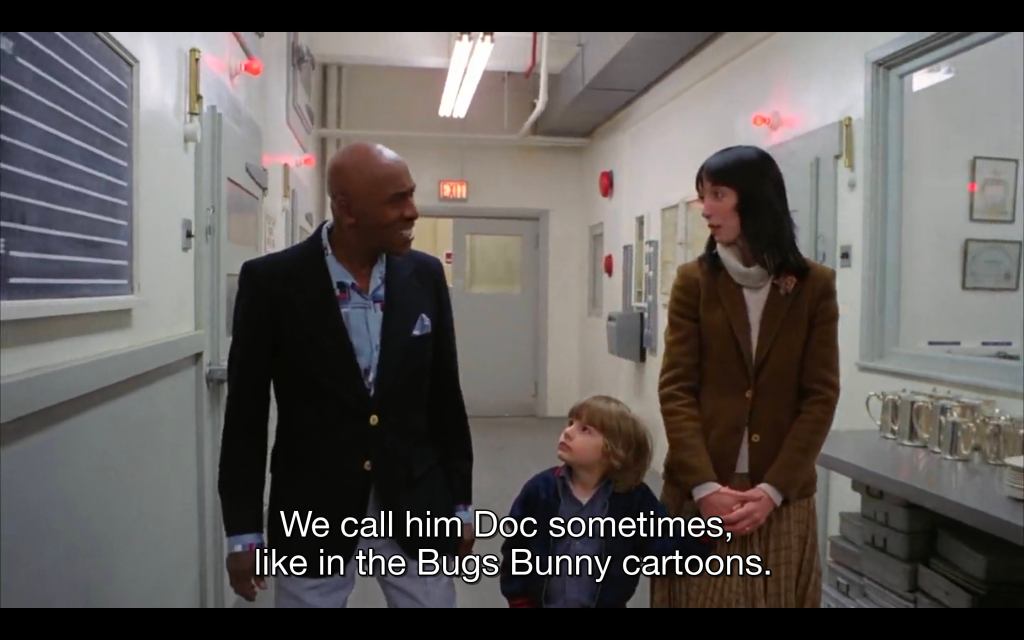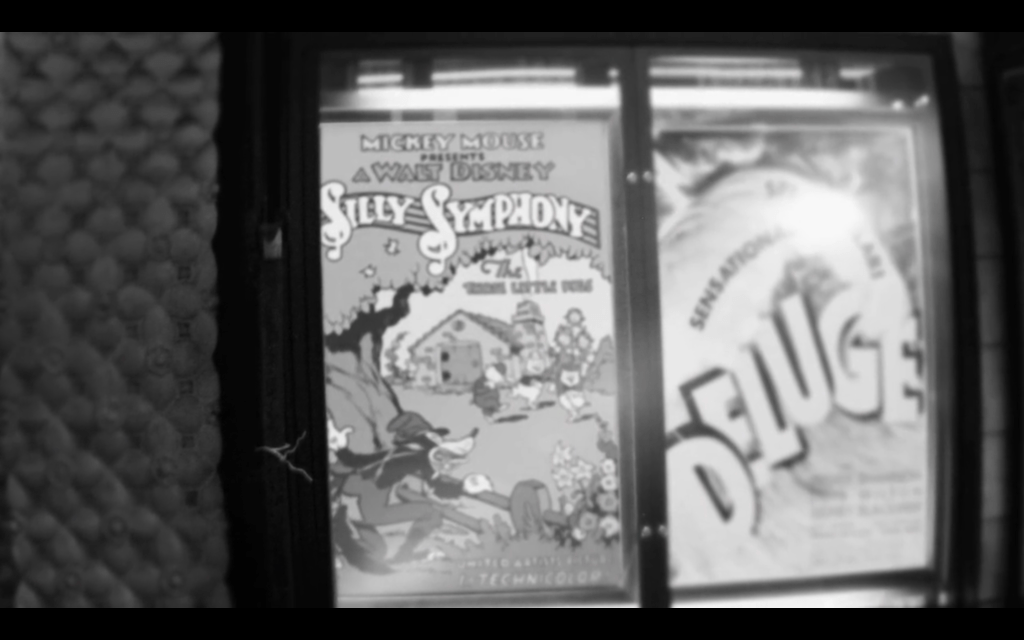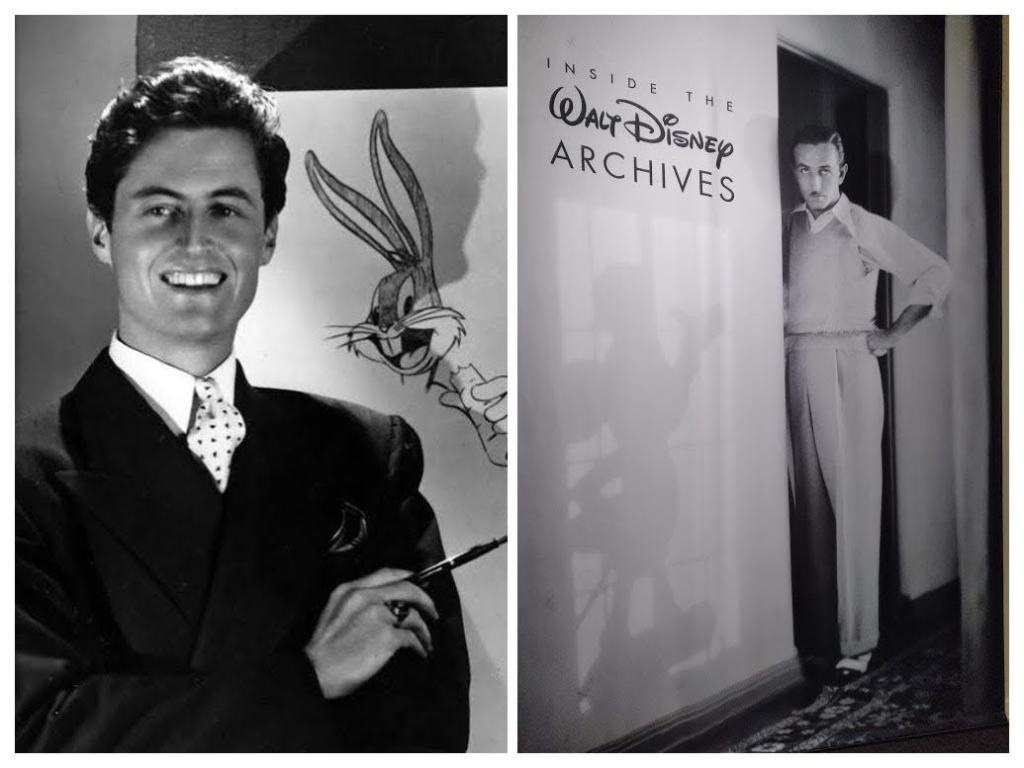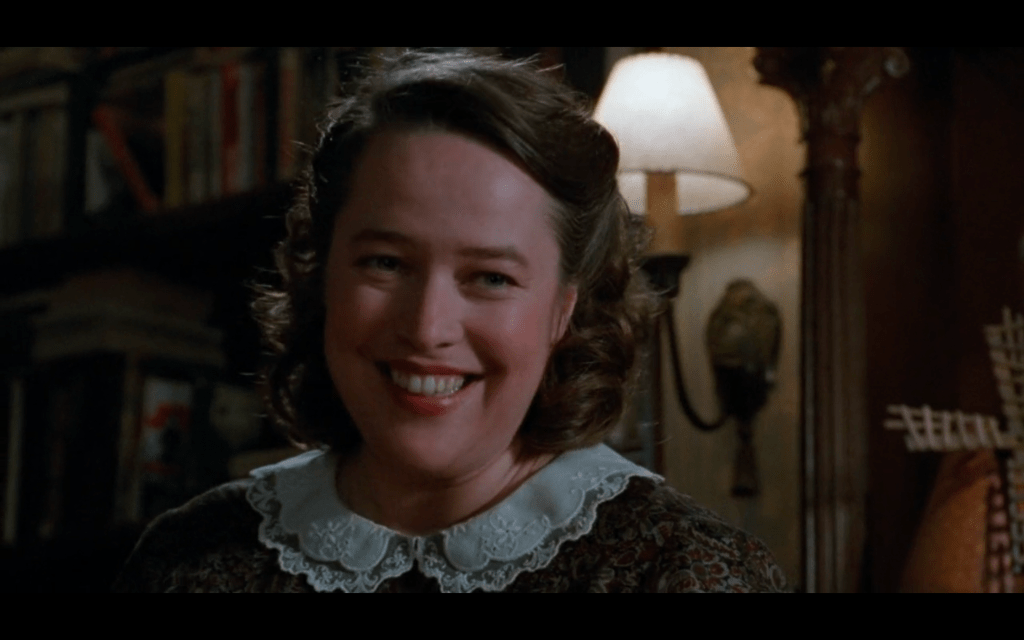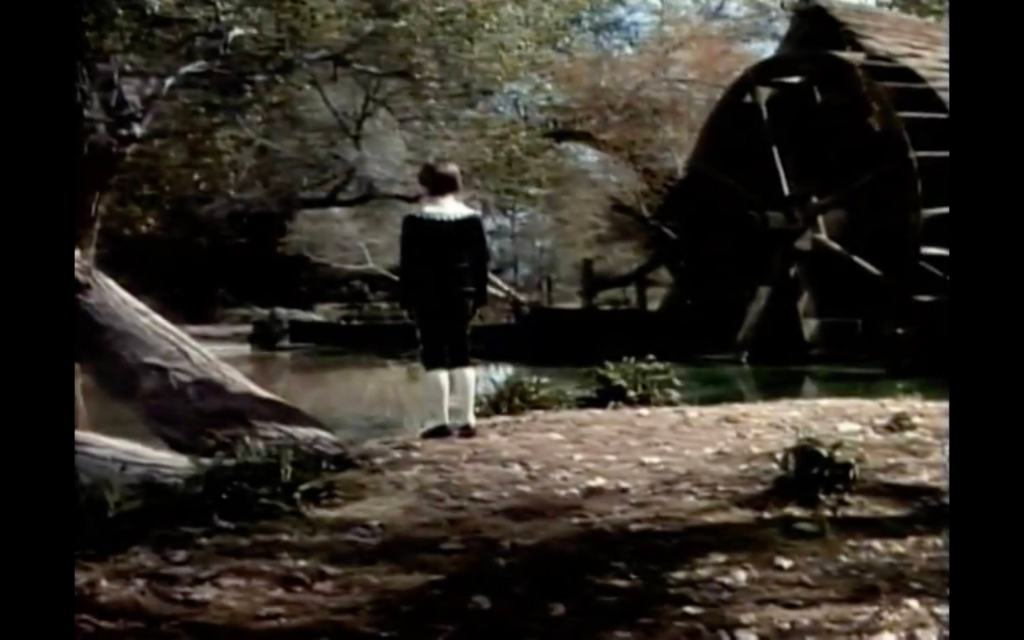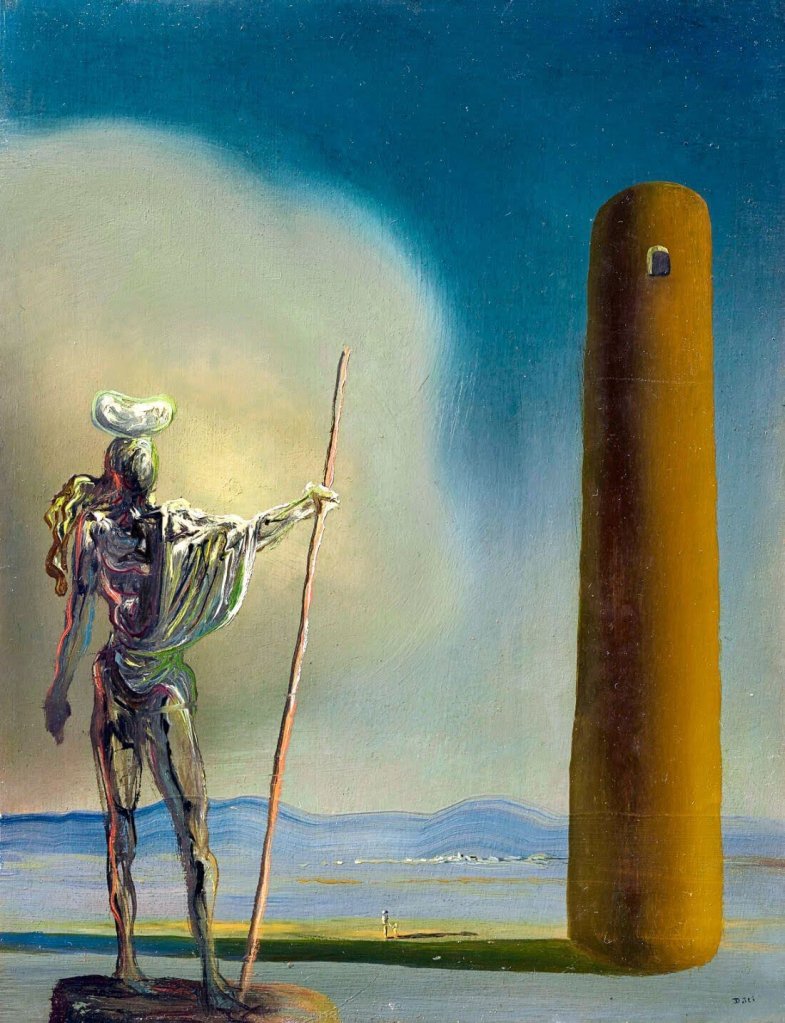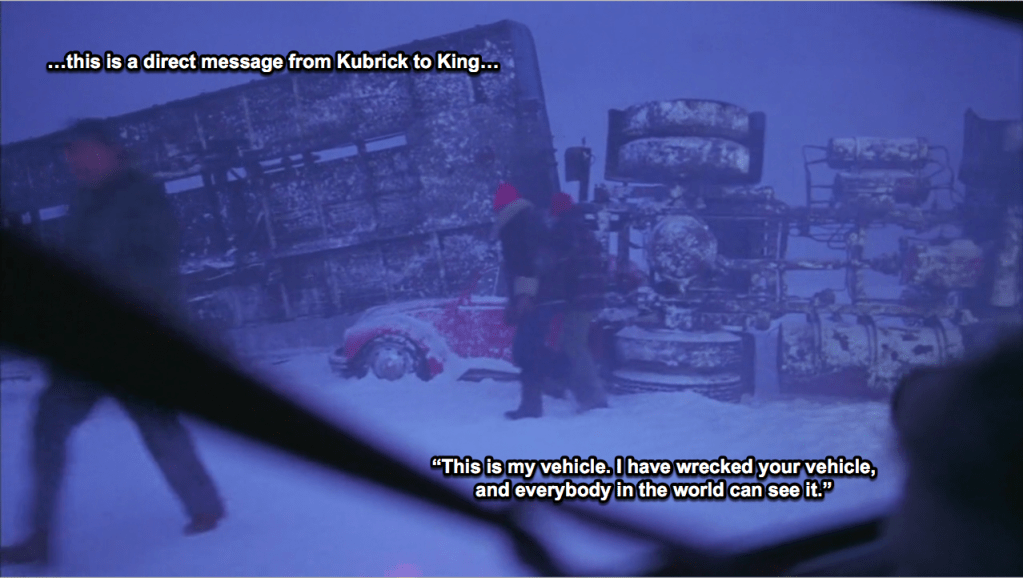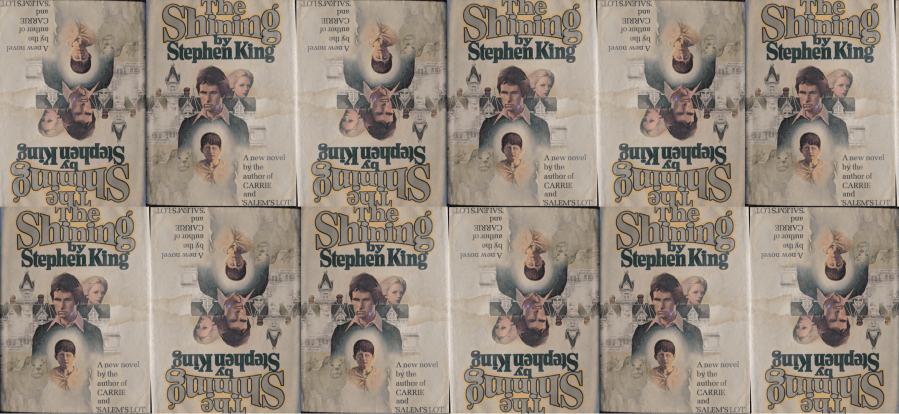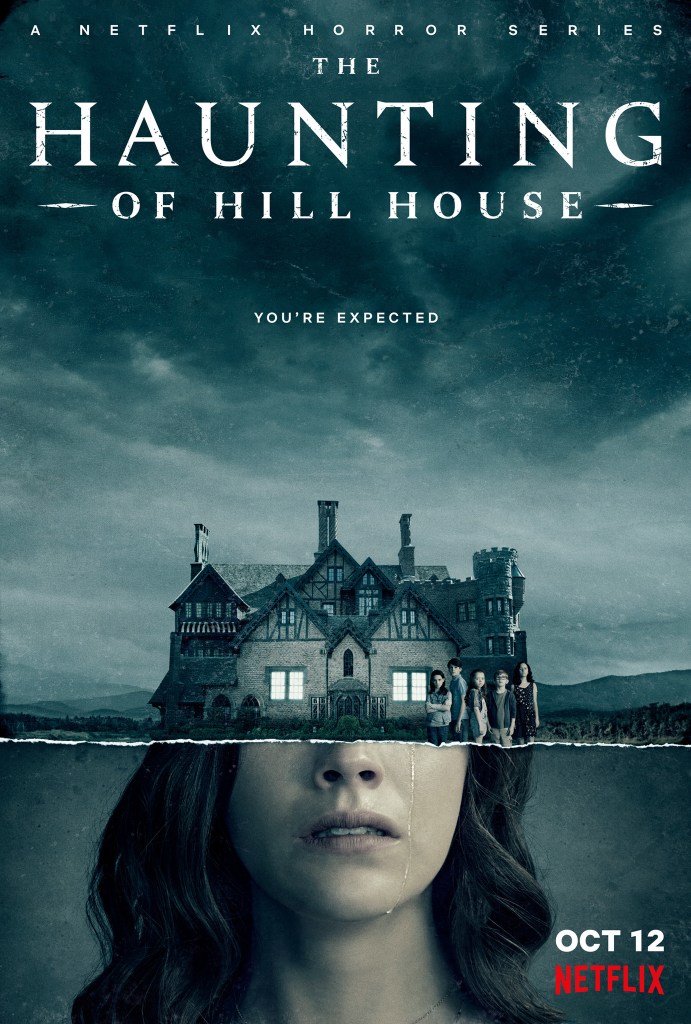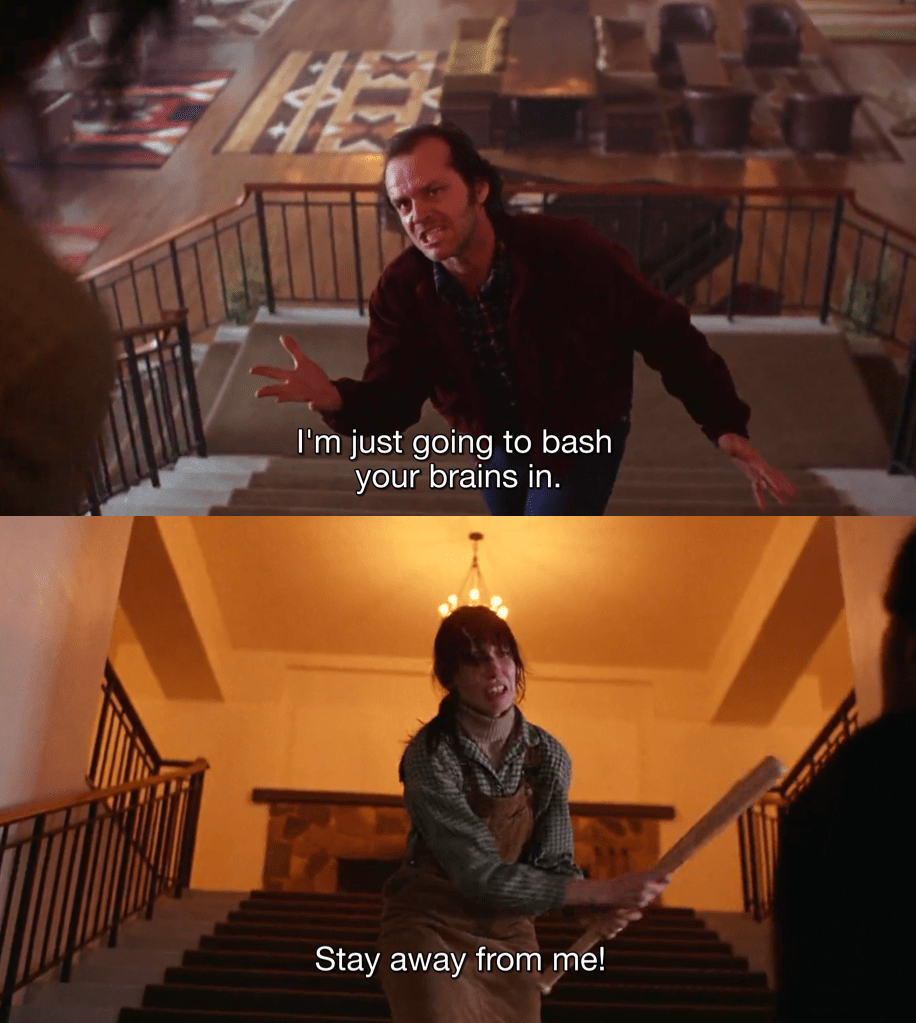
The Long Run of 2025 King Adaptations, Part II: Back to The Shining 

“This is truly amazing, a portable television studio. No wonder your president has to be an actor. He’s gotta look good on television.”

Doc Brown, Back to the Future (1985)

…and it must end–will end–in fire.

Stephen King, Never Flinch (2025)

This post has a deep Shining rabbit hole in the middle framed by a discussion of The Running Man. (I’ll justify The Shining inclusion by noting that it was screened in IMAX this December and that Dick Hallorann (and his shining) is a major character in this year’s Welcome to Derry.)

Table of Contents

My Little Runaway
The Rabbit Hole Never Ends
The Alice of It All
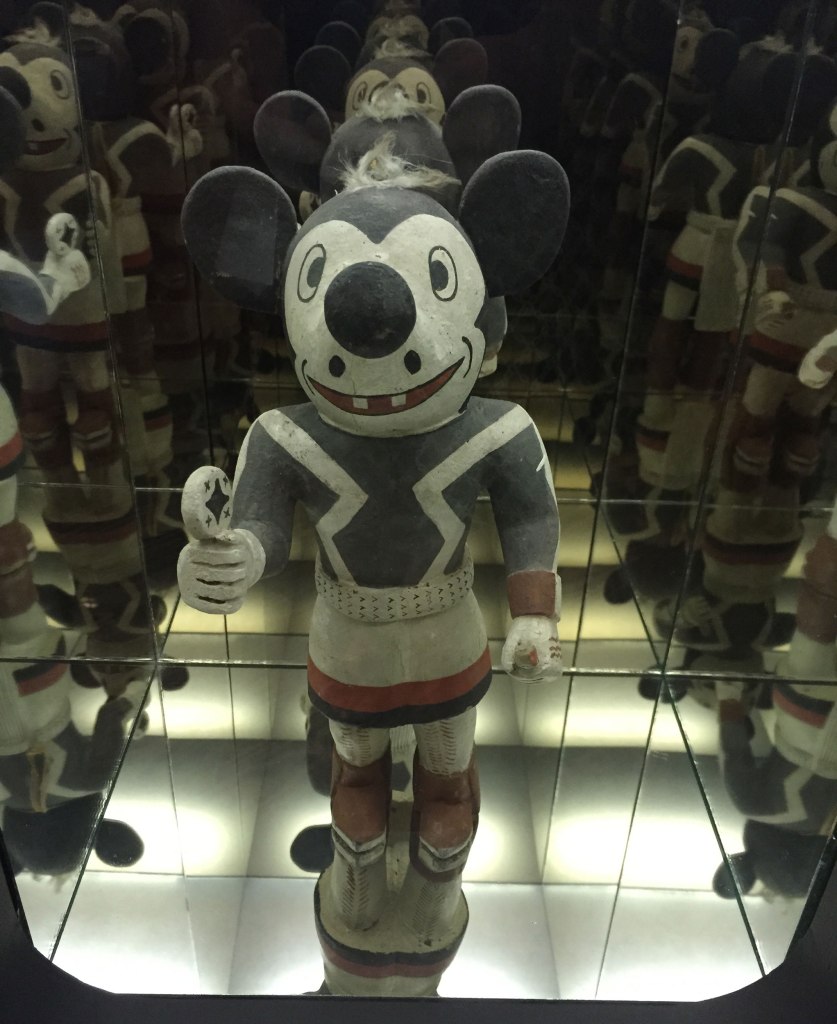
The Mickey Sweater Theory
Back to The Running Man
The Eyes Have It
Works Cited

My Little Runaway

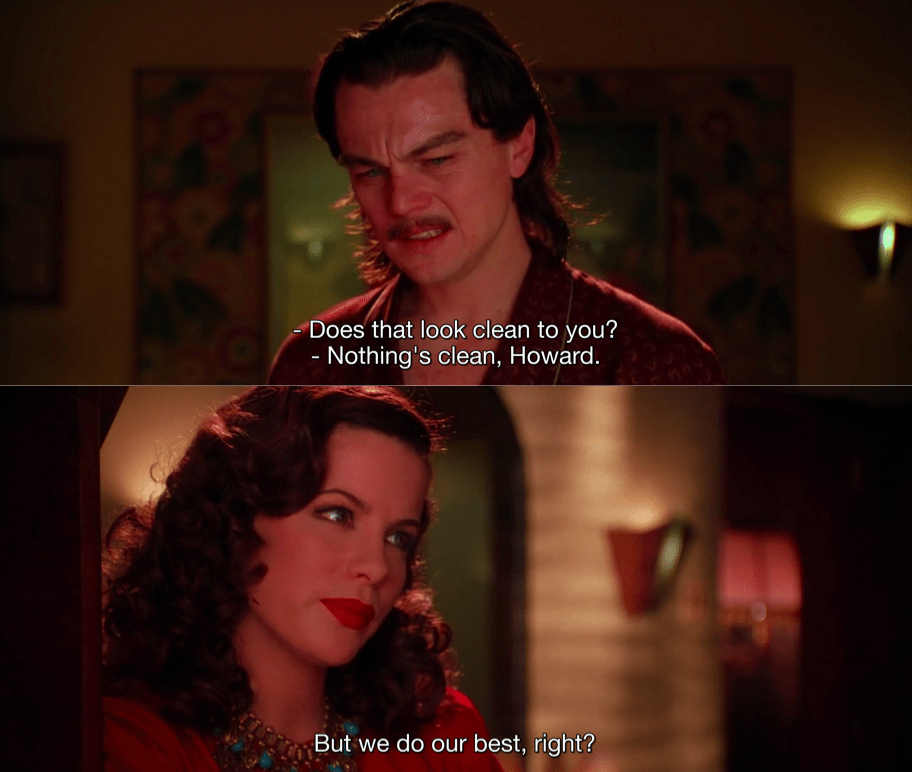
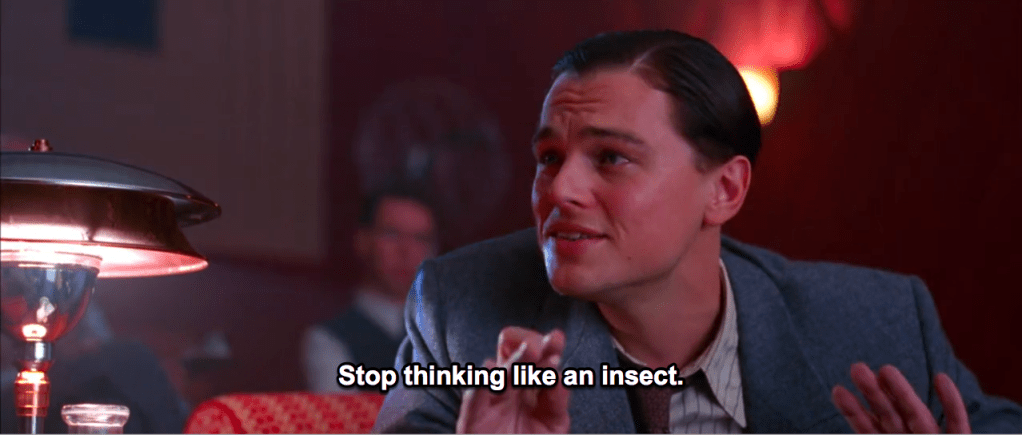
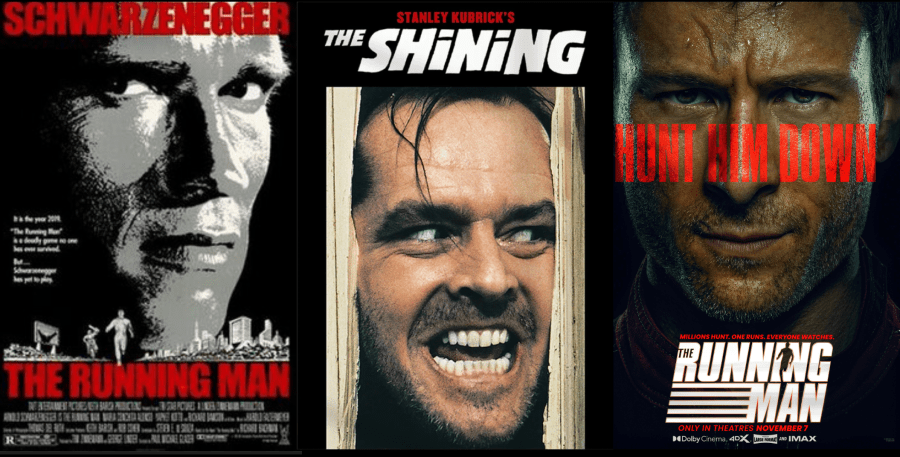
The last line of King’s Richard Bachman novel The Running Man (1982) describes “a tremendous explosion.” And its opening weekend at the box office was apparently a less tremendous explosion, a bomb of a different type. I did see it during its opening weekend, and it is a traditional Hollywood action blockbuster different in tone and quality from The Long Walk. I enjoyed The Running Man, but The Long Walk is a better movie. 

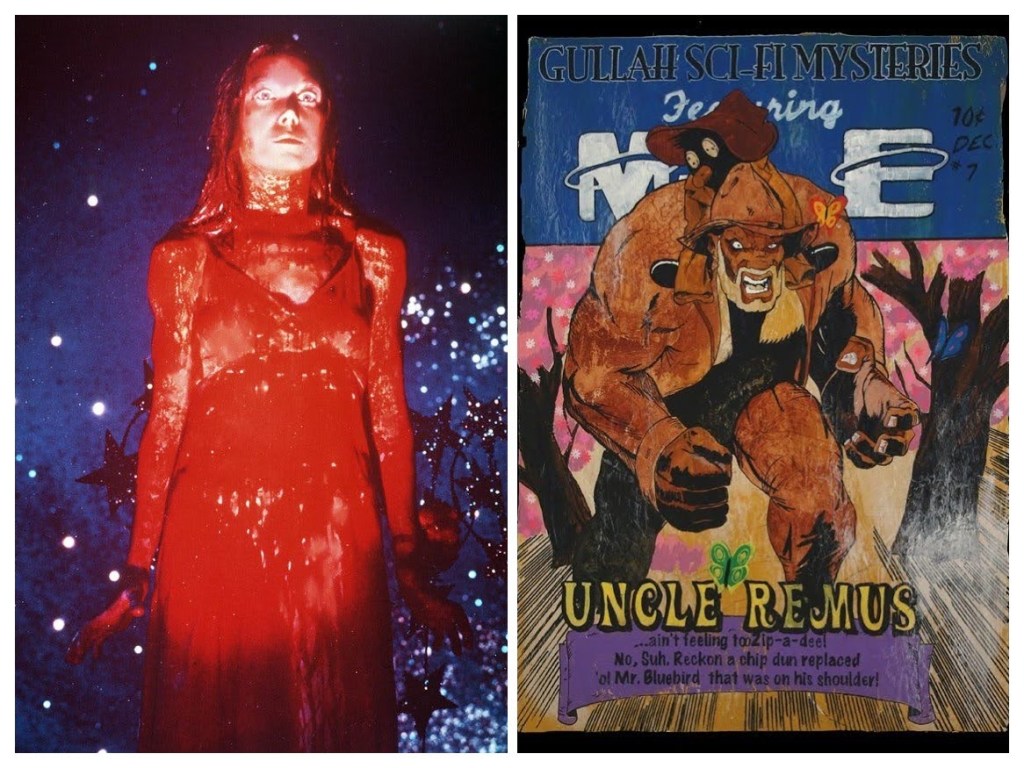
Part of what’s more fun about The Running Man is that, unlike all the other 2025 King adaptations, it has a preexisting adaptation for comparison, the 1987 version with Arnold Schwarzenegger, which is a fairly typical Schwarzenegger flick, ridiculous and campy with him beating people up and then dropping comedic one-liners. I kind of love this movie (I might be biased toward Schwarzenegger because my father watched his movies T2: Judgment Day (1991) and True Lies (1994) on repeat when I was growing up). People like to talk about how far afield this adaptation went from the book, with commentary on the new one being that it’s fairly faithful to the source material. But the new one actually does something akin to what Mike Flanagan does in Doctor Sleep (2019) when he reconciles versions of The Shining, King’s novel with Kubrick’s adaptation: it reconciles the Bachman novel with the Schwarzenegger adaptation. Early in the movie when the main character Ben Richards is watching game shows on the “free-vee,” the host holds up some “new dollars,” which have Schwarzenegger’s face on them. 

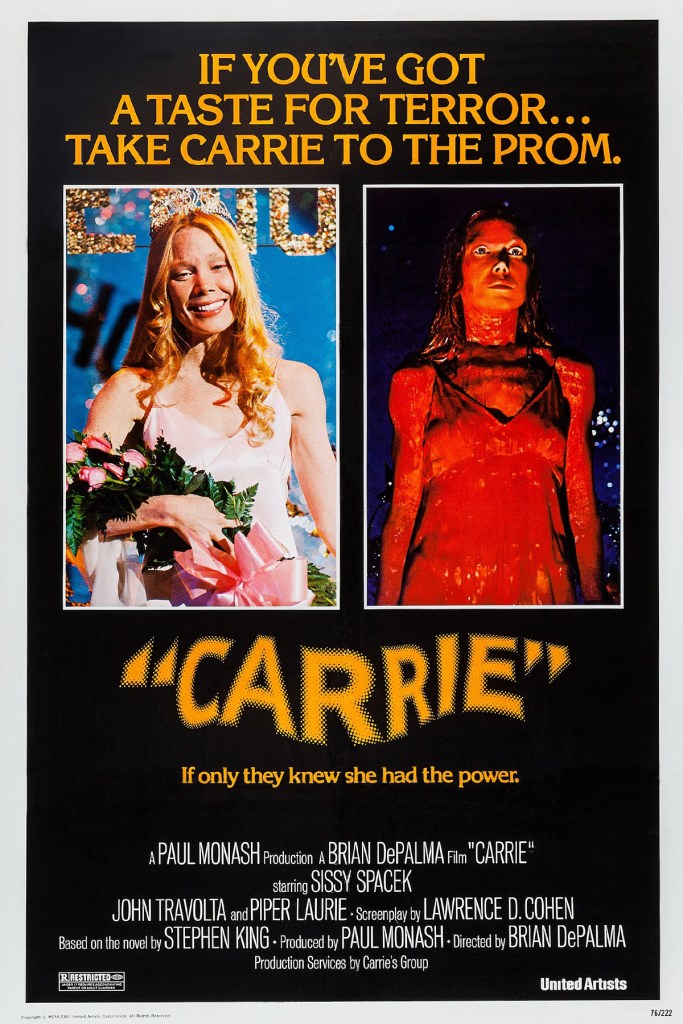
The 1987 movie is billed as being based on the novel by Richard Bachman, not King (the new one credits King), and apparently the creators did not realize it was a Stephen King book until after they’d started making it (according to The Kingcast‘s interview with the new one’s director, Edgar Wright). This makes sense, since King was outed as Bachman in 1985 and the film rights would have been optioned by that point. This also would seem to indicate that King’s experiment in seeing if he could be successful under a different name was showing that he very well could be if the movie adaptations were starting. We can’t technically know for sure since that’s exactly when Bachman was outed, but it does not seem like Schwarzenegger’s Running Man would have launched Bachman like De Palma’s Carrie did King. It’s still amazing that two of the handful of Oscar nominations actors King adaptations have ever garnered were from the very first movie (the others are Kathy Bates for Misery–the only winner ever for a King adaptation–Tim Robbins for The Shawshank Redemption and Michael Clarke Duncan for The Green Mile). We’ll see if The Long Walk turns out to be a contender. 

A big change the ‘87 movie makes from the beginning that seems promising is that Ben Richards is not a poor desperate father whose daughter is sick, but a police officer who’s ordered to kill civilians in a food riot and refuses. They send him to prison and frame him for killing the civilians they then proceeded to kill anyway. It’s really when the depiction of the game show itself starts that the film goes off the rails (yet was still ranked number 17 out of 60 King adaptations in 2018; there’s been about 60 more since then, half of them this year). The Running Man isn’t supposed to flee out into the world to be hunted by the public at large for thirty days, but is released in a circumscribed environment where he has to battle “stalkers” much akin to the exaggerated personae of fake professional wrestlers. 

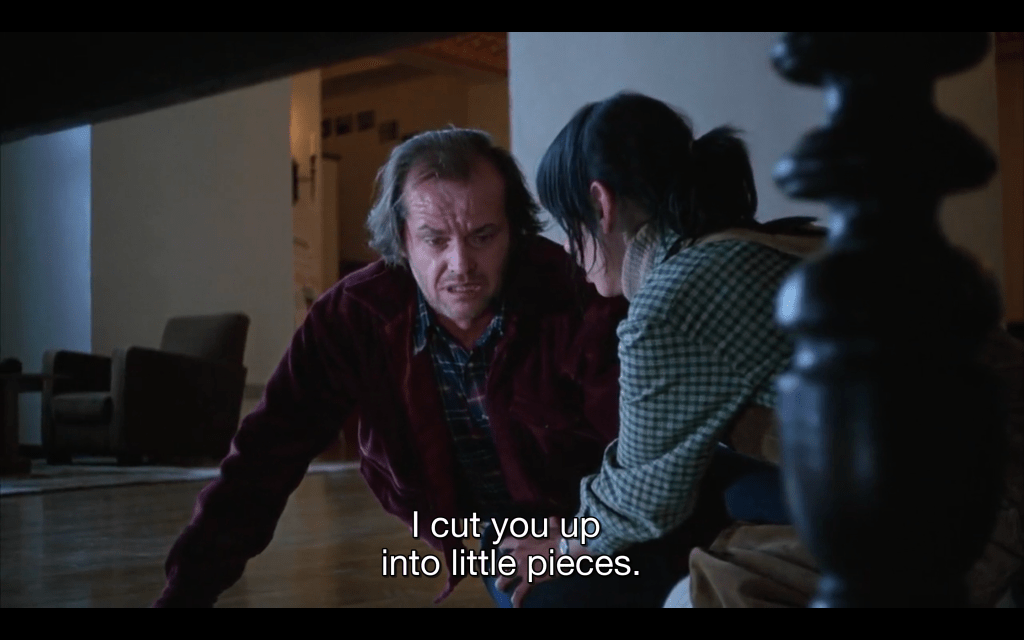
Two of these stalkers, Sub-Zero and Fireball, struck me as a fitting metaphor for a framework for King adaptations with its foundation in King’s comments on Kubrick’s Shining adaptation when he said the film is “Cold. I’m not a cold guy. I think one of the things that people relate to in my books is there’s a warmth…with Kubrick’s The Shining I felt that it was very cold.” He’s being figurative, but of course the book and the movie also represent this opposition literally: in King’s, the boiler explodes and the Overlook and Jack burn, and in Kubrick’s, Jack freezes to death. As The Running Man reinforces, King is fond of ending his work with explosions and/or fires. Yet King apparently did not have a problem and claimed he liked the changes in another adaptation that turned his work from hot to cold in a vein quite similar to The Shining: David Cronenberg’s adaptation of The Dead Zone (1983). In this film, a major incident the main character Johnny Smith is clairvoyant about and tries to prevent is a bar burning down with people trapped inside, while in the movie, it’s that some kids are going to drown playing hockey on a frozen lake when the ice breaks. (Christopher Walken’s “The ice…is gonna break” is iconic enough to be one of the soundbites in the opening sequence of The Kingcast.) The Dead Zone adaptation also adds a lot more references to Poe’s “The Raven,” which is interesting when The Shining novel has more Poe references that Kubrick downplayed. Also, both Kubrick and Cronenberg rejected King’s screenplay drafts for their respective adaptations (and if you’ve seen the 1997 Shining television miniseries King wrote, you’ll understand why). 

The Rabbit Hole Never Ends

I’m back in The Shining rabbit hole exploring its Alice in Wonderland references for a new book of essays planned to mark the novel’s fiftieth anniversary. As I’ve noted, Alice is one of King’s most common literary references throughout his work but is especially prominent in The Shining. References to it also appear both in The Long Walk (the first novel he ever wrote) and in The Running Man. About halfway through The Long Walk novel, Garraty gets frustrated with Stebbins giving him cryptic answers to his questions and says he’s like the caterpillar from Alice in Wonderland, to which Stebbins responds he’s more the white rabbit type and maybe for his wish he’ll ask to be invited “home for tea.” Then at the end of the novel Stebbins reveals the Major is his father and is using him as “the rabbit” to drive the other walkers farther, though he compares himself more to a mechanical rabbit in that part, and says that his wish was going to be to be invited into his father’s home. Given that the entire third of three sections of the novel is called “The Rabbit,” this makes the Alice reference fairly significant. (The film cuts the explicit Alice references but has Stebbins say that he wanted his father to invite him “home for tea” when he’s making the rabbit analogy and paternity confession.) In The Running Man, near the end after learning his family has been killed and he’s being offered a deal to join the show as a hunter, Richards invokes, apparently in his head, a few lines from “The Walrus and the Carpenter” poem from Carroll’s second Alice novel, Through the Looking-Glass (1871). This feels fairly unnatural given the pains the novel has gone to to depict Richards as occupying the extreme lower rungs of a class system that would mean he lacks an education. Had he compared someone’s grin to a cheshire cat’s as King’s Alice references frequently take the form of, that would feel more natural as referring to common knowledge; actually citing verse is more far-fetched. But King can’t help himself. (The verse does appear in the Disney version, but King makes no indication it’s a Disney reference, and though he makes frequent Disney references, his Alice references usually seem to allude to Carroll rather than Disney.)

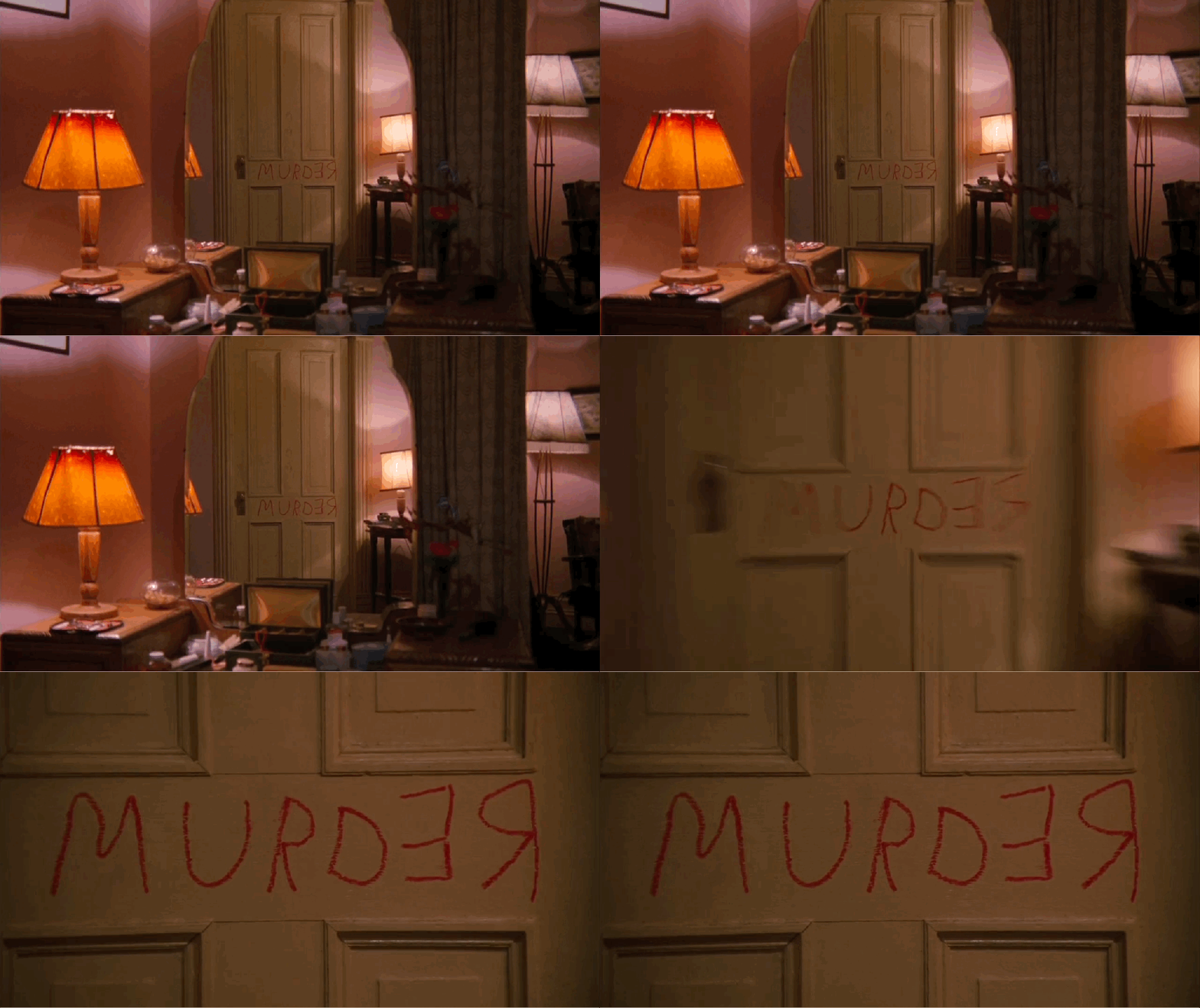
Given a major theme in King’s work, epitomized in IT, about the scope and power of childhood imagination to defeat evil, reinforcing a need to transcend dehumanized modern industrial culture that values rationality above all else and no longer believes in magic, it makes sense that Lewis Carroll’s Alice would be a touchstone for him–the potential liberation of childhood imagination being a major theme there. The Alice references in The Shining are part of Danny’s mediation of the unreality he’s experiencing; he’s in his own version of Wonderland, a horrifying one rather than magical. Let’s not forget that a roque mallet becomes the murder weapon in King’s version, and that the croquet mallets in Alice during a significant sequence are living animals. Inanimate objects as live animals recall King’s use of the topiary animals (when Jack notes he got the caretaker job because Al Shockley recalled he’d had a job trimming a topiary before, he says that topiary was “playing cards,” another big Alice motif). Wordplay is a huge part of the Alice texts (as when Alice asks where’s the servant to answer the door and the reply is, “‘What’s it been asking of?’”) and of course wordplay becomes a huge part of The Shining through the repetition of “redrum,” which is revealed, in a mirror, to be “murder” backwards; Tony also appears to Danny “way down in the mirror.” And in Carroll’s Through the Looking-Glass (1871), Alice enters Wonderland through a mirror. In discussing King’s use of archetypes and fairy tales, Ron Curran has done an analysis of the use of the Alice references, how they’re linked to the Bluebeard fairy tale in the text, and how they reflect the Jungian parental complex–both Alice and Bluebeard “carry the dynamics as well as the images of the primal fears of children living with both the father and the mother complex” (42). Curran notes that in Danny’s entering room 217, King uses “the Red Queen and her croquet game to frame Danny’s experience of terror” (42). 

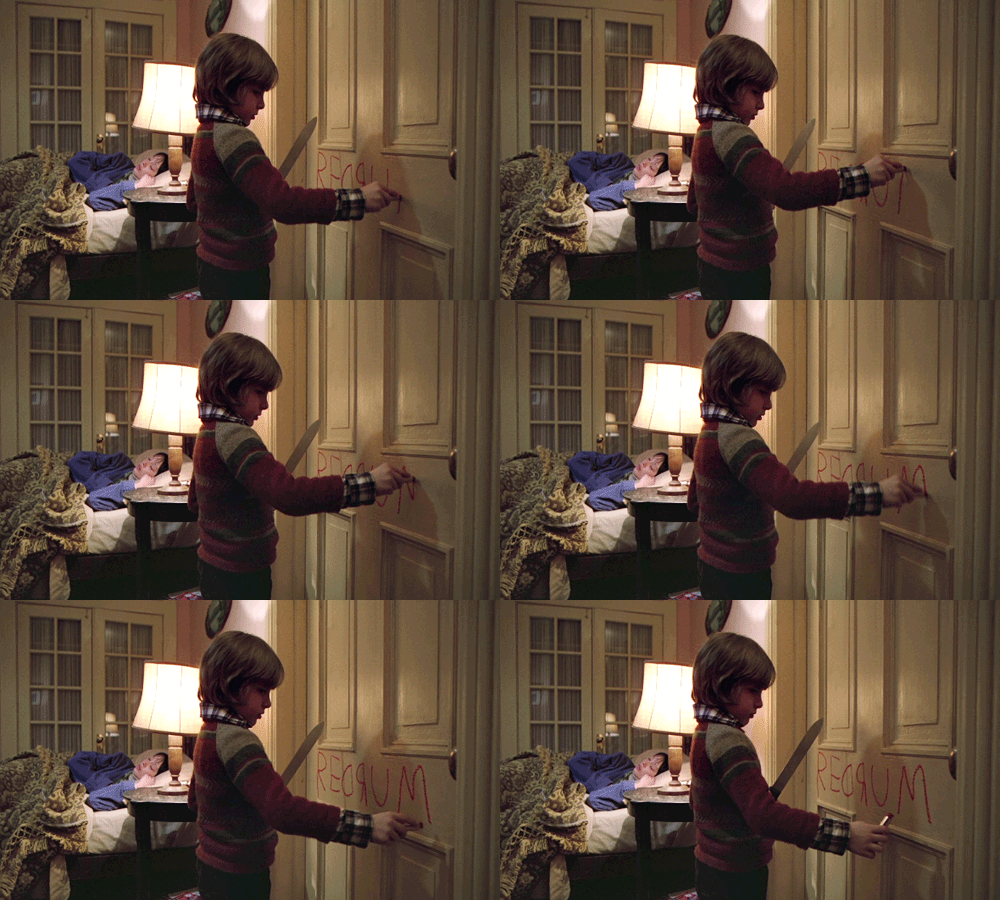
Curran doesn’t suggest that the REDRUM concept might be a Through the Looking-Glass reference, but I don’t think that’s a stretch. One Alice reference Curran doesn’t address is how King provides an answer to the famous unanswered riddle from the Mad Hatter’s eternal tea party, “why is a raven like a writing desk?” King’s answer: “the higher the fewer, of course!” The meaning of REDRUM is itself a sort of riddle in the text that is in effect “answered,” its meaning revealed when we see it in the mirror. There’s a “murder” reference in Alice–the Red Queen has sentenced the Mad Hatter to the eternal tea party because at some point he was wasting her time, or as she puts it, “murdering the time.” When Curran refers to the key (literal) link between the texts–“With this key Danny opens up the whole world of the Overlook in the same way that Alice’s key admits her to the world of Wonderland” (41)–he’s referring to a scene where Danny uses a key to wind up a clock. King’s novel has a version of the eternal tea party (a conceit of time being murdered as a punishment for time being murdered) which is the ballroom party that takes place on August 29, 1945. King reminds us the riddle is a reference to the eternal tea party when, after providing the riddle’s answer, he adds, “Have another cup of tea!” Curran seems to be somewhat split in terms of how horrific Alice is, at first saying the references provide an “emotional distance” that makes Danny’s tension more bearable because it’s a counterpoint to the horror, then pointing out that it does echo the horror in aspects like its “homicidal queen.” One video unpacks the cultural critique of British industrial society some of Carroll’s references address that are truly horrific, like how it was common (and common knowledge) for hat-makers, or hatters, to go mad from mercury poisoning in the process of making hats, and how opium was marketed as something mothers could give to babies to quiet them that ended up poisoning and killing a lot of them. The video also comments on the repetition of the lessons and poems Alice recites as part of the education system’s process of not teaching students but turning them into mindless cogs.    

In a new volume of King criticism released this year, Theorizing Stephen King, its editor Michael J. Blouin asserts that: 

King’s adaptations have become so ubiquitous, his reservoir of filmic references so deep, that he has spawned what I would describe as a style in its own right: the King-esque. Simply put, because it has become extremely difficult, perhaps impossible, to extricate the author’s legacy from the ever-growing tome of adapted versions of his work, spanning a wide array of mediums, one cannot adequately theorize Stephen King without the aid of adaptation studies.

And one cannot adequately theorize about The Shining without addressing the wide range of theorizing about it up to this point that exists entirely outside of academia. Per one YouTube comment, “Is it safe to say that ‘Shinning Analysis’ is a genre unto itself now?” To which I’d say, does a bear shit in the woods? Matthew Merced addresses this phenomenon in his essay “​​Lost in the labyrinth: Understanding idiosyncratic interpretations of Kubrick’s The Shining,” describing “the psychological operations underlying the mind’s interpretive ability … with emphasis on how idiosyncratic interpretations are derived” (56), with an “idiosyncratic” interpretation being one “that provides unique or unusual meaning for objects/events in the stimulus field … best understood as a marker that an interpretation reflects something about the interpreter’s beliefs and experiences. The more an interpretation diverges from obvious distal properties and ordinary associations, the more it reflects personally meaningful (i.e., idiographic) aspects of the interpreter’s psychology” (59). Interpretations as mirrors (as I have theorized that adaptations are like mirrors; as a mirror for Kubrick himself, whose directing style some have characterized as “emotionally abusive,” the “cold” changes in his adaptation would seem to reinforce this)… Merced’s title uses the labyrinth, which will be a central part of the theory I’m about to launch into, as a metaphor for the range of interpretations The Shining generates, but never discusses it otherwise except as part of the film’s plot summary. Merced notes that in light of the limitations of idiosyncratic interpretations, he recommends “using theory‐driven analytical frameworks, which are more likely to generate interpretations that are rooted in observable, nontrivial, evidence and are consistent with principles of logic” (56). Which would align with Blouin’s mandate, to avoid interpretations that amount to “little more than sycophantic devotionals,” to “‘Always theorize!’” Though Ron Riekki notes in an introduction to a book of academic essays on IT that

…there is an infamous legend about Tony Magistrale’s essay on Children of the Corn being read at a conference King was attending and how King’s response to the essay was that the “thought of Vietnam never crossed my mind.” Interestingly enough, essays about Stephen King are not only about Stephen King. They are also about the person writing the essay. Magistrale’s essay gives insight into the imaginative, inventive, scholarly mind of Tony Magistrale…

The Many Lives of It: Essays on the Stephen King Horror Franchise, edited by Ron Riekki, McFarland & Company, Inc., 2020.

Yet King admitted The Long Walk was about Vietnam and vehemently protested it in college, so it seems safe to say it was in his mind somewhere.

The Alice of It All

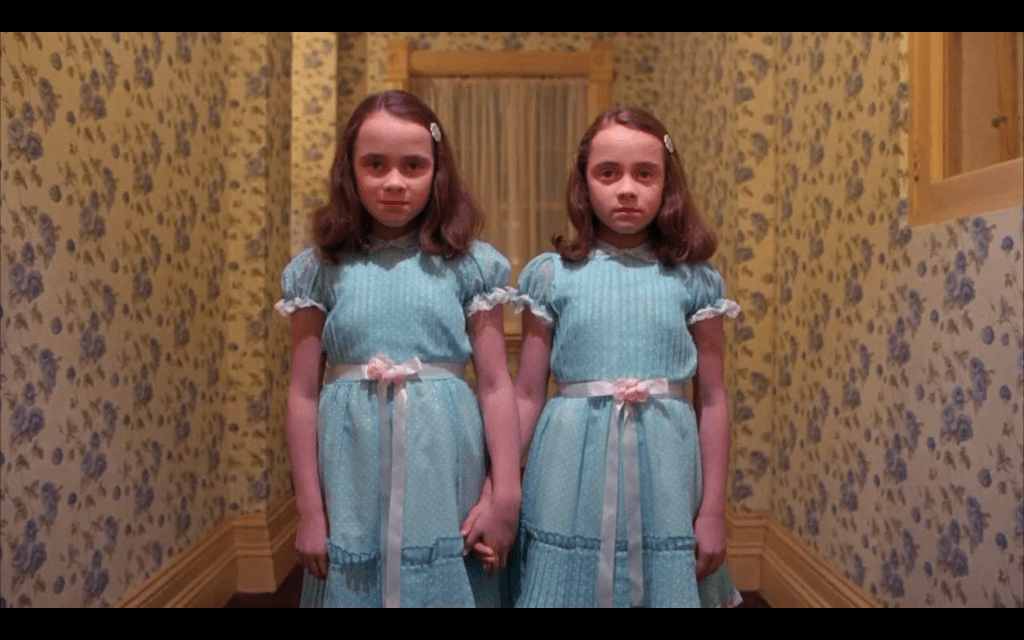
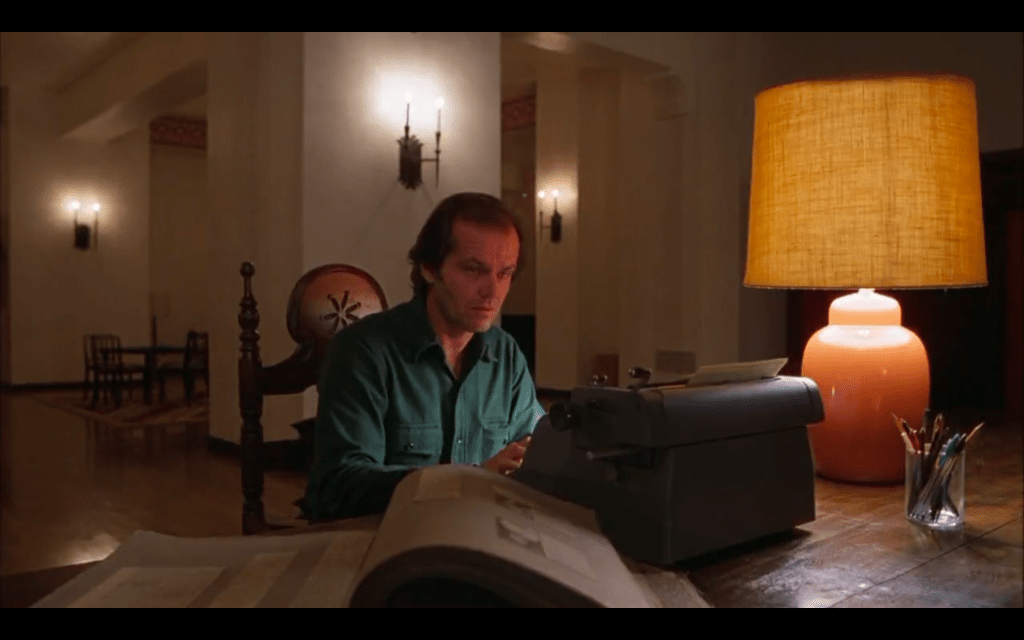
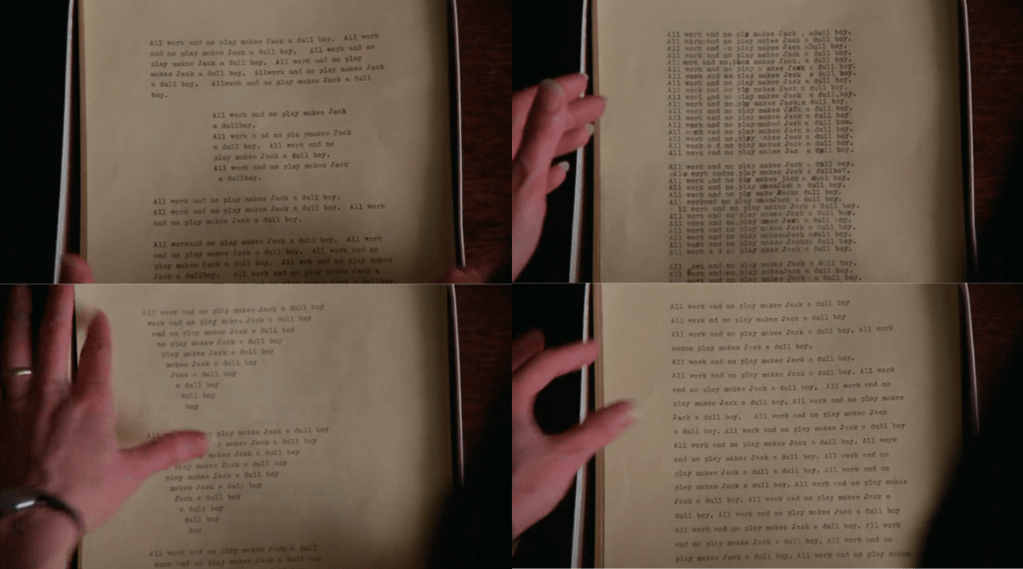
It’s been my theory that Kubrick picked up on the Alice references in King’s novel and extrapolated from them some of the significant changes he made in his film. The centrality of the Grady twins (who are technically not twins in the film but are played by twins and present as twins, a la Tweedledee and Tweedledum). More mirrors. I would argue the iconic “All work and no play” line that’s not in the book could be inspired by Alice and that narrative’s emphasis on the significance of childlike play (it could also be a joke that Jack has been sitting there working and produced “no play,” since a play is what Jack was trying to write in the book). And last (chronologically) but not least, changing the hedge animals to a hedge maze. Except the hedge maze does not appear in Carroll’s version–this is a change Disney made in his Alice adaptation. It makes a kind of sense that, being the adapter, Kubrick leaned more into the Disney adaptation when it came to the Alice motif, while King, the original novel writer, references the original Alice novel source text. So there’s a parallel in adaptations: King references Carroll’s Alice; Kubrick references Disney’s Alice, because Disney is the original adapter of Carroll. 

As far as I can tell no one else has talked much about this, and when it comes to any kind of analysis of The Shining, idiosyncratic or otherwise, it’s hard to believe anyone could come up with something that has not already been discussed to death. There is a video about elements of Disney’s Alice in Kubrick’s movie, but it includes no hypothesis about the relevance of these references. My ultimate hypothesis about the relevance would be it’s a means of Kubrick mediating (so to speak) his own adaptation process, which is largely characterized by his extrapolations from the source text, utilizing elements in the source text that are different from how they were used in the source–like how the line “come play with me … Forever. And Forever. And Forever” is in the novel uttered by a random ghost child rather than the Grady children. While King has Delbert Grady have the conversation with Jack that occurs much as it does in the film, the ghosts of the Grady girls never appear in the novel, which seems like a huge narrative oversight Kubrick rectified.

Kubrick and King apparently had a similar take on how horrific Disney’s children’s films are, with Kubrick saying

Children’s films are an area that should not just be left to the Disney Studios, who I don’t think really make very good children’s films. I’m talking about his cartoon features, which always seemed to me to have shocking and brutal elements in them that really upset children. I could never understand why they were thought to be so suitable. When Bambi’s mother dies this has got to be one of the most traumatic experiences a five-year-old could encounter.

Which sounds a hell of a lot like King’s take:  

In a 2014 Rolling Stone interview, when asked what drew him to writing about horror or the supernatural, King responded: “It’s built in. That’s all. The first movie I ever saw was a horror movie. It was Bambi. When that little deer gets caught in a forest fire, I was terrified, but I was also exhilarated. I can’t explain it” (Green). In a 1980 essay for TV Guide, written while King was writing his novel Cujo, King again explained that “the movies that terrorized my own nights most thoroughly as a kid were not those through which Frankenstein’s monster or the Wolfman lurched and growled, but the Disney cartoons. I watched Bambi’s mother shot and Bambi running frantically to escape being burned up in a forest fire” (King, TV Guide 8). 

“Cujo, the Black Man, and the Story of Patty Hearst” by Sarah Nilsen, in Violence in the Films of Stephen King, ed. Tony Magistrale and Michael J. Blouin. Lexington Books. Kindle Edition. 2021.

Given that The Shining is Kubrick’s first horror movie (though some have analyzed how it flouts a lot of tropes in this genre) and that it surrounds a traumatized five-year-old, that Kubrick might go to the Disney version makes a kind of sense. 

In King’s version of The Shining, the topiary (in his case animals) is the impetus of the novel because it’s noted they’re what made “Uncle Al”–that name could be an Alice nod–think of Jack for the job in the first place, and in Kubrick’s version, the hedge (in his case a maze) is critical to the climax and outcome of the story. And in Kubrick’s case the topiary is a seemingly more explicit Alice reference, though not as explicit as King’s references to Alice when Danny’s entering room 217. King has an Alice reference impact the plot in a more direct way by having Jack’s potential murder weapon be the roque mallet, but the boiler would be the corollary to Kubrick’s hedge maze in terms of the climax and what kills Jack.

Merced quotes a producer of Kubrick’s film claiming Kubrick “deliberately infused uncertainty into the film” (61) which is hardly surprising, but then Merced does provide more concrete evidence for it:

Perceptually, the viewer can never be confident that what is observed is real, even within the film’s own ontology. In The Shining‘s opening image, the sky and mountains are mirrored in a lake’s still surface. What is real and what is a reflection? This perceptual ambiguity is repeated several times throughout the film when an establishing image is revealed to be its mirror image (61).

In the Disney version of Alice (and not Carroll’s), Alice first sees the white rabbit as a reflection in a body of water, which in hindsight is an indication of the white rabbit’s not being real. 

Merced later invokes a different meaning of reflection without connecting it to the first type of reflection: “It is argued that The Shining‘s oedipal content generates potent archaic associations within viewers; these associations are latent and not available for conscious reflection” (62)–this after presenting the evidence that Kubrick and co-screenwriter Diane Johnson discussed Freud and consciously put Oedipal content into the film. This would make the reflections in bodies of water more potent–the surface reflections reflect something deeper beneath the surface of the conscious mind. 

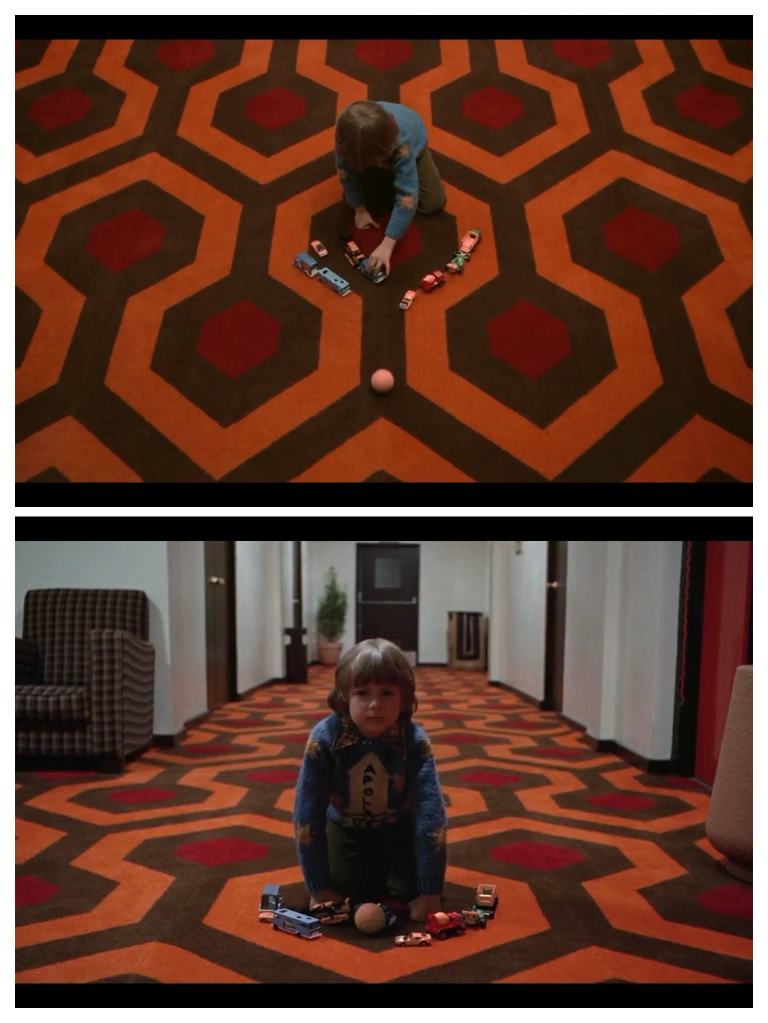
In King’s version, Danny would be the figurative Alice figure; as Curran puts it, King “pairs two children with burning curiosity to enter forbidden territory,” and this is reinforced when Alice references surround Danny turning the key and entering room 217. In Kubrick’s version, Danny doesn’t choose to do this; he discovers that the door to Room 237 is ajar with a key dangling from the lock that he did not turn himself (though he does test the doorknob earlier in the film and finds it locked, so he is still curious). Rather than Danny, it’s the Grady twins who are rendered Alice through their outfits. And because there are two, they are possibly an indication that Kubrick is referencing the Disney version, the second version of Alice. People have remarked on how they’re shown in a way that’s not explicitly identical, with one being slightly taller (though again, the actresses are identical twins), which would speak to how an adaptation is not its source material’s twin, and also to how most viewers perceive the characters are twins. But Ullman says they were “about eight and ten” when he’s telling the story to Jack, so they are not twins, though the concept of “The Shining twins” will go down in posterity as one of the most famous aspects of the film. (Of course, there’s a YouTube explanation for this.) The “all work and no play” line that’s repeated is in a sense “twinned” (non-identically) in the twins’ creepy call to Danny to “come play with us.” Palmer Rampell notes that the “all work and no play” line might represent how

Genre fiction and films have been criticized as the mechanistic repetition of one plot (see McGurl 2009, 26), and much of the later output (e.g., Jaws, Star Wars) of New Hollywood took the form of familiar genres, which could be said to appeal to audiences’ familiarity with generic narratives, with the desire to see the same plot reproduced indefinitely (165-166).

Not unlike King’s plots… Rampell also notes that it captures Kubrick’s famous penchant for the amount he made his actors repeat takes. He doesn’t quite go so far as to say the representation of repetition would allude to the adaptation process itself being a form of repeating the source material, and obviously Kubrick’s adaptations are far from a repetition in that sense.

People have noted the repeated references to the number 42 in Kubrick’s film, often presented as evidence that he’s commenting on the Holocaust, and in both the book Alice and the Disney version, “Rule Forty-two” is invoked in the trial scene near the end when Alice grows large again and they tell her this rule is that all persons a mile high must leave the court. Of course if that’s in both texts, it can’t be evidence that Kubrick is taking more from the Disney version, but the endings of the book and movie diverge after this moment when, in the book, Alice shortly thereafter declares to the guards about to come for her “you’re nothing but a pack of cards,” and as they start to attack she wakes up from the dream the whole thing has been. This declaration is in the Disney movie, but the narrative continues from there as Alice flees from the court and is chased–through the hedge maze. She has to go back through a sequence of landmarks that marked her journey on the way in to get to the door she came through in the first place after falling down the rabbit hole, but it’s locked (again) and when she looks through the keyhole, she sees herself sleeping on the riverbank. Which means she’s doubled like the Shining (non)twins! 

Alice’s declaration about the pack of cards to awaken herself in the book echoes King’s ending when Danny defeats the Overlook monster in Jack by declaring to it that it’s “just a false face.” This verbal articulation of the true state of the monster being the instrument of its defeat is a common trope in King (one adapted by the Muschiettis in shifting the ending of It: Chapter Two and the final defeat of Pennywise that comes off as a little ridiculous). Kubrick of course changes this to the hedge maze chase, but echoes the Disney Alice and how she has to go back the way she came to get out of Wonderland: Danny outsmarts Jack in the hedge maze by tracking backward over his own footsteps, going back the way he came.  

Both the Disney version and Carroll’s open with the book Alice’s sister is reading and Alice thinking it’s useless for not having pictures (Carroll’s Alice books do have pictures, illustrated by John Tenniel). In the Disney version, her tutor is reading it out loud to Alice, while in Carroll’s, the sister appears to be reading it to herself and Alice only thinks about the pictures rather than saying anything out loud to her sister. In the Disney version she sings a whole song about what her nonsense world would be like and how everything would be its opposite before seeing and chasing the white rabbit; in Carroll’s the rabbit shows up right away and by the end of the third paragraph she sees “it pop down a large rabbit-hole under the HEDGE” (caps mine). (Her fall down the rabbit-hole is rendered as “falling down a very deep well,” which might explain King’s penchant for wells that the Muschiettis also utilized in the first It and are returning to in Welcome to Derry.) The idea of pictures in a book becomes relevant in The Shining when, in King’s version, Hallorann tells Danny the things he might see in the Overlook can’t hurt him, and Danny thinks of the picture in Bluebeard, which will be connected to Alice directly in the sequence where he thinks about both as he decides to enter Room 217. Kubrick takes this idea and adjusts it: we don’t see the conversation between Hallorann and Danny, but right after Danny sees the nontwins in the hallway–intercut with the image of their ax-murdered bodies as they tell him to come play with them forever and ever and ever–he tells Tony he’s scared, and Tony (via Danny’s finger) tells him to remember what Mr. Hallorann told him–“‘It’s just like pictures in a book, Danny. It isn’t real.’” Not that they “‘couldn’t hurt you’” as Hallorann puts it in the book, but that they aren’t real. It’s the scene right after this that Danny asks to go get his firetruck from their apartment and goes up where Jack is supposed to be sleeping but turns out to be awake. Which brings us to…

The Mickey Sweater Theory 

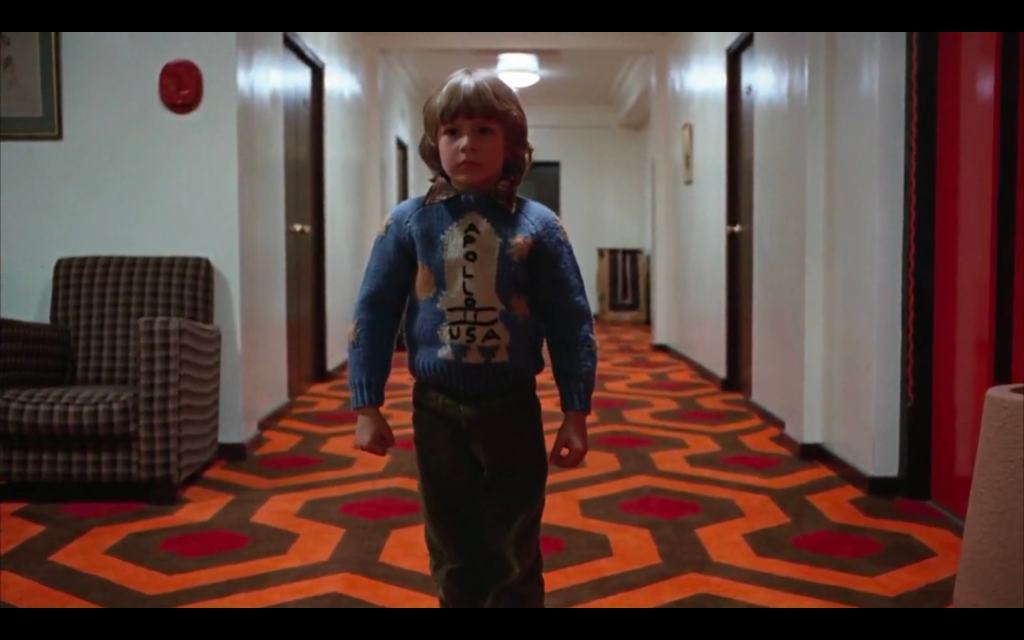
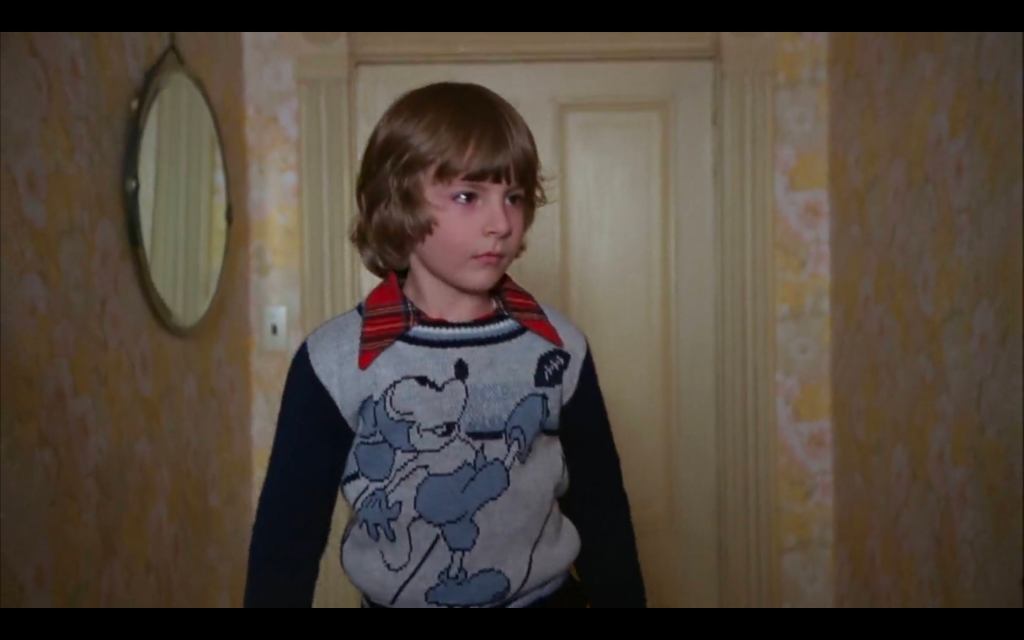
Brian Kent has noted that King’s Alice references are overt and not as artfully done as, say, Nabokov’s Alice references in Lolita (1955). And it happens that Kubrick also adapted Lolita, in 1962, eighteen years before The Shining. I was surprised to see Nabokov himself was credited with the screenplay, but apparently Kubrick changed pretty much all of it–control freak that he was. This is somewhat ironic given the extent of the commentary that The Shining is a commentary on fascism and the Holocaust–i.e., that Kubrick would be indicting the dictator Hitler when his own mode of working has been described as “dictatorial.” The Holocaust theory was always interesting to me in the context of his seeming to shift the significant period of the Overlook’s haunted history from the post-WWII forties in King’s version to the twenties. Even though the explicit references are to the twenties, like the flappers and the 1921 date on the photo at the end, one detail I’ve seen cited that Kubrick is addressing the advent of the Nazis that happened later is one of the sweaters Danny wears, one that has received a lot less attention than his Apollo 11 sweater (the one that’s a major piece of (circumstantial) evidence that the movie is really Kubrick’s secret confession he filmed the fake moon landing). I’m talking about the sweater with Mickey Mouse on it kicking a football.
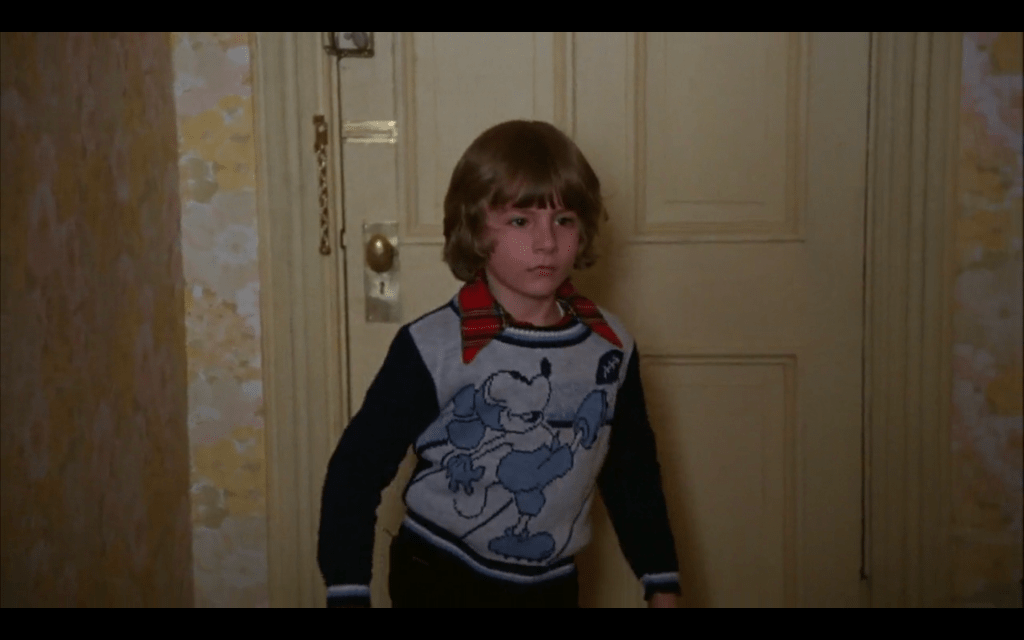
Danny wears this in the scene where he talks to Jack in the apartment, who’s shown at the beginning of the scene reflected in a mirror (twinned because you can see him and the reflection). This echoes the Jungian parental complex Curran talks about King getting at with his Bluebeard and Alice references in both Danny and Alice being under threat of beheading by parent or parental figure (43). Jung describes the child’s “imago” of the parent figure, or image that’s part the parent figure but part derived from or a projection by the child himself, so it is “‘therefore an image that reflects the object with very considerable qualifications’” (44). A picture in your brain can hurt you…

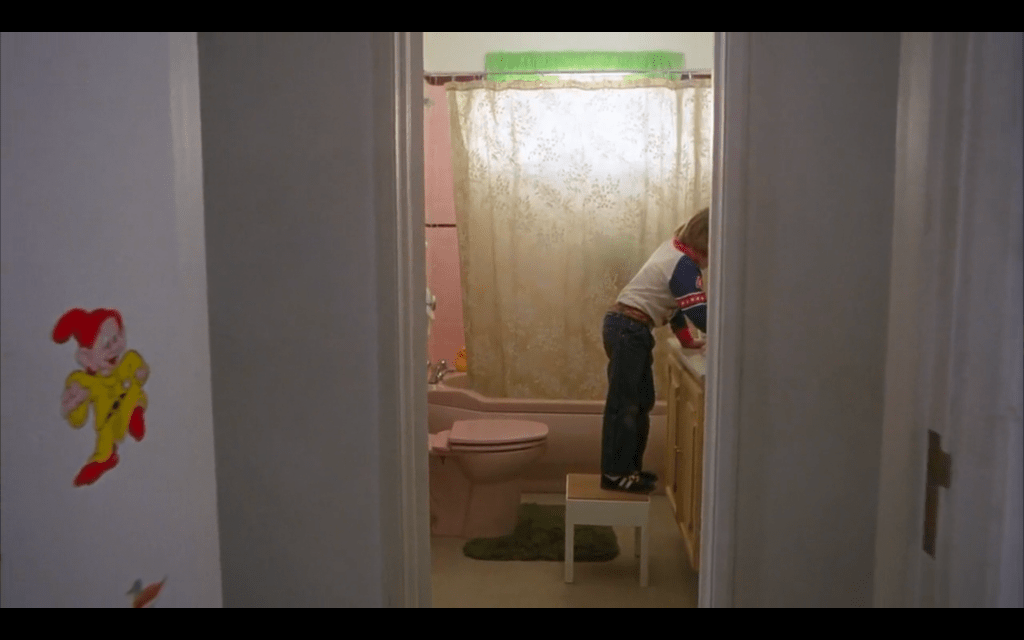
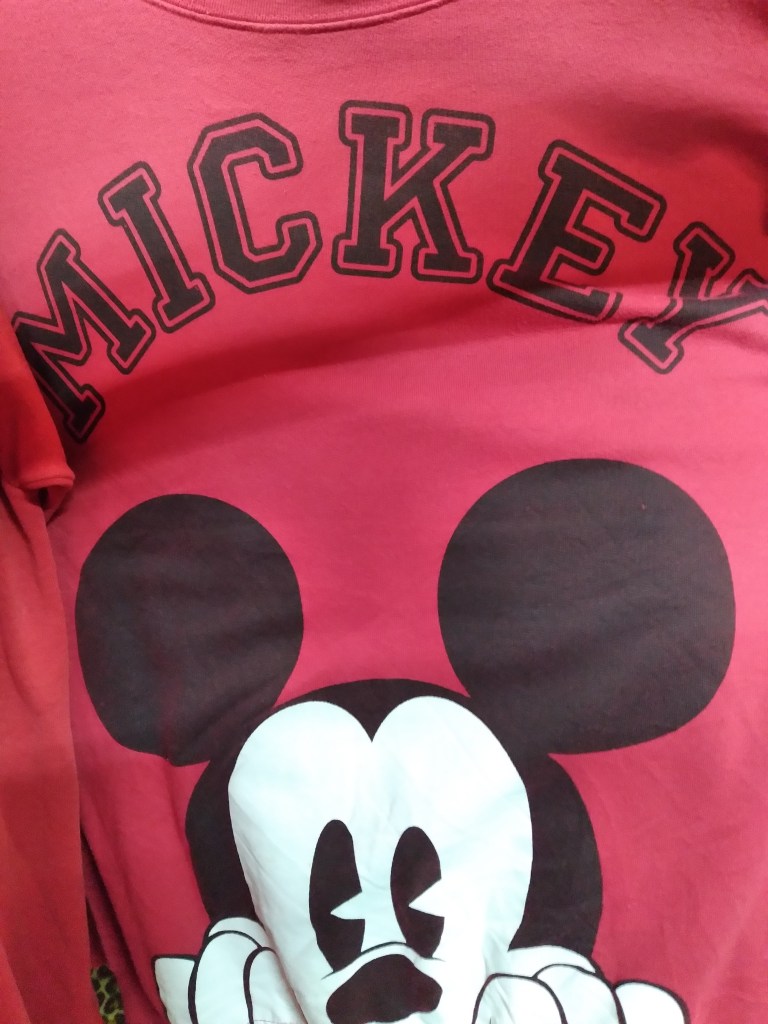
But someone has argued Mickey’s posture on Danny’s sweater in this scene looks like a “goose-stepping” Nazi. Now, when you look at the images of Nazis goose-stepping next to the sweater (which you can see through that link), you can see a likeness. But Kubrick did not include an image of goose-stepping Nazis anywhere in a frame or the scene with the Mickey image itself to draw out this likeness–not like he did when he had Shelley Duvall’s Wendy wearing the exact same outfit as a Goofy figurine you can see in the same scene as her wearing this outfit–red shirt, blue jumper, yellow shoes. The shoes are kind of the kicker, so to speak, in forcing you to admit that yeah, it’s the exact same outfit. (The site here suggests Kubrick might have wanted to emphasize Duvall’s general aesthetic likeness to Goofy.) The shoes are also the kicker in this sense when it comes to the claim that the dress the Grady twins are wearing is Alice’s dress. The dress doesn’t look exactly the same, but the shoes do. It’s the white smock that’s such a significant part of the Alice dress that the twins seem to be missing, though if you look at a photo of the twin actresses on set, the bottom half of the dress appears a lot more like a white smock than it does in the hallway shots. Also, some sites list the twins’ characters’ names as “Alexa and Alexie,” which would be very Alice-like, except their first names are never stated in the film, so I have no idea where those names are supposed to be coming from. 

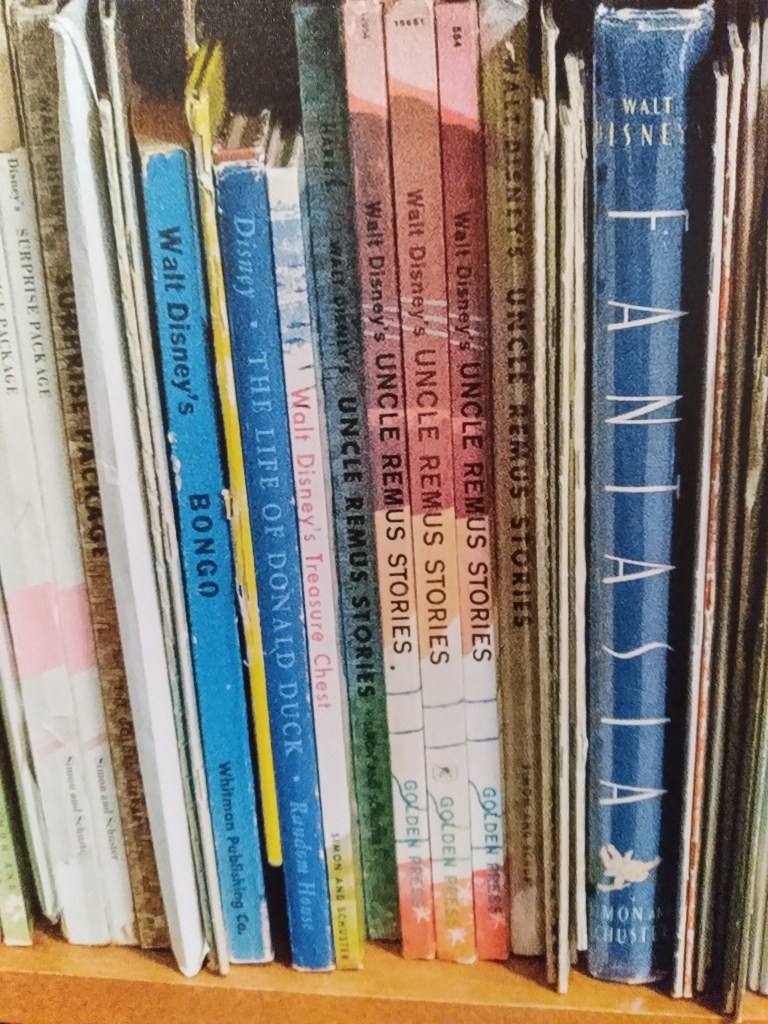
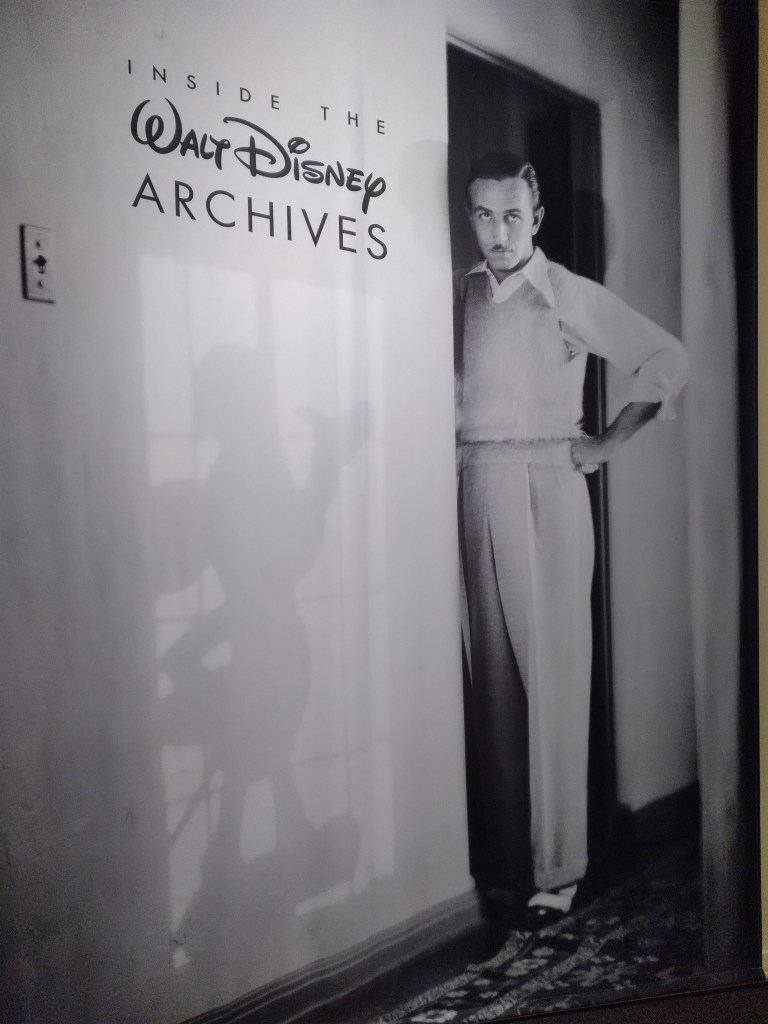
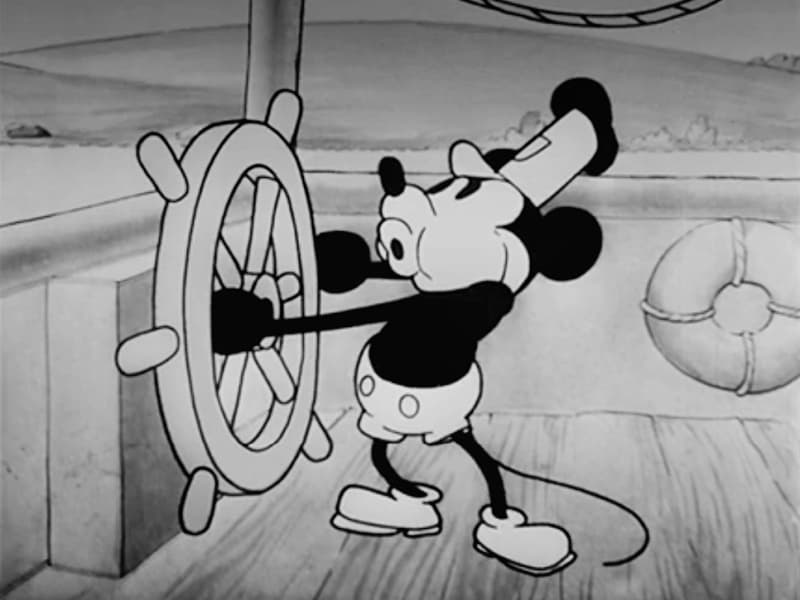
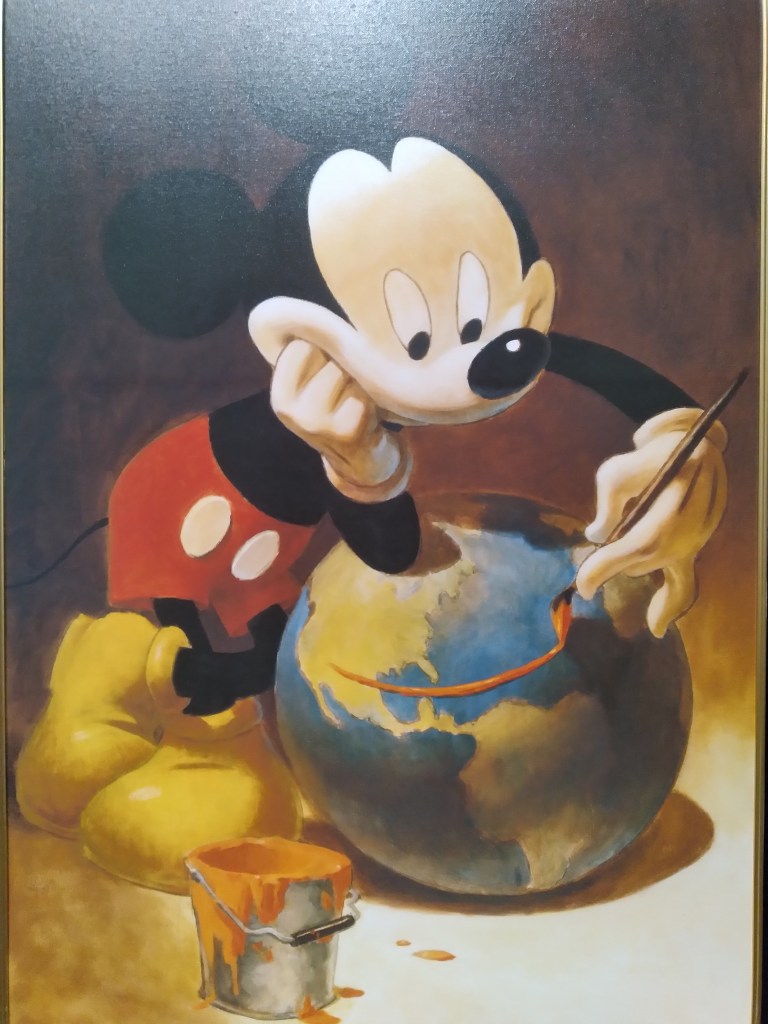
Most people probably think Mickey Mouse was Disney’s originating character, responsible for launching the company. Disney liked to foster this idea by saying “remember this all started with a mouse,” something he said during the first episode of Disneyland in 1954 (Bumstead 48), but that’s not true. It all started with Alice. In the years 1923 to 1927 (circa the haunted timeline in Kubrick’s Shining), Disney made 52 “Alice comedies” that were a hybrid of a live actress in an animated world. Then “Steamboat Willie” launched Mickey into the stratosphere in 1928. Kubrick’s film is in effect symbolically showing this: 

​​Alice’s presence in Disney’s first hit series encouraged audiences of all ages to invest in the hermetic reality of an animated world, and trust Disney’s creative authority as the producer of that world. But as the series continued, Alice’s role as the audience’s avatar in an imaginary world became less necessary. Disney’s animated world transcended the realness of a live-action girl: he achieved a synthesis between nature and technology, turning a technological world of his own making into a new nature. In other words, he naturalized his technologically produced landscape, teaching his audiences to accept his personal imaginary world as a common, universal one. And once Disney’s dominion was established, Alice was no longer needed (Elza 23).

So going back to Nazi Mickey on Danny’s sweater: MICKEY MURDERED ALICE. 

The scene where Wendy is dressed like Goofy is right after Danny’s passed out after talking to Tony IN A MIRROR and seeing images of the Overlook for the very first time. These images are the blood pouring from the elevator with a quick flash of the Grady nontwins in between–while they’re still alive, not the image of them after they’re ax-murdered (by Mickey). We’ll recall that the scene with the Mickey sweater comes right after Danny’s seen the nontwins in the hallway, both their alive and ax-murdered images (so two different versions of them). The twins tell him to come play with them “forever…and ever…and ever.” In the following Mickey-sweater scene, Danny asks Jack if he likes the hotel and Jack says he loves it and that he wishes they could stay there “forever, and ever, and ever.” Bit of a red flag there. This is an explicit connection to the previous nontwins scene, which thus connects Mickey to the nontwins and their ax murder. Right after Jack says the forever line, Danny asks “‘You’d never hurt Mommy or me, would you?’” which could indicate that Danny thinks Jack echoing the nontwins’ line means he poses the potential to hurt him because he thinks the nontwins have the potential to hurt him–echoing King’s framing of the pictures in a book in the novel in relation to the potential to harm–or could indicate Danny thinks Jack could kill him to make him stay there forever like the nontwins’ father did to them, but either way, the image of Mickey is linked to the idea of the potential to do harm, certainly of the type the consuming public would think he would “never” do.  

Apparently there was a line cut from the movie that refers to Jack reading Bluebeard to Danny as a bedtime story (McAvoy 355). Co-screenwriter Diane Johnson acknowledges that the idea of using fairytales in the film partly came from King but that “‘Bluebeard wasn’t really the prototype.’” Yet the deleted Bluebeard reference would seem to contradict this. Alice never comes up in any of Johnson’s discussions of what she and Kubrick discussed while writing and making the film. Just like Mickey excised Alice–or rather, Disney himself did using Mickey (kind of like the Overlook uses Jack to carry out murder)–Johnson excises Bluebeard and Alice by extension, as those two stories are inextricably linked in the novel version.

There is a theory of abuse latent in the Mickey-sweater scene that would implicitly connect to Nabokov connecting Lolita to Alice and calling Lewis Carroll “‘the first Humbert Humbert'” (Joyce 339). The theory of this abuse occurring would seem far-fetched, but might be less so considering Kubrick worked with Nabokov on adapting Lolita. This theory posits both Danny’s and Jack’s experiences in the bathroom of Room 237 are dreams expressing their respective emotions about this abuse–and of course in Alice, Carroll’s and Disney’s alike, it was all a dream. There was also a “real” Alice, Alice Liddell, who is the inspiration for Carroll’s book and who might have potentially experienced some real harm from Carroll, or at the least interest on his part that was not innocent. The evidence as to whether Carroll ever acted on what very much appears to be a non-innocent interest in young girls is inconclusive, just as this theory about whether Jack abused Danny in that way is inconclusive.

So the question is begged, in the context of both versions of Alice starting with her thinking about books without pictures, did Alice influence this idea in the novel? Kubrick places the line adjacent to the Alice nontwins without repeating it elsewhere, again seeming to possibly hint he’s utilizing and building on the Alice motif in the novel, including the nontwins expressing the idea to come play, with a major theme in Alice being the importance of childhood play and imagination, hence Kubrick framing the picture idea as not being real, connecting more to imagination, rather than referring to an explicit potential for harm. Kubrick utilizes and builds on King’s source material, including but not limited to King’s Alice motif, in a way that echoes the way Disney built on Carroll’s source material: instead of thinking what’s the use of a book without pictures, Disney’s Alice says to her tutor “‘How can one possibly pay attention to a book without pictures in it?’” To which her tutor responds that there have been “many good books in this world without pictures,” to which Alice responds “‘In this world perhaps. But in my world, the books would be nothing but pictures.’” This in turn spurs her larger description of how her world will work that expresses the essence of how Wonderland works in Carroll’s version but which is never explicitly stated this way in Carroll’s version: “‘Nothing would be what it is, because everything would be what it isn’t. And contrariwise, what it is, it wouldn’t be, and what it wouldn’t be, it would. You see?’” The way Kubrick utilizes and builds on King’s Alice motif is a microcosm of how he utilizes and builds on other aspects of King’s novel and thus representative of his approach to adaptation, but the way the (Disneyfied) Alice motif informs the movie’s climax (a la the hedge maze and Danny going back the way he came like Disney Alice does) renders it more significant on the whole. 

In the Disney version, Alice more explicitly pits word against image in a way that echoes a cornerstone of adaptation studies, as Matthew Holtmeier and Chelsea Wessels note: 

For Kamala Elliott, debates around fidelity are illustrative of the perceived rivalry between literature and film, which are the result of a longstanding hierarchy that places literature above the moving image and pits word against image. She responds to this false dichotomy by arguing that films include words and novels include images, but both discourses tend to reject these similarities in favor of emphasizing what the film or novel can or cannot do. Elliott writes that “the novel’s retreat from its own pictorial aspirations is followed by a taunt that film cannot follow” (11). Instead of placing the two mediums in opposition, Elliot suggests that they might be “reciprocal looking glasses,” which offer “an endless series of inversions and reversals” (209–12). This view of the relationship between word and image, which Stam and others might see as an intertextual approach to adaptation, emphasizes the interdependence of texts in the adaptation process. In this case, while King might author the “original” text that provides a starting point for an adaptation, each adaptation is also informed by other adaptations that have tackled similar subjects.

The Alice motif affects Kubrick’s version on narrative and thematic levels; Palmer Rampell reads King’s Overlook as symbolic of Doubleday and his contractual obligations to it (he was not happy with this contract) and Kubrick’s Overlook as symbolic of the controlling capitalist entity he had a contract with, Warner Bros. Disney thematically connects to evil media overlords, but Kubrick as a figure also shares a significant likeness to Disney in, as Thomas Leitch argues, building a reputation as an auteur exclusively from adaptations. Hitchcock is the third figure Leitch ties into this auteur-adapter discussion, which mentions King at the end as an afterthought:

No less than Disney do Hitchcock and Kubrick imply corporate models of authorship that seek to hide any signs of corporate production beneath the apparently creative hand of a single author whose work–that is, whose intentions, whose consistency, whose paternal individual care for the franchise, even if that franchise is as suspenseful as Hitchcock’s, as prickly as Kubrick’s, or as horrific as Stephen King’s–can be trusted.

This implicitly highlights that King himself is an adapter (one of the aspects I’ve connected to his Disneyization), but unlike Kubrick and Disney and Hitchcock, King’s version of adapting goes beyond adapting one specific text but rather integrates elements from several that he then gets to present as his own “original” material. 

One text about Kubrick entitled Stanley Kubrick: Adapting the Sublime (2013) notes 

The structural and stylistic patterns that characterize Kubrick adaptations seem to criticize scientific reasoning, causality, and traditional semantics. In the history of cinema, Kubrick can be considered a modernist auteur. In particular, he can be regarded as an heir of the modernist avant-garde of the 1920s.

That first line would certainly align Kubrick’s subjects of critique with Carroll’s in Alice. The second line gets at the implicit Disney connection of being a corporate auteur. And the final line identifies his heirship from the decade Disney was ascendant, and if this analysis is referring to more literary forebears in the designation “modernist avant-garde,” Disney should in no sense be excluded from this category in introducing and developing one of the most groundbreaking forms of narrative (i.e., animation) in this decade. As Cary Elza notes: 

Without Alice, who functioned as a historically significant character, as an image rich with references, and importantly, as a representative of childhood innocence and the transformative power of imagination, Disney’s body of work might have been something very different – perhaps not as successful with audiences, who rewarded Disney’s mix of live action and animated antics with box office success, or with artists and critics like Sergei Eisenstein and Walter Benjamin, who saw nothing short of the sublime in Disney’s paradoxical use of technology to produce irrational flights of fancy (see Benjamin, 2002: 344–413; Eisenstein, 1986).

Walter Metz refers to The Shining’s “dominant horror film intertext, Psycho (Alfred Hitchcock, 1960)” (44) and offers an intertextual reading of Kubrick’s film as combining elements from the horror of the supernatural and from the family melodrama, using for the latter a film called Bigger Than Life (1956). I’d read The Shining as combining Psycho and Disney’s Alice, which would offer it as an effective representation of Thomas Leitch’s analysis of the big three auteurs who established themselves as such specifically through adaptations–Kubrick, Hitchcock, and Disney.   

The way Alice is fundamental to Kubrick’s adaptation, narratively and thematically, echoes how Alice is fundamental to Disney as a company–starting off with filming a live actress in a world of animation largely due to budget, a live girl in an animated world is itself an apt version of Carroll’s Wonderland, a girl in a world fundamentally different from her own. To quote Elza again, 

Disney’s early interpretation of Alice in Wonderland opened the door to an animated realm made natural and universal by her presence, and his use of media technology helped persuade audiences to come along for the adventure (9).

One of the theories in Room 237 is about Jack representing the minotaur who is imprisoned in a labyrinth in the Greek myth Theseus and the Minotaur, which makes symbolic sense. One of the (seemingly extraneous) details supporting this theory in Room 237 is a poster with a skier on it resembling a minotaur in the room where Danny is playing darts–which is visible in the frame when he turns around and sees the Alice nontwins. Which could mean that the minotaur link is a byproduct of the Alice-inspired labyrinth and not the original source of it. But that would be building off one of those idiosyncratic details of stretched circumstantial evidence. 

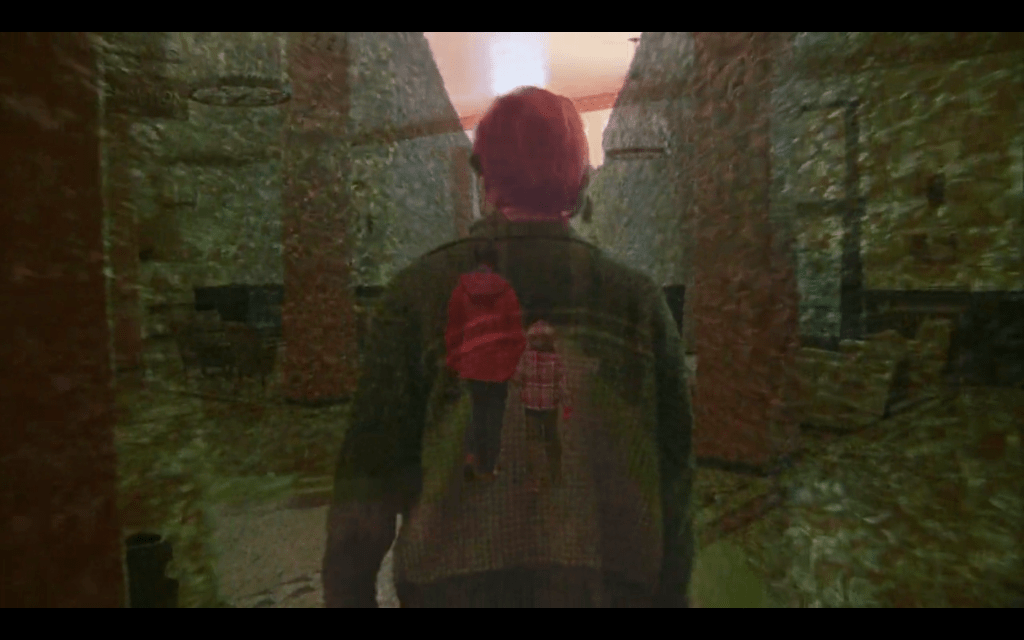
It’s started to seem to me that the rabbit hole of Shining-interpretation theories can drive one as mad as the Mad Hatter, and that when you go down this rabbit hole via the YouTube algorithm, it does feel like you’ve entered Wonderland itself–a land of nonsense. Except there’s a degree of logic in Wonderland’s nonsense that surpasses the logic of a lot of these theories. Possibly one of the craziest theories, or collection of theories, I’ve seen is from a guy who’s named his site on the project “Eye Scream,” who’s done a bunch of time-code and page-number analyses of where things line up. The issue with the page-number thing–in King’s novel Danny enters Room 217 on page 217!–is that he’s using the paperback edition, when the first-edition hardback would not have had the same page numbers, and King would have had no concept of what the pagination of the final published version would be as he was writing it. (Also, I have the paperback edition he’s using and Danny technically enters Room 217 on page 216.) This guy is also obsessed with the “mirrorform” version of the film, where you play the film backwards from the end superimposed over it playing from the beginning. That would seem to derive from Alice-related themes–the idea that “the film is meant to be watched forwards and backwards simultaneously” is a thematic echo of Danny going backward over his forward footsteps in the maze–though Alice doesn’t come up very prominently in his discussions. Elements of things he says make more sense than others; some of the lines and diagrams he draws look like that classic crazy conspiracy-theorist mood board. He has done an extensive cataloguing of the hundreds of pieces of art that show up in the film (if drawing some very questionable conclusions from a lot of them, and pulling from images in the film that make it very hard to tell how the piece of art is even recognizable from how small and blurry it appears). He also mentions Stith Thompson’s Motif-Index of Folk-Literature and claims that Kubrick has left numbers correlated to the tales he references throughout the film (again often pointing to images claiming the numbers are on it that to me seem illegible). 

There’s a fine line between exhaustive and exhausting. Though this is probably bringing up some of my insecurities about how consumed I generally am with analyzing Stephen King. Like wanting to create a correlating index of King’s work using Thompson’s folklore index…

Possibly the worst theory ever is “The Wendy Theory,” which posits Wendy hallucinates most of the events in the film (including ones she’s not present for) and is a paranoid schizophrenic who’s really the one who hurt Danny (unsurprisingly, other YouTubers have debunked this). One of the many shoddy pieces of evidence for this theory is that Wendy is reading The Catcher in the Rye in one scene, which is a book that has inspired unstable people to commit violence. This would seem to primarily refer to two famous instances, Mark David Chapman citing it in relation to his assassination of John Lennon, and John Hinkley, Jr. citing it in relation to his attempted assassination of Ronald Reagan. Both occurred after–very shortly after, but after–the release of The Shining in 1980 (Lennon was assassinated a few months after the film was released) and 1981, respectively. Which means the theory should be that Wendy reading that book in The Shining is actually the cause of these two events…

One of the Eye Scream theories made me think more about Lennon’s assassination, which there are conspiracy theories King was involved with because he bears a likeness to Chapman. The Eye Scream guy has a “Redrum Road” section about correlations between the film and The Beatles’ album Abbey Road, inspired by the shots when Jack and Wendy are touring the hotel when they first arrive with Ullman and his assistant and they walk in a line of four that resembles the Beatles on the Abbey Road cover. They do look kind of like that, but any extrapolations based on the resemblance are about as much of a stretch as the idea that King killed Lennon. 

Lennon was a fan of Carroll’s Alice books, which partially inspired his song “I Am the Walrus,” which he explicated in a 1980 Playboy interview:

It never dawned on me that Lewis Carroll was commenting on the capitalist system. I never went into that bit about what he really meant, like people are doing with the Beatles’ work. Later, I went back and looked at it and realized that the walrus was the bad guy in the story and the carpenter was the good guy. I thought, Oh, shit, I picked the wrong guy. I should have said, ‘I am the carpenter.’ But that wouldn’t have been the same, would it? [Sings, laughing] ‘I am the carpenter …’ 

People probably would have thought the song was about Jesus, in that case. Lennon demonstrates misinterpretation at work. One can certainly see the nonsense influence on the song (“goo goo g’joob”) and it also references Edgar Allen Poe. So maybe it did influence The Shining… If it seems like I’ve gone on too much of a tangent, recall that it was a Lennon lyric that inspired The Shining in the first place–“we all shine on.” Surely there must be some larger connection here… 

Kubrick noted his gravitation toward adapting novels that prioritized the inner lives of the characters that he could then render externally through action: 

The perfect novel from which to make a movie is, I think, not the novel of action but, on the contrary, the novel which is mainly concerned with the inner life of its characters. It will give the adaptor an absolute compass bearing, as it were, on what a character is thinking or feeling at any given moment of the story. And from this he can invent action which will be an objective content, will accurately dramatise this in an implicit, off-the-nose way without resorting to having the actors deliver literal statements of meaning (n.p.) (qtd in Allen 362).

This might implicitly highlight something that’s fundamentally “Kingesque”–King somehow writes texts that are both inherently “cinematic” and visual yet conversely depend significantly on rendering the inner lives of the characters. Regardless, this seems to offer a sort of key to Kubrick’s approach to adaptation in giving himself a foundation that necessarily calls for his own inventions: in his source texts he’s looking for a template that cannot be translated to film directly, that will necessarily have to be changed. Given the element of control that’s so central to his auteur persona, this aspect seems critical to his feeling in control of the source text rather than the source text controlling him when it comes to fidelity. Alice–more specifically, Alice’s significance to the history of animation via Disney–echoes this idea thematically; Disney maintained control by concealing the evidence of his control: 

The fact that Carroll depicts the original Wonderland as the product of a little girl’s reverie, then, allows him to present his own vision of a childhood world as if it came from an unimpeachable source. Likewise, Disney’s interest in nostalgia, in capturing the perspective of the child and a vision of utopia, meant that he didn’t want, exactly, to give independent life to a universe he himself was depicted as creating; instead, he wanted to first establish the authenticity, the authority of his universe as coming from a little girl’s imagination, then make it independent. To make this work, the ‘hand of the artist’ trope was largely absent from the Alice shorts (Elza 14).

As Thomas Leitch puts it, a similarity between Kubrick, Hitchcock and Disney is their engagement with “corporate models of authorship that seek to hide any signs of corporate production” (120). 

In terms of the connection between Kubrick and Disney, the construction of their auteur personae around the extent of control they exercised over their corporate-artistic endeavors would seem to be the most significant. I’ve written about how King took cues from Disney in the construction of his brand persona (Uncle Walt, Uncle Steve, Uncle…Al); I don’t think Kubrick took cues from Disney so much as operated on a parallel track. (Being nineteen years older than Kubrick would be less subject to Disney as an influential figure.) Disney had to change dark fairy tales and append happy endings to be marketable to children…Kubrick just wanted the changes in his adaptations to reflect his own genius and control, I guess. At any rate, in taking the hedge maze from Disney’s Alice, Kubrick created an apt metaphor for the foundational aspect of what he looked for in his source material: the maze creates a parallel exterior version of the interior of the Overlook (which Wendy explicitly refers to as “an enormous maze”)–which Kubrick also shows a microcosm of inside the Overlook itself, with Jack overlooking it, which one analysis reads as meaning the maze represents Jack’s psychological state. It also is a fixture with the potential for horror/creepiness that doesn’t rely on the outright supernatural, as King’s use of the topiary animals does. In terms of idiosyncratic interpretations and how far they might stretch deductions from evidence, the whole psychological versus supernatural aspect of The Shining itself plays out this process. That Kubrick maintains more ambiguity in downplaying aspects that can be defended as outright supernatural from King’s novel, a la the hedge animals versus the hedge maze, might to some degree explain why his Shining is one of the most (over)interpreted texts of all time. 

There’s a likeness between Kubrick and Disney as auteurs in perpetuating a false image, or maybe to put it more kindly, a myth, as we see Disney do with the claim “this all started with a mouse.” The book Stanley Kubrick Produces (2021) mainly addresses the myth Kubrick constructed about his own all-encompassing control:

He’d always wanted control and information, even when working as a photographer throughout his late teens and early twenties at Look magazine. To relinquish control meant that Kubrick would have to do things other people’s way, and that just wasn’t his way. The narrative of Kubrick’s life is all about control and was from the very beginning.

So maybe Kubrick, a la the moon-landing theory, feels guilty to some degree about this dishonest representation regarding his own control and, in this subliminal representation of Mickey murdering Alice(s), is pointing out how Disney did the same thing. Obviously in connecting this to the moon-landing theory (that other sweater-based theory), I’m being facetious and pointing out this is a stretch; I doubt Kubrick would really have experienced any guilt over a dishonest representation of his own persona. Then again, given the extent of the film’s themes in relation to the unconscious (and strategies to manipulate it), it does beg the question of what of Kubrick’s own unconscious might be manifesting here. The crux of his reputation (and in turn of the film’s being overinterpreted, or interpreted…to death) is his intentionality, but even a man so supposedly conscious of every little detail still has to have an unconscious. 

Blood In An Elevator

Kubrick uses the Overlook’s elevator differently from King’s version, where the elevator plays a critical role when Jack tries to deny he saw anything in the ballroom and Wendy finds party favors in the elevator that she uses to call out his lie. So it’s something inside the elevator that provides concrete evidence of the supernatural (and also the elevator running seemingly of its own accord, though you could ascribe that to a mechanical malfunction, or as Jack tries to, “a short circuit”; the party favors can’t be explained away). The blood tide pouring from the elevator is one of the film’s most significant changes from the book (and, as noted, is first shown in conjunction with the Alice-like nontwins). It’s striking that this image is rendered not as the elevator doors opening and the blood pouring out from inside them; the elevator doors remain closed the whole time, and the blood is pouring from somewhere outside them.

In terms of deviations from source texts, I have been searching for a satisfactory answer as to where Disney got the idea for the hedge maze in his Alice that’s not in Carroll’s version, and where Kubrick got the ideas for the hedge maze and blood tide. For the latter, Google AI responds: 

Stanley Kubrick got the idea for the hedge maze from his own anxieties and the limitations of special effects at the time. While Stephen King’s novel featured hedge animals that attacked Danny, Kubrick replaced them with a hedge maze because the technology to create realistic animated hedge animals wasn’t available. Kubrick’s creative decision was to represent Jack’s psychological state through a maze and to visually link it to the hotel’s exterior architecture, notes Colorado Public Radio and Reddit users.  

Other discussions (included in that Reddit thread) reinforce that Kubrick wanted to downplay the supernatural aspects to make them seem more possibly psychological than the progression of this question in King’s text. So the budget thing is just wrong, as is that the hedge animals “attack” Danny in the novel. (Don’t trust AI!)

The answer for Disney’s labyrinth idea: 

Disney’s idea for a maze-like structure is rooted in the original Disneyland park’s planned but unbuilt Alice in Wonderland hedge maze, with the actual attraction, “Alice’s Curious Labyrinth,” first realized at Disneyland Paris in 1992. The concept was inspired by Britain’s history of hedge mazes and the visually confusing, labyrinth-like nature of Wonderland itself in Lewis Carroll’s books. … Time and budget constraints: Due to time and budget limitations, the maze concept was put aside, and the park opened with a dark ride attraction instead.

Both answers claim a budget constraint motivation… a contradictory one since the hedge maze was too expensive for Disney and supposedly the affordable option for Kubrick. And both seem to claim the maze as a metaphorical representation with no concrete referent (I’m arguing for Disney’s Alice maze being Kubrick’s concrete referent; I guess the description implies the Overlook itself was his concrete referent, but I still think Alice could have helped get him there). The British hedge maze begs the question why Carroll, being British, wouldn’t have included this himself. (Kubrick lived in Britain–and filmed The Shining in Britain–but Disney didn’t.) By that same admittedly inconclusive logic, Kubrick was apparently a master chess player, and the explicit layout of the geography in Carroll’s Through The Looking-Glass is of Alice advancing over a chessboard, begging the question why Kubrick wouldn’t incorporate that aspect, and so showing he’s focused more on the Disney version than Carroll’s–but not really; what could he have done with this, made a hedge chessboard? Maybe, but that wouldn’t work with the ending… I guess I’ll just have to go to the Kubrick Archives (in London) and figure out at what stage of the writing the maze became pivotal to the climax of the entire thing. 

Andrew Bumstead, working in the framework of Linda Hutcheon’s “participatory mode” of adaptations, compares two Disney theme park Alice attractions that are not the labyrinth and finds that they “differ wildly” in terms of reinforcing children’s capitulation to adult authority (the dark ride which contains horrifying elements that cause children to revert in fear to their parents as protectors) and reinforcing children having their own agency (the spinning teacup ride where children have access to the wheel to control the cup’s spinning) (49). That a major change in Disney’s adaptation of the film was rooted in his theme park concept aligns with his synergistic strategies: the movie was released in 1951 as they were planning the park; the first episode of Disneyland in which he metaphorically offs Alice in favor of Mickey airs in 1954 while the first park is under construction, and he essentially created the show to discuss and promote the upcoming opening of the park. (And this is all in the same decade Kubrick started directing.) It’s tempting to read the conceived hedge maze attraction as Disney paying homage to Alice in this pivotal process of expanding the Disney brand into parks and television to assuage some kind of guilt over her displacement in the company’s origin story. Or to read this maze as a representation of his own psychological state over this like it represents Jack’s in The Shining. Alice’s influence on the park would seem to extend beyond the labyrinth; as she started the entire company in the twenties, Wonderland conceptually would seem to be behind the entire theme park layout being “lands”: Adventureland, Fantasyland, Tomorrowland, and Frontierland. (Not to mention the major Disney trope of anthropomorphization prominent in Carroll’s texts.) But, as with Kubrick, I doubt he really felt any guilt, at least not consciously; honestly both Kubrick and Disney could have been sociopaths, which might complicate trying to read their unconscious(es).  

One video analyzes the “Red Book” that’s visible sitting on Ullman’s desk in Jack’s interview and connects this to a Jungian analysis of how the Overlook represents the unconscious; this creator seemed shook when a commenter pointed out: 

There is another meaning to that RED BOOK and anyone who has ever managed in the hospitality industry knows what the Red Book is for…. The Red Book is a communication tool between managers, when a shift ends and another begins, the incoming manager reads ‘the story’ of the day before. 

The creator then posted a video that he was “wrong” about the Red Book and still tried to defend other aspects of his theory but had presented the Red Book itself, a concrete object, as the key that connected all the pieces of his theory, with the first video subtitled “How A Red Book Could Explain Everything.” Many commenters on the first video seem content to believe the Red Book can be both things and have a double meaning: “The mundane industry log and metaphysical key to the psyche in a simple understated prop. I love Kubrick.” (This double meaning would seem to be indicative of spiritual literacy.) Co-screenwriter Diane Johnson seems to mention Freud more as an influence on the screenplay than Jung, which is interesting considering Kubrick’s interest in working with her stemmed from her 1974 novel The Shadow Knows (categorized as “psychological horror”). Surprisingly, this Jungian analysis of The Shining mentions that the blood pouring from the elevator likely represents the blood of Native Americans, but says nothing about Jung’s vision that he depicted in the Red Book of the “River of Blood” that essentially seems like a prediction or prophetic vision of World War I. The video here goes into a fair amount of detail about the contents of the Red Book and what led to them (Jung’s break with Freud which undermined his career trajectory), also describing the “killing frost dreams” Jung had a few months after the River of Blood vision, in which frost killed all living things–which strongly recalls Jack’s death in Kubrick’s version. The Red Book explicates (and illustrates–a book with pictures that Alice would have approved of) Jung exploring the symbols in his own unconscious, and might well be the real key to the multitude of interpretations of The Shining–its utilization of symbols from the collective unconscious that speak to so many in different ways and on different levels. (It seems like an oversight that the Adapting the Sublime book about Kubrick doesn’t mention Jung at all, as Kubrick’s interest in Jung has been documented and explicitly acknowledged in his film after The Shining, Full Metal Jacket (1987).) The initial reviews of The Shining that were so confounded by it thought it leaned too much on archetypes (a Jungian concept) (Blankier 3), but it’s these archetypes that allow it to reach an emotional level that’s ironic in light of King’s “hot v. cold” analysis: 

According to James Naremore, ‘The emotions [Kubrick] elicits are primal but mixed; the fear is charged with humor [sic] and the laughter is both liberating and defensive.’7 Because this alternating register is based so deeply in emotion rather than intellect, The Shining refuses to be interpreted neatly on a social or cognitive level. (Blankier 4) 

Jung was a mystic, in touch enough with the collective unconscious to have visions that to some degree seemed prophetic. I haven’t seen anyone citing evidence that Kubrick’s depictions in his films amounted to anything prophetic, i.e., future-predicting, even if artistically he’s been credited with “visions.” King would definitely seem to be more in that camp (though maybe Kubrick showing Wendy reading Catcher in the Rye combined with the Abbey Road configurations amounts to a prophetic vision of Lennon’s assassination, if not a “cause” of it). To shine, in effect, might be a rendering of this mystical power or intuition. There is King’s depiction of reality TV and someone flying a plane into a building at the end of The Running Man (1982), and his Trump-like depiction of Greg Stillson in The Dead Zone (1979)–and Trump is essentially the mashup of the reality-television and insane-president pseudo-prophecies. There’s also his depiction of a global flu pandemic in The Stand (1978). In The Stand, he has a character cite the poem “The Second Coming” by William Butler Yeats (1920), a poet who has also been described as a mystic; King refers to the line “the center does not hold” from the poem (a misquote of “the centre cannot hold”), which then goes on to describe: “The blood-dimmed tide is loosed, and everywhere / The ceremony of innocence is drowned.” Like the elevator blood drowning the Alices… This poem amounts to a motif in The Stand so if King was so familiar with it, it almost seems like the “blood-dimmed tide” should have been in the novel version of The Shining–especially if you look at the prologue King wrote for The Shining that was cut from the novel but published in 1982, in which he describes the history of its construction and “the rising tide of red ink” its original constructor, Bob T. Watson, had to face so that he eventually had to sell and strike a deal for his family to be the hotel’s lifelong “maintenance workers” starting in 1915: “‘If we’re janitors,” Bob T. had once told his son, ‘then that thing going on over in France is nothing but a barroom squabble.’” “That thing going on over in France” being what Jung’s river of blood vision was in reference to.

Like their similar views on Bambi, King and Kubrick both have an interest in Jung, who believed in precognitive powers and who King connects to Poe in The Shining‘s sequel Doctor Sleep (2013), the same novel he has a character have a precognitive awareness re 9/11:

“The dreamer believes he is awake,” Kemmer said. “Jung made much of this, even ascribing precognitive powers to these dreams . . . but of course we know better, don’t we, Dan?”

“Of course,” Dan had agreed.

“The poet Edgar Allan Poe described the false awakening phenomenon long before Carl Jung was born. He wrote, ‘All that we see or seem is but a dream within a dream.’”

Dan goes on to think:

The truth, however, was that one or both of his double dreams were often predictive, usually in ways he only half understood or did not understand at all.

I’m becoming increasingly convinced this is a truth that might well describe King himself… I mean, come on, the original tagline for the Running Man novel published in ’82 and written over a decade before that was “Welcome to America in 2025, where the best men don’t run for president, they run for their lives.” The novel was published during Reagan’s tenure, aka the first actor president who paved the way for Trump’s ascension via the false image of himself as a savvy businessman in pop-culture cameos from Home Alone 2 to The Fresh Prince of Bel-Air before parlaying that into the propagator of his image that’s the real uncanny connection to King’s text: “reality” television. That the ’87 adaptation features two celebrities who went on to become politicians, Schwarzenegger and Jesse Ventura–who plays, of all things, “Captain America”–further compounds the uncanny associations surrounding this text.

Lewis Carroll doesn’t seem to have had a reputation as a mystic like Yeats did, but “Alice expert and author of Through a Looking Glass Darkly” Jake Fior observes that “‘Carroll had a definite interest in the esoteric. I have a catalogue of his possessions, including his library, and he had lots of books on the supernatural’”; an exhibition associated with his book “will be a good opportunity for fans to go back to the darker side of the stories, something that the Disney cartoon version has almost obliterated.” Herein might lie the connection between Kubrick’s films Jungian references and its Alice ones, pointing out the dark side of Disney’s Alice–in being murdered by Mickey. 
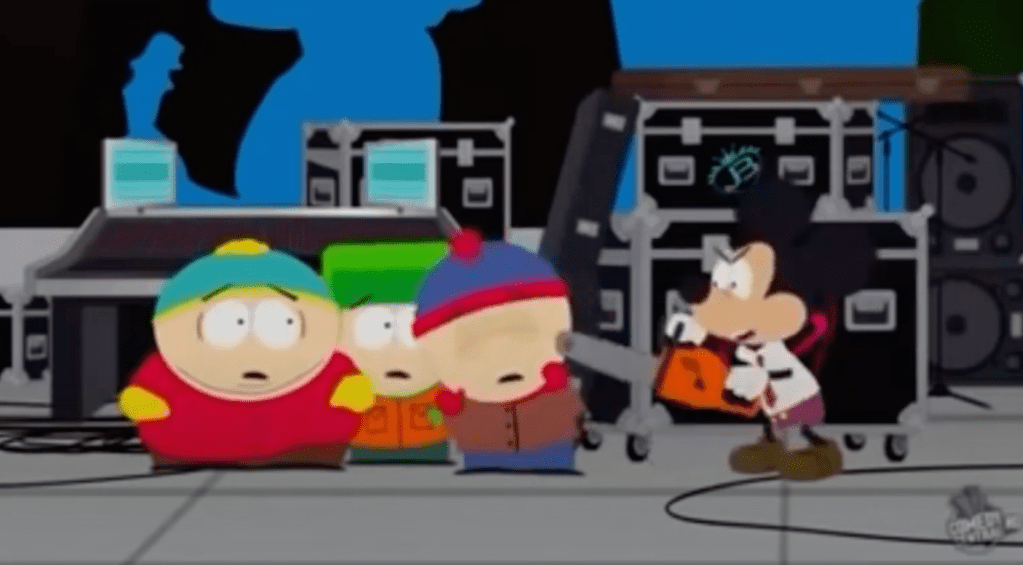
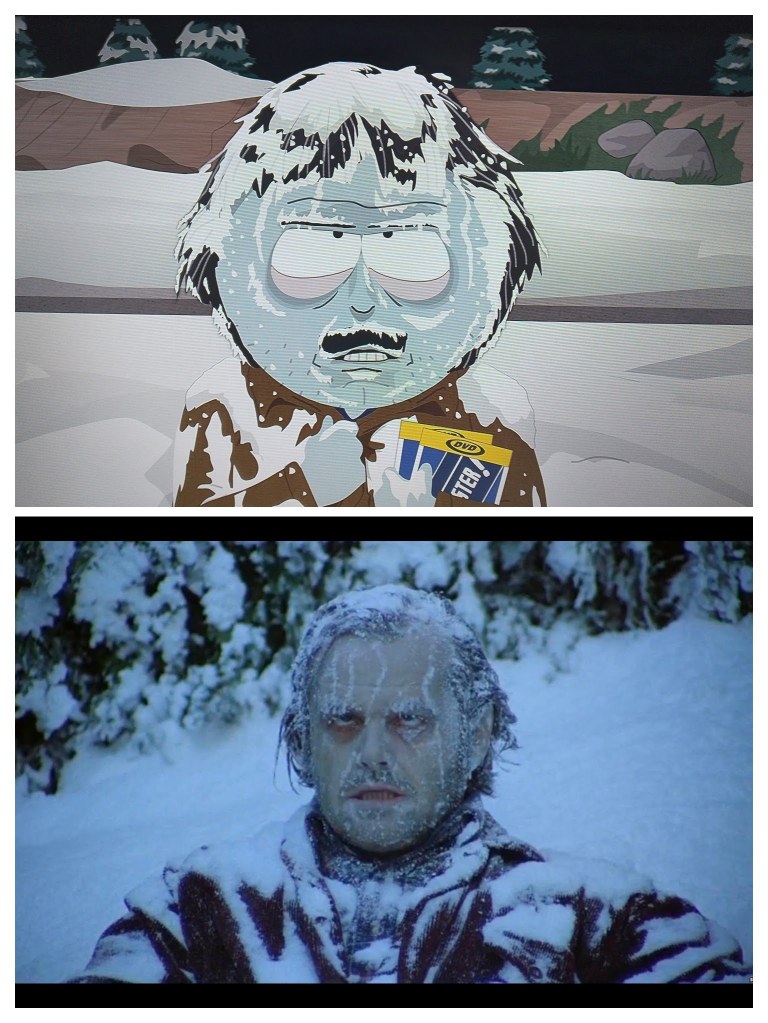
“I’ll cut you up, haha.” South Park 13.1, “The Ring,” March 11, 2009

Okay, logically, rationally, what I’m really arguing with the Alice/Mickey-sweater theory isn’t that Kubrick consciously depicted Disney offing Alice through Mickey, but that certain details–or pieces–align that illuminate an interesting parallel between these foundational myths that these two adapting auteurs constructed–Disney’s “it all started with a mouse” which sits at the locus of the synergistic strategies that represent his all-encompassing control, and Kubrick’s image of all-encompassing control that has played a significant role in the proliferation of theories surrounding the film and its meaning(s). So the (Disney) Alice labyrinth represents The Shining as a “maze of meaning-making,” to use Mr. Eye Scream’s phrase, and sheds light on the significance of myth in propagating auteurs in a corporate framework specifically. The more control you pretend to have, the more control you’ll get.  

Back to The Running Man

Before doing more research on the matter, I’d wondered if Danny’s Mickey football sweater might be a reference to a description of Jack expressing his anger as a high-school student by playing football. If there is peripheral evidence Kubrick is referencing this, it might be when he shows Jack wearing a “Stovington” shirt in another scene, which is an explicit novel reference, as it’s the high school Jack got fired from teaching from never referenced otherwise in the movie itself, except Jack noting he used to be a schoolteacher in his interview (but not where). 

Commentary on the new Running Man talks about the depiction of Ben Richards’ anger being accentuated in a way that’s true to the novel and was not represented in 1987 (one network employee testing Richards notes they’ve never had someone so angry apply, to which he replies “That really pisses me off”). King himself has commented on this, noting that he doesn’t feel so angry anymore as he did when he was writing it. Which is hardly surprising. If there’s plenty still to be angry about regarding the state of this country, King is not personally experiencing any of it, but is now just a witness. There’s some kind of implicit justification for the racist and homophobic things Ben says in the novel during the interview process just being provocative and not things he really thinks, but his thoughts elsewhere in the novel wouldn’t support this. As Katy O’Brian, who plays one of the other running “men” in the new film, notes:

I read the book, and I kind of thought the character that Glen plays is kind of dick. By modern standards, kind of disgusting. And when I read Edgar’s version of the script, I was like, “OK, he’s humanized a little bit, made him a little less—” He’s still angry but less hostile towards women. I think it was one of the main things that was shocking to me.

So yeah, if the “best men” are running for their lives in King’s version, then there are no good men…

The new movie depicts similar racial dynamics as the novel with the inclusion of Bradley Throckmorton, a Black man, inclined to help out Richards with the insinuation that they’re in the same oppressed position. To have this movie-star action figure white man (whose body is emphasized in an embellishment from the novel when he has to climb down the front of a building in a towel) represented as an oppressed minority is basically ridiculous. (They didn’t make Killian Black in this version as he is in the novel (he’s played by Josh Brolin), but the host of the show itself is Black (played by Colman Domingo).) I noted before that it might have been what was truly horrifying to King to have a white man be in a position that’s as oppressed as a Black man. But depicted in a 2025 movie, this reads as basically tone-deaf. Even if it makes a kind of sense that a white man would be the most angry at injustices leveled against him due to his inherent sense of entitlement and privilege being violated. I guess they tried to mitigate the tone-deafness by giving him a Black wife and a biracial baby. 

If Kubrick noted interiority versus exteriority as foundational to good source material, Arnold Schwarzenegger also has an opinion on the subject: he has given the new Running Man his blessing while taking the opportunity to bash the remake of Total Recall, which he’s apparently done before (seeming to have a bone to pick about this akin to King’s ongoing complaining about Kubrick’s adaptation). Schwarzenegger’s criteria for this is whether or not the original version was already “perfect,” and he thinks The Running Man, while it came out well, could have done more to develop its future environment with a bigger budget. Though really watching it now, the hilarious eighties conception of what a future environment looks like is one of the main reasons it’s worth watching (I’m looking at you and your 2015 fax machines, Back to the Future II). And at this rate the new Running Man has a lot of catching up to do budget-wise, having made about half what it cost to make. Schwarzenegger apparently criticized a decision the director made in his version that he “shot the movie like it was a television show, losing all the deeper themes” but another outlet noted the “tone changed from a dark allegory to a humorous action film with the change of the film’s star.” O, the blame game…

While the new Running Man keeps the structure and main beats from the source material, it plays with and embellishes these. In the first close-call sequence where Ben ends up blowing up a YMCA (now changed to a YVA) from the basement when he’s cornered, he runs into an elevator, and after the doors shut, the janitor standing there picks up a sign that’s fallen off of it that reads “Borken,” and says “‘Idiot.’” Ben ends up stuck between floors–or stories–and has a back and forth toss with a conveniently located grenade with the hunter McCone (who’s more present throughout the movie rather than just at the end like he is in the book). And as Wright noted in his Kingcast interview, no way could they do the original ending where Richards flies a hijacked plane into the network building, but I was pretty surprised they referenced it as overtly as they did by having the network frame Richards for attempting to fly the plane into their building but then shooting him down before he could. Another embellishment was having Bradley Throckmorton posting videos to expose the Network’s lies, which he does to show the plane had an ejecting capsule that Richards could have used to escape. Which of course he did, and he gets to reunite with his wife and child as opposed to dying in a blaze of glory with his guts hanging out like in the novel. The movie connected some pieces that felt like narrative holes in the novel, in which it’s apparently supposed to be true that Richards’ wife and baby were randomly killed by thieves shortly after he tried out for the show. In the movie Killian tries to tell him his wife and baby were killed by hunters from the show as revenge for Richards killing one of the other hunters to incentivize Richards becoming a hunter to hunt them down, but of course that’s all lies.

At the end of the ’87 version, Schwarzenegger kills Killian (this version conflates Killian into both host and the producer calling the behind-the-scenes shots) by launching him, on one of the weird bobsled-vehicles the show uses, through a billboard–which seems like a missed opportunity and that he should have been launched through one of the screens that occupied positions similar to the billboards. The way this death was handled in the new one was shifted, with Richards pulling a gun not on the host but Killian the producer and counting down like producers do before the cameras start rolling, and at the moment he’s going to shoot, it cuts to the credits.

The Eyes Have It

Or, The Way Eyes Look

Alice is informed, “You may look in front of you, and on both sides if you like, but you can’t look ALL round you – unless you’ve eyes at the back of your head” (Carroll 167). Alice can look all around her, but not at the same time, thus she cannot technically see everything (Hart 432).

“Just look along the road, and tell me if you can see either of them.”

“I see nobody on the road,” said Alice.

“I only wish I had such eyes,” the King remarked in a fretful tone. “To be able to see Nobody! And at that distance, too! Why, it’s as much as I can do to see real people, by this light!”

Lewis Carroll, Alice Through the Looking-Glass (1871).

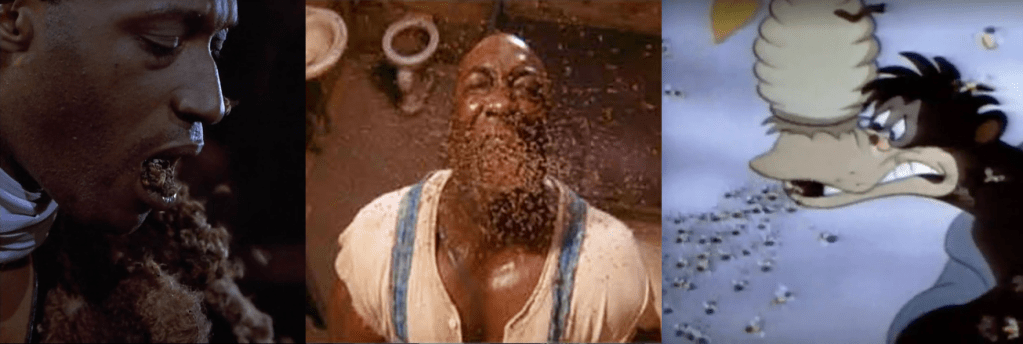
As I’ve noted before, Graham Allen reads the figure of the wasps’ nest in The Shining and its absence in Kubrick’s adaptation as a metaphor for the general adaptation process–like the nest in King’s narrative, a text is emptied and refilled in this process. Eyes become a significant part of this discussion: 

Isn’t that what Kubrick’s Overlook Hotel offers up, after all—a mode of vision which sees everything and sees it all the time?… This is a mode of vision that is unbearable because it is total, like the vision of a god, or like the vision of a movie-camera, another ‘being’ that does not have eyelids to close, a sclerophthalmic machine if you will. … elements of the uncanny enumerated by Freud are to be found in the film: the double, the repetition of the same thing, fear of the animation of the dead, the evil eye. Most significantly of all, throughout Freud’s essay, first in his analysis of Hoffmann’s ‘The Sandman’ and then more generally, there is a focus on eyes. This is understandable, because as Freud makes clear, the uncanny is most often generated by the temporary collapse of the distinction between the imaginary and the real, moments when the evidence of our eyes comes under question (366-67).

We are conditioned to look for patterns, and The Shining in particular conditions the viewer to look for (carpet) patterns. Mr. Eye Scream concludes his video with: 

If I had to summarize Eye Scream as one thing I would say it’s this: everything is connected to everything. The only question is how wide are you willing to open your eyes and how much are you prepared to see? 

In terms of mysticism and spirituality, I would agree with the very broad statement that everything is connected to everything. And it would in theory describe King’s multiverse and how everything in his books connects via the Dark Tower. And a trained eye for surprising connections lends itself to having a facility with metaphors that is definitely one of King’s key ingredients. But in terms of Shining and other theorizing, the generalization that everything is connected to everything kind of nullifies the relevance of any more specific connections between things you’re trying to make. And as the current first comment on the video notes: “The way someone analyses and interprets The Shining is a direct representation of their own psyche.” This is the thesis of Matthew Merced’s article on “idiosyncratic interpretations” (which he apparently expanded into a book on the subject). And Echoed by someone else: “look for patterns hard enough and you’ll se ’em everwhere.”

Reflections and projections…

The mode of vision in terms of an all-seeing camera was also a big factor in The Running Man, which added a depiction of independent floating cameras to capture footage wherever running men were located. Another cool moment that was added is later on when the floating cameras are revealed to also be guns, shooting some guys who are trying to stop Ben because they want him to be able to continue on for the sake of ratings. This added a nice layer of the violence inherent in a lot of media representations via what cameras capture (so to speak). The ‘87 Running Man had an interesting conflation of the imaginary and the real via the real-life game-show host Richard Dawson playing the host of Running Man show–an interesting choice on his part because this character is such a villain.

There is also a camera eye in The Long Walk, but it’s only referenced once, not constantly and omnipresent like in Running Man. In terms of adjustments to source material, The Long Walk excises the watching audience, while The Running Man increases it. The way the movie shows Richards able to see on the TV where his pursuers are right outside the room he’s inside of seeing them on the TV echoes how students still inside Columbine High School after the shooting were watching coverage of the school from outside (a shooting anticipated by King’s first published Bachman novel, Rage. Which seems safe to say will never be adapted (knock on wood)).  

The Shining was also noted for its use of the “Steadicam,” which, as it happens, Eddie Dean remarks on, twice, in book two of the Dark Tower series, The Drawing of the Three (1987), in a sequence where he and Roland are able, through the device of the mystical/magical doors that appear in this text, to see through the eyes of Odetta Holmes/Detta Walker: 

Roland had never seen a movie. Eddie had seen thousands, and what he was looking at was like one of those moving point-of-view shots they did in ones like Halloween and The Shining. He even knew what they called the gadget they did it with. Steadicam. That was it.”

And 

He was staring into the doorway, hypnotized, as an aisle of Macy’s rushed forward—he was reminded again of The Shining, where you saw what the little boy was seeing as he rode his trike through the hallways of that haunted hotel. He remembered the little boy had seen this creepy pair of dead twins in one of those hallways. The end of this aisle was much more mundane: a white door.

So in terms of King multiverse logic/cosmology, the world where The Shining takes place would seem to be the same world where IT takes place based on Dick Hallorann making a cameo in IT, which the Muschiettis have expanded on as one of the major threads of Welcome to Derry where Dick uses his shining powers to help the Air Force locate Pennywise (because they want to weaponize him of course). But in the world where Eddie Dean comes from, The Shining exists as a movie, which means it must also exist in the form of King’s novel. This will end up tracking when we learn a few books later that Stephen King exists as a character in the series who’s writing the whole story. What’s interesting is that King had no sense of that narrative development at the time, not only because he’s reputed in his writing process to generally not plan ahead, but also because his real-life near-death experience in 1999 when he was hit and almost killed by a van largely determined this particular development in the final three books of the series he’d write and publish not too long thereafter. So here in Book 2 he’s probably just making a little joke to amuse himself, though based on his general virulence toward Kubrick’s adaptation I’m surprised he doesn’t take the opportunity to insult it. 

In Welcome to Derry episode four, there is a significant horror sequence related to eyes–possibly the most horrifying I’ve ever…seen–that is linked to the film projectors the Muschiettis are fond of emphasizing. In class the students are watching a projected film about a kind of parasite that gets into snails and bugs out their eyes, which makes them more appealing to birds, who then pick up the snails and thus spread the parasite further. Of course there’s a more significant plot point occurring while the students are watching this: we see the character Marge is setting up Lily somehow at the urging of the popular group of girls. Later in the episode when Marge is having a change of heart and is going to confess to Lily it’s a bullying setup, something starts to happen to Marge’s eyes–they start to bug out of her head like the snails’. We get several point-of-view shots of her distorted vision as she starts to panic and runs into what must be the woodshop classroom. I legit covered my eyes for a good part of this scene so am not sure of the exact order of events; she starts to try to gouge out her eyes with some kind of screwdriver then turns on a bandsaw and is going to saw them off (they’re protruding quite far by this point). I have never said “oh my god” out loud so many times while watching something. Lily manages to stop her and has to pry the screwdriver out of her hand, so that when other people show up it looks like Lily is the one trying to gouge Marge’s eyes out. I thought that was a great twist and Lilly would be going back to the asylum after that, but there appear to have been no consequences for that particular development. Which at least so far is an anomaly in terms of the show’s narrative shortcomings.

It was when I was listening to the Kingcast guys discuss the episode and recap this that it occurred to me it was a fitting metaphor for how King’s work (including its adaptations) have become the primary lens through which I view the world–or put another way, have taken over the way I see the world–and facing the possibility that his presence as such amounts to an internal parasite that I’m now spreading through this and other platforms. If that’s disturbing, it resonates with the use of the “viral” metaphor Holtmeier and Wessels invoke in their Theorizing Stephen King article “Towards Infection: Viral Adaptations of King”–using the “viral adaptation” concept “to define examples where the adaptations mutate beyond the scope of the original text” with the mutations taking from other aspects of King’s work–which the use of The Shining‘s Dick Hallorann and the appearance of the lockboxes from Doctor Sleep in Welcome to Derry offer further support for.

And if Edgar Wright, who in his Kingcast interview evinced much gratitude to King for his blurb for Shaun of the Dead, wanted to remain in King’s good graces and make a warm adaptation instead of a cold one, then it makes sense the stalker from the ’87 movie he paid homage to in his adaptation was Fireball and not Sub-Zero: the runner played by Katy O’Brien gets killed by some adolescent civilians wielding the same flame-spewing guns Fireball does. I might have thought that Sub-Zero’s use of hockey in the ’87 version was potentially an homage to the cold The Dead Zone adaptation and amounts to the ’87 version trying to have its cake and eat it too in hot and cold terms, except it was probably all written before the writers realized the source text was King’s. Wright might have had his own Dead Zone homage to the novel itself with the significance of hot dogs to the changes made to the sequence with the character Elton Parrakis (played by Michael Cera). 

If King-as-Bachman ended The Running Man with “a tremendous explosion,” this set the staging ground for The Shining ending in what Palmer Rampell calls “a tremendous fireball” (170) (The Running Man was published later but written first). King’s penchant for explosions speaks to one aspect of his cinematic adaptability, and The Shining adaptation ending in its opposite might speak to it being more “arthouse” than “mass market.” Wright’s Running Man doesn’t take itself very seriously despite themes that honestly should be, which might be a problem. Though I have a feeling that’s not really the reason it bombed. 

-SCR

Works Cited (for Works not linked to)

Allen, Graham. “The Unempty Wasps’ Nest: Kubrick’s The Shining, Adaptation, Chance, Interpretation.” Adaptation: The Journal of Literature on Screen Studies, vol. 8, no. 3, 2015, pp. 361–71, https://doi.org/10.1093/adaptation/apv009.

Blankier, Margot. “A Very Serious Problem with the People Taking Care of the Place’: Duality and the Dionysian Aspect in Stanley Kubrick’s The Shining.” The Irish Journal of Gothic and Horror Studies, no. 13, 2014, pp. 3-16.

Blouin, Michael J. “Introduction: Stephen King and His Critics.” Theorizing Stephen King, edited by Michael J. Blouin, Taylor & Francis Group, 2025. Kindle edition. 

Bumstead, Andrew. “Alice in Disneyland: Power and Subversion in Two Theme Park Rides.” South Atlantic Review, vol. 84, no. 4, 2023, pp. 48-64.

Curran, Ronald T. “Complex, Archetype, and Primal Fear: King’s Use of Fairy Tales in The Shining.” The Dark Descent: Essays Defining Stephen King’s Horrorscape, edited by Tony Magistrale, Greenwood Press, 1992, pp. 33–46.

Elza, Cary. “Alice in Cartoonland: Childhood, Gender, and Imaginary Space in Early Disney Animation.” Animation : An Interdisciplinary Journal, vol. 9, no. 1, 2014, pp. 7–26, https://doi.org/10.1177/1746847714520936.

Fenwick, James. Stanley Kubrick Produces. Rutgers University Press, 2021, https://doi.org/10.36019/9781978814912.

Hart, Angela. “Alice In Wonderland & Alice Through the Looking Glass by Lewis Carroll: Do Words Have Meaning? Lacanian Theory on Carroll’s Writing.” International Journal of Arts & Sciences, vol. 8, no. 3, 2015, p. 425.

Holtmeier, Matthew and Chelsea Wessels. “Towards Infection: Viral Adaptations of King.” Theorizing Stephen King, edited by Michael J. Blouin, Taylor & Francis Group, 2025. Kindle edition. 

Joyce, James. “Lolita in Humberland.” Studies in the Novel, vol. 6, no. 3, 1974, pp. 339-48.

Kent, Brian. “And We All Shine On: Stephen King’s The Shining as Stream of Non-Consciousness.” Discovering Stephen King’s “The Shining”: Essays on the Bestselling Novel by America’s Premier Horror Writer, edited by Tony Magistrale, Wildside Press, 2006, pp. 19-38.

Leitch, Thomas. “The Adapter as Auteur: Hitchcock, Kubrick, Disney.” Books in Motion : Adaptation, Intertextuality, Authorship, edited by Mireia Aragay, Rodopi, 2005.

Metz, Walter. “Toward a Post-Structural Influence in Film Genre Study: Intertextuality and ‘The Shining.’” Film Criticism, vol. 22, no. 1, 1997, pp. 38–61.

McAvoy, Catriona. “The Uncanny, The Gothic and The Loner: Intertextuality in the Adaptation Process of The Shining.” Adaptation : The Journal of Literature on Screen Studies, vol. 8, no. 3, 2015, pp. 345–60, https://doi.org/10.1093/adaptation/apv012.

Merced, Matthew. “Lost in the Labyrinth: Understanding Idiosyncratic Interpretations of Kubrick’s The Shining.” International Journal of Applied Psychoanalytic Studies, vol. 16, no. 1, 2019, pp. 55–64, https://doi.org/10.1002/aps.1592.

Nilsen, Sarah. “Cujo, the Black Man, and the Story of Patty Hearst.” Violence in the Films of Stephen King, edited by Tony Magistrale and Michael J. Blouin, Lexington Books, 2021. Kindle Edition. 

Pezzotta, Elisa, and Gene D. Phillips. Stanley Kubrick Adapting the Sublime. University Press of Mississippi, 2013.Rampell, Palmer. “The Shining and the Media Conglomerate; or, How All Work and No Play Made Jack a Creative Artist in the 1970s.” American Literature, vol. 91, no. 1, 2019, pp. 151–82, https://doi.org/10.1215/00029831-7335385.
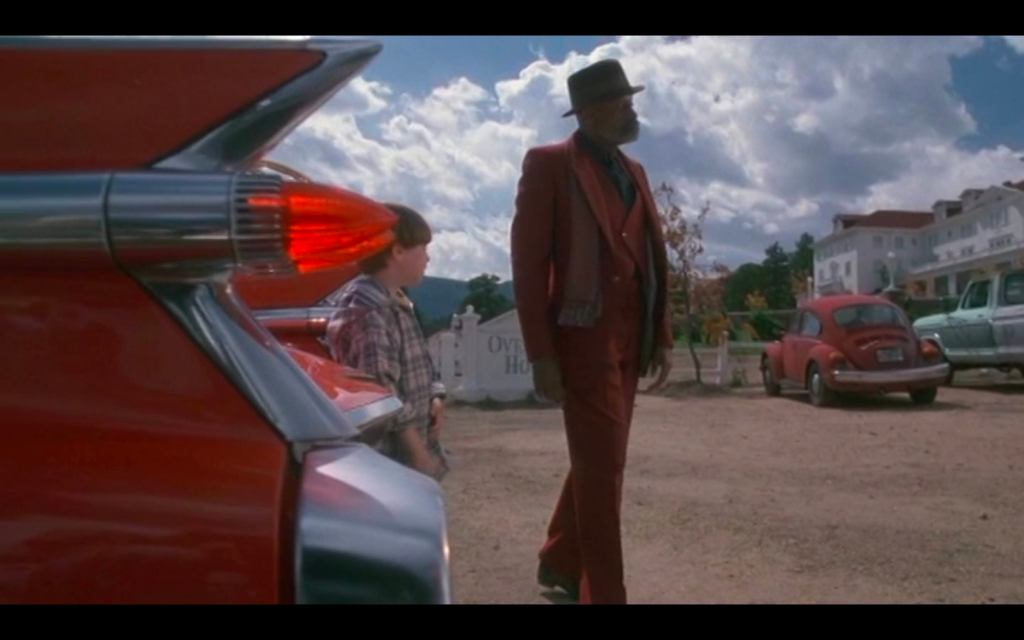
The Laughing Place is a Rabbit Hole to Disney’s Animal KINGdom, Part III: The Shining

The Writing on the Wall Carries Critterations and Shitterations

Well, you ain’t never caught a rabbit / And you ain’t no friend of mine

Big Mama Thornton, “Hound Dog” (1953); Elvis Presley, “Hound Dog” (1956).

(This inhuman place makes human monsters.)

Stephen King, The Shining (1977).

Well, since my baby left me / Well, I’ve found a new place to dwell

Elvis Presley, “Heartbreak Hotel” (1956).

He was reminded of the 3-D movies he’d seen as a kid. If you looked at the screen without the special glasses, you saw a double image—the sort of thing he was feeling now. But when you put the glasses on, it made sense.” (boldface mine)

Stephen King, The Shining (1977).

I mean, these were some of the astutest people I’ve ever known, and they were in [most] cases almost totally overlooked, except as a beast of burden—but even at that age, I recognized that: Hey! The backs of these people aren’t broken, they [can] find it in their souls to live a life that is not going to take the joy of living away. (boldface mine)

Peter Guralnick, Sam Phillips: The Man Who Invented Rock n Roll (2014).

The Shadow Has Exploded

I concluded Part II of this discussion with Bryan Fuller’s question: “Is Christine the Overlook ghost on wheels?” Wheels are an apt symbol of the previously mentioned Thermidor Effect, which in turn pretty much exactly replicates/describes my experience of attempting to read through the Kingverse chronologically—one step forward, two steps back is how the wheel rotates.

Bryan Fuller is a noteworthy figure in the Kingdom for having written the teleplay of the ’02 television miniseries version of Carrie, an adaptation that no one really seems to want to remember, but one that indicates he’s done a closer study than most on this foundational King canon text.

Fuller’s version is in keeping with King’s fidelity trend in television adaptations of his own work–the 1997 television miniseries version of The Shining that King himself wrote to fix what he hated about Kubrick’s version (ironically, since Kubrick’s remains pretty much definitively the most influential adaptation of his work) is a quintessential example, though King did make some changes, like the exchange that confirms for Hallorann Danny’s shining abilities:

The Shining (1997).

Hallorann: [out loud] “My Bessie… Ain’t she sweet?” [in head] “Sweet as honey from the bee.”

Danny: [out loud] “Sweet as honey from the bee.”

The Shining (1997).

Fuller is also apparently directing a new adaptation of Christine, that vehicular entity which, in his ’03 interview with Magistrale, King explicates at the site of the intersection of horror and humor, and consumption:

When I wrote Christine I wanted LeBay to be funny in a twisted sort of way. He’s the same blend of horror and humor that you find in the car itself. Christine is a vampire machine; as it feeds on more and more victims, the car becomes more vital, younger. … The whole concept is supposed to be amusing but scary at the same time.

Tony Magistrale, Hollywood’s Stephen King (2003).

In his version of Carrie, Fuller restores a couple of the major elements from the novel that Brian De Palma changed in his 1976 adaptation–namely, the epistolary structure that allows for a retrospective reflection of and attempted accounting for Carrie’s destruction via the device of a detective’s interrogation, and showing Carrie stopping her mother’s heart when she kills her. But there is a pretty major change in Fuller’s version: it turns out Carrie is still alive, and that Sue helped her escape.

But what really “escapes,” figuratively, in the novel version of Carrie, is the “shadow” from the text-within-the-text The Shadow Exploded, the shadow that is a manifestation of Toni Morrison’s Africanist presence and that Carrie’s trigger moment reveals to be inextricable to the history of American music and how this history enacts and underwrites the history of America itself.

Royal Labor Pains

The novel Black House (2001), which King co-wrote with Peter Straub, refers to Albert Goldman’s 1981 book on Elvis Presley as a “trash tome,” but “trash has its place,” as King notes about his mother’s influence on his qualification of literature in the afterword to ‘Salem’s Lot (1975), in which he essentially explicates that novel’s nature as a mashup between Dracula and Peyton Place. Without conceptions of “trash,” it seems rock ‘n’ roll would not exist…

“Sam would come in and say, ‘That’s it, that’s what I want.’” And the band, or the blues singer, would be totally taken aback and say, “But that’s trash, Mr. Phillips.” And he would say, “That’s what I want.”

Peter Guralnick, Sam Phillips: The Man Who Invented Rock n Roll (2014).

Goldman’s tome opens with a worthwhile reflection on the American preoccupation with royalty, or as he puts it, “the trappings of royalty.”

At the Rock N Soul Museum in Memphis, TN.

Goldman’s reading opens the door to a key to a map of American musical royalty. We like to mint kings, as we’ve done in music:

The King of the Blues, the King of Rock ‘n’ Roll, and the King of Pop, respectively.

The King of Pop bears a white glove, identified in Nicholas Sammond’s study on the history of animation as a sign of the minstrel…

As well as their relations…

The Artist Formerly Known as Prince, Queen Bey, and the Fresh Prince, respectively.

There are also other things we treat as kings….

The idea that a fetus is not just a full human but a superior and kinglike one—a being whose survival is so paramount that another person can be legally compelled to accept harm, ruin, or death to insure it—is a recent invention. (boldface mine)

Jia Tolentino, “Is Abortion Sacred?” (July 16, 2022).

Baz Luhrmann’s recent Elvis biopic also pivots around three kings:

B.B. King, Elvis Presley, and Martin Luther King, Jr.

This is fitting for a couple of reasons. One would be the three acts both Elvis’s career (and hence Baz’s film) neatly divides itself into:

Like Gaul, the career is divided into three parts: Memphis Elvis (the singer), Hollywood Elvis (the movie star), and Vegas Elvis (the sacred monster).

Mark Feeney, “Elvis Movies,” American Scholar 70.1 (2001).

Another reason is that Elvis liked to watch three screens at a time, as his Graceland basement reveals–sadly not one of the parts of his house recreated for the film, and sadly not one I got a decent picture of when I visited this past December:

Elvis’s basement rec room with mirrored ceiling at Graceland.

Others have taken better pics:

From here.

Graceland is an important place…

Bruce Springsteen explicates the state of grace as a place in an Elvis documentary:

Graceland. Just the name of it itself pulled directly out of gospel tradition. It’s an idealized home, the perfect symbol of someone who’s come up from the bottom and–and enjoyed the best the country has to offer. It was a huge moment for Elvis to walk through those doors and call that place his home.

Elvis Presley: The Searcher (2018).

Later in The Searcher, after post-Hollywood Elvis is returning to his musical roots, Springsteen notes that “you can take the boy out of Memphis, but you can’t take Memphis out of the boy.”

This figurative sense of place is echoed in a description of an Uncle Remus-like figure in the biography of legendary Memphis record producer Sam Phillips:

“[Uncle Silas] liked to sit in the kitchen and put me on his knee, grab me by my bony shoulder and say, ‘Samuel, you’re going to grow up and be a great man someday.’ I mean, I was just a sickly kid—physically, I don’t know, maybe mentally, too—but somehow, as much as I didn’t believe him, I did believe him. Because he sounded so confident. And he was a great storyteller—but [what I got from his stories] is that, number one, you must have a belief in things that are unknown to you, that what you see and hear is really not all that important, except for the moment. I mean, Africa was just another way of him pointing to the things that were all over and available to us one way or another. Africa was a state of mind that he hoped everybody could see and be a part of or participate in.” Most of all, rather than moralize, he just tried to teach the sickly little boy, as much by example as anything else, “how to live and be happy, no matter what came along, [that] even when you’re feeling bad, you’re feeling good.”

Peter Guralnick, Sam Phillips: The Man Who Invented Rock n Roll (2014).

Sam Phillips is the founder of Elvis’s initial record label, Sun Records in Memphis, and is credited with creating rock ‘n’ roll in an oft-repeated labor metaphor that implicitly likens him to a midwife:

Writing on the wall at an exhibit at the Graceland complex in Memphis, TN.

(The B-Side of Elvis’s first single “That’s All Right” is a cover of a bluegrass song (a white genre), so if the A-Side is shown by Baz to be a mashup of blues and gospel, this morphs into a “‘three-way’ appeal” as record-store owner Ruben Cherry put it, of pop-hillbilly-r&b, or blues-gospel-bluegrass.)

As a child of the media, I have been pleased to have attended the healthy birth of rock and roll, and to have seen it grow up fast and healthy . . . but I was also in attendance, during my younger years, at the deathbed of radio as a strong fictional medium.

Stephen King, Danse Macabre (1981).

The birth of rock ‘n’ roll is contingent on the circumstances created by post-WWII culture, the pivotal shift into which is embodied in the history buried in the basement scrapbook of The Shining‘s Overlook Hotel…

For many critical historians, that moment in August 1945 delineates Modernism from a postmodern era that was violently born out of it.

Tony Magistrale and Michael Blouin, Stephen King and American History (2020).

A rooster (or a cock) is the critter Phillips chose as the centerpiece of his label’s design, inadvertently evoking its deeper function: cock rock is the foundation of the patriarchy. Or, to use one of my buzzwords, cock rock underwrites the patriarchy, as well as underwrites the expression of the patriarchy in the KINGdom.

The Sun Records label’s color scheme also potentially evokes the mascot of Phillips’ alma mater Coffee High School:

The yellow jacket at Graceland…not a bee, not a wasp, not a hornet, but another stinging insect.

It’s also intriguing that the midwife of Rock ‘n’ Roll apparently became so due to the influence of that magical Black uncle…

The story of Uncle Silas is at the epicenter of everything that Sam Phillips ever believed both about himself and the “common man,” in that most uncommon narrative that became the lodestar for his life. It was not sympathy for this old black man’s plight that drew him to Silas Payne—far from it, Sam Phillips always insisted. Rather, it was admiration for those same qualities of imagination, creativity, and invincible determination that he had first noted in the black fieldworkers on his father’s farm—that and the kind of emotional freedom, the unqualified generosity and kindness that he himself would have most liked to be able to achieve.there was something almost magical about Uncle Silas, with the hundreds of chickens he kept out back, every one of whom he could distinguish by name, and the Bible stories he rhymed up, the songs he sang, the stories he told of an Africa he had never known, with battercake trees and a Molasses River that took a twelve-year-old boy away to a world in which he was freed from all the emotional and physical bonds by which he felt so constricted in his day-to-day existence.

Peter Guralnick, Sam Phillips: The Man Who Invented Rock n Roll (2014).

So that cock logo might well derive from Uncle Silas’s influence…in which the Black man helps free the white boy in a way that in addition to bearing resemblance to Uncle Remus will resemble the function of B.B. King’s character in Baz’s flick, in which Elvis is shown to be cut from the same cloth as B.B. when they converse in the famed Beale Street Lansky Brothers clothing store about Elvis’s upcoming television appearance on the Milton Berle show, with B.B. referring to the host as “Uncle Miltie” as the pair examine themselves in the mirror…

B.B. is an important presence but still disappointingly functions as a magical Black bestie for Elvis, offering a version of “freedom” to the white man by having his own record label and touring wherever he wants as a corollary for the restrictions Elvis ends up with when he allows Colonel Tom Parker to take over all of his business enterprises.

Another example of Baz’s B.B. function is when Elvis shows up at the Beale Street club where B.B. plays, distraught about how to navigate the backlash against him, and, echoing the language of the place of that state of mind passed down from Uncle Silas that “even when you’re feeling bad, you’re feeling good,” B.B. advises:

“If you’re sad and you want to be sad, you’re at the right place. If you’re happy and you want to be happy, guess what? You’re at the right place.”

Elvis (2022).

But is he? Confronting the film’s imagery of Beale Street itself, it is striking for being NYC-like in its teeming pedestrian traffic, striking for the image of Elvis as a lone white person navigating an exclusively African American population.

Writing on the wall in Candyman (2021).

Striking the more so in light of Sam Phillips’ own description of his initial encounter of this place when he first visited Memphis in 1939:

Well, I’d heard about Beale Street all my life, pictured it in my mind what it was—I could not wait! We arrived at four or five o’clock in the morning in pouring-down rain, but I’m telling you, Broadway never looked that busy. It was like a beehive, a microcosm of humanity—you had a lot of sober people there, you had a lot of people having a good time. You had old black men from the Delta and young cats dressed fit to kill. But the most impressive thing to me about Beale Street was that nobody got in anybody’s way—because every damn one of them wanted to be right there. Beale Street represented for me, even at that age, something that I hoped to see for all people. That sense of absolute freedom, that sense of no direction but the greatest direction in the world, of being able to feel, I’m a part of this somehow.

Peter Guralnick, Sam Phillips: The Man Who Invented Rock n Roll (2014).

This quote was deemed significant enough for inclusion in the Sun Records section of one of the Graceland exhibits:

The idea of being part of something larger than oneself is part and parcel of hive symbolism for the individual v. collective, with traditional American narratives of the West manifesting/championing/fostering the former, as in the conclusion of Eminem’s 2002 semiautobiopic 8 Mile:

This time, however, he echoes the Western hero who, in splendid isolation, rides off into the sunset.

Roy Grundmann, “White Man’s Burden: Eminem’s Movie Debut in 8 Mile,” Cinéaste, Vol. 28, No. 2 (2003), p. 33. 

One critic invokes hive-metaphor language to describe one of the scenes in Baz’s Elvis:

When Elvis passes through Black crowds in Memphis’s Beale Street, they lovingly swarm him for autographs.

Richard Brody, “‘Elvis’ Is a Wikipedia Entry Directed by Baz Luhrmann” (June 27, 2022).

This image evokes a description in Goldman’s biography of Elvis at age sixteen:

The onset of Elvis’s emotional crisis was signaled by the appearance of recurrent nightmares. These dreams were so powerful that they resembled states of absolute possession or even the condition of being spellbound. Night after night… he would imagine that he was being attacked by a mob of angry men. They would circle him ominously as he hurled at them defiant challenges. Then a violent struggle would commence. (79)

The primary image presented by Elvis’s nightmares is the familiar paranoid delusion of the one against the many.

Albert Goldman, Elvis (1981).

Stephen King also experienced a recurrent nightmare:

In another dream—this is one which has recurred at times of stress over the last ten years—I am writing a novel in an old house where a homicidal madwoman is reputed to be on the prowl. I’m working in a third-floor room that’s very hot. A door on the far side of the room communicates with the attic, and I know—I know—she’s in there, and that sooner or later the sound of my typewriter will cause her to come after me (perhaps she’s a critic for the Times Book Review). At any rate, she finally comes through the door like a horrid jack from a child’s box, all gray hair and crazed eyes, raving and wielding a meat-ax. And when I run, I discover that somehow the house has exploded outward—it’s gotten ever so much bigger—and I’m totally lost.

Stephen King, Danse Macabre (1981).

Elvis’s being “lost” is another of the motifs in Baz’s depiction…Is there a mind meld going on reminiscent of that titular device in The Shining?

“By the light of day … Beale Street might not have looked so glamorous, but it was shining with the hopes and aspirations and beliefs of all the people who thronged to its sights”

Peter Guralnick, Sam Phillips: The Man Who Invented Rock n Roll (2014).

And then there’s Paul Simon’s invocation of the literal place of Graceland (in which state becomes synecdoche for nation…) evoking a larger figurative one….

The Mississippi Delta
Was shining like a national guitar
I am following the river
Down the highway
Through the cradle of the Civil War

I’m going to Graceland, Graceland
Memphis, Tennessee

Paul Simon, “Graceland” (1986).

The musical appropriation that occurred in the making of Simon’s Graceland album, which he recorded in South Africa, is intriguingly documented in Under African Skies (2011) (in her collection Florida exploring literal and figurative place-states, Lauren Groff’s “Ghosts and Empties” derives from “Graceland” lyrics in one example of the shrapnel of Elvis’s explosive influence). Are Simon’s “ghosts” and “shining” references (in conjunction with his dating Shelley Duvall right before she filmed The Shining), qualify as strong enough evidence to be invoking The Shining?

Regardless, the “national guitar” Simon conjures renders the guitar a symbol, opening the door to explore other “semiotic levels” (per Magistrale) such a symbol might operate on, like the weaponization of music (such as in the covert history of the national anthem as premeditated partisan propaganda) … a tool/weapon to prop up an illusion of freedom… and also evoked in the guitar as “axe,” which is, of course, Kubrick’s Jack Torrance’s weapon of choice. (The guitar, more specifically its neck, also becomes a weapon–inadvertently–in a 1986 Twilight Zone episode penned by George R.R. Martin in which Elvis’s twin kills him.) King’s Jack Torrance’s weapon of choice is the roque mallet, which will evoke a Disney influence (by way of Lewis Carroll) via the underwriting influence of Alice in Wonderland on King’s novel that I am eventually getting to below…but not quite yet.

The Singer-Gunslinger

B.B. King reads the label of “rock ‘n’ roll” itself as racially coded distinction:

B.B. spoke diplomatically of the rock ’n’ roll revolution as it unfolded. Decades later, in a moment of candor, he would dismiss the genre as “just more white people doing blues that used different progressions”: “Elvis was doing Big Boy Crudup’s tunes, and they were calling that rock and roll. And I thought it was a way of saying, ‘He’s not black.’”

Daniel de Visé, King of the Blues: The Rise and Reign of B.B. King (2021) (here).

Elvis potentially underwrites the center of the Gunslinger Song Cycle by being a figure that explodes the color line with his music…

[Sam Phillips] had sensed in Elvis a kindred spirit almost from the start. … It was almost subversive what they had done, sneaking around through the music. They had gone out into this no man’s land, “where the earth meets the sky,” as Sam always liked to put it, without so much as a map or a compass … Together they had “knocked the shit out of the color line.”

Peter Guralnick, Sam Phillips: The Man Who Invented Rock n Roll (2014).

…and then becoming a crossover Hollywood star; his first “dramatic” role is in a Western, playing a “gunslinger” character with a white father and a Native American mother.

Baz’s film emphasizes that the backlash against Elvis when his popularity explodes in 1956 is a predominantly race-based fear, starting with the emphasis that Elvis’s first single is a mashup of two Black genres, Blues and Gospel, and the emphasis on Black sexuality latent in the Blues genre. A fear of Black sexuality, or of Black people because of their more open sexuality, is an implicit fear of their reproduction…

Baz’s biopic invokes a motif of literal signs, and Elvis himself is a sort of sign, refracted out of personhood into reproduced images, as Andy Warhol evinces:

Eight Elvises by Andy Warhol.

Eight is a sideways infinity sign

At the time of his death in 1977, Elvis Presley’s was the second most commonly reproduced image in the world. The first was Mickey Mouse.

Albert Goldman, Elvis (1981).

Alongside Disney’s, Elvis’s influence (and via that, the influences on him) essentially refracts infinitely. Baz notes in text at the film’s conclusion that “His influence on music and culture lives on.” Long live the King…Elvis died (reportedly) in 1977, the same year The Shining was published, and so the same year the presence embodied in its Overlook Hotel explodes to reverberate throughout the rest of the KINGdom.

Does Elvis himself, referred to as an “atomic-powered singer,” embody this explosive presence and what it symbolizes?

From here.

On The Shining, one critic notes about what another critic notes:

Roger Luckhurst, who has written so convincingly on trauma and torture, describes “the scenes around the events inside Room 237 [to be] the enigmatic core of the whole film” (57) … Luckhurst notes in talking of the twins‚ “can they really be Grady’s daughters, who Ullmann states were eight and ten years old? Might they not signify something else, subliminally encoded? Of course! All ghosts are signs of broken story, and bear witness to silent wrongs” (47). Here I believe The Shining, as is appropriate for a film genre-challenger like Kubrick, fights the common trope of ghosts like, say, Hamlet’s father, those spirits who wish to give a story of a contemptible crime, a free transgressor, and a plea that his son avenge him and kill his uncle. (boldface mine)

Danel Olsen, “‘Cut You Up Into Little Pieces’: Ghosts & Violence in Kubrick’s The Shining,” Violence in the Films of Stephen King (ed. Magistrale and Blouin, 2021).
The Shining (1980).

This is the first shot of the twins shown in the movie, which flashes very quickly in Danny’s first horrific vision (which he has via talking to his finger/Tony in the mirror) of the blood pouring from the elevators early on before the nuclear trio of the Torrance family leaves for the Overlook Hotel. Thus the twins are instantly and irrevocably linked to an expression of this place as a horrific entity.

Would/should twins potentially find this expression offensive? I haven’t done the official academic research to support this, but it seems like twins have the potential to evoke horror via representing some kind of reproduction of the self that is unsettling for the way it violates selfhood…if there can be two of the same person, that somehow has the potential to diminish the value of my individual, distinct selfhood–though such horror really bespeaks larger cultural conditioning of valuing the individual over the collective: the “splendid isolation” factor, which through the producing influence of Sam Phillips will be disseminated through rock ‘n’ roll, as Phillips is:

a father who was different from anybody else’s father that they knew, a father who, in the little time they got to spend with him, emphasized over and over, to their own occasional bewilderment, the importance of being yourself, the imperative to be a rebel without becoming an outcast, to always choose individualism over conformity. (boldface mine)

Peter Guralnick, Sam Phillips: The Man Who Invented Rock n Roll (2014).

(Noticing the prominence of Alice in Wonderland in The Shining that will be discussed below, I’m also wondering if King derived the creepy twins from Tweedledee and Tweedledum…)

The one thing he was not prepared to scrimp on was the sign that would announce the presence of the Memphis Recording Service to the world—well, two identical neon signs, actually, one for each of the plateglass windows on either side of the door.

Peter Guralnick, Sam Phillips: The Man Who Invented Rock n Roll (2014).
Twin signs. From here.

Elvis himself was a twin whose brother Jesse died at birth, which I learned on the Graceland tour’s recorded narration by John Stamos, aka Uncle Jesse from Full House, whose character is named for Elvis’s twin and whose character’s love of Elvis derives from John Stamos’s irl-love of Elvis. What Elvis’s twin’s ghost is a sign of is that Elvis became divested with “the strength of two men.”

And Andy Warhol dated two different twins, Jed and Jon, respectively…he creepily liked ’em younger, just like Elvis…

twin shadows…

The story of Memphis’s music history is inextricably linked to movies the way Elvis’s career was–a centerpiece of the Memphis Music Hall of Fame is the twin Oscars won by Memphis artists for Best Original Song for the films Shaft and Hustle and Flow.

The Rock N Soul Museum near Beale Street also covers the “persistent legend” of blues guitarist Robert Johnson:

That Johnson, with his “haunting songs,” supposedly died of poisoning becomes part of a musical “curse” that explodes from a site at the intersection of literal and figurative place, that of the “crossroads,” which I hadn’t considered having a literal corollary until my brother recently told me that he’d gone on a pilgrimage, not to the site of Johnson’s Morgan City grave, but to the crossroads invoked in the 1996 Bone Thugs-n-Harmony single “Tha Crossroads.” Hint: the song appears to be about the crossroads of the Robert Johnson legend:

This song is definitely paying homage to the late and great Robert Johnson. Legend has it he sold his soul to the devil in exchange for guitar playing skills at the crossroads (insersection of hwy 49 and hwy 61 in Clarksdale Miss.). The legend also claims he was a terrible guitar player until making his pact. After the pact, he became a legend. Johnson claims that when he went to the crossroads he “never felt lonely”. … This is also stated in BTNH”s hook in “The Crossroads”. Keep in mind RJ was a blues legend and is often considered the father of rock and roll during the 1930’s. Just my 2 cents!

Joe from Lewisville, Tx (here).

The musical curse is that of the “27 Club,” meteorically talented musicians who have, like Johnson, died at age 27. There’s a moment in Baz’s flick when the Colonel is hearing Elvis’s “That’s All Right” single for the first time where the track slows down in apparent homage to DJ Screw, and the radio DJ voiceover says they’re going to play the track “for the 27th time,” a phrase that then starts repeating on a loop. The film’s narrative is that in Elvis’s deal for the Colonel to manage him–made, symbolically, on a ferris wheel–Elvis has, like Johnson in the legend, essentially sold his soul to the devil. There are many reasons the Colonel’s management of Elvis could be considered thus (it would eventually be deemed “financial abuse” in a court of law), with a major one being that his agreed-upon cut of Elvis-generated income would be HALF. Fifty percent is pretty exorbitant compared to the traditional ten percent this management role is more associated with.

(Stephen King also experienced contractual mismanagement of income proportion with his initial publisher, Doubleday.)

Like King’s (Stephen’s), that self-identified “child of the media,” Elvis’s history is the history of media development (and the technology that media is necessarily disseminated through) writ large–Elvis’s “atomic powered” identity, his true plutonium, is an array of media modes to ensure global dissemination, which becomes concurrent with domination–identified on the poster above that brands him thus: he is the “dynamic star of television, records, radio and movies.” Like Disney is also taking advantage of at the time, these different modes allow for “transmedia dissipation,” and as the Colonel claims to invent merchandise and put Elvis’s “face on every conceivable object,” Elvis’s mother’s protest to her son that “you’re losing yourself” takes on a disturbing resonance. Elvis, in selling his soul, goes from being a 3-D person to a 2-D image.

For his deal with the devil Elvis was not cursed to die at 27, like other members of that haunted club such as Jimi Hendrix, Amy Winehouse, Kurt Cobain and Janis Joplin whose portraits Elvis’s shares ceiling space with…

Above the bar of the Hard Rock Cafe on Beale Street in Memphis, TN.

But two years ago this month, Elvis’s only (maritally legitimate) grandson joined this club in what seems very possibly the product of bearing the burden of the King’s legacy. (Elvis himself died at age 42, which commentators in Room 237 (2012) have pointed out is a number that appears prominently in Kubrick’s version of The Shining.)

As part of the development of the theme of the Colonel being the devil, Las Vegas is rendered in Elvis as nothing less than a Hellscape in a truly Kingian fashion–the sweeping shots up the facade of the International Hotel to Elvis’s penthouse at the top felt like I was watching the Randall Flagg’s Vegas sequences in The Stand. The wheel-like ouroboros of consumption Vegas represents is evoked via emphasis on two of the Colonel’s favorite gambling devices, the roulette wheel and the slot machine. We’re informed at the film’s end that the Colonel spent the final years of his life “pouring” his fortune into the slot machines of the casino that had paid him that fortune to keep Elvis in residence there at the International Hotel. In this way Elvis’s first major-label single, “Heartbreak Hotel,” offers further (highly circumstantial) evidence that Elvis is part and parcel of the Africanist presence (carried over from Carrie) that explodes from the Overlook Hotel at the end of The Shining: Elvis offers a similar “index of the post-WWII American character,” as Jack describes the Overlook being in King’s novel:

“I had an idea of writing about the Overlook, yes. I do. I think this place forms an index of the whole post–World War II American character.” (boldface mine)

Stephen King, The Shining (1977).

An inextricable element of Elvis’s character embodies the type of “fluid duality” of Carrie White in the trigger moment the (Overlook’s) shadow explodes out of:

When you examine Elvis’s life in detail, however, you find countless instances of contradictory behavior that appear to spring out of a personality that was unconsciously dichotomous.

…It must not be thought that once the Bad Elvis started to emerge the Good Elvis began to recede. Quite the contrary: Both characters developed apace, alternating, like the faces on a turning coin. (84)

Basic to [Elvis’s ideal] pattern was the perfect positioning of his polar twins. Elvis the Bad acquired the classic punk look and began his evolution toward that Snarling Darling who would become eventually the greatest hero of rock ‘n’ roll. Elvis the Good moved off at this time in precisely the opposite direction. He elected to become a lay priest, a gospel singer, a dancer before the Lord. (p87, boldface mine)

Albert Goldman, Elvis (1981).

The symbolic concept of twins generally embodies “duality,” and one framework for duality that King likes to fall back on in his own critical analyses is Apollonian v. Dionysian–basically, rational v. emotional. These seem more like binaries that would qualify as symbolic “polar twins” than horror and humor per se, which would both likely be deemed more emotional, but they evoke the duality concept by being “seemingly oppositional elements,” as Magistrale puts it. King also locates Kubrick’s work at the site of a horror-humor nexus (that embodied in the Kingian “Laughing Place”–which is an “inhuman place that makes human monsters” as manifest in The Overlook in The Shining)–though notably omitting The Shining among his examples:

…an interesting borderline that I want to point out but not step over—this is the point at which the country of the horror film touches the country of the black comedy. Stanley Kubrick has been a resident of this borderline area for quite some time. A perfectly good case could be made for [Dr. Strangelove, A Clockwork Orange,] and for 2001: A Space Odyssey as a political horror film with an inhuman monster (“Please don’t turn me off,” the murderous computer HAL 9000 begs as the Jupiter probe’s one remaining crewman pulls its memory modules one by one) that ends its cybernetic life by singing “A Bicycle Built for Two.”

Stephen King, Danse Macabre (1981).

Chopped and Screwed

Elvis’s imprisonment in his Vegas residency by what Baz’s flick underscores is a “father figure” anticipates the parallel Vegas imprisonment of Britney Spears by her father…which Baz underscores in a mashup of Spears’ “Toxic” with Elvis’s “Viva Las Vegas.”

So it turns out that one of the prominent literal signs in Baz’s biopic…

Exhibit at Graceland in Memphis, TN.

…is a sign of the devil. It’s funny to me that people would call the Colonel’s character “enigmatic” in Baz’s film portrayal because he’s basically unequivocally the devil. Tom Hanks’ version of the Colonel is even compared to South Park‘s Eric Cartman in one Reddit thread…

Eric Cartman and Tom Hanks as Colonel Tom Parker.

…and Eric Cartman is one of the most unequivocally evil/corrupted characters ever created. His name is an anagram for CRTN AMERICA. Eric Cartman is the embodiment of “Cartoon America”–that is, he’s the ethos of America embodied (or more specifically, the ugly underbelly that constitutes its psyche), which only a cartoon character could fully capture; it has to be “larger than life” because the spirit of a country is necessarily too large to be encapsulated in an individual physical body, unless that individual body is capable of transcending the boundaries of a “real” physical human body, a capability granted by the genre of animation. (Or maybe his name could also be “Carton America,” embodying America’s fast-food consumption…)

And what, ironically, is Elvis’s name an anagram of? “Evils.” And if you were wondering what the “B.B.” in B.B. King STANDs for…

Riley King…had quickly become more broadly identified by a less product-oriented label, first as the Singing Black Boy, then as the Singing Blues Boy, then as the Boy from Beale Street, until, finally, he was recognized simply as Bee Bee—transmitted to the world at large on his records as “B.B.”—King. (boldface mine)

Peter Guralnick, Sam Phillips: The Man Who Invented Rock n Roll (2014).

So we have three minstrel figures…

And if the media-savvy mass-disseminator of Elvis’s image (i.e., the Colonel) is a grotesque villain as he’s portrayed with just cause in Baz’s biopic, that would imply that the mass-disseminator he’s on par with (i.e., Disney) is also a grotesque villain…

I’d argue Baz’s film also evidences the influence of De Palma’s Carrie (1976) via his liberal (but strategic) use of the split screen, which at one point explodes into innovative combinations of those De Palma shots I mentioned last time, the split screen and kaleidoscope–Baz chops and screws the screen not unlike some of the places he chops and screws the timeline.

But it was the triple-split screen that might be the most thematically impactful, specifically composed of young Elvis juxtaposed with older Elvis juxtaposed with Arthur Crudup, the Black blues artist who initially recorded Elvis’s breakout 1954 single “That’s All Right.” (Elvis recorded this breakout single at the age of nineteen, a number that becomes significant in King’s Dark Tower series seemingly because King himself started work on what would become that series at the age of nineteen.) Some cranky critics consider such cinematographic showmanship to be more style than substance:

“Elvis” is a cold, arm’s-length, de-psychologized, intimacy-deprived view of Presley that Luhrmann microwaves with quick cuts, montages of multiple images arrayed side by side, tricky lighting, huge sets, crowd scenes, and, above all, the frenetic onstage impersonation of Elvis that its star, Austin Butler, delivers.

Richard Brody, “‘Elvis’ Is a Wikipedia Entry Directed by Baz Luhrmann” (June 27, 2022).

This review says more about Brody than it does about Baz, with the irony that he sounds about as out of touch as the critics who wanted to throw Elvis in jail for the way he moved back in 1956. There’s a point made by Baz’s visual composition of the passage/evolution of a (musical) text through time that visually renders the history “buried” in music. Jordan Peele’s new movie appears to highlight the role and history of Blackness in cinematic movement, which in Memphis is linked to music history…

Twin Kings

Elvis and Stephen could be considered twin Kings based on a number of likenesses.

Both are icons in respective fields. Both reflect the American patriarchy. Both had close relationships with their mothers who died when both Kings were still relatively young, in their 20s. Both have relationships with Hollywood as a product of their primary career field. Both suffered from addiction. Both had recurring nightmares, and both had/have distinctive custom themed gates at the entrance of their estates (Stephen King’s gates were erected in 1982, the same year Graceland’s gates opened for public tours).

Elvis’s Graceland estate in Memphis, TN (top); King’s estate in Bangor, ME (bottom).

But the most significant parallel might be in how these twin Kings evince a stance indicative of the colorblindness that underwrites/facilitates our culture’s ongoing systemic racism…

The Gatekeepers. Top: Stephen King opens the new gates to his bat-guarded Victorian home in this November 1982 photograph. BANGOR DAILY NEWS PHOTO BY CARROLL HALL. Bottom: Elvis at his new gates in 1957.

This stance obscures the existence of racism by way of being well-meaning. Elvis doesn’t understand why people would be upset at his way of moving/performing when Black people have always been doing it that way:

“…Them critics don’t like to see nobody win doing any kind of music they don’t know nuthin’ about. The colored folk been singing it and playing it just the way I’m doin’ now, man, for more years than I know. Nobody paid it no mind till I goosed it up.” (81)

Elvis quoted in Albert Goldman, Elvis (1981).

With this stance, Elvis evinces an ignorance of the racism that underlies this reaction to him, a white man, moving the way Black people do. When a white man moves in the “Black style,” he starts to erase a marker of the distinction between black and white that threatens the white-supremacist order. This aspect is aptly captured in the This is Elvis (1981) documentary in footage of a white man articulating his problem with Elvis’s type of music while standing next to a certain sign:

footage from the 50s in This Is Elvis (1981).

And is reminiscent of another likeness Eminem could have included on his Elvis soundtrack number “The King and I”:

…Eminem’s overbearing presence takes from rap more than it gives: it erases rap’s history before the film can reference it, overlooking or simply ignoring many of rap’s historical and cultural details. (boldface mine)

Roy Grundmann, “White Man’s Burden: Eminem’s Movie Debut in 8 Mile,” Cinéaste, Vol. 28, No. 2 (2003), p. 33. 

Historical erasure is a theme that provides one of the confluences between The Shining and Candyman

The Shining (1980).
Candyman (2021).

The idea of playing the HAND you’re dealt in life…

“Perfect imperfection” was [Sam Phillips’] watchword—both in life and in art—in other words, take the hand you’re dealt and then make something of it.

Peter Guralnick, Sam Phillips: The Man Who Invented Rock n Roll (2014).

…echoes the concept of colorblindness as a sort of false narrative erasing white privilege, and, in invoking playing cards, will relate to the underwriting connection between Alice in Wonderland and The Shining, that text which presents us with our first example of that well-documented phenomenon of King’s well-meaning but still racist depictions of Black characters, the “Magical Negro.” Jordan Peele outlines the quintessential examples of this Kingian trope in a setup to a Shining spoof on Key and Peele in the episode “Michael Jackson Halloween” (October 31, 2012), during which Peele identifies the insects that come out of John Coffey’s mouth–a symbol of people’s evil nature/horrible pain sucked out of them–as BEES…

The ’92 Candyman, ’99 John Coffey, and ’46 Brer Bear

And in King’s The Shining, we’re going to meet the bee’s evil twin: the wasp.

OverlooKing the Rabbit Hole

The Shining is another text in which the Disney influence on King is palpable in King–though it’s arguable if the motif that emerges related to Alice in Wonderland is more based on the Disney version or Lewis Carroll’s source text. What is clear is that the influence of Alice on our culture is pretty major: Jefferson Airplane’s “White Rabbit,” Go Ask Alice (1971), Susan Sontag’s play Alice in Bed (1991), and The Matrix (1999) all invoke it.

The function of the hedge animals in The Shining are an interesting critteration through the lens of Sarah Nilsen’s “creatureliness” aspect: here are inanimate facsimiles of animals that become horrific when they start acting like “real” animals (i.e., become animate). It turns out that technically these hedge animals are, arguably, the device that underwrites The Shining‘s entire plot–i.e., a necessitating element or starting point without which the rest of the narrative cannot unfold, as is the white rabbit that Alice follows down the hole. (To which Jack Torrance’s first published story, “Concerning the Black Holes,” might constitute a racialized connection; in The Shining, the Rabbit Hole is a Black Hole.)

We learn that the hedge animals are the reason Jack Torrance gets the job as Overlook Hotel caretaker because…

“Those animals were what made Uncle Al think of me for the job,” Jack told him. “He knew that when I was in college I used to work for a landscaping company. That’s a business that fixes people’s lawns and bushes and hedges. I used to trim a lady’s topiary.”

[he and Wendy laugh about this…]

“They weren’t animals, Danny,” Jack said when he had control of himself. “They were playing cards. Spades and hearts and clubs and diamonds. But the hedges grow, you see—”

(They creep, Watson had said … no, not the hedges, the boiler. You have to watch it all the time or you and your fambly will end up on the fuckin moon.)”

Stephen King, The Shining (1977).

Here we see that an Uncle figure, Uncle Al, is the underwriter of Jack’s caretaker job–underwriter in the traditional, financial sense of the term–and thus the generative underwriter of the novel’s entire plot. His name could be an homage to the figure of Alice, who’s been invoked directly in the text by this point, and playing cards are a big motif in Alice in Wonderland, with the Red Queen’s playing-card soldiers (i.e., animate playing cards).

Further, that Jack conflates the hedges with the boiler becomes significant in light of the latter’s climactic explosion and the “shadow exploded” concept…

He walked over to the rabbit and pushed the button on the handle of the clippers. It hummed into quiet life.

“Hi, Br’er Rabbit,” Jack said. “How are you today? A little off the top and get some of the extra off your ears? Fine. Say, did you hear the one about the traveling salesman and the old lady with a pet poodle?”

His voice sounded unnatural and stupid in his ears, and he stopped. It occurred to him that he didn’t care much for these hedge animals. It had always seemed slightly perverted to him to clip and torture a plain old hedge into something that it wasn’t. (boldface mine)

Stephen King, The Shining (1977).

Animating the inanimate is a relatively common device to evoke horror. Kubrick famously changed the hedge animals in the novel to the hedge maze in the film, which he seems to have done by way of observation of the prominence of Alice in Wonderland in the source text…

Disney’s Alice in Wonderland (1951).

And there’s bee imagery associated with the Red Queen via the pattern of her black-and-yellow garb…

Disney’s Alice in Wonderland (1951): the evil Queen Bee evokes the horrors of the matriarchy.

The Queen Bee, which Chris Hargensen is also an example of a “type” of as defined in Rosalind Wiseman’s 2002 study (with her book on these teen types being the basis for Mean Girls (2004)), a type that is by definition evil. This then imparts that a matriarchy would be horrific, thus reinforcing the patriarchy.

Charles the First by Jean-Michel Basquiat (1982).

It’s also interesting that in Disney texts, queens are evil while princesses are the ideal…

Via animal comparisons/creatureliness/critterations, overlapping themes of “laboring bodies” surface here again via rhetorical justifications/contortions of who is and is not a “person/human” that resonate with the abortion debate (white people had to rhetorically dehumanize those they wanted to enslave, i.e., “slaves” are not considered human the same way one side of the abortion debate does not consider fetuses “human”). These hedge animals manifest the evil spirit/ghost of the Overlook itself when they start to come “alive,” but before they do, a different “critter” (according to Orwell’s animal-defining paradigm in Animal Farm from Part I) manifests the Overlook ghost: wasps, or “wall wasps” as Jack refers to them at one point.

Wasps are invoked as a symbol of savagery underlying civilized veneers, and are shown to manifest powers to manipulate psychologically via being vehicle that reveals Jack’s backstory, and to manipulate physically by being the first undeniable physical manifestation of a supernatural element when wasps come back from the dead, but still an ambiguous/deniable one via the possible explanation that the “poison” Jack uses on them is defective. As the wasps manifest the Overlook ghost by haunting Jack via his personal history, they also, in this same capacity, as I previously discussed here, reveal the lack of individual characterization that King’s first “Magical Negro” figure, Dick Hallorann, gets. (I also noticed looking at the wasps this time around that the wasps in Jack’s childhood memory are in a nest up in an apple tree, while the wasps that Hallorann’s childhood memory are in a ground nest.)

I initially thought that in manifesting as a sign of the novel’s “evil” presence of the Overlook ghost(s), this same presence figured in the wasps would manifest “signs” of being an Africanist presence, but then the wasps actually seem a sign of something else:

Jack enters most fully into the ghostworld of the Roaring Twenties (instead of his son and wife, too), as Magistrale evinces, because Jack most wants what the 1920s offers adult male WASPS: booze, flappers, unquestioned freedom, and an embarrassment of riches without an embarrassment of one’s (retreating) ethics. (boldface mine)

Danel Olsen, “‘Cut You Up Into Little Pieces’: Ghosts & Violence in Kubrick’s The Shining,” Violence in the Films of Stephen King (ed. Magistrale and Blouin, 2021).

It makes perfect sense: wasps as a sign of a white-supremacist presence: such a satisfying sibilance.

The mallet (which Kubrick changes to an ax)…

…appears to be another sign of the presence of Alice in Wonderland via the croquet in that text. The mallet does not function in the sense of a traditional weapon therein, nor does a traditional weapon of force exist so much as a manipulation of rules. This is only one aspect of the rhetorical manipulation Alice comments on…if not Disney:

Well before Kafka and George Orwell, who dismantled the mechanisms of Fascism and Communism, Lewis Carroll exposed the mainspring of totalitarian powers: manipulating language, twisting words to make them signify the opposite of what they mean in order to grab and manipulate minds. (boldface mine)

Bruckner, Pascal, and Nathan J. Bracher. “On Alice in Wonderland.” South Central Review, vol. 38, no. 2-3, 2021.

Such manipulation of language is also a major hallmark of legal rhetoric…the pattern in the Alice stories of characters harping on literal meanings brought to mind the semantic manipulations of Bill Clinton during his impeachment interrogations (“it depends on what the meaning of ‘is’ is”). Such legal-language wrangling lurks in a particular description of wasps in the novel:

A few wasps were crawling sluggishly over the paper terrain of their property, but they were not trying to fly. From the inside of the nest, the black and alien place, came a never-to-be-forgotten sound: a low, somnolent buzz, like the sound of high-tension wires.

Stephen King, The Shining (1977).

WASPs exert power via property ownership via manipulations of legal rhetoric manifest on the paper of “official” documentation, violence enacted via paper, implicit rather than explicit force.

So the wasps represent/manifest the ghost of the Overlook Hotel, and “the hotel represents the successful epitome of white male domination over all other races and women” as Tony Magistrale and Michael J. Blouin put it in their 2020 study, Stephen King and American History (pp. 90-91, boldface mine). The wasps as a sign of a white-supremacist presence fits with the excessive racial slurs the Overlook ghost projects in Hallorann’s mind to try to deter him from coming to help.

This white-supremacist presence should, in theory, be oppositional to the Africanist presence that’s become associated with the bee–so, wasp v. bee. Yet by Orwell’s Animal Farm paradigm, wasps and bees should manifest versions of the same thing/presence rather than opposing forces. But bees manifesting an Africanist presence by way of being a “laboring body” that produces honey led me to google whether wasps also made honey:

NO. Wasps steal honey in large amounts if they can get access to a bee-hive but usually they are carnivores, feeding on larvae and small insects. They have powerful jaws to chew up chitinous insects. A most unpleasant sight is to see a wasp neatly cut a honey bee in half and fly away with the abdomen section, leaving the poor bee’s head and thorax still alive and walking about. Wasps do not in fact store anything. Their paper-like combs are only used to rear wasp larvae.

From here.

Jack himself also specifies a distinction between bees and wasps in their ability to inflict harm:

Wasps don’t leave them in. That’s bees. They have barbed stingers. Wasp stingers are smooth. That’s what makes them so dangerous. They can sting again and again.” (boldface mine)

Stephen King, The Shining (1977).

And if there was any doubt the wasps are linked to the haunted Overlook presence:

…he didn’t like the Overlook so well anymore, as if it wasn’t wasps that had stung his son, … but the hotel itself. (boldface mine)

Stephen King, The Shining (1977).

There’s a fluid duality across this bee-wasp symbolism in stinging ability as well in being aligned by way of the Orwellian paradigm, but opposed by way of certain biological distinctions. There’s also a fluid duality within the wasp itself in being a more personal/individually relevant symbol (for Jack Torrance) or general symbol (Overlook/imperialism). (In a 2020 podcast on King’s The Stand, The Company of the Mad, Jason Sechrest notes that he interpreted the wasps as symbolic of Jack’s anger, but then he potentially undermines this reading in which this symbolism is limited to Jack’s individual character when he points out that in The Stand, the dog Kojack also is described as having wasps in his head in a similar way.)

In The Shining, King evokes Jack’s individual anger most vividly in conjunction with the sport of football:

Football had provided a partial safety valve, although [Jack] remembered perfectly well that he had spent almost every minute of every game in a state of high piss-off, taking every opposing block and tackle personally. He had been a fine player, making All-Conference in his junior and senior years, and he knew perfectly well that he had his own bad temper to thank … or to blame. He had not enjoyed football. Every game was a grudge match.

Stephen King, The Shining (1977).

Much has been made of a certain sweater of Danny’s in Kubrick’s version…

The Shining (1980).

But in light of the relevance of football to Jack’s anger in the source text, perhaps this one is also important:

The Shining (1980).

Then the wasps start to manifest their own fluid duality in another way. It turns out there is a species of wasps that don’t sting, not “wall wasps,” but “gall wasps,” as I learned from a recent article in my alumni magazine about the discovery of a new type of this species of non-stinging wasp on the Rice campus outside of its graduate-student pub, a pub that is named for a Norse god that will now become the namesake for these wasps as well, with the headline in the print magazine reading “Cheers to the Valhalla Wasp,” and a description that notes it “spends 11 months of the year locked in a crypt.”

A new species of the gall…a different type of wasp (from here).

This is not the first time a new gall species of wasp has been discovered at Rice (an earlier article documents the parasitic tendencies of this species in terms out of a horror movie), but as the latter discovery was unfolding, I was also in the process of discovering a new type of wasp: one that’s capable of mutating. This type transmutes from white-supremacist to Africanist, thereby embodying how this binary exists in all single/individual bodies, as one is predicated on the other, and thus symbolizing, per Morrison, the inextricability of the Africanist presence to the white-supremacist one.

The transmutation in The Shining‘s wasp references occurs in chapter 33, “The Snowmobile,” which comes right before chapter 34, “The Hedges.” (So the snowmobile becomes the vehicle for the transmutation.) If Jack undergoes a transition in the process of being possessed by the Overlook, transitioning from loyalty to his family unit to loyalty to the forces of the hotel, the wasp symbolism transitions with him. Early on, while Jack is still loyal to his family, he initially encounters the wasps as an entity that pose a threat to the family, one that does enact harm by stinging Danny’s hand. In enacting this harm, the wasps are aligned with or carrying out the (evil white-supremacist) will of the Overlook. By chapter 33, Jack’s loyalties are passing the tipping point so that he’s no longer loyal to his family but now to the hotel. And in this chapter, the snowmobile is extensively compared to a wasp:

The snowmobile sat almost in the middle of the equipment shed, a fairly new one, and Jack didn’t care for its looks at all. Bombardier Ski-Doo was written on the side of the engine cowling facing him in black letters which had been raked backward, presumably to connote speed. The protruding skis were also black. There was black piping to the right and left of the cowling, what they would call racing stripes on a sports car. But the actual paintjob was a bright, sneering yellow, and that was what he didn’t like about it. Sitting there in its shaft of morning sun, yellow body and black piping, black skis, and black upholstered open cockpit, it looked like a monstrous mechanized wasp. When it was running it would sound like that, too. Whining and buzzing and ready to sting. But then, what else should it look like? It wasn’t flying under false colors, at least. Because after it had done its job, they were going to be hurting plenty. All of them. By spring the Torrance family would be hurting so badly that what those wasps had done to Danny’s hand would look like a mother’s kisses.

…It was a disgusting thing, really. You almost expected to see a long, limber stinger protruding from the rear of it.

Stephen King, The Shining, 1977.

Now this wasp-like entity does not pose a threat to the family as the wasps did previously, but rather a hope for the family in the snowmobile-wasp being a means of escape–thus the wasp is now associated not with a threat to the family, but has transmuted to being associated with a threat to the Overlook. Instead of doing the Overlook’s harmful bidding, the figurative wasp now manifests a threat to the Overlook’s will, so the wasps are now opposed to the white-supremacist spirit of the hotel, which means they can be read as manifesting its opposite, an Africanist presence.

Which brings us to another sign of the white-supremacist presence: snow. Morrison notes that no writer is more important to “American Africanism” than Edgar Allen Poe, and Poe is arguably as important a literary underwriter of The Shining as Alice in Wonderland, via a direct epigraph; the novel could be considered a mashup of Alice in Wonderland and Poe’s “The Masque of the Red Death.” (And King could be considered a mashup artist not unlike that which Baz’s construction of Elvis reveals both Baz and Elvis to be.)

Snow would count as what Morrison uses a couple of variations in term for: “figurations of impenetrable whiteness,” “images of impenetrable whiteness,” and “images of blinding whiteness.” Snow would seem to manifest a white-supremacist presence in its threat to blot out all in whiteness. (Baz also echoes these themes of snow as a sign of a white-supremacist presence in his treatment of the Colonel as a villainous “snowman,” with the term being synonymous for “conman.”) In keeping with the Overlook ghost being a white-supremacist presence by virtue of its historical ghosts and evils being the byproducts of the white-supremacist capitalist patriarchy, the snow is a means through which the Overlook can trap its occupants. (Snow will play a similar negative threatening role in Misery, whose importance will be even more significant in underwriting that novel’s plot than The Shining‘s, and in keeping with the fact that both of the plots in which the snow plays a significant role take place in the same geographical vicinity of Sidewinder, CO.)

If The Shining offers ample evidence of Poe’s ample influence on King, it’s just the tip of the iceberg, as it were. In the ’03 Hollywood’s Stephen King interview, Magistrale asks King about the influence of the “Poepictures” on his work, quoting a term King uses in On Writing and asking whether the film adaptations of Poe’s stories or the written stories themselves had more of an influence on him; King claims the latter, though noting The Masque of the Red Death is the best of the Poepictures, as well as the influence of the images of their “scare moments,” noting in particular the concluding image of The Pit and the Pendulum, which resonates with the Carrie trigger moment in being an image whose evocativeness is contingent on the way eyes look:

All you see are the horrified eyes of Barbara Steele gazing out through a small opening in the contraption that encases her.

Tony Magistrale, Hollywood’s Stephen King (2003), p11.

King further reveals a preoccupation with the way eyes look in a discussion of The Creature from the Black Lagoon (1954) via an image also associated with some of the recurring elements in this ongoing discussion of the Kingian Laughing Place (mud and walls):

…the image that remains forever after is of the creature slowly and patiently walling its victims into the Black Lagoon; even now I can see it peering over that growing wall of mud and sticks.

Its eyes. Its ancient eyes.

Stephen King, Danse Macabre (1981).

This brings us to another major tenet of The Shining‘s plot and themes, the idea/refrain that “the pictures in a book…couldn’t hurt you.” This is Hallorann’s claim to Danny about the hotel’s ghosts, and of course, Hallorann turns out to be very wrong about this. But the general idea resonates with the opening of Carroll’s first book on Alice:

Alice was beginning to get very tired of sitting by her sister on the bank, and of having nothing to do: once or twice she had peeped into the book her sister was reading, but it had no pictures or conversations in it, “and what is the use of a book,” thought Alice, “without pictures or conversations?”

Lewis Carroll, Alice’s Adventures in Wonderland (1865).

This is an idea Disney also emphasizes in its opening, changing the interaction from being with Alice’s sister to being with her tutor, who is trying to use a book to teach Alice lessons. It’s also part and parcel of an idea I emphasize in my composition classes when I have students rhetorically analyze visual texts, in particular the ethics of visual texts, with the overall lesson being, as The Shining demonstrates, that the pictures in a book could hurt you.

When we analyze the ethics of visual texts, I emphasize that this amounts to analyzing the ethics of the overall message(s) the text is imparting to its viewers. I have to warn the students, by way of the repetition of a refrain, not to fall into the TRAP of stopping short at evaluating the ethics of the actions of the characters themselves (that is, just because a character in the text does something unethical, that does not necessarily/automatically make the overall text itself unethical). In Through the Looking Glass, Carroll’s sequel to the original Alice’s Adventures in Wonderland, there is a specific category of “messenger”: “those queer Anglo-Saxon Messengers.” These messengers impart an “attitude” that Carroll’s text conflates with physical gesture:

“But he’s coming very slowly—and what curious attitudes he goes into!” (For the messenger kept skipping up and down, and wriggling like an eel, as he came along, with his great hands spread out like fans on each side.)

“Not at all,” said the King. “He’s an Anglo-Saxon Messenger—and those are Anglo-Saxon attitudes. He only does them when he’s happy. …”

…the King said, introducing Alice in the hope of turning off the Messenger’s attention from himself—but it was no use—the Anglo-Saxon attitudes only got more extraordinary every moment, while the great eyes rolled wildly from side to side. (boldface mine)

Lewis Carroll, Through the Looking Glass (1872).

WASP alert…the snowmobile sequence in chapter 33 has a weird potentially Protestant emphasis when part of what constitutes this as a critical turning point for Jack is his looking at the hotel and thinking its windows LOOK LIKE EYES, and this facilitates the epiphany that in turn facilitates Jack’s transition in loyalties, specifically the epiphany “that it was all true”–i.e., that the Overlook’s ghosts are indeed “real.” This epiphany is underscored by a memory digression in which Jack recalls “a certain black-and-white picture he remembered seeing as a child, in catechism class” presented by a nun:

The class had looked at it blankly, seeing nothing but a jumble of whites and blacks, senseless and patternless. Then one of the children in the third row had gasped, “It’s Jesus!” …

…What had only been a meaningless sprawl had suddenly been transformed into a stark black-and-white etching of the face of Christ-Our-Lord. … The face of Christ had been in the picture all along. All along. (boldface mine)

Stephen King, The Shining (1977).

This objective correlative for the Overlook ghost(s) really being there “all along,” which the novel’s narrative bears out as “true,” or “real,” thus seems to reinforce that Jesus is “real/true” in a similar way–except it’s not actually Jesus himself that’s really there, but, Magritte-like, only a picture of him. So this sequence could be read as underscoring not a Protestant deity as “real,” but only the belief in it as such (while at the same time iterating a biblical Genesis narrative of the gaining of world-changing knowledge). The passage also underscores a fluidity underlying what should be the opposite of fluid, the “black-and-white picture,” since “black-and-white” is supposed to mean clear-cut–yet more often, it’s muddy, concealing more beneath the surface encountered initially.

The Keys to the Kingdom

It’s dramatic irony that Danny is the one who is told the ghosts can’t hurt him, when he himself is specifically the “key” to their gaining the ability to do so. Though as we’ll see, the Overlook Hotel, or its ghost(s), in addition to the bee, is also a key to the Africanist presence that explodes through the King canon…

Danny uses a literal key to get into Room 217; in the movie with Room 237 it would appear a ghost uses a key to open its door, since Danny discovers it already opened:

The Shining (1980).

This is interesting in light of King’s debate of should you open the door or not in chapter 5 of Danse Macabre:

I think both Wise and Lovecraft before him understood that to open the door, in ninety-nine cases out of a hundred, is to destroy the unified, dreamlike effect of the best horror. “I can deal with that,” the audience says to itself, settling back, and bang! you just lost the ballgame in the bottom of the ninth.

My own disapproval of this method—we’ll let the door bulge but we’ll never open it—comes from the belief that it is playing to tie rather than to win. There is (or may be), after all, that hundredth case, and there is the whole concept of suspension of disbelief. Consequently, I’d rather yank the door open at some point during the festivities; I’d rather turn my hole cards face-up. And if the audience screams with laughter rather than terror, if they see the zipper running up the monster’s back, then you just gotta go back to the drawing board and try it again.

Stephen King, Danse Macabre (1981).

Room 217 (and 237) is where Danny is first demonstrably harmed by one of the ghosts (if you don’t count the wasps in the novel/miniseries). In the novel’s buildup to Danny finally using the key to enter the room, the Overlook is manifesting a voice in his head (rendered in King’s signature parentheticals), one that “was as if [it] had come from outside, insectile, buzzing, softly cajoling,” and one that prominently adopts the voice of the Red Queen in Alice in Wonderland and her off-with-his-head refrain as Danny turns the key in the lock while trying to convince himself the ghosts can’t hurt him since what he had seen in the “Presidential Sweet” had disappeared. (Another image-reference Danny associates with what’s behind the closed door of the room is Bluebeard, which echoes the off-with-his-head decapitation motif when it turns out Bluebeard’s former wives’ heads are behind the door. The losing-your-head idea literally and viscerally evokes the horror of losing your head (i.e., mind) figuratively.)

Both Kubrick and King do show what’s behind the door of Room 217/237, and Kubrick goes a bit farther with that bulge in the door…

The Shining (1980).

This is the bathroom door, the same door Danny lipsticks the “Redrum” on and the third of three bathrooms in which significant scenes occur.

The theme of real v. imagined emphasized by the haunting entities in The Shining‘s plot is underscored by the treatment of geographical place in the novel…

The Shining (1980).

…with the Overlook apparently positioned between the the fictional town of Sidewinder and the real town of Estes Park:

“I guess I know well enough where that is,” he said. “Mister, you’ll never get up to the old Overlook. Roads between Estes Park and Sidewinder is bloody damn hell.”

Stephen King, The Shining (1977).

One of the scrapbook articles that evokes the Overlook via a critteration emphasizes the key theme:

The Overlook Hotel, a white elephant that has been run lucklessly by almost a dozen different groups and individuals since it first opened its doors in 1910, is now being operated as a security-jacketed “key club,” ostensibly for unwinding businessmen. The question is, what business are the Overlook’s key holders really in?

Stephen King, The Shining (1977).
Elvis’s high school key club directory at Graceland.

“Poisonous Inspiration”

Associations with positive and negative iterations of “poison” also mark the fluid duality of the bee-wasp symbolism, which we will see more of in future parts on Misery and The Girl Who Loved Tom Gordon. The earliest memory of his that King describes in On Writing involves a fantasy of being a circus ringmaster demonstrating his strength by lifting a cinderblock that’s hiding something…

Unknown to me, wasps had constructed a small nest in the lower half of the cinderblock. One of them, perhaps pissed off at being relocated, flew out and stung me on the ear. The pain was brilliant, like a poisonous inspiration. (boldface mine)

Stephen King, On Writing: A Memoir of the Craft (2000).

This is not unlike the “muddy insights” he credits Magistrale crediting him with… It turns out this “poisonous inspiration” is part and parcel of the Africanist presence that will explode out of the trigger moment in Carrie, through the Overlook ghost in The Shining, and on through Misery (to be discussed in Part IV) and The Girl Who Loved Tom Gordon (Part V). Another major marker, or sign, of the fluid duality across the bee-wasp symbolism in King’s oeuvre is that Misery will refer to bees as “poisonous” while Tom Gordon will refer to wasps as “poisonous.” And one thing that’s famously “poisonous,” and a reference point for Carrie herself in her trigger moment, is Snow White’s apple:

They were still all beautiful and there was still enchantment and wonder, but she had crossed a line and now the fairy tale was green with corruption and evil. In this one she would bite a poison apple, be attacked by trolls, be eaten by tigers.

They were laughing at her again. (boldface mine)

Stephen King, Carrie (1974).

This means in the trigger moment in the novel that is doubly rendered, once in Norma’s perspective and once in Carrie’s, both invoke Disney texts as reference points. In his nonfiction treatise on horror Danse Macabre, King discusses Snow White specifically in a chapter that further reveals Disney’s extensive influence on him:

…in Snow White and Sleeping Beauty, one with her enticingly red poisoned apple (and what small child is not taught early to fear the idea of POISON?)…”

Stephen King, Danse Macabre (1981).

and

I took Joe and my daughter Naomi to their first movie, a reissue of Snow White and the Seven Dwarves. There is a scene in that film where, after Snow White has taken a bite from the poisoned apple, the dwarves take her into the forest, weeping copiously. Half the audience of little kids was also in tears; the lower lips of the other half were trembling. The set identification in that case was strong enough so that I was also surprised into tears. I hated myself for being so blatantly manipulated, but manipulated I was, and there I sat, blubbering into my beard over a bunch of cartoon characters. But it wasn’t Disney that manipulated me; I did it myself.

Stephen King, Danse Macabre (1981).

I’ll beg to differ on that one. (Also, the movie‘s title is not spelled “Dwarves,” but “Dwarfs.”)

Here King is discussing the consumption of a visual text depicting the consumption of food, a type of consumption that Alice in Wonderland is also preoccupied with via Alice’s movements between parts of Wonderland necessitated by her eating or drinking something in order to (physically) change herself, which, since this is all Alice’s own dream, reflects a preoccupation of the character of Alice herself:

“What did they live on?” said Alice, who always took a great interest in questions of eating and drinking.

Lewis Carroll, Alice’s Adventures in Wonderland (1865).

Consumption of visual texts and consumption of food (of a sort) are conflated in both King’s and Kubrick’s Shinings when the Torrance family discusses the Donner party on their initial drive to the Overlook:

The Shining (1980).

Is our consumption of visual texts toxic…? What seems potentially toxic is how so many problematic visual texts can be excused as “products of their time” but then via Disney’s re-issue strategy are shown to people who are not of that time, and so become a means for the (problematic) values of one generation to be passed down to another in a way that might potentially hinder progress…

Now the snow was covering the shingles. It was covering everything.

A green witchlight glowed into being on the front of the building, flickered, and became a giant, grinning skull over two crossed bones.

Poison,” Tony said from the floating darkness. “Poison.”

Other signs flickered past [Danny’s] eyes, some in green letters… (boldface mine)

Stephen King, The Shining (1977).

King comments directly on a different aspect of Disney’s re-issue strategy:

Yet it is the parents, of course, who continue to underwrite the Disney procedure of release and rerelease, often discovering goosebumps on their own arms as they rediscover what terrified them as children . . . because what the good horror film (or horror sequence in what may be billed a “comedy” or an “animated cartoon“) does above all else is to knock the adult props out from under us and tumble us back down the slide info childhood. And there our own shadow may once again become that of a mean dog, a gaping mouth, or a beckoning dark figure.

*In one of my favorite Arthur C. Clarke stories, this actually happens. In this vignette, aliens from space land on earth after the Big One has finally gone down. As the story closes, the best brains of this alien culture are trying to figure out the meaning of a film they have found and learned how to play back. The film ends with the words A Walt Disney Production. I have moments when I really believe that there would be no better epitaph for the human race, or for a world where the only sentient being absolutely guaranteed of immortality is not Hitler, Charlemagne, Albert Schweitzer, or even Jesus Christ-but is, instead, Richard M. Nixon, whose name is engraved on a plaque placed on the airless surface of the moon.

Stephen King, Danse Macabre (1981).

I have discussed the Nixon/Watergate legacy’s presence in The Shining–which it turns out is part and parcel of the Africanist-presence-associated symbolic shadow exploding from it throughout the rest of King’s canon–here.

From here.

Kubrick invokes a Snow White reference in his film…

The Shining (1980).

After Danny has his first vision of the elevators gushing blood, a sticker of Dopey the Dwarf (3) on his bedroom door disappears: “Before,” Cocks says, “Danny had no idea about the world. And now, he knows. He’s no longer a dope about things.”

Bilge Ebiri, “Four Theories on The Shining From the New Documentary Room 237” MAR. 17, 2013 (here).

Here you can also see the color scheme of clothing that Wendy and Danny are frequently shown in together, a visual cue of their unity against Jack/the Overlook.

The Shining (1980).

Via the Overlook ghost’s possession of Jack, his mind is effectively poisoned against his family. Part of the poison he consumes is the narrative of History in the scrapbook from the Overlook’s basement, which, in is keeping with the cannibalism themes:

In The Shining, then, Jack’s impulse to organize, to make meaning out of such gory madness, is itself a crucial component of the violent acts that he chronicles. Caretakers like Jack (or [Pet Sematary‘s Louis] Creed) practice abject servility to the mighty tide of American History and, in turn, find themselves consumed by its relentless, cannibalizing force. (boldface mine)

Tony Magistrale and Michael Blouin, Stephen King and American History (2020).

The “gory madness” referred to in this passage is American History itself, which to me is another way of saying The Shining portrays American History as black and white and re(a)d all over (reified by the film’s tide of elevator blood), as the newspaper clippings in the scrapbook themselves are. Magistrale implicates WASPs in this bloody history:

Located near the center of America geographically, the Overlook is also a testament to the triumph of white Protestant male capitalism–and its ability to exploit the labor and land of others to strengthen its own position. (boldface mine)

Tony Magistrale, Stephen King: America’s Storyteller (2010), p104.

The way this WASPy system achieves this is encoded in the most prominent writing on the wall in The Shining…except it’s actually on a (bathroom) door….

The Shining (1980).

…that has to be properly “read” in a mirror, mirror on the wall…

The Shining (1980).

The writing on the wall as a symbol of a rhetorical construction, as it is in the case of “Carrie White eats shit” and as Candyman manifests when he claims “I am the writing on the wall,” is itself a version of a symbolic mirror. The Candyman is summoned through mirrors specifically, further implying/emphasizing that mirrors are symbolic writing on the wall–that is, that our constructions of others are actually subverted constructions of ourselves; we–our worldviews and biases–are reflected in our projections. (Jack only sees the Room 237 woman as a rotting corpse when he sees her in the mirror.)

So it is that a critic’s criticism of a novelist/filmmaker is actually a mirror, saying more about the critic than about the content criticized, or about the creators of that content. Just like visual texts themselves are mirrors of our culture capable of both reflecting it, but in that process of reflection, also shaping it.

Magistrale’s logic that…

So central is the scrapbook to King’s narrative that it appears at a critical junction in the book and is the exclusive subject of its own chapter (18)… (boldface mine)

Tony Magistrale, Stephen King: America’s Storyteller (2010), p107.

…reinforces the importance of two of my earlier discussion points that get their own chapters, the hedges and the snowmobile (the latter qualifying as a “critical junction” via Jack’s epiphany that “it was all true”). Magistrale also notes that:

In Kubrick’s film, the scrapbook occupies a much more subdued position… But its presence is notable in scenes that feature Jack at his typewriter.

Tony Magistrale, Stephen King: America’s Storyteller (2010), p107.
The Shining (1980).

But in the novel:

…Jack finds himself alone in the basement of the hotel searching for “good places to set [rodent] traps, although he didn’t plan to do that for another month–I want them all to be home from vacation, he had told Wendy” (154). It is highly ironic that Torrance plans such a strategy against the vermin living in the basement, for it is clear that it is actually the hotel itself that has set the trap… (boldface mine)

Tony Magistrale, Stephen King: America’s Storyteller (2010), pp109-110.

According to Magistrale’s analysis, “the scrapbook documents the Overlook’s rebirth” and facilitates Jack’s bond with the Overlook as a “place” by way of its “secret history” that echoes Jack’s own history of secret-keeping, becoming part of a larger Kingian pattern in which:

…his male protagonists use the silence of secrets–that is, the deliberate omission of language–to exclude women from narrative action and empowerment.

Perhaps it is this very preclusion of women that makes the keeping of secrets so dangerous and ultimately self-destructive for the men who elect to maintain them. For their adherence pushes King’s males toward isolation and into a state that forfeits the familial bond so sacred in King’s universe. Although it is true that these men derive a certain level of perverse power from the concealed knowledge they possess, secret knowledge in King is always forbidden knowledge. (boldface mine)

Tony Magistrale, Stephen King: America’s Storyteller (2010), p116.

This concept of “forbidden knowledge” echoes the epistemic exchange of the apple in Genesis, a premise that posits this exchange as poisonous in a way that is recapitulated in the Snow White narrative, which, as it happens, is a typical example of a parallel that further demonstrates Disney’s influence on King:

Steven Watts has noted, “Disney carried out of boyhood a great fondness for a big family full of warmth and happiness, a feeling largely shaped by his own family’s lack of such qualities” (14), with reference to the strained relations between Disney and his father and the difficult times the children experienced under his stern paternalism. An emphasis on the family as a source of social cohesion would lead Disney to what Watts called “the Disney Doctrine: a notion that the nuclear family, with its attendant rituals of marriage, parenthood, emotional and spiritual instruction, and consumption, was the centerpiece of the American way of life” (326). (boldface mine)

The narrative impulse and urge of the entire film is toward family stability and social cohesion. Given Disney’s attitude and belief system, this happened naturally and inevitably and would happen again in many more films to come.

M. Thomas Inge, “Walt Disney’s Snow White: Art, Adaptation, and Ideology,” Journal of Popular Film and Television 32(3) (2004), p141.

Despite killing the patriarch in a literal explosion (the same explosion through which the shadow of the Overlook escapes into his future work), King fails to explode the concept of the nuclear family bond passed through this narrative. (Does the language “nuclear family” imply instability/an inherently explosive nature?) But Donald Barthelme made a valiant effort to do so in his postmodern novel Snow White (1967), which I’ve discussed here, and which invokes the concept of a “failure of imagination”–Snow White’s reason for why she cohabitates with the dwarfs–that potentially implicates Disney’s failure in conceiving a more diverse family framework as well as the failure of King, who’s deployed similar phrasing against criticism of his own failures in this regard.

While King did not experience the “stern paternalism” Disney personally did because his father left altogether, that absence creates a parallel with Disney’s in his childhood experience being outside the traditional family bond conception influencing his emphasis on this aspect, which is not then unrelated to assuming the role of a major cultural storyteller (or “Uncle”).

The role of the nuclear family unit in King’s work is also interesting in light of the fact that King’s father apparently started another family after leaving the one he started with King’s mother, from which King has four half-siblings. On the PBS show Finding Your Roots in 2014, Henry Louis Gates, Jr., perhaps most famous in academic circles for his book (on critterations) The Signifying Monkey: A Theory of Afro-American Criticism (1988), reviewed records with Stephen King (here) showing that King’s father had unofficially changed his surname from “Pollock” to “King” at some point while he was in the Merchant Marines; Gates concludes that “…the origin of the surname ‘King’ remains a mystery.”

The importance of family to Elvis is a mainstay in Baz’s Elvis in both theme and plot: early on we see the Colonel spying on Elvis and his family in their pre-performance huddle, with his mother saying they’re family, which is “the most important thing.” Thereafter the Colonel uses this as a manipulative wedge to control Elvis–very successfully. (That nuclear family is part of the emotional expression inherent in the blues/soul/gospel music Elvis was influenced by is emphasized by two singers who are portrayed in the film, Big Mama Thornton and Sister Rosetta Tharpe.)

Left: Vernon, Gladys & Elvis Presley; Center: Jack, Wendy & Danny Torrance from The Shining first ed. cover; Right: Elvis, Priscilla, and Lisa Marie Presley.

As discussed in Part II, Sarah E. Turner reads Carrie as rendering but not promoting either side of the abortion debate, but Magistrale’s observation of this larger pattern in King’s work of emphasizing the sacredness of the “familial bond” is potential evidence of the cultural movement backward we’ve just experienced via the Dobbs decision, with the irony, or one of them, being that King himself would disavow this decision and the political system that’s fostered it, but his work’s promotion of the importance of the traditional family unit would undermine this.

The social scientist Silvia Federici has argued, in her book “Caliban and the Witch,” that church and state waged deliberate campaigns to force women to give birth, in service of the emerging capitalist economy.

Jia Tolentino, “Is Abortion Sacred?” (July 16, 2022).

The concept of secret, forbidden knowledge is also evoked in Elvis in relation to metaphorical cannibalism and sexuality when the Colonel appraises the reaction to the first performance of Elvis he experiences by noting that Elvis appears to one girl as “forbidden fruit” and that she “could have eaten him alive.”

Articulate, Recapitulate

Via the Overlook ghost’s possession of Jack that the scrapbook initiates, The Shining‘s premise essentially recapitulates/reiterates/reenacts a form of blackface: it is a monster that wears a human face…which might also have implications for the critical placement of the black-and-white image of Jesus’s face.

It came around the corner. In a way, what Danny felt was relief. It was not his father. The mask of face and body had been ripped and shredded and made into a bad joke. (boldface mine)

Stephen King, The Shining (1977).

This blackface-recapitualation is reinforced in the climactic confrontation when Danny in part defeats the monster by way of articulating its nature as a “false face.” At one point, wasps actually compose this symbolic blackface the same way the pig blood does in Carrie:

A door opened with a thin screeing sound behind him.

A decayed woman in a rotten silk gown pranced out, her yellowed and splitting fingers dressed with verdigris-caked rings. Heavy-bodied wasps crawled sluggishly over her face.

“Come in,” she whispered to him, grinning with black lips. “Come in and we will daance the taaaango …”

False face!!” he hissed. “Not real!” She drew back from him in alarm, and in the act of drawing back she faded and was gone. (boldface mine)

Stephen King, The Shining (1977).

Though according to the original racist “logic” of the blackface minstrel performances, a monster wearing a human face would be a form of inverse blackface, which then is a form or version–or ITeration–of the whiteface clown makeup that Pennywise wears… or that of another ka-tet quartet of implicitly white-power rockers…

Do the letters stand for “Keep It Simple Stupid” or “Knights in Satan’s Service”? (From here.)

Or kind of like this reverse appropriation of Mickey Mouse…

From here.

Is the refrain to Danny that “You will remember what your father forgot”–in reference to the boiler’s potential to explode and destroy everything–the white man’s burden carried over from Carrie?

The Shining (1980).

It is basically “the white man’s burden” to be the WASP–“the hotel represents the successful epitome of white male domination over all other races and women” as noted that Tony Magistrale and Michael J. Blouin put it: that success is the burden, because it creates the pressure to maintain that success. And it’s a lot of work to maintain your authorit-eye over that many territories…

The shadow of the Africanist presence has exploded through American pop culture via the domination of Mickey Mouse the (secret) minstrel, as well as through the history of American music perpetuated by the minstrel-trickster figure of Elvis. “I know you are lost. Burdened,” the Colonel tells Elvis in a hall of mirrors, which segues into the ferris-wheel “this can all be yours” deal-with-the-devil sequence. Elvis says he’s “ready to fly,” but once he takes off, he’ll never be able to land again, as the character himself articulates in the final words he speaks in the film. Baz evokes thematic cycles with a motif of spinning wheels that transpose into each other: a ferris wheel into a 45, a roulette wheel into a driving car’s tire. Thus we might read what Magistrale calls the scrapbook’s “record of evil” (109) as inherently connected to musical records, as are referenced in Danny’s initial Tony-induced vision of what will happen at the Overlook:

Pictures torn off the walls. A record player

(?Mommy’s record player?)

overturned on the floor. Her records, Grieg, Handel, the Beatles, Art Garfunkel, Bach, Liszt, thrown everywhere. Broken into jagged black pie wedges.

Stephen King, The Shining (1977).

Like wedges of Don McLean’s “American Pie”…

Another way musical (history) themes are implicitly present in The Shining intersects with one of its major critterations, Overlook owner Horace Derwent’s patsy Roger, the “AC/DC” “dogman” (previously discussed here). I mentioned that this dogman treatment creates interesting implications for King identifying his favorite bands–which he’s noted he listens to as he’s writing–as AC/DC, Guns ‘n’ Roses, and Metallica. In light of one writer essentially implicating the likes of these as white-power bands…

[Eldridge] Cleaver believed that the younger generation of whites would be wooed away from their omnipotent administrator fathers by African-American dance and music. Whites began to dance better, but that didn’t make them more humanistic. Rock and roll made billions for white artists and became the entertainment at white-power rallies and accompanied the black-hating lyrics of Axl Rose.

Ishmael Reed, preface to Eldridge Cleaver’s Soul on Ice (1999).

…this might imply an explanation for some of the undermining white-supremacist undertones so prevalent in King’s work.

It is a theme of Orwell’s Animal Farm that music has the power to indoctrinate/be propagandized, via the recurring anthem of the animals, “Beasts of England,” described as “a stirring tune, something between ‘Clementine’ and ‘La Cucaracha’.” The other major historical discovery I’ve made since entering the Matrix of the Kingdom at the beginning of 2020, akin to the discovery of Mickey Mouse’s blackface minstrel nature and parallel to it in manifesting a historical erasure narrative, is about “The Star-Spangled Banner”:

In the Journal of the Early Republic, historian William Coleman argues that the “standard accounts” of the Star-Spangled Banner’s origin focus on Francis Scott Key’s individual composition of it in a “single moment of patriotic inspiration,” that this account “obscure[s] his connection” to the Federalist tradition, and that “the partisan political aspects of ‘The Star Spangled Banner’ have largely been overlooked precisely because the song was (and continues to be) so successful at presenting its specific vision of national unity as a universal model for American patriotism” (601-02 emphasis mine); (note this article is from 2015). These “standard accounts” thus themselves function as an erasure narrative, downplaying the Banner’s “political history” and the use of music in general “as a way of convincing the public to unify through common consent to government power” (602), as Coleman puts it. 

From here.

In Orwell’s Animal Farm, the concept of heaven is also rendered a rhetorical construction, that of a mountain:

In Sugarcandy Mountain it was Sunday seven days a week, clover was in season all the year round, and lump sugar and linseed cake grew on the hedges. (boldface mine)

George Orwell, Animal Farm (1945).

A symbolic mountain, independent of the literal mountain the Overlook Hotel is on (which is never named), also appears in The Shining:

Martin Luther King had told them not long before the bullet took him down to his martyr’s grave that he had been to the mountain. Dick could not claim that. No mountain, but he had reached a sunny plateau after years of struggle. He had good friends. 

…Was he going to chance the end of that—the end of him—for three white people he didn’t even know? (boldface mine)

Stephen King, The Shining (1977).

The answer is yes, because he’s a “Magical Negro,” and the asking of the question is supposed to articulate and thereby address the problem of the trope. That is, to “say it” is to solve the problem. But articulation of the issue is not enough to alleviate/circumvent it, which is a trap King falls into repeatedly…to “say it” is only the beginning of the problem…

Candyman (2021).

Rap’s defense goes along the lines of, ‘We don’t create hatred-we simply rearticulate what’s already out there.’ (boldface mine)

Roy Grundmann, “White Man’s Burden: Eminem’s Movie Debut in 8 Mile,” Cinéaste, Vol. 28, No. 2 (2003), p. 33. 

One critic draws a parallel between the consumption of alcohol and the consumption of blood in a process of articulation:

If Jack Daniels signals the earthly waters of oblivion and release and forgiveness for Jack Torrance, the fresh blood of the Overlook’s visitors announces memories, actions, and feelings to the ghostly denizens of that hotel—and they know what is going to happen in the end to Jack and to Wendy and Danny. We recall from chapter seven of Freud’s The Interpretation of Dreams that the dead sipping blood in dreams and in The Odyssey are trying to recall who they were and who they were connected to and what they were doing—and blood allows them to articulate all this. (boldface mine)

Danel Olsen, “‘Cut You Up Into Little Pieces’: Ghosts & Violence in Kubrick’s The Shining,” Violence in the Films of Stephen King (ed. Magistrale and Blouin, 2021).

This same critic traces a lineage of animated and comedic Shining parodies:

The interest here is to offer some more unusual and less often cited reasons for The Shining to have such long reach in its terror—around the world and across generations and throughout media from cartoons like those obligatory riffs appearing on The Simpsons, Bojack Horseman, South Park, and Bob’s Burgers (the episode “The Belching: A Masterpiece of Modern Burger” being my favorite) to a clutch of Pixar Movies either directed, produced, or co-written by Lee Unkrich [Caretaker of TheOverlookHotel.com] or comedy skits like those of Key & Peele (Peele of Get Out fame) to commercials for Mountain Dew–No Sugar featuring Bryan Cranston, a terrified woman in a bathroom, an axe, and a flood of sickly green soda splashing out of the elevators and drowning the cameras. That does not begin to catalog all the filmic nods to The Shining in recent films of race, gender, or class-isolation, like, respectively, Get Out, Sorry to Bother You, and Passengers.

Danel Olsen, “‘Cut You Up Into Little Pieces’: Ghosts & Violence in Kubrick’s The Shining,” Violence in the Films of Stephen King (ed. Magistrale and Blouin, 2021).

I still don’t know where Olsen got this Bob’s Burgers title; when you google it, the only result that comes up is Olsen’s quote of it above, and the name of the episode in which Bob’s Burgers spoofs The Shining is their second episode ever, “Crawl Space” (January 16, 2011), with Bob becoming delirious after he gets trapped in the walls. But the South Park spoof, in the episode “A Nightmare on FaceTime” (October 24, 2012) is worth mentioning for its commentary on modes of media dissemination: the Overlook Hotel is rendered a Blockbuster Video store that Randy Marsh purchases, convinced it’s a cash cow. Spoiler: he’s wrong.

Speaking of cartoon animation…what’s in Danny’s name? Something that Kubrick carries over from the novel and that becomes even more significant in light of its relevance to the title of The Shining‘s sequel, Doctor Sleep (2013):

The Shining (1980).

Apparently there’s been a white male pissing contest over credit for the creation of Bugs Bunny, with a man named Bob Clampett vying for credit alongside a couple of the other of the posse of original white male Looney Tunes directors. Clampett is notable for being the director of the Snow White parody Coal Black and de Sebben Dwarfs (1943) which is one of the Warner Bros. “Censored Eleven” cartoons deemed, like Disney’s Song of the South, too offensive in their depiction of ethnic stereotypes to be distributed. This is a little ironic considering that another one of these Eleven that Clampett is credited with was apparently selected for another distinction:

Clampett’s Tin Pan Alley Cats (1943) was chosen by the Library of Congress as a “prime example of the music and mores of our times” and a print was buried in a time capsule in Washington, D.C. so future generations might see it.

From here.

It’s interesting that “Looney Tunes” is a reference to “toons,” short for “cartoons,” being synonymous with “tunes,” as though a reference to their roots in (blackface) musical performance, though apparently this moniker is Disney’s fault:

The Looney Tunes name was inspired by Walt Disney‘s musical cartoon series, Silly Symphonies.[4]

From here.
Room 237 (2012).

Which Room 237 notes is the source of Jack’s “Three Little Pigs” riff before he chops down the bathroom door…

A shadowy confluence between Bob Clampett and Walt Disney.

Nicholas Sammond implicates Looney Tunes and Song of the South alongside each other and among others, and, implicitly, the Thermidor Effect:

There is no doubt that animation went through rapid and significant technological and formal changes during the first fifty years of its development, yet assuming that this development has been unreservedly progressive—that the fading of explicit links to minstrelsy in American commercial cartoons necessarily indicates a gradual improvement in animation’s articulation of racial formations—risks producing a narrative that glosses over profound and significant discontinuities in the form. Rather than becoming less racist as live minstrelsy faded, American commercial animation engaged in an intensification of racist imagery in its depiction of music generally and swing music in particular, as in racially problematic cartoons such as many of the Warner Bros. Merrie Melodies and Looney Tunes, in George Pal’s stop-action Puppetoons (1932–1947), and in Disney’s combination of live action and animation Song of the South (Jackson and Foster, 1946). Likewise, an implicitly progressive narrative occludes the ways popular commercial animation actively participated in (rather than simply reflected) the racial formations of the day through its circulation of fantastic embodiments of dominant notions about the relationship between blackness and whiteness in the United States. Cartoons created visual correlates that associated African Americans with slavery, the jungle, and animals, literalizing and animating long-standing stereotypes.

NICHOLAS SAMMOND, BIRTH OF AN INDUSTRY: BLACKFACE MINSTRELSY AND THE RISE OF AMERICAN ANIMATION (2015).

Olsen’s thesis boils down to the sentence that follows the reference-cataloguing passage above:

I contend it is the way violence emerges in The Shining that aids the film’s longevity and relevance for viewers and for filmmakers.

Danel Olsen, “‘Cut You Up Into Little Pieces’: Ghosts & Violence in Kubrick’s The Shining,” Violence in the Films of Stephen King (ed. Magistrale and Blouin, 2021).

His argument proceeds to defend that “the way violence emerges” is a product of the process of the ghosts becoming “realer” which the “fresh blood” of the Torrances enables them to do. And it’s Jack’s alcoholism (and his not unrelated anger) that makes him susceptible to the ghosts’ (rhetorical) manipulations.

These themes of addiction “demons” manifest a kind of circular “logic”: Jack gets far enough gone to consume ghost alcohol in the empty bar, then returns later to find it full of ghost people which are a sign of the haunted presence of the hotel getting stronger specifically because he consumed the ghost alcohol…

The Shining (1980).

A thought of Wendy’s in relation to Jack’s hurting Danny (an action inextricably linked to his drinking) evokes the Thermidor effect:

“What happened, doc?” she asked, although she was sure she knew. Jack had hit him. Well, of course. That came next, didn’t it? The wheels of progress; sooner or later they took you back to where you started from.”

Stephen King, The Shining (1977).

And the Indian face Danny sees behind a wheel that evinces this wheel of progress connects to the thematic idea of Jack donning the Overlook ghost’s “false face” amounting to an iteration of blackface:

Things were missing. Worse still, things had been added, things you couldn’t quite see, like in one of those pictures that said CAN YOU SEE THE INDIANS? And if you strained and squinted, you could see some of them—the thing you had taken for a cactus at first glance was really a brave with a knife clamped in his teeth, and there were others hiding in the rocks, and you could even see one of their evil, merciless faces peering through the spokes of a covered wagon wheel. (boldface mine)

Stephen King, The Shining (1977).

The DONNER PARTY was traveling in covered-wagon times, and turned cannibalistic in order to survive, as Jack notes:

The Shining (1980).

In an interview from last fall, King notes that one of his favorite of his own works is the story “Survivor Type“; this hails from the collection Skeleton Crew (1985); it is about a guy stranded on a deserted island who has to cannibalize himself–which might be, essentially, what King is doing in and with his own work at this point?

A Skeleton Crew review quotes King describing his inspiration for “Survivor Type” by way of a shitteration:

…Mr. King explains: ”I got to thinking about cannibalism one day . . . and my muse once more evacuated its magic bowels on my head. I know how gross that sounds, but it’s the best metaphor I know.” Freud would have gone crazy – and so would Mr. King’s readers, if he did not distance himself from his material through humor, self-awareness and irony.

From here.

Via cannibalism, the Donner party became no longer whole human beings but pieces of food, an idea Kubrick surely includes to resonate with the quote Olsen takes for the title of his essay, a quote that is not in the novel, “cut you up into little pieces” (since the Alice-derived mallet in the novel can’t execute this labor like the film’s axe).

Jack’s dream in The Shining (1980).

This links violence to “pieces” like those in a jigsaw puzzle, or the pieces of a behind-closed-doors historical narrative in the basement scrapbook, through whose

…juicy moments from the hotel’s past especially designed to intrigue a writer’s imagination, [Jack] is absorbed into the structuralist method, into piecing together the hotel’s History “like pieces in a jigsaw“…, Jack feels emboldened in his quest due to his sudden conviction that there must be a “mystic connection” that ties together the stray bits of information scattered in the belly of the building.

Tony Magistrale and Michael J. Blouin, Stephen King and American History (2020).

Magistrale and Blouin consider this conception that pieces can be made into a whole part of an American “curse”:

In this way, The Shining intentionally critiques a structuralist account of American History prevalent in the immediate aftermath of the world wars. Jack’s proposed neat-and-tidy chronicle of the hotel–dependent as it is upon the illusion of omnipotence, the bird’s-eye view from History’s “overlook,” nestled in Colorado in the middle of the American landscape–is revealed to be part and parcel of a curse that has enthralled generations of American citizens.

Tony Magistrale and Michael J. Blouin, Stephen King and American History (2020).

The way that this critique occurs in this analysis is that:

…Jack is compelled to imagine that the chronology of his own life synthesizes perfectly with the hotel’s bloody marching orders, and that he and this metonymic building are, in fact, “simpatico”…

Tony Magistrale and Michael J. Blouin, Stephen King and American History (2020).

Which, figured another way, is Jack synthesizing himself with the larger collective of the hotel in a way that echoes the bee and its hive, and this giving Jack the illusion of a “bird’s-eye view” echoes Cristopher Hollingsworth’s take in his Poetics of the Hive academic study that connects the hive metaphor in literature to the forbidden (Edenic) knowledge in the scrapbook:

[Nietzsche] begins The Genealogy of Morals with an invitation to join the collective. Tellingly, he uses the Hive to make this appeal. More forcefully than in Virgil’s picture of Carthage, Nietzsche assumes that we are by nature citizens of the Hive: ‘‘We knowers are unknown to ourselves, and for good reason: how can we ever hope to find what we have never looked for? There is a sound adage which runs: ‘Where a man’s treasure lies, there lies his heart.’ Our treasure lies in the beehives of our knowledge. We are perpetually on our way thither, being by nature winged insects and honey gatherers of the mind. The only thing that lies close to our hearts is the desire to bring something home to the hive’’ (149). The Hive’s pictorial space is bipolar; its emotional associations follow suit. Community attracts, but it also repels. To know a social order as a whole is an act of simplification that extends to all of its elements. Yes, to see the whole, the city, the future from afar is to long for it, to wish, as it were, to join the masons raising its walls. However, to see in this way is also to stand apart and above, to be superior. To see a human group thus is to be privileged with the big picture, to be beyond and thereby relieved of the problems of cooperative becoming, of history, of a shared present and a future complicated by others. (boldface mine)

Cristopher Hollingsworth, Poetics of the Hive: Insect Metaphor in Literature (2001).

This is significant for the difference in Jack’s remembered wasps’ nest being up in an apple tree (even if it’s in the “lower branches”) while Dick’s remembered wasps’ nest is in the ground–Jack’s position is “privileged with the big[ger] picture.”

Thus seeing through the symbolism of the bee is a way to see a buried history of systemic racism and white privilege, evinced in the imagery of the 2021 Candyman credits…

The eye of the bee in the shadow in Candyman (2021).

And being “privileged with the big[ger] picture” might also have implications for external perspective shots…

Wasp on the hand in The Shining (1997).

v. internal perspective shots…

Bee sting on the hand in Candyman (2021).

As implications necessarily arise from the point of view or “gaze” in visual texts, the Alice in Wonderland Queen’s off-with-his-head refrain might recall the implicit violence latent in media headlines that may or may not be describing explicit violence; one newspaper headline on display in Baz’s Elvis is “Elvis the Pelvis Belongs in the Jungle,” which:

1) essentially cuts Elvis “up into little pieces” by figuring him as–by reducing him to–a body part, enacting what Coco Fuscol calls “symbolic violence” and reinforcing the 3-D to 2-D flattening process engendered in the infinite reproduction of his image as an inherently violent process,

and 2) recalls a racialized critteration/creatureliness association of the jungle with Blackness via the negative association with savage animals that I pointed out the critic Henry Louis Gates, Jr. pointing out in a previous post… Elvis continued to develop the motif (or “own” it, as it were) both by covering the song “Tiger Man” (including the lyrics “I’m the king of the jungle, they call me the tiger man”) and by decorating the “Jungle Room” at Graceland, and King’s Overlook’s carpet is repeatedly described as evoking the “jungle.” One point King’s carpet is “the black-and-blue-twined carpets,” which recalls an early (the first from Danny’s perspective) description of Hallorann as “this black giant in blue serge,” shortly after the introductory and more general description of him as:

…a tall black man with a modest afro that was beginning to powder white. He had a soft southern accent and he laughed a lot, disclosing teeth too white

Stephen King, The Shining (1977).

Then there’s the carpet in Kubrick’s version…which is in a liminal space, a horror-evoking device one of my students used Kubrick’s Overlook hallway as an example of in their presentation on the concept, going on to compare this physical liminal space to the psychological liminal space of Carrie’s state of mind in her trigger moment. By thus doing this student has blown my mind by reinforcing the reading of “the shadow exploded” as manifest in Carrie’s trigger moment being present in the Overlook, out of which it will explode again… it also links bullying to the Kingian(/American) Laughing Place. The Overlook could be considered a sort of metaphysical-historical liminal space…one that we keep cycling around and around…a cycle that might be reinforced by a detail pointed out in Room 237–the pattern in the carpet in the scene where Danny goes in Room 237 changes directions:

The Shining (1980). (The change is most noticeable in the brown line the ball travels down toward Danny in the top shot being absent in bottom shot.)

Jerome Charyn’s novel The Tar Baby was published that year of Roe v. Wade, 1973 (as was Donald Bogle’s landmark study Toms, Coons, Mulattoes, Mammies and Bucks: An Interpretative History of Blacks in Films). The titular Tar Baby is a publication, (highlighting the more general nature of the “tar baby” as a construction) and a “polyphonic narrative” not unlike Carrie (I usually refer to this aspect as “epistolary,” as King himself refers to Carrie in On Writing, but that technically refers to letters and not other genres), but The Tar Baby is an even more fragmented narrative with replications of advertisements alongside its newspaper/magazine stories.

The tar baby of Old India was seldom a baby at all; it might be a grown man, an old woman, or a monkey, depending on the text, and was often made of wax (or wood chips, blood, feathers, and soft coal). The tar baby performed a thousand functions: votive, seer, voluptuary, scarecrow, caretaker, shaman, murderer, savior, stud, moralist, viper, broom. Hence in one version from Hemachandra’s Paricistaparvan, a band of rowdy monkeys fighting over a lone female wastes itself and the she-monkey in its blind attacks; the oldest monkey, wilier than the rest, manages to survive; it ruts the dead female, then sits exhausted on a rock. The rock happens to ooze with bitumen, and the thirsty monkey, dumbed by its fighting and rutting, licks the bitumen, imagining it to be rusty water. A farmer passing the rock sees the bituminous monkey, swears it’s a devil, and clubs it to death. …

The Cherokee, the Zulu, and the Mpongwe of Nassau, among others, also adopted the tar baby; again, these tar babies were complicated, multi-layered beings (dead warriors encased in the hardened blood of their enemies, adulterous wives who were feathered and left in caves, false prophets who lived among cattle and caked themselves with dung to emphasize their disgrace); and in suggesting The Tar Baby Review to Korn, I was hoping for a subtle, varied magazine that would further the tar baby legend, reflect the voices and faces of Galapagos, and encourage indigenous art; instead, Korn…turned The Tar Baby into a flabby, corrupted image of himself. (pp189-190, boldface mine)

Jerome Charyn, The Tar Baby (1973).

That is, the Tar Baby as a publication becomes a mirror of one man… It’s no coincidence that tar babies would sometimes be made of wax and Charyn names the main character in this text Anatole Waxman-Weissman, the hyphenated addition to “waxman” imparting that this construction as a man(-baby) is only one part of his identity…

‘The time has come,’ the Walrus said,
    ‘To talk of many things:
Of shoes—and ships—and sealing-wax
    Of cabbages—and kings

Lewis Carroll, Through the Looking Glass (1872).

Then, like Alice through the looking glass, I stepped through a door still bearing a desiccated Christmas wreath, and that’s when everything got awesome. Graceland’s formal rooms are all white carpet and gold trimmings and mirrors — walls and walls of mirrors. 

Margaret Renkl, “Graceland, At Last” (Jan. 6, 2018).

Which makes Elvis himself simpatico with Graceland…

Marion said Elvis was like a mirror, with everyone seeing in him what they wanted to see, but Sam saw in him the very person that he himself was but rarely showed. Where Elvis appeared unsure, tongue-tied, incapable of expressing himself, Sam saw in him the same kind of burning ambition that had driven Sam from the start, he was only lacking the ability to verbalize it.

Peter Guralnick, Sam Phillips: The Man Who Invented Rock n Roll (2014).

That is, to articulate it… And the facade of Graceland evokes a Song-of-the-South-type plantation-fantasy of whiteness…

MEMPHIS, TN – CIRCA 1957: Rock and roll singer Elvis Presley strolls the grounds of his Graceland estate in circa 1957. (Photo by Michael Ochs Archives/Getty Images, here)

…one King specifically explodes at the end of Firestarter, essentially blowing up the “cradle of the Civil War”?

Firestarter (1984).

The postmodernist/New Historicist deconstruction/fragmentation into which The Shining (axe-/mallet-)smashes American History, largely via the newspaper accounts in the basement scrapbook, has implications for what academic Jason Sperb calls Disney’s “transmedia dissipation” strategy, which strips problematic textual elements from their original context seemingly in service of stripping the problems. But this strategy is itself problematic, because you’re not removing the problem: you’re just hiding it via covert racism. Olsen’s essay’s title of Kubrick’s “cut you up into little pieces” quote essentially describes and embodies the symbolic violence wrought via the erasures manifest in Disney’s transmedia dissipation strategy (if not the generational re-issue strategy issue). The violence implicit in necessarily dissociating mediation, of the refraction into a media image, is echoed in Baz’s split-screen extravaganza to capture Elvis’s 70s touring, a frenetic pace that indicates its own inability to be sustained.

So one can essentially track the Africanist presence that “explodes” in Carrie’s trigger moment through the entity of the Overlook ghost that then itself explodes when the boiler does at the end of King’s novel. Of course we know that “exploded” is not the same thing as “destroyed,” as signs of the Overlook’s presence will manifest again in King’s oeuvre–and will do so well before The Shining‘s 2013 sequel Doctor Sleep. The next post will tackle the manifestation of this presence in Misery (1987) and the one after that The Girl Who Loved Tom Gordon (1999), but at the conclusion of this part it’s worth noting how it continues to manifest in 2022: a new show called Shining Vale offers a comedic play on The Shining, with the wife and husband played, respectively, by Courtney Cox and Greg Kinnear, aka 2020 Stand‘s vaping Glen Bateman.

The show amounts to a rewriting of the patriarchal order often reinforced (unintentionally) in King’s work by making the Jack Torrance writer figure a woman. Wonders never cease.

-SCR

The Laughing Place is a Rabbit Hole to Disney’s Animal KINGdom, Part I

The Writing on the Wall Carries Critterations & Shitterations

The brother in black puts a laugh in every vacant place in his mind. His laugh has a hundred meanings. It may mean amusement, anger, grief, bewilderment, chagrin, curiosity, simple pleasure or any other of the known or undefined emotions.

Zora Neale Hurston, Mules and Men (1935).

“They’re all going to laugh at you.”

Carrie (1976).

I am joking, but it’s nervous joking, the kind analogous to whistling past the graveyard.

Stephen King, “Stephen King on violence at the movies,” EW.com (October 8, 2007).

“When will these things be, and what will be the sign of your presence and of the conclusion of the system of things?”​

The Bible, MATTHEW 24:3.

Black and White and Re(a)d All Over

My previous post discussed the critical trigger moment in Carrie exemplifying the intersection of horror and humor, more precisely locating music’s specific confluence of these two via blackface minstrel performances as fundamental to the foundation/formative contradiction/oxymoron at the heart of American history. This amounts to the site of the (re)production of violence manifest in America’s cyclical wheel of inciting race-based hatred. Or a ferris wheel of it…

Because another name for a “theme park” is an “amusement park.”

Well, we’re on the wheel again.

Horror and humor might seem to be diametrically opposed but are inextricably linked in the Kingverse–or Kingdom–manifest in the characters that certain merch would indicate qualify as King’s most iconic creations:

Likely iconic enough to need no introduction…but just to be safe: King at the center of the film adaptation versions of Pennywise from It (1986/1990), Carrie from Carrie (1974/1976), Jack Torrance from The Shining (1977/1980), and Annie Wilkes from Misery (1987/1990).

I initially read Carrie through the lens of Toni Morrison’s concept of the Africanist presence here, back when Covid was nary a blip on my mental radar and George Floyd was still alive, but, after instituting Carrie as a primary text in three different courses I taught in 2021, I recently read Carrie through Morrison’s lens so again as the basis for a talk at an academic conference for the Popular Culture Association (which has its own “Stephen King” area). And this time, having a little more context for the Kingverse, I unearthed a bit more.

Okay, a (‘Salem’s) LOT more.

The “Africanist presence” is not only Black characters or explicit references to Blackness/Black people in a given text. It is anywhere you can detect the influence/effects/constructions of Blackness, often in attempts to erase or implicitly/unconsciously marginalize it. It turns out that white characters and entities that are not technically Black can also manifest an Africanist presence. And it turns out that in the text of Carrie (1974), Carrie White herself becomes an Africanist presence, both Black and White, a bifurcated duality implicitly reinforced by the imagery of both the first-edition book cover and movie poster:

The figure of Carrie, in a sense, constitutes a “merging” of Black and White, her Blackness manifest as an otherness via the marginalization of her by her classmates–that is, Carrie is constructed as an outcast in the imagination of her classmates. She is “imagined” as one by them, and thus essentially becomes one; the “imagined” construction has real, material effects. Imagined and real merge.

In his academic essay “King Me: Inviting New Perceptions and Purposes of the Popular and Horrific into the College Classroom,” Michael A. Perry explicitly compares Stephen King’s fiction to Toni Morrison’s, finding both characterized by a: “merging of fact and truth, of real life events with creative re-imaginings” (emphasis mine). This thesis is a bit oversimplified for my taste, as this statement is true for most if not all writers of fiction. But the concept of “merging” is also invoked by master of King criticism Tony Magistrale in his study Hollywood’s Stephen King, for which Magistrale interviewed King himself:

The merging of horror and humor characterizes some of the most memorable cinematic adaptations of your work. I’m thinking of films such as Carrie, Misery, Stand by Me. Why do these apparently oppositional elements appear to work so harmoniously with each other in these films? (p. 11, boldface mine)

Tony Magistrale, Hollywood’s Stephen King (2003).

Well, “apparently oppositional elements” by nature create tension, because to be in opposition is to be in conflict and conflict is the genesis of tension, which is fiction’s narrative engine. But King has a bit more detailed of a theory:

SK: We can only speculate here. I think that what happens is that you get your emotional wires crossed. The viewer gets confused as to what reaction is appropriate, how to respond. When the human intellect reaches a blank wall, sometimes the only thing left is laughter. It is a release mechanism, a way to get beyond that impasse. Peter Straub says that horror pushes us into the realm of the surreal, and whenever we enter that surreal world, we laugh. Think of the scene with the leeches in Stand by Me. It’s really funny watching those kids splash around in the swamp, and even when they try to get the leeches off, but then things get plenty serious when Gordie finds one attached to his balls. Everything happens too fast for us to process. We all laugh at Annie Wilkes because she is so obviously crazy. But at the same time, you had better not forget to take her seriously. She’s got Paul in a situation that is filled with comedy, and then she hobbles his ankle. Like Paul Sheldon himself, the viewer doesn’t know what to do. Is this still funny, or not? This is a totally new place, and it’s not a very comfortable place. That’s the kind of thing that engages us when we go to the movies. We want to be surprised, to turn a corner and find something in the plot that we didn’t expect to be there.

What Billy Nolan and Christine Hargensen do to Carrie is both cruel and terrifying, but the two of them are also hilarious in the process. [Actor John] Travolta in particular is very funny. His role as a punk who is manipulated by his girlfriend’s blow-jobs suggests that he’s not very bright. But a lot of guys can appreciate Billy Nolan’s predicament. He’s got a hot girlfriend who wants to call all the shots. He’s the one character in De Palma’s film that I wish could have had a more expanded role. He’s a comic character who behaves in an absolutely horrific manner (boldface mine).

Tony Magistrale, Hollywood’s Stephen King (2003).

King’s interview with Magistrale is infamous in academic circles due to King’s infamous disdain for academia; as Simon Brown notes, Magistrale is one of the only, if not the only, academic King has engaged with:

[King] has been openly skeptical of what he describes as “academic bullshit” (King 1981b, 268), a clear example of which comes from one of his few engagements with critical analysis, his endorsement on the front cover of Landscape of Fear: Stephen King’s American Gothic by Tony Magistrale:

Tony has helped me improve my reputation from ink-stained wretch popular novelist to ink-stained wretch popular novelist with occasional flashes of muddy insight.” (1988)

King is not denigrating Magistrale’s book; indeed, Magistrale remains one of the few academic writers on King with whom King will engage, even offering an interview for Magistrale’s book Hollywood’s Stephen King (2003).

Instead, this endorsement reflects King’s self-deprecating discomfort with his work being subjected to such examination. The origins of this attitude appear to lie in his well-documented, poverty-stricken background and bluecollar roots, which are inextricably linked to his desire to simply tell entertaining tales. (boldface mine)

Simon Brown, Screening Stephen King (2018).

Yet in his desire to be entertaining, King does things in his writing that warrant subjecting his work to “such examination,” and one might even think that his aversion to this examination is a fear of what people will see when they look more closely…which is the “undermining” factor I had definitely identified before I found more official academic support for it in the book Stephen King and American History (2020) that Magistrale wrote with his former student Michael J. Blouin (which I’ve previously quoted here): that “in his rush to dismantle History as a tool manipulated by the powerful, King sometimes empowers the ruling class that he apparently wishes to undermine” (boldface mine). Which is another way of saying that King undermines himself, or undermines his own commentary/critique. So you can read King as being modestly self-deprecating in the blurb he provided for Magistrale’s 1988 academic study when he credits himself only with “occasional flashes of muddy insight,” but King’s own characterization of his insight reveals some unconscious associations one can trace through manifestations of the Africanist presence in invocations of the “minstrel” (a reference King reaches for when mud masks manifest in both Carrie (1974) and The Girl Who Loved Tom Gordon (1999)). The figure of the minstrel, via its defining feature of blackface in the American context, constitutes a type of “merging” of Black and white via a white person performing as a Black person–or a construction of a Black person–what Wesley Morris and Nicholas Sammond call performing “imagined blackness.” And one can trace these racist associations through precisely the texts Magistrale references as quintessential examples of King’s “merging of horror and humor”–Carrie, Misery, and Stand By Me, with the racial/racist associations more prominent in King’s source texts than in the adaptation versions. In another study, Stephen King: America’s Storyteller (2010), Magistrale again identifies these three texts as examples of this primary (indeed, defining) Kingian trait:

De Palma’s film version of Carrie managed to capture the slippery blending of horror and humor that is often a crucial–albeit elusive–element in a King text, and characterizes several of the most memorable cinematic adaptations of his work, such as Stand by Me and Misery. (p9, boldface mine)

Tony Magistrale, Stephen King: America’s Storyteller (2010).

This crucial, blended element would seem to elude Magistrale at least, who, in this same study’s discussion of King’s The Girl Who Loved Tom Gordon (1999), mentions that the Tom Gordon figure is a “Magical Negro,” but then Magistrale seems to excuse this:

In creating blacks who are long-suffering and whose reasons for existence are primarily defined via their service to white characters, these critics argue that King undercuts [i.e., undermines] whatever liberal spirit may have inspired their creation and, ironically, produces racist stereotypes that lack both independence and individuality, characteristics that are always associated with his Maine heroes and heroines. I will leave it to others, however, to pronounce judgment on King’s racial sensibilities; I wish to point out only that whatever deficiencies are inherent in the writer’s construction of the “Magical Negro” figure, they are at least in part fueled by his regionalism. As a Mainer, King’s exposure to blacks has been necessarily limited; throughout the past century, Maine has remained the whitest state in the union, and has thereby necessarily restricted King’s exposure to black people throughout most of his life. So once more we witness evidence of the influence of Maine on King’s writing, and always as a decidedly ambivalent presence (boldface mine). (p37)

Tony Magistrale, Stephen King: America’s Storyteller (2010).

The Africanist presence as an “ambivalent presence”…Magistrale’s use of the term “blacks” instead of “black people” (until his third reference) is implicitly dehumanizing and might indicate that his exposure has been potentially as limited as King’s…which might be why he wants to leave it to others to “pronounce judgment.”

Is it a coincidence that these three texts (among others) that I will show manifest similar racist associations via blackface minstrelsy share this “elusive” yet “crucial” trait of merging horror and humor? Since minstrelsy essentially constitutes the original site of America’s nexus, or merging, of horror and humor–using humor as a means to mask horror–it would seem likely not. (And since The Girl Who Loved Tom Gordon also invokes minstrelsy, I will be circling back to it as a major part of this discussion.)

“Crucial” is also a descriptor Toni Morrison uses for a critical (or crucial) point in Playing in the Dark:

These speculations have led me to wonder whether the major and championed characteristics of our national literature—individualism, masculinity, social engagement versus historical isolation; acute and ambiguous moral problematics; the thematics of innocence coupled with an obsession with figurations of death and hell—are not in fact responses to a dark, abiding, signing Africanist presence. It has occurred to me that the very manner by which American literature distinguishes itself as a coherent entity exists because of this unsettled and unsettling population. Just as the formation of the nation necessitated coded language and purposeful restriction to deal with the racial disingenuousness and moral frailty at its heart, so too did the literature, whose founding characteristics extend into the twentieth century, reproduce the necessity for codes and restriction. Through significant and underscored omissions, startling contradictions, heavily nuanced conflicts, through the way writers peopled their work with the signs and bodies of this presence—one can see that a real or fabricated Africanist presence was crucial to their sense of Americanness. And it shows (boldface mine).

Toni Morrison, Playing in the Dark: Whiteness and the Literary Imagination (1992).

And nowhere does it show more than in King’s work. Morrison’s penultimate sentence here about what’s “crucial” reinforces that this study is not about Blackness in and of itself, but about Whiteness defining itself by constituting itself in relation to Blackness.

Tracing the connections of King’s racist associations to minstrelsy has led down quite the rabbit hole–a figurative rabbit hole that has a literal corollary not only in the one in Alice in Wonderland (which is a foundational, underwriting text in The Shining), but also in Song of the South (1946), that Disney text at the trigger site of Carrie’s critical trigger moment. Similar in being a Disney rabbit hole, it’s also different, because in SoS it’s not a “literal” rabbit hole as it is in Alice. It is the “Laughing Place,” which in the SoS film constitutes a site of the “real” merged with the “imagined” and which I wrote about as manifesting a nexus of horror and humor in relation to Carries’ trigger moment last time.

Here I will trace a fuller lineage of The Laughing Place I found tracing through the texts Magistrale invokes but a couple more: Carrie (1974), The Shining (1977), Misery (1987), and The Girl Who Loved Tom Gordon (1999). (Magistrale also mentioned Stand by Me as “merging [] horror and humor” and I can fit “The Body” into this lineage in a near-future post since Different Seasons is next on the write-up list chronologically.)

A recent teabag tag I encountered declares that “Laughter is the same in all languages.” But it can function in diametrically opposed ways. For example, my mother recently had an extensive operation on her large intestine, and since she laughs pretty much harder and louder than anyone I know (excepting, though only possibly, her sisters), I worried about what potential damage boisterous laughter could lead to during her post-op recovery. It turned out to be helpful in strengthening her core, reinforcing on literal and figurative levels that clichéd maxim that “laughter is the best medicine.” But in The Shining, the benevolence of this sentiment is undermined (intentionally) by the malevolent refrain voiced initially by Jack Torrance’s abusive father–“‘Take your medicine'”–that, when eventually uttered by Jack himself, becomes a significant marker (or a “sign”) of his sinister transition.

Laughter also has its own history of racial associations, as elucidated by Ralph Ellison in his essay “The Extravagance of Laughter” (1985), which echoes King’s idea via Peter Straub quoted above, that “the greater the stress within society, the stronger the comic antidote required.” And since American society is inherently white supremacist, “stress within society” is necessarily going to be more intense for Black people. Which means, in turn, Black people need/have created a “stronger [] comic antidote.”

The Carrie trigger moment demonstrates, obviously, a harmful function of laughter…laughing “at” instead of “with”…

This moment is first described retrospectively by Norma Watson in her memoir, whose title, We Survived the Black Prom, manifests a sign of the Africanist presence. When Norma describes this moment by comparing Carrie to a minstrel, it becomes a re-enactment of the original minstrel performances. (And let’s also remember that Norma refers to Carrie not just as a minstrel but as a “Negro minstrel”–a Black person performing as a white person’s construction of imagined blackness, a doubling of humiliation.) By dramatizing the horror that the harmful laughter leads to, and, further, by placing the origin of that harmful laughter in a stereotype (one, the tarbaby, that is in the mouth of another stereotype, Uncle Remus–a doubling of stereotypes), King purports to demonstrate the harmful and inextricable nature of bullying and pop-culture-perpetuated stereotypes.

But, as ever, King seems to undermine his own critique.

In the infamous 2003 academic interview discussed above, Magistrale starts to push King toward a closer examination of his own work by bringing up Spike Lee’s (infamous) criticism of John Coffey’s character in The Green Mile, which some cite as the origin or at least popularizing of the “Magical Negro” trope. King sounds entirely defensive when he asserts that Magistrale’s idea that Coffey’s suffering might somehow be related to his race “represents an imaginative failing on your part” (p15)–this is the (Trumpian) rhetoric of accusing others of what you yourself are guilty of. King’s evidence for this rebuttal is also telling:

Remember Steinbeck’s Lenny in Of Mice and Men. He’s white and he bears similar scars of suffering.

Tony Magistrale, Hollywood’s Stephen King (2003).

Having recently reread Of Mice and Men (1937) after noting its recurrence in King’s 1999 novel (or linked short fiction) Hearts in Atlantis, I can tell you that it is one of the most misogynist books I have ever read, in which the death of a woman who never gets a name and is only (repeatedly) referred to as “Curley’s wife” is used as a plot device to emphasize not how sad the DEATH OF A WOMAN is (since it’s essentially the plot that she is implicitly to blame for her death herself for being a slut, or in the book’s parlance, a “tart”), but rather how sad it is that her death means the two main male characters will not get to realize their dream of OWNING LAND. The presence of the single Black character, who incidentally does get a name, “Crooks,” serves to underscore the sadness of the white males not getting to own land with the implication that the sadness of this landlessness resides in a likeness to Blackness. The introduction of the Crooks character in the Steinbeck text might also be telling in the context of its influence on King and some…associations foundational to this post’s (or posts’) thesis when it likens and juxtaposes the Black presence with animals:

The door opened quietly and the stable buck put in his head; a lean Negro head, lined with pain, the eyes patient. “Mr. Slim.”

Slim took his eyes from old Candy. “Huh? Oh! Hello, Crooks. What’s’a matter?”

“You told me to warm up tar for that mule’s foot. I got it warm.”

John Steinbeck, Of Mice and Men (1937).

I will eventually get to a more developed analysis of John Coffey (though at this rate, that will be years from now), but King claims his main goal in the creation of this character was to have him be a selfless Christ figure, and that Coffey’s being Black is incidental. But the reason King tries to provide for this incidental-ness–that “he’s black because his color makes certain that he will fry” (14)–undermines the premise that his race is incidental by revealing that it’s actually essential to the plot. According to King’s own logic, he could have given the character any name with the initials “J.C.” to impart the Christ symbolism; yet the last name he ended up choosing, “Coffey,” is a moniker that bears the burden of America’s historical commodification of Black people, the legacy of which is often (unconsciously) visible in a tic King provides an indirect version of here when he says Coffey will “fry”–white writers comparing the skin tones of Black people to food, most often chocolate and coffee:

….never use the words ‘chocolate’ or ‘coffee’ or any other food related word to describe someone’s skin color, especially someone of color. i wrote a whole paper about how referring to darker skin tones as specifically chocolate was about aggression and appropriation and has links to colonialism. think about it, what is the best way to show dominance? by eating someone – like in the animal kingdom. it’s a disgusting practice, so please watch yourself while writing biographies and replying to people, or even in your short stories/novels. (boldface mine)

From here.

I’ve been reading one of Tabitha King’s novels, Pearl (1988), whose title character is biracial.

As such, the name of the character and the novel alike are already implicated in the problem described above (a commodity, if not an edible one), which is reinforced by other descriptions:

When [Pearl] was little, the world was populated by people of nearly every imaginable shade, from blue-black to espresso to bitter chocolate to coffee-and-cream to cinnamon, amber, ivory, and bisque.

Tabitha King, Pearl (1988).

Pearl surely might be a cannibal to see so many people in shades of food, though to be fair, eating is central to Pearl’s story generally, as she will take over the diner in the small Maine town she moves back to in the novel’s main action. The above passage is our introduction to Pearl’s backstory, which shortly leads to the apparent reason eating is central to her identity, that her mother worked in a diner–a reason with an Easter egg, that the Washington Post quote on the cover above might hint toward by claiming the novel “shines”:

In the off season, summer, the night manager was in charge; winters the All-Night was managed by a cook named Dick Halloran. It was Dick Halloran who hired Pearl’s mother.

Tabitha King, Pearl (1988).

If this is in fact the same Dick as King’s first Magical Negro character, which by his cook profession he would very much seem to be, then his name is spelled wrong, because in The Shining his last name is spelled “Hallorann” with two n’s, not one. (I’d suggest it’s a potential copyright issue, but when Pearl references Cujo, the name is spelled the same as it appears in her husband’s text, though notably it’s the text itself that’s referenced, in book and movie form.) So if Dick Halloran(n) from The Shining is central to the reason eating/food is central to Pearl’s identity (underwrites it literally by facilitating the financial foundation, the job that influences the aspect of Pearl’s identity that plays the most direct role in the novel’s present action), does that explain why Pearl conceives of the man who will become her (non-biological) father to the point of taking his last name in terms of food?

It was a summer evening when a tall coffee-colored man with a smooth, naked egg-shaped skull and a deep, rumbling way of laughing came into the diner and introduced himself as Mr. Norris Dickenson, the owner. 

Tabitha King, Pearl (1988).

The “laughing” here is supposed to be a positive trait for a generally positive character, but juxtaposed with the food references, this trait undermines itself, with this King purporting to laugh with the character and not realizing the descriptions objectify and dehumanize to the point that we’re necessarily invited to laugh at and not with.

At one point a character gives Pearl a poem that’s rendered in full:

The Sunday New York Times Newspaper War

“Mine, mine.”
We rip the newspaper to shreds,
tear words letter from letter,
and toss them overhead, to float
and flutter and lastly swoon earthward.
Black and white and read all over,
the newspaper winter falls
upon us
in the shape of a map;
X marks the spot where
something is buried.

Tabitha King, Pearl (1988).

The themes expressed here–of ownership linked to violence facilitated by forms of media that conceal the whole truth (and as we’ll see, iterations of “letters”)–echo through Stephen King’s oeuvre, and that symbolic X marks the nexus of many of its defining (contradictory) traits: good and evil, natural and supernatural, canonical literature and popular culture…

…and not least of all, horror and humor, the nexus which might be the most significant sign of a “spot where / something is buried”–the American blackface minstrel legacy, that which underwrites our current state of systemic racism.

The Writing on the Wall: Critterations

Norma’s reference in Carrie to Disney’s Song of the South might only be a sentence, but its position at the text’s critical moment implies that in a figurative sense, it underwrites Carrie’s destruction, and through that, underwrites King’s entire canon.

With Michael Eisner’s (hostile) takeover of Disney in the 80s, the company leaned on the so-called “’Uncle Walt’ mythology,” as well as the “transmedia dissipation” strategy, to, as Jason Sperb puts it in his 2012 study on Song of the South, “sanitize[] the company’s past.” That is, Disney methodically covered up the most egregiously racist pieces of Disney texts without banishing those texts completely, continuing to use the less egregiously racist/problematic elements, or pieces, of a text in merchandise and other spinoff media, like theme park rides.

Sperb describes how the Disneyworld Splash Mountain amusement park ride manifested but “dissipated” (until very recently) the “theme” of Song of the South, with the strategy of using the iconography of the film’s animated “critters” while eradicating references to the problematic Remus figure–except not quite:

Before setting foot in the hollowed-out log that serves as the vehicle, Uncle Remus’s sayings do selectively appear scattered through the queue line as generic, unattributed axioms (e.g., “The critters, they was closer to the folks, and the folks, they was closer to the critters, and if you’ll excuse me for saying so, ’twas better all around”). These anonymous plaques, however, are the only direct connections remaining to the character himself. This is done in no small part to remove perhaps the most overt signifier of the film’s racism.

JASON SPERB, DISNEY’S MOST NOTORIOUS FILM: RACE, CONVERGENCE, AND THE HIDDEN HISTORIES OF SONG OF THE SOUTH (2012).

But the vestige that remains–the “critter” quote–is a sign of covert racism. This is the sugarcoating, whitewashing rhetoric of what Sperb terms “evasive whiteness,” expressing a nostalgia for the institution of slavery by way of a likening of human to animal–a likening more insidious for seeming innocuous, a trait it shares with the “Magical Negro” stereotype.

If an “iteration” of something is a “version” of it, one “iteration” of the critter–or as I will term it, a “critteration”–is the animated version as it appears in SoS; another iteration is this textual reference to the critters on the Splash Mountain wall, which is positioned so patrons see it while they wait in line for the ride–meaning it’s positioned for maximum exposure, since patrons will spend more time in line than on the ride itself.

When a Slate review of Sperb’s study on Song of the South posits that Sperb isn’t being entirely fair to Disney, it notes:

While his choice of the Remus stories was motivated by profit and popular taste, it’s not hard to see how Disney would be drawn to a story about a beloved storyteller whose gift ultimately saves an impressionable boy’s life. Remus guides Johnny away from stilted real life and into “a laughing place,” an alternate time when “the folks, they was closer to the critters, and the critters, they was closer to the folks.” It is naturally a cartoon world full of eyelash-batting animals. The whole film is like a test run for the immersive theme parks that Disney would eventually destroy acres of forest to build. (boldface mine)

From here.

In the boldface passage, this reviewer sounds like they’ve drunk the sugary Kool-Aid of the covertly racist critter rhetoric, and like they’ve misread the function of the “laughing place,” which in the film explicitly functions as a covert means to enact harm (notably, in response to harm received) not as a lighthearted fun place–despite the tone of the promotional materials.

As King put it in his response to Magistrale: “Is this still funny, or not? This is a totally new place, and it’s not a very comfortable place.”

The Slate passage also implicitly draws a parallel in its description–Disney is drawn to the figure of a “beloved storyteller” because Disney himself is a “beloved storyteller.” Disney is a Remus figure!

And who is King? According to Tony Magistrale’s 2010 study, he is America’s STORYTELLER.

And of course, so is “Uncle Walt,” aka Disney himself. One academic article from 1992 by Peggy A. Russo makes the case that “Uncle Walt’s” version of Uncle Remus is significantly more problematic than the original depiction of this figure by Joel Chandler Harris, that Uncle Walt is the one who constructed Uncle Remus as an Uncle Tom in a version that ultimately eclipsed/displaced Harris’s original. This article is also one of many that will reflect the fluidity of meaning in the concept of the “laughing place,” here presenting it as it exists in Harris’s version as the site of storytelling itself, providing anecdotal accounts of Mark Twain describing being told stories around a fireplace as a child by a “black storyteller” he refers to as “Uncle Dan’l”; Russo concludes her discussion with:

Once Uncle Remus’s fireplace becomes our “laughing place,” we learn to value more fully the magic of folktales that come out of the joy and pain of human experience, and we grow to respect the fundamental dignity of all men no matter what their social or economic status.

Russo, Peggy A. “Uncle Walt’s Uncle Remus: Disney’s Distortion of Harris’s Hero.” The Southern Literary Journal, vol. 25, no. 1, 1992, pp. 19–32.

The fluidity of “the laughing place” is further underscored by the conclusion of an article published two years before Russo’s and that digs deeper into whether Joel Chandler Harris was compiling authentic African folklore or “fakelore”:

Beyond the humor there is a discussion of a lifestyle, a pastoral element, not those about whom the stories are written, rather, about the White Southerner, his convictions and reminiscences of the Old South. Also revealed in these stories is a vivid description of a castle-like system made possible by the addition of characters from the plantation. The stories present a picture of Southern life for those who desire to preserve the attributes of slavery. Harris presented the pastoral element and embroidered tales to the extent that plantation settings and characters are common elements. The plots are filled with degradations and stereotypes, folklore in disguise–all presented as humor and labeled Black Folklore (223).

Evelyn Nash, “Beyond Humor in Joel Chandler Harris’s ‘Nights with Uncle Remus.’” The Western Journal of Black Studies, vol. 14, no. 4, 1990.

Another article calls out Russo’s argument specifically as unsupported while providing the larger context of the debate of how to read both Remus and Harris’s intent in depicting the character, claiming that:

Wayne Mixon has convincingly argued, however, that there is a subtle “racial subversiveness” at work in Harris’s writing and “that sufficient evidence exists both within the Remus tales and in Harris’s other writings to justify the conclusion that a major part of his purpose as a writer was to undermine racism” (Mixon 461) (226) (boldface mine).

M. Thomas Inge, “Walt Disney’s Song of the South and the Politics of Animation.” J Am Cult, vol. 35, no. 3, 2012, pp. 219–230.

Though like King, Harris probably undermined his own attempts to undermine… Despite Harris’s apparent intent for Remus to “undermine racism,” Inge refutes Russo by showing how “[t]he development of Uncle Remus’s identification as an Uncle Tom figure had been well on its way among critics before Disney came along” (227).

Avuncular Stereotypewriters Undermined

Walt Disney peddled plenty of covert racism across the board, disseminating it not just through his movies but through the persona he crafted for himself of “Uncle Walt”:

Genial “Uncle Walt” was also a fierce opponent of labor unions, a strident anti-Communist who named names before the House Un-American Activities Committee (HUAC) in 1947, and a showman who (despite his genuine commitment to cross-cultural understanding) remained oddly tone-deaf to racial and ethnic stereotypes. 

From here.

So a persona King adopted for himself–one adopted specifically for the sake of commenting on popular culture–seems another vestige of the Disney influence:

It’s the end of an era: After seven years of jotting down his thoughts on pop culture for a back-of-the-book column in Entertainment Weekly, Stephen King has penned his farewell note. “It’s time for Uncle Stevie to grab his walking cane, put on his traveling shoes, and head on down the road,” the horror author wrote, and that was King’s column in a nutshell: Oddly folksy in a way recalling Dan Rather, it was dictated by “Uncle Steve,” who — much like an actual uncle — told interesting stories and made embarrassing revelations in equal measure. (boldface mine)

From here.

But a more academic “take” reveals that the influence of this moniker, King’s casting of himself in this avuncular lineage, extends to the “tone-deaf [] racial and ethnic stereotypes”; in his essay “A Taste for the Public: Uncle Stevie’s Work for Entertainment Weekly,” Scott Ash

discusses how King adeptly utilizes his position as a literary and cultural critic while simultaneously abusing such power often in an attempt to remain seen as “just one of the guys,” or good ol’ “Uncle Stevie.”

Stephen King’s Modern Macabre. eds. Patrick McAleer and Michael A. Perry. McFarland & Company, 
Inc., Publishers. 2014.

Ash’s title for his analysis invoking “taste” resonates with the tagline on the movie poster for Carrie:

And Perry’s essay in the same volume comparing King and Morrison’s fiction places them both in the lineage of Mark Twain (whose pen name deriving from his occupation as a steamboat captain is also reminiscent of the moniker in Disney’s first animated short, “Steamboat Willie”). King’s naming himself “Uncle Steve” shows that he places himself in an avuncular lineage that goes back to that historic national uncle, Uncle Tom (which might be the alter ego of the first national uncle, Uncle Sam?). 

From here.

Karina Longworth’s You Must Remember This podcast series on Song of the South (which I highly recommend) also reveals that the history of the film’s “centerpiece song” “Zip-a-Dee-Doo-Dah” is an intentional throwback phenomenon to minstrel music, evoking the “zip coon” stereotype that Remus himself embodies, and that also enacts a more overt manifestation of the racist strain of likening human to animal. Remus concurrently embodies the Uncle Tom stereotype of being innocuous and subservient to white people, a variation of the “Magical Negro.” The “zip coon” type encodes the problematic “critter” comparison component; as cinema historian Donald Bogle explains in his influential study Toms, Coons, Mulattoes, Mammies and Bucks: An Interpretive History of Blacks in American Films (1973), Remus as “an amusement object” embodies this type that is “the most blatantly degrading of all black stereotypes,” depicting them as “subhuman.”

That is, there’s a link between “critterations” and harmful stereotypes. In a recent essay on King’s Cujo (1981), Sarah Nilssen notes:

King sees this rural community and its excessive linkage to the animal world as a bodily threat to middle-class normality and closely linked to the popular perception of nonhuman animals as aggressive and unruly. (boldface mine)

Sarah Nilsen, “Cujo, the Black Man, and the Story of Patty Hearst” in Violence in the Films of Stephen King (ed. Magistrale & Blouin), 2021.

Nilsen has previously written about King’s use of the “Magical Negro” trope in a volume edited by Magistrale (with whom she teaches at the University of Vermont), The Films of Stephen King, from 2008. In her 2021 analysis, she coins a term for this animal linkage–“creatureliness”–that she’s using in a more explicitly negative connotation than the “critter” likeness–a linkage to animals that are explicitly threatening/scary, which would constitute an overtly racist comparison if linked to a human. “Critters” are the opposite of “aggressive and unruly” animals: they are cute, innocuous, harmless–thus a likening of human to this type of animal constitutes/signifies covert racism. In the case of Song of the South, it helps provide the plausible deniability that the film is racist by presenting the film as a vision of an antiracist utopia.

Longworth also notes (in the episode here) that the Splash Mountain ride incorporated “recycled white birds” from a ride where an employee died from being crushed between a moving and stationary wall and other employees heard her screaming, but mistook it for the sounds of the ride itself. If ever an anecdote metaphorically reinforced the potential of walls (and the writing on them) to enact harm, it’s this one.

Remus: Dishyer’s de only home I knows. Was goin’ ter whitewash de walls, too, but not now. Time done run out.

SONG OF THE SOUTH, 1946 (HERE).

But it turns out Remus did whitewash the walls by way of manifesting this nostalgic idea that times were better when his kind were “closer to the critters.” And just like violence rooted in racism, the critter strategy continues/persists…

This is the type of toxic nostalgia manifest in the time of Reagan that cycled back around via Trump, both of whom, it happens, project unique Hollywood/pop-culture related/bolstered personae that helped them into office…(Is it a coincidence that the two Presidents who have most egregiously exploited toxic nostalgia initially entered the popular imagination initially via the silver screen?)

But a more significant influence on King is likely Disney, and the critical Carrie trigger moment implicates Walt Disney’s narrative influence/perpetuation of the racist legacy of toxic nostalgia in the bargain. Around the time I actually published my last post further discussing Disney’s legacy of essentially culturally weaponizing unrealistic happy endings, the Kingcast podcast had King himself on (here), who mentioned that the title of his upcoming book that will be released this September is Fairy Tale. This fits with Heidi Strengell’s equation for what constitutes the King brand:

His brand of horror is the end product of a kind of genre equation: the Gothic + myths and fairy tales + literary naturalism = King’s brand of horror. As I see it, the Gothic provides the background; myths and fairy tales make good stories; and literary naturalism lends the worldview implicit in King’s multiverse. (boldface mine)

Heidi Strengell, Dissecting Stephen King From the Gothic to Literary Naturalism, p22 (2005). 

Disney was apparently quite formative for King…

From here and here.

…as Nilssen notes:

King has often noted the childhood origins for his interest in horror and its link to the violent encounters between humans and nonhuman animals. He has repeatedly singled out Bambi as a primary source. In a 2014 Rolling Stone interview, when asked what drew him to writing about horror or the supernatural, King responded: “It’s built in. That’s all. The first movie I ever saw was a horror movie. It was Bambi. When that little deer gets caught in a forest fire, I was terrified, but I was also exhilarated. I can’t explain it” (Green). In a 1980 essay for TV Guide, written while King was writing his novel Cujo, King again explained that “the movies that terrorized my own nights most thoroughly as a kid were not those through which Frankenstein’s monster or the Wolfman lurched and growled, but the Disney cartoons. I watched Bambi’s mother shot and Bambi running frantically to escape being burned up in a forest fire (King, TV Guide 8). And in his 2006 Paris Review interview, he retells the origin story again: “I loved the movies from the start . . . I can remember my mother taking me to Radio City Music Hall to see Bambi. Whoa, the size of the place, and the forest fire in the movie—it made a big impression. So, when I started to write, I had a tendency to write in images because that was all I knew at the time” (Rich). The fact that Bambi premiered at Radio City Music Hall in 1942 and King was born in 1947 makes it unlikely that his first film going experience was at Radio City Music Hall, but King certainly considers Bambi central to his development as a horror writer.

Cujo, the Black Man, and the Story of Patty Hearst” by Sarah Nilsen, in Violence in the Films of Stephen King, ed. Tony Magistrale and Michael J. Blouin. Lexington Books. Kindle Edition. 2021.

Jason Sperb’s SoS study elucidates Disney’s very deliberate strategy of re-releasing its films in theaters about once a decade, making it plausible that King did see Bambi at Radio City Music Hall. That King derives horror from this animated genre not explicitly designed to express it, a genre with problematic emphasis on happy endings to boot, is further reinforcement of his larger pattern of exploiting the tension between horror and humor.

Splash Mountain’s transmedia-dissipation function in shifting SoS from overt racism to covert racism is manifest in another change the ride made to the source text: instead of a tar baby appearing along the ride, there is a honey pot:

This change and its implications are so significant that Sperb invokes it for the title of his study’s chapter on Splash Mountain: “On Tar Babies and Honey Pots: Splash Mountain, ‘Zip-a-Dee-Doo-Dah,’ and the Transmedia Dissipation of Song of the South.”

The tarbaby is a signifier of overt racism while, like the critter quote, the honeypot signifies covert racism.

Via this change, I started to think of Carrie’s merging of Black and White as manifesting a sort of fluid duality. As laughter itself encodes the opposing functions of helping and harming, the tar that the tarbaby is constructed from can encode different meanings, as Ta-Nehisi Coates explained after Mitt Romney was criticized for using the term in a nonracial context:

Is tar baby a racist term? Like most elements of language, that depends on context. … Among etymologists, a slur’s validity hangs heavily on history. The concept of tar baby goes way back, according to Words@Random from Random House: “The tar baby is a form of a character widespread in African folklore. In various folktales, gum, wax or other sticky material is used to trap a person.” The term itself was popularized by the 19th-century Uncle Remus stories by Joel Chandler Harris, in which the character Br’er Fox makes a doll out of tar to ensnare his nemesis Br’er Rabbit … “…But the term also has had racial implications. … The Oxford English Dictionary (but not the print version of its American counterpart) says that tar baby is a derogatory term used for ‘a black or a Maori.’” (emphases mine).

From here.

(Coates here parenthetically notes that the term’s racist associations have been erased/obscured in America specifically.)

Toni Morrison herself has written a novel entitled Tar Baby (1981) (which I discuss in detail here) in which she plays with the figurative (and literal) fluidity in iterations of tar, offering a converse of tar’s negative trapping function as it’s displayed in Song of the South. Rather than “trap,” tar can “hold things together” as Morrison put it to one interviewer. Tar can thus be read as a symbolic binding agent demonstrating the essential inextricability between constructions of whiteness and blackness. In Morrison’s hands, the tar baby as a symbol, the “blatant sculpture sitting at the heart of the folktale,” becomes the “bones of the narrative” as it’s enmeshed in a network of consumption and commodification

In Tar Baby’s foreword, Morrison describes conceiving of its characters as “African masks,” thus examining the roots of constructions of blackness that amount to stereotypes in order to get “through a buried history to stinging truth” (boldface and underline mine). So you can bet that when Morrison compares a Black character’s skin tone to an edible commodity, she does so with intent. The character she does it with is Jadine Childs, who, not incidentally, is the character struggling the most with her racial identity as a Black woman with a wealthy white patron who has financed her elite European (i.e., white) education. Jadine’s struggle with Black authenticity manifests in a reference likening skin to tar: “the skin like tar against the canary yellow dress” of a woman Jadine sees in a supermarket, the sight of whom “had run her out of Paris,” indicating that Jadine is fleeing her own Black authenticity, a reading that’s reinforced when Jadine’s skin tone is likened, on two occasions, to honey.

Splash Mountain’s replacement of the tar baby with a honeypot seems to be a reference to the “Laughing Place” in the SoS film, since Brer Rabbit tricks Brer Bear into disturbing a beehive when he points to a hole in some bushes and claims (after noticing some bees emerging from it) that it’s the Laughing Place. Which should mean that this honey is not very sweet…

From Song of the South (1946).

Honey also CARRIEs (or “bears”) its own problematic implications. Morrison plays extensively with iterations of commodification in Tar Baby, often via sugar; Jadine’s wealthy white patron derives his wealth from a (inherited) candy company, and he is known as the Candy King (no joke). He also “owns” the Caribbean island where the bulk of the novel’s action takes place.

There aren’t any bees prevalent in Morrison’s Tar Baby, but one critic has read an extended passage near the novel’s end, which takes up the point of view of an ant, as rewriting, or “signifying on,” Sylvia Plath’s bee sequence from her collection Ariel (1965):

Morrison’s repetition and revision of Plath’s bee queen in Tar Baby uncovers an Africanist presence in Plath’s bee poems, a presence unnoticed by Plath critics. Furthermore, fiction, unlike criticism, allows Morrison a space for a corrective revision to such distorted representations of Africanism, a place in which the truth of African American being can be told. (boldface mine)

Malin Walther Pereira, “Be(e)ing and ‘Truth’: Tar Baby’s Signifying on Sylvia Plath’s Bee Poems,” Twentieth Century Literature, 1996.

This article mentions the origin for Plath’s sequence is procuring a “bee colony” after her separating from her husband, which she then uses “as a metaphor for a female escape from patriarchal colonization,” developing black and white imagery to do so, with the bees associated with blackness:

…the poem ultimately reaffirms white supremacy by insisting on black stupidity in the representation of the bees as “Black asininity” (Collins 218).  

Malin Walther Pereira, “Be(e)ing and ‘Truth’: Tar Baby’s Signifying on Sylvia Plath’s Bee Poems,” Twentieth Century Literature, 1996.

and

Plath’s image of the bees as Africans sold to the slave trade draws on the horrors of the middle passage and ultimately appropriates it as a metaphor for female colonization throughout the bee poems. The imagery, furthermore, seems racially stereotypical in its representation of African hands as “swarmy” and the echoes of shrunken heads, both of which connote savagery. Although Plath appropriates slavery as an emblem of her female speaker’s colonization within patriarchy, the text fails to critique the speaker’s own position as a white colonizer. The speaker, in fact, so fears the bees that she exults in her power over them: “They can be sent back. / They can die, I need feed them nothing, I am the owner” (213). She paints herself a benevolent master in the hope they won’t turn on her, promising “Tomorrow I will be sweet God, I will set them free” (213). That the speaker’s relationship to the bees is represented through the figures of enslavement and ownership reflects the defining racial discourse informing the poems’ epistemology (boldface mine). 

Malin Walther Pereira, “Be(e)ing and ‘Truth’: Tar Baby‘s Signifying on Sylvia Plath’s Bee Poems,” Twentieth Century Literature, 1996.

Yikes. The title of Plath’s sequence, Ariel, appears to derive from the name of a character, more specifically, the that of a gender-fluid fairy in Shakespeare’s play The Tempest (1611). The counterpoint to Ariel’s spritely presence in the play is the figure of Caliban, who you can tell from the basic description of the character on Wikipedia functions as a version of an Africanist presence:

Caliban is half human, half monster. After his island becomes occupied by Prospero and his daughter Miranda, Caliban is forced into slavery.[3] While he is referred to as a calvaluna or mooncalf, a freckled monster, he is the only human inhabitant of the island that is otherwise “not honour’d with a human shape” (Prospero, I.2.283).[4] In some traditions, he is depicted as a wild man, or a deformed man, or a beast man, or sometimes a mix of fish and man, a dwarf or even a tortoise.[5]

From here.

We can see Nilsen’s concept of “creatureliness” at work here, so might start to see a link between creatureliness and Africanist presences. A “beast man,” part animal, part human, embodies the dichotomy of civilized v. savage that provides the rhetorical foundation for moral justifications of the institution of slavery. In The Shining, the figure of the wasp expresses this dichotomy:

When you unwittingly stuck your hand into the wasps’ nest, you hadn’t made a covenant with the devil to give up your civilized self with its trappings of love and respect and honor. (boldface mine)

Stephen King, The Shining (1977).

The figure of the wasp becomes a prominent motif in The Shining, one specifically associated with the ghost(s) of the Overlook Hotel (more on this in Part II). Apparently the possibility also exists that the bees in Song of the South are actually wasps:

One of these tales, based on Harris’s “Brer Rabbit’s Laughing-Place,” deals explicitly with the liberating powers of laughter. In the version in Song of the South, Brer Fox and Brer Bear are about to roast Brer Rabbit. Facing his imminent demise, Brer Rabbit breaks out into laughter and, when asked about why he is laughing so hard, explains that he has been thinking about his secret laughing place. Enticed by the promise of a place that can induce laughter, Brer Fox and Brer Bear demand that Brer Rabbit show them the location of this laughing place. Brer Rabbit then tricks the Fox and Bear into believing that his laughing place is hidden behind a set of bushes—Fox and Bear fall for the trap and stumble into a wasp’s nests, getting stung miserably by the agitated insects. Accused of deception, Brer Rabbit exclaims: “I didn’t say it was your laughin’ place, I said it was my laughin’ place.” (p28, boldface mine)

Daniel Stein, “From Uncle Remus to Song of the South: Adapting American Plantation Fictions,” The Southern Literary Journal, volume xlvii, number 2, spring 2015.

The clause where Stein identifies the insect as a wasp is weirdly phrased/punctuated to the point of seeming incorrect: “a wasp’s nests” indicates that a single wasp is manifesting ownership of multiple nests here, when it seems it should be the opposite, multiple wasps inhabiting a single nest, which would be rendered “a wasps’ nest.” The possessive apostrophe is also relevant in related contexts, with the above passage also emphasizing how possession, or ownership, is baked into the “laughing place” as a concept–its ownership is fluid.

Stein continues:

The story of the laughing place exemplifies Brer Rabbit’s capacity to outsmart his competitors and to do so in a way that amuses Uncle Remus’s young listeners, who share in the rabbit’s laughter. Remus tells Johnny and his girlfriend, Ginny, that “everybody has a laughing place,” and Johnny eventually realizes that his laughing place—the place where all his troubles go away—is Remus’s cabin: “my laughing place is right here.” In Harris’s version of the tale, however, the laughing place is conceived as a psychological disposition rather than an actual place: a disposition that retains the ability to laugh despite the rigid strictures of the slave system. Harris’s laughing animals are thus indicative of the conflicted feelings that many Americans had about what Ralph Ellison called the “hoot-and-cackle” of the slave and the “extravagance of laughter” (653) through which the free black folk confounded their fellow white citizens once slavery had been abolished. Black laughter is the most central sound and activity in Harris’s books, and its ambiguity is never fully resolved. Brer Rabbit enjoys the pain he causes others, and his frequent laughter is as humiliating as it is vicious: “laughter fit to kill,” as Remus calls it many times throughout the books.11

Racially ambiguous laughter is part of what Tara McPherson calls America’s “cultural schizophrenia” about the South as at “once the site of the trauma of slavery and also the mythic location of a vast nostalgia industry,” as a space where the brutalities of slavery and Jim Crow “remain disassociated from . . . representations of the material site of those atrocities, the plantation home” (3). This schizophrenia, McPherson argues, is “fixat[ed] on sameness or difference without allowing productive overlap or connection” (27) despite “more than two and a half centuries of incredible cross-racial intimacy and contact around landscapes and spaces” (29). (p28-29, emphases mine)

Daniel Stein, “From Uncle Remus to Song of the South: Adapting American Plantation Fictions,” The Southern Literary Journal, volume xlvii, number 2, spring 2015.

This might represent a different version of “cabin fever,” which is a concept also at play in The Shining; one essay even mentions, obliquely, that

…legendary activist and polemicist Angela Davis … concludes that slave cabins in American antebellum history were the one and only place that her ancestors were free from the master’s gaze.

Danel Olsen, “‘Cut You Up Into Little Pieces’: Ghosts & Violence in Kubrick’s The Shining,” Violence in the Films of Stephen King (ed. Magistrale and Blouin), 2021.

It seems that it was Joel Chandler Harris and/or Disney’s mission to violate this safe space by giving Remus and his cabin to the little white boy as his Laughing Place….

Harris’s version of “Brother Rabbit’s Laughing-Place” might illuminate the bee v. wasp question as well as some other things–Johnny identifies his own “laughing place” not as Remus’s cabin, but as Remus himself:

“Why, you are my laughing-place,” cried the little lad…

Joel Chandler Harris, Told by Uncle Remus: New Stories of the Old Plantation (1903).

Remus then asks, “’But what make you laugh at me, honey?’” And the “lad” clarifies:

“Why, I never laughed at you!” exclaimed the child, blushing at the very idea. “I laugh at what you say, and at the stories you tell.”

Joel Chandler Harris, Told by Uncle Remus: New Stories of the Old Plantation (1903).

Remus then explains that he’s been able to make people laugh at his stories for a long time, though back when he did it for the boy’s father (or “pa”):

“…dem wuz laughin’ times, an’ it look like dey ain’t never comin’ back. Dat ’uz ’fo’ eve’ybody wuz rushin’ roun’ trying fer ter git money what don’t b’long ter um by good rights.” (boldface mine)

Joel Chandler Harris, Told by Uncle Remus: New Stories of the Old Plantation (1903).

When Remus finally does get to the critter story, it looks a lot different from the Disney version, mainly in that Brer Rabbit doesn’t take Brer Fox to his Laughing Place because he’s been captured by him, but because the critters have been having a contest to see who could laugh the loudest, and when Brer Rabbit refuses to participate because he claims to have his own Laughing Place, they demand to see it, and he explains they can only go one at a time and takes Brer Fox first. When they get to the (rabbit) hole in the thicket, Brer Rabbit explains that it will only work if Brer Fox runs back and forth in and out of the thicket, in the course of which the Fox hits his head on something that is only revealed in the tale’s final line to be not a wasp’s nest or a bee’s nest (or a wasps’ nest or bees’ nest/hive), but a “hornet’s nes!

Apparently a nest that only belongs to a single hornet as well… the change in the Disney version that Brer Rabbit is being “roasted” for a meal calls to mind the connotation of the term “roasting” in insult comedy.

But there is another Harris Remus tale in a different Remus volume that invokes bees, “The End of Mr. Bear” (in this tale, Remus is working on an “axe handle” as he tells it), in which Brer Rabbit pulls a trick on Brer Bear when he tells him:

‘I come ‘cross wunner deze yer ole time bee-trees. Hit start holler at de bottom, en stay holler plum der de top, en de honey’s des natchully oozin’ out…

Leas’ways, dey got dar atter w’ile. Ole Brer B’ar, he ‘low dat he kin smell de honey. Brer Rabbit, he ‘low dat he kin see de honey-koam. Brer B’ar, he ‘low dat he can hear de bees a zoonin’. Dey stan’ ‘roun’ en talk biggity, dey did, twel bimeby Brer Rabbit, he up’n say, sezee:

“‘You do de clim’in’, Brer B’ar, en I’ll do de rushin’ ‘roun’; you clim’ up ter de hole, en I’ll take dis yer pine pole en shove de honey up whar you kin git ‘er,’ sezee.

“Ole Brer B’ar, he spit on his han’s en skint up de tree, en jam his head in de hole, en sho nuff, Brer Rabbit, he grab de pine pole, en de way he stir up dem bees wuz sinful—dat’s w’at it wuz. Hit wuz sinful. En de bees dey swawm’d on Brer B’ar’s head, twel ‘fo’ he could take it out’n de hole hit wuz done swell up bigger dan dat dinner-pot, en dar he swung, en ole Brer Rabbit, he dance ‘roun’ en sing:

“Tree stan’ high, but honey mighty sweet— Watch dem bees wid stingers on der feet.’ (boldface mine)

Joel Chandler Harris, Uncle Remus, His Songs and His Sayings (1886).

Whether hornet, or bee, or wasp, are these stinging winged-insect (civilized) “critters,” or more aggressive (savage) “animals”? In George Orwell’s novella Animal Farm (1945), the animals boil down the “essential principle” of “Animalism” to a simple almost-binary/dichotomy: 

“Whatever goes upon two legs is an enemy. Whatever goes upon four legs, or has wings, is a friend.” 

George Orwell, Animal Farm, 1945.

By this framework, wasps (and hornets) would seem to align with the bees rather than manifest as their adversary. In this case they manifest another “startling contradiction,” which per Toni Morrison, could be a “sign” of the Africanist presence.

Another major racially loaded literary use of bees occurs in Sue Monk Kidd’s 2001 debut novel The Secret Life of Bees, which is set in 1964 and features three Black beekeeper sisters who help the main character of a little white girl find herself. (The 2008 film adaptation, produced by Will and Jada Pinkett Smith, has been designated “too maudlin and sticky-sweet.”) In her article “Teaching Cross-Racial Texts: Cultural Theft in ‘The Secret Life of Bees'” (2008), the critic Laurie Grobman applies Morrison’s Africanist-presence framework to argue that the novel constitutes cultural theft rather than exchange, and in its depiction of mammy stereotypes in particular, constitutes what the artist Coco Fuscol calls “symbolic violence”–a term that describes the harm done by stereotypes, and one that, notably, appears nowhere in the recent Magistrale/Blouin volume Violence in the Films of Stephen King (2021), despite what might appear to be a very prominent depiction of a symbolic Africanist presence on its cover…

Another racially associated invocation of bees (or the commodity they produce)–one that, as we’ll see in Carrie, seems to play with overlapping versions of “labor”–is the 1958-play-turned-1961-British film A Taste of Honey, in which a white working-class seventeen-year-old girl is taken care of by her gay bestie after being impregnated and then left by a Black sailor. Racy…

A Taste of Honey (1961)

What’s in a Name

“What’s in a name? That which we call a rose/ By any other name would smell as sweet.” 

Shakespeare, Romeo and Juliet (1597) (from here).

The idea Juliet expresses above is that names aren’t important, but this is the (Trumpian) covert rhetoric of stating the opposite of what you really mean on Shakespeare’s part. Consider the “Candy King” in Morrison’s Tar Baby (who in the novel has a candy named after him rather than the other way around), or the “Crimson King” in King’s Dark Tower series. Consider Jennifer Egan’s new novel The Candy House (2022), a phrase which Egan says initially appeared in the novel in “a comic context” as a phrase on a billboard that says “Never trust a candy house” as a warning against using Napster (but that one interviewer insisted was a callback to Hansel and Gretel). Consider the name of “Old Candy, the swamper,” from Steinbeck’s Of Mice and Men, the death of whose dog is more poignant than that of “Curley’s wife” (more later on the racist associations evoked in literature by the swamp as a place). Consider the bounty hunter Dr. King Schultz and the owner of the Candyland plantation Calvin Candie in Tarantino’s Django Unchained (2012). Consider the former name of the country band Lady Antebellum, whose song “American Honey” was taken for the title of a 2016 film, and who changed their name in June of 2020 due to having their eyes opened to the name’s “racist connotations.”

Per Morrison, the Africanist presence manifests in “signs and bodies.” A sign can also be a name, and a name can also be a sign. Last year Jordan Peele, a figure who manifests the productivity of merging humor and horror if ever there was one, rebooted the 1992 classic horror film Candyman, the plot of which he described a decade ago on his sketch show Key & Peele when he identified it as one of his faves:

“That’s the movie where you say ‘Candyman’ five times into a mirror in the bathroom and a black dude from the 19th century with a hook for a hand and bees all over his face comes out and kills you.”

Key & Peele, “Gay Marriage Legalized,” February 28, 2012.
1992 Candyman movie poster

The bees become a prominent sign of the Candyman’s presence, an association linked to the Candyman’s personal history in the movie:

Professor Philip Purcell, an expert on the Candyman legend, [] says that the Candyman, born in the late 1800s as the son of a slave, grew up to become a well-known artist. After he fell in love with and impregnated a white woman, her father sent a lynch mob after him. They cut off his right hand and smeared him with honeycomb stolen from an apiary, attracting bees that stung him to death.

From here.

In the movie, this figure is an explicit Africanist presence, the first Black supernatural slasher figure according to Robin Means Coleman, but while this representation is a milestone of sorts, Coleman also notes some problems:

Candyman is … no charming vampire. Indeed, when Candyman and Helen (who is only partially conscious) finally have a consummating kiss, the moment of miscegenation is punished as “bees stream from his mouth. Thus … horror operates here to undermine the acceptability of interracial romance.” 40

Robin Means Coleman, Horror Noire: Blacks in American Horror Films from the 1890s to Present, 2011.

(Coleman adapted her Horror Noire study into a 2019 documentary with Jordan Peele.)

The ’92 version has made an important change to its source text in making the Candyman a Black man; in the original version, the novella “The Forbidden” by British writer Clive Barker, which appeared in his volume The Books of Blood (1985), the figure is an implicit rather than explicit Africanist presence:

From here.

It’s also worth noting that the British Barker has pretty much fully credited Stephen King for his success in a 2007 speech he gave for (one of?) King’s Lifetime Achievement Award(s):

“When my English publishers put out my first stories, The Books of Blood, they were greeted with a very English silence. Polite and devastating. I don’t know what I was expecting, but it certainly wasn’t this smothering shrug.

“And then, a voice. Not just any voice. The voice of Stephen King, who had made people all around the world fall in love with having the shit scared out of them. He said, God bless him, that I was the future of horror. Me! An unknown author of some books of short stories that nobody was buying. Suddenly, there is a phantom present in that chair.

“Stephen had no reason to say what he said, except pure generosity of spirit. The same generosity he has shown over the years to many authors. A few words from Stephen, and lives are changed forever.

“Mine was. I felt a wonderful burden laid upon my shoulders; I had been seen, and called by name, and my life would never be the same again.

From here.

In both Barker’s text and the ’92 film, the Candyman declares: “I am the writing on the wall.” What does this mean, exactly? You could read it as a commentary on his being a product/construction of white people: they created/engendered this vengeful manifestation by doing something to him that credited revenge–but this reading only holds up for the film version. Yet “Sweets to the sweet” appears as literal writing on the wall in both texts, which is rendered another “sign” of the Candyman’s presence:

Candyman (1992).

That bees and “sweets” are associated with the implicitly Africanist presence in Barker’s ’85 text seems mostly like an arbitrary device to evoke horror, since that text mentions nothing about the Candyman’s backstory–i.e., there’s not an explanation of why bees should be(e) the sign of this particular presence as there very definitively is in the ’92 version (side note: the maniacal laughter of the white professor after his mansplaining of the legend is a highlight of the film for me).

For a broader context of the phrase “the writing on the wall,” according to Wikipedia, it’s “an idiomatic expression that suggests a portent of doom or misfortune, based on the story of Belshazzar’s feast in the book of Daniel.”

This becomes more interesting in light of Barker’s description of his inspiration for the “sweetness” element (which his novella also invokes in the context of “sweetmeats”):

The character of the Candyman draws upon a motif Clive had long been developing since writing his 1973 play, Hunters in the Snow – that of the calmly spoken gentleman-villain – who seduces Helen with the poetry of Shakespeare and the measured rhythms of a lover. …

“I use a quote from Hamlet in the story: Sweets to the sweet,” [Barker] notes. The earlier origin of the quote is Biblical:

Judges 14: 14: “And he said unto them, Out of the eater came forth meat, and out of the strong came forth sweetness.”

“In England, we have golden syrup. The makers of this syrup put on their can a picture of the partially rotted corpse of a lion with bees flying around it, and the Biblical quote…”

The makers of the golden syrup were Tate and Lyle. Clive had named his heroine Helen Buchanan (but Bernard Rose later renamed her Helen Lyle) and the bees and the sweetness coalesced into the story elements. (boldface mine)

From here.
Appetizing imagery…

So we’ve potentially finally gotten to the true origin point of the bee imagery: Shakespeare, via the Bible. This description of Shakespearean verse as a weapon of the Candyman’s also implicitly identifies the potential for Shakespearean verse to inflict harm, while purporting to do the opposite.

The biblical passage is from the story of Samson, more specifically, a consumption-based riddle that Samson poses, and riddles are a major element of King’s Dark Tower novels whose significance I’ll return to.

“Samson told it. The strong guy in the Bible? It goes like this—”

“ ‘Out of the eater came forth meat,’ ” said Aaron Deepneau, swinging around again to look at Jake, “ ‘and out of the strong came forth sweetness.’ That the one?”

…He threw his head back and sang in a full, melodious voice:

“ ‘Samson and a lion got in attack,
And Samson climbed up on the lion’s back.
Well, you’ve read about lion killin men with their paws,
But Samson put his hands round the lion’s jaws!
He rode that lion ’til the beast fell dead,
And the bees made honey in the lion’s head
.’”

“So the answer is a lion,” Jake said.

Aaron shook his head. “Only half the answer. Samson’s Riddle is a double, my friend. The other half of the answer is honey. Get it?”

Stephen King, The Waste Lands (1991).

In Hamlet, the “sweets to the sweet” phrase is uttered by Hamlet’s mother, referring to a funereal bouquet she’s placing on Ophelia’s grave, which Barker hints at in “The Forbidden”:

She glanced over her shoulder at the boarded windows, and saw for the first time that one four-word slogan had been sprayed on the wall beneath them. ‘Sweets to the sweet’ it read. … she could not imagine the intended reader of such words ever stepping in here to receive her bouquet. (boldface mine)

Clive Barker, “The Forbidden,” Books of Blood vol. 5, 1985.
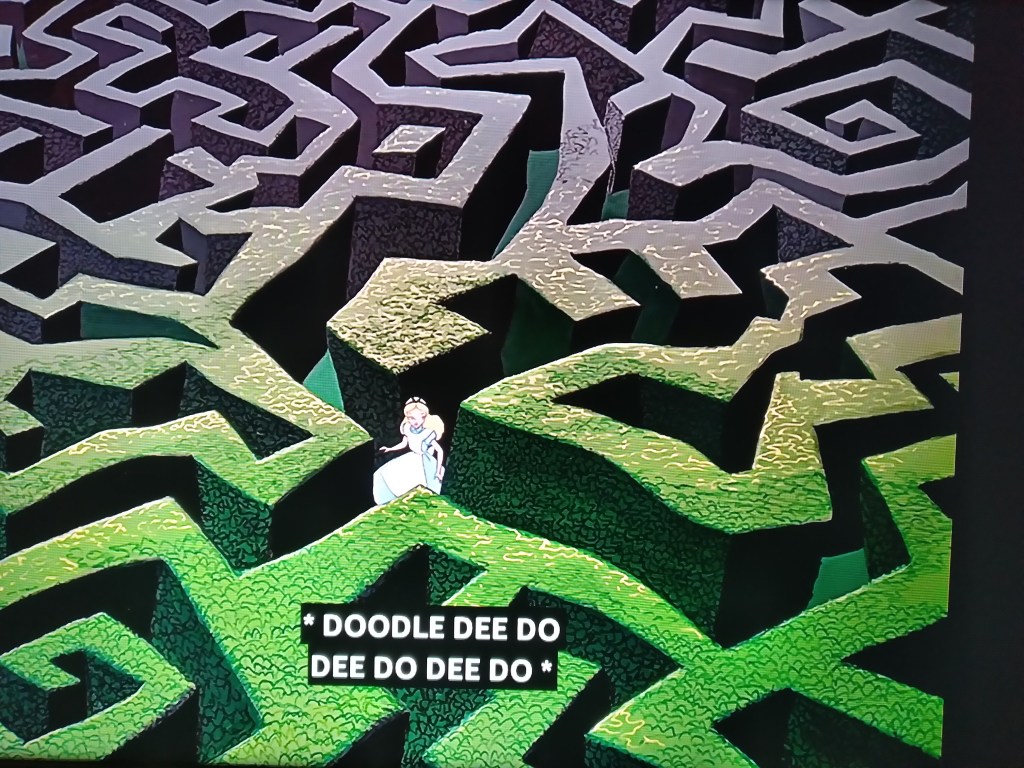
This discussion on Barker’s website also notes that the “Bloody Mary” element of saying the Candyman’s name into a mirror was added in the film, not in Barker’s original text…meaning the movie made a sort of Shakespeare-influence mashup, crossing Hamlet’s mother’s quote with Juliet’s about what’s in a name.

Reading King has also led me to unearth more about both of my parents’ surnames: my mother’s, “Dyer,” names an occupation King once held himself:

My job was dyeing swatches of melton cloth purple or navy blue. I imagine there are still folks in New England with jackets in their closets dyed by yours truly. (boldface mine)

Stephen King, On Writing: A Memoir of the Craft (2000).

And my father’s, “Rolater,” I only recently learned the supposed original spelling of in the same conversation I asked my mother if I remembered correctly that she had once named a car of hers “Christine” after King’s novel–or rather, after the car the novel is named for–and she confirmed that she had. My father (who, now deceased, can no longer confirm) apparently once told her that “Rolater” was originally spelled “Rollaughter.” Rol-LAUGHTER.

I shit you not.

The Hamlet influence on Candyman is also resonant in light of that play’s prominent use of the evil uncle figure (which David Foster Wallace takes as the plot of his magnum opus titled with a Hamlet quote, Infinite Jest (1996)) and a quote from it that’s far more prominent/recognizable than “sweets to the sweet”–and that quote would be:

To be, or not to be, that is the question:

Shakespeare, Hamlet (1603).

Which we might rephrase: “To bee or not to bee, that is the question…” or, “A bee, or not a bee, that is the question.”

And resonant in light of another famous Hamlet quote, but not a Hamlet quote:

And if you rearrange the letters in “be(e) true,” you (almost) get a quote connoting the opposite of being true, “Et tu, brute?” A sign of bee-trayal…

Like the twin threads of maternal-paternal genetics, the above research seems to indicate that there are essentially two bee-symbolism threads that can be tracked/traced through folklore histories–a Eurocentric track running through the Bible then Shakespeare, and an Afrocentric track that runs through African folklore imported to America by forcibly imported African people, debatably “transcribed” or “compiled” by Joel Chandler Harris in the original Uncle Remus tales, and then “re-popularized” by Song of the South.

These two threads apparently have “real-life” corollaries via “Africanized Bees vs. European Honeybees”:

The best way to distinguish between the African and European honey bee is by their overall behavior. Almost everything about Africanized honey bees is more aggressive, hence where the term “killer bee” came from. When provoked, instead of sending out 10-20 protection bees, African honey bees will send out 300+ bees to defend the colony. This is an extremely dangerous and effective tactic to not only disorient the person or animal but in actually harming them as well. And more bees means more bee stings. In addition to sending out more bees for protection, they will also chase the victim for a much longer distance from the hive, sometimes up to 40 yards!

Aside from the initial reaction to a disturbance, Africanized honey bees remain agitated and aggressive much longer than their docile cousins. In some cases, they can remain that way for several days after an incident. This is dangerous because an innocent passerby could accidentally stumble upon a disturbed Africanized bee colony and pay for it dearly. Depending on the situation, a disturbance to the hive could mean that they swarm in order to find a new place to call home. Seeing as African colonies are so much more aggressive, this also poses a problem to those who are in the surrounding area.

From here.

I’m sensing a bias against the “Africanized” bees here–and why are they “Africanized” instead of just “African”? It’s almost like an implicit admission they’re a European construction of African rather than actually African…but another article directly explores the question of “What’s in a Name?”:

Box 1. What’s in a name?
In popular literature, “African,” “Africanized,” and “killer” bees are terms that have been used to describe the same honey bee. However, “African bee” or “African honey bee” most correctly refers to Apis mellifera scutellata when it is found outside of its native range. A.m. scutellata is a subspecies or race of honey bee native to sub-Saharan Africa, where it is referred to as “Savannah honey
bee” given that there are many subspecies of African honey bee, making the term “African honey bee” too ambiguous there. The term “Africanized honey bee” refers to hybrids between A.m. scutella and one or more of the European subspecies of honey bees kept in the Americas.

M. K. O’Malley, J. D. Ellis, and C. M. Zettel Nalen, “Differences Between European and African Honey
Bees
,” University of Florida, The Institute of Food and Agricultural Sciences (IFAS), 2019.

Honeybees are “sweeter,” hence the use of “honey” as an endearment…as Remus repeatedly uses for the little white boy in Harris’s Remus stories.

We might find in Cujo’s name “a buried history of stinging truth” of sorts that Nilsen describes in the same essay she coins “creatureliness”:

…the spirit that attacks Donna is directly linked to Cujo’s namesake, William Wolfe. Wolfe (his name signifying the non-domesticated, unfeeling canine forefather) was a member of the Symbionese Liberation Army (SLA), his code name was “Cujo,” and he was involved in the kidnapping of the 19-year-old heiress, Patty Hearst with whom he had a sexual relationship. Wolfe, like Hearst and Donna, were all white, middle to upper middle-class, educated, seemingly average Americans, who appeared on the surface like anybody’s child, but their placid middle-class façade appeared to hide behind it a terrifying and threatening core.

Sarah Nilsen, “Cujo, the Black Man, and the Story of Patty Hearst” in Violence in the Films of Stephen King (ed. Magistrale & Blouin), 2021.

So a name provides a sort of wall between an entity’s “façade” and its “core”…just as a book cover is a sort of wall between its text and the world…

If you were considering going to the mirror to utter a certain name a certain number of times, you might consider the joke Jordan Peele’s description of the Candyman plot culminated in on the aforementioned Key & Peele episode, in which they explain that if you did say his name five times into a mirror after seeing the movie, that meant (or was a sign that) you were white, because Black people don’t fuck around with the supernatural. Why? Because the last time they encountered a presence they didn’t understand, it kidnapped them for enslavement in America….which might provide some insight into the updated Candyman movie poster with the tag line changed from “We dare you to say his name five times” to:

If the Candyman is the writing on the wall, then the above image renders the Candyman himself a wall with writing on it…

In Playing in the Dark, Morrison introduces the Africanist presence concept by way of analyzing its manifestation in an example text: Marie Cardinal’s memoir The Words To Say It (1975), which in large part chronicles Cardinal’s treatment for mental-health issues, or what Cardinal in the text designates “the Thing.” Morrison describes how this Thing becomes racially associated and thus a sign of an Africanist presence when Cardinal locates the scene of her mental breaking point to a panic attack induced by hearing Louis Armstrong play at a club.

It seems to be the change of setting, or place, to Chicago from Liverpool in England that inspires the change in the film Candyman’s race; the writing on the wall in Barker’s original text manifesting as graffiti might also have more racialized associations in the American setting via the hip-hop culture that was becoming prominent at the time.

Candyman (1992).

The bees emanating from the Candyman’s mouth might call attention to their symbolic nature as comprising words (via being a “letter,” B), not to mention have something of a freaky confluence….

The cutting off of the hand in the Candyman legend is similar to the bees in being arbitrary horror in Barker’s version, and more historically loaded in the film version. The reason why the hand symbolism is more historically loaded takes us back to Song of the South by way of cartoon animation. The scholar Nicholas Sammond explains the critical link between blackface minstrelsy and the cartoon industry:

because the figure of the blackface minstrel itself was an appropriative fantasy of the black laboring body, a moment’s consideration of the minstrel’s physiognomy and its gestural economy will also delineate some of the most common visual conventions that animation’s continuing characters shared with live minstrels and will set the stage for considering how those characteristics eventually became vestigial.

One of the most familiar tropes in classical American animation is characters wearing white gloves, which were also quite common in blackface minstrelsy. (boldface mine)

Nicholas Sammond, Birth of an Industry: Blackface Minstrelsy and the Rise of American Animation (2015).

(White gloves are a sign of the blackface minstrel’s presence that we’ll return to.) Bees represent a version of a “laboring body” which in turn makes them an apt symbol to evoke the “laboring bodies” that constitute the institution of slavery–a body that labors that is exploited for that labor because of the product of that labor: the bees are a laboring body that produce: honey. (Sweet, sweet honey.) Sugar is inextricably connected to a commodity that the laboring bodies of live human beings were exploited for during slavery; Morrison’s Tar Baby (1981) showcases the inextricable link between this consumption and slavery/colonialism/imperialism.

Via this historical thread from Sammond, the SoS podcast series from Karina Longworth also taught me something that blew my f*cking mind: the foundational Disney character, Mickey Mouse himself, is a minstrel:

Commercial animation in the United States didn’t borrow from blackface minstrelsy, nor was it simply influenced by it. Rather, American animation is actually in many of its most enduring incarnations an integral part of the ongoing iconographic and performative traditions of blackface. Mickey Mouse isn’t like a minstrel; he is a minstrel.

Nicholas Sammond, Birth of an Industry: Blackface Minstrelsy and the Rise of American Animation (2015).

Which potentially gives us another iteration of something black and white and re(a)d all over…

Peek-a-boo! It’s the minstrel underwriting all of American popular culture, the LYNCHpin of the company that has eaten up every other competing company…

Talk about “a buried history of stinging truth”…Mickey Mouse manifests covert racism in his inverted blackface image–white over black.

This is the figure that underwrites American popular culture in both the traditional financial sense of the term and the more figurative sense I’ve come to use it in providing an inextricable/integral foundation for something (like a novel’s plot).

The covert-racist harm latent in cartoon animation is further evidenced by “animation” being a “critteration” in deriving from animals:

The figure for nature in language, animal, was transformed in cinema to the name for movement in technology, animation. And if animals were denied capacity for language, animals as filmic organisms were themselves turned into languages, or at least, into semiotic facilities.

Laurel Schmuck, “Wild Animation: From the Looney Tunes to Bojack Horseman in Cartoon Los Angeles,” European Journal of American Studies 13.1 (2018). (Special issue: Animals on American Television)

And the language is communicating that “critterations” can’t be trusted… And animated cartoon animals being a prominent “critteration” contain a buried function of animating the same “imagined blackness” on display in blackface minstrel shows. American cartoons have perpetuated the narratives that alongside the consumption of sugary breakfast cereals that they were the “real” vehicle to advertise, have now been consumed to excess by multiple generations, in a sense offering the explanation for the entrenchment of systemic racism as the privileged continue to go about their lives convinced that racism doesn’t exist. 

-SCR

The Running Man’s Dark Tower: A Park of Themes

I’m just sitting here watching the wheels go round and round
I really love to watch them roll
No longer riding on the merry-go-round

John Lennon and Yoko Ono, “Watching the Wheels,” 1980.

I have always tried to live in an ivory tower, but a tide of shit is beating at its walls, threatening to undermine it.

Julian Barnes, Flaubert’s Parrot, 1984.

“—and there was this crazy remake called The Wiz, starring black people—”

“Really?” Susannah asked. She looked bemused. “What a peculiar concept.”

“—but the only one that really matters is the first one, I think,” Jake finished.

Stephen King, Wizard and Glass, 1997.

King’s Verse

The opening credits of the Netflix series Cheer uses the song “Welcome to My World”; this initially aired in January of 2020, around the same time I started this project, for which this would have been an equally appropriate theme song. In a recent post, I discussed how King hints at the cosmology of his sprawling Dark Tower series with the Beatles’ song “Hey Jude”: when this song is part of an environment that feels like it’s supposed to be the 1800s, we realize something is off–this can’t really be the 1800s, and Roland the Gunslinger’s old-west world is actually in a future far ahead of our time: “Hey Jude” welcomes us into what turns out to be a world of worlds. In the film The Dark Tower from 2017, starring Idris Elba as Roland and Matthew McConaughey as Walter, aka the man in black, a different cue is used to hint at this cosmology (possibly due to the difficulty of obtaining Beatles’ rights?):

The Dark Tower (2017)

Jake: You have theme parks here. 

Roland: These ancient structures are from before the world moved on. No one knows what they are. 

Jake: [pause] They’re theme parks.

From The Dark Tower (2017).

I was initially reluctant to watch this movie, thinking it would have spoilers for the rest of the series, but after hearing the Kingcast hosts repeatedly trash it, with one noting that he’d reread the series before seeing the movie and doing so had turned out to be “pointless,” I couldn’t resist. The theme park exchange was of particular interest because I had of late been thinking that my ideal job, a more elaborate version of hosting a podcast on King, would be to work at a King theme park: King World. I had started to think this because of certain passages in a) Carrie, b) The Green Mile, and c) Misery.

a) I’m writing a paper for an academic conference on the invocation of Disney in the critical moment in Carrie (1974) when Carrie is triggered to unleash holy hell after the blood dumps on her, hell she specifically unleashes not because of the blood itself, but because everyone starts laughing at her. The character Norma, whose perspective we initially see this moment in, explains why everyone starts laughing:

When I was a little girl I had a Walt Disney storybook called Song of the South, and it had that Uncle Remus story about the tarbaby in it. There was a picture of the tarbaby sitting in the middle of the road, looking like one of those old-time Negro minstrels with the blackface and great big white eyes. When Carrie opened her eyes it was like that. They were the only part of her that wasn’t completely red. And the light had gotten in them and made them glassy. God help me, but she looked for all the world like Eddie Cantor doing that pop-eyed act of his.

Stephen King. Carrie. 1974.

(If you need further evidence of how important the horrific function of laughter/humor is in this particular text and through it the importance of this function throughout King’s canon, one of the handful of iconic lines of dialog from King film adaptations that the Kingcast opens each episode with is Piper-Laurie-as-Margaret-White’s “They’re all gonna laugh at you!”)

b) The influence of Walt Disney and his worlds is also prominently on display throughout King’s The Green Mile (1996), in which a pet mouse is initially named “Steamboat Willie” (the novel’s primary timeline is set only a couple of years after the initial Disney “Steamboat Willie” cartoon was released in 1928). One character convinces an inmate about to be put to death that they will send his pet mouse to “Mouseville”:

“What dis Mouseville?” Del asked, now frantic to know.

“A tourist attraction, like I told you,” Brutal said. “There’s, oh I dunno, a hundred or so mice there. Wouldn’t you say, Paul?”

“More like a hundred and fifty these days,” I said. “It’s a big success. I understand they’re thinking of opening one out in California and calling it Mouseville West, that’s how much business is booming. Trained mice are the coming thing with the smart set, I guess—I don’t understand it, myself.”

Del sat with the colored spool in his hand, looking at us, his own situation forgotten for the time being.
“They only take the smartest mice,” Brutal cautioned, “the ones that can do tricks.”

Stephen King. The Green Mile: The Complete Serial Novel. 1996.

This mouse is pivotal to the plot the way one could argue Disney has been to American pop culture…and the way the “Mouseville” story is fabricated to make Del feel better replicates Disney’s manipulation of fairy tales to change the grimmer aspects of their life lessons into hollow happy endings.

Further, how this manipulation ends up backfiring when Del finds out the truth then replicates how these hollow happy endings sow seeds of discontent with our own lives when they don’t work out so perfectly that drive us further into the cycle of consumption/destruction…

c) In Misery (1987), the main character, novelist Paul Sheldon, has created a popular romance series around the character of Misery Chastain:

He remembered getting two letters suggesting Misery theme parks, on the order of Disney World or Great Adventure. One of these letters had included a crude blueprint.

Stephen King. Misery. 1987.

As I teach an elective on “world-building” this semester, I am especially attuned to the mechanics of “otherworldly” cosmologies. The Dark Tower movie–which I fully concur with the Kingcast hosts is generally terrible–offers a strange distillation of the series’ cosmology that did help me wrap my mind around it in new ways. Notably, just after Jake and Roland’s “theme park” exchange in the film, their conversation addresses the cosmology of the world of worlds even more directly (some might say, heavy-handedly). Before Jake crosses into Roland’s world through a portal, he has been drawing pictures, one of which he draws again for Roland in the sand:

The Dark Tower, 2017.

Jake: I just don’t know what this is. 

Roland: It’s a map. My father showed me a map like this once. Inside the circle is your world, and my world, and many others. No one knows how many. The Dark Tower stands at the center of all things, and it’s stood there from the beginning of time. And it sends out powerful energy that protects the universe, shields us from what’s outside it. …

Jake: What’s outside the universe?

Roland: Outside is endless darkness full of demons trying to get to us. Forces want to tear down the tower and let them in.

From The Dark Tower, 2017.

For emphasis, Roland picks up a tarantula and drops it outside the circle and they both watch it crawl in.

I know things I shouldn’t if I only knew the content of the first four books of the series that I’ve actually read: that Father Callahan from ‘Salem’s Lot is going to play a role at some point, that there’s going to be some kind of meta-reference to King himself as a character/entity. And of course Randall Flagg has made a brief appearance at the end of Book 3, with the superflu-apocalypse that occurred in The Stand invoked in Book 4, and Flagg makes cameos that are a bit more developed, though still fleeting, in Book 4. These intertextual references in conjunction with the distilled Dark Tower map contributed to a sort of Dark-Tower epiphany: its structure replicates the King canon itself, with the godhead of King-the-author at its epicenter–everything revolves around him, as he necessarily produces it. I was considering this right before reading King’s afterword to Book 4’s Wizard and Glass (1997), in which King notes:

I am coming to understand that Roland’s world (or worlds) actually contains all the others of my making; there is a place in Mid-World for Randall Flagg, Ralph Roberts, the wandering boys from The Eyes of the Dragon, even Father Callahan, the damned priest from ’Salem’s Lot, who rode out of New England on a Greyhound Bus and wound up dwelling on the border of a terrible Mid-World land called Thunderclap. This seems to be where they all finish up, and why not? Mid-World was here first, before all of them, dreaming under the blue gaze of Roland’s bombardier eyes.

Stephen King, Wizard and Glass. 1997.

Every spoke in this wheel is a different world is a different work of King’s, the cyclical nature I suppose in this sense excusing/justifying as cosmically significant the echoes across King’s many, many plots that are essentially the same thing happening over and over.

But these spokes are more than just works King has written himself (and probably far more numerous than on Jake’s rudimentary renderings, to the point where individual spokes might not even be discernible if these were “to scale”…). They’re also the works that influenced him, whose range across the pop-culture-literary-canon spectrum amount to King’s “secret sauce,” as discussed in the initial Dark Tower post on Book 1’s The Gunslinger. This goes back to what could be the most influential text on King, Lord of the Rings, but via Dracula, as King clarifies in his afterword to ‘Salem’s Lot:

When I discovered J. R. R. Tolkien’s Rings trilogy ten years later, I thought, “Shit, this is just a slightly sunnier version of Stoker’s Dracula, with Frodo playing Jonathan Harker, Gandalf playing Abraham Van Helsing, and Sauron playing the Count himself.”

Stephen King. ‘Salem’s Lot. 1975.
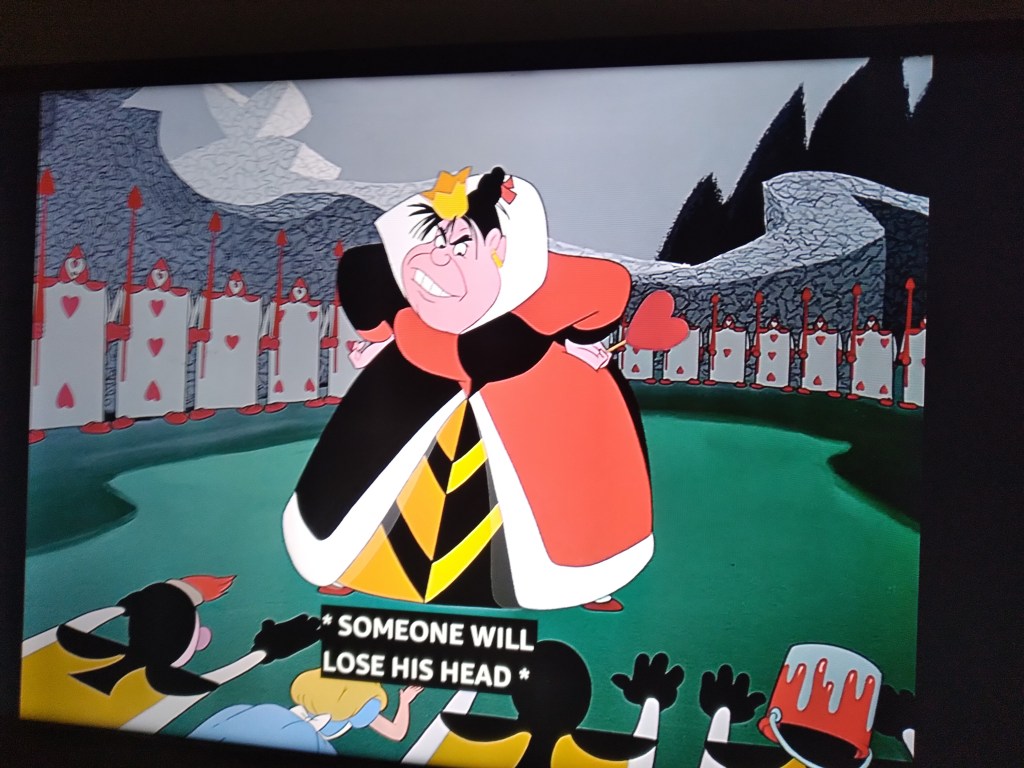
So it seems appropriate that a ‘Salem’s Lot character specifically will be returning… The above passage would seem to be a critical insight of King’s about the utility of telling the same story over and over, that the “secret sauce” is taking and using a template that’s worked for generations, specifically the “ka-tet” or “fellowship” narrative, which, with Dark Tower book 4’s Wizard and Glass, King also yokes The Wizard of Oz into the lineage of…

The Wizard of Oz (1939)

The king lives long through the continued passing down of the same narrative… King’s multiverse is a metaverse, I thought. Then I remembered that was what Facebook has renamed itself and/or its conglomerate of companies, and I shuddered.
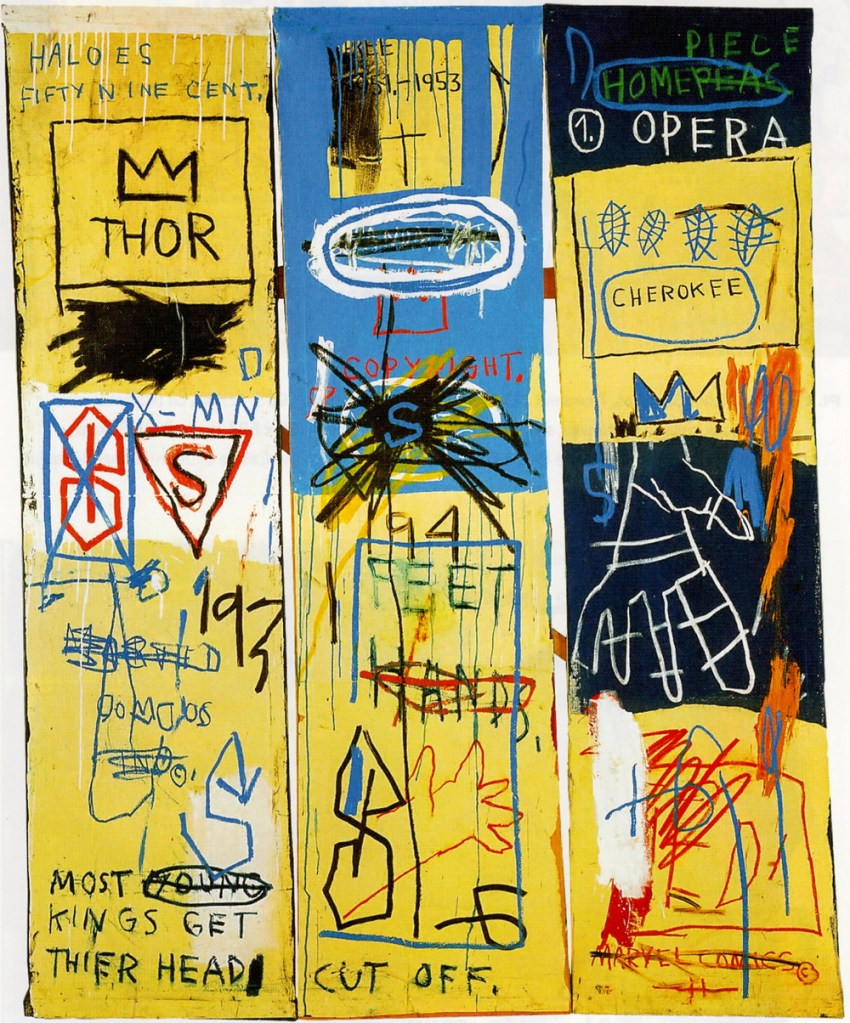
From here.

Run, Forrest

My comprehension of King’s meta-multiverse was also facilitated by a particular Kingcast episode with guest Marc Bernardin, who chose to discuss The Running Man. Bernardin was one of the Hulu series Castle Rock writers, the show that leans on the “connective tissue” of Kingverse cosmology but introduces original characters and storylines to it; Bernardin articulated the general template of a King plot:

Stephen King is the great unheralded American writer, you know, nobody gives him credit for being the character writer that he is. I mean they always give him credit for the horror stuff, they always give him credit for the boo stuff, but when you look at Stephen King books, for the most part, they’re not mysteries. They are: here’s a bunch of people, and we’re going to introduce you to their lives, and then a bad thing is going to crash into their lives, and what do they do about it. And in order to make stories like that function, you need to build those lives of those characters so that we understand them, we can empathize with them, and know who they are, so when that giant mack truck of supernatural awfulness blindsides their lives, we know who they are and can respond to it.

From here.

Bernardin’s work on Castle Rock prompted the hosts to ask about his thoughts on the Dark Tower series, and I appreciated his response that he “appreciated” it more than he liked it. When they finally got to The Running Man, Bernardin had a reading of it that blew my mind: since its protagonist Ben Richards is essentially from the “projects,” Bernardin likes to think that Ben Richards is Black.

I was initially resistant to this reading, largely because I thought it gave King too much credit. There is much textual evidence to refute the idea that King intended to write a Black protagonist here, mainly through the characters that are identified and described as Black (such as the villainous Killian) in a way that seems to distinguish them from the point of view describing them–Richards’ (and in a way that’s often blatantly racist from Richards’ perspective). It is also Killian, CEO of the network airing The Running Man game show, being explicitly Black that made me resistant to reading Richards as Black–if the narrative were an allegory for the oppression and exploitation of Black Americans, why would a Black character be at the helm of the exploitative vehicle? (Then, of course, there are also the book covers that depict Richards with an illustration of a white man.)

I couldn’t really tell if Bernardin was saying he thought King had intentionally written Richards as Black or if he himself just liked to read it that way, though I guess his calling out King’s “blind spot” when it came to writing race should have been a clue it was the latter:

…maybe it’s because i’m interpreting things in the text that aren’t there, but in my interpretation of Ben Richards as an African American, one of the things I discovered on Castle Rock doing a deep dive there is that one of Stephen King’s big blind spots is writing race–and, and, it’s either magical negro, or magical negro, and that’s kind of it. 

From here.

When I Googled Bernardin and learned that he is Black, his reading made more sense as a reclamation reading, not a literal one. To my mind, a white guy reading Richards as Black would amount to more of a white apologist reading.

As a consequence of the suffering that protagonists experience at the hands of a state-corporate nexus that does not adequately address the rehabilitative needs of citizens, Bachman’s books articulate a politics of pure negation (a modality that plays a vital role in the decades to come) by tracking ‘protagonists who are sociologically so tightly determined and whose free will is so limited that they find violence and self-destruction as their only means to take a stand’ (Strengell 218).

Blouin, Michael J.. Stephen King and American Politics (Horror Studies) (p. 45). University of Wales Press. Kindle Edition.

That quote from Heidi Strengell could be read, via Bernardin, as describing the state of Black people in the American state specifically, as you could define white privilege as not being “sociologically so tightly determined” that your free will is necessarily diminished, and this strikes me as another way of framing my reading of the Bachman novels as deriving their horror from playing out a white male protagonist essentially being treated as a Black person (ultimately in a way that’s condescending toward Black people rather than creating sympathy with their plight).

In the world-building elective I’m teaching, theme parks have become a prominent…theme, since they constitute literal world-building, the construction of an immersive experience. And of course there’s one theme park to rule them all, the one King invokes in all of the above references to Carrie, The Green Mile, and Misery.

The academic Jason Sperb, focusing on Disney’s “most notorious film,” Song of the South (1946)–significantly, the one that Norma invokes in the critical Carrie moment–notes:

One of the main critiques often leveled at the Disney empire for decades has been its distortion of history.45 Disney’s romanticized view of its own past, as the self-appointed king of the golden age of Hollywood, is one thing. Yet more disturbing is its rewriting of American history in general. … Disney’s fondness for rewriting American history, often to the benefit of white, middle-class consumers, came to a head in the 1990s, when cultural critics, historians, and political activists successfully pressured the company to abandon plans for a history-themed amusement park in Virginia, to be called “Disney’s America.” In questionable taste, this endeavor would have awkwardly mixed Disney’s own idealization and whitewashing of history with the uglier history of the surrounding areas, which feature countless institutionalized reminders of the country’s violent colonial and Civil War legacies.

Jason Sperb, Disney’s Most Notorious Film: Race, Convergence, and the Hidden Histories of Song of the South. 2012.

A short story by fiction writer George Saunders, “CivilWarLand in Bad Decline,” helps illuminate this legacy, and in the specific context of “Disney’s America”‘s take on it. The first-person narrator of this story works at a theme park recreating the Civil War, working as a “verisimilitude inspector” with a “Historical Reconstruction Associate.” This would seem like a wacky enough premise on its own (potentially) when a gang of teen vandals starts wreaking havoc and the park becomes a site of violence in its own right rather than just re-enacting it, but then literal ghosts appear in the story to play a pivotal role as well. It’s really the final line of this story that emphasizes the true nature of this Civil-War legacy as the first-person narrator is killed by the ghost of a boy named Sam:

I see the man I could have been, and the man I was, and then everything is bright and new and keen with love and I sweep through Sam’s body, trying to change him, trying so hard, and feeling only hate and hate, solid as stone.

George Saunders. “CivilWarLand in Bad Decline.” 1992. 

Contrast this ending with another one of Saunders’, almost thirty years later:

From across the woods, as if by common accord, birds left their trees and darted upward. I joined them, flew among them, they did not recognize me as something apart from them, and I was happy, so happy, because for the first time in years, and forevermore, I had not killed, and never would.

George Saunders. “Escape from Spiderhead.” 2010. 

In the final lines of both of these stories, the same literal thing is happening: a white-male first-person narrator is dying and in so doing reflecting on his life. But the latter seems to transcend the hate of the (American) human condition, while the former is consumed by it. (I had to wonder if Saunders’ professional success in the intervening decades has softened his worldview, since the earlier story would have been written when he was still essentially an impoverished failure.)

Saunders’ introduction of the fantasy/supernatural element of ghosts in “CivilWarLand” is appropriate for the story’s figurative (and Kingian) theme: that we are haunted by the ghosts of our past. The legacy of America’s collective haunting is a major thematic preoccupation for Saunders, as realized in his long-anticipated first novel Lincoln in the Bardo (2017). Saunders has described his inspiration for this novel (which, also in a classic Kingian vein, revolves around a father-son narrative) essentially being an image of the Lincoln Memorial crossed with Michaelangelo’s La Pietà. This might not be surprising when you consider the final line of “CivilWarLand” with the comparison of hate being “solid as stone” connecting to another major fixture of the Civil War legacy: monuments.

This manifestation of a legacy extends beyond Civil-War-related Confederate monuments; my alma mater Rice University has recently convened “task forces” to address what should be done with a memorial of the school’s founder, William Marsh Rice, a slaveowner. This memorial statue has always been prominently positioned at the center of the main quad on campus, and the decision has been made not to get rid of it entirely, but to move it elsewhere. It’s still a part of our school’s history that should not just be erased, but it should no longer be positioned at the center of our school’s historical narrative.

From here.

This idea of narrative (re)centering reminded me of another running man, one from a classic movie that positioned a particular figure (played by America’s “dad” and/or “everyman” Tom Hanks) at the nexus of several American historical narratives, from Elvis’s signature dance moves (which it should be noted he took from Black people, not a little white boy) to Nixon’s impeachment. I recalled how this other running man got his name:

When I was a baby, Mama named me after the great Civil War hero General Nathan Bedford Forrest. She said we was related to him in some way. What he did was he started up this club called the Ku Klux Klan. They’d all dress up in their robes and their bed sheets and act like a bunch of ghosts or spooks or something. They’d even put bed sheets on their horses and ride around. And anyway, that’s how I got my name, Forrest Gump. Mama said the Forrest part was to remind me that sometimes we all do things that, well, just don’t make no sense.

Forrest Gump, 1994 (here).

This explanation would seem to render this Civil War General’s legacy as excusable, innocuous and justified…and putting this figure named after Forrest at the center of these classic American historical narratives would seem to symbolize the prominence of Forrest and his legacy to our current state–albeit inadvertently.

King’s plots often purport to promote the idea that we can only heal by facing our history, but these narratives seem to reinforce a theme that we’re still running away from it.

Whitewashing

Sperb accuses Disney of “the whitewashing of history,” using a term I had thought of before reading it in his work, specifically when I recently visited a “Walt Disney Archives” exhibit held at the Graceland Exhibition Center in Memphis (Graceland as in Elvis Presley’s Graceland, which now has enough appendages–such as this exhibition center–to qualify as its own theme park). I was visiting these archives specifically for any possible Song of the South materials because of the Carrie reference–but there were none.

If you want to talk about a model for a metaverse–i.e., interconnected narratives within narratives within narratives–then Song of the South is a solid one–“solid as stone,” you might say. Like many (most?) Disney movies, the story for this one is not original but was taken from elsewhere–from the “Uncle Remus” stories by Joel Chandler Harris, a white man who took folklore he overheard enslaved people sharing with one another on a Georgia plantation and then transcribed into books with his own name on them as author.

From here.

Harris tells tales of the “Uncle Remus” character–whose title might recall another infamous racially charged avuncular fictional fixture, Uncle Tom–telling tales. As visible on the title page above, these are not designated as his “stories,” but rather “his songs and his sayings.” The “songs” aspect–emphasized in the Disney adaptation’s appellation SONG of the South–underscores how this narrative replicates the role of the cultural appropriation of music in American history (which I’ve discussed in relation to King’s The Stand here and here), with all of American music tracing back to the white appropriation of Black songs from the plantations, manifest initially in the blackface minstrel performances in which white performers, following the example of Stephen Foster, were performing a version of “imagined blackness.”

Now we put up white draperies and pipe in Stephen Foster and provide at no charge a list of preachers of various denominations.

George Saunders. “CivilWarLand in Bad Decline.” 1992. 

The framing device of the Remus narrator offers another version of a performance of imagined blackness: “Joel Chandler Harris’s jolly slave, the eponymous minstrel-like narrator of several collections of African American folklore…the Remus re-popularized by Disney with Mr. Bluebird on his shoulder” (emphasis mine), as Kurt Mueller puts it in a 2010 issue of Gulf Coast discussing the recasting of this character by Houston-based artist Dawolu Jabari Anderson–specifically, as the “Avenging Uncle Remus”:

The Carrie trigger moment as described by Norma explicitly links Remus to musical minstrel performance by comparing Carrie to the “tarbaby” Remus describes in the Disney story and then by comparing that tarbaby image to “those old-time Negro minstrels with the blackface,” emphasizing this minstrel connection further via the real-life minstrel performer Eddie Cantor (whose Wikipedia page only designates as such implicitly by including him in the “Blackface minstrel performers” category).

This function of Remus is also essentially a figurative iteration of the magical Black man: his magic is to impart wisdom and life lessons in an innocuous way, a depiction of Black man that’s both nonthreatening and subservient–and ultimately dehumanizing. Remus’s tales centering around anthropomorphized animals is another iteration of Remus’s dehumanization, illuminating his function as a figure that purports to be human without being fully so, a facsimile of a human that’s necessarily less than human (and thus justifiably enslavable by actual humans). Disney ends up emphasizing this dehumanizing aspect even more by having the actor who plays Uncle Remus, James Baskett, voice more than one of the cartoon animals in Remus’s tales. Baskett also voiced the “Jim Crow” crow in Dumbo (1941), and he has the distinction of being the first person hired to act live for a Disney film, but this fact that is often presented as a “distinction” turns out to reinforce the film’s dehumanization of Black people through the Remus character–he is literally positioned on screen next to cartoons, a parallel that creates the impression, however subconscious, that this figure is also essentially a cartoon.

Though maybe you could try to argue that this cartoon-rendering of Remus could help us read the dialect of his dialog as cartoonish, i.e., unrealistic:

Remus: Dishyer’s de only home I knows. Was goin’ ter whitewash de walls, too, but not now. Time done run out.

Song of the South, 1946 (here).

In the second room of this Gracleand Walt Disney Archives exhibit, which according to the copy was a replication of the archives kept at the official studios in Burbank, CA, the far wall appeared to be covered by a floor-to-ceiling bookshelf that turned out to only a picture of same:

A picture of a picture of a wall of books…ceci n’est pas une…books.

Via the “‘s” visible on many of these spines, one can see a penchant for a certain framing of the possessive visible on these (faux) book spines, Disney’s assertion of ownership by way of the apostrophe, but the possessive is notably absent in the “Uncle Remus Stories” phrase itself–these aren’t “Remus’s” stories, they’re Disney’s….

Here the Remus stories are positioned next to Fantasia, in which the connection between music and narrative is focalized through the figure of the conductor-narrator, who in being a narrator is in that position similar to Remus:

Now, there are three kinds of music on this Fantasia program. First, there’s the kind that tells a definite story. Then there’s the kind, that while it has no specific plot, does paint a series of more or less definite pictures. Then there’s a third kind, music that exists simply for its own sake. … what we call absolute music. Even the title has no meaning beyond a description of the form of the music. What you will see on the screen is a picture of the various abstract images that might pass through your mind if you sat in a concert hall listening to this music. At first, you’re more or less conscious of the orchestra, so our picture opens with a series of impressions of the conductor and the players. Then the music begins to suggest other things to your imagination. They might be, oh, just masses of color. Or they may be cloud forms or great landscapes or vague shadows or geometrical objects floating in space. 

From Fantasia (here).

These “vague shadows” recall Toni Morrison’s concept of the Africanist presence, which, when I first applied this concept to Carrie, I described as “the white mainstream’s shadow self, implicitly a site of horror that whiteness can define itself in relation to.” One might read this presence into the image that greeted the viewer in the first room of the Archives…

Not from the Disney Archives.

This room also had another iteration of this presence in an image reminiscent of Joseph Conrad’s Heart of Darkness (1899), an imperialist narrative with the implied setting of the “economically important Congo River“:

“Displayed here are examples of concept art for used to [sic] ‘pitch’ the idea of Disneyland to prospective investors, lessees, licensees and sponsors.”

This appears to be a mockup of the “Jungle Cruise” ride that’s recently come under criticism for its problematic native-related imagery, which means it has something in common with the “Splash Mountain” ride that people were calling to be “re-themed” because its theme was from…Song of the South. Though the ride didn’t have imagery directly connected to the Remus character, it had other innocuous-seeming elements from the film (bluebirds, etc.), part of a strategy Jason Sperb articulates as a major part of his project:

This attention to the “paratexts”2—the additional texts and contexts surrounding a primary text—becomes especially acute when focused on a Disney film that has benefited from its parent company’s noted success in exploiting its theatrical properties across numerous forms of cross-media promotion and synergy. Song of the South is another beneficiary of what Christopher Anderson has dubbed Disney’s “centrifugal force . . . one that encouraged the consumption of further Disney texts, further Disney products, further Disney experiences.”3 In the seventy years since its debut, Song of the South footage, stories, music, and characters have reappeared in comic strips, spoken records, children’s books, television shows, toys, board games, musical albums, theme park attractions, VHS and DVD compilations, and even video games (including Xbox 360’s recent Kinect Disneyland Adventures, 2011). By conditioning the reception of the main text, these paratexts are fundamentally intertwined with it, thus problematizing the hierarchical distinction between the two. What I hope to add to this discussion is the powerful and often unconsidered role that paratexts have played historically and generationally in shifting perceptions of the full-length theatrical version. (p5).

Jason Sperb, Disney’s Most Notorious Film: Race, Convergence, and the Hidden Histories of Song of the South, 2012.

This analysis reveals something critical about the critical Carrie trigger moment–Norma doesn’t reference the movie Song of the South as her source for the “tarbaby” image, she references one of its “paratexts”: “I had a Walt Disney storybook called Song of the South…” (Though when one looks up what SoS-related storybooks Disney released, none of them are actually titled the exact same as the film itself.) Norma’s reference to the paratext tracks with the success of the paratext strategy for this particular property–Sperb’s research shows:

In 1972, Song of the South was the highest-grossing reissue from any company that year, ranking it sixteenth among all films.

Jason Sperb, Disney’s Most Notorious Film: Race, Convergence, and the Hidden Histories of Song of the South, 2012.

Norma’s use of the Remus character as a point of reference (in the critical trigger moment!) reveals how the re-release of this 1940s text influenced the perspective of the children of the 1970s.

Disney did relatively recently change the theme of the Splash Mountain ride to eradicate all Song of the South references, but the fact that they released a movie based on the Jungle Cruise ride, called Jungle Cruise, just last year seems an extension of this problematic strategy rather than a rectification of it. I made it through only half of the movie when I tried to watch it, but since it’s the depiction of the jungle “natives” that were the problem, it’s worth noting that every time over-the-top natives appear in the first half, their exaggerated costumes and actions are revealed to be a performance paid for and manipulated by the main character of the cruise skipper.

It’s also worth noting that the jungle is a prominent theme at Graceland itself due to Elvis having a themed “Jungle Room” in his Graceland mansion, showcased further by the “Jungle Room” bar across from the exhibit space in the Exhibition center. The critic Henry Louis Gates, Jr. points to the problematic association between the “jungle” and depictions of Blackness (as epitomized by Uncle Remus and potentially with Heart of Darkness as Ground Zero) by titling his introduction to issue 50.4 (2017) of the African American Review “Criticism in de Jungle,” in which he mentions the concept of the “text-milieu” in relation to the application of academic literary theory:

…what Geoffrey Hartman has perceptively termed their [literary works’] “text-milieu.”4 Theory, like words in a poem, does not “translate” in one-to-one relationship of reference. Indeed, I have found that in the “application” of a mode of reading to black texts, the critic, by definition, transforms the theory, and, I might add, transforms received readings of the text, into something different, a construct neither exactly “like” its antecedents nor entirely new.

Hartman’s definition of “text-milieu” (“how theory depends on a canon, on a limited group of texts, often culture-specific or national”) does not break down in the context of the black traditions; it must, however, be modified since the texts of the black canon occupy a rhetorical space in at least two canons, as does black literary theory. The sharing of texts in common does allow for enhanced dialogue, but the sharing of a more or less compatible critical approach also allows for a dialogue between two critics of two different canons whose knowledge of the other’s texts is less than ideal. The black text-milieu is extra-territorial.

Henry Louis Gates, Jr., “Criticism in de Jungle,” African American Review 50.4, Winter 2017.

Which reminds me of movie-Roland’s map and my idea that the titular concept of the “Dark Tower” is a play or inversion of the “ivory tower” of academia, an institution King has over the years evinced more than a little disdain for (as in Christine‘s invented institution “Horlicks College”).

But of course for Disney, a jungle cruise is where all of this started…

“Steamboat Willie,” 1928 (from here).

Happy Endings

We’d gotten to the happily-ever-after part of the fairy tale, as far as he was concerned; Cinderella comes home from the ball through a cash cloudburst.

Stephen King, Bag of Bones, 1998.

When viewed through the lens of the Civil-War legacy, the idea of “whitewashing” seems to me part and parcel of a cultural lust for fairy-tale “happy endings.” If Disney distorts history, its systematic appropriation–which they like to call “adaptations”–of existing narratives and the manipulation of those narratives’ darker elements into such happy endings is a natural extension of this.

A replica of a painting in the first room of the Graceland exhibit Disney Archives.

I thought of this fairy-tale distortion when watching the misery of Princess Diana’s “real-life” narrative play out in recent fictionalized retellings (The Crown with episode 3.4 about the Royal Wedding titled “Fairy Tale,” and last year’s film Spencer)–the life that everyone thought of as a real-life “fairy tale” turned out to be a living hell. This dynamic plays out again on Cheer via Gabi Butler, a figure whom all in her field emulate and idolize largely due to her omnipresence and image permeated on social media…products of what the show reveals to be an essentially slave-driven exploitation of her by her own parents. Not unlike Diana, Gabi Butler lives in the glass bubble of a pressure cooker.

The prominence of Disney’s fairy-tale narrative of Cinderella specifically can be seen in another intersection of music and narrative: opera. The majority of the Graceland Disney Archives consisted of costumes and props from different films, with several that I hadn’t realized were associated with Disney.

The dress Julia Roberts wears in the opera scene in Pretty Woman.

In Pretty Woman (1990), Edward Lewis (Richard Gere) takes Vivian Ward (Julia Roberts) to an opera where they see “La Traviata” in what amounts to a test of Vivian’s character by Edward, as explained by the latter:

“People’s reactions to opera the first time they see it is very dramatic. They either love it or they hate it. If they love it they will always love it. If they don’t, they may learn to appreciate it – but it will never become part of their soul.”

From here.

Needless to say, she passes this test–if not the Bechdel one.

In Moonstruck (1987), the two primary love interests, played by Cher and Nicolas Cage, go to the opera to see La Boheme, which the narrative of the film itself is a retelling of; Cage’s character doesn’t articulate the visit as an explicit test for Cher’s, but the scene otherwise plays out almost identically. There was another interesting detail connecting these two films:

From Moonstruck.

In Pretty Woman, as with the opera-as-test, the Cinderella connection is explicitly articulated (some have billed it as an “R-rated Cinderella“), by a character named Kit played by none other than the same actress who played Nadine Cross in the ’94 miniseries adaptation of The Stand, Laura San Giacomo:

Kit: It could work, it happens.

Vivian: I just want to know who it works out for. Give me one example of someone that we know that it happened for.

Kit: Name someone, you want me to name someone, you want me to like give you a name or something? … Oh god, the pressure of a name. [Rubs temples in intense concentration before throwing her hands up; she has the answer.]

Cinde-fuckin-rella.

From here.

And the red dress extends to Wizard-of-Oz-like red shoes:

INT. SHOE STORE — DAY
ANOTHER SALESMAN fits Vivian with a pair of red high heel shoes.
Edward sits next to her. He leans over and whispers to her.
EDWARD
Feel like Cinderella yet?
Vivian nods happily.

From here.

Happy endings indeed…

Frank Darabont’s adaptation of The Shawhank Redemption (1994), which, in my opinion, derives a lot of its emotional power from its score, adds a sequence that wasn’t in the original text when Andy Dufresne plays an opera record–Mozart’s “Le Nozze de Figaro”–over the prison loudspeakers in a moment that constitutes an explicit rebellion; this moment also reinforces the power of opera as a quintessential form of musical narrative, communicating something fundamental even without words discernible to the listener, as articulated in voiceover by the character Red:

I have no idea to this day what them two Italian ladies were singin’ about. Truth is, I don’t want to know. Some things are best left unsaid. I like to think they were singin’ about something so beautiful it can’t be expressed in words, and makes your heart ache because of it. I tell you, those voices soared. Higher and farther than anybody in a gray place dares to dream. It was like some beautiful bird flapped into our drab little cage and made these walls dissolve away…and for the briefest of moments — every last man at Shawshank felt free.

From here.

Andy does two weeks in solitary confinement for the stunt; when he emerges he tells his fellow convicts it was the easiest time he ever did because he had Mozart to keep him company. Red thinks Andy is speaking literally and asks if they really let him bring the record player down there. Andy tells him no, the music was in his head and in his heart, and gives a speech about a “place” constituted by music, a figurative rather than a literal place:

Andy: That’s the one thing they can’t confiscate, not ever. That’s the beauty of it. Haven’t you ever felt that way about music, Red?

Red: Played a mean harmonica as a younger man. Lost my taste for it. Didn’t make much sense on the inside.

Andy: Here’s where it makes most sense. We need it so we don’t forget.

Red: Forget?

Andy: That there are things in this world not carved out of gray stone. That there’s a small place inside of us they can never lock away, and that place is called hope.

From here.

What we end up with here is a white man lecturing a Black man on the importance of music as a means to both hope and to not forget, which, via slavery, is the precise origin of American music in the first place–enslaved people came up with music to help them cope with the desolation of enslavement and stay in touch with their humanity, and then white men took that music for the blackface minstrel performances that became the foundation for the rest of American music until Elvis made it palatable for a white man to play it without the blackface but was still essentially doing the same thing. That we tend to forget this makes Andy lecturing a Black man about the importance of remembering a little grating.

This figurative “place” of hope is reminiscent in a sense of “the laughing place”–a place that’s also figurative and that must also originate from slavery since it manifests from the voice of the Remus narrator. In Song of the South, Remus tells three different tales about Br’er Fox’s efforts to catch Br’er Rabbit with Br’er Bear usually inadvertently interfering; the second is the tale with the tar-baby figure entrapment that Norma refers to in the critical Carrie moment, and the third and final involves Br’er Rabbit convincing Br’er Bear that he has a “laughing place”–doing so via musical number and leading him into a thicket with a beehive that the bear stumbles into, leading the bees to attack and sting him.

There is no shortage of King making visual comparisons to white characters looking like they’re in minstrel blackface in his canon:

His cheeks and forehead were smeared with blueberry juice, and he looked like an extra in a minstrel show.

Stephen King, “The Body,” Different Seasons, 1982.

She applied mud for five minutes, finishing with a couple of careful dabs to the eyelids, then bent over to look at her reflection. What she saw in the relatively still water by the bank was a minstrel-show mudgirl by moonlight. Her face was a pasty gray, like a face on a vase pulled out of some archeological dig.

Stephen King, The Girl Who Loved Tom Gordon, 1999.

(The latter passage is of interest in conjunction to this minstrel-mask-like mud soothing a wasp sting and the function of wasps in relation to King’s first magical black man, Dick Hallorann in The Shining (1977) as I discussed here.)

But in what I’ve read so far of King’s canon, there’s only one other direct invocation of Uncle Remus besides Norma’s in Carrie (1974) (Tom Gordon refers to Little Black Sambo in conjunction with the above passage); the other Remus reference is in Misery (1987):

“I have a place I go when I feel like this. A place in the hills. Did you ever read the Uncle Remus stories, Paul?”

He nodded.

“Do you remember Brer Rabbit telling Brer Fox about his Laughing Place?”

“Yes.”

“That’s what I call my place upcountry. My Laughing Place. Remember how I said I was coming back from Sidewinder when I found you?”

He nodded.

“Well, that was a fib. I fibbed because I didn’t know you well then. I was really coming back from my Laughing Place. It has a sign over the door that says that. ANNIE’S LAUGHING PLACE, it says. Sometimes I do laugh when I go there.

“But mostly I just scream.”

Stephen King, Misery, 1987.

If this association with Annie Wilkes, one of King’s most infamous villains, doesn’t highlight a horrific undertone–or overtone–of the concept of “The Laughing Place” as the nexus of humor and horror, nothing will. An integral association between humor and horror and the Carrie trigger moment underscores via Norma’s explanation about how they had to laugh so they wouldn’t cry.

Annie Wilkes has strong feelings about the function of narrative in a more technical sense as well: when Paul tries to circumnavigate the plot development of Misery’s death to write Annie a new book about Misery, he sees Annie’s rage in full force for the first time as she explains to him, via the “Rocket Man” movies she used to go see as a kid, why he wrote “a cheat”:

“The new episode always started with the ending of the last one. They showed him going down the hill, they showed the cliff, they showed him banging on the car door, trying to open it. Then, just before the car got to the edge, the door banged open and out he flew onto the road! The car went over the cliff, and all the kids in the theater were cheering because Rocket Man got out, but I wasn’t cheering, Paul. I was mad! I started yelling, ‘That isn’t what happened last week! That isn’t what happened last week!’”

Stephen King, Misery, 1987.

This narrative “cheating” strikes me as akin to Disney’s cheating by means of simplifying complex narratives by slapping on their unrealistic happy endings. I realized reading Annie’s Rocket-Man rant that Disney’s The Rocketeer was also appropriating a pre-existing narrative from these Rocket Man stories…

Disney Archives at Graceland.

…before they even did RocketMan.

Apart from the invocation of Remus and his Laughing Place, Song of the South and Misery have another connection via a particular lace visual, in the former, one that induces other boys to laugh at the main character in a way not so dissimilar from the way Carrie’s classmates laugh at her:

“Look at that lace collar!” Song of the South, 1946.
Paul Sheldon’s pain meds in Rob Reiner’s Misery (1990), which he then uses to try to drug Annie during a pseudo-romantic dinner he convinces her to have with him…for which she wears:
…a lace collar.

The wheel of ka could be read as a hamster wheel, keeping us running toward that happy ending that we can never reach and that pretty lace collar more like a leash…

Song of the South, 1946

The Carrie trigger moment shows intersection of horror, humor, AND music, replicating the intersecting function of these in American history, and marking only the beginning of this thematic preoccupation for King. In their mocking laughter, Carrie’s classmates render her an “other” apart from their group that enables her to be read as a manifestation of the Africanist presence herself–in spite of her last name being White. In the trigger moment, Carrie is black and white and re(a)d all over, playing out a revenge cycle. I am in a way reading Carrie as “Black” in a similar but different way than Marc Bernardin reads Ben Richards as Black–but hopefully not in a white apologist way!

The current Running Man reboot in production is evidence of how King’s cyclical wheel cosmology applies to the adaptations of his work (it’s also retroactively fitting that in the 1987 original, the Running Man was played by Mr. Universe on a Day-Glo-limned set that might be considered to have a theme-park aesthetic). Rebooting It in 2017 jump-started another King Renaissance, which is somewhat ironic when The Dark Tower, the apotheosis of the King multiverse, was released the same year and a total bomb. (The cyclical interest in our historical preoccupations might also be underscored by the man playing the man in black who had his own renaissance in the form of the McConnaissance (one like King’s in being similarly unaffected by the badness of this movie), making the white-savior Civil War movie Free State of Jones, which he apparently uses as the basis of a film class he teaches for the University of Texas.)

The way that King takes other texts ranging across the low- and high-culture spectrum (his “secret sauce”) and regurgitates them into his own brand of cyclical repeating narrative actually turns out to be quite similar to the Disney model…similar as well in the way it often reinforces a patriarchal worldview…

…what does the map revolve around?

Salvador Dalí’s The Knight at the Tower (1932).

King’s construction of his metaverse has also inspired me to unveil the scrolaverse, my creative wheel in which Long Live the King is but one spoke. And the spoke of Flatten Them Into A Set is definitely influenced by the range of textual references King shoehorns into every text of his…

-SCR

A Shining History: Unmasking America’s Shadow Self (Part III): A Deep Derwent Dive

Oh, he was afraid of what face might come to light when the time for unmasking came around at last.

Stephen King. The Shining. 1977.

Unmanned Vehicles

As Texas enters its coronavirus surge, I’m still stuck on the object of the mask and its shifting connotations. Staying at home to avoid all the people refusing to wear one–connoting to me a refusal to accept reality, but hey, that’s me–I happened to watch the movie Room 237 (2012), in which several people expound (invisibly, via voiceover) on their theories about Stanley Kubrick’s film adaptation of The Shining over spliced footage from that movie and several others. I initially thought this movie must have been a spoof (it’s not, apparently) while observing that some of the theories make more sense than others. These theories range from literary analysis (Kubrick is representing the carnage of past American genocides) to outright conspiracy theories (the movie is about Kubrick faking the moon-landing footage).

Room 237 did give me a better appreciation of the historical commentary Kubrick is potentially making, using the roaring 20s and Native American history in lieu of King’s source material about the dawn of the post-WWII era. Both the novel and movie point to different periods to draw the same conclusion that America’s history is a nightmare, the very thing we’re having to confront as a culture right now. One concrete manifestation of this confrontation is the toppling of Confederate monuments (the erection of which in the first place is a fascinating rhetorical story). Accepting a version of American history that doesn’t glorify defiant white guys is proving as difficult for a lot of people as the idea of wearing masks to go about any daily public business…

One theory from Room 237 I appreciated was that Kubrick was toppling the monument of his source material by changing the color of the Torrance Volkswagen from the red it is in the novel to yellow, then showing Dick Hallorann pass by a red Volkswagen that’s been crushed by a flipped semi:

Room 237.

This symbolic aggression strikes me as symptomatic of that white guy defiance manifest…that characteristic patriarchal machismo that may or may not have driven Stephen King to write an entirely new screen version of The Shining in the 90s, or to direct his own film adaptation of his own work (in 1986) in which the horror was specifically vehicles unmanned by drivers…

Maximum Overdrive.

Kubrick’s wringing new meanings from his source material may be some version of a pissing contest, but is not unrelated to the idea King acknowledges in On Writing (2000), that a text is no longer solely the property of the writer once the writer releases it into the world.

So now I’m taking the wheel.

The Howard Hughes Connection

Here’s a theory I was working on before I saw Room 237 that, after seeing Room 237, made me wonder if I was as crazy as some of that movie’s crazier commentators…

The figure of Horace Derwent, that “aircraft, movie, munitions, and shipping magnate” who is shadow proprietor of the Overlook Hotel and whose arc seems to embody that of America post-WWII in King’s version of The Shining, bears an uncanny resemblance to Howard Hughes.

Fiction writers have to tread carefully when taking…inspiration from real-life figures, as an author’s note at the beginning of The Shining reflects:

Some of the most beautiful
resort hotels in the world
are located in Colorado, but
the hotel in these pages
is based on none of them.
The Overlook and the people
associated with it exist
wholly within
the author’s
imagination.

But according to Lisa Rogak’s biography of King, before writing The Shining, King stayed in Room 217 of the Stanley Hotel:

When he and Tabby entered the hotel, he noticed that three nuns were leaving, as if the place were about to become godless, and when he and Tabby checked in, they learned it was the last day of the season before the hotel closed for the winter.

Rogak, Lisa. Haunted Heart (p. 78). St. Martin’s Publishing Group. Kindle Edition.

King discussed imagining how someone had died in the room’s tub, and their dinner in the creepily empty dining room. It seems fairly safe to say based on these tidbits that the Overlook is based on the Stanley, which to this day derives tourism from people wanting to stay in Room 217. Perhaps before the book was such a success, it seemed that the management of any real-life hotel might not be pleased to see their hotel depicted as a gallery of murderous ghosts, hence the book publisher’s legal department felt the need to have King slap this note on to cover its ass.

It’s funny they felt the need to do this on top of the standard legal boilerplate that appears on every novel’s copyright page, including this one’s:

This is a work of fiction. Names, characters, places, and incidents either are the product of the author’s imagination or are used fictitiously. Any resemblance to actual persons, living or dead, events, or locales is entirely coincidental.

So let’s look at how many coincidences there are in the Derwent-Hughes resemblance…

Howard Hughes is buried in Houston in an elaborate gated-off plot in Glenwood Cemetery, whose grounds are replete with phallic obelisks and stone angels weeping over the dead vestiges of oil fortunes. The Hughes name is not visibly displayed for the layperson, so you have to know where to look.

The Hughes family plot in Glenwood Cemetery.

It’s possible that my proximity to Hughes’ highly decorated if long decomposed corpse–it lies roughly a mile from my apartment–might make me biased in terms of reading too much into his resemblance to Derwent, that expression of our post-WWII national moral fiber. But I do have evidence from the text.

A lot of it comes from a text-within-the-text, the newspaper clippings about the Overlook that Jack finds in the scrapbook in the basement (King’s third novel in a row to integrate some epistolary element). And it’s not a perfect corollary.

Born poor in St. Paul, [Derwent] never finished high school, joined the Navy instead. Rose rapidly, then left in a bitter wrangle over the patent on a new type of propeller that he had designed. In the tug of war between the Navy and an unknown young man named Horace Derwent, Uncle Sam came off the predictable winner. But Uncle Sam had never gotten another patent, and there had been a lot of them.

The patent battle does echo some of Hughes’ government-contracting work; the biggest divergence is the “[b]orn poor” part. A rags-to-riches story is a fairly quintessential American narrative, though it is interesting how here King sets up a dichotomy of Derwent v. America rather than Derwent representing America, and interesting how in other places the text links Derwent to England, as though it’s also quintessentially American to aspire to the aristocracy we patently (so to speak) denounced…

But Howard Hughes was hardly born poor. The fortune with which he was able to make his grand and risky investments originates in Houston oil; according to Wikipedia, his father “patented (1909) the two-cone roller bit, which allowed rotary drilling for petroleum in previously inaccessible places.” King makes no mention of Derwent’s fortunes being connected to oil (perhaps that would have made the resemblance too much to pass for coincidence), nor does Derwent seem to have any of the OCD-characteristics that made Hughes so distinct and eccentric in his later years (he died in 1976, the year before The Shining was published). Giving Derwent a rags-to-riches narrative–even if those riches were gained, Gatsby-like, through nefarious means–feels less interesting here than a magnate who started off with money, because logistically you probably need inherited wealth to start off with in order to build up to the level of wealth attained by a Hughes or by a Koch brother…

At any rate, Hughes’ significant contributions to aviation, Hollywood, and Vegas are fairly unique markers that Derwent’s many distinctions echo–or the distinctions he’s reputed for, anyway:

When Derwent, who is rumored to have substantial Las Vegas holdings, was asked if his purchase and refurbishing of the Overlook signaled the opening gun in a battle to legalize casino-style gambling in Colorado, the aircraft, movie, munitions, and shipping magnate denied it … with a smile. “The Overlook would be cheapened by gambling,” he said, “and don’t think I’m knocking Vegas! They’ve got too many of my markers out there for me to do that!”

Wikipedia mentions Hughes’ Vegas connection:

Hughes extended his financial empire to include Las Vegas real estate, hotels, and media outlets, spending an estimated $300 million, and using his considerable powers to take-over many of the well known hotels, especially the organized crime connected venues. He quickly became one of the most powerful men in Las Vegas. He was instrumental in changing the image of Las Vegas from its Wild West roots into a more refined cosmopolitan city.

from here

That final sentence has a “citation needed” at the end of it, but regardless of how strictly factual that evaluation may be, this transition is a fairly significant/symbolic development in our country’s history in general–what amounts to a shift from an overtly brutal ethos to a covertly brutal one, both equally predicated on profit motive. King seems to be capturing this national shift by channeling Hughes via Derwent.

King pushes the Vegas stuff a bit further:

There had been rumors, Jack recalled, that some of the means employed by Derwent to keep his head above water were less than savory. Involvement with bootlegging. Prostitution in the Midwest. Smuggling in the coastal areas of the South where his fertilizer factories were. Finally an association with the nascent western gambling interests.

The newspaper articles debate whether Derwent has intentions of trying to legalize gambling in Colorado and turn the Overlook into a casino, a version of Vegas with inverted topography and climate. Vegas, that great neon oasis of the American west, is a glut of excess that seems to play out capitalism’s logical endpoint while also representing a distilled form of its mechanics via the act of gambling, which is a microcosm of financial investment and playing the stock market.

After Derwent sells the Overlook in the 50s, a “Las Vegas Group” buys the Overlook in the 60s, and scrapbook articles hint that Derwent may be involved via a series of shell corporations masking his involvement. An investigating reporter can’t get a comment from Derwent, who “guards his own privacy jealously”–another potential Hughes link. The aforementioned mob connections arise in connection to Vegas people, stockholders in a slot-machine company who have a laundry list of extreme gangster criminal charges on their records (including murder by ax, though a couple could only be charged officially with income-tax evasion), making these gangsters’ official titles “investors.” It’s these investing gangsters in particular that fire up Jack’s imagination:

Making deals that would turn over millions of dollars, maybe in the very suite of rooms where Presidents had stayed. There was a story, all right. One hell of a story.

Again this occupation of the same space, even if theoretical, draws a parallel between Presidents and gangsters, implying that they are not so different. Presidents, too, the country has learned the hard way by the 70s, do shady illegal sh*t.

The very last article Jack reads in this extended chapter 18 sequence reinforces the President-gangster connection, reporting a violent murder-by-shotgun that took place by some of the gangsters in “the Presidential Suite where two American Presidents have stayed.” Danny saw remnants of this murder on the tour earlier (right before Ullman swept open the windows for the grand public view) and he sees it again very briefly in the climactic sequence. Only “two” Presidents are reported here, when Ullmann listed four; these murders are reported to have occurred in 1966, which means Nixon, inaugurated in 1969, would have stayed in the room after the murders (signifying the state of the country when he took office), but the other three–“Wilson, Harding, Roosevelt”–would have already been President by 1966…

Jack also finds a mysterious note after the article describing the Presidential-Suite murder: “They took his balls along with them.” This tidbit links an element of toxic masculinity to these linked exchanges of money as the Overlook changed hands (or at least purported to) and of bullets between gangsters, toxic masculinity that characterize the Overlook’s sordid history (and thus the country’s) as one that’s necessarily the product of bull-headed (white) men who are bull-headed precisely as a means to prove their masculinity….marking our dirty history of imperialism as a product of such?

Hollywood Hells

In both their similarities and differences, Derwent and Hughes illuminate how the horror of our history is in many ways a product of an underlying but inextricable connection between politics and pop culture. According to the Century of the Self documentary I mentioned in a previous post, Edward Bernays, in his pioneering deployment of Freud’s psychological techniques in public relations, was one of the first to link politics with celebrity, inviting movie stars to White House parties in a consolidation of appearances and power.

It is via this Hollywood link that I will justify bringing up The Aviator, Martin Scorsese’s 2004 biopic of Howard Hughes (played by Leonardo DiCaprio), as a reference point for some other similarities and differences between Hughes and Derwent that further illuminate some specifically American…character foibles. Perhaps most prominently the prominence of the male ego and the importance of heroic (pop) cultural narratives masking more sordid exchanges in the forging of our collective identity…

Hughes’ life is too complex for the scope of a single movie, even a three-hour one. Scorsese omits the Vegas stuff and focuses on the aviation and Hollywood elements, while with Derwent, King focuses more on the Vegas and Hollywood stuff instead of the aviation. King also omits mention of anything resembling this figure having obsessive compulsive disorder, another critical element of The Aviator‘s depiction.

The Aviator‘s main plot revolves around Hughes’ efforts to build the biggest plane ever, the Hercules, and how rival airline CEO Juan Trippe (Alec Baldwin) uses political connections to try to ruin Hughes for his failure to deliver on his contract for the plane by the end of WWII.

A white man naming his thing in The Aviator.

Subplots touch on Hughes’ ongoing Hollywood film projects (he’s a multitasker). In keeping with its main plot, it focuses most on Hughes’ breakthrough aviation-related picture, Hell’s Angels (1930), while still reinforcing the impression that he pioneered the Western and gangster genres by single-handedly introduced the concept that appealing to sex (The Outlaw in 1943, released in ’46) and violence (Scarface, 1932 precursor to the 1983 Al Pacino version) were pretty much the hottest possible selling points cinema could perpetrate on the mass populace. Basically bringing Edward Bernays’ mass manipulations of Freudian fears and desires to Hollywood.

Spelling it out in The Aviator.

Derwent’s Hollywood contributions seem to be in a similar Bernaysian vein; he not only owned a movie studio (whose main child star is noted to have died of a heroin overdose in 1934), but helped make it profitable by pushing the boundaries then set for public decency:

During one of [Derwent’s studio’s movies] an unnamed costume designer had jury-rigged a strapless bra for the heroine to appear in during the Grand Ball scene, where she revealed everything except possibly the birthmark just below the cleft of her buttocks. Derwent received credit for this invention as well, and his reputation—or notoriety—grew.

The Aviator shows Hughes designing a very similar bra in a manner identical to how he engineers his airplanes–that is, with blueprints, which he unveils for the bra in the exact same scene he unveils the idea for the Hercules and its blueprints (drawn on the back of a headshot of his future girlfriend Ava Gardner). Just a few lines after Hughes tells his inner circle the name of his new plane, he says he wants them to “rig up something like this”–the viewer is led to believe he’s talking about the Hercules because there’s been nothing to overtly indicate a change in topic, but then, in a bait-and-switch played for comedy, it’s revealed the blueprints he’s holding up this time are actually for a bra.

Plane blueprints and bra blueprints in The Aviator.

Though both emphasize the concept of sexual appeal in cinema being a systematically designed feat of engineering, King’s rendering seems richer for revealing that Derwent didn’t really design this groundbreaking contraption himself, further developing the theme of the American character constituted by duplicity. This small-scale difference reflects the main large-scale difference between King’s Derwent and Scorsese’s Hughes: The Aviator, while purporting to show the shadowy underbelly of a great man’s mind in depicting his struggles with OCD (even more of a struggle for it not being a recognized disorder at the time), ultimately seems to valorize Hughes and imply that his reputation was not overblown, but should be even more impressive because of what he had to overcome. King’s Derwent(-America) is a sinister figure; Scorsese’s Hughes(-America) is a hero, if a tragic one. Hughes’ heroic arc is a narrative of individual triumph against the larger collective forces of the American government conspiring with private industry.

The movie’s opening scene with Hughes as a child plants the seed for his future OCD-related issues–and apparently his coping mechanism for it–in the opening lines from little Howard himself: “Q-U-A-R-A-N-T-I-N-E. Quarantine. Q-U-A-R-A-N-T-I-N-E.” Spelled out twice. A little freaky to watch during the coronavirus…as his mother bathes him while quizzing him about cholera and typhus and if he’s “seen the signs on the houses where the coloreds live.”

Later, we see Hughes as an adult attempting to quell an episode in which he can’t stop repeating himself (“Show me the blueprints”) by again spelling out “Quarantine.”

Verbal coping in The Aviator.

Scorsese thus seems to inadvertently reinforce a Kingian theme of the formative influence of childhood fears, as it would seem Howard internalized his mother’s lesson as much as he inherited his father’s money…

Escaping the swamp in The Aviator.

Using Hughes’ failure to deliver the Hercules as a pretext to launch a government investigation means that the twin villains of our conspiring senator Alan Alda and rival airline CEO Alec Baldwin can send G-men into Hughes’ home to touch all of his stuff, something that upsets him a lot more than most people (which they know–dirty tricks). It also means that the figures Hughes sometimes sees that he knows aren’t there, might, sometimes, actually be there. Despite this psychological warfare and threats of a public hearing to air his dirty laundry, Hughes refuses to kowtow to his foes’ demands that he support a bill that would grant a patently un-American monopoly on international air travel to his rival–though they won’t call it a “monopoly,” even behind closed doors.

Blatant verbal obfuscating in The Aviator.

Hughes’ ability to fight this battle is further compromised by his physical state after he’s nearly killed in a plane crash piloting a test flight. (During his meeting with the senator, he hides his cane in the foyer before he enters so as not to appear as weak, and boldly erupts that Juan Trippe can kiss both sides of his ass before storming out and almost immediately collapsing.) The senator, true to his word, launches the public hearing, inducing a purgatorial period during which Hughes quarantines himself in his screening studio, pissing in the milk bottles we’ve seen him drink from over the course of the film in what started as a cute quirk, now unable to complete the loop of spelling “quarantine” to bring himself out of his mental spiral (“Q…R…N…T…Q…U…E…I…T…I…N…E…N…E…I…”, the letters strung out like the lined-up piss-filled bottles).

Jack Torrance imagines the secret illicit deals that took place behind the closed doors of the Overlook. After Leo’s Hughes has a behind-closed-doors but face-to-face meeting with the slimy senator, he meets with Baldwin’s Trippe through the closed door of his quarantine studio, and Trippe, while blowing smoke through the door’s keyhole, gloats about the impending bankruptcy of Hughes’ airline, TWA. This confrontation galvanizes Hughes to emerge and get cleaned up by his ex-gf movie star Ava Gardner, who dumped him earlier after discovering a certain unseemly habit of his reminiscent of a certain government agency I know….

Blatant verbal obfuscating in The Aviator.

But it seems Ava’s ready to forgive and forget; while shaving and trimming Hughes, she offers an answer that represents the movie’s larger Shining-reminiscent themes about the duplicitous dichotomy between the public and private faces of government:

Questionable wisdom in The Aviator.

Hughes pulls himself together for a fine performance during the hearings (hearings the senator, a committee chairman, has repeatedly noted he had the power to render private or public) via rhetorical appeals to logic (“coming clean” about bribing military officials for contracts by explaining it as a standard business practice necessitated by the system), outing the interrogating senator’s unseemly relationship with Juan Trippe, and vowing to leave the country if the Hercules doesn’t fly.

Hughes’ performance here is the movie’s real climax, and what renders him heroic via what amounts to telling the truth by outing the politician’s duplicity and exposing the real mechanics of the capitalist motivations grinding the gears of our country’s legislation. Yet instances of Hughes’ own duplicity elsewhere in the film–as when he calls on an employee to testify with some blathering pseudo-science before the motion-picture censorship board about the “mammaries” on display in The Outlaw–are treated as cheeky and endearing strokes of genius…

The Hercules does fly–Hughes’ third test flight shown in the movie, and the only one that doesn’t end in a crash–and the bill that would have destroyed Hughes’ airline is defeated. The movie concludes with a reminder that Hughes’ victory here and achievements in general have come at a cost, as he again spots (presumably) phantom figures and ends the film stuck in one of his verbal loops, this time repeating “The way of the future.”

And that would be….

Covid resonance in The Aviator.

Another possible piece of evidence for the Derwent-Hughes connection, which I didn’t notice until re-watching The Aviator, is that the turbulent flight Dick Hallorann takes from Florida to Colorado is on TWA, Hughes’ airline:

Another hard bump rocked the plane and then dropped her with a sickening elevator plunge. Hallorann’s stomach did a queasy hornpipe. Several people—not all women by any means—screamed.

“—that we’ll see you again on another TWA flight real soon.”

“Not bloody likely,” someone behind Hallorann said.

This passage immediately precedes the sharp-faced woman bringing up the CIA and “dollar-diplomacy intervention,” that key component of America’s shadow self I discussed in the first post of this series.

I guess it just goes to show, the higher you fly, the farther you fall…

Out of gas in The Aviator.

Playing with the Phallus

In a post about queerness in ‘Salem’s Lot, I discussed the chapter “On Stephen King’s Phallus: or The Postmodern Gothic” in Robert K. Martin and Eric Savoy’s book American Gothic: New Interventions in a National Narrative (1998), which analyzes “a desire for verbal acuity that is coded queer” in King’s work by applying Jacques Lacan’s theory about the phallus. This chapter mentions Derwent:

While the phallus-as-signifier in Lacan does not equal the penis, it can never be divested of the penis; it must always signify the penis at the same time it transcends it. Language, the phallus-as-signifier, has it both ways (like Harry Derwent of The Shining), and its AC/DC nature troubles the straight male writer, who is, as Thad Beaumont knows, “passing some sort of baton” (437) in a phallic play that is pleasurable, homoerotic.

AMERICAN GOTHIC: NEW INTERVENTIONS IN A NATIONAL NARRATIVE (1998), P. 91

Which brings us to the fact that in The Shining Derwent is depicted as bisexual:

Such queerness is realized in the ghostly voices of the Overlook Hotel in The Shining. Harry Derwent, the hotel’s erstwhile owner, is “AC/DC, you know,” and during the spectral masquerade party that takes over the hotel and the Torrances’ lives, Derwent coyly pursues Roger, the man in the dog suit. Roger “is only DC,” the voices tell Jack. “He spent a weekend with Harry in Cuba once … oh, months ago. Now he follows Harry everywhere, wagging his little tail behind him” (The Shining 347). And it is this same Roger who represents to Danny the threat of castration (“I’m going to eat you up, little boy. And I think I’ll start with your plump little cock”) as he equates Danny with his ex-lover Harry.

AMERICAN GOTHIC: NEW INTERVENTIONS IN A NATIONAL NARRATIVE (1998), PP. 87-88

This was the first time I learned “AC/DC” was a term that could mean (or signify) bisexual…which made me think of the name of the band differently–a band that’s one of King’s favorites based their doing the soundtrack to his one-off film directorial effort Maximum Overdrive in 1986:

Car carnage in Maximum Overdrive.

And also based on this quote from On Writing:

I work to loud music—hard-rock stuff like AC/DC, Guns ’n Roses, and Metallica have always been particular favorites…

First on the list!

Anyway, since Derwent is more sinister than heroic, this is similar to coding the Lot‘s villain Barlow as queer, creating an association that bisexual/queer = evil.

Which brings me to the phrase “skeletons in the closet”… a phrase connoting general unsavory secrets but also including a phrase specifically about hiding queerness:

Many gay men, for instance, described negotiating their presence in an often hostile world as living a double life, or wearing a mask and taking it off…

Quoting George Chauncey’s Gay New York: Gender, Urban Culture, and the Making of the Gay Male World.

It seems like King is (consciously or unconsciously) developing a problematic metaphor in Derwent’s “going both ways,” his doing so sexually a reflection of his going both legal and illegal in his business dealings. A newspaper headline muses:

MILLIONAIRE DERWENT BACK IN
COLORADO VIA BACK DOOR?

This is referring to a sneaky chain of companies snaking back to Derwent that seems designed to obscure his Overlook ownership in later years. I wouldn’t put it past King to be amusing himself with a “back door” joke here, and linking Derwent’s financial double dealings to sexual double dealings is itself pretty shady…but Jack’s considerations about illicit business dealings taking place behind the closed doors of the Overlook invokes ideas of what else might be going on behind closed doors there…

The depiction of the dynamic between Derwent and his apparent lover Roger is also all kinds of f*cked up in other ways; the academics discussing the “AC/DC” bit above say the Overlook’s voices tell Jack that Roger is “only DC,” but what the specific ghost telling him this actually says is “‘Poor Roger’s only DC'” (emphasis mine), and that this comes at the end of an extended sequence of the Derwent ghost having Roger literally perform in front of an audience as though he’s a dog, and this passage makes it seem like the performance is enacting/symbolic of male-on-male sex being “grotesque” and also weirdly impotent, as though negating its own possibility:

Roger capered grotesquely on all fours, his tail dragging limply behind him.

Really this Grand Ball scene is Derwent’s (narrative) climax, since it’s when we actually get to see him “in the flesh”/”in person,” whereas before we were only getting accounts about him from newspapers. Of course, the newspapers don’t mention anything about the “AC/DC” stuff–that’s the shadowy truth that lies beneath the surface of what the media reports. Derwent’s “in person” performance seems designed as a representation of the worst that (American/British/imperialist-capitalist) humanity has to offer–the Overlook (and thus postwar America) is run by a guy who would publicly, and sexually, exploit another man like a dog…and a man who has felt the need to keep his continued ownership of the Overlook a secret… I’m just saying that using the “grotesqueness” of male intercourse to cement/characterize the grotesqueness of the corruption of the American postwar character would cross the line into homophobia on King’s part–probably also reflective of white mainstream attitudes at the time while potentially further exacerbating them.

Kubrick also seemed to find the homosexual-sex-with-a-dog bit horrifying enough to include completely out of context…

Unexplained figments caught in the oral act in The Shining.

The Aviator depicts Hughes as a ladies’ man, as does his Wikipedia page, that end-all be-all authority. The main basis for the rumors that Hughes might have been AC/DC seems to be a biography, Howard Hughes: The Secret Life by Charles Higham, supposedly based on testimony from Hughes acquaintances. This was published in 1994, so it seems doubtful any rumors about Hughes’ sexuality were really on King’s radar when he was writing Derwent, if Hughes was on his radar at all. Also, based on the many other lurid celebrity bios this biographer has penned, these rumors seem to have as much credibility as a checkout-lane tabloid. Funny, because this book is dubiously credited as the basis of The Aviator, a claim that seems like it originated with Higham himself in a 2009 memoir…

Spaghetti Spawn

Ultimately, whether King intended any correlation or not, the way Hughes directed his business ventures quarantined in Vegas penthouses in his later years resonates with both The Shining‘s cabin-fever themes and its behind-closed-doors corrupt political/business themes. Potentially there is some overlap in King’s representation of Derwent as perpetually trapped in the Overlook, not just trapped in the hotel but trapped eternally at the same party–the party that’s a direct parallel to the quarantine party in Poe’s “Masque of the Red Death.” The grand opening of America’s postwar society is now on a nightmarish loop at the Overlook; since the novel’s present is the 1970s, enough time has passed to reveal the fault lines in its foundation, as the climactic unmasking of the ghostly partygoers reveals:

There had been other things at the Overlook: a bad dream that recurred at irregular intervals—some sort of costume party and he was catering it in the Overlook’s ballroom, and at the shout to unmask, everybody exposed faces that were those of rotting insects—and there had been the hedge animals.

This passage is from Dick Hallorann’s perspective, showing that the Overlook’s ghosts are not just the manifestation of Jack’s skewed perceptions…

Thinking big in The Aviator.

And maybe there’s even a little redemption in the largely undeveloped characterization of Hallorann that he gets to be the one who actually sees what’s beneath the mask…

Maybe I can’t fault The Aviator for not exploring unsubstantiated rumors about Hughes’ sexuality (unless it really is based on the book that the rumors came from…). But it does feel like this Oscar-bait flick about an American hero directed by Scorsese, one of the most “influential directors in film history”–and one whose legacy is largely derived from gangster flicks–is valorizing some aspects of toxic masculinity as much as any of the violent westerns Hughes had a hand in spawning.

I recently learned more about the history of the so-called “spaghetti westerns” from my mother when I called her on Father’s Day and asked what movie I should watch in honor of my father, who died a few years ago. He loved movies, but when my wife had asked what his favorite was, I couldn’t come up with an undisputed victor out of the many that seemed to run on intermittent loops throughout my childhood.

My tentative answer was McClintock! (1963), starring John Wayne. My father had converted my brother’s old bedroom into the “John Wayne Room,” including such accents as light-switch plates bordered with tiny rifles. (If my default present for my mother is the latest Stephen King book, my default for my father was John Wayne paraphernalia.) The final sequence of McClintock! had embedded itself on my psyche: John Wayne, playing self-made rancher George Washington (G.W.) McClintock, stalks his wife–played by Maureen O’Hara, whom my red-haired mother bore some resemblance to–through the streets of their small western town (Maureen, for some reason, clad in only a slip and high heels). When he inevitably catches her, he serves her a public spanking in front of the whole town. (She was getting mouthy before, but this does the trick, and they live happily ever after.) The promotional poster on the movie’s Wikipedia page pretty much sums it up:

But McClintock! is not what my mother said. She said, The Good, The Bad, and the Ugly–1966, starring Clint Eastwood.

I said, I’ve never even seen that!

She said, Don’t you remember his ringtone?

I immediately heard it in my head, the tinny sound of it issuing from the black square my father had always kept holstered, gun-like, at his hip. (He had an ankle holster for his actual gun.) I’d never connected it with a specific movie. It was the ubiquitous sound of all westerns, probably because I’d only ever heard it in parodies.

There were also, I realized, posters for Clint Eastwood movies in the John Wayne room.

I said, If that was his favorite movie, how come I never saw him watching it?

She said, Oh, I wouldn’t let him watch that in front of you kids. It was much too violent.

I thought of John Wayne publicly walloping Maureen O’Hara. But I didn’t mention that. I said, That’s funny, because I was just watching the Back to the Future trilogy (released in ’85, ’89, ’90 respectively).

In the third one, they take the time machine back to the old west, where Marty McFly adopts the alias and attire of “Clint Eastwood” and re-enacts an Eastwood trick set up earlier. I asked my mom if it was The Good, The Bad, and the Ugly playing in that scene in the second one where Biff is watching a Clint Eastwood western in the hot tub.

Film homage in Back to the Future II.

(Side note: the inspiration for the trilogy’s villain and quintessential bully Biff Tannen was, supposedly, one Donald Trump. Which doesn’t really bode well for our futures…)

It’s a different “spaghetti western“–the one on the Wikipedia page for this genre. I’d heard the term but didn’t know its origin. My mom explained they were called that because they were directed by Italians. She said John Wayne refused to do them because he thought they were beneath him, but Clint Eastwood did a lot of them. My dad loved them. Then she said, offhandedly, that her knowing about them–one of her sisters was a film buff–was probably the reason they’d gotten together in the first place. I was unaware that my mother’s familiarity with Clint Eastwood’s spaghetti westerns was where my father’s interest in her originated…

…and therefore was where I originated?

Hughes & Hoover, Hoover & Hughes

When inspired to watch J. Edgar (2011) for the first time, another portrayal of a historical figure who, as founder of the FBI, played a significant role in forging America’s deep-state shadow self (and who is also played by Leonardo DiCaprio into the point of needing old-age makeup), I wasn’t expecting much representation on the queerness or corruption fronts when I saw it was directed by Clint Eastwood, whom I primarily associate with violent westerns and talking to chairs.

Eastwood in conversation at the 2012 Republican National Convention (from here).

Boy was I wrong.

Conceiving of Eastwood as a symbol of American imperialist machismo and having no prior knowledge of his directorial efforts, I had a low bar. But a New Yorker critic notes in his review of J. Edgar:

Eastwood long ago gave up celebrating men of violence: the mysterious, annihilating Westerners and the vigilantes who think that they alone know how to mete out justice. But Clean Edgar, working with an efficient state apparatus behind him, is a lot more dangerous than Dirty Harry.

David Denby, “The Man in Charge,” November 7, 2011.

J. Edgar was undoubtedly clunky in many places, but I was frankly shocked at the thematic complexity and queer-repping in this movie. I was expecting a movie about a heroic macho male leading this country to greatness, and got a movie about a male projecting a heroic macho male leading the country into moral ambiguity…

Howard Hughes’ and J. Edgar Hoover’s careers both straddle the shift to post-WWII society, starting out in the 1920s and ending with their deaths in the 1970s. Hughes is but a “private citizen” as he designates himself in his Aviator public Senate hearing, while his life reveals the power a private citizen can wield with his wealth, as well as a potentially inevitable involvement with the public sector in order to maintain that wealth and power. Hoover’s life reveals how power is most effectively wielded in the public sector via the support of private buttresses–“private” in both the personal and business senses.

As a narrative about a man formative in implementing what King would (via the sharp-faced woman on the TWA flight) classify as “dirty tricks” (or working in the shadows) in the American government, dirty tricks that include manipulating narratives and information, J. Edgar was framed as a manipulative narrative, as Hoover relayed his account of pivotal moments in the FBI’s development (or rather, his development of the FBI) to an FBI public relations officer. Hoover is extremely conscious of his dictation as a narrative; when one of these PR guys asks if Hoover himself was actually at the scene of a Communist crime he’d just described, Hoover says “let’s leave that to the reader’s imagination,” because “it’s important we give our protagonist a bit of mystery.” The movie explores the fine line between hero and villain, if at times with a leaden hand, by portraying Hoover as primarily interested in the “spotlight” and appearances above all else.

The acute tension in the present, ongoing as Hoover is telling his version of the FBI’s story to his PR minions, is a covert battle against Martin Luther King, Jr. As the past timeline Hoover is describing unfolds, we see this battle is predicated on the pattern that enabled Hoover to maintain his position of power in the notorious snakepit of D.C. for seven decades–pretty much way longer than anyone. His secret weapon is…secrets.

Once Hoover created a secret domestic police force by leveraging the horror of the Lindbergh baby kidnapping, he pioneered effective forensic science techniques like fingerprinting, but also did some pretty questionable shit when he wrangled permission to use secret wiretaps without a warrant.

Going outlaw in J. Edgar.

Hoover’s pattern, as Eastwood shows it, is to use illicit information he gains from the wiretaps–info unrelated to why the wiretaps were authorized in the first place but nonetheless useful for blackmail, usually involving sexual “indiscretions.” Having caught MLK thus with his pants down, Hoover makes a threat to out MLK’s extramarital affair if MLK accepts the Nobel Peace Prize–though Hoover makes the threat covertly, dictating the blackmail letter to his secretary as though it’s from someone else.

Identity politics in J. Edgar.

Notice how shadowy the shot is of him dictating this shadowy letter…you can’t even see his face. Eastwood seems to be highlighting the dirty covert political-rhetorical trick of accusing someone else of doing what you yourself are doing as he shows Hoover dictate this historically verifiable document:

The pot calling the kettle black in J. Edgar.

At the climax of this arc, Hoover watches MLK go through with accepting the Nobel Peace Prize on TV, having moments before been utterly convinced his gambit would be successful and MLK would decline. Eastwood thus seems to highlight a certain irony at play here: accepting this peace prize is essentially, secretly, an act of war. The new warfare, information warfare, is secret, undetectable as warfare in the traditional sense of overt violence. But Eastwood positions as the climax a failure of this warfare, and in so doing doesn’t seem to condone it as essential for national security as so many (other) right-wingers tend to, but rather seems to confront it as part of our horrific national past in a way King (Stephen, not Martin) would condone based on the way Danny faces down the Overlook’s ghost….

The subject of the FBI’s covert campaign against MLK and the Civil Rights Movement was raised again this past MLK Day, when the FBI tweeted a tribute to MLK. (I guess we have their PR department to thank for that…) That some people have called for the FBI’s building named after Hoover to be renamed seems connected to the idea of getting rid of Confederate monuments as a means of confronting our racist past.

The reason Hoover considers MLK a threat in the first place would appear to be that he’s riling up the Communists, which the arc of the movie shows were a legitimate threat when Hoover was starting out in the 1920s, but the menace of whom was increasingly used as a pretext. (The relationship between MLK and what’s referred to as “Hoover’s FBI” is quite complicated, made more so by the continued declassification of government documents.)

By the end of his decades-long reign, J. Edgar‘s Hoover is more interested in power for power’s sake…

Continued delusion in J. Edgar.

His fight against tyranny has gone and turned him into a tyrant without him even realizing it–but Eastwood makes (extra) sure the viewer realizes it.

Early in his rise, Hoover acquires a right-hand man, Clyde, who makes quite the googly eyes at Hoover from the get-go. Clyde and Hoover live happily ever after, except for never having sex–just a fistfight that stands in for it after Hoover suggests he might marry a woman. Eastwood addresses their non-platonic love for each other overtly (= jaw-drop for me), framing the whole celibate aspect of it as a product of what would seem to be Hoover’s own inability to commit what he perceives as “indiscretions” because he’s intimately aware of how that could be exploited as leverage against him, having used it as leverage against so many other people himself. (Plus we see his mother Dame Judi Dench tell him she would “rather have a dead son than a daffodil for a son.”)

The odd couple in J. Edgar.

Hence Hoover is sexually frustrated by his own lust for power, sad…in a way that felt similar to how Scorsese depicted Hughes as being trapped by his own great mind, the whole your greatest strength being your greatest weakness thing…

Clyde also serves the useful narrative purpose of calling Hoover’s version of events into question–of bearing witness to his manipulation of them. Clyde keeps him honest…sort of. Near the end of the movie, Clyde tells Hoover he read the account Hoover dictated to the PR reps, calling out several of the more pronounced inaccuracies. Clyde also tries to question Hoover’s increasing interest in the covert dirty tricks like what he’s trying to pull with MLK, though to little effect.

The movie showcases a production of myth as history, and thus the power of narrative, information, and language. The word “indiscretion” is set up in an early scene at the Library of Congress, where Hoover shows his future lifelong secretary Miss Gandy the cataloguing system he created at the Library of Congress, setting up the (false) dichotomy between sexual and political indiscretions.

The blurred lines between these indiscretions are on display during an exchange between young Clyde and Hoover when Hoover invites him to spend a weekend with him at the horse races, staying at a hotel on the FBI’s dime. Clyde is uncomfortable with this, on the surface because he doesn’t want to cost the FBI money. Hoover proposes that if they get an adjoined suite, that will save enough money to address Clyde’s concern, and Clyde agrees. Their conversation is then interrupted by the scientist who’s supposedly some kind of wood expert helping with the Lindbergh baby case, who seems to express the themes latent in Clyde and Hoover’s preceding exchange via phallic language play in the Lacanian vein…

Not-so-subtle subtext in J. Edgar.

Another theme reminiscent of The Aviator was the influence of Hollywood, or more specifically, how Hoover was bent on using that image to his own ends in promoting the FBI. Frustrated at the cinematic glorification of gangsters due to the success of Hughes’ Scarface and its descendants, Hoover helped switch the trend to glorifying G-men, villain and hero trading roles.

This is a collaboration that the so-called Deep State has continued, the CIA working with Hollywood from its inception and starting a more active campaign in the 90s to be portrayed favorably on screen (the CIA has also manipulated literature, for what it’s worth). And in that light, as well as in light of the fact that this is a movie made to make money (if not also burnish its director’s legacy), it feels a little ironic/hypocritical to have this Hollywood movie essentially criticizing this character’s seeking of the “spotlight,” even if the idea is that the context of that character’s role as head of a government organization is specifically what makes his obsession with appearances over reality so problematic.

On a final note about J. Edgar‘s historical “reality,” the rumors about Hoover’s penchant for cross-dressing are probably more prominent in the cultural imagination than rumors about Hughes’ bisexuality, judging by the fact that they’re mentioned on Hoover’s Wikipedia page and joked about other places.

The Simpsons, “The Springfield Files,” 8.10

These rumors are apparently uncorroborated, but Eastwood addresses them, if briefly. Clothes are prominent in general as a theme reinforcing Hoover’s obsession with appearances, and how these essentially manifest as a mask or disguise. If Eastwood’s Hoover is remotely accurate, probably nothing would be more horrifying to him than to be represented as a crossdresser in a pop-culture touchstone…

In the end, both of these films were helmed by old white men who have had the privilege of directing lots of other movies. (Not to mention that Harvey Weinstein produced The Aviator.) Eastwood seems to be calling attention to how these institutions have shaped our cultural/national narratives, but he’s still doing that within the framework of white-male-shaped narratives…

There were some other similarities between these two white-male biopics…

Hiring a weather expert in The Aviator.
Hiring a wood expert in J. Edgar.
Testifying at a public Senate hearing in The Aviator.
Testifying at a public Senate hearing in J. Edgar.

Yet again we have Leo showing us the arc of a young whippersnapping upstart growing grizzled under the weight of his own genius and/or power… showing us, in short, how hard it is to be a white man!

And if Hughes brought Vegas out of the Wild West and into the appearance of being more urbane (if no less cutthroat), J. Edgar is a modern western on the East coast, seat (or chair?) of the country’s real power center.

And if Hughes beget the classic western, he may or may not have killed it when he filmed John Wayne playing Genghis Khan in The Conqueror in the desert downwind of fallout from the government’s nuclear testing….

(And for another nugget of Hollywood-related history, Armand (Armie) Hammer, the actor who plays Clyde-the-covert-love-interest in J. Edgar, is named for his grandfather, an “oil tycoon” prominent in the papers of the ostracized scholar Antony Sutton (mentioned in the first post of this series). Sutton theorizes that polarizing dichotomies like capitalism v. communism are really just pretexts for power and money grabs; Hammer’s business ties to the Soviet Union demonstrate this by his profiting from the Cold War conflict developing resources that would be used against Americans in a fortune that presumably at least in part made its way down to his grandson….)

Hoover died when Nixon was President, and at the end of J. Edgar we see Nixon call Hoover a “cocksucker” in private and then a “truly remarkable man” (emphasis mine) in public. Nixon’s quest for power via the dirt of secrets on his adversaries has much in common with Hoover’s covert tactics, and led to his own ejection from the seat of power via Watergate. Apparently there are rumors that Hughes was actually somehow involved in this scandal in another tangled web of wealth’s influence on politics. Since Hughes’ connection to Watergate apparently came under more scrutiny because of The Aviator‘s release, it’s again unlikely this connection was on King’s radar in the 70s. But if Watergate is a public exposure of the previously Deep-State shadow self thus marking the site of a national collective trauma, and if The Shining can be read as tracing the horror of Watergate back to a necrotic rot underlying the prosperity that emerged from the carnage of WWII, then ultimately the novel is tracing the roots of the political horror we’re living right now…

The Trump Card

Though The Shining‘s literal details evidence a more concrete corollary between King’s Derwent and Hughes, in some ways Derwent has more in common with Eastwood’s Hoover, who’s repeatedly shown taking credit for things he didn’t do.

In The Shining‘s “Closing Day” section, we see Ullman have an interesting exchange with a woman who is checking out after he’s asked to handle her by an employee:

“It’s Mrs. Brant,” the clerk said uncomfortably. “She refuses to pay her bill with anything but her American Express card. I told her we stopped taking American Express at the end of the season last year, but she won’t …”

The woman, whose clothes denote her class, rants a bit more about how she’s always paid with this particular credit card before Ullman escorts her behind a closed door to “take care of it,” and we don’t get to see how it’s taken care of. There’s an implication that American credit has run out in light of exposure of the crimes our politicians and government agencies have committed…yet also a sinister implication that despite that, we’ll underhandedly force its acceptance anyway…

No one has leveraged this lapsed American credit more than Trump, and in so doing, damaged it further. Invoking the “Deep State” and claiming it’s out to get him has become a rather convenient device that enables him to turn the tables on absolutely anyone accusing him of absolutely anything. If he’s been accused of something, it’s because there’s been a conspiracy on the part of these long-standing covert experts to frame him. This proliferation of accusing accusers sows confusion to the point that facts, reality, and words no longer mean what they used to…

This image has an empty alt attribute; its file name is new-yorker.jpeg
“Under Control,” by Brian Stauffer.

I didn’t realize until I was actually using political conspiracy theories as the course theme for my comp classes that Trump gained traction in politics in the first place because of his spreading the baseless–except in racism–Obama “birther” conspiracy theory: the theory that Obama was not born in the U.S. and thus that his Presidency was illegitimate. Trump has pretty much never wavered from the tactic of spouting baseless conspiracy theories since then, often, still, about Obama:

…at a press conference on the White House lawn, Trump made that clear, in a memorable exchange with Phil Rucker, of the Washington Post, that echoed the paranoid fulminations of Trump’s hero Joseph McCarthy at his worst. “What crime, exactly, are you accusing President Obama of committing?” Rucker asked. “Obamagate,” Trump replied. “It’s been going on for a long time,” he added, without offering specifics. “What is the crime, exactly, that you’re accusing him of?” Rucker asked again. “You know what the crime is,” Trump answered. “The crime is very obvious to everybody.”

Susan B. Glasser, “‘Obamagate’ is Niche Programming for Trump Superfans,” May 15, 2020.

If Trump’s political success was built on the back of a conspiracy theory, it was also because of a methodical cultivation of image and a manipulation of “reality” that we have certain television producers to thank. His administration is the logical conclusion of the intersection of pop culture and politics, a triumph of capitalist imperatives and Bernaysian rhetoric. Not to mention his money also has tentacles in that sinful epicenter of the American west…

The polar opposite of paradise in Back to the Future II.

That we’ve ended up in Trump country might mean, according to King’s haunted historical model as figured in The Shining, we have not properly exorcised the demons of Watergate because we have not properly reckoned with Watergate’s roots. This is the equivalent of an alcoholic–such as Jack Torrance–giving up the bottle without dealing with the psychological and emotional issues/trauma that gave rise to the urge to drink in the first place. And Jack’s continued craving for alcohol is precisely what makes him ripe for the Overlook’s taking.

The Amazing Roach Motel

There’s still plenty more to say about The Shining, not least of which is the novel’s treatment of addiction and how it unconsciously manifests some personal demons King had yet to deal with at the time. But if I don’t move on to King’s next work now it feels like I never will…

Kubrick’s changing the Volkswagen’s color in the movie is a change a lot of viewers might not notice (at least I didn’t), but the substitution of the topiary maze for the topiary animals is largely the most noticeable/significant change he made, a more memorable symbol of adaptive liberties, of making the material his own. As I write this, the maze increasingly seems a symbol of the writing process itself, a symbol for the process of trying to make sense of history, a symbol for the endless signification inherent in interpretive analysis once you get started…

A sign in The Shining.

The more of King’s work I read, the more connections there are to make. I’m getting deeper and deeper into a Kubrickian maze of my own making, though what is the maze but another version of the winding corridors of the Overlook itself….

Overlooking the maze in The Shining.

Some might argue you can’t move forward if you keep looking at the past, others that you have to look at the past in order to move forward. The more I think about it, the more tangled the possible readings of the Overlook exploding in the novel get. It ties into King’s idea that evil destroys itself. But if the Overlook represents history, that’s not something that can just be destroyed. It seems like we need to learn to acknowledge and thus live with our historical ghosts, that destroying them would mean ignoring and thus not learning from past mistakes…so I guess ultimately I can’t look to a King novel for all the solutions to our problems.

But I can’t get too bogged down in analyzing anymore analysis or making anymore historical connections, or I really might end up stuck in the Overlook forever…

…and ever…

-SCR

A Shining History: Unmasking America’s Shadow Self (Part II): George Floyd

In death, George Floyd’s name has become a metaphor for the stacked inequities of the society that produced them.

Jelani Cobb, “An American Spring of Reckoning,” June 14, 2020.

“No one ever asks about the language.”

Stephen King quoting Amy Tan in On Writing: A Memoir of the Craft, 2000.

[Dick] Hallorann had the dark eyes and that was all. He was a tall black man with a modest afro that was beginning to powder white.

Stephen King, The Shining, 1977.

Black America

In the time I’ve been compiling this post since making my last one, the world has changed again in the wake of George Floyd’s murder. Trying to process the immense scope of systemic racism and injustice–in the face of an ongoing global pandemic, no less–can be more than a little daunting. But I want to be clear (to myself not least of all) that I don’t consider reading Stephen King’s work to be a distraction from the world’s horrors, but rather a way of engaging with them. Because most of us are horrified right now, whether we know it or not.

It might seem counterintuitive to address issues surrounding race by writing about a white man’s writing (not to mention for a white person such as myself to do so), but examining representations of race in the writing of one of America’s premier white male writers (in terms of numbers of readers, at least) can reveal quite a bit about a major component of our collective national unconscious, or America’s shadow self. What my wife calls my “white man problem” is also the country’s white man problem.

New Yorker writer Jelani Cobb recently discussed George Floyd’s murder as a sort of flashpoint through which White America has become conscious of the existence of Black America–i.e., become aware of the fact that black Americans live in an ostensibly different country than white Americans. More aware of that national shadow self constituted (so to speak) by an economic system based on racial exploitation that’s continued long after Juneteenth. Ongoing and flagrant police brutality reveals how the legal system in this country is explicitly, staggeringly, appallingly racist, but White America needs to maintain a larger awareness of systemic problems and how white people’s daily lives, habits, and choices are continuing to perpetuate them. The systemic problem that the capitalist system is rigged in favor of white people–specifically because of this system’s American origins in slavery–creates other problems, not least of which is that white people are not naturally inclined to see their having this inherent advantage as a “problem,” and it’s to our advantage to remain in denial about the fact that this advantage exists, because if it does, that means we haven’t “earned” what we have based on our own merits, which would be horrifying…

Toni Morrison articulates the relationship between capitalist power structures and race via her character Booker in her 2015 novel God Help the Child:

He suspected most of the real answers concerning slavery, lynching, forced labor, sharecropping, racism, Reconstruction, Jim Crow, prison labor, migration, civil rights and black revolution movements were all about money. Money withheld, money stolen, money as power, as war. Where was the lecture on how slavery alone catapulted the whole country from agriculture into the industrial age in two decades? White folks’ hatred, their violence, was the gasoline that kept the profit motors running. So as a graduate student he turned to economics—its history, its theories—to learn how money shaped every single oppression in the world and created all the empires, nations, colonies with God and His enemies employed to reap, then veil, the riches.

Toni Morrison, God Help the Child, 2015.
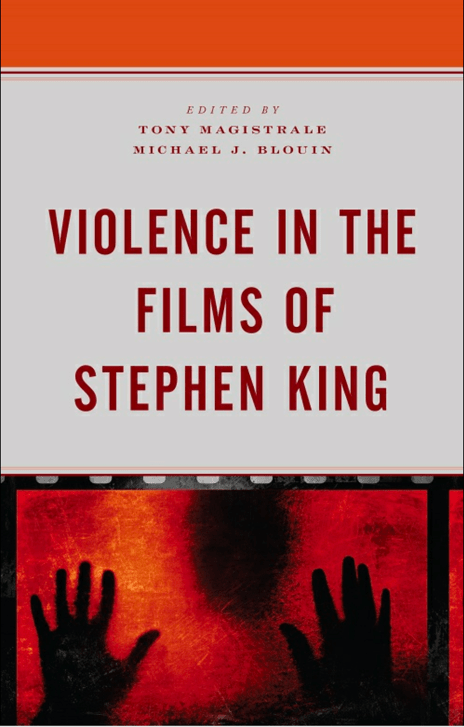
So a bit more of an academic gloss on the old maxim money is the root of all evil

In narrative structure, for a plot to “work” you ideally need an intersection of chronic and acute tensions–there is an ongoing problem before the story starts (chronic tension), and the story starts with an incident (acute tension) that forces up that which was previously submerged beneath the emotional surface: the acute tension incident causes the character to confront the chronic tension problem they were avoiding dealing with. If our country is a character, George Floyd’s murder is the acute tension incident that is forcing the problem of White America’s lack of awareness of Black America to the surface.
As Toni Morrison has it in the aforementioned passage, a critical element of this chronic tension problem pivots around money: more specifically, that White America doesn’t want to recognize that slavery’s effects continue to this day, that the capital generated by slave labor has trickled down through white families and white businesses to form the backbone of our current capitalist economy. The economic landscape of our country, in other words, would look quite different had those white European settlers never kidnapped people from Africa and forced them to work for free. Morrison further points out that the motivation to forcibly remove people from their homeland and violently oppress them was ultimately the profit motive, the incentive of a capitalist system. And it seems important to note that while we nominally abolished slavery, we still abide by the same system that fostered it, created it. Abolishing slavery is treating a symptom, not the disease itself.

White America doesn’t want to face the truth of this disease. The books of King’s I’ve read so far seem to advocate for the necessity of facing the problem/monster head on in a specifically verbal confrontation. As King would have it via Carl Jung, we need to face it, or it will continue to fester. It’s festering right now as people pour into the streets, and as I heard one commentator say on my local independent radio station, if the murders and violence by police continue, we could cross the line from predominantly peaceful protests into true civil unrest.

Narratively, it’s often a satisfying plot to have a character figuratively shoot themselves in the foot. That is, they cause their own problems, in literary fiction reflecting a flaw(s) in their personal character, and in having to deal with a problem caused by their flaw, they’re forced to confront the flaw itself. As human beings, we’re implicitly burdened with the possible unforeseen consequences of the choices we make. In terms of this country, before it even existed as such, a choice was made to kidnap people from another continent and exploit them for free labor. But free labor came at a non-monetary price. Mat Johnson touches on the fear of rebellion that existed among white slaveowners in his book The Great Negro Plot: A Tale of Conspiracy and Murder in Eighteenth-Century New York. I can imagine a type of Newtownian fear equation: the more horribly a white slaveowner mistreats the people they’re enslaving, the more likely those enslaved people will be to want to take violent revenge against the white slaveowner. Power creates paranoia, and the more horrible you are, the more afraid you should be.

A deep-rooted fear still exists within the White psyche–the fear of vengeance for White America’s original sin, a sin that deep down we still harbor shame and guilt over. But we are unable to face that shame–don’t want to admit we feel it because we don’t want to admit we did anything to merit feeling it, which would be to admit a lot of other things, opening a can of worms with an explosive force that might knock us off our pedestal of privilege. So we deflect that shame onto others, a kind of emotional alchemy wherein we try to convince ourselves our original sin was not really a sin: if the groups that white European settlers slaughtered and subjugated are not really our “equals” as human beings, then we can conceive of what we did to them as acceptable…

The kind of duplicitous Bernaysian rhetoric I talked about in my last post that infuses our capitalist marketing and foreign policy is very present in our figuring of these marginalized groups, aka the other, such as the indigenous people already living on the North American continent when Columbus arrived, as “savage,” and us European settlers as “civilized,” when the Europeans are the ones who slaughtered the indigenous people (via both outright overt violence and more covert duplicitous methods like smallpox blankets) to take their land by force.

The idea articulated by one character in The Stand, that “nobody is as afraid of robbery as a thief,” reflects a lot of White America’s unconscious fears: we stole the land we live on, and we stole human beings to do work to generate wealth from it. By this logic, by this history, everything white people has comes from theft. Nothing we have is really, truly ours by the terms of which we understand ownership. It’s another common narrative device that doing something “wrong” may entail a certain payout, but that payout frequently comes at a cost that’s too high. The cost is often psychic/psychological–fear of getting caught, guilt, etc. Fear that the consequences will catch up with your, fear that there will be a reckoning. Toni Morrison’s concept of Africanist “othering” is a reflection of White fear of a reckoning for the reason Black people are in this country in the first place.

White America owes a debt, a debt we don’t want to own up to because it will mean giving up the advantages that constitute our cushy comfortable lifestyles, and there’s an implicit unconscious shame attendant in that failure that constitutes a collective national psychic wound. The bottom line is reparations have to be paid somehow, or White America will continue to live in fear that Black America will rise up to take what they are owed by force. (This idea is related to depictions/figurations of black violence, the construction of the black criminal/”thug” archetype.) We nominally abolished slavery, but not the system that enabled it–not just enabled it, but actively motivated it–capitalism. The demons White America needs to face, its chronic tension, is that we continue to abide by the system that engendered this horror. Slavery is not the true monster that needs to be slain, but a mere appendage of it.

The N-Word

King’s brief cameo on the first season of The Chappelle Show in 2003 is fairly representative of the posture toward race/blackness that appears in his work: outwardly innocuous-seeming, like your best friend’s dad with his somehow endearingly nasal voice and the pen clipped inside the neck of his weathered black tee, but with somehow insidious implications/undertones. Despite sensing their existence, I cannot even properly explicate the problematic implications of King’s question(s), which itself is indicative of my own white privilege and lack of awareness, but what I can tell you is that when King takes a humorously long time to come up with the word “undertaker,” thus prompting the segment’s titular “Black Person” interlocutor Paul Mooney to quip that King “almost said” the N-word, Mooney invokes a word that appears disturbingly often in King’s work.

As an English teacher and a writer, I am someone who believes in the power of words. I’ve never used the N-word in any of my own fiction that I can recall; I can’t even recall considering using it, and I wouldn’t use it without consideration. The N-word is the only word I have ever censored in any published fiction I’ve assigned to students as an English/creative-writing teacher. There have been two writers off the top of my head I’ve had to do this with: Ernest Hemingway and Flannery O’Connor.

Of course there’s a whole debate about censorship in literature, accuracy of historical representation, etc. One of my English professors in college (a Latino man, for what it’s worth) said he used to use the N-word outright in class in the context of reading/discussing passages from novels, but after a student expressed to him how traumatic it was for her to hear it, no matter the context, he substituted “N” for any time he needed (“needed”) to say it in class discussion. Context seems critical to the situation described here about a white professor being investigated for using the N-word in class in reference to a quote of James Baldwin’s. There is a subjective question at the center of this debate about whether censoring the N-word in contexts that are not invoking it as a racist slur is going too far and potentially stifling the interrogation and/or critique of the history and meaning of its use and what it says about our country, etc.

King himself contributes to this discussion in On Writing: A Memoir of the Craft (which wasn’t published until 2000, but reading King chronologically in 2020 means allowing for the context of hindsight):

Not a week goes by that I don’t receive at least one pissed-off letter (most weeks there are more) accusing me of being foulmouthed, bigoted, homophobic, murderous, frivolous, or downright psychopathic. In the majority of cases what my correspondents are hot under the collar about relates to something in the dialogue: “Let’s get the fuck out of Dodge” or…

Stephen King, On Writing: A Memoir of the Craft, 2000.

He then quotes two more fake examples of offensive dialogue, one invoking the N-word (in a metaphor invoking “cotton” to boot), and one invoking an anti-gay slur that I don’t really feel like repeating either. King’s point is one that I raise in my comp classes when we look at pop culture texts: just because a character does something unethical doesn’t automatically mean the text/author it/themself is unethical; it depends on the text’s ultimate message/attitude toward that unethical aspect. King’s defense is thus that in representing racist characters saying unethical things, he is representing the ugly truth of the existence of racism and homophobia–not endorsing it, but revealing it, and additionally, providing a sense of reality via verisimilitude. “It’s important to tell the truth,” he says two sentences after the above passage in which he spells out the N-word, a passage that comes some pages after he parenthetically designates H.P. Lovecraft a “galloping racist,” noting the frequent inclusion of “sinister Africans” in Lovecraft’s stories, an analysis it seems like Toni Morrison would have appreciated.

King’s going out of his way to use the offending words in his fake examples seems a way to intentionally underscore this point. And yes, there is a distinction between depicting a racist/homophobic/etc. character and the narrative promoting racism/homophobia/etc.; it can be important and necessary to depict such characters as he argues, though I’m sure that nuance is lost on some (if not many) people. But it was notable to me how King juxtaposed the racist and gay slurs in his fake examples, because at this point in my King reading project, King’s work’s racism and homophobia are definitely some major twin emergent threads. At points King threads a finer line than others in telling the “truth” about these things in a way that is perpetuating problems he’s supposedly telling the truth about rather than addressing them in any productive way. There’s an underlying assumption symptomatic of white male privilege in King’s claims about truth-telling: he assumes that if he doesn’t intend his fictional depictions to be racist, but to be in the service of what he deems some greater truth, then his work can’t and won’t be racist. I guess he forgot about his own unconscious…

It strikes me as further emblematic of white male privilege that King should basically declare such slurs acceptable to use in the service of truth-telling. He has the authority to declare it acceptable to do so because of his status as a white man. But since he’s a white man, there is literally no slur, no word with the power to inflict on him the pain those words have for the groups they’ve been used against–for white men such a word cannot exist by concept. It’s supposed to be King’s job as a fiction writer to imagine other people’s experiences and what being able to be hurt by words might feel like, but I’m starting to think it’s a problem how often we give fiction writers the license to render their imaginings of things they have no firsthand experience with.

This is all a pretty big can of worms–a can of snakes, really. The reason I’m writing this blog in the first place is indirectly related to these issues, a way to explore the politics of representation, which basically came to paralyze my own fiction writing. All writers are political, whether they want to be or not. It’ll be a white man who advises you not to think about that stuff, to just put your head down and do the work.

A Screwed Up Interlude

A year ago, when we lived in a different world, I was teaching a summer literature class at the University of Houston. Providing a brief overview of literary history, I noted the trend of the death of the all-knowing author (not to be confused with Roland Barthes’ concept of the death of the author, which applies to literary criticism rather than to literary fiction). If you look at 19th century novels, Tolstoy and the Victorians and the like, you’ve got an entity making sweeping statements about mankind, who not only knows what all of the characters are thinking, but things that not any of the characters know–essentially amounting to a God-like figure. Then the theretofore unknown level of carnage inflicted in the Great War blotted out the concept of any overarching deity harboring a grand design, heralding the advent of Modernism, in which fiction reflected the concept that we were all necessarily trapped in the prison cells of our own perspectives. The more I think about it, the more it seems presumptive, and usually a symptom of the inherent authority of white male privilege, to invoke a fully omniscient perspective. (King is prone to invoking it, but probably more for the sake of creating suspense than necessarily making sweeping generalizations about humanity.)

I’d been grappling with the debate(s) about racial representation in fiction, with who had the right to tell whose story in fiction. On the one hand, a novel, which is what I was trying to work on, ought to incorporate a diversity of perspectives, otherwise it would implicitly privilege the white perspective it was my own default to write from, because that was my personal perspective. On the other hand, as a white person, I did not have the right to presume to describe the experience of a person of color; I could feel the inherent element of identity theft in this, of exploitation. But plenty of (probably white) writers had said or implied that you could do enough research, talk to enough people, put in enough work, to get it right. Secondhand experience substituting for first.

It wasn’t until the president of the University of Houston sent out an email after George Floyd’s murder mentioning it that I learned Floyd was a member of the Screwed Up Click. I was not overly familiar with DJ Screw, which is another travesty that reveals my ignorance and privilege, since I’m a Houstonian–a college transplant, not born and raised, but still–until about a year ago, when I happened to read Jia Tolentino’s “Losing Religion and Finding Ecstasy in Houston” detailing some of Screw’s history and influence, and recalled the archive of materials dedicated to the city’s hip hop history in the UH Library, and visited it on the last day of my summer class. It’s in the Special Collections Department, which means you have to put your bags in a locker and sign a bunch of forms before they’ll unlock the glass doors for you.

At that hour on a Friday afternoon, this windowless inner sanctum was otherwise empty. I found what I didn’t know I was looking for in a box of photo negatives taken by Peter Beste for his book Houston Rap. I was there to find out more about the world I wanted one of my characters to inhabit, a world I lived adjacent to–commuted through on a daily basis to get to the UH campus, in fact–but only knew what it looked like from the outside. The Houston Rap book itself is pretty immersive–in both the photos and the interviews–but in the full collection you can see the negatives of all of the photos Beste took, of which ultimately only a fraction made it in. So many were taken contiguously they were like little film reels.

I also had the person behind the desk haul out a few boxes of Screw’s records, the ones he used to make his Screw Tapes. (They had some of his Tapes too, but they didn’t have anything you could listen to them with.) There were old flyers for house party shows, magazine articles, a handful of grillz, the program for “Robert ‘Screw’ Davis”‘s funeral with an image of a turntable xeroxed onto the cover. I was there for a couple of hours.

I bicycled home through the Third Ward just ahead of a thunderstorm, past Cuney Homes, where George Floyd grew up, past the corner stores and the churches and the row houses and the Garden of Eat’n (est. 1985). I crossed the main drag of Emancipation, which until very recently was Dowling, named for a Confederate general. The Ward ends at a knot of freeways; I bike under one and over another, giving me a view of the back of an exit sign graffitied with the tag KONQR in enormous letters that must be taller than a person, hovering in space over a steady stream of traffic.

DJ Screw has loomed fairly large in my creative life since then, something I hope to return to (eventually) in a discussion of King’s use of (black) music in The Stand. For now I’ll just mention a couple of my takeaways from that afternoon of vicarious cultural immersion from the academic citadel.

One is the blatant misogyny that rages through hip hop, which might qualify as “common knowledge” by this point, but was reinforced by image after image of fully clothed men tossing green paper at women naked but for the rubber-banded bills above their knees and the occasional tattoo.

It’s a dichotomy we’ve all had to deal with (I won’t say “accept”), that an artistic creation might have merit in some ways and be problematic in others. Artists are mere mortals, after all. I was reminded of this problem again reading James Baldwin’s “The Creative Process” and feeling many lines that resonated, but then being irked by his constant references to the ubiquitous “artist” as “he,” and his using “men” when he really meant–or at least should have meant–“people.”

But the conquest of the physical world is not man’s only duty. He is also enjoined to conquer the great wilderness of himself.

James Baldwin, “The Creative Process,” 1962.

I was reminded of the problem again reading a recent article re-evaluating Flannery O’Connor’s racism–and how scholars have consistently glossed over it. While the white writer of this article patently acknowledges O’Connor’s racism, he did elect to use the uncensored N-word in the context of his discussion. And back on the subject of that subjective debate, I’m in the camp that white people shouldn’t use it (as my not using it here might have implied). White people can claim they’re using it for a purpose that they’ve deemed productive, but it’s a dubious defense and a fine line.

Which brings me to the second takeaway from DJ Screw I’ll mention. As a DJ, Screw’s creative work was screwing together other people’s creative work, emblematic of the eminently subjective fair use principle and raising questions concerning intellectual ownership. Which reminds me of the idea of collective ownership over nebulous non-physical entities, over something like the N-word. White people don’t like to hear that black people can say it and they can’t, that black people might have ownership of something they don’t. The implication that only white people have the right to own something (whether concrete or abstract, living or inanimate) strikes me as being a product of that old psychic slavery-related wound.

Dick Hallorann, Magical Black Man

In an earlier post about Carrie I analyzed King’s treatment of race via Toni Morrison’s theory in her book Playing in the Dark:

The Africanist presence exists in the marginal shadows of the white mainstream that has dominated literature–the Africanist presence is the white mainstream’s shadow self, implicitly a site of horror that whiteness can define itself in relation to.

From here.

This presence is “shadowy” because a) it exists on the margins and b) it’s an unconscious reflection of white attitudes toward blackness. And as Jelani Cobb has it, via George Floyd’s death White America is becoming conscious of these formerly unconscious attitudes, which have been contributing to the ongoing oppression of Black America as much as overt police brutality.

These formerly unconscious attitudes include guilt/shame over white privilege and continuing to profit from the original sin of slavery. Like a grown son of a mother forced to continuously bail him out of situations of his own creation who lashes out at her because he’s displacing/redirecting his shame and anger at his own inadequacy, White America lashes out against the minorities who have more of a right to lash out at them, and White American maintains recourse to plenty of psychological and rhetorical contortions to position themselves in the “right,” which include, among other things, Morrison’s concept of “Africanist othering”–depicting the Africanist presence as “other”–necessarily different, and implicitly something to be feared.

But in certain attempts to rectify past racial injustices, the pendulum can swing too hard in the other direction. White people at pains to demonstrate that they’re not racist can overcompensate in their narrative depictions of black people–instead of depicting them as something to be feared, as a sort of demonic presence, white writers have fallen to depicting black figures as something to be revered, divine, magical.

The problem is, even if a divine presence is “good” instead of “evil,” it is technically as inhuman as a demonic presence. This type of implicit dehumanization is potentially even more problematic than explicit dehumanization because it’s masquerading as its opposite–it’s in disguise, and thus, according to King’s narrative logic in The Shining, even more insidious–another characteristic/aspect of duplicitous Bernaysian/Hegelian rhetoric. The irony is that while King seems to almost consciously render such rhetorical duplicity as “evil” through The Shining‘s plot, he does not seem to recognize that he’s resorting to a sort of rhetorical duplicity himself. Though to be fair, if it’s unintentional, I guess it can’t technically be called duplicity through definition, which implies purposeful deception. Through Hallorann’s character, King seems to be making conscious efforts to not be racist, or to be even anti-racist, but in doing so reveals unconscious racism. His good intentions are precisely the problem, symptomatic and indicative of White America’s larger aforementioned problem(s). Because you know what they say the road to hell is paved with.

In On Writing, King jokes that “Dick” is “the world’s most Freudian name,” though without noting the times it’s appeared in his own fiction, like the character Dick Hallorann in The Shining. This Dick would appear to be King’s first significant use of the trope of the magical black man:

These Black characters, often referred to as “magical Negroes,” generally focus their abilities toward assisting their White lead counterparts. At first glance, casting the Black and White leads in this manner seems to provide examples of Black and White characters relating to each other in a constructive manner; however, a closer examination of these interactions suggests a reinvention of old Black stereotypes rather than authentic racial harmony. 

Cerise L. Glenn & Landra J. Cunningham, “The Power of Black Magic: The Magical Negro and White Salvation in Film,” Journal of Black Studies 40.2, Nov. 2009. 

Another academic examined this same issue the same year:

I find that these films constitute “cinethetic racism “–a synthesis of overt manifestations of racial cooperation and egalitarianism with latent expressions of white normativity and antiblack stereotypes. “Magical negro” films thus function to marginalize black agency, empower normalized and hegemonic forms of whiteness, and glorify powerful black characters in so long as they are placed in racially subservient positions. The narratives of these films thereby subversively reaffirm the racial status quo and relations of domination….

Matthew W. Hughey, “Cinethetic Racism: White Redemption and Black Stereotypes in ‘Magical Negro’ Films,” Social Problems 56.3, August 2009.

A key word here being “subversively”–being racist specifically through depictions that seem anti-racist on the surface. These articles are specifically examining films, but the trope holds true in books as well; both articles discuss the use of the trope in the film adaptation of King’s The Green Mile. King mentions the character that’s the trope in that source novel in On Writing:

…not long after I began The Green Mile and realized my main character was an innocent man likely to be executed for the crime of another, I decided to give him the initials J.C., after the most famous innocent man of all time. … Thus death-row inmate John Bowes became John Coffey.

Stephen King, On Writing: A Memoir of the Craft, 2000.

Here King is invoking the trope indirectly, unconsciously rather than consciously, since some have posited that Jesus Christ is the original manifestation of this trope, and because “Coffey” had to be the C-word you chose to name your black character, Steve? Really?

But almost twenty years before that, we have Dick Hallorann in The Shining. I mentioned before that while all three (white) members of the Torrance family were extensively developed as human beings, Dick felt like a plot device. King explicitly takes up Dick’s point of view at the beginning of the final section of the book, and we’re with him for quite awhile along his arduous journey to drive to the Overlook through a snowstorm (and to encounter a white woman on the plane prior to that who’s very conscious of America’s deep-state shadow and very nice to him), and yet nowhere was I really made to feel that Dick Hallorann has a legitimate personal or emotional reason to risk his life to save a little white boy he’d talked to once for all of half an hour. (That Danny has the strongest shining ability he’s ever encountered and Dick somehow feels the need to preserve this would be based more on concept than character.) Not only risk his life, but face down a force so malevolent as to be able to project into his mind racist slur-filled rants that I will not excerpt here. I’m tempted to say these slurs were “appalling”; all slurs should be appalling inherently, but if you take a regular appalling slur and multiply it by ten, then just mathematically it should be ten times more appalling. King multiplies it by ten at least.

Also, Dick Hallorann verbally sacrifices his own family in order to save Danny when he has to lie and tell his boss, Queems, that his son was shot in order to justify taking off work:

“Hunting accident?”

“No, sir,” Hallorann said, and let his voice drop to a lower, huskier note. “Jana, she’s been livin with this truck driver. A white man. He shot my boy. He’s in a hospital in Denver, Colorado. Critical condition.”

That Hallorann says he has to leave for his son creates an implication that Danny is his figurative son. Hallorann is thus still being defined as a character by Danny rather than himself–we don’t even know if anything he says to Queems is based in fact.

One might argue that since the (appalling) racist invective–rendered in ALL CAPS–is being hurled at Hallorann by the ghost of the Overlook, that figures this racist invective as bad: the monster is doing it, which means it’s a monstrous/evil thing to do, which means King is sending a message that expressing racism through such virulent slurs is bad, so don’t do it. I basically argued before that the Overlook ghost represents the worst of our country’s history, which would make its invective here in line with King’s idea of truth-telling about our country’s ugly history.

But there’s a significant distinction in the way the Overlook ghost makes very individualized character-tailored seductions and threats against Jack (like putting Jack’s former student George Hatfield in 217’s bathtub) while exclusively interfacing with Hallorann as an individual who is defined only by his race–saying things to Hallorann that would in theory be offensive to any black person, but saying things to Jack that are about Jack’s personality and history, things that could not be applied to anyone else. Maybe one could argue that this still makes the Overlook ghost racist instead of making King’s authorial depiction of it racist, but I’m not so sure. The sheer amount of racist invective that gets airtime undermines this emotionally if not logically. At the same time, it does effectively demonstrate words’ potential to be weaponized…just too effectively, is ultimately the problem.

Then there’s the fact that the title of the book derives from a racially loaded term that King was, according to Lisa Rogak’s biography, unaware of:

[King] based the title on a song by John Lennon and the Plastic Ono Band called “Instant Karma,” with a refrain that went “We all shine on.” But he had to change the title to The Shining after the publisher said that shine was a negative term for African-American.

Rogak, Lisa. Haunted Heart (p. 84). St. Martin’s Publishing Group.

The way Rogak says “the publisher said” is a little weird, as though this connotation doesn’t really exist beyond the publisher’s claim that it does… There’s also an interesting moment in the biography when Rogak depicts King as the marginalized outcast in the publishing world due to his foundation in genre:

In the winter of 1976, Steve went to a publishing party in New York where he met an agent who primarily worked with fantasy and horror writers. Kirby McCauley, who had recently moved to New York from the Midwest, had read only one of King’s two books when they met, Salem’s Lot, but after chatting with Steve discovered they shared many of the same interests in obscure authors from the 1940s and ‘50s. … McCauley saw out of the corner of his eye that most of the other writers were queuing up to talk with author James Baldwin, who was holding court in a corner of the room. But Steve was happy to stay with McCauley, and he was impressed when the agent mentioned some of his other clients, including Frank Herbert, Piers Anthony, Robert Silverberg, and Peter Straub.

Rogak, Lisa. Haunted Heart (p. 81). St. Martin’s Publishing Group.

In other words, Steve was impressed with the roster of White Man, White Man, White Man, and White Man… And there’s some kind of implication that the establishment, ignorant of King’s value at this point, is ignorant in the way it’s fawning over (black man) James Baldwin.

Anyway, another tidbit reinforcing Hallorann’s lack of development is one of the few memories we get from Hallorann of his past. (We know his brother died when Hallorann was in the army, but this is used only as a device to explain–to Danny specifically–how the shining works.) In the novel’s climax, just after the hotel has exploded, Hallorann looks back and sees what one can only assume is the Overlook ghost dispersing in a black cloud that reminds him of when he and his brother were kids and blew up “a huge nest of ground wasps” with a “[N-word]chaser…saved all the way from the Fourth of July.” Which is an interesting linkage of our most patriotic holiday’s explosive symbolism of our (explosive) history with that slur so casually dropped by a black person…in a way that definitely does not seem would be so casually used or thought by an actual black person. That term is slang for a firework that (racist) white people would use. Yet this slang is put not even just in the mouth, but the head of a black person, as we’re in Hallorann’s close-third-person point of view for this passage. Putting it in the thoughts of a black person in this way creates an implication that it’s patently not a racist term, that it’s a term Hallorann himself is completely fine with; he thinks it as breezily as he would think a word as mundane as “bread.” But if the bombs that gave us the freedom that we so patently celebrate and venerate, both in the fireworks whose fuses we light on July Fourth every year and in our National Anthem (not to mention the funding of our military-industrial complex), are replicated in another layer of symbolism here as “[N-word]chasers,” that’s sending some kind of message about the purpose of these venerated bombs to be targeting a certain group, or being designed to “chase” them away, which is kind of ironic (but hardly uncharacteristic of our country’s patriotic rhetoric), considering that this demographic was specifically brought here in the first place by force against their will. (It might have been more verbally logical to imply the fireworks were bombs chasing away Native Americans, since that’s the demographic white Americans actually had to chase away.)

My original point about this passage concerning Hallorann’s memory is that the whole wasp thing has already been extensively developed through Jack’s reflections and experiences. Jack is thus someone who as a character it would make sense for him to associate something he sees with wasps. It’s like a Rorschach blot. Wasps characterize Jack, so to use them here with Hallorann is to apply Jack’s characterization/experience to him in a way that problematically blots out Hallorann’s point of view/individuality. Hallorann should see something else, his own personal Rorschach association, but he just sees what the white man saw. Again, there could be a potential white apologist reading here: it’s the Overlook ghost Hallorann is mentally making this linkage to wasps about, so you might argue the wasps are the Overlook’s thing, not Jack’s, so it’s not discriminatory to have Hallorann associate wasps with it. The fact that the wasp passages are directly in the different characters’ points of view makes it feel more problematic, though again a big part of the Overlook ghost’s insidiousness is shown to be its ability to penetrate a person’s thoughts…and that it might be making both Jack and Hallorann think about wasps is potentially even creating a type of theoretical equality between them. But even if the white apologist defense might hold up logically, Hallorann still feels subsumed into the white man’s perspective.

I doubt King was necessarily consciously aware of Hallorann’s lack of character development, especially at this point, in the 70s, but I can almost feel him trying to mitigate the problematic nature of Hallorann’s lack of development by making him…magical. Magical by sharing Danny’s telepathic ability (the one accidentally named after a racial slur against Hallorann’s racial demographic), and magical in the heroic role he plays in saving Danny and Wendy (an extension of his original magical ability). Heroic, but inhuman.

Danny also has magical, technically inhuman abilities, and he sees things generally associated with the hotel rather than his personal life, but this is largely because he’s still a child, and his love for his father is developed in a way that makes him feel like a human with a magical ability rather than nothing but a cipher for the magical ability. So it’s important to note that it’s not just Hallorann’s magical abilities that make his character problematic, it’s that his magical abilities and his desire to help Danny are the only things that characterize him.

After watching Kubrick’s adaptation, I’m tempted to say that King’s version is less racist in letting Hallorann not only survive but be the critical figure who literally carries Wendy and Danny out of the hotel as it’s exploding. In the film, Hallorann is also critical: he brings the snow plow that enables Wendy and Danny to flee the hotel. He also does this in the book, but then instead of surviving to be a hero, he is almost immediately axed in the chest by Jack as soon as he enters the hotel, fulfilling another racist trope of the black man in the horror movie being first to die.

Another adjustment Kubrick makes concerns the use of the N-word: instead of having the Overlook ghost scream racist invective in Hallorann’s head, its sentiment is quietly subdued–yet no less sinister–as it issues from the mouth of Grady, the former caretaker, in that critical scene where Jack shifts his loyalties from his family to the hotel (and Kubrick shifts the setting from the pantry to the (red) bathroom). This exchange shocked me almost as much as the book’s all-caps invective–in fact seemed almost an homage to it. The N-word is used three times in a row (separated only by the article “a”) as Grady uses it to specify the “outside party” Danny is bringing to the hotel, Jack then repeats it back to him, and Grady says it back, this time adding “cook” (thereby extending Hallorann’s characterization to his job in addition to his race). The exchange pretty closely mirrors that in the book except for adding an extra N-word, in the film replacing where in the book Jack actually identified Hallorann by (last) name. This excessiveness almost seems like it’s calling attention to the word’s evil itself, with the hotel’s evil embodied in Grady and his use of this slur infecting Jack, but that feels like another white apologist explanation to me, as does the reading that Jack’s axing Hallorann in the film is symbolic of the callousness of white America’s crimes. It is symbolic of that, but likely more unconsciously than consciously…

Unsurprisingly, considering that the characterization of the white Torrances is less developed in the film than in the novel, Hallorann’s film characterization is no more developed than in the source material either. The most significant hint of Hallorann’s personal life we get in the film is a glimpse of his bedroom when he’s watching the news and Danny shine-messages him. What do we see in there to give us an idea of Hallorann as an individual? (The news he’s watching is a pure plot device warning about the bad weather he’s about to have to navigate, so no characterization there.) He has two framed images on his walls–both of black women with afros, one topless, the other fully nude. These feel like images that primarily highlight his identity via categories: his blackness, and his maleness, kind of like how Grady defines him by the category of his job. Kubrick generally seems more interested in categories than character, and again I can foresee a white apologist counterargument of these images being a symbol of/calling attention to the stereotypes emblematic of the blaxploitation film genre, but I can’t really see what these images are doing to counteract those stereotypes.

I recently read If It Bleeds, King’s latest book (I had to since I got it for my mother for Mother’s Day), and it seemed like King was trying even harder to be NOT RACIST in ways that are still revealing a lack of awareness of his own unconscious racism and white privilege. He is still, in 2020, using the N-word, and his publisher is allowing it. The apparent progress would be that instead of it being used as racial invective, as a slur hurled against a black character in an effort to intimidate and belittle them, it’s used by a black character to explicate/express the historical racial injustices his black grandfather suffered as proprietor of a speakeasy he dubbed “The Black Owl,” the same title this black character plans to use for his own book on the subject. The sentence the N-word is invoked in is the final one in a lengthy chunk of dialog, and really, I thought, the sentence with it is utterly unnecessary to get the point across, feels excessive in a way that seems like he’s using it just for the sake of using it. It feels like the white author using it, not the black character. The black character is reduced to a device, a mouthpiece–a mask, if you will–through/from behind which the white author can safely use the word under cover of context.

Say Their Name

The converse of not using the N-word outright–if you’re not part of the demographic that’s been oppressed by its usage–would seem to be the articulation promoted by the “Say Their Name” mantra that’s arisen in response to our country’s ongoing race-related hate crimes. Rayshard Brooks. George Floyd. Breonna Taylor. Ahmaud Arbery.

The idea of the importance and power of naming is something used as an effective narrative device in Bryan Washington’s recent story collection Lot, set in the city of Houston, where Washington, an alum of the University of Houston, lives (and from which he’s been writing dispatches about the city’s protests and Floyd’s visitation for The New Yorker). Several but not all of the stories in Lot are about the same character, whom we see grow up (or “come of age” as the copy says) over the course of the book. This first-person narrator, whose mother is black while his father is Latino, remains nameless until the final story. The very naming of his character (Nicolás) represents his emotional breakthrough of finally being able to trust someone else enough to try an intimate (gay!) relationship instead of running from his feelings so he won’t eventually get hurt, as we’ve seen him do in the stories leading up to this one. The dropping of the name (in dialog by the character he’s finally trusting) feels visceral to the reader after the consistent withholding of it; the name has been withheld because the character has been withheld from himself. Name is identity. Its use in the climax of the collection’s climactic story is a way to show that the character is coming to terms with who he really is. It was powerful.

In the comedy special Douglas, Hannah Gadsby makes a recurring theme of “white men naming things” as part of a vendetta against that which she names the “patriarchy.” I started noticing more how often King uses proper Brand Names, a tendency that seems to mostly come from a desire for verisimilitude and a general love of pop culture, but often feels like he’s cutting deals on the side for product placement. Whether he is or not, his verisimilitude is usually a boon for whoever he’s mentioning in a way that’s unconsciously perpetuating a patriarchal corporate system much like the way he unconsciously perpetuates implicit racism. White men naming things, mindlessly…

In fiction, naming specific places–using proper street names, neighborhood names and the like–provides a more convincing sense of setting (and often poetry), just as naming those individuals who have been murdered hopefully helps keep them from fading into statistics. A name signifies an individual identity, a distinct existence. In Lot, Washington constantly names places as a way of rendering the setting of the city I live in; I was excited to recognize many, and ashamed of how many I didn’t. Washington also often utilizes names as a way to form lists that efficiently create a sense of passing time and/or accumulation, as in this passage:

But it didn’t stop the two of us. We touched in the park on Rusk. By the dumpsters on Lamar. At the pharmacy on Woodleigh and the benches behind it.

Bryan Washington, “Lockwood,” Lot, 2019.

My initial reaction to this passage was probably as a Houstonian: to be excited to recognize the names. My second was as a creative writer: that neither “the dumpsters on Lamar” nor “the pharmacy on Woodleigh” were actually very specific location descriptors, since the roads mentioned would have lots of dumpsters and pharmacies on them. This isn’t really a weak point, though, since there’s just one pharmacy on Woodleigh for the character…that’s how he thinks of it. But I was reminded of my initial impulse to judge that element of the style of Washington’s writing–too many names, and lazily used, leaned on like crutches!–when someone I’d told I was reading the book said someone else they knew hadn’t liked it, because Washington had gotten the names of some places in Houston wrong. And he could at least go to the trouble to get the names right!

But Washington is rendering a different landscape, one that the above (presumably white) person’s reaction to his use of names seems evidence of their inability to see. He’s rendering the landscape White (and Straight) America hasn’t seen, the one that it does, in theory, see now, via the flashpoint of George Floyd’s murder. Washington uses understatement as a way to render his protagonist’s pain and inability to face that pain, creating a sense of a character at a distance from himself. Washington also frequently kept me, a white reader, at a distance with uncontextualized slang, inserting little hurdles in the language itself, in the use of the names that reflect a different experience than the mainstream (i.e., white) mode of expression that defines the patriarchy that defines everything else. And in making me feel that distance, Washington invited me in.

-SCR

The Shining: Jack Torrance’s Breakdown

“I’m trying to help him find the difference between something real and something that was only a hallucination, that’s all.”

Excerpt From: Stephen King. “The Shining.” iBooks.

The Ghosts are Real

Considered King’s first masterpiece, The Shining (1977) is immensely more enjoyable of a read for me than ‘Salem’s Lot. Plot is integrated with character in The Shining in a way that seems infinitely more sophisticated than its immediate predecessor, some of my chief complaints about which were that its novelist-protagonist Ben Mears felt like a cardboard cutout, and that Ben’s writing, for all the emphasis it got, ultimately didn’t influence the plot that much.

Third time’s the charm. The Shining feels like King is splitting the difference between his first two novels, between the focused development of a primary character (Carrie) and the far-flung reaches of an ensemble cast (the Lot).

So is Jack Torrance The Shining‘s main character?

Fittingly enough, this question is directly related to the plot, or more specifically, the question that is the plot-driving engine: which member of the Torrance family does the Overlook really want? The Overlook itself turns out to be its own character, developed to the extent that I almost thought “The Overlook” would have been a more appropriate title for the novel. It’s interesting that King’s first book was named after a character, the second after a town (which also in essence became a character) and the third a concept/ability, which doesn’t seem to become a character as much as the hotel itself does, but I suppose the titular concept and the hotel are not unrelated…

At any rate, this gives us, in theory, four main characters: the Overlook, and the three members of the Torrance family–Jack, Wendy, and Danny. (I would argue Dick Hallorann is more plot device than character.) Of the three Torrances, Jack does get the most development, but Wendy and Danny are hardly flat. It seems almost necessary that Jack get the most development for the sake of the plot, because the hotel–or ghost of the hotel, or whatever it is–exploits Jack’s weaknesses (his emotional baggage/chronic tension) in an attempt to gain control of Danny, which we ultimately learn it believes will make it more powerful due to Danny’s powerful shining ability. A scene toward the end of the novel where Danny turns a key to wind a clock in the ballroom seems to confirm the theory that the intensity of his shining ability has enabled the hotel’s ghosts to cross a significant boundary from merely appearing as visions to actually interacting materially with the “real world,” which would theoretically intensify their capacity to do harm. (That Danny is the key also seems like an echo of Salem’s Lot‘s vague intimations that Ben Mears’ return to the Lot was somehow related to Barlow’s appearance in the Marsten house, to that house’s evil “dry charge” reigniting.)

The infamous scene where Danny encounters the dead woman in 217 is well placed as the climax of Part IV because it constitutes a significant escalation in the rising action: Danny is forced to confront that what Hallorann told him–that the hotel’s ghosts are “just like pictures in a book” and can’t hurt him–is not true, which makes the prospect of being trapped in the hotel with them that much more terrifying. The plot seems to pivot around this premise–that the ghosts are real, and the ghosts can hurt. While this novel might fit the descriptor “psychological horror,” it becomes clear that the ghosts cannot be written off as merely the product of a character(s)’ hallucinations.

That critical boundary King crosses in the initial room 217 scene seems very possibly inspired by one of his major influences, Shirley Jackson, who references this conceptual boundary in her novel The Haunting of Hill House (1959):

“No physical danger exists,” the doctor said positively. “No ghost in all the long histories of ghosts has ever hurt anyone physically. The only damage done is by the victim to himself. One cannot even say that the ghost attacks the mind, because the mind, the conscious, thinking mind, is invulnerable; in all our conscious minds, as we sit here talking, there is not one iota of belief in ghosts. Not one of us, even after last night, can say the word ‘ghost’ without a little involuntary smile. No, the menace of the supernatural is that it attacks where modern minds are weakest, where we have abandoned our protective armor of superstition and have no substitute defense.”

An image for the Netflix adaptation of the novel struck me as an apt representation of the psychological horror embodied in Jackson’s haunted house:

And Jackson’s novel actually strikes me as a critical nexus between ‘Salem’s Lot and The Shining via the horror trope of the haunted house. King virtually broadcasts this connection by having both of his novels invoke Jackson’s Hill House directly, the former in the epigraph for its Part One, using Hill House‘s opening lines:

No live organism can continue for long to exist sanely under conditions of absolute reality; even larks and katydids are supposed, by some, to dream. Hill House, not sane, stood by itself against its hills, holding darkness within; it had stood for eighty years and might stand for eighty more. Within, walls continued upright, bricks met neatly, floors were firm, and doors were sensibly shut; silence lay steadily against the wood and stone of Hill House, and whatever walked there, walked alone.

SHIRLEY JACKSON
The Haunting of Hill House

And The Shining directly in the text, in Part IV, referencing that same Hill House passage (so to speak):

The Overlook was having one hell of a good time. There was a little boy to terrorize, a man and his woman to set one against the other, and if it played its cards right they could end up flitting through the Overlook’s halls like insubstantial shades in a Shirley Jackson novel, whatever walked in Hill House walked alone, but you wouldn’t be alone in the Overlook, oh no, there would be plenty of company here.

But the different–if not polar opposite–approaches King’s second and third novels take to the haunted-house trope potentially illuminate why the latter is narratively stronger. In the Lot, some of the action takes place inside the Marsten House, but the majority takes place outside of it. The Shining inverts this ratio: the majority of the action takes place inside the haunted house. This internal/external approach to the house matches up with the novels’ respective approaches to character: The Shining goes much further in developing its characters’ interiority and chronic tension. (I’m tempted to think a lack of such development is going to be a pitfall of the ensemble cast in general…we’ll see if King’s able to combine the best of both worlds in The Stand.)

The Simple Screen

If comparing The Shining to the Lot illuminates the strength of the former’s character development by way of juxtaposition to an explicit lack thereof, comparing the novel version of The Shining to Stanley Kubrick’s infamous 1980 film adaptation yields a similar result. King himself disliked Kubrick’s adaptation to the extent that he helped write a new miniseries adaptation that aired in the 90s and hued more closely to his own source material.

While I do not think Kubrick’s adaptation is anywhere near as nuanced and thought-provoking as the novel, I don’t think a faithful execution of what happens in the novel’s pages translates well to the screen, which creates a kind of convoluted hierarchy wherein even though the novel is better than Kubrick’s film, Kubrick’s film is (far) better than the miniseries even though the miniseries sticks (far) closer to the novel. This more or less reveals a critical distinction between cinema and prose echoed by a major change made in Brian De Palma’s Carrie adaptation: in the novel Carrie stops her mother’s heart with her mind; in the movie she telekinetically crucifies her mother with sharp silverware. De Palma’s version is more visually stimulating, as film requires. Prose has the ability to rove between internal and external because it can utilize and invoke all five senses, while cinema is largely restricted to the visual and auditory, though able to use these to mimic and thus offer facsimiles of the remaining senses. (That prose’s invocation of the senses creates something more than mere facsimile is evidenced here.)

The Carrie film adaptation also reveals cinema’s more general budget and time constraints in comparison to prose. The special effects required to render Carrie’s full range of telekinetic destruction were too expensive to fully realize on screen, thus were limited to the high school rather than encompassing the entire town, and, due to time, none of the novel’s epistolary snippets exploring the aftermath of Carrie’s destruction made it into the movie, which a) robbed the movie of the depth of social commentary achieved in the novel, and b) is kind of funny because King only added those epistolary snippets about the aftermath in the first place to make the book long enough to qualify as a “novel.” b) would seem to reveal the general difference in temporal scope between genres, as does the Kubrick adaptation (especially when compared to the oh-so-faithful hours-long miniseries). The narrative that stays focused only on what happens in the present is too short to be a novel but pretty much the perfect length for a film, while the narrative that expands its scope to encompass a richer representation of the past and/or future (an expansion that necessarily enriches the perspective, aka the whole 20/20 hindsight thing…) achieves the scope of a novel but then becomes too unwieldy for a film.

At the same time, film can often achieve a narrative and emotional efficiency/economy that you can especially see in adaptations by way of comparison to the book versions, which makes me wonder if it might be a product of having more people’s input, or the medium itself, or both. Take, for instance, all the exposition in The Shining about Jack breaking Danny’s arm. Kubrick’s version artfully condenses this into a monologue Wendy delivers to the doctor that conveys not only the information of the event itself, but also her own denial about it that hints at a rich emotional history for her personally.

But this is pretty much the only piece of backstory/chronic tension the film incorporates; there is mention that Jack lost his job, to the point that it seems the viewer is specifically being made to wonder why he lost his job, and that the answer to this question is being specifically withheld, because we never get it. Basically, as far as Jack is concerned in the movie, he’s crazy from the beginning, while in the novel, the Overlook’s slow seduction of Jack unfolds in a way that feels more character-based specifically because the Overlook’s seduction occurs via exploitation of Jack’s chronic tension, which the movie negates to represent at all. I guess this is the work all Jack Nicholson’s random creepy staring is supposed to do, but while his eyebrows are admittedly impressive, they can’t carry that much. In the film, Jack is not a developed character. He’s a pure monster.

History Lives

The plot utility of Jack’s chronic tension is quite well executed in the novel–that is, it works in tandem with the acute tension rather than the acute tension doing all the work, in which case the plot is something that happens to the character(s), a pitfall that can often lead to the character(s) lacking agency and thus development. So if the acute tension is the Overlook gig and the chronic tension is everything before that, then we see the novel opens with a natural starting point for the acute tension, the interview for the Overlook gig. Jack’s chronic tension–the chain of events (and the factors influential therein) that led to his having to apply for the gig–is directly invoked in this acute scene when Ullman mentions Jack having lost his teaching job, thereby creating a platform for a larger exploration of the theme of history (aka chronic tension), in relation to which the name “Overlook” (changed from the name of the hotel’s real-life counterpart, the Stanley) attains more than one meaning…but more on that another time.

Conjointly with booze (the hotel’s means of exploiting/triggering/exacerbating Jack’s chronic tension issues), the Overlook’s history is precisely the mechanism through which it sinks its ghosty talons into Jack’s personhood, advancing the process that the novel’s main thread of rising action is predicated upon–Jack’s being seduced to transfer his loyalties from his family to the Overlook. (This thread of the Overlook’s history is also omitted by the movie more or less entirely.) We see this when Jack discovers a scrapbook detailing the Overlook’s sordid history in the basement, a critical escalation in the rising action of this loyalty transfer:

It seemed that before today he had never really understood the breadth of his responsibility to the Overlook. It was almost like having a responsibility to history.

In terms of the chronic tension that ultimately enables the Overlook to seduce Jack–in effect seducing him through a manipulation of his own personal history–we get quite a bit. We have Jack’s general drinking problem, then three specific events: 1) Jack breaking Danny’s arm, 2) Jack deciding to stop drinking after hitting a kid’s bike in a car with Al Shockley some time after he broke Danny’s arm, and 3) Jack assaulting George Hatfield and getting fired some time after he decided to stop drinking. This trifecta of chronic-tension events might initially seem clunky (it did to me) but actually makes sense in that the third event sheds new light on the first: initially, like Wendy, you might see Jack’s breaking Danny’s arm as a product/result of his drinking, meaning the threat should diminish after he stops drinking, but the third event reveals that the threat hasn’t actually diminished, laying the groundwork for the discord the Overlook will further stoke in the acute tension, and revealing that Jack’s (and thus the family’s) chronic tension isn’t the drinking itself, but the factors that are motivating/influencing the drinking/urge to drink.

For the most part, I think King avoids the trap fiction writer Robert Boswell articulates in his craft essay “Narrative Spandrels” (which I explain further here). Basically, the trap is writing scenes in which the only thing that “happens” is a character thinks about something as a means to provide expository info to the reader, and/or the scene exists specifically to plant something that will be needed later for the plot’s sake and has no other narrative reason to exist. This turns out to be a trap a lot of amateur (and more experienced) writers fall into when they’re attempting to provide expository info deemed narratively “necessary” in order to identify/clarify the chronic tension that will make the acute tension relevant/meaningful. It’s more impressive that King (mostly) avoids this trap while delivering so much chronic tension expository info (the breadth of which is in large part, again, why his character development is so strong). In addition to the trifecta of chronic events we get in Part I as Jack goes through his interview, once the Torrances settle in at the Overlook, we start to get even more information about his chronic-tension events as Jack thinks about them.

The first extended sequence where Jack does this is when he’s fixing shingles on the Overlook’s roof at the beginning of Part III. This is actually a master class in how to handle exposition, so let’s back up and talk about the possible ways a writer might handle it. There’s straight-up “telling” it, which writers can pull off if they include details along the way that “show” what they’re “telling.” Imagine The Shining beginning with “Jack hadn’t meant to break his son Danny’s arm, but…”, providing Jack’s whole account of that before winding around to something like “That was two years ago, and now here he was sitting before this officious little prick…”

In this example, exposition is provided before scene, and, correspondingly, chronic tension is thus provided before acute. A writer could get away with this back in Queen Victoria’s time, but by the end of WWII, it’s basically putting the cart before the horse, or, to put it more bluntly, narrative suicide. Our brains have changed since we wrote letters by hand and the light of a candle. Readers with increasingly short attention spans need the hook of the plot before being plied by exposition.

Having a character think about whatever it is you need to convey exposition about might seem like a less clunky way to convey it than straight-up telling, but is often more. Clunky. Clunkier. The first issue with providing exposition by having a character think about it is that there has to be a specific reason they’re thinking about it when and where they’re thinking about it–this is a reason that must necessarily transcend (which might be another way of saying disguise) the reason that the writer needs to supply this particular information. The reason King the writer needs the reader to know about the George Hatfield incident is because he needs the reader to know that Jack still has the potential to be violent even though he’s no longer drinking: the introduction of this knowledge introduces/creates suspense. The official technical problem King the writer has to solve is when/where/how to show/tell the reader about the George Hatfield incident. And so: the official narrative reason Jack is thinking about the George Hatfield incident is because he’s discovered a wasp’s nest beneath the roof’s shingles. In the description of it, King himself seems to acknowledge that this vehicle for the character’s thoughts might be clunky:

He felt that he had unwittingly stuck his hand into The Great Wasps’ Nest of Life. As an image it stank. As a cameo of reality, he felt it was serviceable. He had stuck his hand through some rotted flashing in high summer and that hand and his whole arm had been consumed in holy, righteous fire, destroying conscious thought, making the concept of civilized behavior obsolete. Could you be expected to behave as a thinking human being when your hand was being impaled on red-hot darning needles? Could you be expected to live in the love of your nearest and dearest when the brown, furious cloud rose out of the hole in the fabric of things (the fabric you thought was so innocent) and arrowed straight at you? Could you be held responsible for your own actions as you ran crazily about on the sloping roof seventy feet above the ground, not knowing where you were going, not remembering that your panicky, stumbling feet could lead you crashing and blundering right over the rain gutter and down to your death on the concrete seventy feet below? Jack didn’t think you could. When you unwittingly stuck your hand into the wasps’ nest, you hadn’t made a covenant with the devil to give up your civilized self with its trappings of love and respect and honor. It just happened to you. Passively, with no say, you ceased to be a creature of the mind and became a creature of the nerve endings; from college-educated man to wailing ape in five easy seconds.

He thought about George Hatfield.

And thus, on the heels of this description that is basically an extended metaphor for what the Overlook will eventually do to Jack, we get the full-blown detailed story of what happened with George Hatfield–or Jack’s version of it anyway. And here’s what else we get along the way: Jack’s version is unreliable. The way King reveals this, and his depiction of how Jack’s mind works in general, was one of my favorite aspects of the book. After a description of a confrontation in which George accuses Jack of setting the timer ahead during a practice debate, we get:

You hate me because you know …

Because he knew what?

What could he possibly know about George Hatfield that would make him hate him? That his whole future lay ahead of him? That he looked a little bit like Robert Redford and all conversation among the girls stopped when he did a double gainer from the pool diving board? That he played soccer and baseball with a natural, unlearned grace?

Ridiculous. Absolutely absurd. He envied George Hatfield nothing. If the truth was known, he felt worse about George’s unfortunate stutter than George himself, because George really would have made an excellent debater. And if Jack had set the timer ahead—and of course he hadn’t—it would have been because both he and the other members of the squad were embarrassed for George’s struggle, they had agonized over it the way you agonize when the Class Night speaker forgets some of his lines. If he had set the timer ahead, it would have been just to … to put George out of his misery.

But he hadn’t set the timer ahead. He was quite sure of it.

By the end of this passage it should be pretty clear to the reader from these denials that Jack did set the timer ahead, and the reader will likely be less disturbed by that than by Jack’s capacity to convince himself that he didn’t. Likewise, that capacity for denial reveals that Jack does in fact envy George Hatfield, which will connect to other threads of his chronic tension that the hotel will eventually exploit to drive him crazy, as we will see. But in terms of plot construction, using the wasps’ nest as the vehicle for the Hatfield exposition–not to mention all the other wasp symbolism that does end up getting perhaps a tad (or more so) heavy-handed–technically works because the wasps’ nest does not remain in the realm of mere symbol, but, as my former fiction teacher Justin Cronin puts it, “participate[s] in the story’s kinetic action.” If Jack had finished his thinking and climbed down from the roof without the wasps’ nest that triggered his thoughts coming up again, the scene would not have justified itself. Because Jack bug-bombs the nest and then gives it to Danny, the nest comes to play a material role in the (kinetic) action that justifies the scene–something has “happened” here more than Jack just thinking about something that has already happened: he found the nest. This becomes relevant to the rest of the plot when the wasps turn out to not be dead and emerge to sting Danny in what becomes the first concrete manifestation/iteration of something at the hotel being alive/inflicting harm even though it should be dead. This is something that happens because of that scene that justifies it as more than just a placeholder for Jack’s thinking.

In addition to being a vehicle for the Hatfield exposition, the wasps’ nest also becomes a link to an even deeper chronic tension for Jack. The reason Jack decides to give the nest to Danny in the first place is mentioned almost offhandedly:

Two hours from now the nest would be just so much chewed paper and Danny could have it in his room if he wanted to—Jack had had one in his room when he was just a kid, it had always smelled faintly of woodsmoke and gasoline. He could have it right by the head of his bed. It wouldn’t hurt him.

And then, a bit later when he actually gives the nest to Danny, to Wendy’s discomfort, we get:

“Are you sure it’s safe?”

“Positive. I had one in my room when I was a kid. My dad gave it to me. Want to put it in your room, Danny?”

Here’s the critical link that will take us to our next point in the plot of Jack sitting and thinking about his chronic tension. At this next point, the reasons that Jack envies George Hatfield will be further illuminated, as we move further back to where it seems Jack’s drinking issues ultimately originate: his father.

Before we get there, I’d like to note one of King’s effective suspense-building techniques: repetition. He builds an ominous tone around the Overlook from the beginning, or almost the beginning–from the beginning of the first time we get Danny’s point of view near the beginning, and Tony shows him the Overlook with a skull and crossbones over it, and then the vision of something chasing him yelling at him things like “come here, you little shit,” and, somewhat more distinctively, “take your medicine.” (Another instance of effective repetition are creepy descriptions of the jungle-like carpet.) This vision and these phrases are repeated throughout the novel until they are of course ultimately played out in real time in the climax. At some point fairly early on, the reader, if not Danny, realizes that the figure chasing him in these visions is Jack–or at least, a version of Jack.

So back to the next chronic tension exposition sequence. Notably, King saves this sequence for the beginning of Part IV; this is good for pacing because Part III ended with a high-action climax, that aforementioned boundary-crossing, of the dead woman grabbing Danny by the throat. The reader desperately wants to know what’s happening with this, which means King has us right where he wants us–by the balls. We’re not going anywhere, so now he can patiently unspool some more exposition. Again, this exposition will all be entirely justified by becoming directly relevant to the kinetic action of the acute tension.

When we open with Jack in Part IV, he’s dozing in the basement while going through the old Overlook records that have begun to increasingly obsess him. Notably, King does a lot less work here to trigger Jack’s train of thought pivoting to his father:

He slipped down farther in his chair, still holding a clutch of the receipts, but his eyes no longer looking at what was printed there. They had come unfocused. His lids were slow and heavy. His mind had slipped from the Overlook to his father, who had been a male nurse at the Berlin Community Hospital. Big man.

There’s no ostensible external reason for Jack to suddenly start thinking about his father here, but this could potentially be excused by this point as the Overlook manipulating him, or something. Basically, Jack’s been primed. The Overlook is haunted, but everyone’s ghosts are different. Different, but the same: your parents.

So here we learn that Jack’s father was an alcoholic, but that when Jack was very young, circa Danny’s age, Jack loved him and would play a game called “elevator” with him (which is of course a relevant object in the hotel). There are some creepy details already present in this period of love: Jack’s father is usually drunk when he returns home, as evidenced by a “mist” of beer always hovering around his face (in another effective instance of creepy repetition), and that sometimes causes him to drop Jack during their elevator game. The critical paternal trauma is a night when Jack is nine and his father beats his mother for no reason. We get this in a full-blown flashback, which is remarkable for a couple of reasons. The first is it reveals the source of one of those other effective instances of creepy repetition:

Momma had dropped to the floor. He had been out of his chair and around to where she lay dazed on the carpet, brandishing the cane, moving with a fat man’s grotesque speed and agility, little eyes flashing, jowls quivering as he spoke to her just as he had always spoken to his children during such outbursts. “Now. Now by Christ. I guess you’ll take your medicine now. Goddam puppy. Whelp. Come on and take your medicine.” (emphasis mine)

The second is how King handles a potentially clichéd scene of domestic violence by dwelling on a couple of weird off-putting details:

He and Becky crying, unbelieving, looking at their mother’s spectacles lying in her mashed potatoes, one cracked lens smeared with gravy.

In my fiction classes, I often talk about the craft concept of the “bloody potato” (which I explain in more detail here). This is basically a symbol that carries emotional weight but also participates in the story’s action, an objective correlative. It overlaps with a concept that often comes in handy when depicting violence: don’t look at it head on, but look at the side effects, which serve as a stand-in for the head-on thing by providing evidence of its occurrence. It might seem counterintuitive, but looking at the evidentiary side effects is usually more powerful than looking at the head-on thing directly. (Think of someone being shot in a movie, but the moment the gunshot sounds, the camera cuts to a flock of birds simultaneously exploding into flight from the naked branches of a tree.)

The “bloody potato” comes from Anton Chekhov’s story “The Murder”; in it, instead of looking at the corpse of the man who’s been murdered, the man who has murdered him is stunned by the sight of a potato lying in the murdered man’s blood. This is a captivating image on its own for its juxtaposition of the violent with the mundane/domestic, but its meaning is deepened in the context of this particular narrative, in which one man has murdered another precisely because he was eating a potato, or more precisely, because he was eating it with oil on a religious day of fasting (the bottle of oil is the murder weapon). Hence the potato not only highlights the absurdity of murder in general, but in murder for the sake of defending a religious principle.

Funnily enough, I’ve also analyzed a potato being used in a similar but different way as an objective correlative in a Pulitzer-Prize-winning novel here; that potato is boiled, not bloody. King’s potato(es) here is bloody but not–the spectacles aren’t literally bloody, but the way the potato’s gravy is described dripping down them invokes blood, substituting for it, and is creating that same horrifying juxtaposition of the violent and the domestic. King leans on this mundane-detail tactic again in another memorable detail about this incident for Jack:

Momma getting slowly to her feet, dazed, her face already puffed and swelling like an old tire with too much air in it, bleeding in four or five different places, and she had said a terrible thing, perhaps the only thing Momma had ever said which Jacky could recall word for word: “Who’s got the newspaper? Your daddy wants the funnies. Is it raining yet?”

But now we have to ask again, does this scene do something more than just provide more chronic tension information? Yes: it plays a direct role in the acute tension when this recollection of Jack’s father beating his mother evolves into a nightmare of his father shouting at him through the radio to kill Wendy and Danny, which then leads to Jack destroying the radio, cutting off one of their critical links to the outside world in what creates a critical escalation in the acute tension’s rising action.

The specific chronic tension this scene of thinking/dreaming hones in on will play a critical role in a turning point in the acute tension, but King saves it for awhile. First, he deploys the George Hatfield chronic tension in the acute when Jack finds himself in room 217 again; instead of seeing the dead lady Danny saw, Jack sees George Hatfield in the tub with a knife in his chest. The exchange they have escalates the rising action by revealing that mentally, Jack has crossed a certain threshold:

“First you tried to run me over on my bike and then you set the timer ahead and then you tried to stab me to death but I still don’t stutter.” George was coming for him, his hands out, the fingers slightly curled. He smelled moldy and wet, like leaves that had been rained on.

“It was for your own good,” Jack said, backing up. “I set it ahead for your own good. Furthermore, I happen to know you cheated on your Final Composition.”

“I don’t cheat … and I don’t stutter.”

George’s hands touched his neck.

Jack turned and ran, ran with the floating, weightless slowness that is so common to dreams.

“You did! You did cheat!” he screamed in fear and anger as he crossed the darkened bed/sitting room. “I’ll prove it!”

There are actually a couple of revelations about Jack’s mentality here: first, he admits outright that he did set the timer ahead, a marked contrast to his denial of doing so in his thoughts to himself up on the roof fixing shingles. Second, there is conflation upon conflation happening here: the George ghost says Jack tried to run him over on his bike, which directly invokes the chronic-tension incident that caused Jack to finally stop drinking in a way that might make the reader note it involved a figurative ghost, if it didn’t before–the ghost of the kid who was not on the bike, whose body he and Al spent two hours searching the highway shoulder for but never found. The ghost of the death Jack might have caused, had he kept drinking…a version of Danny. Jack then starts to conflate the real-life incident with George with the version he’s writing in his play when he starts accusing the George ghost of cheating on his final composition, reinforcing that Jack was writing about the Hatfield incident in some kind of fictionalized version in his play, and, ultimately, that he’s going crazy, precisely because he’s having trouble telling what’s “real” from what’s not.

This is how Jack’s fictional writing project plays a role in the plot’s kinetic action in a way that Ben Mears’ in ‘Salem’s Lot markedly does not: we’ve seen that a critical escalation of the rising action (positioned as the climax of Part III for being so critical) was the dead woman in 217 actually harming Danny (an acute event intersecting with chronic when Wendy assumes it must have been Jack who hurt Danny); Jack then tells them he didn’t see anything in 217 afterward when he in fact did, showing the reader that his loyalties are starting to transfer to the Overlook, since it doesn’t really seem like he’s lying to his wife and son about this for their own good. Later that same afternoon, Jack looks over his play and realizes it’s “puerile.” This is another marked contrast to his earlier attitude, when he’d thought being at the hotel had enabled him to overcome his writer’s block and arrive at new productive insights about his characters. This change in attitude about his play is reflective of larger changes in attitude about the Overlook v. his family. It’s not a good sign, in short.

The conflation of Jack’s play with “real life” that he makes in his encounter with the George ghost in 217 is a mental erosion with a similar parallel in the one Jack is experiencing with the hotel’s ghosts. The scene enacts another conflation when Jack attacks the George ghost and the George ghost transmutes into a version of Danny. It seems telling that Danny sees a “real” ghost in 217, the woman who died in the room (whom he’ll later call a “false face”), while Jack sees his own personalized chronic-tension ghost in George Hatfield. This is part of what makes the Overlook so scary: its potential to manipulate/enlist your personal demons.

Acutely Kubrick

It’s worth noting how some of these acute developments are handled in Kubrick’s adaptation in the absence of the chronic context that packs them with such power in King’s version. Since Kubrick never explains why Jack lost his pre-Overlook job, George Hatfield can’t appear in the bathtub. In his place, Kubrick has the arrestingly stunning set of the bathroom itself:

And of course Kubrick also has the original dead woman–except she doesn’t look dead, at first. She’s the full-frontally nude equivalent of a supermodel who seduces Jack but then rots away in his arms once he’s making out with her in a sequence that invokes a seemingly universal fear of decomposition, decay, death that lurks beneath the surface of even the most beautiful living things. Powerful, sure, but as I try (often unsuccessfully) to explain to my 14-year-old writing students, the specific is actually more powerful than the universal.

The Kubrick bathroom scene seems like an exercise in the male gaze more than anything else. How horrifying, that a beautiful woman will ultimately grow old and decrepit! Since, in the novel, Jack does not see the hotel’s ghost in the bathroom, but his own (making the sequence more specific than universal), the potential corollary in the novel of Jack’s experiencing the hotel’s seduction in the overtly sexual way Kubrick presents is a scene where Jack is dancing in the ballroom during a ghost party in full swing:

She was wearing a small and sparkly cat’s-eye mask and her hair had been brushed over to one side in a soft and gleaming fall that seemed to pool in the valley between their touching shoulders. Her dress was full-skirted but he could feel her thighs against his legs from time to time and had become more and more sure that she was smooth-and-powdered naked under her dress,

(the better to feel your erection with, my dear)

and he was sporting a regular railspike. If it offended her she concealed it well; she snuggled even closer to him.

In this scene there’s some restraint in comparison to Kubrick’s since the woman’s not actually naked. The cat’s-eye mask the woman is wearing is an object that’s accrued some unnerving connotations since Wendy recently pulled one out of the elevator after Jack tried to claim there was nothing there–though it’s true this is not as horrifying as the horror that comes to be associated with the naked woman in Kubrick’s version.

In addition to affecting the 217 bathroom scene, the movie jettisoning the George Hatfield chronic tension means that it’s lost the primary means through which the original narrative derives horror/suspense via Jack’s writing project. The way the film is still able to generate horror from this writing project I thought was ultimately stronger than its modifications to Jack’s 217 encounter. Wendy eventually discovers that Jack’s pages all say nothing but the infamous phrase “All work and no play make Jack a dull boy,” a phrase that never actually appears in the novel. In what must have been quite the typing project for some lowly production assistant, every page that Wendy looks at is covered with these lines in a different configuration:

This almost seemed an homage to the way the content of Jack’s writing project operates in the novel, specifically how his conflations in the bathroom scene between real life and his written fictionalized version of it show us he’s going crazy. In the film, the different versions of the same thing (different formatting of the same line) do the same work–show us Jack’s going crazy, or is crazy already.

Chronic King

So we see that Jack’s chronic tension ultimately traces back to his father. King’s biographer Lisa Rogak notes that after The Shining came out, King commented on this aspect more directly than he did a lot of his work:

“People ask if the book is a ghost story or is it just in this guy’s mind. Of course it’s a ghost story, because Jack Torrance himself is a haunted house. He’s haunted by his father. It pops up again, and again, and again.”

Rogak, Lisa. Haunted Heart (p. 85). St. Martin’s Publishing Group. Kindle Edition.

Here King is implicitly highlighting the general appeal of his work, the popularity of which has started to explode around this time (the late 70s) thanks to the Carrie adaptation. I don’t think there’s much ambiguity in The Shining about whether the ghosts are supposed to be “real” in the literal sense–I could cite plenty of evidence, predominantly consisting of the fact that multiple characters have experiences with ghosts or evidence of them, like Wendy pulling the cat’s-eye mask from the elevator. I’ve already mentioned that the book does derive a fair amount of its horror/tension from the fact that the ghosts are literally real, but it actually derives more horror/tension from the figurative ghosts the characters are haunted by, which is another way of saying their chronic tension(s). Everyone has the chronic tension of emotional baggage in some form that is inherently “haunting,” hence the general appeal of horror; the acute horrific/supernatural situations King concocts are literalized versions of his characters’ emotional monsters. And this is appealing because we all have emotional monsters. (This all probably also means that it doesn’t really matter whether the ghosts in the narrative are literally “real” or not…)

A lot of the acute situations King concocts in his novels, as with those of probably most writers of conventional genre thrillers, happen to the characters (giving plot primacy) rather than because of the characters (giving characters primacy). To make a gross generalization, giving plot primacy in the traditional genre fiction mode seems to appeal to more short-term pleasure sensors; it might make a reader fly through the pages faster, but giving character primacy in the more literary mode of fiction has the potential to make a longer-term impact on the reader, like thinking about what they would do in the character’s shoes, or actually remembering the book later. I’m starting to develop a theory that plot-based thrillers that subvert character to action are having a detrimental effect on our brains in encouraging us to dehumanize others…but at any rate, the point here is, The Shining really qualifies as a King masterpiece because it represents a near-perfect balance of character and action in how the action happens because of the characters. Even better, this novel’s particular acute situation makes this true not just for a single main character, but for all three members of the Torrance family.

Weeping Wendy

Which brings us to Wendy. Wendy is a developed character–though not as developed as the main white guy, it’s true–because she gets her own chronic tension that affects her decisions in the acute situation (which in turn affects how the acute situation plays out). Wendy’s chronic tension is that her mother blamed Wendy when Wendy’s father divorced her, and she has treated Wendy as an emotional punching bag ever since. Her being with Jack in the first place seems in large part due to how he enabled her a certain emotional independence from her mother, but it also means that in the acute situation, Wendy’s between a rock and a hard place. This is overtly clarified right before they take Danny to the doctor in Sidewinder:

“If there’s something wrong, I’m going to send you and him to your mother’s, Wendy.”

“No.”


“I can’t go to my mother, Jack. Not on those terms. Don’t ask me. I … I just can’t.”

This comes up again in a conversation Wendy and Danny have in the car shortly before they know they will be snowed in at the Overlook and won’t be able to escape if something happens:

“And if you … he … think we should go, we will. The two of us will go and be together with Daddy again in the spring.”

He looked at her with sharp hope. “Where? A motel?”

“Hon, we couldn’t afford a motel. It would have to be at my mother’s.”

“I know how you feel about her,” Danny said, and sighed.

“How do I feel?”

“Bad,” Danny said, and then rhyming, singsong, frightening her: “Bad. Sad. Mad. It’s like she wasn’t your mommy at all. Like she wanted to eat you.” He looked at her, frightened. “And I don’t like it there. She’s always thinking about how she would be better for me than you. And how she could get me away from you. Mommy, I don’t want to go there. I’d rather be at the Overlook than there.”

Wendy was shaken. Was it that bad between her and her mother? God, what hell for the boy if it was and he could really read their thoughts for each other. She suddenly felt more naked than naked, as if she had been caught in an obscene act.

“All right,” she said. “All right, Danny.”

If Wendy’s mother would have welcomed them with open arms, this would obviously have been a very different story…or rather, not much of a story at all. This also speaks to an interesting overlap between King’s supernatural horror and how it reflects the horrific underbelly of the natural realist domestic (also a trend in his first two novels). Wendy’s chronic tension leads to her decision to trap herself in the Overlook with Jack and its ghosts, but this acute situation becomes symbolic/reflective of how she’s trapped herself in her marriage with Jack in general in a way that probably reads as familiar to more women than we’d like to think; we see how Wendy potentially used the marriage as an escape hatch from her mother, and now, that escape hatch is becoming worse than what she was trying to escape in the first place. The volatile nature of this marriage is underscored when we see Jack specifically use Wendy’s chronic tension against her:

Don’t you dare leave us alone!” she shrieked at him. Spittle flew from her lips with the force of her cry.

Jack said: “Wendy, that’s a remarkable imitation of your mom.”

She burst into tears then, unable to cover her face because Danny was on her lap.

In the immediate/surface situation here, Wendy does not want Jack to leave them alone in the face of a potentially supernatural element–the elevator that requires someone to run it has just started running by itself–but this passage symbolically encapsulates the potential horror of marriage in general, especially when it begets a kid. Here the intimacy of marriage has enabled Jack, more aware of Wendy’s chronic tension with her mother than anyone, to deploy it against her, an attack she is defenseless against specifically because her energy is entirely taken up by having to care for their son.

And speaking of the son, Danny’s declaration that he “‘want[s] to stay with Daddy'” by the end of this car conversation is also a critical decision on his part to seemingly ignore the implications of the horrific visions Tony has been sending him. So he, as the third main character (or more accurately second if we’re really ranking them in terms of development), also makes a critical decision facilitating the continuation of the acute tension. This decision is made out of love, which also contributes to the novel’s horror via the tragic, horrific truth that love is so often our downfall. And the way the situation eventually plays out with the hotel apparently taking over Jack so that he’s not himself anymore seems to encode a powerful emotional truth about how people can stay with abusers by perceiving that abuser as two different people…a form of emotional compartmentalizing.

In his dream, Jack’s father tells him “a real artist must suffer,” but the Torrances show that really it’s your characters who have to suffer if they’re going to undergo any meaningful development:

She had never dreamed there could be so much pain in a life when there was nothing physically wrong.

The Ending(s)

At the point when Jack wakes from his nightmare of killing the George ghost in room 217 that turns into Danny, he still seems to be trying to fight off the Overlook’s influence. That will ultimately change not long afterward, when Jack is seduced into tossing away the snowmobile’s battery, their last link to the outside world after the radio is destroyed. This is another critical escalation in the rising action. Yet another comes after this when Jack openly turns on Wendy, which happens after he gets thoroughly drunk in the Colorado Lounge. This acute escalation gains power from the invocation of Jack’s chronic tension via the aforementioned creepy repetition associated with his father’s drinking:

Jack was stirring. She went around the bar, found the gate, and walked back on the inside to where Jack lay, pausing only to look at the gleaming chromium taps. They were dry, but when she passed close to them she could smell beer, wet and new, like a fine mist. (emphasis mine)

When Jack fully wakes up and tries to strangle Wendy, she manages to knock him out (with, appropriately enough, a wine bottle), then she and Danny drag him to the pantry and lock him in. When Jack wakes there, we get another of his extended thought sequences, and it’s precisely their contrast to the previous two described (the one on the roof and the one in the basement) that drives the narrative forward by showing us that Jack has passed the point of no return in his loyalties transferring away from his family, and it all begins with this line:

He could begin to sympathize with his father.

We get a kind of rehashing of the chronic-tension incident we got earlier with the non-bloody mashed potatoes, only this time instead of being appalled at his father’s random viciousness, Jack frames his father’s actions as entirely justified and his mother as fully to blame. This marked transfer of loyalties in his initial nuclear unit signifies a parallel transfer in the acute situation with his latter nuclear unit. As a reader, I found this to be a very effective narrative strategy. Showing how deranged Jack has become by this point by showing him rationalizing his father’s obviously deranged actions that had previously horrified him was truly chilling. We see that the hotel has effectively turned him into his father (as played out by him yelling his father’s “take your medicine” phrase at Danny). This is a scene that seems to successfully further the action by having a character merely sit in a room and think (and throw a box of Triscuits). The tension has risen enormously because you see how far gone he truly is.

At this point, the Grady ghost lets Jack out of the pantry, after he promises to kill Wendy and bring the manager Danny (seeming to answer the question of how “real” the ghosts are, for any readers who care to have that question answered definitively). Now we’re really off to the races, because we know from being shown Jack’s frame of mind that he is capable of redrum.

So Wendy gets a bad feeling and, brave gal that she is, goes to check Jack’s still locked in the pantry, at which point there’s an exciting confrontation. Jack breaks some of Wendy’s ribs and something in her back with the roque mallet Grady left him, and Wendy ends up stabbing Jack in the back with a butcher’s knife. This slows Jack down some, but just some, and we get one of my favorite sequences as a hobbled Jack relentlessly pursues a hobbled Wendy up the grand staircase:

“Right behind you,” he panted through his bloody grin, as if reading her mind. “Right behind you now, bitch. With your medicine.”

The repetition of that medicine phrase, to borrow a phrase of Holden Caulfield’s, kills me. Not to mention that the physical damage this husband and wife have wrought on each other here seems a powerful manifestation/representation of the emotional damage they’ve inflicted on each other (though probably mostly Jack on Wendy). In the context of this reading, the Overlook itself represents marriage as a terrifying institution of entrapment ultimately conducive to cabin fever:

“It’s a slang term for the claustrophobic reaction that can occur when people are shut in together over long periods of time. The feeling of claustrophobia is externalized as dislike for the people you happen to be shut in with. In extreme cases it can result in hallucinations and violence—murder has been done over such minor things as a burned meal or an argument about whose turn it is to do the dishes.”

Being a month away from my own wedding as I read this (as stay-at-home orders were imposed for the coronavirus, no less), it gave me some feelings to say the least…

Kubrick effectively economized for the film version by combining this staircase scene with the aforementioned scene of Jack first openly attacking Wendy; in Kubrick’s scene, Wendy is backing up the stairs facing Jack instead of having her back to him like she does in King’s version. Kubrick dispensed with the knife in Jack’s back, but now Jack also has no weapon to make good on his threats:

In both versions, Jack ends up in the pantry and gets out and chases Wendy into their apartment’s bathroom, where he’s stopped short of killing her by hearing Dick Hallorann arrive. Then pretty much everything after this point in the narrative is changed in the movie. In the movie, Jack kills Hallorann about five seconds after he walks in, while in the book, Hallorann survives (a stark contrast I intend to discuss further in a future post). In the movie, Danny flees outside instead of upstairs, and Jack pursues him into the hedge maze that was one of the better changes the movie made (from the novel’s attacking hedge animals); Danny outsmarts Jack by stepping backwards through his own footprints in the snow so Jack can’t follow him, and Danny and Wendy escape in the snowplow that Hallorann very conveniently brought while Jack freezes to death in the maze.

In the book, Jack finds Danny upstairs, as Danny’s visions foreshadowed, and the two have a face-to-face confrontation. (Which means Kubrick inverted a face-to-face confrontation in the book to a chase scene in Jack and Danny’s case, and inverted a chase scene to more of a face-to-face confrontation in Jack and Wendy’s case….) The novel’s confrontation had a critical verbal component: Danny yells a bunch of stuff at his dad to the effect that he knows he’s not really his dad but the hotel:

“You’re not my daddy,” Danny told it again. “And if there’s a little bit of my daddy left inside you, he knows they lie here. Everything is a lie and a cheat. Like the loaded dice my daddy got for my Christmas stocking last Christmas, like the presents they put in the store windows and my daddy says there’s nothing in them, no presents, they’re just empty boxes. Just for show, my daddy says. You’re it, not my daddy. You’re the hotel. And when you get what you want, you won’t give my daddy anything because you’re selfish. And my daddy knows that. You had to make him drink the Bad Stuff. That’s the only way you could get him, you lying false face.”

“Liar! Liar!” The words came in a thin shriek. The mallet wavered wildly in the air.

But of course, Danny’s words are true, as we’re effectively shown when the “real” Jack Torrance peeks out one last time to assure Danny he loves him and beat himself with the roque mallet before he’s fully swallowed up by the hotel monster, whom Danny then reminds to dump the boiler. Then Hallorann gets Wendy and Danny out just in time while Jack and/or the hotel ghost die when the boiler explodes.

The verbal element of the climactic confrontation in the book struck a very familiar chord. It reminded me of the climax of King’s The Outsider from 2018, which I read last year before I started reading King’s work from the beginning, and in which, as one Goodreads reviewer noted, “this latest [big baddie] was defeated with a few impotence jibes and a weighted sock. I wish I was joking.” The key word here being the “jibes”–the verbal insults that amount to explanations of the monster’s existence while helping to defeat it. I have to say these verbal confrontations–or perhaps the ease of their success–felt fairly absurd to me in both books. This absurd pattern played out a third time when I happened to watch the It: Chapter Two movie adaptation not long after finishing The Shining. The climax was stunningly similar: the group fighting the monster finally succeeds in destroying it–It–by hurling verbal epithets at…It. I have yet to read It; there were a bunch of jokes in the movie about one of the characters not writing good endings to his novels which seemed to be references to the ending of It itself being notoriously bad (or maybe I have this impression because I remember a student specifically complaining about how bad it was when the rest of the book was good).

But for now, I’m sensing a pattern in King’s work. The Shining is another key development in the ethos of the King universe by expanding on the concept of precognition, but also on the plot pattern that amounts to a theme that through apparent repeated iterations over decades seems to amount to an almost Kingian religion: you have to face your fears head-on to be able to defeat them.

In light of what potentially appears to be King’s severe reverence to this tenet, it’s really no surprise that he hated what Kubrick did with his story: not only did Kubrick stripping Jack of his chronic tension turn the narrative into a rudimentary finger painting of its former self, but his adjustment of the ending changed the ultimate message from “face your fears” to “flee your fears.”

-SCR