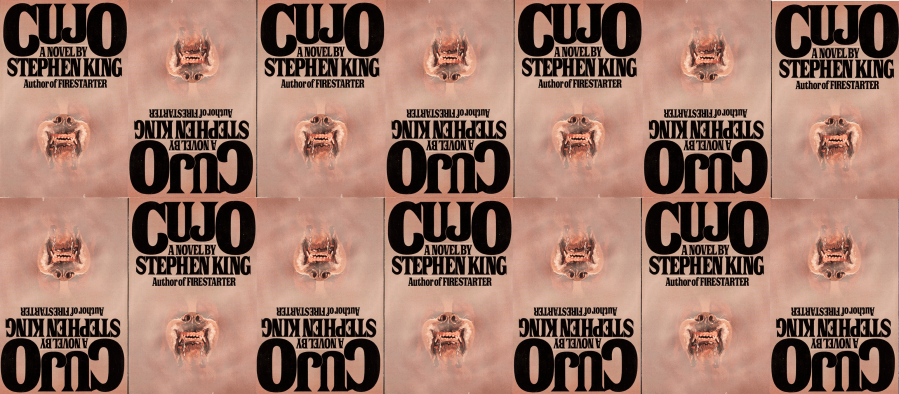
Cujo Kills, Connects to Carrie

“Y’know, I never thought I’d say this about a movie, but I really hope this dog dies.”

Rachel watching Cujo in Friends 8.12, “The One Where Joey Dates Rachel”

We finally arrive in the ’80s with the publication of Cujo (1981), which has a reputation as one of Stephen King’s self-described “cocaine novels,” aka he claims he was so high on coke in the course of its composition that he can’t remember writing it. This would appear to be something of a myth, though. King biographer Lisa Rogak identifies 1979 as the year King got “hooked on cocaine” and is more specific about what King doesn’t remember:

[King] would later admit that when he did the revisions for Cujo in early 1981, he had no recollection of doing so.

Rogak, Lisa. Haunted Heart (p. 114). St. Martin’s Publishing Group. Kindle Edition.

Later in the biography Rogak describes aspects of King’s composition of this novel in enough detail that it seems to contradict a summation she makes early on in it that reinforces the myth, that King has “also spoken with regret that he couldn’t remember writing certain books, such as Cujo” (p. 2).

The novel’s omniscient opening tells us that the “monster” serial killer Frank Dodd (of The Dead Zone) returned to the town of Castle Rock in 1980, in what will be one of the hottest summers on record. Four-year-old Tad Trenton encounters this monster in his closet, but when his parents come in, they don’t see anything. The summer before, Tad’s father Vic took the family out to the mechanic Joe Camber’s on the outskirts of town to have the car worked on, and they met the Cambers’ giant but good-natured Saint Bernard, Cujo. Now, Cujo chases a rabbit into a ground cave on the Camber property, disturbing some bats and incurring a bite on his muzzle. Meanwhile, Vic’s small-time ad agency Ad Worx with his partner Roger is on the rocks after a debacle in which their biggest client, Sharp Cereal, suffered a blow to the credibility of their ad spokesman the Sharp Cereal Professor due to some food dye in their product Red Razberry Zingers made it look like kids were vomiting blood. Vic and Roger are planning a ten-day trip to try to remedy the seemingly hopeless situation as Vic entertains suspicions that his wife Donna is cheating on him.

The Cambers’ neighbor, WWII veteran and alcoholic Gary Pervier, encounters Cujo on his porch and is surprised when Cujo uncharacteristically growls at him. Donna has a threatening encounter with her lover Steve Kemp when Steve shows up at the Trenton house and doesn’t take it well when she tries to end things with him; she started the affair following discontent with the sort-of Vic’s-job-dictated move to Maine and fear of getting old (see new M. Night movie…). Meanwhile, Charity Camber, the mechanic Joe’s wife, wins five thousand dollars on a lottery ticket and starts to lay plans for a trip to visit her sister in Connecticut and take their son Brett, which she knows Joe will resist. Steve Kemp, furious at being jilted, jots a note to Vic exposing his affair with Donna. Vic advises Donna to take their Pinto that’s been acting up out to Joe Camber’s while Vic is gone, and writes down the Monster Words he recites nightly to keep the monsters out of the closet for Tad.

Charity buys a new chainfall for Joe with some of the lottery money; Cujo growls at the two men who deliver it and they consider calling Joe Camber to tell him but don’t. Vic receives Steve Kemp’s note at his office. Charity proposes the trip to Joe and wins a standoff with him after promising a trade of letting Brett go on Joe’s next hunting trip. Vic confronts Donna about the affair and she explains her fear of getting old (the confrontation keeps Vic from remembering to call Joe Camber about the Pinto). Joe Camber plans a trip with Gary Pervier while Charity is off on her trip. The morning Charity and Brett are supposed to leave, Brett sees Cujo looking very scary and abnormal, but Charity convinces him not to tell Joe or Joe won’t let them go, and they get on the bus. Cujo attacks and kills Gary Pervier at Gary’s house. Charity considers the significance of the trip for Brett seeing another way of life besides his father’s. Vic leaves with Roger for their work trip.

Joe discovers Gary’s corpse at Gary’s place, then Cujo comes up from Gary’s basement and kills Joe, too. Donna debates what to do when the Pinto starts acting up again; she decides to drive it to Joe Camber’s even though he’s not answering his phone, and she relents when Tad insists on going with her instead of staying with a babysitter. The Pinto stalls out as soon as they pull in the Cambers’ driveway, and when Donna gets out, Cujo emerges and chases her back into the car.

In Boston, Vic proposes that the Sharp Cereal Professor make a final ad appearance in which he apologizes for the Red Razberry Zingers debacle. Donna debates whether the door to the Cambers’ house is locked and if she should try to make a run for it, and she manages to get the Pinto started but it quickly stalls out again. Brett Camber calls the house to no avail, and the sound of the ringing phone agitates Cujo. Donna and Tad eat some of the little food they brought and doze in the car while Cujo stands watch. Steve Kemp enters the unlocked Trenton house and, finding it empty, trashes it.

Charity again calls the Camber house to no avail and Brett comments on Charity’s sister and her husband flaunting their money. Knowing she’s getting weaker after the first night in the car, Donna makes a run for the house after testing to see if Cujo is hiding in front of the car; he tricks her by waiting to make his move and then attacks, driving her back into the car with a bad bite in her stomach before she manages to shut the door. Vic starts to get worried when Donna doesn’t answer the phone at home, eventually calling the police, who discover the trashed house. Charity ponders but rejects the possibility of divorce.

Tad has a convulsion in the overheated car. Vic comes home and tries to piece together what happened with the police. When Sheriff Bannerman goes out to check if the missing Pinto could be at Camber’s place, Cujo attacks and kills him. Vic falls asleep and wakes hours later when Roger calls with the news that Sharp has decided to let them keep the account. Vic has a note from the police that Kemp has been arrested and Donna isn’t with him, and decides to drive out to the Cambers’ as Donna faces the fact that Tad is dying in the heat and gets out of the car. She staves off Cujo with a baseball bat that was lying in the grass, but he keeps coming at her until it splinters, and then she stabs him in the eye with it. She’s bludgeoning the dog’s corpse as Vic pulls into the driveway, and when Vic gets to Tad in the back of the car, Tad’s dead.

Donna eventually recovers and Vic and Roger are able to keep the Sharp account long enough to keep the agency afloat. Charity manages to hang on to the Camber property and they get a new dog.

The End.

In the biography, Lisa Rogak chronicles how this narrative sparked from two incidents in King’s life:

[King] got the idea for Cujo by continuing his habit of connecting two seemingly unrelated subjects. With Carrie, it was “adolescent cruelty and telekinesis.”

With Cujo, it was two incidents a couple of weeks apart. While bringing his motorcycle in for service to a mechanic located on a remote back road, his bike gave out in the yard. He called out, but instead of a human, a mammoth Saint Bernard galloped out of the garage heading straight toward him, growling all the way. The mechanic followed, but the dog continued to charge. When the dog lunged at King, the mechanic hit the dog on the butt with a massive socket wrench.

“He must not like your face,” he said, then asked Steve about the motorcycle.

Even though they were now flush, Steve and Tabby were still driving the Ford Pinto they had bought new with the $2,500 advance from Carrie, even though the car had been plagued with problems from the beginning. A couple of weeks after Steve’s run-in with the Saint Bernard, the car acted up and Steve’s wild imagination thought back to what if Tabby had driven the car to the mechanic and the dog had lunged toward her? And what if there no humans were around? Worse yet, what if the dog was rabid?

Rogak, Lisa. Haunted Heart (p. 112). St. Martin’s Publishing Group. Kindle Edition.

This constitutes another Carrie connection by way of King’s own account, in his craft memoir On Writing, of two real-life encounters, or rather two real-life people, converging for the inspiration of that novel: a high-school classmate of his who was so poor she wore the same clothes every day and who was mocked relentlessly when she finally did wear nicer clothes, and another classmate whose mother had situated a “life-sized crucified Jesus, eyes turned up, mouth turned down, blood dribbling from beneath the crown of thorns on his head” in their trailer’s living room.

In relation to Cujo, Rogak provides another illuminative quote about King’s writing process-slash-basic narrative structure/suspense-building:

“Then the game became to see if I could put them in a place where nobody will find them for the length of time that it takes for them to work out their problem.”

Rogak, Lisa. Haunted Heart (p. 113). St. Martin’s Publishing Group. Kindle Edition.

Or, as Vic considers it in the novel itself:

Why? Why had something like this been allowed to happen? How could so many events have conspired together?

One might notice a variation in King’s typical narrative approach via the lack of chapter divisions:

Cujo was an experiment for King, the first book he had written where the story was told all within the confines of a single chapter. It didn’t start out that way; he had initially envisioned the story in terms of traditional chapters. But as the story developed, along with the sense of horror, he altered his approach: “I love Cujo because it does what I want a book to do. It feels like a brick thrown through somebody’s window, like a really invasive piece of work. It feels anarchic, like a punk-rock record: it’s short and it’s mean.”

Rogak, Lisa. Haunted Heart (p. 113). St. Martin’s Publishing Group. Kindle Edition.

But something that’s definitely in keeping with King’s typical thematic patterns is his supernatural gloss on the plot’s premise, a premise that would be every bit as horrifying (if not more so?) if it had been left in the realm of what could “really” happen. The events of the novel require no supernatural element to make them “work,” as most of his other novels up to this point have in that the events necessarily could not have occurred without a supernatural cause–the telekinesis in Carrie, vampires in ‘Salem’s Lot, more telekinesis/telepathy/psychic powers in The Shining, supernatural/divine prophets of sorts in The Stand, psychic powers again in The Dead Zone, and pyrokinesis in Firestarter. Realistic-via-supernatural horror has been one of the primary distinctions between King and his pseudonymous Bachman novels, so publishing this under his own name might have necessitated this element, consciously or unconsciously, for “Brand Stephen King,” as Simon Rich dubs it in his 2018 Screening Stephen King academic study that links this Brand to “a particularly mainstream form of horror.” There’s also the fact that this is the second Castle Rock novel, though the supernatural element doesn’t seem inherently connected to this recurring King setting, or at least not any more so than other settings he uses. The first Castle Rock novel, The Dead Zone, references Carrie not as events that happened in the “real world” of its particular universe, but as a pop-culture text, and Cujo‘s setting is also Castle Rock and via the Frank Dodd/Sheriff Bannerman connections (and Dead Zone protagonist John Smith also referenced) occupies the same “reality,” which then means in the reality/world of Cujo, Carrie White exists only as a fictional figment.

At any rate, given the gaps in King’s memory he attributes to his substance abuse, the breadth of the linked elements in his multiverse is almost staggering, though perhaps less surprising if considered within the context (or confines) of the white male ego and its preference for referencing itself. The most prevalent example of this at the current moment might be this year’s Later; Cujo shares the hallmark element of what Charles Yu identifies in his review of Later, its real-life horrors reigning emotionally if not literally over its supernatural elements:

And the horrors are many. There are hints of evil from another dimension, things from “outside the world” and “outside of time.” But mostly the horrors are familiar ones. Plain old human cruelty. The loss of loved ones to disease or old age. Alzheimer’s. Also, less morbid though no less heavy: the loss of innocence. Growing up too fast. The unexplainable, the incomprehensible in our everyday lives.

From here.

This sentiment seems to echo one previously put forth in this ancient debate of the extent and/or limitations of King’s literary prowess, appearing in the LA Review of Books in 2012 (in direct response to a particular savaging of King’s quality):

But all [King’s] novels, even the stinkers, have resonance. By this I mean, his fiction isn’t just reflective of the current culture, it casts judgment. Innocent Carrie White wakes up with her period and telekinesis at the height of the women’s movement. No wonder everybody craps on her, and no wonder we’re delighted that she slaughters them all. In Cujo, the materialism of the 1980s American family tears itself apart from the inside, as represented by the family dog gone mad.

From here.
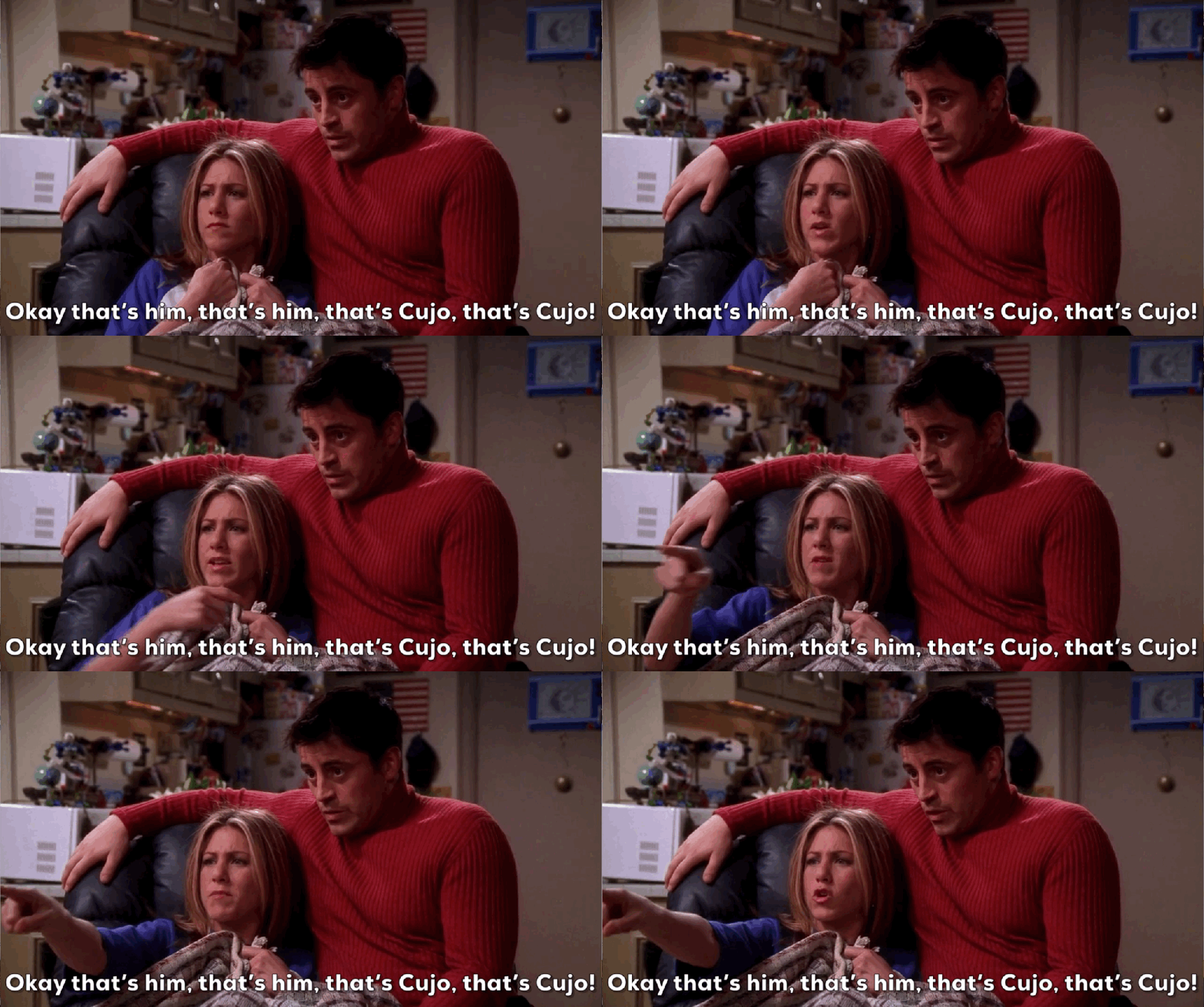
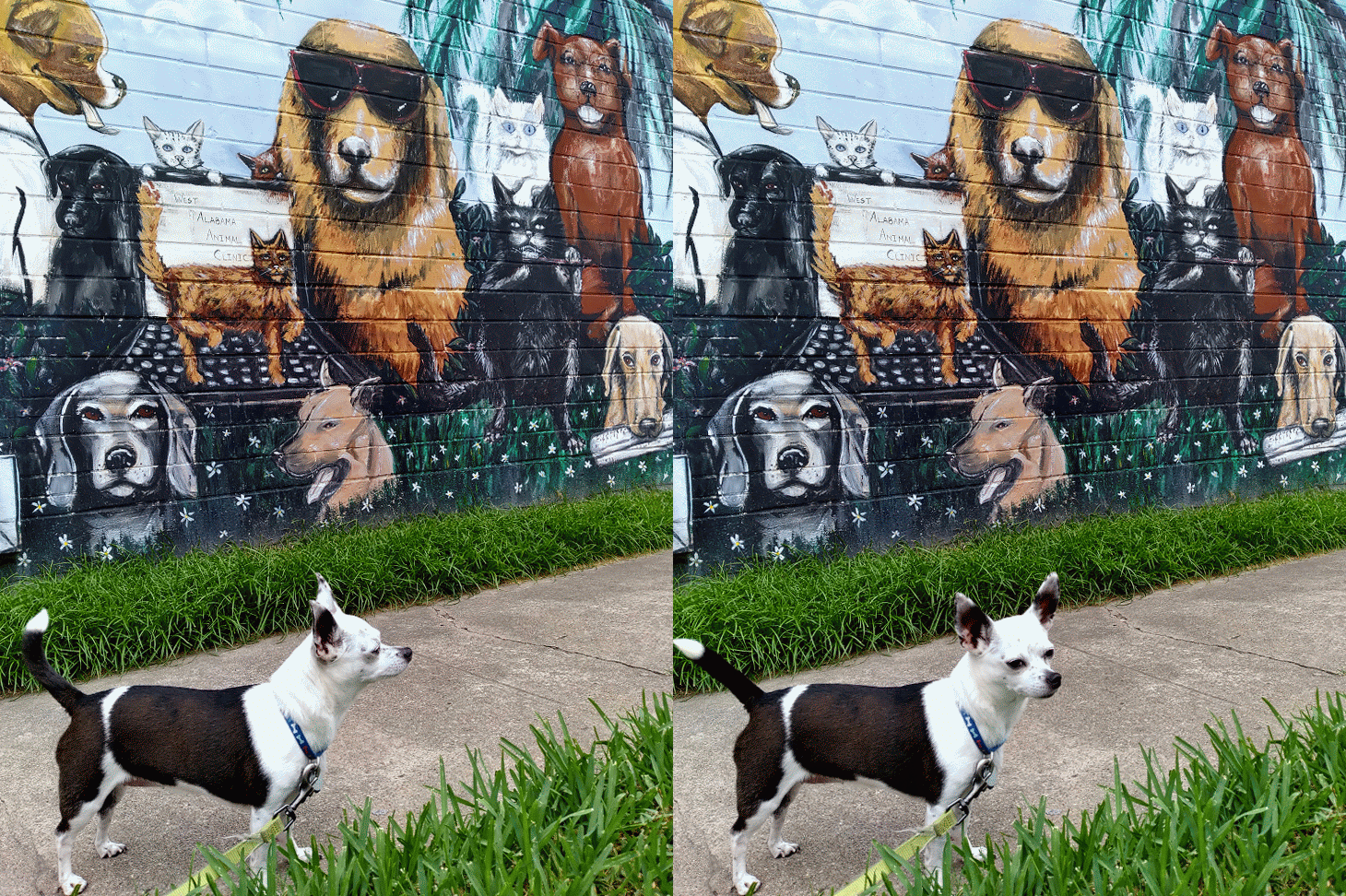
Its appearance on Friends ought to be a clear enough marker of Cujo‘s cultural caché, but for a more recent piece of evidence, I offer the personal anecdote of my new landlord greeting my (incessantly) barking chihuahua with “Hey, Cujo!”
In addition to helping the supernatural developments, the novel’s omniscient point of view helps the parallel development of the Trenton and Camber family units; the latter’s absence from the film adaptation might be evidence of the necessarily narrower scope of that media. The novel’s plot registers the interdependence of white-collar and blue-collar, with Steve Kemp a sort of wild card that–forgive me–straddles both worlds, though it’s Kemp who wears the chambray shirt that consistently makes cameos throughout King’s work, and which decidedly has a blue collar. Kemp as a character definitely comes off the worst and most overtly villainous in this narrative. Donna’s affair with him, while a demonstration of her culturally attenuated fears, at first didn’t strike me as affecting the plot materially in the way of playing a direct role in Tad’s death. But one might argue Kemp functions materially as a red herring to mislead the police, that if he hadn’t trashed the house, they might have gone looking at Cambers’ place sooner for lack of other options.

Kemp is an unequivocal douche bag, marked perhaps most overtly by the only detail I recalled from my adolescent reading of the novel–his jacking off on Donna and Vic’s bed after trashing their house–and also in other details like his refusal to shake hands with a tennis opponent if he’s lost the match. That he’s a poet does not speak well for poets, then; his side hustle, or really main one, refinishing furniture under the moniker the “Village Stripper” sexualizes him in a way that also characterizes his relationship to his other work:

…he masturbated a great deal. Masturbation, he believed, was a sign of creativity. Across from the bed was his desk. A big old-fashioned Underwood sat on top of it.

Considering he turns masturbation into a criminal offense in the one scene I remembered, Kemp as a character isn’t doing much for the reputation of the Great White Male writer (and/or connection to the Underwood typewriter), except he identifies more as a poet than a fiction writer–that his fiction-writing exclusively consists of a draft of a novel he’s “attacked badly from six different angles” reads more intensely in light of his attempted rape of Donna. His aforementioned chambray shirt and self-identifying as a poet are strongly reminiscent of Jess Rider’s character from The Stand, a character who also functions as an object of derision and whose chambray shirt becomes a demonstration of his posing as more working-class than he is, thus linking poets to posers. Kemp appears to be a poet in the same posing vein, but taken to the next level of violence and aggression, apparenty largely by virtue of his being older than Jess was; we see the personal agitation Kemp experiences in response to Donna’s jilting him being connected to his age when he discovers the “first threads of gray in his beard”; his irrational/irresponsible actions are thus linked to an almost identical anxiety to what Donna describes to Vic in articulating her reasons for getting with Kemp.

Kemp is more the villain, even, than Cujo himself, who can’t be blamed for his actions. Can King the author be blamed for letting Tad die?

Readers gave him an earful about it, and he received letters by the truck-load that criticized him for letting a child die in a book, albeit one who was innocent and simply in the wrong place at the wrong time, unlike the dozens of teenagers who were killed in Carrie, who seemingly deserved it because of their actions.

Rogak, Lisa. Haunted Heart (p. 113). St. Martin’s Publishing Group. Kindle Edition.

This echoes the “main character” Cujo himself as summed up in the novel’s conclusion:

He had never wanted to kill anybody. He had been struck by something, possibly destiny, or fate, or only a degenerative nerve disease called rabies. Free will was not a factor.

Despite one essentially (if still ultimately indirectly) killing the other, both Cujo and Tad as characters are “innocent.” For Cujo, rabies is a scientifically sanctioned form of what amounts to demonic possession–nice touch how he gets it from a bat bite, a la vampires. Tad did not call his own demise upon himself, but the actions of his parents did; readers seem to be reacting to the use of a child as a plot device. On Friends, Rachel wants the dog to die in the movie, and he does, if in a bit more dramatic fashion, but I knew the second Tad’s death was confirmed in the book that he would be resuscitated in the film version.

The way events unfold may implicate white-collar reliance on blue-collar: the ultimate coincidence facilitating the horrific scenario is the blue-collar family uncharacteristically being away on vacation. The lottery ticket that facilitates this coincidence may itself be the novel’s biggest coincidence, but it “works” because it plays on what is definitely not a coincidence, the blue-collar pursuit of the possibility of something better, which is further played out by Charity and Brett’s trip and the larger possibilities it opens up in escaping Joe and what he stands for.
In his Later review, Charles Yu also notes:

In his craft memoir, “On Writing,” Stephen King describes a moment in his process when he asks himself the “Big Questions.” The biggest of which are: “Is this story coherent? And if it is, what will turn coherence into a song?”

From here.

Reading Carrie for Toni Morrison’s Africanist presence, there were no actual black characters, but only descriptions that comparatively invoked Blackness. Black characters are almost entirely absent from Cujo as well but exist in relation to music, and manage to be fairly revealing in the limited time they take the page-stage, which I’m quoting here in full:

The cab driver was black and silent. He had his radio tuned to an FM soul station. The Temptations sang “Power” endlessly as the cab took him toward Logan Airport through streets that were almost completely deserted. Helluva good movie set, he thought. As the Temptations faded out, a jiveass dj came on with the weather forecast. It had been hot yesterday, he reported, but you didn’t see nuthin yesterday, brothers and sisters. Today was going to be the hottest day of the summer so far, maybe a record-breaker. The big G’s weather prognosticator, Altitude Lou McNally, was calling for temperatures of over 100 degrees inland and not much cooler on the coast. A mass of warm, stagnant air had moved up from the south and was being held in place over New England by bands of high pressure. “So if you gas gonna reach, you gotta head for the beach,” the jiveass dj finished. “It ain’t goan be too pretty if you hangin out in the city. And just to prove the point, here’s Michael Jackson. He’s goin ‘Off the Wall.’”

“Black and silent” is pretty much the most succinct and accurate summation one could make concerning the Africanist presence here with this weird combo of a literally silent Black body and a disembodied Black voice (or white projection of one)…despite the foundation of American music discussed in my previous post that this obliquely invokes. It seems a potential unintended coincidence that this silent presence appears behind the wheel of a car, that most critical object in this particular plot’s premise.

Charity Camber’s aspirations for a better life are ultimately futile, but we see how her sister escaped Charity’s circumstances through luck, demonstrating how Charity herself had a parallel chance for upward mobility. The “black and silent” cab driver never gets that chance. The futility Charity confronts seems to demonstrate how the illusion of the American Dream is a dangled carrot that keeps the subservient classes subservient. This tactic may be largely successful, but, as with cars, can backfire. Donna’s invocation of the “greenhouse effect” trapping the heat in the car, that most direct cause of Tad’s death, seems perversely prophetic as climate disasters advance apace and we continue to refuse to curb our emissions. From 2021, Tad’s death could be read as an indictment of consumption and its cost to future generations.

-SCR

The Dead Zone: Hot Dogs and Coke

He was an actor of genius. There was no more overwhelming actor on the stage, in the motion pictures, nor even in the pulpit.

Sinclair Lewis. It Can’t Happen Here. 1935.

In The Dead Zone, Stephen King takes his exploration of the country’s political anxieties to the next level. I noted in my analysis of The Stand how that novel’s premise reflects a mistrust of the American government rooted in Watergate that has spawned a propensity toward conspiracy theories one could argue has played a significant role in the Trumpian nightmare from which we will (hopefully) soon be waking–not unlike The Dead Zone‘s everyman John Smith emerging from his coma spanning roughly the length of a single Presidential term (+ the final campaign push toward it). So it’s fitting that Watergate happens while John is in his coma:

“It was Watergate.”

“Watergate? Was that an operation in Vietnam? Something like that?”

“The Watergate Hotel in Washington,” Herb said. “Some Cubans broke into the offices of the Democratic Committee there and got caught. Nixon knew about it. He tried to cover it up.”

“Are you kidding?” Johnny managed at last.

John’s disorientation at this political sea change is part of his everymanness, reflecting the feelings of the average American’s political dislocation, that which eventually trickled down to give us Trump. And there are lots of things about The Dead Zone‘s human monster Greg Stillson that are reminiscent of … certain current human monsters.

Yes, there were lots of things about Greg Stillson that scared Johnny.

The domineering father and laxly approving mother. The political rallies that felt more like rock concerts. The man’s way with a crowd, his bodyguards—

Ever since Sinclair Lewis people had been crying woe and doom and beware of the fascist state in America, and it just didn’t happen.

I happened to read the Sinclair Lewis novel this passage is most likely referring to, It Can’t Happen Here, around the time Trump was inaugurated in 2017; like Greg Stillson, this novel’s political villain, Buzz Windrip, bears some unsettling similarities to Trump, though unlike Stillson, Windrip does succeed in ascending to the presidency. (Similarly to Stillson in a defining non-Trumpian quality, Windrip holds political office before running for President.) Windrip creates his own militia called the Minute Men, “more menacing than the Kuklux Klan.” It’s a fantasy of overt domination in the Orwellian vein–one whose elements were probably realized most saliently during yesterday’s storming of the Capitol to interrupt certification of the Electoral College results (did you ever think that would happen here?)–but which we’ve been feeling the echoes of as Trump has attempted his own version of a coup in the wake of the 2020 election:

…Trump’s effort to subvert the election results has been made explicit and unmistakably clear. He is no longer merely pursuing spurious lawsuits in state courts; in recent days, he and his lawyers have confirmed publicly that Trump now is trying to directly overturn the election results and the will of the American people by pressuring Republican state legislators to appoint electors who will vote for Trump in the Electoral College instead of Biden.

Susan B. Glasser, “Trump’s Clown Coup Crisis,” November 20, 2020.

How dangerous is a clown?

“You saw him,” Roger said, gesturing at the TV set. “The man is a clown. He goes charging around the speaking platform like that at every rally. Throws his helmet into the crowd—I’d guess he’s gone through a hundred of them by now—and gives out hot dogs. He’s a clown, so what? Maybe people need a little comic relief from time to time. We’re running out of oil, the inflation is slowly but surely getting out of control, the average guy’s tax load has never been heavier, and we’re apparently getting ready to elect a fuzzy-minded Georgia cracker president of the United States. So people want a giggle or two. Even more, they want to thumb their noses at a political establishment that doesn’t seem able to solve anything. Stillson’s harmless.”

The mention of hot dogs in this passage is one of the clues that Stillson is anything but.

The Hot Dogs

The Dead Zone offers quite a plot to ponder while experiencing the roller coaster of the 2020 election, though perhaps 2016 would have been a more appropriate year to ponder the ethics of this general hypothetical in regards to politicians whose own actions (and/or inaction) would result in irreparable lasting damage….

At any rate, a hot dog is integral to the novel’s entire plot in being the first link in the chain of events that leads to John’s crash then coma then everything else: John would not be in the position of his particular quandary re: political assassination were it not for … a hot dog. More specifically, a “bad” one. It’s on John and Sarah’s date to the fair Sarah gets sick from eating this “bad hot dog”; we’re even treated to a scene of her projectile-vomiting it up. Lest you think I exaggerate the hot dog’s significance, here are the highlights:

“I always eat at least three hot dogs.”

You parked your car in a dirt parking lot and paid your two bucks at the gate, and when you were barely inside the fairgrounds you could smell hot dogs, frying peppers and onions, bacon, cotton candy, sawdust, and sweet, aromatic horseshit.

At last they escaped and he got them a couple of fried hot dogs and a Dixie cup filled with greasy french fries that tasted the way french fries hardly ever do once you’ve gotten past your fifteenth year.

I got a bad hot dog, she thought dismally.

“I think it was my hot dog.”

“It’s those hot dogs, I bet. You can get a bad one pretty easy.”

“I ate the bad hot dog.”

“It was just a bad carnival hot dog, Johnny. ”

Well, they ate a bad hot dog called Vietnam and it gave them ptomaine.

And this other guy, his name was Nixon, he said, “I know how to fix that. Have a few more hot dogs.” And that’s what’s wrong with the youth of America.

“Carnival hot dogs, I guess …”

“Yes we did, until … well, I ate a bad hot dog or something. We had my car and Johnny drove me home to my place in Veazie. I was pretty sick to my stomach. He called a cab.”

“If I hadn’t eaten that bad hot dog … if you had stayed instead of going back …”

“Is a bad hot dog an act of God?”

HOT DOGS!!

These hot dog references track the entire opening plot sequence and then beyond: Sarah’s initial request for them, eating them at the fair, Sarah feeling sick from them, John thinking about them as a metaphor for what’s wrong with the youth of America in the cab ride he takes home from Sarah’s specifically because she got sick from the hot dog, which Sarah then mentions again directly before she learns of John’s death and again when she meets John’s father Herb right after John’s coma-thus-enhanced-precognitive-ability-inducing accident. The hot dog is specifically considered by Sarah to be the cause of everything, i.e. the derailing of her and Johnny’s life together, which she references in her and John’s final meeting when they finally get it on. After this point, the hot dog morphs into one of the “boards” in Stillson’s political “platform.” By the point it becomes associated with Stillson, the hot dog has gained fully negative connotations–making someone sick, thereby creating the impression that Stillson is someone who should … make you sick. 

The clown is dangerous.

Stillson specifically uses hot dogs as part of his campaign, and that campaign, in turn, is successful. The hot dogs as a critical ingredient to this success is highlighted by their position as the climactic “board” in Stillson’s platform of (empty) promises:

“Last board,” Stillson said, and approached the metal cart. He threw back the hinged lid and a cloud of steam puffed out. “HOT DOGS!!

He began to grab double handfuls of hot dogs from the cart, which Johnny now recognized as a portable steam table. He threw them into the crowd and went back for more. Hot dogs flew everywhere. “Hot dogs for every man, woman, and child in America! And when you put Greg Stillson in the House of Representatives, you gonna say HOT DOG! SOMEONE GIVES A RIP AT LAST!

Apparent wordplay here in Stillson positioning himself as giving a “RIP” when the novel indicates his political success is tantamount to mass nuclear annihilation.

“In speeches, he refers to independent candidate Stillson as the only member of the American Hot Dog party. But the fact is this: the latest CBS poll in New Hampshire’s third district showed David Bowes with twenty percent of the vote, Harrison Fisher with twenty-six-and maverick Greg Stillson with a whopping forty-two percent. Of course election day is still quite a way down the road, and things may change. But for now, Greg Stillson has captured the hearts—if not the minds—of New Hampshire’s third-district voters.”

The TV showed a shot of Herman from the waist up. Both hands had been out of sight. Now he raised one of them, and in it was a hot dog. He took a big bite.

“This is George Herman. CBS News, in Ridgeway. New Hampshire.”

Walter Cronkite came back on in the CBS newsroom, chuckling. “Hot dogs,” he said, and chuckled again. “And that’s the way it is …”

Walter Cronkite, last vestige of a nationally trusted news source…

Stillson showing his true colors via the “dark blue snowmobile suit with bright yellow piping” worn by the baby he uses as a shield is enough to kill his political prospects just a few years out from Watergate; a certain orange-complected politician showing his true colors, conversely, only furthered his political success.

This image has an empty alt attribute; its file name is trump-hot-dog.png

“You never want nothing but the best, and the kid comes home with hair down to his asshole and says the president of the United States is a pig. A pig! Sheeyit, I don’t …”

“Look out!” Johnny yelled.

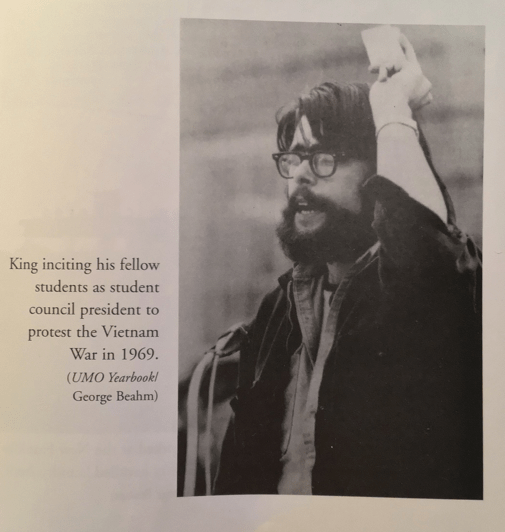
It’s tempting (for me) to think that King extrapolated the plot utility of a literal hot dog from the figurative connotations of the term: human “hot dogs” are showoffs full of hot air, i.e., meaningless words. Pivotal to my personal political disillusionment was my first serious run-in with the dumb power of words at the end of 7th grade, running for student council president. The campaign for this consisted primarily of a handful of posters in the hallways–mine bearing bad clipart and something about “integrity”–and culminated in the various candidates each giving a speech to the entire K-8 student body. My speech was in the earnest vein of my posters, a snooze for sure, enumerating my practical qualifications for the position, which I believed (and still do) were more legit than my opponent’s, since I was a disciplined straight-A student while he was something of a … class clown. I didn’t understand but was about to learn that these things were a popularity contest and that his being class clown, or an ass, was an asset.

His speech was something. He wove an extended metaphor around the refrain “Let me be your toilet paper,” enumerating not his specific personal qualifications, but the general dependable qualities and necessity of…that with which you wipe your ass. Until the official announcement of the election results confirmed my loss, I clung to the delusion that rationality would prevail, but when I heard the gales of laughter in response to his invocations of toilet paper echoing in the school gymnasium that day, I knew the truth. I ate the bad hot dog of my own personal Watergate.

From the Lisa Rogak biography oF King Haunted Heart (2009)

The hot dog, in being the root cause of The Dead Zone‘s plot, mirrors the way King locates Watergate as a root cause of a national disillusionment with America’s political system that from the hindsight of the year 2020 seems to have paved the way for Trump the way The Apprentice did.

The road to Trump seems to run through Reagan, the original actor-politician, who also graces the pages of The Dead Zone:

It was Ford who was in a scrap for his political life with Ronald Reagan, the ex-governor of California and ex-host of “GE Theater.”

As he did with Jimmy Carter, Johnny also shakes hands with Reagan:

He shook hands with Morris Udall and Henry Jackson. Fred Harris clapped him on the back. Ronald Reagan gave him a quick and practiced politico’s double-pump and said, “Get out to the polls and help us if you can.” Johnny had nodded agreeably enough, seeing no point in disabusing Mr. Reagan of his notion that he was a bona fide New Hampshire voter.

That Johnny doesn’t get the precog vision that Reagan will win the Presidency like he did with Carter probably nixes any theory that King’s Trump-like representation of Stillson is evidence that King himself has any precognitive abilities…

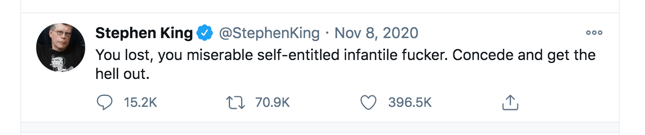
Johnny resorts to violence to prevent violence, taking an action the novel seems to both deem necessary and valorize without acknowledging its parallels to the logic (or lack thereof) of the arms race. And I have to say that King seems to be doing nothing so much as sinking to a Trumpian level when he explicitly involves himself in today’s politics:

Not infantile at all… From here.

Yet here I am repeating it, so…

The Coke

I mentioned in my first Dead Zone post that the novel feels like it could have been one of King’s “cocaine novels”–as in, written under the influence of. King biographer Lisa Rogak locates 1979 as the year King became hooked; The Dead Zone was published in August of that year. The origin point of King’s personal cocaine narrative is loosely sketched thus:

In the movie and media world of the late seventies, drugs were as much as part of doing business as alcohol, and it wasn’t unusual to see Valium, quaaludes, and cocaine presented in abundance at cocktail parties and industry functions. As Steve began to spend more time in this world—and given his experimentation with drugs back in college—it was inevitable that he would try out these drugs as well, and so around this time he used cocaine for the first time. …

“With cocaine, one snort, and it owned me body and soul,” [King] said. “It was like the missing link. Cocaine was my on switch, and it seemed like a really good energizing drug. You try some and think, ‘Wow, why haven’t I been taking this for years?’ So you take a bit more and write a novel and decorate the house and mow the lawn and then you’re ready to start a new novel again.

Rogak, Lisa. Haunted Heart (p. 96). St. Martin’s Publishing Group. Kindle Edition.

Sounds great, though it will take an eventual toll as the go-go 80s wears on…but the introduction of white-collar cocaine and its blue-collar counterpart, crack, has its origin in the 70s, and as with so much of our national evil (i.e., Watergate) that King skewers with his allegorical pitchfork, this one goes back to that old resigned devil, Tricky Dick Nixon. Nixon’s 70s administration is the one that launched the War on Drugs; Reagan took this ball and ran with it through the 80s largely via the vehicle of…cocaine.

I’ll pause here to note that–at the point of this writing at the tail end of 2020–I have only gotten through writing about King’s eighth published book total (including two pseudonymous technically non-King Bachman novels): Carrie (’74), ‘Salem’s Lot (’75), The Shining (’77), Rage (’77), The Stand (’78), Night Shift (’78), The Long Walk (’79) and now The Dead Zone (’79), which covers roughly the first five years of the King’s career. I’m ahead of that in my reading, having gotten through Roadwork (’81), Cujo (’81), The Running Man (’82), The Gunslinger (’82), Different Seasons (’82), Christine (’83), and Pet Sematary (’83), covering roughly the first decade of his career.

Recently watching the Shawshank movie adaptation after finishing that novella in Different Seasons, I noticed in the opening credits that its production company was Castle Rock Entertainment, and wondered if it was connected to King’s Castle Rock. According to Wikipedia:

King’s fictional town of Castle Rock in turn inspired the name of Rob Reiner‘s production company, Castle Rock Entertainment, which produced the film Lord of the Flies (1990).[32]

From here.

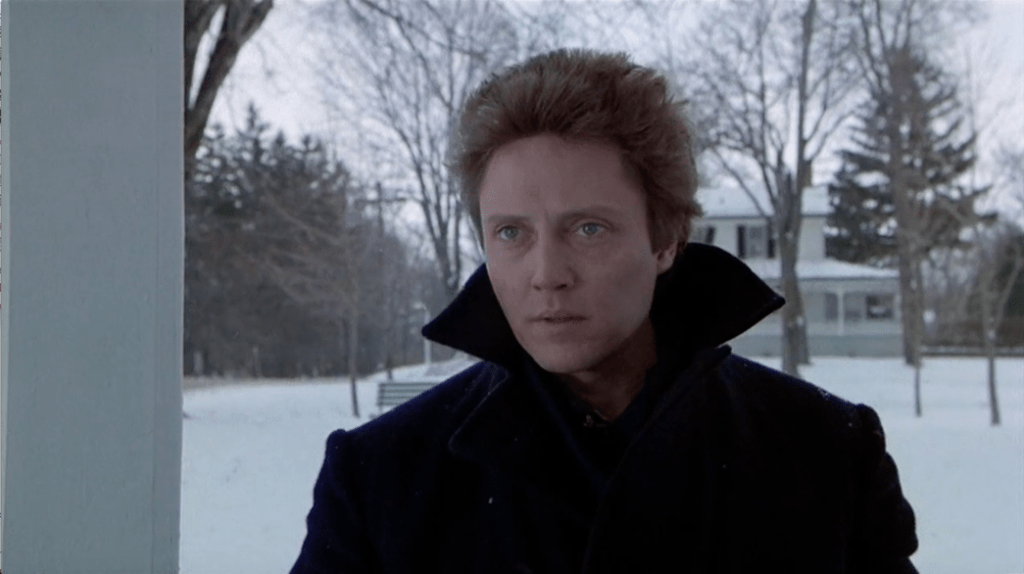
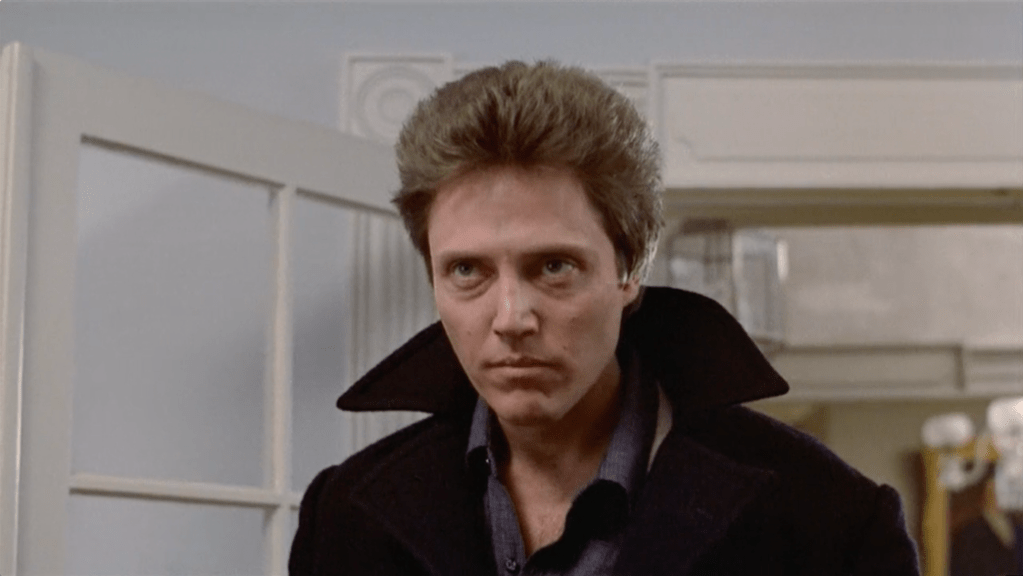
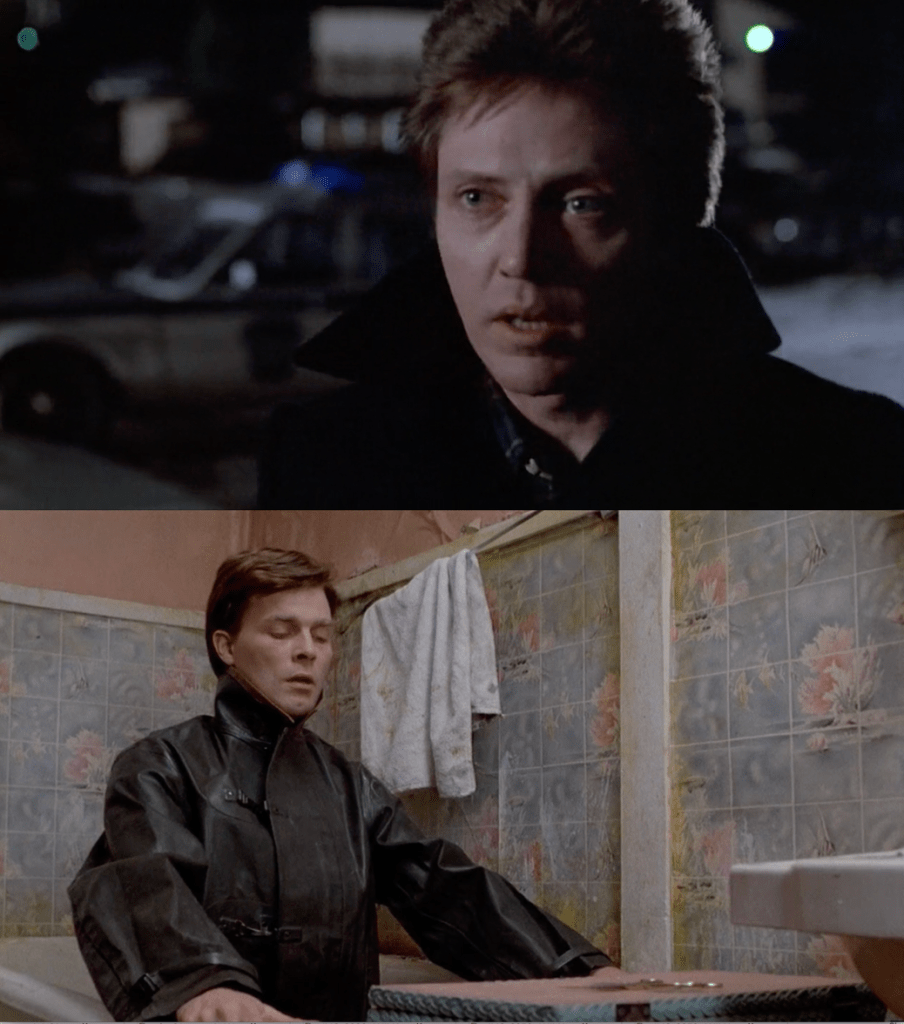
Just as King’s Dark Tower is the nexus of the space-time continuum and Castle Rock is the nexus of the Kingverse, King himself exists at the nexus of reciprocal influence between film, literature, television…and cocaine. In The Dead Zone, Johnny likes to ask Sarah in a flirty way that signifies their love for each other if she’s still “doing that wicked cocaine”–a teasing tidbit whose absence from David Cronenberg’s 1983 film adaptation of the book is the jumping-off point of Sarah E. Turner’s academic essay “Reaganomics, Cocaine, and Race: David Cronenberg’s Off-Kilter America and The Dead Zone.” Cronenberg develops an aspect of John’s character that the novel doesn’t via both the landscape–snowy, white–and John’s overcoat–black, large collar necessarily turned up against the former.

Christopher Walken as John Smith (as raven) in David Cronenberg’s 1983 adaptation of The Dead Zone.

The meaning of the coat is set up by a literary reference at the film’s beginning that is absent from the novel, John reading Edgar Allen Poe’s classic poem “The Raven” out loud to his English class. He also tells them they’ll be reading “The Headless Horseman” next, but the raven is the figure Walken’s winged collar will render him against the blizzardy-white landscape into which his circumstances will force him, and which will thereby, according to Turner, further “posit[] him as representational of otherness/blackness,” as will the framing of other coat shots (and windows and doorways).

Cinematographic framing in David Cronenberg’s 1983 adaptation of The Dead Zone

Turner has specified by this point she means racial blackness, further evidence for which she offers via a racialized reading of the Poe poem offered by film critic William Beard in his interpretation of the milk truck that causes John’s accident in the film, a detail specifically changed from the accident’s cause (drag-racing) in the novel, a change that becomes…

…inherent to the underlying racial message of the text–whiteness attacks him, almost takes his life, and plunges him into the role of Other/blackness that he assumes.

Sarah E. Turner, “Reaganomics, Cocaine, and Race: David Cronenberg’s Off-Kilter America and The Dead Zone,” The Films of Stephen King, ed. Tony Magistrale, 2008.

Which apparently explains why “The Raven” bit, another change from the novel, is included…

…a decision that is both intriguing and troubling in that [Cronenberg] sets a tone of racial intolerance from the opening shots.[4] Although much has been said about the parallels between John Smith and the narrator of the poem, and the obvious references and fanatical brooding on the embodiment of Poe’s Lenore in the figure of Sarah, there is another, much “darker” reading of Cronenberg’s decision to reference Poe. Poe’s poem, albeit about lost love and questionable sanity, also reflects Poe’s truly American gothic side in its fear of blackness and by extension, black characters and imagery.

Sarah E. Turner, “Reaganomics, Cocaine, and Race: David Cronenberg’s Off-Kilter America and The Dead Zone,” The Films of Stephen King, ed. Tony Magistrale, 2008.

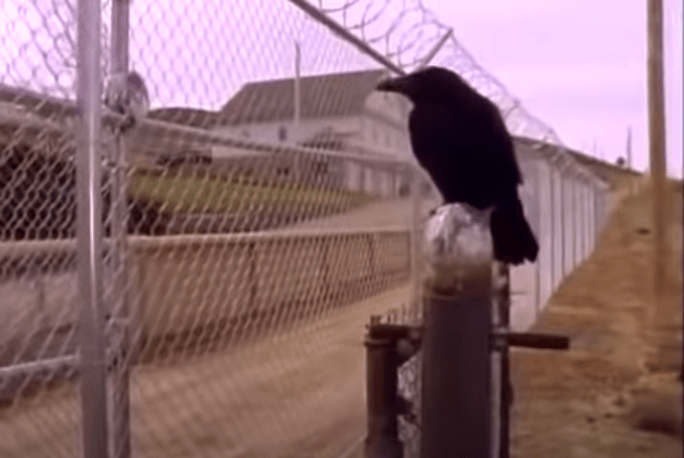
Which brings us to the blackbird, the iconography of which I was reminded while teaching a collage class this past fall and a student was doing a project involving bird imagery. I had recently watched the 1994 adaptation of The Stand in which King, penning the screenplay, leaned even more heavily on the representation of the Dark Man as a crow that he had planted in the novel version (a tactic he developed further in The Gunslinger and presumably the rest of the Dark Tower series)…

One minute, eight seconds into the 1994 miniseries of The Stand.

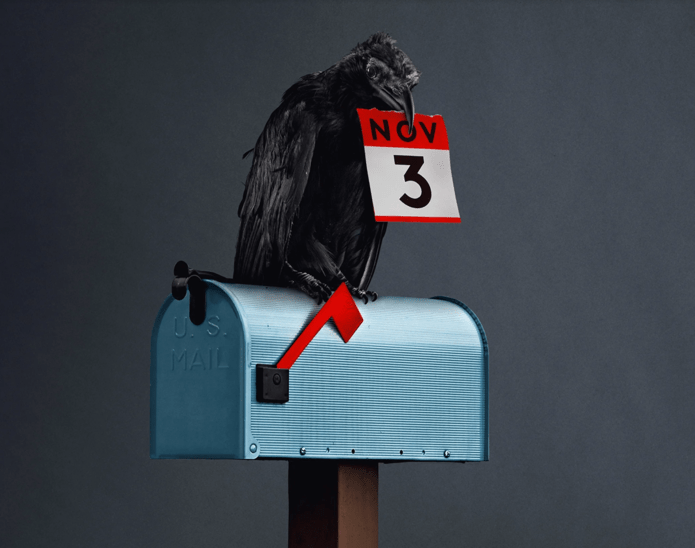
I had also recently seen this image accompanying a September 2020 article in The New Yorker:

Illustration by Tyler Comrie. Photographs by Zena Holloway / Getty (bird); Nathan Griffith / Getty (mailbox). Accompanying “The Legal Fight Awaiting Us After the Election,” by Jeffrey Toobin, September 21, 2020.

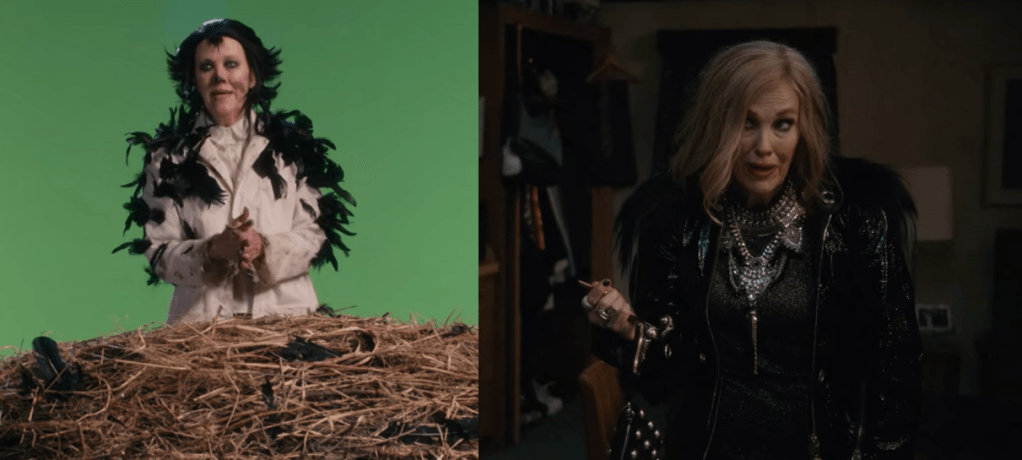
But it seems this winged harbinger of doom might have presaged/foreshadowed a more personal dark fate for Mr. Toobin than he initially realized… an example of attendant meanings’ ability to morph over time if ever there was one. Toobin is still working for CNN and probably won’t have trouble supporting himself when this all blows over–like Johnny when he goes to the symbolic city of Phoenix to work on a road crew in the period before he makes his move on Stillson, I’m sure he’ll rise again, not unlike Moira Rose’s career after starring in the horror flick The Crows Have Eyes in season 5 of Schitt’s Creek:

Moira Rose playing a literal and figurative crow, respectively, in episodes 1 and 2 of Schitt’s Creek season 5 (January 2019).

Turner’s essay then proceeds to discuss some aspects of the film adaptation that reflect the gap between the novel (1979) and film (1983), only four years apart, and yet 1979 is a significant boundary, ushering in the age of Reagan. Turner’s essay is pre-Trump, with the Trump era adding another layer of parallels on top of the ones she mentions:

The parallels between Stillson as politician-actor and Reagan as actor-politician cannot be overlooked. … Cronenberg’s … seemingly conservative nature is instead a harsh criticism on the Reagan years, the rise of the conservative right, and the institutionalized racism suggested both by the group of white men to whom Stillson announces “the missiles are flying” in Smith’s vision and by the conspiracy theory that connected the CIA to the rising crack epidemic in the inner cities of America.

Sarah E. Turner, “Reaganomics, Cocaine, and Race: David Cronenberg’s Off-Kilter America and The Dead Zone,” The Films of Stephen King, 2008.

Cocaine is a drug that is cut along class and race lines–one that specifically cuts the non-hegemonic race into the poorer, more incarcerated class. In Cronenberg’s adaptation, the shots of snow emphasize the white landscape which reinforce the uniform whiteness of the crowd at Stillson’s campaign rally, implicitly highlighting the absence of both blackness and cocaine, elements that loom on the margins via Reagan’s floating head:

“Nobody, and I mean nobody, is gonna stop me!”
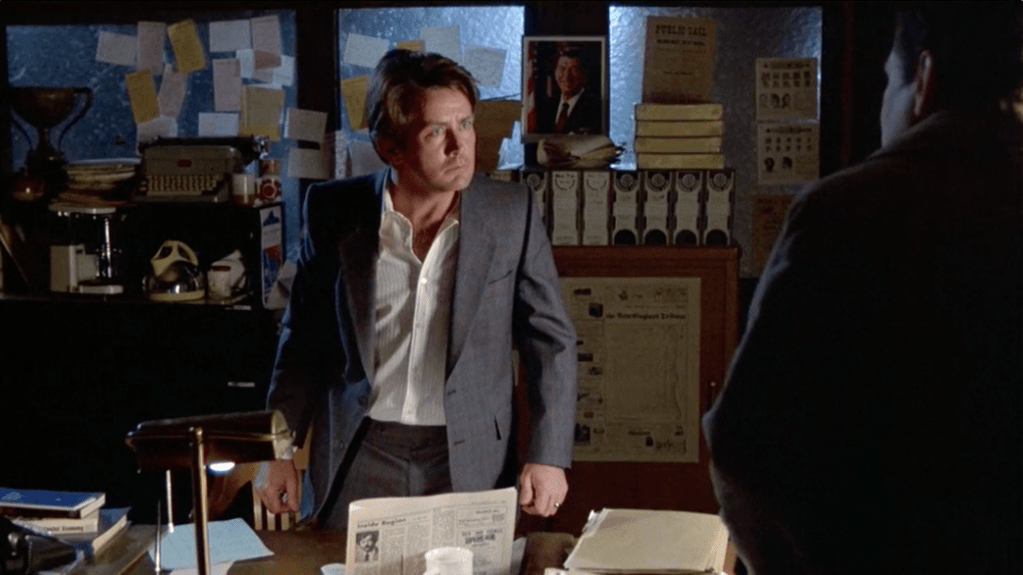
Martin Sheen as politician-villain Greg Stillson in David Cronenberg’s 1983 adaptation of The Dead Zone

If Stillson is an alter ego for Reagan (and/or Trump), then this might lend credence to or in turn be supported by the theory that Dodd is Johnny’s alter ego, an aspect the movie develops more than the novel by seeming to extrapolate from a detail the novel attributes to Dodd–his wearing a black vinyl raincoat–and using Johnny’s coat to define an aspect of his character in turn.

Jekyll and Hyde…

Dodd’s black vinyl raincoat is a more utilitarian attribute in the novel, as we see when we’re in the killer’s point of view that he wears it specifically because it is “slick” and thereby impedes his victims from fighting him off. John’s coat with its noticeably large collar is utilitarian for the harsh wintry Maine landscape in which he finds himself; shots of him in this landscape further reinforce him as outsider in an allegorical reading of the film as a white man experiencing the horror of what it is to be Black in America–which is necessarily White America. (Kind of like the It’s Always Sunny in Philadelphia episode “The Gang Turns Black” from January 2017, but less on the nose.) Though this analogy kind of falls apart in the face of John’s sort-of-selfless willingness to sacrifice himself to save America–which is necessarily White America, though figures like Stillson (and Reagan and Trump) are working to make it even whiter….

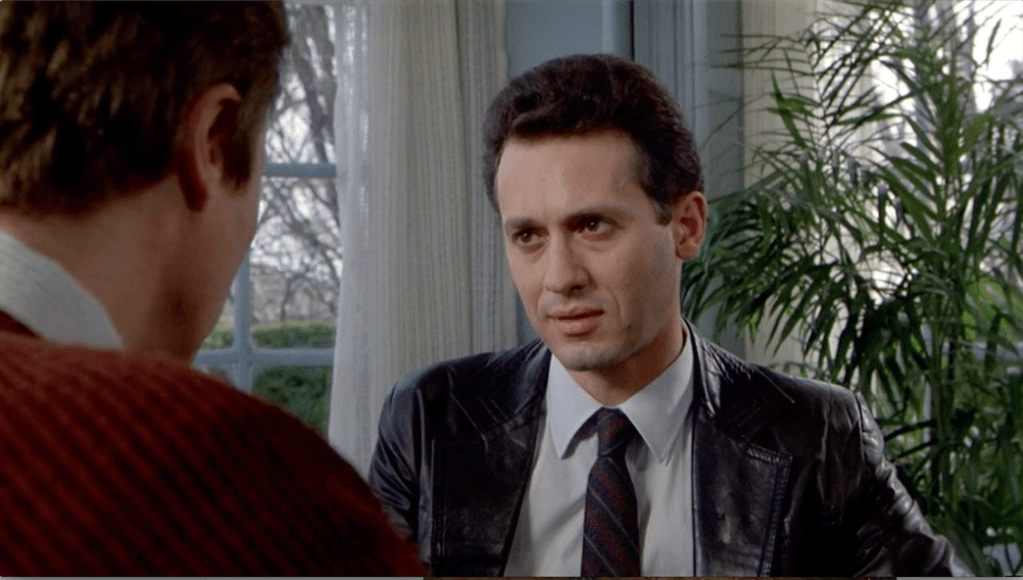
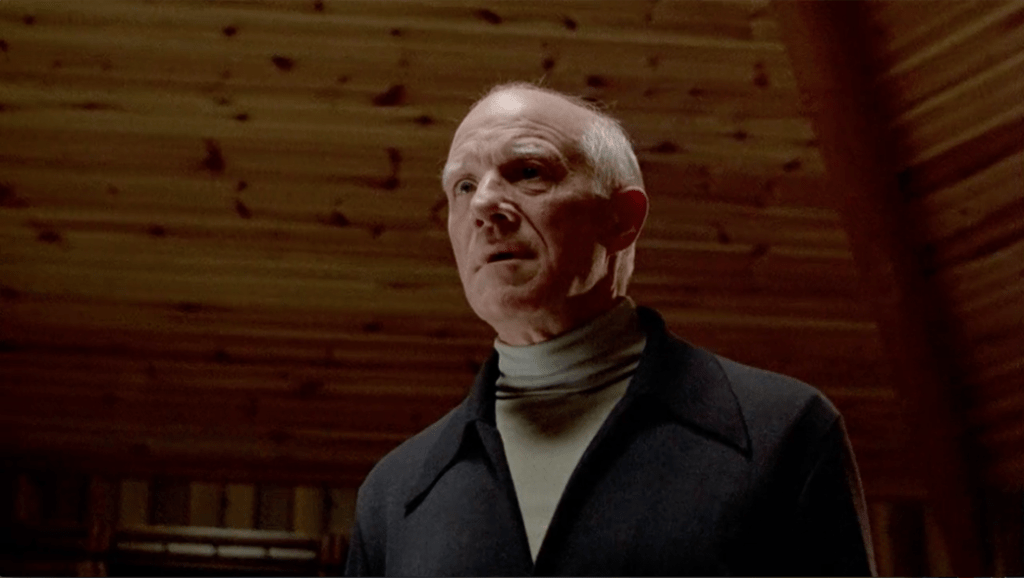
Two other figures in the film bear sharp black lapels on their torsos, the latter notably more winged:

The reporter who goads Johnny into giving a demonstration at the press conference
The dude Stillson goads into executing the nuke-launch sequence in Johnny’s vision

John is still wearing one of his Mister Rogers sweaters in the scene with the reporter, so if it’s largely his black winged-collared coat that renders him “other,” then I guess it means his transformation to other isn’t complete yet and figures like the reporter are helping him on his way. The latter dude’s collar seems to more definitively link him to John’s mode of representational otherness, and if he’s literally Stillson’s helping hand (he has to press his full hand down on the screen to execute the nuke sequence), then perhaps he’s showing that if John does nothing with his precognitive knowledge of this then he will essentially be helping Stillson almost as directly as this patsy is…

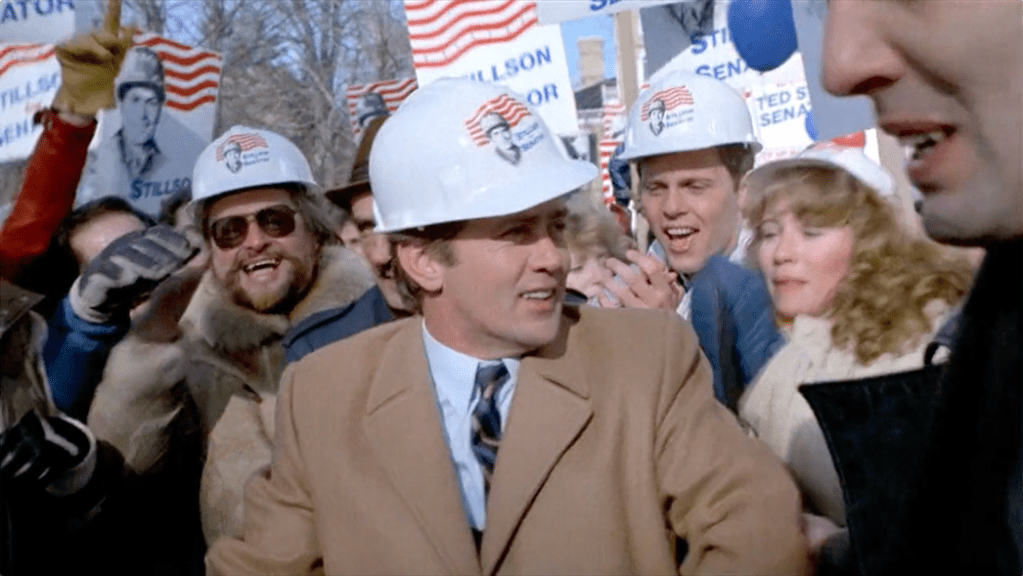
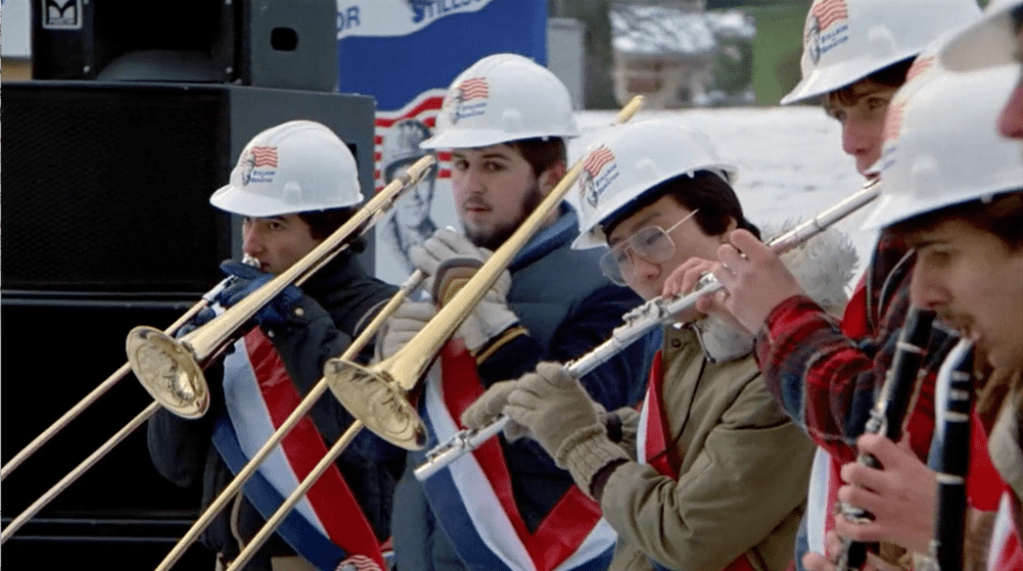
Part of Stillson’s “act” as politician is also reinforced through clothing/accessories, specifically the working-man’s hard hat or “helmet” he wears to his campaign rallies, which in the novel is specifically noted to be yellow:

Stillson moved quickly through the ranks of the band to shake hands on the other side, and Johnny lost complete sight of him except for the bobbing yellow helmet. …

… A female hand reached for the bobbing yellow hard hat, maybe just to touch it for good luck, and one of Stillson’s fellows moved in quickly.

The film shifts the hard hat’s color to white, in keeping with the theory that the film is reinforcing a ubiquitous vision of whiteness(-as-nightmare) in multiple elements of its landscape:

Keep America under construction: Cronenberg’s “construction of America” in The Dead Zone

Now I’m wondering if the helmet is yellow in the novel in order to render the figure of Stillson more hot-dog-like…

Another way clothes come into play in the novel’s narrative is via the aforementioned snowsuit (with yellow piping) of the baby-as-shield, through which Stillson reveals his true figurative colors. The novel links this snowsuit to a metaphor made by Ngo Phat, the piping likened to the stripes of the tiger that had to be killed when it got a taste for human meat. As with the hot dog, the movie dispenses with Ngo and his metaphor (adding a new flourish by having the child Stillson uses as a shield be Sarah’s). Turner’s essay claims in a footnote that “it must be noted that there aren’t any clearly defined black or minority characters in the book,” but this completely overlooks Ngo Phat, whom the text identifies as the Chatsworths’ “Vietnamese groundsman” (and who in classic King fashion exemplifies his workingman status by wearing a “chambray work shirt”). Ngo is more a device for plot and theme development than developed character in his own right; he affects the plot because Johnny is at the rally where he touches Stillson and has the nuclear-holocaust vision because he goes with Ngo’s U.S. citizenship class; he affects the theme through his tiger metaphor applied to Stillson, developing the theme of politician-as-monster. Since Ngo’s “character” actually serves more than one function, he gets more play than a fair amount of minority characters in the Kingverse–certainly more play than the one person of color in the film Turner does take pains to note via the “brief shot of an Asian American man in the band that plays outside at the Stillson rally in the latter part of the film.”

The lone POC in David Cronenberg’s The Dead Zone

She doesn’t note that his clothes also seem to differentiate him… but she does expound further in a footnote that in a latter shot of the band:

…his head is obscured by the raised arm of the white man standing next to him, in a sense erasing his difference as, from the neck down, he looks like all the other white members of the band.

Sarah E. Turner, “Reaganomics, Cocaine, and Race: David Cronenberg’s Off-Kilter America and The Dead Zone,” The Films of Stephen King, ed. Tony Magistrale, 2008.

I was unable to locate this latter shot (there’s a guy with his head obscured that it seems like she might be referring to, but he’s not playing the flute). But perhaps this single “Asian man” in the film is a sort of homage to the scrapped “character” of Ngo Phat…

That Cronenberg (who’s from Canada, and filmed The Dead Zone there) constructed an “off-kilter America” in which the hegemonic culture’s vision of itself is subtly but horrifically realized feels fitting for an adaptation of the first novel in which King’s Castle Rock appears, that “fictional” landscape of a “real” place. (King’s wife Tabitha has her own parallel Maine creation, setting several of her novels in the fictional town of Nodd’s Ridge; one of these, The Trap (1985), explores the nexus of the film industry, cocaine, and the legacy of (the bad hot dog of) the Vietnam War.) This “off-kilter” aspect of a fictional setting amid “real” surroundings and events seems an implicit acknowledgment that any single author’s take on the “real” is necessarily limited by their individual perspective, despite narrative devices like omniscience and/or representing multiple characters’ points of view. The fictional mileage King has gotten out of Castle Rock places it in the tradition of William Faulkner’s Yoknapatawpha County, that fictional Mississippi county in which real Southern attitudes were expressed; a new book compares Faulkner’s fiction’s evisceration of those racist attitudes to his real-life failure “to truly acknowledge the evils of slavery and segregation.”

The Rock is a fictional town in the whitest state in America, and I’m not so far sensing a gap between the author and the fiction in terms of attitudes expressed, what often becomes an inadvertent and often good-intentioned but ultimately racist attempt to perform anti-racism, or a racist performance of racism for the sake of showing the ugly truth of its existence. This is the vibe I’m getting from my dip into the first decade of King texts, manifest in an exchange Turner quoted that King once had with Tony Magistrale, a King scholar (and apparently at some point King’s research assistant). The exchange is about John Coffey from The Green Mile (1996); King says the character’s racial blackness is necessary to the narrative to make Coffey doomed when he’s caught with the dead girls in his arms (the implication being his guilt will be assumed instantly); when Magistrale suggests Coffey’s suffering as a black Christ figure “becomes all the more profound because he is black and a victim of wounds that are particular to his racial history,” King accuses Magistrale of “an imaginative failing.” Which is ironic (in a way that I shudder to say is almost Trumpian), because King seems to be the one demonstrating such a failure here, a failure to imagine all the possible meanings a text can inadvertently accrue or manifest, despite King’s history as and valorization of English teachers. But maybe his blind spot with inadvertent meanings is more specifically race-related… and/or maybe its his ability to compartmentalize white guilt that helps fuel his prodigious output… We’ll see how King’s Castle Rock’s “off-kilter” elements confront the trickle-down “evils of slavery and segregation” from here… and if our so-called democracy survives.

-SCR

The Dead Zone: Narrative Execution

When Roger came to the neck of land that joined the Castle Rock to the mainland he was not surprised to be challenged. He had reckoned, during the terrible night, on finding at least some of the tribe holding out against the horrors of the island in the safest place.

William Golding. Lord of the Flies. 1954.

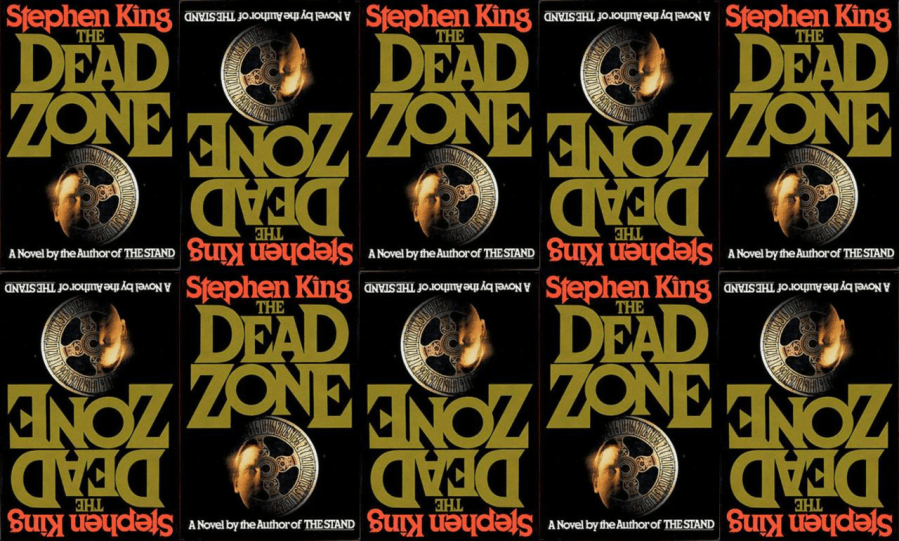
Published on August 30, 1979, Stephen King’s novel The Dead Zone might be more significant for marking the first appearance of King’s fictional creation Castle Rock than as a narrative achievement in and of itself, were it not for reading it during the 2020 election…

Prologue 

In 1953, six-year-old John Smith is out skating on a pond when a bigger boy collides with him, causing him to bash his head on the ice. When he comes to, he has a premonition about one of the men helping him, telling the man not to “jump it no more” because of “the acid.” A month later the man tries to jump a car battery and it explodes in his face. 

In 1955, a traveling Bible salesman named Greg Stillson pulls up to a farm; no one is home and a dog comes out, growling at him; Greg sprays it with ammonia then ends up kicking it to death when it bites his pants leg. He has a feeling he’s destined for greatness if he can keep his temper under control.

Part 1: The Wheel of Fortune

In late October of 1970, Sarah Bracknell shows up for a date at John Smith’s apartment in Cleaves Mills, Maine, and he frightens her by greeting her in a Jekyll and Hyde mask. They’re both new high-school English teachers in their first year out of college; Sarah had a toxic boyfriend right before John and hasn’t slept with John yet. When they get to the county fair, their date goes really well until John is betting on a wheel of fortune and Sarah starts to feel sick from a hot dog she ate. Getting one of his “hunches,” John plays the wheel for a growing crowd until he wins $500, then takes a sick Sarah home. She had wanted him to stay over for the first time that night, but since she’s sick, he takes a cab home, telling him she loves him for the first time right before he leaves. On its way to John’s, the cab collides head-on with a drag-racing car. Johnny’s parents Herb and Vera are notified; Vera, extremely religious, keeps ejaculating prayers and is hostile to Sarah when they meet her for the first time at the hospital and receive the news that John is in a coma. Sarah tries to pick her life back up, and a killer starts strangling women in Castle Rock, Maine. Greg Stillson recruits a greasy biker named Sonny Elliman to be his chief enforcer. Sarah stays in touch with Herb but eventually begins to date again and marries a law student; Herb goes to her wedding while Vera is off with some crazy religious people on a farm waiting for the rapture. Sarah has a baby, and the Castle Rock killer strikes again. 

After four and a half years, Johnny wakes from his coma. When he touches people, he knows things about them. Herb and Vera visit and Herb tries to order Vera not to proselytize to John about his having survived to fulfill some purpose of God’s. When John touches the hand of Dr. Weizak, he gets a flash revealing that Weizak’s mother didn’t actually die during WWII like Weizak had always thought, but had gotten amnesia and was actually living in California; Weizak calls and confirms that it’s true. John has surgeries to lengthen the ligaments that shortened while he was bedridden; Sarah visits while he’s recuperating and he tells her where her lost wedding ring is. His mother stops taking her blood-pressure medication and his old principal offers him his job back. When he’s working with a physical therapist one day, he gets a flash that her house is on fire, which turns out to be true. This prompts a bunch of reporters to show up at the hospital, and Johnny gives a press conference during which one of the reporters demands he do a demonstration and hands him a medallion he has on his person; when Johnny touches it he’s able to tell the reporter’s sister died of a meth-related heart attack, and a ruckus with the agitated reporter ensues. That night John gets a call from his father that his mother’s in the hospital after having a stroke when she saw the press conference with him on the news. Weizak drives John over and she again insists God has a job for him before she dies.

As mayor of Ridgeway, New Hampshire, Greg Stillson privately assaults and threatens a youth offender for wearing an obscene t-shirt. Sarah’s husband Walt shows her the news story about Johnny’s press conference and thinks Johnny is hoaxing it for money, an idea that angers Sarah. A guy from a tabloid newspaper tracks John down at his father’s once he’s discharged from the hospital to offer him a clearly unsavory job as a magazine psychic; John insults and borderline assaults him turning it down, infuriating the guy and getting them to run a story accusing Johnny of being a fraud. Stillson runs for an open House of Representatives seat because he’s gotten photos of the supposedly unbeatable incumbent sleeping with someone who’s not his wife. Sarah comes to visit Johnny with her young son Denny when they’re vacationing nearby (sans her husband, who has political aspirations) and finally sleeps with John, saying it will be just for this one day. John is happy people think he’s a fraud because it means he’s not constantly being mailed objects to touch, but then he gets a call from a sheriff in Castle Rock about the murderer there after Dr. Weizak mentioned John’s abilities to the sheriff. John refuses to help at first, but when a nine-year-old girl is raped and murdered, he agrees to help and meets with Sheriff Bannerman, who gives him a cigarette pack they believe the killer touched. This doesn’t produce any results, but when they go to the town common (with reporters following) where one of the murders happened, John sees enough to realize the killer is Frank Dodd, one of Bannerman’s deputies. Bannerman doesn’t want to believe it at first, but they go to confront Dodd at his house where his mother tries to stop them; by the time they get to him upstairs, Dodd has cut his own throat. After the news stories about his help with the case come out, John loses his teaching job because the school board doesn’t want his notoriety. 

Part II: The Laughing Tiger

Six months later, in the summer of 1976, John is living in the guest house of the wealthy Chatsworth family, tutoring their high-school-senior son Chuck, who has reading problems–specifically processing/remembering what he reads after he’s read it. This day during their lesson John tests a method he’s been waiting to try, asking Chuck unrelated questions to get his mind off the text before returning to it, and it works. Sonny Elliman accosts someone about to run a story revealing Stillson’s illegal real-estate scams. 

While he’s tutoring Chuck, John develops an interest in politics and meets several politicians, including Jimmy Carter, whom he shakes hands with, inducing a premonition that Carter will win his run for the Presidency. After Chuck’s reading breakthrough, his father gives John a bonus, revealing he knows about John’s past as a psychic, and they see a clip of Stillson campaigning on the news (this is the first time John sees/hears of him); his campaign is described as “eccentric” and he presents himself as a man of the people by wearing a yellow hardhat everywhere. John thinks Stillson looks crazy, but Chatsworth, while conceding the point, predicts Stillson will appeal to the blue-collar electorate and win.

Johnny strikes up an acquaintance with the Chatsworths’ Vietnamese groundkeeper Ngo Phat, who’s in the process of applying for U.S. Citizenship; when Ngo’s class and Johnny attend a Stillson rally, Johnny ends up touching Stillson, getting a flash of Stillson taking the oath of office and some vague broader destruction that’s in the “dead zone,” the part of John’s brain that’s been damaged, leading to blank spots in his precognitive visions. Stillson senses something (as people tend to when Johnny gets flashes from them via touch) and some of his biker goons rush John, who passes out and wakes up in an interrogation room with an FBI agent who was at the rally. Ngo compares Stillson to a tiger from his village who had to be trapped and killed after he got a taste for human meat. Johnny watches the ’76 election results and sees Carter beat Ford and Stillson also win his race. Chuck puts off taking the SATs to attend Stovington Prep for a year. Johnny becomes obsessed with Stillson and looks into his history, including his stint as a rainmaker, and puzzles as to why the press hasn’t probed more into his shady real-estate deals and biker-goon bodyguards. When Johnny’s father gets remarried, Johnny sees Sarah at the wedding and meets her husband for the first time; he asks his father’s new father-in-law who served in WWI if he would go back in time and kill Hitler, and the man says he would, as does Chuck Chatsworth.

In the summer of 1977, Chuck graduates from high school, and at a gathering after the ceremony when Johnny hugs him, he sees that the place where everyone is going for their graduation party that night will burn down after being struck by lightning, trapping and killing a lot of people. Roger Chatsworth thinks the prediction is ridiculous, but Chuck says he won’t go; the two go with Johnny to the place, Cathy’s, to try to convince the owner to close but he says it’s worth too much money and claims he has lightning rods, even though when they go outside they see he doesn’t. They invite everyone to the Chatsworth’s for a party instead but only about half accept; at the party that night the news breaks that Cathy’s has burned down and several of the graduating students there were killed.

Johnny drifts to Phoenix and keeps rejecting checks from Roger Chatsworth, but Roger pays off all his medical bills. The FBI agent Johnny talked to who was looking into Stillson turns up murdered. Stillson is reelected to his House of Representatives seat. Johnny debates about assassinating Stillson. When he finds out he’s almost “run out of time,” he buys a rifle and makes his way to a Stillson gathering in Timmesdale, New Hampshire, looking visibly sick to everyone he encounters. He writes letters to his father and Sarah. He examines the space where the Stillson gathering will be and spends the night hiding in its upstairs gallery. One of Stillson’s bodyguards almost finds him the next morning but is just doing a cursory check, and misses him. When Stillson comes into the crowded gathering, Johnny stands to shoot him but Stillson ducks; Johnny gets shot by the bodyguards but still tries to get another shot off, at which point Stillson grabs a little boy in a snowsuit from someone and holds him up as a shield. Johnny doesn’t try to risk shooting him again, and thinks he’s failed. He falls down from the gallery, and when Stillson and some of the bodyguards approach him (Stillson yelling at some of them to go chase down a kid who took a picture of him holding up the baby as a shield), John grabs Stillson’s ankle and sees that everything’s changed, that Stillson won’t become president and start a nuclear war, that his political career is finished. John dies. 

III: Notes from the Dead Zone

We get Johnny’s letter to his father interspersed with testimony acquired by the “Stillson Committee” looking into the attempted assassination. It turns out Johnny had found out he had a brain tumor and only a limited time to live without another operation, which he’d declined. Dr. Weizak claims that the brain tumor is not responsible for Johnny’s actions and that his letters show he was rational to the end. Sarah visits Johnny’s grave and briefly feels his hand on her neck before saying goodbye. The End.     

Narrative Execution

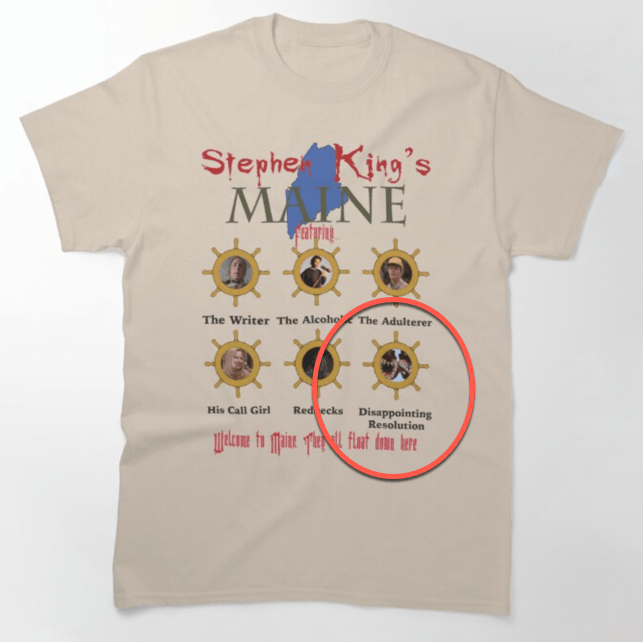
The execution of this plot feels disjointed and jerky in ways the physicality of John’s climactic assassination attempt plays out almost comically, and which also feels like it might be King starting to write under the pressure of contract-reinforced deadlines (and possibly the influence of cocaine). According to the authority of certain t-shirts, King has trouble sticking the landing when it comes to his endings:

From here.

Reader dissatisfaction with King’s endings strikes me as a product of how good/immersive his books are up that point and thus a product of a double-edged sword: the better the book–that is, the more the reader is immersed in its world and characters–the better the ending has to be to satisfy. It’s like King has set such a high bar for himself in the buildup that his ending will necessarily never be able to meet it; the reader comes to love the characters and their world so much that no ending can be good enough. Any resolution is inherently “disappointing” because it means the book is over and you can no longer continue reading it… But The Dead Zone was the opposite for me: I liked the ending; it was the buildup to it that felt lacking.

Let’s start with the prologue: here we get two separate scenes focusing on two different characters. The scene we get of our protagonist John Smith seems critical to the overall narrative in showing us an early head injury that is implied to be related to why the eventual coma has the effect on him that it does in terms of his precognitive abilities. Then there’s the scene of Greg Stillson: this scene shows us the character in a way that instills a sense of foreboding about him, but unlike John’s scene, what happens in it is not technically critical to any later plot developments–it’s not like what happens here with the dog causes or has any influence on changing his actions in a pivotal way, like this is the moment he decides he has a higher calling specifically due to what happened in the scene. The other problem is that its placement implies Johnny and Stillson are going to get equal or at least comparable airtime/page counts throughout the book, but Johnny gets much more, and part of what we do end up getting about Stillson’s side doesn’t even directly involve him–like a scene of his enforcer Sonny Elliman threatening a journalist. Such scenes, like that of Stillson’s in the prologue, show us something about the character and his general trajectory, but don’t feel directly critical to the Johnny-Stillson plot–Elliman has presumably threatened many journalists, so why is this threat the one we end up getting in scene?

Stillson is not developed in any satisfying way as a human being in the scenes we do get of him or otherwise, but rather is shown to be a psychotic monster with no nuance. This could be fine for thematic purposes, highlighting the monstrousness of politicians and/or the political machine that subsumes people who have to adhere to its platforms/demands in order to be successful in politics. I am increasingly wary of narratives that humanize would-be monsters so that we end up sympathizing with them in a way that might implicitly let them off the hook (I don’t want to sympathize with Donald Trump, no matter how mean his father was to him). But the framing of Stillson we get via the prologue, if in form more than content, sets up an expectation that he’ll get more nuanced development than he does.

Yet despite the page count dedicated to him, development is a problem that extends to Johnny as well. By naming this protagonist “John Smith” with no middle name, King seems to be branding Johnny as an everyman, more cipher than individual, which a lack of character development would seem in keeping with. So there’s a technical explanation, but John’s everymanness sure is boring to read–he’s as bland as freeze-dried rations that only approximate the flavor of meat. Sarah is a plot/character device for John in that she represents the life John would have had if he hadn’t lost those 4.5 years due to the accident–her son Denny should have been his son, etc. And he was a preternaturally gifted charismatic English teacher, so the happy life he should have had is outlined to heighten the tragedy of what is precisely the sacrifice of his individuality that defines the plot’s rising action, but the sketching of all of this bent toward hokey.

This aspect combined with the extended period of time the novel covers in jerks and stutters make the overall reading experience a bit of a slog. The interest we’re told Johnny develops in politicians following his coma feels utterly contrived, something that clearly exists only because of/for the sake of the plot: Johnny’s interest in politicians seems to be due to his increased post-coma precog abilities, but it would be better if this interest had some seed in his individual character that existed apart from these abilities. His mother’s extreme religious tendencies seem to exist to introduce the idea that John has been chosen or called on by some larger/divine force to use his abilities for some larger significant purpose, but there is nothing about John independent of these abilities, nothing about his individual character, that impacts his decision to ultimately accept his calling and use them. If it’s supposed to be due to the deathbed exchange he has with his crazy religious mother about his calling, that’s not really working for me, though perhaps some might try to argue for this mother-based motivation based on the theory that Frank Dodd is a version of Hyde to Johnny’s Jekyll. The narrative basically lays the blame/motivation for Dodd’s…tendencies…at the mother’s doorstep with the descriptions of how she made him clothespin his penis when she caught him playing with it when he was young, and his invocation of her language (“nasty-fuckers”) in his direct point-of-view considerations of his crimes.

Pacing-wise, the lack of page count around Stillson is apparently due to getting a lot of stuff about Johnny that is prepping him for how to handle Stillson, but since the prologue is also focalized on Stillson, it’s implied the rising action should also revolve more around Stillson. Instead we get a long digression about Johnny’s psychic fight with another human monster: Castle Rock serial killer Frank Dodd. This plot thread is in theory supposed to be something that vindicates Johnny’s abilities and thus his decision to go through with attempting to kill Stillson, but his vision about Chuck Chatsworth and the graduation party would in theory be enough to serve this purpose. The whole Frank Dodd thread feels like it should be its own separate novel with the confrontation with Dodd as its climax; we get scenes in the killer’s point of view, but this plot thread, especially Bannerman’s relationship with Dodd, ends up feeling undeveloped and rushed. King will lean on Dodd later in his development of Castle Rock (particularly in Cujo, whose titular character/monster will be implied to be some manifestation of Dodd), and if King had leaned on Dodd more here than he does, that would also be more satisfying.

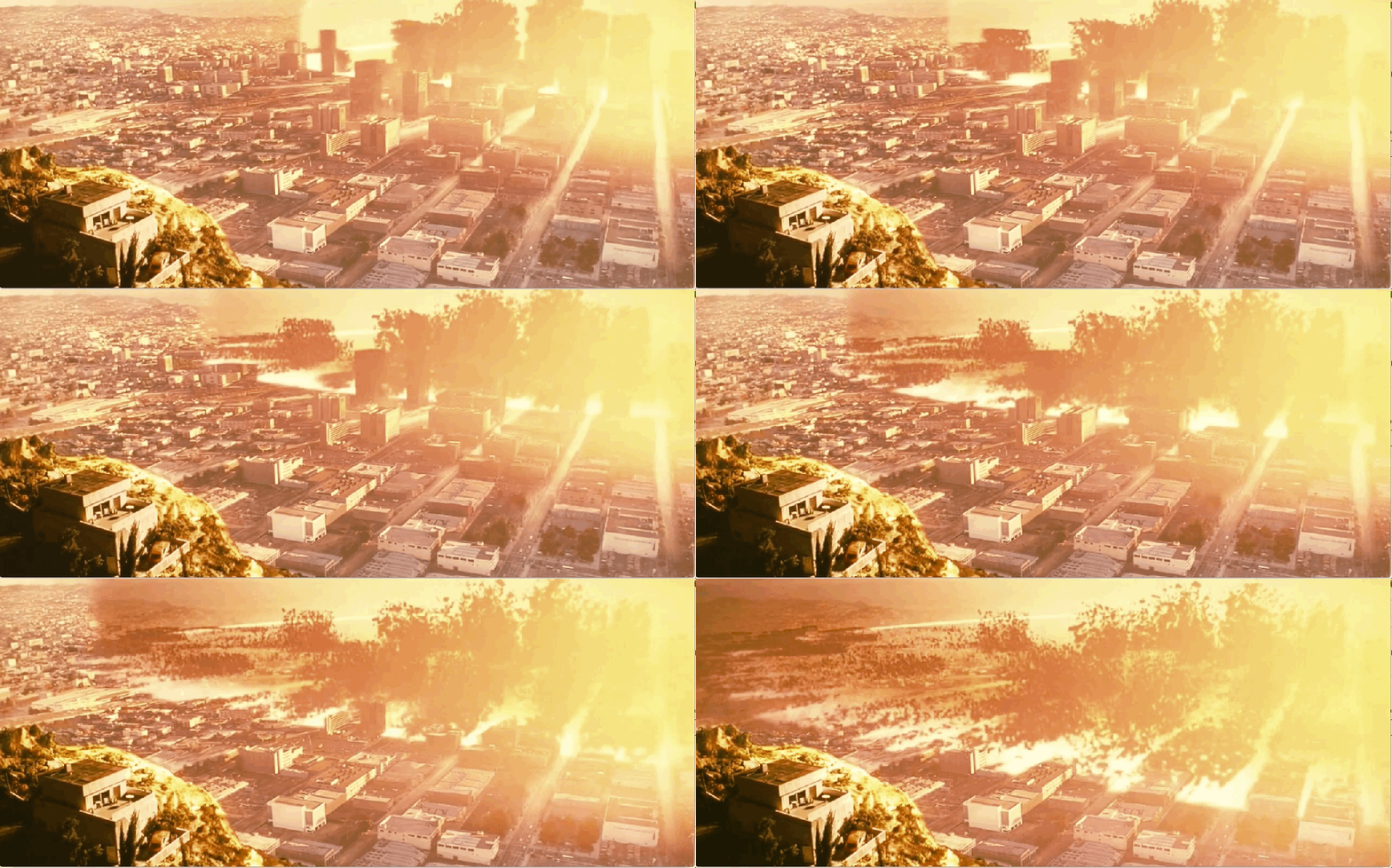
As for the ending, the setup implies two obvious outcomes for the fulcrum of Johnny’s assassination attempt on Stillson: he succeeds in killing Stillson and thus annihilating the possibility of nuclear annihilation for the world at large, or he fails and we all die in an inferno much like the one conjured by Sarah Connor’s consciousness in Terminator 2.

Terminator 2.

Our protagonist does die in the attempt that fails in its most immediate goal: Stillson is not killed. But the attempt itself turns out to achieve the larger goal the assassination was meant to achieve by causing Stillson to show his true colors, thus ending his political career and his chance to access the nuclear codes. So even if you don’t succeed, sometimes just trying is enough…

Of course, how heroic Johnny really is in sacrificing himself for this mission that’s supposed to serve the greater good of humanity is somewhat mitigated by the fact that he was going to die soon anyway from a brain tumor…

In John we have another significant Kingian figure, the English teacher who battles the monster(s). As a teacher, I can appreciate King’s emphasis on the importance of the teacher, and by extension of reading…

Long-suffering good humor predominated, but beneath it he could sometimes see another Chuck: sullen, worried, and scared. Plenty scared. Because it was a reader’s world, the unlettered of America were dinosaurs lumbering down a blind alley, and Chuck was smart enough to know it. And he was plenty afraid of what might happen to him when he got back to school this fall.

This lends new meaning to the term “letter jacket”…

Enter the Kingverse

It feels ironic to me that King declared The Dead Zone his “first real novel,” though his biographer’s juxtaposition of this inflated claim with another tidbit about this novel speaks volumes:

“That’s the first real novel I wrote,” [King] said. “Up until then, the others were just exercises. That’s a real novel with real characters, a real big plot and subplots.”

The Dead Zone was his first book set in Castle Rock, a town in Maine that he’s said he’s patterned after Durham and Lisbon Falls. He borrowed the name from William Golding’s Lord of the Flies, one of his favorite books as a kid. Castle Rock is the rocky part of the island where Golding’s story occurs.

Rogak, Lisa. Haunted Heart (p. 99). St. Martin’s Publishing Group. Kindle Edition.

So The Dead Zone is King’s first (published) novel to introduce the now infamous imaginary Maine town of Castle Rock. In this and other critical ways, it provides insight into King’s world-building tactics, as does its Author’s Note at the beginning:

What follows is a work of fiction. All of the major characters are made up. Because it plays against the historical backdrop of the last decade, the reader may recognize certain actual figures who played their parts in the 1970s. It is my hope that none of these figures has been misrepresented. There is no third congressional district in New Hampshire and no town of Castle Rock in Maine. Chuck Chatsworth’s reading lesson is drawn from Fire Brain, by Max Brand, originally published by Dodd, Mead and Company, Inc.

So, an interplay between the fictional and the “actual,” which the fictional Castle Rock reflects by being situated in a Maine topography both “actual” and fixed in other King novels:

“All right, Daddy,” Johnny said, almost in a whisper. “Yes. Cumberland General. I know where it is. Just above Jerusalem’s Lot. Okay. All right. Daddy …”

It’s later on, when John is tutoring Chuck, that another setting link to the Kingverse, one outside the bounds of Maine, crops up:

…the decision had already been made between Chuck and his father that he would spend a year at Stovington Prep, a good private school in Vermont.

Stovington Prep is where Jack Torrance of The Shining taught, so this is an even more direct link to that novel than the use of Stovington in general as the location of a disease-control center where Stu Redman ends up in The Stand. Of course, The Dead Zone cannot technically take place in the “same” world as The Stand, since the majority of the population of that world has already been killed off, though it seems like The Dead Zone could take place in the same world as The Shining. But this aspect is complicated by another reference:

And then, suddenly, from somewhere behind him Patty Strachan began to talk in a high hysterical voice. “It’s his fault, that guy there! He made it happen! He set it on fire by his mind, just like in that book Carrie. You murderer! Killer! You …”

The Dead Zone takes place in a world where Carrie exists as a work of fiction rather than as events that “really” happened. Which seems like an odd choice, considering the overlapping supernatural-seeming abilities these works’ protagonists share…

While I would dispute that this novel feels like it has “real characters,” King’s claim in his Night Shift foreword that if the story is good enough it will make up for such shortcomings rings true here. Stillson may not be developed, but the landscape in which such a supposedly anti-political figure could succeed definitely is:

There was also a carton of paperbacks entitled America the TruthWay: The Communist-Jewish Conspiracy Against Our United States.

Greg did better with this paperback, printed on cheap pulp stock, than with all the Bibles put together. It told all about how the Rothschilds and the Roosevelts and the Greenblatts were taking over the U.S. economy and the U.S. government. There were graphs showing how the Jews related directly to the Communist-Marxist-Leninist-Trotskyite axis, and from there to the Antichrist Itself.

The days of McCarthyism were not long over in Washington; in the Midwest Joe McCarthy’s star had not yet set, and Margaret Chase Smith of Maine was known as “that bitch” for her famous Declaration of Conscience. In addition to the stuff about Communism, Greg Stillson’s rural farm constituency seemed to have a morbid interest in the idea that the Jews were running the world.

Conspiracy theories appealing to a “rural farm constituency” that purports to be Christian, hmm…sounds familiar. Stillson’s initial occupation as a Bible/conspiracy-theory tract salesman offers an interesting overlap with John’s occupation as English teacher/tutor and King’s conception of a “reader’s world” as played out via Chuck Chatsworth. Chuck’s specific issue is not that he can’t read, but that he can’t remember/retain what he reads, which has larger thematic implications for how we “read” history and what we’ve actually learned/retained from it. King has constructed a fictional world around the pillars of our “real” one, as indicated by the references to McCarthy and other real historical figures in the above passage, and perhaps embodied more directly here in the figure of Jimmy Carter, the “fuzzy-minded Georgia cracker president of the United States” referred to by Roger Chatsworth above, and whom John himself has something of a chance in-person meeting with during his initial campaign for the Presidency, during which he shakes Carter’s hand and thereby gets a precognitive flash that Carter will win. While this meeting feels like one of the contrived absurdities that largely constitute the plot of this book, in the larger context of the Kingverse it feels symbolic of the intersection of the fictional and the “real” threads that comprise the fabric of the King cosmos in a weave rendering (rather than rending) what King would call the “capital-T Truth,” a weave more fully formed via the creation of King’s seminal setting, Castle Rock. That “Castle Rock” is a literary reference further emphasizes the reading-related themes.

-SCR