Carrie: A Period Piece

My first post about Carrie covered how Stephen King is able to derive horror from the real as much as the fantastical–in particular a horror of the domestic and the mundane. But there’s definitely more to say about the horror King derives from a particular plot device. What could better straddle the cross-section between the horrific and the mundane than not just bleeding from your vagina, but bleeding from it on a regular basis?

So let’s talk about the fact that the book that launched the career of the King opens with a scene of a teenaged girl getting her first period.

It’s a birth scene. Or, a scene of a birth of a birth, literal birth not happening here but rather the starting point of the biological process that enables birth, which would make this starting point a metaphorical birth, or possibly birth’s literal birth? Metaphorical birth also being an appropriate metaphor for how narrative/plot works in that the actual event of the birth is big enough to constitute a narrative climax (which is perhaps where all of this really starts–except no, first is the period) and whatever this climactic event is in the novel you are writing (in this novel, Carrie’s destroying most of the town, and/or killing her mother), you the writer have to trace that event back to its starting point, and open the novel there. Hence, we open in the girl’s locker room when Carrie gets her period.

This is where it all starts. King’s career; Carrie’s now inevitable destruction. But neither could have started without…some conducive circumstances.

The Period in Pop Culture

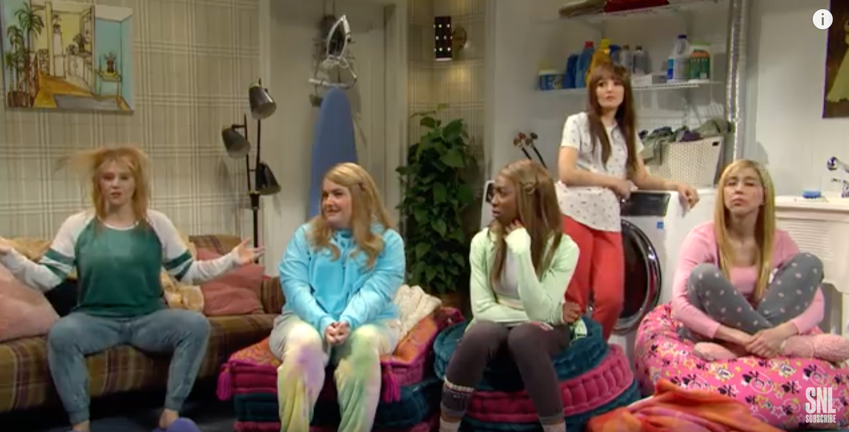
If one need evidence of the period’s destructive power still reigning resonant in pop culture, perhaps one need look no further than a recent SNL sketch with Adam Driver that aired in the first episode of 2020, in which a young girl’s trying to manage her period results in significant plumbing damage:

“Just tell the hot dad that your period broke his whole house.”

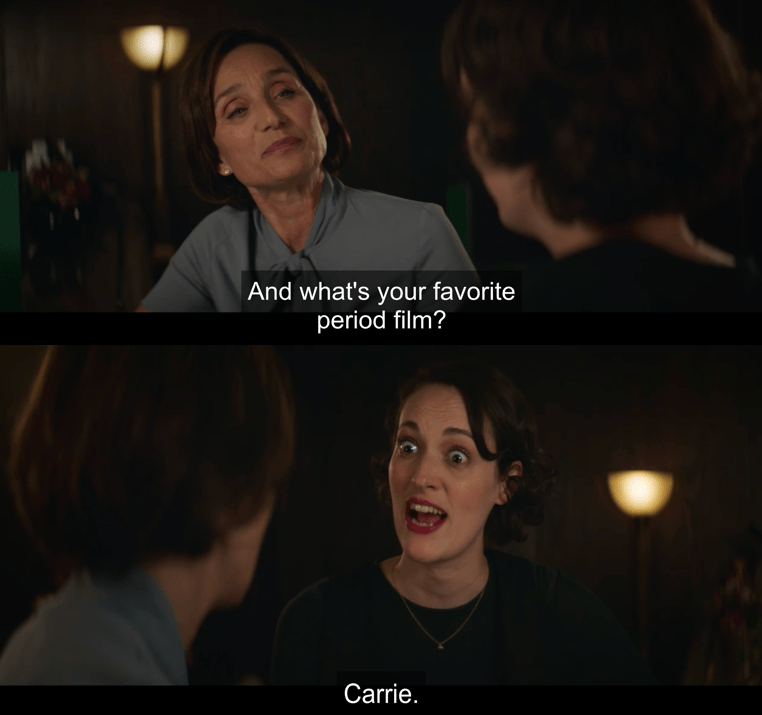
And if one wants period commentary that digs a little deeper, a scene from the stunning second season of Fleabag not only directly invokes Carrie:

but offers large-scale insights that deserve to be quoted in full:

“Women are born with pain built in. It’s our physical destiny: period pains, sore boobs, childbirth, you know. We carry it within ourselves throughout our lives, men don’t.

“They have to seek it out, they invent all these gods and demons and things just so they can feel guilty about things, which is something we do very well on our own. And then they create wars so they can feel things and touch each other and when there aren’t any wars they can play rugby.

“We have it all going on in here inside, we have pain on a cycle for years and years and years and then just when you feel you are making peace with it all, what happens? The menopause comes, the f***ing menopause comes, and it is the most wonderful f***ing thing in the world.

“And yes, your entire pelvic floor crumbles and you get f***ing hot and no one cares, but then you’re free, no longer a slave, no longer a machine with parts. You’re just a person.”

I guess we need look no further for the ultimate explanation of why King writes horror fiction filled with “demons and things”…

The Period in Carrie

It seems significant that the onset of Carrie’s menstrual cycle is the onset of the plot of the book on two fronts:

Both medical and psychological writers on the subject are in agreement that Carrie White’s exceptionally late and traumatic commencement of the menstrual cycle might well have provided the trigger for her latent talent.

There’s the period itself as trigger: Carrie is coming into her true powers at this moment because this is the moment at which she becomes a woman. But she might not have come to exercise her powers the way she does had this advent of womanhood not occurred in the traumatic fashion it does, a potential commentary that the onset of womanhood is always inherently traumatic, though this is potentially undermined by Ms. Desjardin’s attitude toward her first period:

A terrible and black foreknowledge grew in Rita Desjardin’s mind. It was incredible, could not be. She herself had begun menstruation shortly after her eleventh birthday and had gone to the head of the stairs to yell down excitedly: “Hey, Mum, I’m on the rag!”

Yet Carrie’s name itself seems to be potential commentary on that burden of womanhood further elaborated on so articulately in the Fleabag speech–she carries the burden of womanhood!

Carrie’s terror at what is happening in the locker room, her belief that she is dying, offers a defamiliarized look at the period that makes its horrific aspects all the more salient. It’s interesting that through the defamiliarized lens of Carrie’s ignorance, the period appears a harbinger of death rather than its opposite. This ties back into the horror of the domestic: the birth of the child = the death of the parent, in terms of personal identity.

The period symbolism potentially comes to a climax in the moments after Carrie’s death, in the final lines of Part Two:

[Sue’s] rapid breathing slowed, slowed, caught suddenly as if on a thorn—

And suddenly vented itself in one howling, cheated scream.

As she felt the slow course of dark menstrual blood down her thighs.

On the surface the description of this coursing blood itself reads as horrific. But if, as discussed previously, Sue’s possible pregnancy up to this point is the true horror, then her period coming here should actually be a relief (unless, now that Tommy’s dead, she wants his baby to remember him by, but this would be pure speculation because there’s no clear reference to indicate she might feel this way). Since King leaves the reader to make this connection, the horrific undertones surrounding the period in this climactic moment remain.

King’s descriptions of menstrual flow in moments like this one (and of Carrie in the opening shower scene) feel a bit off; if you must know and don’t already, blood does not come gushing down your thighs the moment you start your period. But I’m assuming that King’s wife would have told him this, so it seems almost intentional that he would have left these exaggerated descriptions in to serve more as symbolism and set a more ominous tone. When I think of the idea that dictates discussion in the pop-culture composition classes I teach at UH–that pop culture both reflects and shapes our world–Carrie seems to express anxiety over a power women inherently have that men expressly do not–the power to grow life. It’s also probably responsible for amplifying that anxiety through the decades; one way to look at the narrative (that may or may not be oversimplifying things) is that it’s just an exaggerated version of PMS, or PMS taken to its most extreme, “logical” conclusion: Carrie’s just a crazy cartoonish bitch on the rag.

I guess it’s open to debate whether this is an admirable acknowledgment of the true power women hold coiled within them, or just a bad joke. Certainly my analysis up to this point would seem to show the novel is more than just the latter. But I’m still having trouble discerning if the female rage this narrative expresses through the period is feminist or derogatory.

It is not insignificant that the figure who will become monstrous is herself initially the one who is horrified–Carrie thinks that bleeding from her vagina must mean she is dying. Then there are the disgusted reactions of her classmates and teacher; Ms. Desjardin remarks on it:

“I understand how those girls felt. The whole thing just made me want to take the girl and shake her. Maybe there’s some kind of instinct about menstruation that makes women want to snarl, I don’t know.”

That last remark feels a little on the nose, but fine. Part of the horror is simply being a woman, because women are inherently more cruel than men:

“It seemed like . . . oh, a big laugh. Girls can be cat-mean about that sort of thing, and boys don’t really understand. The boys would tease Carrie for a little while and then forget, but the girls . . . it went on and on and on and I can’t even remember where it started any more.”

Of course, a period is a starting point, the starting point of the life cycle. King has effectively written a scene of his own birth as a writer.

Now let’s talk more about the woman who gave birth to Carrie.

Margaret and the Serpent

In the initial background we get on Carrie’s mother, Margaret White, it’s noted that she might not even have known she was pregnant before she gave birth to Carrie:

We have records of at least three letters to a friend in Kenosha, Wisconsin, that seem to prove conclusively that Mrs. White believed, from her fifth month on, that she had “a cancer of the womanly parts” and would soon join her husband in heaven. . . .

As far as Carrie’s mother Margaret is concerned, her pregnancy might as well have been a cancer. Her religious beliefs are so extreme that she believes sex itself is a sin, even if the man and woman are married. By this “logic,” human life itself is an abomination. We see in one of Margaret’s rants that this “logic” seems to have derived from a slightly different interpretation of the biblical Garden of Eden story than most of us might be used to, the usual version being that Adam and Eve were banished from the garden for eating the fruit from the one tree God told them not to after the serpent tempted Eve with it. In this version, it’s generally interpreted to have been the woman’s fault (and not the serpent’s) for eating the fruit and getting Adam to eat it, and thus the woman’s fault that humankind lost paradise (hence gender inequality thence forward). Margaret’s version of the story is similar but slightly different:

“And Eve was weak and loosed the raven on the world,” Momma continued, “and the raven was called Sin, and the first Sin was Intercourse. And the Lord visited Eve with a Curse, and the Curse was the Curse of Blood. And Adam and Eve were driven out of the Garden and into the World and Eve found that her belly had grown big with child.”

The first sin is usually interpreted as eating the fruit that was forbidden, not intercourse itself. Margaret recasts Eve’s period and pregnancy as a punishment. In the dozens of times we went over this story in my twelve years of Catholic schooling, this was not an interpretation I was ever presented with. We Catholic students were taught that sex was sacred precisely because it was a gateway to life (and that blocking that gateway with things like birth control was a sin precisely because of its potential interference with life, by which “logic” one might then argue that not having sex at any given point is a sin because it’s interfering with the potential production of life…). At any rate, this is what Margaret tells Carrie when Carrie first comes home with her period saying it’s “not her fault.”

Margaret returns to the topic much later in the book when she and Carrie have their climactic final confrontation, explaining that she became pregnant with Carrie after Carrie’s father raped her:

“At first it was all right. We lived sinlessly. We slept in the same bed, belly to belly sometimes, and o, I could feel the presence of the Serpent, but we. never. did. until.”

This is an intriguing passage to me due to its invocation of the Serpent. From the physical description, there’s no getting around that Margaret is saying she can feel his erection as they sleep facing each other, that that’s what the Serpent physically symbolizes here, but of course it’s still the snake from the Garden of Eden that tempts Eve. In this passage then, the erect penis becomes the temptation, and the source of danger. In a way, then, this is a passage that implicitly places the blame for the fall of man back on…the man.

The book opens with a short article about the time stones rained down on the White house when Carrie was three, and it’s not too long before this incident is elaborated on in more detail in a magazine interview with Carrie’s former next-door neighbor. This neighbor was a teenager at the time and liked to sunbathe in a bathing suit in the yard, which upset Carrie’s mother. One day her bathing suit top slipped off when she was sleeping, leading Carrie to ask about her breasts:

So I fixed it and said, ‘Those are my breasts, Carrie.’

Then she said—very solemnly: ‘I wish I had some.’

I said: ‘You have to wait, Carrie. You won’t start to get them for another . . . oh, eight or nine years.’

‘No, I won’t,’ she said. ‘Momma says good girls don’t.’ She looked strange for a little girl, half sad and half self-righteous.

I could hardly believe it, and the first thing that popped into my mind also popped right out my mouth. I said: ‘Well, I’m a good girl. And doesn’t your mother have breasts?’

She lowered her head and said something so softly I couldn’t hear it. When I asked her to repeat it, she looked at me defiantly and said that her momma had been bad when she made her and that was why she had them. She called them dirtypillows, as if it was all one word.

It’s interesting that this idea of divine punishment that Margaret has conceived (so to speak) will likely register as ridiculous and extreme to the reader, yet the structure of the book itself is in fact a model of retribution–Carrie’s.

Margaret figures that her sin of Intercourse is responsible for the abomination of Carrie’s being a witch–“Thou shalt not suffer a witch to live” is her justification for attempting to murder her own daughter because that daughter decided to go to a school dance. In Margaret’s estimation, sex is truly what is horrifying, though this is complicated by the fact that she claims to have enjoyed being raped. Through 2020 hindsight lenses, this is a little problematic.

The Historical Period

Moving on to less literal interpretations of the period, we might discuss how the larger historical period of the 1970s is reflected via the text of Carrie. I can’t really pinpoint why King decided to set the book a few years ahead of the time he was actually writing it (the book was published in 1974, but in it Prom Night occurs in 1979). I noted in my first post that the Vietnam references in Carrie pale in comparison to those that will populate Salem’s Lot, and have already unpacked the JFK references. Now I’m interested in the racial references.

One of the seminal academic texts about the treatment of race–particularly of African Americans–in western literature is Toni Morrison’s Playing in the Dark: Whiteness and the Literary Imagination (1992). In it, Morrison asks:

When does racial “unconsciousness” or awareness of race enrich interpretive language, and when does it impoverish it?

p. xii

Our American literary landscape is rife with texts that treat race “unconsciously,” which is certainly interesting to note in light of King’s recurring themes about the horrors that stem from our unconscious–his treatment of “psychological” horror. Morrison tracks instances of blackness in literature figured as a “dark, abiding, signing Africanist presence” that the “major and championed characteristics of our national literature–individualism, masculinity, social engagement versus historical isolation; acute and ambiguous moral problematics; the thematics of innocence coupled with an obsession with figurations of death and hell” (p. 5) exist in response to. This is a classic example of texts reflecting cultural attitudes in an unconscious (which is to say, unintentional) way. The Africanist presence exists in the marginal shadows of the white mainstream that has dominated literature–the Africanist presence is the white mainstream’s shadow self, implicitly a site of horror that whiteness can define itself in relation to.

So where can we detect the Africanist presence in Carrie?

There are a handful of references in the text that gesture toward this presence. The n-word that would seem to be the most overt signifier of outright racism appears one time, in the passage where Sue projects her domestic horrors most patently:

The word she was avoiding was expressed To Conform, in the infinitive, and it conjured up miserable images of hair in rollers, long afternoons in front of the ironing board in front of the soap operas while hubby was off busting heavies in an anonymous Office; of joining the P.T.A. and then the country club when their income moved into five figures; of pills in circular yellow cases without number to insure against having to move out of the misses’ sizes before it became absolutely necessary and against the intrusion of repulsive little strangers who shat in their pants and screamed for help at two in the morning; of fighting with desperate decorum to keep the n*****s out of Kleen Korners, standing shoulder to shoulder with Terri Smith (Miss Potato Blossom of 1975) and Vicki Jones (Vice President of the Women’s League), armed with signs and petitions and sweet, slightly desperate smiles.

I’ve censored the text here; the actual word does appear in the original. (We can have a debate about literary censorship; this is the only word I personally have been moved to censor in disseminating texts, whether in blog form or to students.) I don’t know what “Kleen Korners” is referring to, but it’s referenced a couple of other times, always in relation to the country club; a questionable google result claims it’s a kind of mop, which would make the reference figurative. This is a passage filtered through Sue’s disdain for the domestic, which makes it more of a commentary on the town’s racism that Sue, and via her King, is making, rather than engaging in herself–she does not want to be subsumed into the town’s values, including its casual racism. The casual racism seems here, in fact, to be part of what’s so horrific about the small-town lifestyle. Here King seems to be potentially acknowledging the marginalizing of the Africanist presence rather than engaging in that marginalizing himself.

But other racial references in the text do not seem to be made with such deliberate commentary, though it might be hard to tell:

When I was a little girl I had a Walt Disney storybook called Song of the South, and it had that Uncle Remus story about the tarbaby in it. There was a picture of the tarbaby sitting in the middle of the road, looking like one of those old-time Negro minstrels with the blackface and great big white eyes. When Carrie opened her eyes it was like that. They were the only part of her that wasn’t completely red.

This passage is from a memoir by Prom Night survivor Norma Watson. What makes the racial aspect more difficult to parse is its placement in an epistolary snippet rather than a direct scene. One could say this is Norma’s casual racism, not King’s, and that King is merely representing it (in a more conscious way than might be delineated by the term “reflecting” it). The passage then also potentially comments on how Norma’s casual racism is a product of the culture’s in a way that shows how pop culture texts can disseminate such problematic attitudes–thanks, Walt Disney! It’s interesting that Norma’s invocation of this Disney text is to explain why everyone was laughing at Carrie in the moments after the blood dumped: the tarbaby is figured as a source of humor, a joke. Its connection to Carrie, then, provides potential further commentary in that the other students’ laughing at Carrie prompts her bloody retribution, is, in a way, responsible for it. And if it’s responsible for it, then it’s potentially being pinpointed as problematic. Hence the humorous positioning of the tarbaby could be figured as more consciously than unconsciously problematic–again meaning that King is deliberately commenting on racism being problematic rather than problematically engaging in that racism himself. And yet, Carrie’s face in the moments after the blood dumps is a defining image in the text, and reaching for an image encapsulating both the humorous and the horrific and finding a “tarbaby” is a problem. The most damning evidence that it’s a problem for the author, and not just the character, would be this subsequent minstrel reference:

They came in pajamas and curlers (Mrs. Dawson, she of the now-deceased son who had been a very funny fellow, came in a mudpack as if dressed for a minstrel show); they came to see what happened to their town, to see if it was indeed lying burned and bleeding. Many of them also came to die.

We get this in a direct scene, and not only in a direct scene but in an omniscient voice in the scene rather than through a specific character’s point of view, which means this can’t be written off as showcasing small-mindedness rather than actively engaging in it. Why does a cosmetic mud mask need to be compared to blackface (even if it’s in parentheses)? The comparison seems to speak to casual cultural prejudices ingrained in King more than anything else, as does this line:

“Would you take me with you?” [Chris] asked. She looked at him from the floor, her lip puffed to negroid size, her eyes pleading.

This passage is also from a direct scene, but in it we’re squarely located in Billy’s point of view rather than in an omniscient description. This potentially means this description could be written off as Billy’s small-mindedness, but that problematic description in the omniscient point of view potentially undermines this, as it does with more charitable readings of the other instances of well, like the Disney one. King’s offhandedly using blackface as a point of reference makes me think he probably wasn’t calling out Disney’s negative influence on the culture, but that King’s description (and not just Norma’s) was rather a symptom of this negative influence.

The description of Chris’s lip is the last reference to an Africanist presence I can find, but while we’re on Chris and Billy, it’s worth noting the dynamic the above passage and its implicit racism is a part of depicting: they’re fighting over whether the buckets with the pigs’ blood can be traced back to them, and Billy has slapped Chris because she’s freaking out. Chris, in turn, is “pleading” for Billy to take her with him to California immediately after he’s used violence on her. Violence being a significant element of their sexual attraction has been well established in their previous interactions, and Billy’s titillation has more than clearly escalated in response to assaulting Carrie:

When this was over he was going to have [Chris] until every other time she’d been had was like two pumps with a fag’s little finger. He was going on her like a raw cob through butter.

(The homophobia in this passage could arguably be attributed to Billy, not King, but we’ll see a more stringent and questionable thread of homophobia emerge in ‘Salem’s Lot.)

The sexual violence between Chris and Billy is an interesting subplot in relation to other aspects of the book, specifically Carrie’s powers and Margaret White’s attitude toward sex. It’s also interesting through the post-MeToo lens of the year 2020, as their relations smear the boundaries of consent:

If she had not given in willingly on Monday, he would have taken her by force.

Chris’s attraction to Billy starts to appear to exist due to his violence toward her rather than existing in spite of it. A scene that depicts the complexities of this attraction while potentially crossing the line into gratuitous titillation for titillation’s sake encapsulates the combination of highbrow and low that’s really quintessential King: while Billy’s driving them in his car the tire blows out and Chris thinks they’re going to die in an accident; when they don’t and she gets mad at him afterward, he orders her around to help him fix the tire, which she initially resists but then gives in to, a dynamic of submission and desire realized in the sex they have immediately afterward that’s exacerbated by her near-death experience and symbolized by the grease that gets smeared all over her expensive clothes. (As it happens, the only specific thing I remember from my first read of the book as a teenager was when Billy “groped greedily.”) Chris’s attraction to Billy is also interesting in light of her father the lawyer, he who tries to bully the principal through nonphysical means. Billy’s delinquency and raw potential for violence is what patently distinguishes him from Chris’s other lovers, another conflation of violence with sex that’s all over the book (and likely King’s work in general).

Some might argue over whether Chris’s attitudes are a reflection of 1970s misogyny ingrained in the author or a more complex expression of female subjectivity. I’d say Chris’s character reflects the shallow attitudes of the time in a way that tries to call attention to their being problematic more than expressing them in an actively problematic way, though King is not above using a character for both meaningful commentary and shock value/the aforementioned gratuitous titillation. It’s the combo that makes him the King, and when he claims his work is the “Big Mac” of the literary landscape, as he did once in a 60 Minutes interview, I like to think it’s this combo element he’s implicitly invoking. But the fact that King has basically positioned Carrie’s subjectivity at the center of the narrative would seem to support more complex readings of his representations of femalehood, and make his Big Mac comment a self-deprecating underestimation of his own work potentially surprising for its being uttered by a white male….

There’s an especially interesting passage where the conflation of sex and violence seems most explicit, describing Sue’s feeling in her climactic confrontation with Carrie when Carrie uses her telepathy to access Sue’s interior:

The feverish feeling of being raped in her most secret corridors began to fade.

While rape has reared its ugly head in not just one but two relationships in the novel (Chris and Billy; Margaret and Ralph), this passage is the only time the word itself appears in the book–in a figurative rather than literal description. This passage is actually describing Carrie retracting her telepathic powers out of Sue’s mind, which she does immediately after she’s gleaned the most relevant information from Sue’s psyche:

But no ill will for Carrie personally, no plan to get her in front of everyone and undo her.

Carrie may or may not realize here that a lot of the destruction she’s wrought this night might have been unwarranted; regardless, the likening of telepathically reading someone to a sexual violation seems a critical link to an allegorical reading of how the horrors of the fantastical express the horrors of the real, and sexual violence is irrevocably linked to the two primary causes of Carrie’s destruction–Carrie’s literal birth and the procurers of the pigs’ blood. Also, the violation of secrecy that telepathy entails as invoked in the rape passage connects back to the period themes:

Someone began to laugh, a solitary, affrighted hyena sound, and she did open her eyes, opened them to see who it was and it was true, the final nightmare, she was red and dripping with it, they had drenched her in the very secretness of blood, in front of all of them and her thought

(oh . . . i . . . COVERED . . . with it)

was colored a ghastly purple with her revulsion and her shame. She could smell herself and it was the stink of blood, the awful wet, coppery smell.

We can connect this back to the first minstrel passage, that defining image looking externally at Carrie opening her eyes–here we’re re-experiencing that moment, but from Carrie’s perspective, returned to her female subjectivity. This return might redeem some potential misogyny, but does nothing to address or mitigate the racism of the tarbaby image. Instead, we’re getting more complex associations with shame and the period figured in the act of pig’s blood being dumped on Carrie, an act that, according to Carrie’s take on it in the wording of this passage, externalizes and advertises something women should be ashamed of. I previously commented on the symmetry of the narrative (which the narrative itself points out) in starting with Carrie getting her period in the shower and ending with showering her in blood; Billy wasn’t able to get buckets full of period blood, but, as he keeps subtly chuckling to himself (“Pig blood for a pig”), he got the next best thing. The pig is woman and woman is pig… But it’s the symmetry of the horror that amplifies and associates that horror specifically with the period (which is to thus symbolically associate it with womanhood itself)–it’s nightmarish enough to start your period in a public place, made more so if you don’t have a clue what this blood between your legs actually is, and the blood shower in front of the entire school is that original nightmare wrought extreme: “drenched…in the very secretness of blood.” The period has symbolically been rendered an on-stage spectacle with associations that don’t seem especially positive. But then: Carrie enacts bloody revenge (blood for blood; Billy ought to like that), with the power she holds in her mind. Described this way, Carrie suddenly sounds like an allegory for righteous female vengeance against the patriarchy that has made women ashamed of the very menstrual cycles that are responsible for the literal existence of every patriarchy member (so to speak).

So, it’s complicated.

To circle back to the setting of the figurative telepathic rape–a roadhouse parking lot–also connects back to the literal idea of rape, since the “roadhouse” is an integral element of Margaret White’s attitude toward sex:

The Something was dangerous, ancient, unutterably evil. It could make you Feeble. Watch, Momma said. It comes at night. It will make you think of the evil that goes on in parking lots and roadhouses.

and Margaret prays:

“—protect us from he with the split foot who waits in the alleys and in the parking lots of roadhouses, O Saviour—”

It’s revealed that Margaret’s parents owned a roadhouse, which, combined with the fact that this is apparently the reason her father died, would seem to be the source of Margaret’s tracing the sinful origin point of sexual desire back to this precise location:

Her parents were fairly well-to-do; they owned a prosperous night spot just outside the Motton town limits called The Jolly Roadhouse. Margaret’s father, John Brigham, was killed in a barroom shooting incident in the summer of 1959.

The roadhouse being the source of her father’s death is also significant because this death leaves Margaret’s mother available to take up with another man. One might postulate/psychoanalyze from the clues King drops that it’s Margaret’s inability to cope with this familial intruder that leads her to channel her complex emotions into a righteous religious indignation that reaches the beyond-fundamentalist extreme level of believing that sex and thus life itself is a sin: Margaret essentially comes to believe her own existence should be cancelled out.

Self-loathing, much?

It is thus not insignificant that Chris and Billy abscond to a roadhouse after dumping the blood on Carrie, or that Carrie dies in the parking lot of a roadhouse that she’s specifically heading toward for the sake of her mother:

It was three miles out to The Cavalier, even cross country, as Carrie was going. …

It was really amazing that she kept going. But of course it was for Momma. Momma wanted her to be the Angel’s Fiery Sword, to destroy—

If we can glean how Margaret’s extreme beliefs are twisted projections of Freudian familial fallout, here we’re definitely seeing the twists and turns tangling Carrie’s maternal influence: here she is still wanting to please the woman who just tried to kill her–the woman who’s essentially been trying to kill her her entire life, and who’s essentially responsible for the carnage Carrie wreaks on the town if we want to play the blame game (which novels/narratives are more or less always playing, to varying degrees of complexity), based on this passage that seems to trace the origin point of Carrie’s alienation to the religious influence of her mother:

She had defied Momma in a hundred little ways, had tried to erase the red-plague circle that had been drawn around her from the first day she had left the controlled environment of the small house on Carlin Street and had walked up to the Barker Street Grammar School with her Bible under her arm. She could still remember that day, the stares, and the sudden, awful silence when she had gotten down on her knees before lunch in the school cafeteria—the laughter had begun on that day and had echoed up through the years.

The red-plague circle was like blood itself—you could scrub and scrub and scrub and still it would be there, not erased, not clean.

This invocation of blood-as-marker–aside from being reminiscent of Lady Macbeth–reads with certain shall-we-say negative connotations that complicate readings of the novel’s treatment of the period. Blood as unclean, blood as signifier of death rather than life. Blood as the trigger of destruction, both in the onset of Carrie’s menstrual cycle heralding the true advent of her powers and in the dumping of pig’s blood being the trigger for her using those powers to consciously enact a massacre. Blood as secret and not-so-secret shame.

As we can see (by my massive segue away from the initial Africanist presence discussion if nothing else), female subjectivity is explored in depth here while the Africanist presence is not just a shadow, but a shadow of a shadow: there are not even actual characters on the margin representing this presence; instead the presence is only invoked in absentia for the sake of (white) comparisons on three separate occasions (one in parentheses), with a fourth reference that still does not invoke a specific individual character.

It will be interesting to see if/how/when the Africanist presence becomes less shadowy in King’s work with time (and to revisit his appearance on The Chappelle Show during which he seems to reveal his general racial cluelessness), though it is worth noting just how shadowy it is at the outset in the work of a white man who came of age in the 1960s. I’m not by any means calling King a racist, but in the vein of Toni Morrison trying to highlight how the text reflects the author’s internalized worldview of this presence–how the author figures this presence unconsciously.

Thinking about representations of marginalized groups in literature is also interesting in light of the publishing industry’s most recent controversy surrounding Jeanine Cummins’ American Dirt published earlier this year, a much-hyped novel that King hailed as “an extraordinary piece of work” (and we all know what an endorsement from Stephen King can do). Here a white writer has represented Latinx characters rather than relegating them to the shadowy margins, and that representation has been called into question by the people represented. (You can read more about the backlash and the backlash against the backlash here.) The main takeaway seems to be that white people are still largely clueless about such issues, and if King’s blurb is any indication, so is he.

-SCR

Here We Go: Carrie

“All right. What happened?”

…. “Nobody knows, not yet.”

Stephen King. “Carrie.” iBooks.

Carrie, Stephen King’s first novel, was published in 1974. The book juxtaposes epistolary snippets from newspapers, books, and even graffiti scrawled about Carrie White on classroom desks with direct scenes of the titular character and those surrounding her who will play pivotal roles in her taking revenge on the small town of Chamberlain, Maine, where Carrie has always been treated as an outcast.

The book is divided into three parts. Part One, “Blood Sport,” opens with a newspaper story about stones raining down on Margaret White’s house when her daughter Carrie was three. We then go into a direct scene of a morning when Carrie, now a high-school senior, is showering in the locker room after gym class when, unbeknownst to her, she gets her period for the first time. Having never been informed about this standard occurrence by her mother, Carrie believes the blood means she is dying and freaks out while her fellow classmates jeer and throw tampons at her. As Carrie is distressed, weird things happen like a light fixture popping and an ashtray flipping off the principal’s desk when he dismisses her for the day. On her walk home, Carrie notes that the muscle in her brain she can use to move things sometimes seems to be getting stronger. When she then confronts her zealously religious mother for never informing her about periods, her mother says that the blood is a mark of sin, and she locks Carrie in the prayer closet for hours.

Meanwhile, one of the girls in the locker room during the incident, Sue Snell, confides to her popular boyfriend Tommy that she feels bad about what happened. The sentiment is not shared by another girl involved, Chris Hargensen, who refuses to participate in the gym teacher Ms. Desjardin’s detentions for the incident and is thus banned from attending the prom (or Spring Ball). Sue asks Tommy to take Carrie to the prom as her own penance, and he agrees; he has some trouble convincing Carrie he really wants to take her, but she eventually agrees. Discovering Tommy and Carrie’s names on the ballots for Ball King and Queen, Chris enlists her delinquent boyfriend Billy to procure some pig’s blood, which he does with his delinquent group of friends.

In Part Two, “Prom Night,” Carrie’s mother of course does not want her to go to the prom and is enraged Carrie’s sewn a sinful red dress for the occasion, but Carrie goes (after enduring some anxiety that Tommy will not actually show up). She enjoys herself at first, until she and Tommy are called up on stage after being voted King and Queen, and Billy and Chris unleash the buckets of pig blood Billy’s rigged above the stage, dousing Carrie and knocking Tommy out with a falling pail. A bit later, Sue, at home, notices that the school she can see through her kitchen window from a distance is on fire. We learn through other accounts that somehow in the gym the doors shut and locked themselves, trapping the majority of the students inside while the fire-sprinkler system starts deploying. Carrie is later seen walking around town starting fires and disabling the fire hydrants that might put them out.

We circle back to Carrie’s point of view of what happened when the blood dropped, seeing that she mentally shut the gym doors and started the sprinklers in response to her classmates’ laughter. After leaving, she stops at a church to pray (but fails to sense God) before heading home to confront her mother, who confesses that when Carrie’s father raped her, she liked it, before stabbing Carrie in the shoulder. Carrie is still able to kill her by using her telekinesis to stop her mother’s heart, then leaves. When Billy and Chris pass by her driving and Billy tries to run her over, Carrie flips their car and kills them, then collapses in a parking lot. Sue is able to find her by tapping into the psychic energy Carrie’s exuding that everyone seems to notice, and when Sue finds her, they communicate telepathically so that Sue is able to feel what it’s like to be teased and tortured like Carrie, and Carrie sees that Sue didn’t plan on Tommy taking her to the prom as a trick. Sue feels Carrie die.

In Part Three, “Wreckage,” we see the mass funerals and debates in the books about the incident and what to make of it, including the official investigative body’s conclusion that there’s “no reason to believe that a recurrence is likely or even possible” before we get a final letter from a woman describing her child clearly exhibiting telekinetic powers. The End.

The narrative of Carrie might be more familiar to people from Brian DePalma’s movie adaptation in 1976 that launched the career of Sissy Spacek (who, to my joy, narrated my audiobook version of the novel), but the film omits some of the critical elements that give the book a lot more depth. The first is the epistolary snippets. These provide more context about the before and after of the novel’s present timeline–things like Carrie having had at least one major telekinetic incident in the past with the raining stones, and, perhaps more importantly, an attempt by others, including those directly involved like Sue but mainly those only made aware of it after the fact, like politicians and scientists, to reckon with what has happened. The movie narrows its focus on the effects of what happened to just Sue, ignoring the possibility of national awareness about the incident. But by threading this larger awareness into the novel, King achieves a few things the film doesn’t. The first is suspense: these snippets provide direct hints very early on that a major incident involving a lot of death is going to happen because of Carrie. The second is a more meaningful cultural commentary than the film manages to make by refusing to look outside the present timeline. And finally, one could also argue that in representing the larger reverberations of this incident and the existence of telekinesis as supposed scientific fact, Carrie is the entry portal into the King extended universe.

Suspense

King actually tells us a few things outright early on. On the second page (of the ebook at least), we’re told:

What none of them knew, of course, was that Carrie White was telekinetic.

And the mere existence of epistolary snippets from books analyzing Carrie and an apparent tragedy she’s related to provides a hook that pulls the reader in. This is a hook that writers deploy frequently but when described seems counterintuitive: you’re basically giving away the end at the beginning. But even if the specifics of a high death toll are revealed, the reader’s interest is piqued by this knowledge rather than coming to the conclusion that the book has become pointless to read if we already know the end. We might know what happens–loosely–but now we want to know how it happens. And now the drama behind potentially low-stakes developments like who is or is not going to be able to go to a high-school dance is intensified, because we implicitly understand that these developments are pivotal to the development of a massacre.

King’s references to the tragedy the arc is building toward are somewhat vague at first but become more pointed in an escalation of their own. Very early on we get from one of the snippets of a book written about the incident:

The great tragedy is that we are now all Monday-morning quarterbacks . . .

Not long after that another one of the book snippet’s mentions:

One of her surviving classmates, Ruth Gogan…

A bit later, when we start getting excerpts from Sue’s memoir, she gives us a more specific estimate of the death toll that’s coming:

In the wake of two hundred deaths and the destruction of an entire town, it is so easy to forget one thing: We were kids.

One thing to note about this final passage is the double duty it’s doing: it reveals a suspenseful scale of upcoming destruction, but that scale is used as a springboard to characterize Sue and her attitude about what happened, not to mention that Sue, via the existence of her memoir, is also revealed to have survived.

Related to suspense is the novel’s structure: we start with a scene of Carrie getting her period in a shower. We build to a climax (or near-climax) of blood being dumped on her, in response to which she thinks (among other things):

They had finally given her the shower they wanted.

Something the pacing starts to do in the second part is circle back to describe the same incident through different points of view, specifically witnesses’ experiences of what happened juxtaposed with Carrie’s experience, a tactic that works to draw out the suspense of this extended action sequence and provide natural breaks that increase the tension. These competing accounts also complicate the dichotomy of monster versus victim.

Essentially there are two threads running through the rising action in the epistolary snippets and the direct scenes, and these build to a nice concurrent climax in the Carrie-Sue exchange when Sue’s contentious interview with the White Commission is juxtaposed with what “really” happened between her and Carrie. The film’s adaptation of the rising action’s penultimate and ultimate events also demonstrates a critical distinction between novels and film in how novels can depict action in the mind in a way films can’t. Hence, we have the climax of the film being when Carrie kills her mother by telekinetically hurling sharp objects at her, something that’s much easier to represent visually on a screen than Carrie’s visualizing her mother’s heart to bring it to a stop (an action that resonates more with themes of parental love and responsibility). Then immediately after Carrie kills her mother in the movie, the house implodes. I wasn’t sure if this was supposed to be a product of Carrie’s own psychic tumult in the wake of her matricide, but I do know that it was not as satisfying to me as the psychic exchange between Sue and Carrie in the novel’s climax, which in a way feels almost sexual as each feels what it’s like to be the other–two become one. This climax is also a potentially implicit commentary on the type of access that fiction-writing itself offers–direct access to someone else’s head, to what it feels like to be somebody else. And the film adaptation’s doing away with this element of the climax altogether seems–to this fiction writer at least–like an implicit admission of films’ inability to do what novels can.

Cultural Commentary

The movie, as mentioned, dispenses almost entirely with any reckoning with the aftermath of the tragedy, but this is in large part where the novel is able to derive its relevant commentary, perhaps most acutely via the primary investigative body dubbed the “White Commission,” an almost too on-the-nose label reminiscent of the real-life Warren Commission that investigated the assassination of JFK. If there was any doubt of the connection, one of the book snippets notes:

Morton Cratzchbarken, in an admittedly sensationalized address to The National Colloquium on Psychic Phenomena last year, said that the two most stunning events of the twentieth century have been the assassination of John F. Kennedy in 1963 and the destruction that came to Chamberlain, Maine, in May of 1979.

It’s also interesting that Carrie, published in 1974, is set a few years in the future, but in drafting it King himself would have been less than a decade out from JFK’s death. So what commentary is he making, exactly, with this likeness? What we see in snippets from the White Commission’s interviews, most climactically in its interview with Sue, is an unwillingness to listen to what the witnesses have to tell them–they seem to want to ignore the collective testimony serving as evidence for Carrie’s telekinesis and telepathy alike. Sue notes before we actually see her (post-)climactic interview with the Commission that they used her as a “handy scapegoat,” language that might call to mind a possible likeness to JFK-assassin Lee Harvey Oswald. But not long after Sue makes this claim, the passage cited above continues:

Cratzchbarken points out that both events were driven home to the citizenry by mass media, and both events have almost shouted the frightening fact that, while something had ended, something else had been irrevocably set in motion, for good or ill. If the comparison can be made, then Thomas Ross played the part of a Lee Harvey Oswald—trigger man in a catastrophe. The question that still remains is: Did he do so wittingly or unwittingly?

Here we’re seeing another element the epistolary structure introduces (lost in the film translation): the divide between what really happened and what people think happened. If the novel were purely epistolary, we’d have competing accounts that we’d be left on our own to make sense of, meaning we wouldn’t know an objective “truth” about what happened. But by intercutting these accounts with direct scenes of what happened that include access to different characters’ actual thoughts (and not just what they tell others), the reader is provided the objective truth of what “really” happened, which we’re then able to compare to the version of events recounted by others. This means that we do know the answer to the question posed by the passage above of whether Tommy is a witting or unwitting “trigger man”–he is patently unwitting. Anyone looking at the events from outside can’t be sure whether Tommy and Sue set Carrie up as a joke intentionally, but the reader knows definitively that their motives were pure, which heightens the tragedy. But if Tommy (and/or Sue) is an Oswald figure, then there’s potential commentary that our culture’s historical conception of Oswald as “witting” trigger man is fallible. By showing us how potentially off-base the White Commission’s interpretation of events is, King seems to be showing us that such investigatory bodies by their inherent nature not only cannot offer us a full picture of what “really” happened, but will actively obscure it.

And even if isolation could be made successful, would the American people allow a small pretty girl-child to be ripped away from her parents at the first sign of puberty to be locked in a bank vault for the rest of her life? I doubt it. Especially when the White Commission has worked so hard to convince the public that the nightmare in Chamberlain was a complete fluke.

Indeed, we seem to have returned to Square One . . .

If Sue is the Oswald figure, she is left having to reckon with the massively negative fallout that resulted from what she’d intended to be a good deed. This could be potential commentary on our country’s foreign policy–we think we know best, so we go meddle with some other country’s affairs and leadership (in Guatemala, Chile, El Salvador…the list goes on)–but then it turns out to have consequences we were unable to foresee (migrant caravans, anyone?). The CIA, our country’s potential shadow self, orchestrated the assassination of many others’ country’s leaders, so even if they aren’t directly responsible for JFK’s death, they are in many ways responsible indirectly. Even if Lee Harvey Oswald was the trigger man, the larger animosity between nations that the trail of a bullet between two individual men represented is still the product of our government’s actions that make JFK’s shooting much more than a mere “fluke.” King seems to be pointing out the dangers of ignoring such implications:

In conclusion, I would like to point out the grave risk authorities are taking by burying the Carrie White affair under the bureaucratic mat—and I am speaking specifically of the so-called White Commission. The desire among politicians to regard TK as a once-in-a-lifetime phenomenon seems very strong, and while this may be understandable it is not acceptable. The possibility of a recurrence, genetically speaking, is 99 per cent. It’s time we planned now for what may be. . . .

The White Commission’s problematic conclusion ends up being the penultimate statement of the novel:

. . . and so we must conclude that, while an autopsy performed on the subject indicates some cellular changes which may indicate the presence of some paranormal power, we find no reason to believe that a recurrence is likely or even possible . . .

The final piece of Carrie‘s epistolary puzzle, snapped into place immediately after this conclusion, is a letter in which a woman describes seeing her young daughter exhibiting telekinetic powers. This juxtaposition would seem to make a fairly clear–and foreboding–statement about the fallibility of the White Commission’s conclusion. The evidence is right in front of their faces, and yet they ignore it. This would seem to be another critical element of how King injects “real-life” horror into his fantastical scenarios.

I’d posit that King’s ability to inject “real-life” horror into such scenarios is potentially one of his defining features and a major element of his success. Carrie’s powers aren’t the truly horrifying thing here, but rather the combination of circumstances that give rise to her deploying them in such a horrifying way. These factors are the religious oppression of her mother and the mockery of her classmates, the latter seeming to stem directly from the former. But it’s definitely worth noting, if risking stating the obvious, that these factors are both things that could occur in the “real” world, and through this lens this narrative seems a harbinger of the modern-day school shooter: a high-school student who is alienated due to relentless mocking uses the potentially destructive powers at her disposal to take revenge on a mass scale (the death toll mentioned at the end is 400+ and counting). In this reading, Carrie’s powers become the equivalent of the modern ease of access to the AK-47, foreshadowing a trend of predominantly teenaged retribution in school hallways that won’t be fully realized in the culture for another two decades.

Related to these themes of alienated teens and the country’s dicey foreign policy in the seventies, Carrie is not pocked by as many references to what was likely the most salient and horrific political flashpoint of the time, the Vietnam War, as its followup Salem’s Lot will be. But Carrie‘s image of the bodies for a collective mass funeral of high school students seems to be commenting on the senseless carnage of youth in Vietnam:

They were buried on June 1 and 2 in three mass ceremonies. A memorial service was held on June 3 in the town square. It was the most moving ceremony that this reporter has ever witnessed. Attendance was in the thousands, and the entire assemblage was still as the school band, stripped from fifty-six to a bare forty, played the school song and taps.

If the horror of Vietnam is a mere trickle of an undercurrent in Carrie, the horror of the potential mundanity of domesticity is closer to a riptide–sneaky and powerful enough to suck you under and carry you away. Take Sue’s consideration of her potential future:

The word she was avoiding was expressed To Conform, in the infinitive, and it conjured up miserable images of hair in rollers, long afternoons in front of the ironing board in front of the soap operas while hubby was off busting heavies in an anonymous Office; of joining the P.T.A. and then the country club when their income moved into five figures; of pills in circular yellow cases without number to insure against having to move out of the misses’ sizes before it became absolutely necessary and against the intrusion of repulsive little strangers who shat in their pants and screamed for help at two in the morning; of fighting with desperate decorum to keep the n*****s out of Kleen Korners, standing shoulder to shoulder with Terri Smith (Miss Potato Blossom of 1975) and Vicki Jones (Vice President of the Women’s League), armed with signs and petitions and sweet, slightly desperate smiles.

After we momentarily marvel at the datedness of an income aspiring to “five figures” (and return to the casual racism in a future post), let’s note Tommy’s teasing response to Sue’s ennui:

“I’ll probably end up working at my dad’s car lot,” he said. “I’ll spend my Friday and Saturday nights down at Uncle Billy’s or out at The Cavalier drinking beer and talking about the Saturday afternoon I got that fat pitch from Saunders and we upset Dorchester. Get married to some nagging broad and always own last year’s model, vote Democrat—”

“Don’t,” she said, her mouth suddenly full of a dark, sweet horror. She pulled him to her. “Love me. My head is so bad tonight. Love me. Love me.”

Interestingly, Sue’s response to these visions of domestic horror is to want Tommy to have sex with her; also interestingly, this will be the first time the sex is actually good for her. Later, the possibility that Sue is pregnant is briefly noted:

Her period was late. Almost a week late. And she had always been as regular as an almanac.

I didn’t notice any followup references to this, but it comes very close to the climactic dumping of the pig’s blood, seeming to underscore its potential horror.

Sue’s horror of domesticity seems to serve as reinforcement for Carrie’s domestic conundrum and how her going to the prom with Tommy comes to represent the one possibility for escape she has:

And if he didn’t come, if she drew back and gave up? High school would be over in a month. Then what? A creeping, subterranean existence in this house, supported by Momma, watching game shows and soap operas all day on television at Mrs. Garrison’s house when she had Carrie In To Visit (Mrs. Garrison was eighty-six), walking down to the Center to get a malted after supper at the Kelly Fruit when it was deserted, getting fatter, losing hope, losing even the power to think?

No. Oh dear God, please no.

(please let it be a happy ending)

This passage complicates how to read the ending that we do get. Carrie’s apparently subconscious–to judge from the parentheses–clinging to the idea of a happy ending shows to an extent how she’s been conditioned by the culture despite the restrictions of her upbringing, and it certainly humanizes someone about to engage in a monstrous spree of destruction–which is more or less the novel’s entire project. It also invites us to consider the alternative to her not engaging in this monstrous spree. Her moment of choice has come, but the real tragedy is not so much the eventual death toll as the fact that she has no good choice. She’ll either attempt to step out of her shell and be pushed over the edge, or she’ll stay stuck in the swamp of a domestic nightmare. (There’s also the interesting detail that Carrie’s mother works at a laundry, and that this is specifically noted more than once to be a source of the brute physical strength she sometimes uses on Carrie.) Is not her escape from this swamp, no matter the means, a version of a happy ending?

Cultural Commentary II: Narrative Stance

In The Art of Perspective, writer Christopher Castellani notes the advent of shows like The Affair, which uses a plot device frequently noted from the Japanese movie Rashomon, according to Wikipedia:

The film is known for a plot device that involves various characters providing subjective, alternative, self-serving, and contradictory versions of the same incident.

With this device, the viewer/reader is never shown the objective, true reality of what “really” happened, but is left with the understanding that in a world where we’re all trapped in our own necessarily limited perspectives, truly there is no objective reality. This development is part of a trend that can be tracked through literary movements: look at 19th-century novels, like Tolstoy’s Anna Karenina, and we have omniscient narrators espousing about what becomes through their omniscient perspective official facts about human nature, implying that there is a universal objective reality. Around the time we get to Henry James’ The Portrait of a Lady (1881), narrative focus starts to pivot from the external to the internal–action is based in the internal vagaries of the mind, and narrative climax defined by the James Joycean epiphany. In the wake of the First World War’s apparent evidence of a lack of any all-knowing and -loving deity, the modernists become obsessed with the limitations of the individual subjective experience, and we get Proust mining from his own thoughts and memories enough material for a seven-volume novel. The postmodernists take the conundrum of subjectivity’s limitations to absurdist levels, bringing the backlash of minimalist realism and then something called post-postmodernism. Granted, this is a narrative of literary history distilled from my years of myopic patriarchal western imperialist classical education, but it seems more or less true that we’ve arrived at a point in time where the all-knowing narrator has bitten the dust, due in large part to the now abundantly obvious issues of 1) omniscience/objective reality not actually being a thing that exists, and 2) any all-knowing narrator has to be written by a decidedly not-all-knowing individual human person.

(This issue of a lack of an all-knowing entity who can offer a comprehensive and infallible account of “what happened” permeates not only fiction, but history as well. History is written by the victors, as Winston Churchhill is said to have said, which connects directly to theme raised by JFK.)

Basically, who now has the ego to aspire to godhood, omniscience-wise? The Victorians doing so was a symptom of the hubris that drove their ruthless colonialist expansion. But America was and is also an empire. Enter a young Stephen King. Who could have more hubris than a white American male under the age of 25 (except for maybe one over the age of 25)?

King gives us competing accounts of what happened this night in Chamberlain, but does not limit these to subjectivity. These “direct scenes” often strip psychic distance to the bone to give us direct access to different characters’ thoughts, and King plays with the technique that critics like James Wood have dubbed “free indirect discourse/style” in which characters’ thoughts are given to us directly in their pure unmediated substance by doing this in the traditional sense and seeming to penetrate to an even deeper layer of the mind by depicting some thoughts within parentheses. This reinforces the King tenet of potential horror lurking in the hidden corners of the mind (more on that below) and is a nice setup to allow us to see Carrie’s telepathy at play in other characters’ minds later (also more on that below).

But King frequently give us lines that transcend the subjectivity of individual experience into a broader objectivity, latitude King sets up for himself in the opening lines of the first “direct scene”:

Nobody was really surprised when it happened, not really, not at the subconscious level where savage things grow. On the surface, all the girls in the shower room were shocked, thrilled, ashamed, or simply glad that the White bitch had taken it in the mouth again. Some of them might also have claimed surprise, but of course their claim was untrue.

By incorporating this omniscience into his narrative stance, King seems to imply that fiction is more substantive than official history in being able to provide a full and complete accounting of “what happened.” This omniscience also transcends historical themes to connect to the book’s religious ones about the nature of God. Take this passage:

If someone had been there to watch, he would have been struck by the resemblance between [Carrie and her mother].

It’s interesting that King constructs this hypothetical entity in this passage when, having given himself the latitude of a purely omniscient narrator, King doesn’t really need to position this supposition as being from this hypothetical entity’s perspective but could just tell us that a strong resemblance exists between mother and daughter. But the hypothetical entity King conjures here is of course reminiscent of God, with the construction of the sentence–“If someone had been there…”–calling into question whether God might really be there or not. The existence of God is not something that this omniscient narrator is prepared to take a definitive stance on, apparently. (We’ll put the gendering of this potential omniscient entity aside for a future post.)

The conflict between religion and science is on full display as Carrie’s mother reckons with Carrie’s powers as some kind of divine punishment while the scientific community reckons with the evidence of Carrie’s telekinesis. King takes great pains to establish another critical element the film omits–the scientific basis of telekinesis:

With the TK phenomenon, the male appears to be the carrier; the TK gene may be recessive in the female, but dominates only in the female.

There’s also the fact that Carrie’s autopsy revealed abnormalities in her brain, something the White Commission acknowledges before immediately dismissing as a one-time anomaly. While that dismissal allows for a pointed commentary on the fallibility of human reasoning within the space of this one novel, King’s ending the book with the implication that others do indeed have powers like Carrie’s is a punt outside the confines of this book into future ones.

The King Universe

Carrie seems primarily driven by the concept of telekinesis, but the novel also establishes a link between telekinesis and telepathy that we’ll no doubt see recur in other novels (this link is the main basis for his most recent release, The Institute). In the second half of the book detailing the destruction that occurs on Prom Night, several witnesses are able to identify Carrie White by name despite having never seen her before. Tommy notes hearing her name echoing in his head:

Carrie drew in a startled, smothered gasp, and Tommy again felt (but for only a second) that weird vertigo in his mind

(carrie carrie carrie carrie)

that seemed to blank out all thought but the name and image of this strange girl he was with. For a fleeting second he was literally scared shitless.

Then one witness interviewed later not only recognizes Carrie without ever having seen her, but seems to know what she’s thinking:

And she kept looking at her hands and rubbing them on her dress, trying to get the blood off and thinking she’d never get it off and how she was going to pour blood on the whole town and make them pay. It was awful stuff.

Q. How would you have any idea what she was thinking?

A. I don’t know. I can’t explain.

Q. For the remainder of your testimony, I wish you would stick to what you saw, Mr. Quillan.

and

“Tom Quillan flinched back. “Carrie. Carrie White.”

“Who? How do you know?”

Quillan blinked slowly. “I dunno. It just sort of . . . came to me.”

and

Q. Mrs. Simard, how did you know it was Carrie White?

A. I just knew.

Q. This knowing, Mrs. Simard: was it like a light going on in your head?

A. No, sir.

Q. What was it like?

A. I can’t tell you. It faded away the way a dream does. An hour after you get up you can only remember you had a dream. But I knew.

Q. Was there an emotional feeling that went with this knowledge?

A. Yes. Horror.

Carrie’s “psychic energy” encompassing both telekinesis and telepathy is relevant to another significant tenet of the King universe, one conveyed in the first line of the novel we get that’s a direct scene rather than an epistolary snippet:

Nobody was really surprised when it happened, not really, not at the subconscious level where savage things grow.

The true horror, King implies almost immediately, originates from within the self, rather than from external factors. This would seem to be why so many of King’s books are dubbed “psychological thrillers,” and seems reinforced here in that one of the main books he’s fabricated about the White incident is called “The Shadow Exploded.” This dichotomy of an internal versus external starting point for narrative action is potentially a key to a broader point I’ll return to about the distinction between “genre fiction” and “literature” as plot-based (something happens to characters) and character-based (something happens because of characters).

By its very title, Carrie would seem to be a character-based narrative. Notably, few novels in the King canon are named for characters: there’s Misery (which isn’t the character’s real name), and Dolores Claiborne, and Mr. Mercedes (also not the character’s real name). (Cujo and Christine might in a sense be named for characters, but those characters being a dog and a car, respectively, don’t really count.) This means King’s first three most character-based narratives are female-centric (though Misery might split the difference, being from a man’s perspective; we’ll see).

Carrie‘s being character-based, by the classifying definition I offered above, would put it more in the realm of literary than genre–the action happens because of the character. And yet if Carrie causes the action to happen via her telekinetic powers, she’s exercising them in response to external stimuli–she snaps because of her classmates’ excessive teasing, a narrative thread that can be traced back to her mother’s fundamentalist restrictions marking her as an outcast from day one. These are all things that happen to Carrie, not things that she causes. But the root causes of these external factors also have a basis in human nature that potentially makes them more literary, as the aforementioned referenced line points out, and which connects back to King frequently deriving horror from the real in the midst of the fantastical–in this case, the horror of the human capacity for cruelty. What makes Carrie a complex character is that we understand her motivations; we’ve been granted access to her selfhood and situation, and we sympathize. We might, in her situation, have done the very same thing.

-SCR