Stand Down

They fancied themselves free, and no one will ever be free so long as there are pestilences.

Albert Camus. The Plague. 1947.

People on all sides of the political equation make the mistake of seeing pestilence as punishment, with famous precedent in the black plague of the fourteenth century.

The Coronavirus, and Why Humans Feel a Need to Moralize Epidemics,” Adam Gopnik, March 11, 2020.

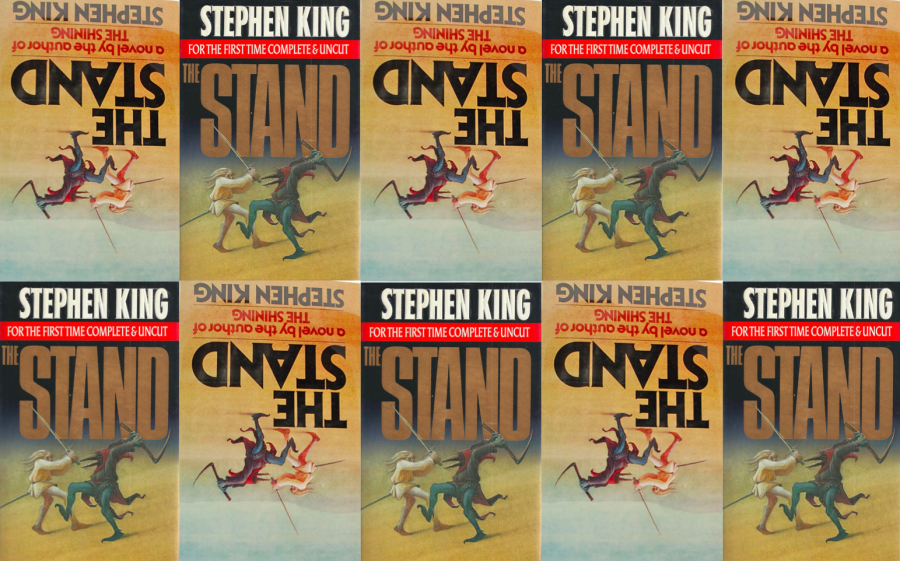
King notes in the preface to the Uncut edition of The Stand that he is “a writer who has been accused over and over again of having diarrhea of the word processor.” As his fame grew, so did readers’–and therefore publishers’–willingness to not just tolerate this so-called diarrhea, but to revel in it. So, the Uncut.

In the Uncut preface, King notes a couple of the major additions he specifically thought enriched this story: Frannie’s altercation with her conservative mother over her premarital pregnancy, and the Trashcan Man’s journey west to join the dark man. In my humble opinion, the former is a bit overwrought, but it’s a good setup for how something that seems like a problem in one context can become the potential salvation of mankind in another. As for the extra time with the Trashcan Man, I could have done without it. His journey alongside the Kid, who was cut from the original, seems designed to humanize the Trashcan Man and make him and his loyalty to Flagg sympathetic, but the backstory about his mother marrying the man who killed his father and then sent young Trash to an institution already does this work, and that childhood backstory is really what ends up being critical to the plot, since it’s a comment triggering a flashback to childhood bullying that causes Trash to start blowing up shit, which then leads to him trying to redeem himself by unearthing the A-bomb. King says he’s glad readers got to meet the Kid, but I don’t think I’ve yet read a more absurd caricature in the King catalogue (except for maybe the Rat Man who appears near The Stand‘s end, but he doesn’t get nearly as much airtime as the Kid).

I’ve said before that I don’t find narratives of pure good v. pure evil particularly compelling, and while the setup for the main conflict in this novel is basically that, King does complicate matters in the process of how things unfold such that I’m certainly not ready to dismiss it out of hand, even if the overtly Christian themes–King refers to it as a novel of “dark Christianity”–are more than a little annoying. The way the plot unfolds in this epic battle of good v. evil is not so much the good defeating the evil as the evil defeating itself. In this way its themes are reminiscent of a lot of what I talked about with The Shining, but in this plot much more overtly implicating the U.S. government. It’s almost like The Stand literalizes what The Shining treats allegorically.

To synopsize this epic narrative in a nutshell, when a biological weapon in the form of a superflu escapes a U.S. military base due to incompetence and kills 99% of the population, the survivors start having dreams about a dark (but Caucasian) man and a nice old (Black) lady. Those who choose to follow the dark man, aka Randall Flagg, primarily settle in Las Vegas, while those who follow the old lady, aka Mother Abagail, settle in Boulder, CO. As the latter form their new government and fear an eventual attack from Flagg’s side, they send three spies to Vegas to try to get intel on how soon that attack might come. Mother Abagail then decrees, on God’s authority, that Boulder’s four leading men (Stu, Larry, Glen, and Ralph) must go to Vegas to face the dark man openly instead of sneaking around and spying. On the way, Stu breaks his leg; the other three have to leave him behind and are then apprehended by Flagg’s men. Glen is killed in his jail cell after he mocks Flagg, while Ralph and Larry are taken to be pulled apart by a torture contraption in a gruesome public display to demonstrate Flagg’s power over the other side. When one of the Vegas people in the crowd to witness this display protests, Flagg flicks a “ball of electricity” at the protestor that burns his brain. Then one of Flagg’s people, the Trashcan Man, whom Flagg enlisted to hunt down weapons, shows up with an A-bomb that the electricity ball inadvertently detonates, killing everyone there. From his distant vantage in the desert, Stu sees the mushroom cloud; he ends up making it back to Boulder with the help of one of the spies, Tom Cullen, who is on his way back from Vegas. Fran’s baby survives, heralding the survival of the human race.

Of course 2020 is a special context in which to read The Stand‘s treatment of a flu pandemic. King has updated the timelines in this novel twice, shifting the year the flu hits from 1980 to ’85 in the paperback edition, and then to ’90 in the Uncut. Some have noted that simply changing the year doesn’t do enough to change the novel reading like it’s from the ’70s in a lot of its references and in how it exemplifies the “paranoia” of that period, which is in keeping with my reading of how the narrative extends/continues a lot of the themes in The Shining. The “evil” in the novel functions very much by way of covert ops in the Nixonian/CIA fashion, by which very means–namely secrecy–that evil ultimately destroys itself (or nearly does). The complication in The Stand arises when the “good guys” resort to the same covert means–namely, sending three “spies” to the West.

The deterministic Christian worldview played out by the plot is unambiguous, which characters themselves specifically point out in regards to the “psychic experience” of their similar dreams. That is to say, the text provides what amounts to proof that a supernatural/divine force is at play. Mother Abagail claims the four men she tells to go west have a choice about whether to go, but when the men protest that it would be a pointless suicide mission, she berates them for thinking God’s “plan” could be that simple (at which point she miraculously heals Fran’s injured back). This would seem to make the novel’s guiding philosophy the polar opposite of the existentialist random suffering evoked by Camus’ pandemic in The Plague, and yet, in spite of this and these novels’ supernatural v. natural treatment of pandemic subject matter, they share some illuminating similarities alongside the differences.

Cry Me A Conspiracy Theory

The all-pervasive “plague” in Camus’ context becomes symbolic of the specter of death itself and the great equalizer of the human condition–the inescapability of MORTALITY. In King’s context, the true underlying “plague” would seem to be government itself. The thematic treatment of nuclear fallout as emblematic of the self-destructive fallout of man’s (and it is pretty exclusively man‘s) will to dominion/knowledge/power resulting in cyclical self-destruction is reminiscent of Walter M. Miller’s 1960 novel A Canticle for Leibowitz. But King’s taking pains to depict a very specific cause of his novel’s pandemic is pretty anti-existentialist (and makes this novel’s mass appeal reminiscent of religion’s…) and in the location of that cause (aka the military), reflective of that ’70s mistrust of the government that stems from Watergate. The Stand, even more so in the Uncut version, takes great pains to depict the great pains the government takes to cover up their responsibility for the pandemic.

Now that we have a real pandemic on our hands, we might gauge whether King’s or Camus’ take on the experience rings truer. This is a subjective question based on individual experiences of Covid, but the depiction of the pandemic’s origin and its accuracy might be more objective. In Camus, plague appears randomly, vanishes randomly, and will reemerge somewhere else later, randomly. In King, the origin point is squarely in America, by America, for America, and the coverup is so egregiously gruesome that the government is as unequivocally as evil as Flagg himself. Not only does King’s pandemic start and spread in America, the military intentionally spreads it to other countries in order to cover up its American origin point:

“Cleveland has between eight and twenty men and women in the U.S.S.R. and between five and ten in each of the European satellite countries. Not even I know how many he has in Red China.” Starkey’s mouth was trembling again. “When you see Cleveland this afternoon, all you need tell him is Rome falls. You won’t forget?”

“No,” Len said. His lips felt curiously cold. “But do you really expect that they’ll do it? Those men and women?”

“Our people got those vials one week ago. They believe they contain radioactive particles to be charted by our Sky-Cruise satellites. That’s all they need to know, isn’t it, Len?”

This is (at least) a double indictment of the government’s nefarious nature: they’re willing to spread it further to hide that they started the spread in the first place, and they will achieve this spread by not telling the people who are spreading it what they’re actually doing. Covert all the way. And the post-pandemic rebirth of society will replay this cycle. The bottom line this narrative reinforces is that the conspiracy theories are true, and any mistrust of the government is not paranoia but entirely founded.

Covid, of course, started in China and spread here not so much due to explicitly malicious intent but more due to a globalized culture. In our current case, it’s not the virus that’s been weaponized so much as the idea of its weaponization that’s been weaponized: aka the conspiracy theory that covid was spread intentionally, not to mention the even more potentially harmful conspiracy theory that the virus is a hoax and doesn’t really exist. As I said in my analysis of how The Shining treats these themes (covert/secretive action = “dirty”), our current conspiracy-theory-riddled times–compounded by our conspiracy-theory-spewing President who wields a significant amount of his power through this rhetorical weapon–can be traced back to this ’70s period, and The Stand plays this out even more than The Shining does. Framed this way, I’m starting to wonder if The Stand‘s anti-government narrative reinforces a cultural mindset that Trump continues to manipulate to his advantage…

(Side note: Bob Woodward, a journalist who did a lot of the reporting exposing the Watergate scandal back in the day, just released Rage, his second book on Trump, and, as noted here, has a recording of Trump saying back in a February interview that he “wanted to always play it down,” the “it” here being Covid-19, even though he knew it was “more deadly than even your strenuous flus,” because he didn’t want to create a “panic.” Thus clarifying that he was actively deceiving the American people rather than being dumb enough himself to not recognize the situation’s seriousness, but doing so (supposedly) for the sake of their own protection. A blanket justification invoked by so-called intelligence agencies going decades back…)

The propensity to believe in conspiracy theories is driven by a psychological urge for explanation, a need to be able to pinpoint a responsible party for the bad things that happen, because, while it might seems counterintuitive or at the least ironic, apparently it’s easier to accept these horrible things if someone is at fault for them rather than if they just happen for no reason. (It seems to be a similar psychological urge that drives us to produce and consume narratives via novels.) In the figure of Randall Flagg, King has provided a handy scapegoat; according to The Stand‘s narrative logic, he can be blamed for the government being to blame for the end of civilization as we knew it. This is in keeping with Flagg being vaguely linked to a lot of the violence and unrest in the period’s recent history:

He remembered the civil rights marches of 1960 and 1961 better—the beatings, the night rides, the churches that had exploded as if some miracle inside them had grown too large to be contained. He remembered drifting down to New Orleans in 1962, and meeting a demented young man who was handing out tracts urging America to leave Cuba alone. That man had been a certain Mr. Oswald, and he had taken some of Oswald’s tracts and he still had a couple, very old and crumpled, in one of his many pockets. He had sat on a hundred different Committees of Responsibility. He had walked in demonstrations against the same dozen companies on a hundred different college campuses. He wrote the questions that most discomfited those in power when they came to lecture, but he never asked the questions himself; those power merchants might have seen his grinning, burning face as some cause for alarm and fled from the podium. Likewise he never spoke at rallies because the microphones would scream with hysterical feedback and circuits would blow. But he had written speeches for those who did speak, and on several occasions those speeches had ended in riots, overturned cars, student strike votes, and violent demonstrations. For a while in the early seventies he had been acquainted with a man named Donald DeFreeze, and had suggested that DeFreeze take the name Cinque. He had helped lay plans that resulted in the kidnapping of an heiress, and it had been he who suggested that the heiress be made crazy instead of simply ransomed.

Flagg is on all of the “Committees of Responsibility”–i.e., somehow inciting the country’s periods of unrest. He’s linked here to two major historical events that greatly interest (if not “obsess”) King–the JFK assassination (though simply taking one of Oswald’s tracts as described above wouldn’t seem to make him all that “responsible”), and the Patty Hearst kidnapping. In his treatise on horror, Danse Macabre (1981), King basically locates the Hearst kidnapping as the source of his idea in the first place when he describes the germ of his idea originating with a phrase he heard on a Colorado biblical radio station: “Once in every generation the plague will fall among them” combined with his musings about Patty Hearst and the SLA in the news at the time:

I sat there for another fifteen minutes or so, listening to the Eagles on my little cassette player, and then I wrote: Donald DeFreeze is a dark man. I did not mean that DeFreeze was black; it had suddenly occurred to me that, in the photos taken during the bank robbery in which Patty Hearst participated, you could barely see DeFreeze’s face. He was wearing a big badass hat, and what he looked like was mostly guesswork. I wrote A dark man with no face and then glanced up and saw that grisly little motto again: Once in every generation the plague will fall among them. And that was that.

Note: Donald DeFreeze was black, which is why I guess King felt the need to clarify that he did not mean racial blackness by the terminology “dark man.” I’ll be returning to King’s problematic conflations of the negatively connotated term “darkness” with race…

This allocation of blame feels both unrealistic and not, reflective of the ways our corporate/bureaucratic culture diffuses responsibility, “passing the buck,” as one expression puts it, and probably most directly addressed by one of Stu’s “doctors” at the Stovington disease control facility when Stu demands an explanation:

“Listen to me,” Deitz said. “I’m not responsible for you being here. Neither is Denninger, or the nurses who come in to take your blood pressure. If there was a responsible party it was Campion, but you can’t lay it all on him, either. He ran, but under the circumstances, you or I might have run, too. It was a technical slipup that allowed him to run. The situation exists. We are trying to cope with it, all of us. But that doesn’t make us responsible.”

“Then who is?”

“Nobody,” Deitz said, and smiled. “On this one the responsibility spreads in so many directions that it’s invisible. It was an accident. It could have happened in any number of other ways.”

(Note: The “Stovington” disease facility would seem to be a callback to The Shining, Stovington, Vermont being where the Torrance family lived before they moved to Boulder. Though in The Shining Stovington is intimated to only have the prep school Jack teaches at a nearby “IBM plant”…)

Since Deitz and Denninger are obvious villains, Dietz’s saying this itself becomes evidence that the claim isn’t true, which the reader already knows from other things they’ve been shown up to this point, since the reader is patently not in the position of Stu’s very limited perspective here. By adding the opening showing Campion’s escape from the base in the Uncut, King provides an even more definitive identification of the pandemic’s origin point. In this way the omniscient point of view in the novel seems to almost inadvertently reinforce the conspiracy-theory themes: a need/urge to believe in such theories evidences a need for certainty–a need that omniscience–not to mention religion–fulfills. Camus’ version would seem to more accurately reflect the uncertainty that in 2020 many of us are grappling with more directly. But ironically the fact that we’re grappling with uncertainty more directly then drives us to the comforts of certainty-laced narratives like The Stand–and some of us even further to the comforts of conspiracy theories…

I would have thought King was disavowing The Plague both philosophically and structurally in this novel if it weren’t for his own assessment in Danse Macabre:

In spite of its apocalyptic theme, The Stand is mostly a hopeful book that echoes Albert Camus’s remark that “happiness, too, is inevitable.”

But I didn’t catch any explicit references to Camus in the text of The Stand, and King tends to be fairly explicit with his references. By that metric, the text he’s using as more of a model is that of the quest from Tolkien’s Lord of the Rings, which he calls out in the preface of ‘Salem’s Lot as being cribbed from Dracula. He seems to acknowledge the debt by having his characters verbalize it:

“The beginning of a journey,” she said, and then so softly he wasn’t sure he’d heard her correctly: “The way leads ever on …”

“What?”

“It’s a line from Tolkien,” she said. “The Lord of the Rings. I’ve always thought of it as sort of a gateway to adventure.”

and:

She had a sudden horrible feeling that it was staring at her, that it was his eye with its contact lens of humanity removed, staring at her as the Eye of Sauron had stared at Frodo from the dark fastness of Barad-Dur, in Mordor, where the shadows lie.

These very specific LOTR references in the mouths of female characters in particular feel more than a little ridiculous, and such literary references are something of a (bad) Kingian habit. H.G. Wells is also more present on the layperson’s mind here than would probably be the case:

Still clutching the gun he whirled around again, and now it was not the soldiers in their sterile Andromeda Strain suits that he saw on the screen of his interior theater but the Morlocks from the Classic Comics version of H. G. Wells’s The Time Machine, humped and blind creatures coming out of their holes in the ground where engines ran on and on in the bowels of the earth.

and:

They camped a quarter of a mile over the line, beneath a water tower standing on tall steel legs like an H. G. Wells Martian.

and:

His white underpants were the brightest thing in the darkness; in fact, the boy’s skin was so dark that at first glance you almost thought the underpants were there alone, suspended in space, or else worn by H. G. Wells’s invisible man.

Maybe one character could be characterized by a particular interest in Wells, but these three passages are from three different characters’ points of view–Larry, Nick, and Nadine, respectively–which makes these references feel not like characterization but by the writer showing his hand by not differentiating the characters’ viewpoints enough.

The Hand of God

Some have accused The Stand‘s plot of being resolved by a deus ex machina, which would be generally in keeping with the Christian themes of there being an overarching divine plan rather than everything being simply random, but while “the hand of God” literally makes an appearance in the plot’s climax, it’s a little more nuanced than a completely random occurrence forcing the action to its final destination. The intersection of threads here is the product of evil, as specifically embodied in “dark man” Randall Flagg, destroying itself, which most prominently pivots on Flagg’s enlistment of the highly unstable Trashcan Man to unearth weapons. His instability leads to Trash blowing up many of the weapons Flagg planned to use against the Free Zone, which then leads to Trash trying to make it up by scrounging up an A-bomb. The reason the A-bomb ultimately detonates and destroys Vegas instead of the Free Zone is also a manifestation of Flagg destroying himself–it detonates specifically because of “the ball of electricity Flagg had flicked from the end of his finger,” the force that inadvertently swells into what’s referred to as “the hand of God.” The reason Flagg flicks this ball also plays out overt v. covert themes: after explicitly lying that the three Boulder men tried to sneak in under cover of night and that they were the ones responsible for the destruction Trashcan wrought, someone on Flagg’s side finally stands up to him for being so evil; in response, Flagg bores his head in with the electricity ball.

For a time, the “good” side falls prey to the apparent evil of the “old ways” in attempting to send spies to the other side, but then the avatar of “good,” aka Mother Abagail, aka the Magical Black Lady, corrects this mistake by sending the four men west with nothing but the clothes on their backs for an overt, direct, face-to-face confrontation, much in the manner that Danny confronts the Overlook ghost in the form of his father in The Shining‘s climax. The deus ex machina feeling some readers might get here could be due to the three Boulder men not actually doing very much once they get to Vegas, a feeling that it’s not action on their part that affects the outcome. But their presence there is crucial, because if they hadn’t shown up, Flagg wouldn’t have been compelled to have a public display of their destruction, prompting the lone voice of dissent, prompting the ball of electricity. One might argue that Trash’s showing up with the A-bomb at that particular moment is pretty convenient/coincidental, but King can basically write off any accusations of that with the Christian theology explicitly influencing, if not directing, the outcome. Glen Bateman’s presence in Vegas might feel the most irrelevant, but it’s the verbal component of the confrontation with Flagg, whom he meets face-to-face, even if through bars. All through the final sequence Flagg is shown trying to get others to do his dirty work for him–he wants Lloyd to shoot Glen, and he wants Lloyd to get Trashcan Man to get him to take the A-bomb away.

In Danse Macabre, King lays out a narrative horror formula:

Further, I’ve used one pompously academic metaphor, suggesting that the horror tale generally details the outbreak of some Dionysian madness in an Apollonian existence, and that the horror will continue until the Dionysian forces have been repelled and the Apollonian norm restored again.

An ancient Greek gloss on the whole good v. evil idea. He applies this to The Stand:

On the surface, The Stand pretty much conforms to those conventions we have already discussed: an Apollonian society is disrupted by a Dionysian force (in this case a deadly strain of superflu that kills almost everybody). Further, the survivors of this plague discover themselves in two camps: one, located in Boulder, Colorado, mimics the Apollonian society just destroyed (with a few significant changes); the other, located in Las Vegas, Nevada, is violently Dionysian.

In The Stand, Dionysus announces himself with the crash of
an old Chevy into the pumps of an out-of-the-way gas station in Texas. … [T]he Apollonian steady state is restored when … the book’s two main characters, Stu Redman and Frannie Goldsmith, look through a plate-glass window in the Boulder hospital at Frannie’s obviously normal baby. As with The Exorcist, the return of equilibrium never felt so good.

King also discusses The Stand and his struggle to write it at some length in On Writing, identifying it as a “fantasy epic” (“there was a chance for humanity’s remaining shred to start over again in a God-centered world to which miracles, magic, and prophecy had returned”) and revealing the influence of the time period–“the so-called Energy Crisis in the 1970s”–on its development. But the real reason he finds it worth discussing is the struggle aspect: he almost abandoned it because he couldn’t figure out how to end it. This invokes a distinction of process we discuss in my creative-writing classes, that between “pantsing” (aka flying by the seat of your pants) and “plotting” (having a plan/outline from the beginning). I was surprised to learn that King was a pantser, mainly just considering the sheer scope of this particular novel. Maybe it’s too much of a generalization to say more “literary” novels are the product of pantsing while more formulaic genre thriller-type books are less so, but I’ve always thought pantsing as a method, though probably often slower, leads to better books, that if a writer is willing to let the narrative surprise them as they’re writing it, then the reader will also be surprised, and the ending will feel more authentic, less contrived.

In spinning the epic of his struggle to finish The Stand, King notes:

…I started taking long walks (a habit which would, two decades later, get me in a lot of trouble).

He made no progress for weeks…

…and then one day when I was thinking of nothing much at all, the answer came to me. …

What I saw was that the America in which The Stand took place might have been depopulated by the plague, but the world of my story had become dangerously overcrowded—a veritable Calcutta. The solution to where I was stuck, I saw, could be pretty much the same as the situation that got me going—an explosion instead of a plague, but still one quick, hard slash of the Gordian knot. I would send the survivors west from Boulder to Las Vegas on a redemptive quest—they would go at once, with no supplies and no plan, like Biblical characters seeking a vision or to know the will of God. In Vegas they would meet Randall Flagg, and good
guys and bad guys alike would be forced to make their stand.

It was at this point that he engineered the bomb at the committee meeting, “sav[ing] my book by blowing approximately half its major characters to smithereens.”

What’s interesting to me as a writer is that what I identified as a complication enriching the narrative, King identifies as the source of his writer’s block in the first place:

What had stopped me was realizing, on some level of my mind, that the good guys and bad guys were starting to look perilously alike, and what got me going again was realizing the good guys were worshipping an electronic golden calf and needed a wake-up call. A bomb in the closet would do just fine.

And then, for the record, he goes on to identify God’s existence as the novel’s definitive ruling logic:

The folks who plant the bomb are doing what Randall Flagg told them to, but Mother Abagail, Flagg’s opposite number, says again and again that “all things serve God.” If this is true—and within the context of The Stand it certainly is—then the bomb is actually a stern message from the guy upstairs, a way of saying “I didn’t bring you all this way just so you could start up the same old shit.”

He notes how his experience with writer’s block led to him considering the development of theme much more explicitly than he ever had as a writer before, though the theme he’s referring to here isn’t all things serving God, but rather “that violence as a solution is woven through human nature like a damning red thread.”

In his epic of the writing of the epic, King likens the bomb plot development to being a way of cutting the “Gordian knot” of his numerous characters and their tangled plotlines, as the plague itself was a Gordian knot dispensing with all the problems of modern civilization. This is a metaphor whose thought-provokingness is somewhat undermined by its being awkwardly shoved into the mouth of more than one character in a manner reminiscent of the literary references.

So if King pantsed it and did not contrive his ending in advance, in theory that should make the ending feel more natural. Yet his endings in general get shit on quite a bit. A gag about this recurs in last year’s It: Chapter Two movie, and one of my new high-school freshmen was even compelled to comment that he liked Stephen King, “except for the endings. The endings are crap.”

I’m guessing some of that attitude might be due to the frequency of a verbal calling-out of evil being adequate to defeat it, as in The Shining. Simply calling out a bully for bullying or a liar for lying is turning out to be pretty useless in the Trump era. But the ending of The Stand technically “works” because their making their stand ultimately enables the detonation of the A-bomb.

As for the extra parts that were added/reinstated for the Uncut, none of them are actually necessary to the plot, which is more or less what King told the reader in his Uncut preface (the part they were supposed to read in the bookstore before they went to the cash register). The guy who catalogued the changes says he prefers the longer, but others have argued for the shorter.

It seems that in large part what King readers love is being immersed in a world with his characters, which could be why so many continue to read him even when there’s an apparent consensus about the crappiness of the endings. At the same time, immersing the reader further in that world as the Uncut does actually puts more pressure on the ending to do justice to the characters the reader has grown to love so much…

Baby, Can You Dig Your (White) Man?

King might have avoided a full-blown deus ex machina in the execution of this ending, as well as in having humanity technically kill itself off by creating the plague in the first place. And he finds some wiggle room within the narrative’s determinism to eke out some character development…but only some. Is this a pitfall of the epic’s scope? Or of the patriarchy in general…or some insidious combination of both…?

Fran is the only “main” female character in a cast of what I would designate four main characters: Fran, Stu, Larry, and Nick. The Free Zone committee of seven would seem to imply there should be seven main characters, but you can tell the real main characters from those who get more extensive pre-pandemic chapters. Glen Bateman is a prominent character and committee member, but we don’t meet him until most of the country’s been killed off. Glen is also pretty much only a mouthpiece for thematic development rather than a developed character in his own right, offering theories as a sociologist and driving the committee’s policies (including ratification of America’s founding documents), painting “mediocre pictures” literally and figuratively. Another committee member, Sue Stern, the only other woman of the seven, gets pretty much no development at all before she’s killed, and Ralph Brentner, who would seem to be fairly important as one of the four who’s sent west to make the stand against the dark man, is also only a type (“a simple soul, but canny”) with no nuanced development. Nick, who gets pre-pandemic chapters, turns out to be the biggest disappointment as a character for me, not just because he’s killed off, but because before that, after they’re in Boulder, he does basically nothing. He’s noted to the be “heart” of the committee, and his decision to send Tom west as a spy becomes critical to the plot when Tom ends up rescuing Stu, but this critical decision doesn’t feel like a product of any of the character development we got about him, specifically the backstory about his struggle but eventual success in learning to read and write. Ultimately Nick feels more plot device than character.

King specifically designated Fran and Stu as the “main characters.” But Fran’s entire function ultimately is to propagate the species through reproduction, as a woman should. Stu is technically critical to the plot in a lot of ways, but his development on the whole feels pretty lame. He ends up running the committee meetings, leading Fran to think at one point how much he’s evolved/developed from the quiet/shy man she initially met, but this feels contrived too. Stu’s pre-pandemic chapter isn’t pre-pandemic in the sense that Fran’s is: his first chapter is the start of the pandemic as it shows him meeting patient zero. Everything we learn about Stu’s past–he stayed in Arnette after his mother died of cancer instead of taking a football scholarship so he could support his younger brother; he had a wife who died of cancer–never comes up again. He thinks one time that I can recall about his wife, when the caginess of the Stovington disease docs remind him of her doctors. We don’t even learn her name. His mother and brother never cross his mind again.

The nameless wife and general lack of female characters are a shared trait/symptom with The Plague, as is the main male cast: Dr. Rieux, Tarrou, Grand, Cottard, and Rambert. Camus’ (white) men are more evenly developed as they weather the plague in different (philosophically symbolic) ways, and the (minimal) female characters are sacrificed to the cause. The climax of the plot hinges on two deaths, Tarrou’s and Rieux’s wife’s. Tarrou’s been there the whole time, and the friendship he forges with Dr. Rieux becomes the emotional center of the book. Rieux’s unnamed wife leaves for a sanatorium before the pandemic strikes the town, so she’s only present in one scene near the beginning when he says goodbye to her. The two deaths are necessary in theory because one is due to the plague and one is not, point being that even if the literal bubonic/pneumonic plague is over, the plague of mortality will never be. But for this to fully work it feels like Tarrou’s and the wife’s importance to Rieux would have to be equally developed, which is far from the case. (“A perfect achievement,” reads a quote emblazoned across the front of my Plague paperback edition. My ass.)

Larry Underwood probably gets the most significant character development to my mind. Fittingly so, I suppose, since he ends up being the explicitly designated “sacrifice” in this pseudo-Biblical narrative. Larry’s pre-pandemic chapters provide two refrains, both initially voiced by women, that sum up his pre-pandemic character that seems reflective of a largely American selfishness/self-interestedness: “‘You ain’t no nice guy,'” from a one-night stand, and “‘You’re a taker, Larry,'” from his mother. He’s tested by two more women, Rita Blakemoor and Nadine Cross, on his journey to become the “righteous man” of the song that ironically turned him into a bigger asshole by virtue of being a hit. (King emphasizes the importance and destination of this journey by making the lyrics of Larry’s song one of the epigraphs. Since it’s a song lyric I could abide this move much more than his using the character’s quote that triggers Trash to start blowing stuff up on his own side, which is then repeated in the text itself, thus making its use as an epigraph entirely unnecessary…)

Larry’s development also shows how the women basically serve only to characterize the men, failing the characterization version of the Bechdel test, but at the least he’s more developed than Stu because when he’s thrust into a position of leadership and rises to the challenge, it actually marks a change.

“Larry is a man who found himself comparatively late in life,” the Judge said, clearing his throat. “At least, that is how he strikes me. Men who find themselves late are never sure. They are all the things the civics books tell us the good citizens should be: partisans but never zealots, respecters of the facts which attend each situation but never benders of those facts, uncomfortable in positions of leadership but rarely able to turn down a responsibility once it has been offered … or thrust upon them. They make the best leaders in a democracy because they are unlikely to fall in love with power.”

That such a democratically ideal figure should be the sacrifice seems to be another sign that we should do away with the American version of democracy (i.e., the pretend one that’s only masquerading as a democracy).

Larry’s forced to make a choice when Nadine comes to him after he’s with Lucy Swann (the fifth woman sacrificed to Larry’s character development), begging him to sleep with her when she wouldn’t let him before. Larry thinks his choice not to is what shows he’s truly changed, which is true, though this is complicated by the fact that his sleeping with Nadine would, the narrative definitively (ridiculously) emphasizes, save her from the dark man and by extension that she probably would not have planted that bomb that ends up killing those committee members…

In keeping with King’s questionable association of magical abilities with “otherness,” Joe/Leo, the child who reverts to savagery post-superflu (denoted by a loss of language) and whose defining trait is his “Chinese eyes,” is unambiguously indicated to have psychic tendencies, and during one of these episodes–when he’s telling Larry that Nadine and Harold are going to go west–Joe/Leo specifically indicts the committee:

“The committee won’t help you, it won’t help anyone, the committee is the old way, he laughs at your committee because it’s the old way and the old ways are his ways…”

Which seems part and parcel of King’s pretty much wholesale indictment of politicians as evil (no argument on my part) for being so duplicitous and slimy and saying the opposite of what they really mean and achieving their underhanded aims via underhanded means. But then King seems to be trying to have his cake and eat it too on the whole spying front, because Stu only ends up surviving specifically because of their having sent Tom Cullen as a spy….

The indictment of politicians comes into play in the development of the other character who’s potentially the most developed despite his not getting his own pre-pandemic chapters, and who is (of course) another white male, Harold Lauder.

King uses Harold to implicitly characterize flowery writing styles, which will then be implicitly linked to politicians via other aspects of Harold’s character:

Harold edited the Ogunquit High School literary magazine and wrote strange short stories that were told in the present tense or with the point of view in the second person, or both. You come down the delirious corridor and shoulder your way through the splintered door and look at the racetrack stars—that was Harold’s style.

“He whacks off in his pants,” Amy had once confided to Fran.

The juxtaposition between these two paragraphs speaks volumes…

Harold’s pivotal transition to the dark side is precipitated by his discovery that Stu and Fran are together, at which point he starts plotting and presenting a patently false face to his fellow Free Zoners. And this patently false face is likened to…

“Don’t think I know you,” Harold said, grinning, as they shook. He had a firm grip. Larry’s hand was pumped up and down exactly three times and let go. It reminded Larry of the time he had shaken hands with George Bush back when the old bushwhacker had been running for President. It had been at a political rally, which he had attended on the advice of his mother, given many years ago. If you can’t afford a movie, go to the zoo. If you can’t afford the zoo, go see a politician.

This Uncut passage actually names a figure who was only designated by title when they make an earlier appearance in the narrative on television to blatantly and ridiculously deny the danger of the flu (sound familiar?).

Harold’s evil political characterization is reinforced by his constant “grin,” and before the passage above officially identifies who the President is, we get a reference to the anonymous figure when he relieves General Starkey of his duties:

“It was really him, then?”

“The President, yes. I’ve been relieved. The dirty alderman relieved me, Len. Of course I knew it was coming. But it still hurts. Hurts like hell. It hurts coming from that grinning, gladhanding sack of shit.”

The Bushwhacker

King’s exploration of the 70s Energy Crisis still permeates the narrative even when he shifts the dates up a decade and it should be more in the rearview. (His references to the Arab oil embargo in the Uncut are historically inaccurate with his updated timeline.) But even though sometimes all he does is change out “Carter” for “Bush” in some passages, George H.W. Bush could be a figure more relevant to a lot of his themes than he or most have probably realized. And Wred Fright, cataloguer of changes between editions, notes a slightly more substantive change made to the “glandhanding sack of shit” passage above:

In Chapter 22, King updates the reference from Jimmy Carter to George Bush.  So, instead of a description of the President of the USA as the “Georgia Giant” and a “clod-hopper”; he gets called “The dirty alderman.”  Despite their shared Maine background, it appears King might have liked Bush less than he did Carter.  Then again, he also deletes the line, “The night that man had been elected had been a night of horror for him, and for all thinking men”, but since the thought is attached to Len Creighton, who is one of the men responsible for the flu, it’s probably just a reflection of the fact that Carter was not perceived as militaristic as his predecessors Nixon and Ford were, and thus might have been viewed as a threat by men such as Creighton to the military’s development of biological weapons, and perhaps to Creighton’s livelihood of war in general.

From here.

That King felt “dirty” to be a descriptor specific to Bush is significant, since he’s used it as a descriptor specific to the CIA: their “dirty little wars” mentioned in The Shining (these are the wars that are “dirty” because they’re a) specifically engineered for profit, and b) presented to the public as being for national security, not for profit). Bush’s association with the CIA is that he served as its director for one year in 1976–Bush is not publicly purported to have ever worked for the CIA in any capacity before or after this one year. According to the CIA’s own account, Bush came on as Director of Central Intelligence during the “‘time of troubles'”:

The Agency was shrouded in controversy from the leak of the “Family Jewels,” an internal report detailing controversial activities undertaken by the Agency dating back to President Dwight Eisenhower’s administration.

From here.

But don’t worry, because Bush turned everything around:

As DCI he immediately established himself as a leader who restored the morale and reputation of the CIA.

From here.

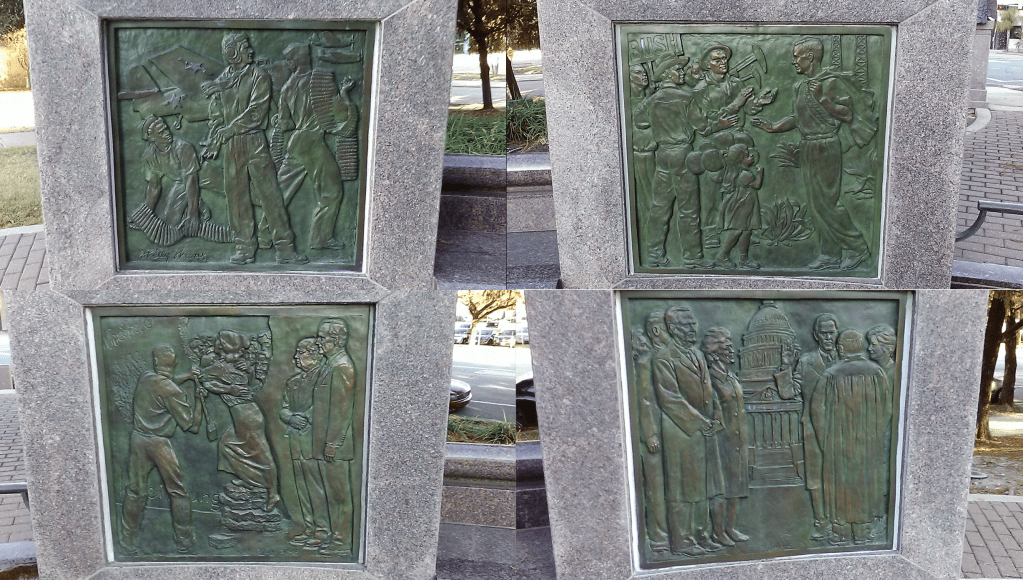
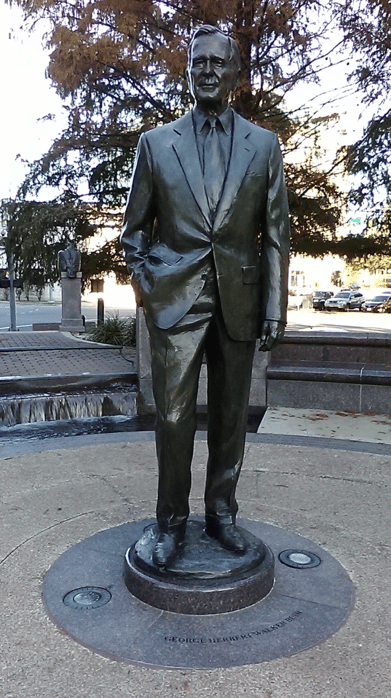
Bush originally hailed from snobby New England, where his father was a Connecticut senator named Prescott who initially worked “as a Wall Street executive investment banker,” but George (known in the family as “Poppy”) made his fortune down in Texas, eventually settling here in Houston and tapping the burgeoning offshore drilling market in the nearby Gulf of Mexico. After his time in office, he lived here until he died not quite two years ago, triggering a spate of articles extolling his heroism. There is a fairly elaborate monument to him here downtown that was dedicated long before he died, in ’04, which emphasizes how important both oil and war heroism are to his narrative.

The four panels by Willy Wang at the downtown Houston Bush Monument. (The backs of these panels have Bush quotes carved in them ranging from ’89 to ’97.)
The man himself.
The day after the man died.

The investigative journalist Russ Baker has some pretty crazy-sounding ideas about Bush’s connection to JFK’s assassination and Watergate that he lays out in his book Family of Secrets–excerpts of which you can read here. Baker’s first excerpt lays out some not unconvincing evidence that Bush was actually a CIA agent long before he was named their DCI. The theory continues that Bush used the offshore oil rigs from his oil business to stage operations related to the covert Bay of Pigs operation, and that he helped train a group of Cubans that helped assassinate JFK. This theory basically cites the motivation to do so as JFK’s intentness on getting rid of “the oil depletion allowance, which greatly reduced taxes on income derived from the production of oil,” predominantly coveted by Texas oilmen (such as Bush). Baker claims the revenue lost by the taxpayers to this allowance was $140 billion. (When you realize that politicians write the tax code and learn about the loopholes like this one it’s pocked with, it’s not so hard to see how the wealth keeps trickling up…)

I don’t necessarily think King is alluding to this conspiracy theory in any way intentionally (I doubt it was on his radar, predominant as the narrative of Bush being a “wimp” was), it connects back both to his fascination with the Kennedy assassination and to how these 70s novels of his are haunted by the political duplicity of Watergate, which specifically pivoted on the covert methods the CIA practiced. And to inhabit the worlds of King’s early novels that are so saturated with this 70s paranoia, it becomes even more possible (for me at least) to believe in at least the possibility that the CIA, cornered by the publication of its secrets, staged bringing in an outsider in order to clean up its act.

The Bush rabbit hole goes deeper…Antony Sutton, the academic who did (subsequently shunned) research on the U.S. financing “both sides” of wars including the Cold War, Korea, and Vietnam, wrote about the idea of “contrived conflict” as utilized by the “Hegelian State” in his 1983 book America’s Secret Establishment: An Introduction to the Order of Skull & Bones. Bush, as was his father Prescott and his son W., was a member of this “secret” order (as was W.’s ’04 Presidential election opponent John Kerry). Really this society is just a natural (if insanely insidious) extension of what we in modern society dub “networking.” H.W.’s membership in this order is also cited as circumstantial evidence of his being a CIA agent, since the Ivy League secret societies, especially the Bones, were heavily recruited from. It almost seems like these “secret” groups are especially designed to practice/indoctrinate members to the idea of covert ops…

(Side note: One of the “dirty little wars” I mentioned when King referenced these these in The Shining was the 1954 coup in Guatemala engineered to preserve the bottom line of the American corporation the United Fruit Company, purveyor of bananas, which I thought of when Dayna Jurgens tries to stab Flagg with her switchblade and it turns into…a banana.)

At any rate, thinking about these possibilities (admittedly far from proven but hardly completely crackpot), it’s amusing to picture the elder Bush sitting there telling the American people that:

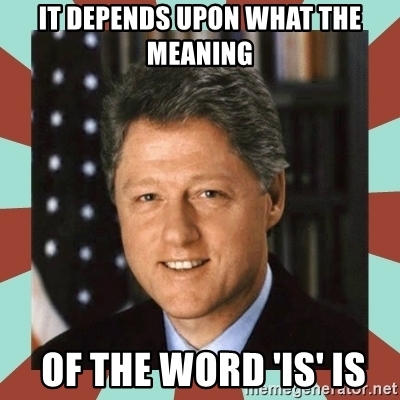
“Further, there has been a vicious rumor promulgated by certain radical anti-establishment groups that this strain of influenza has been somehow bred by this government for some possible military use. Fellow Americans, this is a flat-out falsehood, and I want to brand it as such right here and now. This country signed the revised Geneva Accords on poison gas, nerve gas, and germ warfare in good conscience and in good faith. We have not now nor have we ever—”

[a spasm of sneezes]

“—have we ever been a party to the clandestine manufacture of substances outlawed by the Geneva Convention. This is a moderately serious outbreak of influenza, no more and no less. We have reports tonight of outbreaks in a score of other countries, including Russia and Red China. Therefore we—”

[a spasm of coughs and sneezes]

Somebody give him a mask that’s not just made of empty rhetoric!

The Stand is very much about the character of America itself, and King seems to be saying that character leaves a lot to be desired…

“We used to watch Presidents decay before our very eyes from month to month and even week to week on national TV—except for Nixon, of course, who thrived on power the way that a vampire bat thrives on blood, and Reagan, who seemed a little too stupid to get old. I guess Gerald Ford was that way, too.”

Good thing we’re about to see a Presidential election between a 74-year-old white man and a 77-year-old white man…

“I’d like to have that old fellow they call the Judge. But he’s seventy, and that’s too damn old.”

-SCR

The Stand: The Summary

“Plague is here and we’ve got to make a stand, that’s obvious.”

Albert Camus. The Plague. 1947.

This is the point where the chronological part of this project gets all kinds of f*cked up. The Stand, which King notes in On Writing to be what many fans rate their favorite work of his, was originally published in 1978. King worked on most of it while he was still on sojourn in Colorado (probably explaining why a significant part of it, like The Shining, is set there), but he had moved back to his native Maine by the time he finished it. Tracking an epic superflu pandemic and its fallout (literally, as we shall see), the tome is certainly appropriate subject matter for our current times. The trailer for the new limited series adaptation dropped a couple of days ago; the 1994 TV miniseries that this is rebooting is currently available. (King himself wrote the 1994 miniseries, and his son Owen is apparently in the writers’ room for the new one.)

The chronology problem is twofold: first, I just plain f*cked up the publication order and read The Stand, originally published in October of 1978, before I read King’s story collection Night Shift, published in February of 1978, King’s publisher violating their one-King-title-a-year policy that year. Night Shift has a story called “Night Surf” following a first-person narrator in a flu-induced apocalypse that is supposedly the basis for The Stand, though there are some noticeable differences in the nature of the pandemic in the two narratives.

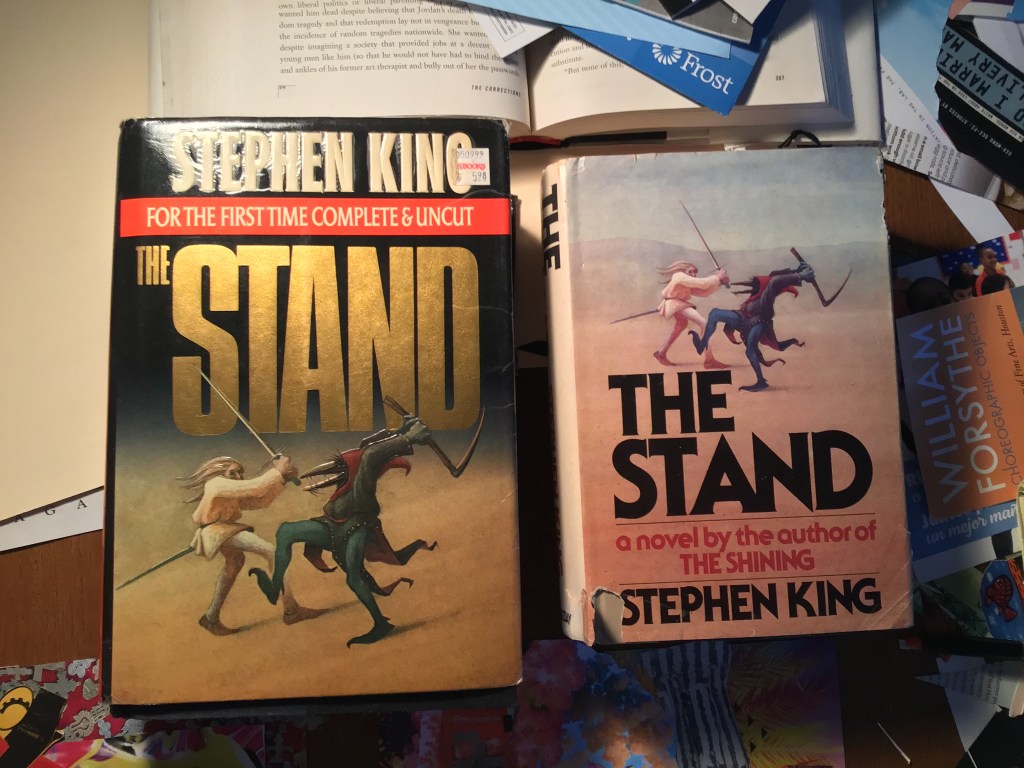
The second problem is multiple editions: I did not read the version of The Stand published in October of ’78, which is no longer in print. The one that the King consumer will most likely find when searching for this title now is the “Complete & Uncut” edition, published on January 1, 1990. In his characteristically chatty preface to this ’90 edition, King describes how the version he submitted to his publisher in the 70s had to be cut by some 400 pages, and this version was reinstating some (albeit not all) of that material. He also notes that some people thought the original version was already too long so…buy at your own peril, basically.

I did find a version of the original on Amazon (there were surprisingly few available to make comparisons).

King did more than just add sections back in; he basically line-edited the pre-existing parts as well. The story’s the same, but the text is rife with references to the 80s, though in some Presidential references only the name was changed. (This person has done a pretty thorough job cataloguing the changes between the two editions.) That King wrote the teleplay for the ’94 miniseries gave him another crack at compressing and rearranging pieces of this narrative, while at the same time seeming to demonstrate how his “cinematic” style lends itself to the silver screen and how King’s influences are almost a 50/50 confluence of written and visual texts. (My primary example of this would be the Blue Oyster Cult song “Don’t Fear the Reaper” playing during the opening credits, which King used as one of his many epigraphs.)

At any rate, the scope of this narrative and its cast makes it more difficult to summarize in paragraph form, so I’m outlining it–the Uncut version–by chapter.

Prologue: “The Circle Opens”

Charlie Campion, a guard on a military base where something’s gone wrong and killed a bunch of men, escapes due to a malfunction, retrieves his wife and daughter, and flees the state.


Book I “Captain Trips” June 16-July 4, 1990

Ch. 1 In Arnette, Texas, Campion crashes into some gas pumps at a Texaco where Stu Redman and some other men are gathered; Campion’s wife and daughter are dead and Campion is almost dead.

Ch. 2 In Ogunquit, Maine, Frannie Goldsmith tells her boyfriend Jess Rider she’s pregnant; he doesn’t take it that well.

Ch. 3 In Arnette, Joe Bob the deputy warns the men who were at the Texaco that the health department wants to put them under quarantine. One of the men, Norm, and his family, start getting sick.

Ch. 4 At the military base where the “accident” happened, a general, Starkey, is looking at dead people on monitors and considering the chain of coincidences that led to Campion’s escaping the base.

Ch. 5 Larry Underwood returns from California to his mother’s in NYC after releasing a successful single on the radio (“Baby Can You Dig Your Man”) but then getting in debt to a drug dealer.

Ch. 6 Frannie tells her father she’s pregnant and prepares to tell her much more judgmental mother.

Ch. 7 Vic Palfrey from Arnette is dying, but Stu Redman, held in the same facility, seems fine. Stu refuses to cooperate with medical personnel until they tell him what’s going on.

Ch. 8 In Arnette, Joe Bob the deputy unknowingly spreads the sickness, and from there it spreads farther and farther.

Ch. 9 In Shoyo, Arkansas, Nick Andros, who is deaf and dumb, is assaulted by several townies, then ends up in jail. He explains himself to Sheriff Baker via writing, and the sheriff agrees to help him prosecute his assailants.

Ch. 10 Larry wakes up after a bender at a dental hygienist’s he slept with the night before; she starts throwing stuff at him when he abruptly leaves, telling him “you ain’t no nice guy.”

Ch. 11 Larry visits his mother at work to apologize for staying out all night without calling; she tells him he’s a “taker” but agrees to let him stay and gives him money for the movies.

Ch. 12 In her mother’s sacred parlor, Frannie tells her mother she’s pregnant; her mother flips out and her father tries to intervene to little avail.

Ch. 13 Another doctor, Colonel Dietz, comes to talk to Stu and gives him enough info about how many people have died that he agrees to cooperate with their tests.

Ch. 14 Dietz narrates a report to Starkey about how little progress they’ve made against the virus.

Ch. 15 A nurse at Stu’s facility unknowingly spreads the virus.

Ch. 16 Poke and Lloyd Henreid are on a multi-state crime spree; when they try to knock over a gas station, Poke dies in a violent shootout and Lloyd is arrested.

Ch. 17 Starkey gets word that some reporters from Houston are getting ready to report on the spread of the disease, and okays a plan to deal with it. The reporters are stopped on the road and killed by soldiers.

Ch. 18 Nick starts working at the sheriff’s station after his assailants are arrested (except the main one, Ray, who fled), and has to keep an eye on them when the sheriff gets sick (during which time Nick writes out his life story). The sheriff dies and the town doctor tells Nick lots of people are dying and the town seems to be quarantined by soldiers.

Ch. 19 Right after Larry hears he’s got some money in the bank, his mother gets sick. When he tries to call the hospital, no one answers.

Ch. 20 After Fran breaks it off with her baby’s daddy Jess, her father tells her her mother has gotten sick, then calls back, hysterical, when she gets worse.

Ch. 21 Stu, now being kept at a facility in Stovington, Vermont, watches the news and ponders escape.

Ch. 22 Starkey tells an underling the situation is out of control and to execute a plan to do something with “vials” in other parts of the world. Then he goes down to the dead men in the cafeteria he was watching on the monitors earlier and shoots himself.

Ch. 23 Randall Flagg is walking down the highway thinking about his vaguely remembered history and how he’s recently become capable of magic again.

Ch. 24 Lloyd talks to his lawyer in prison who tells him he’s very likely to get the death penalty very soon thanks to a particular law.

Ch. 25 Nick tends to Sheriff Baker’s wife until she dies while Shoyo deteriorates, and after two out of three of his assailants in the jail die, he lets the third one go.

Ch. 26 An omniscient chapter tracking resistance to the government’s narrative that the flu pandemic is under control.

Ch. 27 Sitting in Central Park thinking about his past and recently deceased mother, Larry meets the older and wealthy Rita Blakemoor.

Ch. 28 Frannie, her parents both dead now, is visited by Harold Lauder, her dead best friend’s off-putting younger brother. He leaves her alone to bury her father.

Ch. 29 Stu is visited by a man named Elder who presumably has orders to kill him, but Stu manages to kill Elder instead and then escapes the Stovington facility, where most of the remaining people are dead.

Ch. 30 A brief description of an abandoned Arnette.

Ch. 31 Sick in Boulder, Colorado, Christoper Bradenton is visited by the man he knows as Richard Fry, who shows up and retrieves the car that Bradenton procured for him registered to Randall Flagg.

Ch. 32 In his prison cell, Lloyd has bloodied his hands trying to unscrew a cot leg that he uses to kill a rat he hides as possible food, since all the guards are gone and he might starve.

Ch. 33 When the power finally goes out in the sheriff’s station, Ray Booth breaks in and tries to kill Nick and seriously wounds him, but Nick manages to kill Ray.

Ch. 34 In Gary, Indiana, Donald Merwin Elbert, aka the Trashcan Man, a (possibly schizophrenic) pyromaniac who’s now free from prison, lights some giant oil tanks on fire, injuring himself in the process.

Ch. 35 Larry and Rita head out of NYC, with Rita’s helplessness increasingly irritating Larry. They fight when her feet turn bloody from her impractical sandals, and he abandons her and crosses through the dark Lincoln Tunnel, shooting at someone following him who turns out to be Rita.

Ch. 36 Frannie and Harold leave Ogunquit with plans to head for the disease center in Stovington; Harold paints a sign on a barn saying where they’re going.

Ch. 37 Stu meets sociologist Glen Bateman and his dog Kojak; Glen postulates on possible fates for the remainder of the human race, emphasizing the importance of technological knowhow. Both men are having nightmares.

Ch. 38 Omniscient chapter about a small percentage of superflu survivors dying in other random ways in the pandemic’s aftermath. (The “No great loss” chapter.)

Ch. 39 Randall Flagg frees the nearly starving Lloyd Henreid from prison and makes him his Number Two.

Ch. 40 Nick treats his wound, dreams of Mother Abagail, and leaves Shoyo on a bicycle.

Ch. 41 Larry discovers Rita has choked on her own vomit (from pills) in the tent next to him while he was asleep. He doesn’t bury her but leaves on a motorcycle that he crashes into a horse trailer, making him paranoid and more cautious.

Ch. 42 On their way to Stovington, Frannie and Harold cross paths with Stu Redman; Harold is hostile and doesn’t want to believe what Stu says about Stovington, but Stu manages to convince Harold to let Stu join them by promising he’s not interested in Frannie.

Book II “On the Border” July 5-September 6, 1990

Ch. 43 Nick meets the mentally challenged Tom Cullen in May, Oklahoma. Nick lets Tom join him, and Tom helps save him from a tornado. A few towns later, Nick meets the nymphomaniac Julie Lawry, who turns on him when he won’t sleep with her a second time to the point he has to drive her away with a gun; then she shoots at them and they flee, and are picked up in a truck by Ralph Brentner.

Ch. 44 Larry eventually meets the pair following him, Nadine and Joe, when Joe tries to kill him with a knife. Larry wins him over when they find a guitar. They see Harold’s sign in Ogonquit and follow their trail on motorbikes. They pick up Lucy Swann and determine they’re having the same dreams, though Nadine suspiciously denies she is (and denies Larry’s advances). When they get to Stovington they see another sign from Harold directing them west to Nebraska.

Ch. 45 In Hemingford Home, Nebraska, Abagail Freemantle, the oldest woman in the state, has her coffee and toast and thinks about her family’s past, including her being the first negro to sing at the town hall. She asks god to take this cup from her, and that night has a dream that the dark man disrupts her town-hall singing. Nick and Tom’s party arrive and eventually they all depart for Boulder, the place where they’ll settle to take their stand against the dark man.

Ch. 46 Passages from Fran’s POV alternated with passages from her diary (that are farther back chronologically than the non-diary passages, starting back in Stovington); their group picks up a couple, Mark and Perion, who both die, Mark from appendicitis (after Stu tries to operate) and then Perion from suicide. The group debates about the significance of their having similar dreams.

Ch. 47 Fran’s group encounters an ambush on the road and the four attacking men are killed in a shootout, along with one of the women they were keeping hostage; the three other women join them. Back to Fran’s diary (and back in time) for a passage where Harold tries to kiss her and she rejects him. Frannie and Stu finally get together and try to hide it from Harold but he sees them. Harold starts secretly reading Fran’s diary at night.

Ch. 48 Two alternating timelines with Trashcan Man: his arrival in Vegas, and his journey there with the Kid. The Kid sodomizes him with a .45 pistol, and in the mountains when the Kid refuses to abandon his prized car in a traffic jam and keeps threatening Trash, the dark man sends timberwolves to corner the Kid in a car and lead Trash west. Trash is welcomed in Vegas and helps to crucify a man for using drugs, then meets Randall Flagg, who tells him there’s great work for him in the desert.

Ch. 49 Larry and Nadine’s group is now bigger, headed toward the Boulder Free Zone (after hearing transmissions from Ralph Brentner’s CB radio) and Nadine’s still denying she’s having any dreams, resisting Larry’s advances in order to save herself for the dark man.

Ch. 50 In Boulder, Stu and Glen Bateman discuss how to set up a new society run by an ad hoc committee of seven, with Glen wanting to ratify all the founding documents of the old one. Mother Abagail thinks she’s been prideful from people venerating her due to their dreams. When she welcomes Larry Underwood and his party, she has a weird interaction with Nadine. Nick and Ralph make preparations for their committee and Nick won’t let Harold on it. Larry visits Frannie to tell her about his obsession with Harold. Harold embraces his hate by writing in his ledger and plans to leave the Boulder Free Zone.

Ch. 51 Larry meets Harold in person and there are some contrasts with his expectations. Stu asks Larry to join the committee. Remarking on the recent changes in Harold (like his constant grin), Frannie looks over her diary again and sees Harold’s unmistakable chocolate thumbprint on it. The ad hoc committee of seven meets that night and debates and then all vote to send three spies to the west: a 70-year-old judge who came in with Larry, Dayna Jurgens, and Tom Cullen.

Ch. 52 Mother Abagail leaves Boulder to pay penance for her sin of pride. Stu goes out with Harold looking for her and Frannie breaks into Harold’s to look for anything suspicious. Harold plans to kill Stu while they’re looking for Abagail but then misses his chance; he goes home and sees the footprint of someone who broke in. Kojak the dog shows up (wounded, having battled the dark man’s wolves on his way).

Ch. 53 The whole Zone meets with Stu leading the meeting, and Harold motions for their committee to be voted in in toto. Nadine visits Larry asking to sleep with him (so she can stay in Boulder and not go to the dark man) but since he’s with Lucy Swann now he resists. Nadine gets a planchette, remembering a time in college a spirit communicated with her through one.

Ch. 54 The committee has another meeting and elects Stu marshal. Harold works on the burial committee and resists the pull of kinship with the other men. Nadine shows up at Harold’s and has everything but vaginal sex with him, saving that for the dark man.

Ch. 55 The judge heads west. Nick, Stu, and Ralph hypnotize Tom to go west, and Tom somehow knows Mother Abagail is still alive. Harold confirms Frannie broke in from her shoe print and continues to nurse his resentment.

Ch. 56 News comes that newborns died of what may or may not have been the superflu. Nadine moves out of her house into Harold’s, causing Joe to regress. They have another big meeting, at which the judge’s absence is noticed. Dayna and Tom head west (separately). Harold builds a bomb.

Ch. 57 Leo tells Larry that Nadine and Harold are working for the dark man. Brad Kitchner gets the power back on momentarily. Larry and Frannie break into Harold’s house and take his ledger. After Nadine plants the bomb in the house where the committee will meet, she feels the dark man penetrate her and her hair turns white. The dark man tells her their cover is blown and they have to leave Boulder.

Ch. 58 Though Larry, Stu, and Frannie suspect Harold will attempt some kind of sabotage, the Free Zone Committee meets as planned. Frannie gets a bad feeling during the meeting, and then a bunch of people show up with news that Mother Abagail’s come back. Nick gets a feeling there’s something in the closet and is looking for it when the bomb goes off (activated by Harold’s voice via walkie talkie). A couch lands on Frannie. Harold and Nadine flee west.

Ch. 59 Nick and Sue Stern were killed in the explosion, but Stu, Frannie, Larry and Glenn survive because they made it outside. With Mother Abagail in a coma, they have another town meeting and put off electing new committee members but talk about the dark man. The power comes back on. Mother Abagail wakes up and tells the remaining committee members that Larry, Glenn, Stu and Ralph have to go west to face the dark man themselves.

Ch. 60 The four men head west.

Book III The Stand September 7, 1990-January 10, 1991

Ch. 61 The judge runs into the dark man’s scouts and they kill him, though when one, Bobby Terry, fails to preserve the judge’s face so his head can’t be sent back, the dark man kills him (via teeth).

Ch. 62 Dayna is sleeping with Lloyd, who’s giving her some intel about their weapons, and she noticed Tom Cullen at one point. She hears about the judge’s death, and then they come for her too, and she meets the dark man alone; he wants her to give her the name of the third spy, which he can’t see, but she kills herself before he can make her.

Ch. 63 Julie Lawry sees Tom in Vegas and recognizes him from her run-in with him and Nick.

Ch. 64 Harold is dying, writing his final ledger entry after he crashed his vespa and shattered his leg and Nadine abandoned him, saying it was the dark man’s plan; he almost managed to shoot her but she got away. Harold shoots himself.

Ch. 65 The dark man meets Nadine in the desert and has sex with her to the point that she becomes catatonic. He senses Tom pass him that night when the moon is full but can’t see him, and senses the four are coming.

Ch. 66 In Vegas Lloyd Henreid gets word from one of their pilots that Trashcan Man blew up some of their vehicles after some of the men made offhand remarks about him being a firebug. Julie Lawry tells Lloyd she suspects Tom Cullen is a spy. Tom leaves Vegas.

Ch. 67 Lloyd tries to round up Tom and finds him gone. Trashcan Man blows up the remainder of their pilots. Lloyd talks to Flagg, doubting him now that Flagg doesn’t know about Tom or Trash, and they put out a search. Then Nadine comes out of her catatonia long enough to bait Flagg into killing her (and his unborn baby).

Ch. 68 In the desert, Trashcan Man seeks redemption for turning on his friends when he inadvertently snapped. He finds an Air Force base.

Ch. 69 Lloyd gets drunk but stays loyal to Flagg by refusing an offer to leave. Tom continues to make progress.

Ch. 70 Trash discovers an atomic bomb at the base.

Ch. 71 Flagg casts his eye out into the desert and sees it’s true the four are coming as Nadine told him.

Ch. 72 The four—Ralph, Larry, Stu, and Glen (with Kojak)—make steady progress, sticking to Mother Abagail’s instructions of staying on foot. (They see the Kid’s corpse on the way.) When they have to cross a steep gully, Stu breaks his leg, and after a long debate with Larry, they leave him behind.

Ch. 73 Kojak stays with Stu and gets him food, and the other three are picked up by Flagg’s men and driven to Vegas and put in jail cells. Flagg and Lloyd visit Glen the next day; Glen baits Flagg by mocking him until Flagg makes Lloyd shoot Glen. The day after that, Larry and Ralph are taken out in front of everyone in Vegas and put in cages where they’re going to be pulled apart; Flagg tries to blame Trash Can’s sabotage on them. When Whitney Horgan tries to protest, Flagg burns him with fire from his finger that turns into a fireball and drifts away as Trashcan Man, almost dead from radiation poisoning, rides up toting an A-bomb. Flagg wants Lloyd to make him get rid of it, but then the fireball drifts back down and the A-bomb goes off.

Ch. 74 Stu, sick, feels the bomb go off and with Kojak’s help drags himself to the top of the ravine and sees the mushroom cloud. Then Tom Cullen finds him and drags him until they find a car Stu manages to start.

Ch. 75 Stu and Tom hole up in a hotel and Tom nurses Stu back to health (with the help of advice from Nick in a dream) until Stu’s leg is well enough for them to try to head for Boulder. They make it back right after Frannie’s had her baby.

Ch. 76 Stu and Frannie reunite in her hospital room.

Ch. 77 Frannie’s son Peter has Captain Trips, but manages to fight it off and survive.

Ch. 78 That May, Frannie tells Stu she’d like to go to Maine; Stu’s amenable since the Free Zone seems to be returning to the old political ways, and they take Peter with them. Lucy had Larry’s twins.

“The Circle Closes”

Flagg, now “Russell Faraday,” washes up on the shore of an island with little memory (but with his boots). He tells the “brown, smooth-skinned folk” he finds there that he’s come to civilize them.

-SCR

Rage: The Queer Catcher Connections

“The trouble with me is, I like it when somebody digresses. It’s more interesting and all.”

J.D. Salinger, The Catcher in the Rye (1951).

When you write, tell me why Holden Caulfield always has to have the blues so much when he isn’t even black.

Stephen King. The Dead Zone (1979).

The business of virgins is always deadly serious—not pleasure but experience.

Stephen King. The Stand (1989).

I wasn’t far into Richard Bachman’s Rage, Stephen King’s first pseudonymous novel, before a certain likeness screamed off the page. The first-person voice of narrator Charlie Decker whining against the establishment with an affected detachment was definitely derivative of one Holden Caulfield. Rereading J.D. Salinger’s The Catcher in the Rye revealed further resemblances.

Thankfully, Charlie doesn’t take up Holden’s most distinct verbal tics (“I mean,” “really,” “goddam”), but has a similarly sarcastic take on things, and his own distinct voice constituted largely via his pop culture references. Both Charlie and Holden’s troubled psyches have been molded by pop culture, particularly the movies–or more specifically, by the mainstream attitudes and unrealistic fantasies perpetuated by them.

Both Charlie and Holden are narrating their respective tales retrospectively from an institution, something Holden reveals at the very beginning but that Charlie withholds until the end. Holden also doesn’t kill anyone to end up at his institution like Charlie does; rather he’s just flunked out of a bunch of prep schools, probably due to clinical depression (or as he puts it, getting “pretty run-down”), probably due to unresolved grief about his younger brother’s death.

Holden also seems to have a more palpable emotional breakthrough at the end of his narrative: his opting not to protect his sister Phoebe from falling off her carousel horse marks a distinct change from his figuring himself the eponymous “catcher in the rye” whose job it is to stop children from running over a cliff (into adulthood)–though this so-called breakthrough potentially being what sends him to his institution might complicate its nature as such. If Charlie ever has an emotional breakthrough, I never felt it; his reveal that he has a secret again at the end when previously he’d been airing all his dirty laundry could mark a reversal of sorts, but what that reversal signifies emotionally is muddled at best.

Both The Catcher in the Rye and Rage also influenced and possibly motivated real-life murderers; it’s apparently for this reason that only the former remains in print, and continues to sell millions of copies a year, despite its potential role in the murder of John Lennon.

Another likeness started to float to the surface of these texts–and their adolescent male (anti)protagonists–as I reread them alongside each other. Holden and Charlie end up in institutions for different reasons on the surface, but the subtextual motives for why they do the different things that land them in the same place struck me as strikingly similar. Both Charlie’s and Holden’s shall we say… “asocial” tendencies seem more and more to me to be a product of their closeted sexualities–closeted, it seems, even to themselves.

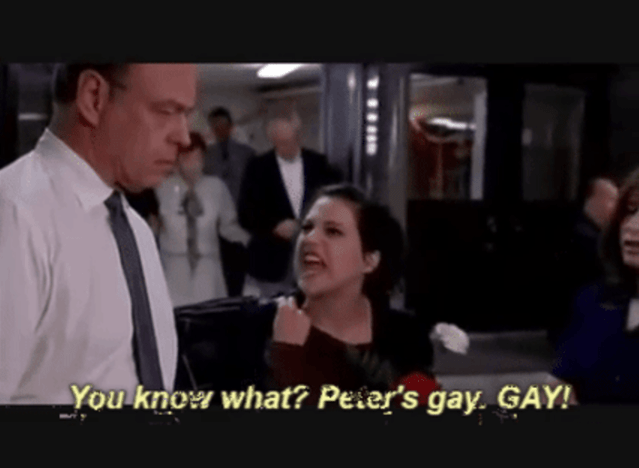
From Drop Dead Gorgeous (1998).

As someone who spent their own adolescence closeted even to themselves, this could be something I’m more inclined to see than other readers, though others have also theorized about Holden’s queerness.

My last post mentioned the prominence of clothes in Rage–specifically in relation to sex–and clothes are used as a narrative device quite a bit in Catcher, too (which I’ve written more about here). And both texts’ narrators’ queerness often expresses itself via their frequent invocations of clothing.

In Rage, when Charlie is unable to get it up with Dana at the college party, he broaches the topic of his possible queerness more directly than Holden ever does, and in a way that implicitly points out how the phrase “coming out of the closet” implicitly invokes clothes:

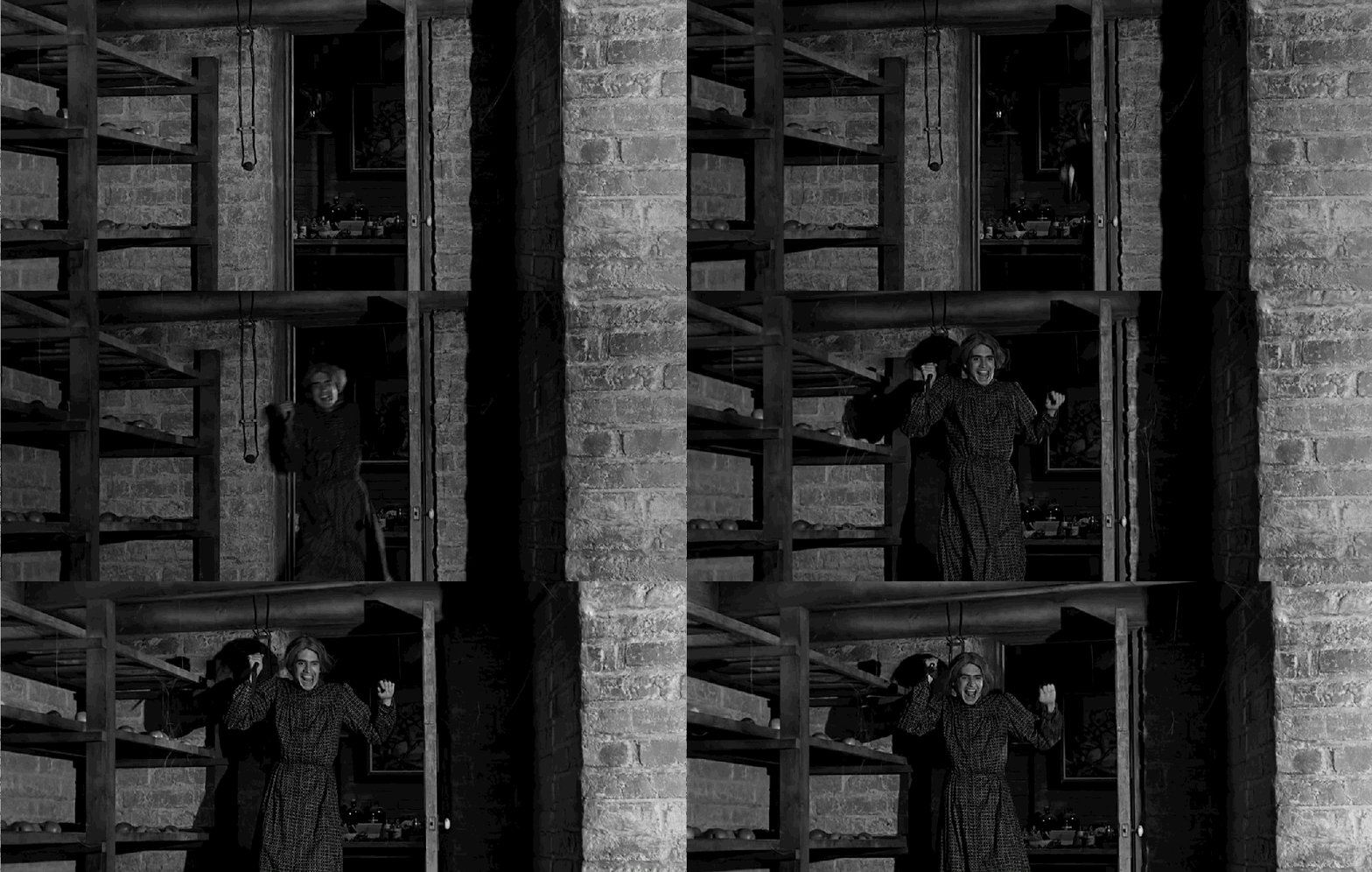
The cold certainty that I was queer crept over me like rising water. I had read someplace that you didn’t have to have any overt homosexual experience to be queer; you could just be that way and never know it until the queen in your closet leaped out at you like Norman Bates’s mom in Psycho, a grotesque mugger prancing and mincing in Mommy’s makeup and Mommy’s shoes.

The out-of-the-closet climax in Psycho (1960).

Fun fact: the angle never shows Norman wearing Mommy’s shoes in the film, and he’s not wearing women’s makeup either. But that the epitome of horror is a man dressed up in women’s clothes (well, okay, his mother’s clothes) doesn’t seem like it would create positive associations with non-normative gender expressions…

This Rage passage also shows how Charlie’s worldview has been shaped by movies, a characteristic that seems to be contributing to his general disaffectedness in a way that turns out to be pretty similar to Holden’s, if not as artfully realized. The Hollywood influence is responsible for both of these characters repressing themselves into depression.

Charlie’s Psycho reference expresses an attitude of fear and horror toward queerness, or more specifically toward the the idea of being queer himself: being queer is on par with the grotesqueness manifest in Norman Bates wearing his mother’s clothes, that fundamental part of what makes that character the eponymous “psycho.” This iconic film in part expresses a larger cultural attitude Charlie’s been compelled to adopt that being attracted to another guy, and not being able to “perform” with a woman, is a living nightmare, because it implicitly means he’s not really a “man” as society defines one. And these feelings of inadequacy are a big part of what has driven Charlie to take some form of power back via the “stick” of his father’s pistol.

It’s hard to take Charlie’s admission, this “certainty,” that Charlie is queer at face value. He’s quite inebriated at this point, for one thing. For another, his queerness is not ever explicitly mentioned again, making it seem more like a deflective in-the-moment excuse that’s not meant to be taken seriously, like his weird asides about circle jerks. Though maybe those should be taken seriously as further evidence for his queerness, since I’m not sure what would be an apter symbol of performative masculinity…. Also, the day Charlie takes his classmates hostage is after the day of this college party where he’s supposedly admitted to himself he’s queer, and yet, after he’s made this admission, but before he’s mentioned it to his hostages or the reader, we see him performing (toxic) heteronormative masculinity:

A girl I didn’t know passed me on the second-floor landing, a pimply, ugly girl wearing big horn-rimmed glasses and carrying a clutch of secretarial-type books. On impulse I turned around and looked after her. Yes; yes. From the back she might have been Miss America. It was wonderful.

Pretty much everything about Charlie’s narration in the present undermines the idea that he consciously considers himself queer after his failure to perform at the college party, since he doesn’t present himself as such to the reader. The above passage would seem to offer clues of unconscious queerness via the fact that he can only appreciate a girl’s beauty “[f]rom the back.”

Charlie’s descriptions of Joe McKennedy and his relationship with Joe especially belie–if inadvertently–the interpretation that there’s not a more meaningful layer of queerness present, offering further evidence that the above passage is mere posturing on Charlie’s part. I postulate that Charlie is, if not secretly in love with Joe McKennedy, at the least (strongly) sexually attracted to him.

Joe was a friend, the only good one I ever had. He never seemed afraid of me, or revolted by my weird mannerisms …. I had Joe beat in the brains department, and he had me in the making-friends department. …. But Joe liked my brains. He never said, but I know he did. And because everyone liked Joe, they had to at least tolerate me. I won’t say I worshiped Joe McKennedy, but it was a close thing. He was my mojo.

Those final two sentences are the most loaded of all, since whenever you say something you’re not saying, you’re still saying it… it’s pretty ironic that Charlie “won’t say” what he’s saying (sort of) between the lines here about “worshipping” Joe, when his whole mission is supposed to be saying the things you’re not supposed to say. Plus “mojo” is a word that I have strong sexual associations with for some reason…

Sir Austin Powers.

For other queerly suspicious Joe references, Charlie sees Joe after coming back into the college party following his dawning “certainty” of his queerness:

Joe was over in a corner, making out with a really stunning girl who had her hands in his mop of blond hair.

This is another example of Charlie performing heterosexual masculinity in his narration, in this case juxtaposed with the true object of desire that performance is meant to deflect from. Here we have a lame, abstract descriptor for the female–“stunning”–while when Charlie looks at Joe, he sees the more concrete “mop of blond hair.” That shows who he’s really looking at more closely.

Joe is present and a potentially integral part of the critical incident when Charlie is twelve and gets beaten up for wearing the corduroy suit; Joe intervenes, which emasculates Charlie and makes the incident even more humiliating. Joe and Charlie also go on a double date, during which Charlie, due to his stomach problems, throws up in Joe’s car and has a generally miserable time. It seems that Joe helping him get access to girls is the surface reason Charlie calls Joe his “mojo,” but then when he’s on a date with a girl, he’s too sick to do anything. It seems the unspecified root of Charlie’s stomach problems–specified as the root of his violence in the form of the reason he claims he started bringing the pipe wrench to school–could likely be his repressed sexuality.

Joe is also present in a sex dream Charlie has about his mother following the dream where his father had a stake driven through his crotch. The mother dream is more graphic: his mother is giving him an enema while Joe fondles her (he also initially thinks Joe is waiting for him outside before realizing Joe is there participating). These dreams potentially draw a problematic parallel between Charlie’s attraction to Joe and his attraction to his parents, creating an implication that a sexual attraction to either or both of your parents is as sick as a homosexual attraction to your best friend. Or maybe the implication is just that because of the attitudes of the culture around him, he thinks these two things are equally sick. According to Freudian theory, it’s a certain level of normal to have an unconscious sexual attraction to your parents; what makes Charlie abnormal is that the unconsciousness of these attractions seems to have become more conscious, and this abnormality is implied to be the reason he’s turned murderer, and thus would be the source of his titular “rage,” as it were.

At the novel’s end, Joe is absent in body but present in the form of a letter to Charlie, in which his language that he and everyone else are “pulling for” Charlie is suspiciously reminiscent of Charlie’s constant references to circle jerks throughout the text. One of the redacted parts of the letter also seems to have possibly queer undertones:

Maybe you know what happened to Pig Pen, no one in town can believe it, about him and Dick Keene [following has been censored as possibly upsetting to patient], so you can never tell what people are going to do, can you?

These redactions and Charlie’s “secret” in the form of not liking custard at the end seems to signal that Charlie has returned to the world where the taboo is once again unspeakable–which could mean that he’s cured or what’s considered “normal.” But the custard secret struck me as an objective correlative for queerness–the custard is a cover for the real secret–that everyone, including the reader, thinks he likes women when he really doesn’t…and his framing it this way enables him to keep the secret even from the reader, and possibly still himself.

Charlie’s repeated performances of heterosexual masculinity due to fear of his own queerness recall the novel’s thematic references to Teddy Roosevelt’s “big stick” idea of performing military prowess as a form of defense/security. This would seem to show (whether consciously on King/Bachman’s part or not) that the ethos of individual American masculinity is bound up with the explicitly masculine imperialist ethos of our country, as expressed in fittingly phallic language…

Aside from references to Joe, there’s an interesting little moment in the first description of Ted that one could read a deeper meaning into with a queer lens:

Ted Jones … was a tall boy wearing wash-faded Levi’s and an army shirt with flap pockets. He looked very fine. 

I mentioned in the previous post how Ted’s army-associated clothes link him to Charlie’s father, who’s wearing his navy uniform in the pseudo sex dream Charlie has about him. “Very fine” might be an abstract descriptor similar to the girl he describes as “stunning,” but that it comes on the heels of a very specific description of Ted’s clothing is again a concrete way of showing how closely Charlie is looking at him.

Charlie’s sex dream about his father in particular illustrates the influence of Hollywood on his psyche: he sees his father in a coffin in “the basement of an old castle that looked like something out of an old Universal Pictures movie”–the basement being a classic metaphor for unconscious part of the mind. The “stake” in his father’s crotch is also a version of the “stick” of Teddy’s performative masculinity foreign policy. It also seems to indicate a sort of paradoxical sexual desire in figuring the penis being penetrated by a penis-like object…which might also connect to how Charlie himself is penetrated by the “stick” of Philbrick’s gun in the novel’s climax, which Charlie intentionally provokes him into doing for no stated reason:

I made as if to grab something behind Mrs. Underwood’s desktop row of books and plants. “Here it comes, you shit cop!” I screamed.

He shot me three times.

The gun-as-stick links Charlie’s cinema-centered sexuality issues to his gun violence: gun violence as expression of repressed sexuality.

Charlie’s patterns have a predecessor in depicting a need to perform heterosexual masculinity originating from performances on the silver screen. As one Goodreads reviewer put it, “In this Bachman book, Holden Caulfield takes the Breakfast Club hostage with a pistol.”

Teenage concerns in The Breakfast Club (1985).

The Catcher in the Closet

The Hollywood influence in Catcher appears in the first paragraph:

I mean that’s all I told D.B. about, and he’s my brother and all. He’s in Hollywood. …  Now he’s out in Hollywood, D.B., being a prostitute. If there’s one thing I hate, it’s the movies. Don’t even mention them to me. 

But Holden will mention them several more times, including a lengthy description of a movie he goes to see to kill time, purportedly by way of illustrating how terrible (i.e., phony) it is but really inadvertently demonstrating how closely he’s paying attention to it. He also frequently likes to “horse around” and play out little fantasies, like having to hold his guts in after he’s been shot. He sometimes fantasizes that a woman is taking care of him when he’s been shot, specifically Jane, a former neighbor that, via his narration, he performs a level of sexual interest in by describing things like the only time they “ever got close to necking.” That the text immediately connects Hollywood’s influence to “being a prostitute” connects Holden’s sexual anxieties–as expressed through his performance of heteronormative masculinity–to the fantasies that movies put in his head.

Movie star wisdom in The Aviator (2004).

That is, Holden inadvertently expresses in the novel’s opening that he hates movies due to their depictions of sex specifically. He locates Hollywood as the source of a cultural standard of (toxic) masculinity/virility that will implicitly be responsible for his compulsion to procure a prostitute later in the novel, an exchange that will further evidence his queerness and conflate sex and violence in a manner that’s similar to Rage‘s use of that conflation and how it expresses the violence of sexual repression.

But before the actual prostitute makes an appearance, other clues start to point toward the true source of Holden’s malaise. As the book opens with Holden indicting Hollywood, he’s literally looking down on a football game he’s not attending because “[t]here were never many girls at all at the football games” and “I like to be somewhere at least where you can see a few girls around once in a while” and the only girl who usually attends “wasn’t exactly the type that drove you mad with desire.” He tells us that he’s supposed to be at a match with the fencing team but they had to come back early:

I left all the foils and equipment and stuff on the goddam subway. It wasn’t all my fault. I had to keep getting up to look at this map, so we’d know where to get off. 

Then clothes start to express queerness. Holden procured a distinctive red hunting hat on his brief foray into the city with the fencing team just before the novel started. When his non-friend Ackley tells him it’s a “‘deer shooting hat,'” Holden clarifies that it’s “‘a people shooting hat. … I shoot people in this hat'” (he’ll also shortly note that “I really got a bang out of that hat.”). Holden’s roommate Stradlater storms in asking to borrow Holden’s houndstooth jacket for a date, but Holden is afraid Stradlater will “‘stretch[] it with your goddam shoulders and all,'” redundantly clarifying for the reader that Stradlater “had these very broad shoulders.” (Concrete attribute!) Also: Then Stradlater heads to the bathroom to groom for his date:

No shirt on or anything. He always walked around in his bare torso because he thought he had a damn good build. He did, too. I have to admit it. 

Holden follows Stradlater to the can (hmm), where, not irrelevantly, he does one of his movie-inspired “horsing around” routines (tap dancing in this case). He finds out that Stradlater’s date is with Jane, the girl he’s convinced himself he’s attracted to in lieu of admitting he’s attracted to Stradlater. Even Stradlater’s name–straddle…later–expresses his true queer function, that Holden secretly wants to straddle him but can’t presently cope with/acknowledge that desire.

While Stradlater is gone on his date with Jane, Holden can’t stop thinking about the fact that Stradlater is gone on the date, another instance of narrative heteronormative performance wherein the locus of anxiety is implied to be Jane but is more likely really Stradlater. When Stradlater returns from the date–on which he wore Holden’s jacket, the one Holden had to say he didn’t want Stradlater to wear so as to seem the opposite of attracted to his “broad shoulders”–Holden expresses his anxiety in a conflation of sexual desire and violence, getting in a physical altercation with Stradlater that ends with Stradlater pinning him down by sitting on his chest. The male fistfight/wrestling match as stand-in/substitute for the sex you want but can’t have.

This desire-displacement situation with Stradlater and Jane reminded me of Charlie’s performance of desire for Sandra Cross in Rage, manifest in clothes again via an oft-referenced peek Charlie got at her “white underpants,” and which culminates in the moment Charlie is motivated to shoot Ted when Sandra reveals she had sex with him. Charlie narrates this sequence to read as though his motivation to shoot Ted is a product/evidence of his heteronormative desire for Sandra, when really it’s more likely for nonheteronormative desire for Ted, the boy he thinks looks “very fine.”

As if to highlight that the houndstooth jacket of Holden’s that Stradlater wears on his date with Jane came out of Holden’s closet, Holden randomly fetches something that requires him to return to it while Stradlater is gone:

The second I opened the closet door, Stradlater’s tennis racket–in its wooden press and all–fell right on my head. 

The one railing against phonies is the one most likely to be a phony (the real reason Holden is obsessed with phoniness is because he feels he can’t be who he really is–i.e., GAY), and Holden has pretty much told us outright he is one:

I’m the most terrific liar you ever saw in your life. 

And it stands the “most terrific liar” would be the one capable of lying even to himself… He also pretty clearly demonstrates his own phoniness in (at least) one instance when he calls up a former classmate to see if he’ll meet for a drink:

I think he was pretty surprised to hear from me. I once called him a fat-assed phony. 

If Holden thinks this guy’s a phony, he’d have to be some kind of phony himself to be calling him up to meet with him. During this particular meeting Holden continues to demonstrate his own phoniness/unreliability when he acts like he has a “sex life” when we know he has none to speak of, since he’s told the reader by this point that “[i]f you want to know the truth, I’m a virgin. I really am.” He didn’t tell us this for awhile though, not until after he’s agreed to have the prostitute sent up to his hotel room. Before his admission, he called out some other guy for being a virgin in a way that implied he himself was not a virgin:

He was a virgin if ever I saw one. I doubt if he ever even gave anybody a feel. 

Holden’s explanation for why he’s still a virgin reveals how his malaise is largely wrapped up in specifically sexual anxiety and how queer-shaming is connected to rape culture in creating that standard of toxic masculinity that drives men to violate women as a means of proving their masculinity:

The thing is, most of the time when you’re coming pretty close to doing it with a girl–a girl that isn’t a prostitute or anything, I mean–she keeps telling you to stop. The trouble with me is, I stop. Most guys don’t. I can’t help it. You never know whether they really want you to stop, or whether they’re just scared as hell, or whether they’re just telling you to stop so that if you do go through with it, the blame’ll be on you, not them. 

Men, always trying to find a loophole in “No means no”…

Presidential testimony.

Another terrifyingly misogynist sequence, one that’s connected to movies, is when Holden talks to three women at a bar whom he refers to as “dopes”:

The two ugly ones’ names were Marty and Laverne. … I tried to get them in a little intelligent conversation, but it was practically impossible. You had to twist their arms. You could hardly tell which was the stupidest of the three of them. And the whole three of them kept looking all around the goddam room, like as if they expected a flock of goddam movie stars to come in any minute. They probably thought movie stars always hung out in the Lavender Room when they came to New York, instead of the Stork Club or El Morocco and all. 

Holden seems to hate women due to his own lack of desire to do anything more with them than have “intelligent conversation”…

So now he wants to just get this goddam virginity lost already with a prostitute. Before she gets to his room, he sees some other hotel patrons out the window:

I saw one guy, a gray-haired, very distinguished-looking guy with only his shorts on, do something you wouldn’t believe me if I told you. First he put his suitcase on the bed. Then he took out all these women’s clothes, and put them on. Real women’s clothes–silk stockings, high-heeled shoes, brassiere, and one of those corsets with the straps hanging down and all. Then he put on this very tight black evening dress. I swear to God. Then he started walking up and down the room, taking these very small steps, the way a woman does, and smoking a cigarette and looking at himself in the mirror. He was all alone, too.

That this guy is “gray-haired” is a pretty significant link to Holden, who mentions his own premature gray hair several times. The suitcase is also an important object popping up throughout the novel as well, further reinforcing that this guy is a version of Holden, revealing what Holden’s concealing in his psychological suitcase. The use of clothes here reveals their transformative potential and how they’re an expression/performance of both gender and sexuality. Holden’s performance of shock at this sight is reinforced as being specifically for the reader: “you wouldn’t believe me if I told you.” But the man is “looking at himself in the mirror” because by looking at this man, Holden is essentially looking at himself in a mirror. And what does he see? That the man is “all alone, too.” Here’s a potential key to his malaise: to be this way, which would be his true, non-phony self, will lead to him being alone.

So then the time comes to do it with the prostitute–who seems to emphasize that this is what time it is by asking him three times if “‘ya got a watch on ya,'” and as signified, of course, by a removal of clothing…

…and then she stood up and pulled her dress over her head. 

I certainly felt peculiar when she did that. I mean she did it so sudden and all. I know you’re supposed to feel pretty sexy when somebody gets up and pulls their dress over their head, but I didn’t. Sexy was about the last thing I was feeling. I felt much more depressed than sexy. 

Why does he feel this way? The surface, performative, unreliable narration is geared to have us believe that it has something to do with her only attribute he’s noted up to this point–she’s about his age, i.e., young to be in this line of work. And perhaps there’s some hint that the element of monetary exchange is tainting the transaction, rendering it, as he would say, “phony.” He immediately offers an excuse for why he feels “peculiar”–because she took the dress off so suddenly.

He repeats for the reader that he feels “peculiar,” then tries to stall by making conversation, asking, among other things, where she’s from–“‘Hollywood'”–before he makes up a ridiculous lie (so phony!) about being unable to go through with it because he’s just had an operation. She eventually leaves but returns with her pimp, Maurice, who also ends up disrobing in Holden’s room:

Old Maurice unbuttoned his whole uniform coat. All he had on underneath was a phony shirt collar, but no shirt or anything. He had a big fat hairy stomach. 

Of course, the male disrobing is depicted as grotesque and here signifies a threat of violence, reflecting Holden’s general disgust with the idea of male disrobing, a stand-in for gay sex–or rather, disgust with his own interest in the idea–and thus his horror of and resistance to his interest driving him to depression. Maurice continues to conflate sex and violence:

Then what he did, he snapped his finger very hard on my pajamas. I won’t tell you where he snapped it, but it hurt like hell. 

After Maurice and Sunny the prostitute leave, Holden acts out one of his I’ve-been-shot fantasies, including Jane in it as a way to perform his heterosexuality to both himself and the reader, and then he specifically identifies movies as the fantasy’s source:

I pictured her holding a cigarette for me to smoke while I was bleeding and all. 

The goddam movies. They can ruin you. I’m not kidding. 

This explicit link between the movies and his fantasies, referred to elsewhere by him as “horsing around,” potentially illuminates something Holden thinks about his virginity:

Half the time, if you really want to know the truth, when I’m horsing around with a girl, I have a helluva lot of trouble just finding what I’m looking for, for God’s sake, if you know what I mean. 

Seems like he means he’s looking for something a girl doesn’t have… The phrase “horsing around” here is a lingual link between the movie fantasies and sex, reinforcing the inextricable link between these things in Holden’s psyche.

Literature has also apparently influenced Holden on the old sex front, as he describes a book he once read by way of explanation for why he feels the need to practice with a prostitute:

I read this book once, at the Whooton School, that had this very sophisticated, suave, sexy guy in it. Monsieur Blanchard was his name, I can still remember. It was a lousy book, but this Blanchard guy was pretty good. …. He was a real rake and all, but he knocked women out. He said, in this one part, that a woman’s body is like a violin and all, and that it takes a terrific musician to play it right. It was a very corny book–I realize that–but I couldn’t get that violin stuff out of my mind anyway. 

It’s probably important that Holden emphasizes this book is “corny,” i.e., basically on par with the terrible movie he describes and only “literature” in the literal sense of being a book–the ideas about sex/masculinity it’s conferring are equally unrealistic/toxic, and to Holden, equally influential. At a bar, he happens to note:

If I were a piano player, I’d play it in the goddam closet. 

If the female body has been figured as a violin, then it stands to reason the male body would be a different instrument, like possibly a piano…

Holden’s eye for clothes could definitely read as attuned in a Queer Eye/Tim Gunn gay fashion guru sort of way…

Fashion feedback on Project Runway.

This is something else Charlie has in common with Holden…

I reached into my back pocket and brought out my red bandanna. I had bought it at the Ben Franklin five-and-dime downtown, and a couple of times had worn it to school knotted around my neck, very continental, but I had gotten tired of the effect and put it to work as a snot rag. Bourgeois to the core, that’s me.

This is a passage from Rage, but it bore such a strong resemblance to Holden’s red hunting hat that I went back looking for this “continental” description in Catcher.

Holden further demonstrates his queer eye for clothes by ogling some of his sister’s when he sneaks home:

Old Phoebe’s clothes were on this chair right next to the bed. …. She had the jacket to this tan suit my mother bought her in Canada hung up on the back of the chair. Then her blouse and stuff were on the seat. Her shoes and socks were on the floor, right underneath the chair, right next to each other. I never saw the shoes before. They were new. They were these dark brown loafers, sort of like this pair I have, and they went swell with that suit my mother bought her in Canada. My mother dresses her nice. She really does. My mother has terrific taste in some things. She’s no good at buying ice skates or anything like that, but clothes, she’s perfect. 

While Holden’s home, his parents return from a party, and he has to hide in the closet. But don’t worry, because:

Then I came out of the closet. 

His next move is to go stay with a former teacher, Mr. Antolini, “a pretty young guy” whom he notes is married to a woman who’s “about sixty years older” than him and “lousy with dough.” He also notes that Mr. Antolini tried to stop Holden’s brother D.B. from going out to Hollywood because he thought D.B. was too good a writer for it. Holden endures some drunken lecturing from Antolini and gets to sleep on the couch…

Then something happened. I don’t even like to talk about it. 

I woke up all of a sudden. I don’t know what time it was or anything, but I woke up. I felt something on my head, some guy’s hand. Boy, it really scared hell out of me. What it was, it was Mr. Antolini’s hand. What he was doing was, he was sitting on the floor right next to the couch, in the dark and all, and he was sort of petting me or patting me on the goddam head. Boy, I’ll bet I jumped about a thousand feet. 

Mr. Antolini tries to act like he wasn’t doing anything untoward, but Holden stammers lame excuses and flees:

Boy, I was shaking like a madman. I was sweating, too. When something perverty like that happens, I start sweating like a bastard. That kind of stuff’s happened to me about twenty times since I was a kid. I can’t stand it. 

It’s unclear here if by “something perverty” Holden means other guys in general or older men making passes at him… But he seems a bit overly insistent that he “can’t stand it.”

The other context in which homosexuality comes up explicitly is when Holden is waiting at a bar for his old classmate Luce, the one he once called a “fat assed phony”:

The other end of the bar was full of flits. They weren’t too flitty-looking–I mean they didn’t have their hair too long or anything–but you could tell they were flits anyway. 

Takes one to know one… That long hair is apparently associated with “flittiness” probably explains why Holden wears his hair in a crew cut.

Holden called Luce a phony yet seems to consider him a genuine expert on sexual matters, including one that Holden might have a certain preoccupation with:

He knew quite a bit about sex, especially perverts and all. He was always telling us about a lot of creepy guys that go around having affairs with sheep, and guys that go around with girls’ pants sewed in the lining of their hats and all. And flits and Lesbians. Old Luce knew who every flit and Lesbian in the United States was. All you had to do was mention somebody–anybody–and old Luce’d tell you if he was a flit or not. Sometimes it was hard to believe, the people he said were flits and Lesbians and all, movie actors and like that. 

Some intersection of queerness and Hollywood at the end there…Holden probably would like to think that the very people whose performances of heterosexual domesticity and masculinity are responsible for his own performances of the same might be more akin to what he is in real life…

Holden goes on a bit more about how Luce scared him into thinking he might be a flit before assessing Luce as “sort of flitty himself, in a way.” If Luce is a genuine sexpert as far as Holden thinks, then perhaps this potential flittiness is part of why Holden thinks Luce is a phony. But Luce is really just another version of a mirror Holden is looking at…

An analysis of Holden’s exchanges with Sally, his old sort-of girlfriend, would add further textual evidence for Holden’s queerness, but I’ll limit to one observation he makes while he’s out on his date with her:

On my right there was this very Joe Yale-looking guy, in a gray flannel suit and one of those flitty-looking Tattersall vests. All those Ivy League bastards look alike. My father wants me to go to Yale, or maybe Princeton, but I swear, I wouldn’t go to one of those Ivy League colleges, if I was dying, for God’s sake. Anyway, this Joe Yale-looking guy had a terrific-looking girl with him. Boy, she was good-looking. 

Funny that his expression about a girl’s attractiveness is framed with “Boy”… Here we again witness Holden’s consciousness of clothes, more specifically his awareness of how clothes have the potential to make you look “flitty” (and by implication, not flitty). By associating the “flitty-looking” clothes with the Ivy Leagues and then vehemently disavowing the Ivy Leagues–representative here of his parents’ desires for his future–he’s symbolically attempting to disavow his own flittiness, hence there’s probably a direct correlation between his repressed sexuality and his repeatedly flunking out of school. His disavowal is then reinforced by his immediately claiming to find a girl “good-looking” after claiming that all guys to him, or Ivy League ones anyway, look alike. But he’s still using an abstract descriptor for the female, like Charlie, while he in fact saw something more concrete about the dude in observing his vest.

Both Holden and Charlie express a desire for authenticity in response to the repression of the establishment of polite, cultured society, and yet through the performance of masculinity in their unreliable narration, both fail to live up to their own standard, specifically through the failure to confront their own queerness. Their compulsions to perform straightness are linked to the performance of unrealistic fantasies they’ve witnessed in the movies. They’ve been molded by the movies that manifest the larger culture’s homophobia and misogyny, internalizing standards they can’t live up to, and so they both end up in institutions, isolated ostracized from society.

Pretty cheerful stuff…

Drill, Baby, Drill

Post-Covid, in an increasingly online world, maybe there will be fewer opportunities for school shootings, but up to this point, as someone who teaches both at a college and at a high school, their possibility is something that was always in the back of my mind (kind of like the possibility of getting covid is now…).

I was in the eighth grade when Columbine happened, and even though school shootings obviously became increasingly prevalent afterward, my high school had no protocol was in place for the occurrence. So I was a little caught off guard when the siren started blasting at the high school where I teach part-time now, and a voice over the intercom announced we were having a school-shooter drill. The students had to tell me what to do, since no one else had. Lock the door, turn out the lights, close the windows, hunker by the base of a wall, be quiet. But the door required a key to lock, which as a part-time “consultant,” I did not have. Fortunately, the teacher next door somehow realized this and came over to lock it–fortunate because someone did come around to test the knob and check the windows, and I didn’t want to look like a total ass.

The students were dead silent during the drill–a noticeable anomaly–and always have been in the ones we’ve done since. They’re creative-writing students at an arts school, and you can almost hear everyone’s brains humming as we hunch in the dark, summoning the tension and drama of a real shooter stalking the halls. (Or maybe that’s just me imagining it.) Yet I still always think this is the last school that would have such a shooter. I think this because the kids are allowed to be who they are, the art school’s expressive ethos the antithesis of the average repressive American high school’s. They don’t even have sports teams! It’s pretty much in every way the polar opposite of my Catholic high school, repression personified, any frustration at such played out on a field or court with clearly demarcated lines (though not without some violence). But then of course I have to mentally knock on wood, because even if I had at times–absurdly I know–thought of the school as the happiest place on earth when I walked in to snatches of live violin music or the heavy bass of dance music thumping down the main black-and-white-checkered hall where Beyoncé herself had once walked as a student, you still never knew.

Then I went to a training for the college that made imagining a shooter stalking the hallways outside my classroom a little more possible than I would have liked. In February of 2018, the day before the Parkland school shooting, an email went out from UH’s emergency alert system that there was a report of a person with a weapon on campus who was considered dangerous. The email said they would send out more information when it was available, but I can’t find any such email in my inbox now. I remember the weapon turned out to have been misidentified and was a tape dispenser or a dispenser of some sort.

Probably Parkland compounded this incident to motivate the university’s police department to offer emergency-response trainings. Thus it was that under the pretext of a lesson I did not retain, a campus officer played a group of English Department teachers a recording of a 911 call that the Columbine High School librarian made while the shooters were outside in the hall. I had read the journalist Dave Cullen’s book Columbine years before, and I recalled, with mounting dread, that most of the carnage had taken place in the library.

The officer had not given much, if any, warning before playing this recording. I could hear sniffles around me as the librarian on the line with the operator said the shooter was right outside the door, screamed at the kids in the library to stay on the floor, and the gunshots began going off. The recording ends with the librarian whispering that the shooter is in the library.

The idea of dying to protect our students was probably broached in this training. It’s occurred to me, self-servingly, that many of my students would probably be more willing and able defenders than myself, either with guns themselves–concealed carry is allowed on campus–and/or with military experience likely including more specific training in disarming assailants than listening to 911 calls of teachers trying to keep their students calm before shooters come in shooting to kill. I don’t get hazard pay.

The fact that I have to think about any of this both is and is not ridiculous.

One of the few pieces of practical advice from the training was to assess your classroom for possible escape routes, like using a desk to break a window to get out. That semester one of my classes was in a windowless basement classroom, so I’d be stuck with another practical piece of advice–tying a belt around the doorknob to hold it closed with more leverage (teachers can’t lock classroom doors from the inside in most campus buildings). One day I showed up and a lot more students than usual were absent. I asked what was up and was told that someone had posted some kind of threat on social media about a possible shooting. Unsettling, but no official university alert had gone out, so I did what I pretty much always do when in doubt–continue with class.

I had a belt on, after all.

Pop Culture Lessons

It’s well known among college composition teachers that there are a handful of topics comp students will gravitate toward if left to their own devices: legalizing marijuana (it’s still illegal in Texas), abortion, and gun control. I try to steer students away from the clichés associated with these topics by having them look at issues through the lens of pop culture texts. If they want to write about one of these topics, they have to write about a pop culture text’s treatment of the topic.

I use gun control as an example topic, not just talking about how pop culture texts treat it, but also how pop culture texts have influenced this country’s gun violence problem as much as gun-control legislation (or lack thereof). Of course the treatment and influence is related–the idea that pop culture texts both reflect and shape our world. And the intersection of pop culture and gun violence struck me (likely because I teach this so much) as a thematic element King/Bachman was exploring in Rage.

I lean heavily on the concept of “implications” in teaching students to analyze pop culture texts (which can then be applied to any text). An implication is defined as “the conclusion that can be drawn from something, although it is not explicitly stated.” We practice looking for implications with the statement:

He engages the safety without having to look at the revolver.

David Foster Wallace, Infinite Jest (1996)

If “He” doesn’t even have to look at the gun to know where the safety is, it stands to reason that he must be pretty familiar with this weapon. It also seems possible he might have recently thought he was in danger then decided he wasn’t, if he had the safety of his gun off and is now thinking it’s safe to put the safety on. Then there’s the fact that this passage is from a novel; one student pointed out that revolvers don’t have safeties. If that’s the case, you might conclude that the person who wrote this passage is not very familiar with guns–certainly not as familiar as they’re trying to imply their character is. But other students have claimed that some types of revolvers do have external safeties. I’m not a gun expert myself.

We practice looking for implications in a children’s book by Lemony Snicket, The Bad Mood and the Stick (2017). A male character, Lou, has fallen in a mud puddle goes into a dry cleaner’s and tells the woman who runs it, Mrs. Durham, that he’s going to take his pants off so she can clean them. Mrs. Durham replies, “‘You will do no such thing… This is a family place.'” But Lou’s already got his pants off before she’s finished saying this. The text offers that “you would think” this would cause Mrs. Durham to catch the contagious bad mood going around, “[b]ut it didn’t.” In fact the opposite: she takes one look at Lou in his underwear, and her mood improves!

A (horrifying) sequence from Lemony Snicket’s The Bad Mood and the Stick (2017).

Despite the fact that Mrs. Durham is referred to exclusively as “Mrs. Durham,” implying she is already married, she marries Lou at the end of the book. Entire destinies shifted into alignment, all thanks to a man taking off his pants without permission!

This book happens to have been published in October of 2017–the month the stories about Hollywood producer Harvey Weinstein’s serial sexual assaults broke–and struck me as a quintessential example of a problematic depiction of consent–or of a lack thereof. Technically, according to the way it’s written, Lou has taken off his pants before Mrs. Durham can even manage to explicitly tell him not to, so it’s not like he ignores her, more like he doesn’t even bother to hear what she has to say one way or the other, implying her response is irrelevant either way, implying consent is irrelevant. Nonetheless, Mrs. Durham is also basically shown saying a form of “no,” and instead of getting mad at Lou for doing what she’s said no to anyway, she’s shown to actually appreciate that he does it anyway, implying she was dumb to say “no” in the first place, implying that overriding a woman’s “no” will actually be for her own good as well as the man’s. The implications are shockingly reminiscent of Holden’s idea that girls might just be “telling you to stop so that if you do go through with it, the blame’ll be on you, not them.”

Looking at Snicket’s text again after reading Rage, it also seems another example of the problems with the “stick,” that phallic object that Teddy Roosevelt so long ago invoked not necessarily to inflict violence, but to, at the least, perform the possibility of violence as a means to gain/maintain power. The titular stick doesn’t appear in the aforementioned sequence, but throughout the text is the means through which the bad mood is transferred to different characters, and plot-wise is responsible for Lou ending up in Mrs. Durham’s dry cleaners. This whole dynamic between the bad mood and stick might seem to be sending an ethical message that good things can come from things that initially seem bad (like falling in a mud puddle leading you to meet your future spouse), so you shouldn’t get overly frustrated when bad things happen, but when you frame this in terms of a woman’s consent, it definitely becomes problematic as a means to justify a conception of no-means-yes (as the backlash over a comment that Sansa Stark made near the end of Game of Thrones might further indicate).

Before the Snicket book and #MeToo, I’d also been using some texts about Elliot Rodger and the 2014 Isla Vista killings to facilitate the discussion about the intersection of pop-culture texts and gun violence. Rodger’s father Peter works in Hollywood, is known for being “second unit director on The Hunger Games (2012),” and a controversial article by Washington Post film critic Ann Hornaday notes that Elliot Rodger seemed to be playing a version of a Hollywood villain in the Youtube videos he made explaining the motives for his massacre, or what he termed his “retribution.” Hornaday raises the possibility of a larger pop cultural influence on Rodger:

How many students watch outsized frat-boy fantasies like “Neighbors” and feel, as Rodger did, unjustly shut out of college life that should be full of “sex and fun and pleasure”? How many men, raised on a steady diet of Judd Apatow comedies in which the shlubby arrested adolescent always gets the girl, find that those happy endings constantly elude them and conclude, “It’s not fair”?

Movies may not reflect reality, but they powerfully condition what we desire, expect and feel we deserve from it.

Ann Hornaday, “In a final videotaped message, a sad reflection of the sexist stories we so often see on screen,” May 25, 2014.

Judd Apatow and Seth Rogen were not happy about this article, but don’t worry, Hornaday’s linking their movie to Rodger’s motives did not preclude a sequel (about a sorority instead of a fraternity–progress!). Hornaday provides statistics showing that the overwhelming majority of Hollywood blockbusters–i.e., most of the visual texts mainstream society is exposed to–are made by white men. Meaning mainstream cultural attitudes are dictated by…(straight) white men. Aka Hollywood perpetuates the patriarchy.

One scene from Neighbors (2014) that I look at with my classes seems to offer possibly ethical implications while undermining that with unethical ones. In it, the vice president of the fraternity, Pete, tries to convince the president of the fraternity, Teddy, that it doesn’t really matter if they get their picture on the frat Wall of Fame, and claims that Teddy is really just prioritizing this ultimately meaningless goal because he’s afraid of facing his post-college future. This sounds ethical: a message that the future is really more important than the frat. But in this conversation, VP Pete also implies there’s a different reason the Wall-of-Fame goal is frivolous:

TEDDY: “Who cares?” Are you kidding me? You’re the VP, man. We have wanted this since we were freshmen.

PETE: Dude, that was four years ago, okay? We were fucking virgins. All right? We’re about to be, like, adults now. In two weeks, none of this is even gonna matter.

The Wall doesn’t matter because they’re going to graduate, but when Pete says “We were fucking virgins” (“fucking” presumably used a modifier instead of an active verb in this construction), he implies that the Wall doesn’t matter because they’ve already attained the true, most important goal: not being virgins.

The frat boy and his stick in Neighbors (2014).

And that goal seems to be the one that obsessed Elliot Rodger–not to mention Catcher‘s Holden Caulfield and Rage‘s Charlie Decker. While Rodger apparently felt isolated because of it, the rise of the rage-based Incel movement, which takes Rodger as its icon, would indicate he’s hardly alone. That the vehicle seems to be a common homicidal weapon among this disturbed consort, and that Rodger also stabbed some of his victims in addition to shooting them, would seem to support the idea that gun-control measures would be treating only a single symptom of a much more complicated disease. The pressure on the idea of not being a virgin is an implicitly heterosexual pressure (which implicitly shames queerness), one reinforced constantly in the popular movies I watched in high school: American Pie (1999) and American Pie 2 (2001), Van Wilder (2002), Old School (2003). Neighbors can be traced back to these, which can be traced back to Animal House (1978). But looking at Catcher, you can see that the preoccupation with losing your virginity as a marker of manhood goes back way further.

In October of 2017, the same month #MeToo started, a criminal incident email went out from the university police department that differed from the late-night car jackings and muggings whose suspects were always described in similarly generic terms. This one reported a sexual assault occurring around 6pm at “an on-campus outdoor social gathering” by the university’s football stadium, on the date of a football game, implying it happened at a tailgate. The suspect, described/identified as wearing a black polo with the university logo, came up behind a female student and reached under her dress.

The language of the email was, as it was in all of the police department’s reports of on-campus crimes, quite clinical, as though holding up these incidents at arm’s length like dirty diapers. Yet they’d inadvertently painted quite the picture in my mind. This suspect, presumably a student, had been in broad daylight in the middle of a crowd of people, which said to me that he likely presumed both the people surrounding him, and even the woman he was grabbing, would not have a problem with what he was doing. It seemed very possible this sense of invincibility was fueled by alcohol, but that would only have been exacerbating a pre-existing attitude. And even if I’m wrong and he was using the crowd of people as cover so the woman he was grabbing wouldn’t be able to identify him (which, if so, didn’t work), there’s still a clear sense of entitlement here.

But there was another part of the picture I hadn’t seen from the pieces in the email. When I brought it up in class as an example of why the issues in the pop-culture texts we’d been discussing were directly relevant to their lives and college experiences, one student who identified himself as a member of a fraternity mentioned that he could tell from the description in the email that the suspect was also a member of a fraternity–he could tell which fraternity (not his) from the clothing description, which in addition to the black university polo also mentioned the suspect was wearing “dark faded blue jeans.” My student informed us that each fraternity wore a specific colored school polo and jeans to tailgates, in order to distinguish themselves.

Guns,” the essay that King wrote explaining why he pulled Rage from publication, was published in response to the 2012 Sandy Hook shooting. King presents the viewer’s consumption of each mass shooting via the media as a kind of movie in which the same narrative formula cycles repeatedly with different variables, or victims. A pair of pop-culture texts that we rhetorically analyze in the comp classes was spurred by the same shooting. The visual text here of a PSA of celebrities tells viewers to “Demand a Plan” from their legislators in the wake of Sandy Hook, while the visual text here is directly responding to the first text by splicing it with clips from those same celebrities’ movies that seem to be glorifying gun violence. (Trigger warning–even if you think you’re used to cinematic depictions of gun violence, a collage of them can be a little intense.) The second text makes a pretty good point about the general hypocrisy of many celebrities; something else that irritates me about the PSA is that these celebrities are the ones who are actually have a platform to “demand a plan” from legislators; instead they bark at the faceless viewer from behind their black-and-white smokescreen of privilege: “You! Demand it!”

King has a whole section in the “Guns” essay dismembering the general argument that shootings are so prevalent in this country because of a “culture of violence” reflected in the movies:

The assertion that Americans love violence and bathe in it daily is a self-serving lie promulgated by fundamentalist religious types and America’s propaganda-savvy gun-pimps. It’s believed by people who don’t read novels, play video games, or go to many movies. People actually in touch with the culture understand that what Americans really want (besides knowing all about Princess Kate’s pregnancy) is The Lion King on Broadway, a foul-talking stuffed toy named Ted at the movies, Two and a Half Men on TV, Words with Friends on their iPads, and Fifty Shades of Grey on their Kindles. To claim that America’s “culture of violence” is responsible for school shootings is tantamount to cigarette company executives declaring that environmental pollution is the chief cause of lung cancer.

Okay, boomer…

King’s identification of that period’s most popular pop-culture texts implies–seemingly inadvertently–the dominance of a more patriarchal/misogynist culture. (His language in that first sentence–“gun-pimps,” also connects guns to sex in a manner similar to Rage‘s conflations.) The comp teacher in me also can’t help but point out that just because gun-violence-heavy movies didn’t dominate the box office during 2012–from which King concludes there’s a “clear message” that “Americans have very little interest in entertainment featuring gunplay”–might indicate that we’ve become inured to gun violence to the point that it won’t sell movies because it’s so common on the street/in schools, and also because movies have already done it to death. Focusing on box-office receipts in a single year undermines the mind-boggling scope of the presence of gun violence in popular movies, however “sanitized” in various versions. When Holden fantasizes about shooting and being shot gun violence and when Charlie imitates James Cagney being a classic/archetypal cinematic (aka glorified) gangster, their worldviews evidence the history of this presence and its influence alongside the long-running misogynist narratives that don’t feature explicit guns. That they don’t need to wield guns explicitly to dominate anymore is what should be disturbing: the patriarchy is reinforcing its own power implicitly, so you don’t even realize it’s happening.

At the conclusion of that passage, King seems to be implying that our lacking gun-control measures is the “chief cause” of our comparative situation, then goes on to enumerate several possible measures that he acknowledges are unlikely to ever come to pass that would help stem gun violence, pretty much shooting his own argument in the foot (sorry). While measures like his suggestions certainly would help if implemented, since they’re likely not going to be, we need to address what King has raised without actually addressing here–the dominance of the casually misogynistic pop-culture texts of the sort whose influence fringes the facade of Charlie Decker’s and Holden Caulfield’s faux-masculine narration, texts sending the sorts of messages Ann Hornaday highlighted that have been stoking angsty adolescent boys to rage since their inception. When you think about the fact that men like Harvey Weinstein produce so many of them, it shouldn’t be all that surprising…. At this point I don’t know if it’s less realistic to expect change on the gun-control front or the number of pop-culture texts that continue to express and perpetuate “white male rage.”

-SCR

Rage: Context and Summary

You couldn’t see the letters that made my name anymore.

Richard Bachman. Rage. 1977.

Chronological complications arise when reading King’s books according to publication date. By that schema, the next book after The Shining is Rage, the first that King published under his pseudonym Richard Bachman. I’m including the Bachman novels in my reading of “King’s work,” since Stephen King still wrote them even if “Stephen King” didn’t publish them, and since whatever contrast there presumably is between the books published under his real name and those under Bachman’s ought to provide some insight into the books published under his own name–especially the ones about writers with creepy alter egos…

There seem to be a couple of reasons King started publishing under a pseudonym. First, his publisher didn’t want to put out more than one “Stephen King” a year, otherwise his books would potentially cut into each other’s sales. Second, under Bachman’s name King seems to have published a lot of the early work that he tried and failed to get published before breaking through with Carrie. According to his biographer Lisa Rogak:

He had several first drafts of completed novels and others he had written before he had written Carrie. While some writers may have considered these novels to be just apprenticeship books, learning opportunities and unpublishable, Steve wanted them to be given a chance to see the light of day as finished books.

Lisa Rogak. Haunted Heart: The Life and Times of Stephen King. 2008.

Rogak leaves it at that, though there seems to be an implication that maybe these books shouldn’t have seen the light of day…King himself would eventually come to agree with this assessment about Rage, but more on that later.

Rage is also different from the first three novels King published under his own name in that it’s told from the first-person perspective, and contains not even a hint of a supernatural element–the horror is derived purely from the physically possible. No telepathy or vampires or literal ghosts. So we’ll see if sticking to the realistic is a definitive characteristic distinguishing the work of “Bachman” from the work of “King.”

As for chronology, Rage appeared under the Richard Bachman name in 1977, a few months after The Shining, but King actually wrote it as Getting It On back when he was in college. He sent the manuscript to his eventual publisher Doubleday not long after he graduated, where it gained him the initial attention of his longtime friend and editor Bill Thompson, and he did several rounds of revision on it at the publisher’s behest before it was ultimately rejected.

Another King expert, George Beahm, provides some context about the genesis of what was initially Getting It On, locating it in the summer after King graduated from high school in 1966:

This novel, which took its title from a rock ‘n’ roll song by T. Rex, “Bang a Gong (Get It On),” was an intense psychological study, tapping into King’s fears in high school of being an outsider, a time when he characterized himself as being filled with rage, worried whether or not he’d go crazy.

George Beahm, Stephen King: America’s Best-Loved Boogeyman. 1998.

Beahm later notes that the second Bachman book, The Long Walk, is the first novel manuscript that King actually completed. But in the sense of the themes it shares with Carrie, it feels appropriate that Rage is the first published Bachman book even if it isn’t the first one King actually finished…

So, the summary:

Rage is told from the first-person perspective of Charlie Decker, a senior at Placerville High School in Maine. Charlie is sitting in algebra class one morning when he’s called to the principal’s office. While waiting, he runs into a friend of his father’s who’s selling textbooks, causing him to recall a hunting trip he went on with his father’s friends when he was nine years old, where he overheard his father describe how he’d give Charlie’s mother a “Cherokee nose job” if he ever caught her cheating on him.  

Charlie is informed by the principal Mr. Denver that a teacher Charlie recently assaulted, Mr. Carlson, is recovering. When Mr. Denver wants to know why Charlie assaulted Mr. Carlson, Charlie is openly defiant and begins taunting him until Denver expels him. Charlie then goes to his locker, where he retrieves a pistol and some shells, then burns some of his textbooks to start a fire in it. He returns to his algebra classroom, where he shoots and kills the teacher, Ms. Underwood. The fire alarm goes off from his locker fire, and when another teacher, Mr. Vance, comes by the room to tell them to leave, Charlie shoots and kills him, too. 

Charlie takes his algebra class hostage and speaks to the principal over the intercom while police gather outside. When one of the hostage students asks why he’s doing what he’s doing, another suggests it must be because of his parents, leading Charlie to tell the story of how his parents met (his mother was his father’s sister’s college roommate at the University of Maine). He then tells his hostages about an incident when he was four and he broke his father’s storm windows for no reason, sowing discord between his parents.

Disgusted by Charlie’s blaming his parents, a boy named Ted Jones declares that he’s going to take Charlie’s gun away, but then another boy announces that he knows why Ted had to quit football and tells the class Ted’s mother is an alcoholic, information that Charlie uses to needle Ted into an emotional outburst. 

The counselor Mr. Grace then comes on the intercom, and Charlie baits him as well, pretending he’s shot someone when Mr. Grace accidentally asks a question after Charlie told him not to. When one of his classmates, a girl named Grace, cheers him on for breaking Mr. Grace down, another girl, Irma, lashes out at her, insulting her mother for being a whore. Charlie lays out rules for a controlled physical showdown in which Irma eventually admits she was wrong to call Grace and her mother whores and admits she did it because of her own insecurities. A boy nicknamed Pig Pen says he wishes he had the “stick” Charlie does so he could kill his mother. The police start hollering at Charlie through the window with a bullhorn, prompting him to shoot out the windows with random gunshots.  

Charlie’s classmates want him to “tell” something else, so he describes an incident when he was twelve and his mother forced him to go Carol Granger’s  birthday party in a corduroy suit when he knew no one else would be dressed up, and he ended up getting beaten up because of it. Carol Granger, who is a hostage in the algebra class (and slated to be valedictorian) admits she had a crush on the boy who beat Charlie up that day, and someone else mentions that the boy is dead now. 

A cop, Mr. Philbrick, gets on the intercom to try to negotiate with Charlie, to no avail. 

Carol Granger suggests that sex might have something to do with Charlie’s acting strangely, and he agrees to tell about his sex life if she tells about hers. Carol says she’s a virgin but can’t adequately explain why she is when Charlie needles her. Carol expresses solidarity with Charlie’s resistance, and another girl, Sandra Cross, admits that she always feels empty and that’s why she let Ted Jones have sex with her. This admission causes Charlie to pick up his pistol to shoot Ted, but when he leans forward to do it, a sharpshooter shoots him through the window. He’s saved when the bullet hits the padlock from his locker that he put in his breast pocket earlier that morning. He yells at the principal over the intercom, then gets Sandra Cross to resume her story about Ted. Sandra adds that after she had sex with Ted and didn’t get pregnant, she had sex with a random guy she picked up; her description of this encounter especially angers Ted. 

Admitting to himself that things are out of his control now, Charlie tells the story of when he and his friend Joe McKennedy visited the University of Maine, where he smoked a lot of dope and got really horny while flirting with a girl at a party but then lost his erection when she was ready to have sex, causing him to think he’s queer. He’s upset his story doesn’t command as much interest as Sandra’s. He lets Irma leave to go to the bathroom, and she returns to the algebra classroom of her own accord. 

Charlie tells Philbrick on the intercom that he’ll release everyone in an hour, and closes the classroom’s shades. He tells the story of the incident that led to his expulsion, how he assaulted the teacher Mr. Carlson with a pipe wrench he’d started carrying to school (primarily because of nervousness due to his bad stomach) after Mr. Carlson mocked him for being unable to do a problem on the board in front of the class. He then “got it on” with his father in a physical altercation afterwards (and started bringing his father’s pistol to school), and he realizes it’s his father he really wanted to kill, not his teachers.

Charlie asks everyone if they know what the last remaining order of business is, and everyone raises their hand except for Ted. Carol Granger says they have to show Ted “where he’s gone wrong.” When Ted tries to leave, everyone else attacks him while Charlie watches, beating him and smearing black ink on him. Charlie then releases everyone except Ted, who’s incapacitated. When Philbrick comes in, Charlie acts like he’s going to shoot him, causing Philbrick to shoot Charlie three times. 

Charlie is acquitted for the murders of Ms. Underwood and Mr. Carlson by reason of insanity and sent to an institution, where his friend Joe McKennedy writes him with an update on everyone’s progress and tells him everyone is “pulling for” him. Ted Jones is also sent to an institution, and does not recover. Charlie’s mother sends him the high-school yearbook, but he’s afraid he’ll see black ink on the pictures of his classmates if he looks at it. The hospital staff thinks he likes custard when he really doesn’t, and he feels better now that he has a secret again.   

The End.

-SCR  

A Shining History: Unmasking America’s Shadow Self (Part III): A Deep Derwent Dive

Oh, he was afraid of what face might come to light when the time for unmasking came around at last.

Stephen King. The Shining. 1977.

Unmanned Vehicles

As Texas enters its coronavirus surge, I’m still stuck on the object of the mask and its shifting connotations. Staying at home to avoid all the people refusing to wear one–connoting to me a refusal to accept reality, but hey, that’s me–I happened to watch the movie Room 237 (2012), in which several people expound (invisibly, via voiceover) on their theories about Stanley Kubrick’s film adaptation of The Shining over spliced footage from that movie and several others. I initially thought this movie must have been a spoof (it’s not, apparently) while observing that some of the theories make more sense than others. These theories range from literary analysis (Kubrick is representing the carnage of past American genocides) to outright conspiracy theories (the movie is about Kubrick faking the moon-landing footage).

Room 237 did give me a better appreciation of the historical commentary Kubrick is potentially making, using the roaring 20s and Native American history in lieu of King’s source material about the dawn of the post-WWII era. Both the novel and movie point to different periods to draw the same conclusion that America’s history is a nightmare, the very thing we’re having to confront as a culture right now. One concrete manifestation of this confrontation is the toppling of Confederate monuments (the erection of which in the first place is a fascinating rhetorical story). Accepting a version of American history that doesn’t glorify defiant white guys is proving as difficult for a lot of people as the idea of wearing masks to go about any daily public business…

One theory from Room 237 I appreciated was that Kubrick was toppling the monument of his source material by changing the color of the Torrance Volkswagen from the red it is in the novel to yellow, then showing Dick Hallorann pass by a red Volkswagen that’s been crushed by a flipped semi:

Room 237.

This symbolic aggression strikes me as symptomatic of that white guy defiance manifest…that characteristic patriarchal machismo that may or may not have driven Stephen King to write an entirely new screen version of The Shining in the 90s, or to direct his own film adaptation of his own work (in 1986) in which the horror was specifically vehicles unmanned by drivers…

Maximum Overdrive.

Kubrick’s wringing new meanings from his source material may be some version of a pissing contest, but is not unrelated to the idea King acknowledges in On Writing (2000), that a text is no longer solely the property of the writer once the writer releases it into the world.

So now I’m taking the wheel.

The Howard Hughes Connection

Here’s a theory I was working on before I saw Room 237 that, after seeing Room 237, made me wonder if I was as crazy as some of that movie’s crazier commentators…

The figure of Horace Derwent, that “aircraft, movie, munitions, and shipping magnate” who is shadow proprietor of the Overlook Hotel and whose arc seems to embody that of America post-WWII in King’s version of The Shining, bears an uncanny resemblance to Howard Hughes.

Fiction writers have to tread carefully when taking…inspiration from real-life figures, as an author’s note at the beginning of The Shining reflects:

Some of the most beautiful
resort hotels in the world
are located in Colorado, but
the hotel in these pages
is based on none of them.
The Overlook and the people
associated with it exist
wholly within
the author’s
imagination.

But according to Lisa Rogak’s biography of King, before writing The Shining, King stayed in Room 217 of the Stanley Hotel:

When he and Tabby entered the hotel, he noticed that three nuns were leaving, as if the place were about to become godless, and when he and Tabby checked in, they learned it was the last day of the season before the hotel closed for the winter.

Rogak, Lisa. Haunted Heart (p. 78). St. Martin’s Publishing Group. Kindle Edition.

King discussed imagining how someone had died in the room’s tub, and their dinner in the creepily empty dining room. It seems fairly safe to say based on these tidbits that the Overlook is based on the Stanley, which to this day derives tourism from people wanting to stay in Room 217. Perhaps before the book was such a success, it seemed that the management of any real-life hotel might not be pleased to see their hotel depicted as a gallery of murderous ghosts, hence the book publisher’s legal department felt the need to have King slap this note on to cover its ass.

It’s funny they felt the need to do this on top of the standard legal boilerplate that appears on every novel’s copyright page, including this one’s:

This is a work of fiction. Names, characters, places, and incidents either are the product of the author’s imagination or are used fictitiously. Any resemblance to actual persons, living or dead, events, or locales is entirely coincidental.

So let’s look at how many coincidences there are in the Derwent-Hughes resemblance…

Howard Hughes is buried in Houston in an elaborate gated-off plot in Glenwood Cemetery, whose grounds are replete with phallic obelisks and stone angels weeping over the dead vestiges of oil fortunes. The Hughes name is not visibly displayed for the layperson, so you have to know where to look.

The Hughes family plot in Glenwood Cemetery.

It’s possible that my proximity to Hughes’ highly decorated if long decomposed corpse–it lies roughly a mile from my apartment–might make me biased in terms of reading too much into his resemblance to Derwent, that expression of our post-WWII national moral fiber. But I do have evidence from the text.

A lot of it comes from a text-within-the-text, the newspaper clippings about the Overlook that Jack finds in the scrapbook in the basement (King’s third novel in a row to integrate some epistolary element). And it’s not a perfect corollary.

Born poor in St. Paul, [Derwent] never finished high school, joined the Navy instead. Rose rapidly, then left in a bitter wrangle over the patent on a new type of propeller that he had designed. In the tug of war between the Navy and an unknown young man named Horace Derwent, Uncle Sam came off the predictable winner. But Uncle Sam had never gotten another patent, and there had been a lot of them.

The patent battle does echo some of Hughes’ government-contracting work; the biggest divergence is the “[b]orn poor” part. A rags-to-riches story is a fairly quintessential American narrative, though it is interesting how here King sets up a dichotomy of Derwent v. America rather than Derwent representing America, and interesting how in other places the text links Derwent to England, as though it’s also quintessentially American to aspire to the aristocracy we patently (so to speak) denounced…

But Howard Hughes was hardly born poor. The fortune with which he was able to make his grand and risky investments originates in Houston oil; according to Wikipedia, his father “patented (1909) the two-cone roller bit, which allowed rotary drilling for petroleum in previously inaccessible places.” King makes no mention of Derwent’s fortunes being connected to oil (perhaps that would have made the resemblance too much to pass for coincidence), nor does Derwent seem to have any of the OCD-characteristics that made Hughes so distinct and eccentric in his later years (he died in 1976, the year before The Shining was published). Giving Derwent a rags-to-riches narrative–even if those riches were gained, Gatsby-like, through nefarious means–feels less interesting here than a magnate who started off with money, because logistically you probably need inherited wealth to start off with in order to build up to the level of wealth attained by a Hughes or by a Koch brother…

At any rate, Hughes’ significant contributions to aviation, Hollywood, and Vegas are fairly unique markers that Derwent’s many distinctions echo–or the distinctions he’s reputed for, anyway:

When Derwent, who is rumored to have substantial Las Vegas holdings, was asked if his purchase and refurbishing of the Overlook signaled the opening gun in a battle to legalize casino-style gambling in Colorado, the aircraft, movie, munitions, and shipping magnate denied it … with a smile. “The Overlook would be cheapened by gambling,” he said, “and don’t think I’m knocking Vegas! They’ve got too many of my markers out there for me to do that!”

Wikipedia mentions Hughes’ Vegas connection:

Hughes extended his financial empire to include Las Vegas real estate, hotels, and media outlets, spending an estimated $300 million, and using his considerable powers to take-over many of the well known hotels, especially the organized crime connected venues. He quickly became one of the most powerful men in Las Vegas. He was instrumental in changing the image of Las Vegas from its Wild West roots into a more refined cosmopolitan city.

from here

That final sentence has a “citation needed” at the end of it, but regardless of how strictly factual that evaluation may be, this transition is a fairly significant/symbolic development in our country’s history in general–what amounts to a shift from an overtly brutal ethos to a covertly brutal one, both equally predicated on profit motive. King seems to be capturing this national shift by channeling Hughes via Derwent.

King pushes the Vegas stuff a bit further:

There had been rumors, Jack recalled, that some of the means employed by Derwent to keep his head above water were less than savory. Involvement with bootlegging. Prostitution in the Midwest. Smuggling in the coastal areas of the South where his fertilizer factories were. Finally an association with the nascent western gambling interests.

The newspaper articles debate whether Derwent has intentions of trying to legalize gambling in Colorado and turn the Overlook into a casino, a version of Vegas with inverted topography and climate. Vegas, that great neon oasis of the American west, is a glut of excess that seems to play out capitalism’s logical endpoint while also representing a distilled form of its mechanics via the act of gambling, which is a microcosm of financial investment and playing the stock market.

After Derwent sells the Overlook in the 50s, a “Las Vegas Group” buys the Overlook in the 60s, and scrapbook articles hint that Derwent may be involved via a series of shell corporations masking his involvement. An investigating reporter can’t get a comment from Derwent, who “guards his own privacy jealously”–another potential Hughes link. The aforementioned mob connections arise in connection to Vegas people, stockholders in a slot-machine company who have a laundry list of extreme gangster criminal charges on their records (including murder by ax, though a couple could only be charged officially with income-tax evasion), making these gangsters’ official titles “investors.” It’s these investing gangsters in particular that fire up Jack’s imagination:

Making deals that would turn over millions of dollars, maybe in the very suite of rooms where Presidents had stayed. There was a story, all right. One hell of a story.

Again this occupation of the same space, even if theoretical, draws a parallel between Presidents and gangsters, implying that they are not so different. Presidents, too, the country has learned the hard way by the 70s, do shady illegal sh*t.

The very last article Jack reads in this extended chapter 18 sequence reinforces the President-gangster connection, reporting a violent murder-by-shotgun that took place by some of the gangsters in “the Presidential Suite where two American Presidents have stayed.” Danny saw remnants of this murder on the tour earlier (right before Ullman swept open the windows for the grand public view) and he sees it again very briefly in the climactic sequence. Only “two” Presidents are reported here, when Ullmann listed four; these murders are reported to have occurred in 1966, which means Nixon, inaugurated in 1969, would have stayed in the room after the murders (signifying the state of the country when he took office), but the other three–“Wilson, Harding, Roosevelt”–would have already been President by 1966…

Jack also finds a mysterious note after the article describing the Presidential-Suite murder: “They took his balls along with them.” This tidbit links an element of toxic masculinity to these linked exchanges of money as the Overlook changed hands (or at least purported to) and of bullets between gangsters, toxic masculinity that characterize the Overlook’s sordid history (and thus the country’s) as one that’s necessarily the product of bull-headed (white) men who are bull-headed precisely as a means to prove their masculinity….marking our dirty history of imperialism as a product of such?

Hollywood Hells

In both their similarities and differences, Derwent and Hughes illuminate how the horror of our history is in many ways a product of an underlying but inextricable connection between politics and pop culture. According to the Century of the Self documentary I mentioned in a previous post, Edward Bernays, in his pioneering deployment of Freud’s psychological techniques in public relations, was one of the first to link politics with celebrity, inviting movie stars to White House parties in a consolidation of appearances and power.

It is via this Hollywood link that I will justify bringing up The Aviator, Martin Scorsese’s 2004 biopic of Howard Hughes (played by Leonardo DiCaprio), as a reference point for some other similarities and differences between Hughes and Derwent that further illuminate some specifically American…character foibles. Perhaps most prominently the prominence of the male ego and the importance of heroic (pop) cultural narratives masking more sordid exchanges in the forging of our collective identity…

Hughes’ life is too complex for the scope of a single movie, even a three-hour one. Scorsese omits the Vegas stuff and focuses on the aviation and Hollywood elements, while with Derwent, King focuses more on the Vegas and Hollywood stuff instead of the aviation. King also omits mention of anything resembling this figure having obsessive compulsive disorder, another critical element of The Aviator‘s depiction.

The Aviator‘s main plot revolves around Hughes’ efforts to build the biggest plane ever, the Hercules, and how rival airline CEO Juan Trippe (Alec Baldwin) uses political connections to try to ruin Hughes for his failure to deliver on his contract for the plane by the end of WWII.

A white man naming his thing in The Aviator.

Subplots touch on Hughes’ ongoing Hollywood film projects (he’s a multitasker). In keeping with its main plot, it focuses most on Hughes’ breakthrough aviation-related picture, Hell’s Angels (1930), while still reinforcing the impression that he pioneered the Western and gangster genres by single-handedly introduced the concept that appealing to sex (The Outlaw in 1943, released in ’46) and violence (Scarface, 1932 precursor to the 1983 Al Pacino version) were pretty much the hottest possible selling points cinema could perpetrate on the mass populace. Basically bringing Edward Bernays’ mass manipulations of Freudian fears and desires to Hollywood.

Spelling it out in The Aviator.

Derwent’s Hollywood contributions seem to be in a similar Bernaysian vein; he not only owned a movie studio (whose main child star is noted to have died of a heroin overdose in 1934), but helped make it profitable by pushing the boundaries then set for public decency:

During one of [Derwent’s studio’s movies] an unnamed costume designer had jury-rigged a strapless bra for the heroine to appear in during the Grand Ball scene, where she revealed everything except possibly the birthmark just below the cleft of her buttocks. Derwent received credit for this invention as well, and his reputation—or notoriety—grew.

The Aviator shows Hughes designing a very similar bra in a manner identical to how he engineers his airplanes–that is, with blueprints, which he unveils for the bra in the exact same scene he unveils the idea for the Hercules and its blueprints (drawn on the back of a headshot of his future girlfriend Ava Gardner). Just a few lines after Hughes tells his inner circle the name of his new plane, he says he wants them to “rig up something like this”–the viewer is led to believe he’s talking about the Hercules because there’s been nothing to overtly indicate a change in topic, but then, in a bait-and-switch played for comedy, it’s revealed the blueprints he’s holding up this time are actually for a bra.

Plane blueprints and bra blueprints in The Aviator.

Though both emphasize the concept of sexual appeal in cinema being a systematically designed feat of engineering, King’s rendering seems richer for revealing that Derwent didn’t really design this groundbreaking contraption himself, further developing the theme of the American character constituted by duplicity. This small-scale difference reflects the main large-scale difference between King’s Derwent and Scorsese’s Hughes: The Aviator, while purporting to show the shadowy underbelly of a great man’s mind in depicting his struggles with OCD (even more of a struggle for it not being a recognized disorder at the time), ultimately seems to valorize Hughes and imply that his reputation was not overblown, but should be even more impressive because of what he had to overcome. King’s Derwent(-America) is a sinister figure; Scorsese’s Hughes(-America) is a hero, if a tragic one. Hughes’ heroic arc is a narrative of individual triumph against the larger collective forces of the American government conspiring with private industry.

The movie’s opening scene with Hughes as a child plants the seed for his future OCD-related issues–and apparently his coping mechanism for it–in the opening lines from little Howard himself: “Q-U-A-R-A-N-T-I-N-E. Quarantine. Q-U-A-R-A-N-T-I-N-E.” Spelled out twice. A little freaky to watch during the coronavirus…as his mother bathes him while quizzing him about cholera and typhus and if he’s “seen the signs on the houses where the coloreds live.”

Later, we see Hughes as an adult attempting to quell an episode in which he can’t stop repeating himself (“Show me the blueprints”) by again spelling out “Quarantine.”

Verbal coping in The Aviator.

Scorsese thus seems to inadvertently reinforce a Kingian theme of the formative influence of childhood fears, as it would seem Howard internalized his mother’s lesson as much as he inherited his father’s money…

Escaping the swamp in The Aviator.

Using Hughes’ failure to deliver the Hercules as a pretext to launch a government investigation means that the twin villains of our conspiring senator Alan Alda and rival airline CEO Alec Baldwin can send G-men into Hughes’ home to touch all of his stuff, something that upsets him a lot more than most people (which they know–dirty tricks). It also means that the figures Hughes sometimes sees that he knows aren’t there, might, sometimes, actually be there. Despite this psychological warfare and threats of a public hearing to air his dirty laundry, Hughes refuses to kowtow to his foes’ demands that he support a bill that would grant a patently un-American monopoly on international air travel to his rival–though they won’t call it a “monopoly,” even behind closed doors.

Blatant verbal obfuscating in The Aviator.

Hughes’ ability to fight this battle is further compromised by his physical state after he’s nearly killed in a plane crash piloting a test flight. (During his meeting with the senator, he hides his cane in the foyer before he enters so as not to appear as weak, and boldly erupts that Juan Trippe can kiss both sides of his ass before storming out and almost immediately collapsing.) The senator, true to his word, launches the public hearing, inducing a purgatorial period during which Hughes quarantines himself in his screening studio, pissing in the milk bottles we’ve seen him drink from over the course of the film in what started as a cute quirk, now unable to complete the loop of spelling “quarantine” to bring himself out of his mental spiral (“Q…R…N…T…Q…U…E…I…T…I…N…E…N…E…I…”, the letters strung out like the lined-up piss-filled bottles).

Jack Torrance imagines the secret illicit deals that took place behind the closed doors of the Overlook. After Leo’s Hughes has a behind-closed-doors but face-to-face meeting with the slimy senator, he meets with Baldwin’s Trippe through the closed door of his quarantine studio, and Trippe, while blowing smoke through the door’s keyhole, gloats about the impending bankruptcy of Hughes’ airline, TWA. This confrontation galvanizes Hughes to emerge and get cleaned up by his ex-gf movie star Ava Gardner, who dumped him earlier after discovering a certain unseemly habit of his reminiscent of a certain government agency I know….

Blatant verbal obfuscating in The Aviator.

But it seems Ava’s ready to forgive and forget; while shaving and trimming Hughes, she offers an answer that represents the movie’s larger Shining-reminiscent themes about the duplicitous dichotomy between the public and private faces of government:

Questionable wisdom in The Aviator.

Hughes pulls himself together for a fine performance during the hearings (hearings the senator, a committee chairman, has repeatedly noted he had the power to render private or public) via rhetorical appeals to logic (“coming clean” about bribing military officials for contracts by explaining it as a standard business practice necessitated by the system), outing the interrogating senator’s unseemly relationship with Juan Trippe, and vowing to leave the country if the Hercules doesn’t fly.

Hughes’ performance here is the movie’s real climax, and what renders him heroic via what amounts to telling the truth by outing the politician’s duplicity and exposing the real mechanics of the capitalist motivations grinding the gears of our country’s legislation. Yet instances of Hughes’ own duplicity elsewhere in the film–as when he calls on an employee to testify with some blathering pseudo-science before the motion-picture censorship board about the “mammaries” on display in The Outlaw–are treated as cheeky and endearing strokes of genius…

The Hercules does fly–Hughes’ third test flight shown in the movie, and the only one that doesn’t end in a crash–and the bill that would have destroyed Hughes’ airline is defeated. The movie concludes with a reminder that Hughes’ victory here and achievements in general have come at a cost, as he again spots (presumably) phantom figures and ends the film stuck in one of his verbal loops, this time repeating “The way of the future.”

And that would be….

Covid resonance in The Aviator.

Another possible piece of evidence for the Derwent-Hughes connection, which I didn’t notice until re-watching The Aviator, is that the turbulent flight Dick Hallorann takes from Florida to Colorado is on TWA, Hughes’ airline:

Another hard bump rocked the plane and then dropped her with a sickening elevator plunge. Hallorann’s stomach did a queasy hornpipe. Several people—not all women by any means—screamed.

“—that we’ll see you again on another TWA flight real soon.”

“Not bloody likely,” someone behind Hallorann said.

This passage immediately precedes the sharp-faced woman bringing up the CIA and “dollar-diplomacy intervention,” that key component of America’s shadow self I discussed in the first post of this series.

I guess it just goes to show, the higher you fly, the farther you fall…

Out of gas in The Aviator.

Playing with the Phallus

In a post about queerness in ‘Salem’s Lot, I discussed the chapter “On Stephen King’s Phallus: or The Postmodern Gothic” in Robert K. Martin and Eric Savoy’s book American Gothic: New Interventions in a National Narrative (1998), which analyzes “a desire for verbal acuity that is coded queer” in King’s work by applying Jacques Lacan’s theory about the phallus. This chapter mentions Derwent:

While the phallus-as-signifier in Lacan does not equal the penis, it can never be divested of the penis; it must always signify the penis at the same time it transcends it. Language, the phallus-as-signifier, has it both ways (like Harry Derwent of The Shining), and its AC/DC nature troubles the straight male writer, who is, as Thad Beaumont knows, “passing some sort of baton” (437) in a phallic play that is pleasurable, homoerotic.

AMERICAN GOTHIC: NEW INTERVENTIONS IN A NATIONAL NARRATIVE (1998), P. 91

Which brings us to the fact that in The Shining Derwent is depicted as bisexual:

Such queerness is realized in the ghostly voices of the Overlook Hotel in The Shining. Harry Derwent, the hotel’s erstwhile owner, is “AC/DC, you know,” and during the spectral masquerade party that takes over the hotel and the Torrances’ lives, Derwent coyly pursues Roger, the man in the dog suit. Roger “is only DC,” the voices tell Jack. “He spent a weekend with Harry in Cuba once … oh, months ago. Now he follows Harry everywhere, wagging his little tail behind him” (The Shining 347). And it is this same Roger who represents to Danny the threat of castration (“I’m going to eat you up, little boy. And I think I’ll start with your plump little cock”) as he equates Danny with his ex-lover Harry.

AMERICAN GOTHIC: NEW INTERVENTIONS IN A NATIONAL NARRATIVE (1998), PP. 87-88

This was the first time I learned “AC/DC” was a term that could mean (or signify) bisexual…which made me think of the name of the band differently–a band that’s one of King’s favorites based their doing the soundtrack to his one-off film directorial effort Maximum Overdrive in 1986:

Car carnage in Maximum Overdrive.

And also based on this quote from On Writing:

I work to loud music—hard-rock stuff like AC/DC, Guns ’n Roses, and Metallica have always been particular favorites…

First on the list!

Anyway, since Derwent is more sinister than heroic, this is similar to coding the Lot‘s villain Barlow as queer, creating an association that bisexual/queer = evil.

Which brings me to the phrase “skeletons in the closet”… a phrase connoting general unsavory secrets but also including a phrase specifically about hiding queerness:

Many gay men, for instance, described negotiating their presence in an often hostile world as living a double life, or wearing a mask and taking it off…

Quoting George Chauncey’s Gay New York: Gender, Urban Culture, and the Making of the Gay Male World.

It seems like King is (consciously or unconsciously) developing a problematic metaphor in Derwent’s “going both ways,” his doing so sexually a reflection of his going both legal and illegal in his business dealings. A newspaper headline muses:

MILLIONAIRE DERWENT BACK IN
COLORADO VIA BACK DOOR?

This is referring to a sneaky chain of companies snaking back to Derwent that seems designed to obscure his Overlook ownership in later years. I wouldn’t put it past King to be amusing himself with a “back door” joke here, and linking Derwent’s financial double dealings to sexual double dealings is itself pretty shady…but Jack’s considerations about illicit business dealings taking place behind the closed doors of the Overlook invokes ideas of what else might be going on behind closed doors there…

The depiction of the dynamic between Derwent and his apparent lover Roger is also all kinds of f*cked up in other ways; the academics discussing the “AC/DC” bit above say the Overlook’s voices tell Jack that Roger is “only DC,” but what the specific ghost telling him this actually says is “‘Poor Roger’s only DC'” (emphasis mine), and that this comes at the end of an extended sequence of the Derwent ghost having Roger literally perform in front of an audience as though he’s a dog, and this passage makes it seem like the performance is enacting/symbolic of male-on-male sex being “grotesque” and also weirdly impotent, as though negating its own possibility:

Roger capered grotesquely on all fours, his tail dragging limply behind him.

Really this Grand Ball scene is Derwent’s (narrative) climax, since it’s when we actually get to see him “in the flesh”/”in person,” whereas before we were only getting accounts about him from newspapers. Of course, the newspapers don’t mention anything about the “AC/DC” stuff–that’s the shadowy truth that lies beneath the surface of what the media reports. Derwent’s “in person” performance seems designed as a representation of the worst that (American/British/imperialist-capitalist) humanity has to offer–the Overlook (and thus postwar America) is run by a guy who would publicly, and sexually, exploit another man like a dog…and a man who has felt the need to keep his continued ownership of the Overlook a secret… I’m just saying that using the “grotesqueness” of male intercourse to cement/characterize the grotesqueness of the corruption of the American postwar character would cross the line into homophobia on King’s part–probably also reflective of white mainstream attitudes at the time while potentially further exacerbating them.

Kubrick also seemed to find the homosexual-sex-with-a-dog bit horrifying enough to include completely out of context…

Unexplained figments caught in the oral act in The Shining.

The Aviator depicts Hughes as a ladies’ man, as does his Wikipedia page, that end-all be-all authority. The main basis for the rumors that Hughes might have been AC/DC seems to be a biography, Howard Hughes: The Secret Life by Charles Higham, supposedly based on testimony from Hughes acquaintances. This was published in 1994, so it seems doubtful any rumors about Hughes’ sexuality were really on King’s radar when he was writing Derwent, if Hughes was on his radar at all. Also, based on the many other lurid celebrity bios this biographer has penned, these rumors seem to have as much credibility as a checkout-lane tabloid. Funny, because this book is dubiously credited as the basis of The Aviator, a claim that seems like it originated with Higham himself in a 2009 memoir…

Spaghetti Spawn

Ultimately, whether King intended any correlation or not, the way Hughes directed his business ventures quarantined in Vegas penthouses in his later years resonates with both The Shining‘s cabin-fever themes and its behind-closed-doors corrupt political/business themes. Potentially there is some overlap in King’s representation of Derwent as perpetually trapped in the Overlook, not just trapped in the hotel but trapped eternally at the same party–the party that’s a direct parallel to the quarantine party in Poe’s “Masque of the Red Death.” The grand opening of America’s postwar society is now on a nightmarish loop at the Overlook; since the novel’s present is the 1970s, enough time has passed to reveal the fault lines in its foundation, as the climactic unmasking of the ghostly partygoers reveals:

There had been other things at the Overlook: a bad dream that recurred at irregular intervals—some sort of costume party and he was catering it in the Overlook’s ballroom, and at the shout to unmask, everybody exposed faces that were those of rotting insects—and there had been the hedge animals.

This passage is from Dick Hallorann’s perspective, showing that the Overlook’s ghosts are not just the manifestation of Jack’s skewed perceptions…

Thinking big in The Aviator.

And maybe there’s even a little redemption in the largely undeveloped characterization of Hallorann that he gets to be the one who actually sees what’s beneath the mask…

Maybe I can’t fault The Aviator for not exploring unsubstantiated rumors about Hughes’ sexuality (unless it really is based on the book that the rumors came from…). But it does feel like this Oscar-bait flick about an American hero directed by Scorsese, one of the most “influential directors in film history”–and one whose legacy is largely derived from gangster flicks–is valorizing some aspects of toxic masculinity as much as any of the violent westerns Hughes had a hand in spawning.

I recently learned more about the history of the so-called “spaghetti westerns” from my mother when I called her on Father’s Day and asked what movie I should watch in honor of my father, who died a few years ago. He loved movies, but when my wife had asked what his favorite was, I couldn’t come up with an undisputed victor out of the many that seemed to run on intermittent loops throughout my childhood.

My tentative answer was McClintock! (1963), starring John Wayne. My father had converted my brother’s old bedroom into the “John Wayne Room,” including such accents as light-switch plates bordered with tiny rifles. (If my default present for my mother is the latest Stephen King book, my default for my father was John Wayne paraphernalia.) The final sequence of McClintock! had embedded itself on my psyche: John Wayne, playing self-made rancher George Washington (G.W.) McClintock, stalks his wife–played by Maureen O’Hara, whom my red-haired mother bore some resemblance to–through the streets of their small western town (Maureen, for some reason, clad in only a slip and high heels). When he inevitably catches her, he serves her a public spanking in front of the whole town. (She was getting mouthy before, but this does the trick, and they live happily ever after.) The promotional poster on the movie’s Wikipedia page pretty much sums it up:

But McClintock! is not what my mother said. She said, The Good, The Bad, and the Ugly–1966, starring Clint Eastwood.

I said, I’ve never even seen that!

She said, Don’t you remember his ringtone?

I immediately heard it in my head, the tinny sound of it issuing from the black square my father had always kept holstered, gun-like, at his hip. (He had an ankle holster for his actual gun.) I’d never connected it with a specific movie. It was the ubiquitous sound of all westerns, probably because I’d only ever heard it in parodies.

There were also, I realized, posters for Clint Eastwood movies in the John Wayne room.

I said, If that was his favorite movie, how come I never saw him watching it?

She said, Oh, I wouldn’t let him watch that in front of you kids. It was much too violent.

I thought of John Wayne publicly walloping Maureen O’Hara. But I didn’t mention that. I said, That’s funny, because I was just watching the Back to the Future trilogy (released in ’85, ’89, ’90 respectively).

In the third one, they take the time machine back to the old west, where Marty McFly adopts the alias and attire of “Clint Eastwood” and re-enacts an Eastwood trick set up earlier. I asked my mom if it was The Good, The Bad, and the Ugly playing in that scene in the second one where Biff is watching a Clint Eastwood western in the hot tub.

Film homage in Back to the Future II.

(Side note: the inspiration for the trilogy’s villain and quintessential bully Biff Tannen was, supposedly, one Donald Trump. Which doesn’t really bode well for our futures…)

It’s a different “spaghetti western“–the one on the Wikipedia page for this genre. I’d heard the term but didn’t know its origin. My mom explained they were called that because they were directed by Italians. She said John Wayne refused to do them because he thought they were beneath him, but Clint Eastwood did a lot of them. My dad loved them. Then she said, offhandedly, that her knowing about them–one of her sisters was a film buff–was probably the reason they’d gotten together in the first place. I was unaware that my mother’s familiarity with Clint Eastwood’s spaghetti westerns was where my father’s interest in her originated…

…and therefore was where I originated?

Hughes & Hoover, Hoover & Hughes

When inspired to watch J. Edgar (2011) for the first time, another portrayal of a historical figure who, as founder of the FBI, played a significant role in forging America’s deep-state shadow self (and who is also played by Leonardo DiCaprio into the point of needing old-age makeup), I wasn’t expecting much representation on the queerness or corruption fronts when I saw it was directed by Clint Eastwood, whom I primarily associate with violent westerns and talking to chairs.

Eastwood in conversation at the 2012 Republican National Convention (from here).

Boy was I wrong.

Conceiving of Eastwood as a symbol of American imperialist machismo and having no prior knowledge of his directorial efforts, I had a low bar. But a New Yorker critic notes in his review of J. Edgar:

Eastwood long ago gave up celebrating men of violence: the mysterious, annihilating Westerners and the vigilantes who think that they alone know how to mete out justice. But Clean Edgar, working with an efficient state apparatus behind him, is a lot more dangerous than Dirty Harry.

David Denby, “The Man in Charge,” November 7, 2011.

J. Edgar was undoubtedly clunky in many places, but I was frankly shocked at the thematic complexity and queer-repping in this movie. I was expecting a movie about a heroic macho male leading this country to greatness, and got a movie about a male projecting a heroic macho male leading the country into moral ambiguity…

Howard Hughes’ and J. Edgar Hoover’s careers both straddle the shift to post-WWII society, starting out in the 1920s and ending with their deaths in the 1970s. Hughes is but a “private citizen” as he designates himself in his Aviator public Senate hearing, while his life reveals the power a private citizen can wield with his wealth, as well as a potentially inevitable involvement with the public sector in order to maintain that wealth and power. Hoover’s life reveals how power is most effectively wielded in the public sector via the support of private buttresses–“private” in both the personal and business senses.

As a narrative about a man formative in implementing what King would (via the sharp-faced woman on the TWA flight) classify as “dirty tricks” (or working in the shadows) in the American government, dirty tricks that include manipulating narratives and information, J. Edgar was framed as a manipulative narrative, as Hoover relayed his account of pivotal moments in the FBI’s development (or rather, his development of the FBI) to an FBI public relations officer. Hoover is extremely conscious of his dictation as a narrative; when one of these PR guys asks if Hoover himself was actually at the scene of a Communist crime he’d just described, Hoover says “let’s leave that to the reader’s imagination,” because “it’s important we give our protagonist a bit of mystery.” The movie explores the fine line between hero and villain, if at times with a leaden hand, by portraying Hoover as primarily interested in the “spotlight” and appearances above all else.

The acute tension in the present, ongoing as Hoover is telling his version of the FBI’s story to his PR minions, is a covert battle against Martin Luther King, Jr. As the past timeline Hoover is describing unfolds, we see this battle is predicated on the pattern that enabled Hoover to maintain his position of power in the notorious snakepit of D.C. for seven decades–pretty much way longer than anyone. His secret weapon is…secrets.

Once Hoover created a secret domestic police force by leveraging the horror of the Lindbergh baby kidnapping, he pioneered effective forensic science techniques like fingerprinting, but also did some pretty questionable shit when he wrangled permission to use secret wiretaps without a warrant.

Going outlaw in J. Edgar.

Hoover’s pattern, as Eastwood shows it, is to use illicit information he gains from the wiretaps–info unrelated to why the wiretaps were authorized in the first place but nonetheless useful for blackmail, usually involving sexual “indiscretions.” Having caught MLK thus with his pants down, Hoover makes a threat to out MLK’s extramarital affair if MLK accepts the Nobel Peace Prize–though Hoover makes the threat covertly, dictating the blackmail letter to his secretary as though it’s from someone else.

Identity politics in J. Edgar.

Notice how shadowy the shot is of him dictating this shadowy letter…you can’t even see his face. Eastwood seems to be highlighting the dirty covert political-rhetorical trick of accusing someone else of doing what you yourself are doing as he shows Hoover dictate this historically verifiable document:

The pot calling the kettle black in J. Edgar.

At the climax of this arc, Hoover watches MLK go through with accepting the Nobel Peace Prize on TV, having moments before been utterly convinced his gambit would be successful and MLK would decline. Eastwood thus seems to highlight a certain irony at play here: accepting this peace prize is essentially, secretly, an act of war. The new warfare, information warfare, is secret, undetectable as warfare in the traditional sense of overt violence. But Eastwood positions as the climax a failure of this warfare, and in so doing doesn’t seem to condone it as essential for national security as so many (other) right-wingers tend to, but rather seems to confront it as part of our horrific national past in a way King (Stephen, not Martin) would condone based on the way Danny faces down the Overlook’s ghost….

The subject of the FBI’s covert campaign against MLK and the Civil Rights Movement was raised again this past MLK Day, when the FBI tweeted a tribute to MLK. (I guess we have their PR department to thank for that…) That some people have called for the FBI’s building named after Hoover to be renamed seems connected to the idea of getting rid of Confederate monuments as a means of confronting our racist past.

The reason Hoover considers MLK a threat in the first place would appear to be that he’s riling up the Communists, which the arc of the movie shows were a legitimate threat when Hoover was starting out in the 1920s, but the menace of whom was increasingly used as a pretext. (The relationship between MLK and what’s referred to as “Hoover’s FBI” is quite complicated, made more so by the continued declassification of government documents.)

By the end of his decades-long reign, J. Edgar‘s Hoover is more interested in power for power’s sake…

Continued delusion in J. Edgar.

His fight against tyranny has gone and turned him into a tyrant without him even realizing it–but Eastwood makes (extra) sure the viewer realizes it.

Early in his rise, Hoover acquires a right-hand man, Clyde, who makes quite the googly eyes at Hoover from the get-go. Clyde and Hoover live happily ever after, except for never having sex–just a fistfight that stands in for it after Hoover suggests he might marry a woman. Eastwood addresses their non-platonic love for each other overtly (= jaw-drop for me), framing the whole celibate aspect of it as a product of what would seem to be Hoover’s own inability to commit what he perceives as “indiscretions” because he’s intimately aware of how that could be exploited as leverage against him, having used it as leverage against so many other people himself. (Plus we see his mother Dame Judi Dench tell him she would “rather have a dead son than a daffodil for a son.”)

The odd couple in J. Edgar.

Hence Hoover is sexually frustrated by his own lust for power, sad…in a way that felt similar to how Scorsese depicted Hughes as being trapped by his own great mind, the whole your greatest strength being your greatest weakness thing…

Clyde also serves the useful narrative purpose of calling Hoover’s version of events into question–of bearing witness to his manipulation of them. Clyde keeps him honest…sort of. Near the end of the movie, Clyde tells Hoover he read the account Hoover dictated to the PR reps, calling out several of the more pronounced inaccuracies. Clyde also tries to question Hoover’s increasing interest in the covert dirty tricks like what he’s trying to pull with MLK, though to little effect.

The movie showcases a production of myth as history, and thus the power of narrative, information, and language. The word “indiscretion” is set up in an early scene at the Library of Congress, where Hoover shows his future lifelong secretary Miss Gandy the cataloguing system he created at the Library of Congress, setting up the (false) dichotomy between sexual and political indiscretions.

The blurred lines between these indiscretions are on display during an exchange between young Clyde and Hoover when Hoover invites him to spend a weekend with him at the horse races, staying at a hotel on the FBI’s dime. Clyde is uncomfortable with this, on the surface because he doesn’t want to cost the FBI money. Hoover proposes that if they get an adjoined suite, that will save enough money to address Clyde’s concern, and Clyde agrees. Their conversation is then interrupted by the scientist who’s supposedly some kind of wood expert helping with the Lindbergh baby case, who seems to express the themes latent in Clyde and Hoover’s preceding exchange via phallic language play in the Lacanian vein…

Not-so-subtle subtext in J. Edgar.

Another theme reminiscent of The Aviator was the influence of Hollywood, or more specifically, how Hoover was bent on using that image to his own ends in promoting the FBI. Frustrated at the cinematic glorification of gangsters due to the success of Hughes’ Scarface and its descendants, Hoover helped switch the trend to glorifying G-men, villain and hero trading roles.

This is a collaboration that the so-called Deep State has continued, the CIA working with Hollywood from its inception and starting a more active campaign in the 90s to be portrayed favorably on screen (the CIA has also manipulated literature, for what it’s worth). And in that light, as well as in light of the fact that this is a movie made to make money (if not also burnish its director’s legacy), it feels a little ironic/hypocritical to have this Hollywood movie essentially criticizing this character’s seeking of the “spotlight,” even if the idea is that the context of that character’s role as head of a government organization is specifically what makes his obsession with appearances over reality so problematic.

On a final note about J. Edgar‘s historical “reality,” the rumors about Hoover’s penchant for cross-dressing are probably more prominent in the cultural imagination than rumors about Hughes’ bisexuality, judging by the fact that they’re mentioned on Hoover’s Wikipedia page and joked about other places.

The Simpsons, “The Springfield Files,” 8.10

These rumors are apparently uncorroborated, but Eastwood addresses them, if briefly. Clothes are prominent in general as a theme reinforcing Hoover’s obsession with appearances, and how these essentially manifest as a mask or disguise. If Eastwood’s Hoover is remotely accurate, probably nothing would be more horrifying to him than to be represented as a crossdresser in a pop-culture touchstone…

In the end, both of these films were helmed by old white men who have had the privilege of directing lots of other movies. (Not to mention that Harvey Weinstein produced The Aviator.) Eastwood seems to be calling attention to how these institutions have shaped our cultural/national narratives, but he’s still doing that within the framework of white-male-shaped narratives…

There were some other similarities between these two white-male biopics…

Hiring a weather expert in The Aviator.
Hiring a wood expert in J. Edgar.
Testifying at a public Senate hearing in The Aviator.
Testifying at a public Senate hearing in J. Edgar.

Yet again we have Leo showing us the arc of a young whippersnapping upstart growing grizzled under the weight of his own genius and/or power… showing us, in short, how hard it is to be a white man!

And if Hughes brought Vegas out of the Wild West and into the appearance of being more urbane (if no less cutthroat), J. Edgar is a modern western on the East coast, seat (or chair?) of the country’s real power center.

And if Hughes beget the classic western, he may or may not have killed it when he filmed John Wayne playing Genghis Khan in The Conqueror in the desert downwind of fallout from the government’s nuclear testing….

(And for another nugget of Hollywood-related history, Armand (Armie) Hammer, the actor who plays Clyde-the-covert-love-interest in J. Edgar, is named for his grandfather, an “oil tycoon” prominent in the papers of the ostracized scholar Antony Sutton (mentioned in the first post of this series). Sutton theorizes that polarizing dichotomies like capitalism v. communism are really just pretexts for power and money grabs; Hammer’s business ties to the Soviet Union demonstrate this by his profiting from the Cold War conflict developing resources that would be used against Americans in a fortune that presumably at least in part made its way down to his grandson….)

Hoover died when Nixon was President, and at the end of J. Edgar we see Nixon call Hoover a “cocksucker” in private and then a “truly remarkable man” (emphasis mine) in public. Nixon’s quest for power via the dirt of secrets on his adversaries has much in common with Hoover’s covert tactics, and led to his own ejection from the seat of power via Watergate. Apparently there are rumors that Hughes was actually somehow involved in this scandal in another tangled web of wealth’s influence on politics. Since Hughes’ connection to Watergate apparently came under more scrutiny because of The Aviator‘s release, it’s again unlikely this connection was on King’s radar in the 70s. But if Watergate is a public exposure of the previously Deep-State shadow self thus marking the site of a national collective trauma, and if The Shining can be read as tracing the horror of Watergate back to a necrotic rot underlying the prosperity that emerged from the carnage of WWII, then ultimately the novel is tracing the roots of the political horror we’re living right now…

The Trump Card

Though The Shining‘s literal details evidence a more concrete corollary between King’s Derwent and Hughes, in some ways Derwent has more in common with Eastwood’s Hoover, who’s repeatedly shown taking credit for things he didn’t do.

In The Shining‘s “Closing Day” section, we see Ullman have an interesting exchange with a woman who is checking out after he’s asked to handle her by an employee:

“It’s Mrs. Brant,” the clerk said uncomfortably. “She refuses to pay her bill with anything but her American Express card. I told her we stopped taking American Express at the end of the season last year, but she won’t …”

The woman, whose clothes denote her class, rants a bit more about how she’s always paid with this particular credit card before Ullman escorts her behind a closed door to “take care of it,” and we don’t get to see how it’s taken care of. There’s an implication that American credit has run out in light of exposure of the crimes our politicians and government agencies have committed…yet also a sinister implication that despite that, we’ll underhandedly force its acceptance anyway…

No one has leveraged this lapsed American credit more than Trump, and in so doing, damaged it further. Invoking the “Deep State” and claiming it’s out to get him has become a rather convenient device that enables him to turn the tables on absolutely anyone accusing him of absolutely anything. If he’s been accused of something, it’s because there’s been a conspiracy on the part of these long-standing covert experts to frame him. This proliferation of accusing accusers sows confusion to the point that facts, reality, and words no longer mean what they used to…

This image has an empty alt attribute; its file name is new-yorker.jpeg
“Under Control,” by Brian Stauffer.

I didn’t realize until I was actually using political conspiracy theories as the course theme for my comp classes that Trump gained traction in politics in the first place because of his spreading the baseless–except in racism–Obama “birther” conspiracy theory: the theory that Obama was not born in the U.S. and thus that his Presidency was illegitimate. Trump has pretty much never wavered from the tactic of spouting baseless conspiracy theories since then, often, still, about Obama:

…at a press conference on the White House lawn, Trump made that clear, in a memorable exchange with Phil Rucker, of the Washington Post, that echoed the paranoid fulminations of Trump’s hero Joseph McCarthy at his worst. “What crime, exactly, are you accusing President Obama of committing?” Rucker asked. “Obamagate,” Trump replied. “It’s been going on for a long time,” he added, without offering specifics. “What is the crime, exactly, that you’re accusing him of?” Rucker asked again. “You know what the crime is,” Trump answered. “The crime is very obvious to everybody.”

Susan B. Glasser, “‘Obamagate’ is Niche Programming for Trump Superfans,” May 15, 2020.

If Trump’s political success was built on the back of a conspiracy theory, it was also because of a methodical cultivation of image and a manipulation of “reality” that we have certain television producers to thank. His administration is the logical conclusion of the intersection of pop culture and politics, a triumph of capitalist imperatives and Bernaysian rhetoric. Not to mention his money also has tentacles in that sinful epicenter of the American west…

The polar opposite of paradise in Back to the Future II.

That we’ve ended up in Trump country might mean, according to King’s haunted historical model as figured in The Shining, we have not properly exorcised the demons of Watergate because we have not properly reckoned with Watergate’s roots. This is the equivalent of an alcoholic–such as Jack Torrance–giving up the bottle without dealing with the psychological and emotional issues/trauma that gave rise to the urge to drink in the first place. And Jack’s continued craving for alcohol is precisely what makes him ripe for the Overlook’s taking.

The Amazing Roach Motel

There’s still plenty more to say about The Shining, not least of which is the novel’s treatment of addiction and how it unconsciously manifests some personal demons King had yet to deal with at the time. But if I don’t move on to King’s next work now it feels like I never will…

Kubrick’s changing the Volkswagen’s color in the movie is a change a lot of viewers might not notice (at least I didn’t), but the substitution of the topiary maze for the topiary animals is largely the most noticeable/significant change he made, a more memorable symbol of adaptive liberties, of making the material his own. As I write this, the maze increasingly seems a symbol of the writing process itself, a symbol for the process of trying to make sense of history, a symbol for the endless signification inherent in interpretive analysis once you get started…

A sign in The Shining.

The more of King’s work I read, the more connections there are to make. I’m getting deeper and deeper into a Kubrickian maze of my own making, though what is the maze but another version of the winding corridors of the Overlook itself….

Overlooking the maze in The Shining.

Some might argue you can’t move forward if you keep looking at the past, others that you have to look at the past in order to move forward. The more I think about it, the more tangled the possible readings of the Overlook exploding in the novel get. It ties into King’s idea that evil destroys itself. But if the Overlook represents history, that’s not something that can just be destroyed. It seems like we need to learn to acknowledge and thus live with our historical ghosts, that destroying them would mean ignoring and thus not learning from past mistakes…so I guess ultimately I can’t look to a King novel for all the solutions to our problems.

But I can’t get too bogged down in analyzing anymore analysis or making anymore historical connections, or I really might end up stuck in the Overlook forever…

…and ever…

-SCR
A Shining History: Unmasking America’s Shadow Self (Part II): George Floyd

In death, George Floyd’s name has become a metaphor for the stacked inequities of the society that produced them.

Jelani Cobb, “An American Spring of Reckoning,” June 14, 2020.

“No one ever asks about the language.”

Stephen King quoting Amy Tan in On Writing: A Memoir of the Craft, 2000.

[Dick] Hallorann had the dark eyes and that was all. He was a tall black man with a modest afro that was beginning to powder white.

Stephen King, The Shining, 1977.

Black America

In the time I’ve been compiling this post since making my last one, the world has changed again in the wake of George Floyd’s murder. Trying to process the immense scope of systemic racism and injustice–in the face of an ongoing global pandemic, no less–can be more than a little daunting. But I want to be clear (to myself not least of all) that I don’t consider reading Stephen King’s work to be a distraction from the world’s horrors, but rather a way of engaging with them. Because most of us are horrified right now, whether we know it or not.

It might seem counterintuitive to address issues surrounding race by writing about a white man’s writing (not to mention for a white person such as myself to do so), but examining representations of race in the writing of one of America’s premier white male writers (in terms of numbers of readers, at least) can reveal quite a bit about a major component of our collective national unconscious, or America’s shadow self. What my wife calls my “white man problem” is also the country’s white man problem.

New Yorker writer Jelani Cobb recently discussed George Floyd’s murder as a sort of flashpoint through which White America has become conscious of the existence of Black America–i.e., become aware of the fact that black Americans live in an ostensibly different country than white Americans. More aware of that national shadow self constituted (so to speak) by an economic system based on racial exploitation that’s continued long after Juneteenth. Ongoing and flagrant police brutality reveals how the legal system in this country is explicitly, staggeringly, appallingly racist, but White America needs to maintain a larger awareness of systemic problems and how white people’s daily lives, habits, and choices are continuing to perpetuate them. The systemic problem that the capitalist system is rigged in favor of white people–specifically because of this system’s American origins in slavery–creates other problems, not least of which is that white people are not naturally inclined to see their having this inherent advantage as a “problem,” and it’s to our advantage to remain in denial about the fact that this advantage exists, because if it does, that means we haven’t “earned” what we have based on our own merits, which would be horrifying…

Toni Morrison articulates the relationship between capitalist power structures and race via her character Booker in her 2015 novel God Help the Child:

He suspected most of the real answers concerning slavery, lynching, forced labor, sharecropping, racism, Reconstruction, Jim Crow, prison labor, migration, civil rights and black revolution movements were all about money. Money withheld, money stolen, money as power, as war. Where was the lecture on how slavery alone catapulted the whole country from agriculture into the industrial age in two decades? White folks’ hatred, their violence, was the gasoline that kept the profit motors running. So as a graduate student he turned to economics—its history, its theories—to learn how money shaped every single oppression in the world and created all the empires, nations, colonies with God and His enemies employed to reap, then veil, the riches.

Toni Morrison, God Help the Child, 2015.

So a bit more of an academic gloss on the old maxim money is the root of all evil

In narrative structure, for a plot to “work” you ideally need an intersection of chronic and acute tensions–there is an ongoing problem before the story starts (chronic tension), and the story starts with an incident (acute tension) that forces up that which was previously submerged beneath the emotional surface: the acute tension incident causes the character to confront the chronic tension problem they were avoiding dealing with. If our country is a character, George Floyd’s murder is the acute tension incident that is forcing the problem of White America’s lack of awareness of Black America to the surface.

As Toni Morrison has it in the aforementioned passage, a critical element of this chronic tension problem pivots around money: more specifically, that White America doesn’t want to recognize that slavery’s effects continue to this day, that the capital generated by slave labor has trickled down through white families and white businesses to form the backbone of our current capitalist economy. The economic landscape of our country, in other words, would look quite different had those white European settlers never kidnapped people from Africa and forced them to work for free. Morrison further points out that the motivation to forcibly remove people from their homeland and violently oppress them was ultimately the profit motive, the incentive of a capitalist system. And it seems important to note that while we nominally abolished slavery, we still abide by the same system that fostered it, created it. Abolishing slavery is treating a symptom, not the disease itself.

White America doesn’t want to face the truth of this disease. The books of King’s I’ve read so far seem to advocate for the necessity of facing the problem/monster head on in a specifically verbal confrontation. As King would have it via Carl Jung, we need to face it, or it will continue to fester. It’s festering right now as people pour into the streets, and as I heard one commentator say on my local independent radio station, if the murders and violence by police continue, we could cross the line from predominantly peaceful protests into true civil unrest.

Narratively, it’s often a satisfying plot to have a character figuratively shoot themselves in the foot. That is, they cause their own problems, in literary fiction reflecting a flaw(s) in their personal character, and in having to deal with a problem caused by their flaw, they’re forced to confront the flaw itself. As human beings, we’re implicitly burdened with the possible unforeseen consequences of the choices we make. In terms of this country, before it even existed as such, a choice was made to kidnap people from another continent and exploit them for free labor. But free labor came at a non-monetary price. Mat Johnson touches on the fear of rebellion that existed among white slaveowners in his book The Great Negro Plot: A Tale of Conspiracy and Murder in Eighteenth-Century New York. I can imagine a type of Newtownian fear equation: the more horribly a white slaveowner mistreats the people they’re enslaving, the more likely those enslaved people will be to want to take violent revenge against the white slaveowner. Power creates paranoia, and the more horrible you are, the more afraid you should be.

A deep-rooted fear still exists within the White psyche–the fear of vengeance for White America’s original sin, a sin that deep down we still harbor shame and guilt over. But we are unable to face that shame–don’t want to admit we feel it because we don’t want to admit we did anything to merit feeling it, which would be to admit a lot of other things, opening a can of worms with an explosive force that might knock us off our pedestal of privilege. So we deflect that shame onto others, a kind of emotional alchemy wherein we try to convince ourselves our original sin was not really a sin: if the groups that white European settlers slaughtered and subjugated are not really our “equals” as human beings, then we can conceive of what we did to them as acceptable…

The kind of duplicitous Bernaysian rhetoric I talked about in my last post that infuses our capitalist marketing and foreign policy is very present in our figuring of these marginalized groups, aka the other, such as the indigenous people already living on the North American continent when Columbus arrived, as “savage,” and us European settlers as “civilized,” when the Europeans are the ones who slaughtered the indigenous people (via both outright overt violence and more covert duplicitous methods like smallpox blankets) to take their land by force.

The idea articulated by one character in The Stand, that “nobody is as afraid of robbery as a thief,” reflects a lot of White America’s unconscious fears: we stole the land we live on, and we stole human beings to do work to generate wealth from it. By this logic, by this history, everything white people has comes from theft. Nothing we have is really, truly ours by the terms of which we understand ownership. It’s another common narrative device that doing something “wrong” may entail a certain payout, but that payout frequently comes at a cost that’s too high. The cost is often psychic/psychological–fear of getting caught, guilt, etc. Fear that the consequences will catch up with your, fear that there will be a reckoning. Toni Morrison’s concept of Africanist “othering” is a reflection of White fear of a reckoning for the reason Black people are in this country in the first place.

White America owes a debt, a debt we don’t want to own up to because it will mean giving up the advantages that constitute our cushy comfortable lifestyles, and there’s an implicit unconscious shame attendant in that failure that constitutes a collective national psychic wound. The bottom line is reparations have to be paid somehow, or White America will continue to live in fear that Black America will rise up to take what they are owed by force. (This idea is related to depictions/figurations of black violence, the construction of the black criminal/”thug” archetype.) We nominally abolished slavery, but not the system that enabled it–not just enabled it, but actively motivated it–capitalism. The demons White America needs to face, its chronic tension, is that we continue to abide by the system that engendered this horror. Slavery is not the true monster that needs to be slain, but a mere appendage of it.

The N-Word

King’s brief cameo on the first season of The Chappelle Show in 2003 is fairly representative of the posture toward race/blackness that appears in his work: outwardly innocuous-seeming, like your best friend’s dad with his somehow endearingly nasal voice and the pen clipped inside the neck of his weathered black tee, but with somehow insidious implications/undertones. Despite sensing their existence, I cannot even properly explicate the problematic implications of King’s question(s), which itself is indicative of my own white privilege and lack of awareness, but what I can tell you is that when King takes a humorously long time to come up with the word “undertaker,” thus prompting the segment’s titular “Black Person” interlocutor Paul Mooney to quip that King “almost said” the N-word, Mooney invokes a word that appears disturbingly often in King’s work.

As an English teacher and a writer, I am someone who believes in the power of words. I’ve never used the N-word in any of my own fiction that I can recall; I can’t even recall considering using it, and I wouldn’t use it without consideration. The N-word is the only word I have ever censored in any published fiction I’ve assigned to students as an English/creative-writing teacher. There have been two writers off the top of my head I’ve had to do this with: Ernest Hemingway and Flannery O’Connor.

Of course there’s a whole debate about censorship in literature, accuracy of historical representation, etc. One of my English professors in college (a Latino man, for what it’s worth) said he used to use the N-word outright in class in the context of reading/discussing passages from novels, but after a student expressed to him how traumatic it was for her to hear it, no matter the context, he substituted “N” for any time he needed (“needed”) to say it in class discussion. Context seems critical to the situation described here about a white professor being investigated for using the N-word in class in reference to a quote of James Baldwin’s. There is a subjective question at the center of this debate about whether censoring the N-word in contexts that are not invoking it as a racist slur is going too far and potentially stifling the interrogation and/or critique of the history and meaning of its use and what it says about our country, etc.

King himself contributes to this discussion in On Writing: A Memoir of the Craft (which wasn’t published until 2000, but reading King chronologically in 2020 means allowing for the context of hindsight):

Not a week goes by that I don’t receive at least one pissed-off letter (most weeks there are more) accusing me of being foulmouthed, bigoted, homophobic, murderous, frivolous, or downright psychopathic. In the majority of cases what my correspondents are hot under the collar about relates to something in the dialogue: “Let’s get the fuck out of Dodge” or…

Stephen King, On Writing: A Memoir of the Craft, 2000.

He then quotes two more fake examples of offensive dialogue, one invoking the N-word (in a metaphor invoking “cotton” to boot), and one invoking an anti-gay slur that I don’t really feel like repeating either. King’s point is one that I raise in my comp classes when we look at pop culture texts: just because a character does something unethical doesn’t automatically mean the text/author it/themself is unethical; it depends on the text’s ultimate message/attitude toward that unethical aspect. King’s defense is thus that in representing racist characters saying unethical things, he is representing the ugly truth of the existence of racism and homophobia–not endorsing it, but revealing it, and additionally, providing a sense of reality via verisimilitude. “It’s important to tell the truth,” he says two sentences after the above passage in which he spells out the N-word, a passage that comes some pages after he parenthetically designates H.P. Lovecraft a “galloping racist,” noting the frequent inclusion of “sinister Africans” in Lovecraft’s stories, an analysis it seems like Toni Morrison would have appreciated.

King’s going out of his way to use the offending words in his fake examples seems a way to intentionally underscore this point. And yes, there is a distinction between depicting a racist/homophobic/etc. character and the narrative promoting racism/homophobia/etc.; it can be important and necessary to depict such characters as he argues, though I’m sure that nuance is lost on some (if not many) people. But it was notable to me how King juxtaposed the racist and gay slurs in his fake examples, because at this point in my King reading project, King’s work’s racism and homophobia are definitely some major twin emergent threads. At points King threads a finer line than others in telling the “truth” about these things in a way that is perpetuating problems he’s supposedly telling the truth about rather than addressing them in any productive way. There’s an underlying assumption symptomatic of white male privilege in King’s claims about truth-telling: he assumes that if he doesn’t intend his fictional depictions to be racist, but to be in the service of what he deems some greater truth, then his work can’t and won’t be racist. I guess he forgot about his own unconscious…

It strikes me as further emblematic of white male privilege that King should basically declare such slurs acceptable to use in the service of truth-telling. He has the authority to declare it acceptable to do so because of his status as a white man. But since he’s a white man, there is literally no slur, no word with the power to inflict on him the pain those words have for the groups they’ve been used against–for white men such a word cannot exist by concept. It’s supposed to be King’s job as a fiction writer to imagine other people’s experiences and what being able to be hurt by words might feel like, but I’m starting to think it’s a problem how often we give fiction writers the license to render their imaginings of things they have no firsthand experience with.

This is all a pretty big can of worms–a can of snakes, really. The reason I’m writing this blog in the first place is indirectly related to these issues, a way to explore the politics of representation, which basically came to paralyze my own fiction writing. All writers are political, whether they want to be or not. It’ll be a white man who advises you not to think about that stuff, to just put your head down and do the work.

A Screwed Up Interlude

A year ago, when we lived in a different world, I was teaching a summer literature class at the University of Houston. Providing a brief overview of literary history, I noted the trend of the death of the all-knowing author (not to be confused with Roland Barthes’ concept of the death of the author, which applies to literary criticism rather than to literary fiction). If you look at 19th century novels, Tolstoy and the Victorians and the like, you’ve got an entity making sweeping statements about mankind, who not only knows what all of the characters are thinking, but things that not any of the characters know–essentially amounting to a God-like figure. Then the theretofore unknown level of carnage inflicted in the Great War blotted out the concept of any overarching deity harboring a grand design, heralding the advent of Modernism, in which fiction reflected the concept that we were all necessarily trapped in the prison cells of our own perspectives. The more I think about it, the more it seems presumptive, and usually a symptom of the inherent authority of white male privilege, to invoke a fully omniscient perspective. (King is prone to invoking it, but probably more for the sake of creating suspense than necessarily making sweeping generalizations about humanity.)

I’d been grappling with the debate(s) about racial representation in fiction, with who had the right to tell whose story in fiction. On the one hand, a novel, which is what I was trying to work on, ought to incorporate a diversity of perspectives, otherwise it would implicitly privilege the white perspective it was my own default to write from, because that was my personal perspective. On the other hand, as a white person, I did not have the right to presume to describe the experience of a person of color; I could feel the inherent element of identity theft in this, of exploitation. But plenty of (probably white) writers had said or implied that you could do enough research, talk to enough people, put in enough work, to get it right. Secondhand experience substituting for first.

It wasn’t until the president of the University of Houston sent out an email after George Floyd’s murder mentioning it that I learned Floyd was a member of the Screwed Up Click. I was not overly familiar with DJ Screw, which is another travesty that reveals my ignorance and privilege, since I’m a Houstonian–a college transplant, not born and raised, but still–until about a year ago, when I happened to read Jia Tolentino’s “Losing Religion and Finding Ecstasy in Houston” detailing some of Screw’s history and influence, and recalled the archive of materials dedicated to the city’s hip hop history in the UH Library, and visited it on the last day of my summer class. It’s in the Special Collections Department, which means you have to put your bags in a locker and sign a bunch of forms before they’ll unlock the glass doors for you.

At that hour on a Friday afternoon, this windowless inner sanctum was otherwise empty. I found what I didn’t know I was looking for in a box of photo negatives taken by Peter Beste for his book Houston Rap. I was there to find out more about the world I wanted one of my characters to inhabit, a world I lived adjacent to–commuted through on a daily basis to get to the UH campus, in fact–but only knew what it looked like from the outside. The Houston Rap book itself is pretty immersive–in both the photos and the interviews–but in the full collection you can see the negatives of all of the photos Beste took, of which ultimately only a fraction made it in. So many were taken contiguously they were like little film reels.

I also had the person behind the desk haul out a few boxes of Screw’s records, the ones he used to make his Screw Tapes. (They had some of his Tapes too, but they didn’t have anything you could listen to them with.) There were old flyers for house party shows, magazine articles, a handful of grillz, the program for “Robert ‘Screw’ Davis”‘s funeral with an image of a turntable xeroxed onto the cover. I was there for a couple of hours.

I bicycled home through the Third Ward just ahead of a thunderstorm, past Cuney Homes, where George Floyd grew up, past the corner stores and the churches and the row houses and the Garden of Eat’n (est. 1985). I crossed the main drag of Emancipation, which until very recently was Dowling, named for a Confederate general. The Ward ends at a knot of freeways; I bike under one and over another, giving me a view of the back of an exit sign graffitied with the tag KONQR in enormous letters that must be taller than a person, hovering in space over a steady stream of traffic.

DJ Screw has loomed fairly large in my creative life since then, something I hope to return to (eventually) in a discussion of King’s use of (black) music in The Stand. For now I’ll just mention a couple of my takeaways from that afternoon of vicarious cultural immersion from the academic citadel.

One is the blatant misogyny that rages through hip hop, which might qualify as “common knowledge” by this point, but was reinforced by image after image of fully clothed men tossing green paper at women naked but for the rubber-banded bills above their knees and the occasional tattoo.

It’s a dichotomy we’ve all had to deal with (I won’t say “accept”), that an artistic creation might have merit in some ways and be problematic in others. Artists are mere mortals, after all. I was reminded of this problem again reading James Baldwin’s “The Creative Process” and feeling many lines that resonated, but then being irked by his constant references to the ubiquitous “artist” as “he,” and his using “men” when he really meant–or at least should have meant–“people.”

But the conquest of the physical world is not man’s only duty. He is also enjoined to conquer the great wilderness of himself.

James Baldwin, “The Creative Process,” 1962.

I was reminded of the problem again reading a recent article re-evaluating Flannery O’Connor’s racism–and how scholars have consistently glossed over it. While the white writer of this article patently acknowledges O’Connor’s racism, he did elect to use the uncensored N-word in the context of his discussion. And back on the subject of that subjective debate, I’m in the camp that white people shouldn’t use it (as my not using it here might have implied). White people can claim they’re using it for a purpose that they’ve deemed productive, but it’s a dubious defense and a fine line.

Which brings me to the second takeaway from DJ Screw I’ll mention. As a DJ, Screw’s creative work was screwing together other people’s creative work, emblematic of the eminently subjective fair use principle and raising questions concerning intellectual ownership. Which reminds me of the idea of collective ownership over nebulous non-physical entities, over something like the N-word. White people don’t like to hear that black people can say it and they can’t, that black people might have ownership of something they don’t. The implication that only white people have the right to own something (whether concrete or abstract, living or inanimate) strikes me as being a product of that old psychic slavery-related wound.

Dick Hallorann, Magical Black Man

In an earlier post about Carrie I analyzed King’s treatment of race via Toni Morrison’s theory in her book Playing in the Dark:

The Africanist presence exists in the marginal shadows of the white mainstream that has dominated literature–the Africanist presence is the white mainstream’s shadow self, implicitly a site of horror that whiteness can define itself in relation to.

From here.

This presence is “shadowy” because a) it exists on the margins and b) it’s an unconscious reflection of white attitudes toward blackness. And as Jelani Cobb has it, via George Floyd’s death White America is becoming conscious of these formerly unconscious attitudes, which have been contributing to the ongoing oppression of Black America as much as overt police brutality.

These formerly unconscious attitudes include guilt/shame over white privilege and continuing to profit from the original sin of slavery. Like a grown son of a mother forced to continuously bail him out of situations of his own creation who lashes out at her because he’s displacing/redirecting his shame and anger at his own inadequacy, White America lashes out against the minorities who have more of a right to lash out at them, and White American maintains recourse to plenty of psychological and rhetorical contortions to position themselves in the “right,” which include, among other things, Morrison’s concept of “Africanist othering”–depicting the Africanist presence as “other”–necessarily different, and implicitly something to be feared.

But in certain attempts to rectify past racial injustices, the pendulum can swing too hard in the other direction. White people at pains to demonstrate that they’re not racist can overcompensate in their narrative depictions of black people–instead of depicting them as something to be feared, as a sort of demonic presence, white writers have fallen to depicting black figures as something to be revered, divine, magical.

The problem is, even if a divine presence is “good” instead of “evil,” it is technically as inhuman as a demonic presence. This type of implicit dehumanization is potentially even more problematic than explicit dehumanization because it’s masquerading as its opposite–it’s in disguise, and thus, according to King’s narrative logic in The Shining, even more insidious–another characteristic/aspect of duplicitous Bernaysian/Hegelian rhetoric. The irony is that while King seems to almost consciously render such rhetorical duplicity as “evil” through The Shining‘s plot, he does not seem to recognize that he’s resorting to a sort of rhetorical duplicity himself. Though to be fair, if it’s unintentional, I guess it can’t technically be called duplicity through definition, which implies purposeful deception. Through Hallorann’s character, King seems to be making conscious efforts to not be racist, or to be even anti-racist, but in doing so reveals unconscious racism. His good intentions are precisely the problem, symptomatic and indicative of White America’s larger aforementioned problem(s). Because you know what they say the road to hell is paved with.

In On Writing, King jokes that “Dick” is “the world’s most Freudian name,” though without noting the times it’s appeared in his own fiction, like the character Dick Hallorann in The Shining. This Dick would appear to be King’s first significant use of the trope of the magical black man:

These Black characters, often referred to as “magical Negroes,” generally focus their abilities toward assisting their White lead counterparts. At first glance, casting the Black and White leads in this manner seems to provide examples of Black and White characters relating to each other in a constructive manner; however, a closer examination of these interactions suggests a reinvention of old Black stereotypes rather than authentic racial harmony. 

Cerise L. Glenn & Landra J. Cunningham, “The Power of Black Magic: The Magical Negro and White Salvation in Film,” Journal of Black Studies 40.2, Nov. 2009. 

Another academic examined this same issue the same year:

I find that these films constitute “cinethetic racism “–a synthesis of overt manifestations of racial cooperation and egalitarianism with latent expressions of white normativity and antiblack stereotypes. “Magical negro” films thus function to marginalize black agency, empower normalized and hegemonic forms of whiteness, and glorify powerful black characters in so long as they are placed in racially subservient positions. The narratives of these films thereby subversively reaffirm the racial status quo and relations of domination….

Matthew W. Hughey, “Cinethetic Racism: White Redemption and Black Stereotypes in ‘Magical Negro’ Films,” Social Problems 56.3, August 2009.

A key word here being “subversively”–being racist specifically through depictions that seem anti-racist on the surface. These articles are specifically examining films, but the trope holds true in books as well; both articles discuss the use of the trope in the film adaptation of King’s The Green Mile. King mentions the character that’s the trope in that source novel in On Writing:

…not long after I began The Green Mile and realized my main character was an innocent man likely to be executed for the crime of another, I decided to give him the initials J.C., after the most famous innocent man of all time. … Thus death-row inmate John Bowes became John Coffey.

Stephen King, On Writing: A Memoir of the Craft, 2000.

Here King is invoking the trope indirectly, unconsciously rather than consciously, since some have posited that Jesus Christ is the original manifestation of this trope, and because “Coffey” had to be the C-word you chose to name your black character, Steve? Really?

But almost twenty years before that, we have Dick Hallorann in The Shining. I mentioned before that while all three (white) members of the Torrance family were extensively developed as human beings, Dick felt like a plot device. King explicitly takes up Dick’s point of view at the beginning of the final section of the book, and we’re with him for quite awhile along his arduous journey to drive to the Overlook through a snowstorm (and to encounter a white woman on the plane prior to that who’s very conscious of America’s deep-state shadow and very nice to him), and yet nowhere was I really made to feel that Dick Hallorann has a legitimate personal or emotional reason to risk his life to save a little white boy he’d talked to once for all of half an hour. (That Danny has the strongest shining ability he’s ever encountered and Dick somehow feels the need to preserve this would be based more on concept than character.) Not only risk his life, but face down a force so malevolent as to be able to project into his mind racist slur-filled rants that I will not excerpt here. I’m tempted to say these slurs were “appalling”; all slurs should be appalling inherently, but if you take a regular appalling slur and multiply it by ten, then just mathematically it should be ten times more appalling. King multiplies it by ten at least.

Also, Dick Hallorann verbally sacrifices his own family in order to save Danny when he has to lie and tell his boss, Queems, that his son was shot in order to justify taking off work:

“Hunting accident?”

“No, sir,” Hallorann said, and let his voice drop to a lower, huskier note. “Jana, she’s been livin with this truck driver. A white man. He shot my boy. He’s in a hospital in Denver, Colorado. Critical condition.”

That Hallorann says he has to leave for his son creates an implication that Danny is his figurative son. Hallorann is thus still being defined as a character by Danny rather than himself–we don’t even know if anything he says to Queems is based in fact.

One might argue that since the (appalling) racist invective–rendered in ALL CAPS–is being hurled at Hallorann by the ghost of the Overlook, that figures this racist invective as bad: the monster is doing it, which means it’s a monstrous/evil thing to do, which means King is sending a message that expressing racism through such virulent slurs is bad, so don’t do it. I basically argued before that the Overlook ghost represents the worst of our country’s history, which would make its invective here in line with King’s idea of truth-telling about our country’s ugly history.

But there’s a significant distinction in the way the Overlook ghost makes very individualized character-tailored seductions and threats against Jack (like putting Jack’s former student George Hatfield in 217’s bathtub) while exclusively interfacing with Hallorann as an individual who is defined only by his race–saying things to Hallorann that would in theory be offensive to any black person, but saying things to Jack that are about Jack’s personality and history, things that could not be applied to anyone else. Maybe one could argue that this still makes the Overlook ghost racist instead of making King’s authorial depiction of it racist, but I’m not so sure. The sheer amount of racist invective that gets airtime undermines this emotionally if not logically. At the same time, it does effectively demonstrate words’ potential to be weaponized…just too effectively, is ultimately the problem.

Then there’s the fact that the title of the book derives from a racially loaded term that King was, according to Lisa Rogak’s biography, unaware of:

[King] based the title on a song by John Lennon and the Plastic Ono Band called “Instant Karma,” with a refrain that went “We all shine on.” But he had to change the title to The Shining after the publisher said that shine was a negative term for African-American.

Rogak, Lisa. Haunted Heart (p. 84). St. Martin’s Publishing Group.

The way Rogak says “the publisher said” is a little weird, as though this connotation doesn’t really exist beyond the publisher’s claim that it does… There’s also an interesting moment in the biography when Rogak depicts King as the marginalized outcast in the publishing world due to his foundation in genre:

In the winter of 1976, Steve went to a publishing party in New York where he met an agent who primarily worked with fantasy and horror writers. Kirby McCauley, who had recently moved to New York from the Midwest, had read only one of King’s two books when they met, Salem’s Lot, but after chatting with Steve discovered they shared many of the same interests in obscure authors from the 1940s and ‘50s. … McCauley saw out of the corner of his eye that most of the other writers were queuing up to talk with author James Baldwin, who was holding court in a corner of the room. But Steve was happy to stay with McCauley, and he was impressed when the agent mentioned some of his other clients, including Frank Herbert, Piers Anthony, Robert Silverberg, and Peter Straub.

Rogak, Lisa. Haunted Heart (p. 81). St. Martin’s Publishing Group.

In other words, Steve was impressed with the roster of White Man, White Man, White Man, and White Man… And there’s some kind of implication that the establishment, ignorant of King’s value at this point, is ignorant in the way it’s fawning over (black man) James Baldwin.

Anyway, another tidbit reinforcing Hallorann’s lack of development is one of the few memories we get from Hallorann of his past. (We know his brother died when Hallorann was in the army, but this is used only as a device to explain–to Danny specifically–how the shining works.) In the novel’s climax, just after the hotel has exploded, Hallorann looks back and sees what one can only assume is the Overlook ghost dispersing in a black cloud that reminds him of when he and his brother were kids and blew up “a huge nest of ground wasps” with a “[N-word]chaser…saved all the way from the Fourth of July.” Which is an interesting linkage of our most patriotic holiday’s explosive symbolism of our (explosive) history with that slur so casually dropped by a black person…in a way that definitely does not seem would be so casually used or thought by an actual black person. That term is slang for a firework that (racist) white people would use. Yet this slang is put not even just in the mouth, but the head of a black person, as we’re in Hallorann’s close-third-person point of view for this passage. Putting it in the thoughts of a black person in this way creates an implication that it’s patently not a racist term, that it’s a term Hallorann himself is completely fine with; he thinks it as breezily as he would think a word as mundane as “bread.” But if the bombs that gave us the freedom that we so patently celebrate and venerate, both in the fireworks whose fuses we light on July Fourth every year and in our National Anthem (not to mention the funding of our military-industrial complex), are replicated in another layer of symbolism here as “[N-word]chasers,” that’s sending some kind of message about the purpose of these venerated bombs to be targeting a certain group, or being designed to “chase” them away, which is kind of ironic (but hardly uncharacteristic of our country’s patriotic rhetoric), considering that this demographic was specifically brought here in the first place by force against their will. (It might have been more verbally logical to imply the fireworks were bombs chasing away Native Americans, since that’s the demographic white Americans actually had to chase away.)

My original point about this passage concerning Hallorann’s memory is that the whole wasp thing has already been extensively developed through Jack’s reflections and experiences. Jack is thus someone who as a character it would make sense for him to associate something he sees with wasps. It’s like a Rorschach blot. Wasps characterize Jack, so to use them here with Hallorann is to apply Jack’s characterization/experience to him in a way that problematically blots out Hallorann’s point of view/individuality. Hallorann should see something else, his own personal Rorschach association, but he just sees what the white man saw. Again, there could be a potential white apologist reading here: it’s the Overlook ghost Hallorann is mentally making this linkage to wasps about, so you might argue the wasps are the Overlook’s thing, not Jack’s, so it’s not discriminatory to have Hallorann associate wasps with it. The fact that the wasp passages are directly in the different characters’ points of view makes it feel more problematic, though again a big part of the Overlook ghost’s insidiousness is shown to be its ability to penetrate a person’s thoughts…and that it might be making both Jack and Hallorann think about wasps is potentially even creating a type of theoretical equality between them. But even if the white apologist defense might hold up logically, Hallorann still feels subsumed into the white man’s perspective.

I doubt King was necessarily consciously aware of Hallorann’s lack of character development, especially at this point, in the 70s, but I can almost feel him trying to mitigate the problematic nature of Hallorann’s lack of development by making him…magical. Magical by sharing Danny’s telepathic ability (the one accidentally named after a racial slur against Hallorann’s racial demographic), and magical in the heroic role he plays in saving Danny and Wendy (an extension of his original magical ability). Heroic, but inhuman.

Danny also has magical, technically inhuman abilities, and he sees things generally associated with the hotel rather than his personal life, but this is largely because he’s still a child, and his love for his father is developed in a way that makes him feel like a human with a magical ability rather than nothing but a cipher for the magical ability. So it’s important to note that it’s not just Hallorann’s magical abilities that make his character problematic, it’s that his magical abilities and his desire to help Danny are the only things that characterize him.

After watching Kubrick’s adaptation, I’m tempted to say that King’s version is less racist in letting Hallorann not only survive but be the critical figure who literally carries Wendy and Danny out of the hotel as it’s exploding. In the film, Hallorann is also critical: he brings the snow plow that enables Wendy and Danny to flee the hotel. He also does this in the book, but then instead of surviving to be a hero, he is almost immediately axed in the chest by Jack as soon as he enters the hotel, fulfilling another racist trope of the black man in the horror movie being first to die.

Another adjustment Kubrick makes concerns the use of the N-word: instead of having the Overlook ghost scream racist invective in Hallorann’s head, its sentiment is quietly subdued–yet no less sinister–as it issues from the mouth of Grady, the former caretaker, in that critical scene where Jack shifts his loyalties from his family to the hotel (and Kubrick shifts the setting from the pantry to the (red) bathroom). This exchange shocked me almost as much as the book’s all-caps invective–in fact seemed almost an homage to it. The N-word is used three times in a row (separated only by the article “a”) as Grady uses it to specify the “outside party” Danny is bringing to the hotel, Jack then repeats it back to him, and Grady says it back, this time adding “cook” (thereby extending Hallorann’s characterization to his job in addition to his race). The exchange pretty closely mirrors that in the book except for adding an extra N-word, in the film replacing where in the book Jack actually identified Hallorann by (last) name. This excessiveness almost seems like it’s calling attention to the word’s evil itself, with the hotel’s evil embodied in Grady and his use of this slur infecting Jack, but that feels like another white apologist explanation to me, as does the reading that Jack’s axing Hallorann in the film is symbolic of the callousness of white America’s crimes. It is symbolic of that, but likely more unconsciously than consciously…

Unsurprisingly, considering that the characterization of the white Torrances is less developed in the film than in the novel, Hallorann’s film characterization is no more developed than in the source material either. The most significant hint of Hallorann’s personal life we get in the film is a glimpse of his bedroom when he’s watching the news and Danny shine-messages him. What do we see in there to give us an idea of Hallorann as an individual? (The news he’s watching is a pure plot device warning about the bad weather he’s about to have to navigate, so no characterization there.) He has two framed images on his walls–both of black women with afros, one topless, the other fully nude. These feel like images that primarily highlight his identity via categories: his blackness, and his maleness, kind of like how Grady defines him by the category of his job. Kubrick generally seems more interested in categories than character, and again I can foresee a white apologist counterargument of these images being a symbol of/calling attention to the stereotypes emblematic of the blaxploitation film genre, but I can’t really see what these images are doing to counteract those stereotypes.

I recently read If It Bleeds, King’s latest book (I had to since I got it for my mother for Mother’s Day), and it seemed like King was trying even harder to be NOT RACIST in ways that are still revealing a lack of awareness of his own unconscious racism and white privilege. He is still, in 2020, using the N-word, and his publisher is allowing it. The apparent progress would be that instead of it being used as racial invective, as a slur hurled against a black character in an effort to intimidate and belittle them, it’s used by a black character to explicate/express the historical racial injustices his black grandfather suffered as proprietor of a speakeasy he dubbed “The Black Owl,” the same title this black character plans to use for his own book on the subject. The sentence the N-word is invoked in is the final one in a lengthy chunk of dialog, and really, I thought, the sentence with it is utterly unnecessary to get the point across, feels excessive in a way that seems like he’s using it just for the sake of using it. It feels like the white author using it, not the black character. The black character is reduced to a device, a mouthpiece–a mask, if you will–through/from behind which the white author can safely use the word under cover of context.

Say Their Name

The converse of not using the N-word outright–if you’re not part of the demographic that’s been oppressed by its usage–would seem to be the articulation promoted by the “Say Their Name” mantra that’s arisen in response to our country’s ongoing race-related hate crimes. Rayshard Brooks. George Floyd. Breonna Taylor. Ahmaud Arbery.

The idea of the importance and power of naming is something used as an effective narrative device in Bryan Washington’s recent story collection Lot, set in the city of Houston, where Washington, an alum of the University of Houston, lives (and from which he’s been writing dispatches about the city’s protests and Floyd’s visitation for The New Yorker). Several but not all of the stories in Lot are about the same character, whom we see grow up (or “come of age” as the copy says) over the course of the book. This first-person narrator, whose mother is black while his father is Latino, remains nameless until the final story. The very naming of his character (Nicolás) represents his emotional breakthrough of finally being able to trust someone else enough to try an intimate (gay!) relationship instead of running from his feelings so he won’t eventually get hurt, as we’ve seen him do in the stories leading up to this one. The dropping of the name (in dialog by the character he’s finally trusting) feels visceral to the reader after the consistent withholding of it; the name has been withheld because the character has been withheld from himself. Name is identity. Its use in the climax of the collection’s climactic story is a way to show that the character is coming to terms with who he really is. It was powerful.

In the comedy special Douglas, Hannah Gadsby makes a recurring theme of “white men naming things” as part of a vendetta against that which she names the “patriarchy.” I started noticing more how often King uses proper Brand Names, a tendency that seems to mostly come from a desire for verisimilitude and a general love of pop culture, but often feels like he’s cutting deals on the side for product placement. Whether he is or not, his verisimilitude is usually a boon for whoever he’s mentioning in a way that’s unconsciously perpetuating a patriarchal corporate system much like the way he unconsciously perpetuates implicit racism. White men naming things, mindlessly…

In fiction, naming specific places–using proper street names, neighborhood names and the like–provides a more convincing sense of setting (and often poetry), just as naming those individuals who have been murdered hopefully helps keep them from fading into statistics. A name signifies an individual identity, a distinct existence. In Lot, Washington constantly names places as a way of rendering the setting of the city I live in; I was excited to recognize many, and ashamed of how many I didn’t. Washington also often utilizes names as a way to form lists that efficiently create a sense of passing time and/or accumulation, as in this passage:

But it didn’t stop the two of us. We touched in the park on Rusk. By the dumpsters on Lamar. At the pharmacy on Woodleigh and the benches behind it.

Bryan Washington, “Lockwood,” Lot, 2019.

My initial reaction to this passage was probably as a Houstonian: to be excited to recognize the names. My second was as a creative writer: that neither “the dumpsters on Lamar” nor “the pharmacy on Woodleigh” were actually very specific location descriptors, since the roads mentioned would have lots of dumpsters and pharmacies on them. This isn’t really a weak point, though, since there’s just one pharmacy on Woodleigh for the character…that’s how he thinks of it. But I was reminded of my initial impulse to judge that element of the style of Washington’s writing–too many names, and lazily used, leaned on like crutches!–when someone I’d told I was reading the book said someone else they knew hadn’t liked it, because Washington had gotten the names of some places in Houston wrong. And he could at least go to the trouble to get the names right!

But Washington is rendering a different landscape, one that the above (presumably white) person’s reaction to his use of names seems evidence of their inability to see. He’s rendering the landscape White (and Straight) America hasn’t seen, the one that it does, in theory, see now, via the flashpoint of George Floyd’s murder. Washington uses understatement as a way to render his protagonist’s pain and inability to face that pain, creating a sense of a character at a distance from himself. Washington also frequently kept me, a white reader, at a distance with uncontextualized slang, inserting little hurdles in the language itself, in the use of the names that reflect a different experience than the mainstream (i.e., white) mode of expression that defines the patriarchy that defines everything else. And in making me feel that distance, Washington invited me in.

-SCR
A Shining History: Unmasking America’s Shadow Self (Part I)

“I think this place forms an index of the whole post–World War II American character. That sounds like an inflated claim, stated so baldly … I know it does … but it’s all here, Al!”

Stephen King. “The Shining.” iBooks.

Oh, but I trip on the truth when I walk that wire
When you wear a mask, always sound like a liar

Tune-Yards, “Find a New Way

As I mentioned in my previous post, Stanley Kubrick’s film adaption of Stephen King’s third novel, The Shining, omitted not just Jack Torrance’s extensively developed personal history, but the history of the Overlook Hotel (whose real-life counterpart happens to be named the Stanley). For me, this omission stripped the narrative of a significant source of its power. The development of the Overlook’s history in the novel becomes a commentary on American capitalism and culture–more specifically at a rottenness at the core of these things–that I would say pushes the novel into literary territory (even if Kubrick apparently said that “[t]he novel is by no means a serious literary work”).

Or put another way, I’m now reading The Shining through my American flag sunglasses (and the film adaptation, again).

The rotten heart–or put another way, the shadowy underbelly–of these United States of America is a recurring theme in King’s work, and unsurprisingly so in light of his impoverished upbringing. King may be a cis white male, but he did not grow up particularly privileged, and he has an intimacy with this country’s systematic exploitation of its underclass that many literary writers only know conceptually via expensive ivy-league educations. By this point in 2020, King may not have been that intimate with it in decades, but at the point he was writing The Shining in the mid-70s, he had only just escaped the clutches of that capitalist quicksand that sucks so many under, and was still close enough to it to fear it might still.

All of which is to say that King’s commentary here, encompassing the capitalist v. communist dichotomy that defined our country’s post-WWII values and identity, feels less pretentious than that of some of his more “literary” counterparts. I know for some readers, King’s graphicness and violence can seem gratuitous and/or adolescent, but on the other hand, this adolescent mode could itself be a kind of commentary. As King’s biographer Lisa Rogak notes, his first published story, “Graveyard Shift,”

was about giant rats in an old factory basement and the men who were sent in to clean out the basement. He’d based it on the stories he’d heard from the July Fourth cleanup crew at Worumbo Mills.

Rogak, Lisa. Haunted Heart (p. 60). St. Martin’s Publishing Group. Kindle Edition.

If that story ends with these giant rats devouring a man (in a scene that at least in the version collected in Night Shift is not actually that graphic in comparison to the scene of rats devouring someone that got cut from ‘Salem’s Lot), and if that ending disgusts and appalls readers, well, that’s actually a fairly apt evocation of the disgust and horror one ought to feel at the prospect of being slowly eaten alive by a numbing life of manual labor, the sort of manual labor necessary to maintain the infrastructure of the basic lifestyle of American comfort and convenience that we’ve been conditioned to believe is a fundamental right, and that the coronavirus pandemic has perhaps forced us not to take so much for granted….

The commentary in The Shining seems to dig even deeper into the horror latent in this country’s history. (In certain ways it might make a good companion text for Howard Zinn’s A People’s History of the United States, though there are aspects of our country’s history the text seems to actively ignore that I plan to address in a future post.) The horror derived from the commentary here is developed largely around the theme of class, or more specifically, the American construction of class via capitalism (and largely in response to communism). And in light of the class theme, I guess I’m picking an ironic starting point for the discussion.

The Academic Angle

Ironic because academic jargon is frequently impenetrable to the point that it almost seems designed to be inaccessible–unless you’re of a certain class able to attain a certain education that costs a certain amount of money. “Academic” articles from scholarly journals are in large part only accessible to members of these educational institutions, electronically walled off in databases like Academic Search Complete and JSTOR (which the hacktivist Aaron Swartz was federally prosecuted for downloading articles from).

Fortunately, I teach at one of these educational institutions, so I have access.

Kubrick’s film adaptation’s commentary on class and capitalism is a subject that academic theorists have commented on in some detail. The essay here points out and agrees with the critical consensus that the movie is better than the book:

Indeed, as Jameson suggests, Kubrick’s adaptation, while it maintains elements necessary to cue the genre of the horror film, expands King’s work of popular entertainment into a thoroughly postmodern work of art.

Rob Giampietro, “Spaces and Storytelling in The Shining,” 2000

Indeed. Referenced here is the prominent academic literary and political theorist Fredric Jameson, a famous voice in academic circles for decades now for critiquing capitalism’s effect on mass culture. (Giampietro, though in general agreement with Jameson, does point out failures of his argument in ways that show the venerated Jameson is not accepted as infallible about lit and culture crit.) Giampietro notes how the characters of Jack and Wendy are “flattened” in the film adaptation from the developed versions they are in the book as a reflection of a postmodern tendency that

…suggest[s] a “flattened” human psyche, and these “depthless” characters bring with them a flattening on the film’s thematic and metaphysical levels: where King’s story is an epic of Good versus Evil, Kubrick’s film is more ambiguous.

Rob Giampietro, “Spaces and Storytelling in The Shining,” 2000

Though I did have to take some academic classes for my creative writing masters degree, I read primarily as a creative writer, and through that lens I find the developed versions of Jack and Wendy who actually feel human more compelling than these “depthless” versions that represent a larger/more general loss of humanity engendered by the controlling mechanisms of a late capitalist society–even if, intellectually, I might be in agreement with the sentiment expressed by the characters’ lack of humanity.

Pop culture critic and theorist Michael J. Blouin notes that critics have generally read the film as “about the corruption of the American dream at the hands of its own excesses,” quoting Valdine Clemens’ book on Gothic literature, The Return of the Repressed:

“…the Overlook on its lofty mountain peak not only represents the failure of the American Dream since World War II, but it also represents the failure of the original promise of the City on the Hill, the dream of America’s puritan forefathers.”

quoted in Michael J. Blouin, “The Long Dream of Hopeless Sorrow: The Failure of the Communist Myth in Kubrick’s The Shining,” Magistrale T. (eds) The Films of Stephen King. Palgrave Macmillan, New York (2008)

Blouin then goes on to offer a “radical rereading” suggesting that the film is not only condemning capitalism as so many have argued, but is also condemning Communism. This is interesting in light of Clemens’ quote above, which in essence links communism to puritanism in a way that recalls Arthur Miller’s classic play “The Crucible” (1953), that staple of required high-school reading written about the puritan witch hunts so early in our country’s history that Miller himself has said are representative of the Red Scare in the late 1940s:

But by 1950, when I began to think of writing about the hunt for Reds in America, I was motivated in some great part by the paralysis that had set in among many liberals who, despite their discomfort with the inquisitors’ violations of civil rights, were fearful, and with good reason, of being identified as covert Communists if they should protest too strongly.

… The Red hunt, led by the House Committee on Un-American Activities and by [Joseph] McCarthy, was becoming the dominating fixation of the American psyche.

…The Soviet plot was the hub of a great wheel of causation; the plot justified the crushing of all nuance, all the shadings that a realistic judgment of reality requires.

Arthur Miller, “Why I Wrote ‘The Crucible’,” October 14, 1996

I’ll come back to the idea that the origins of this country rest on a foundation of fear exacerbated by a manipulation of language.

Blouin positions a lot of his reading in relation to Fredric Jameson’s reading, quoting Jameson’s argument that Jack is “yearning for the certainties and satisfactions of a traditional class system.” Blouin claims in contrast that Jack actually wants “to join a larger social movement that dissolves the hierarchies that are already established from the moment Jack enters the Overlook.” Blouin argues that the Overlook tempts Jack to abandon his family with a “horrific fantasy” that parallels the “Communist myth,” which is comprised of two promises:

…according to Marx, to overthrow the bourgeois and to make goods ultimately accessible to all.

Michael J. Blouin, “The Long Dream of Hopeless Sorrow: The Failure of the Communist Myth in Kubrick’s The Shining

According to this reading, the trajectory of the film’s plot reveals the fantasy to be horrific by being false, false because the community of Overlook workers (Grady the caretaker, Lloyd the bartender, et. al) who are staging a collective “workers’ revolution” that they want to enlist Jack in is ultimately “striving toward power and wealth more than Marx’s ideal community.” The Overlook’s promises of a collective community are false, not true; they are ultimately only manipulations, hollow rhetoric, for the ulterior motive of getting to Danny. According to Blouin, ultimately attempting to reach this “capitalist dream” of “power and wealth” turned out to “characterize[] many ‘Marxist’ economies in the twentieth century.” Blouin is invoking a larger historical context in which Communist leaders were essentially implementing a system of hollow rhetoric–i.e., false promises, lies–to enrich themselves. Of course, it seems to me that false promises/manipulations made in the service of self-enrichment happens just as often under capitalism. It makes me think of the chicken-or-the-egg conundrum: are capitalism/communism as systems the problem, or are corrupt individuals manipulating these systems the problem? Are individuals controlling the system? Or is the system controlling the individuals? Or is it some complex/convoluted combination of both…

The Power of Rhetoric

So a vulnerability to corruption and a deployment of hollow rhetoric/false promises seem to be shared characteristics of these two systems that are, in theory, supposed to be antithetical to each other. It seems to me that King is not necessarily interested in offering a critique of the effectiveness (or lack thereof) of these systems per se, as he is interested in critiquing the exploitations of these systems by fallible power-hungry humans, and the means through which these exploitations occur: false promises. In this reading, the systems of capitalism and communism aren’t actually economic systems so much as systems of language/rhetoric/narrative: both systems are perpetuated through mythical–i.e., false–promises, and are different versions of the same means to the same end, that end being for an elite class to maintain control and rule over a majority. The different versions of the same means are in this case rhetorical constructions of theoretically opposed ideologies that embody opposing values: the dichotomy of capitalism v. communism offers us the dichotomy of the individual v. the collective.

My reading is that King’s version of The Shining critiques a shadow history of governance in America, that which is the ancestor of the mutation Trump now refers to as the “deep state.” The form of governance critiqued seems based on a belief that governance will be most effective in maintaining control if its true nature is disguised, masked, kept in the shadows. King’s critique, in my reading anyway, seems to show that this form of governance is kept in the shadows, or masked, in order to disguise that government policy is really motivated by protecting a capitalist bottom line rather than an interest in the well-being in the majority of its citizenry. This duplicitous masking is critiqued as, in a word, evil. In more words, this shadow form of governance is critiqued as being self-destructive, carrying the seeds of destruction within itself. King seems to me to be saying that the influence of this shadow government on our history and present situation needs to be unmasked. Which is to say, discussed.

So buckle up.

While this reading of mine does have textual evidence to support it, how I’ve interpreted this textual evidence is of course influenced by my personal perspective(s) and probably says as much about me as it does about King. I teach rhetoric-and-composition classes in addition to creative-writing classes, and for them I use subject matter I have some personal interest in for the college students to read and write about: pop culture for the first-semester section (analytical writing) and political conspiracy theories for the second-semester section (argumentative writing). I emphasize to the students that I’m not an “expert” on either of these topics (which in this context would mean an academic researcher/scholar), but rather on making experts’ research accessible to non-experts.

At any rate, it’s not surprising that connections between King’s subject matter and the subject matter in my classes are constantly jumping out at me. King increasingly strikes me as embodying a great nexus between pop culture and politics, with The Shining illustrative of not just the independent influence of these two elements on our country, but how their inextricability from each other has specifically influenced America’s history.

The use of “rhetoric” is ultimately what I’m teaching via the themes of pop culture and politics, and as a teacher of rhetoric, it strikes me as interesting that one of the foundational pieces of rhetoric that the ethos of our country is based on is “all men are created equal,” and yet it seems that in theory, the system of communism with its stated goals of abolishing the class system is more in line with this tenet of equality than a capitalist system in which we’re all rendered from before the moment of our births as patently unequal as the balances in our respective bank accounts. According to Blouin at least, quoting Edgar Allan Poe’s poem “Dreams”:

…though the “cold reality” of capitalism may seem “hopeless,” the dreams it provides are a way to keep moving forward, to stay sane in the midst of crisis.

Michael J. Blouin, “The Long Dream of Hopeless Sorrow: The Failure of the Communist Myth in Kubrick’s The Shining

So capitalism offers a way to stay sane in a crisis, though the crisis was created/exacerbated by/is the system of capitalism itself… But implicit in Blouin’s point is that the capitalist system enables (in fact is necessarily predicated upon) “dreams” that are largely unrealistic–the existence of possibility, however unlikely, that one could become wildly rich or at least more successful than one is currently–and such dreams of greatness patently can’t exist in a system where everyone is actually supposed to be completely equal, because “greatness” is inherently predicated on being better than others. (Of course it’s worth nothing that King’s own personal arc from rags to riches through a mixture of talent and hard work is a quintessential version of the American dream that might provide hope to a lot of writers toiling in poverty…which could also be a good or a bad thing, depending on your (political) perspective…)

That these dreams should sustain our sanity would seem to suggest that fundamentally, as people, we don’t actually want to be equal at all. We’re living in a society where success is inherently defined as being better off than someone else. The operating idea would then seem to be that we’re all equal in that we’re all striving to be better off than everyone else; that is, we’re all equally striving to be unequal…which would then seem to mean that the entire system we’re operating under is based on faulty logic?

George Costanza as the Joker. (From here.)

As Blouin has that Kubrick has it, the Communist system is based on not just faulty but horrific logic, in that this system’s blanket equality necessarily erases the defining distinctions of both individual and family (this system’s devaluation of the latter is covered by prominent communist and philosopher Friedrich Engels in his The Origin of the Family). The family is an inherently capitalist unit in its original design: man works while woman stays home to take care of children to ensure continuation of system. But of course by this point, we’ve evolved past a point of sheer utility in our institutions to attributing more significant meaning to the family unit, and hence we figure the Communist abolition of the family unit as horrific, as represented by Grady’s insistence on Jack’s killing his family:

There is no sympathy or need to preserve the family for economic stability; instead, it must be ruthlessly chopped into pieces and neatly stacked in one of the wings.

Michael J. Blouin, “The Long Dream of Hopeless Sorrow: The Failure of the Communist Myth in Kubrick’s The Shining

So through this lens, it perhaps starts to become more understandable just why the Red Scare was so scary to Americans. This reading about the Communist destruction of the family could apply equally to the novel, though Blouin points out some textual evidence that the film implicates the false promises of the Communist myth more directly than the novel seems to, namely in shifting the setting of the critical moment where Jack’s alliances shift from his family to the hotel being a red bathroom, and adding both the recurring curtain of red blood and the infamous “All work and no play” phrase, neither of which were in the book.

If Kubrick is emphasizing how scary Communism is, here’s what King’s version shows is actually so scary about how scary Communism is: the scarier we find its potential to destroy the very things that we’ve been conditioned to define our humanity (ironic as it is that the thing we should be most horrified of is true equality), the greater the potential we have to be manipulated and controlled through this fear that can then be exploited for ends more horrific than (or at least as horrific as) the thing that we were afraid of in the first place. And the means of that manipulation and control?

Rhetoric.

And what is rhetoric but a mask made of language?

The Shining reveals our shadow history to be a pattern of being governed through a predominantly rhetorical manipulation of our fears, and how America’s post-WWII identity was predicated on a manipulation of a fear of Communism specifically. The Shining is about the psychological fallout of this governance-by-fear on a collective national identity, what Arthur Miller calls the “dominating fixation of the American psyche” during the McCarthy era. The Shining‘s link to the post-WWII McCarthy era is thus linked, through Miller’s “The Crucible,” to the ideological frameworks in which the founding of this country was forged, the ghosts that haunt our collective national consciousness–which for a lot of us might have become unconscious by this point, which also seems part of King’s point: the importance of facing the unconscious shadow, as bringing it to conscious awareness might be the only way to dispel it.

Capitalist Crooks

King apparently thought his conceit in ‘Salem’s Lot applied directly to the dark aspects of our country that The Shining takes on, according to a quote of his I included in one of my previous ‘Salem’s Lot posts:

I wrote Salem’s Lot during the period when the Ervin committee was sitting. That was also the period when we first learned of the Ellsberg break-in, the White House tapes, the shadowy, ominous connection between the CIA and Gordon Liddy, the news of enemies’ lists, of tax audits on antiwar protestors and other fearful intelligence… [T]he unspeakable obscenity in ‘Salem’s Lot has to do with my own disillusionment and consequent fear for the future. The secret room in ‘Salem’s Lot is paranoia, the prevailing spirit of [those] years. It’s a book about vampires; it’s also a book about all those silent houses, all those drawn shades, all those people who are no longer what they seem.

TEACHING STEPHEN KING BY ALISSA BURGER (2016), P. 14

It’s funny that these aspects of our country’s history are something I’m fascinated by and even construct part of a writing course I teach around, and thus am aware of, but it didn’t occur to me how the conceit of ‘Salem’s Lot was exploring them until I read this quote. I definitely thought of them without being prompted when I was reading The Shining.

The history of the Overlook is a prominent element of the narrative from the very first chapter, with its manager, the “officious little prick” Ullman, spouting off about its supposedly more savory aspects during Jack’s job interview:

“Vanderbilts have stayed here, and Rockefellers, and Astors, and Du Ponts. Four Presidents have stayed in the Presidential Suite. Wilson, Harding, Roosevelt, and Nixon.”

“I wouldn’t be too proud of Harding and Nixon,” Jack murmured.

Ullman frowned but went on regardless. “It proved too much for Mr. Watson, and he sold the hotel in 1915. It was sold again in 1922, in 1929, in 1936. It stood vacant until the end of World War II, when it was purchased and completely renovated by Horace Derwent, millionaire inventor, pilot, film producer, and entrepreneur.”

“I know the name,” Jack said.

Derwent basically turns out to be the critical figure in the Overlook’s history in many ways. Ullman goes on to note that Derwent was personally responsible for having the roque court installed, which becomes extremely relevant in light of the fact that the roque mallet is later Jack’s potential murder weapon–the one the hotel directly supplies him with via Grady. It’s also interesting that roque is the “British forebear” of croquet, as though Derwent has a hint of aristocracy about him rather than having pulled himself up by the good ole fabled bootstraps of American capitalism (though Ullman also notes Derwent was taught the game by his “social secretary”).

The next time Derwent comes up is when Ullman waxes more poetic about him on Closing Day when the whole Torrance family is there, and here there’s another England link:

Fashioned to look like London gas lamps, the bulbs were masked behind cloudy, cream-hued glass that was bound with crisscrossing iron strips.

“I like those very much,” [Wendy] said.

Ullman nodded, pleased. “Mr. Derwent had those installed throughout the Hotel after the war—number Two, I mean. In fact most—although not all—of the third-floor decorating scheme was his idea. This is 300, the Presidential Suite.”

At this point, basically the apex of the Overlook’s glory, Ullman dramatically sweeps open the Presidential Suite’s drapes:

The sitting room’s wide western exposure made them all gasp, which had probably been Ullman’s intention. He smiled. “Quite a view, isn’t it?”

“It sure is,” Jack said.

The view of the beautiful mountains is then described in some detail, which is a symbol reinforcing the figurative view of history the Overlook offers; the beautiful view through this most magnificent suite’s windows contrasts starkly with the supplementary information about the Overlook Jack will finds in the dark dank basement. This hotel represents a Newtonian conundrum: Ullman has designated the Overlook the single most beautiful spot in the country, precisely because of its perch in the Rocky Mountains. But as the narrative arc of the book will go on to show, the isolation necessarily connected to the beauty of this perch can flip the most beautiful spot in America to precisely its opposite–the most horrifying, which even the hotel’s biggest champion, Ullman, begins to foreshadow by describing to Jack how cut off from the rest of the world the hotel is rendered in the dead of winter (so to speak). This means, essentially, that the beauty and isolation of the hotel correlate directly so that the more beautiful the hotel is, the more dangerous it has the potential to be (which is the figurative Newtonian aspect).

What I’m figuring as this “Newtonian aspect” is really the shadow aspect, what lies beneath the surface facade–any great, triumphant story–like that of the Overlook, as told by Ullman, which basically represents the skewed account of American history in most high-school history books–probably hinges on some omitted/ignored aspect, which I was reminded of in a recent article about “mutual aid” during the Covid crisis:

There’s a certain kind of news story that is presented as heartwarming but actually evinces the ravages of American inequality under capitalism: the account of an eighth grader who raised money to eliminate his classmates’ lunch debt, or the report on a FedEx employee who walked twelve miles to and from work each day until her co-workers took up a collection to buy her a car. We can be so moved by the way people come together to overcome hardship that we lose sight of the fact that many of these hardships should not exist at all. 

Jia Tolentino, “What Mutual Aid Can Do During a Pandemic,” May 11, 2020

The Overlook’s basement, that shadowy corollary to the grand views afforded from the Presidential Suite, is actually the next place Derwent comes up again. That this scrapbook is a deliberate malignant manifestation somehow orchestrated by the Overlook itself seems evidenced by the vision Danny has in a self-induced trance at the doctor’s office, seeing Jack find the scrapbook before he actually does in what amounts to a sequence that should have very scary music playing during it because of its context: in Danny’s creepy vision. This scrapbook is apparently a successful gambit on the Overlook’s part, since it makes Jack feel like:

…before today he had never really understood the breadth of his responsibility to the Overlook. It was almost like having a responsibility to history.

The fact that the scrapbook supplements Ullman’s one-sided savory aspects about the Overlook with a lot of unsavory ones seems to reinforce this feeling of Jack’s. Notably, the very first thing Jack finds in the scrapbook is an invitation:

It looked almost as though you could step right into it, an Overlook Hotel that had existed thirty years ago.

Horace M. Derwent Requests
The Pleasure of Your Company
At a Masked Ball to Celebrate
The Grand Opening of

THE OVERLOOK HOTEL

Dinner Will Be Served At 8 P.M.
Unmasking And Dancing At Midnight

August 29, 1945

RSVP

Of course, later Jack will step right into this party, so this invitation is foreshadowing a significant plot development…a plot development that reinforces the thematic importance of the date of the Overlook’s grand opening (notably not its original opening, but its opening under Derwent)–1945. More specifically, less than a week before the official end of World War II. The text’s emphasis on this date is evidence that I would argue refutes a major reason the aforementioned academic Fredric Jameson characterizes the novel version as “mediocre”:

Yet at this level the genre does not yet transmit a coherent ideological message, as Stephen King’s mediocre original testifies: Kubrick’s adaptation, indeed, transforms this vague and global domination by all the random voices of American history into a specific and articulated historical commentary, as we shall see shortly.

Fredric Jameson, “Historicism in ‘The Shining‘” (1981)

I’d argue the pattern of history presented in the novel is not “vague” and that the historical voices it presents are hardly “random.” The ball at which the climactic unmasking will occur–has been occurring over and over in its ghostly fashion–is a very specific historical point, the significance of which is commented on directly:

The war was over, or almost over. The future lay ahead, clean and shining. America was the colossus of the world and at last she knew it and accepted it.

And later, at midnight, Derwent himself crying: “Unmask! Unmask!” The masks coming off and …

(The Red Death held sway over all!)

He frowned. What left field had that come out of? That was Poe, the Great American Hack. And surely the Overlook—this shining, glowing Overlook on the invitation he held in his hands—was the furthest cry from E. A. Poe imaginable.

Sure it is, Jack.

This passage describes America’s postwar future as “shining,” linking it directly to the titular concept, and indirectly to the idea of shadows/surfaces. Here we’re also seeing something King’s done before–directly integrating one of his epigraphs into the text. The Shining actually doesn’t have multiple epigraphs for all the different parts like a lot of King’s novels do, which lends this particular epigraph more weight. Poe seems an appropriate author for the context, being one of the early major American writers and one who used horror/the gothic as commentary (not to mention one who was also a drunk in the classic white American male writer mode). The idea of masks/unmasking is developed into a fairly extensive motif throughout King’s text, and it originates in the narrative with this party, the grand opening of Derwent’s Overlook. This party basically directly correlates Derwent to Prince Prospero from “The Masque of the Red Death,” the 1842 short story from which the Poe epigraph is taken, because in that story Prince Prospero also throws a grand party, one that spans seven ballrooms. Since he throws it for a select group of rich people to isolate themselves while a (seemingly Ebola-like) plague rages outside killing all the poor people off, this is a story that’s attained new resonance during the current coronavirus pandemic, which is changing the meaning of a lot of things, including the connotations of masks in general, once a sinister signifier of a criminal with something to hide, now a banner of protection that signifies you’re doing your part for both yourself and others to preserve the American way of life:

from an email advertisement for Custom Ink

But at the time The Shining was published in the 70s, the cultural resonance would have rendered the significance of Poe’s plague figurative rather than literal, representative of the wealthy and powerful preserving their own interests while leaving the poor majority to fend for themselves. Exactly how the wealthy during this period were figuratively isolating themselves in a castle was (and is) connected inextricably to both economic and governmental systems.

At that time, the corruption and rot at the heart of the American government was becoming increasingly apparent via the Nixon presidency, as King pointed out in his quote about ‘Salem’s Lot, and which Jack himself comments on directly when Ullman tries to cite Nixon as a check mark in the column for the positive (or shining) side of the Overlook’s history. Nixon, along with the other U.S. Presidents who have stayed at the Overlook and symbolized by the whole idea of the Presidential Suite, is a link the text offers between the Overlook’s history and the country’s history in general, and Nixon specifically is a link between the overt and covert facets of this country’s government, which is what the Watergate scandal essentially revealed–a President ordering a government spy to do illegal shit. This scandal, and the resulting impeachment and Presidential resignation, was potentially a collective national trauma on the scale of the Kennedy assassination (which we saw King explore the fallout of in Carrie), and occurred just over a decade later. Nixon resigned on August 9, 1974. According to Lisa Rogak’s biography of King, the King family, flush with the money from the Carrie movie rights and a multibook contract, moved from Maine to Boulder, Colorado in August of 1974.

This means the country was going through a significant, essentially unprecedented transition at the same time King was going through a significant, essentially unprecedented personal one. (Which kind of feels like me getting married during the coronavirus pandemic….) King was moving away from the state where he’d lived his entire life and which would become a defining element of his oeuvre. Colorado was in the same country as Maine but might as well have been an alien land (though the climate transition must have felt less jarring than, say, moving to Texas). Moving so many literal states away must have been significant, but it seems King was also moving figurative ones: for the first time in his life, he could write full-time, and shouldn’t have had to worry about crushing poverty the way he once had (though he still did anyway).

In this new alien land, King was casting about for ideas to fulfill his multibook contract. That the country’s fresh collective trauma would have influenced the development of these ideas doesn’t strike me as all that far-fetched. After all, King himself has commented on how he’s a writer “of the moment,” frequently more than he’d like to be. The whole Watergate thing seems like an essential element of The Shining‘s DNA, a book in which King traces that national mid-70s trauma to a particular origin point.

And that origin point would be: 1945, the dawn of post-WWII America. Via Horace Derwent’s 1945 Overlook takeover, the scrapbook reveals how the Overlook “forms an index of the whole post–World War II American character” in the different iterations it will undergo under this capitalist titan. It’s the nature of this “American character” that will ultimately culminate in Watergate (and not even really culminate there, but continue on…). The corollary created in the text is that Derwent is to WWII what the Overlook is to America: or, the Overlook post-Derwent’s 1945 takeover represents America post-WWII–and everything that’s wrong with it.

Through the Overlook’s unsavory aspects revealed in the scrapbook, we learn that at one point post-Derwent, the Overlook was run by mobsters whose illegal/illegitimate dealings are implied to be no less shady than Derwent’s legal business dealings. A parallel is thus created between the implicit brutality of the sanctioned system of American capitalism and the explicit brutality of gangsters engaging in blatantly illegal violence and coercion. The latter is implied to be the necessary counterpart/shadowy (Newtonian) underbelly of the former, both in the Overlook and in America(n history) itself, since that’s what the Overlook is symbolic of. In that light, the hotel’s fictionalized name is also notable, symbolically providing an overview of the dynamics underpinning American history–which is to necessarily “overlook” or ignore its own unsavory aspects.

This is the essence of the country’s figurative shadow under discussion–the dark side of our history, the bad things we’ve done that are too shameful to acknowledge (or put another way, the lies we’ve told and the reasons we’ve told them…). Jack’s arc is a microcosm of the Overlook’s, which is a microcosm of our country’s: a dream corrupted.

“Dirty Little Wars”

Connected to Dick Nixon’s crookedness being the culmination of America’s rotten post-WWII character, the ghosts concealed in the walls of the Overlook–and in the Presidential Suite itself, where it’s revealed a violent mob murder took place–could be read as government “spooks,” or agents of the government’s covert agencies, primarily the CIA, as King invoked in his aforementioned quote about ‘Salem’s Lot, and as he invokes in the text of The Shining much more directly than he does its predecessor when Dick Hallorann makes up a lie to explain to a stranger his reaction to Danny telepathically screaming in his head:

“I’ve got a steel plate in my head. From Korea. ….”

“It is the line soldier who ultimately pays for any foreign intervention,” the sharp-faced woman said grimly.

“…This country must swear off its dirty little wars. The CIA has been at the root of every dirty little war America has fought in this century. The CIA and dollar diplomacy.”

That this woman ends up having some “shine” to her, and that she and Hallorann bond in their brief but intensely turbulent time on the plane, would seem to raise the possibility that the woman is right about what she’s saying here and not just a crazy conspiracy theorist. At this time in the 1970s, the CIA was embroiled in a series of public scandals–involvement of former agents in the Watergate burglary not least among them–because evidence was coming to light about the “dirty little wars” this minor character is referring to. Her descriptor “little” would seem to distinguish these wars from the two “World Wars” of that century, and actually wouldn’t have happened until after the end of the second one–would have happened, actually, precisely because of developments that were a consequence of that second one. The dirtiness of these wars is part and parcel of the trajectory of the “post-WWII American character” that culminates in the disgrace and shame of Watergate–and that didn’t really culminate there, but has continued to evolve to give us the Trump Presidency, taking the intersection of pop culture and politics that began in the decades leading up to WWII to another level entirely….

The history of these “dirty little wars” originates with the American government’s increased use of “covert operations,” which can be traced back to…WWII. And these covert types of operations–practiced on domestic soil by the FBI and on foreign soil by the CIA–led to a pretty slippery ethical slope, as Watergate revealed. “Covert operations” are “political and psychological warfare,” and/or spying, and initially came to be practiced by the CIA in the 1950s, according to Tim Weiner’s Legacy of Ashes: The History of the CIA (2006). Largely based on CIA documents declassified decades after their origin, this book describes all of the CIA’s “dirty little wars” that the “sharp-faced woman” (never named otherwise) is referring to.

So why, exactly, are they “dirty”?

In the novel the sharp-faced woman on the plane doesn’t specify, but they’re pretty much dirty both in the means they employ and for the end goal the means are designed to attain. The end goal of a series of covert campaigns the CIA undertook around the globe in the decades after WWII was to overthrow the established governments–democracies, in many cases–of foreign countries in order to install leaders the CIA appointed who would do what they wanted (the political aspect of the warfare, which is directly connected to business interests) while the means was to use deception and misinformation to weaken the targeted government’s resistance and/or stage a fake coup. The first such operation, Operation Ajax in Iran in 1953, was spearheaded by CIA agent Kermit Roosevelt (grandson of Theo and cousin to FDR), working in conjunction with the UK. Unsurprisingly (from a Houstonian’s perspective), the motivation for this first dirty little war is that dirty little substance that makes the world go round–oil. The democratically elected Iranian president, Mohammad Mossadegh, had plans to nationalize Iran’s oil industry, essentially kicking out private American and British petroleum companies (like BP, or British Petroleum), and that was going to be a major problem for these companies’ profits. Faking an uprising against Mossadegh by the people worked like a charm, to the point that the CIA did it again. And again. And again.

You can read more about this “campaign of coups” that spanned from the 50s to the 70s here; the last one I’ll mention is the CIA’s 1954 coup in Guatemala, Operation PBSUCCESS. As an example of how psychological warfare works, it’s based on duplicitousness/deception, which is in large part why it might be characterized as “dirty.” It’s effective because you don’t need to actually organize a coup to overthrow the government–you just have to make the leader of that government think that there’s a coup. The CIA pulled this off with democratically elected president of Guatemala, Jacobo Arbenz, who, in what you might start to recognize as a pattern, wanted to nationalize Guatemalan land that belonged to an American corporation, the United Fruit Company. (The effect the essential invasion of this foreign company had on the country of Guatemala and on other parts of South America serves as the backdrop for part of Gabriel Garcia Marquez’s classic novel One Hundred Years of Solitude.) This war was waged on foreign and domestic fronts: not only did the CIA more or less drive Arbenz insane and create unrest across Guatemala by broadcasting misinformation on the radio that the rebel (American-backed) army was winning, at home in America the CIA spread propaganda convincing the populace that Arbenz represented a significant Communist threat. They won the war on Guatemalan soil not by having a bigger or more sophisticated army, but by tricking Arbenz and the Guatemalan people into thinking they had the bigger army. And they made the American people believe this dirty trick was actually a triumph of national security by portraying Arbenz as a threat to America rather than as a threat to one very specific American business.

This two-pronged “dirty little war” is significant because it represents a confluence/convergence of private and public interests–or rather, public interests being used as a rhetorical smokescreen for private interests. The convergence is further represented by the roles of the key players who waged it, specifically the Dulles brothers, both graduates of Princeton and George Washington University Law School: John Foster, secretary of state under Eisenhower in 1954, and Allen, head of the CIA. Before stepping into these critical governmental roles, both brothers worked at a law firm that brokered deals for the United Fruit Company. The implication is that government officials were using pretexts of protecting the public to protect their own business/financial interests, the “dollar diplomacy” King’s “sharp-faced woman” is referring to, which emerges as something of a pattern in our country’s history…having currently evolved into the present legal occupation of “lobbyist.”

Bernays and Banana Brains

For another rhetorical twist, the type of third-world exploitation exemplified by the United Fruit Company is where the term “banana republic” originates (originally coined by the fiction writer O. Henry near the dawn of the 20th century, apparently), and in that light it strikes me as a little…off-putting that there’s a popular clothing brand named Banana Republic. The original iteration of the name was meant to evoke a safari theme before Gap bought and re-branded it with a more “upscale” image–these days most frequently donned by lawyers and their aspirants–that seems to evoke the importance of rhetoric in masking the predominant but unacknowledged imperialism central to this country’s identity….

Gwen Stefani, “Hollaback Girl,” March 21, 2005

A central figure in the saga of the United Fruit Company was a man named Edward Bernays, who, as the “father of public relations,” I would argue is a critical figure in our country’s history in general. This is the man who essentially invented modern advertising. The BBC documentary The Century of the Self details how Bernays did so by exploiting a theory developed about human nature by his uncle, none other than Sigmund Freud, the inventor of psychoanalysis. (The Medium post here offers a helpful summary of the documentary.) Freud’s seemingly rudimentary but fundamental theory about human nature goes that humans are primarily motivated by two factors:

Fear.

Desire.

Terminator 2: Judgment Day (1991)

Understanding why people do things turns out to be information relevant to a range of career fields. Fiction writers, for instance, need to understand this to create realistic, sympathetic characters, as many craft books point out:

Every character should want something, even if it is only a glass of water.

Kurt Vonnegut, Introduction to Bagombo Snuff Box: Uncollected Short Fiction (2000)

Aristotle rather startlingly claimed that a man is his desire. It is true that in fiction, in order to engage our attention and sympathy, the central character must want, and want intensely. / The thing that the character wants need not be violent or spectacular; it is the intensity of the wanting that counts. (40)

Janet Burroway, Writing Fiction: A Guide to Narrative Craft (1982)

We yearn. We are the yearning creatures of this planet. There are superficial yearnings, and there are truly deep ones always pulsing beneath, but every second we yearn for something. And fiction, inescapably, is the art form of human yearning. / Yearning is always part of fictional character. In fact, one way to understand plot is that it represents the dynamics of desire. It’s the dynamics of desire that is at the heart of narrative and plot.

Robert Olen Butler, From Where You Dream: The Process of Writing Fiction (2005)

All of these quotes focus on the desire aspect; but the fiction writer Steve Almond acknowledges how fear is desire’s necessary counterpart:

Plot is the mechanism by which your protagonist is forced up against her deepest fears and/or desires.

Steve Almond, This Won’t Take But A Minute, Honey (2011)

I introduce Freud’s concept of the “twin engines of human motivation” to both my composition and creative-writing classes; it’s critical to studying rhetoric (how language persuades) in the former and character in the latter. I ask my students to think about why they do the things they do, pointing out that they’re probably in college because they want a job and/or are afraid of not having one and what that will mean. Freud’s main point, the one Bernays exploited to a degree of untold influence on the current landscape of our culture, is that humans are creatures governed/motivated by emotions rather than logic:

[Bernays] showed American corporations how they could make people want things they didn’t need by systematically linking mass produced goods to their unconscious desires.

From here.

Before Bernays, a car company would be more inclined to use logical appeals in its advertising: buy this vehicle because you need a way to get from point A to point B. Post-Bernays, such companies could tap into the more “primal” unconscious desires that are really motivating us–buy this vehicle because it will make you appear more sexually attractive/masculine/outdoorsy/classy–and they would sell more cars because of it. Logically, these emotional appeals might sound ridiculous, but the fact is they’re extremely effective. Bernays’ biggest “coup” is credited as overcoming the social taboo on women smoking in public by linking cigarettes to the women’s movement via branding them as “torches of freedom.” This is also why associating emotions with objects via T.S. Eliot’s concept of the “objective correlative” is effective in creative writing, as I noted King illustrated with his use of wasps’ nests and potatoes in The Shining.

The Sopranos, “Mayham,” 6.3 (March 26, 2006)

The theory would seem to have a range of applicability based on where Bernays peddled his services–to private companies for the purpose of selling products, and to the government for the purpose of selling wars. On United Fruit Company’s payroll in the 50s, Bernays helped design the “terror campaign” to intimidate Arbenz (psychologically terrorizing him with strategic misinformation), was critical in generating media coverage portraying him as a Communist menace, and bolstered the public image of the dictator Castillo Armas that the CIA installed in Arbenz’s place (reminiscent of Jennifer Egan’s story/chapter “Selling the General” from her 2011 Pulitzer-winning novel A Visit From the Goon Squad).

The “terror campaign” aspect is significant in light of the development of “terrorism” in the modern world, the role this “ism” would play in shifting American culture after September 11, 2001, and the unrest and instability generated in the countries and surrounding regions where the CIA orchestrated its “dirty little wars” that would last for decades–violence and unrest that continues to this day and is largely the reason there are caravans of migrants seeking asylum in our country currently.

We could look at this through a lens of an even broader historical context, all the way back to the country’s beginnings. America’s foundational documents have some…contradictions. A major one being that our Founding Fathers wanted to claim all men were created equal while building an economy on the backs of slaves that evolved into the systematic inequality that continues to this day despite slavery being nominally abolished. You might say wealth is still essentially “trickling down” from the original wealth that was generated from slave labor–though only through time, not social classes, which could be another thing the blood pouring around Kubrick’s Overlook’s elevator doors symbolizes….

King seems to be commenting more on the shadiness of the CIA’s using covert ops to support a capitalist bottom line rather than the shadiness of slavery being foundational to our economy, but both are connected by the duplicitous rhetoric innate to covert ops.

The economist and historian Antony Sutton was an academic whose research ties into the idea of governance via duplicity, a duplicity derived from something called the thesis/antithesis/synthesis triad in Hegelian philosophy:

In classical liberalism, the State is always subordinate to the individual. In Hegelian Statism, as we see in Naziism and Marxism, the State is supreme, and the individual exists only to serve the State.

Our two-party Republican-Democrat (= one Hegelian party, no one else welcome or allowed) system is a reflection of this Hegelianism. A small group – a very small group – by using Hegel, can manipulate, and to some extent, control society for its own purposes.

Progress in the Hegelian State is through contrived conflict: the clash of opposites makes for progress. If you can control the opposites, you dominate the nature of the outcome.

Antony Sutton, America’s Secret Establishment: An Introduction to the Order of Skull & Bones, (1983)

Some key words here are “contrived conflict.” AKA those “dirty little wars,” since the purpose this small group (the 1%) has in controlling society is to advance a capitalist bottom line. Sutton’s research shows that:

the conflicts of the Cold War were “not fought to restrain communism” but were organised in order “to generate multibillion-dollar armaments contracts”, since the United States, through financing the Soviet Union “directly or indirectly armed both sides in at least Korea and Vietnam”[3]

From here.

Sutton was doing this research from 1968-1973 as a fellow for Stanford University’s Hoover Institution on War, Revolution, and Peace, and he claims to have been forced out because they were unhappy with his conclusions. Perhaps this is unsurprising considering that part of his conclusions were that the American education system exists to dumb us down and make us more susceptible to the government-by-duplicity model. Sutton basically claimed we’re being trained to become “mindless zombies” to serve the state, but that we’re being trained to do so through a rhetoric that promotes our unique individualism, or in other words, a rhetoric expressing that we’re the exact opposite of what the rhetoric is designed to condition us to be…which is another iteration of Hegelian rhetoric’s thesis/antithesis/synthesis manipulation, achieving an outcome by deploying opposites against each other.

From here.
Fight Club, 1999

This mask-like nature of our country’s fundamental form of governance could be a potential progenitor of the CIA’s later “dirty”–i.e., covert–tactics. Instead of creating a government “of the people, by the people, for the people,” just use some sleights-of-hand to make the people think they have freedom. It almost seems in some ways that the Founding Fathers were operating under a Bernaysian dictate/mandate long before he actually brought Freud’s ideas to American soil, in that they created a form of government through which an elite ruling class (now known as the 1%) maintains control over the populace specifically through the illusion of not being in control (in an overtly oppressive authoritarian/totalitarian sense)–making the populace believe they exist in a so-called democracy where their vote and voice matter. In other words, democracy is essentially a mask made of words. Words like government “for the people,” when really the people are just cogs in a capitalist machine that keeps the wealth moving up toward the 1%. It makes me wonder if the right to “free speech” is really the right to lie, in that it essentially grants the freedom to say the complete opposite of what you mean….

Century of the Self argues that the cultivation of a consumerist/materialist society of the sort that cultivates a healthy bottom line for the 1% further placates the “masses” and makes them easier to control by giving them the illusion of freedom via individual expression via buying products, enslaving us with our own desires. This connects slavery to capitalism figuratively, but recent academic scholarship about just how integral literal slavery is to modern capitalism and our current economy has apparently shifted, as the article here outlines in discussing a new book by a historian of slavery:

Once slavery is positioned as the foundational institution of American capitalism, the country’s subsequent history can be depicted as an extension of this basic dynamic. This is what Walter Johnson does in his new book…

Johnson’s guiding concept is “racial capitalism”: racism as a technique for exploiting black people and for fomenting the hostility of working-class whites toward blacks, so as to enable white capitalists to extract value from everyone else.

Nicholas Lemann, “Is Capitalism Racist?” May 18, 2020.

Whether or not Johnson explicitly acknowledges it as such, he’s essentially describing a Hegelian dynamic: the intentional “fomenting” of a conflict between two sides–white workers and black workers–to benefit a third party, the 1% “white capitalists.”

To keep our economy going (for the 1%), desire and/or fear must be kindled and cultivated. Once you understand Freud’s formula (or rather Bernaysian/Hegelian manipulation of it), this isn’t all that difficult to do. It can be done quite simply with an image. If you’re driving in your car or sitting on your couch and see an image of a burger on a billboard or a television screen, then you very well might get an inclination to eat and end up eating a burger when you would not have otherwise. Of course, with increasing capitalist competition, if you encounter a bunch of different images of burgers, then the message the picture is sending might need to be refined to gain an edge over its competing images, and hence make more specific appeals to those primal unconscious urges:

(Please don’t go to Burger King now…)

Bernays understood the importance of image on multiple levels–the power of pictures to place an idea in the viewer’s mind, and how images and objects can be used to create certain impressions.

Rene Magritte’s “The Treachery of Images.”

Of course, as good writers know, images can also be created through words, a medium whose power to influence and deceive Bernays also understood well. “Public relations” is basically smoke and mirrors, a panoply of words and pictures obfuscating reality, and it seems to have permeated our culture on every level. In this society, it’s less important to be a certain way than it is to seem a certain way. This “seeming” is why we dress “professionally” for jobs and job interviews. It’s why we buy things. It’s why we vote for presidents. It’s why we support wars. It’s why I believe it really is important that I’m teaching college freshmen to analyze rhetoric. The language and images we’re bombarded with on a daily basis are shaping our fears and desires, and thus shaping our actions and lives, and thus shaping our country.

Superpower(s)

It’s almost like a superpower, one that could be used for good or evil, this power to persuade by pulling the levers of human emotion via language and image. The shadow history of our country is that these levers have been pulled with motives more or less precisely the opposite of the motives declared to the humans whose emotional levers are being pulled. The motives are capitalist–i.e., profit motive, bottom line–and our country’s emphasis on this motive has led to blood on our hands. The bloody murders that took place at the Overlook are symbolic of all of the blood this country was built on because of its capitalist system specifically–the blood that’s trickled down from the once legal slaves to the third-world laborers who are sewing our blue jeans in dilapidated sweatshops as we speak. The blood of empire.

Terminator 2: Judgment Day (1991)

Sutton’s research bears out a Hegelian arc of wars fomented for profit motive focusing on the Soviet Union specifically; during the Cold War everyone was constantly terrified they were about to be instantly incinerated by a Soviet Union nuke that had been made and sold to them by a western corporation. And that wasn’t an illusion, not a case of a fake war covert-coup style; in order for the money to change hands, the other side had weapons that might well have been used against us. Real war, real destruction, is incentivized by the capitalist profit motive. (WWII ended the Great Depression.) This basically means the capitalist profit motive bears the seeds of its own destruction from its conception–that it has the very real potential to destroy itself.

Because as Jimi Hendrix pointed out, “castles made of the sand fall into the sea, eventually.”

So if you figure the capitalist profit motive as evil in this scenario, which isn’t hard to do if you’re (or I’m) identifying it as the source of unnecessary war and death, that means that this evil–an evil specifically characterized by duplicitousness–is self-destructive. And this, this is the idea that King loves to the extent that it might even be designated a Kingian idea, which I say at this point based on how The Shining plays out and also on how The Stand plays out, since I’m reading the books a lot faster than I can write about them.

The Shining (and The Stand) more specifically play out the idea that using duplicitous rhetoric for evil purposes is self-destructive, and/or that duplicitous rhetoric must be inherently evil. The climax of the novel’s plot seems to hinge on Danny’s conception about lying and “false faces,” a label he appends to the Overlook’s ghosts that ties back to the mask motif–the masked revelers in the ballroom, the emergent 1%, whose masks symbolize the duplicitousness of their capitalist maneuvers facilitated by their networking which is facilitated by the institution of the Overlook itself:

“You’re a mask,” Danny said. “Just a false face. The only reason the hotel needs to use you is that you aren’t as dead as the others. But when it’s done with you, you won’t be anything at all. You don’t scare me.”

“I’ll scare you!” it howled. The mallet whistled fiercely down, smashing into the rug between Danny’s feet. Danny didn’t flinch. “You lied about me! You connived with her! You plotted against me! And you cheated! You copied that final exam!” The eyes glared out at him from beneath the furred brows. There was an expression of lunatic cunning in them. “I’ll find it, too. It’s down in the basement somewhere. I’ll find it. They promised me I could look all I want.” It raised the mallet again.

Here Jack is confusing his own writing with his own life, and he’s confusing the truly “conniving” party with the innocent one–the Overlook has convinced Jack that his family is conniving against him when really it’s the Overlook who’s conniving against him. The Overlook essentially used Hegelian rhetoric to do this–it accused someone else of doing the opposite of what that party was really doing, accused that party of doing the very thing the Overlook itself was doing itself as a means of distracting from the fact that it was doing it!

The way the hotel manipulates Jack (which is analyzed in more detail in my previous post) is principally duplicitous, the equivalent of psychological warfare: it does not attack him outright, is not overt about its diabolical nature, but covert–or put another way, it masks its true nature. It seduces him by making him think it wants him rather than Danny and manipulates his weaknesses in ways that he can’t see what it’s doing; when Danny confronts it as a “false face,” he specifically points out how it’s exploited Jack’s weakness for alcohol to do so. The way the hotel has apparently planted a scrapbook of newspaper articles in the basement as part of its means of manipulating Jack is reminiscent of the way the CIA distributed leaflets and literature to populations it wanted to encourage to support its coups. The Overlook uses deception as its primary weapon, rendering its tactics “dirty”–it doesn’t fight fair. The success of the Overlook’s dirty tactics with Jack in getting him to transfer his loyalty from his family to it would seem to imply that the adult demographic, weighed down with increasing emotional baggage as more time passes, is necessarily more susceptible to such duplicitous tactics–to manipulations of their unconscious fears and desires–than children, whose innocence and concurrent moral superiority will become an extended Kingian motif that we’ve seen developed through Mark in ‘Salem’s Lot and with Danny here. (Children’s susceptibility to to fun and colorful Bernaysian advertisements for sugary cereals notwithstanding.)

And so, the way to defeat the duplicitous monster is to articulate, quite explicitly it would seem, what it’s doing. Danny, the pure, innocent child, does not resort to any “dirty” covert tactics, but comes out of hiding to face the monster head on and to call it out for what it is. Danny’s overt up-front tactics defeat the monster’s covert ones. But then there’s the evil/duplicitousness-is-self-destructive element, since it’s not so much something Danny does that ultimately defeats the monster as something the monster doesn’t do, in time, at least–dump the boiler. (Though some of the other ghosts, including the mobsters, vanish when Danny calls them “false faces,” intimating that his method does have some power in and of itself.) The monster apparently gets so distracted with its covert machinations, and possibly with the proximate success of its goal, that it shoots itself in the foot by neglecting its fundamental responsibilities, the basic maintenance of the entity that it wanted Danny’s powers to enhance in the first place. This could be read as a rebuke of covert tactics/Hegelian rhetoric and a warning against their continued use: a message that they will inherently destroy the very thing they were designed to protect (i.e., America’s superpower status).

And the advent of the Trump administration might show us how prescient this potential warning is…next time.

-SCR
The Father, Son, and Holy Ghost of ‘Salem’s Lot

God told his son, “It’s time to come home
I promise you won’t have to die all alone
I need you to pay for the sins I create”
His son said, “I will, but Dad, I’m afraid”

-“Here’s Your Future,” The Thermals

The Holy Ghost

I complained in my initial post on the Lot that pure good versus pure evil doesn’t, in theory, make for morally complex or interesting narratives, but this would also seem to be something that, in large part, is integral to one of the pillars of the Lot‘s source material–Bram Stoker’s Dracula. Dracula is, technically, a purely evil monster.

Yet King’s analysis of Dracula in his intro to the Lot actually points out that Stoker’s narrative is more complex than good v. evil when he describes it as a “novel of old horrors colliding with modern technology and investigative techniques.” Stoker’s characters aren’t just good in a moral sense; they’re more technologically sophisticated, and the story of their triumph is the story of the triumph of modern civilization (and perhaps an argument that technological progress is inherently moral?). Perhaps these themes are ultimately why King considers Dracula to be “the first fully satisfying adult novel I ever read,” but I’d argue that his version of the vampire narrative has strayed from some of the complications that make the source material so satisfying. Technological sophistication does not especially characterize our band of good ole boys in the Lot, who are instead defined mainly by blind, stupid, and ultimately rewarded bravery.

‘Salem’s Lot‘s treatment of religion is also derived to an extent from Dracula–but King seems to surpass Stoker’s presentation of it as an unmitigated force for good in the face of unadulterated evil. The trail of literal bread crumbs to the saving power of Catholicism that Stoker leaves are definitely present, but at least somewhat more subtle. Stoker’s first crumb appears thus:

As to Van Helsing, he was employed in a definite way. First he took from his bag a mass of what looked like thin, wafer-like biscuit, which was carefully rolled up in a white napkin; next he took out a double-handful of some whitish stuff, like dough or putty. He crumbled the wafer up fine and worked it into the mass between his hands. This he then took, and rolling it into thin strips, began to lay them into the crevices between the door and its setting in the tomb. I was somewhat puzzled at this, and being close, asked him what it was that he was doing. Arthur and Quincey drew near also, as they too were curious. He answered:—

“I am closing the tomb, so that the Un-Dead may not enter.”

“And is that stuff you have put there going to do it?” asked Quincey. “Great Scott! Is this a game?”

“It is.”

“What is that which you are using?” This time the question was by Arthur. Van Helsing reverently lifted his hat as he answered:—

“The Host. I brought it from Amsterdam. I have an Indulgence.” It was an answer that appalled the most sceptical of us, and we felt individually that in the presence of such earnest purpose as the Professor’s, a purpose which could thus use the to him most sacred of things, it was impossible to distrust.

We will go on to see that the Host of the Catholic Eucharist does indeed seem to be an impediment to the Undead’s mobility; they will plant pieces of the Host in the different boxes of dirt they know Count Dracula bought so that he’ll no longer be able to use them. The Host will also reveal when one of their own have been turned:

As he had placed the Wafer on Mina’s forehead, it had seared it—had burned into the flesh as though it had been a piece of white-hot metal.

And, in the novel’s exciting penultimate battle:

The expression of the Count’s face was so hellish, that for a moment I feared for Harker, though I saw him throw the terrible knife aloft again for another stroke. Instinctively I moved forward with a protective impulse, holding the Crucifix and Wafer in my left hand. I felt a mighty power fly along my arm; and it was without surprise that I saw the monster cower back before a similar movement made spontaneously by each one of us.

So yes, Catholics and their Hosts and Crucifixes are very powerful and venerated in Dracula, though, interestingly, the word “Catholic” never actually appears in the text of Dracula, while it appears in the text of the Lot twenty-five times. In updating this narrative for 1970s small-town America, I might have expected the idea of the legitimate, literal power of religion (rather than, say, its psychological power) to be downplayed rather than played up, but King went for the latter. There’s the blue light released by Callahan’s crucifix like he’s got some kind of superpower, a marked amplification of the colorless power flying along Dr. Seward’s arm in the passage above. There’s the sacramental confession Callahan makes them undergo as a means to purify themselves for their confrontation with Barlow. There’s also the rather extended sequence of Danny Glick’s funeral:

“With faith in Jesus Christ, we reverently bring the body of this child to be buried in its human imperfection. Let us pray with confidence to God, who gives life to all things, that he will raise up this mortal body to the perfection and company of saints.”

He turned the pages of his missal. A woman in the third row of the loose horseshoe grouped around the grave had begun to sob hoarsely. A bird chirruped somewhere back in the woods.

“Let us pray for our brother Daniel Glick to our Lord Jesus Christ,” Father Callahan said, “who told us: ‘I am the resurrection and the life. The man who believes in me will live even though he dies, and every living person who puts his faith in me will never suffer eternal death.’ Lord, you wept at the death of Lazarus, your friend: comfort us in our sorrow. We ask this in faith.”

“Lord, hear our prayer,” the Catholics answered.

“You raised the dead to life; give our brother Daniel eternal life. We ask this in faith.”

“Lord, hear our prayer,” they answered. Something seemed to be dawning in Tony Glick’s eyes; a revelation, perhaps.

“Our brother Daniel was washed clean in baptism; give him fellowship with all your saints. We ask this in faith.”

“Lord, hear our prayer.”

“He was nourished with your body and blood; grant him a place at the table in your heavenly kingdom. We ask this in faith.”

“Lord, hear our prayer.”

Marjorie Glick had begun to rock back and forth, moaning.

“Comfort us in our sorrow at the death of our brother; let our faith be our consolation and eternal life our hope. We ask this in faith.”

“Lord, hear our prayer.”

He closed his missal. “Let us pray as our Lord taught us,” he said quietly. “Our Father who art in heaven—”

“No!” Tony Glick screamed, and propelled himself forward. “You ain’t gonna throw no dirt on my boy!”

When Tony then disrupts the service by tumbling down onto his son’s coffin, one might interpret it as a representation of how spouting these ritualistic Catholic prayers is an utterly inadequate salve for these parents’ grief. And yet the prayers themselves are depicted in such detail that it still almost seems like Catholic propaganda, especially in the context of Father Callahan’s character (whose arc seems to show that it’s not the religion itself that’s inadequate, but rather humanity’s frail capacity for faith in it), as well as the rest of the depictions of the literally saving power of Catholic iconography.

Which brings us to an interesting aspect of Catholicism in general: its more literal interpretation of what other religions treat as symbolism via the sacrament of Communion: bread (the Wafer/Host) and wine are “transubstantiated” into Jesus Christ’s body and blood. Official Catholic doctrine holds that after transubstantiation, the bread and wine have actually become Jesus’s body and blood, while my understanding is that other Christian denominations (Episcopalian, Lutheran, Presbyterian and the like) maintain that the bread and wine are merely symbols of Jesus’s body and blood. This distinction is where there seems to be the most potential for commentary via the vampiric narrative: the vampire literally drinks blood, as Catholics believe themselves to be doing during what constitutes one of their most sacred sacraments (a sacrament that demands suspension of belief in the physical senses). So it’s almost like the Catholics are using the vampire narrative as a means to figure themselves in the exact opposite role of what they really are to distract from their true nature, in a spin move reminiscent to me at the moment of (Trumpian) politics–accuse someone else of doing what you yourself have done to get the heat off you. But Stoker, who was Irish, was raised Protestant, according to his Wikipedia page; I’ll leave analyzing how this influenced his depiction of Catholicism to a Stoker scholar.

At any rate, Stoker’s Dracula seems to touch on this idea of the Catholics being the real vampires via the character of the insane-asylum resident Renfield, who’s made a habit of eating flies and spiders:

“Why, I myself am an instance of a man who had a strange belief. … I used to fancy that life was a positive and perpetual entity, and that by consuming a multitude of live things, no matter how low in the scale of creation, one might indefinitely prolong life. At times I held the belief so strongly that I actually tried to take human life. The doctor here will bear me out that on one occasion I tried to kill him for the purpose of strengthening my vital powers by the assimilation with my own body of his life through the medium of his blood—relying, of course, upon the Scriptural phrase, ‘For the blood is the life.’”

Here Renfield essentially reminds us that this biblical phrase Jesus uttered is the precedent for the Catholic sacrament and literal interpretation of the Eucharist–the way Renfield phrases it calls attention to the fact that this is actually what Catholics believe they are doing every week at Mass: drinking blood. This then potentially figures Catholics as monstrous, because they are doing what Count Dracula is doing. But then the Wafer that is representative of literal flesh-eating being successfully deployed against the overtly monstrous blood-drinking figure seems to figure Catholics as heroic… This apparent contradiction is part of what makes Stoker’s treatment of religion ultimately less problematically valorizing than King’s.

Of course, the treatment of religion in Dracula is a complicated subject that academic literary scholars have had time to write quite a bit about. A relatively recent (2018) article by Stephen Purcell in the literary journal Christianity & Literature, cleverly titled “Not Wholly Communion,” has an interesting take that reverses what would seem to be a traditional interpretation of the novel’s treatment of Catholicism:

A recurring theme in Dracula criticism is the assumption that, because Stoker’s protagonists rely on Catholic sacraments and symbols, they represent Catholicism, High Church Protestantism, or a perverse variation thereof. The protagonists’ adoption of Catholic sacramentality, however, lacks any accompanying moral or epistemological shift—Stoker’s protagonists never adopt Christian morality, nor do they transition from skepticism to faith. Rather, the protagonists instrumentalize Catholic sacramental objects, making them tools with which to exterminate vampires and to justify the hatred that underpins that task. The protagonists’ relationship to the Communion wafer encapsulates their disregard for theology and their willingness to manipulate sacrament.

“Not Wholly Communion: Skepticism and the Instrumentalization of Religion in Stoker’s Dracula” by Stephen Purcell, Christianity & Literature 2018, Vol. 67(2) 294–311.

This interpretation that the characters in Dracula are using religious iconography as weapons in the service of vengeance/hatred would seem to show that it’s human frailty that’s the problem rather than the religion or theology itself. ‘Salem’s Lot plays this idea out to a more extreme degree via the amplified Catholic aspects I’ve already mentioned, particularly Father Callahan’s arc seeming to reinforce that the problem is ultimately with the believer, not the belief. All of which seems to enact a version of the biblical original sin narrative–it’s the weakness of humans, not the framework they exist in, that’s figured as the problem.

But shouldn’t that weakness still be a reflection of their Creator?

Father and Son

If the Creator fucked up and created a faulty creation capable of sinning at the beginning of the Bible’s Old Testament, then this is essentially plot point one, the initiating incident of the Bible’s rising action, which then, for Christians, leads to a narrative climax in the New Testament of the Creator’s Son dying on a cross to save humans from their sins (saving them both proactively and retroactively, apparently). What’s potentially most relevant about this narrative framing for this discussion is that a father-son relationship is more or less central to Christianity. (The whole virginal mother thing affecting conceptions (so to speak) and treatment of women is a whole other issue…)

Which brings us to ‘Salem’s Lot‘s opening line:

Almost everyone thought the man and the boy were father and son.

This pseudo nature of the father-and-son relationship invoked in the novel’s opening could be read through a religious lens: the father-son relationship that’s central to Christianity (and the trinity) is not a traditionally biological one. The biblical narrative is: the son pays for the father’s sins. If Mark’s and Ben’s relationship is figured as parental in this manner, Mark would somehow be paying for Ben’s sins, which seems to potentially be referenced when Ben keeps begging Mark to go first into the boarding house where they know Barlow is with him, then to go back to ‘Salem’s Lot with him in the prologue. (The idea of the child paying for the parent’s sins doesn’t really seem to play out in the level of depth that it will in The Shining, though that explores biological parental relationships.)

The first chapter in the first academic text on King’s work that I checked out from the University of Houston library–Stephen King: The First Decade, Carrie to Pet Sematary by Joseph Reino (1988)–is about representations of father-son relationships in King’s earliest published novels, and I was surprised at how directly the author was reading these relationships through the lens of King’s personal biography. I guess I’ve forgotten a fair amount since the academic literature classes I had to take for my master’s degree. I do recall the general literary cage match between critics who want to probe the author’s life to gain further insight into the text, and the New Critics who think the text should stand on its own, independently of the author’s personal life–Roland Barthes’ “Death of the Author” and all that. Personally, I think it’s kind of dumb to try to study the text independently of the author, because the text does not exist in a vacuum. ‘Salem’s Lot itself represents that in the figure of novelist Ben Mears, returned to the Lot to try to exorcise his demons by writing them away. Whether his destroying his manuscript by novel’s end signifies a failure to do so is arguable, especially in light of his succeeding in killing the head vampire, further complicated by the ambiguity of whether he successfully kills off the rest of the vampires. (Perhaps significantly, King actually returns to the Lot in a later short story, showing the vampires have in fact not been killed off.)

Anyway, this father-son analysis chapter, “Cinderella Hero/Cinderella Heroine,” notes a critical King biographical detail: his father walked out on the family when Steve was only two, left to go get cigarettes and never came back–that old cliché. Not only that, young Steve later made a startling and formative discovery in the attic:

…young Steve found a “treasure trove” of his father’s old Avon paperbacks of horror stories and weird fiction, as well as–most surprising of all–discarded manuscripts of horror stories that Donald King had unsuccessfully attempted to publish.

Stephen King: The First Decade, Carrie to Pet Sematary by Joseph Reino (1988) p. 2

In this context, Reino invokes the opening line of ‘Salem’s Lot:

Almost everyone thought the man and the boy were father and son.

Reino notes this as one of the pieces of evidence of a “‘lost-father motif'” in King’s work:

the theme of a father lost and strangely regained was to be one of the identifying hallmarks of King’s fiction.

Stephen King: The First Decade, Carrie to Pet Sematary by Joseph Reino (1988) p. 3

Reino notes King noting in Danse Macabre that the image of the hanging corpse opening his eyes came from a dream he had when he was eight years old, then offers an interesting reading of some lines that had not occurred to me in Ben’s being required to have: “‘at least three references’ (a phrase with not-too-subtle genital implications)” (p. 6) to attain membership in the boys’ club that was the reason he went into the Marsten House as a child in the first place. (Arguably there’s more of a father-son relationship between Ben and his inner child than there is between Ben and Mark….)

I was not aware that the term “reference” had “genital implications,” but even without this implication, it makes sense that because one of Ben’s “references” becomes the snow globe that he takes from the Marsten House as proof of having gone in (or penetrated it), the snow globe then becomes a symbol of his masculinity. Thus the snow globe’s fate becomes significant:

Ben tosses the glass paperweight onto the floor where his proof of masculinity shatters into a thousand pieces. Then, … King points out that novelist Ben Mears, perhaps out of an unconscious fear of having to face some unbearable realities, runs away without waiting to see what might have “leak[ed] out” of the broken snow globe.

Stephen King: The First Decade, Carrie to Pet Sematary by Joseph Reino (1988) p. 6

Reino seems to be implying that King’s work is unconsciously reflecting that he as a writer is unwilling to face the reality that his written work reflects him personally facing (or not facing) his own “unbearable realities,” and as such it almost seems like Reino is calling King’s masculinity into question, with masculinity now implicitly being defined by an ability to face “unbearable realities.”

The bravery King attributes to Ben in his intro–which, interestingly according to Reino’s reading, Ben is patently not exhibiting in the moment he breaks the snow globe–could certainly be read as a coded form of masculinity: brave = masculine. The bravery King invokes applies to an external enemy: Ben v. Barlow, whom Ben defeats. The lack of bravery exhibited by Ben’s inability to stick around and see what leaked out of the snow globe applies to an internal enemy: Ben v. himself. But this latter battle doesn’t play out in all that satisfying of a way, certainly not via any apparent conscious crafting on King’s part (not like it will in The Shining).

The way Ben’s character reflects unconscious ideas about masculinity on the part of the author is more interesting than the conscious ideas Ben conveys in being man enough to take on the vampire who’s been around since Catholics “hid in the catacombs of Rome and painted fishes on their chests so they could tell one from another.” Mark conveys similarly boring ideas about masculinity in the first scene he appears in, in which he bests a notorious bully not just physically, but psychologically. These are the characteristics of the masculine hero, perhaps an evolutionary rung above John Wayne in dominating not just with brute force (though Mark does use force with the bully and in killing Straker with a bed leg), but with cleverness. Even though these characteristics are also shared by the vampires–the cleverness in particular demonstrated by the knife trap they set for Jimmy Cody–there doesn’t seem to be any significant intimation or acknowledgment that this sinking to the enemies’ level would in any way mar the protagonists’ masculine integrity–on the contrary.

It also seems worth noting that Mark’s cleverness is linked to his love of pop culture in a couple of instances: his fascination with pop culture monsters leads him to have a plastic cross from a mock graveyard he uses to ward off a vampire, and his having read a Houdini biography leads him to be able to escape being tied up and kill Straker. This almost seems like King figuring pop culture as offering a saving power potentially equivalent to religion, and the toy cross in particular seems an embodiment of this overlap.

A chapter that explores the figure of the vampire in the book Teaching Stephen King: Horror, the Supernatural, and New Approaches to Literature, reiterates Jerome Cohen’s idea about monster theory:

Our monsters are not just fictional bogeys that go bump in the night, but rather the symbolic manifestation of the cultural moment’s deepest fears and anxieties.

Teaching Stephen King: Horror, the Supernatural, and New Approaches to Literature by Alissa Burger (2016), p. 11

The vampire and the way it steadily takes over the Lot is actually a fitting monster for the fears of the current cultural moment of the coronavirus (more on this coming, to be sure). This slow takeover constitutes a version of an epidemic, where people might still look like some version of themselves but have become “unclean” and highly contagious, and by the end, everyone who’s left is hiding behind closed doors, afraid to interact with anyone.

But that’s relatively far in the future for this 2016 chapter, which goes on to note that in the Lot, “many of the tried and true vampire defenses falter and fail” (p. 16), meaning King is playing with rather than remaining fully loyal to the tropes. It’s interesting to note what aspects influenced the changes he made. One divergence from Stoker’s version is that there’s no intimation that the vampire figure can control rats, as there is in a memorable scene in Dracula in which rats overrun a chapel (imagery that would seem to support Stephen Purcell’s thesis about the novel’s depiction of religion). The King biography Haunted Heart (2009) by Lisa Rogak specifically notes why a nod to this aspect was removed:

[Bill Thompson] also asked Steve to rewrite one of the scenes where Jimmy Cody, the local doctor, is eaten alive by a horde of rats. “I had them swarming all over him like a writhing, furry carpet, biting and chewing, and when he tries to scream a warning to his companion upstairs, one of them scurries into his open mouth and squirms as it gnaws out his tongue,” Steve said. “I loved the scene, but Bill made it clear that no way would Doubleday publish something like that, and I came around eventually and impaled poor Jimmy on knives. But, shit, that just wasn’t the same.”

Rogak, Lisa. Haunted Heart (p. 76). St. Martin’s Publishing Group. Kindle Edition.

This is interesting both in light of how it shifted King’s use of the vampire trope, and how it reflects shifting standards in the publishing industry. The rat death reminds me of probably what still remains the most disgusting thing I’ve ever read, a passage from Bret Easton Ellis’s American Psycho (1991) involving a rat and a woman, which I will not go into any more detail about here other than to say what publishers were willing to publish changed dramatically in the almost two decades intervening.

Returning to our current coronavirus moment, the potentially fundamental shift in physical human interactions this moment might constitute reminds me of a hypothesis from historian Yuval Noah Harari, author of Sapiens:

Thanks to advances in computing, cyborg engineering, and biological engineering, “we may be fast approaching a new singularity, when all the concepts that give meaning to our world—me, you, men, women, love and hate—will become irrelevant.”

From here.

That’s a lot to process, and probably before the coronavirus a lot of people (myself included) couldn’t even begin to wrap their minds around such fundamental shifts in civilization. I still can’t (or maybe just don’t want to), but I’ll try to start by just biting off just one of these concepts–love.

Alissa Burger notes that one distinction between Dracula and ‘Salem’s Lot is that the group fighting the vampire figure successfully coheres in the former while it fails to in the latter–the group is always physically split in the Lot, never all in the same location at once. (Burger also notes that a critical element of the group’s coherence is Mina stringing together the members’ different epistolary accounts into a coherent narrative that helps them figure out how to defeat Dracula, making the epistolary nature of the Stoker’s novel more directly relevant to the plot than King makes it in either Carrie or the Lot.) The core of this group ends up coming down to our figurative father and son, Ben and Mark.

Before the group is whittled down to two, Ben is already interested in the concept of love as it applies to the vampire:

“Folklore says they can’t be seen in mirrors, that they can transform themselves into bats or wolves or birds—the so-called psychopompos—that they can narrow their bodies and slip through the tiniest cracks. Yet we know they see, and hear, and speak…and they most certainly taste. Perhaps they also know discomfort, pain—”

“And love?” Ben asked, looking straight ahead.

“No,” Jimmy answered. “I suspect that love is beyond them.”

The directness with which the topic of love is addressed almost seems a response to Stoker’s depiction of Count Dracula when one of his vampire subjects seems to accuse him of the same thing:

“You yourself never loved; you never love!” On this the other women joined, and such a mirthless, hard, soulless laughter rang through the room that it almost made me faint to hear; it seemed like the pleasure of fiends. Then the Count turned, after looking at my face attentively, and said in a soft whisper:—

“Yes, I too can love; you yourselves can tell it from the past. Is it not so? Well, now I promise you that when I am done with him you shall kiss him at your will. Now go!”

I guess King is not taking Dracula at his word here, probably based on Stoker not really seeming to do any more development of this aspect of the Count’s character. And being a Romantic, as King is basically in the (writing) process of figuring out here as his unconscious leads him to let the good guys (almost) win, King seems to want to reinforce the power of real love as an antidote to such evil. In the prologue, we’re supposed to understand there’s some powerful element at work influencing the man and boy’s relationship, that they’ve gone through something extreme together, as the man asks the boy to go back to the site of trauma:

“Can you come with me?” the man asked.

“Do you love me?”

“Yes. God, yes.”

The boy began to weep, and the tall man held him.

The invocation of God by the man here seems an attempt to link this love to religion and thus reinforce it as platonic, which introduces an interesting (or perhaps a more appropriate word would be disturbing) undercurrent in the novel’s treatment of Catholicism–the subtext of priests and pedophelia, since this scene comes immediately on the heels of the scene where Ben talks to a priest about the confession Mark made in anticipation of joining the priesthood himself.

That Mark, one of our pair of masculine heroes, is joining the priesthood would seem to patently mark it as a force for good rather than evil. That the priest who hears his confession is named “Gracon,” very reminiscent of “garçon,” French for “boy,” strikes me as a little weird. According to Wikipedia, the scandal of sexual abuse in the Catholic church doesn’t really seem to have permeated mainstream cultural awareness until the late 80s, so it seems unlikely King would have had anything about it in mind, especially since most of the priest relations on the surface seem more or less positive–Father Callahan’s faith may fail him, but I never caught any intimation he was a pedophile. The only single nod to the possibility is when Callahan contacts Mark’s parents:

Mr and Mrs Petrie eat sandwiches in their kitchen, trying to puzzle out the call they have just received, a call from the local Catholic priest, Father Callahan: Your son is with me. He’s fine. I will have him home shortly. Good-by. They have debated calling the local lawman, Parkins Gillespie, and have decided to wait a bit longer.

The possibility of a priestly threat is intimated here, but never comes up again. Obviously you could write a very different vampire novel involving boys and priests in the Catholic church… This novel seems to be consciously/directly figuring belief in religion as an antidote to evil, but in showing its masculine heroes sinking to the evil/enemy’s level in sharing similar traits and strategies in attempting to overcome each other, it unconsciously/indirectly anticipates the evil the Catholic church harbors beneath its surface.

King bookends the narrative with the love theme when he follows up the exchange between the man and boy in the prologue with this exchange right after Ben chops up the coffin containing Barlow in the moments before their climactic confrontation:

He dealt it a final blow and slung the ax away. He held his hands up before his eyes. They blazed.

He held them out to Mark, and the boy flinched.

“I love you,” Ben said.

They clasped hands.

The awkward and undeveloped way Ben and Mark’s relationship is supposed to figure love almost seems like an unconscious expression of the awkward and undeveloped expression of love between the father and son central to Christianity, with the son having to sacrifice his own body and blood for the father’s shortcomings (officially humanity’s, unacknowledged as a form of the father’s shortcomings) and then having to have that sacrifice re-enacted in what’s effectively an unacknowledged form/manifestation of cannibalism and vampirism that would in other contexts be construed as monstrous….

Lately I’ve been wondering about the power of religion as a salve in these trying times. I’m starting to see vampires everywhere. Alissa Burger quotes critic John Sears in Stephen King’s Gothic (2011) saying ‘Salem’s Lot is all about failure:

“King’s version of the vampire in this novel expresses the negative, pessimistic fulfillment of this myth. ‘Salem’s Lot is a novel of failure and despair, the failure of belief and faith…the failure of Fathers to rule and of heterosexual love to redeem and, in its representation of the undead and their uncanny, persistent afterlives, a novel of the failure of endings” (Sears 18).

Teaching Stephen King: Horror, the Supernatural, and New Approaches to Literature by Alissa Burger (2016), p. 17

In this passage Sears seems to unintentionally call attention to an implicit contradiction in a vampire narrative valorizing the Catholic religion: the afterlife is an originally religious construction that the vampire narrative co-opted to fundamentally shift–reverse–the connotation of the afterlife and immortality. Perhaps living forever as a vampire is a version of the Christian conception of Hell, but there’s no positive counterpart to that fate to match Heaven. Jesus had to die to pay for mankind’s sins (or his father’s mistakes…), but then he rose from the dead in what strikes me now as a very vampiric arc. In this reading, the vampire figure is a co-opted Christ, a metaphor for how the Christ figure, and via him religion, became an oppressive/repressive vampiric force…

So is all this Catholic iconography really valorizing Catholicism, or implicitly pointing out its vampiric aspects? I could buy the latter is the case in Dracula, but I don’t think as strong a case could be made that the commentary is that sophisticated in the Lot, at least on any intentional level. I do think the figure of Callahan becomes increasingly fascinating in the light of what would later be revealed about the Catholic church’s sexual abuse scandals and the thematic question the Lot raises about the fallibility of faith/humans versus the fallibility of religion/the Catholic church as an institution. Callahan’s faith, or lack thereof, is specifically the problem, as reinforced when he tries to get back into the church after Barlow makes him drink blood and he’s blown back from the door, crying “Unclean!” The symbolic lack of cleanliness here is that lack of faith, which bars the doors of the church to you; here the man as figured as fallible, not the church. Similarly, one could argue it’s the individual priests and who are at fault for their abuse, not the church, but then of course the church covered it all up for decades, so that involves them a bit, and then there’s also the scale–the institution of the priesthood would seem to either attract predators or create them or both, and or systemize a sexual repression that has a tendency to then manifest in problematic, monstrous ways….

John Sears calls attention to the ambiguity of the ending in not showing whether the fire Ben sets actually succeeds in eradicating the vampires, which Alissa Burger points out King shows in a later short story, “One for the Road,” it did not. So Ben’s staking Barlow is not really a happy ending, but rather a battle won in a lost war. Based on his retroactive introductions, King still seems to consider it a personal victory on his own path to faith in human integrity: it was a happy ending for him that his characters had the bravery to fight the war, even if it was ultimately a doomed effort. I guess that’s the type of bravery we’re going to need now more than ever.

-SCR
‘Salem’s Lot: The Summary

‘Salem’s Lot was published in 1975, just a year after Carrie. Stephen King’s second book is his first official doorstopper, so I’m posting the summary by itself for manageability.

In the novel’s prologue, a tall man and a young boy who are apparently not father and son are making their way across the country. The man supports them with odd jobs and checks the Maine newspapers for any news of the town of ‘Salem’s Lot, which he eventually finds in the form of a long article describing how a lot of the town’s residents have relocated or simply vanished. The young boy decides he wants to join the priesthood, and a priest confronts the man about the insane things in the boy’s confession, which the man says are all true. The man then asks the boy to return with him to ‘Salem’s Lot.

In Part One, “The Marsten House,” thirty-two-year-old Ben Mears returns to ‘Salem’s Lot twenty-five years after he lived there as a boy, and two years after his wife Miranda was killed in a motorcycle accident. Ben’s first move is to scope out the creepy town fixture of the Marsten House. Then in the park, he meets an attractive girl named Susan, who happens to be reading one of the novels Ben has written. Ben tells her about his childhood in the Lot, including leaving shortly after his aunt’s house burned down in the big town fire of ’51. We get some history about the town, including that it was named after a pig and that it’s so small it’s isolated from most of the country’s tragedies. Susan fights with her mother about Ben (she’s been dating another man, Floyd Tibbets, whom her mother prefers) before going to the movies with him, after which Ben tells her about the time he went into the Marsten House, which has a famous history in the town because the rumored gangster Hubie Marsten shot his wife there before hanging himself. Going in as a boy to impress some other boys, Ben claims he saw Hubie Marsten still hanging in the master bedroom, and that Hubie opened his eyes before Ben fled. He admits he could have hallucinated it, but believes the house has some kind of monstrous, psychic energy. He had wanted to rent the house upon his return, but someone had already bought it, and he and Susan can see apparent candlelight illuminating it from the porch of Ben’s boarding house.

We get a description of a long day in the Lot tracking different town members, including a groundskeeper, Mike Ryerson, finding the body of a dead dog hanging from the cemetery gates; the new young boy Mark Petrie besting a bully; the real-estate agent Larry Crockett reflecting on the suspicious deal he made with the strange man named Straker who bought the Marsten House and is opening an antique furniture store with his partner Barlow; the high-school English teacher Matt Burke noticing there’s a car parked at the Marsten House; Ben going to Sue’s parents’ for dinner; the young brothers Ralphie and Danny Glick heading through the woods after dusk to visit Mark Petrie when they’re accosted by something mysterious; and finally, a mysterious figure apparently making some kind of sacrifice. Danny returns home without Ralphie and can’t remember what happened, and a few days later Danny’s hospitalized and dies of anemia. Straker calls in a service from Larry Crockett (who made a killing investing in trailer parks) to have some furniture delivered to his house. The men tasked with the delivery are overcome with fear as they drag a large piece of furniture down to the Marsten House cellar. One of them returns to Larry and says he thinks he might have seen a kid’s clothes down there that might be Ralphie Glick’s, but Crockett bribes him to ignore it.

Constable Parkins Gillespie interrogates Ben about where he was when Ralphie disappeared, and Ben refuses to let Gillespie near his manuscript pages. Gillespie also questions Straker. Ben and Susan have sex in the park, after which point he finally explains that his book is about the Marsten House and that he’s done a lot of research on Hubie Marsten, who was a contract killer. Ben believes the house still contains Hubie’s evil, especially since kids have started disappearing again now that the house is re-occupied. Ben then goes out to Dell’s bar and ends up meeting Matt Burke, who talks to him about the Marsten House because he found out Ben was writing about it from the town librarian. After Danny Glick’s funeral, Mike Ryerson is burying the coffin when he becomes convinced that Danny’s eyes are open inside the coffin, and he eventually digs it up and sees that they are. A weird stranger visits Dud Rodgers at the dump he runs, and Dud starts to feel hypnotized. Father Callahan, drunk again on a Sunday night, ponders the nature of evil. Matt and Ben have dinner together and keep discussing the Marsten house and Danny Glick’s death. Matt goes to Dell’s and runs into Mike Ryerson, who’s very sick, so Matt lets him come home with him; that night Matt hears Mike say “come in” and Matt is overcome by fear as he hears the laugh of a child and “sucking sounds.”

In Part Two, “The Emperor of Ice Cream,” Matt calls Ben to his house (asking him to bring a crucifix) and they debate whether Mike is dead; Matt voices his vampire suspicions, and Ben says people will think he’s crazy, so they call in the Constable and medical examiner to make their own determination, fudging what really happened. Matt, Ben, and Susan are planning to visit the Marsten house that day when Ben is attacked by Floyd Tibbets and has to be hospitalized. Susan argues with her mother, who thinks Ben is bad news and has something to do with all the weird stuff going on; when she shows Susan a tabloid claiming Ben was drunk at the time of the motorcycle accident that killed his wife, Susan says she’s moving out. Ben sends Susan to Matt’s house and Matt tells her what happened with Mike; they hear a noise upstairs and Matt goes up and sees Mike rise, then banishes him out the window with a crucifix. Matt has a heart attack.

Sandy McDougall wakes the next morning to find her baby Randy dead. Ben and Susan debate what really happened at Matt’s house. Floyd Tibbets dies in jail. Corey Bryant visits Bonnie Sawyer to carry on their affair when Bonnie’s husband shows up and threatens to kill Corey; when Corey finally leaves, he runs into Barlow. Some bodies have disappeared from the morgue. The undead Danny Glick visits Mark Petrie, who staves him off with a cross. Ben convinces Dr. Jimmy Cody to exhume Danny Glick, but when they try to get permission from the Glick parents, they find out they’ve died. In the meantime, Susan decides to go out to the Marsten house by herself, where she runs into Mark Petrie. Jimmy and Ben sit up with Marjorie Glick’s body, and when night falls, she rises and attacks them, biting Jimmy before Ben banishes her with a cross; Jimmy douses his bite wound with vodka which somehow staves off its effects. They make up a story about what happened when they talk to Sheriff McCaslin. Mark and Susan see Straker leave the house before they break in, but then Straker is inside and knocks Mark out and ties him up in the attic. Using Houdini as inspiration, Mark manages to free himself and bashes Straker in the head with a bed leg when Straker returns. Mark tries to go down to the cellar to get Susan, but Barlow is down there with her, and Mark flees; that night Susan visits him as a vampire but he refuses to let her in. Father Callahan visits Matt and they debate about the supernatural and the changing conception of “evil” in the Catholic church.

In Part Three, “The Deserted Village,” lots more townspeople are getting sick. Susan attacks Sheriff McCaslin and her parents. Mark tells Ben what happened to Susan, and Mark, Ben, Jimmy and Father Callahan make plans to confront Barlow. Eva Miller notices a weird smell in the cellar of her boarding house where Ben’s been staying. Father Callahan hears everyone’s confessions so they’ll be pure for their confrontation with Barlow. When they get to the Marsten house, Callahan tries to banish the evil with a cross, and there’s a weird light and the windows blow out. Inside, Straker’s hanging upside down and bled out, and Barlow’s left a letter for them saying he’s going to kill them. They go to the cellar, where Ben stakes Susan. Callahan and Mark go to Mark’s parents while Ben and Jimmy go back to Matt at the hospital. At Mark’s, Barlow attacks and kills Mark’s parents; Callahan gets him to let Mark go by agreeing to let go of his cross, and Barlow makes Callahan drink blood. Ann Norton visits the hospital with a gun but is stopped, then dies. Ben and company debate where Barlow is hiding now that his house has been compromised. Father Callahan, now unclean so he can’t enter a church, buys a bus ticket out of town (and some liquor to go with it). The school bus driver wakes up to kids vandalizing his bus that turn out to be vampires. Corey Bryant returns as a vampire to Bonnie’s to take his revenge.

The next day, Jimmy, Ben and Mark visit Barlow and Straker’s shop, now closed, and find Mike Ryerson’s body. Ben makes stakes at Mark’s house while Mark and Jimmy try to find the vampires’ daytime hiding places and go to the McDougals’, exposing the father’s body and making him writhe but letting him return to the shadows. They realize from chalk Mark saw on Barlow’s fingers that he’s in Eva Miller’s boarding house basement, where there’s a pool table. A former student visits Matt at the hospital and witnesses Matt’s heart attack and death. Jimmy and Mark go to the boarding house, where Jimmy falls into a trap set by the vampires, who removed the cellar stairs and put a bunch of knives at the bottom. Mark manages to escape and gets Ben. They get holy water from the church and return to Eva’s, finding Barlow’s case in the cellar. Ben hacks it open with an ax and Barlow looks in Mark’s eyes, causing Mark to attack Ben and almost shoot him, but Ben overcomes him and manages to drive a stake into Barlow, destroying him. The other vampires come out but can’t touch Mark and Ben because of their holy water. After Ben burns his manuscript, he and Mark leave ‘Salem’s Lot.

In the epilogue, strange stories from ‘Salem’s Lot continue, and Ben and Mark return to town. They go to the place where the famous fire of ’51 started, and Ben starts a fire to drive out the remaining vampires. The End.

Carrie: Reading Monsters

Scary monsters, super creeps
Keep me running, running scared
Scary monsters, super creeps
Keep me running, running scared

Scary Monsters (and Super Creeps)” by David Bowie

Reading for…

To me the world of academia frequently feels cloistered and condescending, conjuring that clichéd image of the Ivory Tower, defined when googled as “a state of privileged seclusion or separation from the facts and practicalities of the real world” and “a metaphorical place—or an atmosphere—where people are happily cut off from the rest of the world in favor of their own pursuits, usually mental and esoteric ones.” So here I’m going to try to apply some of the theory I learned in the Tower and connect the project of analyzing a fictional text to current issues in the real world.

I was an English major at Rice and got my MFA in Creative Writing at UH, the latter requiring several academic literature credits in addition to the creative ones. While I generally hated the academic classes and the impenetrable language in the articles we had to read, in hindsight I do think I got some valuable things out of applying abstract theories to texts. No doubt anyone who’s ever majored in English has been interrogated at some point about the practicality of the degree. We didn’t do it for money. We did it for love.

Literature provides different lenses on our culture. As I frequently discuss in my fiction classes, fiction in particular offers us the opportunity to experience what it’s like to be someone else: studies show that our brains can feel things described in what we’re reading as though we’re experiencing them directly. But along with all the different types of characters and experiences it’s possible to depict are all the different types of readers who will be reading the depictions. That the author does not have full authority over the meaning of the text–that texts are joint constructions between writer and reader–is a contentious idea in the history of literary analyses, and in that vein Roland Barthes’ seminal academic essay “The Death of the Author” will be unpacked in more detail at a later point.

A good illustration of the general idea of applying different readings to texts–of how to “read”–is offered in a recent SNL sketch in which Ru Paul visits a library to read to children.

But instead of reading these classic children’s books in the traditional word-for-word sense one might expect, Ru starts roasting them, saying things like the character Eloise “needs to get a hot-oil treatment for that broom on her head.” This greatly confuses the parents in the audience; one wonders aloud, “What is happening?” Ru explains that he’s “reading these book girls for filth.” As Ru roasts some more, the parents and curators debate how educational the process is, with one parent claiming it’s the most fun she’s had since her kid “blasted” out of her.

For the purposes of our discussion, one of the most symbolically helpful elements of the sketch is the use of glasses for reading:

As everyone in the audience puts them on–note that they are colorful and fancy, each pair unique–Ru says, “Now, I’ll show you how to read. Then, you try.” He dons a different pair of glasses from his previous ones before he starts to “read”:

It is also significant that these are more colorful than the plain black square ones he had on before. These are the lenses through which he will “read for filth,” in essence, reading through the perspective of a drag queen, showing how one can put on these particular symbolic lenses to read any text. By dramatizing the confusion in reaction to Ru’s applying his specific way of reading, the sketch shows how we’re frequently trapped in limited perspectives when consuming content and narratives, and thereby the sketch implicitly highlights the importance of considering other perspectives. Applying theory can help us with this.

Monster Theory

Via the King of the mainstream, I’d like to make theory more accessible. I’ve already used academic theory once in the period post when I applied Toni Morrison’s reading of the Africanist presence to Carrie. Since probably no one’s played in prose with monsters more than King, another academic theory that will be applicable to King’s work in particular is Jeffrey J. Cohen’s Monster Theory: Reading Culture. As this book’s Amazon blurb says, “Monsters provide a key to understanding the culture that spawned them.”

Cohen’s monster theory has seven theses:
1. the monster’s body = the cultural body
2. the monster always escapes
3. the monster is a harbinger of category crisis
4. the monster dwells at Gates of Difference
5. the monster polices the borders of the possible
6. the fear of the monster is really a sort of desire
7. the monster stands at the threshold of becoming

Number 6 speaks to a tenet of fiction in general; the writer Steve Almond points out that plot is pushing your characters up against their deepest fears and/or desires. As I frequently note in my comp classes when explaining how rhetorical techniques work, emotional appeals of the sort perhaps most frequently made in advertisements exploit people’s fears and desires, which often amount to the same thing: sending the message that you should buy this pickup truck so you will appear more masculine and thus more attractive to women is exploiting a desire to be more masculine/attractive and a fear that you are not masculine/attractive enough. Fears and desires, I end up pointing out to my composition and creative-writing classes alike, are the twin engines of human motivation. The ultimate reason we’re doing anything we’re doing can be traced back to being afraid of something, wanting something, or both. (The documentary Century of the Self is a fascinating road map to the history of the marketing industry’s massively successful exploitation of this Freudian principle, spearheaded by Freud’s own nephew.)

Related to this idea is the tenet that humans are not rational creatures but rather primarily emotional ones, something important to grasp for the craft element of character development, among other things. Our fears and desires are emotion-based, hence our motivation is emotion-based. Something I’ve been using lately to illustrate this idea is a study done by the University of Houston Marketing Department showing that people are more likely to not waste food if the food is anthropomorphized, in essence, if it has a face on it:

from here

(This is also a tenet that Steve Jobs’ fundamental understanding of was a key factor in his success, as well as a critical element of Horacio Salinas’s collaged found-object creatures.)

King is essentially putting a human face on horror and vice versa in the construction of his monsters. Carrie is like the spotted banana we’re now willing to eat instead of throwing away because we’ve lived her experience and she is human to us. And she is human to us because King gives us access to her interiority and thus her fears and desires.

Cohen’s reading the culture through its monsters is indicative of how pop culture both reflects and shapes the culture. A particularly fascinating tenet of his theory to me is that zombie narratives are more prevalent in the culture when Republicans are in political control because they represent the “great unwashed masses” being a threat to wealthy, conservative government (the supposed danger to society that things like welfare “handouts” and the like represent from a conservative perspective), while vampire narratives are more prevalent when Democrats are in control, representing the wealthy and aristocratic arising in response to and as a threat toward liberal government.

As Cohen has it, monsters are what we project our cultural fears and desires onto in order to express them as an attempt to rid ourselves of them–though according to Cohen’s second tenet, we can’t. Take the shark in Jaws–a monster hidden and lurking beneath the surface, more likely to rise for the bait of bared flesh. Almost like a zombie-vampire hybrid… And Darth Vader in Star Wars–the monster turns out to be our father.

Monsters in Carrie

With Carrie we’re not quite at the zombie versus vampire dichotomy yet (the whole vampire element will come into play in ‘Salem’s Lot), but Carrie the character offers an interesting look at the narrative and cultural construction of a monster. The thing about monsters generally is that they’re frequently oversimplified manifestations of fear that reflect a cultural unconscious desire to empower ourselves by ostracizing others (Cohen tenet #4): I can only feel good about myself via the relativity of feeling better than somebody else–a posture that potentially highlights an implicit problem with our country’s foundational tenet of all men being created equal. Any politician worth his salt knows how helpful going to war can be in creating an us v. them mentality that unites the country and boosts political approval ratings. Hence a shadow justification of othering can be traced through our cultural narratives–just look at the treatment of terrorists in shows like 24 after the cultural turning point of 9/11.

The privileging of certain narratives over others is indicative of the binary us-v.-them brand of thinking. (Perhaps it makes a certain unconscious eponymous sense that the U.S. might indulge in this brand more than others.) The Ru Paul sketch implicitly demonstrates the primacy of the patriarchal lens: these heteronormative families were initially powerless to process Ru’s way of seeing things, or really even to process the idea that Ru might have a different way of seeing things than their own–indeed, they’re powerless to process the very idea that there even could be a different way of seeing things. And it’s that very feeling of powerlessness that is itself very threatening to the patriarchy. Ru, whose perspective was once on the margin, is now taking control of the narrative.

Who has control of the narrative is an integral element of defining the monster in Carrie. As discussed in my initial analysis, King goes to great lengths to humanize the figure who would be considered a monster from an external perspective, and to dramatize the shortcomings of limited perspectives in knowing the “full story” of “what happened.” Were we to only get others’ perspectives of Carrie, she’d remain a monster. Because we get Carrie’s perspective–occupying her interiority to the extent that we get the experience of feeling like we are her, mirrored in Sue’s feeling what it’s like to be Carrie via Carrie’s telepathy in the novel’s climax–she transcends the monstrous and becomes human, even though notably, she’s not human in the traditional sense due to her telekinetic and telepathic powers. And yet she is. Human.

That does not mean there are not other monsters in the book. The figuring of the monstrous comes into play in tracing the true origins of the destruction that occurs in Chamberlain, Maine. The monstrous figure of Carrie covered in blood and enacting bloody fiery retribution that we eventually build up to is merely a vessel containing a convergence of monstrous factors that can also be parsed from my initial analysis. One of the biggest factors influencing what happens is the extremity of Carrie’s religious upbringing–this is shown to be a critical factor in the alienation that makes her think the pig’s blood was a more elaborate setup than it actually was, finally pushing her over the edge. Hence, religious extremity is figured as part of the monstrous–arguably extremity of religion more than religion itself, since Margaret’s brand of religion is dramatized as a more extreme brand than most in seeming to believe that life itself is a sin. Margaret’s brand manifests an erasure of self that Carrie’s enactment of violence is an attempt to recast in a way that connects to the reading of Carrie as anticipating the age of school shooters enacting violence as a way to make themselves known, and, in their figuring, instantly immortal.

General adolescent cruelty and lack of empathy is also figured as part of the monstrous in being shown to help cause Carrie to become a monster.

But in unpacking the monstrous influences on Carrie, King goes even further in unpacking the monstrous influences on the monstrous influences. Particularly, Margaret. If the extremity of her worldview was so formative for Carrie, what was so formative in influencing that extreme worldview? Fittingly, Margaret being Carrie’s parent, this can be traced back to Margaret’s parents; as I concluded before, “Margaret’s extreme beliefs are twisted projections of Freudian familial fallout,” specifically, Margaret’s psychological inability to deal with her mother having sex with someone who is not Margaret’s father. So the ultimate monster, then, is really our psychological frailties?

Monsters Like Carrie

One can see how the monstrous in Carrie is, in a sense, figured as Frankensteinian, an amalgamation of pieces jammed together to make a monster rather than the monster being a singular creature. In the recent Netflix documentary Killer Inside: The Mind of Aaron Hernandez, a modern amalgamation of the monstrous reared a head full of formative Freudian psychological frailties alongside a serious case of football-induced brain trauma.

As the child of parents born and raised in Dallas, Texas, I once basked in the Roman-arena glories of football, donning an oversized Troy Aikman jersey to cheer for the Cowboys in the Super Bowl appearances whose commemorative posters hang framed and now extremely faded in the garage of the house I grew up in. The Cowboys were a sort of lifeline for our young family, who’d been exiled from Texas to Memphis for my father’s job–a way to remember who we were and where we’d come from. It was in the midst of the Cowboys’ peak years, sandwiched not-so-neatly between their Super Bowl wins in ’93 and ’95, that O.J. happened, and the country got a glimpse of how the violence they loved to cheer for on the field might manifest in more troubling ways. Of course, he was acquitted, and nothing about the system of professional sports seemed to change even as evidence for brain damage incurred by contact-induced concussions of the sort endlessly showcased on ESPN mounted in the intervening decades. But I quit watching, even if I’m still wearing my dead father’s Cowboys slippers as I write this.

(For a deep dive into a lifelong fan’s reckoning with the ethics of the sport he loves, see Steve Almond’s Against Football: One Fan’s Reluctant Manifesto.)

Aaron Hernandez was a more recent professional football player accused of murder. The former New England Patriot was convicted in 2015 of the murder of Odin Loyd (frequently described as his “friend”) and acquitted in 2017 of the murders of Daniel de Abreu and Safiro Furtado just days before he hung himself in prison with an appeal in his 2015 conviction ongoing.

The Netflix doc tackles Hernandez’s life from beginning to end, presenting several factors in the formation of what might look like a monster from a certain surface perspective, if you conclude that he really is a killer (which the comp teacher in me must point out the title “Killer Inside” is implicitly directing you to do).

Hernandez’s Formative Factors:
-sexual abuse by a teenaged boy when he was a child,
-sexual relationships with males and females as a teen,
-his masculinity-centric father dying suddenly when he was sixteen,
-his mother having an affair with his closest relative’s husband,
-his being pulled out of high school early to go play football at a huge faraway state school less than a year after his father died,
-marijuana addiction,
-his being the youngest draft in the NFL at 20 years old
-his brain in autopsy revealing advanced CTE

The portrayal of these factors means the doc goes beyond just painting Hernandez as a monster, indicting along the way several mainstays of our culture: Hernandez’s life becomes a lens through which larger cultural problems are magnified. One monster that emerges with barbed tentacles is the football-industrial complex. There’s always been a narrative that football is a way “out” for some kids who might have remained trapped in untenable impoverished situations for the rest of their lives otherwise, but this comes at a cost. Football players are effectively chattel sacrificed to the whims of our thinly disguised bloodlust, but we’re able to overlook this because generally they’re well compensated; it distinguishes them from the Christians in the lion pits and slaves in general, even though their bodies are still commodities. Hernandez was taking regular beatings on the field from a young age on his path to multimillion-dollar stardom. He was 27 when he died, and the CTE in his brain was more advanced than anything doctors had seen in someone so young to date. CTE affects areas of the brain that deal with decision-making, amplifying rashness and impulsivity. Combined with his professional training and daily practice in literally physically violent confrontation, this seems like a volatile mix.

This fundamental difference borne out in brain biology also bears echoes of the critical differences in Carrie’s brain from her peers, as confirmed in the novel via an autopsy. (Though Hernandez’s brain changed after he was born due to the external factor of football, while Carrie was presumably born with her brain differences based on the pains the novel takes to establish telekinesis as genetic.) And like Carrie’s trigger for channeling her powers into vengeful violence, the triggers for Hernandez’s physically violent confrontations off the football field were not random. Enter another monster: the culture’s construction of the brand of masculinity now frequently dubbed “toxic.”

Hernandez’s sexuality became a matter of much speculation after his death largely because his suicide came on the heels of a sports radio show interview with a journalist who claimed that the police had been investigating his sexuality as a factor in the motive for Lloyd’s murder. The journalist, Michele McPhee, and hosts then engaged in a bunch of crass homophobic wordplay implying Hernandez was gay. This was 2017. The theory that Hernandez’s suicide was somehow related to all of this seemed bolstered by the fact that he’d been acquitted of two murders just days before and still stood a chance to get out of his current life sentence–in theory, he should have been hopeful, not suicidal.

The doc has testimony from a high school teammate of Hernandez’s who claims to have had a sexual relationship with him at the time–more intriguingly, the teammate testifies alongside his own father, who speaks to the utter lack of acceptance the boys would have faced at the time had their relations been exposed, and to the acceptance of his bisexual son he’s come to now. There’s also separate testimony from a former NFL player who I’m not even sure knew Hernandez but who is gay and who spoke to how completely he felt the need to hide who he was, describing how he deliberately gained weight to make himself unattractive so people wouldn’t question why he didn’t have a girlfriend, and who said he had fully intended to kill himself when he reached the point he was no longer able to play football.

According to testimony in the doc, Hernandez blamed his attraction to men on the sexual abuse he’d suffered as a child. One can see how, combined with the rigid and unaccepting culture he grew up in, this would create a perfect cocktail of self-loathing. This combined with the impulsivity spurred on by his CTE is what creates the killer. Hernandez was short-tempered, as he himself acknowledged in recordings, and a major trigger for his temper seemed to be any perceived threat to his masculinity, and, despite being arguably one of the greatest athletes in the world–indeed, it starts to seem, because he was one of the greatest athletes–he perceived threats to it everywhere.

Perhaps one of the most significant similarities between Hernandez’s story and Carrie’s is the formative role of a parent’s sexual relationship outside the parents’ marriage, which in Hernandez’s case seems to be a big crack in the foundation of his masculinity. In Carrie, Margaret turns to religious extremism as a way to conceive of retribution against her widowed mother and mother’s boyfriend, and in that way King seems to show that unresolved emotional trauma can lead to dire unforeseen and extreme consequences later. In Hernandez’s case, not only did his father die when his masculine identity was still in adolescent formation–despite his father’s influence being shown to be toxic in a lot of ways, much was made in the doc of the significance of his loss of a critical male role model at a critical time–but around then Hernandez finds out not only that his mother has been having an affair, but that it’s with the husband of the female cousin he’s become most emotionally dependent upon. And then this guy up and moves into the house with him and his mom.

It’s hard for me to conceive of a more emasculating scenario for somebody growing up in an environment that’s more or less a shrine to traditional conceptions of masculinity. And Hernandez’s emotional inability to cope with such a severe degree of emasculation seems to be a big part of why he consistently scored as emotionally and socially immature on any evaluation of these metrics he ever got. But of course his scoring that way, alongside numerous other red flags including incidents of violence, never stopped his football career from advancing apace–though it looked like it might, for a second, when the Patriots took until the fourth round to draft him in 2010. But draft him they did–at 20, he was the youngest draft pick to enter the NFL–eventually offering him a contract for $40 million.

The discipline necessitated by the Patriots’ dynasty was apparently cancelled out by the convenient proximity of the team’s location to certain unsavory acquaintances Hernandez had grown up with and now continued to see. One of these was a drug dealer that Hernandez apparently shot at one point, and when the guy didn’t die, Hernandez’s paranoia that the guy would seek retribution reached extreme levels. He installed an elaborate surveillance system around his mansion that wound up recording a lot of the most incriminating evidence that he’d murdered Odin Lloyd. Narratively, this is Oedipal, him causing his own downfall directly by trying to avoid it. (Carrie does this in some sense by choosing to attend the prom with the belief that it offers the only possibility of escape from her dreary domestic prospects.) But the point is that the formation of the character who makes self-destructive choices for the sake of self-preservation is reflective of the culture they come from.

The construction of a monster is the construction of a man.

Some have faulted the doc for putting too much emphasis on the sexuality factor–evidence for which remains largely speculative, though according to Hernandez’s brother’s DJ’s memoir, Hernandez came out to him, their mother, and his lawyer–and not enough emphasis on the CTE, but along the lines of Carrie capturing the tragedy of a specific convergence of circumstances, I feel like the doc captured the possible combination of factors at play and did not let the NFL off the hook for treating its players as expendable. I came away with the impression reinforced that the stakes and scale of the capitalist-driven football complex dwarf concerns for individual well-being. But not all of the individuals that this NFL culture and the potential CTE affect become murderers.

I can understand how some might think that the doc leaned on the sexuality angle for the sake of sensationalism (which might echo a larger debate about King’s treatment and the culture’s consumption of dark subject matter), but the people who are unwilling to entertain the notion that Hernandez could have murdered someone simply because they knew he was gay or bi strikes me as naive, as do attempts to apply “logic” to Hernandez’s rationale:

But it’s such a strange path — to murder someone, risking a record-breaking, $40 million annual contract with the most successful football team in recent memory, just to avoid suspicion of being gay. It’s so strange, in fact, that it’s unlikely — and indeed the documentary later thoroughly debunks this idea as purely speculative.

Vox.com

Yes, the doc concedes we still have no actual idea why Hernandez killed Lloyd; it also points out that his motive in the double murder he ended up acquitted of was never stronger than his being angry that one of the guys had spilled a drink on him. We’re at the point where we have to make some educated guesses. And these guesses aren’t primarily important for the light they shed on Hernandez’s case per se, but for what light the existing possibilities shed on the culture. It may still technically be speculative that his CTE was responsible for his impulsivity and aggression. It’s a case that reminds me of sociopaths: not all sociopaths become serial killers, even if serial killers are usually sociopaths; it’s about the other circumstances that shape the sociopath that determine if they’ll become a killer. Similarly, lots of current and former football players probably have CTE by now. Clearly not all of them have ended up killing people. So while the CTE factor is definitely something we need to be aware of–and reason enough to abolish football altogether as far as I’m personally concerned–we have to also be mindful of the factors that might exacerbate it. CTE is an injury more likely to occur in the world of contact sports–boxing and football. Which is to say that the environments in which CTE is more likely to develop come with preconceived ideations of masculinity attached that seem almost especially designed to exacerbate it. This would be how Hernandez enacts Cohen’s seventh tenet–when he says monsters stand at the “threshold of becoming,” he means the monsters turn out to be creatures of our own creation–we did it to ourselves, just like Hernandez recording himself with incriminating evidence.

The Monster’s Body

“…This bond doth give thee here no jot of blood;
The words expressly are ‘a pound of flesh.’”

Merchant of Venice, Act-IV, Scene I

When Cohen posits that the monster’s body is the cultural body in his first thesis, he means our monsters reflect the needs of our time period. Football has been revered in our culture for decades, but the continued reverence in light of the more recent revelations about its pitfalls to the physical body reflects the current trend of plunging ahead with our pleasures in the face of increasingly blatant knowledge of dire consequences (global warming, anyone?), enacting a kind of gulf between cultural brain and cultural body.

And speaking of bodies, even though Hernandez is not figured as the monster by the Netflix doc itself, it does offer a glimpse of how those who prosecuted him for murder attempted to read his body as that of a monster. Hernandez was known for his tattoos as a football player, and his tattoo artist testified at one of his murder trials about inking on him a head-on view of a gun barrel, a bullet chamber with one bullet missing, “God forgives”–backwards. A prosecutor explicates this as a confession. Circumstantial, I’d tell my students, but in conjunction with all the other pieces of evidence, not insignificant.

The factoring of Hernandez’s physical body into the equation harkens back to Carrie’s body and the period, and in particular the Fleabag period speech about men’s psychological need to seek out the blood and pain they weren’t born with like women were:

[Men] have to seek it out, they invent all these gods and demons and things just so they can feel guilty about things, which is something we do very well on our own. And then they create wars so they can feel things and touch each other and when there aren’t any wars they can play rugby.

The show being British, the character cites rugby, but football is the perfect American parallel. Unfortunately, in Hernandez’s case it seems that the sport that’s supposed to serve as our surrogate for bloodlust had the opposite effect and amplified that bloodlust in multiple ways.

If the monster’s an individual creature instead of an amalgamation of factors, it’s easier to kill–so in (monster) theory, it’s the amalgamation that’s more horrifying. But in analyzing this amalgamation, there’s the risk of potentially mitigating individual responsibility: does contextualizing Hernandez’s crimes as products of larger monstrous forces in the culture let him off the hook? Does King let Carrie off the hook (especially if you read her as vengefully dismantling the patriarchy who forged her)? Possibly not, since both of their stories end in their deaths, which is to say, the destruction of the bodies that served as vessels to enact the impulses of their addled brains….

Monsters Continued

The question of whether humanizing potential monsters is itself monstrous is one I’ll return to as King’s work continues to explore different monstrous dimensions, but it’s worth noting that we’re currently in a significant cultural moment with the ongoing trial of Harvey Weinstein. Jia Tolentino demonstrates how revisiting fictional texts refracts insight both on the texts and the current moment by re-reading J.M. Coetze’s novel Disgrace, and x glimpses the trial via the lens of the Oscars ceremony with particularly monstrous undertones:

The night before Salinas’s appearance in court, the Academy Awards had taken place in Los Angeles, and there was something instructive to me in witnessing the two events in such quick succession. Clearly, there was much to distinguish Hollywood’s glitz-fest from the grim proceedings of the People of New York v. Harvey Weinstein, which, by February 10th, had entered its fourth week. But, sitting at the trial, which I had attended intermittently since its opening, I found myself thinking of the beautiful actresses who took the stand, one by one, as the shadow doubles of those posing on the red carpet of a Hollywood awards show. The latter had seemingly bested the system, ascending to its highest point, while the former had fallen victim to it.

If we’re technically in the throes of a conservative political administration, then pop culture should be replete with zombies: and indeed, The Walking Dead is still somehow going strong, and The Passage, a vampire narrative in 2019, was cancelled. But Weinstein strikes me (and others) as a vampire figure, so I’ll save that cultural commentary for the lens of ‘Salem’s Lot, if I ever get there…

-SCR