The Laughing Place is a Rabbit Hole to Disney’s Animal KINGdom, Part II: Carrie

The Writing on the Wall Carries Critterations & Shitterations

Carrie White eats shit.

Stephen King. Carrie (1974).

“ ‘Hip-deep in pigshit’? Man, you are absolutely on the money. I have been hip-deep in pigshit, not to mention chest-deep and even chin-deep in pigshit, most of my life.”

Stephen King & Peter Straub, Black House (2001).

wish in one hand, shit in the other, see which one fills up first—these phrases and others like them aren’t for the drawing-room, but they are striking and pungent.

Stephen King, On Writing: A Memoir of the Craft (2000).

It does not end happily with all of united once more, chastened and disciplined, for life is not concerned with results, but only with Being and Becoming.

Mabel Dodge Luhan, Preface to Lorenzo in Taos (1932).

The question of who carries the shadow is central to the psychology of a culture, a group or pairing, an individual, or an analysis. Equally important is the response of the individual or group receiving a shadow projection.  

John Ensign, “Rappers and Ranters: Scapegoating and Shadow in the Film ‘8 Mile’ and in Seventeenth Century Heresy,” The San Francisco Jung Institute Library Journal, Vol. 24, No. 4 (November 2005), p.18. 

The Menstrual Minstrel

One review of Karina Longworth’s podcast season on Disney’s Song of the South notes:

…Every time I listen to another season of You Must Remember This, I’m always struck by how we seem to continuously loop back into the exact same struggles.

So, and I actually learned this term while researching the season, but some historians refer to what they call the “Thermidor Effect,” which basically means … that progress moves two steps forward, one step back. And so in times when we see progressive change, usually the culture will make a leap forward and then it’ll rubber-band and there will be a backlash.

From here.

As Jason Sperb tracks in his 2012 Song of the South study, this happened with the Reagan era after the Civil-Rights era, and it’s happening again now with the overturning of Roe v. Wade.

The Thermidor Effect also manifests historical erasure/revisionist narratives, as can be seen in the history of cartoon animation covertly carrying on the legacy of blackface minstrelsy as discussed in Part I via Nicholas Sammond’s study:

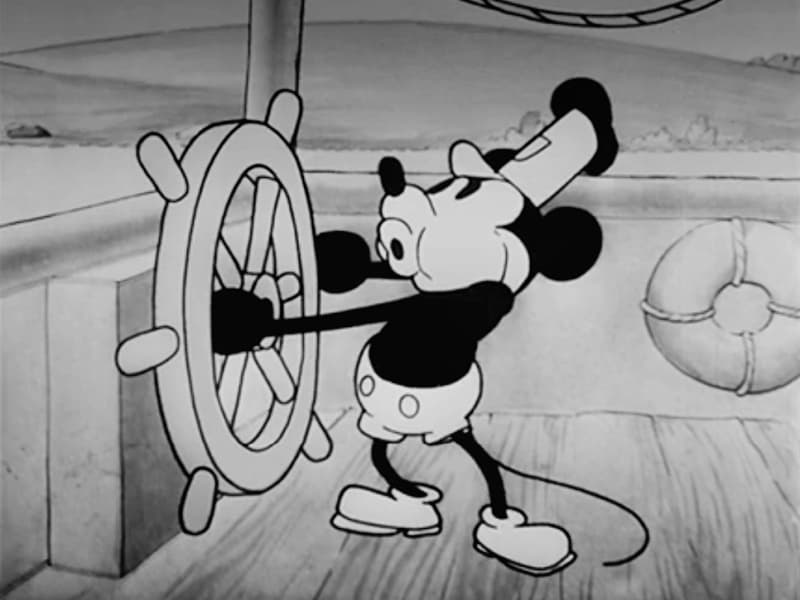
Cherished cartoon characters, such as Mickey Mouse and Felix the Cat, were conceived and developed using blackface minstrelsy’s visual and performative conventions: these characters are not like minstrels; they are minstrels. They play out the social, cultural, political, and racial anxieties and desires that link race to the laboring body, just as live minstrel show performers did.

From here.

The animated characters’ WHITE gloves are a vestigial relic of minstrelsy recycled for a new generation that didn’t overtly associate it with that, but the gloves are nonetheless a sign that still covertly encodes that history. Multiple generations have now imbibed racist images without realizing these images are racist.

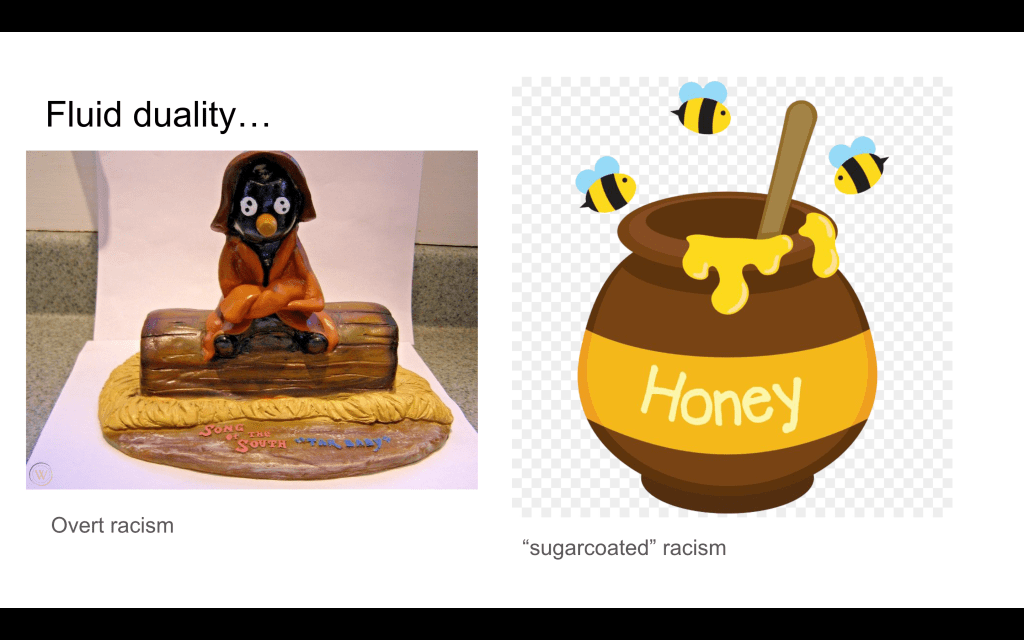
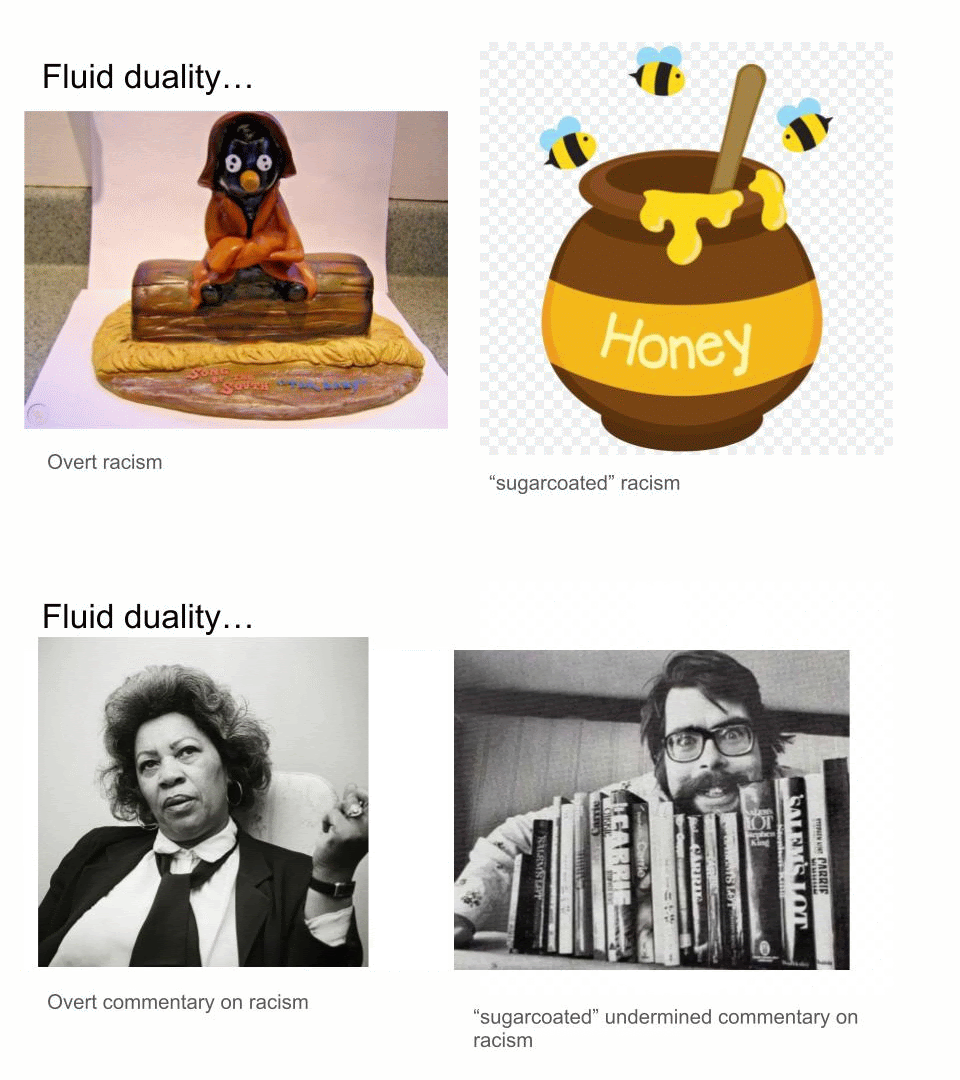
While “laboring bodies,” as invoked by Sammond, are linked to race via describing the physical labor of people historically enslaved, this term can also describe maternal bodies in the labor of giving birth. So the fluid duality inherent in the figure of Carrie White is in embodying both of these types of “laboring body,” via the prominence of the period that signifies the ability to bear children (encoded in her first name), and in manifesting an Africanist presence via the blackface minstrel references.

This fluid duality might then be captured most concisely in identifying Carrie White as a MENSTRUAL MINSTREL.
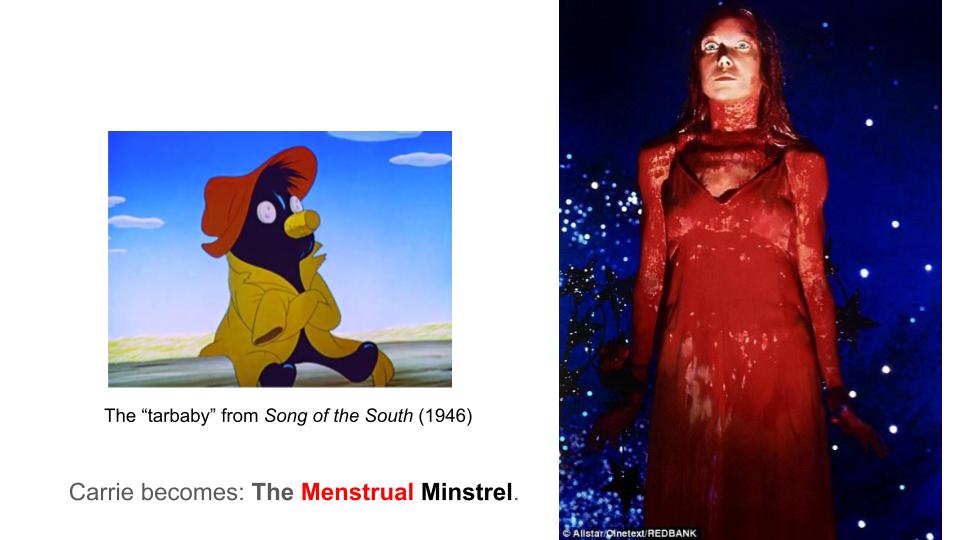
Sarah E. Turner notes that in her review of De Palma’s Carrie, film critic Pauline Kael makes: 

references to menstruation and pregnancy albeit through a problematic, misogynistic lens: she calls the film ‘a menstrual joke—a film noir in red’ and refers to Carrie as seemingly ‘unborn—a fetus’ (Kael). Menstruation becomes a joke while Carrie is infantilized. (boldface mine)

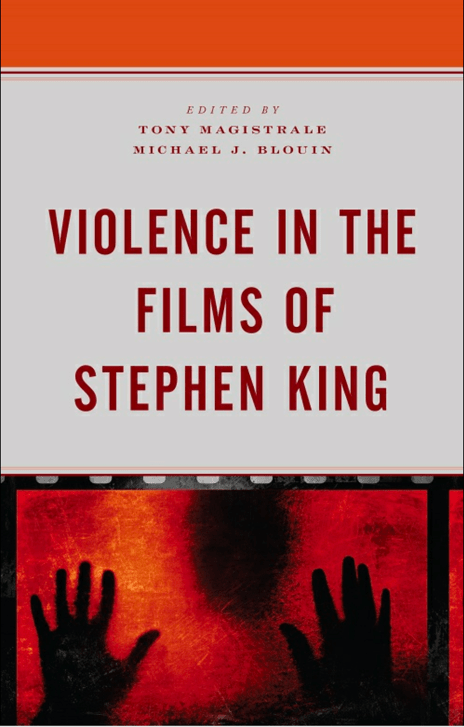
Sarah E. Turner, “Stephen King’s Carrie: Victim No More?” in Violence in the Films of Stephen King (ed. Magistrale & Blouin, 2021).

To read Carrie as a “menstrual minstrel” is to read her as a version of a tar baby.

The Writing on the Wall: Shitterations

If a “critteration” is an iteration of a critter, then, it stands to reason, a “shitteration” is an iteration of shit. An “iteration” by concept can run the gamut between literal and figurative; an example of a literal shitteration would be a prominent element of the recent trial surrounding two Kingverse actors–Johnny Depp (who played Mort Rainey in Secret Window in 2004) and Amber Heard (who played Nadine Cross in The Stand 2020).

Another would be, as Simon Brown quotes in my previous post, King referring to “academic bullshit,” and another would be King’s direct response to Spike Lee’s criticism of The Green Mile‘s John Coffey being a “Magical Negro” in the interview with Tony Magistrale:

TM: According to [Spike] Lee: “You have this super Negro who has these powers, but these powers are used only for the white star of the film. He can’t use them on himself or his family to improve his situation.” How accurate is this criticism?

SK: It’s complete bullshit.

Tony Magistrale, Hollywood’s Stephen King (2003).

And via the “bull,” that’s a critteration-shitteration…

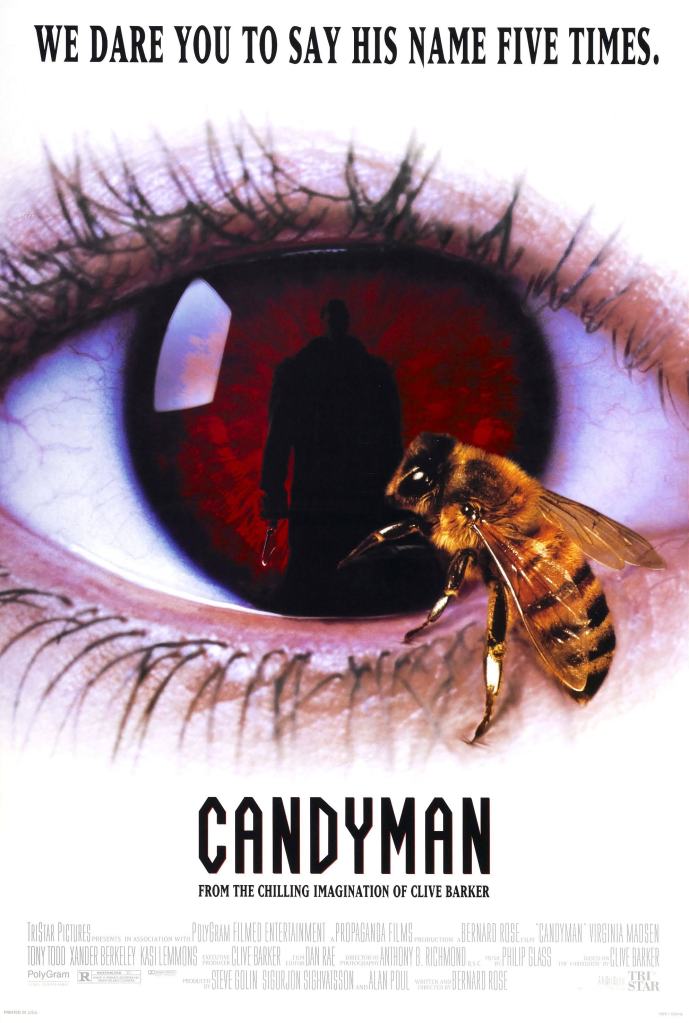
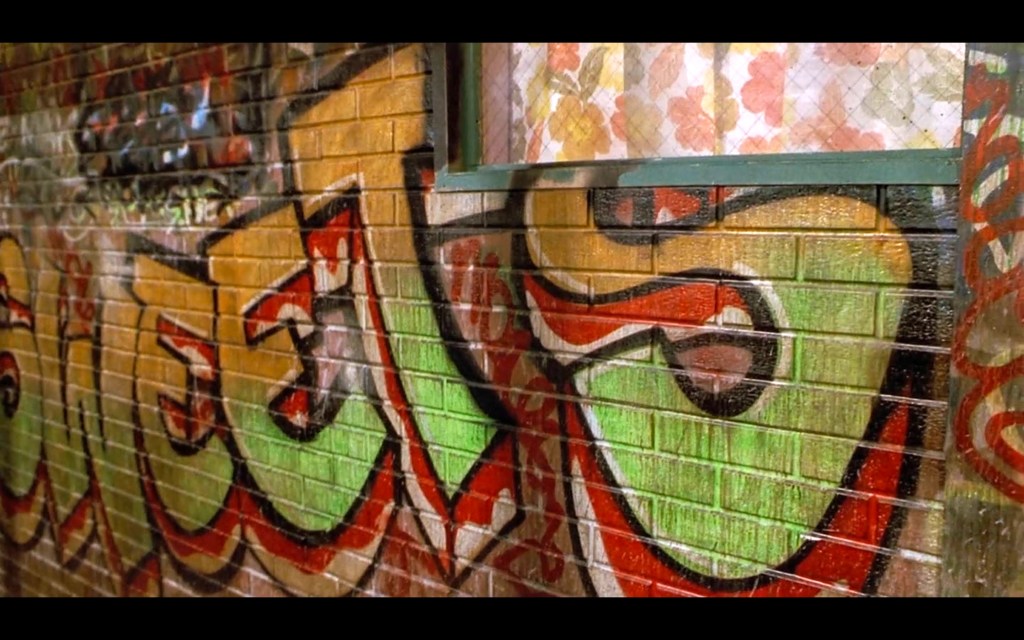
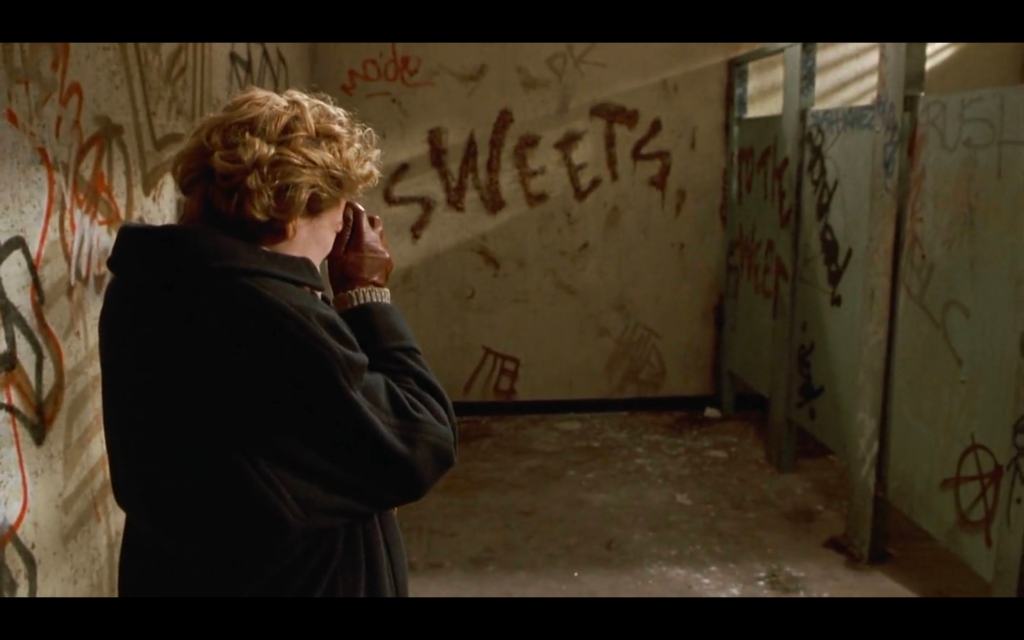
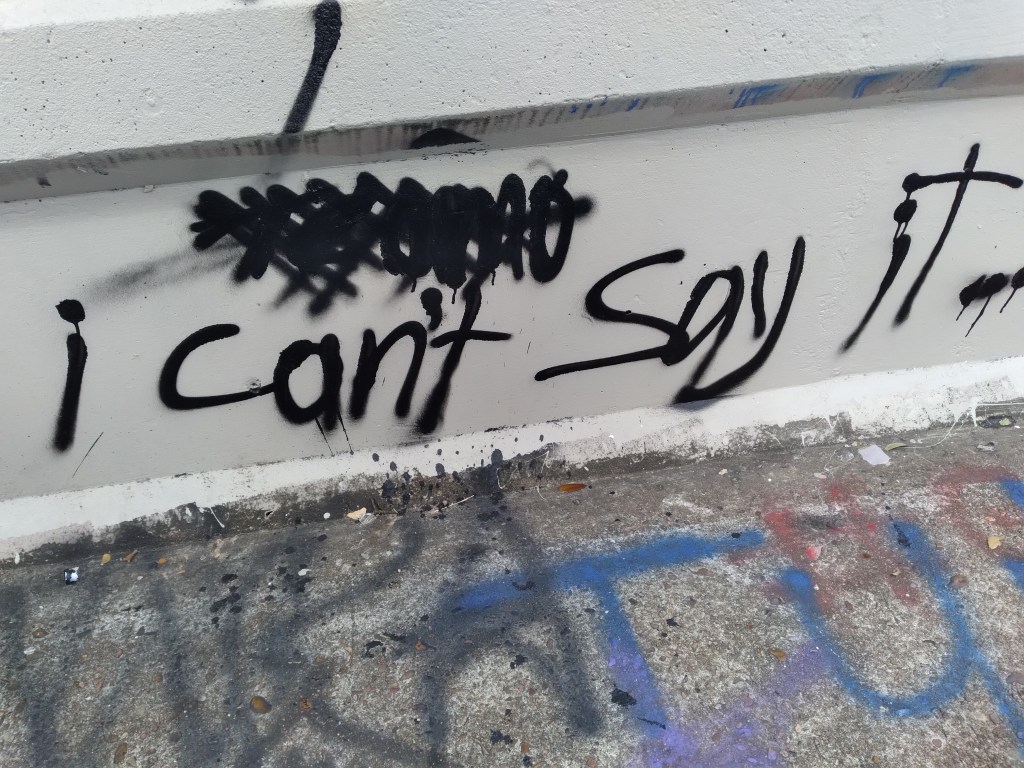
The ’92 Candyman backstory legend also manifests a “shitteration” when some of the literal writing on the wall is written in literal shit:
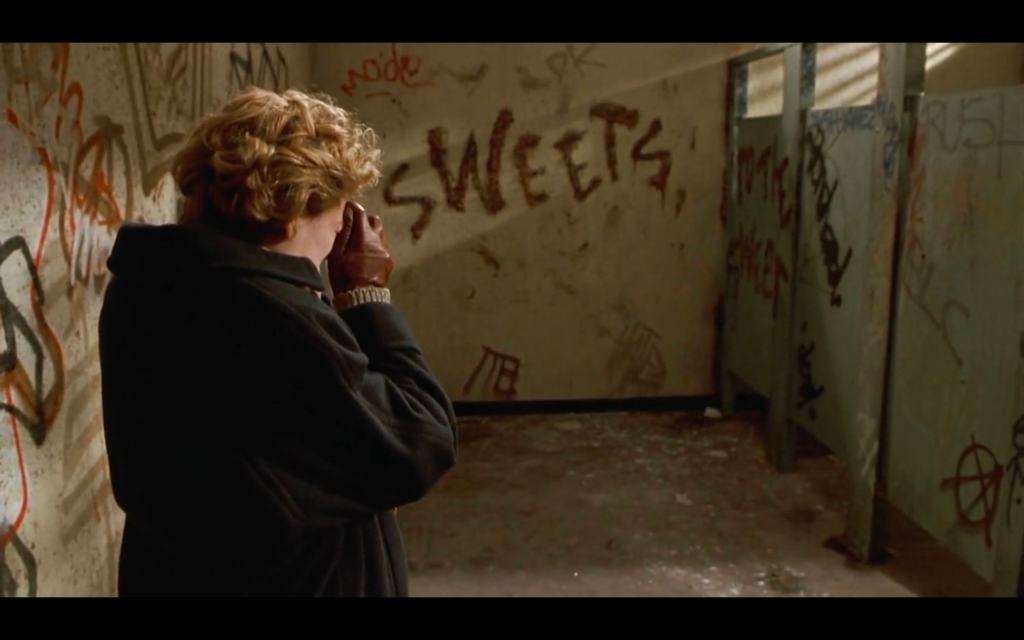
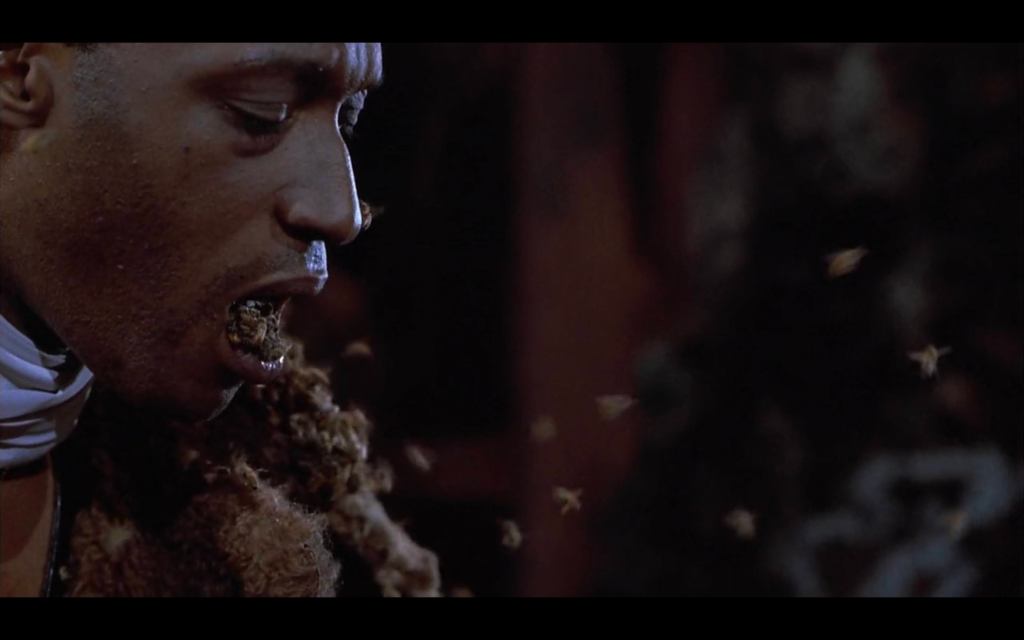
…which appears in concurrence with the bees that are a sign of the Candyman’s presence then manifesting in a shitteration….
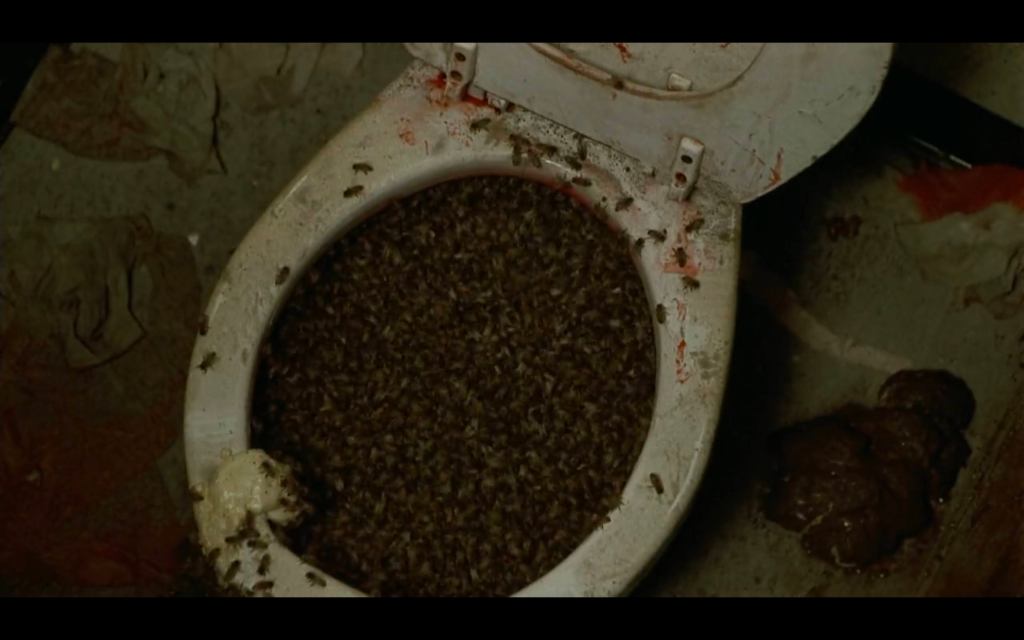
Candyman (1992).

Like the South Park creators I’ve previously likened King to via using the example episode “Turd Burglars”–which turns out to be very appropriate for this discussion–King is quite fond of shitterations–a more academic term for which would be the scatological–to the point that they’re nothing less than a critical ingredient in the composition of the Kingdom, perhaps critical, especially to that critical Kingian nexus of horror and humor.

I reluctantly agreed to do the surgery myself. I think I did a fairly good job, for a writer who has been accused over and over again of having diarrhea of the word processor. (boldface mine)

Stephen King, preface to 1990 Uncut edition of The Stand (1978).
In his response to Magistrale’s humor/horror question discussed in Part I, we can see that King specifically associates shitterations with this horror-humor nexus when his go-to example is Christine‘s villain Roland LeBay, whose defining catchphrase is to call anyone who displeases him a “shitter”; when Arnie starts using this unique phrase, it becomes a sign of LeBay’s presence manifesting in him.

It was via The Green Mile (1996) that I realized a major element of the Kingdom most prominently developed via The Dark Tower series–the concept of ka–was itself a shitteration:

That night, when Brutal ran his check-round, Wharton was standing at the door of his cell. He waited until Brutal looked up at him, then slammed the heels of his hands into his bulging cheeks and shot a thick and amazingly long stream of chocolate sludge into Brutal’s face. He had crammed the entire Moon Pie into his trap, held it there until it liquefied, and then used it like chewing tobacco.

Wharton fell back on his bunk wearing a chocolate goatee, kicking his legs and screaming with laughter and pointing to Brutal, who was wearing a lot more than a goatee. “Li’l Black Sambo, yassuh, boss, yassuh, howdoo you do?” Wharton held his belly and howled. “Gosh, if it had only been ka-ka! I wish it had been! If I’d had me some of that—”

“You are ka-ka,” Brutal growled, “and I hope you got your bags packed, because you’re going back down to your favorite toilet.”

Stephen King, The Green Mile: The Complete Serial Novel, 1996. 

Since the word is spelled “caca” as it usually appears (with most if not all variations spelled with “c” instead of “k”), King seems to be making an in-joke by spelling it with the Dark Tower cosmology’s defining concept. In this Green Mile passage, we also see a shitteration linked to a major stereotypical trope mentioned on the “Magical Negro” wikipedia page:

Critics use the word “Negro” [in “Magical Negro”] because it is considered archaic in modern English. This underlines their message that a “magical black character” who goes around selflessly helping white people is a throwback to stereotypes such as the “Sambo” or “noble savage“.

From here.

Wharton is an unequivocally evil character in The Green Mile, rendering the use of “ka” for shit in this context as negative, but in Christine, ka-as-shit it takes on a more positive role when it’s a major function of the vehicle that the novel’s protagonist Dennis uses to defeat the evil titular vehicle:

‘What is she?’

Pomberton poked a Camel cigarette into his mouth and lit it with a quick flick of his horny thumbnail on the tip of a wooden match. ‘Kaka sucker,’ he said.

‘What? ‘

He grinned. ‘Twenty-thousand-gal on capacity, he said. ‘She’s a corker, is Petunia.’

‘I don’t get you.’ But I was starting to.

Her job was pumping out septic systems.

Stephen King, Christine (1983).

Cycling back to how these themes manifest in Carrie, let’s start with King’s take on the comedy of John Travolta’s performance specifically in his interview with Magistrale discussed in Part I:

What Billy Nolan and Christine Hargensen do to Carrie is both cruel and terrifying, but the two of them are also hilarious in the process. [Actor John] Travolta in particular is very funny

TONY MAGISTRALE, HOLLYWOOD’S STEPHEN KING (2003).

It’s noteworthy where Travolta diverges from the source material for his character to enhance the comedic element, specifically when he and Chris set up the pig blood buckets together (instead of Billy doing it by himself as he does in the novel). Here we see Chris repeat a label for him that he previously made clear he finds offensive when she calls him a “stupid shit,” and when she orders him to hurry up, he slips into a parody of the same language that essentially defines John Coffey, who refers to main character Paul Edgecombe as “boss” (which is ironically called attention to in Wharton’s invoking the stereotypical language Coffey himself uses in the above passage):

“Yes, ma’am! We’se doin the best we can, we really are, boss.”

Carrie, dir. Brian De Palma (1976).

(I probably would not have known exactly what Billy is parodying here, that it’s a visual text, were it not for a similar reference in another visual text I saw as a kid.)

In the novel, when Billy sets up the pig blood buckets alone, it’s noted that there is a witness of sorts:

A bust of Pallas, used in some ancient dramatic version of Poe’sThe Raven,” stared at Billy with blind, floating eyes …. (boldface mine)

Stephen King, Carrie (1974).

This reference becomes significant when read for Toni Morrison’s Africanist presence, as Morrison notes that “No early American writer is more important to the concept of American Africanism than Poe,” who frequently manifests “these images of blinding whiteness [that] seem to function as both antidote for and meditation on the shadow that is companion to this whiteness.” (boldface mine)

Visual imagery might also help cement a certain likeness…
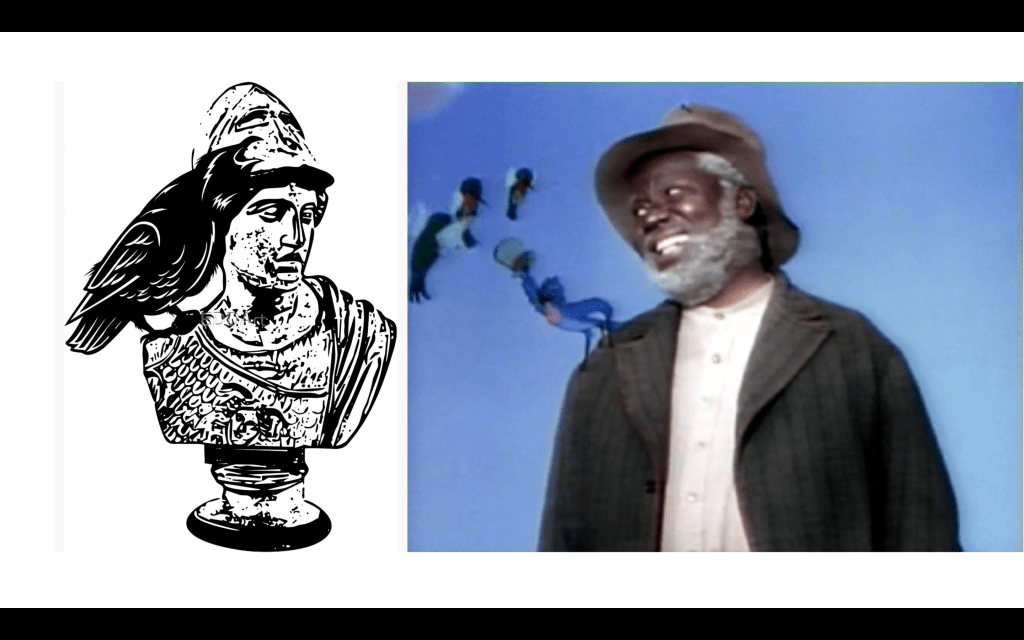
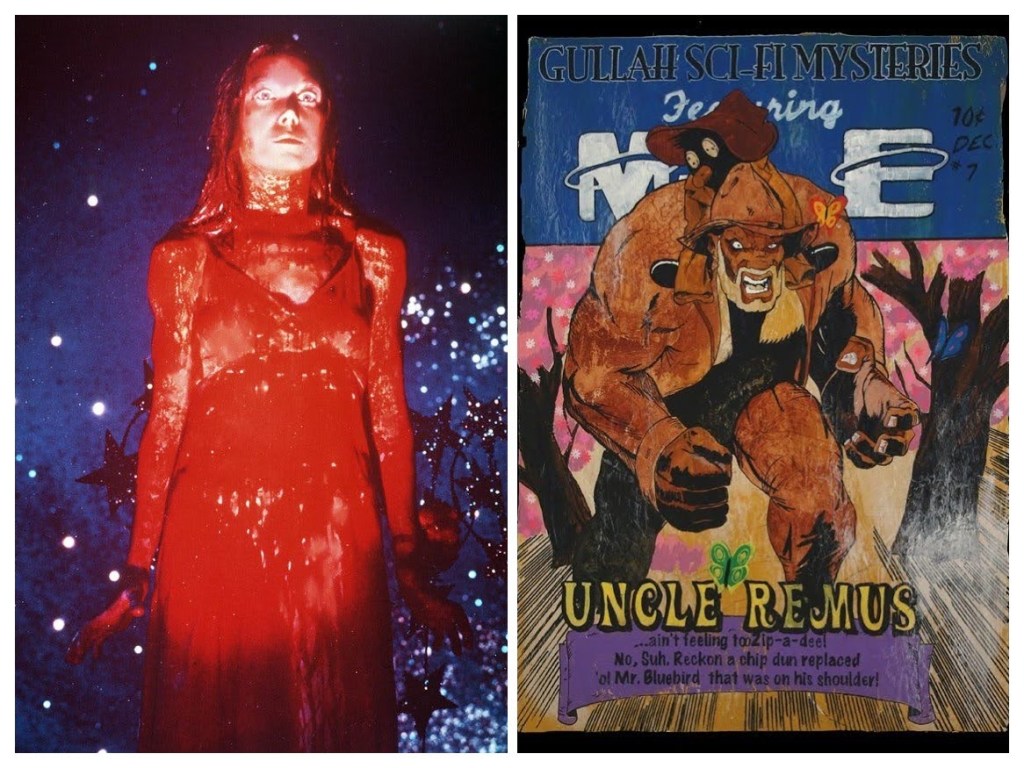
The bust of Pallas with the raven; Uncle Remus in Song of the South (1946) with the bluebird.

In a previous post on Cujo I talked about Jonathan Franzen’s concept of “Consuming Narratives” from his 2001 novel The Corrections, derived from a scene therein of a professor teaching a class on “Consuming Narratives” and having a student challenge his (essentially rhetorical) analysis of a visual text.

“Excuse me,” Melissa said, “but that is just such bullshit.”

“What is bullshit?” Chip said.

“This whole class,” she said. “It’s just bullshit every week. …” (boldface mine)

Jonathan Franzen. The Corrections (2001).

The scene concludes (after the student articulates more specific criticisms of Chip’s criticism) by repeating the same critteration-shitteration about academic criticism that King has applied to it:

Melissa’s accusations had cut him to the quick. He’d never quite realized how seriously he’d taken his father’s injunction to do work that was “useful” to society. Criticizing a sick culture, even if the criticism accomplished nothing, had always felt like useful work. But if the supposed sickness wasn’t a sickness at all—if the great Materialist Order of technology and consumer appetite and medical science really was improving the lives of the formerly oppressed; if it was only straight white males like Chip who had a problem with this order—then there was no longer even the most abstract utility to his criticism. It was all, in Melissa’s word, bullshit. (boldface mine)

Jonathan Franzen. The Corrections (2001).

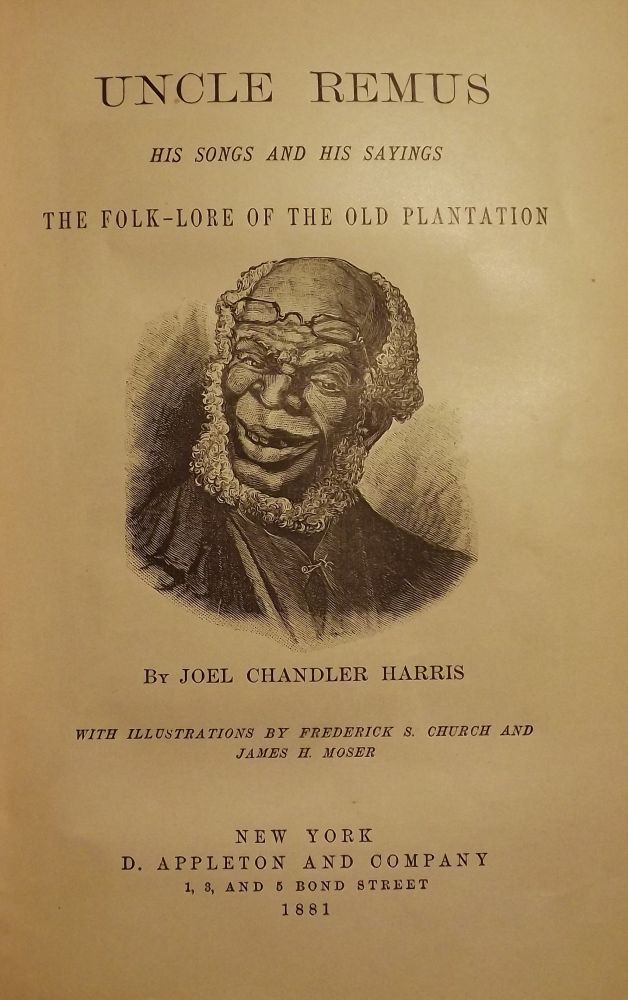
Like Remus’s bluebird or the bust of Pallas’s raven, I have a Chip on my shoulder about not so much the utility of criticism as the institutional systems by which it’s bound in our capitalist system. That such criticism is all just “academic bullshit,” as King himself as puts it, is also the root reason that, much like what happens to Julie in Julie and Julia (2009), Stephen King would hate my blog…

Chip may put it in a pompous way, but it’s hard to argue with his analysis of the visual text itself problematically seducing students with a narrative that purports to empower women for the ultimate purpose of consuming products.

When I read about the current state of the world…

In a single week in late June, the conservative Justices asserted their recently consolidated power by expanding gun rights, demolishing the right to abortion, blowing a hole in the wall between church and state, and curtailing the ability to combat climate change. (boldface mine)

Jeannie Suke Gersen, “The Supreme Court’s Conservatives Have Asserted Their Power,” The New Yorker, July 3, 2022.

…a refrain from another visual text rings in my head:
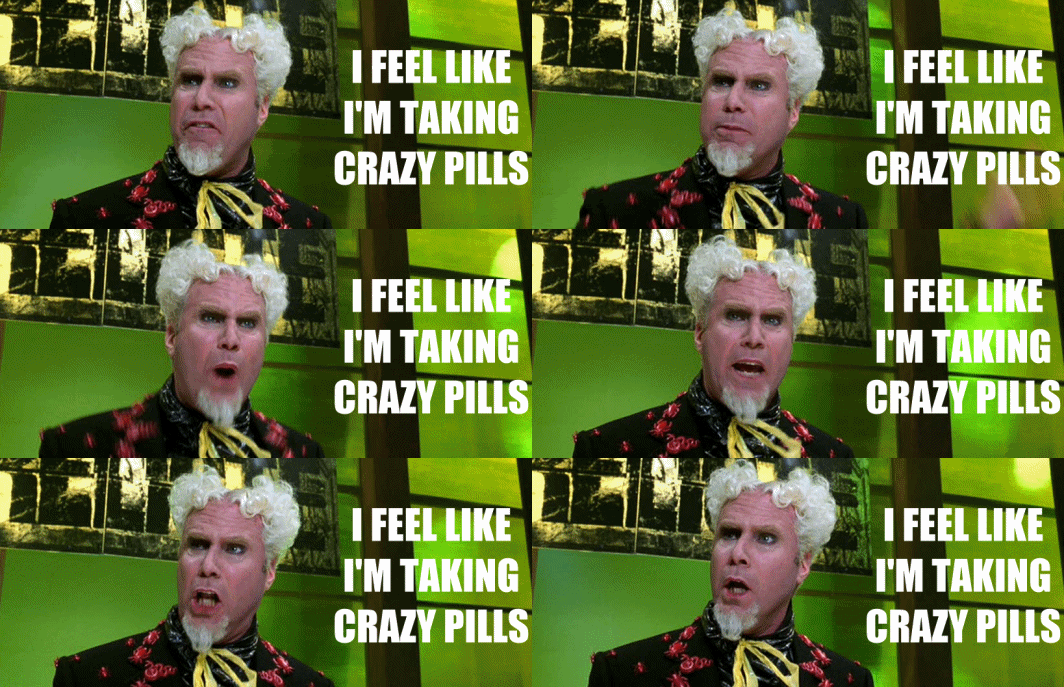
Zoolander (2001)

Consuming Carrie

A variation (or iteration) of a “consuming narrative” seems to surround the character of Carrie White via a shitteration, as constituted by the repetition (or refrain) of the idea that Carrie “eats shit.” This assertion appears twice in the novel–notably both times made not verbally, but in writing–first as graffiti on a grammar-school desk with just that phrase (very early, before the locker-room scene unfolds), and the second as graffiti on a junior-high desk that’s slightly more developed:

Roses are red, violets are blue, sugar is sweet, but Carrie White eats shit.

Stephen King. Carrie. 1974.

This reflects an “abject” horror tactic (“abject” being something that would be objectively horrifying to anyone/everyone):

The gibe “Carrie White eats shit” thus in fact paints Carrie as doubly abject, as it not only mockingly accuses her of ingesting bodily waste, already abject in itself, but also confounds the traditional functions of two distinct bodily orifices.

Victoria Madden, “‘We Found the Witch, May We Burn Her?’: Suburban Gothic, Witch-Hunting, and Anxiety-Induced Conformity in Stephen King’s Carrie,” The Journal of American Culture; Malden Vol. 40, Iss. 1,  (Mar 2017): 7-20.

But it might be more complex:

The abject and its emphasis on the body—on waste and fluids and expulsion—is not gothic in the sense that Madden argues, but instead may be read as a personification or manifestation of the future as envisioned by those opposed to the women’s right to choose. What this means, I would argue, is that the sociocultural concerns expressed and explored in Carrie are not those of the homogeneous suburban need to/fear of containing the ‘other’; instead, what Carrie is exploring is the impact of the 1973 Supreme Court Decision in Roe v. Wade.

Sarah E. Turner, “Stephen King’s Carrie: Victim No More?” in Violence in the Films of Stephen King (ed. Magistrale & Blouin, 2021).

This reading was intriguing when I first read it back in March. When I revisited it in May after a certain draft of a Supreme Court decision was leaked, it was mind-blowing, and since then, of course, it’s been overturned officially, leaving me and many others in a state of numb shock. Via Turner’s reading, this development has made reading Carrie, and in turn, King, more relevant than ever.

Turner essentially places the Roe v. Wade decision in 1973 as underwriting the success of the King canon when she places it as pivotal to the cultural climate that engendered the success of De Palma’s Carrie. For Turner, this answers the question of why King set Carrie a few years ahead of the year it was published; for us, it means now reading Carrie embodying not the horrifying potential of a woman’s right to choose, but that of a woman who does not have the right to choose.

Let us just take a moment to process that for basically the entire span of King’s career as a writer, almost fifty years, abortion has been legal (minus some complications at the state level, as in Texas, the one where I happen to live). If the Thermidor effect is supposed to be two steps forward, one step back, it feels like now we’ve gone at least twenty steps back. The current cultural climate renders not only Carrie relevant again, but all of the horror genre as a horrifyingly accurate representation of the world in which we live.

Turner’s reading of Carrie as an “abortion practitioner” requires for me a re-reading of a moment I might have misread initially: I did not, as Turner does, read Carrie as aborting Sue’s fetus in that moment near Carrie’s death when they have their telepathic exchange. Turner’s discussion also illuminates something else I’ve always struggled to understand–the “logic” behind the continued pursuit of criminalizing abortion again. Conservatives can claim Christianity as their motive all they want, but in the mouths of politicians that’s a bullshitteration of covert rhetoric for sure. If one thing qualifies as laughable, it’s the vociferous defense of fetuses when so many conservative imperatives have hung so many actual human beings not out to dry, but to DIE. Usually the ulterior motive of such political hypocrisy is directly connected to the capitalist incentive, and in the case of the abortion issue, I still struggle to understand how this particular predominant ulterior motive would be at work. Criminalizing abortion doesn’t seem like it would be good for the economy or as a means to line the puppet-masters’ pockets, so is it just for the sake of controlling women?

Apparently, the answer is yes:

Abortion then, a woman’s right to choose, was initially criminalized to ensure the male medical monopoly and to disenfranchise women who sought to practice medicine. That midwives and female healers became defined and persecuted as witches further underscores the desire to control the female body, and for many, this includes the right to choose.

Sarah E. Turner, “Stephen King’s Carrie: Victim No More?” in Violence in the Films of Stephen King (ed. Magistrale & Blouin, 2021).

Or the answer is almost yes… capitalist incentive is at work in this history of the medical industry:

The other side of the suppression of witches as healers was the creation of a new male medical profession, under the protection and patronage of the ruling classes.

Sarah E. Turner, “Stephen King’s Carrie: Victim No More?” in Violence in the Films of Stephen King (ed. Magistrale & Blouin, 2021).

Talk about unearthing a “buried history” of the term “witch.” Turner reads “competing visions” of Carrie as the subversive “witch/abortionist” figure offered in the novel v. film versions:

Both King and De Palma see Carrie as a threat, but King’s Carrie embodies the empowering but “threatening” potential of Roe v. Wade, while De Palma’s Carrie is an outlier, a threat to traditional femininity as defined and oppressed by the patriarchy. These two views set up the tension at the heart of this reading of Carrie that seeks to reclaim her—to move her from ostracized victim to subversive challenger.

Sarah E. Turner, “Stephen King’s Carrie: Victim No More?” in Violence in the Films of Stephen King (ed. Magistrale & Blouin, 2021).

Here Turner is offering a couple of other versions of Carrie manifesting what I’ve designated “fluid duality”: “witch/abortionist” being one version and “victim/challenger” another (though these overlap with each other as well as with my fluidly dual categories of “menstrual/minstrel”). Turner reads King’s version of Carrie as more nuanced, offering a meaningful cultural critique while De Palma’s Carrie merely titillates, though the narratives of both versions revolve around Carrie’s “power”–telekinesis, which per Turner in King’s version, can be read as dramatizing the figurative empowerment women gained over their bodies via the 1973 Roe v. Wade decision. Thus, what Carrie does with this empowerment plays out cultural fears and narratives surrounding what women will do with their new cultural empowerment, a nuance that De Palma, per Turner, fails to capture:

Ultimately, the reader of King’s text is left with a sense of ambiguity: King presents both sides of the abortion debate, albeit hyperbolically, but he does not dictate how to read them. He creates tension between mother and daughter that represents the duality of the debate around abortion and a woman’s right to choose. Margaret White is the hyperbolic manifestation of the religious right—an extreme King seems to reject even as he creates her; Carrie is the potentially monstrous implications of the Roe v. Wade decision: destructive, vindictive, unnatural, deadly. However, De Palma’s movie engenders no sense of ambiguity… Ending the film with Carrie’s hand reaching out from the grave to grab Sue’s arm, even though the moment is embedded within Sue’s nightmare, signals De Palma’s interpretation of Carrie as a monster, a hysterical woman who must be destroyed. (boldface mine)

Sarah E. Turner, “Stephen King’s Carrie: Victim No More?” in Violence in the Films of Stephen King (ed. Magistrale & Blouin, 2021).

That is, the hand is a sign…
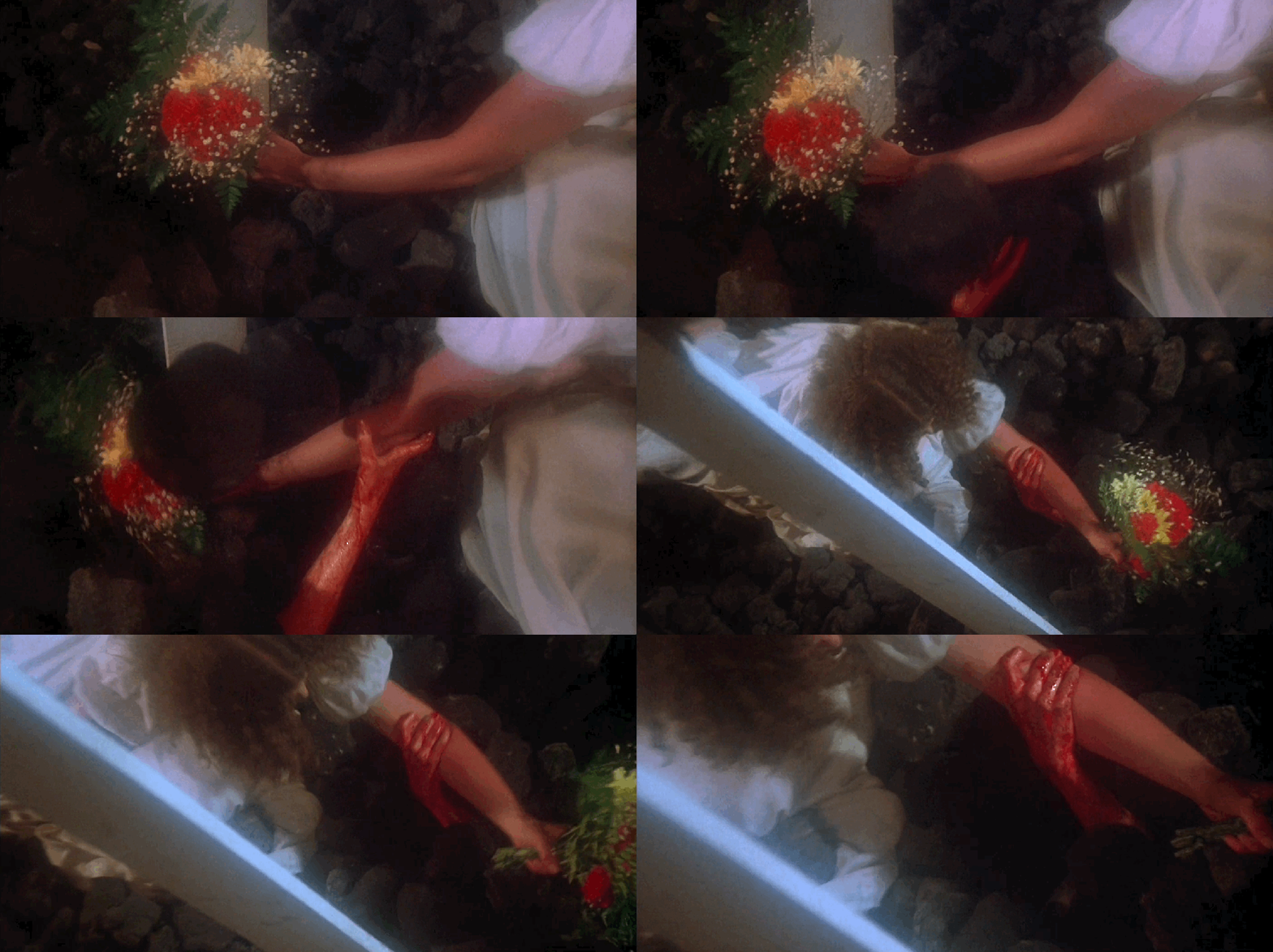
Carrie (1976).

(Turner doesn’t mention this, but it’s worth noting that the plot of King’s Insomnia (1994) revolves around a pro-choice rally … and is also a Dark Tower entry perhaps most notable for marking the first appearance of the Crimson King.)

In the context of the influence of Disney’s problematic Happy Endings, Tony Magistrale mentions an academic take on my primary example in a previous discussion:

If Chelsea Quinn Yarbro is right in her interpretation of the Cinderella myth as a vehicle for programming women to accept their social role and obligation to Western culture (47-49), then Carrie’s classmates torture her to reaffirm their own unstable positioning as emerging women. (29)

Tony Magistrale, Hollywood’s Stephen King (2003) (citing “Cinderella’s Revenge–Twists on Fairy Tales and Mythic Themes in the Work of Stephen King” in Fear Itself: The Horror Fiction of Stephen King eds. Tim Underwood and Chuck Miller, 1982).

Carrie purports to subvert the Cinderella narrative, which as some have noted, would have ended at about this point if it was simply re-enacting it:
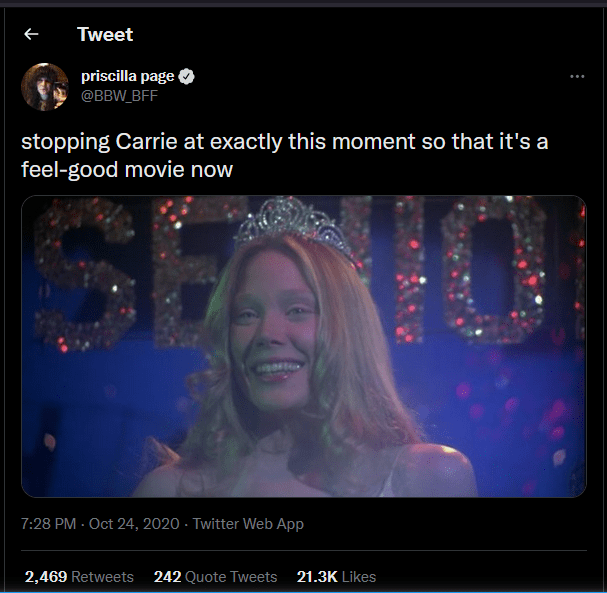
And the screenwriter of Song of the South, Maurice Rapf, was a Communist whose only other screenwriting credit is…CINDERELLA, which Karina Longworth in her podcast series on Song of the South notes provides a narrative that is sympathetic to the plight of exploited workers. So Rapf was a “red,” and as such he was eventually “blacklisted.” And Cinderella can be read as programming women for the patriarchy, or as fighting the power of the patriarchy by highlighting its exploitation.

At any rate, part of the reason Carrie‘s narrative can’t reasonably end at the Happy Place is specifically because of history–in this localized case, the history of Carrie being constructed as an outcast/other by her classmates. Despite Sue’s attempt to erase this construction by assimilating Carrie into their peer group, the assimilation is foredoomed by the pre-existing construction.

De Palma’s Carrie invokes the shit-eating abject construction of Carrie-as-outcast more directly by verbalizing it in its (added) opening scene, positioning the high-school girls in a gym-class volleyball match that precedes the infamous locker-room tampon-pelting scene. In her essay “The Queen Bee, the Prom Queen, and the Girl Next Door: Teen Hierarchical Structures in Carrie,” from The Films of Stephen King: From Carrie to Secret Window (2008), Alison M. Kelly applies Rosalind Wiseman’s 2002 criteria of different teen types to Carrie‘s characters, and analyzes De Palma’s opening in more detail to show that “[t]he female hierarchy in Carrie is immediately established in the opening scene: the P.E. volleyball game” (13). Namely, the scene establishes Chris as “Queen Bee” and Carrie as “Target”–or put another way, Chris as bully and Carrie as victim. The less-than-a-minute opening scene concludes with Chris growling at Carrie, “You eat shit.”

A bit later, when Ms. Collins (Ms. Desjardin in the book) is reprimanding the girls who harassed Carrie–telling them, twice, that it’s a “really shitty thing” they did, there’s a shot of Carrie looking in from outside, where she would be unable to see what the viewer can from the camera angle, the rather large graffiti reading “Carrie White eats shit” on the inside of the gym door/wall.
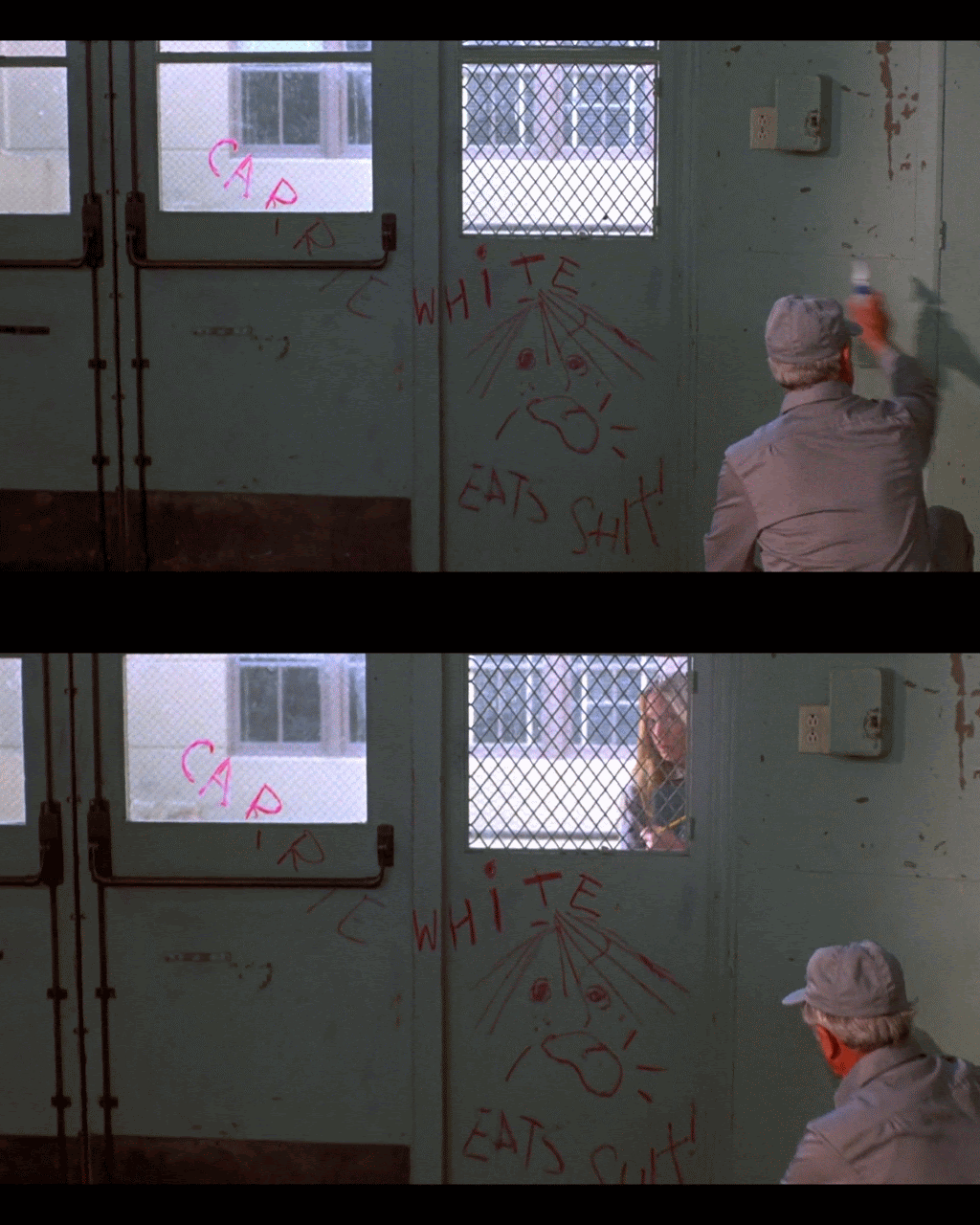
And of course we all know what will happen in this same gym later…in this shot, Carrie’s classmates’ construction of her is essentially shown to “underwrite” the destruction that will take place here; it’s the writing on the wall that in this moment literally positions Carrie as outsider.

Perhaps “you eat shit” was a common insult in the 70s–though it is still present, even prominent, in the ’02 and ’13 Carrie adaptations–but it’s the technical (abject) logic of it that strikes me as interesting: eat the waste product of your eating. A kind of ourouborous configuration…
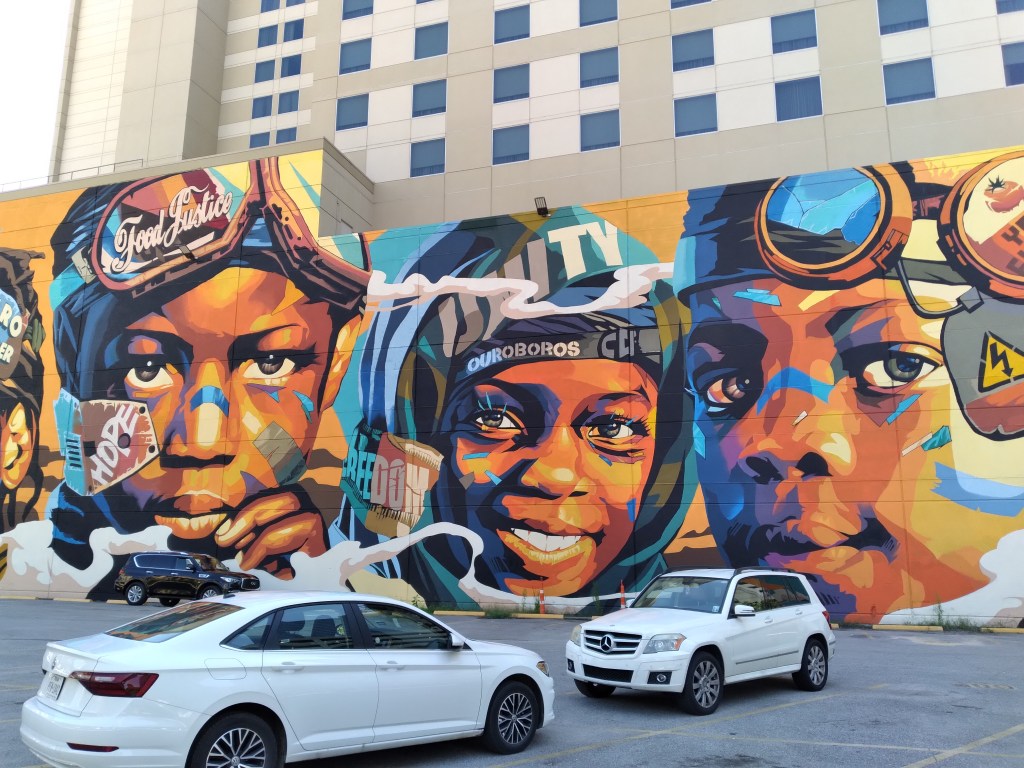
“Houston’s largest mural brings attention to food insecurity”

Which a certain trial apparently also was…

The [Depp-Heard] trial, in short, turned the op-ed into an ouroboros: what was intended as a #MeToo testimonial about women being punished for naming their experiences became a post-#MeToo instrument for punishing a woman who named her experiences. (boldface mine)

Jessica Winter, “The Johnny Depp-Amber Heard Verdict is Chilling,” The New Yorker (June 2, 2022).

An ouroboros also visually replicates a circle, or cycle…of how we are consuming ourselves.

Last semester I read Carrie with a group of high-school students for an elective on horror writing, and after seeing Kelly’s essay, I was inspired to use it in a new way in my college composition classes. I’d already been using the figure of Carrie as an example of how to apply monster theory to the culture for one set of composition classes–applying the criteria of what makes a monster a monster laid out by Jeffrey Jerome Cohen’s monster theory essay in a way similar to how Kelly applies criteria from Wiseman’s categories for different teen types to the Carrie characters.

Via Kelly’s argument that the brief opening scene efficiently establishes a “female hierarchy”–more specifically, one with Carrie at the very bottom and Chris at the very top–Kelly provides a version of a “rhetorical analysis” of the opening scene compatible with the first major essay my composition students have to write about a visual text. But it’s Kelly’s inclusion and discussion of a specific screen shot from the scene as evidence to support her argument–a shot of the opening scene’s culmination in which Chris verbalizes (or more specifically, sneers) “you eat shit” at Carrie, cementing her “queen bee” status–that prompted me to use the essay as a model for what my students have to do in their first essay assignment.
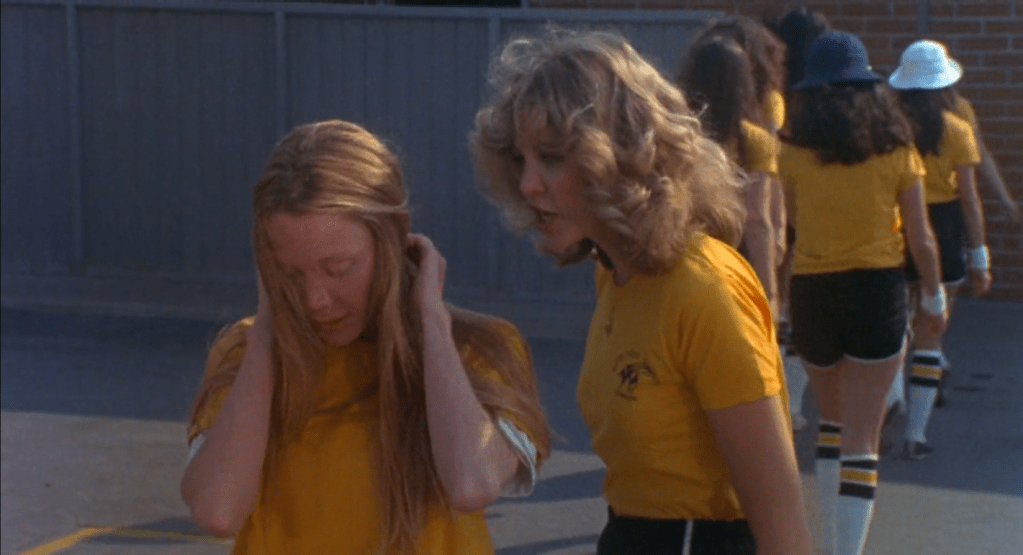
“You eat shit.”

I’ve had students analyze pop-culture “visual texts” in their major essays for years, with the requirement that they have to discuss a specific screen shot(s) from the text they pick to support one of their points that in turn support their thesis. Kelly generates a numbered list of discussion points based on observations of the above screen shot that replicates a version of what our course textbook Writing Analytically calls the “Notice & Focus” exercise. (One observation I might make is that the stripes on the white socks of the girls visible walking away behind Chris are bee-like.)

Tony Magistrale also presents a screenshot-based discussion of De Palma’s opening scene in a less explicitly structured way, with this shot at the top of a chapter on “lost children” in King’s work:
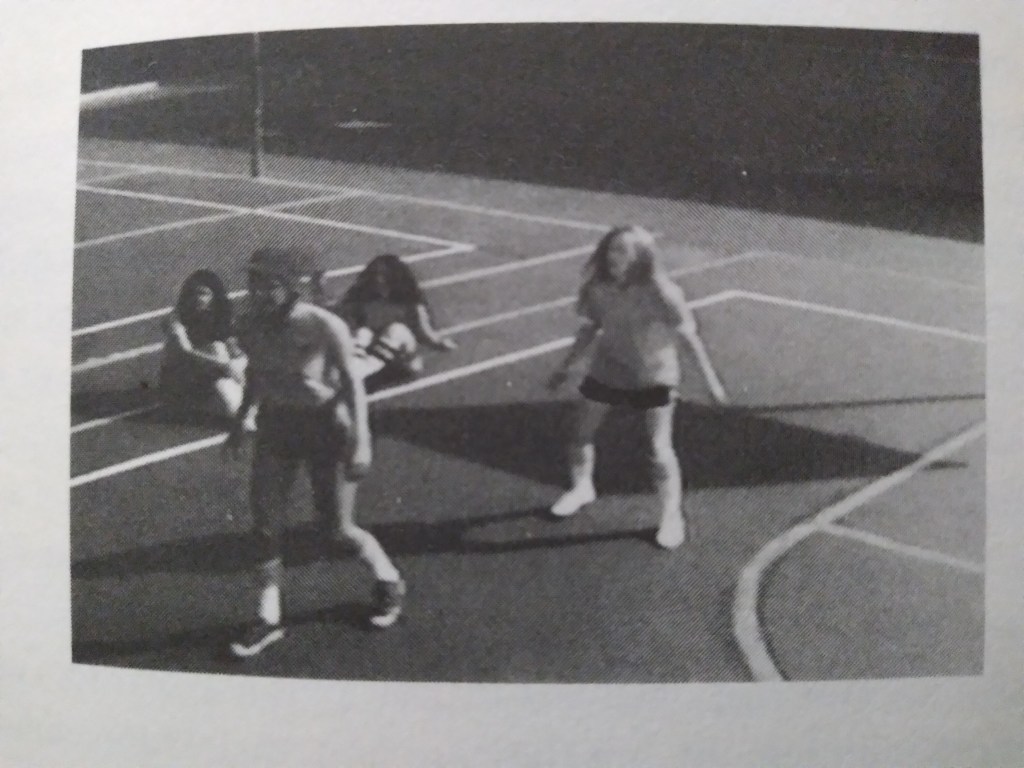
From Hollywood’s Stephen King by Tony Magistrale (2003).

When I tried to grab a screen shot for a color version, I found that this exact angle weirdly does not seem to exist in full frame, with the closest being:
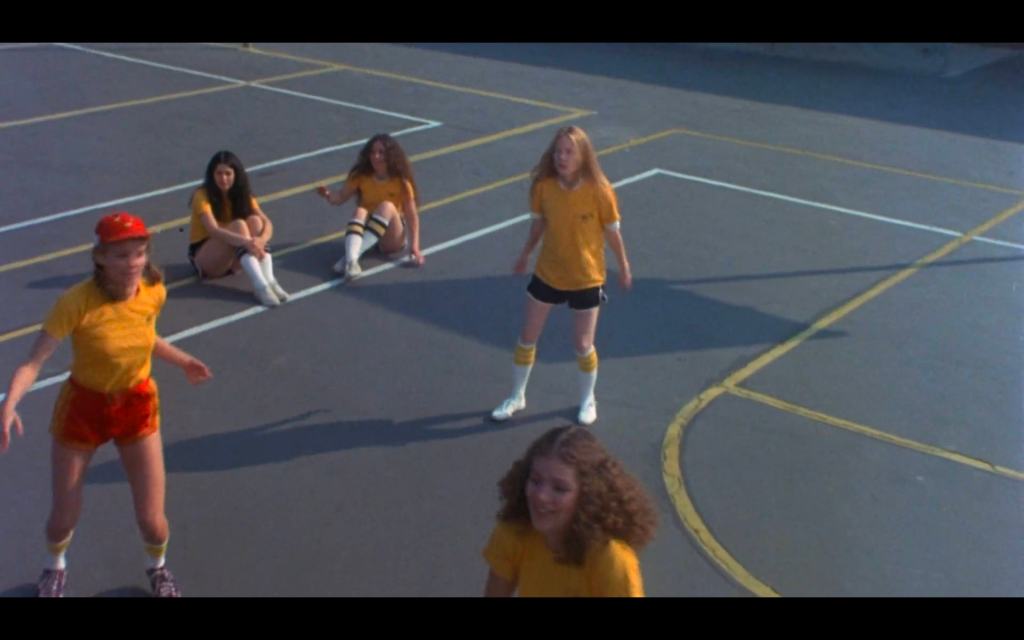
At any rate, Magistrale’s point is about how the shot treats Carrie:

As the camera zooms in on Carrie White and she is pushed deeper into the upper corner of the volleyball court by her unsupportive teammate, we note that the square shadow of a basketball backboard looms directly behind her. … [B]y the end of the scene she also stands inside the only shadow cast on the volleyball court’s surface. Boxed into a shadowed corner, swatted in the face for her athletic failings, and and told to “eat shit,” Carrie retreats alone into the girls’ locker room. (boldface mine)

Tony Magistrale, Hollywood’s Stephen King (2003).

Both versions of the screen shot provide evidence of the prominent use of shadows in relation to the figure of Carrie, which I can now use to support a point Magistrale is not actively making here, about how Carrie manifests an Africanist presence, not just in the trigger moment, but from the beginning. Magistrale proceeds to note:

…these initial images of Carrie portrayed in shadowy isolation and boxlike enclosures are restated in an effort to dramatize forcefully her own experience in high school as “a time of misery and resentment.” (boldface mine)

Tony Magistrale, Hollywood’s Stephen King (2003), p27.

With that last quote being from a 1999 speech of King’s describing his own high-school experience. Magistrale’s description of the trigger moment tracks the role of the laughter:

In response to this final indignity, Carrie goes ballistic. While none of the other promgoers is actually laughing at her plight, except for Chris’s vile friend and co-conspirator Norma (P.J. Soles), Carrie automatically perceives them from the perspective of her mother. Their imaginary laughter sparks Carrie’s telekinetic wrath, and in a scene inspired by the Old Testament, Carrie punishes everyone in Bates High School gymnasium–the innocent as well as the guilty. (boldface mine)

Tony Magistrale, Hollywood’s Stephen King (2003), p24.

This Old-Testament-style destruction is also likened to a Shakespeare text, something De Palma took from the source text, though Turner frames it slightly differently in her analysis of Carrie’s likeness to Lady Macbeth as integral to her reading “competing visions” of Carrie in the novel v. the film:

Brian De Palma has famously acknowledged his debt to Gustave Moreau’s 1851’s portrait of Lady Macbeth as the inspiration for the seminal shot of Carrie—drenched in pig’s blood and backlit by flames—as well as her posture and gait in the later parts of the film. And clearly at some level King had her in mind as well—as readers are told that Carrie was “unaware that she was scrubbing her bloodied hands against her dress like Lady Macbeth” after the destruction of the high school and town (140). And yet, the two men have competing visions of both Lady Macbeth and Carrie; for De Palma, the women are destructive, unnatural, a threat to the heteronormative patriarchal culture of their time. … Lady Macbeth, in her violation of the Elizabethan great chain of being, also acts to violate the king’s divinity and the rules of domestic hospitality by goading Macbeth into action. Shakespeare, like King with Carrie, may be critical of Lady Macbeth’s actions, but he creates a powerful woman whose actions insofar as they stand in defiance of traditional woman’s role bridled by patriarchal law and custom may be read as the precursor to Carrie as “witch/abortionist.” (boldface mine)

Sarah E. Turner, “Stephen King’s Carrie: Victim No More?” in Violence in the Films of Stephen King (ed. Magistrale & Blouin, 2021).
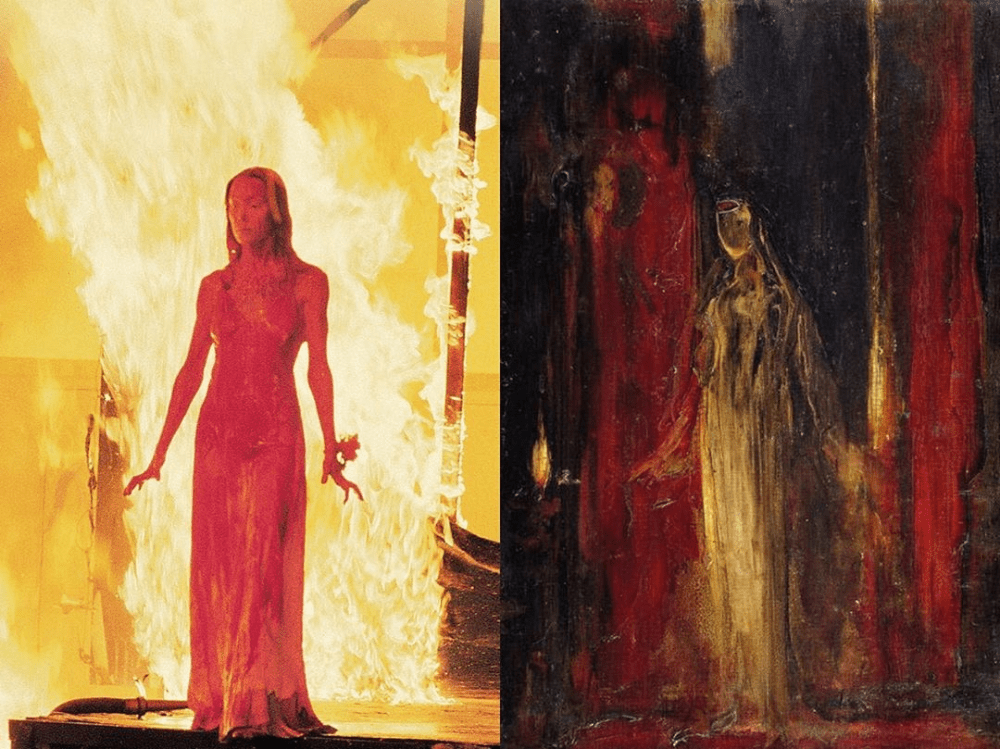
This image has an empty alt attribute; its file name is 8756d61b39aca4f806575bef71a13df5.png
From here.

Macbeth doesn’t have any prominent uncles, but it does emphasize the theme of the divine right of kings, which is an interesting theme to consider in light of the plot-significance of the tradition of prom king and queen in Carrie

It makes a certain kind of sense that Carrie would be triggered by an imaginary construction (i.e. Magistrale’s reading of “imaginary laughter”), since her being triggered is itself a response to the way she’s been constructed in the imagination of her classmates manifest in their writing on the wall–i.e., that she “eats shit.” It’s also worth noting that the way the laughter sequence unfolds in the novel is more protracted than the film version, including but not limited to how it’s rendered in different perspectives: first Norma’s, then Carrie’s. Interesting that it would be rendered first from the perspective of the character who is the only one to laugh at her in the film…
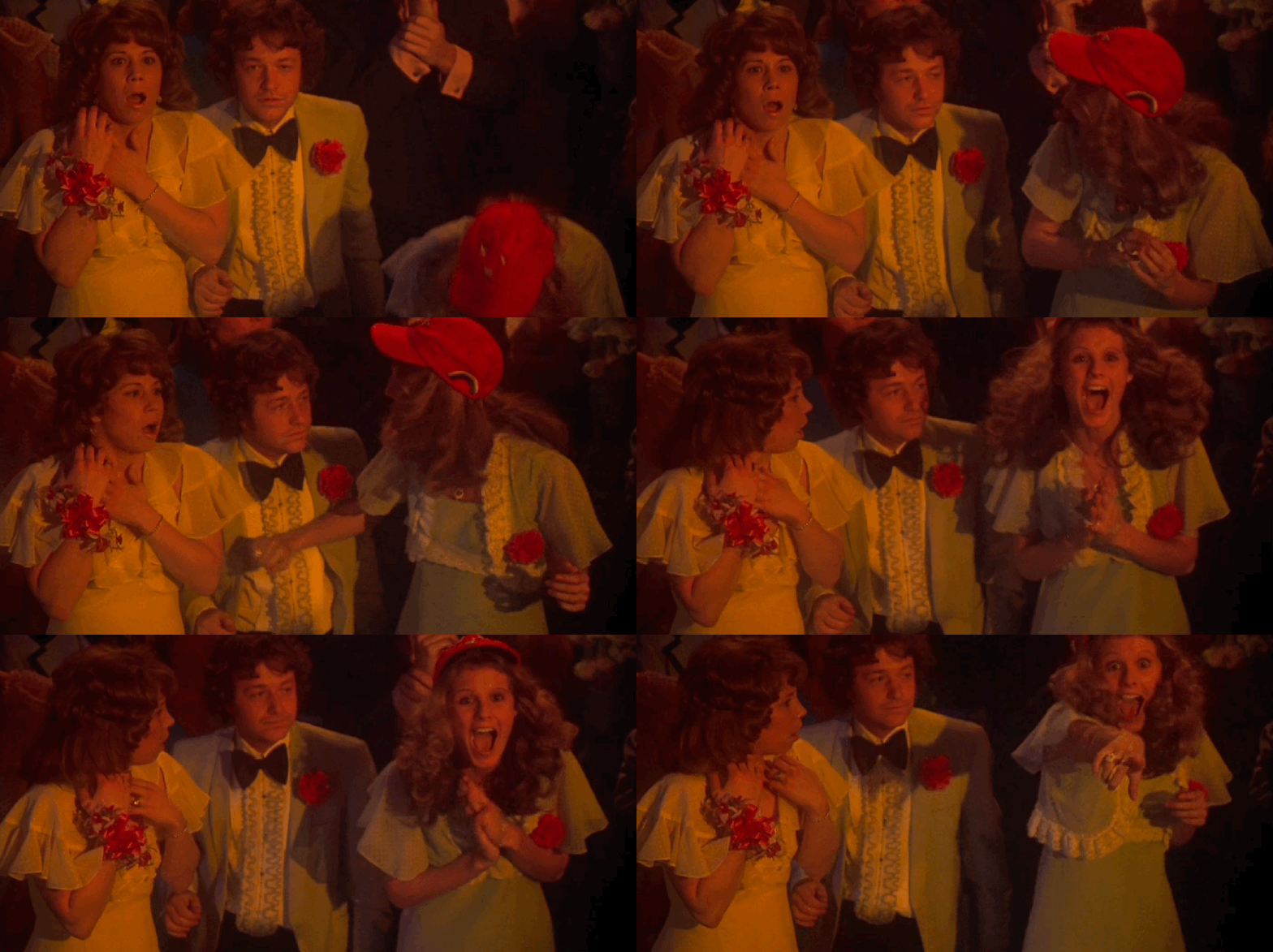
Also interesting how hard Norma hits the guy next to her who is not laughing, as if De Palma is punctuating the violence manifest in Norma’s laughter.

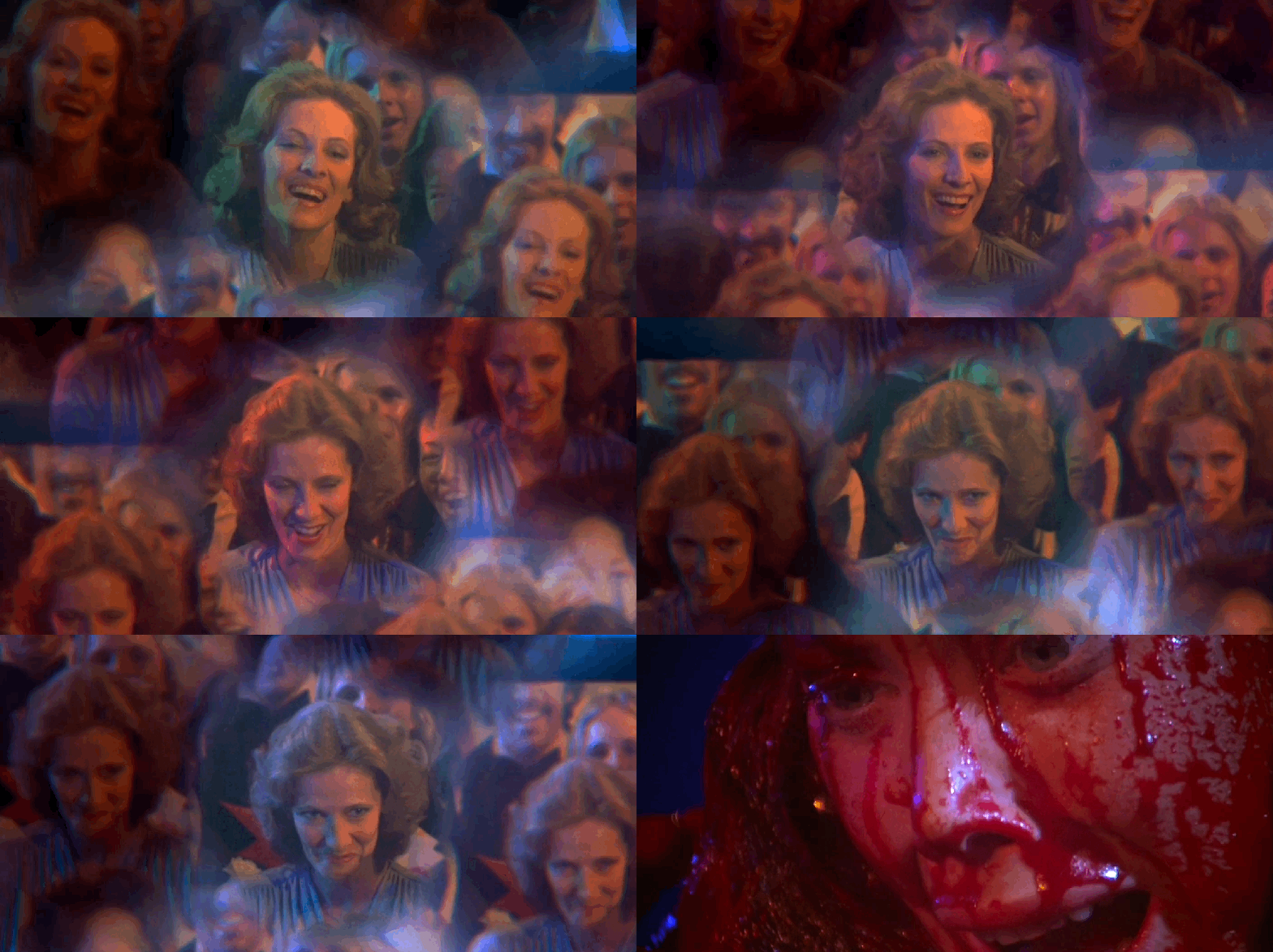
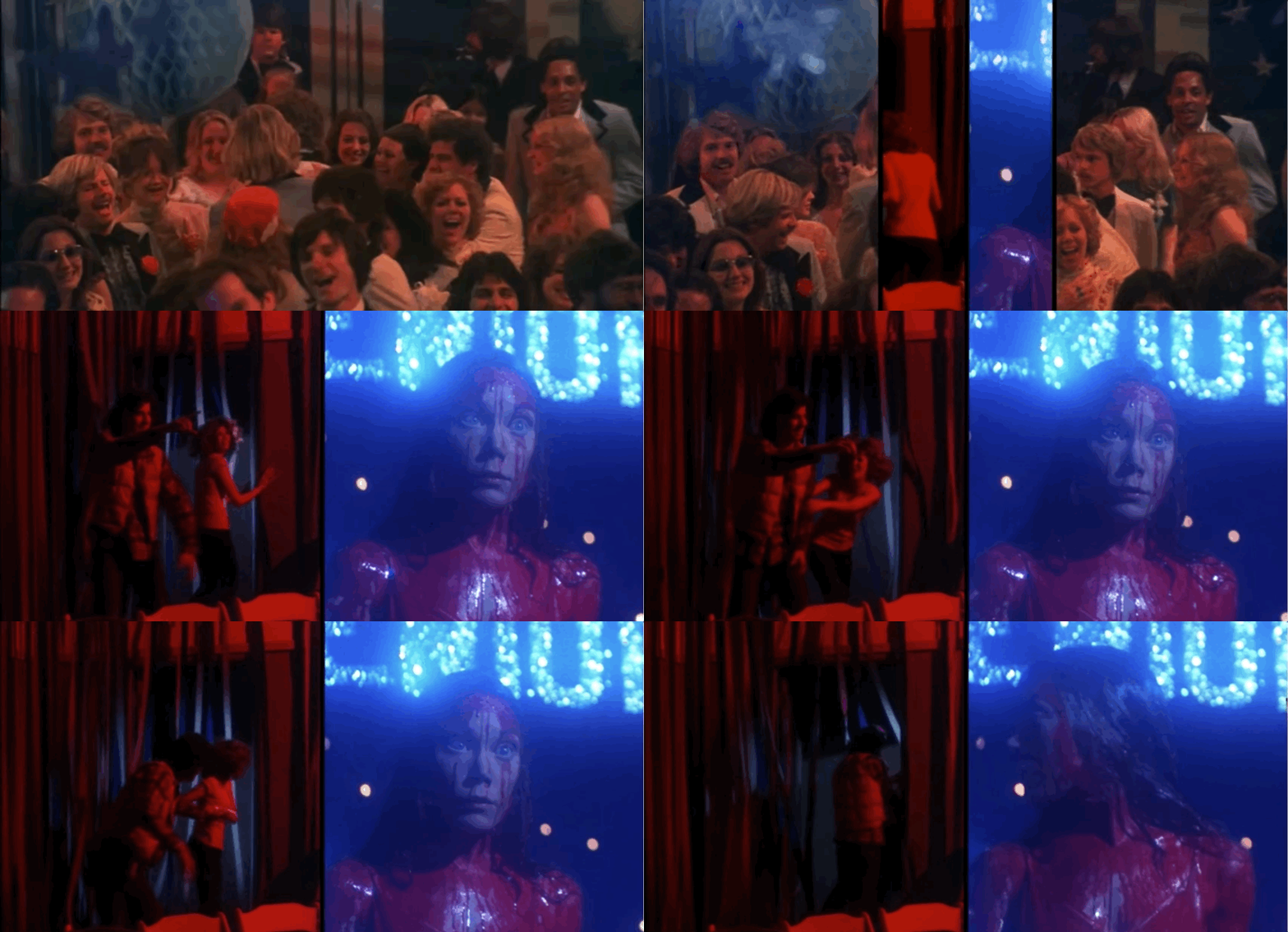
In the novel, Norma explains why they all laughed at Carrie via the Song of the South reference that has led me down this rabbit hole, and if we might think it’s possible that Norma, who in the novel is recounting this in her memoir, could be exaggerating about how many people were laughing to save face if she were in fact the only one who did laugh, we then get Carrie’s perspective, though this also has the potential to be skewed. So is it “imaginary laughter” that “sparks Carrie’s telekinetic wrath” in the novel? The moment of “imaginary laughter” in De Palma’s version is one of the times you can see him taking from but adjusting the source text, specifically these shots:
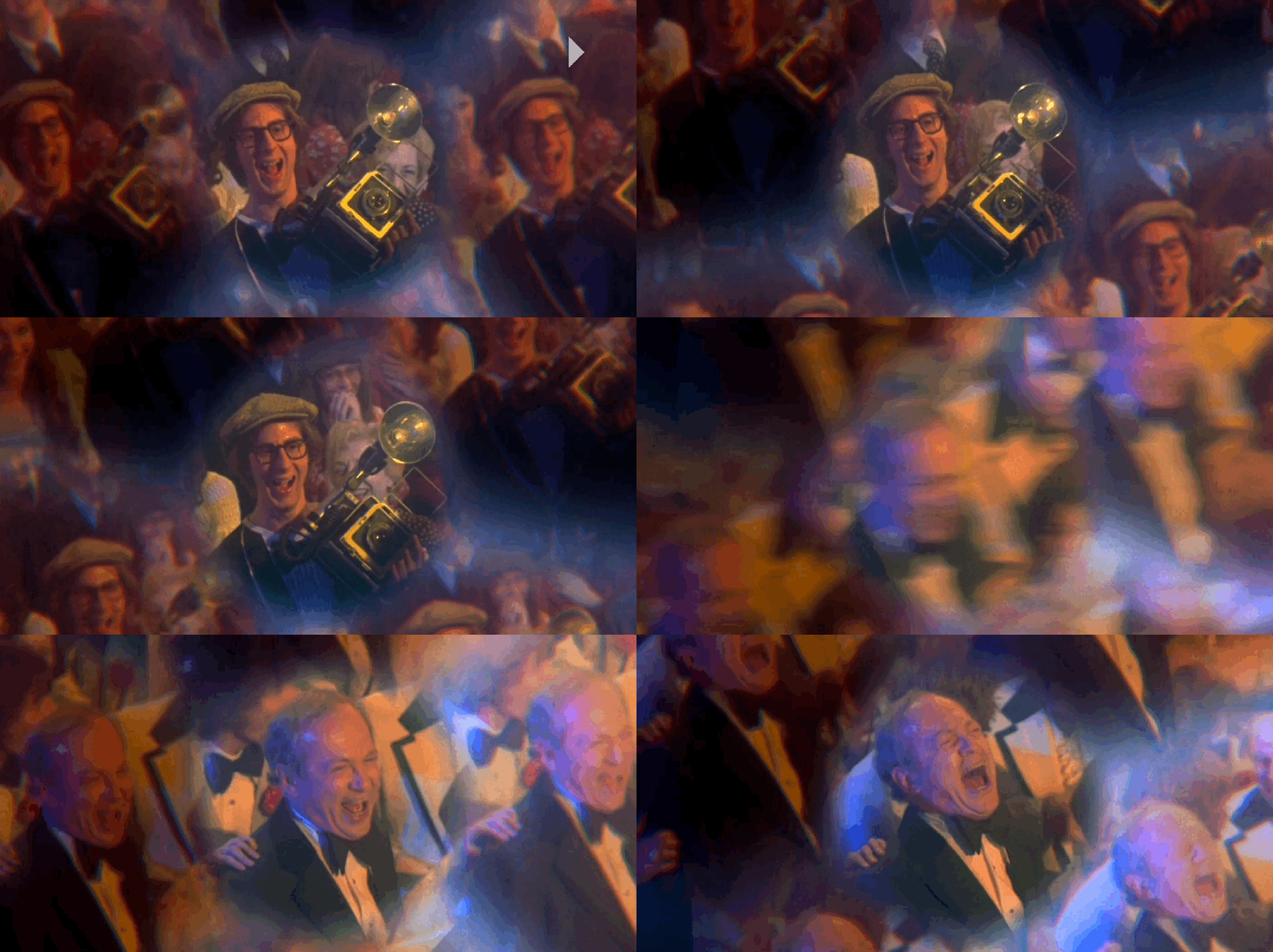
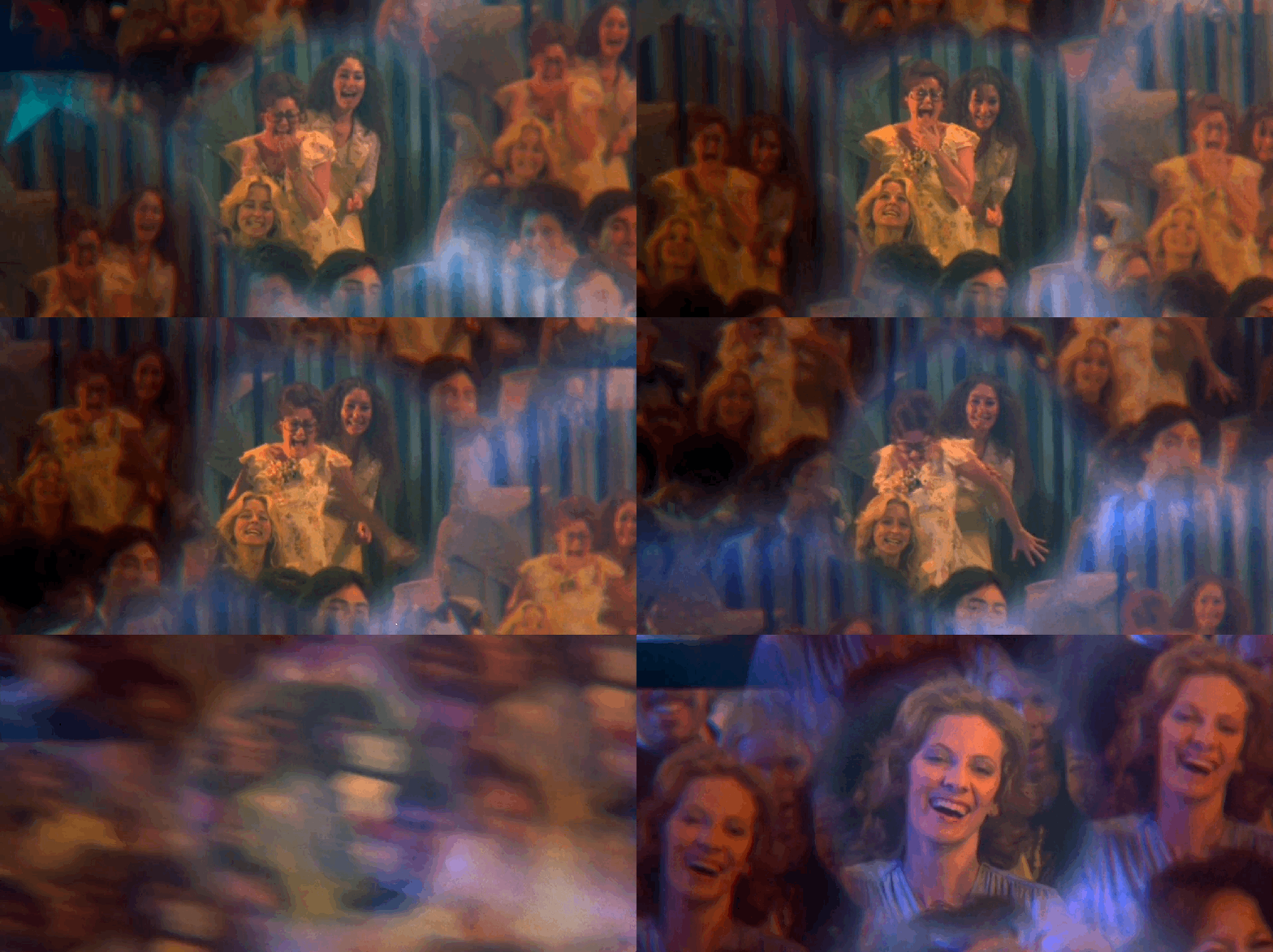
The key link between the film and novel versions is the “kaleidoscope” perspective, which brings us to the description of the trigger moment in the novel from Carrie’s point of view:

Carrie sat with her eyes closed and felt the black bulge of terror rising in her mind. Momma had been right, after all. They had taken her again, gulled her again, made her the butt again. The horror of it should have been monotonous, but it was not; they had gotten her up here, up here in front of the whole school, and had repeated the shower-room scene . . . only the voice had said

(my god that’s blood)

something too awful to be contemplated. If she opened her eyes and it was true, oh, what then? What then?

Someone began to laugh, a solitary, affrighted hyena sound, and she did open her eyes, opened them to see who it was and it was true, the final nightmare, she was red and dripping with it, they had drenched her in the very secretness of blood, in front of all of them and her thought

(oh . . . i . . . COVERED . . . with it)

was colored a ghastly purple with her revulsion and her shame. She could smell herself and it was the stink of blood, the awful wet, coppery smell. In a flickering kaleidoscope of images she saw the blood running thickly down her naked thighs, heard the constant beating of the shower on the tiles, felt the soft patter of tampons and napkins against her skin as voices exhorted her to plug it UP, tasted the plump, fulsome bitterness of horror. They had finally given her the shower they wanted.

A second voice joined the first, and was followed by a third—girl’s soprano giggle—a fourth, a fifth, six, a dozen, all of them, all laughing. Vic Mooney was laughing. She could see him. His face was utterly frozen, shocked, but that laughter issued forth just the same.

She sat quite still, letting the noise wash over her like surf. They were still all beautiful and there was still enchantment and wonder, but she had crossed a line and now the fairy tale was green with corruption and evil. In this one she would bite a poison apple, be attacked by trolls, be eaten by tigers.

They were laughing at her again.

Stephen King, Carrie (1974).

As Magistrale notes about De Palma’s version, Carrie is essentially seeing through her mother’s perspective when she experiences the “imaginary laughter,” reflected by her hearing her mother’s refrain in her head: “They’re all gonna laugh at you,” which is what we hear during the above “kaleidoscope” shots, and which is a line that does not appear in the book. But this depiction is all in keeping with the novel’s description of Carrie’s thought in this moment that “Momma had been right.” Carrie’s novel account does depart from Norma’s memoir’s in describing a “solitary” burst of laughter initially before more join in, though the solitary laugh is what causes her to then finally open her eyes, and according to Norma, it’s what Carrie looks like after she opens her eyes specifically–the pop eyes that, like white gloves, are another sign of a blackface minstrel’s presence–that makes, supposedly, everyone laugh. And Carrie’s perception of the laughter in general is called into question by the end of the above passage when Vic Mooney is described as laughing even though his face is “frozen”–a blatant contradiction. This plays out as the passage proceeds from there in Carrie’s perception of Miss Desjardin:

Miss Desjardin was running toward her, and Miss Desjardin’s face was filled with lying compassion. Carrie could see beneath the surface to where the real Miss Desjardin was giggling and chuckling with rancid old-maid ribaldry.

Stephen King, Carrie (1974).

So Carrie is even aware that the laughter she’s perceiving is not “real,” so a version of “imaginary laughter” is propelling her here–fear/paranoia of laughter, an outcome of her conditioning from her classmates’ construction of her–as she proceeds to use her power to hurl Miss Desjardin against the wall:

“Let me help you, dear. Oh I am so sor—”

She struck out at her

(flex)

and Miss Desjardin went flying to rattle off the wall at the side of the stage and fall into a heap.”

Stephen King, Carrie (1974).

Here Carrie turns a tool of her classmates’ construction of her into a weapon, that same tool, which was really also a version of a weapon in its capacity to enact harm (the wall, with writing on it) that De Palma previously emphasized as elemental in her classmates’ construction of her, and we see the tragedy of the fallout of what was written on that wall affecting an innocent party, though this also emphasizes the evil of what caused all this in the first place…laughter.

At this point in the novel, Carrie then leaves the gym and the building entirely, basically passing through a gauntlet of (imaginary) laughter along the way:

She went down [the steps] in great, awkward leaps, with the sound of the laughter flapping around her like black birds.

Then, darkness.

Stephen King, Carrie (1974).

She then lies on the school lawn outside mulling things over for a bit before she decides to use her power to teach them all a lesson and then returns to the gym to do so–so the film handles the sequence a little more efficiently.

Via Norma being the only one laughing (minus possibly one other guy in a fleeting shot that’s not a distorted kaleidoscope one), De Palma seems to have been attuned to the importance of Norma’s role in the trigger moment in the novel. Another observation for the Notice and Focus exercise about De Palma’s opening scene is that the girls are all in yellow and black uniforms–except one girl, whose shorts are red and who is wearing a matching red hat. This girl is Norma, who throughout the entire film is NEVER not wearing her red hat. She is still wearing it with her prom dress in the shot of her violently laughing above, and in one of the places De Palma deploys humor in the film, as she’s getting ready for prom:
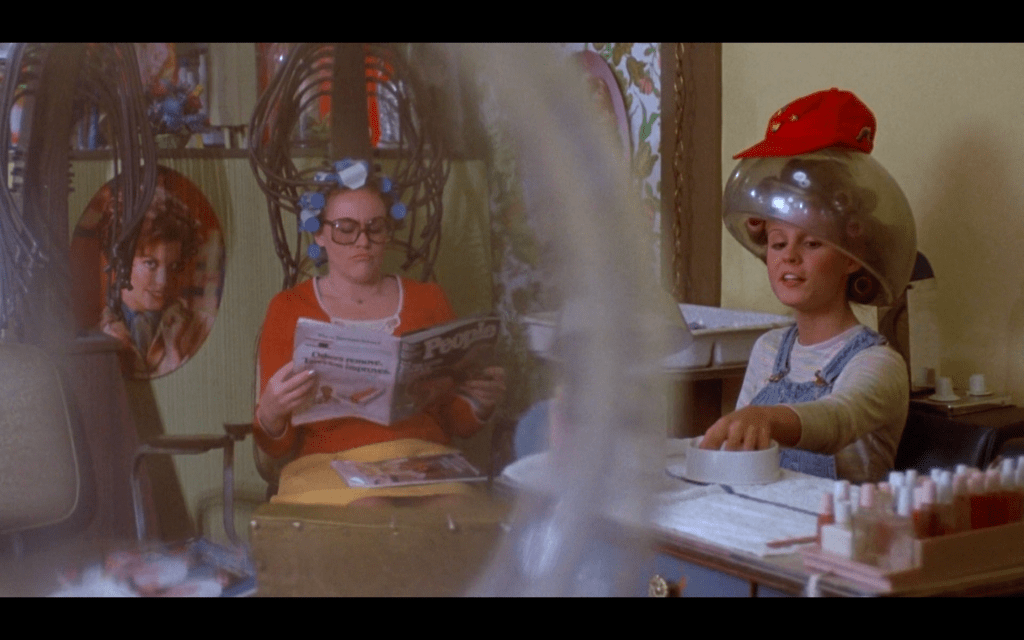
Still wearing the red hat, sort of…

The scene that cuts directly to the shot above also has a character wearing a red hat:
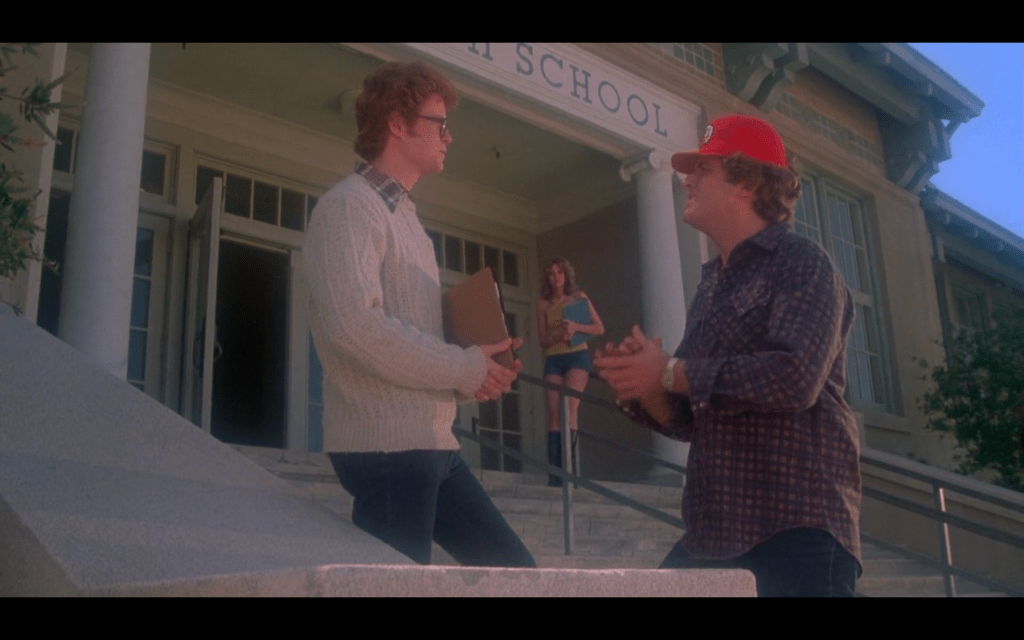
The red hat is a sign of another “vile co-conspirator” of Chris’s (she is visible in the background at the center of the shot).

Given the role of conformity, something Norma conforms to via, per Kelly, being the teen type of the “sidekick” to Queen Bee Chris, it’s interesting that her clothes mark her as an outlier, which resonates with her being the only one whose laughter Carrie is not imagining in the film.

Chris and the laughter brings us back to the bees…
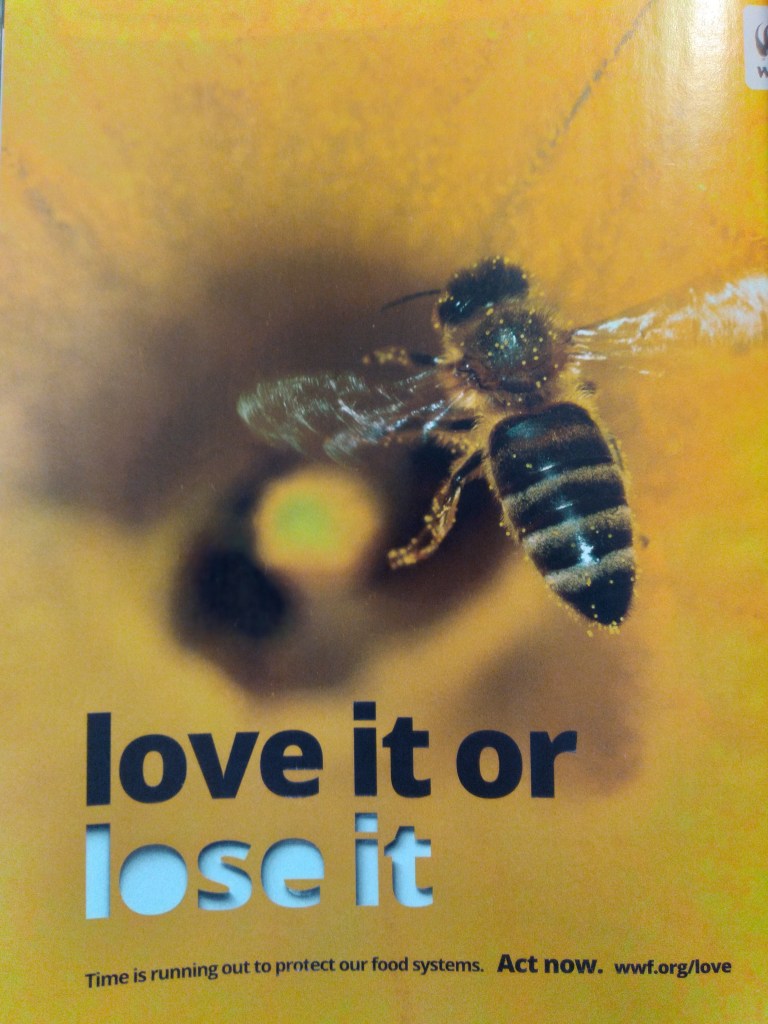
Per Kelly, Chris as “queen bee” constitutes the film’s “real horror,” and if, via Song of the South associating bees with The Laughing Place that manifests a similar merging of horror and humor as is enacted in the Carrie trigger moment, bees are associated with the Africanist presence, this means that Chris too potentially manifests an Africanist presence. Kelly notes as well the depiction of the school’s mascot in the film: “Bates High School’s colors [] are yellow and black and their mascot is the Stinger. According to art director Jack Fisk, ‘We didn’t want anything cuddly or too friendly’” (15). In the screen shot analysis from the opening scene, Kelly notes that the school gym uniform fits Chris but is too big on Carrie, meaning the unfriendly stinging atmosphere of the school is a better “fit” on Chris. Here’s a screen shot from a different scene that could also be used as evidence from the text to support this point:
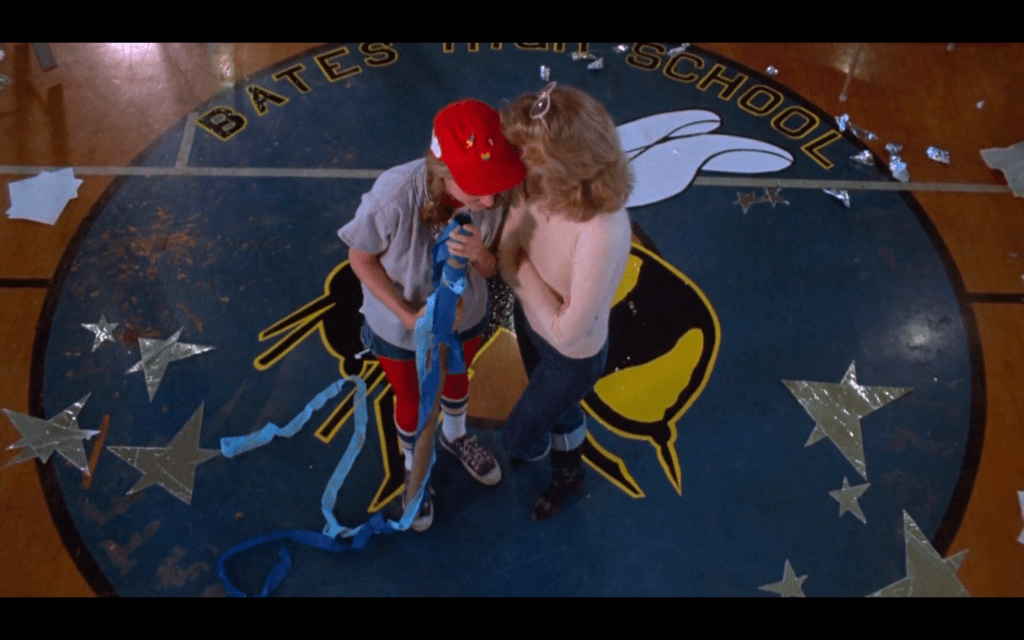
Queen Bee and Sidekick conspiring…this (amazing) shot is angled so that Chris looks like both the wings and stinger (or bottom half with the stinger) are protruding from her body…

The potential viciousness of a “queen bee” is evoked in a more current pop-culture text, an episode of The Big Bang Theory from 2009 with what’s certainly in contention for the show’s most disgusting episode title, “The Dead Hooker Juxtaposition.” The titular “dead hooker” is derived from a new girl who moves into the apartment building where the main characters live and becomes a threat to Penny, at that point the show’s only main female role (the counterpoint to the typical all-male ka-tet quartet comprised by the rest of the main cast); this girl, like Penny, aspires to be an actress and is thrilled to land a role as a “hooker that gets killed.” At one point, Sheldon seems to be attempting to shed some light on the situation by invoking a metaphor, but it’s elemental (so to speak) to Sheldon’s character that he isn’t capable of this type of symbolic thinking; he takes most things literally in a way that seems to verge on the autistic (though this aspect of his quirkiness, much like his sexuality, is never named):

Sheldon: You know, Penny, there’s something that occurs in beehives you might find interesting. Occasionally, a new queen will arrive while the old queen is still in power. When this happens, the old queen must either locate to a new hive or engage in a battle to the death until only one queen remains.

Penny: What are you saying, that I’m threatened by Alicia? That I’m like the old queen of the hive and it’s just time for me to go?

Sheldon: I’m just talking about bees. They’re on the discovery channel. What are you talking about?

Penny: Bees. 

The Big Bang Theory 2.19, “The Dead Hooker Juxtaposition” (March 30, 2009).

What’s in a Name, Again

If “What’s in a name?” were a riddle, then one answer would be: letters.

The symbolism of bees and insects as used in literature is tracked extensively in the academic study Poetics of the Hive: Insect Metaphor in Literature by Cristopher Hollingsworth (2001); the introduction’s title “The Alphabet of the Bees” implicitly underscores the potential importance of a single letter in the context of shifting meaning.

Take, for example, the change of a single letter in the spelling of Chris’s last name–I noticed that in his Hollywood’s Stephen King analysis, Magistrale (or his copyeditor) spells her last name “Hargenson” instead of “Hargensen” as it appears in King’s text. Chris’s patriarchal lineage plays an explicit role in the book if not the movie when her lawyer-father barges into the principal’s office and demands Chris be allowed to attend the prom, and King portrays the principal in the localized context of the scene as a minor/momentary hero when he is not intimidated by litigious threats and does not change his mind about Chris being banned from the prom. But King potentially undermines himself (again) when the narrative necessitates/generates the possibility that if the lawyer-father Hargensen had succeeded in his rhetorical (white-privileged) manipulations, then none of the rest of the book (more specifically the horrible violence and death that unfolds in it) would have happened, because the punishment Chris was trying to avenge, that which was compelling her to carry out the pig-blood plot, would have been nullified. But the change in this single letter in the spelling led me to a new discovery; when I went to see how Chris’s last name was spelled in the film screenplay after confirming it was “Hargensen” in King’s text, I discovered this screenplay draft that is credited to both Lawrence D. Cohen, who has sole screenwriting credit for the final version, and Stephen King; this draft has two full scenes before the one the final version opens with. (And in this draft, “Hargensen” appears as it does in the novel.)

We saw the implications of King changing the initial of the last name of The Green Mile‘s John Coffey from “B” to “C”–which is itself a phrase that essentially tracks the Poetics of the Hive study’s thesis: the figure of the bee is the key to seeing: from bee to see.

The Hive topos’s primary office is to picture social order, to define by mutual contrast the human individual and the organized collective. This topos’s core is an imitation of a visual experience, that of surveying a group from a sovereign position. From this external position, the observer may apprehend the group as a whole, now simplified. The visual field is then divided into two antithetical regions, which (along with their contents) are interpretable according to a code of proximity and similitude. This process of interpretation then enables the observing consciousness to attribute otherness to the observed collective. And depending upon a collective’s degree of organization and its ethical alignment, it tends to be figured as either an angelic beehive or a demonic ant heap. (boldface mine)

Poetics of the Hive

As tracked by Hollingsworth across the history of literature, the bee symbolism, or hive symbolism–because the bees as a symbol are a “synecdoche” (pronounced sin-ech-duh-KEY), meaning one necessarily signals or stands in for the presence of a larger whole–gets quite complicated, evolving over time in its deployment to reflect how literature reflects the evolution of the culture.

It also defines human nature…

“Synchrony is a highly effective “biotechnology of group formation,” as neuroscientist Walter Freeman put it—but why would such a technology be necessary?

Because, says Jonathan Haidt, “human nature is 90 percent chimp and 10 percent bee.” Haidt, a psychologist at NYU’s Stern School of Business, notes that in the main, we are competitive, self-interested animals intent on pursuing our own ends. That’s the chimp part. But we can also be like bees—“ultrasocial” creatures who are able to think and act as one for the good of the group. Haidt argues for the existence in humans of a psychological trigger he calls the “hive switch.” When the hive switch is flipped, our minds shift from an individual focus to a group focus—from “I” mode to “we” mode. Getting this switch to turn on is the key to thinking together to get things done, to extending our individual minds with the groups to which we belong.

Annie Murphy Paul, The Extended Mind: The Power of Thinking Outside the Brain (2021).

That is, bees are the key to seeing outside of ourselves…

Another example of the significance of a single letter is the spelling of “lynchpin” v. that of “linchpin.” It is spelled the latter in a text edited jointly by Sarah E. Turner, the author of the Roe v. Wade essay on Carrie discussed above, and Sarah Nilssen, the author of the essay on Cujo and “creatureliness” discussed in Part 1:

What makes diversity work from a colorblind standpoint is that it ostensibly supports its main ideological linchpin—the claim that race no longer matters. (boldface mine)

The Colorblind Screen: Television in Post-Racial America, ed. Sarah Nilsen and Sarah Turner, New York
University Press, 2014.

The spelling of “linchpin” v. “lynhcpin” is explained in some detail here, which notes, among other things, that:

Lynchpin is a variant spelling of [linchpin]. It is used somewhat frequently, although it is nonstandard and incorrectly suggests an association with lynch. (boldface mine)

From here.

“Incorrectly” according to the word’s etymology in Old English, which would predate all of post-Columbus American history, but then the advent of a particular part of that American history once it does occur–i.e., the role of lynching, means that an association of “lynchpin” with lynching today is not so much “incorrect” as unavoidable, whether consciously or not. Turner and Nilssen don’t seem to acknowledge the irony of using the term “linchpin” in the context of the concept of “colorblindness,” i.e., the idea that racism no longer exists, this problematic erasure of racism as a means to perpetuate covert racism that aligns with Sperb’s study of Song of the South.

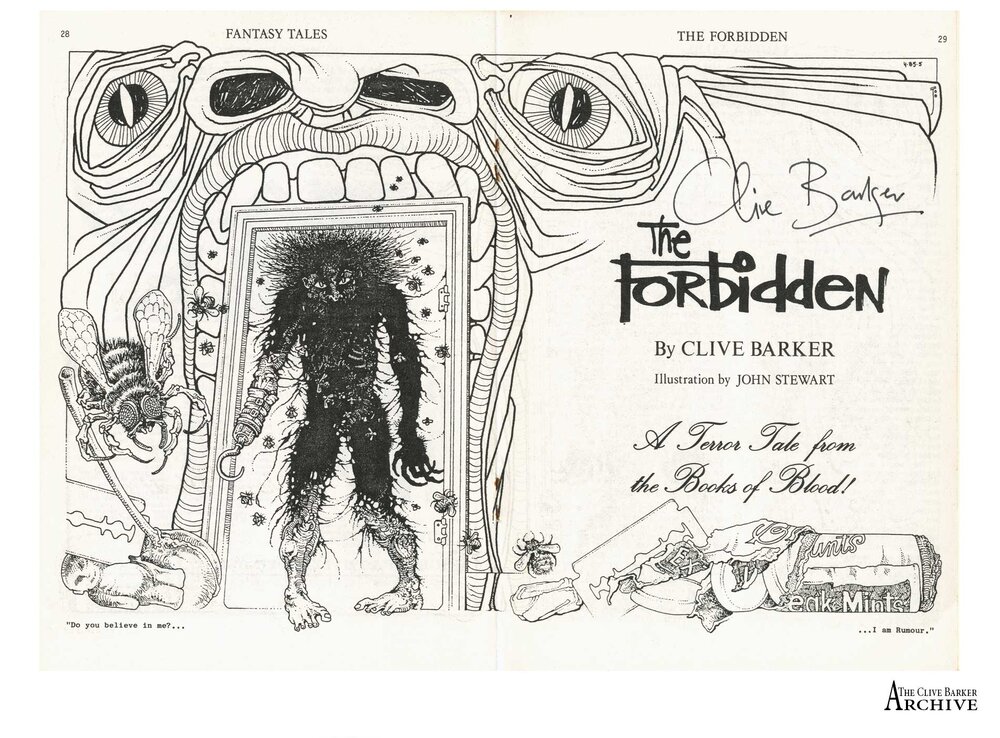
From one perspective, it seems potentially more respectful to spell this word with “i” instead of “y” so that it does not call to mind this horribly violent aspect of American history. Since the term does not officially derive from a tool used for lynching and thus derive from lynching itself and so is not associated with it in that most fundamentally integral way, it does not seem to technically be a form of erasure of the history of lynching itself. But I still wonder. Jason Sperb uses “linchpin” in his study on Song of the South, as does Simon Brown in his Screening Stephen King study, both published by University of Texas Press; Barker’s “The Forbidden”–the basis for Candyman and from a British publisher–uses “lynchpin.”

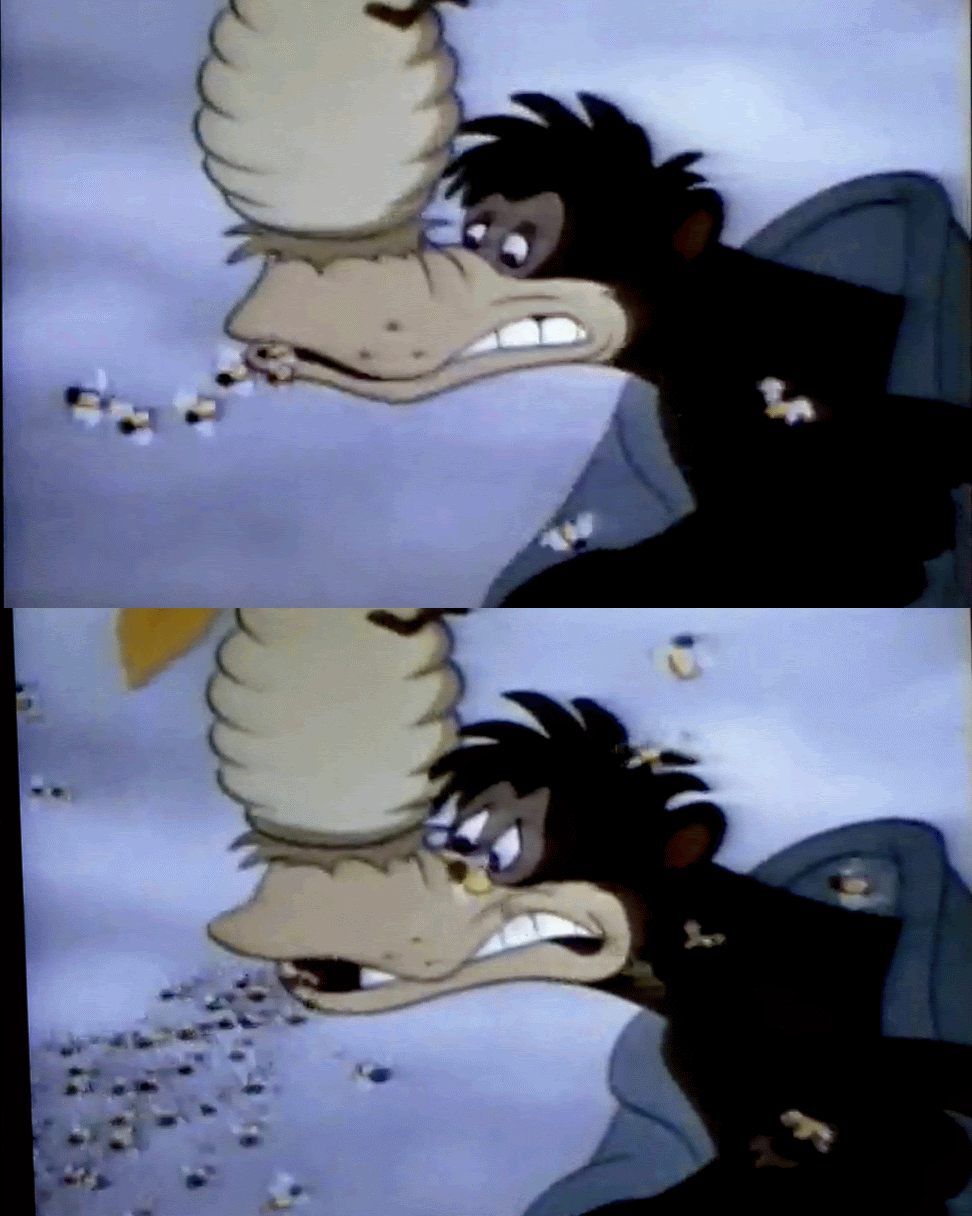
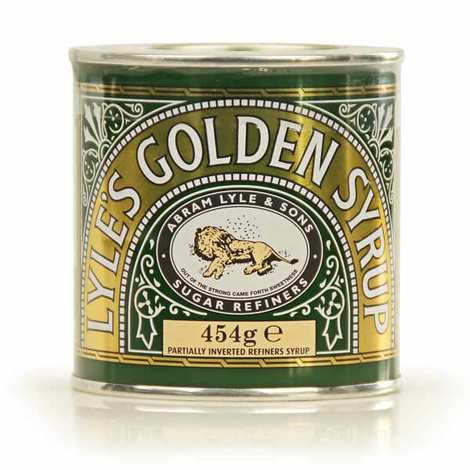
The ’92 Candyman film adds what was not in Barker’s source text–the backstory that the Candyman is the ghost of a Black man lynched by white men, who lynched him–after cutting his hand off–by way of painting him with honey and unleashing bees on him–so the bees become the weapon that carries out the lynching, and are ever present with the Candyman’s ghost as a sign of his presence, one that evokes horror, but also implicitly evokes that of America’s history of lynching; now the Candyman’s ghost deploys as a weapon (to inspire fear even if we don’t see him sic the bees on people) that which was used as a weapon against him–which is something he has in common with Carrie in how she deploys the wall (and how, as we’ll see shortly, she deploys something else that was used in her construction as an object of laughter).
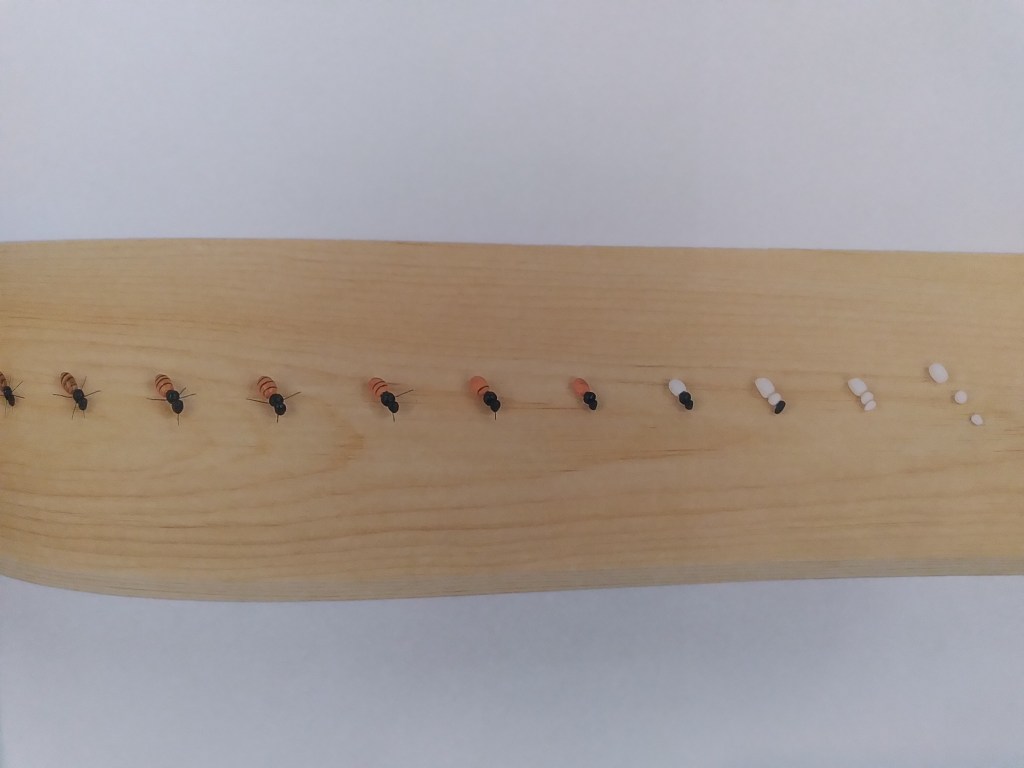
The construction of bees: Untitled by Tom Friedman (2002). “A progression of handmade bees showing the step-by-step process of their making or unmaking, displayed on a wood shelf.”

This likeness between Carrie and the Candyman, as well as the Remus reference at the trigger moment, will add another “semiotic level” (i.e. symbolic level) to those Magistrale points out about a critical object:

Although she is naked throughout [the locker-room] scene, Carrie does wear a single key on a string around her neck. The key operates on several semiotic levels simultaneously. Since it appears to be the key to her gym locker, she apparently wears it around her neck so as not to lose it, and thus it signals Carrie’s emotional immaturity… Carrie’s key also reminds us of the fact that she is “locked up,” emotionally and physically; she has not been open to society, open to her own sexuality… As the key symbolizes that part of Carrie that has been padlocked up and contained, separated from the rest of the world, it thereby connects with the visual images of enclosure and confinement that are found throughout the film’s opening sequence. But the key may also be viewed as signaling the dramatic change that is about to occur to Carrie, for she holds the key to unlocking herself from the bondage of her past and the opportunity to view, however ephemerally, the possibilities of an emancipated future. (boldface mine)

Tony Magistrale, Hollywood’s Stephen King (2003), pp27-28.

By the end of this passage, Magistrale really starts using language that underscores Carrie’s manifesting an Africanist presence. And though this is not one of the “semiotic levels” of the key he points out, in light of the Song of the South reference at the trigger moment, the image of Carrie with the key around her neck–
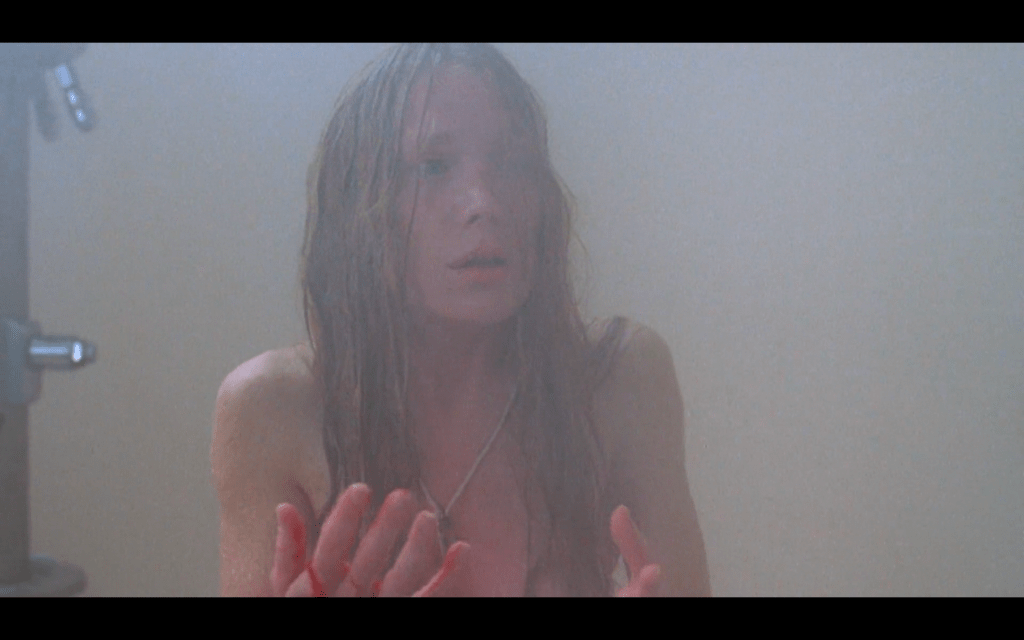
Carrie (1976): Carrie with blood on her hands…

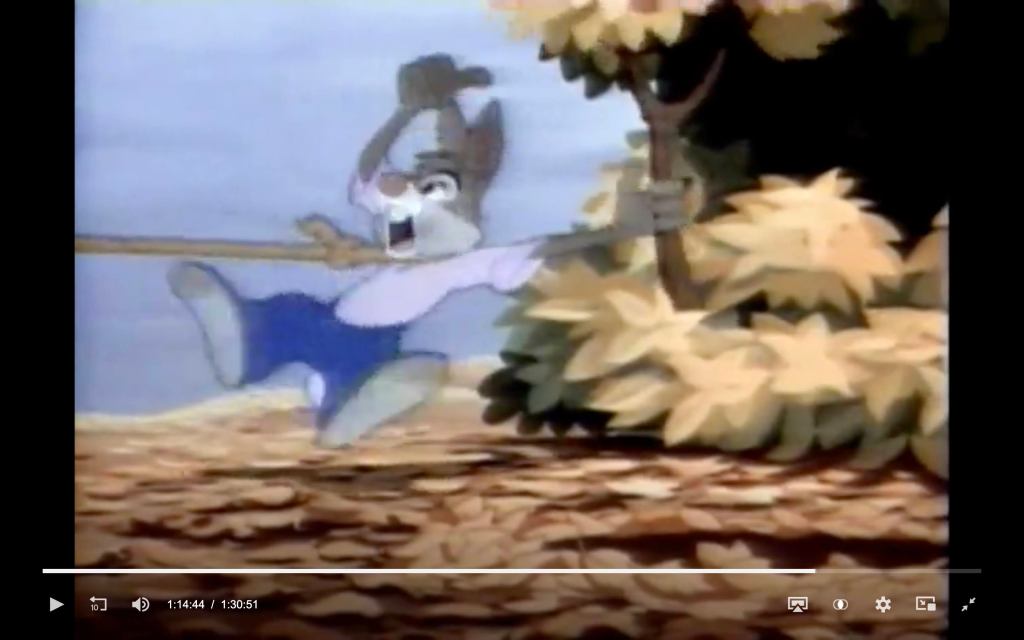
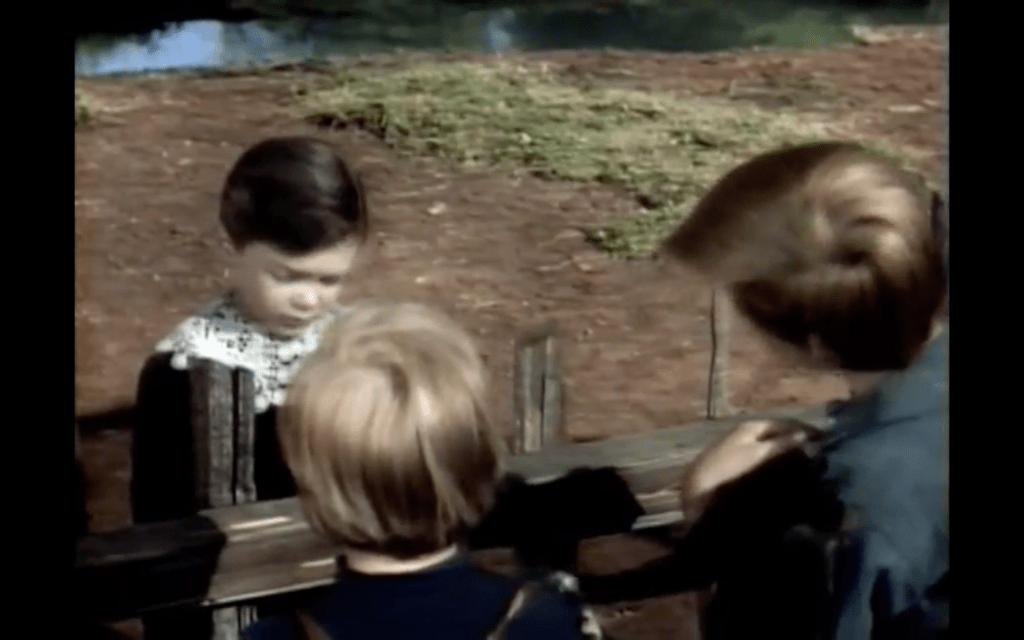
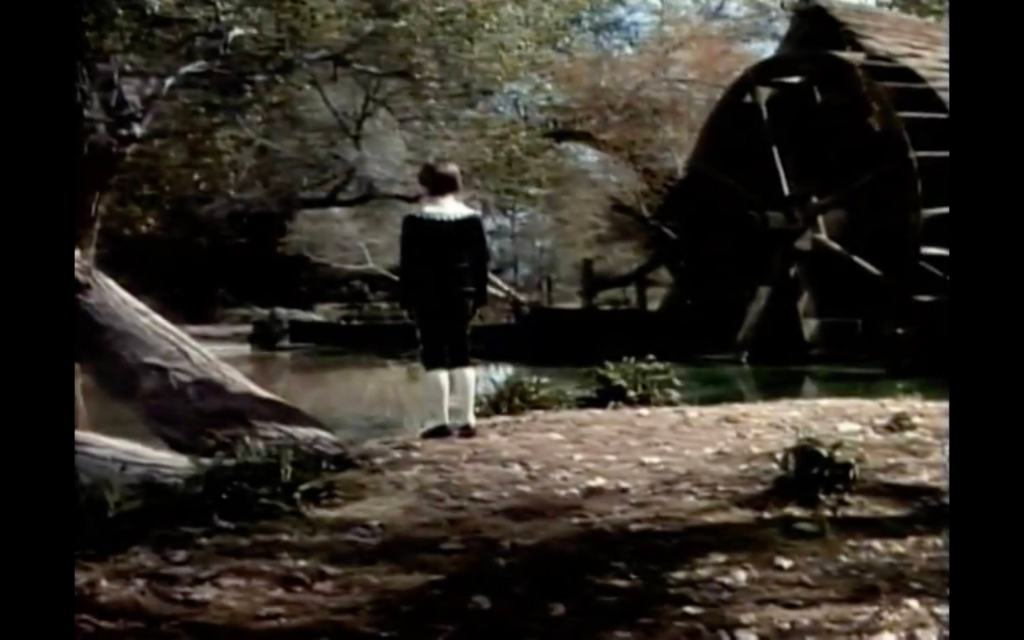
–recalls that of Brer Rabbit as he’s leading Brer Fox and Brer Bear to his Laughing Place:
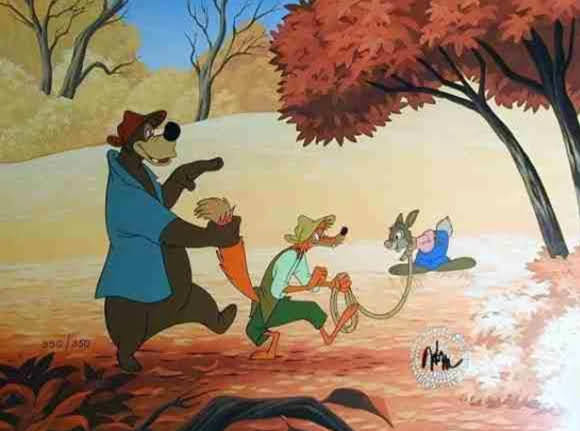
Song of the South (1946): Brer Rabbit at his Laughing Place with a rope around his neck.

An important way the bee is a key to both Kingian semiotics and King’s general appeal to readers is in how, as Cris Hollingsworth puts it, the bee “imitates a particular visual experience,” which is what King’s prose does generally in a different context in his being a visual or “cinematic” writer and seems to be a major key to his success, both in the popular success of the books in and of themselves, but also in their potential for screen adaptations.

(And if we ask what is in the name of that original Disney minstrel, Mickey Mouse, we will find a key–MicKEY.)

The name of “Bates High” is a change from the “Ewan High” of the novel, an homage to the character Norman Bates from Alfred Hitchcock’s classic slasher Psycho (1960), which the name of Norma from the novel is an homage to also also, since Hitchcock is as much an influence on King as he is on De Palma (one of the influences critical to his development as a “cinematic” writer), and King frequently invokes variants of this name in Hitchcock’s honor, though you could argue it’s in honor of Robert Bloch’s novel as the source text. Bloch and Hitchcock alike would qualify as a synecdoche for the larger Hive of Horror, and the “Norman” name is also an homage to the general horror principle King extols in his study on the subject:

After all, when we discuss monstrosity, we are expressing our faith and belief in the norm and watching for the mutant. The writer of horror fiction is neither more nor less than an agent of the status quo.

Stephen King, Danse Macabre (1981).

How the name “Norma/Norman” encodes this agency (and how King uses it as carte blanche to demonize minorities) is articulated in Dreamcatcher (2001):

“Queerboy!” Jonesy yells, rubbing frantically at his mouth . . . but he’s starting to laugh, too. Pete’s an oddity—he’ll go along quietly for weeks at a time, Norman Normal, and then he’ll break out and do something nutso.

Stephen King. Dreamcatcher: A Novel (2001).

King inverts the name being a sign of the “normal” (while simultaneously reinforcing it as such) in Rose Madder (1995) when the evil abusive psycho cop villain husband of the titular character Rose is named Norman:

“That’s his for-real no-fooling name?”

“Yes.”

“As in Bates.”

“As in Bates.”

Stephen King, Rose Madder (1995).

One of the other talks in my PCA potpourri panel on King was by Amber Moon on Rose Madder; Moon’s argument that in it Norman fits the criteria of a stereotypical monster and Rose the criteria of a stereotypical “ideal victim” would support my broad thesis that King is a stereotypewriter, and her discussion of Norman’s monstrousness manifest in his dehumanization via being repeatedly likened to a bull offers an example of Kingian tics I’ve tracked–the use of the refrain, which in this case reinforces the bull-likening via the repetition of “Viva Ze Bool,” with this bull-likening being another example of a critteration, though this provides an example of the distinction between my “critteration” concept and Nilssen’s “creatureliness” concept–the creatureliness is animal-likening that’s explicitly scary, wild animal as savage monster, while the critteration is a likening to a cute non-threatening animal not intended to evoke fear but implicitly scary for manifesting some form of dehumanization and covering it up. Moon’s talk did remind me there is an intersection of creatureliness and critteration in Rose Madder when Norman snatches a rubber Ferdinand-the-Bull mask off a kid and dons it himself. Ferdinand the Bull is a critteration in the fully non-threatening sense that King’s novel subverts to manifest creatureliness. The character first appeared in the 1936 children’s book The Story of Ferdinand that was then adapted by Walt Disney into an animated short film in 1938, which means Moon’s talk can support more than just the broad argument of King-as-stereotypewriter: King-as-stereotypewriter specifically due to the influence of Walt Disney. There’s even a bee that plays a critical role in the plot and Ferdinand’s fate when it accidentally stings Ferdinand:
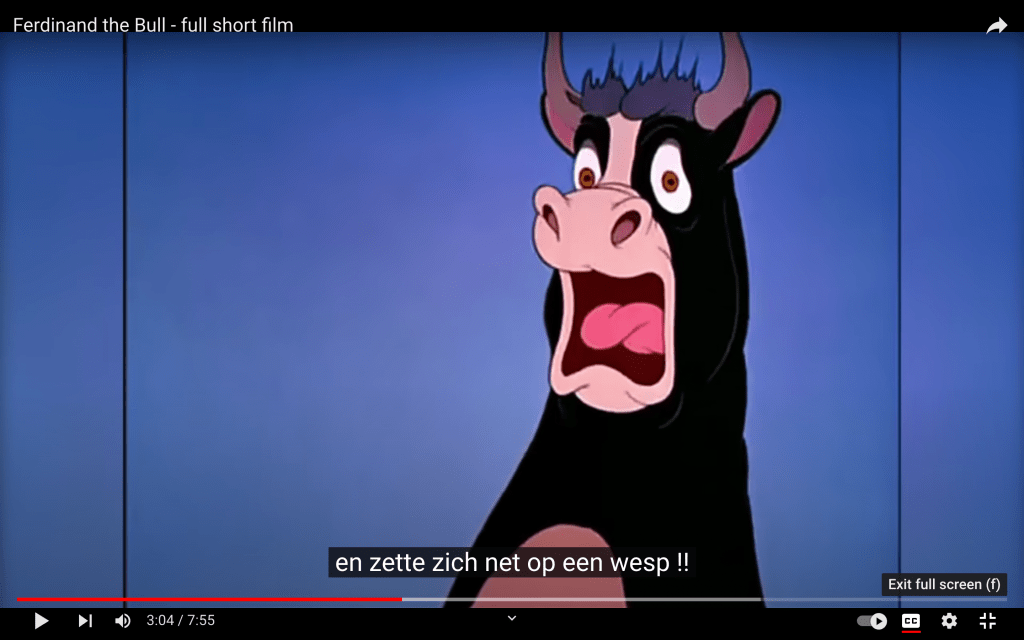
Horror as humor in Disney’s Ferdinand the Bull (1938): “…and he sat on a bumblebee!”

Stinging bees are invoked in Carrie when Carrie tries out this weaponized brand of harmful humor herself on no less significant a character than Norma herself: 

“You’re positively GLOWING. What’s your SECRET?”

“I’m Don MacLean’s secret lover,” Carrie said. Tommy sniggered and quickly smothered it.

Norma’s smile slipped a notch, and Carrie was amazed by her own wit—and audacity. That’s what you looked like when the joke was on you. As though a bee had stung your rear end. Carrie found she liked Norma to look that way.

Stephen King, Carrie (1974).

Carrie’s taste for enacting the same abuse she’s endured herself speaks to the cyclical/toxic nature of violence. (The blood on her hands by the end all occurs because of the blood on her hands at the beginning.) The “looked like” in this passage underscores the literary nature of bees as a visual signifier (as well as the strange circularity of Norma’s description of the trigger moment amounting to people laughing at what Carrie’s eyes looked like), but we also have an auditory signifier via the reference to singer Don McLean, probably most famous for the song “American Pie” from his 1971 album American Pie:
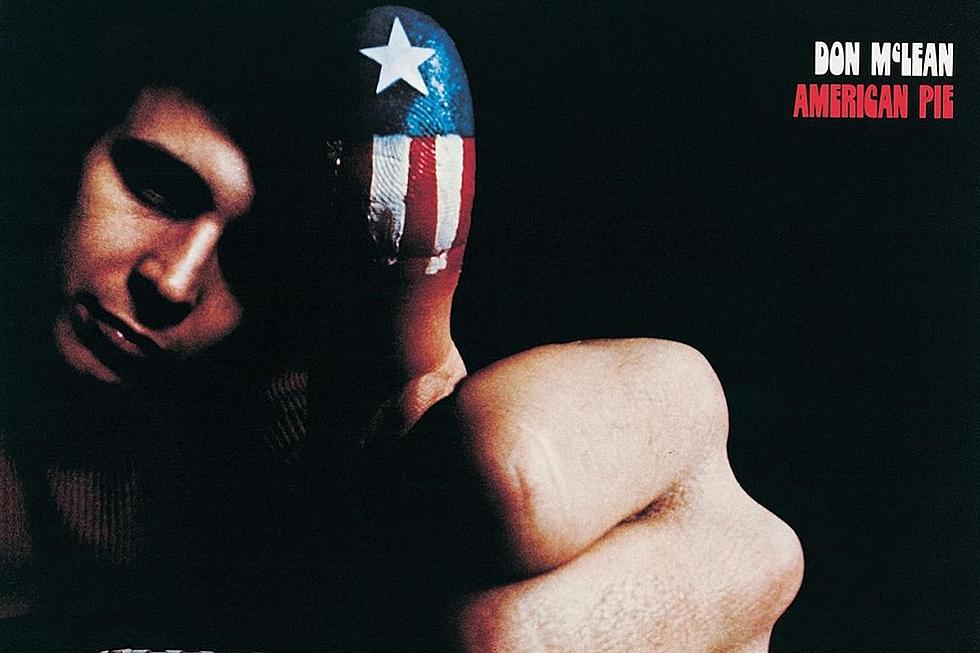
This offers a connection between consuming narratives via music, and the consumption of food.

“You haven’t touched your pie, Carrie.” Momma looked up from the tract she had been perusing while she drank her Constant Comment. “It’s homemade.”

“It makes me have pimples, Momma.”

“Your pimples are the Lord’s way of chastising you. Now eat your pie.”

Stephen King, Carrie (1974).

De Palma accentuates this moment with the set dressing, specifically a large image of The Last Supper visible above the dinner table intermittently illuminated by lightning and initially shown in close-up right before the above exchange, in which “pie” is changed to “apple cake,” perhaps invoking the original Biblical consuming narrative of Eve eating the apple, for, as Margaret emphasizes when she earlier exhorted Carrie to “‘say it,'” “‘Eve was weak.'” Or maybe it could (also) be a Snow-White reference in deference to Carrie comparing her trigger experience to Snow Whtie eating the poison apple in the novel.
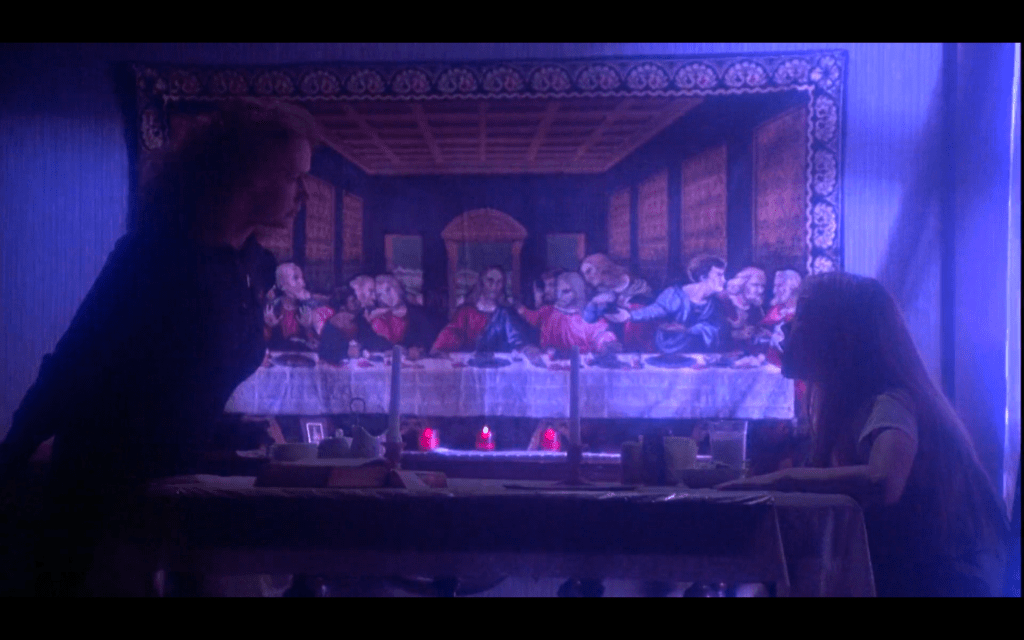
Carrie’s Last Supper with her mother…

A concern about what she consumes causing pimples is something Carrie shares with Sue:

Hubie had genuine draft root beer, and he served it in huge, frosted 1890s mugs. She had been looking forward to tipping a long one while she read a paper novel and waited for Tommy—in spite of the havoc the root beers raised with her complexion, she was hooked.

Stephen King, Carrie (1974).

Of course, this is a common concern for teenagers (it will plague Arnie “Pizza-Face” Cunningham in Christine as well) in a horror trend that King tracks in his own study on the subject:

In many ways I see the horror films of the late fifties and early sixties—up until Psycho, let us say—as paeans to the congested pore.

Stephen King, Danse Macabre (1981).

Which, in invoking a “paean,” aka a song of praise, is a passage that merges this particular fear with music.

What’s in a Name: Momma Songs and Musical Curses

In a two-part essay from 2017 entitled “The Curses,” John Jeremiah Sullivan attempts to track the origin of the phrase “playing the blues” and what is supposedly the very first “‘blues song,'” discovering that it seems to be a song called “Curses” by Paul Dresser. In another example of the significance of a single letter, this Paul Dresser is the brother of Theodore Dreiser, author of, among other novels, Sister Carrie (1900), and whom Sullivan credits with “chang[ing] the course of American literature.”

Why the surname difference between brothers? After noting that Paul Dresser’s mother referred to herself as Pennsylvania Dutch, Sullivan notes:

that term “Dutch” being in this case not our surviving word meaning Hollanders but a corruption of “Deutsch” — Germans who had left the homeland

John Jeremiah Sullivan, “The Curses, Part II: The Curse of the Dreamer,” The Sewanee Review (2017).

Sullivan then goes on to note:

The pocket-biographical line is that Paul Dresser ‘changed his name’ from Dreiser, which it had been at birth, but that’s putting a complicated problem in a very simplistic way. Nobody, it seems, could ever decide how to spell the family name. Even back in Germany, it had been written several different ways (Dreysers, Dreeser, etc.), and the first time the boy’s name appears in print, in the 1860 census, it’s spelled Dresser, just as he later took to writing it. At least a few local businessmen knew them as the Dressers. It seems truest to say that anyone born into that family had surname options. Certainly, though, in the end, there was a difference. The rest of the family settled on Dreiser, and he went with Dresser. It helped that the variant sounded less German, because if ever a man was American, it was Paul Dresser. (boldface mine)

Sullivan also notes that Dresser was “one of the fattest men in America, and for a time its most successful songwriter” offering a parallel obliquely present in Carrie’s Don McLean joke between the consumption of music and the consumption of food–a parallel that is distinctly American.

In tracking the different accounts of the origin of the blues, Sullivan notes:

A feature of the blues origin narrative is that, at the center, one tends to find the teller.

John Jeremiah Sullivan, “The Curses, Part I: Ahjah is Coming,” The Sewanee Review (2017).

This might actually be a feature of all narratives…side note: Sullivan also wrote a 2011 piece for The New York Times about Disney World, or more specifically, being high at Disney World.

In keeping with the prominence of the period in Carrie, that which is often referred to as the “monthly curse,” Turner in her reading of Carrie as “witch/abortionist” also invokes the concept of curses:

Stamp Lindsey argues that “monstrosity is explicitly associated with menstruation and female sexuality . . . [but] menstruation and female sexuality here are inseparable from the ‘curse’ of supernatural power, more properly the domain of horror films” (36). Reading Carrie’s powers as a “curse” serves to disenfranchise Carrie herself; instead of taking charge of her life, she is “cursed” and thus must be saved…

Sarah E. Turner, “Stephen King’s Carrie: Victim No More?” in Violence in the Films of Stephen King (ed. Magistrale & Blouin, 2021).

That as a society we often refer to menstruation as a “curse” when it’s a sign of the potential for biological reproduction and therefore should be a positive sign of our capacity to endure as a species is itself a sign of the patriarchy…

At one level, the class response to Carrie’s panic when she begins to menstruate reflects how women are taught to hate their own bodies and particularly their periods—“plug it up” is more than just derisive mockery; it is the language of self-abjection. Societal taboos dictate that menstruation is “dirty”—something to hide—not something to publicize let alone celebrate.

Sarah E. Turner, “Stephen King’s Carrie: Victim No More?” in Violence in the Films of Stephen King (ed. Magistrale & Blouin, 2021).

The repetition of “Plug it up” constitutes what turns out to be a common Kingian device, the refrain, that might well derive from King’s love of music–he is a rhythm guitarist, after all…
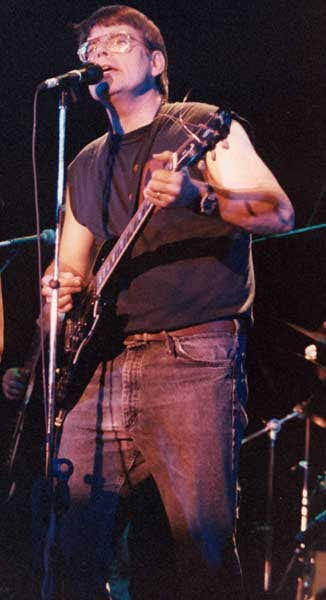
King with the Rock Bottom Remainders in 1994 (from here)

…and rhythm in prose is often manifest in repetition. The “plug it up” phrase, in the context of the trigger moment scene, made me think of the phrase “plug it in,” which might be an old slogan for Glade air-freshener, but I thought of it because Carrie’s potential to enact harm in this scene, while obviously derived from her telekinetic powers, depends on what is in her immediate surroundings that she can weaponize; what she seizes on is the water in the pipes, and this causes a lot of damage and death due to the presence of electrical music equipment, as we see from Norma’s perspective:

I looked around and saw Josie Vreck holding onto one of the mike stands. He couldn’t let go. His eyes were bugging out and his hair was on end and it looked like he was dancing. His feet were sliding around in the water and smoke started to come out of his shirt.

Stephen King, Carrie (1974).

Laughed at for looking like a minstrel, Carrie has now turned Josie into one. We also see the musical equipment very fleetingly from Tommy’s perspective, which continues into the moments immediately following his death:

He was still sprawled on the stage when the fire originating in the electrical equipment of Josie and the Moonglows spread to the mural…

Stephen King, Carrie (1974).

And again from Carrie’s perspective (right after we see that she calculated the danger of unleashing the water because of the presence of all the “power cords”):

He caught hold of one of the microphone stands and was transfixed. Carrie watched, amazed, as his body went through a nearly motionless dance of electricity. His feet shuffled in the water, his hair stood up in spikes, and his mouth jerked open, like the mouth of a fish. He looked funny. She began to laugh.

(by christ then let them all look funny)

Stephen King, Carrie (1974).

This description could essentially function as one of a parody minstrel performance, and also recalls an earlier time Carrie invoked looking, or actually being, “funny,” in the Last Supper scene (an exchange that is rendered identically in the novel and film):

“Momma, please see that I have to start to . . . to try and get along with the world. I’m not like you. I’m funny—I mean, the kids think I’m funny. I don’t want to be. I want to try and be a whole person before it’s too late to—”

Mrs. White threw her tea in Carrie’s face.

Stephen King, Carrie (1974).

As noted by the “White Commission” in the novel:

One of the fictional texts excerpted within the novel, The Shadow Exploded, which, along with Norma’s memoir’s invoking the “Black Prom,” signifies that Carrie’s telekinetic powers manifest an Africanist presence, notes that:

The White Commission‘s stand on the trigger of the whole affair—two buckets of pig blood on a beam over the stage—seems to be overly weak and vacillating… (emphases mine)

Stephen King, Carrie (1974).

This passage identifies the two key ingredients to Carrie’s construction as Menstrual Minstrel–the pig blood renders the Menstrual and the stage renders the Minstrel. (And might foreshadow the significance of the “beam” in the Dark Tower series.)

As with the wall that she weaponized when she hurled Ms. Desjardin against it, the potential for destruction latent in the power cords, or live wires that Carrie realizes is another instance of her weaponizing what was weaponized against her in becoming an element of her construction-as-outcast in the imagination of her classmates, in this case a minstrel-critical element in its relation to music, a link that’s reinforced when the other explicit “minstrel” reference occurs–notably in an omniscient rather than localized to any one character’s perspective, and notably in parentheses–in a description of the townspeople emerging to witness the destruction that segues to one of these townspeople’s descriptions of trying to avoid the live wires:

They came in pajamas and curlers (Mrs. Dawson, she of the now-deceased son who had been a very funny fellow, came in a mudpack as if dressed for a minstrel show); they came to see what happened to their town, to see if it was indeed lying burned and bleeding. (boldface mine)

Stephen King, Carrie (1974).

It’s noteworthy that she doesn’t ever “laugh” while unleashing her powers on the student body in De Palma’s version, which would likely make her less sympathetic, but which does speak to the seemingly counterintuitive logic that those who have been bullied will bully others when given the chance rather than refrain from doing so due to their personal insight into the pain that bullying causes.

De Palma also localizes the destruction to the school instead of the whole town as occurs in the novel, but having recently visited Memphis (where I grew up), more specifically the “Rock n Soul” museum there just down the block from Beale Street, reputed birthplace of the blues, Carrie’s music-facilitated destruction of the larger township resonated for me with the understated yet devastating conclusion of the exhibit:
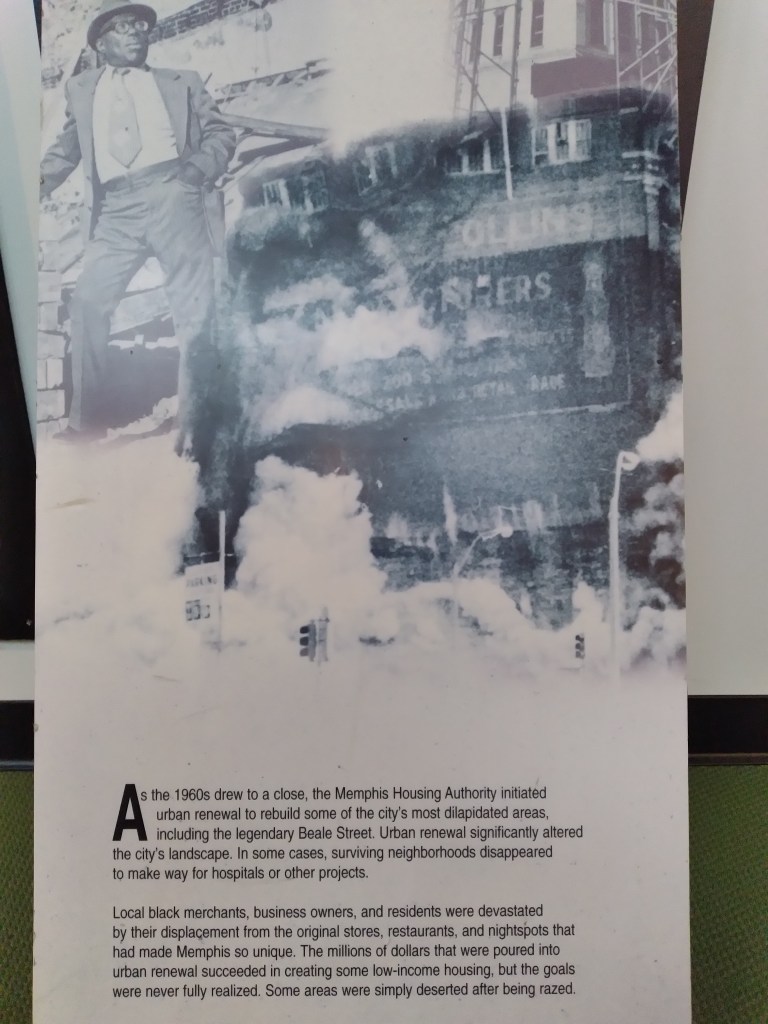
Beale Street now is something of a depressing tourist trap where you can buy souvenirs commemorating the Black musicians whose community was systematically destroyed; you can see a highly stylized version of it in its 1950s heyday in Baz Luhrmann’s new Elvis biopic.

Trapping the Trickster in the Shadow

So if I have argued that in the critical trigger moment, Carrie White is Black and White and re(a)d all over, enacting our Civil War legacy–by invoking blackface minstrelsy, Carrie’s critical trigger moment can also be read as showing that American music is Black and White and re(a)d all over, specifically by way of enacting it as a nexus of horror and humor and recapitulating its position as pivotal/foundational to American history.
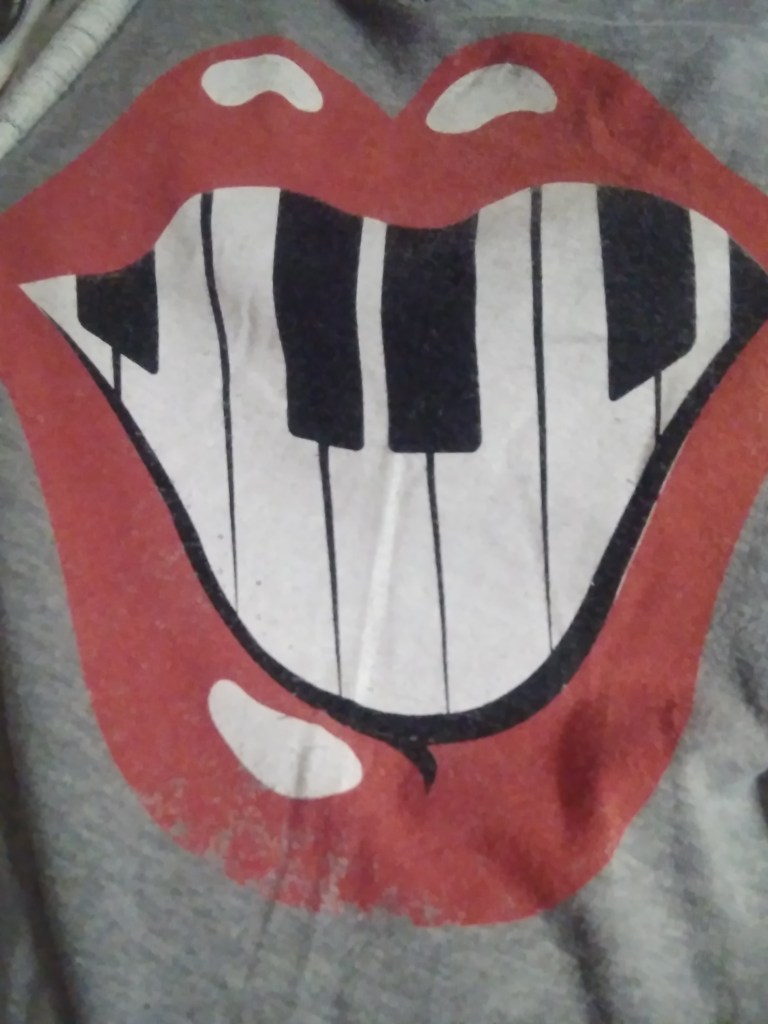
Musical keys: black and white and red all over….

The stinging bees linked to the “Laughing Place” in the Song of the South text are integrally linked to the blackface minstrel dynamic of violence provoking laughter and vice versa in what iterates an endless (or snowballing) cycle predicated on vengeance and the fear of same.

The stinging bees are also linked to the violence latent in the subjectivity/fluidity of this cycle; as Brer Rabbit explains:

“I didn’t say it was your laughing place, I said it was my laughing place.”

Song of the South (1946).

This is not the punch line of a joke so much as the revelation of a “trick,” for Brer Rabbit embodies the trope of the critteration of the “trickster figure”:

…Brer Rabbit [] originated from the hare-trickster figure found in folktales in South, Central and East Africa…

Emily Zobel Marshall, “’Nothing but Pleasant Memories of the Discipline of Slavery’: The Trickster and the Dynamics of Racial Representation,” Marvels & Tales, Vol. 32, No. 1 (Spring 2018), p59. 

If Carrie is the tar baby (which evokes minstrel blackface), then she is the tool that’s constructed to trick the trickster, since the tar baby is supposed to be a trap for the trickster figure of Brer Rabbit. The trap works, but then Brer Rabbit is able to trick his way out of the trap. His deployment of the bees at his Laughing Place is also a trick carried out in response to being trapped. His tricks, then, are in vengeance, or even just as a practical means of escape. He only tricks in response to tricks (which often manifest as traps), so is Brer Rabbit really the trickster, or just constructed as one by tricksters with more power?

Emily Zobel Marshall offers a compare-contrast reading of the ancestor of Brer Rabbit with that of another mythological trickster figure, Anansi the spider (a figure King will deploy in IT (1986)), finding that the spider trickster historically doesn’t carry the uglier history that Brer Rabbit does:

…variances in cultural and political context have affected the interpretation of the tricksters and suggests that having “no [Joel Chandler] Harris for Anansi” was key to the continued sense of ownership felt by African decedents in the Anglophone Caribbean for Anansi, in contrast with the problematic racial representations the American Brer Rabbit still provokes. 

Emily Zobel Marshall, “’Nothing but Pleasant Memories of the Discipline of Slavery’: The Trickster and the Dynamics of Racial Representation,” Marvels & Tales, Vol. 32, No. 1 (Spring 2018), p59. 

Brer Rabbit is very much central to King’s continued “problematic racial representations,” and this figure’s weaponization of the bees at the site of his Laughing Place–a site which in the Disney version embodies an overlap/intersection between abstract/figurative and concrete/literal places–could be the key to the Kingian version of the Laughing Place as it expresses and relates to the American minstrel dynamic (i.e., blackface minstrelsy). That is, both the Stephen King canon and the history of American music/America itself via blackface minstrel performances iterate a HARMONY between HUMOR and HORROR in the way these two latter elements work together, or in “harmony,” to achieve a certain psychological effect, one of unease. Harmony to underscore/create discord. Which is potentially the answer to a question Magistrale posed quoted in Part I:

The merging of horror and humor characterizes some of the most memorable cinematic adaptations of your work. I’m thinking of films such as CarrieMiseryStand by Me. Why do these apparently oppositional elements appear to work so harmoniously with each other in these films? (p. 11, boldface mine)

TONY MAGISTRALE, HOLLYWOOD’S STEPHEN KING (2003). (From here.)

And bees are potentially the key to how King’s work recapitulates and is linked inextricably with the history of American music.

The fluidity of ownership manifest in Brer Rabbit’s Laughing Place reflects a fluidity of ownership in the history of American music that reflects the problematic nature of ownership in America in general, a problem directly descended/inherited from the institution of slavery.

Perhaps no figure embodies the nature of the theme of black v. white ownership in music than Elvis Presley. This shadowy duality is at play in John Carpenter’s Elvis (1979), in which Elvis speaks to his dead twin brother Jesse, embodied at one point by his own shadow on the wall:
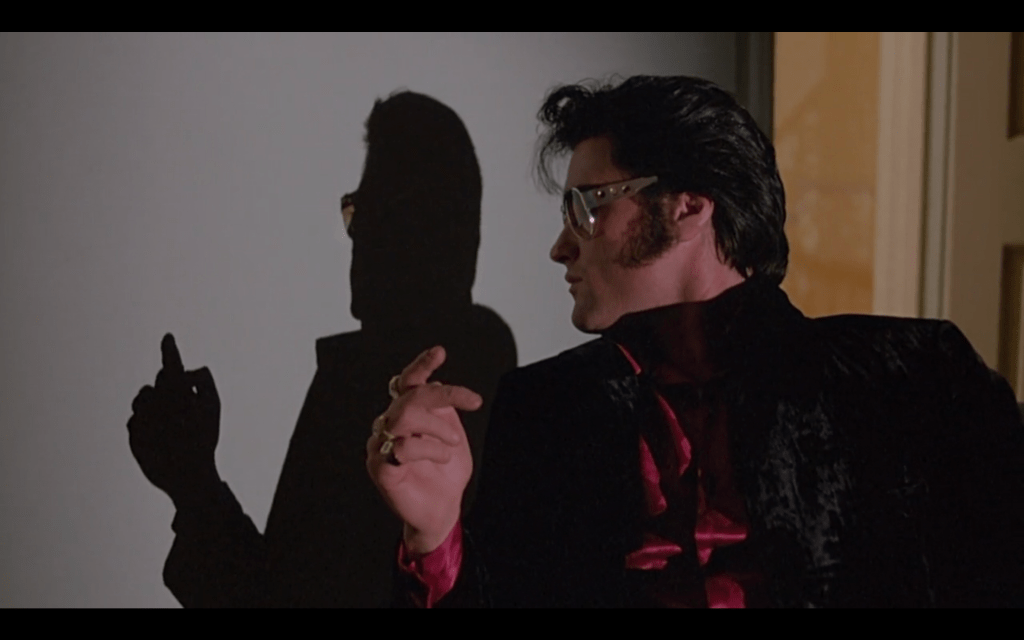
John Carpenter’s Elvis (1979)

Like Mickey Mouse, you could argue Elvis is a minstrel.
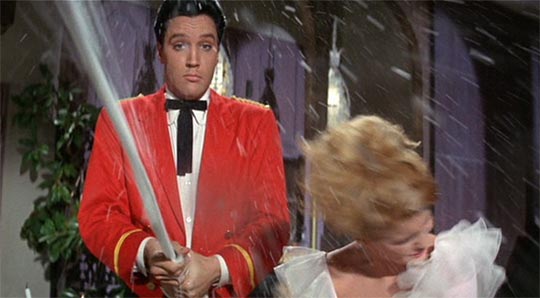
Elvis, black and white and red all over in Viva Las Vegas (1964)

If Mickey Mouse and cartoon animation highlight how “animal” is the basis for “the name for movement in technology, animation” (as quoted from Laurel Schmuck in Part 1), Elvis, along with “The King of Daredevil Comedy,” Harold Lloyd:

…embodied unique places at the crossroads of a shifting culture and the meaning of physical performance. Each challenged the standards of what was possible and accepted within the moving image, becoming icons—and ultimately reflections—of their changing times.

From here.

The new Elvis movie revolves around the machinations and manipulations of Elvis’s manager Colonel Tom Parker, in the film a self-identified “snowman” in the sense of “snowing” = conning, or tricking people. Parker’s narration of the film is an attempt to exonerate himself by way of insisting he and Elvis were a team consisting of the “snowman and the showman.” The film undermines Parker’s claims (intentionally) at pretty much every point, a significant one being when Parker tells Elvis that he, Elvis, is a “trickster,” and Elvis insists “I’m no trickster,” with Parker insisting in turn, “Yes, you are. All showmen are snowmen.” We might then split hairs about whether part of the criteria of being a “trickster” is tricking with intent rather than only doing so inadvertently, but as Norma’s complex network of comparisons in the Carrie trigger moment shows, the figures of the trickster and minstrel are inextricably linked via the work of Harris and passed on and further problematized via Disney, so presenting the possibility that Elvis was a “trickster” necessarily invites the minstrel comparison. The prominence of the idea that Elvis was “caught in a trap” as he famously sings in “Suspicious Minds” (a theme Baz continues to emphasize in the new biopic) further reinforces a reading of Elvis as the trickster rabbit figure specifically, as it’s Brer Rabbit caught in the trap of the tar…
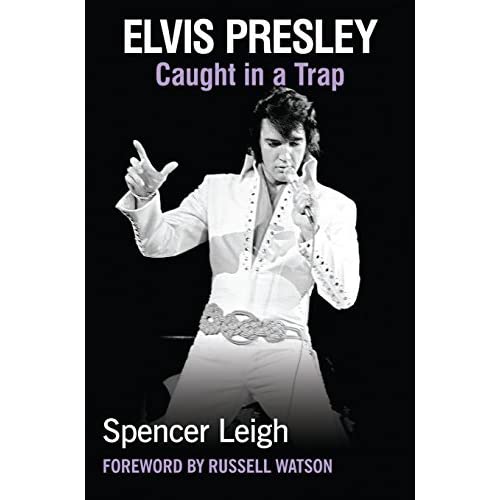
Though Brer Rabbit escaped and Elvis ultimately didn’t.

As many visual texts about Elvis, including Baz’s, like to visually emphasize, before he ascended to his throne as the King of Rock and Roll, Elvis once worked for Crown Electric Company:
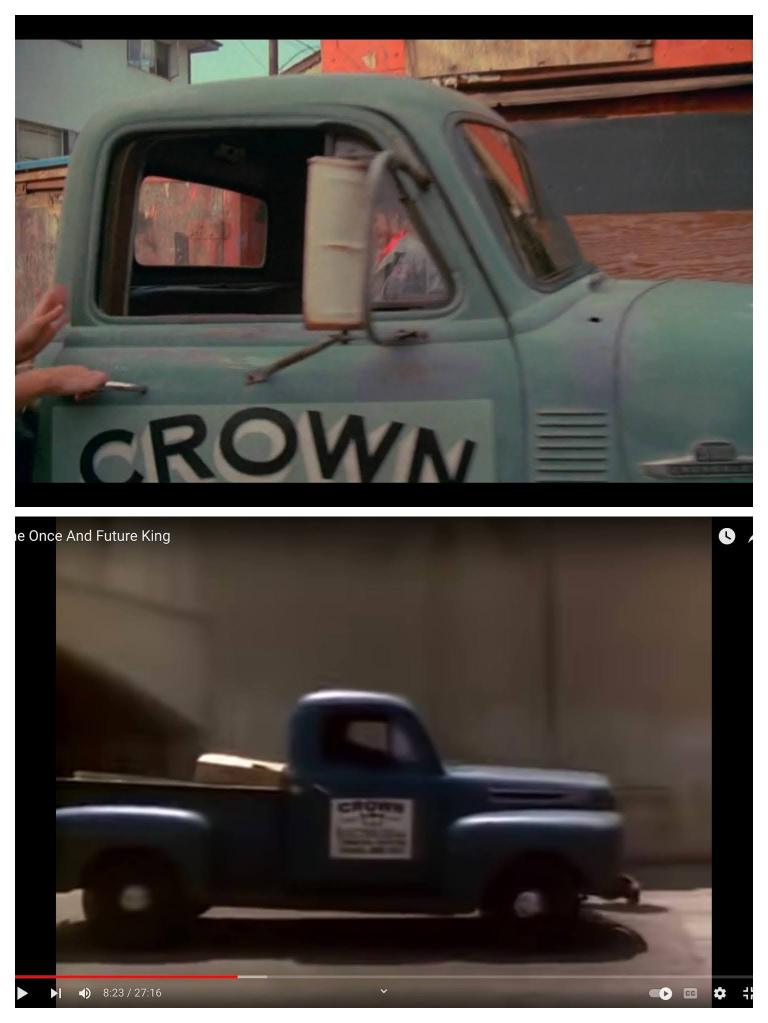
Top: Elvis (1979); Bottom: The Twilight Zone, “The Once and Future King” (1986).

That is, Elvis worked with power cords. This was before his breakthrough as a recording artist and performer with the single (which, like all of his songs, was a cover of someone else’s, in this case blues singer Arthur “Big Boy” Crudup’s) “That’s All Right,” which could have been called “That’s All Right, Mama.” Elvis’s love for his mother is a major component of accounts of his life, so even if Elvis did not write this song (or again, any song) it is a true expression of feeling, one in keeping with an aspect of the blues revealed in Sullivan’s aforementioned history revolving around Paul Dresser, he who was first credited with “playing the blues,” and who was white, and who was a prolific songwriter in his own right:

Paul loved his mother to the point of awe. His entire songbook is shot through with his feelings for her. When dismissive twentieth century critics referred to the pop music of the 1890s as “mother songs,” they were thinking mainly of Dresser. He had used the phrase himself with pride.

John Jeremiah Sullivan, “The Curses, Part II: The Curse of the Dreamer,” The Sewanee Review (2017).

Eminem does not love his mother, but despite this major difference was able to find many similarities between himself and Elvis to list on a track for Baz’s Elvis soundtrack, “The King and I,” similarities that invoke Carrie-like themes by way of linking shitterations as wordplay to a critical aspect of the history of American music, its weaponization:

It seems obvious: one, he’s pale as me/ Second, we both been hailed as kings/ He used to rock the Jailhouse, and I used to rock The ShelterI stole black music, yeah, true, perhaps used it / As a tool to combat school kids / Kids came back on some bathroom shit / Now I call a hater a bidet / ’Cause they mad that they can’t do shit”. (boldface mine)

Eminem, “The King and I” (2022). (From here.)

(Another shitteration at a prominent musical crossroads would be Elvis’s infamous death on the toilet.)

Eminem, for the same reason as Elvis and that he explicitly articulates above when he states “I stole black music,” has also been designated a trickster:

[Eminem] appears to relish his role as a shadow figure, personified in the suitably named artistic persona, Slim Shady, a trickster traceable to such half-mythic figures as the bluesman’s Staggerlee. (boldface mine)  

John Ensign, “Rappers and Ranters: Scapegoating and Shadow in the Film ‘8 Mile’ and in Seventeenth Century Heresy,” The San Francisco Jung Institute Library Journal, Vol. 24, No. 4 (November 2005), pp.20-21. 

In his semiautobiopic 8 Mile (2003), Eminem’s alter ego is not Slim Shady but Bunny Rabbit, or “B. Rabbit.” His mother’s character in the movie claims this nickname derived from his buck teeth as a kid, and Ensign reads the role of his mother as critical in a way that resonates with the negative influence of Carrie’s mother:

Rabbit responds to threats and humiliations with defiance and violence. But beneath their defensive masculinity, he and his friends are caught in the world of the mother, a truth he alone has the temerity to utter. In this sense, the narrative fits the mythic pattern of the young male hero struggling to free himself from the enveloping and castrating feminine. (boldface mine) 

John Ensign, “Rappers and Ranters: Scapegoating and Shadow in the Film ‘8 Mile’ and in Seventeenth Century Heresy,” The San Francisco Jung Institute Library Journal, Vol. 24, No. 4 (November 2005), pp.22. 

Carrie can’t technically be “castrated” by her mother, but De Palma abjectifies a domestic implement, the one that will stab Carrie in the back, by seeming to highlight its castrating potential:
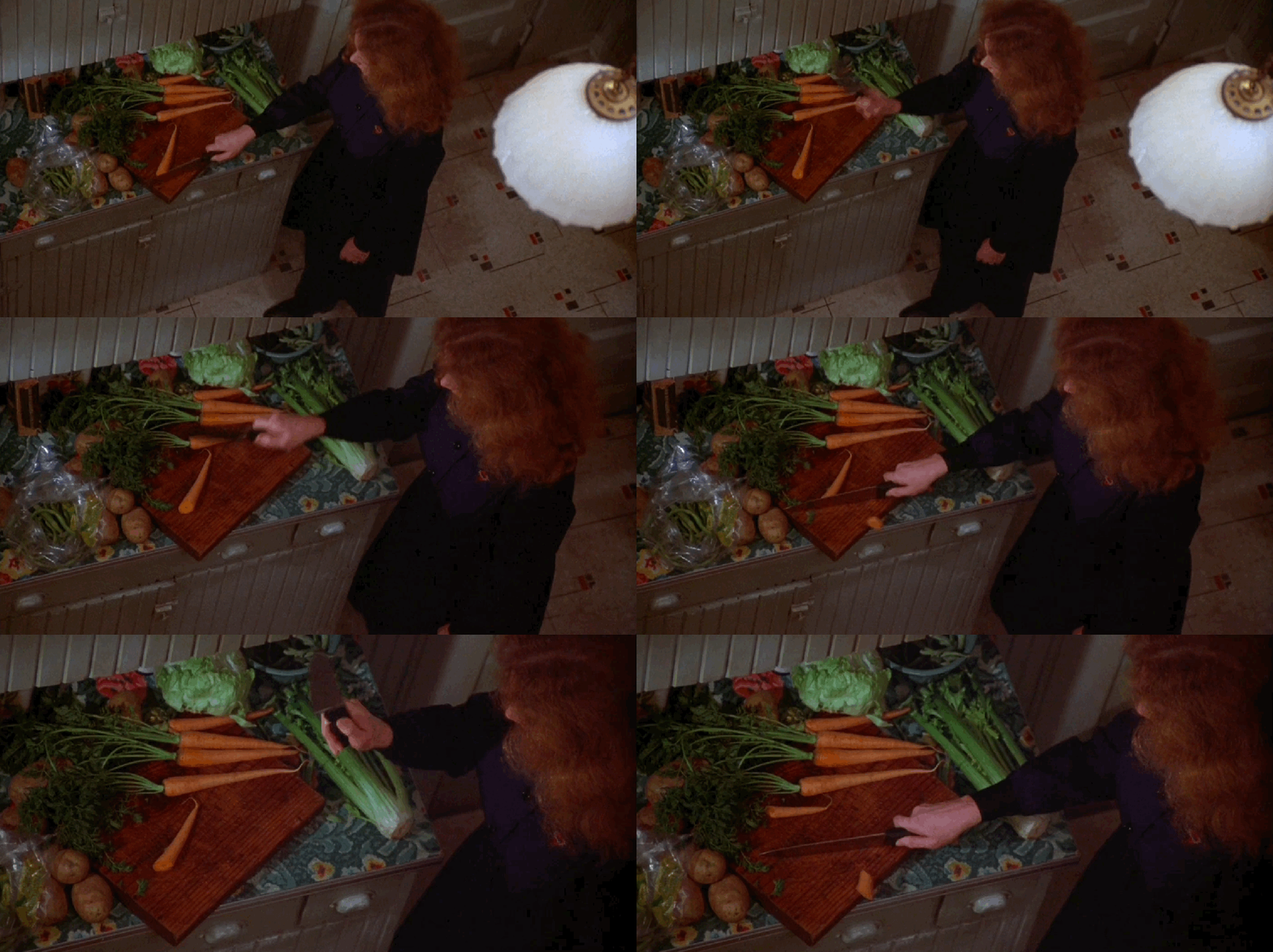
Carrie (1976).

One might be tempted to think the name “B. Rabbit” is a reference to his trickster figure status. (This idea might be complicated by one version of the script bearing an epigraph from John Updike’s novel Rabbit, Run (1960), indicating the character is named for Updike’s main character who is nicknamed Rabbit and who might represent every ugly aspect of the patriarchy at work in the western literary canon in being a glorification of a quintessential white male asshole.) Ensign describes the dynamic captured in 8 Mile in which Eminem as B. Rabbit “assumes a ‘double shadow'” whose vulnerabilities “become a source of power at the film’s conclusion when the protagonist publicly claims his limitations in an obscene diatribe, thereby reversing his powerless position and vanquishing his rival in a ‘rap battle'” (18), a description that recalls the Kingian dynamic, played out by Danny Torrance in the climax of The Shining, of defeating a monster by engaging in a specifically face-to-face verbal confrontation in which the protagonist articulates the truth of the monster’s evil nature (in keeping with this aspect, Eminem as B. Rabbit articulates his rival’s shortcomings in addition to his own).
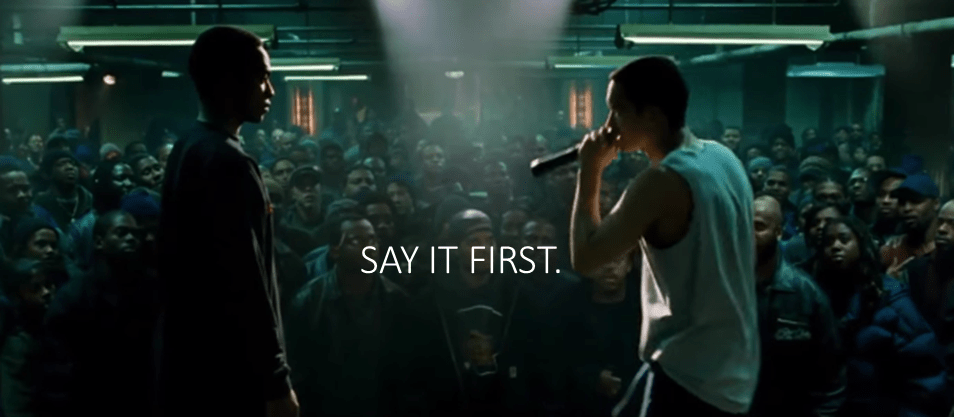
From here.

Returning to this climactic moment again, Ensign notes:

This scene marks the apex of Rabbit’s progression over the course of the narrative, a process of shadow integration interpretable in terms of the scapegoat archetype. (boldface mine) 

John Ensign, “Rappers and Ranters: Scapegoating and Shadow in the Film ‘8 Mile’ and in Seventeenth Century Heresy,” The San Francisco Jung Institute Library Journal, Vol. 24, No. 4 (November 2005), pp.24. 

Ensign then tracks this archetype’s origins back to (the critteration of) the ritualistic sacrifice of literal goats. In Carrie, Miss Desjardin tells the principal that Carrie “has always been a group scapegoat,” while later, after Carrie is dead and so can no longer be the active scapegoat–or put another way, is a shadow that can conclusively not be integrated–Sue twice accuses the White Commission of making her, Sue, the scapegoat.

In another example of Carrie‘s cyclical resonance (or cyclical cyclical resonance), the Kingcast podcast did a recent episode on Carrie with director Scott Derrickson in which one of the hosts, Scott Wampler, rectified a point he’d made on an episode on Carrie two years earlier with director Karyn Kusama (whose film Jennifer’s Body (2009) one of the PVA students did their presentation on in our horror elective). In the earlier episode, Wampler told an anecdote about how King himself first saw De Palma’s Carrie screened on a double bill with the movie Sparkle (1976), a film with an all-Black cast (despite being written by Joel Schumacher, who is white) and so it turned out for the screening garnered an all-Black (except for King) audience. King was worried they wouldn’t like the movie, but when it turned out they did, he knew it would do well with mainstream audiences.

Sparkle is a musical movie (often cited as a prototype for Dreamgirls (2006)) about a talented girl group who struggles with the forces of exploitation surrounding them, even though the story ultimately belongs to the man who manages them, Stix, despite the movie’s title character being a woman (Sparkle only rises to the forefront after the group’s leader, Sister, succumbs to drug addiction). In the film’s climax, Sparkle and the group are performing at an important show while, elsewhere, Stix is stuck in the backseat of a car with a mobster holding a gun to his head who we understand is demanding to manage Sparkle and take a cut of their proceeds. Between shots of Sparkle triumphantly singing on stage in an elaborate red dress, Stix, sweat pouring down his face, shakes his head every time the mobster dry clicks the gun’s trigger at his temple. Ultimately Stix wins the standoff and for reasons that aren’t completely clear, is released with his management (and concurrent manhood) in tact.

Watching this, it was Sparkle’s red dress that was particularly arresting in the way it seems an inversion of the imagery of Carrie White in her trigger moment:
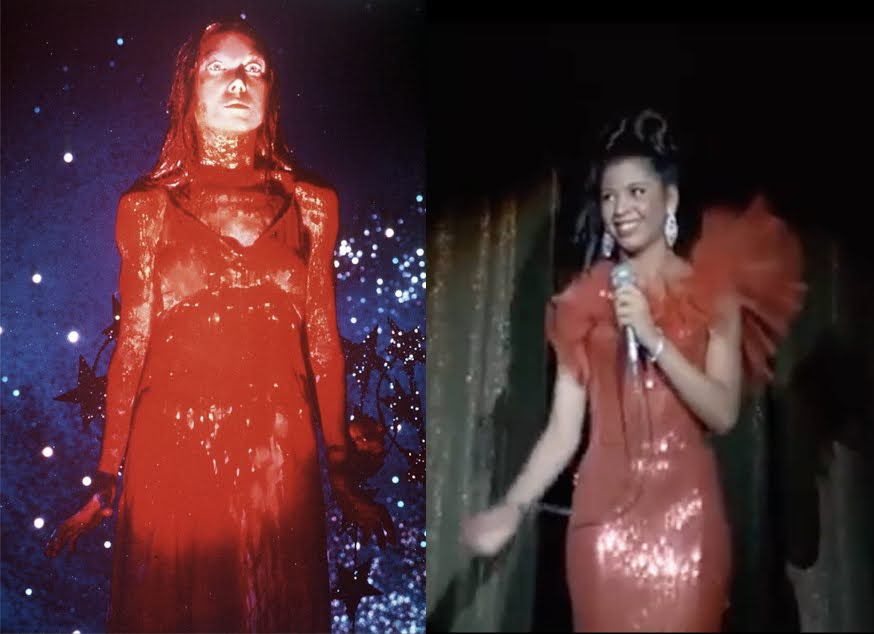
Carrie (1976); Sparkle (1976)

But in the more recent Carrie Kingcast episode, Wampler revealed he had done more research into the matter for a Fangoria article. Unable to substantiate the original claim about King first seeing Carrie alongside Sparkle, which was a statement made by the screenwriter in commentary on a DVD version, Wampler discovered Carrie was never screened with Sparkle but rather alongside “a sex comedy called Norman… Is That You?” about a Black father who finds out his son is gay and tries to change him. So the anecdote still goes that King did first see Carrie with a Black audience, and that, as Wampler puts it, “Black audiences were the first to embrace Stephen King.” (They also apparently saw a double bill of films heavily influenced by Norman Bates.) In response to this, the guest Scott Derrickson noted, by way of a shitteration, that horror as a genre has always been more appealing to Black and Latino audiences:

“Of course it’s going to be appealing to people who society has been shitting on for the entirety of the American experiment.”

From here.

Reading Carrie as an iteration of a demographic that’s been “shit on,” I was struck on a recent rereading by a confluence that occurs at the moment of Carrie’s death as telepathically experienced by Sue:

Sue was suddenly overwhelmed with terror, the worse because she could put no name to it: The bleeding freak on this oil-stained asphalt suddenly seemed meaningless and awful in its pain and dying

(o momma i’m scared momma MOMMA)

Sue tried to pull away, to disengage her mind, to allow Carrie at least the privacy of her dying, and was unable to. She felt that she was dying herself and did not want to see this preview of her own eventual end.

(carrie let me GO)

(Momma Momma Momma oooooooooooooo OOOOOOOOOO)”

Stephen King, Carrie (1974).

Listening to Sissy Spacek perform this for the audiobook version, I had to stop in my tracks: Carrie plaintively calling out for her mother in her death throes was an uncanny anticipation of George Floyd calling out for his mother with a knee on his neck.

As is this:
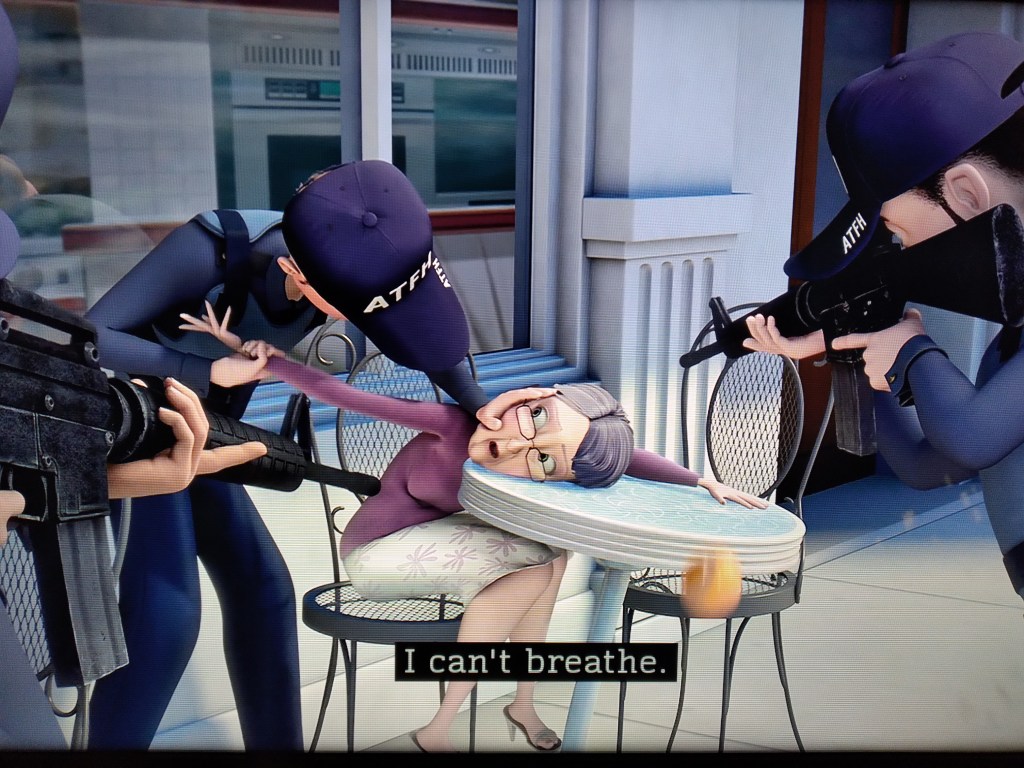
Bee Movie (2007).

Carrie as the Menstrual Minstrel, embodying a fluid duality across types of “laboring bodies,” also helped me realize that my first fiction teacher’s injunction against the word “flow” embodies a parallel duality that’s emblematic of the Updikean literary patriarchy. This teacher banned use of what he termed “the F-word,” claiming the idea that a story “flowed” was a common student fallback position in workshop critiques that was unconstructive in its vagueness. But banning this particular term also smacks of Turner’s discussion of the abjectification of menstruation as something dirty and unspeakable, rendering the ban misogynist. “Flow” is also a term associated with hip hop, marking its exclusion as racist as well.

The Stage Construction Crew

If the stage is an integral ingredient in Carrie’s construction as a minstrel, the Africanist presence underwrites the most prominent converging influences and actions of the three characters who get Carrie to the stage: Chris Hargensen, Sue Snell and Margaret White.

In addition to being the previously discussed “Queen Bee,” Chris manifests an Africanist presence via an explicitly racial comparison, that of “her lip puffed to negroid size” after she’s hit by her boyfriend Billy.

The text’s only invocation of the N-word slur appears in a passage where Sue is projecting a horrific vision of suburban conformity that she would like to avoid, and that she then goes on to try to avoid specifically through the gesture of getting Carrie to the prom, a gesture that marks her as anticonformist. Thus Sue, and through her the overall text (aka King as author of it), seem to be condemning this racism. Analyzing this passage the first time around, I couldn’t find a real-life referent for “Kleen Korners,” but in yet another example of the significance of a single letter, I have since heard that spellings that replace what should be a “C” with a “K” are implicitly racist, possibly due to the precedent of the Ku Klux “Klan”; indeed, the KKK is one of the original “racist associations.” The “Kleen” also thematically invokes racial cleansing parallel to the “whitewashing” Uncle Remus invokes. We see through Sue’s perspective how the identity of the town of Chamberlain itself is constituted by the Africanist presence, more specifically the fear of it. Sue’s actions of getting Carrie to the prom to assimilate her with her peers—i.e., conform with them—become an ironic rejection of conformity, undermining King’s apparent critique of the subdued yet virulent racism manifest in white suburban America—reinforced when Sue’s rebellion is doomed, her efforts to help Carrie thus reinforcing Carrie’s tarbaby function of being “a difficult problem, that is only aggravated by attempts to solve it” (Coates).

Sue could also be read as representing a modern version of white guilt for white privilege–if Carrie can be read as an Africanist presence, Sue’s manipulations to get her to prom could be read as symbolic of the original white subjugators who kidnapped people from Africa–Sue brings Carrie to the prom, aka America, and at first it seems like it’s worked out great until everything goes wrong; Carrie’s Africanist violence is vengeful in nature and engenders both the destruction of her captors/tormentors and herself; the scope of this destruction is so vast as to leave Sue the only survivor (in the movie; in the book Norma is also a survivor like Sue). In the movie’s final sequence, Sue floats in a (virginal) white gown toward Carrie’s black grave as we hear her mother tell someone that a doctor claims Sue is young enough that she will “forget all about it in time,” but then Carrie’s HAND reaches up from the grave to snatch hers, and even though this hand is not “real,” we see it is in the sense of having a material effect on Sue, the final shot of Sue shaking in her mother’s arms an unequivocal indication that Sue will essentially be haunted by this forever. (This is perhaps further underscored by being Sissy Spacek’s real hand.)

Signs of the Africanist presence permeate Margaret White’s construction of the religious fanaticism that in turn leads to Carrie’s construction as an outcast by her peers, from Margaret’s Poe-invoking insistence that “the raven was called sin” to the iconography in the closet she locks Carrie in:

…the Black Man sat on a huge flame-colored throne with a trident in one hand. His body was that of a man, but he had a spiked tail and the head of a jackal. (boldface mine)

Stephen King, Carrie (1974).

Black Man as beast man…as with Sue’s construction of Chamberlain’s constructed racism, layers of construction are present here: these are icons of Margaret’s constructed religion, and it is the Margaret-specific construction of religion, verging past fundamentalist to the outright demonic, that is critiqued as monstrous aberration.

Carrie (1976).

We can also see in one passage how De Palma took from this passage for the (new) opening scene:

Carrie always missing the ball, even in kickball, falling on her face in Modern Dance during their sophomore year and chipping a tooth, running into the net during volley-ball; wearing stockings that were always run, running, or about to run, always showing sweat stains under the arms of her blouses; even the time Chris Hargensen called up after school from the Kelly Fruit Company downtown and asked her if she knew that pig poop was spelled C-A-R-R-I-E: Suddenly all this and the critical mass was reached. (boldface mine)

Stephen King, Carrie (1974). 

Here Chris goes beyond the abjectification of Carrie eating shit to equating Carrie herself with shit–and not just any shit, but pig shit–thus, here we see a critteration shitteration. Significantly, the duality of this double-designation is positioned here as the “critical mass” that engenders Carrie’s tipping point–or trigger moment.
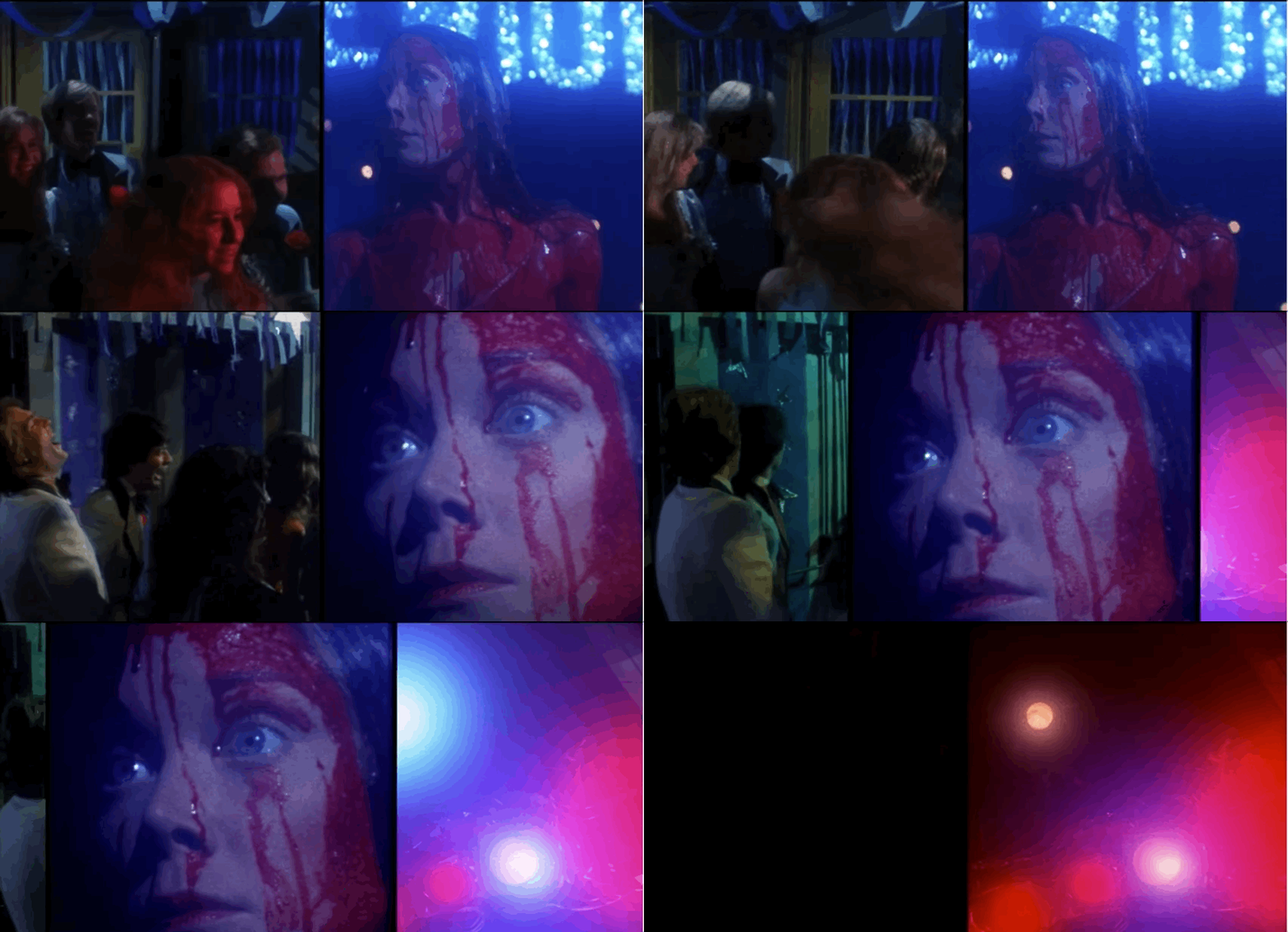
Critterations of Carrie: The Pig Blood

While Carrie in the trigger moment is rendered the Menstrual Minstrel from Norma’s perspective, she is also manifesting a critteration by way of the blood that’s likened to blackface being from a pig.
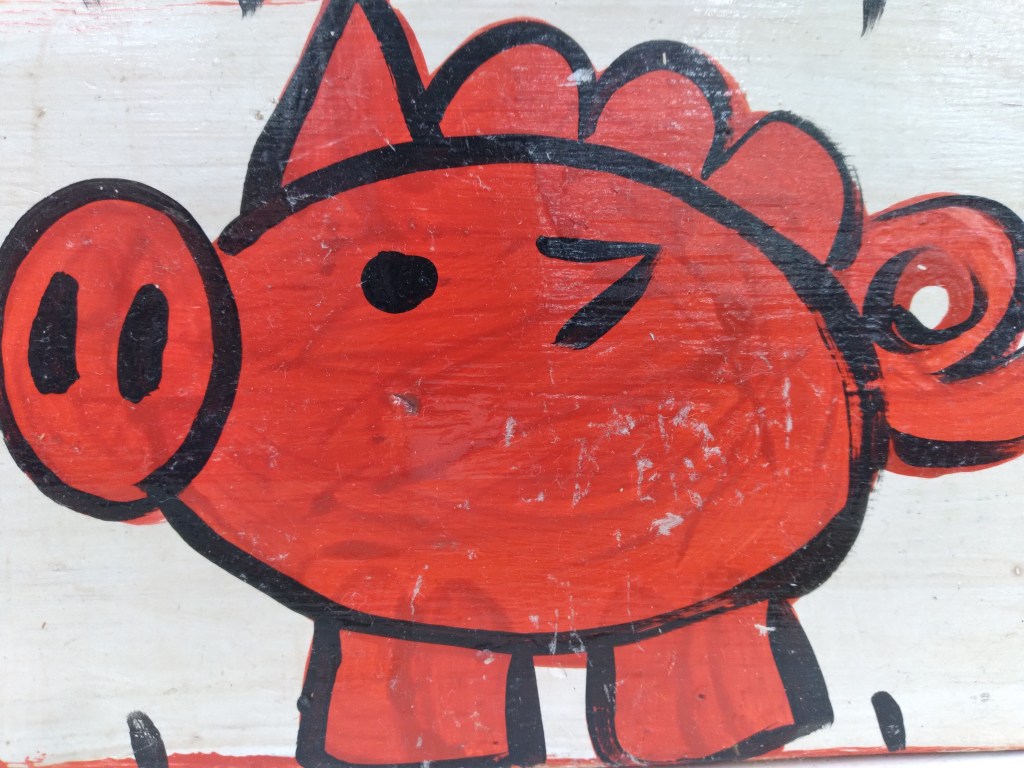
The pig: black and white and re(a)d all over…

In George Orwell’s Animal Farm (1945), the pig in particular embodies a duality when, emphasized as the most “clever” animal, a pair of pigs become the leaders of the new animal movement until one of the pigs, named Napoleon, banishes the other pig, named Snowball; Napoleon can only maintain his reign thereafter by blaming any problems on Snowball, rendering Snowball integral/crucial to Napoleon’s rule in a way that parallels the inextricability of the Africanist presence in constructions of hegemonic whiteness.

The pig becomes the most significant “critter” in Carrie, an integral element of her construction as the Menstrual Minstrel per the White Commission’s claim in the Shadow Exploded text within the novel that “the trigger of the whole affair” was “two buckets of pig blood on a beam over the stage,” a passage that identifies the underwriting (in the plot-generating sense) elements critical to rendering Carrie the “Menstrual Minstrel”–the stage for the latter and the blood for the former. It also invokes a key phrase that encodes the dehumanizing element of animal comparisons/critterations/creatureliness: “pig blood” as opposed to “pig‘s blood.” The phrase “pig’s blood” literally never appears in the novel; every time, and it is several times, it is “pig blood” (all boldface below mine):

Billy found he was slimed in pig blood to the forearms.

Pig blood. That was good. … It made everything solidify. Pig blood for a pig.”

Pig blood for a pig. Yes, that was good, all right.

…and a shadow of humor crossed his face. “Pig blood for a pig.”

…and got the two buckets of pig blood.

…the pig blood had began to clot and streak.

Pig blood for pigs, right?”

“Billy, did you . . . that pig blood . . . was it—”

We’ve seen how a single letter can make a big difference in shifting meaning; now we see, via the apostrophe, the potential significance of a marking no bigger than ant-sized. As with the lack of a possessive apostrophe in Disney‘S “Remus stories”…
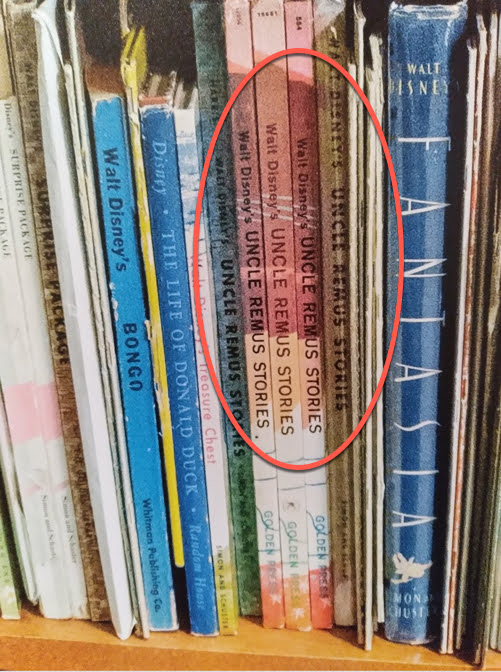
…there is a subtext that reiterates the original form of cultural theft of minstrelsy–that it did not constitute “theft” because the people from that culture did not have the right to property–just like animals don’t. (The book spines recapitulate this idea as the backbone of our culture, more specifically of its systemic racism.)

It’s also interesting to consider the possessive constructions of the two of Magistrale’s major studies on King: Hollywood’s Stephen King (almost as if Stephen King is demonically possessed by Hollywood), and Stephen King: America’s Storyteller.

And possessive constructions in other contexts…

Luhrmann squeezes his name into the credits more times and more quickly than any other director I’ve seen, aided by the idiosyncrasies of contractual punctuation: it’s a Baz Luhrmann film, from a story by Baz Luhrmann and Jeremy Doner and a screenplay by Baz Luhrmann & Sam Bromell and Baz Luhrmann & Craig Pearce and Jeremy Doner, and it’s directed by Baz Luhrmann. 

Richard Brody, “’Elvis’ Is a Wikipedia Entry Directed by Baz Luhrmann,” The New Yorker (June 27, 2022).

I was going to call out Magistrale and Turner for incorrectly using the phrase “pig’s blood” instead of “pig blood” in their discussions of the novel, then noticed King himself does the same thing when he discusses Carrie in On Writing right next to the passage where he describes Sue getting her period rather than suffering a miscarriage/abortion as Turner interprets it:

When I read Carrie over prior to starting the second draft, I noticed there was blood at all three crucial points of the story: beginning (Carrie’s paranormal ability is apparently brought on by her first menstrual period), climax (the prank which sets Carrie off at the prom involves a bucket of pig’s blood—“pig’s blood for a pig,” Chris Hargensen tells her boyfriend), and end (Sue Snell, the girl who tries to help Carrie, discovers she is not pregnant as she had half-hoped and half-feared when she gets her own period). (boldface mine)

Stephen King, On Writing: A Memoir of the Craft (2000).

At least he spells “Hargensen” right… Billy vaguely credits Chris for the concept that pig blood is good for the prank, but we never see Chris actually tell him “pig’s blood for a pig” (or “pig blood for a pig”), and when he utters the phrase to her at one point she responds as if she doesn’t know what he’s talking about, obscuring the phrase’s source in a way that parallels the obscuring of credit at the heart of the origin of American music.

De Palma grants Chris a more direct role in carrying out the pig blood prank–i.e., heightens her Queen-Bee villainy (in a potentially misogynist way)–when she accompanies Billy and his friends, including the male counterpart-conspirator to Norma marked by the red hat, to the farm where he kills a pig. The aesthetics in this sequence seem to emphasize both animalism and animation at play (or at work?) in a villainous groupthink dynamic…
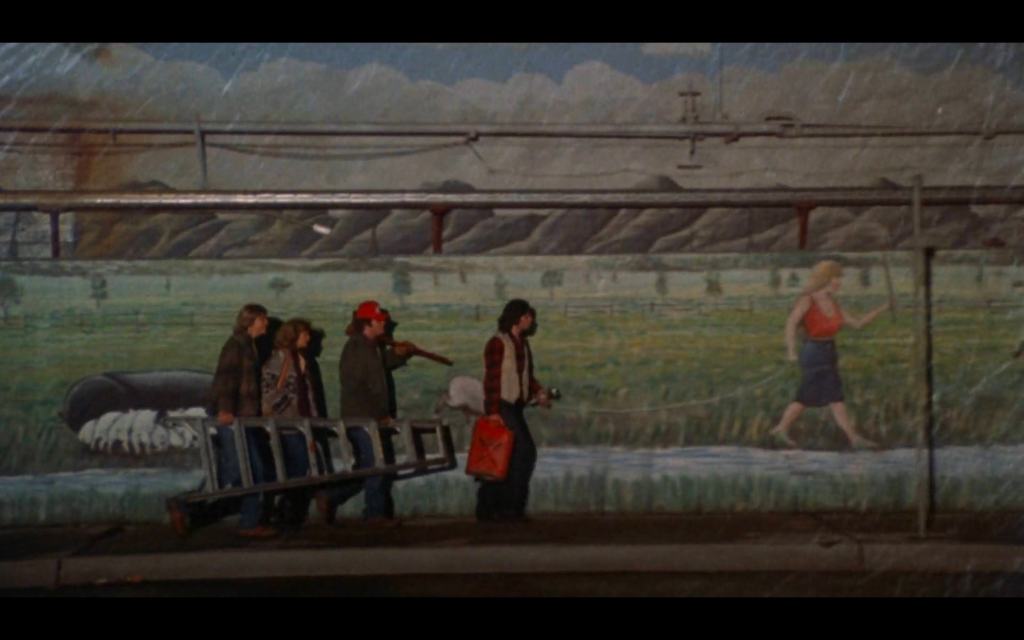
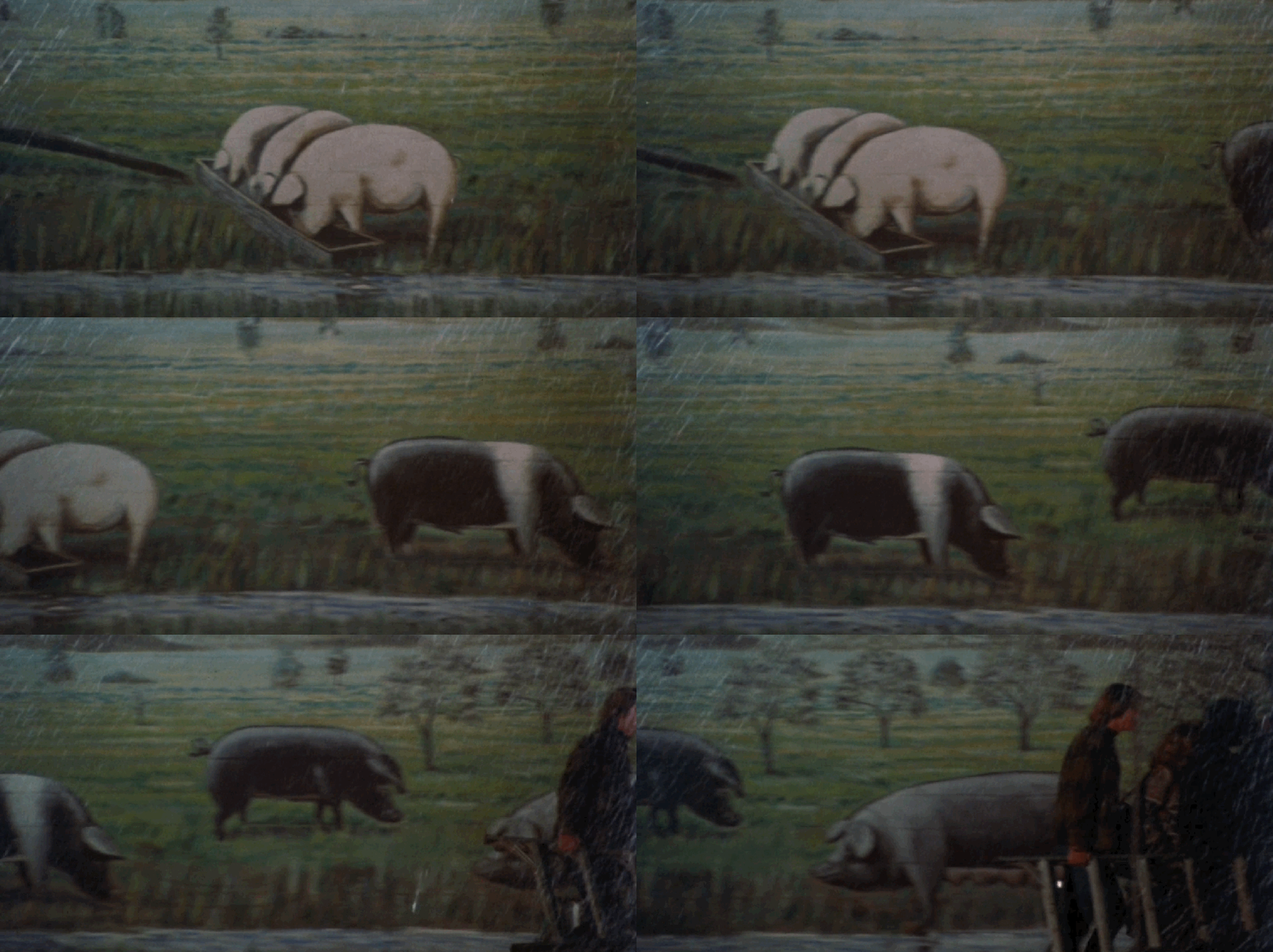
Carrie (1976)

In the film Chris also helps Billy set up the buckets on the beam above the stage, and is the one driving what is presumably Billy’s car (we see him drive it earlier in the film) with which she tries to kill Carrie and instead is killed in turn. Realizing that the novel identifies Chris’s full name as “Christine Hargensen,” I am now incubating a theory that Christine the haunted car in King’s Christine (1983) is haunted not by, or not just by, the ghost of Roland LeBay…
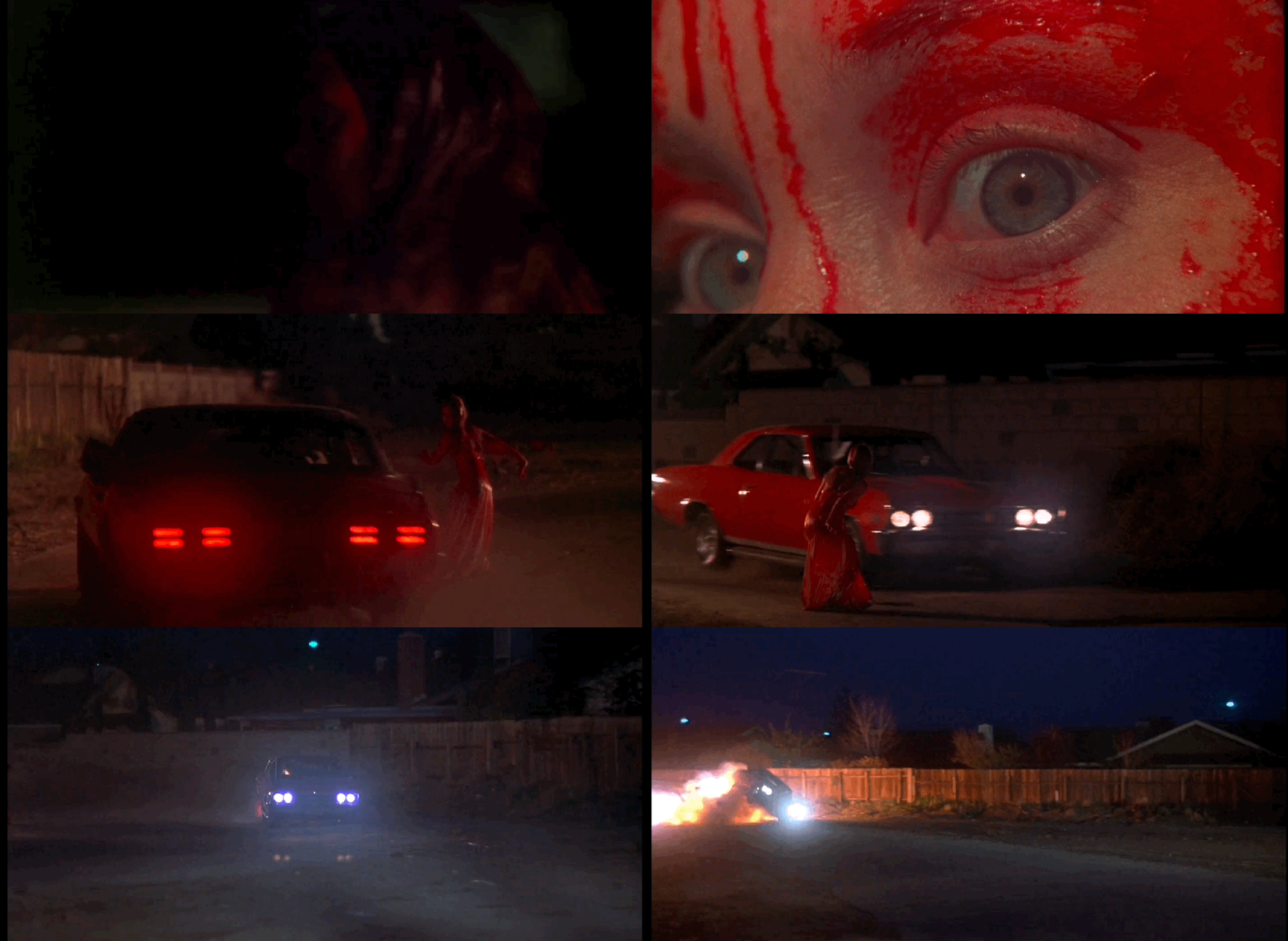

Carrie (1976).

And the segue to the next post on these themes in The Shining and Misery will be a question the television writer and producer Bryan Fuller posed as a guest in a Kingcast episode on Christine (appropriately, since Fuller is supposedly directing the upcoming remake of it):

“Is Christine the Overlook ghost on wheels?”

From here.

Or put another way, is Christine the Shadow Exploded…?

Carrie (1976).

-SCR
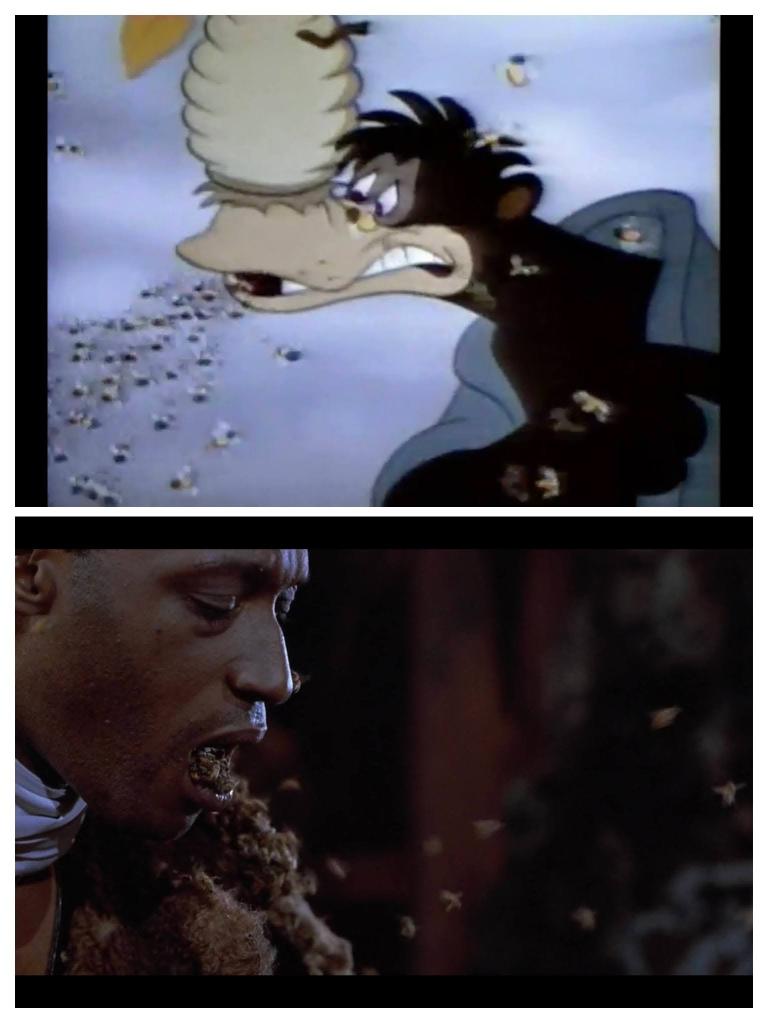
The Laughing Place is a Rabbit Hole to Disney’s Animal KINGdom, Part I

The Writing on the Wall Carries Critterations & Shitterations

The brother in black puts a laugh in every vacant place in his mind. His laugh has a hundred meanings. It may mean amusement, anger, grief, bewilderment, chagrin, curiosity, simple pleasure or any other of the known or undefined emotions.

Zora Neale Hurston, Mules and Men (1935).

“They’re all going to laugh at you.”

Carrie (1976).

I am joking, but it’s nervous joking, the kind analogous to whistling past the graveyard.

Stephen King, “Stephen King on violence at the movies,” EW.com (October 8, 2007).

“When will these things be, and what will be the sign of your presence and of the conclusion of the system of things?”​

The Bible, MATTHEW 24:3.

Black and White and Re(a)d All Over

My previous post discussed the critical trigger moment in Carrie exemplifying the intersection of horror and humor, more precisely locating music’s specific confluence of these two via blackface minstrel performances as fundamental to the foundation/formative contradiction/oxymoron at the heart of American history. This amounts to the site of the (re)production of violence manifest in America’s cyclical wheel of inciting race-based hatred. Or a ferris wheel of it…

Because another name for a “theme park” is an “amusement park.”

Well, we’re on the wheel again.

Horror and humor might seem to be diametrically opposed but are inextricably linked in the Kingverse–or Kingdom–manifest in the characters that certain merch would indicate qualify as King’s most iconic creations:

Likely iconic enough to need no introduction…but just to be safe: King at the center of the film adaptation versions of Pennywise from It (1986/1990), Carrie from Carrie (1974/1976), Jack Torrance from The Shining (1977/1980), and Annie Wilkes from Misery (1987/1990).

I initially read Carrie through the lens of Toni Morrison’s concept of the Africanist presence here, back when Covid was nary a blip on my mental radar and George Floyd was still alive, but, after instituting Carrie as a primary text in three different courses I taught in 2021, I recently read Carrie through Morrison’s lens so again as the basis for a talk at an academic conference for the Popular Culture Association (which has its own “Stephen King” area). And this time, having a little more context for the Kingverse, I unearthed a bit more.

Okay, a (‘Salem’s) LOT more.

The “Africanist presence” is not only Black characters or explicit references to Blackness/Black people in a given text. It is anywhere you can detect the influence/effects/constructions of Blackness, often in attempts to erase or implicitly/unconsciously marginalize it. It turns out that white characters and entities that are not technically Black can also manifest an Africanist presence. And it turns out that in the text of Carrie (1974), Carrie White herself becomes an Africanist presence, both Black and White, a bifurcated duality implicitly reinforced by the imagery of both the first-edition book cover and movie poster:

The figure of Carrie, in a sense, constitutes a “merging” of Black and White, her Blackness manifest as an otherness via the marginalization of her by her classmates–that is, Carrie is constructed as an outcast in the imagination of her classmates. She is “imagined” as one by them, and thus essentially becomes one; the “imagined” construction has real, material effects. Imagined and real merge.

In his academic essay “King Me: Inviting New Perceptions and Purposes of the Popular and Horrific into the College Classroom,” Michael A. Perry explicitly compares Stephen King’s fiction to Toni Morrison’s, finding both characterized by a: “merging of fact and truth, of real life events with creative re-imaginings” (emphasis mine). This thesis is a bit oversimplified for my taste, as this statement is true for most if not all writers of fiction. But the concept of “merging” is also invoked by master of King criticism Tony Magistrale in his study Hollywood’s Stephen King, for which Magistrale interviewed King himself:

The merging of horror and humor characterizes some of the most memorable cinematic adaptations of your work. I’m thinking of films such as Carrie, Misery, Stand by Me. Why do these apparently oppositional elements appear to work so harmoniously with each other in these films? (p. 11, boldface mine)

Tony Magistrale, Hollywood’s Stephen King (2003).

Well, “apparently oppositional elements” by nature create tension, because to be in opposition is to be in conflict and conflict is the genesis of tension, which is fiction’s narrative engine. But King has a bit more detailed of a theory:

SK: We can only speculate here. I think that what happens is that you get your emotional wires crossed. The viewer gets confused as to what reaction is appropriate, how to respond. When the human intellect reaches a blank wall, sometimes the only thing left is laughter. It is a release mechanism, a way to get beyond that impasse. Peter Straub says that horror pushes us into the realm of the surreal, and whenever we enter that surreal world, we laugh. Think of the scene with the leeches in Stand by Me. It’s really funny watching those kids splash around in the swamp, and even when they try to get the leeches off, but then things get plenty serious when Gordie finds one attached to his balls. Everything happens too fast for us to process. We all laugh at Annie Wilkes because she is so obviously crazy. But at the same time, you had better not forget to take her seriously. She’s got Paul in a situation that is filled with comedy, and then she hobbles his ankle. Like Paul Sheldon himself, the viewer doesn’t know what to do. Is this still funny, or not? This is a totally new place, and it’s not a very comfortable place. That’s the kind of thing that engages us when we go to the movies. We want to be surprised, to turn a corner and find something in the plot that we didn’t expect to be there.

What Billy Nolan and Christine Hargensen do to Carrie is both cruel and terrifying, but the two of them are also hilarious in the process. [Actor John] Travolta in particular is very funny. His role as a punk who is manipulated by his girlfriend’s blow-jobs suggests that he’s not very bright. But a lot of guys can appreciate Billy Nolan’s predicament. He’s got a hot girlfriend who wants to call all the shots. He’s the one character in De Palma’s film that I wish could have had a more expanded role. He’s a comic character who behaves in an absolutely horrific manner (boldface mine).

Tony Magistrale, Hollywood’s Stephen King (2003).

King’s interview with Magistrale is infamous in academic circles due to King’s infamous disdain for academia; as Simon Brown notes, Magistrale is one of the only, if not the only, academic King has engaged with:

[King] has been openly skeptical of what he describes as “academic bullshit” (King 1981b, 268), a clear example of which comes from one of his few engagements with critical analysis, his endorsement on the front cover of Landscape of Fear: Stephen King’s American Gothic by Tony Magistrale:

Tony has helped me improve my reputation from ink-stained wretch popular novelist to ink-stained wretch popular novelist with occasional flashes of muddy insight.” (1988)

King is not denigrating Magistrale’s book; indeed, Magistrale remains one of the few academic writers on King with whom King will engage, even offering an interview for Magistrale’s book Hollywood’s Stephen King (2003).

Instead, this endorsement reflects King’s self-deprecating discomfort with his work being subjected to such examination. The origins of this attitude appear to lie in his well-documented, poverty-stricken background and bluecollar roots, which are inextricably linked to his desire to simply tell entertaining tales. (boldface mine)

Simon Brown, Screening Stephen King (2018).

Yet in his desire to be entertaining, King does things in his writing that warrant subjecting his work to “such examination,” and one might even think that his aversion to this examination is a fear of what people will see when they look more closely…which is the “undermining” factor I had definitely identified before I found more official academic support for it in the book Stephen King and American History (2020) that Magistrale wrote with his former student Michael J. Blouin (which I’ve previously quoted here): that “in his rush to dismantle History as a tool manipulated by the powerful, King sometimes empowers the ruling class that he apparently wishes to undermine” (boldface mine). Which is another way of saying that King undermines himself, or undermines his own commentary/critique. So you can read King as being modestly self-deprecating in the blurb he provided for Magistrale’s 1988 academic study when he credits himself only with “occasional flashes of muddy insight,” but King’s own characterization of his insight reveals some unconscious associations one can trace through manifestations of the Africanist presence in invocations of the “minstrel” (a reference King reaches for when mud masks manifest in both Carrie (1974) and The Girl Who Loved Tom Gordon (1999)). The figure of the minstrel, via its defining feature of blackface in the American context, constitutes a type of “merging” of Black and white via a white person performing as a Black person–or a construction of a Black person–what Wesley Morris and Nicholas Sammond call performing “imagined blackness.” And one can trace these racist associations through precisely the texts Magistrale references as quintessential examples of King’s “merging of horror and humor”–Carrie, Misery, and Stand By Me, with the racial/racist associations more prominent in King’s source texts than in the adaptation versions. In another study, Stephen King: America’s Storyteller (2010), Magistrale again identifies these three texts as examples of this primary (indeed, defining) Kingian trait:

De Palma’s film version of Carrie managed to capture the slippery blending of horror and humor that is often a crucial–albeit elusive–element in a King text, and characterizes several of the most memorable cinematic adaptations of his work, such as Stand by Me and Misery. (p9, boldface mine)

Tony Magistrale, Stephen King: America’s Storyteller (2010).

This crucial, blended element would seem to elude Magistrale at least, who, in this same study’s discussion of King’s The Girl Who Loved Tom Gordon (1999), mentions that the Tom Gordon figure is a “Magical Negro,” but then Magistrale seems to excuse this:

In creating blacks who are long-suffering and whose reasons for existence are primarily defined via their service to white characters, these critics argue that King undercuts [i.e., undermines] whatever liberal spirit may have inspired their creation and, ironically, produces racist stereotypes that lack both independence and individuality, characteristics that are always associated with his Maine heroes and heroines. I will leave it to others, however, to pronounce judgment on King’s racial sensibilities; I wish to point out only that whatever deficiencies are inherent in the writer’s construction of the “Magical Negro” figure, they are at least in part fueled by his regionalism. As a Mainer, King’s exposure to blacks has been necessarily limited; throughout the past century, Maine has remained the whitest state in the union, and has thereby necessarily restricted King’s exposure to black people throughout most of his life. So once more we witness evidence of the influence of Maine on King’s writing, and always as a decidedly ambivalent presence (boldface mine). (p37)

Tony Magistrale, Stephen King: America’s Storyteller (2010).

The Africanist presence as an “ambivalent presence”…Magistrale’s use of the term “blacks” instead of “black people” (until his third reference) is implicitly dehumanizing and might indicate that his exposure has been potentially as limited as King’s…which might be why he wants to leave it to others to “pronounce judgment.”

Is it a coincidence that these three texts (among others) that I will show manifest similar racist associations via blackface minstrelsy share this “elusive” yet “crucial” trait of merging horror and humor? Since minstrelsy essentially constitutes the original site of America’s nexus, or merging, of horror and humor–using humor as a means to mask horror–it would seem likely not. (And since The Girl Who Loved Tom Gordon also invokes minstrelsy, I will be circling back to it as a major part of this discussion.)

“Crucial” is also a descriptor Toni Morrison uses for a critical (or crucial) point in Playing in the Dark:

These speculations have led me to wonder whether the major and championed characteristics of our national literature—individualism, masculinity, social engagement versus historical isolation; acute and ambiguous moral problematics; the thematics of innocence coupled with an obsession with figurations of death and hell—are not in fact responses to a dark, abiding, signing Africanist presence. It has occurred to me that the very manner by which American literature distinguishes itself as a coherent entity exists because of this unsettled and unsettling population. Just as the formation of the nation necessitated coded language and purposeful restriction to deal with the racial disingenuousness and moral frailty at its heart, so too did the literature, whose founding characteristics extend into the twentieth century, reproduce the necessity for codes and restriction. Through significant and underscored omissions, startling contradictions, heavily nuanced conflicts, through the way writers peopled their work with the signs and bodies of this presence—one can see that a real or fabricated Africanist presence was crucial to their sense of Americanness. And it shows (boldface mine).

Toni Morrison, Playing in the Dark: Whiteness and the Literary Imagination (1992).

And nowhere does it show more than in King’s work. Morrison’s penultimate sentence here about what’s “crucial” reinforces that this study is not about Blackness in and of itself, but about Whiteness defining itself by constituting itself in relation to Blackness.

Tracing the connections of King’s racist associations to minstrelsy has led down quite the rabbit hole–a figurative rabbit hole that has a literal corollary not only in the one in Alice in Wonderland (which is a foundational, underwriting text in The Shining), but also in Song of the South (1946), that Disney text at the trigger site of Carrie’s critical trigger moment. Similar in being a Disney rabbit hole, it’s also different, because in SoS it’s not a “literal” rabbit hole as it is in Alice. It is the “Laughing Place,” which in the SoS film constitutes a site of the “real” merged with the “imagined” and which I wrote about as manifesting a nexus of horror and humor in relation to Carries’ trigger moment last time.

Here I will trace a fuller lineage of The Laughing Place I found tracing through the texts Magistrale invokes but a couple more: Carrie (1974), The Shining (1977), Misery (1987), and The Girl Who Loved Tom Gordon (1999). (Magistrale also mentioned Stand by Me as “merging [] horror and humor” and I can fit “The Body” into this lineage in a near-future post since Different Seasons is next on the write-up list chronologically.)

A recent teabag tag I encountered declares that “Laughter is the same in all languages.” But it can function in diametrically opposed ways. For example, my mother recently had an extensive operation on her large intestine, and since she laughs pretty much harder and louder than anyone I know (excepting, though only possibly, her sisters), I worried about what potential damage boisterous laughter could lead to during her post-op recovery. It turned out to be helpful in strengthening her core, reinforcing on literal and figurative levels that clichéd maxim that “laughter is the best medicine.” But in The Shining, the benevolence of this sentiment is undermined (intentionally) by the malevolent refrain voiced initially by Jack Torrance’s abusive father–“‘Take your medicine'”–that, when eventually uttered by Jack himself, becomes a significant marker (or a “sign”) of his sinister transition.

Laughter also has its own history of racial associations, as elucidated by Ralph Ellison in his essay “The Extravagance of Laughter” (1985), which echoes King’s idea via Peter Straub quoted above, that “the greater the stress within society, the stronger the comic antidote required.” And since American society is inherently white supremacist, “stress within society” is necessarily going to be more intense for Black people. Which means, in turn, Black people need/have created a “stronger [] comic antidote.”

The Carrie trigger moment demonstrates, obviously, a harmful function of laughter…laughing “at” instead of “with”…

This moment is first described retrospectively by Norma Watson in her memoir, whose title, We Survived the Black Prom, manifests a sign of the Africanist presence. When Norma describes this moment by comparing Carrie to a minstrel, it becomes a re-enactment of the original minstrel performances. (And let’s also remember that Norma refers to Carrie not just as a minstrel but as a “Negro minstrel”–a Black person performing as a white person’s construction of imagined blackness, a doubling of humiliation.) By dramatizing the horror that the harmful laughter leads to, and, further, by placing the origin of that harmful laughter in a stereotype (one, the tarbaby, that is in the mouth of another stereotype, Uncle Remus–a doubling of stereotypes), King purports to demonstrate the harmful and inextricable nature of bullying and pop-culture-perpetuated stereotypes.

But, as ever, King seems to undermine his own critique.

In the infamous 2003 academic interview discussed above, Magistrale starts to push King toward a closer examination of his own work by bringing up Spike Lee’s (infamous) criticism of John Coffey’s character in The Green Mile, which some cite as the origin or at least popularizing of the “Magical Negro” trope. King sounds entirely defensive when he asserts that Magistrale’s idea that Coffey’s suffering might somehow be related to his race “represents an imaginative failing on your part” (p15)–this is the (Trumpian) rhetoric of accusing others of what you yourself are guilty of. King’s evidence for this rebuttal is also telling:

Remember Steinbeck’s Lenny in Of Mice and Men. He’s white and he bears similar scars of suffering.

Tony Magistrale, Hollywood’s Stephen King (2003).

Having recently reread Of Mice and Men (1937) after noting its recurrence in King’s 1999 novel (or linked short fiction) Hearts in Atlantis, I can tell you that it is one of the most misogynist books I have ever read, in which the death of a woman who never gets a name and is only (repeatedly) referred to as “Curley’s wife” is used as a plot device to emphasize not how sad the DEATH OF A WOMAN is (since it’s essentially the plot that she is implicitly to blame for her death herself for being a slut, or in the book’s parlance, a “tart”), but rather how sad it is that her death means the two main male characters will not get to realize their dream of OWNING LAND. The presence of the single Black character, who incidentally does get a name, “Crooks,” serves to underscore the sadness of the white males not getting to own land with the implication that the sadness of this landlessness resides in a likeness to Blackness. The introduction of the Crooks character in the Steinbeck text might also be telling in the context of its influence on King and some…associations foundational to this post’s (or posts’) thesis when it likens and juxtaposes the Black presence with animals:

The door opened quietly and the stable buck put in his head; a lean Negro head, lined with pain, the eyes patient. “Mr. Slim.”

Slim took his eyes from old Candy. “Huh? Oh! Hello, Crooks. What’s’a matter?”

“You told me to warm up tar for that mule’s foot. I got it warm.”

John Steinbeck, Of Mice and Men (1937).

I will eventually get to a more developed analysis of John Coffey (though at this rate, that will be years from now), but King claims his main goal in the creation of this character was to have him be a selfless Christ figure, and that Coffey’s being Black is incidental. But the reason King tries to provide for this incidental-ness–that “he’s black because his color makes certain that he will fry” (14)–undermines the premise that his race is incidental by revealing that it’s actually essential to the plot. According to King’s own logic, he could have given the character any name with the initials “J.C.” to impart the Christ symbolism; yet the last name he ended up choosing, “Coffey,” is a moniker that bears the burden of America’s historical commodification of Black people, the legacy of which is often (unconsciously) visible in a tic King provides an indirect version of here when he says Coffey will “fry”–white writers comparing the skin tones of Black people to food, most often chocolate and coffee:

….never use the words ‘chocolate’ or ‘coffee’ or any other food related word to describe someone’s skin color, especially someone of color. i wrote a whole paper about how referring to darker skin tones as specifically chocolate was about aggression and appropriation and has links to colonialism. think about it, what is the best way to show dominance? by eating someone – like in the animal kingdom. it’s a disgusting practice, so please watch yourself while writing biographies and replying to people, or even in your short stories/novels. (boldface mine)

From here.

I’ve been reading one of Tabitha King’s novels, Pearl (1988), whose title character is biracial.

As such, the name of the character and the novel alike are already implicated in the problem described above (a commodity, if not an edible one), which is reinforced by other descriptions:

When [Pearl] was little, the world was populated by people of nearly every imaginable shade, from blue-black to espresso to bitter chocolate to coffee-and-cream to cinnamon, amber, ivory, and bisque.

Tabitha King, Pearl (1988).

Pearl surely might be a cannibal to see so many people in shades of food, though to be fair, eating is central to Pearl’s story generally, as she will take over the diner in the small Maine town she moves back to in the novel’s main action. The above passage is our introduction to Pearl’s backstory, which shortly leads to the apparent reason eating is central to her identity, that her mother worked in a diner–a reason with an Easter egg, that the Washington Post quote on the cover above might hint toward by claiming the novel “shines”:

In the off season, summer, the night manager was in charge; winters the All-Night was managed by a cook named Dick Halloran. It was Dick Halloran who hired Pearl’s mother.

Tabitha King, Pearl (1988).

If this is in fact the same Dick as King’s first Magical Negro character, which by his cook profession he would very much seem to be, then his name is spelled wrong, because in The Shining his last name is spelled “Hallorann” with two n’s, not one. (I’d suggest it’s a potential copyright issue, but when Pearl references Cujo, the name is spelled the same as it appears in her husband’s text, though notably it’s the text itself that’s referenced, in book and movie form.) So if Dick Halloran(n) from The Shining is central to the reason eating/food is central to Pearl’s identity (underwrites it literally by facilitating the financial foundation, the job that influences the aspect of Pearl’s identity that plays the most direct role in the novel’s present action), does that explain why Pearl conceives of the man who will become her (non-biological) father to the point of taking his last name in terms of food?

It was a summer evening when a tall coffee-colored man with a smooth, naked egg-shaped skull and a deep, rumbling way of laughing came into the diner and introduced himself as Mr. Norris Dickenson, the owner. 

Tabitha King, Pearl (1988).

The “laughing” here is supposed to be a positive trait for a generally positive character, but juxtaposed with the food references, this trait undermines itself, with this King purporting to laugh with the character and not realizing the descriptions objectify and dehumanize to the point that we’re necessarily invited to laugh at and not with.

At one point a character gives Pearl a poem that’s rendered in full:

The Sunday New York Times Newspaper War

“Mine, mine.”
We rip the newspaper to shreds,
tear words letter from letter,
and toss them overhead, to float
and flutter and lastly swoon earthward.
Black and white and read all over,
the newspaper winter falls
upon us
in the shape of a map;
X marks the spot where
something is buried.

Tabitha King, Pearl (1988).

The themes expressed here–of ownership linked to violence facilitated by forms of media that conceal the whole truth (and as we’ll see, iterations of “letters”)–echo through Stephen King’s oeuvre, and that symbolic X marks the nexus of many of its defining (contradictory) traits: good and evil, natural and supernatural, canonical literature and popular culture…

…and not least of all, horror and humor, the nexus which might be the most significant sign of a “spot where / something is buried”–the American blackface minstrel legacy, that which underwrites our current state of systemic racism.

The Writing on the Wall: Critterations

Norma’s reference in Carrie to Disney’s Song of the South might only be a sentence, but its position at the text’s critical moment implies that in a figurative sense, it underwrites Carrie’s destruction, and through that, underwrites King’s entire canon.

With Michael Eisner’s (hostile) takeover of Disney in the 80s, the company leaned on the so-called “’Uncle Walt’ mythology,” as well as the “transmedia dissipation” strategy, to, as Jason Sperb puts it in his 2012 study on Song of the South, “sanitize[] the company’s past.” That is, Disney methodically covered up the most egregiously racist pieces of Disney texts without banishing those texts completely, continuing to use the less egregiously racist/problematic elements, or pieces, of a text in merchandise and other spinoff media, like theme park rides.

Sperb describes how the Disneyworld Splash Mountain amusement park ride manifested but “dissipated” (until very recently) the “theme” of Song of the South, with the strategy of using the iconography of the film’s animated “critters” while eradicating references to the problematic Remus figure–except not quite:

Before setting foot in the hollowed-out log that serves as the vehicle, Uncle Remus’s sayings do selectively appear scattered through the queue line as generic, unattributed axioms (e.g., “The critters, they was closer to the folks, and the folks, they was closer to the critters, and if you’ll excuse me for saying so, ’twas better all around”). These anonymous plaques, however, are the only direct connections remaining to the character himself. This is done in no small part to remove perhaps the most overt signifier of the film’s racism.

JASON SPERB, DISNEY’S MOST NOTORIOUS FILM: RACE, CONVERGENCE, AND THE HIDDEN HISTORIES OF SONG OF THE SOUTH (2012).

But the vestige that remains–the “critter” quote–is a sign of covert racism. This is the sugarcoating, whitewashing rhetoric of what Sperb terms “evasive whiteness,” expressing a nostalgia for the institution of slavery by way of a likening of human to animal–a likening more insidious for seeming innocuous, a trait it shares with the “Magical Negro” stereotype.

If an “iteration” of something is a “version” of it, one “iteration” of the critter–or as I will term it, a “critteration”–is the animated version as it appears in SoS; another iteration is this textual reference to the critters on the Splash Mountain wall, which is positioned so patrons see it while they wait in line for the ride–meaning it’s positioned for maximum exposure, since patrons will spend more time in line than on the ride itself.

When a Slate review of Sperb’s study on Song of the South posits that Sperb isn’t being entirely fair to Disney, it notes:

While his choice of the Remus stories was motivated by profit and popular taste, it’s not hard to see how Disney would be drawn to a story about a beloved storyteller whose gift ultimately saves an impressionable boy’s life. Remus guides Johnny away from stilted real life and into “a laughing place,” an alternate time when “the folks, they was closer to the critters, and the critters, they was closer to the folks.” It is naturally a cartoon world full of eyelash-batting animals. The whole film is like a test run for the immersive theme parks that Disney would eventually destroy acres of forest to build. (boldface mine)

From here.

In the boldface passage, this reviewer sounds like they’ve drunk the sugary Kool-Aid of the covertly racist critter rhetoric, and like they’ve misread the function of the “laughing place,” which in the film explicitly functions as a covert means to enact harm (notably, in response to harm received) not as a lighthearted fun place–despite the tone of the promotional materials.

As King put it in his response to Magistrale: “Is this still funny, or not? This is a totally new place, and it’s not a very comfortable place.”

The Slate passage also implicitly draws a parallel in its description–Disney is drawn to the figure of a “beloved storyteller” because Disney himself is a “beloved storyteller.” Disney is a Remus figure!

And who is King? According to Tony Magistrale’s 2010 study, he is America’s STORYTELLER.

And of course, so is “Uncle Walt,” aka Disney himself. One academic article from 1992 by Peggy A. Russo makes the case that “Uncle Walt’s” version of Uncle Remus is significantly more problematic than the original depiction of this figure by Joel Chandler Harris, that Uncle Walt is the one who constructed Uncle Remus as an Uncle Tom in a version that ultimately eclipsed/displaced Harris’s original. This article is also one of many that will reflect the fluidity of meaning in the concept of the “laughing place,” here presenting it as it exists in Harris’s version as the site of storytelling itself, providing anecdotal accounts of Mark Twain describing being told stories around a fireplace as a child by a “black storyteller” he refers to as “Uncle Dan’l”; Russo concludes her discussion with:

Once Uncle Remus’s fireplace becomes our “laughing place,” we learn to value more fully the magic of folktales that come out of the joy and pain of human experience, and we grow to respect the fundamental dignity of all men no matter what their social or economic status.

Russo, Peggy A. “Uncle Walt’s Uncle Remus: Disney’s Distortion of Harris’s Hero.” The Southern Literary Journal, vol. 25, no. 1, 1992, pp. 19–32.

The fluidity of “the laughing place” is further underscored by the conclusion of an article published two years before Russo’s and that digs deeper into whether Joel Chandler Harris was compiling authentic African folklore or “fakelore”:

Beyond the humor there is a discussion of a lifestyle, a pastoral element, not those about whom the stories are written, rather, about the White Southerner, his convictions and reminiscences of the Old South. Also revealed in these stories is a vivid description of a castle-like system made possible by the addition of characters from the plantation. The stories present a picture of Southern life for those who desire to preserve the attributes of slavery. Harris presented the pastoral element and embroidered tales to the extent that plantation settings and characters are common elements. The plots are filled with degradations and stereotypes, folklore in disguise–all presented as humor and labeled Black Folklore (223).

Evelyn Nash, “Beyond Humor in Joel Chandler Harris’s ‘Nights with Uncle Remus.’” The Western Journal of Black Studies, vol. 14, no. 4, 1990.

Another article calls out Russo’s argument specifically as unsupported while providing the larger context of the debate of how to read both Remus and Harris’s intent in depicting the character, claiming that:

Wayne Mixon has convincingly argued, however, that there is a subtle “racial subversiveness” at work in Harris’s writing and “that sufficient evidence exists both within the Remus tales and in Harris’s other writings to justify the conclusion that a major part of his purpose as a writer was to undermine racism” (Mixon 461) (226) (boldface mine).

M. Thomas Inge, “Walt Disney’s Song of the South and the Politics of Animation.” J Am Cult, vol. 35, no. 3, 2012, pp. 219–230.

Though like King, Harris probably undermined his own attempts to undermine… Despite Harris’s apparent intent for Remus to “undermine racism,” Inge refutes Russo by showing how “[t]he development of Uncle Remus’s identification as an Uncle Tom figure had been well on its way among critics before Disney came along” (227).

Avuncular Stereotypewriters Undermined

Walt Disney peddled plenty of covert racism across the board, disseminating it not just through his movies but through the persona he crafted for himself of “Uncle Walt”:

Genial “Uncle Walt” was also a fierce opponent of labor unions, a strident anti-Communist who named names before the House Un-American Activities Committee (HUAC) in 1947, and a showman who (despite his genuine commitment to cross-cultural understanding) remained oddly tone-deaf to racial and ethnic stereotypes. 

From here.

So a persona King adopted for himself–one adopted specifically for the sake of commenting on popular culture–seems another vestige of the Disney influence:

It’s the end of an era: After seven years of jotting down his thoughts on pop culture for a back-of-the-book column in Entertainment Weekly, Stephen King has penned his farewell note. “It’s time for Uncle Stevie to grab his walking cane, put on his traveling shoes, and head on down the road,” the horror author wrote, and that was King’s column in a nutshell: Oddly folksy in a way recalling Dan Rather, it was dictated by “Uncle Steve,” who — much like an actual uncle — told interesting stories and made embarrassing revelations in equal measure. (boldface mine)

From here.

But a more academic “take” reveals that the influence of this moniker, King’s casting of himself in this avuncular lineage, extends to the “tone-deaf [] racial and ethnic stereotypes”; in his essay “A Taste for the Public: Uncle Stevie’s Work for Entertainment Weekly,” Scott Ash

discusses how King adeptly utilizes his position as a literary and cultural critic while simultaneously abusing such power often in an attempt to remain seen as “just one of the guys,” or good ol’ “Uncle Stevie.”

Stephen King’s Modern Macabre. eds. Patrick McAleer and Michael A. Perry. McFarland & Company, 
Inc., Publishers. 2014.

Ash’s title for his analysis invoking “taste” resonates with the tagline on the movie poster for Carrie:

And Perry’s essay in the same volume comparing King and Morrison’s fiction places them both in the lineage of Mark Twain (whose pen name deriving from his occupation as a steamboat captain is also reminiscent of the moniker in Disney’s first animated short, “Steamboat Willie”). King’s naming himself “Uncle Steve” shows that he places himself in an avuncular lineage that goes back to that historic national uncle, Uncle Tom (which might be the alter ego of the first national uncle, Uncle Sam?). 

From here.

Karina Longworth’s You Must Remember This podcast series on Song of the South (which I highly recommend) also reveals that the history of the film’s “centerpiece song” “Zip-a-Dee-Doo-Dah” is an intentional throwback phenomenon to minstrel music, evoking the “zip coon” stereotype that Remus himself embodies, and that also enacts a more overt manifestation of the racist strain of likening human to animal. Remus concurrently embodies the Uncle Tom stereotype of being innocuous and subservient to white people, a variation of the “Magical Negro.” The “zip coon” type encodes the problematic “critter” comparison component; as cinema historian Donald Bogle explains in his influential study Toms, Coons, Mulattoes, Mammies and Bucks: An Interpretive History of Blacks in American Films (1973), Remus as “an amusement object” embodies this type that is “the most blatantly degrading of all black stereotypes,” depicting them as “subhuman.”

That is, there’s a link between “critterations” and harmful stereotypes. In a recent essay on King’s Cujo (1981), Sarah Nilssen notes:

King sees this rural community and its excessive linkage to the animal world as a bodily threat to middle-class normality and closely linked to the popular perception of nonhuman animals as aggressive and unruly. (boldface mine)

Sarah Nilsen, “Cujo, the Black Man, and the Story of Patty Hearst” in Violence in the Films of Stephen King (ed. Magistrale & Blouin), 2021.

Nilsen has previously written about King’s use of the “Magical Negro” trope in a volume edited by Magistrale (with whom she teaches at the University of Vermont), The Films of Stephen King, from 2008. In her 2021 analysis, she coins a term for this animal linkage–“creatureliness”–that she’s using in a more explicitly negative connotation than the “critter” likeness–a linkage to animals that are explicitly threatening/scary, which would constitute an overtly racist comparison if linked to a human. “Critters” are the opposite of “aggressive and unruly” animals: they are cute, innocuous, harmless–thus a likening of human to this type of animal constitutes/signifies covert racism. In the case of Song of the South, it helps provide the plausible deniability that the film is racist by presenting the film as a vision of an antiracist utopia.

Longworth also notes (in the episode here) that the Splash Mountain ride incorporated “recycled white birds” from a ride where an employee died from being crushed between a moving and stationary wall and other employees heard her screaming, but mistook it for the sounds of the ride itself. If ever an anecdote metaphorically reinforced the potential of walls (and the writing on them) to enact harm, it’s this one.

Remus: Dishyer’s de only home I knows. Was goin’ ter whitewash de walls, too, but not now. Time done run out.

SONG OF THE SOUTH, 1946 (HERE).

But it turns out Remus did whitewash the walls by way of manifesting this nostalgic idea that times were better when his kind were “closer to the critters.” And just like violence rooted in racism, the critter strategy continues/persists…

This is the type of toxic nostalgia manifest in the time of Reagan that cycled back around via Trump, both of whom, it happens, project unique Hollywood/pop-culture related/bolstered personae that helped them into office…(Is it a coincidence that the two Presidents who have most egregiously exploited toxic nostalgia initially entered the popular imagination initially via the silver screen?)

But a more significant influence on King is likely Disney, and the critical Carrie trigger moment implicates Walt Disney’s narrative influence/perpetuation of the racist legacy of toxic nostalgia in the bargain. Around the time I actually published my last post further discussing Disney’s legacy of essentially culturally weaponizing unrealistic happy endings, the Kingcast podcast had King himself on (here), who mentioned that the title of his upcoming book that will be released this September is Fairy Tale. This fits with Heidi Strengell’s equation for what constitutes the King brand:

His brand of horror is the end product of a kind of genre equation: the Gothic + myths and fairy tales + literary naturalism = King’s brand of horror. As I see it, the Gothic provides the background; myths and fairy tales make good stories; and literary naturalism lends the worldview implicit in King’s multiverse. (boldface mine)

Heidi Strengell, Dissecting Stephen King From the Gothic to Literary Naturalism, p22 (2005). 

Disney was apparently quite formative for King…

From here and here.

…as Nilssen notes:

King has often noted the childhood origins for his interest in horror and its link to the violent encounters between humans and nonhuman animals. He has repeatedly singled out Bambi as a primary source. In a 2014 Rolling Stone interview, when asked what drew him to writing about horror or the supernatural, King responded: “It’s built in. That’s all. The first movie I ever saw was a horror movie. It was Bambi. When that little deer gets caught in a forest fire, I was terrified, but I was also exhilarated. I can’t explain it” (Green). In a 1980 essay for TV Guide, written while King was writing his novel Cujo, King again explained that “the movies that terrorized my own nights most thoroughly as a kid were not those through which Frankenstein’s monster or the Wolfman lurched and growled, but the Disney cartoons. I watched Bambi’s mother shot and Bambi running frantically to escape being burned up in a forest fire (King, TV Guide 8). And in his 2006 Paris Review interview, he retells the origin story again: “I loved the movies from the start . . . I can remember my mother taking me to Radio City Music Hall to see Bambi. Whoa, the size of the place, and the forest fire in the movie—it made a big impression. So, when I started to write, I had a tendency to write in images because that was all I knew at the time” (Rich). The fact that Bambi premiered at Radio City Music Hall in 1942 and King was born in 1947 makes it unlikely that his first film going experience was at Radio City Music Hall, but King certainly considers Bambi central to his development as a horror writer.

Cujo, the Black Man, and the Story of Patty Hearst” by Sarah Nilsen, in Violence in the Films of Stephen King, ed. Tony Magistrale and Michael J. Blouin. Lexington Books. Kindle Edition. 2021.

Jason Sperb’s SoS study elucidates Disney’s very deliberate strategy of re-releasing its films in theaters about once a decade, making it plausible that King did see Bambi at Radio City Music Hall. That King derives horror from this animated genre not explicitly designed to express it, a genre with problematic emphasis on happy endings to boot, is further reinforcement of his larger pattern of exploiting the tension between horror and humor.

Splash Mountain’s transmedia-dissipation function in shifting SoS from overt racism to covert racism is manifest in another change the ride made to the source text: instead of a tar baby appearing along the ride, there is a honey pot:

This change and its implications are so significant that Sperb invokes it for the title of his study’s chapter on Splash Mountain: “On Tar Babies and Honey Pots: Splash Mountain, ‘Zip-a-Dee-Doo-Dah,’ and the Transmedia Dissipation of Song of the South.”

The tarbaby is a signifier of overt racism while, like the critter quote, the honeypot signifies covert racism.

Via this change, I started to think of Carrie’s merging of Black and White as manifesting a sort of fluid duality. As laughter itself encodes the opposing functions of helping and harming, the tar that the tarbaby is constructed from can encode different meanings, as Ta-Nehisi Coates explained after Mitt Romney was criticized for using the term in a nonracial context:

Is tar baby a racist term? Like most elements of language, that depends on context. … Among etymologists, a slur’s validity hangs heavily on history. The concept of tar baby goes way back, according to Words@Random from Random House: “The tar baby is a form of a character widespread in African folklore. In various folktales, gum, wax or other sticky material is used to trap a person.” The term itself was popularized by the 19th-century Uncle Remus stories by Joel Chandler Harris, in which the character Br’er Fox makes a doll out of tar to ensnare his nemesis Br’er Rabbit … “…But the term also has had racial implications. … The Oxford English Dictionary (but not the print version of its American counterpart) says that tar baby is a derogatory term used for ‘a black or a Maori.’” (emphases mine).

From here.

(Coates here parenthetically notes that the term’s racist associations have been erased/obscured in America specifically.)

Toni Morrison herself has written a novel entitled Tar Baby (1981) (which I discuss in detail here) in which she plays with the figurative (and literal) fluidity in iterations of tar, offering a converse of tar’s negative trapping function as it’s displayed in Song of the South. Rather than “trap,” tar can “hold things together” as Morrison put it to one interviewer. Tar can thus be read as a symbolic binding agent demonstrating the essential inextricability between constructions of whiteness and blackness. In Morrison’s hands, the tar baby as a symbol, the “blatant sculpture sitting at the heart of the folktale,” becomes the “bones of the narrative” as it’s enmeshed in a network of consumption and commodification

In Tar Baby’s foreword, Morrison describes conceiving of its characters as “African masks,” thus examining the roots of constructions of blackness that amount to stereotypes in order to get “through a buried history to stinging truth” (boldface and underline mine). So you can bet that when Morrison compares a Black character’s skin tone to an edible commodity, she does so with intent. The character she does it with is Jadine Childs, who, not incidentally, is the character struggling the most with her racial identity as a Black woman with a wealthy white patron who has financed her elite European (i.e., white) education. Jadine’s struggle with Black authenticity manifests in a reference likening skin to tar: “the skin like tar against the canary yellow dress” of a woman Jadine sees in a supermarket, the sight of whom “had run her out of Paris,” indicating that Jadine is fleeing her own Black authenticity, a reading that’s reinforced when Jadine’s skin tone is likened, on two occasions, to honey.

Splash Mountain’s replacement of the tar baby with a honeypot seems to be a reference to the “Laughing Place” in the SoS film, since Brer Rabbit tricks Brer Bear into disturbing a beehive when he points to a hole in some bushes and claims (after noticing some bees emerging from it) that it’s the Laughing Place. Which should mean that this honey is not very sweet…

From Song of the South (1946).

Honey also CARRIEs (or “bears”) its own problematic implications. Morrison plays extensively with iterations of commodification in Tar Baby, often via sugar; Jadine’s wealthy white patron derives his wealth from a (inherited) candy company, and he is known as the Candy King (no joke). He also “owns” the Caribbean island where the bulk of the novel’s action takes place.

There aren’t any bees prevalent in Morrison’s Tar Baby, but one critic has read an extended passage near the novel’s end, which takes up the point of view of an ant, as rewriting, or “signifying on,” Sylvia Plath’s bee sequence from her collection Ariel (1965):

Morrison’s repetition and revision of Plath’s bee queen in Tar Baby uncovers an Africanist presence in Plath’s bee poems, a presence unnoticed by Plath critics. Furthermore, fiction, unlike criticism, allows Morrison a space for a corrective revision to such distorted representations of Africanism, a place in which the truth of African American being can be told. (boldface mine)

Malin Walther Pereira, “Be(e)ing and ‘Truth’: Tar Baby’s Signifying on Sylvia Plath’s Bee Poems,” Twentieth Century Literature, 1996.

This article mentions the origin for Plath’s sequence is procuring a “bee colony” after her separating from her husband, which she then uses “as a metaphor for a female escape from patriarchal colonization,” developing black and white imagery to do so, with the bees associated with blackness:

…the poem ultimately reaffirms white supremacy by insisting on black stupidity in the representation of the bees as “Black asininity” (Collins 218).  

Malin Walther Pereira, “Be(e)ing and ‘Truth’: Tar Baby’s Signifying on Sylvia Plath’s Bee Poems,” Twentieth Century Literature, 1996.

and

Plath’s image of the bees as Africans sold to the slave trade draws on the horrors of the middle passage and ultimately appropriates it as a metaphor for female colonization throughout the bee poems. The imagery, furthermore, seems racially stereotypical in its representation of African hands as “swarmy” and the echoes of shrunken heads, both of which connote savagery. Although Plath appropriates slavery as an emblem of her female speaker’s colonization within patriarchy, the text fails to critique the speaker’s own position as a white colonizer. The speaker, in fact, so fears the bees that she exults in her power over them: “They can be sent back. / They can die, I need feed them nothing, I am the owner” (213). She paints herself a benevolent master in the hope they won’t turn on her, promising “Tomorrow I will be sweet God, I will set them free” (213). That the speaker’s relationship to the bees is represented through the figures of enslavement and ownership reflects the defining racial discourse informing the poems’ epistemology (boldface mine). 

Malin Walther Pereira, “Be(e)ing and ‘Truth’: Tar Baby‘s Signifying on Sylvia Plath’s Bee Poems,” Twentieth Century Literature, 1996.

Yikes. The title of Plath’s sequence, Ariel, appears to derive from the name of a character, more specifically, the that of a gender-fluid fairy in Shakespeare’s play The Tempest (1611). The counterpoint to Ariel’s spritely presence in the play is the figure of Caliban, who you can tell from the basic description of the character on Wikipedia functions as a version of an Africanist presence:

Caliban is half human, half monster. After his island becomes occupied by Prospero and his daughter Miranda, Caliban is forced into slavery.[3] While he is referred to as a calvaluna or mooncalf, a freckled monster, he is the only human inhabitant of the island that is otherwise “not honour’d with a human shape” (Prospero, I.2.283).[4] In some traditions, he is depicted as a wild man, or a deformed man, or a beast man, or sometimes a mix of fish and man, a dwarf or even a tortoise.[5]

From here.

We can see Nilsen’s concept of “creatureliness” at work here, so might start to see a link between creatureliness and Africanist presences. A “beast man,” part animal, part human, embodies the dichotomy of civilized v. savage that provides the rhetorical foundation for moral justifications of the institution of slavery. In The Shining, the figure of the wasp expresses this dichotomy:

When you unwittingly stuck your hand into the wasps’ nest, you hadn’t made a covenant with the devil to give up your civilized self with its trappings of love and respect and honor. (boldface mine)

Stephen King, The Shining (1977).

The figure of the wasp becomes a prominent motif in The Shining, one specifically associated with the ghost(s) of the Overlook Hotel (more on this in Part II). Apparently the possibility also exists that the bees in Song of the South are actually wasps:

One of these tales, based on Harris’s “Brer Rabbit’s Laughing-Place,” deals explicitly with the liberating powers of laughter. In the version in Song of the South, Brer Fox and Brer Bear are about to roast Brer Rabbit. Facing his imminent demise, Brer Rabbit breaks out into laughter and, when asked about why he is laughing so hard, explains that he has been thinking about his secret laughing place. Enticed by the promise of a place that can induce laughter, Brer Fox and Brer Bear demand that Brer Rabbit show them the location of this laughing place. Brer Rabbit then tricks the Fox and Bear into believing that his laughing place is hidden behind a set of bushes—Fox and Bear fall for the trap and stumble into a wasp’s nests, getting stung miserably by the agitated insects. Accused of deception, Brer Rabbit exclaims: “I didn’t say it was your laughin’ place, I said it was my laughin’ place.” (p28, boldface mine)

Daniel Stein, “From Uncle Remus to Song of the South: Adapting American Plantation Fictions,” The Southern Literary Journal, volume xlvii, number 2, spring 2015.

The clause where Stein identifies the insect as a wasp is weirdly phrased/punctuated to the point of seeming incorrect: “a wasp’s nests” indicates that a single wasp is manifesting ownership of multiple nests here, when it seems it should be the opposite, multiple wasps inhabiting a single nest, which would be rendered “a wasps’ nest.” The possessive apostrophe is also relevant in related contexts, with the above passage also emphasizing how possession, or ownership, is baked into the “laughing place” as a concept–its ownership is fluid.

Stein continues:

The story of the laughing place exemplifies Brer Rabbit’s capacity to outsmart his competitors and to do so in a way that amuses Uncle Remus’s young listeners, who share in the rabbit’s laughter. Remus tells Johnny and his girlfriend, Ginny, that “everybody has a laughing place,” and Johnny eventually realizes that his laughing place—the place where all his troubles go away—is Remus’s cabin: “my laughing place is right here.” In Harris’s version of the tale, however, the laughing place is conceived as a psychological disposition rather than an actual place: a disposition that retains the ability to laugh despite the rigid strictures of the slave system. Harris’s laughing animals are thus indicative of the conflicted feelings that many Americans had about what Ralph Ellison called the “hoot-and-cackle” of the slave and the “extravagance of laughter” (653) through which the free black folk confounded their fellow white citizens once slavery had been abolished. Black laughter is the most central sound and activity in Harris’s books, and its ambiguity is never fully resolved. Brer Rabbit enjoys the pain he causes others, and his frequent laughter is as humiliating as it is vicious: “laughter fit to kill,” as Remus calls it many times throughout the books.11

Racially ambiguous laughter is part of what Tara McPherson calls America’s “cultural schizophrenia” about the South as at “once the site of the trauma of slavery and also the mythic location of a vast nostalgia industry,” as a space where the brutalities of slavery and Jim Crow “remain disassociated from . . . representations of the material site of those atrocities, the plantation home” (3). This schizophrenia, McPherson argues, is “fixat[ed] on sameness or difference without allowing productive overlap or connection” (27) despite “more than two and a half centuries of incredible cross-racial intimacy and contact around landscapes and spaces” (29). (p28-29, emphases mine)

Daniel Stein, “From Uncle Remus to Song of the South: Adapting American Plantation Fictions,” The Southern Literary Journal, volume xlvii, number 2, spring 2015.

This might represent a different version of “cabin fever,” which is a concept also at play in The Shining; one essay even mentions, obliquely, that

…legendary activist and polemicist Angela Davis … concludes that slave cabins in American antebellum history were the one and only place that her ancestors were free from the master’s gaze.

Danel Olsen, “‘Cut You Up Into Little Pieces’: Ghosts & Violence in Kubrick’s The Shining,” Violence in the Films of Stephen King (ed. Magistrale and Blouin), 2021.

It seems that it was Joel Chandler Harris and/or Disney’s mission to violate this safe space by giving Remus and his cabin to the little white boy as his Laughing Place….

Harris’s version of “Brother Rabbit’s Laughing-Place” might illuminate the bee v. wasp question as well as some other things–Johnny identifies his own “laughing place” not as Remus’s cabin, but as Remus himself:

“Why, you are my laughing-place,” cried the little lad…

Joel Chandler Harris, Told by Uncle Remus: New Stories of the Old Plantation (1903).

Remus then asks, “’But what make you laugh at me, honey?’” And the “lad” clarifies:

“Why, I never laughed at you!” exclaimed the child, blushing at the very idea. “I laugh at what you say, and at the stories you tell.”

Joel Chandler Harris, Told by Uncle Remus: New Stories of the Old Plantation (1903).

Remus then explains that he’s been able to make people laugh at his stories for a long time, though back when he did it for the boy’s father (or “pa”):

“…dem wuz laughin’ times, an’ it look like dey ain’t never comin’ back. Dat ’uz ’fo’ eve’ybody wuz rushin’ roun’ trying fer ter git money what don’t b’long ter um by good rights.” (boldface mine)

Joel Chandler Harris, Told by Uncle Remus: New Stories of the Old Plantation (1903).

When Remus finally does get to the critter story, it looks a lot different from the Disney version, mainly in that Brer Rabbit doesn’t take Brer Fox to his Laughing Place because he’s been captured by him, but because the critters have been having a contest to see who could laugh the loudest, and when Brer Rabbit refuses to participate because he claims to have his own Laughing Place, they demand to see it, and he explains they can only go one at a time and takes Brer Fox first. When they get to the (rabbit) hole in the thicket, Brer Rabbit explains that it will only work if Brer Fox runs back and forth in and out of the thicket, in the course of which the Fox hits his head on something that is only revealed in the tale’s final line to be not a wasp’s nest or a bee’s nest (or a wasps’ nest or bees’ nest/hive), but a “hornet’s nes!

Apparently a nest that only belongs to a single hornet as well… the change in the Disney version that Brer Rabbit is being “roasted” for a meal calls to mind the connotation of the term “roasting” in insult comedy.

But there is another Harris Remus tale in a different Remus volume that invokes bees, “The End of Mr. Bear” (in this tale, Remus is working on an “axe handle” as he tells it), in which Brer Rabbit pulls a trick on Brer Bear when he tells him:

‘I come ‘cross wunner deze yer ole time bee-trees. Hit start holler at de bottom, en stay holler plum der de top, en de honey’s des natchully oozin’ out…

Leas’ways, dey got dar atter w’ile. Ole Brer B’ar, he ‘low dat he kin smell de honey. Brer Rabbit, he ‘low dat he kin see de honey-koam. Brer B’ar, he ‘low dat he can hear de bees a zoonin’. Dey stan’ ‘roun’ en talk biggity, dey did, twel bimeby Brer Rabbit, he up’n say, sezee:

“‘You do de clim’in’, Brer B’ar, en I’ll do de rushin’ ‘roun’; you clim’ up ter de hole, en I’ll take dis yer pine pole en shove de honey up whar you kin git ‘er,’ sezee.

“Ole Brer B’ar, he spit on his han’s en skint up de tree, en jam his head in de hole, en sho nuff, Brer Rabbit, he grab de pine pole, en de way he stir up dem bees wuz sinful—dat’s w’at it wuz. Hit wuz sinful. En de bees dey swawm’d on Brer B’ar’s head, twel ‘fo’ he could take it out’n de hole hit wuz done swell up bigger dan dat dinner-pot, en dar he swung, en ole Brer Rabbit, he dance ‘roun’ en sing:

“Tree stan’ high, but honey mighty sweet— Watch dem bees wid stingers on der feet.’ (boldface mine)

Joel Chandler Harris, Uncle Remus, His Songs and His Sayings (1886).

Whether hornet, or bee, or wasp, are these stinging winged-insect (civilized) “critters,” or more aggressive (savage) “animals”? In George Orwell’s novella Animal Farm (1945), the animals boil down the “essential principle” of “Animalism” to a simple almost-binary/dichotomy: 

“Whatever goes upon two legs is an enemy. Whatever goes upon four legs, or has wings, is a friend.” 

George Orwell, Animal Farm, 1945.

By this framework, wasps (and hornets) would seem to align with the bees rather than manifest as their adversary. In this case they manifest another “startling contradiction,” which per Toni Morrison, could be a “sign” of the Africanist presence.

Another major racially loaded literary use of bees occurs in Sue Monk Kidd’s 2001 debut novel The Secret Life of Bees, which is set in 1964 and features three Black beekeeper sisters who help the main character of a little white girl find herself. (The 2008 film adaptation, produced by Will and Jada Pinkett Smith, has been designated “too maudlin and sticky-sweet.”) In her article “Teaching Cross-Racial Texts: Cultural Theft in ‘The Secret Life of Bees'” (2008), the critic Laurie Grobman applies Morrison’s Africanist-presence framework to argue that the novel constitutes cultural theft rather than exchange, and in its depiction of mammy stereotypes in particular, constitutes what the artist Coco Fuscol calls “symbolic violence”–a term that describes the harm done by stereotypes, and one that, notably, appears nowhere in the recent Magistrale/Blouin volume Violence in the Films of Stephen King (2021), despite what might appear to be a very prominent depiction of a symbolic Africanist presence on its cover…

Another racially associated invocation of bees (or the commodity they produce)–one that, as we’ll see in Carrie, seems to play with overlapping versions of “labor”–is the 1958-play-turned-1961-British film A Taste of Honey, in which a white working-class seventeen-year-old girl is taken care of by her gay bestie after being impregnated and then left by a Black sailor. Racy…

A Taste of Honey (1961)

What’s in a Name

“What’s in a name? That which we call a rose/ By any other name would smell as sweet.” 

Shakespeare, Romeo and Juliet (1597) (from here).

The idea Juliet expresses above is that names aren’t important, but this is the (Trumpian) covert rhetoric of stating the opposite of what you really mean on Shakespeare’s part. Consider the “Candy King” in Morrison’s Tar Baby (who in the novel has a candy named after him rather than the other way around), or the “Crimson King” in King’s Dark Tower series. Consider Jennifer Egan’s new novel The Candy House (2022), a phrase which Egan says initially appeared in the novel in “a comic context” as a phrase on a billboard that says “Never trust a candy house” as a warning against using Napster (but that one interviewer insisted was a callback to Hansel and Gretel). Consider the name of “Old Candy, the swamper,” from Steinbeck’s Of Mice and Men, the death of whose dog is more poignant than that of “Curley’s wife” (more later on the racist associations evoked in literature by the swamp as a place). Consider the bounty hunter Dr. King Schultz and the owner of the Candyland plantation Calvin Candie in Tarantino’s Django Unchained (2012). Consider the former name of the country band Lady Antebellum, whose song “American Honey” was taken for the title of a 2016 film, and who changed their name in June of 2020 due to having their eyes opened to the name’s “racist connotations.”

Per Morrison, the Africanist presence manifests in “signs and bodies.” A sign can also be a name, and a name can also be a sign. Last year Jordan Peele, a figure who manifests the productivity of merging humor and horror if ever there was one, rebooted the 1992 classic horror film Candyman, the plot of which he described a decade ago on his sketch show Key & Peele when he identified it as one of his faves:

“That’s the movie where you say ‘Candyman’ five times into a mirror in the bathroom and a black dude from the 19th century with a hook for a hand and bees all over his face comes out and kills you.”

Key & Peele, “Gay Marriage Legalized,” February 28, 2012.
1992 Candyman movie poster

The bees become a prominent sign of the Candyman’s presence, an association linked to the Candyman’s personal history in the movie:

Professor Philip Purcell, an expert on the Candyman legend, [] says that the Candyman, born in the late 1800s as the son of a slave, grew up to become a well-known artist. After he fell in love with and impregnated a white woman, her father sent a lynch mob after him. They cut off his right hand and smeared him with honeycomb stolen from an apiary, attracting bees that stung him to death.

From here.

In the movie, this figure is an explicit Africanist presence, the first Black supernatural slasher figure according to Robin Means Coleman, but while this representation is a milestone of sorts, Coleman also notes some problems:

Candyman is … no charming vampire. Indeed, when Candyman and Helen (who is only partially conscious) finally have a consummating kiss, the moment of miscegenation is punished as “bees stream from his mouth. Thus … horror operates here to undermine the acceptability of interracial romance.” 40

Robin Means Coleman, Horror Noire: Blacks in American Horror Films from the 1890s to Present, 2011.

(Coleman adapted her Horror Noire study into a 2019 documentary with Jordan Peele.)

The ’92 version has made an important change to its source text in making the Candyman a Black man; in the original version, the novella “The Forbidden” by British writer Clive Barker, which appeared in his volume The Books of Blood (1985), the figure is an implicit rather than explicit Africanist presence:

From here.

It’s also worth noting that the British Barker has pretty much fully credited Stephen King for his success in a 2007 speech he gave for (one of?) King’s Lifetime Achievement Award(s):

“When my English publishers put out my first stories, The Books of Blood, they were greeted with a very English silence. Polite and devastating. I don’t know what I was expecting, but it certainly wasn’t this smothering shrug.

“And then, a voice. Not just any voice. The voice of Stephen King, who had made people all around the world fall in love with having the shit scared out of them. He said, God bless him, that I was the future of horror. Me! An unknown author of some books of short stories that nobody was buying. Suddenly, there is a phantom present in that chair.

“Stephen had no reason to say what he said, except pure generosity of spirit. The same generosity he has shown over the years to many authors. A few words from Stephen, and lives are changed forever.

“Mine was. I felt a wonderful burden laid upon my shoulders; I had been seen, and called by name, and my life would never be the same again.

From here.

In both Barker’s text and the ’92 film, the Candyman declares: “I am the writing on the wall.” What does this mean, exactly? You could read it as a commentary on his being a product/construction of white people: they created/engendered this vengeful manifestation by doing something to him that credited revenge–but this reading only holds up for the film version. Yet “Sweets to the sweet” appears as literal writing on the wall in both texts, which is rendered another “sign” of the Candyman’s presence:

Candyman (1992).

That bees and “sweets” are associated with the implicitly Africanist presence in Barker’s ’85 text seems mostly like an arbitrary device to evoke horror, since that text mentions nothing about the Candyman’s backstory–i.e., there’s not an explanation of why bees should be(e) the sign of this particular presence as there very definitively is in the ’92 version (side note: the maniacal laughter of the white professor after his mansplaining of the legend is a highlight of the film for me).

For a broader context of the phrase “the writing on the wall,” according to Wikipedia, it’s “an idiomatic expression that suggests a portent of doom or misfortune, based on the story of Belshazzar’s feast in the book of Daniel.”

This becomes more interesting in light of Barker’s description of his inspiration for the “sweetness” element (which his novella also invokes in the context of “sweetmeats”):

The character of the Candyman draws upon a motif Clive had long been developing since writing his 1973 play, Hunters in the Snow – that of the calmly spoken gentleman-villain – who seduces Helen with the poetry of Shakespeare and the measured rhythms of a lover. …

“I use a quote from Hamlet in the story: Sweets to the sweet,” [Barker] notes. The earlier origin of the quote is Biblical:

Judges 14: 14: “And he said unto them, Out of the eater came forth meat, and out of the strong came forth sweetness.”

“In England, we have golden syrup. The makers of this syrup put on their can a picture of the partially rotted corpse of a lion with bees flying around it, and the Biblical quote…”

The makers of the golden syrup were Tate and Lyle. Clive had named his heroine Helen Buchanan (but Bernard Rose later renamed her Helen Lyle) and the bees and the sweetness coalesced into the story elements. (boldface mine)

From here.
Appetizing imagery…

So we’ve potentially finally gotten to the true origin point of the bee imagery: Shakespeare, via the Bible. This description of Shakespearean verse as a weapon of the Candyman’s also implicitly identifies the potential for Shakespearean verse to inflict harm, while purporting to do the opposite.

The biblical passage is from the story of Samson, more specifically, a consumption-based riddle that Samson poses, and riddles are a major element of King’s Dark Tower novels whose significance I’ll return to.

“Samson told it. The strong guy in the Bible? It goes like this—”

“ ‘Out of the eater came forth meat,’ ” said Aaron Deepneau, swinging around again to look at Jake, “ ‘and out of the strong came forth sweetness.’ That the one?”

…He threw his head back and sang in a full, melodious voice:

“ ‘Samson and a lion got in attack,
And Samson climbed up on the lion’s back.
Well, you’ve read about lion killin men with their paws,
But Samson put his hands round the lion’s jaws!
He rode that lion ’til the beast fell dead,
And the bees made honey in the lion’s head
.’”

“So the answer is a lion,” Jake said.

Aaron shook his head. “Only half the answer. Samson’s Riddle is a double, my friend. The other half of the answer is honey. Get it?”

Stephen King, The Waste Lands (1991).

In Hamlet, the “sweets to the sweet” phrase is uttered by Hamlet’s mother, referring to a funereal bouquet she’s placing on Ophelia’s grave, which Barker hints at in “The Forbidden”:

She glanced over her shoulder at the boarded windows, and saw for the first time that one four-word slogan had been sprayed on the wall beneath them. ‘Sweets to the sweet’ it read. … she could not imagine the intended reader of such words ever stepping in here to receive her bouquet. (boldface mine)

Clive Barker, “The Forbidden,” Books of Blood vol. 5, 1985.

This discussion on Barker’s website also notes that the “Bloody Mary” element of saying the Candyman’s name into a mirror was added in the film, not in Barker’s original text…meaning the movie made a sort of Shakespeare-influence mashup, crossing Hamlet’s mother’s quote with Juliet’s about what’s in a name.

Reading King has also led me to unearth more about both of my parents’ surnames: my mother’s, “Dyer,” names an occupation King once held himself:

My job was dyeing swatches of melton cloth purple or navy blue. I imagine there are still folks in New England with jackets in their closets dyed by yours truly. (boldface mine)

Stephen King, On Writing: A Memoir of the Craft (2000).

And my father’s, “Rolater,” I only recently learned the supposed original spelling of in the same conversation I asked my mother if I remembered correctly that she had once named a car of hers “Christine” after King’s novel–or rather, after the car the novel is named for–and she confirmed that she had. My father (who, now deceased, can no longer confirm) apparently once told her that “Rolater” was originally spelled “Rollaughter.” Rol-LAUGHTER.

I shit you not.

The Hamlet influence on Candyman is also resonant in light of that play’s prominent use of the evil uncle figure (which David Foster Wallace takes as the plot of his magnum opus titled with a Hamlet quote, Infinite Jest (1996)) and a quote from it that’s far more prominent/recognizable than “sweets to the sweet”–and that quote would be:

To be, or not to be, that is the question:

Shakespeare, Hamlet (1603).

Which we might rephrase: “To bee or not to bee, that is the question…” or, “A bee, or not a bee, that is the question.”

And resonant in light of another famous Hamlet quote, but not a Hamlet quote:

And if you rearrange the letters in “be(e) true,” you (almost) get a quote connoting the opposite of being true, “Et tu, brute?” A sign of bee-trayal…

Like the twin threads of maternal-paternal genetics, the above research seems to indicate that there are essentially two bee-symbolism threads that can be tracked/traced through folklore histories–a Eurocentric track running through the Bible then Shakespeare, and an Afrocentric track that runs through African folklore imported to America by forcibly imported African people, debatably “transcribed” or “compiled” by Joel Chandler Harris in the original Uncle Remus tales, and then “re-popularized” by Song of the South.

These two threads apparently have “real-life” corollaries via “Africanized Bees vs. European Honeybees”:

The best way to distinguish between the African and European honey bee is by their overall behavior. Almost everything about Africanized honey bees is more aggressive, hence where the term “killer bee” came from. When provoked, instead of sending out 10-20 protection bees, African honey bees will send out 300+ bees to defend the colony. This is an extremely dangerous and effective tactic to not only disorient the person or animal but in actually harming them as well. And more bees means more bee stings. In addition to sending out more bees for protection, they will also chase the victim for a much longer distance from the hive, sometimes up to 40 yards!

Aside from the initial reaction to a disturbance, Africanized honey bees remain agitated and aggressive much longer than their docile cousins. In some cases, they can remain that way for several days after an incident. This is dangerous because an innocent passerby could accidentally stumble upon a disturbed Africanized bee colony and pay for it dearly. Depending on the situation, a disturbance to the hive could mean that they swarm in order to find a new place to call home. Seeing as African colonies are so much more aggressive, this also poses a problem to those who are in the surrounding area.

From here.

I’m sensing a bias against the “Africanized” bees here–and why are they “Africanized” instead of just “African”? It’s almost like an implicit admission they’re a European construction of African rather than actually African…but another article directly explores the question of “What’s in a Name?”:

Box 1. What’s in a name?
In popular literature, “African,” “Africanized,” and “killer” bees are terms that have been used to describe the same honey bee. However, “African bee” or “African honey bee” most correctly refers to Apis mellifera scutellata when it is found outside of its native range. A.m. scutellata is a subspecies or race of honey bee native to sub-Saharan Africa, where it is referred to as “Savannah honey
bee” given that there are many subspecies of African honey bee, making the term “African honey bee” too ambiguous there. The term “Africanized honey bee” refers to hybrids between A.m. scutella and one or more of the European subspecies of honey bees kept in the Americas.

M. K. O’Malley, J. D. Ellis, and C. M. Zettel Nalen, “Differences Between European and African Honey
Bees
,” University of Florida, The Institute of Food and Agricultural Sciences (IFAS), 2019.

Honeybees are “sweeter,” hence the use of “honey” as an endearment…as Remus repeatedly uses for the little white boy in Harris’s Remus stories.

We might find in Cujo’s name “a buried history of stinging truth” of sorts that Nilsen describes in the same essay she coins “creatureliness”:

…the spirit that attacks Donna is directly linked to Cujo’s namesake, William Wolfe. Wolfe (his name signifying the non-domesticated, unfeeling canine forefather) was a member of the Symbionese Liberation Army (SLA), his code name was “Cujo,” and he was involved in the kidnapping of the 19-year-old heiress, Patty Hearst with whom he had a sexual relationship. Wolfe, like Hearst and Donna, were all white, middle to upper middle-class, educated, seemingly average Americans, who appeared on the surface like anybody’s child, but their placid middle-class façade appeared to hide behind it a terrifying and threatening core.

Sarah Nilsen, “Cujo, the Black Man, and the Story of Patty Hearst” in Violence in the Films of Stephen King (ed. Magistrale & Blouin), 2021.

So a name provides a sort of wall between an entity’s “façade” and its “core”…just as a book cover is a sort of wall between its text and the world…

If you were considering going to the mirror to utter a certain name a certain number of times, you might consider the joke Jordan Peele’s description of the Candyman plot culminated in on the aforementioned Key & Peele episode, in which they explain that if you did say his name five times into a mirror after seeing the movie, that meant (or was a sign that) you were white, because Black people don’t fuck around with the supernatural. Why? Because the last time they encountered a presence they didn’t understand, it kidnapped them for enslavement in America….which might provide some insight into the updated Candyman movie poster with the tag line changed from “We dare you to say his name five times” to:

If the Candyman is the writing on the wall, then the above image renders the Candyman himself a wall with writing on it…

In Playing in the Dark, Morrison introduces the Africanist presence concept by way of analyzing its manifestation in an example text: Marie Cardinal’s memoir The Words To Say It (1975), which in large part chronicles Cardinal’s treatment for mental-health issues, or what Cardinal in the text designates “the Thing.” Morrison describes how this Thing becomes racially associated and thus a sign of an Africanist presence when Cardinal locates the scene of her mental breaking point to a panic attack induced by hearing Louis Armstrong play at a club.

It seems to be the change of setting, or place, to Chicago from Liverpool in England that inspires the change in the film Candyman’s race; the writing on the wall in Barker’s original text manifesting as graffiti might also have more racialized associations in the American setting via the hip-hop culture that was becoming prominent at the time.

Candyman (1992).

The bees emanating from the Candyman’s mouth might call attention to their symbolic nature as comprising words (via being a “letter,” B), not to mention have something of a freaky confluence….

The cutting off of the hand in the Candyman legend is similar to the bees in being arbitrary horror in Barker’s version, and more historically loaded in the film version. The reason why the hand symbolism is more historically loaded takes us back to Song of the South by way of cartoon animation. The scholar Nicholas Sammond explains the critical link between blackface minstrelsy and the cartoon industry:

because the figure of the blackface minstrel itself was an appropriative fantasy of the black laboring body, a moment’s consideration of the minstrel’s physiognomy and its gestural economy will also delineate some of the most common visual conventions that animation’s continuing characters shared with live minstrels and will set the stage for considering how those characteristics eventually became vestigial.

One of the most familiar tropes in classical American animation is characters wearing white gloves, which were also quite common in blackface minstrelsy. (boldface mine)

Nicholas Sammond, Birth of an Industry: Blackface Minstrelsy and the Rise of American Animation (2015).

(White gloves are a sign of the blackface minstrel’s presence that we’ll return to.) Bees represent a version of a “laboring body” which in turn makes them an apt symbol to evoke the “laboring bodies” that constitute the institution of slavery–a body that labors that is exploited for that labor because of the product of that labor: the bees are a laboring body that produce: honey. (Sweet, sweet honey.) Sugar is inextricably connected to a commodity that the laboring bodies of live human beings were exploited for during slavery; Morrison’s Tar Baby (1981) showcases the inextricable link between this consumption and slavery/colonialism/imperialism.

Via this historical thread from Sammond, the SoS podcast series from Karina Longworth also taught me something that blew my f*cking mind: the foundational Disney character, Mickey Mouse himself, is a minstrel:

Commercial animation in the United States didn’t borrow from blackface minstrelsy, nor was it simply influenced by it. Rather, American animation is actually in many of its most enduring incarnations an integral part of the ongoing iconographic and performative traditions of blackface. Mickey Mouse isn’t like a minstrel; he is a minstrel.

Nicholas Sammond, Birth of an Industry: Blackface Minstrelsy and the Rise of American Animation (2015).

Which potentially gives us another iteration of something black and white and re(a)d all over…

Peek-a-boo! It’s the minstrel underwriting all of American popular culture, the LYNCHpin of the company that has eaten up every other competing company…

Talk about “a buried history of stinging truth”…Mickey Mouse manifests covert racism in his inverted blackface image–white over black.

This is the figure that underwrites American popular culture in both the traditional financial sense of the term and the more figurative sense I’ve come to use it in providing an inextricable/integral foundation for something (like a novel’s plot).

The covert-racist harm latent in cartoon animation is further evidenced by “animation” being a “critteration” in deriving from animals:

The figure for nature in language, animal, was transformed in cinema to the name for movement in technology, animation. And if animals were denied capacity for language, animals as filmic organisms were themselves turned into languages, or at least, into semiotic facilities.

Laurel Schmuck, “Wild Animation: From the Looney Tunes to Bojack Horseman in Cartoon Los Angeles,” European Journal of American Studies 13.1 (2018). (Special issue: Animals on American Television)

And the language is communicating that “critterations” can’t be trusted… And animated cartoon animals being a prominent “critteration” contain a buried function of animating the same “imagined blackness” on display in blackface minstrel shows. American cartoons have perpetuated the narratives that alongside the consumption of sugary breakfast cereals that they were the “real” vehicle to advertise, have now been consumed to excess by multiple generations, in a sense offering the explanation for the entrenchment of systemic racism as the privileged continue to go about their lives convinced that racism doesn’t exist. 

-SCR
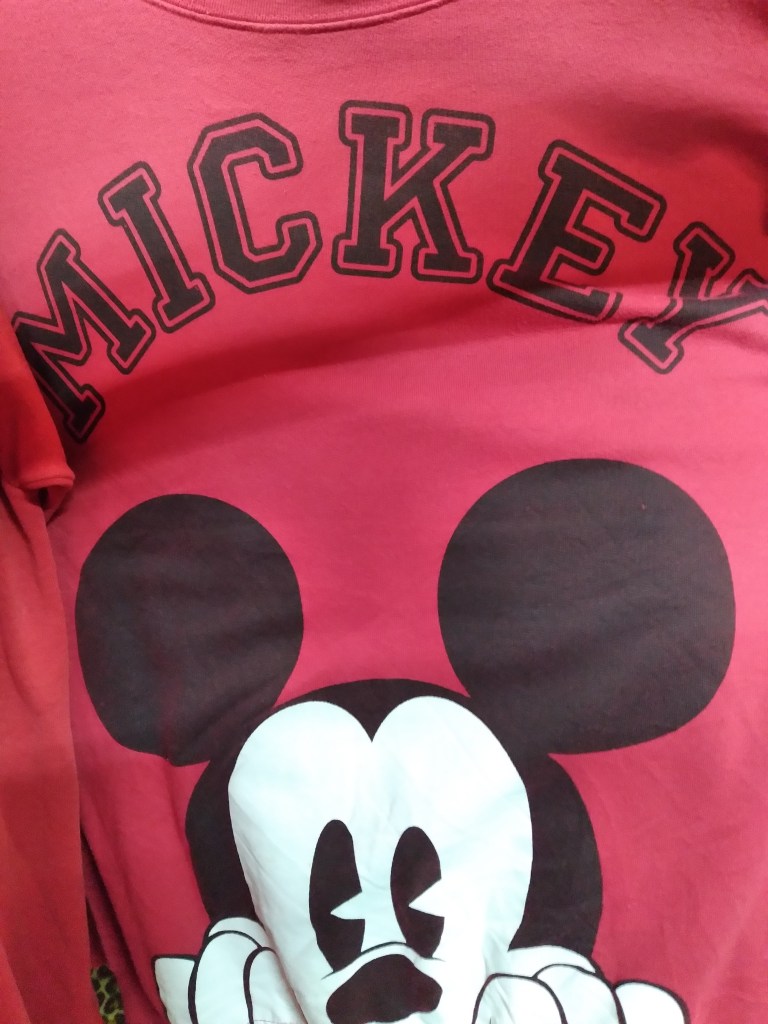
The Running Man’s Dark Tower: A Park of Themes

I’m just sitting here watching the wheels go round and round
I really love to watch them roll
No longer riding on the merry-go-round

John Lennon and Yoko Ono, “Watching the Wheels,” 1980.

I have always tried to live in an ivory tower, but a tide of shit is beating at its walls, threatening to undermine it.

Julian Barnes, Flaubert’s Parrot, 1984.

“—and there was this crazy remake called The Wiz, starring black people—”

“Really?” Susannah asked. She looked bemused. “What a peculiar concept.”

“—but the only one that really matters is the first one, I think,” Jake finished.

Stephen King, Wizard and Glass, 1997.

King’s Verse

The opening credits of the Netflix series Cheer uses the song “Welcome to My World”; this initially aired in January of 2020, around the same time I started this project, for which this would have been an equally appropriate theme song. In a recent post, I discussed how King hints at the cosmology of his sprawling Dark Tower series with the Beatles’ song “Hey Jude”: when this song is part of an environment that feels like it’s supposed to be the 1800s, we realize something is off–this can’t really be the 1800s, and Roland the Gunslinger’s old-west world is actually in a future far ahead of our time: “Hey Jude” welcomes us into what turns out to be a world of worlds. In the film The Dark Tower from 2017, starring Idris Elba as Roland and Matthew McConaughey as Walter, aka the man in black, a different cue is used to hint at this cosmology (possibly due to the difficulty of obtaining Beatles’ rights?):

The Dark Tower (2017)

Jake: You have theme parks here. 

Roland: These ancient structures are from before the world moved on. No one knows what they are. 

Jake: [pause] They’re theme parks.

From The Dark Tower (2017).

I was initially reluctant to watch this movie, thinking it would have spoilers for the rest of the series, but after hearing the Kingcast hosts repeatedly trash it, with one noting that he’d reread the series before seeing the movie and doing so had turned out to be “pointless,” I couldn’t resist. The theme park exchange was of particular interest because I had of late been thinking that my ideal job, a more elaborate version of hosting a podcast on King, would be to work at a King theme park: King World. I had started to think this because of certain passages in a) Carrie, b) The Green Mile, and c) Misery.

a) I’m writing a paper for an academic conference on the invocation of Disney in the critical moment in Carrie (1974) when Carrie is triggered to unleash holy hell after the blood dumps on her, hell she specifically unleashes not because of the blood itself, but because everyone starts laughing at her. The character Norma, whose perspective we initially see this moment in, explains why everyone starts laughing:

When I was a little girl I had a Walt Disney storybook called Song of the South, and it had that Uncle Remus story about the tarbaby in it. There was a picture of the tarbaby sitting in the middle of the road, looking like one of those old-time Negro minstrels with the blackface and great big white eyes. When Carrie opened her eyes it was like that. They were the only part of her that wasn’t completely red. And the light had gotten in them and made them glassy. God help me, but she looked for all the world like Eddie Cantor doing that pop-eyed act of his.

Stephen King. Carrie. 1974.

(If you need further evidence of how important the horrific function of laughter/humor is in this particular text and through it the importance of this function throughout King’s canon, one of the handful of iconic lines of dialog from King film adaptations that the Kingcast opens each episode with is Piper-Laurie-as-Margaret-White’s “They’re all gonna laugh at you!”)

b) The influence of Walt Disney and his worlds is also prominently on display throughout King’s The Green Mile (1996), in which a pet mouse is initially named “Steamboat Willie” (the novel’s primary timeline is set only a couple of years after the initial Disney “Steamboat Willie” cartoon was released in 1928). One character convinces an inmate about to be put to death that they will send his pet mouse to “Mouseville”:

“What dis Mouseville?” Del asked, now frantic to know.

“A tourist attraction, like I told you,” Brutal said. “There’s, oh I dunno, a hundred or so mice there. Wouldn’t you say, Paul?”

“More like a hundred and fifty these days,” I said. “It’s a big success. I understand they’re thinking of opening one out in California and calling it Mouseville West, that’s how much business is booming. Trained mice are the coming thing with the smart set, I guess—I don’t understand it, myself.”

Del sat with the colored spool in his hand, looking at us, his own situation forgotten for the time being.
“They only take the smartest mice,” Brutal cautioned, “the ones that can do tricks.”

Stephen King. The Green Mile: The Complete Serial Novel. 1996.

This mouse is pivotal to the plot the way one could argue Disney has been to American pop culture…and the way the “Mouseville” story is fabricated to make Del feel better replicates Disney’s manipulation of fairy tales to change the grimmer aspects of their life lessons into hollow happy endings.

Further, how this manipulation ends up backfiring when Del finds out the truth then replicates how these hollow happy endings sow seeds of discontent with our own lives when they don’t work out so perfectly that drive us further into the cycle of consumption/destruction…

c) In Misery (1987), the main character, novelist Paul Sheldon, has created a popular romance series around the character of Misery Chastain:

He remembered getting two letters suggesting Misery theme parks, on the order of Disney World or Great Adventure. One of these letters had included a crude blueprint.

Stephen King. Misery. 1987.

As I teach an elective on “world-building” this semester, I am especially attuned to the mechanics of “otherworldly” cosmologies. The Dark Tower movie–which I fully concur with the Kingcast hosts is generally terrible–offers a strange distillation of the series’ cosmology that did help me wrap my mind around it in new ways. Notably, just after Jake and Roland’s “theme park” exchange in the film, their conversation addresses the cosmology of the world of worlds even more directly (some might say, heavy-handedly). Before Jake crosses into Roland’s world through a portal, he has been drawing pictures, one of which he draws again for Roland in the sand:

The Dark Tower, 2017.

Jake: I just don’t know what this is. 

Roland: It’s a map. My father showed me a map like this once. Inside the circle is your world, and my world, and many others. No one knows how many. The Dark Tower stands at the center of all things, and it’s stood there from the beginning of time. And it sends out powerful energy that protects the universe, shields us from what’s outside it. …

Jake: What’s outside the universe?

Roland: Outside is endless darkness full of demons trying to get to us. Forces want to tear down the tower and let them in.

From The Dark Tower, 2017.

For emphasis, Roland picks up a tarantula and drops it outside the circle and they both watch it crawl in.

I know things I shouldn’t if I only knew the content of the first four books of the series that I’ve actually read: that Father Callahan from ‘Salem’s Lot is going to play a role at some point, that there’s going to be some kind of meta-reference to King himself as a character/entity. And of course Randall Flagg has made a brief appearance at the end of Book 3, with the superflu-apocalypse that occurred in The Stand invoked in Book 4, and Flagg makes cameos that are a bit more developed, though still fleeting, in Book 4. These intertextual references in conjunction with the distilled Dark Tower map contributed to a sort of Dark-Tower epiphany: its structure replicates the King canon itself, with the godhead of King-the-author at its epicenter–everything revolves around him, as he necessarily produces it. I was considering this right before reading King’s afterword to Book 4’s Wizard and Glass (1997), in which King notes:

I am coming to understand that Roland’s world (or worlds) actually contains all the others of my making; there is a place in Mid-World for Randall Flagg, Ralph Roberts, the wandering boys from The Eyes of the Dragon, even Father Callahan, the damned priest from ’Salem’s Lot, who rode out of New England on a Greyhound Bus and wound up dwelling on the border of a terrible Mid-World land called Thunderclap. This seems to be where they all finish up, and why not? Mid-World was here first, before all of them, dreaming under the blue gaze of Roland’s bombardier eyes.

Stephen King, Wizard and Glass. 1997.

Every spoke in this wheel is a different world is a different work of King’s, the cyclical nature I suppose in this sense excusing/justifying as cosmically significant the echoes across King’s many, many plots that are essentially the same thing happening over and over.

But these spokes are more than just works King has written himself (and probably far more numerous than on Jake’s rudimentary renderings, to the point where individual spokes might not even be discernible if these were “to scale”…). They’re also the works that influenced him, whose range across the pop-culture-literary-canon spectrum amount to King’s “secret sauce,” as discussed in the initial Dark Tower post on Book 1’s The Gunslinger. This goes back to what could be the most influential text on King, Lord of the Rings, but via Dracula, as King clarifies in his afterword to ‘Salem’s Lot:

When I discovered J. R. R. Tolkien’s Rings trilogy ten years later, I thought, “Shit, this is just a slightly sunnier version of Stoker’s Dracula, with Frodo playing Jonathan Harker, Gandalf playing Abraham Van Helsing, and Sauron playing the Count himself.”

Stephen King. ‘Salem’s Lot. 1975.

So it seems appropriate that a ‘Salem’s Lot character specifically will be returning… The above passage would seem to be a critical insight of King’s about the utility of telling the same story over and over, that the “secret sauce” is taking and using a template that’s worked for generations, specifically the “ka-tet” or “fellowship” narrative, which, with Dark Tower book 4’s Wizard and Glass, King also yokes The Wizard of Oz into the lineage of…

The Wizard of Oz (1939)

The king lives long through the continued passing down of the same narrative… King’s multiverse is a metaverse, I thought. Then I remembered that was what Facebook has renamed itself and/or its conglomerate of companies, and I shuddered.

From here.

Run, Forrest

My comprehension of King’s meta-multiverse was also facilitated by a particular Kingcast episode with guest Marc Bernardin, who chose to discuss The Running Man. Bernardin was one of the Hulu series Castle Rock writers, the show that leans on the “connective tissue” of Kingverse cosmology but introduces original characters and storylines to it; Bernardin articulated the general template of a King plot:

Stephen King is the great unheralded American writer, you know, nobody gives him credit for being the character writer that he is. I mean they always give him credit for the horror stuff, they always give him credit for the boo stuff, but when you look at Stephen King books, for the most part, they’re not mysteries. They are: here’s a bunch of people, and we’re going to introduce you to their lives, and then a bad thing is going to crash into their lives, and what do they do about it. And in order to make stories like that function, you need to build those lives of those characters so that we understand them, we can empathize with them, and know who they are, so when that giant mack truck of supernatural awfulness blindsides their lives, we know who they are and can respond to it.

From here.

Bernardin’s work on Castle Rock prompted the hosts to ask about his thoughts on the Dark Tower series, and I appreciated his response that he “appreciated” it more than he liked it. When they finally got to The Running Man, Bernardin had a reading of it that blew my mind: since its protagonist Ben Richards is essentially from the “projects,” Bernardin likes to think that Ben Richards is Black.

I was initially resistant to this reading, largely because I thought it gave King too much credit. There is much textual evidence to refute the idea that King intended to write a Black protagonist here, mainly through the characters that are identified and described as Black (such as the villainous Killian) in a way that seems to distinguish them from the point of view describing them–Richards’ (and in a way that’s often blatantly racist from Richards’ perspective). It is also Killian, CEO of the network airing The Running Man game show, being explicitly Black that made me resistant to reading Richards as Black–if the narrative were an allegory for the oppression and exploitation of Black Americans, why would a Black character be at the helm of the exploitative vehicle? (Then, of course, there are also the book covers that depict Richards with an illustration of a white man.)

I couldn’t really tell if Bernardin was saying he thought King had intentionally written Richards as Black or if he himself just liked to read it that way, though I guess his calling out King’s “blind spot” when it came to writing race should have been a clue it was the latter:

…maybe it’s because i’m interpreting things in the text that aren’t there, but in my interpretation of Ben Richards as an African American, one of the things I discovered on Castle Rock doing a deep dive there is that one of Stephen King’s big blind spots is writing race–and, and, it’s either magical negro, or magical negro, and that’s kind of it. 

From here.

When I Googled Bernardin and learned that he is Black, his reading made more sense as a reclamation reading, not a literal one. To my mind, a white guy reading Richards as Black would amount to more of a white apologist reading.

As a consequence of the suffering that protagonists experience at the hands of a state-corporate nexus that does not adequately address the rehabilitative needs of citizens, Bachman’s books articulate a politics of pure negation (a modality that plays a vital role in the decades to come) by tracking ‘protagonists who are sociologically so tightly determined and whose free will is so limited that they find violence and self-destruction as their only means to take a stand’ (Strengell 218).

Blouin, Michael J.. Stephen King and American Politics (Horror Studies) (p. 45). University of Wales Press. Kindle Edition.

That quote from Heidi Strengell could be read, via Bernardin, as describing the state of Black people in the American state specifically, as you could define white privilege as not being “sociologically so tightly determined” that your free will is necessarily diminished, and this strikes me as another way of framing my reading of the Bachman novels as deriving their horror from playing out a white male protagonist essentially being treated as a Black person (ultimately in a way that’s condescending toward Black people rather than creating sympathy with their plight).

In the world-building elective I’m teaching, theme parks have become a prominent…theme, since they constitute literal world-building, the construction of an immersive experience. And of course there’s one theme park to rule them all, the one King invokes in all of the above references to Carrie, The Green Mile, and Misery.

The academic Jason Sperb, focusing on Disney’s “most notorious film,” Song of the South (1946)–significantly, the one that Norma invokes in the critical Carrie moment–notes:

One of the main critiques often leveled at the Disney empire for decades has been its distortion of history.45 Disney’s romanticized view of its own past, as the self-appointed king of the golden age of Hollywood, is one thing. Yet more disturbing is its rewriting of American history in general. … Disney’s fondness for rewriting American history, often to the benefit of white, middle-class consumers, came to a head in the 1990s, when cultural critics, historians, and political activists successfully pressured the company to abandon plans for a history-themed amusement park in Virginia, to be called “Disney’s America.” In questionable taste, this endeavor would have awkwardly mixed Disney’s own idealization and whitewashing of history with the uglier history of the surrounding areas, which feature countless institutionalized reminders of the country’s violent colonial and Civil War legacies.

Jason Sperb, Disney’s Most Notorious Film: Race, Convergence, and the Hidden Histories of Song of the South. 2012.

A short story by fiction writer George Saunders, “CivilWarLand in Bad Decline,” helps illuminate this legacy, and in the specific context of “Disney’s America”‘s take on it. The first-person narrator of this story works at a theme park recreating the Civil War, working as a “verisimilitude inspector” with a “Historical Reconstruction Associate.” This would seem like a wacky enough premise on its own (potentially) when a gang of teen vandals starts wreaking havoc and the park becomes a site of violence in its own right rather than just re-enacting it, but then literal ghosts appear in the story to play a pivotal role as well. It’s really the final line of this story that emphasizes the true nature of this Civil-War legacy as the first-person narrator is killed by the ghost of a boy named Sam:

I see the man I could have been, and the man I was, and then everything is bright and new and keen with love and I sweep through Sam’s body, trying to change him, trying so hard, and feeling only hate and hate, solid as stone.

George Saunders. “CivilWarLand in Bad Decline.” 1992. 

Contrast this ending with another one of Saunders’, almost thirty years later:

From across the woods, as if by common accord, birds left their trees and darted upward. I joined them, flew among them, they did not recognize me as something apart from them, and I was happy, so happy, because for the first time in years, and forevermore, I had not killed, and never would.

George Saunders. “Escape from Spiderhead.” 2010. 

In the final lines of both of these stories, the same literal thing is happening: a white-male first-person narrator is dying and in so doing reflecting on his life. But the latter seems to transcend the hate of the (American) human condition, while the former is consumed by it. (I had to wonder if Saunders’ professional success in the intervening decades has softened his worldview, since the earlier story would have been written when he was still essentially an impoverished failure.)

Saunders’ introduction of the fantasy/supernatural element of ghosts in “CivilWarLand” is appropriate for the story’s figurative (and Kingian) theme: that we are haunted by the ghosts of our past. The legacy of America’s collective haunting is a major thematic preoccupation for Saunders, as realized in his long-anticipated first novel Lincoln in the Bardo (2017). Saunders has described his inspiration for this novel (which, also in a classic Kingian vein, revolves around a father-son narrative) essentially being an image of the Lincoln Memorial crossed with Michaelangelo’s La Pietà. This might not be surprising when you consider the final line of “CivilWarLand” with the comparison of hate being “solid as stone” connecting to another major fixture of the Civil War legacy: monuments.

This manifestation of a legacy extends beyond Civil-War-related Confederate monuments; my alma mater Rice University has recently convened “task forces” to address what should be done with a memorial of the school’s founder, William Marsh Rice, a slaveowner. This memorial statue has always been prominently positioned at the center of the main quad on campus, and the decision has been made not to get rid of it entirely, but to move it elsewhere. It’s still a part of our school’s history that should not just be erased, but it should no longer be positioned at the center of our school’s historical narrative.

From here.

This idea of narrative (re)centering reminded me of another running man, one from a classic movie that positioned a particular figure (played by America’s “dad” and/or “everyman” Tom Hanks) at the nexus of several American historical narratives, from Elvis’s signature dance moves (which it should be noted he took from Black people, not a little white boy) to Nixon’s impeachment. I recalled how this other running man got his name:

When I was a baby, Mama named me after the great Civil War hero General Nathan Bedford Forrest. She said we was related to him in some way. What he did was he started up this club called the Ku Klux Klan. They’d all dress up in their robes and their bed sheets and act like a bunch of ghosts or spooks or something. They’d even put bed sheets on their horses and ride around. And anyway, that’s how I got my name, Forrest Gump. Mama said the Forrest part was to remind me that sometimes we all do things that, well, just don’t make no sense.

Forrest Gump, 1994 (here).

This explanation would seem to render this Civil War General’s legacy as excusable, innocuous and justified…and putting this figure named after Forrest at the center of these classic American historical narratives would seem to symbolize the prominence of Forrest and his legacy to our current state–albeit inadvertently.

King’s plots often purport to promote the idea that we can only heal by facing our history, but these narratives seem to reinforce a theme that we’re still running away from it.

Whitewashing

Sperb accuses Disney of “the whitewashing of history,” using a term I had thought of before reading it in his work, specifically when I recently visited a “Walt Disney Archives” exhibit held at the Graceland Exhibition Center in Memphis (Graceland as in Elvis Presley’s Graceland, which now has enough appendages–such as this exhibition center–to qualify as its own theme park). I was visiting these archives specifically for any possible Song of the South materials because of the Carrie reference–but there were none.

If you want to talk about a model for a metaverse–i.e., interconnected narratives within narratives within narratives–then Song of the South is a solid one–“solid as stone,” you might say. Like many (most?) Disney movies, the story for this one is not original but was taken from elsewhere–from the “Uncle Remus” stories by Joel Chandler Harris, a white man who took folklore he overheard enslaved people sharing with one another on a Georgia plantation and then transcribed into books with his own name on them as author.

From here.

Harris tells tales of the “Uncle Remus” character–whose title might recall another infamous racially charged avuncular fictional fixture, Uncle Tom–telling tales. As visible on the title page above, these are not designated as his “stories,” but rather “his songs and his sayings.” The “songs” aspect–emphasized in the Disney adaptation’s appellation SONG of the South–underscores how this narrative replicates the role of the cultural appropriation of music in American history (which I’ve discussed in relation to King’s The Stand here and here), with all of American music tracing back to the white appropriation of Black songs from the plantations, manifest initially in the blackface minstrel performances in which white performers, following the example of Stephen Foster, were performing a version of “imagined blackness.”

Now we put up white draperies and pipe in Stephen Foster and provide at no charge a list of preachers of various denominations.

George Saunders. “CivilWarLand in Bad Decline.” 1992. 

The framing device of the Remus narrator offers another version of a performance of imagined blackness: “Joel Chandler Harris’s jolly slave, the eponymous minstrel-like narrator of several collections of African American folklore…the Remus re-popularized by Disney with Mr. Bluebird on his shoulder” (emphasis mine), as Kurt Mueller puts it in a 2010 issue of Gulf Coast discussing the recasting of this character by Houston-based artist Dawolu Jabari Anderson–specifically, as the “Avenging Uncle Remus”:

The Carrie trigger moment as described by Norma explicitly links Remus to musical minstrel performance by comparing Carrie to the “tarbaby” Remus describes in the Disney story and then by comparing that tarbaby image to “those old-time Negro minstrels with the blackface,” emphasizing this minstrel connection further via the real-life minstrel performer Eddie Cantor (whose Wikipedia page only designates as such implicitly by including him in the “Blackface minstrel performers” category).

This function of Remus is also essentially a figurative iteration of the magical Black man: his magic is to impart wisdom and life lessons in an innocuous way, a depiction of Black man that’s both nonthreatening and subservient–and ultimately dehumanizing. Remus’s tales centering around anthropomorphized animals is another iteration of Remus’s dehumanization, illuminating his function as a figure that purports to be human without being fully so, a facsimile of a human that’s necessarily less than human (and thus justifiably enslavable by actual humans). Disney ends up emphasizing this dehumanizing aspect even more by having the actor who plays Uncle Remus, James Baskett, voice more than one of the cartoon animals in Remus’s tales. Baskett also voiced the “Jim Crow” crow in Dumbo (1941), and he has the distinction of being the first person hired to act live for a Disney film, but this fact that is often presented as a “distinction” turns out to reinforce the film’s dehumanization of Black people through the Remus character–he is literally positioned on screen next to cartoons, a parallel that creates the impression, however subconscious, that this figure is also essentially a cartoon.

Though maybe you could try to argue that this cartoon-rendering of Remus could help us read the dialect of his dialog as cartoonish, i.e., unrealistic:

Remus: Dishyer’s de only home I knows. Was goin’ ter whitewash de walls, too, but not now. Time done run out.

Song of the South, 1946 (here).

In the second room of this Gracleand Walt Disney Archives exhibit, which according to the copy was a replication of the archives kept at the official studios in Burbank, CA, the far wall appeared to be covered by a floor-to-ceiling bookshelf that turned out to only a picture of same:

A picture of a picture of a wall of books…ceci n’est pas une…books.

Via the “‘s” visible on many of these spines, one can see a penchant for a certain framing of the possessive visible on these (faux) book spines, Disney’s assertion of ownership by way of the apostrophe, but the possessive is notably absent in the “Uncle Remus Stories” phrase itself–these aren’t “Remus’s” stories, they’re Disney’s….

Here the Remus stories are positioned next to Fantasia, in which the connection between music and narrative is focalized through the figure of the conductor-narrator, who in being a narrator is in that position similar to Remus:

Now, there are three kinds of music on this Fantasia program. First, there’s the kind that tells a definite story. Then there’s the kind, that while it has no specific plot, does paint a series of more or less definite pictures. Then there’s a third kind, music that exists simply for its own sake. … what we call absolute music. Even the title has no meaning beyond a description of the form of the music. What you will see on the screen is a picture of the various abstract images that might pass through your mind if you sat in a concert hall listening to this music. At first, you’re more or less conscious of the orchestra, so our picture opens with a series of impressions of the conductor and the players. Then the music begins to suggest other things to your imagination. They might be, oh, just masses of color. Or they may be cloud forms or great landscapes or vague shadows or geometrical objects floating in space. 

From Fantasia (here).

These “vague shadows” recall Toni Morrison’s concept of the Africanist presence, which, when I first applied this concept to Carrie, I described as “the white mainstream’s shadow self, implicitly a site of horror that whiteness can define itself in relation to.” One might read this presence into the image that greeted the viewer in the first room of the Archives…

Not from the Disney Archives.

This room also had another iteration of this presence in an image reminiscent of Joseph Conrad’s Heart of Darkness (1899), an imperialist narrative with the implied setting of the “economically important Congo River“:

“Displayed here are examples of concept art for used to [sic] ‘pitch’ the idea of Disneyland to prospective investors, lessees, licensees and sponsors.”

This appears to be a mockup of the “Jungle Cruise” ride that’s recently come under criticism for its problematic native-related imagery, which means it has something in common with the “Splash Mountain” ride that people were calling to be “re-themed” because its theme was from…Song of the South. Though the ride didn’t have imagery directly connected to the Remus character, it had other innocuous-seeming elements from the film (bluebirds, etc.), part of a strategy Jason Sperb articulates as a major part of his project:

This attention to the “paratexts”2—the additional texts and contexts surrounding a primary text—becomes especially acute when focused on a Disney film that has benefited from its parent company’s noted success in exploiting its theatrical properties across numerous forms of cross-media promotion and synergy. Song of the South is another beneficiary of what Christopher Anderson has dubbed Disney’s “centrifugal force . . . one that encouraged the consumption of further Disney texts, further Disney products, further Disney experiences.”3 In the seventy years since its debut, Song of the South footage, stories, music, and characters have reappeared in comic strips, spoken records, children’s books, television shows, toys, board games, musical albums, theme park attractions, VHS and DVD compilations, and even video games (including Xbox 360’s recent Kinect Disneyland Adventures, 2011). By conditioning the reception of the main text, these paratexts are fundamentally intertwined with it, thus problematizing the hierarchical distinction between the two. What I hope to add to this discussion is the powerful and often unconsidered role that paratexts have played historically and generationally in shifting perceptions of the full-length theatrical version. (p5).

Jason Sperb, Disney’s Most Notorious Film: Race, Convergence, and the Hidden Histories of Song of the South, 2012.

This analysis reveals something critical about the critical Carrie trigger moment–Norma doesn’t reference the movie Song of the South as her source for the “tarbaby” image, she references one of its “paratexts”: “I had a Walt Disney storybook called Song of the South…” (Though when one looks up what SoS-related storybooks Disney released, none of them are actually titled the exact same as the film itself.) Norma’s reference to the paratext tracks with the success of the paratext strategy for this particular property–Sperb’s research shows:

In 1972, Song of the South was the highest-grossing reissue from any company that year, ranking it sixteenth among all films.

Jason Sperb, Disney’s Most Notorious Film: Race, Convergence, and the Hidden Histories of Song of the South, 2012.

Norma’s use of the Remus character as a point of reference (in the critical trigger moment!) reveals how the re-release of this 1940s text influenced the perspective of the children of the 1970s.

Disney did relatively recently change the theme of the Splash Mountain ride to eradicate all Song of the South references, but the fact that they released a movie based on the Jungle Cruise ride, called Jungle Cruise, just last year seems an extension of this problematic strategy rather than a rectification of it. I made it through only half of the movie when I tried to watch it, but since it’s the depiction of the jungle “natives” that were the problem, it’s worth noting that every time over-the-top natives appear in the first half, their exaggerated costumes and actions are revealed to be a performance paid for and manipulated by the main character of the cruise skipper.

It’s also worth noting that the jungle is a prominent theme at Graceland itself due to Elvis having a themed “Jungle Room” in his Graceland mansion, showcased further by the “Jungle Room” bar across from the exhibit space in the Exhibition center. The critic Henry Louis Gates, Jr. points to the problematic association between the “jungle” and depictions of Blackness (as epitomized by Uncle Remus and potentially with Heart of Darkness as Ground Zero) by titling his introduction to issue 50.4 (2017) of the African American Review “Criticism in de Jungle,” in which he mentions the concept of the “text-milieu” in relation to the application of academic literary theory:

…what Geoffrey Hartman has perceptively termed their [literary works’] “text-milieu.”4 Theory, like words in a poem, does not “translate” in one-to-one relationship of reference. Indeed, I have found that in the “application” of a mode of reading to black texts, the critic, by definition, transforms the theory, and, I might add, transforms received readings of the text, into something different, a construct neither exactly “like” its antecedents nor entirely new.

Hartman’s definition of “text-milieu” (“how theory depends on a canon, on a limited group of texts, often culture-specific or national”) does not break down in the context of the black traditions; it must, however, be modified since the texts of the black canon occupy a rhetorical space in at least two canons, as does black literary theory. The sharing of texts in common does allow for enhanced dialogue, but the sharing of a more or less compatible critical approach also allows for a dialogue between two critics of two different canons whose knowledge of the other’s texts is less than ideal. The black text-milieu is extra-territorial.

Henry Louis Gates, Jr., “Criticism in de Jungle,” African American Review 50.4, Winter 2017.

Which reminds me of movie-Roland’s map and my idea that the titular concept of the “Dark Tower” is a play or inversion of the “ivory tower” of academia, an institution King has over the years evinced more than a little disdain for (as in Christine‘s invented institution “Horlicks College”).

But of course for Disney, a jungle cruise is where all of this started…

“Steamboat Willie,” 1928 (from here).

Happy Endings

We’d gotten to the happily-ever-after part of the fairy tale, as far as he was concerned; Cinderella comes home from the ball through a cash cloudburst.

Stephen King, Bag of Bones, 1998.

When viewed through the lens of the Civil-War legacy, the idea of “whitewashing” seems to me part and parcel of a cultural lust for fairy-tale “happy endings.” If Disney distorts history, its systematic appropriation–which they like to call “adaptations”–of existing narratives and the manipulation of those narratives’ darker elements into such happy endings is a natural extension of this.

A replica of a painting in the first room of the Graceland exhibit Disney Archives.

I thought of this fairy-tale distortion when watching the misery of Princess Diana’s “real-life” narrative play out in recent fictionalized retellings (The Crown with episode 3.4 about the Royal Wedding titled “Fairy Tale,” and last year’s film Spencer)–the life that everyone thought of as a real-life “fairy tale” turned out to be a living hell. This dynamic plays out again on Cheer via Gabi Butler, a figure whom all in her field emulate and idolize largely due to her omnipresence and image permeated on social media…products of what the show reveals to be an essentially slave-driven exploitation of her by her own parents. Not unlike Diana, Gabi Butler lives in the glass bubble of a pressure cooker.

The prominence of Disney’s fairy-tale narrative of Cinderella specifically can be seen in another intersection of music and narrative: opera. The majority of the Graceland Disney Archives consisted of costumes and props from different films, with several that I hadn’t realized were associated with Disney.

The dress Julia Roberts wears in the opera scene in Pretty Woman.

In Pretty Woman (1990), Edward Lewis (Richard Gere) takes Vivian Ward (Julia Roberts) to an opera where they see “La Traviata” in what amounts to a test of Vivian’s character by Edward, as explained by the latter:

“People’s reactions to opera the first time they see it is very dramatic. They either love it or they hate it. If they love it they will always love it. If they don’t, they may learn to appreciate it – but it will never become part of their soul.”

From here.

Needless to say, she passes this test–if not the Bechdel one.

In Moonstruck (1987), the two primary love interests, played by Cher and Nicolas Cage, go to the opera to see La Boheme, which the narrative of the film itself is a retelling of; Cage’s character doesn’t articulate the visit as an explicit test for Cher’s, but the scene otherwise plays out almost identically. There was another interesting detail connecting these two films:

From Moonstruck.

In Pretty Woman, as with the opera-as-test, the Cinderella connection is explicitly articulated (some have billed it as an “R-rated Cinderella“), by a character named Kit played by none other than the same actress who played Nadine Cross in the ’94 miniseries adaptation of The Stand, Laura San Giacomo:

Kit: It could work, it happens.

Vivian: I just want to know who it works out for. Give me one example of someone that we know that it happened for.

Kit: Name someone, you want me to name someone, you want me to like give you a name or something? … Oh god, the pressure of a name. [Rubs temples in intense concentration before throwing her hands up; she has the answer.]

Cinde-fuckin-rella.

From here.

And the red dress extends to Wizard-of-Oz-like red shoes:

INT. SHOE STORE — DAY
ANOTHER SALESMAN fits Vivian with a pair of red high heel shoes.
Edward sits next to her. He leans over and whispers to her.
EDWARD
Feel like Cinderella yet?
Vivian nods happily.

From here.

Happy endings indeed…

Frank Darabont’s adaptation of The Shawhank Redemption (1994), which, in my opinion, derives a lot of its emotional power from its score, adds a sequence that wasn’t in the original text when Andy Dufresne plays an opera record–Mozart’s “Le Nozze de Figaro”–over the prison loudspeakers in a moment that constitutes an explicit rebellion; this moment also reinforces the power of opera as a quintessential form of musical narrative, communicating something fundamental even without words discernible to the listener, as articulated in voiceover by the character Red:

I have no idea to this day what them two Italian ladies were singin’ about. Truth is, I don’t want to know. Some things are best left unsaid. I like to think they were singin’ about something so beautiful it can’t be expressed in words, and makes your heart ache because of it. I tell you, those voices soared. Higher and farther than anybody in a gray place dares to dream. It was like some beautiful bird flapped into our drab little cage and made these walls dissolve away…and for the briefest of moments — every last man at Shawshank felt free.

From here.

Andy does two weeks in solitary confinement for the stunt; when he emerges he tells his fellow convicts it was the easiest time he ever did because he had Mozart to keep him company. Red thinks Andy is speaking literally and asks if they really let him bring the record player down there. Andy tells him no, the music was in his head and in his heart, and gives a speech about a “place” constituted by music, a figurative rather than a literal place:

Andy: That’s the one thing they can’t confiscate, not ever. That’s the beauty of it. Haven’t you ever felt that way about music, Red?

Red: Played a mean harmonica as a younger man. Lost my taste for it. Didn’t make much sense on the inside.

Andy: Here’s where it makes most sense. We need it so we don’t forget.

Red: Forget?

Andy: That there are things in this world not carved out of gray stone. That there’s a small place inside of us they can never lock away, and that place is called hope.

From here.

What we end up with here is a white man lecturing a Black man on the importance of music as a means to both hope and to not forget, which, via slavery, is the precise origin of American music in the first place–enslaved people came up with music to help them cope with the desolation of enslavement and stay in touch with their humanity, and then white men took that music for the blackface minstrel performances that became the foundation for the rest of American music until Elvis made it palatable for a white man to play it without the blackface but was still essentially doing the same thing. That we tend to forget this makes Andy lecturing a Black man about the importance of remembering a little grating.

This figurative “place” of hope is reminiscent in a sense of “the laughing place”–a place that’s also figurative and that must also originate from slavery since it manifests from the voice of the Remus narrator. In Song of the South, Remus tells three different tales about Br’er Fox’s efforts to catch Br’er Rabbit with Br’er Bear usually inadvertently interfering; the second is the tale with the tar-baby figure entrapment that Norma refers to in the critical Carrie moment, and the third and final involves Br’er Rabbit convincing Br’er Bear that he has a “laughing place”–doing so via musical number and leading him into a thicket with a beehive that the bear stumbles into, leading the bees to attack and sting him.

There is no shortage of King making visual comparisons to white characters looking like they’re in minstrel blackface in his canon:

His cheeks and forehead were smeared with blueberry juice, and he looked like an extra in a minstrel show.

Stephen King, “The Body,” Different Seasons, 1982.

She applied mud for five minutes, finishing with a couple of careful dabs to the eyelids, then bent over to look at her reflection. What she saw in the relatively still water by the bank was a minstrel-show mudgirl by moonlight. Her face was a pasty gray, like a face on a vase pulled out of some archeological dig.

Stephen King, The Girl Who Loved Tom Gordon, 1999.

(The latter passage is of interest in conjunction to this minstrel-mask-like mud soothing a wasp sting and the function of wasps in relation to King’s first magical black man, Dick Hallorann in The Shining (1977) as I discussed here.)

But in what I’ve read so far of King’s canon, there’s only one other direct invocation of Uncle Remus besides Norma’s in Carrie (1974) (Tom Gordon refers to Little Black Sambo in conjunction with the above passage); the other Remus reference is in Misery (1987):

“I have a place I go when I feel like this. A place in the hills. Did you ever read the Uncle Remus stories, Paul?”

He nodded.

“Do you remember Brer Rabbit telling Brer Fox about his Laughing Place?”

“Yes.”

“That’s what I call my place upcountry. My Laughing Place. Remember how I said I was coming back from Sidewinder when I found you?”

He nodded.

“Well, that was a fib. I fibbed because I didn’t know you well then. I was really coming back from my Laughing Place. It has a sign over the door that says that. ANNIE’S LAUGHING PLACE, it says. Sometimes I do laugh when I go there.

“But mostly I just scream.”

Stephen King, Misery, 1987.

If this association with Annie Wilkes, one of King’s most infamous villains, doesn’t highlight a horrific undertone–or overtone–of the concept of “The Laughing Place” as the nexus of humor and horror, nothing will. An integral association between humor and horror and the Carrie trigger moment underscores via Norma’s explanation about how they had to laugh so they wouldn’t cry.

Annie Wilkes has strong feelings about the function of narrative in a more technical sense as well: when Paul tries to circumnavigate the plot development of Misery’s death to write Annie a new book about Misery, he sees Annie’s rage in full force for the first time as she explains to him, via the “Rocket Man” movies she used to go see as a kid, why he wrote “a cheat”:

“The new episode always started with the ending of the last one. They showed him going down the hill, they showed the cliff, they showed him banging on the car door, trying to open it. Then, just before the car got to the edge, the door banged open and out he flew onto the road! The car went over the cliff, and all the kids in the theater were cheering because Rocket Man got out, but I wasn’t cheering, Paul. I was mad! I started yelling, ‘That isn’t what happened last week! That isn’t what happened last week!’”

Stephen King, Misery, 1987.

This narrative “cheating” strikes me as akin to Disney’s cheating by means of simplifying complex narratives by slapping on their unrealistic happy endings. I realized reading Annie’s Rocket-Man rant that Disney’s The Rocketeer was also appropriating a pre-existing narrative from these Rocket Man stories…

Disney Archives at Graceland.

…before they even did RocketMan.

Apart from the invocation of Remus and his Laughing Place, Song of the South and Misery have another connection via a particular lace visual, in the former, one that induces other boys to laugh at the main character in a way not so dissimilar from the way Carrie’s classmates laugh at her:

“Look at that lace collar!” Song of the South, 1946.
Paul Sheldon’s pain meds in Rob Reiner’s Misery (1990), which he then uses to try to drug Annie during a pseudo-romantic dinner he convinces her to have with him…for which she wears:
…a lace collar.

The wheel of ka could be read as a hamster wheel, keeping us running toward that happy ending that we can never reach and that pretty lace collar more like a leash…

Song of the South, 1946

The Carrie trigger moment shows intersection of horror, humor, AND music, replicating the intersecting function of these in American history, and marking only the beginning of this thematic preoccupation for King. In their mocking laughter, Carrie’s classmates render her an “other” apart from their group that enables her to be read as a manifestation of the Africanist presence herself–in spite of her last name being White. In the trigger moment, Carrie is black and white and re(a)d all over, playing out a revenge cycle. I am in a way reading Carrie as “Black” in a similar but different way than Marc Bernardin reads Ben Richards as Black–but hopefully not in a white apologist way!

The current Running Man reboot in production is evidence of how King’s cyclical wheel cosmology applies to the adaptations of his work (it’s also retroactively fitting that in the 1987 original, the Running Man was played by Mr. Universe on a Day-Glo-limned set that might be considered to have a theme-park aesthetic). Rebooting It in 2017 jump-started another King Renaissance, which is somewhat ironic when The Dark Tower, the apotheosis of the King multiverse, was released the same year and a total bomb. (The cyclical interest in our historical preoccupations might also be underscored by the man playing the man in black who had his own renaissance in the form of the McConnaissance (one like King’s in being similarly unaffected by the badness of this movie), making the white-savior Civil War movie Free State of Jones, which he apparently uses as the basis of a film class he teaches for the University of Texas.)

The way that King takes other texts ranging across the low- and high-culture spectrum (his “secret sauce”) and regurgitates them into his own brand of cyclical repeating narrative actually turns out to be quite similar to the Disney model…similar as well in the way it often reinforces a patriarchal worldview…

…what does the map revolve around?

Salvador Dalí’s The Knight at the Tower (1932).

King’s construction of his metaverse has also inspired me to unveil the scrolaverse, my creative wheel in which Long Live the King is but one spoke. And the spoke of Flatten Them Into A Set is definitely influenced by the range of textual references King shoehorns into every text of his…

-SCR