The way we tell stories has real consequences on the way we interpret meaning in our everyday lives.
Matthew Salesses. Craft in the Real World: Rethinking Fiction Writing and Workshopping. 2021.
Published in 1980, Stephen King’s novel Firestarter extends his themes and fictional universe in ways that often feel, like the storyline itself, more repetitive than cumulative.
The Summary
We open with 34-year-old Andy McGee fleeing on foot down a New York City street, carrying his 7-year-old daughter Charlie and closely pursued by two men in a green car. Andy gets them into a cab, using his ability to “push” the cabdriver to convince him the men are after someone else, and that a one-dollar bill Andy gives him is actually a five-hundred-dollar bill to pay for taking them all the way to the Albany airport. En route, Andy dozes and remembers the psychology department experiment run by Dr. Wanless that he participated in twelve years earlier as a senior in college because he needed money; he was given the drug “Lot Six” and met Charlie’s mother Vicky, another participant in the experiment; Vicky is dead, killed by the men now pursuing Andy and Charlie. When they make it to the airport, Andy, suffering a debilitating headache from using the “push,” tells Charlie she needs to get them some money. Charlie uses her abilities to extricate the change from the phones in the phone booths, but some of her power gets away from her, and ends up setting on fire the boots of a nearby serviceman on the phone with–and clearly being a jerk to–his girlfriend.
As Charlie and Andy leave the airport on foot, Andy recalls the experience of the Lot 6 experiment in more detail. During it he was seated across from Vicky, and they began to communicate with each other telepathically and share intimate things with each other, falling in love. During the experiment Andy also saw a boy claw his own eyes out, though an assistant claimed afterward Andy was just hallucinating.
As the green car makes it to the Albany airport and Shop agents search it, a van picks up Andy and Charlie as hitchhikers and drops them at a motel fifteen miles away. Andy recalls the year after Charlie was born, when things would catch on fire but he and Vicky wouldn’t speak of why. Eventually Andy had to yell at Charlie for setting her teddy bear on fire, after which point he called his old college roommate Quincey, who knew about the Lot 6 experiment and who told him that the Shop would be very interested in Charlie if they were to learn about her powers.
At the Shop’s headquarters in Longmont, Virginia, Dr. Wanless has come in to see Captain Hollister, aka “Cap,” who first looks over the McGee file and Wanless’s notes on the Lot 6 experiment, most of whose subjects are now dead. Wanless comes in and gives his usual rant to Cap about how dangerous Charlie must be and how her parents must have given her a complex (a la toilet-training) about controlling her power and what could happen if she gets past this complex; Wanless thinks her “potential for destruction” is so high she needs to be killed. Then Cap meets with Rainbird, a half Cherokee Shop agent.
Meanwhile, at the hotel in Hastings Glen, Charlie recalls learning about her pyrokinesis powers and her parents telling her it was bad to use them. She and Andy shower and hit the road to hitch a ride while Shop agents (including Orv Jamieson, or OJ) convene nearby to search motels and restaurants; the pair of agents approaching Charlie and Andy’s motel blow a tire on the way and just miss them. Charlie and Andy are picked up by a farmer, Irv Manders, who takes them home for lunch with his wife. Sixteen Shop agents converge on the farm, and Charlie can tell (psychically) that they intend to kill her father. When agents grab Andy, she unleashes her pyrokinetic powers more than she ever has; in the commotion, Irv Manders is shot, and the Manders’ house burns down, but the Shop agents scatter (some are killed). Andy has to slap Charlie to snap her out of using her powers, at which point she almost inadvertently burns him up, too. Irv lets Andy and Charlie have his off-road Jeep and gives them directions to follow a dirt road that will help them evade the road blocks the cops have set up in the surrounding area to catch them.
Per the orders he was given in his meeting with Cap, John Rainbird kills Dr. Wanless, but makes Wanless tell him everything Wanless knows about Charlie and her powers first. Charlie and Andy successfully make it to Tashmore, Vermont, to an isolated cottage owned by Andy’s now deceased grandfather. Andy recalls the first time the Shop’s agents abducted Charlie fourteen months prior when she went to spend the night with a friend: after a psychic flash, he left work early and came home to find Vicky dead; the friend’s mother Charlie was staying with told him that some “friends” of his in a van had picked her up. Getting another psychic flash the abductors were escaping via the freeway rather than the airport, he tracked the van to a rest stop and got Charlie back by using his “pushing” abilities on the two agents with her to an extent that they were driven insane (he pushes one of them into believing he’s gone blind). When Charlie learned they killed her mother, she was barely able to keep her power from burning up their hotel bathroom.
Andy and Charlie stay several months over the winter on Tashmore Pond; Charlie turns eight. In the spring Andy decides to mail several letters to different newspapers about what’s happened, thinking that publicizing it might be the only way to save them, but when he doesn’t get a response after a couple of weeks, he assumes, correctly, that his letters have been intercepted and the Shop knows where they are. The Cap enlists Rainbird to assist with their capture, at which point Rainbird reveals he’s been hacking Cap’s computer and has a lot of sensitive info in order to blackmail Cap into letting him have access to Charlie once she’s captured. On the day Andy and Charlie try to leave the cottage, Shop agents, including Rainbird, shoot them with tranquilizer darts and easily capture them.
Five months later, a storm hits the Shop headquarters compound where Charlie and Andy are being held. The power goes out while Rainbird is in Charlie’s room posing as a janitor, and he uses it as an opportunity to get closer to Charlie by making up a story about being scared of the dark because of his time as a prisoner of the Vietcong. The blackout disrupts Andy’s med schedule, inducing a panic attack that somehow helps him regain his pushing abilities, and he ends up using the push on himself in his sleep.
As time passes after the storm, Rainbird–“John” to Charlie–convinces her to participate in a test and make fire in order to get some things for herself, like eventually seeing her father. Andy starts throwing his pills away and pretending he’s still drugged while using his push ability on his handler Dr. Pynchot to let him stick around for more testing instead of sending him away to another compound. Pynchot turns out to be a mental “deviant” (a transvestite), and so the push has an adverse effect on him that slowly makes him lose his sanity. Charlie does a successful test for the Shop people, demonstrating the startling potential scope of her powers. Afterwards she’s allowed to walk outside with John, who takes her to a stable where she meets a horse named Necromancer; Charlie tells John she was able to control her ability during the test in a way she hadn’t before. Cap and Rainbird decide Charlie ultimately can’t be controlled and that Rainbird will kill her.
Cap calls Andy into his office to tell him Dr. Pynchot killed himself and that Andy will be going off to the Hawaii compound; Andy uses his push on Cap to find out how Rainbird has been manipulating Charlie and then to arrange that the Cap will take him along to Pynchot’s funeral. Charlie has a bad dream about Necromancer and other horses burning.
Charlie does another test, this time destroying a cinderblock wall. She demands to see her father and threatens to make something happen if she doesn’t; one of the doctors, Hockstetter, thinks the testing has helped her practice her power in a dangerous way. On the way back from Pynchot’s funeral, Andy pushes Cap to arrange for both Cap and Charlie to come with him on the flight to the base in Hawaii (though he plans to get them off before that at a refueling stop), as well as to send Rainbird off to San Diego, and to give a note to Charlie. The Captain gives Charlie the note, which tells her to meet her father in the stables at 1pm the upcoming Wednesday, and not to trust Rainbird, who should be gone by then. This makes Charlie keep her distance the next time Rainbird visits her, which combined with the knowledge that Cap recently visited her, makes Rainbird nervous. He watches a recording of Cap in Charlie’s room and sees him pass the note; then Rainbird uses stolen computer codes to look over some files and deduces Andy does have his pushing ability and used it on Pynchot and Cap. When Cap calls to send him to San Diego, Rainbird agrees but then uses the Cap’s codes on the computer to cancel the order.
That Wednesday, Charlie asks to go out to the stables, and an agent takes her with orders to leave her there. Rainbird hears about her request to go to the stables and is there waiting in the loft after making everyone else clear out when she gets there. Rainbird calls down to her and she yells at him for betraying her; he says he wants to be straight with her and has almost convinced her to come up the ladder to him to finish their business when her father comes in the with Cap (who came to get him for them to get on the plane to Hawaii). Cap now has a full-blown ricochet effect in his head about golf and snakes from Andy’s pushing. Rainbird has his gun trained on Andy and tells Charlie he can either shoot her father or she can come up the ladder to him and her father can go to Hawaii; she’s about to go to the ladder again with Andy thinking he’ll have to push her not to, but then the Cap freaks out thinking a nearby hose is a snake near the time the agent who escorted Charlie to the stable rings a compound-wide alarm telling everyone to converge on the stables. When Rainbird jerks his gun toward the suddenly moving Cap, Andy uses a massive push against Rainbird to make him jump from the loft. Rainbird breaks a leg but manages to hang on to his gun and shoot Andy (who felt himself already dying from the amount of push he just used anyway). Rainbird wants Charlie to look at him so he can look her in the eye as she dies (this is what he’s wanted from her all along) but as he fires his bullet she uses her power to vaporize both the bullet and then Rainbird.
The back of the stable blows out, hitting a lot of Shop agents with shrapnel. Charlie goes to her dying father, who tells her to “‘[m]ake them know they were in a war” before he dies. When the horses start running from the barn, the Shop agents are on a hair trigger and shoot at them. Charlie comes up behind the agents and starts sending fire. She destroys the entire compound, including the antebellum houses. Her power almost spirals out of control completely, but she manages to get ahold of herself and send it into the duckpond. From the point of view of Shop agent OJ who was at the Manders farm, we get some of the chaos of Shop employees trying to climb the fences to escape and getting attacked by the Dobermen guard dogs there. Charlie sits by the pond recovering, then climbs the fence herself after a woman calls her a witch and Charlie screams back it’s not her fault.
The media reports that the destruction at the Shop compound was a terrorist attack and that Rainbird was a double agent. Four weeks later, the new (female!) head of the Shop wants Charlie found and killed after the initial period of confusion following the destruction enabled her to get away. Charlie shows up at the Manders farm, and they take her in uncertainly because they were threatened by the government to keep quiet about what happened with Charlie last time. After some months, word gets back to the Shop about where Charlie is, but the morning agents show up to apprehend her, she’s already left. She makes it to the offices of Rolling Stone and says she wants to tell one of the writers her story. The End.
The Agency
The titular trope of this novel seems a thematically apt one for the sea change my thoughts on the “craft” of fiction are undergoing as I’m teaching my first advanced fiction workshop in over a year and reading the recently released Craft in the Real World: Rethinking Fiction Writing and Workshopping by Matthew Salesses, who says:
Much of what we learn about craft (about the expectations we are supposed to consider) implies a straight, white, cis, able (etc.) audience.
Matthew Salesses. Craft in the Real World: Rethinking Fiction Writing and Workshopping. 2021.
Like many American institutions, this country’s fiction–popular and literary alike–is largely white supremacist. Nowhere is this more apparent than in King’s oeuvre. Salesses traces our idea of what’s “normal” in fiction back to Aristotle, who dissented with the god-driven plots common in the tragedies of his time to institute the character-driven model that is still the basis of literary fiction to this day. While King has played with both plot-driven and more character-driven models, within either, his white characters enjoy a significant amount of agency.
Take King’s story “Trucks,” for which we have a first-person white male narrator. If character development is knowing anything about this man outside of what he’s doing in immediate response to the sentient semis surrounding him, then we have zero here. But his white (supremacist) gaze is essentially consistent with any of King’s “implied authors,” as Salesses wold have it:
The girl in the booth screamed. Both hands were clamped into her cheeks, dragging the flesh down, turning it into a witch’s mask.
Glass broke. I turned my head and saw that the trucker had squeezed his glass hard enough to break it. I don’t think he knew it yet. Milk and a few drops of blood fell onto the counter.
The black counterman was frozen by the radio, a dishcloth in hand, looking amazed.
Stephen King, “Trucks,” Night Shift. 1977.
When the narrator ends up moored in a truck stop with a bunch of strangers, he sees a “girl,” a “trucker,” and a “black counterman.” The white male narrator is at the mercy of the trucks and essentially ends up enslaved by them at the end, but it is he who is able to lead the stand against them, hence: agency. But the agency of his gaze goes even further in defining a normative standard:
It is easy to forget whom we are writing for if we do not keep it a conscious consideration, and the default is not universal, but privileged. To name the race only of characters of color, for example, because that is how you’ve seen books do it before, is to write to a white audience. It is to write toward the expectations of how white people read the world.
Matthew Salesses. Craft in the Real World: Rethinking Fiction Writing and Workshopping. 2021.
History shows that white people tend to read the world as a hierarchy they’re at the top of, a worldview that keeps us in constant (bloody) conflict. Salesses traces how Aristotle’s character-driven plot model generally promotes the value of individual agency (agency in the sense of having the power ) in a way that certain government Agencies essentially propagated in a specific post-WWII fight:
In other words, the Workshop never meant craft to be neutral. Craft expressed certain artistic and social values that could be weaponized against the threat of Communism.
Matthew Salesses. Craft in the Real World: Rethinking Fiction Writing and Workshopping. 2021.
and
In his book on creative writing programs during the Cold War, Workshops of Empire, Eric Bennett traces the success of the workshop model to its history at the Iowa Writers’ Workshop. He quotes letters from Workshop cofounder Paul Engle to friends and funders, in which Engle sometimes describes his investment in craft as an ideological weapon against the spread of Communism. In one letter, Engle writes that he is convinced, “with a fervor approaching smugness,” that the tradition of Western literature “is precisely what these people [in the East], in their cloudy minds, need most.”
Matthew Salesses. Craft in the Real World: Rethinking Fiction Writing and Workshopping. 2021.
and
If you have been taught to write fiction in America, it is a good bet that you have been taught a style popularized by Ernest Hemingway and later by Raymond Carver, sometimes described as “invisible,” that is committed to limiting the use of modifiers and metaphors, to the concrete over the abstract, to individual agency and action, and to avoiding overt politics (other than the politics of white masculinity). Instead of a political argument, a character might angrily eat a potato. This is supposed to leave conclusions up to readers, though what it really means is that the ideology of craft is to hide its ideology. … If the Workshop is supposed to spread American values without looking like it is spreading American values, what better craft for the job than the craft of hiding meaning behind style? [bold emphasis mine]
I’ve been reading and writing about the “dirty” covert ops of the Central Intelligence Agency for some time, and now come to find out that through the weaponization of creative-writing pedagogy I’ve essentially been spreading their propaganda, an agent whose identity is unbeknownst even to myself…. So, that’s great. Salesses never name-checks the CIA, only this broader “ideological” battle between East and West, but this particular Agency’s enlistment and manipulation of literature is well documented.
In Firestarter, King does name-check the CIA:
“What sort of government agency we talking about? FBI?”
“No. The Shop.”
“What? That CIA outfit?” Irv looked frankly disbelieving.
“They don’t have anything at all to do with the CIA,” Andy said. “The Shop is really the DSI—Department of Scientific Intelligence. I read in an article about three years ago that some wiseacre nicknamed it the Shop in the early sixties, after a science-fiction story called ‘The Weapon Shops of Ishtar.’ By a guy named van Vogt, I think, but that doesn’t matter.”
It doesn’t matter, but it’s a sci-fi reference, so in it will go….and if the Shop didn’t “have anything at all to do with the CIA,” it wouldn’t be necessary for a character to state that categorically. The CIA-Shop likeness goes beyond general(ly questionable) covert tactics to the specificity of this plot: using mind-altering substances on unwitting subjects with the ultimate aim of mind control, which it’s been proven the CIA has attempted.
The CIA did Nixon’s dirty deeds dirt cheap, and Nixon is King’s Necromancer–his favorite whipping horse. This novel piles on the evidence that King was forged in the fires of Watergate and Vietnam.
“I’ve heard things,” Quincey said finally, when he saw that Andy wasn’t going to let him off without something. “But sometimes people listen in on phones, old buddy. It’s the era of Watergate.”
and:
Dr. Joseph Wanless had suffered his stroke on the same day Richard Nixon announced his resignation of the presidency—August 8, 1974. It had been a cerebral accident of moderate severity, and he had never come all the way back physically. Nor mentally, in Cap’s opinion. It was only following the stroke that Wanless’s interest in the Lot Six experiment and follow-up had become constant and obsessive.
As I sit here watching the closing arguments of Trump’s second impeachment trial, I’d say we still have not “come all the way back” from Watergate… the reveal of the potential for political corruption revealed by Nixon and his deployment of “intelligence” agents for a smear campaign is something Boomers could not un-see. After that it seems we entered an emperor-wears-no-clothes situation: we knew the system didn’t work but kept pretending it did anyway. Then Trump raised the specter of that corruption, beating it into a dead horse whose corpse he rode into the White House…
One of Trump’s favorite rhetorical levers is conspiracy theories, which were so effective due to our checkered political history (Watergate all the now known shady shit the CIA has done) opening up the possibility that these theories could be true; there was precedent. Drenched in deep-state government paranoia, Firestarter was published in September of 1980, shortly before John Lennon (RIP) was murdered by Mark David Chapman in December of 1980. There are conspiracy theories that J.D. Salinger’s novel The Catcher in the Rye, which Chapman was reading at the site of Lennon’s murder when police apprehended him, was part of some kind of CIA-related mind-control program, which is noteworthy in light of King’s overlapping interest in the specimen of the male adolescent. (Even if The Catcher in the Rye was not written or utilized as an explicit mind-control device, it’s still a mind-control device.)
Connected to the concept that the human mind might be programmed or controlled, the toilet-training metaphor about Charlie’s relationship to her powers, if leaned on too heavily/repetitively, took on resonance for me as a metaphor for how we’ve been conditioned to define a normative literary and otherwise standard as straight, white, male, etc., individualistic. I’m the perfect audience for some CIA-bashing, but I have been conditioned pretty strongly on the character-driven front to want what is in many ways lacking in this novel. I could do King’s premise-driven pocket-horror short stories for the most part, but in a novel, I struggle. Here, the characters are agents of the plot in that they only exist to advance it, instead of the plot existing to advance them. Not to say the characters should always be advanced, but they could at least be more interesting?
In Firestarter‘s premise, Andy McGee an unwitting victim of the government’s sinister experiment, utterly innocent. He seems to have less agency than a lot of white-male King characters, relentlessly pursued and powerless to stop it–except not entirely powerless. But using the “pushing” power he does have is literally killing him while we come to find the nature of Charlie’s is to feed on itself and grow more powerful, which subverts some of the agency that derives from Andy’s powers. His thorazine-dependent interlude at the Shop compound raises interesting themes about physiological v. psychological addiction and connects the “push” label to “drug pusher” (side note: according to an anecdote in King’s On Writing memoir, “pushing” is also the term King and his brother used for pooping when they were kids). Mind-altering drugs take away one’s personal agency, and I suppose the premise of a white man losing his agency is in large part what King is deriving horror from here. (The horror!)
So the Shop “controls” or is the party whose actions generate most of the plot here, but then they lose control in what turns into a narrative about the dangers of playing god. This happens not because of anything Charlie does–which would mean a more ancient-Greek-type plot of the Shop destroying itself–but because of a random storm, a deus ex machina, God in the form of a not-random storm…evidence for which might be the omniscient point of view in which this pivotal plot point of the electrical power going out is described (an omniscience reminiscent of a will-to-know-all in vein of CIA/NSA surveillance/”intelligence”):
The chain of events that ended in such destruction and loss of life began with a summer storm and the failure of two generators.
As someone who recognizes that the systems of our government consistently and constantly prey on people who have done nothing to “deserve” it, I shouldn’t need Andy to be the victim of his own tragic flaw to make this plot satisfying. Yet it’s my (conditioned) impulse to explore what that would look like, which would trace back to the reason Andy was in the study back in college in the first place: here it’s that he’s poor and needs money as he’s about to go to grad school for English. Surely something else I can sympathize with… but there’s something about him that just feels vanilla and hard to get invested in. (I don’t give a shit about his “Granther,” whose former existence is a paper-thin excuse for the cabin they’re able to hole up in, a convenient property that unwittingly belies this victimized white man’s privilege….) The novel’s alternating presentation of past and present timelines doesn’t help. In theory, opening in the middle of the action as it does should generate more tension/interest, but when it’s presented as Andy actually recalling the past in such detail as they’re in the midst of doing things like climbing down a steep highway embankment, it calls attention to itself as clumsy.
Other notable and in my (conditioned) view detrimental lacking aspects of character development would be Charlie, Vicky, Cap and Rainbird (more on the latter three in Part II). Charlie’s conflict over whether to use her powers is good or bad is pretty generic–ie feels like what any child might feel about this situation without anything to inflect it to express her individual character. Which just says more about my conditioning … the nature of Charlie’s power feeding on itself (the way fire itself does!) and the question of her control over it–her agency–resonates with the Shop’s relationship to its figurative power, but the conclusion of her story doesn’t play this out in much of a satisfying way; we get a Salem reference via the lady calling her a witch as she’s trying to leave and then she makes her way back to the Manders, where she only uses her powers in very tiny helpful ways that I guess are supposed to show us she has internalized the lesson that power corrupts and only seeks more power, a cycle she is then going to stop by going to Rolling Stone, of all places. This conclusion reinforces Charlie’s agency, which would feel more valuable to me for being non-male if she had some character development to pay more than lip service to her empowerment… It’s also a conclusion of King once again reinforcing the power of narrative itself.
Western patriarchal imperialist narrative, of course. This novel takes as its sole epigraph the opening line of Ray Bradbury’s famous novel Fahrenheit 451 about a world in which books aren’t just banned but burned. I mentioned in a previous post how King’s Bradbury homage “I am the Doorway” is “a possible (unconscious) allegory for … a passing of the patriarchal torch from Melville to Hemingway to Bradbury to King,” and it’s ironic that Firestarter takes 451 as its literary antecedent, since 451 seems like a conscious allegory about the dangers of burning down the patriarchal Western canon, while Firestarter feels like an unconscious allegory of the need to burn down the patriarchy itself. As the news breaks that Trump has been acquitted, it would be a pleasure to burn the whole of the Western canon and the political system that’s weaponized it.
He was an actor of genius. There was no more overwhelming actor on the stage, in the motion pictures, nor even in the pulpit.
Sinclair Lewis. It Can’t Happen Here. 1935.
In The Dead Zone, Stephen King takes his exploration of the country’s political anxieties to the next level. I noted in my analysis of The Stand how that novel’s premise reflects a mistrust of the American government rooted in Watergate that has spawned a propensity toward conspiracy theories one could argue has played a significant role in the Trumpian nightmare from which we will (hopefully) soon be waking–not unlike The Dead Zone‘s everyman John Smith emerging from his coma spanning roughly the length of a single Presidential term (+ the final campaign push toward it). So it’s fitting that Watergate happens while John is in his coma:
“It was Watergate.”
“Watergate? Was that an operation in Vietnam? Something like that?”
“The Watergate Hotel in Washington,” Herb said. “Some Cubans broke into the offices of the Democratic Committee there and got caught. Nixon knew about it. He tried to cover it up.”
“Are you kidding?” Johnny managed at last.
John’s disorientation at this political sea change is part of his everymanness, reflecting the feelings of the average American’s political dislocation, that which eventually trickled down to give us Trump. And there are lots of things about The Dead Zone‘s human monster Greg Stillson that are reminiscent of … certain current human monsters.
Yes, there were lots of things about Greg Stillson that scared Johnny.
The domineering father and laxly approving mother. The political rallies that felt more like rock concerts. The man’s way with a crowd, his bodyguards—
Ever since Sinclair Lewis people had been crying woe and doom and beware of the fascist state in America, and it just didn’t happen.
I happened to read the Sinclair Lewis novel this passage is most likely referring to, It Can’t Happen Here, around the time Trump was inaugurated in 2017; like Greg Stillson, this novel’s political villain, Buzz Windrip, bears some unsettling similarities to Trump, though unlike Stillson, Windrip does succeed in ascending to the presidency. (Similarly to Stillson in a defining non-Trumpian quality, Windrip holds political office before running for President.) Windrip creates his own militia called the Minute Men, “more menacing than the Kuklux Klan.” It’s a fantasy of overt domination in the Orwellian vein–one whose elements were probably realized most saliently during yesterday’s storming of the Capitol to interrupt certification of the Electoral College results (did you ever think that would happen here?)–but which we’ve been feeling the echoes of as Trump has attempted his own version of a coup in the wake of the 2020 election:
…Trump’s effort to subvert the election results has been made explicit and unmistakably clear. He is no longer merely pursuing spurious lawsuits in state courts; in recent days, he and his lawyers have confirmed publicly that Trump now is trying to directly overturn the election results and the will of the American people by pressuring Republican state legislators to appoint electors who will vote for Trump in the Electoral College instead of Biden.
“You saw him,” Roger said, gesturing at the TV set. “The man is a clown. He goes charging around the speaking platform like that at every rally. Throws his helmet into the crowd—I’d guess he’s gone through a hundred of them by now—and gives out hot dogs. He’s a clown, so what? Maybe people need a little comic relief from time to time. We’re running out of oil, the inflation is slowly but surely getting out of control, the average guy’s tax load has never been heavier, and we’re apparently getting ready to elect a fuzzy-minded Georgia cracker president of the United States. So people want a giggle or two. Even more, they want to thumb their noses at a political establishment that doesn’t seem able to solve anything. Stillson’s harmless.”
The mention of hot dogs in this passage is one of the clues that Stillson is anything but.
The Hot Dogs
The Dead Zone offers quite a plot to ponder while experiencing the roller coaster of the 2020 election, though perhaps 2016 would have been a more appropriate year to ponder the ethics of this general hypothetical in regards to politicians whose own actions (and/or inaction) would result in irreparable lasting damage….
At any rate, a hot dog is integral to the novel’s entire plot in being the first link in the chain of events that leads to John’s crash then coma then everything else: John would not be in the position of his particular quandary re: political assassination were it not for … a hot dog. More specifically, a “bad” one. It’s on John and Sarah’s date to the fair Sarah gets sick from eating this “bad hot dog”; we’re even treated to a scene of her projectile-vomiting it up. Lest you think I exaggerate the hot dog’s significance, here are the highlights:
“I always eat at least three hot dogs.”
You parked your car in a dirt parking lot and paid your two bucks at the gate, and when you were barely inside the fairgrounds you could smell hot dogs, frying peppers and onions, bacon, cotton candy, sawdust, and sweet, aromatic horseshit.
At last they escaped and he got them a couple of fried hot dogs and a Dixie cup filled with greasy french fries that tasted the way french fries hardly ever do once you’ve gotten past your fifteenth year.
I got a bad hot dog, she thought dismally.
“I think it was my hot dog.”
“It’s those hot dogs, I bet. You can get a bad one pretty easy.”
“I ate the bad hot dog.”
“It was just a bad carnival hot dog, Johnny. ”
Well, they ate a bad hot dog called Vietnam and it gave them ptomaine.
And this other guy, his name was Nixon, he said, “I know how to fix that. Have a few more hot dogs.” And that’s what’s wrong with the youth of America.
“Carnival hot dogs, I guess …”
“Yes we did, until … well, I ate a bad hot dog or something. We had my car and Johnny drove me home to my place in Veazie. I was pretty sick to my stomach. He called a cab.”
“If I hadn’t eaten that bad hot dog … if you had stayed instead of going back …”
“Is a bad hot dog an act of God?”
“HOT DOGS!!”
These hot dog references track the entire opening plot sequence and then beyond: Sarah’s initial request for them, eating them at the fair, Sarah feeling sick from them, John thinking about them as a metaphor for what’s wrong with the youth of America in the cab ride he takes home from Sarah’s specifically because she got sick from the hot dog, which Sarah then mentions again directly before she learns of John’s death and again when she meets John’s father Herb right after John’s coma-thus-enhanced-precognitive-ability-inducing accident. The hot dog is specifically considered by Sarah to be the cause of everything, i.e. the derailing of her and Johnny’s life together, which she references in her and John’s final meeting when they finally get it on. After this point, the hot dog morphs into one of the “boards” in Stillson’s political “platform.” By the point it becomes associated with Stillson, the hot dog has gained fully negative connotations–making someone sick, thereby creating the impression that Stillson is someone who should … make you sick.
The clown is dangerous.
Stillson specifically uses hot dogs as part of his campaign, and that campaign, in turn, is successful. The hot dogs as a critical ingredient to this success is highlighted by their position as the climactic “board” in Stillson’s platform of (empty) promises:
“Last board,” Stillson said, and approached the metal cart. He threw back the hinged lid and a cloud of steam puffed out. “HOT DOGS!!”
He began to grab double handfuls of hot dogs from the cart, which Johnny now recognized as a portable steam table. He threw them into the crowd and went back for more. Hot dogs flew everywhere. “Hot dogs for every man, woman, and child in America! And when you put Greg Stillson in the House of Representatives, you gonna say HOT DOG! SOMEONE GIVES A RIP AT LAST!”
Apparent wordplay here in Stillson positioning himself as giving a “RIP” when the novel indicates his political success is tantamount to mass nuclear annihilation.
“In speeches, he refers to independent candidate Stillson as the only member of the American Hot Dog party. But the fact is this: the latest CBS poll in New Hampshire’s third district showed David Bowes with twenty percent of the vote, Harrison Fisher with twenty-six-and maverick Greg Stillson with a whopping forty-two percent. Of course election day is still quite a way down the road, and things may change. But for now, Greg Stillson has captured the hearts—if not the minds—of New Hampshire’s third-district voters.”
The TV showed a shot of Herman from the waist up. Both hands had been out of sight. Now he raised one of them, and in it was a hot dog. He took a big bite.
“This is George Herman. CBS News, in Ridgeway. New Hampshire.”
Walter Cronkite came back on in the CBS newsroom, chuckling. “Hot dogs,” he said, and chuckled again. “And that’s the way it is …”
Walter Cronkite, last vestige of a nationally trusted news source…
Stillson showing his true colors via the “dark blue snowmobile suit with bright yellow piping” worn by the baby he uses as a shield is enough to kill his political prospects just a few years out from Watergate; a certain orange-complected politician showing his true colors, conversely, only furthered his political success.
“You never want nothing but the best, and the kid comes home with hair down to his asshole and says the president of the United States is a pig. A pig! Sheeyit, I don’t …”
“Look out!” Johnny yelled.
It’s tempting (for me) to think that King extrapolated the plot utility of a literal hot dog from the figurative connotations of the term: human “hot dogs” are showoffs full of hot air, i.e., meaningless words. Pivotal to my personal political disillusionment was my first serious run-in with the dumb power of words at the end of 7th grade, running for student council president. The campaign for this consisted primarily of a handful of posters in the hallways–mine bearing bad clipart and something about “integrity”–and culminated in the various candidates each giving a speech to the entire K-8 student body. My speech was in the earnest vein of my posters, a snooze for sure, enumerating my practical qualifications for the position, which I believed (and still do) were more legit than my opponent’s, since I was a disciplined straight-A student while he was something of a … class clown. I didn’t understand but was about to learn that these things were a popularity contest and that his being class clown, or an ass, was an asset.
His speech was something. He wove an extended metaphor around the refrain “Let me be your toilet paper,” enumerating not his specific personal qualifications, but the general dependable qualities and necessity of…that with which you wipe your ass. Until the official announcement of the election results confirmed my loss, I clung to the delusion that rationality would prevail, but when I heard the gales of laughter in response to his invocations of toilet paper echoing in the school gymnasium that day, I knew the truth. I ate the bad hot dog of my own personal Watergate.
From the Lisa Rogak biography oF King Haunted Heart (2009)
The hot dog, in being the root cause of The Dead Zone‘s plot, mirrors the way King locates Watergate as a root cause of a national disillusionment with America’s political system that from the hindsight of the year 2020 seems to have paved the way for Trump the wayThe Apprentice did.
The road to Trump seems to run through Reagan, the original actor-politician, who also graces the pages of The Dead Zone:
It was Ford who was in a scrap for his political life with Ronald Reagan, the ex-governor of California and ex-host of “GE Theater.”
As he did with Jimmy Carter, Johnny also shakes hands with Reagan:
He shook hands with Morris Udall and Henry Jackson. Fred Harris clapped him on the back. Ronald Reagan gave him a quick and practiced politico’s double-pump and said, “Get out to the polls and help us if you can.” Johnny had nodded agreeably enough, seeing no point in disabusing Mr. Reagan of his notion that he was a bona fide New Hampshire voter.
That Johnny doesn’t get the precog vision that Reagan will win the Presidency like he did with Carter probably nixes any theory that King’s Trump-like representation of Stillson is evidence that King himself has any precognitive abilities…
Johnny resorts to violence to prevent violence, taking an action the novel seems to both deem necessary and valorize without acknowledging its parallels to the logic (or lack thereof) of the arms race. And I have to say that King seems to be doing nothing so much as sinking to a Trumpian level when he explicitly involves himself in today’s politics:
I mentioned in my first Dead Zonepost that the novel feels like it could have been one of King’s “cocaine novels”–as in, written under the influence of. King biographer Lisa Rogak locates 1979 as the year King became hooked; The Dead Zone was published in August of that year. The origin point of King’s personal cocaine narrative is loosely sketched thus:
In the movie and media world of the late seventies, drugs were as much as part of doing business as alcohol, and it wasn’t unusual to see Valium, quaaludes, and cocaine presented in abundance at cocktail parties and industry functions. As Steve began to spend more time in this world—and given his experimentation with drugs back in college—it was inevitable that he would try out these drugs as well, and so around this time he used cocaine for the first time. …
“With cocaine, one snort, and it owned me body and soul,” [King] said. “It was like the missing link. Cocaine was my on switch, and it seemed like a really good energizing drug. You try some and think, ‘Wow, why haven’t I been taking this for years?’ So you take a bit more and write a novel and decorate the house and mow the lawn and then you’re ready to start a new novel again.
Sounds great, though it will take an eventual toll as the go-go 80s wears on…but the introduction of white-collar cocaine and its blue-collar counterpart, crack, has its origin in the 70s, and as with so much of our national evil (i.e., Watergate) that King skewers with his allegorical pitchfork, this one goes back to that old resigned devil, Tricky Dick Nixon. Nixon’s 70s administration is the one that launched the War on Drugs; Reagan took this ball and ran with it through the 80s largely via the vehicle of…cocaine.
I’ll pause here to note that–at the point of this writing at the tail end of 2020–I have only gotten through writing about King’s eighth published book total (including two pseudonymous technically non-King Bachman novels): Carrie (’74), ‘Salem’s Lot (’75), The Shining (’77), Rage (’77), The Stand (’78), Night Shift (’78), The Long Walk (’79) and now The Dead Zone (’79), which covers roughly the first five years of the King’s career. I’m ahead of that in my reading, having gotten through Roadwork (’81), Cujo (’81), The Running Man (’82), The Gunslinger (’82), Different Seasons (’82), Christine (’83), and Pet Sematary (’83), covering roughly the first decade of his career.
Recently watching the Shawshank movie adaptation after finishing that novella in Different Seasons, I noticed in the opening credits that its production company was Castle Rock Entertainment, and wondered if it was connected to King’s Castle Rock. According to Wikipedia:
Just as King’s Dark Tower is the nexus of the space-time continuum and Castle Rock is the nexus of the Kingverse, King himself exists at the nexus of reciprocal influence between film, literature, television…and cocaine. In The Dead Zone, Johnny likes to ask Sarah in a flirty way that signifies their love for each other if she’s still “doing that wicked cocaine”–a teasing tidbit whose absence from David Cronenberg’s 1983 film adaptation of the book is the jumping-off point of Sarah E. Turner’s academic essay “Reaganomics, Cocaine, and Race: David Cronenberg’s Off-Kilter America and The Dead Zone.” Cronenberg develops an aspect of John’s character that the novel doesn’t via both the landscape–snowy, white–and John’s overcoat–black, large collar necessarily turned up against the former.
Christopher Walken as John Smith (as raven) in David Cronenberg’s 1983 adaptation of The Dead Zone.
The meaning of the coat is set up by a literary reference at the film’s beginning that is absent from the novel, John reading Edgar Allen Poe’s classic poem “The Raven” out loud to his English class. He also tells them they’ll be reading “The Headless Horseman” next, but the raven is the figure Walken’s winged collar will render him against the blizzardy-white landscape into which his circumstances will force him, and which will thereby, according to Turner, further “posit[] him as representational of otherness/blackness,” as will the framing of other coat shots (and windows and doorways).
Cinematographic framing in David Cronenberg’s 1983 adaptation of The Dead Zone
Turner has specified by this point she means racial blackness, further evidence for which she offers via a racialized reading of the Poe poem offered by film critic William Beard in his interpretation of the milk truck that causes John’s accident in the film, a detail specifically changed from the accident’s cause (drag-racing) in the novel, a change that becomes…
…inherent to the underlying racial message of the text–whiteness attacks him, almost takes his life, and plunges him into the role of Other/blackness that he assumes.
Sarah E. Turner, “Reaganomics, Cocaine, and Race: David Cronenberg’s Off-Kilter America and The Dead Zone,” The Films of Stephen King, ed. Tony Magistrale, 2008.
Which apparently explains why “The Raven” bit, another change from the novel, is included…
…a decision that is both intriguing and troubling in that [Cronenberg] sets a tone of racial intolerance from the opening shots.[4] Although much has been said about the parallels between John Smith and the narrator of the poem, and the obvious references and fanatical brooding on the embodiment of Poe’s Lenore in the figure of Sarah, there is another, much “darker” reading of Cronenberg’s decision to reference Poe. Poe’s poem, albeit about lost love and questionable sanity, also reflects Poe’s truly American gothic side in its fear of blackness and by extension, black characters and imagery.
Sarah E. Turner, “Reaganomics, Cocaine, and Race: David Cronenberg’s Off-Kilter America and The Dead Zone,” The Films of Stephen King, ed. Tony Magistrale, 2008.
Which brings us to the blackbird, the iconography of which I was reminded while teaching a collage class this past fall and a student was doing a project involving bird imagery. I had recently watched the 1994 adaptation of The Stand in which King, penning the screenplay, leaned even more heavily on the representation of the Dark Man as a crow that he had planted in the novel version (a tactic he developed further in The Gunslinger and presumably the rest of the Dark Tower series)…
One minute, eight seconds into the 1994 miniseries of The Stand.
I had also recently seen this image accompanying a September 2020 article in The New Yorker:
Illustration by Tyler Comrie. Photographs by Zena Holloway / Getty (bird); Nathan Griffith / Getty (mailbox). Accompanying “The Legal Fight Awaiting Us After the Election,” by Jeffrey Toobin, September 21, 2020.
But it seems this winged harbinger of doom might have presaged/foreshadowed a more personal dark fate for Mr. Toobin than he initially realized… an example of attendant meanings’ ability to morph over time if ever there was one. Toobin is still working for CNN and probably won’t have trouble supporting himself when this all blows over–like Johnny when he goes to the symbolic city of Phoenix to work on a road crew in the period before he makes his move on Stillson, I’m sure he’ll rise again, not unlike Moira Rose’s career after starring in the horror flick The Crows Have Eyes in season 5 of Schitt’s Creek:
Moira Rose playing a literal and figurative crow, respectively, in episodes 1 and 2 of Schitt’s Creek season 5 (January 2019).
Turner’s essay then proceeds to discuss some aspects of the film adaptation that reflect the gap between the novel (1979) and film (1983), only four years apart, and yet 1979 is a significant boundary, ushering in the age of Reagan. Turner’s essay is pre-Trump, with the Trump era adding another layer of parallels on top of the ones she mentions:
The parallels between Stillson as politician-actor and Reagan as actor-politician cannot be overlooked. … Cronenberg’s … seemingly conservative nature is instead a harsh criticism on the Reagan years, the rise of the conservative right, and the institutionalized racism suggested both by the group of white men to whom Stillson announces “the missiles are flying” in Smith’s vision and by the conspiracy theory that connected the CIA to the rising crack epidemic in the inner cities of America.
Sarah E. Turner, “Reaganomics, Cocaine, and Race: David Cronenberg’s Off-Kilter America and The Dead Zone,” The Films of Stephen King, 2008.
Cocaine is a drug that is cut along class and race lines–one that specifically cuts the non-hegemonic race into the poorer, more incarcerated class. In Cronenberg’s adaptation, the shots of snow emphasize the white landscape which reinforce the uniform whiteness of the crowd at Stillson’s campaign rally, implicitly highlighting the absence of both blackness and cocaine, elements that loom on the margins via Reagan’s floating head:
“Nobody, and I mean nobody, is gonna stop me!” Martin Sheen as politician-villain Greg Stillson in David Cronenberg’s 1983 adaptation of The Dead Zone
If Stillson is an alter ego for Reagan (and/or Trump), then this might lend credence to or in turn be supported by the theory that Dodd is Johnny’s alter ego, an aspect the movie develops more than the novel by seeming to extrapolate from a detail the novel attributes to Dodd–his wearing a black vinyl raincoat–and using Johnny’s coat to define an aspect of his character in turn.
Jekyll and Hyde…
Dodd’s black vinyl raincoat is a more utilitarian attribute in the novel, as we see when we’re in the killer’s point of view that he wears it specifically because it is “slick” and thereby impedes his victims from fighting him off. John’s coat with its noticeably large collar is utilitarian for the harsh wintry Maine landscape in which he finds himself; shots of him in this landscape further reinforce him as outsider in an allegorical reading of the film as a white man experiencing the horror of what it is to be Black in America–which is necessarily White America. (Kind of like the It’s Always Sunny in Philadelphia episode “The Gang Turns Black” from January 2017, but less on the nose.) Though this analogy kind of falls apart in the face of John’s sort-of-selfless willingness to sacrifice himself to save America–which is necessarily White America, though figures like Stillson (and Reagan and Trump) are working to make it even whiter….
Two other figures in the film bear sharp black lapels on their torsos, the latter notably more winged:
The reporter who goads Johnny into giving a demonstration at the press conferenceThe dude Stillson goads into executing the nuke-launch sequence in Johnny’s vision
John is still wearing one of his Mister Rogers sweaters in the scene with the reporter, so if it’s largely his black winged-collared coat that renders him “other,” then I guess it means his transformation to other isn’t complete yet and figures like the reporter are helping him on his way. The latter dude’s collar seems to more definitively link him to John’s mode of representational otherness, and if he’s literally Stillson’s helping hand (he has to press his full hand down on the screen to execute the nuke sequence), then perhaps he’s showing that if John does nothing with his precognitive knowledge of this then he will essentially be helping Stillson almost as directly as this patsy is…
Part of Stillson’s “act” as politician is also reinforced through clothing/accessories, specifically the working-man’s hard hat or “helmet” he wears to his campaign rallies, which in the novel is specifically noted to be yellow:
Stillson moved quickly through the ranks of the band to shake hands on the other side, and Johnny lost complete sight of him except for the bobbing yellow helmet. …
…
… A female hand reached for the bobbing yellow hard hat, maybe just to touch it for good luck, and one of Stillson’s fellows moved in quickly.
The film shifts the hard hat’s color to white, in keeping with the theory that the film is reinforcing a ubiquitous vision of whiteness(-as-nightmare) in multiple elements of its landscape:
Keep America under construction: Cronenberg’s “construction of America” in The Dead Zone
Now I’m wondering if the helmet is yellow in the novel in order to render the figure of Stillson more hot-dog-like…
Another way clothes come into play in the novel’s narrative is via the aforementioned snowsuit (with yellow piping) of the baby-as-shield, through which Stillson reveals his true figurative colors. The novel links this snowsuit to a metaphor made by Ngo Phat, the piping likened to the stripes of the tiger that had to be killed when it got a taste for human meat. As with the hot dog, the movie dispenses with Ngo and his metaphor (adding a new flourish by having the child Stillson uses as a shield be Sarah’s). Turner’s essay claims in a footnote that “it must be noted that there aren’t any clearly defined black or minority characters in the book,” but this completely overlooks Ngo Phat, whom the text identifies as the Chatsworths’ “Vietnamese groundsman” (and who in classic King fashion exemplifies his workingman status by wearing a “chambray work shirt”). Ngo is more a device for plot and theme development than developed character in his own right; he affects the plot because Johnny is at the rally where he touches Stillson and has the nuclear-holocaust vision because he goes with Ngo’s U.S. citizenship class; he affects the theme through his tiger metaphor applied to Stillson, developing the theme of politician-as-monster. Since Ngo’s “character” actually serves more than one function, he gets more play than a fair amount of minority characters in the Kingverse–certainly more play than the one person of color in the film Turner does take pains to note via the “brief shot of an Asian American man in the band that plays outside at the Stillson rally in the latter part of the film.”
The lone POC in David Cronenberg’s The Dead Zone
She doesn’t note that his clothes also seem to differentiate him… but she does expound further in a footnote that in a latter shot of the band:
…his head is obscured by the raised arm of the white man standing next to him, in a sense erasing his difference as, from the neck down, he looks like all the other white members of the band.
Sarah E. Turner, “Reaganomics, Cocaine, and Race: David Cronenberg’s Off-Kilter America and The Dead Zone,” The Films of Stephen King, ed. Tony Magistrale, 2008.
I was unable to locate this latter shot (there’s a guy with his head obscured that it seems like she might be referring to, but he’s not playing the flute). But perhaps this single “Asian man” in the film is a sort of homage to the scrapped “character” of Ngo Phat…
That Cronenberg (who’s from Canada, and filmed The Dead Zone there) constructed an “off-kilter America” in which the hegemonic culture’s vision of itself is subtly but horrifically realized feels fitting for an adaptation of the first novel in which King’s Castle Rock appears, that “fictional” landscape of a “real” place. (King’s wife Tabitha has her own parallel Maine creation, setting several of her novels in the fictional town of Nodd’s Ridge; one of these, The Trap (1985), explores the nexus of the film industry, cocaine, and the legacy of (the bad hot dog of) the Vietnam War.) This “off-kilter” aspect of a fictional setting amid “real” surroundings and events seems an implicit acknowledgment that any single author’s take on the “real” is necessarily limited by their individual perspective, despite narrative devices like omniscience and/or representing multiple characters’ points of view. The fictional mileage King has gotten out of Castle Rock places it in the tradition of William Faulkner’s Yoknapatawpha County, that fictional Mississippi county in which real Southern attitudes were expressed; a new book compares Faulkner’s fiction’s evisceration of those racist attitudes to his real-life failure “to truly acknowledge the evils of slavery and segregation.”
The Rock is a fictional town in the whitest state in America, and I’m not so far sensing a gap between the author and the fiction in terms of attitudes expressed, what often becomes an inadvertent and often good-intentioned but ultimately racist attempt to perform anti-racism, or a racist performance of racism for the sake of showing the ugly truth of its existence. This is the vibe I’m getting from my dip into the first decade of King texts, manifest in an exchange Turner quoted that King once had with Tony Magistrale, a King scholar (and apparently at some point King’s research assistant). The exchange is about John Coffey from The Green Mile (1996); King says the character’s racial blackness is necessary to the narrative to make Coffey doomed when he’s caught with the dead girls in his arms (the implication being his guilt will be assumed instantly); when Magistrale suggests Coffey’s suffering as a black Christ figure “becomes all the more profound because he is black and a victim of wounds that are particular to his racial history,” King accuses Magistrale of “an imaginative failing.” Which is ironic (in a way that I shudder to say is almost Trumpian), because King seems to be the one demonstrating such a failure here, a failure to imagine all the possible meanings a text can inadvertently accrue or manifest, despite King’s history as and valorization of English teachers. But maybe his blind spot with inadvertent meanings is more specifically race-related… and/or maybe its his ability to compartmentalize white guilt that helps fuel his prodigious output… We’ll see how King’s Castle Rock’s “off-kilter” elements confront the trickle-down “evils of slavery and segregation” from here… and if our so-called democracy survives.
When Roger came to the neck of land that joined the Castle Rock to the mainland he was not surprised to be challenged. He had reckoned, during the terrible night, on finding at least some of the tribe holding out against the horrors of the island in the safest place.
William Golding. Lord of the Flies. 1954.
Published on August 30, 1979, Stephen King’s novel The Dead Zone might be more significant for marking the first appearance of King’s fictional creation Castle Rock than as a narrative achievement in and of itself, were it not for reading it during the 2020 election…
Prologue
In 1953, six-year-old John Smith is out skating on a pond when a bigger boy collides with him, causing him to bash his head on the ice. When he comes to, he has a premonition about one of the men helping him, telling the man not to “jump it no more” because of “the acid.” A month later the man tries to jump a car battery and it explodes in his face.
In 1955, a traveling Bible salesman named Greg Stillson pulls up to a farm; no one is home and a dog comes out, growling at him; Greg sprays it with ammonia then ends up kicking it to death when it bites his pants leg. He has a feeling he’s destined for greatness if he can keep his temper under control.
Part 1: The Wheel of Fortune
In late October of 1970, Sarah Bracknell shows up for a date at John Smith’s apartment in Cleaves Mills, Maine, and he frightens her by greeting her in a Jekyll and Hyde mask. They’re both new high-school English teachers in their first year out of college; Sarah had a toxic boyfriend right before John and hasn’t slept with John yet. When they get to the county fair, their date goes really well until John is betting on a wheel of fortune and Sarah starts to feel sick from a hot dog she ate. Getting one of his “hunches,” John plays the wheel for a growing crowd until he wins $500, then takes a sick Sarah home. She had wanted him to stay over for the first time that night, but since she’s sick, he takes a cab home, telling him she loves him for the first time right before he leaves. On its way to John’s, the cab collides head-on with a drag-racing car. Johnny’s parents Herb and Vera are notified; Vera, extremely religious, keeps ejaculating prayers and is hostile to Sarah when they meet her for the first time at the hospital and receive the news that John is in a coma. Sarah tries to pick her life back up, and a killer starts strangling women in Castle Rock, Maine. Greg Stillson recruits a greasy biker named Sonny Elliman to be his chief enforcer. Sarah stays in touch with Herb but eventually begins to date again and marries a law student; Herb goes to her wedding while Vera is off with some crazy religious people on a farm waiting for the rapture. Sarah has a baby, and the Castle Rock killer strikes again.
After four and a half years, Johnny wakes from his coma. When he touches people, he knows things about them. Herb and Vera visit and Herb tries to order Vera not to proselytize to John about his having survived to fulfill some purpose of God’s. When John touches the hand of Dr. Weizak, he gets a flash revealing that Weizak’s mother didn’t actually die during WWII like Weizak had always thought, but had gotten amnesia and was actually living in California; Weizak calls and confirms that it’s true. John has surgeries to lengthen the ligaments that shortened while he was bedridden; Sarah visits while he’s recuperating and he tells her where her lost wedding ring is. His mother stops taking her blood-pressure medication and his old principal offers him his job back. When he’s working with a physical therapist one day, he gets a flash that her house is on fire, which turns out to be true. This prompts a bunch of reporters to show up at the hospital, and Johnny gives a press conference during which one of the reporters demands he do a demonstration and hands him a medallion he has on his person; when Johnny touches it he’s able to tell the reporter’s sister died of a meth-related heart attack, and a ruckus with the agitated reporter ensues. That night John gets a call from his father that his mother’s in the hospital after having a stroke when she saw the press conference with him on the news. Weizak drives John over and she again insists God has a job for him before she dies.
As mayor of Ridgeway, New Hampshire, Greg Stillson privately assaults and threatens a youth offender for wearing an obscene t-shirt. Sarah’s husband Walt shows her the news story about Johnny’s press conference and thinks Johnny is hoaxing it for money, an idea that angers Sarah. A guy from a tabloid newspaper tracks John down at his father’s once he’s discharged from the hospital to offer him a clearly unsavory job as a magazine psychic; John insults and borderline assaults him turning it down, infuriating the guy and getting them to run a story accusing Johnny of being a fraud. Stillson runs for an open House of Representatives seat because he’s gotten photos of the supposedly unbeatable incumbent sleeping with someone who’s not his wife. Sarah comes to visit Johnny with her young son Denny when they’re vacationing nearby (sans her husband, who has political aspirations) and finally sleeps with John, saying it will be just for this one day. John is happy people think he’s a fraud because it means he’s not constantly being mailed objects to touch, but then he gets a call from a sheriff in Castle Rock about the murderer there after Dr. Weizak mentioned John’s abilities to the sheriff. John refuses to help at first, but when a nine-year-old girl is raped and murdered, he agrees to help and meets with Sheriff Bannerman, who gives him a cigarette pack they believe the killer touched. This doesn’t produce any results, but when they go to the town common (with reporters following) where one of the murders happened, John sees enough to realize the killer is Frank Dodd, one of Bannerman’s deputies. Bannerman doesn’t want to believe it at first, but they go to confront Dodd at his house where his mother tries to stop them; by the time they get to him upstairs, Dodd has cut his own throat. After the news stories about his help with the case come out, John loses his teaching job because the school board doesn’t want his notoriety.
Part II: The Laughing Tiger
Six months later, in the summer of 1976, John is living in the guest house of the wealthy Chatsworth family, tutoring their high-school-senior son Chuck, who has reading problems–specifically processing/remembering what he reads after he’s read it. This day during their lesson John tests a method he’s been waiting to try, asking Chuck unrelated questions to get his mind off the text before returning to it, and it works. Sonny Elliman accosts someone about to run a story revealing Stillson’s illegal real-estate scams.
While he’s tutoring Chuck, John develops an interest in politics and meets several politicians, including Jimmy Carter, whom he shakes hands with, inducing a premonition that Carter will win his run for the Presidency. After Chuck’s reading breakthrough, his father gives John a bonus, revealing he knows about John’s past as a psychic, and they see a clip of Stillson campaigning on the news (this is the first time John sees/hears of him); his campaign is described as “eccentric” and he presents himself as a man of the people by wearing a yellow hardhat everywhere. John thinks Stillson looks crazy, but Chatsworth, while conceding the point, predicts Stillson will appeal to the blue-collar electorate and win.
Johnny strikes up an acquaintance with the Chatsworths’ Vietnamese groundkeeper Ngo Phat, who’s in the process of applying for U.S. Citizenship; when Ngo’s class and Johnny attend a Stillson rally, Johnny ends up touching Stillson, getting a flash of Stillson taking the oath of office and some vague broader destruction that’s in the “dead zone,” the part of John’s brain that’s been damaged, leading to blank spots in his precognitive visions. Stillson senses something (as people tend to when Johnny gets flashes from them via touch) and some of his biker goons rush John, who passes out and wakes up in an interrogation room with an FBI agent who was at the rally. Ngo compares Stillson to a tiger from his village who had to be trapped and killed after he got a taste for human meat. Johnny watches the ’76 election results and sees Carter beat Ford and Stillson also win his race. Chuck puts off taking the SATs to attend Stovington Prep for a year. Johnny becomes obsessed with Stillson and looks into his history, including his stint as a rainmaker, and puzzles as to why the press hasn’t probed more into his shady real-estate deals and biker-goon bodyguards. When Johnny’s father gets remarried, Johnny sees Sarah at the wedding and meets her husband for the first time; he asks his father’s new father-in-law who served in WWI if he would go back in time and kill Hitler, and the man says he would, as does Chuck Chatsworth.
In the summer of 1977, Chuck graduates from high school, and at a gathering after the ceremony when Johnny hugs him, he sees that the place where everyone is going for their graduation party that night will burn down after being struck by lightning, trapping and killing a lot of people. Roger Chatsworth thinks the prediction is ridiculous, but Chuck says he won’t go; the two go with Johnny to the place, Cathy’s, to try to convince the owner to close but he says it’s worth too much money and claims he has lightning rods, even though when they go outside they see he doesn’t. They invite everyone to the Chatsworth’s for a party instead but only about half accept; at the party that night the news breaks that Cathy’s has burned down and several of the graduating students there were killed.
Johnny drifts to Phoenix and keeps rejecting checks from Roger Chatsworth, but Roger pays off all his medical bills. The FBI agent Johnny talked to who was looking into Stillson turns up murdered. Stillson is reelected to his House of Representatives seat. Johnny debates about assassinating Stillson. When he finds out he’s almost “run out of time,” he buys a rifle and makes his way to a Stillson gathering in Timmesdale, New Hampshire, looking visibly sick to everyone he encounters. He writes letters to his father and Sarah. He examines the space where the Stillson gathering will be and spends the night hiding in its upstairs gallery. One of Stillson’s bodyguards almost finds him the next morning but is just doing a cursory check, and misses him. When Stillson comes into the crowded gathering, Johnny stands to shoot him but Stillson ducks; Johnny gets shot by the bodyguards but still tries to get another shot off, at which point Stillson grabs a little boy in a snowsuit from someone and holds him up as a shield. Johnny doesn’t try to risk shooting him again, and thinks he’s failed. He falls down from the gallery, and when Stillson and some of the bodyguards approach him (Stillson yelling at some of them to go chase down a kid who took a picture of him holding up the baby as a shield), John grabs Stillson’s ankle and sees that everything’s changed, that Stillson won’t become president and start a nuclear war, that his political career is finished. John dies.
III: Notes from the Dead Zone
We get Johnny’s letter to his father interspersed with testimony acquired by the “Stillson Committee” looking into the attempted assassination. It turns out Johnny had found out he had a brain tumor and only a limited time to live without another operation, which he’d declined. Dr. Weizak claims that the brain tumor is not responsible for Johnny’s actions and that his letters show he was rational to the end. Sarah visits Johnny’s grave and briefly feels his hand on her neck before saying goodbye. The End.
Narrative Execution
The execution of this plot feels disjointed and jerky in ways the physicality of John’s climactic assassination attempt plays out almost comically, and which also feels like it might be King starting to write under the pressure of contract-reinforced deadlines (and possibly the influence of cocaine). According to the authority of certain t-shirts, King has trouble sticking the landing when it comes to his endings:
Reader dissatisfaction with King’s endings strikes me as a product of how good/immersive his books are up that point and thus a product of a double-edged sword: the better the book–that is, the more the reader is immersed in its world and characters–the better the ending has to be to satisfy. It’s like King has set such a high bar for himself in the buildup that his ending will necessarily never be able to meet it; the reader comes to love the characters and their world so much that no ending can be good enough. Any resolution is inherently “disappointing” because it means the book is over and you can no longer continue reading it… But The Dead Zone was the opposite for me: I liked the ending; it was the buildup to it that felt lacking.
Let’s start with the prologue: here we get two separate scenes focusing on two different characters. The scene we get of our protagonist John Smith seems critical to the overall narrative in showing us an early head injury that is implied to be related to why the eventual coma has the effect on him that it does in terms of his precognitive abilities. Then there’s the scene of Greg Stillson: this scene shows us the character in a way that instills a sense of foreboding about him, but unlike John’s scene, what happens in it is not technically critical to any later plot developments–it’s not like what happens here with the dog causes or has any influence on changing his actions in a pivotal way, like this is the moment he decides he has a higher calling specifically due to what happened in the scene. The other problem is that its placement implies Johnny and Stillson are going to get equal or at least comparable airtime/page counts throughout the book, but Johnny gets much more, and part of what we do end up getting about Stillson’s side doesn’t even directly involve him–like a scene of his enforcer Sonny Elliman threatening a journalist. Such scenes, like that of Stillson’s in the prologue, show us something about the character and his general trajectory, but don’t feel directly critical to the Johnny-Stillson plot–Elliman has presumably threatened many journalists, so why is this threat the one we end up getting in scene?
Stillson is not developed in any satisfying way as a human being in the scenes we do get of him or otherwise, but rather is shown to be a psychotic monster with no nuance. This could be fine for thematic purposes, highlighting the monstrousness of politicians and/or the political machine that subsumes people who have to adhere to its platforms/demands in order to be successful in politics. I am increasingly wary of narratives that humanize would-be monsters so that we end up sympathizing with them in a way that might implicitly let them off the hook (I don’t want to sympathize with Donald Trump, no matter how mean his father was to him). But the framing of Stillson we get via the prologue, if in form more than content, sets up an expectation that he’ll get more nuanced development than he does.
Yet despite the page count dedicated to him, development is a problem that extends to Johnny as well. By naming this protagonist “John Smith” with no middle name, King seems to be branding Johnny as an everyman, more cipher than individual, which a lack of character development would seem in keeping with. So there’s a technical explanation, but John’s everymanness sure is boring to read–he’s as bland as freeze-dried rations that only approximate the flavor of meat. Sarah is a plot/character device for John in that she represents the life John would have had if he hadn’t lost those 4.5 years due to the accident–her son Denny should have been his son, etc. And he was a preternaturally gifted charismatic English teacher, so the happy life he should have had is outlined to heighten the tragedy of what is precisely the sacrifice of his individuality that defines the plot’s rising action, but the sketching of all of this bent toward hokey.
This aspect combined with the extended period of time the novel covers in jerks and stutters make the overall reading experience a bit of a slog. The interest we’re told Johnny develops in politicians following his coma feels utterly contrived, something that clearly exists only because of/for the sake of the plot: Johnny’s interest in politicians seems to be due to his increased post-coma precog abilities, but it would be better if this interest had some seed in his individual character that existed apart from these abilities. His mother’s extreme religious tendencies seem to exist to introduce the idea that John has been chosen or called on by some larger/divine force to use his abilities for some larger significant purpose, but there is nothing about John independent of these abilities, nothing about his individual character, that impacts his decision to ultimately accept his calling and use them. If it’s supposed to be due to the deathbed exchange he has with his crazy religious mother about his calling, that’s not really working for me, though perhaps some might try to argue for this mother-based motivation based on the theory that Frank Dodd is a version of Hyde to Johnny’s Jekyll. The narrative basically lays the blame/motivation for Dodd’s…tendencies…at the mother’s doorstep with the descriptions of how she made him clothespin his penis when she caught him playing with it when he was young, and his invocation of her language (“nasty-fuckers”) in his direct point-of-view considerations of his crimes.
Pacing-wise, the lack of page count around Stillson is apparently due to getting a lot of stuff about Johnny that is prepping him for how to handle Stillson, but since the prologue is also focalized on Stillson, it’s implied the rising action should also revolve more around Stillson. Instead we get a long digression about Johnny’s psychic fight with another human monster: Castle Rock serial killer Frank Dodd. This plot thread is in theory supposed to be something that vindicates Johnny’s abilities and thus his decision to go through with attempting to kill Stillson, but his vision about Chuck Chatsworth and the graduation party would in theory be enough to serve this purpose. The whole Frank Dodd thread feels like it should be its own separate novel with the confrontation with Dodd as its climax; we get scenes in the killer’s point of view, but this plot thread, especially Bannerman’s relationship with Dodd, ends up feeling undeveloped and rushed. King will lean on Dodd later in his development of Castle Rock (particularly in Cujo, whose titular character/monster will be implied to be some manifestation of Dodd), and if King had leaned on Dodd more here than he does, that would also be more satisfying.
As for the ending, the setup implies two obvious outcomes for the fulcrum of Johnny’s assassination attempt on Stillson: he succeeds in killing Stillson and thus annihilating the possibility of nuclear annihilation for the world at large, or he fails and we all die in an inferno much like the one conjured by Sarah Connor’s consciousness in Terminator 2.
Terminator 2.
Our protagonist does die in the attempt that fails in its most immediate goal: Stillson is not killed. But the attempt itself turns out to achieve the larger goal the assassination was meant to achieve by causing Stillson to show his true colors, thus ending his political career and his chance to access the nuclear codes. So even if you don’t succeed, sometimes just trying is enough…
Of course, how heroic Johnny really is in sacrificing himself for this mission that’s supposed to serve the greater good of humanity is somewhat mitigated by the fact that he was going to die soon anyway from a brain tumor…
In John we have another significant Kingian figure, the English teacher who battles the monster(s). As a teacher, I can appreciate King’s emphasis on the importance of the teacher, and by extension of reading…
Long-suffering good humor predominated, but beneath it he could sometimes see another Chuck: sullen, worried, and scared. Plenty scared. Because it was a reader’s world, the unlettered of America were dinosaurs lumbering down a blind alley, and Chuck was smart enough to know it. And he was plenty afraid of what might happen to him when he got back to school this fall.
This lends new meaning to the term “letter jacket”…
Enter the Kingverse
It feels ironic to me that King declared The Dead Zone his “first real novel,” though his biographer’s juxtaposition of this inflated claim with another tidbit about this novel speaks volumes:
“That’s the first real novel I wrote,” [King] said. “Up until then, the others were just exercises. That’s a real novel with real characters, a real big plot and subplots.”
The Dead Zone was his first book set in Castle Rock, a town in Maine that he’s said he’s patterned after Durham and Lisbon Falls. He borrowed the name from William Golding’s Lord of the Flies, one of his favorite books as a kid. Castle Rock is the rocky part of the island where Golding’s story occurs.
So The Dead Zone is King’s first (published) novel to introduce the now infamous imaginary Maine town of Castle Rock. In this and other critical ways, it provides insight into King’s world-building tactics, as does its Author’s Note at the beginning:
What follows is a work of fiction. All of the major characters are made up. Because it plays against the historical backdrop of the last decade, the reader may recognize certain actual figures who played their parts in the 1970s. It is my hope that none of these figures has been misrepresented. There is no third congressional district in New Hampshire and no town of Castle Rock in Maine. Chuck Chatsworth’s reading lesson is drawn from Fire Brain, by Max Brand, originally published by Dodd, Mead and Company, Inc.
So, an interplay between the fictional and the “actual,” which the fictional Castle Rock reflects by being situated in a Maine topography both “actual” and fixed in other King novels:
“All right, Daddy,” Johnny said, almost in a whisper. “Yes. Cumberland General. I know where it is. Just above Jerusalem’s Lot. Okay. All right. Daddy …”
It’s later on, when John is tutoring Chuck, that another setting link to the Kingverse, one outside the bounds of Maine, crops up:
…the decision had already been made between Chuck and his father that he would spend a year at Stovington Prep, a good private school in Vermont.
Stovington Prep is where Jack Torrance of The Shining taught, so this is an even more direct link to that novel than the use of Stovington in general as the location of a disease-control center where Stu Redman ends up in The Stand. Of course, The Dead Zone cannot technically take place in the “same” world as The Stand, since the majority of the population of that world has already been killed off, though it seems like The Dead Zone could take place in the same world as The Shining. But this aspect is complicated by another reference:
And then, suddenly, from somewhere behind him Patty Strachan began to talk in a high hysterical voice. “It’s his fault, that guy there! He made it happen! He set it on fire by his mind, just like in that book Carrie. You murderer! Killer! You …”
The Dead Zone takes place in a world where Carrie exists as a work of fiction rather than as events that “really” happened. Which seems like an odd choice, considering the overlapping supernatural-seeming abilities these works’ protagonists share…
While I would dispute that this novel feels like it has “real characters,” King’s claim in his Night Shiftforeword that if the story is good enough it will make up for such shortcomings rings true here. Stillson may not be developed, but the landscape in which such a supposedly anti-political figure could succeed definitely is:
There was also a carton of paperbacks entitled America the TruthWay: The Communist-Jewish Conspiracy Against Our United States.
Greg did better with this paperback, printed on cheap pulp stock, than with all the Bibles put together. It told all about how the Rothschilds and the Roosevelts and the Greenblatts were taking over the U.S. economy and the U.S. government. There were graphs showing how the Jews related directly to the Communist-Marxist-Leninist-Trotskyite axis, and from there to the Antichrist Itself.
The days of McCarthyism were not long over in Washington; in the Midwest Joe McCarthy’s star had not yet set, and Margaret Chase Smith of Maine was known as “that bitch” for her famous Declaration of Conscience. In addition to the stuff about Communism, Greg Stillson’s rural farm constituency seemed to have a morbid interest in the idea that the Jews were running the world.
Conspiracy theories appealing to a “rural farm constituency” that purports to be Christian, hmm…sounds familiar. Stillson’s initial occupation as a Bible/conspiracy-theory tract salesman offers an interesting overlap with John’s occupation as English teacher/tutor and King’s conception of a “reader’s world” as played out via Chuck Chatsworth. Chuck’s specific issue is not that he can’t read, but that he can’t remember/retain what he reads, which has larger thematic implications for how we “read” history and what we’ve actually learned/retained from it. King has constructed a fictional world around the pillars of our “real” one, as indicated by the references to McCarthy and other real historical figures in the above passage, and perhaps embodied more directly here in the figure of Jimmy Carter, the “fuzzy-minded Georgia cracker president of the United States” referred to by Roger Chatsworth above, and whom John himself has something of a chance in-person meeting with during his initial campaign for the Presidency, during which he shakes Carter’s hand and thereby gets a precognitive flash that Carter will win. While this meeting feels like one of the contrived absurdities that largely constitute the plot of this book, in the larger context of the Kingverse it feels symbolic of the intersection of the fictional and the “real” threads that comprise the fabric of the King cosmos in a weave rendering (rather than rending) what King would call the “capital-T Truth,” a weave more fully formed via the creation of King’s seminal setting, Castle Rock. That “Castle Rock” is a literary reference further emphasizes the reading-related themes.
The Long Walk, published in 1979, is the second novel Stephen King put out under his pseudonym Richard Bachman but the first novel he ever wrote–or at least “completed”–back when he was in college. So perhaps it shouldn’t be surprising that it’s overrun (so to speak) with adolescent boys. As with King’s first Bachman novel, Rage, its focus is on one teenaged boy in particular, but in contrast to the former, this one is told from a close-third-person perspective instead of first. The dystopic premise here might have some promise, but as with its Bachman predecessor, the execution(s) feels clunky, and upon finishing the novel it remains difficult to get a grip on why the main character has done what he did.
The Summary
A car pulls into a lot carrying Ray Garraty, who’s come to participate in an annual race known as the Long Walk that takes place in Maine, where Garraty’s from, with ninety-nine other boys aged 18 or under from around the country. In the hour before the race begins, Garraty meets a couple of the others, including Peter McVries, as the boys check in and get their numbers one by one from the famed figure of the Major. When the Walk starts, the boys have to keep their pace above four miles per hour; their speed is monitored via computer sensor by soldiers on a “halftrack” vehicle pacing them. The participants get three warnings for rule violations like slowing down; a fourth violation within the space of an hour means they’ll be shot and killed. (Each warning is erased after an hour passes.) The boys are walking until only one of them is left alive, whose prize will be whatever his heart desires for the rest of his life, but they don’t seem to register the reality of their looming deaths until the first Walker is shot a few hours in, a boy named Curley who gets a Charlie horse.
Garraty is cheered on regularly by onlookers because he’s from Maine, and is subsumed into a group that dubs themselves the “musketeers,” which includes McVries, Art Baker, Abraham, and Olson. They’re antagonized by a boy named Barkovitch and trailed by a mysterious quiet boy named Stebbins. The second to get his “ticket” is a black boy named Ewing who gets terrible blisters from wearing sneakers. Closer to nightfall, Garraty dozes and thinks about his girlfriend Jan as well as Jimmy Owens, a friend from when he was a kid whom he played Doctor with and later hit in the face. That night, as Garraty starts to feel the possibility of going crazy, he also thinks of Freaky D’Allessio, a kid he knew who died when they were young. Several more boys get their tickets by morning. A guy named Scramm who’s married and a favorite to win–a lot of money is bet on the Long Walk–starts to get a cold he claims is allergies but steadily worsens.
When Garraty defends a trucker who’s angry at the Walkers for blocking his route, he reveals to the musketeers that his father (who was a trucker) was “Squaded” when Garraty was around five for not being “much of a Long Walk booster” and being too free with his political views. They debate about why they’re doing the Long Walk, with Stebbins, who seems to know an awful lot about the Long Walk and its history, chiming in it’s because they “‘want to die.’” McVries saves Garraty when Garraty catches a case of hysterical laughter upon seeing the first huge crowds about a hundred miles in; then McVries tells him how he got a scar on his face during a breakup with a girl after they both got summer jobs at a pajama factory and she ended up making more money than him.
That afternoon, a vendor manages to toss them some watermelon against the rules, and then it starts to storm. When Olson is about to give out, he storms the soldiers on the halftrack, and they shoot him in the gut so it takes him longer to die to discourage the others from following suit. That night Garraty has to stop to take a shit with crowds watching and thinks about people collecting it as a souvenir. The next day, Scramm is clearly dying of pneumonia, and the group collectively decides that whoever wins will do something for his pregnant wife; Scramm and another boy who’d been walking at the front the whole time with his brother take their tickets. In the afternoon Garraty has to stop due to a debilitating leg cramp, managing to start up again just in the nick of time before his final warning. He and McVries talk about getting selected for the Walk (McVries was an alternate for someone who backed out) and how Garraty’s mother and his girlfriend Jan didn’t want him to participate but are supposed to be on the Walkers’ route in Freeport to see him. McVries offers to jerk Garraty off, and Garraty seems to consider it due to McVries’ having saved his life, but then McVries backs off. Barkovitch tries to explain to Garraty that he’s not really such a bad guy shortly before he (Barkovitch) goes crazy and claws out his own throat.
Garraty makes it through another night. The next morning Stebbins baits him about seeing his mother, and Garraty blows up at McVries after trying to confess to him about how he undressed with his friend Jimmy. In Freeport, when Garraty sees his mother and Jan and holds their hands, he almost stays with them too long and gets a ticket, but McVries drags him away, saving him for the second time. The remaining Walkers make a promise that no one will help anyone else from that point on. A boy named Collie Parker manages to take one of the soldiers’ guns and tries to rally the others to mutiny, but they hesitate and Parker is shot. That night it starts to rain; they cross the New Hampshire border with ten Walkers remaining.
The next morning (the last), Stebbins confesses that he’s the Major’s bastard son who’d wanted to claim moving into the Major’s house as his prize, but says he didn’t realize the Major knew who he was all along and was just using him as a carrot to drive the other Walkers farther, which seems to have worked. Seven remaining Walkers make it into Massachusetts, and then Baker gets a bad nosebleed and takes his ticket. McVries wanders off sleeping toward the crowd and Garraty tries to help him, but McVries says it’s time and sits down. Garraty swears he’ll walk down Stebbins before realizing he can’t make it, but when he goes to tell Stebbins he’s giving up, he sees that Stebbins has turned into an old man, and then Stebbins drops dead. The Major tries to declare Garraty the winner, but Garraty runs from him toward a dark figure he sees beckoning. The End.
The Narrative Structure
Trying to remember what happens in what order plot-wise is harder for this book than most of King’s because of how monotonous this narrative is–apparently by design. The premise has a built-in timeline/narrative arc: the duration of the walking contest, with the rising action constituted by Garraty’s and the other characters’ increasing exhaustion. But that’s not enough “action” in and of itself, so we have the relationship between Garraty and McVries, with the most significant developments in the action being Garraty’s close calls to getting his ticket, and McVries then rescuing him. Garraty has three close calls, generating a clear pattern, but unfortunately the first two of these are entirely arbitrary/contrived, i.e., could have happened to any of the boys–his laughing fit and then his leg cramps. The third–wanting to stay with his mother and girlfriend–is the only one that arises from his character and/or his specific individual circumstances, and which feels more like a choice. That Garraty is the main character indicates that he will be the last one walking (the last shall be first…), though the fact that he’s from Maine and so specifically singled out by the crowds introduces another possible rationale for his being the focal character so that the conclusion is not entirely foregone (but still pretty much is).
The most appealing aspect of this novel for me is how its premise starts to achieve an allegorical resonance–the monotonous plod through the long walk of life, of having to endlessly put one foot in front of the other because life, with its endless bullshit and unexpected obstacles, is not going to stop for you. The pattern of Garraty’s close calls plays into this specifically via McVries, who saves him two out of the three times, generating a sense of indebtedness in Garraty and thematically highlighting the necessity of assistance from others and of relationships in general. Late in the game the boys decide they have to make it on their own, but the fact remains that Garraty hardly wins by himself. Then there’s the haunting conclusion of his so-called victory, the beckoning of the reaper-like figure. The book ends with Garraty still in motion.
By this point King has revealed a certain fondness for epigraphs, and here he uses them to excess even for him, with one at the beginning of every chapter, giving us eighteen total. The final chapter’s epigraph demonstrates another favorite King tic of epigraphing quotes from his own characters (though at least in this case he doesn’t have the character state the epigraph quote in the actual chapter itself, rendering it utterly superfluous), but all of the others are from real-life game shows, which, if nothing else, taught me some television history I was unfamiliar with.
On the whole these game-show quotes seem like they would make more sense for King’s next Bachman dystopia, The Running Man (1982), the premise of which revolves around an actual game show. You can get a sense from the titles that The Long Walk is a sort of Running Man precursor, but conceptually the Long Walk is not a game show. Clunk.
The Female Presence
One of the most unappealing aspects of this novel is how entirely male-centric it is. This is not uncommon for King, but seems even more exaggerated here. The premise of Rage at least allowed some space for female characters to have some kind of presence/voice (however problematically rendered), since the class that the protagonist Charlie Decker takes hostage is not exclusively male, as the members of the titular contest are here. Of course, there should be space in Garraty’s backstory for some women, and in that space we have his girlfriend Jan and his mother, who make the briefest of appearances in the present action. It’s quite the contest in and of itself who would be the most undeveloped female character in a King/Bachman novel, but these two are up there:
. . . for the first time it seemed perfectly real and totally unnatural, and he wanted either Jan or his mother, some woman, and he wondered what in the hell he was doing and how he ever could have gotten involved.
“Some woman” just about sums it up. As per usual, these women exist exclusively for male character and/or plot development. Before we hear anything more about Jan than her name, Garraty kisses and gropes a random girl cheering him on from the sideline. Then later on, when things get more dire, Jan becomes his motivation to continue as he thinks about how much he loves her and he feels “a twinge of guilt” about the girl from earlier.
Sure, whatever.
Jan and his mother serve as vague oppositional figures, being against his participating in this contest, highlighting one of this narrative’s other major problems: just why the hell Garraty is doing this in the first place. The narrative explicitly questioning this, as it does in the above passage, does not mitigate the problem, but just calls attention to it. (A form of empty lip service as per Garraty’s “twinge of guilt”: acknowledging the problem is not the same thing as addressing/solving it.) Garraty’s father is much more developed than his mother in that this father has a whole history that connects to the politics of this dystopia and the Long Walk specifically, but the narrative never seems to connect this in any way to Garraty’s motivation to do the Long Walk. This seems like a pretty big missed opportunity, especially considering the climactic reveal revolving around paternity, i.e., Stebbins being the Major’s son. Garraty’s essentially uncoerced and unmotivated participation becomes starker in light of such comparisons as:
The novel since its publication has become a classic in its dystopian vision, the echoes of which can be found throughout popular culture (e.g. The Hunger Games, The Maze Runner).
Katniss “volunteers” as tribute, except not really, since she’s only doing it to replace her younger sister who was forcibly selected. The forcible selection reflects the overt oppression of that novel’s dystopia, and in theory I guess we’re supposed to interpret so many boys’ willingness to participate in the Long Walk (a whole application process is described; no one is being overtly “forced” to apply) as a product of glory and/or the vague grand prize of getting whatever they want, possibly representative of an even creepier form of coercion in the sense that no one realizes they’re being coerced, which definitely resonates with certain aspects of living under a capitalist so-called democracy…
The narrative takes pains to point out that none of the boys really has a concept of what they’re getting into:
“… And I don’t think I ever realized the real gut truth of what this is. I think I had the idea that when the first guy got so he couldn’t cut it anymore they’d aim the guns at him and pull the triggers and little pieces of paper with the word BANG printed on them would . . . would . . . and the Major would say April Fool and we’d all go home. Do you get what I’m saying at all?”
Garraty thought of his own rending shock when Curley had gone down in a spray of blood and brains like oatmeal, brains on the pavement and the white line. “Yes,” he said. “I know what you’re saying.”
This contributes to the allegorical aspect of life/growing up/facing mortality, but Garraty having a more specific motivation would raise the stakes and help the reader become more invested in his character.
The Africanist Presence
The only Black character in the novel is a Long Walker named Ewing, the second boy to get his ticket. Not surprisingly for a King novel, even if published under a different name, the N-word is invoked in relation to him, though by Barkovitch, who’s the closest thing to a villain apart from the Major and the soldiers on the halftrack. Ewing’s mistake is wearing sneakers for the Walk, which the “hints” in the boys’ Long Walk manuals specifically recommend against due to their causing blisters, as they do with Ewing. This novel was written before Nike became ubiquitous, and at least for me, it was surprising to hear that sneakers are supposed to be the worst thing you could wear in an essentially athletic competition like the Walk–especially since it’s never specified what kind of footwear is actually recommended or what they’re actually wearing, except for some moccasins that Stebbins is keeping in his belt for later in the walk (it’s not clear what’s on his feet before he puts these on). At any rate, Ewing chooses not to listen to the establishment’s recommendation, which might make a certain sense from a minority perspective, but the narrative proves him wrong not to have listened.
Ewing has no voice, being merely an observed casualty who never speaks to anyone. Ewing’s position as second to die instead of first might seem like it subverts the horror trope of the Black guy being the first to get killed, but from an inverted perspective, being first might have had more dignity than second:
“How tough it’s going to be for the second-to-last guy.”
“Why so tough?” McVries asked.
… “You know, to walk down everybody, absolutely everybody but that last guy. There ought to be a runner-up Prize, that’s what I think.”
The Africanist presence also appears in another form, not embodied in a character, in a way that reveals, among other things, how this dystopia resembles our “real” world:
“…Ma used to say he was her cross, but he only got into bad trouble that once. I did worse. I was a night rider for three years.”
…
“That’s a Squading offense, but I didn’t care. I was only twelve when I got into it. Ain’t hardly nothing but kids who go night-riding now, you know. Older heads are wiser heads. They’d tell us to go to it and pat our heads, but they weren’t out to get Squaded, not them. I got out after we burnt a cross on some black man’s lawn. I was scairt green. And ashamed, too. Why does anybody want to go burning a cross on some black man’s lawn? Jesus Christ, that stuff’s history, ain’t it? Sure it is.” Baker shook his head vaguely. “It wasn’t right.”
At that moment the rifles went again.
Quite a bit of wordplay here with the “cross,” “Jesus Christ,” and “history”…this overt condemnation of racism–the rifles here linking the horror and general senselessness of the Walkers’ deaths to the senselessness of the murderous violence perpetrated by the KKK–strikes me as indicative of King’s good intentions (believing himself to not be a racist but merely representing the Truth of racism’s existence and manifestations), intentions that he frequently and seemingly unintentionally undermines in other ways, such as in the marginalization of Ewing.
The Gay Stuff
I have put forth a theory that Rage‘s protagonist Charlie Decker is GAY, but The Long Walk engages with queerness a lot more explicitly. Once again we see a male figure from Garraty’s past gets more development than the females via the figure of Jimmy Owens, whom Garraty seems to think about more than gf Jan. Jan’s name is technically mentioned more, but seemingly repeated as a mindless mantra and in reference to her physical/sexual attributes rather than thinking anything substantive about her. Jan, through Garraty’s eyes, does not have what might be termed a personality.
The Truth of being a teenage boy, I’m sure.
In certain ways, Jimmy Owens is positioned in a female role. Jan is mentioned in the the text first, but Jimmy directly displaces her as Garraty walk-dozes:
Jan was gone. Her face became that of Jimmy Owens, the kid down the block from them. He had been five and Jimmy had been five and Jimmy’s mother had caught them playing Doctor’s Office in the sandpit behind Jimmy’s house. They both had boners.
In this sequence Garraty is initially thinking of his mother, who’s then displaced by Jan, connecting to Freudian themes re: the “motherfucker” that resurface throughout the text–via Jimmy telling Garraty what Jimmy’s mother looked like when he saw her naked (“hairy and cut open”), and later through Stebbins antagonizing Garraty about seeing his mother in the present action. Also, by all appearances from the description in the above ruminating/dozing sequence, Garraty and Jimmy have only looked at each other with their clothes off. But something more significant about their Doctor game is revealed later:
He thought of Jimmy Owens, he had hit Jimmy with the barrel of his air rifle, and yes he had meant to, because it had been Jimmy’s idea, taking off their clothes and touching each other had been Jimmy’s idea, it had been Jimmy’s idea.
Embarrassment/shame over this episode is the apparent reason he later hits Jimmy; after McVries relays how his girlfriend cut him with a letter opener during their breakup, Garraty wonders if Jimmy has a scar from when Garraty hit him, further heightening the romantic/non-platonic aspect of Garraty and Jimmy’s association. Appropriately then, McVries steps into Jimmy’s role in the present, and I was as shocked as Garraty at how explicit it became:
“He thinks we’re queer for each other,” McVries said, amused.
“He what?” Garraty’s head snapped up.
“He’s not such a bad guy,” McVries said thoughtfully. He cocked a humorous eye at Garraty. “Maybe he’s even half-right. Maybe that’s why I saved your ass. Maybe I’m queer for you.”
“With a face like mine? I thought you perverts liked the willowy type.” Still, he was suddenly uneasy.
Suddenly, shockingly, McVries said: “Would you let me jerk you off ?”
Garraty hissed in breath. “What the hell—”
“Oh, shut up,” McVries said crossly. “Where do you get off with all this self-righteous shit? I’m not even going to make it any easier by letting you know if I’m joking. What say?”
Garraty felt a sticky dryness in his throat. The thing was, he wanted to be touched. Queer, not queer, that didn’t seem to matter now that they were all busy dying. All that mattered was McVries. He didn’t want McVries to touch him, not that way.
“Well, I suppose you did save my life—” Garraty let it hang.
McVries laughed. “I’m supposed to feel like a heel because you owe me something and I’m taking advantage? Is that it?”
“Do what you want,” Garraty said shortly. “But quit playing games.”
“Does that mean yes?”
“Whatever you want!” Garraty yelled. Pearson, who had been staring, nearly hypnotized, at his feet, looked up, startled. “Whatever you goddam want!” Garraty yelled.
McVries laughed again. “You’re all right, Ray. Never doubt it.” He clapped Garraty’s shoulder and dropped back.
Garraty stared after him, mystified.
There’s some ambiguity, but since Garraty, even though “he wanted to be touched,” then immediately “didn’t want McVries to touch him, not that way,” it does seem like he’s only open to the possibility out of a sense of indebtedness. Which seems like a copout considering the Jimmy backstory…
Basically Garraty doesn’t seem queer as characterized by the text, but rather experiencing traditional adolescent sexual confusion I’ve seen touched on (so to speak) by other apparently straight male writers. This general sexual confusion seems further reinforced by the Freudian themes surrounding Garraty’s mother, revealing a fundamental aspect of male heterosexuality in a patriarchal culture, the conundrum underscored by the lack of female character development (here and in other King novels): heterosexual males are mainly fucking females (or talking about doing so) to demonstrate their heterosexuality/sexual prowess to other males in a dynamic that becomes implicitly homosexual, or rather, constitutes a “crisis of male self-definition that throws into question the very category of male heterosexuality,” as an academic text frames it in a more extended discussion of King’s repping of queerness in ‘Salem’s Lot. This crisis is a recurring King theme.
The way queerness plays into conceptions of masculinity is further highlighted in The Long Walk by a pair of non-white characters who lack any specific individual development:
The vanguard was in plain sight: two tall, tanned boys with black leather jackets tied around their waists. The word was that they were queer for each other, but Garraty believed that like he believed the moon was green cheese. They didn’t look effeminate, and they seemed like nice enough guys . . . not that either one of those things had much to do with whether or not they were queer, he supposed. And not that it was any of his business if they were. But . . .
That’s Garraty’s unfinished thought and ellipses. Eventually it’s confirmed that these boys are not queer:
“Joe and Mike? The leather-jacket guys everybody thought was queer for each other? They’re Hopis. I think that was what Scramm was trying to tell us before, and we weren’t gettin’ him. But . . . see . . . what I hear is that they’re brothers.”
Scramm ends up taking his ticket alongside one of these mistaken queers, and his link to this pair is significant, since Scramm is the one boy who seems to have surpassed boyhood by not only marrying a woman, but impregnating her. But Scramm’s manliness/strength fails him; the favorite to win loses. And if the boys everyone took for queer are straight–or at least their closeness signifies something other than queerness: literal fraternity–then perhaps Garraty’s apparent straightness is…something else.
Our interest in these pocket horrors is undeniable, but so is our own revulsion.
Stephen King. “Night Shift.” iBooks.
Night Shift is Stephen King’s first collection of short stories; published in February of 1978, it contains a lot of material that predates Carrie, his first novel. In Night Shift‘s foreword, King lays out a horror formula predicated on the pattern story and the allegory as the bridge between our conscious and unconscious minds that in the horror form specifically enables us to confront our own mortality. The allegorical form of the pocket horrors means individual readers can read their own psychological shit into them, and thus maybe get something out of them, emotionally. So many of these stories are almost laughably absurd, yet manage to resonate decades later with larger cultural fears. Because horror and anxiety are never in short supply…
Another aspect of King’s craft worth noting is his prioritization of “story,” or what seems to amount to action:
All my life as a writer I have been committed to the idea that in fiction the story value holds dominance over every other facet of the writer’s craft; characterization, theme, mood, none of those things is anything if the story is dull. And if the story does hold you, all else can be forgiven.
Night Shift‘s stories span a spectrum from pure “story” to more “literary” nuanced development of those other “facets.” They all employ the basic pattern formula he describes in the foreword in a comparison about how fiction reflects a writer’s own psychological shit:
Louis L’Amour, the Western writer, and I might both stand at the edge of a small pond in Colorado, and we both might have an idea at exactly the same time. We might both feel the urge to sit down and try to work it out in words. His story might be about water rights in a dry season, my story would more likely be about some dreadful, hulking thing rising out of the still waters to carry off sheep . . . and horses . . . and finally people.
These stories also show King starting to develop his extended universe with two of the stories here linking back to his second novel, ‘Salem’s Lot. King further (inadvertently?) contextualizes why this is the novel he keeps returning to (a pattern?) in the foreword:
Bram Stoker’s Dracula, often a basis of comparison for the modern horror story (as it should be; it is the first with unabashedly psycho-Freudian overtones), features a maniac named Renfield who gobbles flies, spiders, and finally a bird.
King has some Freudian fascinations…
Joey plays Sigmund Freud in “Freud!” in Friends, “The One With the Butt,” October 27, 1994.
…manifest in his literalizing the spectrum of what are probably his own fears but which then reflect/resonate with larger cultural fears (and desires, the other side of the fear coin); any individual living in a particular time will have fears reflective of that time’s larger culture (cough*Covid*cough). That fear is King’s primary personal fascination is the narrative foregrounded in Lisa Rogak’s biography of King, with an introduction that opens:
It’s probably no surprise that his fears rule every second of Stephen King’s existence.
Which seems consistent with the opening line of King’s Night Shift foreword:
Let’s talk, you and I. Let’s talk about fear.
Friends, “The One where Rachel Quits,” December 12, 1996.
King—he prefers to be called Steve—draws upon his fears quite liberally in his writing, yet at the same time, part of the reason that he writes is to attempt to drown them out, to suffocate them and put them out of their misery once and for all so he’ll never be tormented by them again.
Yeah, right. He doesn’t believe it either.
The only way he can block them out is when he’s writing.
King tames his fears masterfully and gracefully as a bullfighter via the smokescreen of his deceptively simple prose.
The Sun Also Rises (1957).
It’s hard to say at this point if reading so much King during Covid is responsible for my increased anxiety or helping it…but at least it’s helping him I guess.
“Jerusalem’s Lot”:
In 1850, Charles Boon moves into Chapelwaite, an estate in Maine he’s inherited from an estranged family member. Told entirely in epistolary format via journals and letters (primarily to Charles’ acquaintance Bones, noted to be an abolitionist), Charles documents the townspeople’s strange reaction to his arrival, the sounds in the walls of the house that seem too loud to be rats, and his and his assistant Calvin’s discovery of a map they follow to a “deserted village” called Jerusalem’s Lot, where they discover a sort of profane church with a book called The Mysteries of the Worm. They discover via a decoded diary that Charles’ ancestor James Boone started the village and procured this “profane bible” dedicated to worshipping “the worm that corrupts,” and thus initially summoned this monster, initiating a curse carried through the Boon bloodline that comes to fruition on All Saints’ Eve. On that day, Charles returns to the Jerusalem’s Lot church with Calvin to destroy the profane book, but is instead possessed:
“Gyyagin vardar!” I screamed. “Servant of Yogsoggoth, the Nameless One! The Worm from beyond Space! Star-Eater! Blinder of Time! Verminis! Now comes the Hour of Filling, the Time of Rending! Verminis! Alyah! Alyah! Gyyagin!”
This incantation summons a “huge and awful form” from beneath the church that kills Calvin before vanishing again as the book turns to ash, and Charles thinks he sees the skeleton of James Boon crawling out of the hole before he flees. He thinks he must kill himself to end the curse since there are other copies of the book and he’s the last of the bloodline, but at the end we see his papers have ended up with another Boon descendant from a bastard offshoot Charles didn’t know about. This Boon, also named James, dismisses Charles’ recorded narrative as the product of brain fever, noting that he himself will be moving into Chapelwaite. The End.
Here King gets to exercise his Victorian chops, while the story’s subject matter and fully epistolary form further mark the degree of Dracula’s influence on him. The ending enacts the horror formula that will be replicated in most of the collection’s other stories: a resolution that’s a sort of lack of resolution, scaring via a sense that the evil force is still present/returning. The “twist” ending in this story’s case also illustrates invokes an element of psychological horror in the final Boon’s refusal to accept Charles’ recorded account as “reality,” but as pretty much all the other stories here will do, this story renders the supernatural monsters “real” rather than possibly projected figments of a character’s imagination. If you read this story in a vacuum, it might seem like Charles’ account could possibly be the product of brain fever as the last Boon posits, but the setting connection to the larger King universe would indicate the evil forces in this particular location are indeed present.
A notable detail about this story is the inclusion of an “abolitionist” whose name is “Bones”:
I’m glad to hear that you are recovered from the miasma that has so long set in your lungs, although I assure you that I do sympathize with the moral dilemma the cure has affected you with. An ailing abolitionist healed by the sunny climes of slave-struck Florida! Still and all, Bones, I ask you as a friend who has also walked in the valley of the shadow, to take all care of yourself and venture not back to Massachusetts until your body gives you leave. Your fine mind and incisive pen cannot serve us if you are clay, and if the Southern zone is a healing one, is there not poetic justice in that?
This tidbit opens the door to a possible allegorical reading in which the bloodline curse represents the real-life evil of white supremacy/white guilt for the “bones” or foundation of this country being slavery, a crime perpetuated by the Euro-Caucasian bloodline or race. Charles is possessed by a larger evil network/system/monster and rendered a catalyst/vessel for its orders: even if it is against his will, he participates/furthers that system. In this reading, the ending is particularly sinister in how the most recent generation of this bloodline is unwittingly starting up the cycle of evil again, more or less due to their belief that this cycle of evil doesn’t really exist. Like the people who think white privilege doesn’t exist…
The whole “worm that corrupts” thing plus the abandoned village giving off Sodom-and-Gomorrah vibes made me wonder if there were some homophobic undertones connected to the monster here, though perhaps that’s contradicted by the curse that summons it being perpetuated through a bloodline necessarily perpetuated by heterosexual intercourse…
The story also includes a recurring King theme of the importance/influence of texts, reinforced both through the epistolary format but also the “profane bible” playing a pivotal role in the plot: the monster apparently can’t exist without it.
“Graveyard Shift”:
At a clothing mill in Gates Falls, Maine, a picker-machine operator named Hall is enlisted by his foreman, Warwick, to join a graveyard-shift crew cleaning out a basement level of the mill that hasn’t been touched in years. As the crew delves deeper into the building, the rats get bigger and more aggressive. Once men are attacked and bitten, Hall gets into a standoff with Warwick (who calls Hall “college boy”) over the working conditions, blackmailing Warwick via library research of an old town law into accompanying him to a newly discovered sub-basement level, where Hall forces Warwick to walk deeper and deeper while the rats get bigger and bigger (and are also blind and missing legs) until Hall uses the industrial hose he’s been fighting the rats off with to spray Warwick into the queen rat-worm, who’s “as big as a Holstein calf.” Hall is killed on his way back out by the worm-rats, including some with wings. The End.
“Graveyard Shift” is the first story King ever published (in October of 1970), based on tales a cleanup crew told him when he worked at a mill. This in itself illuminates King’s spin on the horror formula: take the larger-than-normal rats described by the crew and make them…even bigger. The story has a natural narrative momentum created by the movement of the characters deeper underground and, concurrently, the rats getting bigger and scarier.
When you read “Graveyard Shift” on the heels of “Jerusalem’s Lot,” the similarity between the climactic underground giant-worm monsters–Verminis!–is hard to miss. I guess that makes the exploitative practices of mill management on par with an ancient demonic curse…. This mill is concealing a monster in its depths where the sun don’t shine, a monster that could be read allegorically as the carbon footprint of standard industrial practices. The sensory details here emphasize that aspect literally by showing the polluted river and rotting fabric and the junk piling up in the mill itself that hasn’t been cleaned out in years. A peek behind the curtain of clothing production, the unseemly underbelly your seams are stitched over. And this is before off-shoring…
“Night Surf”:
In this precursor story to The Stand, the majority of the population has been killed off by a superflu alternately referred to as “A6” and “Captain Trips.” As some vague form of sacrifice, the first-person narrator, Bernie, and his friends have just burned a man to death on the beach who was dying of the flu. Bernie is apparently sleeping with Susie, but treats her like shit. Then his friend Needles confesses he has A6, making Bernie realize he himself is not necessarily immune. Discussing Needles’ case with Susie and the implications for their contracting A6, he offers her false hope instead of being the complete and total ass he was formerly. He thinks about the man they burned and the real weight of his fate seems to finally hit him:
It was all narrowing so swiftly, and it was all so mean—there was no dignity in it.
Bernie remembers happier pre-flu times when he used to come to the beach with his former girlfriend Maureen. The End.
This story might seem to achieve–or at least aim for–a more literary treatment of an apocalyptic superflu pandemic by focusing on a single character’s contemplation of his own death, and then concluding with a quietly beautiful/tragic image of better times rather than an action-based twist. Character development constitutes the plot here more than it does in most of the other stories, with the climax showing the narrator making the choice to not be the giant asshole to the girl he seems to only be using for sex. But honestly, fuck this guy every way but literally. The story validates the vaguely rehabilitated asshole type to the extent that it’s probably my least favorite here despite its literary aspirations, and even if the description of the “surf coming in, coming in, coming in” as an objective correlative for the narrator’s overwhelmed emotional state as he ponders death does strike a chord with the tidal wave of terror/blood that is 2020…
(And also reminded me of this and this in terms of tidal metaphors.)
“I Am The Doorway”:
The first-person narrator is telling his friend Richard he’s killed a boy because he’s the “doorway.” His hands itch because of his “new eyes,” and he tells Richard about his trip to space as an astronaut with one other guy to gather intel on Venus (in the effort of finding something worth saving the space program’s budget); nothing seemed to happen on Venus, but he got an eerie feeling when they were close to it. They crashed on re-entry to Earth, eventually killing his partner Cory and leaving him in a wheelchair. After five years, he grew eyes on his hands that now seem to be increasingly able to control him. He and Richard look for where he thinks the boy they made him kill is buried. Richard doesn’t believe him about the eyes on his hands, so the narrator unwraps them, but then the eyes make him attack Richard and lightning strikes him (Richard). When the narrator wakes up, the eyes are tired enough that they don’t realize what he’s doing until he’s managed to soak his hands in kerosene and light them on fire. Seven years later, he has hooks for hands, and now a circle of eyes is growing on his chest. The End.
This sci-fi romp is King writing as Ray Bradbury, whom, based on other references, is up there with Bram Stoker and J.R.R Tolkien in terms of his influences. The sensory details (the itching!) and surreal descriptions are excellent and reflect an aspect of monster theory: the identity of the “real” monster is all a matter of perspective. Overall character development for the narrator here is pretty nil. This one is pure story, with that classic horror twist of the evil returning at the end. To me the hand-eye thing embodies the essence of surrealism…
“The Mangler”:
A machine at an industrial laundry starts injuring and killing people, even though nothing appears to be mechanically wrong with it. When he hears that these incidents began after a young girl cut herself and bled all over the machine, Hinton, a policeman, and his English-teacher friend Mark develop a theory that the machine is demonically possessed. They confirm that the girl is a virgin, thus apparently confirming the theory. Narrowing down the other possible demonic “common denominators” that might have contributed to the machine’s possession, they decide to try a “Christian white magic” exorcism on the machine, but it goes wrong because their theory is wrong about the nature of the machine’s possession: neither realize that belladonna or hand of glory, the most dangerous “common denominator” that can lead to demonic possession, is an ingredient in some medicine that one of the laundry employees spilled in the machine around the same time it got bled on by the virgin. The exorcism fails, with the machine killing Mark as it pulls itself free of its mounts. Hinton flees to the house of another investigator involved in the case, who then hears the noise of the machine coming toward them down the street. The End.
This is another example of pure story with no attendant character development, and the evil/horror unmitigated by the end. King creates suspense in this case via manipulation of point of view when an omniscient narrator reveals what the two main characters don’t know about the nature of the machine’s possession.
King worked in an industrial laundry after graduating from college (at which point he had a wife and child to support), and his mother also worked in one, so it seems he literalized the real-life horror of that menial labor by turning one of the giant industrial (and probably very monstrous-looking already) machines into a literal monster. It’s kind of funny how there’s more pains taken here to explicitly explain the nature of the monster than there is in stories like “Doorway” that use vaguer implications as their foundation. And the whole virgin “common denominator” element is ludicrous; the degree to which the story acknowledges this is questionable. The mangler’s victory at the end due to the human underestimation/presumptiveness can’t be read as some kind of punishment for the belief that virginity is a contributing factor, because it is shown to be one definitively; it’s the medication ingredient that they didn’t take into account.
One of my favorite parts of this story is the conversation the detective has with one of the earthy women who works in the industrial laundry:
“What happened?”
“We was running sheets and the ironer just blew up—or it seemed that way. I was thinking about going home an’ getting off my dogs when there’s this great big bang, like a bomb. Steam is everywhere and this hissing noise . . . awful.”
She also happens to be the one who supplies the critical link to Sherry the virgin.
“The Boogeyman”:
28-year-old divorced Lester Billings comes to tell Dr. Harper the unbelievable story of how his three children died over the course of a few years. When his first child complained about a “boogeyman,” Billings made the kid sleep in his room anyway due to his staunch belief in not coddling children. The pattern repeated itself with the second child, and Billings realized the boogeyman really existed (and lived/hid in the closet) and it eventually followed them when they have a third child (against his will) and move to a new house. He actually witnessed the boogeyman kill his third child by violently shaking him. Now he’s come to tell his story to get it off his chest, even if no one will believe him. The doctor convinces him to make weekly appointments to try to get rid of his guilt for what happened; when Billings comes back in the doctor’s office because the receptionist isn’t there, the doctor is gone, and the voice of the boogeyman speaks to him from the doctor’s closet. The End.
This is actually one of my favorites, for the characterization of the narrator as an unabashed asshole whose actions are shown to be rooted in his past, and for its depiction of (horrific) parenting:
“It started when Denny was almost two and Shirl was just an infant. He started crying when Rita put him to bed. We had a two-bedroom place, see. Shirl slept in a crib in our room. At first I thought he was crying because he didn’t have a bottle to take to bed anymore. Rita said don’t make an issue of it, let it go, let him have it and he’ll drop it on his own. But that’s the way kids start off bad. You get permissive with them, spoil them. Then they break your heart. Get some girl knocked up, you know, or start shooting dope. Or they get to be sissies. Can you imagine waking up some morning and finding your kid—your son—is a sissy? …”
It’s pretty grotesque how Billings uses homophobia as part of his justification for why he left his son in a position to die (he won’t let the son come to bed with them when the son starts crying about the boogeyman more explicitly), but the story itself seems to acknowledge Billings’ hypocrisy in this passage when he talks about permissiveness leading to getting a girl knocked up, which he already implicitly described himself as doing (his stony reaction to the doctor calling him out for his hypocrisy on this front is also hilarious). Billings casually drops the N-word, not once but twice, in the only two instances it’s used in the entire collection. The story goes even further with Billings’ characterization by including a bit of backstory about his own childhood that he uses as the basis of his own parental philosophy:
“Jesus, I loved having the kid in with us. But you can’t get overprotective. You make a kid a cripple that way. When I was a kid my mom used to take me to the beach and then scream herself hoarse. ‘Don’t go out so far! Don’t go there! It’s got an undertow! You only ate an hour ago! Don’t go over your head!’ Even to watch out for sharks, before God. So what happens? I can’t even go near the water now. It’s the truth. I get the cramps if I go near a beach. Rita got me to take her and the kids to Savin Rock once when Denny was alive. I got sick as a dog. I know, see? You can’t overprotect kids. And you can’t coddle yourself either. Life goes on. …”
Billings’ explicit homophobia is especially interesting in light of this story’s central conceit revolving around the “thing that lives in the closet,” as King designates this particular “night creature” in the collection’s foreword. And, of course, the “thing” is still on the loose at the end, perhaps manifesting another subconscious horror of many in revealing the monstrous identity of the therapist who is revealed at the end to have been wearing a “mask”… But really the central conceit seems to point to homosexuality as the allegorical monster, being in the closet and all, and then destroying Billings’ heterosexual nuclear family (or…unit), though that family has got a fair amount of horrific overtones of its own judging from Billings’ own synopsis of his attitude and actions toward his wife and kids. Billings has character development in that we’re given some insight into his motivations and attitudes, but he does not seem to actually “develop” or evolve in any way as a character in terms of actually acknowledging his own mistakes, though in a way it seems he’s doing that by coming to tell his story.
Billings also expresses casual racial superiority that seems to express that of the American military industrial complex:
“His eyes were open. That was the worst, you know. Wide open and glassy, like the eyes you see on a moosehead some guy put over his mantel. Like pictures you see of those gook kids over in Nam. But an American kid shouldn’t look like that. Dead on his back.”
Probably for the best this guy doesn’t end up with any kids to raise…
“Gray Mattter”:
The first-person narrator is hanging out with some other old geezers in a store called Henry’s Nite-Owl when Richie Grenadine’s boy, who usually stops in to pick up a case of beer for his dad, comes in completely freaked out, and Henry takes him in the back to talk to him. When Henry emerges after hearing the boy’s story, he enlists the narrator and another guy to come with him to Richie’s. As they walk over, Henry tells them the story the boy told him: his father drank most of a bad-tasting beer one night that the boy noticed had some gray slime on it. Richie then became increasingly sensitive to light and stopped leaving the house or getting out of his chair, until one day Richie took off the blanket he’d started using to cover himself and showed the boy that he was being consumed by a strange gray slime. Then the boy came home from school early because of a snowstorm, and saw through the broken peephole that his father was inside consuming a dead cat, at which point the boy ran and told Henry. Henry and the others surmise that Richie must be responsible for some other recent disappearances in the town. The three knock on the door, Henry with his gun ready, and the voice on the other side demands they open all the tabs on the beer before leaving it. Then the thing bursts out of the door; the narrator and other man immediately flee while hearing Henry fire shots behind them. Now they’re waiting at the store to see if Henry comes back or if something else does. The End.
Alcoholism allegory alert! Another favorite of mine for that reason. Consumption of beer effectively leads to a man to being consumed by beer, causing him to then consume others in the classic escalating pattern. Not much in the way of characterization here, but Richie’s in some resonant circumstances:
Richie always was a pig about his beer, but he handled it okay when he was working at the sawmill out in Clifton. Then something happened—a pulper piled a bad load, or maybe Richie just made it out that way—and Richie was off work, free an’ easy, with the sawmill company paying him compensation. Something in his back. Anyway, he got awful fat.
Industrial labor as drinking preventative…or drinking-as-much preventative.
The cliffhanger ending of this one feels almost identical to the end of “The Mangler,” except in the latter the details intimate the evil machine is definitely on its way toward more people, while this one leaves the door to the possibility that it might be Henry that returns slightly–slightly–open.
“Battleground”:
Hired assassin John Renshaw has just finished a job killing the head of a toy company when he gets a mysterious package with handwriting on it that is reminiscent of a card he noticed from the toy company CEO’s mother when he was in the CEO’s office. When he opens the package at his penthouse apartment, a bunch of live toy soldiers with live weapons and helicopters emerge and attack him. They corner him in his bathroom, and with the door locked, he crawls out the window and walks around the ledge 43 stories up to his balcony on the other side. He thinks he’ll surprise attack them, but then they kill him with their live toy nuke. The End.
This one might be the purest of the pure-action stories, all premise, in this case the action of a battle that the novelty of involving toy-sized soldiers and weapons is hardly enough to prevent from being generally boring, like the plastic compilations of modern blockbusters’ CGI explosions. There’s a commentary here on the Boomers and their forebears treating nukes like toys, I suppose, with the lack of characterization of the protagonist in this reading potentially contributing to a general characterization of that generation as mindless assassins for hire (aka profit). In terms of the premise, we get the explanation of who the killer toys were sent by (which is important to show that the so-called protagonist is hardly an innocent victim), but nothing close to an explanation of the killer toys’ (bio)mechanics.
The sequence where the narrator circles the building on a ledge forty-plus stories up happens with improbably minimal difficulty, something King attempts to rectify with a curiously similar and much more painstaking excursion in this same collection (“The Ledge”).
“Trucks”:
The first-person narrator is in a truck stop looking out at a bunch of trucks, and a wrecked car, and a corpse on the ground in the parking lot. Snodgrass, one of the people watching inside with him, makes a run for it outside and is knocked by one of the trucks into a ditch. The narrator tells some of the others how he ended up there after an unmanned truck tried to run his car off the road. The power goes out, and the narrator and another guy try to go to an outdoor bathroom to get its water; they are attacked by a truck and don’t make it back with much. One guy notices the trucks are dying when they run out of gas, and then one of the trucks starts bleating Morse code demanding someone in the truck stop gas the trucks up. The people inside debate and refuse to do it, inciting a bulldozer to start knocking the place down. The people make some homemade Molotov cocktails to throw at it, but the bulldozer kills one of them before the narrator manages to blow the bulldozer up. Another truck starts honking at them, so the narrator gives up and goes to pump the trucks’ gas; trucks line up for him so he has to do it for hours. Someone else finally gives him a break, and he thinks the machines will take over until eventually they die because they can’t reproduce, then he figures they’ll somehow manage to get an assembly line going somewhere to keep building themselves. He wonders if a plane in the sky is unmanned. The End.
This is also one of my favorites despite the complete and utter lack of character development. Probably because I often feel stalked by trucks walking my dogs around what should be a relatively sedate Houston neighborhood, minus the leg along a major thoroughfare. Even on the back streets I’m regularly treated to a variety of monstrous machines: cherry pickers blocking the sidewalk with tires as tall as my forehead, WCA Waste trucks wafting noxious odors alongside the noise pollution of their engines and incessant warning beeps, the 4x4s servicing the nonstop construction crews in both personal and professional capacities, luxury sedans taunting with cryptic vanity plates (“I Cater”; “RU ONE2”). If Stephen King lived in my neighborhood, he’d write a pocket horror story about the invasion of the twin three-story townhouses gobbling up the bungalows reasonably sized enough to leave space for lawns.
As for “Trucks,” the concluding speculations about the trucks managing to enlist humans for assembly lines to continue them is a poetically grotesque, or grotesquely poetic?, inversion of the traditional power dynamic between man and machine, one that plenty of sci-fi has played with in the AI vein. But when you apply it to “trucks” specifically, the pocket-horror allegory seems to encompass climate change: the logical extension of the rate at which we were packing our pavement with increasingly hulking fossil-fuel guzzlers. Gas shortages in the 70s during the period King wrote this were revealing a reliance on other country’s resources, and this story plays out a reversal of a traditional oil-related power dynamic reflecting that what we were driven to consume was starting to consume us… Vehicles’ potential to kill in general, which as a culture we seem to take for granted, is also manifest in the premise.
“Sometimes They Come Back”:
Jim Norman, an English teacher, gets a job at a new school after suffering a breakdown at his former one. His “Living with Lit” class is a particular struggle, and then students in it start dying in freak accidents and being replaced with students who bear an uncanny resemblance to the group of teenaged boys whom Jim witnessed murder his older brother Wayne sixteen years prior, when Jim was nine. They start explicitly threatening him, openly admitting who they are and that they’re dead; Jim independently confirms that the boys suspected of killing his brother died in a car crash when they were still teenagers. When Jim’s wife dies after they’ve explicitly threatened to kill her, he invites them to a room in the school, faking surrender. Based on what Jim has read in the book Raising Demons, when he gets to the room, he puts on a record with the sound of the train that went over the overpass as Wayne’s murder happened, summons a spirit with some objects and a pentagram, and offers a sacrifice to it by cutting off both of his index fingers. When the dead boys show up, a Wayne spirit appears from the pentagram and the dead boys, seemingly compelled to involuntarily, re-enact his murder. When the train record ends, the boys are gone, though Jim sees a shadow as he’s leaving and thinks of the book’s warning that “sometimes they come back.” The End.
Maybe if I start keeping a tally of how many of King’s protagonists are English teachers, I’ll feel better about my job(s)… the reading of a book becomes the saving grace here, summoning an ultimately helpful if supremely creepy force, rather than summoning the evil force the “profane book” does in “Jerusalem’s Lot.” The “Living with Lit” class being the setting for this struggle further emphasizes the central importance of books. It also seems to play with the phrase “living with it,” in reference to a past trauma (represented by the living dead boys). What “living with it” even means raises the question of if there’s a way to fully, or at the least more helpfully, “process” traumas like Jim’s. This story has more character development than a lot, possibly most, of the others here via Jim’s processing of his past. The premise here necessarily revolves around the character’s specific emotional past the way a lot of the others don’t (“Trucks,” “Battleground,” etc.). Which is to say, the acute tension situation actually resolves a chronic tension situation for the character.
It seems pretty significant that Jim never tells anyone about his trauma, not his wife, not his therapist:
It had been on the tip of his tongue to spill everything. But how could he? It was worse than crazy. Where would you start? The dream? The breakdown? The appearance of Robert Lawson?
No. With Wayne—your brother.
But he had never told anyone about that, not even in analysis.
King again seems to be literalizing abstract concepts to extract their horrific essence: Jim is haunted by this trauma. He would seem to be more haunted by his apparent compulsion to not speak of the trauma, to keep it a tightly bottled secret. He continues to lie to his wife:
“What’s the matter, Jim?”
“Nothing.”
“Yes. Something is.”
“Nothing I can’t handle.”
“Is it something . . . about your brother?”
A draft of terror blew over him, as if an inner door had been opened. “Why do you say that?”
“You were moaning his name in your sleep last night. Wayne, Wayne, you were saying. Run, Wayne.”
“It’s nothing.”
But it wasn’t. They both knew it. He watched her go.
This is the last time he sees her before she’s killed; the setup implies that his insistence on keeping this secret from her essentially kills her. The pattern of the living dead boys’ murders getting increasingly closer to Jim himself (first his students, then his wife, then…him) could be read as his inability to process this trauma–specifically via a verbal purging–slowly killing him. It’s interesting that the climax doesn’t then have him engage in a verbal purging (so to speak). But it does have him re-enact or effectively relive the trauma itself, and it’s so doing (along with the physical objects, including his own (improbably) removed body parts) that dissolves these demons from his past. The re-enactment element seems like a possible allegory for psychoanalytic treatment of a trauma, in keeping with King’s common theme of facing your demons rather than running away from them–as the above passage seems to reference by invoking Jim’s order to Wayne to run from his murderers, a stand-in/symbolic order to himself about how to handle the trauma. But running away did not work for Wayne.
Jim doesn’t tell his wife or another living person about the trauma, but he confronts the demons directly, and in so doing destroys their power over him. In keeping with the formula, some aspect of the evil must remain, though markedly less so here than in most of the other stories.
This story gets a cameo in King’s craft memoir On Writing:
We both knew Naomi needed THE PINK STUFF, which was what we called liquid amoxicillin. THE PINK STUFF was expensive, and we were broke. I mean stony.
… My friends at the Dugent Publishing Corporation, purveyors of Cavalier and many other fine adult publications, had sent me a check for “Sometimes They Come Back,” a long story I hadn’t believed would sell anywhere. The check was for five hundred dollars, easily the largest sum I’d ever received. Suddenly we were able to afford not only a doctor’s visit and a bottle of THE PINK STUFF, but also a nice Sunday-night meal. And I imagine that once the kids were asleep, Tabby and I got friendly.
The role of the Raising Demons book in the story, plus the re-enactment possibly being symbolic of a psychoanalytic approach involving framing/taking control of the narrative of your trauma (facing “what happened” = describing what happened = telling the story of what happened), would seem to figure stories as symbolic medicine of a sort, which this little anecdote about the story’s role in procuring actual medicine reinforces on a “real-life” level. But I’m increasingly wary of the healing/therapeutic potential of narrative in the age of our current conspiracy-theorist-in-chief (if only, god-willing, for a couple more months) who wields narrative like a weapon.
So that’s the first ten of twenty stories in the collection….
Diana Ross raised the consciousness of every white kid in America.
The Stand. (Uncut edition.) Stephen King. 1990.
“Take a story and give me, yes? Take a story and give me.”
“I know no monster of your sort.”
Black Leopard, Red Wolf (Dark Star Trilogy). Marlon James. 2019.
When I was a kid, eight or nine, the music I listened to consisted primarily of the “classic rock” my white boomer parents had grown up on, which by the early 90s was in regular rotation on radio stations nationwide. Bob Seger and the Beatles, Clapton and the Stones, Led Zeppelin and Three Dog Night. But one Christmas, while visiting family in Dallas, my cousin John introduced me to something a little more contemporary: Salt-N-Pepa’s “None of Your Business,” which, in my memory at least, he played on an incessant loop, trying to memorize all the words.
A month or two later, home in Memphis, I was in the back of a Cash America Pawn, where regular customers weren’t allowed. My father worked as an auditor for the chain, going around to its different locations–there were a lot–to take “inventory.” Sometimes he took me with him so I could look through the CDs that hadn’t been processed for sale out front yet, where the selection would be more picked over. At the triumphant moment my meticulous spine-scanning discovered Salt-N-Pepa’s Very Necessary, my dad’s inventory-taking had taken him out of the immediate vicinity. I popped the disc into a stereo sitting on one of the counters. Despite the song’s “explicit” nature, at that time its overriding sexual themes were entirely lost on me–much like Bob Dylan’s repeated suggestion in my then-favorite song, “Rainy Day Women,” for everyone to “get stoned”–and I suppose I may have turned the volume up a tad high.
If I…wanna take a guy…home with me tonight…
Less than a minute in, an old white guy in a tie burst through the swinging door and, in one swift motion, brought his fist down like a gavel on the player’s spring-loaded opener. “This,” he snarled, brandishing the naked disc at me, “is garbage.” In my memory, he punctuated this declaration by snapping the CD in half, but I might be conflating this with the time my best friend’s father overheard us listening to TLC’s CrazySexyCool.
Either way, at some point in my history, a surly middle-aged white dude broke at least one record of a young Black female hip-hop trio voicing a manifestly sexual independence (of the current “WAP” variety) that was inherently fascinating to me, even if I had no idea what it meant at the time. In hindsight, this violent form of silencing seems a reaction to a perceived violation of white misogynist norms.
In The Stand, King seems to attempt to penetrate beyond the stereotypes of merely using his most significant Black character, Mother Abagail, as a plot device and Magical Black Woman by devoting a chunk of pages to her backstory and writing from her point of view, something he didn’t do with his previous Magical Black Figure, The Shining‘s Dick Hallorann (and which he also attempts to remedy in that novel’s 2013 sequel, Doctor Sleep). A pivotal scene in Abagail’s backstory shows her overcoming racism–in 1902, no less–by the sheer force of her musical talent in a way that expresses the potential of pop culture figures to make some kind of progress on the civil-rights front, but only if they conform to white norms and narratives. The depiction is basically the product of a good-intentioned white author whose belief that he’s not racist ends up leading to a racist representation even more insidious for masquerading as not being racist. This problematic dynamic is underscored by the treatment of music in the rest of the novel, which is tied to race in ways that inadvertently reveal another form of silencing the voice: stealing it.
“Oh Say Can You See”
According to my initial analysis of The Stand, Larry Underwood gets the most significant character development. His transition from hapless capitalist motivated primarily by self-interest–the “taker,” as his mother puts it–to ideally democratic leader motivated by the need to protect others seems to mirror the country’s necessary character development as engendered by the elimination of the majority of its population and infrastructure. Larry’s pre-pandemic occupation as a musician plays a critical role in his development, as well as illuminating the problematic foundation of the book’s treatment of race through the treatment of its aforementioned main Black character, Mother Abagail.
Larry’s career breakthrough comes from the release of his single, “Baby, Can You Dig Your Man”:
They were all pleased with the single, which was getting airplay in Detroit, Philadelphia, and Portland, Maine, already. It looked as if it was going to catch. It had won a late-night Battle of the Sounds contest for four nights running on one Detroit soul station. No one seemed to know that Larry Underwood was white.
The song is even played on “Soul Train.” Larry’s explicitly racist mother invokes the N-word to describe the sound of his voice on the track, and though that particular epithet does not make it into the 1994 prime-time miniseries adaptation, Larry’s teasing response does:
“That brown soun, she sho do get aroun,” Larry said, deepening his voice to Bill Withers level and smiling.
The idea of the “righteous man” in the song thematically reflects Larry’s journey to become pure enough to be the sacrifice and make the literal titular stand at the end, but ironically Larry doesn’t want anything to do with the song once the world ends: it represents to him his selfishness and irresponsibility. Post-pandemic, he actively conceals his status as the song’s singer when he and Frannie happen to overhear it together. The song describing who he’s supposed to become represents to him who he used to be…
What song represents what America used to be before King’s version of the superflu–and or Covid-19, take your pick–wiped it out? The book itself is pretty unequivocal about this when the Free Zone sings the “Star-Spangled Banner” at their first meeting–the one where they ratify America’s founding documents and retie the Gordian knot in a scene whose schmaltziness is probably only matched by the one where Tom and Stu sing “The First Noel” (thus cementing what starts to feel like a link between American and Christian propaganda…). This is one of three instances in which the Banner is sung in scene in the novel.
Fittingly if his arc represents the country’s, Larry is the first to sing the Banner in scene, in chapter 41:
He cleared his throat, spat, and hummed a little to find his pitch. He drew breath, very much aware of the light morning breeze on his naked chest and buttocks, and burst into song.
“Oh! say, can you see, by the dawn’s early light, What so proudly we hailed, at the twilight’s last gleaming? …”
He sang it all the way through…
… Singing the old Star-Speckled Banana had turned him right on.
This happens moments before he discovers Rita’s corpse in the tent, her lack of response to his singing cluing him in to what becomes a pivotal moment in his character development (which, as I mentioned, more than one woman gets to die for).
In chapter 45, Mother Abagail sings the Banner in an extended flashback.
And in 1902 Abagail had played her guitar at the Grange Hall, and not in the minstrel show, either; she had played in the white folks’ talent show at the end of the year.
[pages later…]
She finished to another thunderous ovation and fresh cries of “Encore!” She remounted the stage, and when the crowd had quietened, she said: “Thank you all very much. I hope you won’t think I am bein forward if I ask to sing just one more song, which I have learned special but never ever expected to sing here. But it is just about the best song I know, on account of what President Lincoln and this country did for me and mine, even before I was born.”
They were very quiet now, listening closely. Her family sat stock still, all together near the left aisle, like a spot of blackberry jam on a white handkerchief.
“On account of what happened back in the middle of the States War,” she went steadily on, “my family was able to come here and live with the fine neighbors that we have.”
Then she played and sang “The Star-Spangled Banner,” and everyone stood up and listened, and some of the handkerchiefs came out again, and when she had finished, they applauded fit to raise the roof.
That was the proudest day of her life.
Where to even start…
Mother Abagail’s gratitude for Lincoln’s abolition of slavery might seem lovely to a lot of White readers, but it’s actually pretty sick (in a President-with-Covid type of way, not a Lil Wayne motherfucker-I’m-ill type of way). It’s another version of the revision of our country’s slavery narrative perpetrated by representing the Middle Passage as voluntary rather than violently coerced, which, as tracked in the title poem of Robin Coste Lewis’s 2015 collection Voyage of the Sable Venus, is an erasure narrative that exists in various forms Western art and literature. These false narratives specifically seem to displace responsibility, just as King does by rendering Abagail an idealized Black woman in the expression of her gratitude for abolition. The idea that Black people should be grateful to White people for abolishing slavery negates the fact that White people are at fault for initiating the institution of slavery in the first place. It’s like if I hit you with my car and expected you to fall over backwards thanking me for paying your hospital bills. An expectation of gratitude implies I did something for you that I didn’t have to, which would imply further that you now owe me something…erasing/negating my responsibility for the whole thing in the first place. Mother Abagail’s exhibiting this gratitude that erases White people’s responsibility is a White version of idealized Blackness. Abagail’s overtly “magical” qualities are not part of this flashback, but her gratitude here is about as realistic as her appearing in the dreams of hundreds (thousands?) of people she’s never met.
And while the world burns around us and my family lies slain around me, I am meant to thank you for your contribution to the cause.
King and/or King defenders might point out that the racism of the White people in this time and place is vividly and realistically depicted (epithets and all) in this 1902 sequence–which would be in the service of Truth, as King puts it On Writing–but the more racist the Freemantles’ white neighbors are, the more absurd their applause/praise for Abagail here becomes. The implication that music is an equalizer, that white people could have overcome their extreme racism to recognize and acknowledge her talent/quality, is probably more a product of King’s time of writing than likely to have happened at the turn of the century.
The “blackberry jam” imagery is also especially problematic positioned in a Black person’s point of view; while jam doesn’t have a negative connotation on its own, positioned on the “white handkerchief” as it is here, the blackness implicitly becomes a stain, soiling the Whiteness.
None of the Banner’s lyrics are included in this scene of Abagail singing it, maybe because it would feel repetitive when some of the lyrics appeared previously in the scene when Larry sang it…but which is still to say that the White man gets to speak the sacred words on the page (or be represented so doing), while the Black woman doesn’t, because Larry sings it first chapter-wise, even though Abagail sings it chronologically several decades before he is even born–a demonstration of the narrative subconsciously favoring (and the general unearned privilege of) the White man.
The Free Zone meeting group Banner-singing scene is in chapter 53, offering a kind of narrative catharsis: here it’s sung by a group when we’ve seen it sung twice before this by individuals, reinforcing the characters’ immediate post-pandemic isolation. But the group song is filtered through Larry’s point of view, apparently so we can see it trigger a memory of Rita’s death (which would be a loose interpretation of “necessary”), but in the gap between Fran’s saying the song’s first three words and other voices joining in to finish that initial familiar lyric, Larry feels a dark presence watching them, invoking a song by The Who to capture the feeling that indicates a possible overall tendency on Larry’s part toward white musical preferences, despite his appropriation of that “brown sound” that I’ll circle back to.
The object that is “The Star-Spangled Banner”‘s subject is of course as emblematic as this song itself, or the song wouldn’t be about it. Black artist David Hammons created his “African American Flag” in 1990, updating it with a version called “Oh say can you see” in 2017.
The changing of the original colors–with the only color appearing in both flags being red, presumably representing blood–represents the idea/fact that I mentioned in a previous post via an article by Jelani Cobb about White America and Black America being two overlapping but completely different countries, with the murder of George Floyd this past Memorial Day being a sort of flashpoint through which White America became more aware of Black America’s existence. The updated flag’s tattered nature as well as its title seem to further emphasize that idea, and the reorientation from horizontal to vertical seems to make this version of the flag more reminiscent of a hanging–or lynched–body.
A recent short story called “The Work of Art” centers around multiple layers of artistic reproductions of a pair of lynchings:
The photo of the lynching of Thomas Shipp and Abram Smith, I explained in jerky gchat rhythm, had been an index of an actual event. Those men had been brutalized and hung and burnt (had they been burnt? I googled: yes), and that violence had left its mark on a strip of film—real light had hit real people, then a real chemical composition of silver halide. That photograph had then been reproduced in the form of a postcard. Nearly a century later, Sonia Middleton had rendered that reproduction in an elite, organic medium: oil paint. Did this reversal of reproduction sanctify the event or displace it? The paint on her canvas had not touched those bodies, not even transitively. Worse, this lynching postcard had already been reproduced in art several times over now, by Abel Meeropol in his poem “Bitter Fruit,” which became Billie Holiday’s “Strange Fruit”; by Claudia Rankine in Citizen; by David Powers, whose 2007 mural, American Nocturne, which omitted the lynched bodies, had been protested and taken down, though you could still see it online, in digital photos, another form of mechanical reproduction, whose aura, because of JPEG degradation, is also always already fading . . .
“The Work of Art” by Namwali Serpell, Harper‘s September 2020
Kanye West has sampled Nina Simone’s cover of Billie Holiday’s “Strange Fruit” in a song that also appropriates apartheid as a metaphor for divorce. My familiarity with Kanye’s version is probably why this reference in The Stand leaped out at me:
So he leaned back sleepily, listened to the drowning sounds coming from his chest, and watched the wind blow his extra editions lazily up the road toward Rack’s Crossing. Some of them had caught in the overhanging trees, where they hung like strange fruit.
This character is a random white guy who, on the surface at least, is in no way thinking about or doing anything related to what should be (at least) the primary referents for the invocation of “strange fruit”–slavery, lynching. Here it almost feels like King has no idea of the phrase’s racial connotations and historical implications, and thinks he’s developed his own metaphor after he heard the phrase somewhere and it was buried in his subconscious but liberated from its original context. Which strikes me as another form of erasure. It’s been terrifying to see how prevalent White Supremacy still is as a movement/mindset in parts of this country, and how that element is still systematically revising/erasing narratives surrounding lynching.
This method of systematic erasure should be all that surprising if you look at the history…so look closer.
Take a look. A Saturday Night Live sketch, October 17, 2020.
David Hammons’ title of his updated African American flag highlights these ideas of perception that are embedded in the Banner. Oh say can you see that this is the state of Black America? That Black America exists as a separate and not equal entity? Hammons’ manipulation and recasting of this emblem reveals a sort of Kingian idea, a revelation of what’s concealed beneath the surface of our country’s patriotic rhetoric. The reaction to Colin Kaepernick’s taking a knee during the NFL pre-game anthems reinforces this: White America cares more about disrespect to a symbol (a symbol that represents/communicates a narrative about the false greatness of White America…) than about the senseless and systematic destruction of Black lives.
A statement made by the Louisville interim police chief in the wake of the recent decision not to charge Breonna Taylor’s murderers reeked of this twisted subversion of human life:
“Our hope is that people will lawfully and peacefully express themselves,” Schroeder said ahead of the decision. “We will not tolerate destruction of property.”
I talked in that previous post about how an idea expressed in The Stand–that no one is as afraid of theft as a thief–basically sums up this country’s defining and vigorous defense of property: White Europeans stole this land from indigenous people, and stole people from other countries to generate wealth from it. The rhetoric of our greatness as expressed by the flag and its matching anthem conceals that our current economy is an extension of our founding slave-based economy. What The Stand shows even more specifically is how the exploitation of black labor has permeated (contaminated?) the economy via the music industry.
King depicts this industry as almost-literally monstrous via a bit of dialogue, a producer who wants a piece of Larry once “Baby, Can You Dig Your Man” starts making the rounds:
Some crazy rat’s ass of an A & R man called three times in one day, telling him he had to get in to Record One, not now but yesterday, and record a remake of the McCoys’ “Hang On, Sloopy” as the follow-up. Monster! this moron kept shouting. Only follow-up that’s possible, Lar! (He had never met this guy and already he wasn’t even Larry but Lar.) It’ll be a monster! I mean a fucking monster!
Larry at last lost his patience and told the monster-shouter that, given a choice between recording “Hang On, Sloopy” and being tied down and receiving a Coca-Cola enema, he would pick the enema. Then he hung up.
This phrase “monster-shouter” is then used in a very different context after the superflu starts making the rounds:
The monster-shouter was somewhere off to Larry’s left this fine forenoon, perhaps in the Heckscher Playground. Maybe he would fall into the wading pool there and drown.
“Monsters coming!” the faint, hoarse voice cried. The overcast had broken this morning, and the day was bright and hot. …
“Monsters coming now!” The monster-shouter was a tall man who looked to be in his middle sixties. Larry had first heard him the night before, which he had spent in the Sherry-Netherland. With night lying over the unnaturally quiet city, the faint, howling voice had seemed sonorous and dark, the voice of a lunatic Jeremiah floating through the streets of Manhattan, echoing, rebounding, distorting. Larry, lying sleepless in a queen-sized double with every light in the suite blazing, had become irrationally convinced that the monster-shouter was coming for him, seeking him out, the way the creatures of his frequent bad dreams sometimes did.
The “monster-shouter” appears a couple more times, culminating in his turning up “stabbed repeatedly” “in a huge pool of his own blood,” something of a pivotal plot point for Larry when the sight of it traumatizes Rita to the point of making her a burden.
It’s quite ironic the way that Larry is depicted as being leeched off of in the wake of his single’s success, when his success is the product of his own leeching. The text acknowledges Larry’s leeching in the form of acknowledging that Larry’s single is imparting to his listeners and impression that he is Black, but it doesn’t actually seem to imply that imparting this impression is a form of leeching, or to really portray Larry’s being leeched off of as just desserts for his own leeching. I have the feeling that King is consciously depicting Larry’s mother as racist by having her react to the song the way she does, and that by doing so he’s trying to impart that Larry is in fact not racist: his mother has a problem with the way he sounds because of its racial associations, therefore she has a problem with the race his voice is associated with; Larry doesn’t have a problem with it and thus must not have a problem with that race. This is part of a larger pattern of a type of thinking exhibited by both author and character already demonstrated by the Mother Abagail Banner-singing scene: racist formulations masquerading as the opposite because their formulators can’t process/compute the racists implications (i.e. racists who don’t know their racist).
On the other hand, could Larry’s post-pandemic desire to escape the song parallel a desire to escape what the song represents on the deeper appropriation/exploitation level? Larry’s being presented as exploited by the label and fairweather-friend leeches who just want to smoke his “hospitality bowls” doesn’t seem to heighten his initial characterization as being that of exploiter, so it would seem to be on (King’s) subconscious level that Larry’s necessary-sacrifice death represents the necessity of killing the appropriation/revisionism of Other narratives that it turns out is the bedrock of our (popular) culture.
Inappropriation, Reappropration
In a 2010 appearance on The Colbert Report to promote his new book Reality Hunger, subtitled “A Manifesto,” David Shields says that he wants to “obliterate the laws surrounding appropriation,” part of his general defense of the art form of collage–taking pieces from others to form a whole that’s greater than the sum of its parts.
David Shields: The book is a call to arms though, to urge writers to—
Stephen Colbert: Steal other people’s writing.
David Shields: No. Ignore the laws regarding appropriation, obliterate the distinction between fiction and nonfiction, and to create new forms for the 21st century.
Stephen Colbert: So, could I create new forms for the 21st century if I ignore property rights and obliterate my neighbor’s front door? And just go in there and go, you know what would look good in my house? Your things.
David Shields appears on The Colbert Report to promote Reality Hunger, April 14, 2010
A decade later, Shields’ language as a white man seems more loaded–“call to arms,” “obliterate”–which Colbert’s pseudo-conservative response highlights the implicit violence of. The white man made up property laws to create a narrative of ownership over the land he stole in the first place, and now here’s a white man telling us he wants to obliterate the laws of ownership, invoking the right to bear arms as a means to do so….
On the surface maybe it seems progressive to have a white man stand up for getting rid of the white man’s law. But when I read a quote of Marlon James’ in reference to the narrative of The Lion King, Shields’ “call to arms” struck me differently:
For two years, [James] researched African history and mythology, constructing the foundation for a fantastical vision of the continent that would invert the monolithic “Africa” invented by the West. He drew on oral epics, like the Epic of Sundiata, which some people believe was the basis for “The Lion King,” though the filmmakers have called it an “original story,” while admitting some parallels with Shakespeare. (“I felt like these stories had been stolen from me,” James said at Comic Con. “People say that ‘The Lion King’ is based on ‘Hamlet.’ Please.”)
The “monolithic ‘Africa’ invented by the West” that Tolentino invokes here seems part and parcel of our country’s false narratives surrounding slavery. White people need to maintain an image/conception/perception of an “other” that justifies our historical enslavement of this “other” race, an emotional logic King presents himself as fully aware of in his story “I Am the Doorway” from Night Shift, a collection originally published almost concurrently with the original The Stand:
“… Find some gold or platinum. Better yet, find some nice, dumb little blue men for us to study and exploit and feel superior to. Anything. …”
“Feel superior to” implying that they wouldn’t actually be, and yet they need to be actually “dumb,” implying the people/races certain white people “feel superior to” actually do possess some degree of inferiority…
James’ above Lion King comment also highlights that obliterating the laws surrounding artistic (and implicitly also cultural) appropriation might sound like flying in the face of corporate co-opting of the creative, but this seeming artistic nobility provides a theoretical foundation for taking from those who have already been taken from. Take Disney:
The Walt Disney Company has drawn an astonishing catalog from the work of others: Snow White and the Seven Dwarfs, Fantasia, Pinocchio, Dumbo, Bambi, Song of the South, Cinderella, Alice in Wonderland, Robin Hood, Peter Pan, Lady and the Tramp, Mulan, Sleeping Beauty, The Sword in the Stone, The Jungle Book, and, alas, Treasure Planet—a legacy of cultural sampling that Shakespeare, or De La Soul, could get behind. Yet Disney’s protectorate of lobbyists has policed the resulting cache of cultural materials as vigilantly as if it were Fort Knox—threatening legal action, for instance, against the artist Dennis Oppenheim for the use of Disney characters in a sculpture, and prohibiting the scholar Holly Crawford from using any Disney-related images (including artwork by Lichtenstein, Warhol, Oldenburg, and others)—in her monograph Attached to the Mouse: Disney and Contemporary Art.
Jonathan Lethem. “The Ecstasy of Influence.” Originally quoting Lawrence Lessig in Free Culture.
The 2020 musical film/visual album “Black is King” that Beyoncé made after her work voicing Nala in 2019’s live The Lion King purports “to create a full-length film that will tell the real story with the help of actual Africans instead of using lions and animation,” and, according to Wikipedia, was inspired by an act of uncredited cultural appropriation:
[Beyoncé] learnt about the story of Solomon Linda, the South African composer of the song “Mbube” who received no credit or royalties from the song being used as “The Lion Sleeps Tonight” in the original The Lion King.
Beyoncé’s project seems to restore this appropriated narrative back to its African roots. It is a gorgeous, stunning piece of work, but the film’s use of direct quotes from 2019’s The Lion King, while possibly in service of calling attention to the original appropriator, really seemed more like an advertisement–especially since if it really was trying to call out the original appropriator, Bey would be in cahoots with that original appropriator, having voiced Nala for the project. And if this project is restoring the narrative Disney stole back to its African roots, it’s making god knows how much money for Disney itself in the process. Disney making more money for calling itself out for the unethical ways it’s made all the money it already had…
In the course of this complicated project, Beyoncé updated David Hammons’ “African American Flag”:
A still from Beyoncé’s Black is King. (From here.)
And Beyoncé’s subtitle for the Lion-King-inspired album, “The Gift,” invokes themes of property just as the narrative of The Lion King itself does, as though she wants to remove the narrative’s commercial properties from this iteration. As jazz musician Dizzy Gillespie said, “You can’t steal a gift.” And yet she’s also selling it….
These are the types of contradictions we have to live with in a commercial culture. Another of a not dissimilar variety occurred to me watching Saturday Night Live again this fall: the show presents itself as a liberal mouthpiece, but it’s on the same network that’s basically responsible for Trump being President. (Alec Baldwin’s left-wing-on-the-surface Trump impression also might be doing more harm than good.)
On its recent season premiere, SNL tried to show it was hip to the new racial situation–that is, new awareness of the old situation–with a Black host and a Black musical guest, Chris Rock and Megan Thee Stallion. Both sampled quotes to comment directly on ongoing racial injustices, Rock ending his monologue by invoking James Baldwin invoking a philosophy that I’m noting at this point as recurrent in King (if specifically not in a consciously racial context):
“Not everything that is faced can be changed, but nothing can be changed until it is faced.”
The single Megan Thee Stallion performed, “Savage,” featuring her fellow native Houstonian Beyoncé (unfortunately not in attendance) offers an example of a marginalized/oppressed group reclaiming the language that has been used to oppress them–aka reappropriation. In her performance, she sampled Malcolm X (the same quote, it happens, that Beyoncé used in her 2018 Coachella performance).
“Protect Black Women.” Megan Thee Stallion performs on Saturday Night Live the day after the nation learns President Trump has tested positive for Covid, October 3, 2020.
The designation of a marginalized/Other group as “savage” rather than “civilized” has been used as justification for subjugation and land/property theft via colonization for centuries now, as The Stand indicates by noting:
Music hath charms to soothe the savage beast.
This is in reference to Larry’s guitar-playing soothing the “savage” child Joe, who’s lost his language and is signified as an Other thus:
…those unsettling blue-gray eyes with their Chinese shape had been staring at her with mild savagery. He had pulled the knife back with a low growl. He didn’t talk.
The imperialist connotations of the term “savage” are explored most prominently in the ending newly added for the Uncut, in which Randall Flagg, rechristening himself “Russell Faraday,” shores up on a beach in the wake of his nuking. When he asks the spear-carrying men he discovers there if they speak four different European Romance languages (English, Spanish, French, and German), their lack of response leads him to conclude:
They are simple folk. Primitive; simple; unlettered. But I can use them. Yes, I can use them perfectly well.
Then he declares:
“I’ve come to teach you how to be civilized!”
On the surface this seems like King directly acknowledging how the concept of so-called “civilization” is used to perpetuate subjugation more savage than any of the marginalized groups dubbed thus. Yet the implications of another scene seem to undermine this:
At 9:16 P.M., EST, those still well enough to watch television in the Portland, Maine, area, tuned in WCSH-TV and watched with numbed horror as a huge black man, naked except for a pink leather loincloth and a Marine officer’s cap, obviously ill, performed a series of sixty-two public executions.
His colleagues, also black, also nearly naked, all wore loincloths and some badge of rank to show they had once belonged in the military. They were armed with automatic and semi-automatic weapons. …
The huge black man, who grinned a lot, showing amazingly even and white teeth in his coal-black face, was holding a .45 automatic pistol and standing beside a large glass drum.
This doubly designated “huge black man” then starts drawing names randomly for the executions in what one blogger interpreted as “black nationalists taking revenge on white supremacy one white person at a time live on tv.” But to me this phrasing smacks of the same mindset/logic that King himself seems to have about his racial depictions, another version of what’s reflected in his depiction of Abagail as the Magical Black Woman: the idea that this depiction of murderous black men is anti-white supremacy seems like an erasure/revisionist narrative obscuring (and inadvertently celebrating) its racist nature. While the actions this group of nearly-naked men take might be justifiable by a certain historical logic, this is basically a depiction of a particular race disintegrating into a fantasy of white fear of what black people would do if they gained any sort of leverage or power, a near-instant reversion to our conditioned visions of “savagery,” with the “coal-black” skin of the ringleader reflecting how white fear correlates directly with darkness of skin tone.
Not to mention they’re wearing loincloths, for Christ’s sweet sake.
Screwed Uppropriation
This month the “official” trailer came out for the upcoming adaptation of The Stand, which, in addition to using a Bob Marley song, revealed–lo and behold–that in this version, Larry Underwood is Black. This update mitigates a lot of the original complications with this character, appropriation-wise. Such as: in King’s text, Larry plays a lot of “blues,” but when I looked up the names of the artists of the songs he’s mentioned playing, almost all of them turn out to be white folk singers:
Larry began to pick out a rough melody on the guitar, an old blues he had picked up off an Elektra folk album as a teenager. Something originally done by Koerner, Ray, and Glover, he thought.
…
So he played Geoff Muldaur’s “Goin Downtown” and his own “Sally’s Fresno Blues”; he played “The Springhill Mine Disaster” and Arthur Crudup’s “That’s All Right, Mamma.” He switched to primitive rock and roll—“Milk Cow Blues,” “Jim Dandy,” “Twenty Flight Rock” (doing the boogie-woogie rhythm of the chorus as well as he could, although his fingers were getting slow and numb and painful by now), and finally a song he had always liked, “Endless Sleep,” originally done by Jody Reynolds.
Of the three musicians named as Larry’s influences here, only Arthur Crudup is Black. (The “Jim Dandy” number also appears in “The Woman in the Room” in Night Shift.) Yet the only specifically titled “Blues” number is specifically designated “his own,” blues being a traditionally Black musical tradition and also one a little freer with its conceptions of “ownership”:
In 1941, on his front porch, Muddy Waters recorded a song for the folklorist Alan Lomax. After singing the song, which he told Lomax was titled “Country Blues,” Waters described how he came to write it. “I made it on about the eighth of October ’38,” Waters said. “I was fixin’ a puncture on a car. I had been mistreated by a girl. I just felt blue, and the song fell into my mind and it come to me just like that and I started singing.” Then Lomax, who knew of the Robert Johnson recording called “Walkin’ Blues,” asked Waters if there were any other songs that used the same tune. “There’s been some blues played like that,” Waters replied. “This song comes from the cotton field and a boy once put a record out—Robert Johnson. He put it out as named ‘Walkin’ Blues.’ I heard the tune before I heard it on the record. I learned it from Son House.” In nearly one breath, Waters offers five accounts: his own active authorship: he “made it” on a specific date. Then the “passive” explanation: “it come to me just like that.” After Lomax raises the question of influence, Waters, without shame, misgivings, or trepidation, says that he heard a version by Johnson, but that his mentor, Son House, taught it to him. In the middle of that complex genealogy, Waters declares: “This song comes from the cotton field.”
Blues and jazz musicians have long been enabled by an “open source” culture, in which preexisting melodic fragments and larger musical frameworks are freely reworked.
Jonathan Lethem. “The Ecstasy of Influence.” Originally quoting Siva Vaidhyanathan, “Copyrights and Copywrongs” and Kembrew McLeod, “Freedom of Expression®”
Is Larry just participating in this sort of open-source sharing inherent to the genre, so that he cannot justifiably be accused of the sin of cultural appropriation? His Whiteness matters because of another aspect inherent to this genre: its origins and the race it originated with. As Muddy Waters notes in the above passage, this music goes back to the “cotton field”; the sharing is meant to be among the group who’s had everything else taken from them, whose sharing developed as a means to survive the White man’s exploitation (the ethic of sampling in hip hop seems like an extension of this racial-historical logic). Larry is from the exploiting group, the one that’s always done the taking, has no right to participate in this economy of sharing if he’s part of the economy of taking.
Larry does mentally refer to a black musician at one point:
It occurred to Larry that she was a lovely woman, and a snatch of song occurred to him, something by Chuck Berry: Nadine, honey is that you?
This passage strikes me as a tacit admission that he named the character after this song.
Nadine is a white character whose hair transitions to pure/solid white over the narrative due to her encounters with pure evil. She is almost used up and spit out by Flagg as he rapes her catatonic–after insisting she remain a “virgin” on a very technical basis up to that point–so that she can carry his son. But then she’s able to bait him into killing her and his unborn son. She doesn’t remain a fully exploited and helpless victim, patently does not fulfill the promise of her exploitation by virtue of her own agency. Yet in the context of this particular reading, “Nadine” is something else this narrative has “taken” from a Black musician. That Larry himself must be sacrificed to atone for these sins would seem to be symbolic of what really needs to happen to white appropriators…but Nadine taking her power back is her taking white power back, even if she is named for a Black musician’s song.
As a white child, my primary referent for Chuck Berry was Marty McFly playing his song “Johnny B. Goode” in Back to the Future (1985). Seeing the movie again recently, I was struck by one of those time-travel paradoxes that always nag at such narratives. This one has problematic implications on a deeper level:
I love Marty’s condescension when he tells the Black band “watch me for the changes, and try to keep up.” About a minute and a half in, we see the band member Marty replaced due to his injured hand make a phone call back stage: “Hey, Chuck, it’s Marvin….your cousin, Marvin Berry… you know that new sound you been looking for? Well listen to this!” And he holds the phone up so Chuck can hear Marty playing “Johnny B. Goode.”
As Larry implicitly points out in his reflection on Diana Ross (if anachronistically in the 1990 Uncut), pop music has been a significant means of “raising consciousness” and gaining respect for Black people, since, seemingly, in what King’s scene with Abagail at the non-minstrel talent show shows in grotesque parody, it’s a kind of showcase of raw implicit talent (which can then create monetary value). Chuck Berry’s pioneering of a genre is an example of such talent (even genius), but this narrative of him originally hearing the sound from Marty–a white man-boy–struck me as a form of erasure and/or revision of this narrative of Berry as an avatar of Black achievement (and thus inherent (monetary) value). This narrative presents Berry as a thief, (again) erasing the narrative that traditionally Black people are the ones who have been stolen/taken from. Of course, even for this narrative to work, Marty still necessarily had to have heard the song from Chuck in the first place to be able to play it for Chuck to hear here, and for that to be the case, Chuck could not originally have heard the song from Marty…but like the other time-travel paradoxes, the narrative is asking (if not demanding) the viewer overlook that detail. Which is a form of negating that detail, that detail in this case being the Black artist’s claim to the innovation of an entire genre still prevalent today.
DJ Screw pioneered a genre that had already been pioneered by and for Black people, blending voices from his own community rather than stealing them, “chopping and screwing” them and slowing them down, as though to listen more carefully to what they were saying. A recent article points out how app algorithms continue to obscure/erase the work and narratives of Black artists like DJ Screw, enabling a “whitewashing of black music” that’s a product of white supremacy while continuing to perpetuate it, and which is easy for white people to convince themselves is not a product of racism (if I like this Black musical style enough to use it myself–if I like it so much I’d even like to take credit for it myself–then I can’t be racist). So, the 2020 version of Larry Underwood’s musical “taking.”
I guess the white man sacrificing himself for (white) sins was only lip service…
They fancied themselves free, and no one will ever be free so long as there are pestilences.
Albert Camus. The Plague. 1947.
People on all sides of the political equation make the mistake of seeing pestilence as punishment, with famous precedent in the black plague of the fourteenth century.
King notes in the preface to the Uncut edition of The Stand that he is “a writer who has been accused over and over again of having diarrhea of the word processor.” As his fame grew, so did readers’–and therefore publishers’–willingness to not just tolerate this so-called diarrhea, but to revel in it. So, the Uncut.
In the Uncut preface, King notes a couple of the major additions he specifically thought enriched this story: Frannie’s altercation with her conservative mother over her premarital pregnancy, and the Trashcan Man’s journey west to join the dark man. In my humble opinion, the former is a bit overwrought, but it’s a good setup for how something that seems like a problem in one context can become the potential salvation of mankind in another. As for the extra time with the Trashcan Man, I could have done without it. His journey alongside the Kid, who was cut from the original, seems designed to humanize the Trashcan Man and make him and his loyalty to Flagg sympathetic, but the backstory about his mother marrying the man who killed his father and then sent young Trash to an institution already does this work, and that childhood backstory is really what ends up being critical to the plot, since it’s a comment triggering a flashback to childhood bullying that causes Trash to start blowing up shit, which then leads to him trying to redeem himself by unearthing the A-bomb. King says he’s glad readers got to meet the Kid, but I don’t think I’ve yet read a more absurd caricature in the King catalogue (except for maybe the Rat Man who appears near The Stand‘s end, but he doesn’t get nearly as much airtime as the Kid).
I’ve said before that I don’t find narratives of pure good v. pure evil particularly compelling, and while the setup for the main conflict in this novel is basically that, King does complicate matters in the process of how things unfold such that I’m certainly not ready to dismiss it out of hand, even if the overtly Christian themes–King refers to it as a novel of “dark Christianity”–are more than a little annoying. The way the plot unfolds in this epic battle of good v. evil is not so much the good defeating the evil as the evil defeating itself. In this way its themes are reminiscent of a lot of what I talked about with The Shining, but in this plot much more overtly implicating the U.S. government. It’s almost like The Stand literalizes what The Shining treats allegorically.
To synopsize this epic narrative in a nutshell, when a biological weapon in the form of a superflu escapes a U.S. military base due to incompetence and kills 99% of the population, the survivors start having dreams about a dark (but Caucasian) man and a nice old (Black) lady. Those who choose to follow the dark man, aka Randall Flagg, primarily settle in Las Vegas, while those who follow the old lady, aka Mother Abagail, settle in Boulder, CO. As the latter form their new government and fear an eventual attack from Flagg’s side, they send three spies to Vegas to try to get intel on how soon that attack might come. Mother Abagail then decrees, on God’s authority, that Boulder’s four leading men (Stu, Larry, Glen, and Ralph) must go to Vegas to face the dark man openly instead of sneaking around and spying. On the way, Stu breaks his leg; the other three have to leave him behind and are then apprehended by Flagg’s men. Glen is killed in his jail cell after he mocks Flagg, while Ralph and Larry are taken to be pulled apart by a torture contraption in a gruesome public display to demonstrate Flagg’s power over the other side. When one of the Vegas people in the crowd to witness this display protests, Flagg flicks a “ball of electricity” at the protestor that burns his brain. Then one of Flagg’s people, the Trashcan Man, whom Flagg enlisted to hunt down weapons, shows up with an A-bomb that the electricity ball inadvertently detonates, killing everyone there. From his distant vantage in the desert, Stu sees the mushroom cloud; he ends up making it back to Boulder with the help of one of the spies, Tom Cullen, who is on his way back from Vegas. Fran’s baby survives, heralding the survival of the human race.
Of course 2020 is a special context in which to read The Stand‘s treatment of a flu pandemic. King has updated the timelines in this novel twice, shifting the year the flu hits from 1980 to ’85 in the paperback edition, and then to ’90 in the Uncut. Some have noted that simply changing the year doesn’t do enough to change the novel reading like it’s from the ’70s in a lot of its references and in how it exemplifies the “paranoia” of that period, which is in keeping with my reading of how the narrative extends/continues a lot of the themes in The Shining. The “evil” in the novel functions very much by way of covert ops in the Nixonian/CIA fashion, by which very means–namely secrecy–that evil ultimately destroys itself (or nearly does). The complication in The Stand arises when the “good guys” resort to the same covert means–namely, sending three “spies” to the West.
The deterministic Christian worldview played out by the plot is unambiguous, which characters themselves specifically point out in regards to the “psychic experience” of their similar dreams. That is to say, the text provides what amounts to proof that a supernatural/divine force is at play. Mother Abagail claims the four men she tells to go west have a choice about whether to go, but when the men protest that it would be a pointless suicide mission, she berates them for thinking God’s “plan” could be that simple (at which point she miraculously heals Fran’s injured back). This would seem to make the novel’s guiding philosophy the polar opposite of the existentialist random suffering evoked by Camus’ pandemic in The Plague, and yet, in spite of this and these novels’ supernatural v. natural treatment of pandemic subject matter, they share some illuminating similarities alongside the differences.
Cry Me A Conspiracy Theory
The all-pervasive “plague” in Camus’ context becomes symbolic of the specter of death itself and the great equalizer of the human condition–the inescapability of MORTALITY. In King’s context, the true underlying “plague” would seem to be government itself. The thematic treatment of nuclear fallout as emblematic of the self-destructive fallout of man’s (and it is pretty exclusively man‘s) will to dominion/knowledge/power resulting in cyclical self-destruction is reminiscent of Walter M. Miller’s 1960 novel A Canticle for Leibowitz. But King’s taking pains to depict a very specific cause of his novel’s pandemic is pretty anti-existentialist (and makes this novel’s mass appeal reminiscent of religion’s…) and in the location of that cause (aka the military), reflective of that ’70s mistrust of the government that stems from Watergate. The Stand, even more so in the Uncut version, takes great pains to depict the great pains the government takes to cover up their responsibility for the pandemic.
Now that we have a real pandemic on our hands, we might gauge whether King’s or Camus’ take on the experience rings truer. This is a subjective question based on individual experiences of Covid, but the depiction of the pandemic’s origin and its accuracy might be more objective. In Camus, plague appears randomly, vanishes randomly, and will reemerge somewhere else later, randomly. In King, the origin point is squarely in America, by America, for America, and the coverup is so egregiously gruesome that the government is as unequivocally as evil as Flagg himself. Not only does King’s pandemic start and spread in America, the military intentionally spreads it to other countries in order to cover up its American origin point:
“Cleveland has between eight and twenty men and women in the U.S.S.R. and between five and ten in each of the European satellite countries. Not even I know how many he has in Red China.” Starkey’s mouth was trembling again. “When you see Cleveland this afternoon, all you need tell him is Rome falls. You won’t forget?”
“No,” Len said. His lips felt curiously cold. “But do you really expect that they’ll do it? Those men and women?”
“Our people got those vials one week ago. They believe they contain radioactive particles to be charted by our Sky-Cruise satellites. That’s all they need to know, isn’t it, Len?”
This is (at least) a double indictment of the government’s nefarious nature: they’re willing to spread it further to hide that they started the spread in the first place, and they will achieve this spread by not telling the people who are spreading it what they’re actually doing. Covert all the way. And the post-pandemic rebirth of society will replay this cycle. The bottom line this narrative reinforces is that the conspiracy theories are true, and any mistrust of the government is not paranoia but entirely founded.
Covid, of course, started in China and spread here not so much due to explicitly malicious intent but more due to a globalized culture. In our current case, it’s not the virus that’s been weaponized so much as the idea of its weaponization that’s been weaponized: aka the conspiracy theory that covid was spread intentionally, not to mention the even more potentially harmful conspiracy theory that the virus is a hoax and doesn’t really exist. As I said in my analysis of how The Shining treats these themes (covert/secretive action = “dirty”), our current conspiracy-theory-riddled times–compounded by our conspiracy-theory-spewing President who wields a significant amount of his power through this rhetorical weapon–can be traced back to this ’70s period, and The Stand plays this out even more than The Shining does. Framed this way, I’m starting to wonder if The Stand‘s anti-government narrative reinforces a cultural mindset that Trump continues to manipulate to his advantage…
(Side note: Bob Woodward, a journalist who did a lot of the reporting exposing the Watergate scandal back in the day, just released Rage, his second book on Trump, and, as noted here, has a recording of Trump saying back in a February interview that he “wanted to always play it down,” the “it” here being Covid-19, even though he knew it was “more deadly than even your strenuous flus,” because he didn’t want to create a “panic.” Thus clarifying that he was actively deceiving the American people rather than being dumb enough himself to not recognize the situation’s seriousness, but doing so (supposedly) for the sake of their own protection. A blanket justification invoked by so-called intelligence agencies going decades back…)
The propensity to believe in conspiracy theories is driven by a psychological urge for explanation, a need to be able to pinpoint a responsible party for the bad things that happen, because, while it might seems counterintuitive or at the least ironic, apparently it’s easier to accept these horrible things if someone is at fault for them rather than if they just happen for no reason. (It seems to be a similar psychological urge that drives us to produce and consume narratives via novels.) In the figure of Randall Flagg, King has provided a handy scapegoat; according to The Stand‘s narrative logic, he can be blamed for the government being to blame for the end of civilization as we knew it. This is in keeping with Flagg being vaguely linked to a lot of the violence and unrest in the period’s recent history:
He remembered the civil rights marches of 1960 and 1961 better—the beatings, the night rides, the churches that had exploded as if some miracle inside them had grown too large to be contained. He remembered drifting down to New Orleans in 1962, and meeting a demented young man who was handing out tracts urging America to leave Cuba alone. That man had been a certain Mr. Oswald, and he had taken some of Oswald’s tracts and he still had a couple, very old and crumpled, in one of his many pockets. He had sat on a hundred different Committees of Responsibility. He had walked in demonstrations against the same dozen companies on a hundred different college campuses. He wrote the questions that most discomfited those in power when they came to lecture, but he never asked the questions himself; those power merchants might have seen his grinning, burning face as some cause for alarm and fled from the podium. Likewise he never spoke at rallies because the microphones would scream with hysterical feedback and circuits would blow. But he had written speeches for those who did speak, and on several occasions those speeches had ended in riots, overturned cars, student strike votes, and violent demonstrations. For a while in the early seventies he had been acquainted with a man named Donald DeFreeze, and had suggested that DeFreeze take the name Cinque. He had helped lay plans that resulted in the kidnapping of an heiress, and it had been he who suggested that the heiress be made crazy instead of simply ransomed.
Flagg is on all of the “Committees of Responsibility”–i.e., somehow inciting the country’s periods of unrest. He’s linked here to two major historical events that greatly interest (if not “obsess”) King–the JFK assassination (though simply taking one of Oswald’s tracts as described above wouldn’t seem to make him all that “responsible”), and the Patty Hearst kidnapping. In his treatise on horror, Danse Macabre (1981), King basically locates the Hearst kidnapping as the source of his idea in the first place when he describes the germ of his idea originating with a phrase he heard on a Colorado biblical radio station: “Once in every generation the plague will fall among them” combined with his musings about Patty Hearst and the SLA in the news at the time:
I sat there for another fifteen minutes or so, listening to the Eagles on my little cassette player, and then I wrote: Donald DeFreeze is a dark man. I did not mean that DeFreeze was black; it had suddenly occurred to me that, in the photos taken during the bank robbery in which Patty Hearst participated, you could barely see DeFreeze’s face. He was wearing a big badass hat, and what he looked like was mostly guesswork. I wrote A dark man with no face and then glanced up and saw that grisly little motto again: Once in every generation the plague will fall among them. And that was that.
Note: Donald DeFreeze was black, which is why I guess King felt the need to clarify that he did not mean racial blackness by the terminology “dark man.” I’ll be returning to King’s problematic conflations of the negatively connotated term “darkness” with race…
This allocation of blame feels both unrealistic and not, reflective of the ways our corporate/bureaucratic culture diffuses responsibility, “passing the buck,” as one expression puts it, and probably most directly addressed by one of Stu’s “doctors” at the Stovington disease control facility when Stu demands an explanation:
“Listen to me,” Deitz said. “I’m not responsible for you being here. Neither is Denninger, or the nurses who come in to take your blood pressure. If there was a responsible party it was Campion, but you can’t lay it all on him, either. He ran, but under the circumstances, you or I might have run, too. It was a technical slipup that allowed him to run. The situation exists. We are trying to cope with it, all of us. But that doesn’t make us responsible.”
“Then who is?”
“Nobody,” Deitz said, and smiled. “On this one the responsibility spreads in so many directions that it’s invisible. It was an accident. It could have happened in any number of other ways.”
(Note: The “Stovington” disease facility would seem to be a callback to The Shining, Stovington, Vermont being where the Torrance family lived before they moved to Boulder. Though in The Shining Stovington is intimated to only have the prep school Jack teaches at a nearby “IBM plant”…)
Since Deitz and Denninger are obvious villains, Dietz’s saying this itself becomes evidence that the claim isn’t true, which the reader already knows from other things they’ve been shown up to this point, since the reader is patently not in the position of Stu’s very limited perspective here. By adding the opening showing Campion’s escape from the base in the Uncut, King provides an even more definitive identification of the pandemic’s origin point. In this way the omniscient point of view in the novel seems to almost inadvertently reinforce the conspiracy-theory themes: a need/urge to believe in such theories evidences a need for certainty–a need that omniscience–not to mention religion–fulfills. Camus’ version would seem to more accurately reflect the uncertainty that in 2020 many of us are grappling with more directly. But ironically the fact that we’re grappling with uncertainty more directly then drives us to the comforts of certainty-laced narratives like The Stand–and some of us even further to the comforts of conspiracy theories…
I would have thought King was disavowing The Plague both philosophically and structurally in this novel if it weren’t for his own assessment in Danse Macabre:
In spite of its apocalyptic theme, The Stand is mostly a hopeful book that echoes Albert Camus’s remark that “happiness, too, is inevitable.”
But I didn’t catch any explicit references to Camus in the text of The Stand, and King tends to be fairly explicit with his references. By that metric, the text he’s using as more of a model is that of the quest from Tolkien’s Lord of the Rings, which he calls out in the preface of ‘Salem’s Lot as being cribbed from Dracula. He seems to acknowledge the debt by having his characters verbalize it:
“The beginning of a journey,” she said, and then so softly he wasn’t sure he’d heard her correctly: “The way leads ever on …”
“What?”
“It’s a line from Tolkien,” she said. “The Lord of the Rings. I’ve always thought of it as sort of a gateway to adventure.”
and:
She had a sudden horrible feeling that it was staring at her, that it was his eye with its contact lens of humanity removed, staring at her as the Eye of Sauron had stared at Frodo from the dark fastness of Barad-Dur, in Mordor, where the shadows lie.
These very specific LOTR references in the mouths of female characters in particular feel more than a little ridiculous, and such literary references are something of a (bad) Kingian habit. H.G. Wells is also more present on the layperson’s mind here than would probably be the case:
Still clutching the gun he whirled around again, and now it was not the soldiers in their sterile Andromeda Strain suits that he saw on the screen of his interior theater but the Morlocks from the Classic Comics version of H. G. Wells’s The Time Machine, humped and blind creatures coming out of their holes in the ground where engines ran on and on in the bowels of the earth.
and:
They camped a quarter of a mile over the line, beneath a water tower standing on tall steel legs like an H. G. Wells Martian.
and:
His white underpants were the brightest thing in the darkness; in fact, the boy’s skin was so dark that at first glance you almost thought the underpants were there alone, suspended in space, or else worn by H. G. Wells’s invisible man.
Maybe one character could be characterized by a particular interest in Wells, but these three passages are from three different characters’ points of view–Larry, Nick, and Nadine, respectively–which makes these references feel not like characterization but by the writer showing his hand by not differentiating the characters’ viewpoints enough.
The Hand of God
Some have accused The Stand‘s plot of being resolved by a deus ex machina, which would be generally in keeping with the Christian themes of there being an overarching divine plan rather than everything being simply random, but while “the hand of God” literally makes an appearance in the plot’s climax, it’s a little more nuanced than a completely random occurrence forcing the action to its final destination. The intersection of threads here is the product of evil, as specifically embodied in “dark man” Randall Flagg, destroying itself, which most prominently pivots on Flagg’s enlistment of the highly unstable Trashcan Man to unearth weapons. His instability leads to Trash blowing up many of the weapons Flagg planned to use against the Free Zone, which then leads to Trash trying to make it up by scrounging up an A-bomb. The reason the A-bomb ultimately detonates and destroys Vegas instead of the Free Zone is also a manifestation of Flagg destroying himself–it detonates specifically because of “the ball of electricity Flagg had flicked from the end of his finger,” the force that inadvertently swells into what’s referred to as “the hand of God.” The reason Flagg flicks this ball also plays out overt v. covert themes: after explicitly lying that the three Boulder men tried to sneak in under cover of night and that they were the ones responsible for the destruction Trashcan wrought, someone on Flagg’s side finally stands up to him for being so evil; in response, Flagg bores his head in with the electricity ball.
For a time, the “good” side falls prey to the apparent evil of the “old ways” in attempting to send spies to the other side, but then the avatar of “good,” aka Mother Abagail, aka the Magical Black Lady, corrects this mistake by sending the four men west with nothing but the clothes on their backs for an overt, direct, face-to-face confrontation, much in the manner that Danny confronts the Overlook ghost in the form of his father in The Shining‘s climax. The deus ex machina feeling some readers might get here could be due to the three Boulder men not actually doing very much once they get to Vegas, a feeling that it’s not action on their part that affects the outcome. But their presence there is crucial, because if they hadn’t shown up, Flagg wouldn’t have been compelled to have a public display of their destruction, prompting the lone voice of dissent, prompting the ball of electricity. One might argue that Trash’s showing up with the A-bomb at that particular moment is pretty convenient/coincidental, but King can basically write off any accusations of that with the Christian theology explicitly influencing, if not directing, the outcome. Glen Bateman’s presence in Vegas might feel the most irrelevant, but it’s the verbal component of the confrontation with Flagg, whom he meets face-to-face, even if through bars. All through the final sequence Flagg is shown trying to get others to do his dirty work for him–he wants Lloyd to shoot Glen, and he wants Lloyd to get Trashcan Man to get him to take the A-bomb away.
In Danse Macabre, King lays out a narrative horror formula:
Further, I’ve used one pompously academic metaphor, suggesting that the horror tale generally details the outbreak of some Dionysian madness in an Apollonian existence, and that the horror will continue until the Dionysian forces have been repelled and the Apollonian norm restored again.
An ancient Greek gloss on the whole good v. evil idea. He applies this to The Stand:
On the surface, The Stand pretty much conforms to those conventions we have already discussed: an Apollonian society is disrupted by a Dionysian force (in this case a deadly strain of superflu that kills almost everybody). Further, the survivors of this plague discover themselves in two camps: one, located in Boulder, Colorado, mimics the Apollonian society just destroyed (with a few significant changes); the other, located in Las Vegas, Nevada, is violently Dionysian.
…
In The Stand, Dionysus announces himself with the crash of an old Chevy into the pumps of an out-of-the-way gas station in Texas. … [T]he Apollonian steady state is restored when … the book’s two main characters, Stu Redman and Frannie Goldsmith, look through a plate-glass window in the Boulder hospital at Frannie’s obviously normal baby. As with The Exorcist, the return of equilibrium never felt so good.
King also discusses The Stand and his struggle to write it at some length in On Writing, identifying it as a “fantasy epic” (“there was a chance for humanity’s remaining shred to start over again in a God-centered world to which miracles, magic, and prophecy had returned”) and revealing the influence of the time period–“the so-called Energy Crisis in the 1970s”–on its development. But the real reason he finds it worth discussing is the struggle aspect: he almost abandoned it because he couldn’t figure out how to end it. This invokes a distinction of process we discuss in my creative-writing classes, that between “pantsing” (aka flying by the seat of your pants) and “plotting” (having a plan/outline from the beginning). I was surprised to learn that King was a pantser, mainly just considering the sheer scope of this particular novel. Maybe it’s too much of a generalization to say more “literary” novels are the product of pantsing while more formulaic genre thriller-type books are less so, but I’ve always thought pantsing as a method, though probably often slower, leads to better books, that if a writer is willing to let the narrative surprise them as they’re writing it, then the reader will also be surprised, and the ending will feel more authentic, less contrived.
In spinning the epic of his struggle to finish The Stand, King notes:
…I started taking long walks (a habit which would, two decades later, get me in a lot of trouble).
He made no progress for weeks…
…and then one day when I was thinking of nothing much at all, the answer came to me. …
What I saw was that the America in which The Stand took place might have been depopulated by the plague, but the world of my story had become dangerously overcrowded—a veritable Calcutta. The solution to where I was stuck, I saw, could be pretty much the same as the situation that got me going—an explosion instead of a plague, but still one quick, hard slash of the Gordian knot. I would send the survivors west from Boulder to Las Vegas on a redemptive quest—they would go at once, with no supplies and no plan, like Biblical characters seeking a vision or to know the will of God. In Vegas they would meet Randall Flagg, and good guys and bad guys alike would be forced to make their stand.
It was at this point that he engineered the bomb at the committee meeting, “sav[ing] my book by blowing approximately half its major characters to smithereens.”
What’s interesting to me as a writer is that what I identified as a complication enriching the narrative, King identifies as the source of his writer’s block in the first place:
What had stopped me was realizing, on some level of my mind, that the good guys and bad guys were starting to look perilously alike, and what got me going again was realizing the good guys were worshipping an electronic golden calf and needed a wake-up call. A bomb in the closet would do just fine.
And then, for the record, he goes on to identify God’s existence as the novel’s definitive ruling logic:
The folks who plant the bomb are doing what Randall Flagg told them to, but Mother Abagail, Flagg’s opposite number, says again and again that “all things serve God.” If this is true—and within the context of The Stand it certainly is—then the bomb is actually a stern message from the guy upstairs, a way of saying “I didn’t bring you all this way just so you could start up the same old shit.”
He notes how his experience with writer’s block led to him considering the development of theme much more explicitly than he ever had as a writer before, though the theme he’s referring to here isn’t all things serving God, but rather “that violence as a solution is woven through human nature like a damning red thread.”
In his epic of the writing of the epic, King likens the bomb plot development to being a way of cutting the “Gordian knot” of his numerous characters and their tangled plotlines, as the plague itself was a Gordian knot dispensing with all the problems of modern civilization. This is a metaphor whose thought-provokingness is somewhat undermined by its being awkwardly shoved into the mouth of more than one character in a manner reminiscent of the literary references.
So if King pantsed it and did not contrive his ending in advance, in theory that should make the ending feel more natural. Yet his endings in general get shit on quite a bit. A gag about this recurs in last year’s It: Chapter Two movie, and one of my new high-school freshmen was even compelled to comment that he liked Stephen King, “except for the endings. The endings are crap.”
I’m guessing some of that attitude might be due to the frequency of a verbal calling-out of evil being adequate to defeat it, as in The Shining. Simply calling out a bully for bullying or a liar for lying is turning out to be pretty useless in the Trump era. But the ending of The Stand technically “works” because their making their stand ultimately enables the detonation of the A-bomb.
As for the extra parts that were added/reinstated for the Uncut, none of them are actually necessary to the plot, which is more or less what King told the reader in his Uncut preface (the part they were supposed to read in the bookstore before they went to the cash register). The guy who catalogued the changes says he prefers the longer, but others have argued for the shorter.
It seems that in large part what King readers love is being immersed in a world with his characters, which could be why so many continue to read him even when there’s an apparent consensus about the crappiness of the endings. At the same time, immersing the reader further in that world as the Uncut does actually puts more pressure on the ending to do justice to the characters the reader has grown to love so much…
Baby, Can You Dig Your (White) Man?
King might have avoided a full-blown deus ex machina in the execution of this ending, as well as in having humanity technically kill itself off by creating the plague in the first place. And he finds some wiggle room within the narrative’s determinism to eke out some character development…but only some. Is this a pitfall of the epic’s scope? Or of the patriarchy in general…or some insidious combination of both…?
Fran is the only “main” female character in a cast of what I would designate four main characters: Fran, Stu, Larry, and Nick. The Free Zone committee of seven would seem to imply there should be seven main characters, but you can tell the real main characters from those who get more extensive pre-pandemic chapters. Glen Bateman is a prominent character and committee member, but we don’t meet him until most of the country’s been killed off. Glen is also pretty much only a mouthpiece for thematic development rather than a developed character in his own right, offering theories as a sociologist and driving the committee’s policies (including ratification of America’s founding documents), painting “mediocre pictures” literally and figuratively. Another committee member, Sue Stern, the only other woman of the seven, gets pretty much no development at all before she’s killed, and Ralph Brentner, who would seem to be fairly important as one of the four who’s sent west to make the stand against the dark man, is also only a type (“a simple soul, but canny”) with no nuanced development. Nick, who gets pre-pandemic chapters, turns out to be the biggest disappointment as a character for me, not just because he’s killed off, but because before that, after they’re in Boulder, he does basically nothing. He’s noted to the be “heart” of the committee, and his decision to send Tom west as a spy becomes critical to the plot when Tom ends up rescuing Stu, but this critical decision doesn’t feel like a product of any of the character development we got about him, specifically the backstory about his struggle but eventual success in learning to read and write. Ultimately Nick feels more plot device than character.
King specifically designated Fran and Stu as the “main characters.” But Fran’s entire function ultimately is to propagate the species through reproduction, as a woman should. Stu is technically critical to the plot in a lot of ways, but his development on the whole feels pretty lame. He ends up running the committee meetings, leading Fran to think at one point how much he’s evolved/developed from the quiet/shy man she initially met, but this feels contrived too. Stu’s pre-pandemic chapter isn’t pre-pandemic in the sense that Fran’s is: his first chapter is the start of the pandemic as it shows him meeting patient zero. Everything we learn about Stu’s past–he stayed in Arnette after his mother died of cancer instead of taking a football scholarship so he could support his younger brother; he had a wife who died of cancer–never comes up again. He thinks one time that I can recall about his wife, when the caginess of the Stovington disease docs remind him of her doctors. We don’t even learn her name. His mother and brother never cross his mind again.
The nameless wife and general lack of female characters are a shared trait/symptom with ThePlague, as is the main male cast: Dr. Rieux, Tarrou, Grand, Cottard, and Rambert. Camus’ (white) men are more evenly developed as they weather the plague in different (philosophically symbolic) ways, and the (minimal) female characters are sacrificed to the cause. The climax of the plot hinges on two deaths, Tarrou’s and Rieux’s wife’s. Tarrou’s been there the whole time, and the friendship he forges with Dr. Rieux becomes the emotional center of the book. Rieux’s unnamed wife leaves for a sanatorium before the pandemic strikes the town, so she’s only present in one scene near the beginning when he says goodbye to her. The two deaths are necessary in theory because one is due to the plague and one is not, point being that even if the literal bubonic/pneumonic plague is over, the plague of mortality will never be. But for this to fully work it feels like Tarrou’s and the wife’s importance to Rieux would have to be equally developed, which is far from the case. (“A perfect achievement,” reads a quote emblazoned across the front of my Plague paperback edition. My ass.)
Larry Underwood probably gets the most significant character development to my mind. Fittingly so, I suppose, since he ends up being the explicitly designated “sacrifice” in this pseudo-Biblical narrative. Larry’s pre-pandemic chapters provide two refrains, both initially voiced by women, that sum up his pre-pandemic character that seems reflective of a largely American selfishness/self-interestedness: “‘You ain’t no nice guy,'” from a one-night stand, and “‘You’re a taker, Larry,'” from his mother. He’s tested by two more women, Rita Blakemoor and Nadine Cross, on his journey to become the “righteous man” of the song that ironically turned him into a bigger asshole by virtue of being a hit. (King emphasizes the importance and destination of this journey by making the lyrics of Larry’s song one of the epigraphs. Since it’s a song lyric I could abide this move much more than his using the character’s quote that triggers Trash to start blowing stuff up on his own side, which is then repeated in the text itself, thus making its use as an epigraph entirely unnecessary…)
Larry’s development also shows how the women basically serve only to characterize the men, failing the characterization version of the Bechdel test, but at the least he’s more developed than Stu because when he’s thrust into a position of leadership and rises to the challenge, it actually marks a change.
“Larry is a man who found himself comparatively late in life,” the Judge said, clearing his throat. “At least, that is how he strikes me. Men who find themselves late are never sure. They are all the things the civics books tell us the good citizens should be: partisans but never zealots, respecters of the facts which attend each situation but never benders of those facts, uncomfortable in positions of leadership but rarely able to turn down a responsibility once it has been offered … or thrust upon them. They make the best leaders in a democracy because they are unlikely to fall in love with power.”
That such a democratically ideal figure should be the sacrifice seems to be another sign that we should do away with the American version of democracy (i.e., the pretend one that’s only masquerading as a democracy).
Larry’s forced to make a choice when Nadine comes to him after he’s with Lucy Swann (the fifth woman sacrificed to Larry’s character development), begging him to sleep with her when she wouldn’t let him before. Larry thinks his choice not to is what shows he’s truly changed, which is true, though this is complicated by the fact that his sleeping with Nadine would, the narrative definitively (ridiculously) emphasizes, save her from the dark man and by extension that she probably would not have planted that bomb that ends up killing those committee members…
In keeping with King’s questionable association of magical abilities with “otherness,” Joe/Leo, the child who reverts to savagery post-superflu (denoted by a loss of language) and whose defining trait is his “Chinese eyes,” is unambiguously indicated to have psychic tendencies, and during one of these episodes–when he’s telling Larry that Nadine and Harold are going to go west–Joe/Leo specifically indicts the committee:
“The committee won’t help you, it won’t help anyone, the committee is the old way, he laughs at your committee because it’s the old way and the old ways are his ways…”
Which seems part and parcel of King’s pretty much wholesale indictment of politicians as evil (no argument on my part) for being so duplicitous and slimy and saying the opposite of what they really mean and achieving their underhanded aims via underhanded means. But then King seems to be trying to have his cake and eat it too on the whole spying front, because Stu only ends up surviving specifically because of their having sent Tom Cullen as a spy….
The indictment of politicians comes into play in the development of the other character who’s potentially the most developed despite his not getting his own pre-pandemic chapters, and who is (of course) another white male, Harold Lauder.
King uses Harold to implicitly characterize flowery writing styles, which will then be implicitly linked to politicians via other aspects of Harold’s character:
Harold edited the Ogunquit High School literary magazine and wrote strange short stories that were told in the present tense or with the point of view in the second person, or both. You come down the delirious corridor and shoulder your way through the splintered door and look at the racetrack stars—that was Harold’s style.
“He whacks off in his pants,” Amy had once confided to Fran.
The juxtaposition between these two paragraphs speaks volumes…
Harold’s pivotal transition to the dark side is precipitated by his discovery that Stu and Fran are together, at which point he starts plotting and presenting a patently false face to his fellow Free Zoners. And this patently false face is likened to…
“Don’t think I know you,” Harold said, grinning, as they shook. He had a firm grip. Larry’s hand was pumped up and down exactly three times and let go. It reminded Larry of the time he had shaken hands with George Bush back when the old bushwhacker had been running for President. It had been at a political rally, which he had attended on the advice of his mother, given many years ago. If you can’t afford a movie, go to the zoo. If you can’t afford the zoo, go see a politician.
This Uncut passage actually names a figure who was only designated by title when they make an earlier appearance in the narrative on television to blatantly and ridiculously deny the danger of the flu (sound familiar?).
Harold’s evil political characterization is reinforced by his constant “grin,” and before the passage above officially identifies who the President is, we get a reference to the anonymous figure when he relieves General Starkey of his duties:
“It was really him, then?”
“The President, yes. I’ve been relieved. The dirty alderman relieved me, Len. Of course I knew it was coming. But it still hurts. Hurts like hell. It hurts coming from that grinning, gladhanding sack of shit.”
The Bushwhacker
King’s exploration of the 70s Energy Crisis still permeates the narrative even when he shifts the dates up a decade and it should be more in the rearview. (His references to the Arab oil embargo in the Uncut are historically inaccurate with his updated timeline.) But even though sometimes all he does is change out “Carter” for “Bush” in some passages, George H.W. Bush could be a figure more relevant to a lot of his themes than he or most have probably realized. And Wred Fright, cataloguer of changes between editions, notes a slightly more substantive change made to the “glandhanding sack of shit” passage above:
In Chapter 22, King updates the reference from Jimmy Carter to George Bush. So, instead of a description of the President of the USA as the “Georgia Giant” and a “clod-hopper”; he gets called “The dirty alderman.” Despite their shared Maine background, it appears King might have liked Bush less than he did Carter. Then again, he also deletes the line, “The night that man had been elected had been a night of horror for him, and for all thinking men”, but since the thought is attached to Len Creighton, who is one of the men responsible for the flu, it’s probably just a reflection of the fact that Carter was not perceived as militaristic as his predecessors Nixon and Ford were, and thus might have been viewed as a threat by men such as Creighton to the military’s development of biological weapons, and perhaps to Creighton’s livelihood of war in general.
That King felt “dirty” to be a descriptor specific to Bush is significant, since he’s used it as a descriptor specific to the CIA: their “dirty little wars” mentioned in The Shining (these are the wars that are “dirty” because they’re a) specifically engineered for profit, and b) presented to the public as being for national security, not for profit). Bush’s association with the CIA is that he served as its director for one year in 1976–Bush is not publicly purported to have ever worked for the CIA in any capacity before or after this one year. According to the CIA’s own account, Bush came on as Director of Central Intelligence during the “‘time of troubles'”:
The Agency was shrouded in controversy from the leak of the “Family Jewels,” an internal report detailing controversial activities undertaken by the Agency dating back to President Dwight Eisenhower’s administration.
Bush originally hailed from snobby New England, where his father was a Connecticut senator named Prescott who initially worked “as a Wall Street executive investment banker,” but George (known in the family as “Poppy”) made his fortune down in Texas, eventually settling here in Houston and tapping the burgeoning offshore drilling market in the nearby Gulf of Mexico. After his time in office, he lived here until he died not quite two years ago, triggering a spate of articles extolling his heroism. There is a fairly elaborate monument to him here downtown that was dedicated long before he died, in ’04, which emphasizes how important both oil and war heroism are to his narrative.
The four panels by Willy Wang at the downtown Houston Bush Monument. (The backs of these panels have Bush quotes carved in them ranging from ’89 to ’97.)
The man himself.
The day after the man died.
The investigative journalist Russ Baker has some pretty crazy-sounding ideas about Bush’s connection to JFK’s assassination and Watergate that he lays out in his book Family of Secrets–excerpts of which you can read here. Baker’s first excerpt lays out some not unconvincing evidence that Bush was actually a CIA agent long before he was named their DCI. The theory continues that Bush used the offshore oil rigs from his oil business to stage operations related to the covert Bay of Pigs operation, and that he helped train a group of Cubans that helped assassinate JFK. This theory basically cites the motivation to do so as JFK’s intentness on getting rid of “the oil depletion allowance, which greatly reduced taxes on income derived from the production of oil,” predominantly coveted by Texas oilmen (such as Bush). Baker claims the revenue lost by the taxpayers to this allowance was $140 billion. (When you realize that politicians write the tax code and learn about the loopholes like this one it’s pocked with, it’s not so hard to see how the wealth keeps trickling up…)
I don’t necessarily think King is alluding to this conspiracy theory in any way intentionally (I doubt it was on his radar, predominant as the narrative of Bush being a “wimp” was), it connects back both to his fascination with the Kennedy assassination and to how these 70s novels of his are haunted by the political duplicity of Watergate, which specifically pivoted on the covert methods the CIA practiced. And to inhabit the worlds of King’s early novels that are so saturated with this 70s paranoia, it becomes even more possible (for me at least) to believe in at least the possibility that the CIA, cornered by the publication of its secrets, staged bringing in an outsider in order to clean up its act.
The Bush rabbit hole goes deeper…Antony Sutton, the academic who did (subsequently shunned) research on the U.S. financing “both sides” of wars including the Cold War, Korea, and Vietnam, wrote about the idea of “contrived conflict” as utilized by the “Hegelian State” in his 1983 book America’s Secret Establishment: An Introduction to the Order of Skull & Bones. Bush, as was his father Prescott and his son W., was a member of this “secret” order (as was W.’s ’04 Presidential election opponent John Kerry). Really this society is just a natural (if insanely insidious) extension of what we in modern society dub “networking.” H.W.’s membership in this order is also cited as circumstantial evidence of his being a CIA agent, since the Ivy League secret societies, especially the Bones, were heavily recruited from. It almost seems like these “secret” groups are especially designed to practice/indoctrinate members to the idea of covert ops…
(Side note: One of the “dirty little wars” I mentioned when King referenced these these in The Shining was the 1954 coup in Guatemala engineered to preserve the bottom line of the American corporation the United Fruit Company, purveyor of bananas, which I thought of when Dayna Jurgens tries to stab Flagg with her switchblade and it turns into…a banana.)
At any rate, thinking about these possibilities (admittedly far from proven but hardly completely crackpot), it’s amusing to picture the elder Bush sitting there telling the American people that:
“Further, there has been a vicious rumor promulgated by certain radical anti-establishment groups that this strain of influenza has been somehow bred by this government for some possible military use. Fellow Americans, this is a flat-out falsehood, and I want to brand it as such right here and now. This country signed the revised Geneva Accords on poison gas, nerve gas, and germ warfare in good conscience and in good faith. We have not now nor have we ever—”
[a spasm of sneezes]
“—have we ever been a party to the clandestine manufacture of substances outlawed by the Geneva Convention. This is a moderately serious outbreak of influenza, no more and no less. We have reports tonight of outbreaks in a score of other countries, including Russia and Red China. Therefore we—”
[a spasm of coughs and sneezes]
Somebody give him a mask that’s not just made of empty rhetoric!
The Stand is very much about the character of America itself, and King seems to be saying that character leaves a lot to be desired…
“We used to watch Presidents decay before our very eyes from month to month and even week to week on national TV—except for Nixon, of course, who thrived on power the way that a vampire bat thrives on blood, and Reagan, who seemed a little too stupid to get old. I guess Gerald Ford was that way, too.”
Good thing we’re about to see a Presidential election between a 74-year-old white man and a 77-year-old white man…
“I’d like to have that old fellow they call the Judge. But he’s seventy, and that’s too damn old.”
“Plague is here and we’ve got to make a stand, that’s obvious.”
Albert Camus. The Plague. 1947.
This is the point where the chronological part of this project gets all kinds of f*cked up. The Stand, which King notes in On Writing to be what many fans rate their favorite work of his, was originally published in 1978. King worked on most of it while he was still on sojourn in Colorado (probably explaining why a significant part of it, like The Shining, is set there), but he had moved back to his native Maine by the time he finished it. Tracking an epic superflu pandemic and its fallout (literally, as we shall see), the tome is certainly appropriate subject matter for our current times. The trailer for the new limited series adaptation dropped a couple of days ago; the 1994 TV miniseries that this is rebooting is currently available. (King himself wrote the 1994 miniseries, and his son Owen is apparently in the writers’ room for the new one.)
The chronology problem is twofold: first, I just plain f*cked up the publication order and read The Stand, originally published in October of 1978, before I read King’s story collection Night Shift, published in February of 1978, King’s publisher violating their one-King-title-a-year policy that year. Night Shift has a story called “Night Surf” following a first-person narrator in a flu-induced apocalypse that is supposedly the basis for The Stand, though there are some noticeable differences in the nature of the pandemic in the two narratives.
The second problem is multiple editions: I did not read the version of The Stand published in October of ’78, which is no longer in print. The one that the King consumer will most likely find when searching for this title now is the “Complete & Uncut” edition, published on January 1, 1990. In his characteristically chatty preface to this ’90 edition, King describes how the version he submitted to his publisher in the 70s had to be cut by some 400 pages, and this version was reinstating some (albeit not all) of that material. He also notes that some people thought the original version was already too long so…buy at your own peril, basically.
I did find a version of the original on Amazon (there were surprisingly few available to make comparisons).
King did more than just add sections back in; he basically line-edited the pre-existing parts as well. The story’s the same, but the text is rife with references to the 80s, though in some Presidential references only the name was changed. (This person has done a pretty thorough job cataloguing the changes between the two editions.) That King wrote the teleplay for the ’94 miniseries gave him another crack at compressing and rearranging pieces of this narrative, while at the same time seeming to demonstrate how his “cinematic” style lends itself to the silver screen and how King’s influences are almost a 50/50 confluence of written and visual texts. (My primary example of this would be the Blue Oyster Cult song “Don’t Fear the Reaper” playing during the opening credits, which King used as one of his many epigraphs.)
At any rate, the scope of this narrative and its cast makes it more difficult to summarize in paragraph form, so I’m outlining it–the Uncut version–by chapter.
Prologue: “The Circle Opens”
Charlie Campion, a guard on a military base where something’s gone wrong and killed a bunch of men, escapes due to a malfunction, retrieves his wife and daughter, and flees the state.
Book I “Captain Trips” June 16-July 4, 1990
Ch. 1 In Arnette, Texas, Campion crashes into some gas pumps at a Texaco where Stu Redman and some other men are gathered; Campion’s wife and daughter are dead and Campion is almost dead.
Ch. 2 In Ogunquit, Maine, Frannie Goldsmith tells her boyfriend Jess Rider she’s pregnant; he doesn’t take it that well.
Ch. 3 In Arnette, Joe Bob the deputy warns the men who were at the Texaco that the health department wants to put them under quarantine. One of the men, Norm, and his family, start getting sick.
Ch. 4 At the military base where the “accident” happened, a general, Starkey, is looking at dead people on monitors and considering the chain of coincidences that led to Campion’s escaping the base.
Ch. 5 Larry Underwood returns from California to his mother’s in NYC after releasing a successful single on the radio (“Baby Can You Dig Your Man”) but then getting in debt to a drug dealer.
Ch. 6 Frannie tells her father she’s pregnant and prepares to tell her much more judgmental mother.
Ch. 7 Vic Palfrey from Arnette is dying, but Stu Redman, held in the same facility, seems fine. Stu refuses to cooperate with medical personnel until they tell him what’s going on.
Ch. 8 In Arnette, Joe Bob the deputy unknowingly spreads the sickness, and from there it spreads farther and farther.
Ch. 9 In Shoyo, Arkansas, Nick Andros, who is deaf and dumb, is assaulted by several townies, then ends up in jail. He explains himself to Sheriff Baker via writing, and the sheriff agrees to help him prosecute his assailants.
Ch. 10 Larry wakes up after a bender at a dental hygienist’s he slept with the night before; she starts throwing stuff at him when he abruptly leaves, telling him “you ain’t no nice guy.”
Ch. 11 Larry visits his mother at work to apologize for staying out all night without calling; she tells him he’s a “taker” but agrees to let him stay and gives him money for the movies.
Ch. 12 In her mother’s sacred parlor, Frannie tells her mother she’s pregnant; her mother flips out and her father tries to intervene to little avail.
Ch. 13 Another doctor, Colonel Dietz, comes to talk to Stu and gives him enough info about how many people have died that he agrees to cooperate with their tests.
Ch. 14 Dietz narrates a report to Starkey about how little progress they’ve made against the virus.
Ch. 15 A nurse at Stu’s facility unknowingly spreads the virus.
Ch. 16 Poke and Lloyd Henreid are on a multi-state crime spree; when they try to knock over a gas station, Poke dies in a violent shootout and Lloyd is arrested.
Ch. 17 Starkey gets word that some reporters from Houston are getting ready to report on the spread of the disease, and okays a plan to deal with it. The reporters are stopped on the road and killed by soldiers.
Ch. 18 Nick starts working at the sheriff’s station after his assailants are arrested (except the main one, Ray, who fled), and has to keep an eye on them when the sheriff gets sick (during which time Nick writes out his life story). The sheriff dies and the town doctor tells Nick lots of people are dying and the town seems to be quarantined by soldiers.
Ch. 19 Right after Larry hears he’s got some money in the bank, his mother gets sick. When he tries to call the hospital, no one answers.
Ch. 20 After Fran breaks it off with her baby’s daddy Jess, her father tells her her mother has gotten sick, then calls back, hysterical, when she gets worse.
Ch. 21 Stu, now being kept at a facility in Stovington, Vermont, watches the news and ponders escape.
Ch. 22 Starkey tells an underling the situation is out of control and to execute a plan to do something with “vials” in other parts of the world. Then he goes down to the dead men in the cafeteria he was watching on the monitors earlier and shoots himself.
Ch. 23 Randall Flagg is walking down the highway thinking about his vaguely remembered history and how he’s recently become capable of magic again.
Ch. 24 Lloyd talks to his lawyer in prison who tells him he’s very likely to get the death penalty very soon thanks to a particular law.
Ch. 25 Nick tends to Sheriff Baker’s wife until she dies while Shoyo deteriorates, and after two out of three of his assailants in the jail die, he lets the third one go.
Ch. 26 An omniscient chapter tracking resistance to the government’s narrative that the flu pandemic is under control.
Ch. 27 Sitting in Central Park thinking about his past and recently deceased mother, Larry meets the older and wealthy Rita Blakemoor.
Ch. 28 Frannie, her parents both dead now, is visited by Harold Lauder, her dead best friend’s off-putting younger brother. He leaves her alone to bury her father.
Ch. 29 Stu is visited by a man named Elder who presumably has orders to kill him, but Stu manages to kill Elder instead and then escapes the Stovington facility, where most of the remaining people are dead.
Ch. 30 A brief description of an abandoned Arnette.
Ch. 31 Sick in Boulder, Colorado, Christoper Bradenton is visited by the man he knows as Richard Fry, who shows up and retrieves the car that Bradenton procured for him registered to Randall Flagg.
Ch. 32 In his prison cell, Lloyd has bloodied his hands trying to unscrew a cot leg that he uses to kill a rat he hides as possible food, since all the guards are gone and he might starve.
Ch. 33 When the power finally goes out in the sheriff’s station, Ray Booth breaks in and tries to kill Nick and seriously wounds him, but Nick manages to kill Ray.
Ch. 34 In Gary, Indiana, Donald Merwin Elbert, aka the Trashcan Man, a (possibly schizophrenic) pyromaniac who’s now free from prison, lights some giant oil tanks on fire, injuring himself in the process.
Ch. 35 Larry and Rita head out of NYC, with Rita’s helplessness increasingly irritating Larry. They fight when her feet turn bloody from her impractical sandals, and he abandons her and crosses through the dark Lincoln Tunnel, shooting at someone following him who turns out to be Rita.
Ch. 36 Frannie and Harold leave Ogunquit with plans to head for the disease center in Stovington; Harold paints a sign on a barn saying where they’re going.
Ch. 37 Stu meets sociologist Glen Bateman and his dog Kojak; Glen postulates on possible fates for the remainder of the human race, emphasizing the importance of technological knowhow. Both men are having nightmares.
Ch. 38 Omniscient chapter about a small percentage of superflu survivors dying in other random ways in the pandemic’s aftermath. (The “No great loss” chapter.)
Ch. 39 Randall Flagg frees the nearly starving Lloyd Henreid from prison and makes him his Number Two.
Ch. 40 Nick treats his wound, dreams of Mother Abagail, and leaves Shoyo on a bicycle.
Ch. 41 Larry discovers Rita has choked on her own vomit (from pills) in the tent next to him while he was asleep. He doesn’t bury her but leaves on a motorcycle that he crashes into a horse trailer, making him paranoid and more cautious.
Ch. 42 On their way to Stovington, Frannie and Harold cross paths with Stu Redman; Harold is hostile and doesn’t want to believe what Stu says about Stovington, but Stu manages to convince Harold to let Stu join them by promising he’s not interested in Frannie.
Book II “On the Border” July 5-September 6, 1990
Ch. 43 Nick meets the mentally challenged Tom Cullen in May, Oklahoma. Nick lets Tom join him, and Tom helps save him from a tornado. A few towns later, Nick meets the nymphomaniac Julie Lawry, who turns on him when he won’t sleep with her a second time to the point he has to drive her away with a gun; then she shoots at them and they flee, and are picked up in a truck by Ralph Brentner.
Ch. 44 Larry eventually meets the pair following him, Nadine and Joe, when Joe tries to kill him with a knife. Larry wins him over when they find a guitar. They see Harold’s sign in Ogonquit and follow their trail on motorbikes. They pick up Lucy Swann and determine they’re having the same dreams, though Nadine suspiciously denies she is (and denies Larry’s advances). When they get to Stovington they see another sign from Harold directing them west to Nebraska.
Ch. 45 In Hemingford Home, Nebraska, Abagail Freemantle, the oldest woman in the state, has her coffee and toast and thinks about her family’s past, including her being the first negro to sing at the town hall. She asks god to take this cup from her, and that night has a dream that the dark man disrupts her town-hall singing. Nick and Tom’s party arrive and eventually they all depart for Boulder, the place where they’ll settle to take their stand against the dark man.
Ch. 46 Passages from Fran’s POV alternated with passages from her diary (that are farther back chronologically than the non-diary passages, starting back in Stovington); their group picks up a couple, Mark and Perion, who both die, Mark from appendicitis (after Stu tries to operate) and then Perion from suicide. The group debates about the significance of their having similar dreams.
Ch. 47 Fran’s group encounters an ambush on the road and the four attacking men are killed in a shootout, along with one of the women they were keeping hostage; the three other women join them. Back to Fran’s diary (and back in time) for a passage where Harold tries to kiss her and she rejects him. Frannie and Stu finally get together and try to hide it from Harold but he sees them. Harold starts secretly reading Fran’s diary at night.
Ch. 48 Two alternating timelines with Trashcan Man: his arrival in Vegas, and his journey there with the Kid. The Kid sodomizes him with a .45 pistol, and in the mountains when the Kid refuses to abandon his prized car in a traffic jam and keeps threatening Trash, the dark man sends timberwolves to corner the Kid in a car and lead Trash west. Trash is welcomed in Vegas and helps to crucify a man for using drugs, then meets Randall Flagg, who tells him there’s great work for him in the desert.
Ch. 49 Larry and Nadine’s group is now bigger, headed toward the Boulder Free Zone (after hearing transmissions from Ralph Brentner’s CB radio) and Nadine’s still denying she’s having any dreams, resisting Larry’s advances in order to save herself for the dark man.
Ch. 50 In Boulder, Stu and Glen Bateman discuss how to set up a new society run by an ad hoc committee of seven, with Glen wanting to ratify all the founding documents of the old one. Mother Abagail thinks she’s been prideful from people venerating her due to their dreams. When she welcomes Larry Underwood and his party, she has a weird interaction with Nadine. Nick and Ralph make preparations for their committee and Nick won’t let Harold on it. Larry visits Frannie to tell her about his obsession with Harold. Harold embraces his hate by writing in his ledger and plans to leave the Boulder Free Zone.
Ch. 51 Larry meets Harold in person and there are some contrasts with his expectations. Stu asks Larry to join the committee. Remarking on the recent changes in Harold (like his constant grin), Frannie looks over her diary again and sees Harold’s unmistakable chocolate thumbprint on it. The ad hoc committee of seven meets that night and debates and then all vote to send three spies to the west: a 70-year-old judge who came in with Larry, Dayna Jurgens, and Tom Cullen.
Ch. 52 Mother Abagail leaves Boulder to pay penance for her sin of pride. Stu goes out with Harold looking for her and Frannie breaks into Harold’s to look for anything suspicious. Harold plans to kill Stu while they’re looking for Abagail but then misses his chance; he goes home and sees the footprint of someone who broke in. Kojak the dog shows up (wounded, having battled the dark man’s wolves on his way).
Ch. 53 The whole Zone meets with Stu leading the meeting, and Harold motions for their committee to be voted in in toto. Nadine visits Larry asking to sleep with him (so she can stay in Boulder and not go to the dark man) but since he’s with Lucy Swann now he resists. Nadine gets a planchette, remembering a time in college a spirit communicated with her through one.
Ch. 54 The committee has another meeting and elects Stu marshal. Harold works on the burial committee and resists the pull of kinship with the other men. Nadine shows up at Harold’s and has everything but vaginal sex with him, saving that for the dark man.
Ch. 55 The judge heads west. Nick, Stu, and Ralph hypnotize Tom to go west, and Tom somehow knows Mother Abagail is still alive. Harold confirms Frannie broke in from her shoe print and continues to nurse his resentment.
Ch. 56 News comes that newborns died of what may or may not have been the superflu. Nadine moves out of her house into Harold’s, causing Joe to regress. They have another big meeting, at which the judge’s absence is noticed. Dayna and Tom head west (separately). Harold builds a bomb.
Ch. 57 Leo tells Larry that Nadine and Harold are working for the dark man. Brad Kitchner gets the power back on momentarily. Larry and Frannie break into Harold’s house and take his ledger. After Nadine plants the bomb in the house where the committee will meet, she feels the dark man penetrate her and her hair turns white. The dark man tells her their cover is blown and they have to leave Boulder.
Ch. 58 Though Larry, Stu, and Frannie suspect Harold will attempt some kind of sabotage, the Free Zone Committee meets as planned. Frannie gets a bad feeling during the meeting, and then a bunch of people show up with news that Mother Abagail’s come back. Nick gets a feeling there’s something in the closet and is looking for it when the bomb goes off (activated by Harold’s voice via walkie talkie). A couch lands on Frannie. Harold and Nadine flee west.
Ch. 59 Nick and Sue Stern were killed in the explosion, but Stu, Frannie, Larry and Glenn survive because they made it outside. With Mother Abagail in a coma, they have another town meeting and put off electing new committee members but talk about the dark man. The power comes back on. Mother Abagail wakes up and tells the remaining committee members that Larry, Glenn, Stu and Ralph have to go west to face the dark man themselves.
Ch. 60 The four men head west.
Book III The Stand September 7, 1990-January 10, 1991
Ch. 61 The judge runs into the dark man’s scouts and they kill him, though when one, Bobby Terry, fails to preserve the judge’s face so his head can’t be sent back, the dark man kills him (via teeth).
Ch. 62 Dayna is sleeping with Lloyd, who’s giving her some intel about their weapons, and she noticed Tom Cullen at one point. She hears about the judge’s death, and then they come for her too, and she meets the dark man alone; he wants her to give her the name of the third spy, which he can’t see, but she kills herself before he can make her.
Ch. 63 Julie Lawry sees Tom in Vegas and recognizes him from her run-in with him and Nick.
Ch. 64 Harold is dying, writing his final ledger entry after he crashed his vespa and shattered his leg and Nadine abandoned him, saying it was the dark man’s plan; he almost managed to shoot her but she got away. Harold shoots himself.
Ch. 65 The dark man meets Nadine in the desert and has sex with her to the point that she becomes catatonic. He senses Tom pass him that night when the moon is full but can’t see him, and senses the four are coming.
Ch. 66 In Vegas Lloyd Henreid gets word from one of their pilots that Trashcan Man blew up some of their vehicles after some of the men made offhand remarks about him being a firebug. Julie Lawry tells Lloyd she suspects Tom Cullen is a spy. Tom leaves Vegas.
Ch. 67 Lloyd tries to round up Tom and finds him gone. Trashcan Man blows up the remainder of their pilots. Lloyd talks to Flagg, doubting him now that Flagg doesn’t know about Tom or Trash, and they put out a search. Then Nadine comes out of her catatonia long enough to bait Flagg into killing her (and his unborn baby).
Ch. 68 In the desert, Trashcan Man seeks redemption for turning on his friends when he inadvertently snapped. He finds an Air Force base.
Ch. 69 Lloyd gets drunk but stays loyal to Flagg by refusing an offer to leave. Tom continues to make progress.
Ch. 70 Trash discovers an atomic bomb at the base.
Ch. 71 Flagg casts his eye out into the desert and sees it’s true the four are coming as Nadine told him.
Ch. 72 The four—Ralph, Larry, Stu, and Glen (with Kojak)—make steady progress, sticking to Mother Abagail’s instructions of staying on foot. (They see the Kid’s corpse on the way.) When they have to cross a steep gully, Stu breaks his leg, and after a long debate with Larry, they leave him behind.
Ch. 73 Kojak stays with Stu and gets him food, and the other three are picked up by Flagg’s men and driven to Vegas and put in jail cells. Flagg and Lloyd visit Glen the next day; Glen baits Flagg by mocking him until Flagg makes Lloyd shoot Glen. The day after that, Larry and Ralph are taken out in front of everyone in Vegas and put in cages where they’re going to be pulled apart; Flagg tries to blame Trash Can’s sabotage on them. When Whitney Horgan tries to protest, Flagg burns him with fire from his finger that turns into a fireball and drifts away as Trashcan Man, almost dead from radiation poisoning, rides up toting an A-bomb. Flagg wants Lloyd to make him get rid of it, but then the fireball drifts back down and the A-bomb goes off.
Ch. 74 Stu, sick, feels the bomb go off and with Kojak’s help drags himself to the top of the ravine and sees the mushroom cloud. Then Tom Cullen finds him and drags him until they find a car Stu manages to start.
Ch. 75 Stu and Tom hole up in a hotel and Tom nurses Stu back to health (with the help of advice from Nick in a dream) until Stu’s leg is well enough for them to try to head for Boulder. They make it back right after Frannie’s had her baby.
Ch. 76 Stu and Frannie reunite in her hospital room.
Ch. 77 Frannie’s son Peter has Captain Trips, but manages to fight it off and survive.
Ch. 78 That May, Frannie tells Stu she’d like to go to Maine; Stu’s amenable since the Free Zone seems to be returning to the old political ways, and they take Peter with them. Lucy had Larry’s twins.
“The Circle Closes”
Flagg, now “Russell Faraday,” washes up on the shore of an island with little memory (but with his boots). He tells the “brown, smooth-skinned folk” he finds there that he’s come to civilize them.
“The trouble with me is, I like it when somebody digresses. It’s more interesting and all.”
J.D. Salinger, The Catcher in the Rye (1951).
When you write, tell me why Holden Caulfield always has to have the blues so much when he isn’t even black.
Stephen King. The Dead Zone (1979).
The business of virgins is always deadly serious—not pleasure but experience.
Stephen King. The Stand (1989).
I wasn’t far into Richard Bachman’s Rage, Stephen King’s first pseudonymous novel, before a certain likeness screamed off the page. The first-person voice of narrator Charlie Decker whining against the establishment with an affected detachment was definitely derivative of one Holden Caulfield. Rereading J.D. Salinger’s The Catcher in the Rye revealed further resemblances.
Thankfully, Charlie doesn’t take up Holden’s most distinct verbal tics (“I mean,” “really,” “goddam”), but has a similarly sarcastic take on things, and his own distinct voice constituted largely via his pop culture references. Both Charlie and Holden’s troubled psyches have been molded by pop culture, particularly the movies–or more specifically, by the mainstream attitudes and unrealistic fantasies perpetuated by them.
Both Charlie and Holden are narrating their respective tales retrospectively from an institution, something Holden reveals at the very beginning but that Charlie withholds until the end. Holden also doesn’t kill anyone to end up at his institution like Charlie does; rather he’s just flunked out of a bunch of prep schools, probably due to clinical depression (or as he puts it, getting “pretty run-down”), probably due to unresolved grief about his younger brother’s death.
Holden also seems to have a more palpable emotional breakthrough at the end of his narrative: his opting not to protect his sister Phoebe from falling off her carousel horse marks a distinct change from his figuring himself the eponymous “catcher in the rye” whose job it is to stop children from running over a cliff (into adulthood)–though this so-called breakthrough potentially being what sends him to his institution might complicate its nature as such. If Charlie ever has an emotional breakthrough, I never felt it; his reveal that he has a secret again at the end when previously he’d been airing all his dirty laundry could mark a reversal of sorts, but what that reversal signifies emotionally is muddled at best.
Both The Catcher in the Rye and Rage also influenced and possibly motivated real-life murderers; it’s apparently for this reason that only the former remains in print, and continues to sell millions of copies a year, despite its potential role in the murder of John Lennon.
Another likeness started to float to the surface of these texts–and their adolescent male (anti)protagonists–as I reread them alongside each other. Holden and Charlie end up in institutions for different reasons on the surface, but the subtextual motives for why they do the different things that land them in the same place struck me as strikingly similar. Both Charlie’s and Holden’s shall we say… “asocial” tendencies seem more and more to me to be a product of their closeted sexualities–closeted, it seems, even to themselves.
From Drop Dead Gorgeous (1998).
As someone who spent their own adolescence closeted even to themselves, this could be something I’m more inclined to see than other readers, though others have also theorized about Holden’s queerness.
My last post mentioned the prominence of clothes in Rage–specifically in relation to sex–and clothes are used as a narrative device quite a bit in Catcher, too (which I’ve written more about here). And both texts’ narrators’ queerness often expresses itself via their frequent invocations of clothing.
In Rage, when Charlie is unable to get it up with Dana at the college party, he broaches the topic of his possible queerness more directly than Holden ever does, and in a way that implicitly points out how the phrase “coming out of the closet” implicitly invokes clothes:
The cold certainty that I was queer crept over me like rising water. I had read someplace that you didn’t have to have any overt homosexual experience to be queer; you could just be that way and never know it until the queen in your closet leaped out at you like Norman Bates’s mom in Psycho, a grotesque mugger prancing and mincing in Mommy’s makeup and Mommy’s shoes.
The out-of-the-closet climax in Psycho (1960).
Fun fact: the angle never shows Norman wearing Mommy’s shoes in the film, and he’s not wearing women’s makeup either. But that the epitome of horror is a man dressed up in women’s clothes (well, okay, his mother’s clothes) doesn’t seem like it would create positive associations with non-normative gender expressions…
This Rage passage also shows how Charlie’s worldview has been shaped by movies, a characteristic that seems to be contributing to his general disaffectedness in a way that turns out to be pretty similar to Holden’s, if not as artfully realized. The Hollywood influence is responsible for both of these characters repressing themselves into depression.
Charlie’s Psycho reference expresses an attitude of fear and horror toward queerness, or more specifically toward the the idea of being queer himself: being queer is on par with the grotesqueness manifest in Norman Bates wearing his mother’s clothes, that fundamental part of what makes that character the eponymous “psycho.” This iconic film in part expresses a larger cultural attitude Charlie’s been compelled to adopt that being attracted to another guy, and not being able to “perform” with a woman, is a living nightmare, because it implicitly means he’s not really a “man” as society defines one. And these feelings of inadequacy are a big part of what has driven Charlie to take some form of power back via the “stick” of his father’s pistol.
It’s hard to take Charlie’s admission, this “certainty,” that Charlie is queer at face value. He’s quite inebriated at this point, for one thing. For another, his queerness is not ever explicitly mentioned again, making it seem more like a deflective in-the-moment excuse that’s not meant to be taken seriously, like his weird asides about circle jerks. Though maybe those should be taken seriously as further evidence for his queerness, since I’m not sure what would be an apter symbol of performative masculinity…. Also, the day Charlie takes his classmates hostage is after the day of this college party where he’s supposedly admitted to himself he’s queer, and yet, after he’s made this admission, but before he’s mentioned it to his hostages or the reader, we see him performing (toxic) heteronormative masculinity:
A girl I didn’t know passed me on the second-floor landing, a pimply, ugly girl wearing big horn-rimmed glasses and carrying a clutch of secretarial-type books. On impulse I turned around and looked after her. Yes; yes. From the back she might have been Miss America. It was wonderful.
Pretty much everything about Charlie’s narration in the present undermines the idea that he consciously considers himself queer after his failure to perform at the college party, since he doesn’t present himself as such to the reader. The above passage would seem to offer clues of unconscious queerness via the fact that he can only appreciate a girl’s beauty “[f]rom the back.”
Charlie’s descriptions of Joe McKennedy and his relationship with Joe especially belie–if inadvertently–the interpretation that there’s not a more meaningful layer of queerness present, offering further evidence that the above passage is mere posturing on Charlie’s part. I postulate that Charlie is, if not secretly in love with Joe McKennedy, at the least (strongly) sexually attracted to him.
Joe was a friend, the only good one I ever had. He never seemed afraid of me, or revolted by my weird mannerisms …. I had Joe beat in the brains department, and he had me in the making-friends department. …. But Joe liked my brains. He never said, but I know he did. And because everyone liked Joe, they had to at least tolerate me. I won’t say I worshiped Joe McKennedy, but it was a close thing. He was my mojo.
Those final two sentences are the most loaded of all, since whenever you say something you’re not saying, you’re still saying it… it’s pretty ironic that Charlie “won’t say” what he’s saying (sort of) between the lines here about “worshipping” Joe, when his whole mission is supposed to be saying the things you’re not supposed to say. Plus “mojo” is a word that I have strong sexual associations with for some reason…
Sir Austin Powers.
For other queerly suspicious Joe references, Charlie sees Joe after coming back into the college party following his dawning “certainty” of his queerness:
Joe was over in a corner, making out with a really stunning girl who had her hands in his mop of blond hair.
This is another example of Charlie performing heterosexual masculinity in his narration, in this case juxtaposed with the true object of desire that performance is meant to deflect from. Here we have a lame, abstract descriptor for the female–“stunning”–while when Charlie looks at Joe, he sees the more concrete “mop of blond hair.” That shows who he’s really looking at more closely.
Joe is present and a potentially integral part of the critical incident when Charlie is twelve and gets beaten up for wearing the corduroy suit; Joe intervenes, which emasculates Charlie and makes the incident even more humiliating. Joe and Charlie also go on a double date, during which Charlie, due to his stomach problems, throws up in Joe’s car and has a generally miserable time. It seems that Joe helping him get access to girls is the surface reason Charlie calls Joe his “mojo,” but then when he’s on a date with a girl, he’s too sick to do anything. It seems the unspecified root of Charlie’s stomach problems–specified as the root of his violence in the form of the reason he claims he started bringing the pipe wrench to school–could likely be his repressed sexuality.
Joe is also present in a sex dream Charlie has about his mother following the dream where his father had a stake driven through his crotch. The mother dream is more graphic: his mother is giving him an enema while Joe fondles her (he also initially thinks Joe is waiting for him outside before realizing Joe is there participating). These dreams potentially draw a problematic parallel between Charlie’s attraction to Joe and his attraction to his parents, creating an implication that a sexual attraction to either or both of your parents is as sick as a homosexual attraction to your best friend. Or maybe the implication is just that because of the attitudes of the culture around him, he thinks these two things are equally sick. According to Freudian theory, it’s a certain level of normal to have an unconscious sexual attraction to your parents; what makes Charlie abnormal is that the unconsciousness of these attractions seems to have become more conscious, and this abnormality is implied to be the reason he’s turned murderer, and thus would be the source of his titular “rage,” as it were.
At the novel’s end, Joe is absent in body but present in the form of a letter to Charlie, in which his language that he and everyone else are “pulling for” Charlie is suspiciously reminiscent of Charlie’s constant references to circle jerks throughout the text. One of the redacted parts of the letter also seems to have possibly queer undertones:
Maybe you know what happened to Pig Pen, no one in town can believe it, about him and Dick Keene [following has been censored as possibly upsetting to patient], so you can never tell what people are going to do, can you?
These redactions and Charlie’s “secret” in the form of not liking custard at the end seems to signal that Charlie has returned to the world where the taboo is once again unspeakable–which could mean that he’s cured or what’s considered “normal.” But the custard secret struck me as an objective correlative for queerness–the custard is a cover for the real secret–that everyone, including the reader, thinks he likes women when he really doesn’t…and his framing it this way enables him to keep the secret even from the reader, and possibly still himself.
Charlie’s repeated performances of heterosexual masculinity due to fear of his own queerness recall the novel’s thematic references to Teddy Roosevelt’s “big stick” idea of performing military prowess as a form of defense/security. This would seem to show (whether consciously on King/Bachman’s part or not) that the ethos of individual American masculinity is bound up with the explicitly masculine imperialist ethos of our country, as expressed in fittingly phallic language…
Aside from references to Joe, there’s an interesting little moment in the first description of Ted that one could read a deeper meaning into with a queer lens:
Ted Jones … was a tall boy wearing wash-faded Levi’s and an army shirt with flap pockets. He looked very fine.
I mentioned in the previous post how Ted’s army-associated clothes link him to Charlie’s father, who’s wearing his navy uniform in the pseudo sex dream Charlie has about him. “Very fine” might be an abstract descriptor similar to the girl he describes as “stunning,” but that it comes on the heels of a very specific description of Ted’s clothing is again a concrete way of showing how closely Charlie is looking at him.
Charlie’s sex dream about his father in particular illustrates the influence of Hollywood on his psyche: he sees his father in a coffin in “the basement of an old castle that looked like something out of an old Universal Pictures movie”–the basement being a classic metaphor for unconscious part of the mind. The “stake” in his father’s crotch is also a version of the “stick” of Teddy’s performative masculinity foreign policy. It also seems to indicate a sort of paradoxical sexual desire in figuring the penis being penetrated by a penis-like object…which might also connect to how Charlie himself is penetrated by the “stick” of Philbrick’s gun in the novel’s climax, which Charlie intentionally provokes him into doing for no stated reason:
I made as if to grab something behind Mrs. Underwood’s desktop row of books and plants. “Here it comes, you shit cop!” I screamed.
He shot me three times.
The gun-as-stick links Charlie’s cinema-centered sexuality issues to his gun violence: gun violence as expression of repressed sexuality.
Charlie’s patterns have a predecessor in depicting a need to perform heterosexual masculinity originating from performances on the silver screen. As one Goodreads reviewer put it, “In this Bachman book, Holden Caulfield takes the Breakfast Club hostage with a pistol.”
Teenage concerns in The Breakfast Club (1985).
The Catcher in the Closet
The Hollywood influence in Catcher appears in the first paragraph:
I mean that’s all I told D.B. about, and he’s my brother and all. He’s in Hollywood. … Now he’s out in Hollywood, D.B., being a prostitute. If there’s one thing I hate, it’s the movies. Don’t even mention them to me.
But Holden will mention them several more times, including a lengthy description of a movie he goes to see to kill time, purportedly by way of illustrating how terrible (i.e., phony) it is but really inadvertently demonstrating how closely he’s paying attention to it. He also frequently likes to “horse around” and play out little fantasies, like having to hold his guts in after he’s been shot. He sometimes fantasizes that a woman is taking care of him when he’s been shot, specifically Jane, a former neighbor that, via his narration, he performs a level of sexual interest in by describing things like the only time they “ever got close to necking.” That the text immediately connects Hollywood’s influence to “being a prostitute” connects Holden’s sexual anxieties–as expressed through his performance of heteronormative masculinity–to the fantasies that movies put in his head.
Movie star wisdom in The Aviator (2004).
That is, Holden inadvertently expresses in the novel’s opening that he hates movies due to their depictions of sex specifically. He locates Hollywood as the source of a cultural standard of (toxic) masculinity/virility that will implicitly be responsible for his compulsion to procure a prostitute later in the novel, an exchange that will further evidence his queerness and conflate sex and violence in a manner that’s similar to Rage‘s use of that conflation and how it expresses the violence of sexual repression.
But before the actual prostitute makes an appearance, other clues start to point toward the true source of Holden’s malaise. As the book opens with Holden indicting Hollywood, he’s literally looking down on a football game he’s not attending because “[t]here were never many girls at all at the football games” and “I like to be somewhere at least where you can see a few girls around once in a while” and the only girl who usually attends “wasn’t exactly the type that drove you mad with desire.” He tells us that he’s supposed to be at a match with the fencing team but they had to come back early:
I left all the foils and equipment and stuff on the goddam subway. It wasn’t all my fault. I had to keep getting up to look at this map, so we’d know where to get off.
Then clothes start to express queerness. Holden procured a distinctive red hunting hat on his brief foray into the city with the fencing team just before the novel started. When his non-friend Ackley tells him it’s a “‘deer shooting hat,'” Holden clarifies that it’s “‘a people shooting hat. … I shoot people in this hat'” (he’ll also shortly note that “I really got a bang out of that hat.”). Holden’s roommate Stradlater storms in asking to borrow Holden’s houndstooth jacket for a date, but Holden is afraid Stradlater will “‘stretch[] it with your goddam shoulders and all,'” redundantly clarifying for the reader that Stradlater “had these very broad shoulders.” (Concrete attribute!) Also: Then Stradlater heads to the bathroom to groom for his date:
No shirt on or anything. He always walked around in his bare torso because he thought he had a damn good build. He did, too. I have to admit it.
Holden follows Stradlater to the can (hmm), where, not irrelevantly, he does one of his movie-inspired “horsing around” routines (tap dancing in this case). He finds out that Stradlater’s date is with Jane, the girl he’s convinced himself he’s attracted to in lieu of admitting he’s attracted to Stradlater. Even Stradlater’s name–straddle…later–expresses his true queer function, that Holden secretly wants to straddle him but can’t presently cope with/acknowledge that desire.
While Stradlater is gone on his date with Jane, Holden can’t stop thinking about the fact that Stradlater is gone on the date, another instance of narrative heteronormative performance wherein the locus of anxiety is implied to be Jane but is more likely really Stradlater. When Stradlater returns from the date–on which he wore Holden’s jacket, the one Holden had to say he didn’t want Stradlater to wear so as to seem the opposite of attracted to his “broad shoulders”–Holden expresses his anxiety in a conflation of sexual desire and violence, getting in a physical altercation with Stradlater that ends with Stradlater pinning him down by sitting on his chest. The male fistfight/wrestling match as stand-in/substitute for the sex you want but can’t have.
This desire-displacement situation with Stradlater and Jane reminded me of Charlie’s performance of desire for Sandra Cross in Rage, manifest in clothes again via an oft-referenced peek Charlie got at her “white underpants,” and which culminates in the moment Charlie is motivated to shoot Ted when Sandra reveals she had sex with him. Charlie narrates this sequence to read as though his motivation to shoot Ted is a product/evidence of his heteronormative desire for Sandra, when really it’s more likely for nonheteronormative desire for Ted, the boy he thinks looks “very fine.”
As if to highlight that the houndstooth jacket of Holden’s that Stradlater wears on his date with Jane came out of Holden’s closet, Holden randomly fetches something that requires him to return to it while Stradlater is gone:
The second I opened the closet door, Stradlater’s tennis racket–in its wooden press and all–fell right on my head.
The one railing against phonies is the one most likely to be a phony (the real reason Holden is obsessed with phoniness is because he feels he can’t be who he really is–i.e., GAY), and Holden has pretty much told us outright he is one:
I’m the most terrific liar you ever saw in your life.
And it stands the “most terrific liar” would be the one capable of lying even to himself… He also pretty clearly demonstrates his own phoniness in (at least) one instance when he calls up a former classmate to see if he’ll meet for a drink:
I think he was pretty surprised to hear from me. I once called him a fat-assed phony.
If Holden thinks this guy’s a phony, he’d have to be some kind of phony himself to be calling him up to meet with him. During this particular meeting Holden continues to demonstrate his own phoniness/unreliability when he acts like he has a “sex life” when we know he has none to speak of, since he’s told the reader by this point that “[i]f you want to know the truth, I’m a virgin. I really am.” He didn’t tell us this for awhile though, not until after he’s agreed to have the prostitute sent up to his hotel room. Before his admission, he called out some other guy for being a virgin in a way that implied he himself was not a virgin:
He was a virgin if ever I saw one. I doubt if he ever even gave anybody a feel.
Holden’s explanation for why he’s still a virgin reveals how his malaise is largely wrapped up in specifically sexual anxiety and how queer-shaming is connected to rape culture in creating that standard of toxic masculinity that drives men to violate women as a means of proving their masculinity:
The thing is, most of the time when you’re coming pretty close to doing it with a girl–a girl that isn’t a prostitute or anything, I mean–she keeps telling you to stop. The trouble with me is, I stop. Most guys don’t. I can’t help it. You never know whether they really want you to stop, or whether they’re just scared as hell, or whether they’re just telling you to stop so that if you do go through with it, the blame’ll be on you, not them.
Men, always trying to find a loophole in “No means no”…
Another terrifyingly misogynist sequence, one that’s connected to movies, is when Holden talks to three women at a bar whom he refers to as “dopes”:
The two ugly ones’ names were Marty and Laverne. … I tried to get them in a little intelligent conversation, but it was practically impossible. You had to twist their arms. You could hardly tell which was the stupidest of the three of them. And the whole three of them kept looking all around the goddam room, like as if they expected a flock of goddam movie stars to come in any minute. They probably thought movie stars always hung out in the Lavender Room when they came to New York, instead of the Stork Club or El Morocco and all.
Holden seems to hate women due to his own lack of desire to do anything more with them than have “intelligent conversation”…
So now he wants to just get this goddam virginity lost already with a prostitute. Before she gets to his room, he sees some other hotel patrons out the window:
I saw one guy, a gray-haired, very distinguished-looking guy with only his shorts on, do something you wouldn’t believe me if I told you. First he put his suitcase on the bed. Then he took out all these women’s clothes, and put them on. Real women’s clothes–silk stockings, high-heeled shoes, brassiere, and one of those corsets with the straps hanging down and all. Then he put on this very tight black evening dress. I swear to God. Then he started walking up and down the room, taking these very small steps, the way a woman does, and smoking a cigarette and looking at himself in the mirror. He was all alone, too.
That this guy is “gray-haired” is a pretty significant link to Holden, who mentions his own premature gray hair several times. The suitcase is also an important object popping up throughout the novel as well, further reinforcing that this guy is a version of Holden, revealing what Holden’s concealing in his psychological suitcase. The use of clothes here reveals their transformative potential and how they’re an expression/performance of both gender and sexuality. Holden’s performance of shock at this sight is reinforced as being specifically for the reader: “you wouldn’t believe me if I told you.” But the man is “looking at himself in the mirror” because by looking at this man, Holden is essentially looking at himself in a mirror. And what does he see? That the man is “all alone, too.” Here’s a potential key to his malaise: to be this way, which would be his true, non-phony self, will lead to him being alone.
So then the time comes to do it with the prostitute–who seems to emphasize that this is what time it is by asking him three times if “‘ya got a watch on ya,'” and as signified, of course, by a removal of clothing…
…and then she stood up and pulled her dress over her head.
I certainly felt peculiar when she did that. I mean she did it so sudden and all. I know you’re supposed to feel pretty sexy when somebody gets up and pulls their dress over their head, but I didn’t. Sexy was about the last thing I was feeling. I felt much more depressed than sexy.
Why does he feel this way? The surface, performative, unreliable narration is geared to have us believe that it has something to do with her only attribute he’s noted up to this point–she’s about his age, i.e., young to be in this line of work. And perhaps there’s some hint that the element of monetary exchange is tainting the transaction, rendering it, as he would say, “phony.” He immediately offers an excuse for why he feels “peculiar”–because she took the dress off so suddenly.
He repeats for the reader that he feels “peculiar,” then tries to stall by making conversation, asking, among other things, where she’s from–“‘Hollywood'”–before he makes up a ridiculous lie (so phony!) about being unable to go through with it because he’s just had an operation. She eventually leaves but returns with her pimp, Maurice, who also ends up disrobing in Holden’s room:
Old Maurice unbuttoned his whole uniform coat. All he had on underneath was a phony shirt collar, but no shirt or anything. He had a big fat hairy stomach.
Of course, the male disrobing is depicted as grotesque and here signifies a threat of violence, reflecting Holden’s general disgust with the idea of male disrobing, a stand-in for gay sex–or rather, disgust with his own interest in the idea–and thus his horror of and resistance to his interest driving him to depression. Maurice continues to conflate sex and violence:
Then what he did, he snapped his finger very hard on my pajamas. I won’t tell you where he snapped it, but it hurt like hell.
After Maurice and Sunny the prostitute leave, Holden acts out one of his I’ve-been-shot fantasies, including Jane in it as a way to perform his heterosexuality to both himself and the reader, and then he specifically identifies movies as the fantasy’s source:
I pictured her holding a cigarette for me to smoke while I was bleeding and all.
The goddam movies. They can ruin you. I’m not kidding.
This explicit link between the movies and his fantasies, referred to elsewhere by him as “horsing around,” potentially illuminates something Holden thinks about his virginity:
Half the time, if you really want to know the truth, when I’m horsing around with a girl, I have a helluva lot of trouble just finding what I’m looking for, for God’s sake, if you know what I mean.
Seems like he means he’s looking for something a girl doesn’t have… The phrase “horsing around” here is a lingual link between the movie fantasies and sex, reinforcing the inextricable link between these things in Holden’s psyche.
Literature has also apparently influenced Holden on the old sex front, as he describes a book he once read by way of explanation for why he feels the need to practice with a prostitute:
I read this book once, at the Whooton School, that had this very sophisticated, suave, sexy guy in it. Monsieur Blanchard was his name, I can still remember. It was a lousy book, but this Blanchard guy was pretty good. …. He was a real rake and all, but he knocked women out. He said, in this one part, that a woman’s body is like a violin and all, and that it takes a terrific musician to play it right. It was a very corny book–I realize that–but I couldn’t get that violin stuff out of my mind anyway.
It’s probably important that Holden emphasizes this book is “corny,” i.e., basically on par with the terrible movie he describes and only “literature” in the literal sense of being a book–the ideas about sex/masculinity it’s conferring are equally unrealistic/toxic, and to Holden, equally influential. At a bar, he happens to note:
If I were a piano player, I’d play it in the goddam closet.
If the female body has been figured as a violin, then it stands to reason the male body would be a different instrument, like possibly a piano…
Holden’s eye for clothes could definitely read as attuned in a Queer Eye/Tim Gunn gay fashion guru sort of way…
Fashion feedback on Project Runway.
This is something else Charlie has in common with Holden…
I reached into my back pocket and brought out my red bandanna. I had bought it at the Ben Franklin five-and-dime downtown, and a couple of times had worn it to school knotted around my neck, very continental, but I had gotten tired of the effect and put it to work as a snot rag. Bourgeois to the core, that’s me.
This is a passage from Rage, but it bore such a strong resemblance to Holden’s red hunting hat that I went back looking for this “continental” description in Catcher.
Holden further demonstrates his queer eye for clothes by ogling some of his sister’s when he sneaks home:
Old Phoebe’s clothes were on this chair right next to the bed. …. She had the jacket to this tan suit my mother bought her in Canada hung up on the back of the chair. Then her blouse and stuff were on the seat. Her shoes and socks were on the floor, right underneath the chair, right next to each other. I never saw the shoes before. They were new. They were these dark brown loafers, sort of like this pair I have, and they went swell with that suit my mother bought her in Canada. My mother dresses her nice. She really does. My mother has terrific taste in some things. She’s no good at buying ice skates or anything like that, but clothes, she’s perfect.
While Holden’s home, his parents return from a party, and he has to hide in the closet. But don’t worry, because:
Then I came out of the closet.
His next move is to go stay with a former teacher, Mr. Antolini, “a pretty young guy” whom he notes is married to a woman who’s “about sixty years older” than him and “lousy with dough.” He also notes that Mr. Antolini tried to stop Holden’s brother D.B. from going out to Hollywood because he thought D.B. was too good a writer for it. Holden endures some drunken lecturing from Antolini and gets to sleep on the couch…
Then something happened. I don’t even like to talk about it.
I woke up all of a sudden. I don’t know what time it was or anything, but I woke up. I felt something on my head, some guy’s hand. Boy, it really scared hell out of me. What it was, it was Mr. Antolini’s hand. What he was doing was, he was sitting on the floor right next to the couch, in the dark and all, and he was sort of petting me or patting me on the goddam head. Boy, I’ll bet I jumped about a thousand feet.
Mr. Antolini tries to act like he wasn’t doing anything untoward, but Holden stammers lame excuses and flees:
Boy, I was shaking like a madman. I was sweating, too. When something perverty like that happens, I start sweating like a bastard. That kind of stuff’s happened to me about twenty times since I was a kid. I can’t stand it.
It’s unclear here if by “something perverty” Holden means other guys in general or older men making passes at him… But he seems a bit overly insistent that he “can’t stand it.”
The other context in which homosexuality comes up explicitly is when Holden is waiting at a bar for his old classmate Luce, the one he once called a “fat assed phony”:
The other end of the bar was full of flits. They weren’t too flitty-looking–I mean they didn’t have their hair too long or anything–but you could tell they were flits anyway.
Takes one to know one… That long hair is apparently associated with “flittiness” probably explains why Holden wears his hair in a crew cut.
Holden called Luce a phony yet seems to consider him a genuine expert on sexual matters, including one that Holden might have a certain preoccupation with:
He knew quite a bit about sex, especially perverts and all. He was always telling us about a lot of creepy guys that go around having affairs with sheep, and guys that go around with girls’ pants sewed in the lining of their hats and all. And flits and Lesbians. Old Luce knew who every flit and Lesbian in the United States was. All you had to do was mention somebody–anybody–and old Luce’d tell you if he was a flit or not. Sometimes it was hard to believe, the people he said were flits and Lesbians and all, movie actors and like that.
Some intersection of queerness and Hollywood at the end there…Holden probably would like to think that the very people whose performances of heterosexual domesticity and masculinity are responsible for his own performances of the same might be more akin to what he is in real life…
Holden goes on a bit more about how Luce scared him into thinking he might be a flit before assessing Luce as “sort of flitty himself, in a way.” If Luce is a genuine sexpert as far as Holden thinks, then perhaps this potential flittiness is part of why Holden thinks Luce is a phony. But Luce is really just another version of a mirror Holden is looking at…
An analysis of Holden’s exchanges with Sally, his old sort-of girlfriend, would add further textual evidence for Holden’s queerness, but I’ll limit to one observation he makes while he’s out on his date with her:
On my right there was this very Joe Yale-looking guy, in a gray flannel suit and one of those flitty-looking Tattersall vests. All those Ivy League bastards look alike. My father wants me to go to Yale, or maybe Princeton, but I swear, I wouldn’t go to one of those Ivy League colleges, if I was dying, for God’s sake. Anyway, this Joe Yale-looking guy had a terrific-looking girl with him. Boy, she was good-looking.
Funny that his expression about a girl’s attractiveness is framed with “Boy”… Here we again witness Holden’s consciousness of clothes, more specifically his awareness of how clothes have the potential to make you look “flitty” (and by implication, not flitty). By associating the “flitty-looking” clothes with the Ivy Leagues and then vehemently disavowing the Ivy Leagues–representative here of his parents’ desires for his future–he’s symbolically attempting to disavow his own flittiness, hence there’s probably a direct correlation between his repressed sexuality and his repeatedly flunking out of school. His disavowal is then reinforced by his immediately claiming to find a girl “good-looking” after claiming that all guys to him, or Ivy League ones anyway, look alike. But he’s still using an abstract descriptor for the female, like Charlie, while he in fact saw something more concrete about the dude in observing his vest.
Both Holden and Charlie express a desire for authenticity in response to the repression of the establishment of polite, cultured society, and yet through the performance of masculinity in their unreliable narration, both fail to live up to their own standard, specifically through the failure to confront their own queerness. Their compulsions to perform straightness are linked to the performance of unrealistic fantasies they’ve witnessed in the movies. They’ve been molded by the movies that manifest the larger culture’s homophobia and misogyny, internalizing standards they can’t live up to, and so they both end up in institutions, isolated ostracized from society.
Pretty cheerful stuff…
Drill, Baby, Drill
Post-Covid, in an increasingly online world, maybe there will be fewer opportunities for school shootings, but up to this point, as someone who teaches both at a college and at a high school, their possibility is something that was always in the back of my mind (kind of like the possibility of getting covid is now…).
I was in the eighth grade when Columbine happened, and even though school shootings obviously became increasingly prevalent afterward, my high school had no protocol was in place for the occurrence. So I was a little caught off guard when the siren started blasting at the high school where I teach part-time now, and a voice over the intercom announced we were having a school-shooter drill. The students had to tell me what to do, since no one else had. Lock the door, turn out the lights, close the windows, hunker by the base of a wall, be quiet. But the door required a key to lock, which as a part-time “consultant,” I did not have. Fortunately, the teacher next door somehow realized this and came over to lock it–fortunate because someone did come around to test the knob and check the windows, and I didn’t want to look like a total ass.
The students were dead silent during the drill–a noticeable anomaly–and always have been in the ones we’ve done since. They’re creative-writing students at an arts school, and you can almost hear everyone’s brains humming as we hunch in the dark, summoning the tension and drama of a real shooter stalking the halls. (Or maybe that’s just me imagining it.) Yet I still always think this is the last school that would have such a shooter. I think this because the kids are allowed to be who they are, the art school’s expressive ethos the antithesis of the average repressive American high school’s. They don’t even have sports teams! It’s pretty much in every way the polar opposite of my Catholic high school, repression personified, any frustration at such played out on a field or court with clearly demarcated lines (though not without some violence). But then of course I have to mentally knock on wood, because even if I had at times–absurdly I know–thought of the school as the happiest place on earth when I walked in to snatches of live violin music or the heavy bass of dance music thumping down the main black-and-white-checkered hall where Beyoncé herself had once walked as a student, you still never knew.
Then I went to a training for the college that made imagining a shooter stalking the hallways outside my classroom a little more possible than I would have liked. In February of 2018, the day before the Parkland school shooting, an email went out from UH’s emergency alert system that there was a report of a person with a weapon on campus who was considered dangerous. The email said they would send out more information when it was available, but I can’t find any such email in my inbox now. I remember the weapon turned out to have been misidentified and was a tape dispenser or a dispenser of some sort.
Probably Parkland compounded this incident to motivate the university’s police department to offer emergency-response trainings. Thus it was that under the pretext of a lesson I did not retain, a campus officer played a group of English Department teachers a recording of a 911 call that the Columbine High School librarian made while the shooters were outside in the hall. I had read the journalist Dave Cullen’s book Columbine years before, and I recalled, with mounting dread, that most of the carnage had taken place in the library.
The officer had not given much, if any, warning before playing this recording. I could hear sniffles around me as the librarian on the line with the operator said the shooter was right outside the door, screamed at the kids in the library to stay on the floor, and the gunshots began going off. The recording ends with the librarian whispering that the shooter is in the library.
The idea of dying to protect our students was probably broached in this training. It’s occurred to me, self-servingly, that many of my students would probably be more willing and able defenders than myself, either with guns themselves–concealed carry is allowed on campus–and/or with military experience likely including more specific training in disarming assailants than listening to 911 calls of teachers trying to keep their students calm before shooters come in shooting to kill. I don’t get hazard pay.
The fact that I have to think about any of this both is and is not ridiculous.
One of the few pieces of practical advice from the training was to assess your classroom for possible escape routes, like using a desk to break a window to get out. That semester one of my classes was in a windowless basement classroom, so I’d be stuck with another practical piece of advice–tying a belt around the doorknob to hold it closed with more leverage (teachers can’t lock classroom doors from the inside in most campus buildings). One day I showed up and a lot more students than usual were absent. I asked what was up and was told that someone had posted some kind of threat on social media about a possible shooting. Unsettling, but no official university alert had gone out, so I did what I pretty much always do when in doubt–continue with class.
I had a belt on, after all.
Pop Culture Lessons
It’s well known among college composition teachers that there are a handful of topics comp students will gravitate toward if left to their own devices: legalizing marijuana (it’s still illegal in Texas), abortion, and gun control. I try to steer students away from the clichés associated with these topics by having them look at issues through the lens of pop culture texts. If they want to write about one of these topics, they have to write about a pop culture text’s treatment of the topic.
I use gun control as an example topic, not just talking about how pop culture texts treat it, but also how pop culture texts have influenced this country’s gun violence problem as much as gun-control legislation (or lack thereof). Of course the treatment and influence is related–the idea that pop culture texts both reflect and shape our world. And the intersection of pop culture and gun violence struck me (likely because I teach this so much) as a thematic element King/Bachman was exploring in Rage.
I lean heavily on the concept of “implications” in teaching students to analyze pop culture texts (which can then be applied to any text). An implication is defined as “the conclusion that can be drawn from something, although it is not explicitly stated.” We practice looking for implications with the statement:
He engages the safety without having to look at the revolver.
David Foster Wallace, Infinite Jest (1996)
If “He” doesn’t even have to look at the gun to know where the safety is, it stands to reason that he must be pretty familiar with this weapon. It also seems possible he might have recently thought he was in danger then decided he wasn’t, if he had the safety of his gun off and is now thinking it’s safe to put the safety on. Then there’s the fact that this passage is from a novel; one student pointed out that revolvers don’t have safeties. If that’s the case, you might conclude that the person who wrote this passage is not very familiar with guns–certainly not as familiar as they’re trying to imply their character is. But other students have claimed that some types of revolvers do have external safeties. I’m not a gun expert myself.
We practice looking for implications in a children’s book by Lemony Snicket, The Bad Mood and the Stick (2017). A male character, Lou, has fallen in a mud puddle goes into a dry cleaner’s and tells the woman who runs it, Mrs. Durham, that he’s going to take his pants off so she can clean them. Mrs. Durham replies, “‘You will do no such thing… This is a family place.'” But Lou’s already got his pants off before she’s finished saying this. The text offers that “you would think” this would cause Mrs. Durham to catch the contagious bad mood going around, “[b]ut it didn’t.” In fact the opposite: she takes one look at Lou in his underwear, and her mood improves!
A (horrifying) sequence from Lemony Snicket’s The Bad Mood and the Stick (2017).
Despite the fact that Mrs. Durham is referred to exclusively as “Mrs. Durham,” implying she is already married, she marries Lou at the end of the book. Entire destinies shifted into alignment, all thanks to a man taking off his pants without permission!
This book happens to have been published in October of 2017–the month the stories about Hollywood producer Harvey Weinstein’s serial sexual assaults broke–and struck me as a quintessential example of a problematic depiction of consent–or of a lack thereof. Technically, according to the way it’s written, Lou has taken off his pants before Mrs. Durham can even manage to explicitly tell him not to, so it’s not like he ignores her, more like he doesn’t even bother to hear what she has to say one way or the other, implying her response is irrelevant either way, implying consent is irrelevant. Nonetheless, Mrs. Durham is also basically shown saying a form of “no,” and instead of getting mad at Lou for doing what she’s said no to anyway, she’s shown to actually appreciate that he does it anyway, implying she was dumb to say “no” in the first place, implying that overriding a woman’s “no” will actually be for her own good as well as the man’s. The implications are shockingly reminiscent of Holden’s idea that girls might just be “telling you to stop so that if you do go through with it, the blame’ll be on you, not them.”
Looking at Snicket’s text again after reading Rage, it also seems another example of the problems with the “stick,” that phallic object that Teddy Roosevelt so long ago invoked not necessarily to inflict violence, but to, at the least, perform the possibility of violence as a means to gain/maintain power. The titular stick doesn’t appear in the aforementioned sequence, but throughout the text is the means through which the bad mood is transferred to different characters, and plot-wise is responsible for Lou ending up in Mrs. Durham’s dry cleaners. This whole dynamic between the bad mood and stick might seem to be sending an ethical message that good things can come from things that initially seem bad (like falling in a mud puddle leading you to meet your future spouse), so you shouldn’t get overly frustrated when bad things happen, but when you frame this in terms of a woman’s consent, it definitely becomes problematic as a means to justify a conception of no-means-yes (as the backlash over a comment that Sansa Stark made near the end of Game of Thrones might further indicate).
Before the Snicket book and #MeToo, I’d also been using some texts about Elliot Rodger and the 2014 Isla Vista killings to facilitate the discussion about the intersection of pop-culture texts and gun violence. Rodger’s father Peter works in Hollywood, is known for being “second unit director on The Hunger Games (2012),” and a controversial article by Washington Post film critic Ann Hornaday notes that Elliot Rodger seemed to be playing a version of a Hollywood villain in the Youtube videos he made explaining the motives for his massacre, or what he termed his “retribution.” Hornaday raises the possibility of a larger pop cultural influence on Rodger:
How many students watch outsized frat-boy fantasies like “Neighbors” and feel, as Rodger did, unjustly shut out of college life that should be full of “sex and fun and pleasure”? How many men, raised on a steady diet of Judd Apatow comedies in which the shlubby arrested adolescent always gets the girl, find that those happy endings constantly elude them and conclude, “It’s not fair”?
Movies may not reflect reality, but they powerfully condition what we desire, expect and feel we deserve from it.
Judd Apatow and Seth Rogen were not happy about this article, but don’t worry, Hornaday’s linking their movie to Rodger’s motives did not preclude a sequel (about a sorority instead of a fraternity–progress!). Hornaday provides statistics showing that the overwhelming majority of Hollywood blockbusters–i.e., most of the visual texts mainstream society is exposed to–are made by white men. Meaning mainstream cultural attitudes are dictated by…(straight) white men. Aka Hollywood perpetuates the patriarchy.
One scene from Neighbors (2014) that I look at with my classes seems to offer possibly ethical implications while undermining that with unethical ones. In it, the vice president of the fraternity, Pete, tries to convince the president of the fraternity, Teddy, that it doesn’t really matter if they get their picture on the frat Wall of Fame, and claims that Teddy is really just prioritizing this ultimately meaningless goal because he’s afraid of facing his post-college future. This sounds ethical: a message that the future is really more important than the frat. But in this conversation, VP Pete also implies there’s a different reason the Wall-of-Fame goal is frivolous:
TEDDY: “Who cares?” Are you kidding me? You’re the VP, man. We have wanted this since we were freshmen.
PETE: Dude, that was four years ago, okay? We were fucking virgins. All right? We’re about to be, like, adults now. In two weeks, none of this is even gonna matter.
The Wall doesn’t matter because they’re going to graduate, but when Pete says “We were fucking virgins” (“fucking” presumably used a modifier instead of an active verb in this construction), he implies that the Wall doesn’t matter because they’ve already attained the true, most important goal: not being virgins.
The frat boy and his stick in Neighbors (2014).
And that goal seems to be the one that obsessed Elliot Rodger–not to mention Catcher‘s Holden Caulfield and Rage‘s Charlie Decker. While Rodger apparently felt isolated because of it, the rise of the rage-based Incel movement, which takes Rodger as its icon, would indicate he’s hardly alone. That the vehicle seems to be a common homicidal weapon among this disturbed consort, and that Rodger also stabbed some of his victims in addition to shooting them, would seem to support the idea that gun-control measures would be treating only a single symptom of a much more complicated disease. The pressure on the idea of not being a virgin is an implicitly heterosexual pressure (which implicitly shames queerness), one reinforced constantly in the popular movies I watched in high school: American Pie (1999) and American Pie 2 (2001), Van Wilder (2002), Old School (2003). Neighbors can be traced back to these, which can be traced back to Animal House (1978). But looking at Catcher, you can see that the preoccupation with losing your virginity as a marker of manhood goes back way further.
In October of 2017, the same month #MeToo started, a criminal incident email went out from the university police department that differed from the late-night car jackings and muggings whose suspects were always described in similarly generic terms. This one reported a sexual assault occurring around 6pm at “an on-campus outdoor social gathering” by the university’s football stadium, on the date of a football game, implying it happened at a tailgate. The suspect, described/identified as wearing a black polo with the university logo, came up behind a female student and reached under her dress.
The language of the email was, as it was in all of the police department’s reports of on-campus crimes, quite clinical, as though holding up these incidents at arm’s length like dirty diapers. Yet they’d inadvertently painted quite the picture in my mind. This suspect, presumably a student, had been in broad daylight in the middle of a crowd of people, which said to me that he likely presumed both the people surrounding him, and even the woman he was grabbing, would not have a problem with what he was doing. It seemed very possible this sense of invincibility was fueled by alcohol, but that would only have been exacerbating a pre-existing attitude. And even if I’m wrong and he was using the crowd of people as cover so the woman he was grabbing wouldn’t be able to identify him (which, if so, didn’t work), there’s still a clear sense of entitlement here.
But there was another part of the picture I hadn’t seen from the pieces in the email. When I brought it up in class as an example of why the issues in the pop-culture texts we’d been discussing were directly relevant to their lives and college experiences, one student who identified himself as a member of a fraternity mentioned that he could tell from the description in the email that the suspect was also a member of a fraternity–he could tell which fraternity (not his) from the clothing description, which in addition to the black university polo also mentioned the suspect was wearing “dark faded blue jeans.” My student informed us that each fraternity wore a specific colored school polo and jeans to tailgates, in order to distinguish themselves.
“Guns,” the essay that King wrote explaining why he pulled Rage from publication, was published in response to the 2012 Sandy Hook shooting. King presents the viewer’s consumption of each mass shooting via the media as a kind of movie in which the same narrative formula cycles repeatedly with different variables, or victims. A pair of pop-culture texts that we rhetorically analyze in the comp classes was spurred by the same shooting. The visual text here of a PSA of celebrities tells viewers to “Demand a Plan” from their legislators in the wake of Sandy Hook, while the visual text here is directly responding to the first text by splicing it with clips from those same celebrities’ movies that seem to be glorifying gun violence. (Trigger warning–even if you think you’re used to cinematic depictions of gun violence, a collage of them can be a little intense.) The second text makes a pretty good point about the general hypocrisy of many celebrities; something else that irritates me about the PSA is that these celebrities are the ones who are actually have a platform to “demand a plan” from legislators; instead they bark at the faceless viewer from behind their black-and-white smokescreen of privilege: “You! Demand it!”
King has a whole section in the “Guns” essay dismembering the general argument that shootings are so prevalent in this country because of a “culture of violence” reflected in the movies:
The assertion that Americans love violence and bathe in it daily is a self-serving lie promulgated by fundamentalist religious types and America’s propaganda-savvy gun-pimps. It’s believed by people who don’t read novels, play video games, or go to many movies. People actually in touch with the culture understand that what Americans really want (besides knowing all about Princess Kate’s pregnancy) is The Lion King on Broadway, a foul-talking stuffed toy named Ted at the movies, Two and a Half Men on TV, Words with Friends on their iPads, and Fifty Shades of Grey on their Kindles. To claim that America’s “culture of violence” is responsible for school shootings is tantamount to cigarette company executives declaring that environmental pollution is the chief cause of lung cancer.
Okay, boomer…
King’s identification of that period’s most popular pop-culture texts implies–seemingly inadvertently–the dominance of a more patriarchal/misogynist culture. (His language in that first sentence–“gun-pimps,” also connects guns to sex in a manner similar to Rage‘s conflations.) The comp teacher in me also can’t help but point out that just because gun-violence-heavy movies didn’t dominate the box office during 2012–from which King concludes there’s a “clear message” that “Americans have very little interest in entertainment featuring gunplay”–might indicate that we’ve become inured to gun violence to the point that it won’t sell movies because it’s so common on the street/in schools, and also because movies have already done it to death. Focusing on box-office receipts in a single year undermines the mind-boggling scope of the presence of gun violence in popular movies, however “sanitized” in various versions. When Holden fantasizes about shooting and being shot gun violence and when Charlie imitates James Cagney being a classic/archetypal cinematic (aka glorified) gangster, their worldviews evidence the history of this presence and its influence alongside the long-running misogynist narratives that don’t feature explicit guns. That they don’t need to wield guns explicitly to dominate anymore is what should be disturbing: the patriarchy is reinforcing its own power implicitly, so you don’t even realize it’s happening.
At the conclusion of that passage, King seems to be implying that our lacking gun-control measures is the “chief cause” of our comparative situation, then goes on to enumerate several possible measures that he acknowledges are unlikely to ever come to pass that would help stem gun violence, pretty much shooting his own argument in the foot (sorry). While measures like his suggestions certainly would help if implemented, since they’re likely not going to be, we need to address what King has raised without actually addressing here–the dominance of the casually misogynistic pop-culture texts of the sort whose influence fringes the facade of Charlie Decker’s and Holden Caulfield’s faux-masculine narration, texts sending the sorts of messages Ann Hornaday highlighted that have been stoking angsty adolescent boys to rage since their inception. When you think about the fact that men like Harvey Weinstein produce so many of them, it shouldn’t be all that surprising…. At this point I don’t know if it’s less realistic to expect change on the gun-control front or the number of pop-culture texts that continue to express and perpetuate “white male rage.”
But I couldn’t talk about it. I’ve never been able to talk about it. Until now.
Richard Bachman. Rage. 1977.
As I mentioned in my initial post about Rage, it’s one of the earliest novels King ever wrote. And…it shows. The Freudian and Foucaultian themes raised here are disturbingly intriguing, but the vehicle by which they’re necessarily introduced–the literal and figurative execution of the plot–is generally clunky, ultimately provoking no meaningful emotions. The plot’s failure derives from a failure to develop the main character, first-person narrator Charlie Decker.
Rage feels like a more primitive, less interesting version of Carrie, and Charlie feels like a more primitive, less interesting version of Carrie–their names are even quite similar. In On Writing, King calls Carrie a “female version of Eric Harris and Dylan Klebold,” the Columbine shooters, a likeness that had definitely occurred to me. The primary logistical difference between the plots of Rage and Carrie is that Carrie uses telekinetic powers to enact violent vengeance rather than a gun (also Charlie never actually physically hurts his peers with his instrument of destruction like Carrie does; he only hurts–kills–teachers), making Rage‘s plot an entirely theoretically realistically plausible scenario while Carrie’s is supernatural. And yet Carrie is the one that feels more emotionally authentic, because of her character development, which enables the reader to not only understand her motivations but sympathize with them, that sympathy with who should be a potential villain part of the horror of the experience.
Charlie is more just annoying.
Articulating Teenagers
The book is reputed to have spurred on school shooters in a few cases, an issue that strikes me as a product of Charlie’s character development–specifically that he is characterized as a hero. Even if the development of his heroism is kind of cardboard, the fact remains. Charlie’s motivations for taking his algebra class hostage–and for murdering two teachers in order to do so–is apparently to deconstruct the veneer of civility constraining him and his peers by articulating the taboo, thus revealing the ways society has been holding them hostage, and thus freeing themselves from that societal hostage situation. I’d say Jack Torrance is presented as an antihero; Charlie Decker should be one in theory by virtue of his tactics, but is presented as a hero.
That Charlie’s peers are grateful for their hostage experience indicates that they are suffering from Stockholm syndrome, and some might try to argue that conveys that Charlie’s not actually a hero, but more villainous for convincing his hostages that he is one. But the book’s conclusion, giving us a sweeping look at the future after the day that takes up most of the timeline, goes beyond Stockholm syndrome and reinforces Charlie’s heroism, if with a sinister undertone.
A major but ultimately clunky effort on the part of the author to make Charlie relatable and sympathetic is Charlie’s weak stomach, referenced in the novel’s opening paragraph:
The morning I got it on was nice; a nice May morning. What made it nice was that I’d kept my breakfast down, and the squirrel I spotted in Algebra II.
This vulnerability is not a masculine trait, a detail that’s actually true and interesting–it’s not the confident macho types with the swagger of Clint Eastwood who are going to be driven to gun violence at school. It’s the ones who lack that who are going to be driven to it, driven to it specifically by that lack of masculinity as an attempted means of expressing that masculinity… but the stomach detail doesn’t ever feel developed to that end. And in general it’s not a bad tactic to have your character concurrently experiencing some type of relatable physical pain alongside a potentially more unrelatable emotional one, but the stomach references often feel like they were shoehorned in in a later draft.
The stomach pain is cited as a potential motivation for Charlie’s actions when he later explains why he started carrying a pipe wrench to school:
There was no one reason why I started carrying the pipe wrench to school.
Now, even after all of this, I can’t isolate the major cause. My stomach was hurting all the time, and I used to imagine people were trying to pick fights with me even when they weren’t.
Charlie says there’s not a cause that can be isolated, but we can’t exactly take what he says at face value. Over the course of the day during which the majority of the present action takes place, Charlie relays several anecdotes that are supposed to function by way of explanation for his present actions. The transition to the first of these further reveals the hand of a novice writer: when Charlie is called to the principal’s office, he happens to see a friend of his father’s there selling textbooks. This friend is sitting there only to serve as a trigger for Charlie to recall the camping trip he went on with his father and father’s friends during which he overheard his father say he’d give Charlie’s mother a “Cherokee nose job” if he caught her cheating on him. This trigger feels clunky because the friend ends up being of no consequence in the present plot, as he needs to be to justify his presence narratively in a way that doesn’t call attention to itself as solely a means to bring up the past…
This “Cherokee nose job” incident is located as an instance of formative trauma for Charlie–a trauma that is not enduring any physical violence himself, but rather hearing violence described by his father: the trauma’s vehicle is verbal. Another notable aspect of this trauma is its conflation of sex and violence, a conflation that will saturate the rest of the text. This so-called “nose job” is an act of violence enacted as vengeance for a sexual indiscretion, an act that is also supposed to replicate the sexual, as Charlie’s father explains:
“The idea was to put a [] right up on their faces so everyone in the tribe could see what part of them got them in trouble.”
This “idea” reflects another dichotomy that saturates the text: public versus private. The means by which the private becomes public is again specifically verbal–to publicize your secrets you have to say them out loud. This first anecdote from Charlie’s past is the only one that gets its own chapter that’s not relayed out loud to his hostages in Room 16. These verbal anecdotes are also somewhat clunkily transitioned to in how they’re usually prefaced with “I said:” as the ending of a chapter, with the next chapter presenting the anecdote in prose rather than dialog but understood to be spoken to the class (except for the first one).
So for these anecdotes we get, in this order:
-9 year-old Charlie on camping trip learning of Cherokee nose job -Charlie’s parents getting together and 4 yo Charlie breaking storm windows -12 yo Charlie getting beaten up for wearing a suit to Carol Granger’s birthday party -17 yo Charlie unable to get it up during visit to University of Maine -17 yo Charlie assaulting chemistry teacher with pipe wrench at school and subsequent fight with his father
That the second anecdote is the only one out of order chronologically would seem to reinforce the importance of starting with the Cherokee nose job, a specific conflation of sex and violence, since the storm window scene–the first chronologically–isn’t about sex directly, though there is a bit of a weird potentially sexualized description:
I stuffed stones into the front pockets until it must have looked like I was carrying ostrich eggs.
This anecdote invokes a motif of breaking windows, which seems related to the themes of rendering the private public by articulating the taboo–a figurative breaking of (transparent?) boundaries. Charlie’s probing–or breaking–the veneer of civil society by giving voice to that which it silences is thus deemed an inherently/necessarily violent act–but not a villainous one.
ClothesCover and Carry Character
Three of Charlie’s anecdotes invoke clothes, which constitute another type of boundary. Clothes as related to the writing craft also come up in King’s memoir On Writing when he discusses the genesis of Carrie and two specific outcast girls he went to high school with whom he called upon when summoning her, including one he calls “Dodie”:
Her parents were interested in only one thing, and that was entering contests. They were good at them, too; they had won all sorts of odd stuff, including a year’s supply of Three Diamonds Brand Fancy Tuna and Jack Benny’s Maxwell automobile. …
Whatever the Franklins might have won, a supply of clothes for growing teenagers wasn’t part of the haul. Dodie and her brother Bill wore the same stuff every day for the first year and a half of high school: black pants and a shortsleeved checked sport shirt for him, a long black skirt, gray knee-socks, and a sleeveless white blouse for her.
The contest detail I don’t think made it into Carrie but did make it into Rage, characterizing not Charlie but one of his hostages, a boy nicknamed “Pig Pen” because he’s too poor to wear clean clothes to school. After going into quite a bit of detail about Dodie’s clothes in an anecdote whose plot pivots around them, later in the memoir, King says:
I’m not particularly keen on writing which exhaustively describes the physical characteristics of the people in the story and what they’re wearing (I find wardrobe inventory particularly irritating; if I want to read descriptions of clothes, I can always get a J. Crew catalogue).
It’s a fair warning against getting too detailed when you’re writing any description, but his offhanded aside about “wardrobe inventory” belies how much attention he does pay to clothes as a writer–not in the type of tedious detail he’s berating here, but in what they indicate about the person wearing them, as when Pip Pen’s mother makes an appearance in the crowd outside the window, “her slip hanging a quarter of an inch below the hem of her dress.” (Not to mention that clothes also become pretty important for Carrie’s character in the form of the lurid red prom dress she sews for herself.) And in Rage, King/Bachman reveals an interest in clothes as an inherently sexual element and/or a marker of sexual boundaries.
The incident when Charlie is 12 happens because of his clothes: after repeatedly mocking him for how “wonderful” he looks, Dicky Cable beats him up for wearing a corduroy suit (which his mother forced him to) to Carol Granger’s birthday party when no one else is dressed up. This incident is especially important since it comes up when Charlie later assaults his chemistry teacher:
When I did it wrong for the third time [the teacher] said, “Well, that’s just woonderful, Charlie. Woooonderful.” He sounded just like Dicky Cable. He sounded so much like him that I turned around fast to look. He sounded so much like him that I reached for my back pocket where that pipe wrench was tucked away, before I even thought. My stomach was all drawn up tight, and I thought I was just going to lean down and blow my cookies all over the floor.
Again we see King leaning on the stomach thing to make Charlie sympathetic in this situation, though to me it just feels tacked on. That we’re able to clearly connect the trigger–a verbal trigger, note–to a former childhood trauma also didn’t work for me as a means to making Charlie sympathetic here. Probably because his getting beaten up by Dicky, while having the potential to be traumatic, just felt sort of random. Dicky doesn’t beat Charlie up for anything personal or actually character-based, but for something he was forced to do by his mother, which seems designed to make him a victim and thereby evoke sympathy, but doesn’t.
The assault on his teacher is also specifically enabled because of clothes: Charlie mentions he’s able to bring the pipe wrench to school in his pants thanks to the big bulky sweaters from an aunt that cover his back pockets. And the other anecdote from when he’s 17–when he can’t get it up at the college party–involves clothes in the form of Charlie repeatedly looking up a girl’s dress; her noticing this–“‘You’ve been looking up my dress all night. What does that mean?'”–is the impetus for her to invite him to have sex with her. But by the time she’s ready, everything on Charlie’s end has “collapsed into noodledom.” Impotence that’s probably connected to the violence he then enacts with a reliably solid pipe wrench–a “stick” of some importance.
“Stick It“
Charlie wields power through his gun, but after he kills the second teacher early on, he doesn’t shoot anyone else. He wields his power verbally, and one scene that shows him enacting his mission of articulating the taboo–of getting people to say what they aren’t supposed to–is an exchange he has over the intercom with the counselor Mr. Grace in which he threatens to kill someone if Mr. Grace asks another question. Charlie interrogates Mr. Grace until he eventually trips him up and makes him ask a question–he gets Mr. Grace to say what he wasn’t supposed to. This is another instance of something that should work in theory in terms of plot helping thematic development, but doesn’t help much in practice. Charlie’s mission is hardly made sympathetic when he sounds like a five-year-old trying–successfully–to annoy his parents.
Yet Charlie’s hostages seem to appreciate his efforts to verbally expose the fraudulence of their authority figures, and through these efforts and the exchange of anecdotes they get their Stockholm syndrome. The exchange of anecdotes also illuminates what exactly that nearly titular phrase is supposed to mean:
So I said, “We haven’t finished getting it on down here yet.”
“What does that mean?”
“It means stick it,” I said.
The use of the word “stick” is important to Charlie’s characterization and to that of his nemesis, Ted Jones. Ted is the only one of Charlie’s hostages in Room 16 who considers himself a hostage and who is unwilling to “get it on” by articulating the taboo–as reinforced by his yelling at his fellow hostages and Charlie to “Shut up!” repeatedly. Charlie does needle Ted into some shameful admissions at one point, but Ted makes a point of retracting them later, and Ted’s unwillingness to participate in this articulation leads to the climax of the class attacking Ted, literally and figuratively stripping him. And the resolution: Charlie and Ted both end up in institutions. Charlie is functioning–this institution is where he’s been telling the story from, the ending reveals, so we see he is still in control of his verbal faculties–but Ted’s prognosis is that he won’t recover.
The resolution complicates the climax. King could theoretically be depicting the classmates’ turning on Ted instead of Charlie as horrific, a sort of brainwashing rendered by Charlie the villainous brainwasher, showing how a herd is best dominated/governed by language and emotional appeals rather than overt violence. Ted’s hopeless prognosis, I suppose, could be part of the horror of that depiction, but at the end it feels more like Ted can’t keep his shit together anymore specifically because of his unwillingness to reveal himself authentically via words. Then Charlie reveals to the reader that he has a secret again–the staff thinks he likes custard when he doesn’t–and “having a secret makes me feel better. Like a human being again.” But Ted is unable to even speak anymore, an apparently just punishment for his refusal to speak in the classroom that renders Ted a villain.
Ted’s been pretty clearly established as the villain long before this via his characterization as an “establishment type.” At one point we get:
[Ted’s] eyes were so clear and so straight, so frighteningly purposeful-they were politician’s eyes.
Politician = bad in this figuration, the antithesis of Charlie’s mission of using words (and bullets) to penetrate the polite veneer of society–politicians use words to construct these false edifices. And Ted, via his father, is in line to benefit from the maintenance of these edifices.
But in the first description we get of Ted, Charlie actually says he admires him. In this passage we also get a mini “wardrobe inventory” among some other relevant details:
Ted Jones … was a tall boy wearing wash-faded Levi’s and an army shirt with flap pockets. He looked very fine. I had always admired Ted, although he was never part of the circle I traveled in. He drove last year’s Mustang, which his father had given him, and didn’t get any parking tickets, either. He combed his hair in an out-of-fashion DA, and I bet his was the face that Irma Bates called up in her mind when she sneaked a cucumber out of the refrigerator in the wee hours of the night. With an all-American name like Ted Jones he couldn’t very well miss, either. His father was vice-president of the Placerville Bank and Trust.
Quite a bit going on here… Charlie’s initial admiration of the figure who becomes his nemesis might indicate that his little rampage is a response to his rejection from Ted’s circle, the circle we’re shown generally runs things, as reinforced by Sandra Cross’s anecdote about her date with Ted and how he took her to a bar where he “knew the man who runs it.” But Charlie’s not really shown to have been consistently ostracized, with his getting beaten up an isolated incident because of the suit. He also has a good friend, Joe McKennedy, a relationship I’ll come back to next time. Point for now is that there’s no developed reason Charlie should be an anti-establishment hero.
That Charlie’s teacher-murdering and hostage-taking are supposed to be heroic efforts to pierce the restrictive edifices of society erected (so to speak) by the likes of Ted Joneses (as in “keeping up with the Joneses”?) is complicated by his own invocation of a political philosophy–the “stick”:
Bright kids are like TV dinners. That’s all right. I don’t carry a big stick on that particular subject. Smart girls are just sort of dull.
I certainly learned the lesson about how you could get anyone’s number with a big enough stick. My father picked up the hardhead take, presumably planning to trepan my skull with it, but when I picked up the hatchet, he put it back.
I never saw that pipe wrench again, but what the fuck. I didn’t need that anymore, because that stick wasn’t big enough. I’d known about the pistol in my father’s desk for ten years. Near the end of April I started to carry it to school.
These two passages most directly invoke the origin of the “stick” phrase in President Theodore Roosevelt’s foreign policy framework originating from the quote “Speak softly and carry a big stick; you will go far,” which is apparently, and ironically, a West African proverb…and also publicly declared only days before the President Teddy was VP to was shot and vacated the Presidency for him, enabling him to carry out his grand vision of performing military prowess.
At its core the stick policy is one that depends on violence, or perhaps more accurately, the raising of the possibility of violence. Its proverb wording also pairs this threat of violence with the verbal–“speak softly.” In Rage the word “stick” is, unsurprisingly, also employed in a more explicitly sexual, but still violent, mode:
“I wish I had your stick, Charlie. If I had your stick, I think I’d kill her myself.”
And since “sticks” are now means to enforce power and Charlie figures his father’s pistol as a bigger stick than the pipe wrench, guns are now sticks, and guns are substituted for the penis in several passages, aka further (verbal) conflations of sex and violence:
A hooknosed junior named LaFollet St. Armand began squiring her about, and then knocked her up higher than a kite. LaFollet joined the Marines, where they presumably taught him the difference between his rifle and his gun–which was for shooting and which was for fun.
But by the time she put her hand on my shoulder, I had lost my erection. Wyatt Earp striding into the OK Corral with no sixgun.
Charlie’s formulations of the effectiveness of the big stick, rather than making him a villain by way of likening him to a politician, seem to implicate the larger network of violence Charlie and the country necessarily exist within in a way that potentially makes Charlie the victim and thereby lets Charlie off the hook for his own actions–which he essentially is at the end when he’s sent to an institution instead of prison. But by Charlie’s own logic in having applied the “politician” label to Ted, Charlie himself should be the asshole…
The stick and the clothes motifs intersect in the sub-climactic fight Charlie gets in with his father, which culminates with them threatening each other with the big sticks of everyday garage tools, a rake and a hatchet, in a classic Kingian figuration of the violence latent in the domestic. This fight essentially performs Roosevelt’s policy in culminating in the mere threat of the sticks’ use rather than their actual use… but before that in this scene, violence is enacted, most forcibly when Charlie’s father strikes Charlie in the cheek with his belt. Which is interesting because the belt is not a “stick” but a more…flaccid weapon, and in this case, ironically more successful in inflicting violence. The removal of a belt in general, which Charlie’s father has to do to hit him with it, is also implicitly sexual, marking this moment as a kind of symbolic culmination of Charlie’s conflations of sex and violence being rooted in his own sexual feelings for both of his parents.
In keeping with articulating the taboo, Charlie explicitly addresses these Freudian feelings by noting some dreams he’s had:
I’d been having some goddamn funny dreams, and it scared me, because quite a few of them were wet dreams, and they weren’t the kind that you’re supposed to wake up after with a wet sheet. There was one where I was walking through the basement of an old castle that looked like something out of an old Universal Pictures movie. There was a coffin with the top up, and when I looked inside I saw my father with his hands crossed on his chest. He was neatly decked out–pun intended, I guess–in his dress Navy uniform, and there was a stake driven into his crotch. He opened his eyes and smiled at me. His teeth were fangs. In another one my mother was giving me an enema and I was begging her to hurry because Joe was outside waiting for me. Only, Joe was there, looking over her shoulder, and he had his hands on her breasts while she worked the little red rubber bulb that was pumping soapsuds into my ass.
Quite a bit going on here as well…clothes/father/sex/violence all accounted for. Also a stick in the form of the stake in is father’s crotch. We can see, among other things, how Charlie’s father’s clothes, his Navy uniform, reflect a rigid worldview predicated on rule-following (Ted is also linked to Charlie’s father through his wearing an “army shirt” and Charlie explicitly thinking at one point that Ted could have been his father). And another influence/scapegoat is also invoked here: movies. I guess all of this is supposed to make us feel sorry for him?
The Africanist Presence: Pat Fitzgerald
Since verbal exchange is the means through which Charlie’s hostages/classmates get Stockholm syndrome, we hear from quite a few of the students in the class, though for the sake of narrative simplicity, not from nearly all of the twenty-four we’re told are in Room 16. One student who says nothing substantive but is referenced a few times as window dressing to remind us of the larger cast of the class is Pat Fitzgerald.
Pat Fitzgerald is first mentioned right after another student dismisses the guidance counselor Mr. Grace because “[a]ll he did was look up my dress and try to get me to talk about my sex life”–two traits that by this point have been explicitly attributed to Charlie–and Pat replies “‘Not that you’ve had any,'” getting a laugh. In this and a couple of other instances, the treatment of Pat as window dressing at least seems to include him as an equal in the class’s participation (minus Ted) in Charlie’s taboo articulations.
But the second time Pat Fitzgerald is referenced–the time his Blackness is overtly identified–goes beyond that. It’s when Charlie is verbally (and obnoxiously) sparring with Mr. Grace over the intercom:
“How does Ah do it?” I bawled. “Ah already tole dat dere Mr. Denber how sorry Ah is for hittin’ dat l’il girl wit dat Loosyville Sluggah. Ali wants mah poor paid shrunk! Ali wants mah soul saved an’ made white as snow! How does Ah do it, Rev’rund?”
Pat Fitzgerald, who was nearly as black as the ace of spades, laughed and shook his head.
Um, just no. If this black student in a room full of white students is laughing, it would not be because he thinks Charlie’s racist antics are actually funny. Of course, there’s no acknowledgment of that; rather, this seems to be another moment that’s supposed to show Charlie’s classmates appreciating his open defiance of traditional authorities and his thereby becoming heroic to them. But Charlie is implicitly likening his position in relation to the power structures around him as that of a slave, which I guess wasn’t obvious back in the 70s and still isn’t even obvious now, is an inherently problematic thing for a white man to do.
Sometimes in his capacity as window dressing Pat Fitzgerald just sticks out his tongue or chews his fingernails, but then there’s this:
Pat Fitzgerald’s brown hands worked on his paper plane like the sad, moving fingers of death itself.
Here it seems to be the brownness of Pat Fitzgerald’s hands specifically that is calling up the specter of death, hardly a positive association with a trait that here is inherently racialized.
Pat Fitzgerald’s final contribution, during the class’s climactic collective attack on Ted, is also race-based:
“Soul brother?” Pat Fitzgerald asked. He was smiling, whacking Ted’s bare shoulders lightly with a notebook in cadence. “Be my soul brother? That right? Little Head Start? Little free lunch? That right? Hum? Hum? Brothers? Be soul brothers?”
Here Pat Fitzgerald seems to be engaging in some verbal play of his own, sarcastically inviting Ted to be his equal in and on specifically African-American terms while emphasizing the impossibility of the premise via references to government programs that are supposed to address but mainly exacerbate systemic racism. Which might be the closest Pat Fitzgerald comes to having some type of redemptive agency and the text demonstrating some awareness of systemic racism as part of the polite society Charlie is railing against. Or might be King/Bachman invoking some vague references they associate with Blackness in a way that’s just perpetuating stereotypes…
The references to Carol Granger’s valedictorian speech might shed light on how to interpret the text’s racial consciousness:
Carol Granger raised her hand timidly. … She was smart, smart as a whip. Class president, and a cinch to speak a piece as valedictorian in June “Our Responsibilities to the Black Race” or maybe “Hopes for the Future. ” She was already signed up for one of those big-league women’s colleges where people always wonder how many virgins there are. But I didn’t hold it against her.
Except, he does hold it against her… he refers to her speech again in similar terms:
All I know for sure is that Carol was looking at him defiantly, not like a demure valedictorian-to-be due to speak on the problems of the black race.
Since these passages are both from Charlie’s point of view, they read as condescending; Carol too is an “establishment type” (though one who redeems herself) and her talking about the issue of racial inequality is figured as a kind of false performance characteristic of her class–a self-serving political move. But another student, Sandra Cross, says something that’s reminiscent of these passages about Carol’s speech, but inherently different because it’s not filtered through Charlie’s perspective:
“You try to get interested in things Politics, the school I was on the Student Council last semester but it’s not real, and it’s awfully dull. And there aren’t a lot of minorities or anything around here to fight for, or well, you know. Important things. And so I let Ted do that to me.”
Sandra has discovered the falseness of politics yet seems to have sincere good intentions herself, and her disillusionment that comes from the realization of her own powerlessness to effect any meaningful change leads her to try to have a meaningful experience via sex. This seems like another instance of not just Charlie society-blaming, but the text society-blaming… And the idea that these things are connected, that this type of disillusionment and attempting to exorcise that disillusionment and/or take back some type of power/agency via sex could be insightful, but while the text attempts to make the insight that “establishment types” only want to “help minorities” to prop themselves up, via Pat Fitzgerald it seems to be using minorities as a prop to make that and other insights, thus rendering its commentary hypocritical, at best.
Teaching Logic
The idea that Charlie’s efforts to defy polite society and traditional authorities by articulating the taboo are specifically heroic efforts is supported by the text of Rage itself, but also by the larger King oeuvre often playing out the idea, as in The Shining, that to eradicate the literal and/or figurative demon it must be faced directly in a confrontation that necessarily includes a verbal component in order to qualify as “direct.”
It’s certainly not impossible that King/Bachman could have written a character achieving these heroic efforts by way of the gun and made that character sympathetic–doing so would still be problematic, probably even more so–but Charlie is just too damn whiny for that. He likes to play the blame game, and his two primary scapegoats end up being his father and Hollywood. (In the passage about his parental sex dreams he references a B-horror-flick version of Dracula that seems to embody King’s personal formative artistic influences.) He also potentially implicates pop culture in general with his constant references to songs to describe things (the forum here attempts to track some), and this is the main things that makes his voice interesting enough to get through the book despite his lack of development. Charlie waxes poetic about the influence of movies even more explicitly:
I don’t answer any questions about what happened that morning in Room 16. But if I told them anything, it would be that they’ve forgotten what it is to be a kid, to live cheek-by-jowl with violence, with the commonplace fistfights in the gym, brawls at the PAL hops in Lewiston, beatings on television, murders in the movies. Most of us had seen a little girl puke pea soup all over a priest right down at our local drive-in. Old Book Bags wasn’t much shakes by comparison.
I’m not taking on any of those things, hey, I’m in no shape for crusades these days. I’m just telling you that American kids labor under a huge life of violence, both real and make-believe.
“Old Book Bags” being the teacher he killed whose body is in the room with them the whole time, a fact we’re reminded of only once or twice in a way that felt less like a reflection of Charlie’s callousness than clunky writing. Charlie’s cynical wisdom in general doesn’t feel earned or organic, nor does his so-called rage. It’s an interesting idea how Charlie challenges power structures in society and how they function via repression, but the narrative logic fails in that the stories he tells that are supposed to show us why he feels such an extreme need to do so ultimately don’t. The setup fails.
And the outcome fails. That Charlie’s supposed to have succeeded in actually giving his hostages a meaningful experience rather than simply traumatizing them into thinking that seems borne out by Joe McKennedy’s letter at the end saying that lots of people are still “pulling for” Charlie. That he’s depicted as successfully challenging power structures by murdering two of his teachers is highly problematic, even if he ultimately recognizes:
This thing on the floor between my feet is a classic case of misplaced aggression.
This “thing” being the teacher’s corpse…in a figuration that sounds remorseless, a form of verbal violence, even as it purports to acknowledge the actual problem. As a teacher, I have to say I find this book’s treatment of the teachers pretty offensive. King, or “Bachman,” actually gives one of the murdered teachers an epigraph for the novel as a whole:
So you understand that when we increase the number of variables, the axioms themselves never change.
-Mrs. Jean Underwood
We will see Mrs. Underwood, the algebra teacher, say this in scene in the novel before she’s killed, making its citation as an epigraph seemingly unnecessary, except for extra emphasis, which comes across as novice. I don’t think I’ve ever seen anyone else use a quote from the text itself as an epigraph for that text. Because it really makes no sense.
Another novice move is after the entire novel has been in first-person from Charlie’s point of view, suddenly at the end the text goes epistolary. We get some doctor’s report on Ted from his institution, something Charlie would not have had any access to, unlike the other text we get near the end–Joe McKennedy’s letter to Charlie. The text then switches back into Charlie’s first-person perspective after the doctor’s report. This undermines the book’s narrative logic in a way that makes the ending with Ted seem even more implausible than it already is.
The way the “logic” of Charlie’s anecdotes work to explain his actions seems to be that he’s a victim and that society is responsible, as indicated by Charlie’s vague references to losing his mind as connected to why he started carrying the pipe wrench and then the pistol to school in the first place. (Insanity doesn’t make for interesting character development, even if it’s supposed to be a product of and therefore commentary on larger (pop) cultural forces.) That Dicky Cable is located as the trigger for the assault on Mr. Carlson that led to everything else, and that Dicky Cable beat him up because of his wearing a suit, could show that Charlie’s rebellion against polite conformist–which is to say, adult–society is due to his having suffered specifically for having donned the costume/edifice of this polite society. He was punished for wearing the suit then, so now as he’s on the verge of having to enter polite society and about to have to put the figurative suit of adulthood on again, he’s…not handling it well. The logical pieces might be there, but the emotional ones are not.
The existence of this novel ultimately reminds me of David Foster Wallace saying his first novel, predicated mainly on language games, was written by a “really smart fourteen-year-old,” or the way Harper Lee’s earlier draft of To Kill A Mockingbird was pawned off as a separate book. The whole book itself is adolescent in a way that hinders instead of helps its adolescent subject matter.

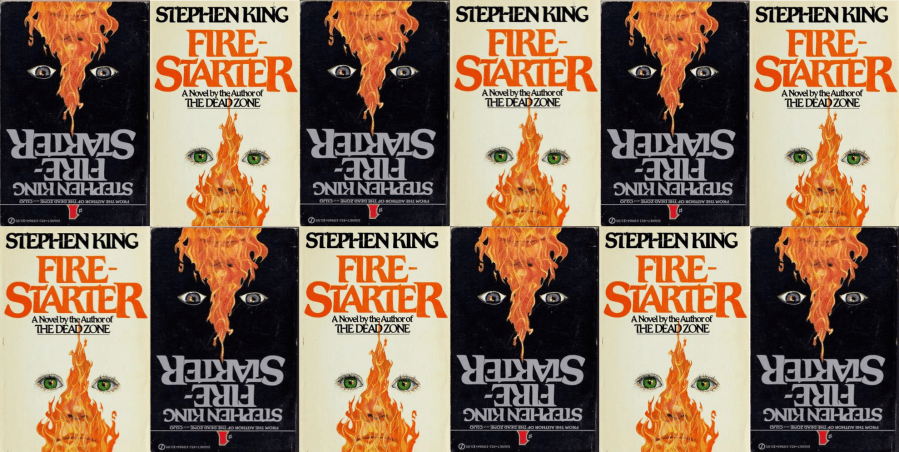


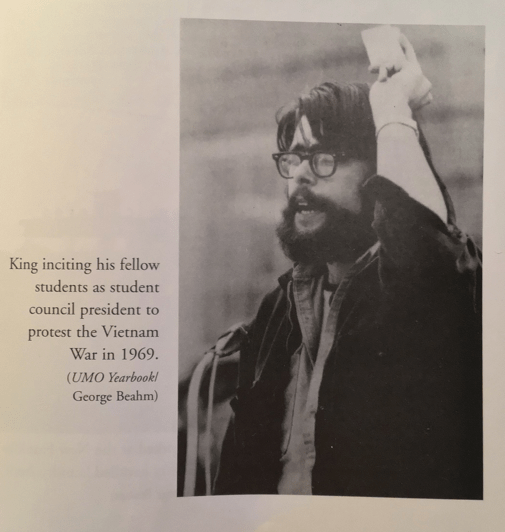
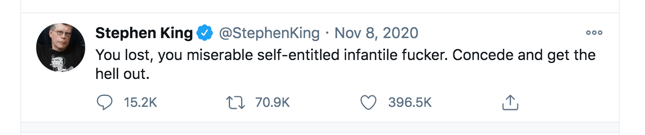
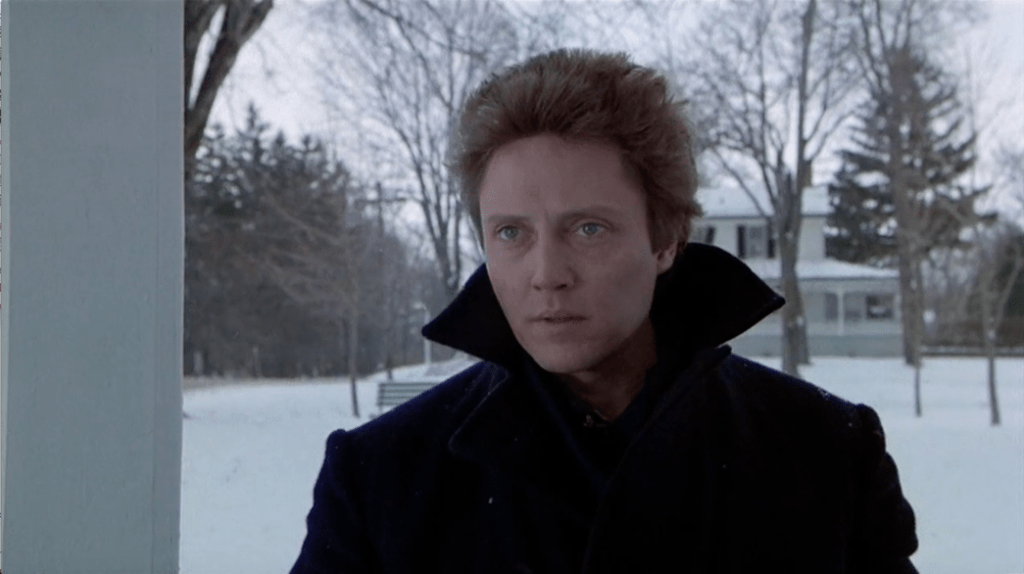
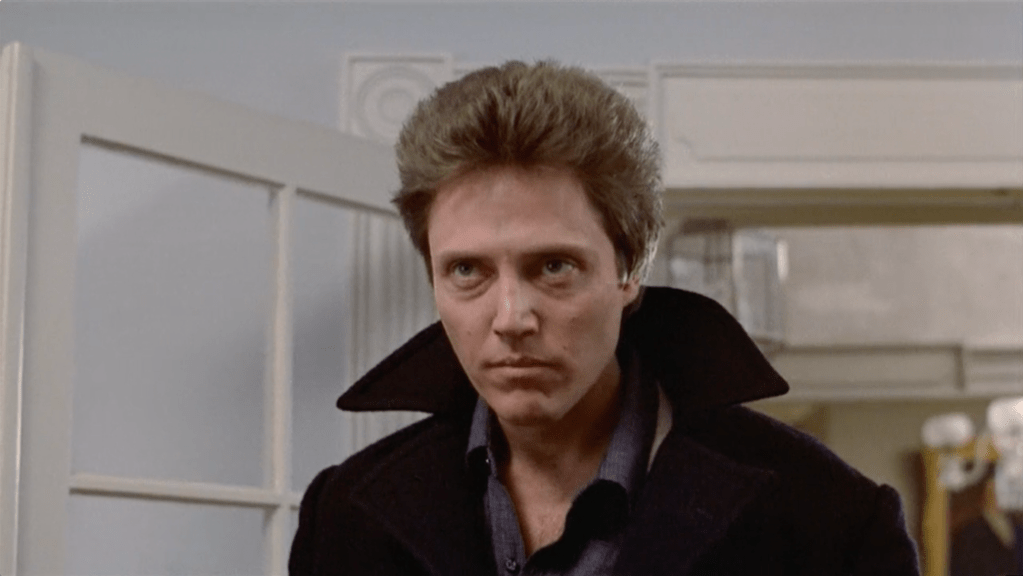
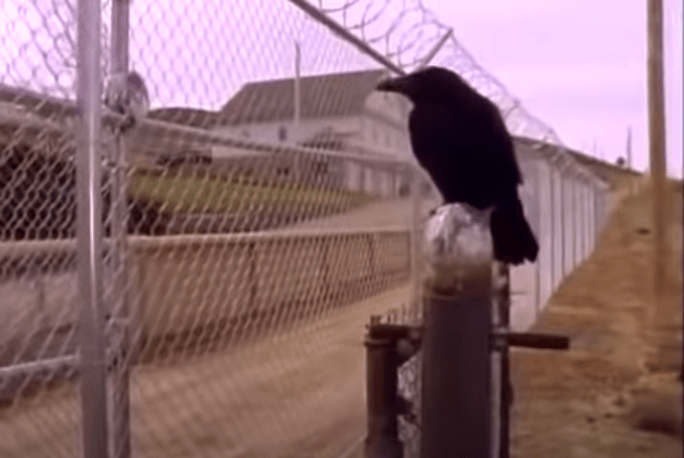

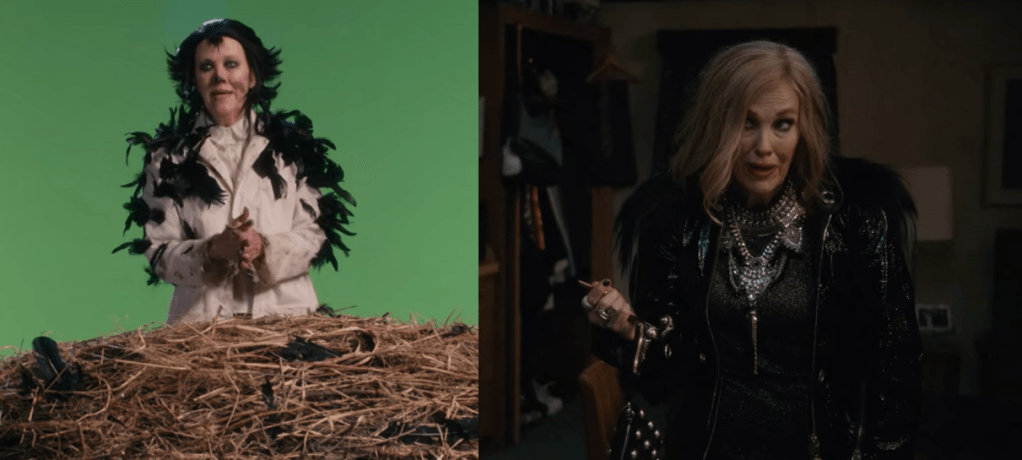
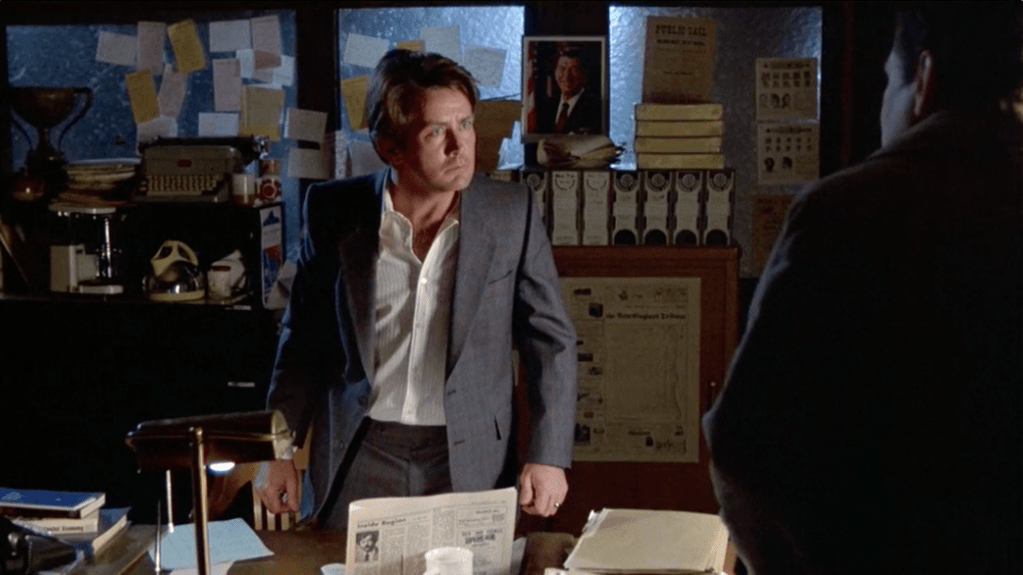
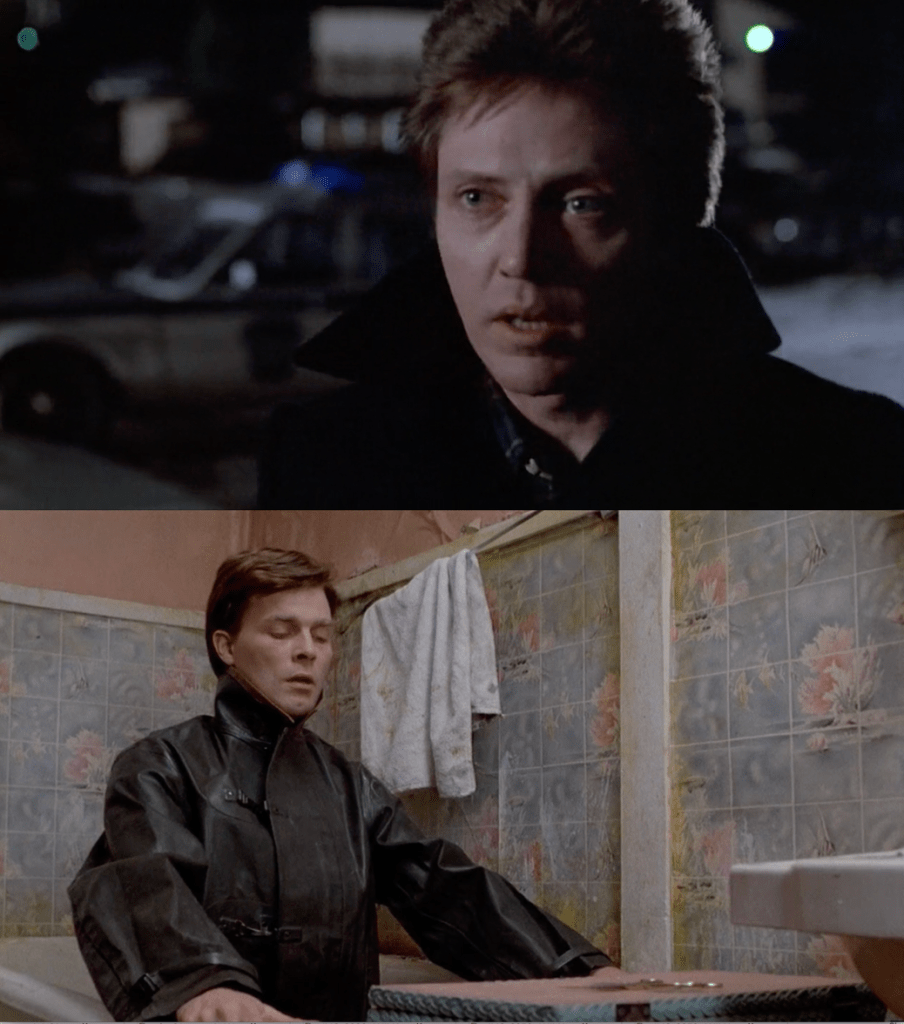
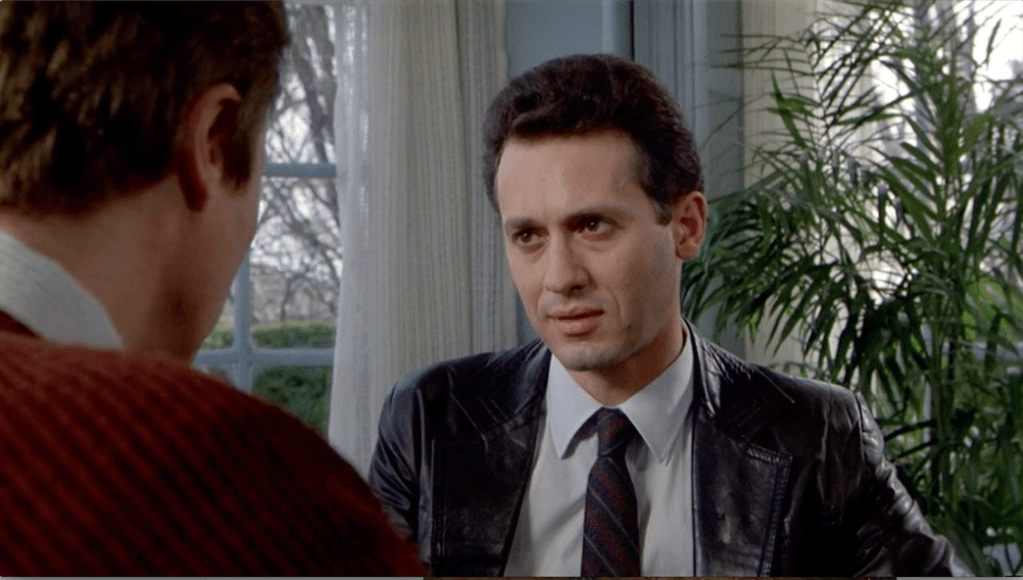
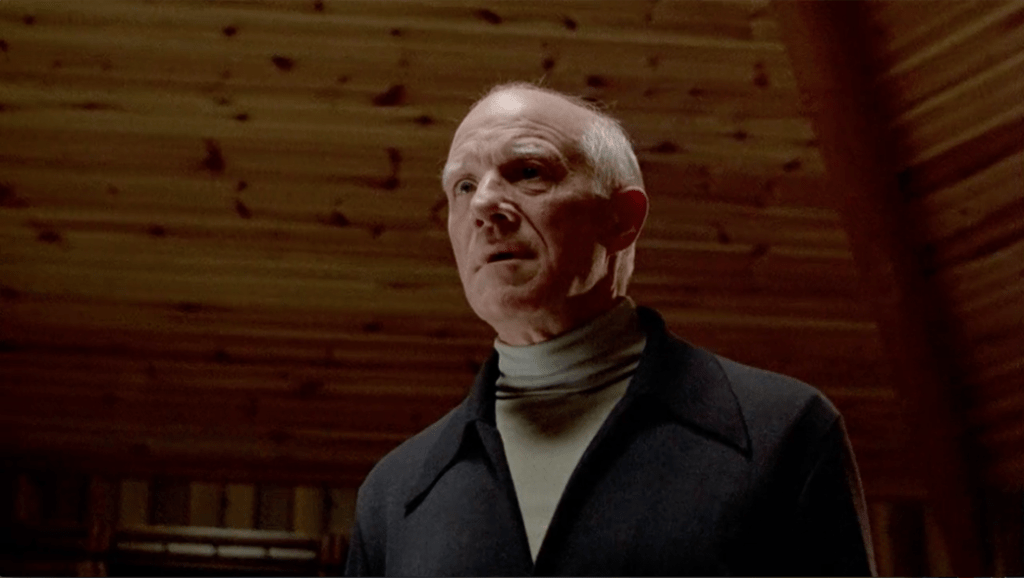
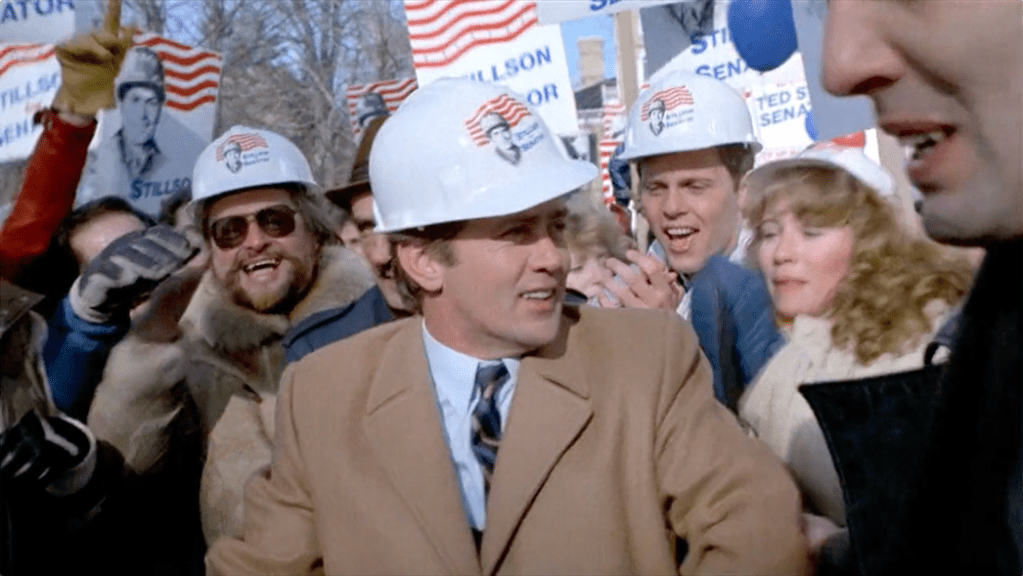
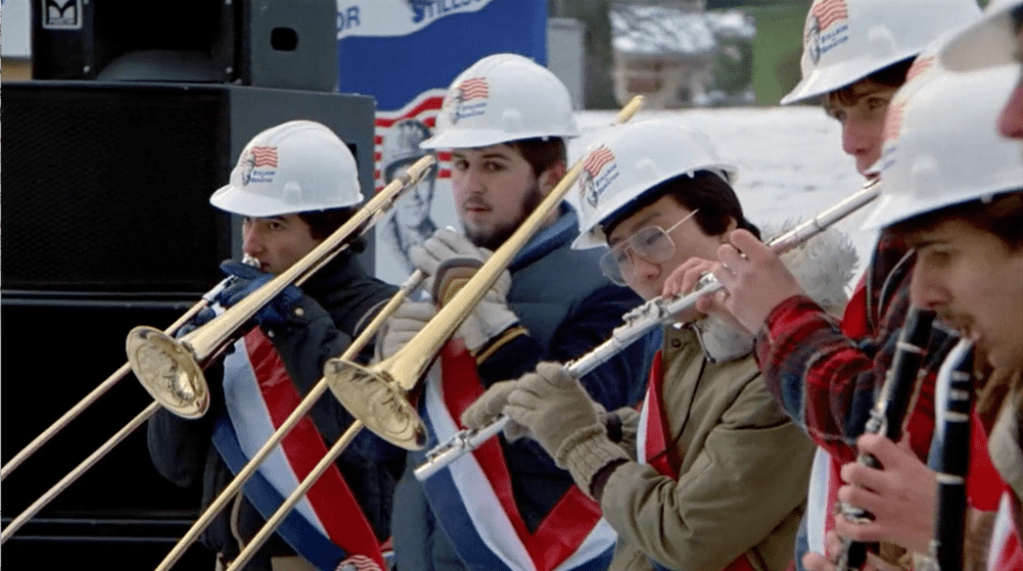
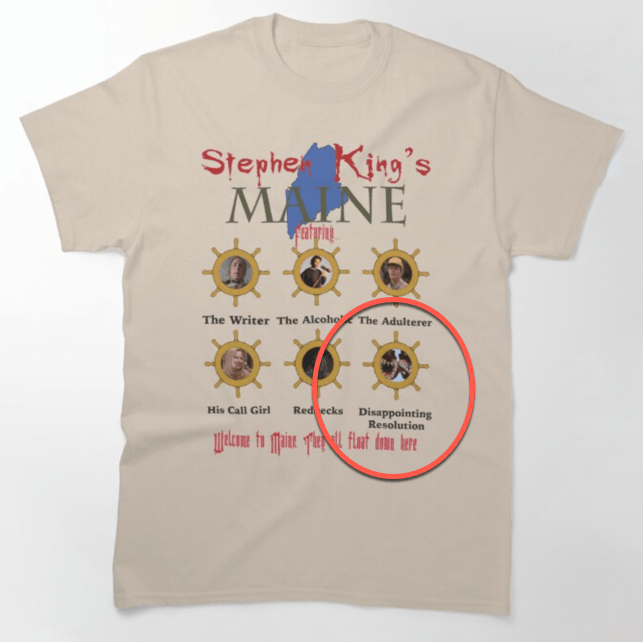
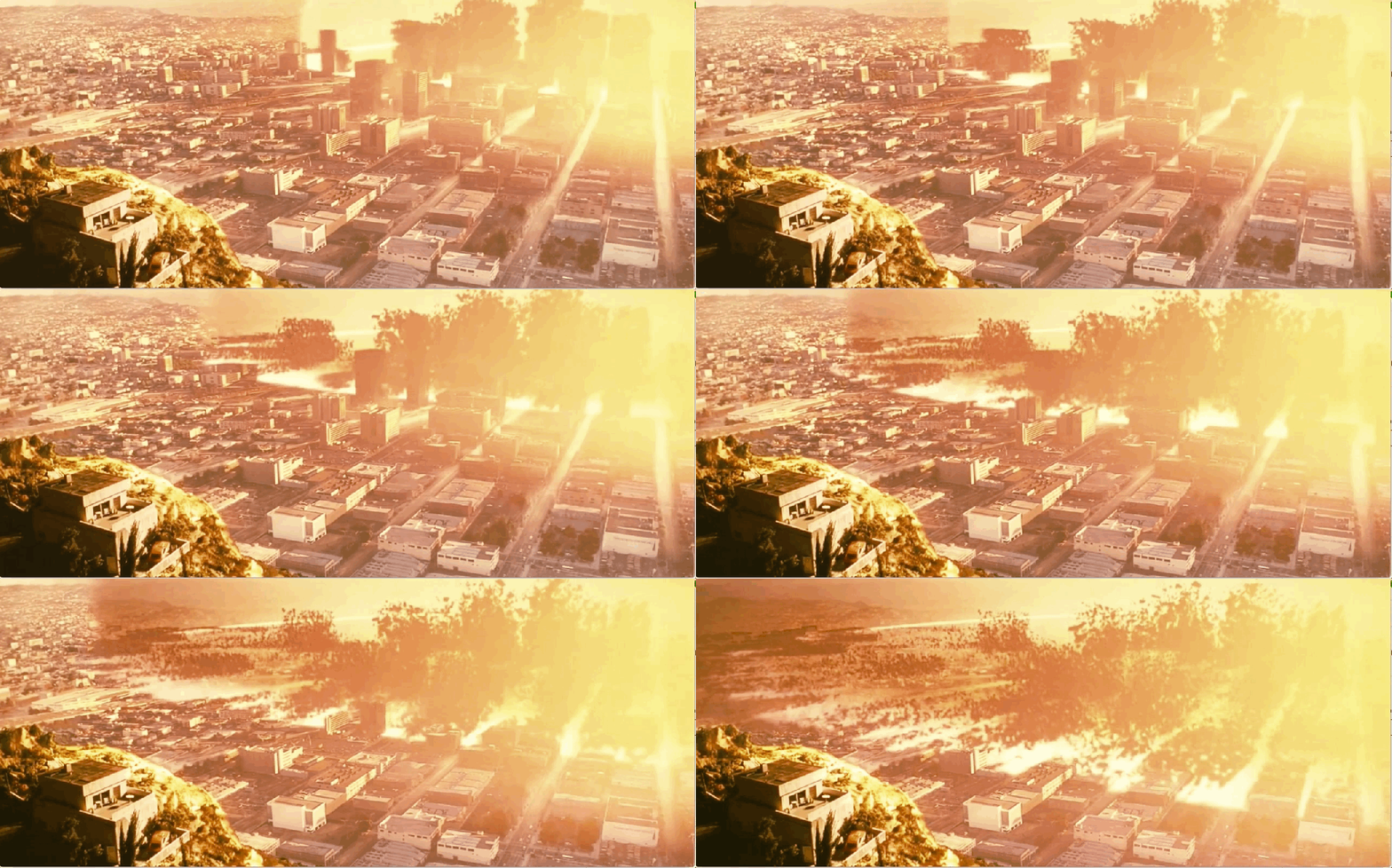
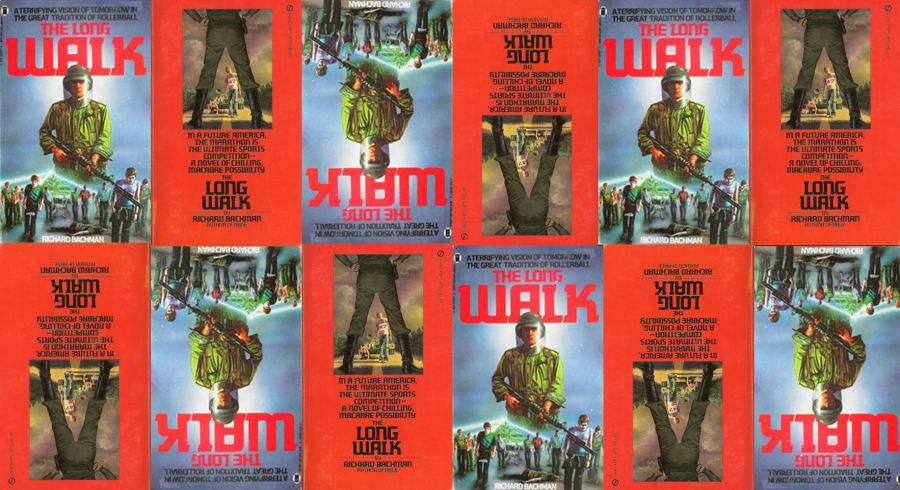

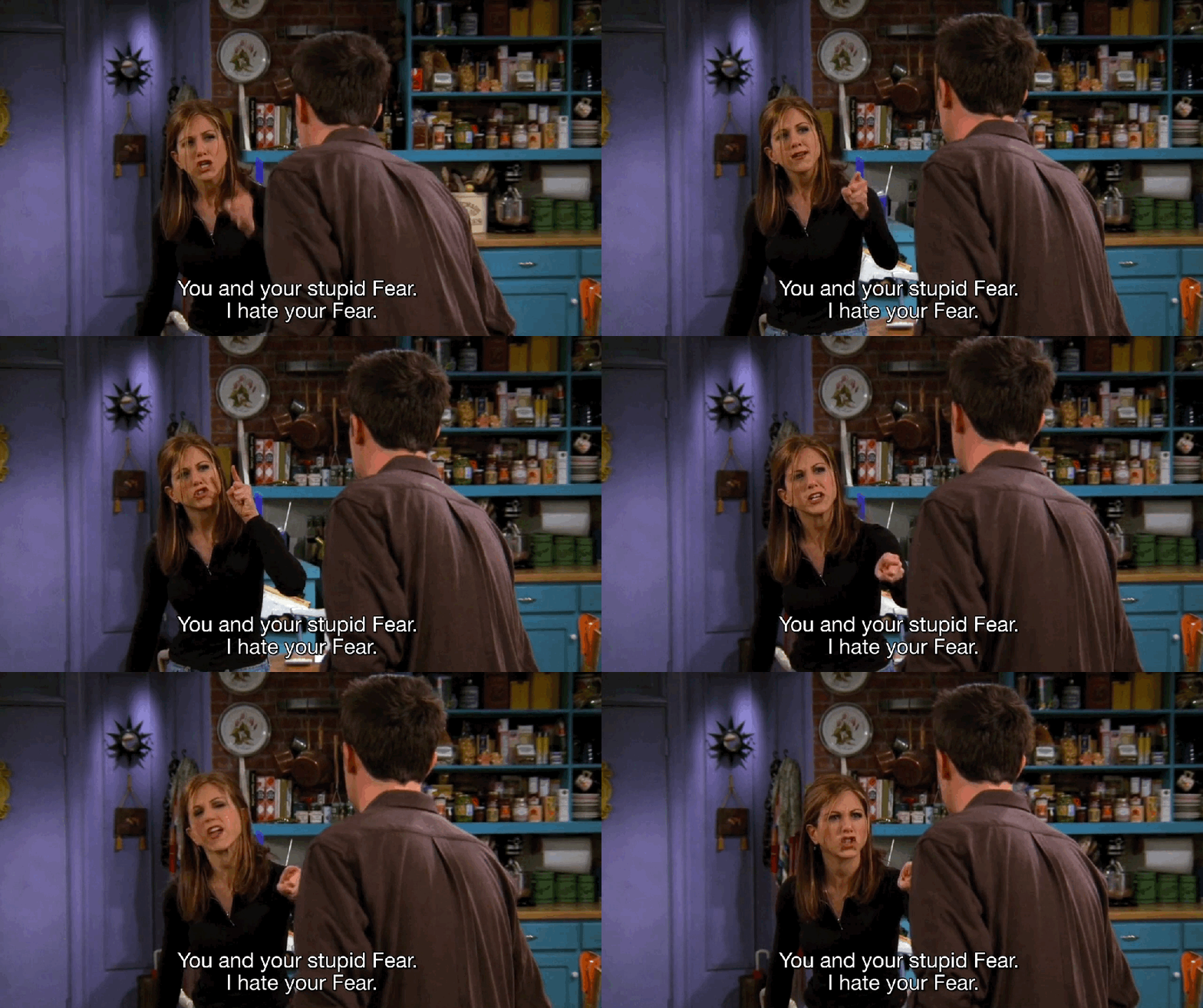
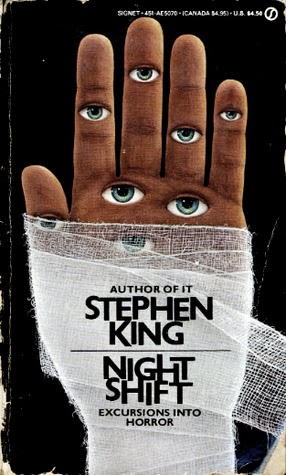
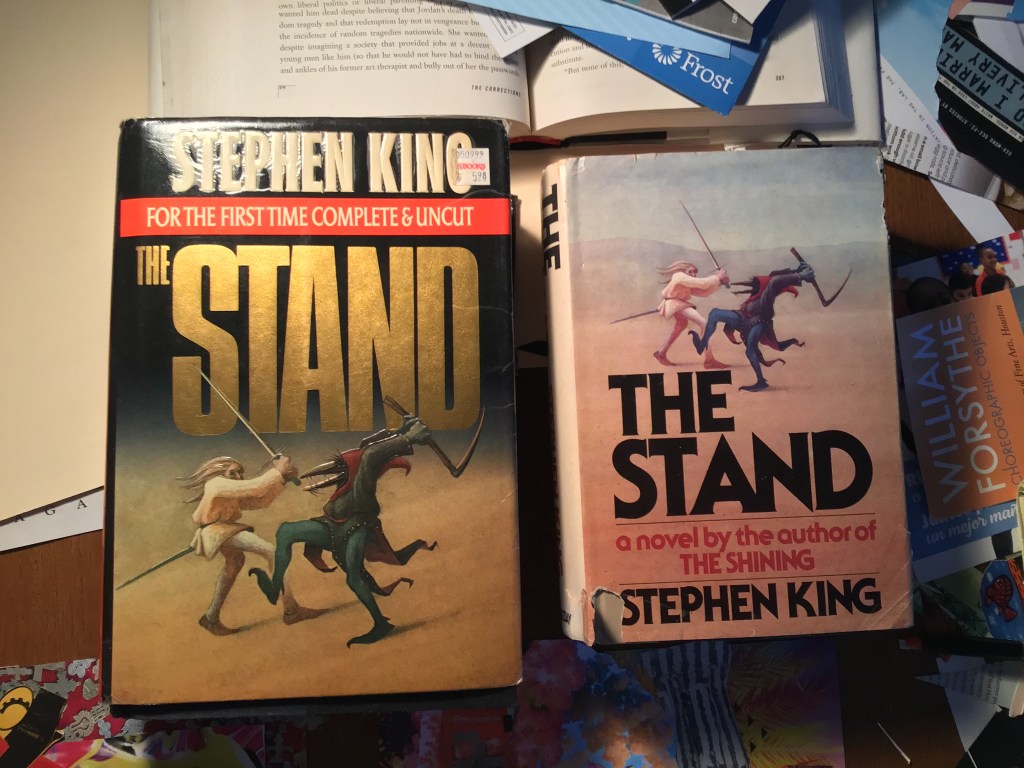

 Long Live The King