The Running Man for President

It was a vast stage without scenery, inviting him to run across, easily seen in the blazing illumination, easily caught, easily shot down.

The Seashell hummed in his ear.

“. . . watch for a man running . . . watch for the running man . . . watch for a man alone, on foot . . . watch . . .”

RAY BRADBURY, FAHRENHEIT 451. 1953.

Published in 1982, The Running Man is Stephen King’s fourth novel written under his pseudonym Richard Bachman; it will be the next Bachman novel, Thinner in 1985, that will enable the reading public to identify Bachman as King.

Summary

In the year 2025, Ben and Sheila Richards are living in a Development apartment in Co-Op City, and their infant daughter Cathy is sick. Recently, Ben has been watching the game shows on the “Free-Vee” obsessively, and now he leaves to go to the network building to apply to be on one of these shows to get some money to treat Cathy. At the Games Building, he’s put through a lot of tests and is chosen for a show called The Running Man; we learn he’s chosen for this for the same reason he hasn’t been able to get steady work in recent years and has been living in poverty: he’s “‘regarded as antiauthoritarian and antisocial’” based on insubordinate interactions with previous work superiors. An executive named Killian explains the show’s rules: Richards will be on the run and if the show’s “hunters” don’t capture him in thirty days, he’ll get a billion dollars. Richards has to mail in regular recordings of himself to air on the show; Killian claims they won’t use these to trace his whereabouts while also noting Richards is generally being set up to fail (no one has ever won the billion dollars). 

Richards is brought on the show and sees that both his own and his wife’s photos that the show airs have been doctored to make them look worse than they are. Then he’s let loose from the building and goes to a connection from his neighborhood who can get him some fake identification papers; he makes it to NYC and then Boston, where he stays in a YMCA. After he sends his first tape recording to the network, he suspects hunters are trailing him and narrowly escapes through a tunnel after blowing up an oil tank in the YMCA’s basement. When Richards emerges from a manhole after this close call, he’s seen by a 7-year-old whom he pays to go get his older brother, who’s connected to a gang who can help him. The brother, Bradley, brings Richards home (while there he’s able to watch an installment of The Running Man and Richards sees they’re also doctoring the recordings he’s sending in); Bradley gets him out of Boston by hiding him in the trunk of his car and he–again narrowly–escapes being discovered during a road-block traffic stop. Bradley procures Richards a car and Richards poses as a priest in the town of Manchester, then goes to find a connection of Bradley’s named Elton Parrakis; the pair bonded over researching the true damage of the rampant pollution and how deaths from cancer are being covered up. Elton’s mother ends up calling the police after recognizing Richards as the Running Man, and when Elton tries to help him escape they end up in a car chase with the police. A police cruiser bumper breaks Richards’ ankle and he gets shot in the arm, but he shoots at the cruiser and it crashes and they escape with Elton, fatally injured, driving the car off and leaving Richards at an abandoned construction site. 

The next day Richards crutches to a town and convinces a boy to mail in his tape clips for him. Then, at a Stop sign, he hijacks a car driven by a lone woman named Amelia Williams, and directs her to drive to a jetport in Derry 150 miles away. After the police shoot at them without any concern about potentially killing Amelia, Richards calls the media to ensure there are cameras broadcasting from there by the time they arrive at the jetport. Having convinced Amelia that the Network has manipulated things and that he’s not really the bad guy, he tells her when she leaves the car that she needs to tell the police he has dynamite on him, when really he’s just got her clutch purse in his pocket and is bluffing. She claims she can’t do it, but when she’s gone and the cops don’t shoot him he figures she did lie to them about the dynamite. The cops honor his demand for a plane with a crew, which he boards, demanding Amelia’s presence on the plane as well. He meets the show’s head hunter Evan McCone, who also gets on the plane and who notes that Richards has broken the record for the contestant who’s lasted the longest on the show. Once they’re in the air, flying low over populated areas so cops won’t blow up the plane, Killian the Network executive speaks to Richards on a monitor and tells him that Sheila and Cathy were stabbed to death days ago by intruders, and that they want to fake his death and have him join their side as a hunter (an offer that enrages McCone). Richards agrees, but then knocks out one of his guards with a coffeepot and shoots the pilots, and he and McCone end up shooting each other. Dying with his intestines hanging out, Richards flies the plane into the Network’s Games Building. 

The End.

Different Races

As for plot and pacing, each chapter being headed with a countdown “…Minus [x] and Counting…” might seem hackneyed (the starting at “100” for the countdown is technically arbitrary) but is actually a fairly simple and effective trick to create tension, like the timer ticking down on a bomb, which is appropriate here since the arc in fact culminates in an explosion. The basic framework of the structure, the arc of Richards’ “running,” is provided by the characters who move him through three primary phases of his journey that entail a literal geographic transfer, and these would be 1) Bradley, 2) Parrakis, and 3) Amelia.

Probably three factors the most worthy of discussion here are: the similarities to the previous Bachman novels, particularly The Long Walk and Roadwork, the dystopic treatment of the year 2025 including creepy foreshadowing of 9/11, and the text’s blatant racism.

Of course these factors are all interrelated to different degrees. The main Roadwork connection to me is that the alienation and fate of Ben Richards is the same as Roadwork’s Barton Dawes but on a larger scale; Dawes’ suffering is more localized and private, and we end with him blowing up his own house. Richards gets to run all over the place–and in general his victimization by the system is probably more sympathetic than Dawes–and he also will die in an explosion at the end, but one that will take a lot more people out (house v. building). Since Richards is competing in a contest for spectator/consumer pleasure, this effectively makes this novel a hybrid of The Long Walk and Roadwork.

Roadwork is explicitly tagged a novel of the Energy Crisis and is set during that period in the 1970s; The Running Man purports to be set in 2025 but is equally obsessed with this 70s Energy Crisis period, though not in a way that really dates it per se since climate change, obviously, has only gotten worse. (We don’t seem to be at the advent of “air cars” even if that’s exactly where we should be.) The novel is freakishly prescient in some ways, the state coverup of pollution’s link to cancer and the general extremity of the environmental situation reminiscent of Exxon covering up direct evidence of climate change back in the 80s…

The primary freakishly prescient element is probably how the narrative heralds the era of reality television, and more than that, the connection between 9/11 as a staged production and this era, as the terrorists’ awareness of the power of the televised images of the disaster influenced their planning:

It is not a hidden truth that some violent and self-destructive people crave an audience. Broadcast television birthed the theatre of media-age terrorism half a century ago. Khalid Sheikh Mohammed imagined the September 11th attacks as a reality-television producer would—their political power was inseparable in his thinking from the fact that the images would be shown over and over on television. Since then, digital technology has democratized broadcast production—lowered the barriers to entry, as economists would put it. Even the Taliban, which banned cameras and music in its initial phase, now produces and distributes snuff videos of its guerrilla and suicide attacks. If it weren’t for digital production and its potential for worldwide distribution on social media, the Islamic State might be of marginal concern outside of the Arab world.

From here.

(I’m so behind on writing about my King reading that I actually started my re-read of this novel to start writing about it on…9/11/21.) This Bachman novel also reminds me of the first one, Rage, and that novel’s influence on gun violence in schools, so direct in that case that King had it pulled from publication because school shooters had copies of it in their locker…one wonders if certain terrorists might have had copies of The Running Man in their knapsacks…though I will say about this plot development that while it is, on the surface, extremely satisfying for Richards to take out these network assholes with him, the feasibility of his managing to execute this feat is more than a little hard to buy–the plane having been on autopilot for most of the flight, it’s unclear how Richards would really be able to direct it toward such a specific target. Yet it “works” because we’re satisfied by Richards weaponizing that which was weaponized against him to take out the ones who weaponized it. (What doesn’t really work is that it seems we’re ultimately to believe it’s true that Richards’ wife and daughter, whom he is doing the game (and thus the entire book) for in the first place, were killed by excessive stabbing in a random break-in that is apparently unconnected to his being a contestant on the famous show, when it seems like their connection to him from the show is exactly what should have been the reason for their murder: thus the effort to save them would be responsible for killing them.)

It also seems important to note that in this scenario, you the reader are rooting for the figure who is plowing the plane into the building! The network honchos are depicted as essentially selling an image to the public of Richards-as-terrorist (they do this even more blatantly in the 1987 film adaptation). This reminded me of narrative themes related to my experience of going to see the musical Wicked (pre-Covid):

For me, having to shove through the morass of Times Square on a December Saturday afternoon in order to get to the theater where Wicked was playing provided another layer of thematic development. Being stuck in a horde of people when one is running late to get somewhere does not make one think the best of one’s fellow woman. I can’t even remember now if it was me or the friend I was with who joked about understanding why someone (i.e. terrorists) would want to blow up all of this shit-show sea of people being blasted by the seizure-inducing flashing lights of gigantic advertisements. We conceded it was probably not a good idea to make that joke too loudly. It all made me think of the good v. evil narrative that the Bush administration propagated after 9/11. It was easy to think of the terrorists as evil, harder to try to understand that perhaps there could have been reasons they did what they did other than just being pure evil, reasons that had to do with things America had done. A whole other post could be written about how Elphaba’s trajectory in Wicked dovetails with America’s surrounding 9/11, if you consider her character arc of becoming as bad as those she was fighting against (going to the “dark side” as exemplified in Abu Ghraib). It’s interesting that the musical version (the novel having been published pre-9/11) was launched in ’03, when the good-v-evil narrative was being propagated so intensely in the buildup to the invasion of Iraq.

From here.

Per the outcome of The Running Man, Richards, by flying the plane into the Games building, patently avoids becoming as bad as those he was fighting against when his doing so is figured as a blatant rejection of the offer to join the Games team as a hunter.

The reality-television era is marked by 9/11 but also the advent of Trump, who many argue would never have become President without the platform of The Apprentice. The creepiness of this connection is only accentuated by a promotional tag line that initiates the text:

In the year 2025, the best men don’t run for president, they run for their lives….

It’s the president of the television network who’s the one with power (and thus evil) in The Running Man, but both the Trump connection and the fact that actor-turned-governor Arnold Schwarzenegger plays Richards in the 1987 film adaptation AND that pro-wrestler-turned-actor-turned governor Jesse “The Body” Ventura plays Captain Freedom (a character that’s not in the book) lends seemingly unintended–despite the tag line–resonance to the descriptor “running”: politicians, or political candidates, “run,” and do so in a way that’s explicitly produced for media imagery and consumption. Not that the text doesn’t point out the connection between politics, media, and manipulation at the center of this game show:

“It’ll work. I think. There will be a dozen free-lance cameramen around in no time, hoping to get some Games money or even the Zapruder Award itself. With that kind of publicity, they’ll have to play it straight.”

Richard Bachman. The Running Man. 1982.

This implicitly highlights the irony of the infamous footage of the JFK assassination (footage…shot by Matthew Zapruder), with JFK’s success as a politician often attributed to the advent and prominence of televised imagery.

If you’re running, you’re in a “race,” connecting the political themes to the novel’s appalling racism, made more appalling by the fact that the novel purports to be set in 2025, rendering the regular use of the term “Negro” (in a non-slur context) that much more grating. Grating as well is the use of slurs intended to depict that the era (but not the author!) is still racist (“darkie,” “pickaninnies”). This novel definitely has more black characters than previous Bachmans and possibly any King novel up to this point between Bradley and Killian the executive, but possibly the most appalling (I will keep using this word) is a nameless boy with a grievance:

When Richards walked into the lobby, the desk clerk was arguing with a tiny, scruffly black boy in a killball jersey so big that it reached down over his blue jeans to midshin. The disputed territory seemed to be a gum machine that stood inside the lobby door.

“I loss my nickel, honky. I loss my muh-fuhn nickel!”

The boy kicked the plaxteel post of the gum machine, then ran. “Muh-fuhn white honky sum bitch!”

Richard Bachman. The Running Man. 1982.

“Scruffly”? “Honky”?? (I am wondering if “scruffly” here is a typo in my e-book since “scruffy” is used elsewhere.) Here is evidence that the text is racist rather than the times the text is trying to depict; in typical King fashion, you can sense the author trying to depict the times as racist at certain…times, while at others it’s just confusing, as when Richards is being tested for the games with ink blots and responds to one by designating it not “Negro,” but the N-word–the text is fairly opaque about whether Richards might be messing with his ostensible captors…he also does use the word “Negro” to describe one of the ink blots–“‘Two Negro women. Kissing.'”–offering a conflation of my two favorite problematic threads through King’s work, racism and homophobia. The latter takes a backseat to the former in general in this novel, but the treatment of both work together to reinforce the utter failure of the text to transcend 1975 in what’s supposed to be a depiction of 2025:

“I didn’t mean to mouth off,” he said unwillingly. Richards thought he could peg him. Well-off young men with a lot of free time often spent much of it roaming the shabby pleasure areas of the big cities, roaming in well-heeled packs, sometimes on foot, more often on choppers. They were queer-stompers. Queers, of course, had to be eradicated. Save our bathrooms for democracy. They rarely ventured beyond the twilight pleasure areas into the full darkness of the ghettos. When they did, they got the shit kicked out of them.

Richard Bachman. The Running Man. 1982.

You can see the authorial effort to depict the times rather than the text/Richards as racist and homophobic when the “bad guys” at the network who function as our protagonist-Richards’ captors and tormentors voice a parallel between our protagonist’s defining heroic-protagonist trait and racism and homophobia:

“In short, you are regarded as antiauthoritarian and antisocial. You’re a deviate who has been intelligent enough to stay out of prison and serious trouble with the government, and you’re not hooked on anything. A staff psychologist reports you saw lesbians, excrement, and a pollutive gas vehicle in various inkblots.”

Richard Bachman. The Running Man. 1982.

I’m confused by the use of the verb “deviate” for what seems intended to mean the noun “deviant” in this context, and this confusion is an apt representation of that generated by the racism King-Bachman exhibits specifically via his efforts to not be racist: I can see that you meant “deviant” (i.e., to not be racist) but that’s not what you’ve put in the version of your actual text…and not not being racist means…

For more context on/evidence of The Running Man‘s inadvertent racism–or potentially the racism masquerading, or attempting to masquerade, as its opposite–we can look at the depictions of the two primary black characters, Bradley and Killian. Bradley represents a more general problem with the characterization of Richards in that we see he exists only to characterize Richards rather than as a character in his own right. My bigger problem with this use of Bradley is that through it Richards is characterized as what might be designated “Black in spirit” (kind of like the “first Black president” designation for Bill Clinton)–Bradley and Bradley’s family are moved to help Richards because he is an impoverished, alienated, marginalized specimen in this society, as are they. Richards is in a sense sociopolitically Black, and if a version of this game show did exist, it seems very possible that targeted demographics might be more likely to root for a black man to be hunted down and killed rather than a white one–probably this is the real horror of this dystopian futuristic premise for King, the prospect of mainstream America cheering for the white man’s death.

So Bradley is willing to put himself at risk, to essentially sacrifice himself for Richards (it is he who delivers Richards a priest costume, no less), to fight for the greater cause against their shared oppressors. This characterization becomes more revealing juxtaposed with the next party willing to help Richards, Bradley’s white friend via correspondence, Parrakis (who is overweight and evoked with some fairly fat-phobic descriptions). The rising-action escalation in this stage of Richards’ journey, requiring a complication to up the stakes, necessarily implicates race: the police are called because someone is not willing to sacrifice herself to help Richards, and that would be Parrakis’ white mother–she is patently unwilling to help the pseudo-Black Richards–not just unwilling to help/sacrifice, but attempting to actively deter him.

Killian has somewhat similar but different or possibly inverted versions of this problem in that he’s a Black character with status and power–a network executive–but, he’s evil, so this creates and undertone–or really overtone–of horror in the Black man in a position of power using that power against the white man, even if that man is pseudo-black.

Killian is introduced in the text thus:

The man behind the desk was of middle height and very black. So black, in fact, that for a moment Richards was struck with unreality. He might have stepped out of a minstrel show.

Richard Bachman. The Running Man. 1982.

Last semester, when I was teaching an elective on horror at an arts high school in which we read Carrie, one student asked how similar Carrie was to the rest of King’s work, if you’d be able to tell it was him writing it if you didn’t know–a question equally pertinent to King’s work as his alter ego Richard Bachman. To my mind, though some say Carrie is different than King’s other books, the primary giveaway/marker of King’s touch in his debut novel would be the parenthetical references to intruding/subconscious thoughts. But there’s actually another giveaway in connection with the above Running Man passage, and that is invoking comparisons to “minstrel” shows, which Carrie does twice. I was appalled to see this comparison appear in a King book as late as 1999–appearing in the point of view of the nine-year-old girl protagonist of The Girl Who Loved Tom Gordon–and probably to later works I haven’t gotten to yet…

To me, The Running Man reinforces that the connective tissue of the Bachman novels is that of a white male protagonist rendered pseudo-Other in his victimization by a larger system, underwritten by the horror of the idea that a white male could be the victim. As much as the original film adaptation diverged from its source material, it retained this fundamental core, and I don’t mean to sound too cynical when I don’t hold out much hope that the latest reboot will represent much progress on this front…

-SCR

Roadwork…Doesn’t Always Work (Part II): The White Man’s Worldview

I’m on the highway to hell.

“Highway to Hell,” AC/DC, 1979.

Roadwork unfolds in a neat three-part structure comprised of November, December, and January, respectively, with narrative momentum established by movement toward a clear deadline–January 20, 1974, the date Barton Dawes is supposed to be out of his house. That the three-month structure straddles the transition from 1973 to 1974 is significant due to the centrality of Watergate in my reading of King’s oeuvre’s depiction of our haunted American history: Nixon resigns in August of ’74. Roadwork‘s resident Nixon reference appears thus:

The house was hot. He had turned the thermostat to seventy-eight degrees and had left it there ever since Mary left. What energy crisis? Fuck you, Dick. Also the horse you rode in on. Fuck Checkers, too.

Is the extravagant consumption Dawes displays here to be taken as a heroic stand for individualism, or, conversely, emblematic of the problematic national penchant to preserve individual rights that led to this period’s “energy crisis” in the first place, or some combination thereof? Here Dawes conceives of the extravagance as a direct flouting of authority in the form of Nixon, still president in the timeline of the narrative, resigned-in-disgrace emblematic-King-villain outside of the text. The latter creates the possibility that opposition to this villainous figure renders Dawes the “good guy,” figuring the extravagant consumption here as more explicitly heroic, and thus condoning it, which would be a problem. This is another one of those instances where it seems like the exact device King-as-Bachman is deploying in order to generate sympathy for Dawes’ character instead makes me hate him.

Train the Dog

My first Roadwork post discussed how this lack of sympathy for Dawes largely manifests by way of the failure of the device of his son Charlie deployed on this front. Part of the reason the Charlie fails to generate sympathy is because his lack of development is highlighted by a stark contrast: there is much more emotional development and detail prevalent in the backstory surrounding the Dawes’ television. In this flashback sequence, both Dawes and his wife get side jobs to be able to buy a color one, which, when they do, leads to sex, creating a counterpoint to Charlie, a byproduct of sex, that might figure television as a hedonistic detriment to society rather than something more conducive to a fruitful continuation of our species….

The structure the television provides for plot, a linking of past and present, occurs when Dawes smashes the television near the height of his self-destructive (or system-inducing self-destruction) spiral, a gesture whose ultimate significance is hard to read in light of Dawes’ almost immediate regret for doing so. Is King-as-Bachman advocating for taking concrete action to escape television’s insidious influence? Is it ultimately figured as a helpful escape from Dawes’ tortured senseless plight of having to move to a new house, or does it play a more insidious role in his paralyzed stasis? It seems ironic that King would indict television on any level seeing the extent of the influence visual media has had on him (not to mention the success he has had in it, though perhaps not quite as much at the time he wrote Roadwork), but… maybe it’s a Freudian form of the father he needs to kill.

We basically see Dawes see the world through the lens of (television) advertisements, and how this impacts/ connects to real-life actions:

“Try one of these,” Harry said, and took a roll of pills from his breast pocket. Written on the outside was:

ROLAIDS

“Thanks,” he said. He took one off the top and popped it into his mouth, never minding the bit of lint on it. Look at me, I’m in a TV commercial. Consumes forty-seven times its own weight in excess stomach acid.

and

They watched the news in silence for a while. A commercial for a cold medicine came on—two men whose heads had been turned into blocks of snot. When one of them took the cold pill, the gray-green cube that had been encasing his head fell off in large lumps.

“Your cold sounds better tonight,” he said.

and

He masturbated instead, in front of the TV, and came to climax while an announcer was showing incontrovertibly that Anacin hit and held the highest pain-relief level of any brand.

It seems like you can track a pattern where we see Dawes increasingly isolated in each of these life-related-to-ad moments; in early ones he’s out interacting with people thinking of ads, then later he’s in front of the TV relating the ads he’s seeing to memories rather than directly experienced life in a reversal of the earlier moments. So when we get a theory Dawes advances to Olivia, it reads ironically in light of his own relationship to television and its attendant advertisements:

“The Trained Dog Ethic, first advanced by Barton George Dawes in late 1973, fully explains such mysteries as the monetary crisis, inflation, the Viet Nam war, and the current energy crisis. Let us take the energy crisis as an example. The American people are the trained dogs, trained in this case to love oil-guzzling toys. Cars, snowmobiles, large boats, dune buggies, motorcycles, minicycles, campers, and many, many more. In the years 1973 to 1980 we will be trained to hate energy toys. The American people love to be trained. Training makes them wag their tails. Use energy. Don’t use energy. Go pee on the newspaper. I don’t object to saving energy, I object to training.”

….

“Like Pavlov’s dogs,” he said. “They were trained to salivate at the sound of a bell. We’ve been trained to salivate when somebody shows us a Bombardier Skidoo with overdrive or a Zenith color TV with a motorized antenna. I have one of those at my house. The TV has a Space Command gadget. You can sit in your chair and change the channels, hike the volume or lower it, turn it on or off. I stuck the gadget in my mouth once and pushed the on button and the TV came right on. The signal went right through my brain and still did the job. Technology is wonderful.”

I’m definitely conditioned to a disturbing degree by the sound of my work email notification…at any rate, Dawes’ constant mental references to advertisements show us he is as trained in the Pavlovian manner by technology in the form of television as the “American people” he so disdainfully describes, which might be especially emphasized in this ad reference:

Before he had a chance to say what, there was a commercial for Gravy Train. The man in the commercial was saying that Gravy Train, when mixed with warm water, made its own gravy. He asked the audience if it didn’t look just like beef stew. To Barton George Dawes it looked just like a loose bowel movement that somebody had done in a red dog dish.

Dawes’ Pavlovian training seems to ultimately reveal itself in a sequence out in the “real world” when he sees a woman in the grocery store drop dead:

He was on his way down a middle aisle toward the checkouts when God perhaps spoke to him. There was a woman in front of him…. She made a funny gobbling, crowing noise in her throat and staggered. The squeeze bottle of mustard she had been holding in her hand fell to the floor and rolled, showing a red pennant and the word FRENCH’S over and over again.

“Ma’am?” he ventured. “Are you okay?”

The woman fell backward and her left hand, which she had put up to steady herself, swept a score of coffee cans onto the floor. Each can said:

MAXWELL HOUSE Good To The Very Last Drop.

After a nearby doctor establishes this woman has died of a brain hemorrhage, the scene ends with:

His calm of the last five days was shattered, and probably for good. Had there ever been a clearer omen? Surely not. But what did it mean? What?

It means Dawes thinks a woman’s death has more significance as a sign for him than it means for her. The brand names prevalent in the surrounding descriptions of this death seem to heighten its horror via juxtaposition/contrast with the ordinary/mundane, but the prevalent presence of objects reinforces the woman’s usage as an object to be read as a sign of relevance for Dawes. Which would seem illustrative of a type of thinking King has a female character explicate in a much later story, “Mr. Harrigan’s Phone,” from his 2020 novella collection If It Bleeds:

“Kids your age have a Ptolemaic view of the universe. I’m young enough to remember.”

“I don’t know what—”

“Ptolemy was a Roman mathematician and astrologer who believed the earth was the center of the universe, a stillpoint everything else revolved around. Children believe their entire worlds revolve around them. That sense of being at the center of everything usually starts to fade by the time you’re twenty or so, but you’re a long way from that.”

It’s telling that in 2020 King is citing children as the most vulnerable to this worldview, when it seems equally applicable to the willful blindness of the white patriarchy, a system designed to revolve around a particular demographic that perpetuates its own worldview (ie that of its own inherent supremacy) as “normal.” When you are inherently supreme, everyone else exists for your benefit, as the woman in the store does for Dawes. The text seems conscious to a degree that Dawes doing this is not exactly the most stable thing to do, that he is a “trained dog” as it were, trained to read all surrounding signs and symbols for their relevance to him. But it seems ironic that, per Matthew Salesses’ ideas I discussed in my first Firestarter post, this is a problem the text itself is perpetuating, training the audience/culture to read all signs for their relevance to…the white man. If Dawes is a “trained dog,” this is another way he is a victim of the systemic injustices of the systems designed to revolve around the white men…a victim of the self-centered conceptual framework that advertising cultivates, even more so when that self is a white man.

(Olivia as a character also amounts to little more than a plot device; sleeping with Dawes for no other apparent reason except his initial refusal to do so, she–or more specifically, his sleeping with her–becomes a pawn the powers that be can blackmail Dawes with. Mary as a female figure doesn’t fare much better.)

Advertising itself ends up affecting the plot more directly when, after Magliore won’t sell him explosives, Dawes hears a PSA about not taking gas home from the gas station because it’s explosive, which then inspires him to use it for homemade molotov-cocktail-style explosives (another Night Shift call back by way of “Trucks”) to vandalize the roadwork site. But this vandalism is ultimately ineffective, foreshadowing the climactic gun-and-car-battery sequence. As this final part unfolds, Dawes’ visual-text trained-dog associations shift from ads to movies:

When the first police car screamed around the corner in a calculated racing drift like something out of The French Connection he was ready.

and

“You know what, fellow? You’ve seen too many movies.”

“I don’t go to the movies much anymore. I did see The Exorcist, thought. I wish I hadn’t. How are your movie guys coming out there?”

and

“You’ll never take me alive!” he yelled, delirious with joy. “You’re the dirty rats who shot my kid brother! I’ll see some of ya in hell before ya get me!”

These passages seem to reveal a pattern of escalation in their own right: internal reference, external interaction that then implicates media in the type of problematic influence we’ve seen the silver screen in Dawes’ living room having, and finally, Dawes literally performing something from a movie as if he is in it. A merging of worlds–but in his head. This is actually creepily starting to seem symbolic of King himself and the extent to which he is a prism of American literary and pop culture…

The treatment of the media here becomes interesting in light of the conclusion of Firestarter, which seems to valorize the freedom of the press pretty unequivocally. Roadwork‘s conclusion is more…equivocal. We’re told people will remember the image of Dawes’ exploding house as filmed by the media, and that the reporting got a Pulitzer for revealing the bad guy/monster is the system itself (in theory making Dawes’ death worthwhile or mean something)…but then people forget again…and nothing changes. It also seems worth noting that the media aspect frames the whole book via the prologue we get of Dawes meeting the reporter who will break his posthumous story–but whom Dawes also won’t remember, a possible symbol of how we don’t realize/recognize how much of what we see/know is “framed” by the media…and yet what the media seems to be revealing in Dawes’ case is how Dawes has in effect been “framed” as the bad guy in this narrative…so, mixed signals.

The Failure

King scholar Patrick McAleer notes a larger pattern that the futility of Dawes’ one-man stand against the larger system can be read into:

…the theory that King’s writing is purposely set up so that the characters fail, suggests that King, at least through his “dark half” Richard Bachman, focuses his writing on failure to criticize his peers: death may be a quite unfavorable climax to anticipate, but the beneficial cost and the moral purpose of, essentially, martyrdom is an ideal that King constantly revisits in order to remind the Boomers of what they abandoned and that their infamy remains alive and as a mark of shame when compared to the foolish and quixotic yet heroic, memorable, and perhaps admirable characters in the Bachman books.

Patrick McAleer, “I Have the Whole World in My Hands … Now What?: Power, Control, Responsibility and the Baby Boomers in Stephen King’s Fiction.” The Journal of Popular Culture, Vol. 44, No. 6, 2011, pp1221-1222

Dawes’ death serves to reveal a larger problem–the highway extension itself being an unnecessary and destructive product of bureaucratic budget acrobatics–but does little to solve it. I suppose this could qualify him as a “martyr,” but that he’s “admirable” would be a stretch for me.

McAleer’s charting of King’s representation of Boomer failures manifests primarily in the figures of Father Callahan from ‘Salem’s Lot, Louis Creed from Pet Sematary, Roland Deschain from The Dark Tower, and (somewhat confusingly since he doesn’t fit the generational profile) Paul Edgecomb in The Green Mile, to support the thesis that:

What King, then, seemingly aims to do through his fiction is to suggest that as many of his characters are placed within positions of power and are given numerous chances to remedy their respective situations, they often fail, and it is through this failure, despite the abundant opportunity to amend any potential wrongs, that King provides a layered discussion focused on a constant lamentation for himself and his generation—the Baby Boomers: a selection of people who were positioned to radically alter their social landscape and who reportedly had the necessary means to do so, yet failed to use the available resources, which were required to accomplish their ends and must now live with and face the constant reminders of their resonating and collective collapse.

Patrick McAleer, “I Have the Whole World in My Hands … Now What?: Power, Control, Responsibility and the Baby Boomers in Stephen King’s Fiction.” The Journal of Popular Culture, Vol. 44, No. 6, 2011, p1210.

Ouch. As a millennial, I can appreciate putting the onus back on the Boomers in a certain reversal…and reading Roadwork in 2020-21, the Boomers’ failures are nothing but amplified on the climate-change front. McAleer’s article as well, now a decade old, has attained new resonance in light of our recent election of yet another Boomer for president:

The real tensions of the new Administration, which began with a twenty-two-year-old old Black poet offering wisdom to a seventy-eight-year-old white President, are generational. Was American liberalism contingent on boomer optimism, and was that contingent on a once-in-human-history sequence of prosperity? There are plenty of ways to define Biden’s agenda, but one is that he is trying to apply a politics built on boomer optimism to an era in which that optimism has faded.

Benjamin Wallace-Wells, “The Conservative Case Against the Boomers,” January 28, 2021.

What McAleer does not seem to directly acknowledge is how King’s “lamentation for himself” included in his generational indictment can be applied to the failure of King’s work–with the “abundant opportunity” inherent in its massive mainstream platform–to provide more equitable representations of marginalized demographics, with two of his more prominent failures on this front being those of gay people and black people. As McAleer himself says, the Bachman books are as relevant as any in King’s oeuvre when it comes to discerning patterns, etc., in his work, and so can offer evidence of King’s problematic treatment of both the Queer presence and the Africanist presence.

In Roadwork, the latter seems more prominent, while the former manifests in Magliore’s use of the term “fruitcake” as a label for Dawes, which is apparently supposed to indicate craziness more than queerness–as in “Nutty as a fruitcake“–though it seems to encode queerness. Queerness also comes up indirectly in references to “coming out of the closet” applied to non-queer contexts, such as:

He had joined the mainstream of lunacy, he had come out of the closet.

This is doing double duty in terms of being offensive to non-“mainstream” demographics, conflating queer people and people with mental-health issues and thus implying there’s some kind of inherent connection between them. The other figurative closet invocation provides a springboard to the appearance of the Africanist presence:

“Are you really going to drink that down-by-de-Swanee-Ribber stuff? I always thought you were a scotch man.”

“I was always a private Comfort-and-ginger-ale man. I’ve come out of the closet.”

Up until this point in the novel, when Dawes doesn’t give a shit anymore because everything’s been taken away from him, he feels the need to hide that this was his drink of choice, as we learn upon its introduction fairly early:

…drinking his private drink, Southern Comfort and Seven-Up. It was his private drink because people laughed when he drank it in public.

It was not until I read the racist fake-dialect-emphasizing exchange where Dawes “come[s] out of the closet” about this drink that I understood the reason people (i.e., white people) would laugh at it has racialized, or more specifically, racist, implications. Dawes is, in effect, aligning and/or associating himself with black people by drinking a drink associated with them, an alignment that is replicated/reiterated through the figure that offered our other platform to the queer presence: Magliore. Magliore invokes the N-word to describe a black person he claims blew up a federal courthouse in an anecdote he presents to Dawes as evidence for why Dawes’ efforts toward vandalism/sabotage (or “action” as McAleer might formulate it) will be futile (or fail). Magliore thus creates a narrative equality/equivalency between Dawes and this nameless black person that underscores how the novel’s entire plot figures Dawes as marginalized by the system in the same way that minorities are. Before he was given his walking papers by the powers that be, Dawes had to hide any potential affinity that would link him to such marginalized groups–he has to stay in the closet when he’s drinking his Southern Comfort. Once he’s been victimized/tossed aside by the system like they’ve been, he can empathize, and, by the text’s formulation, he’s essentially been outed as one of them.

Dawes expresses a similar affinity for blackness/black people elsewhere:

He rode up with a black woman who had a large Afro. She was wearing a jumper and was holding a steno notebook.

“I like your Afro,” he said abruptly, for no reason.

She looked at him coolly and said nothing. Nothing at all.

This seems an attempt on Dawes’ part to declare an allegiance of sorts, one that this black woman doesn’t accept/rebuffs–with silence. But does her silence give her power in this exchange, or is this the text not giving a black woman a voice? Is it some type of progress that this “black woman” is not only given the “Afro” attribute but two other non-racially charged descriptors?

To complicate these questions, we have another nameless avatar of blackness to unpack the stereotypical and sartorial trappings of:

In Norton, blacks stood around on street corners and outside bars. Restaurants advertised different kinds of soul food. Children hopped and danced on chalked sidewalk grids. [Dawes] saw a pimpmobile—a huge pink Eldorado Cadillac—pull up in front of an anonymous brownstone apartment building. The man who got out was a Wilt Chamberlain-size black in a white planter’s hat and a white ice cream suit with pearl buttons and black platform shoes with huge gold buckles on the sides. He carried a malacca stick with a large ivory ball on the top. He walked slowly, majestically, around to the hood of the car, where a set of caribou antlers were mounted. A tiny silver spoon hung on a silver chain around his neck and winked in the thin autumn sun. He watched the man in the rearview mirror as the children ran to him for sweets.

Sweet Jesus…

This figure’s outfit and accessories (inadvertently) reveal how this entire description is a white projection of blackness: the black figure is literally cloaked in whiteness. One might initially be able to conceive of the use of the term “black” as a noun (rather than as an adjective preceding some version of “person”) as Dawes being racist and King just depicting the truth of a white man’s mindset in this particular place and time. But the clothes and car description, in existing in the text as concrete objects, become King’s projection of blackness rather than just Dawes’. There’s also the fact–which I know to be one based on several other references to same appearing in other ’80s King novels–that the figure (who is a “man” by the end of the passage) is unequivocally associated with drug use via the “tiny silver spoon,” and further coded to be a drug dealer corrupting the neighborhood (or perhaps an inherent part of the corruption of a black neighborhood?) via the children running to him for “sweets.”

A version of this sequence recurs in another Magliore-linked section clunky for narrative reasons and even more so for racial reasons: Dawes has a nightmare about a dog from a story Magliore told him, and the pimp from before explicitly appears in this nightmare with all the same markers of car, antlers, suit, hat. And he has candy. All the children run to him but one:

All the children around the pimp were black, but the little boy approaching the dog was white.

Dawes desperately wants the white boy to go to the pimp for candy instead of to the dog, but the boy goes to the dog and gets attacked, at which point he sees it’s Charlie. This would seem to figure the pimp’s candy, formerly symbolically drugs, as some sort of potential saving grace. That or it symbolizes that a white boy will be torn to pieces in a black neighborhood (the dog is “black”)–or rather, the fear that this is what will happen in a black neighborhood. This anecdotal dog of Magliore’s, used several times as a means to highlight Dawes’ rising anxiety and which is here also associated with race, hearkens back to the figurative trained dog of Dawes’ theory, and thus to advertising. This link creates the possibility that the text demonstrates–however inadvertently–how the two-dimensional worlds constructed in the fantasies of advertising become manifest in two-dimensional white projections/fantasies of blackness.

Ultimately the novel engages with interesting political questions, but what would seem to be the defining feature of the Bachman brand up to this point: a literal execution(s) that’s executed poorly, figuratively, which is to say, the text seems to fail largely in its intended aims, at least for an audience that would include myself and people for whom the put-upon white man who has always had everything handed to him while honestly believing what he was being handed was the product of his own hard work having to deal with things no longer being handed to him but even actively taken away from him…

-SCR

Roadwork…Doesn’t Always Work (Part I)

“It might fuck you up worse than you are. But it might help. I’ve heard of it.”

Richard Bachman. Roadwork. 1981.

Roadwork, published in 1981, is the third novel Stephen King published under his pseudonym Richard Bachman, which up to this point in his corpus he seems to have reserved for the use of scenarios more realistic/speculative than the usually explicitly supernatural, if at times psychologically ambiguous. (The 1984 Bachman novel Thinner is a divergence from this distinction, so effectively dissolving it that the novel led to King being outed as the true identity of his pseudonymous alter-ego.)

Stephen King, the real name that sounds like a pen(is) name…

Summary

Prologue

A reporter is interviewing a crowd about a highway extension that’s being constructed, which one interviewee named Dawes cheerfully says he thinks is “a piece of shit.” The reporter will meet this man again months later without either of them remembering having met before. 

Part I: November 1973

On November 20, 1973, Barton Dawes sees a gun shop while out walking and decides to go in. Maintaining an inner dialog between “Fred” and “George,” Dawes makes up a story for the proprietor about needing a rifle as a gift for his cousin who’s a hunter, “Nick Adams,” and buys a huge one. Back at home, Dawes’ wife Mary nags him about finding a new house because they have to move out of theirs in three months. The next day, Dawes is at the industrial laundry where he works and sees messages that a higher-up wants to see him; he calls in an underling, Vinnie Mason, and reams him out for telling this executive, Steve Ordner, that he’s dragging his feet “on that Waterford deal,” aka signing the deal to buy a new property for the laundromat to move to because it’s in the path of the highway extension, just like his house is. Dawes tells Vinnie a long story about the laundromat’s history, the former owner giving him a loan to go to college, and how he worked for the owner for years until the guy died and the large faceless corporation that Ordner works for bought it.

The next morning, Dawes has a dream about building sand castles with his dead son Charlie that get gobbled up by the tide. The day after that, he goes to see Ordner and lies to him about the status of the Waterford deal, claiming he’s letting the option to buy the property run out to somehow then get a cheaper price. On his way home he bemoans the status of their lost neighborhood, all their old friends on the block having already moved for the highway extension, and cries because it’s where they lived with Charlie before Charlie died. That weekend Dawes ponders (via the inner dialog of an argument between Fred and George) about how his lies about the Waterford deal will soon be discovered and he’ll lose his job. He has lunch with his friend Tom in order to ask about a “crook” Tom pointed out recently when they were out having dinner. Dawes calls this so-called crook’s used car lot, but the guy’s out of town. At home, he lies to Mary about being close to finding a new house for them. He recalls back when they were first married and made a deal to get side jobs so they could buy a new TV. He runs into an old neighbor who seems unhappy with his new neighborhood before going to see the car lot crook, Sal Magliore, and requesting to buy “stuff.” Magliore thinks Dawes must be some kind of cop and copies his credit cards to run a check on him while telling him an anecdote about a nice dog that went mean and bit a kid when it got really hot out. That night Dawes dreams this anecdotal dog bit Charlie (who’s been dead three years).

The next day, one of the drivers who works for the laundry is killed in a car accident on the job. Ordner calls Dawes to his downtown office because he found out someone else bought the Waterford property Dawes claimed he was getting for the laundromat to move to. Ordner says Dawes had been earmarked for executive Vice President until this screwup, and Dawes goes on a tirade about how Ordner and the corporation don’t give a shit about the laundromat. Dawes then goes to Magliore’s and tells him he wants explosives to blow up the 784 highway extension, but Magliore won’t do it because he’s convinced it will lead back to him. When Dawes goes home afterward, Mary is crying and upset because people have called to tell her Dawes was fired and ask what’s wrong with him. He tries to claim that his inexplicable actions might have something to do with Charlie. 

Part II: December 1973

Mary’s gone to stay with her parents and Dawes gets drunk while watching TV and pitying himself. He drives around during the day and ends up picking up a young female hitchhiker, Olivia, whom he brings home; they watch TV, and he initially refuses to go to bed with her (he wants to help her by giving her some money and acts like sleeping with her will taint that transaction, prostituting her), but after having a nightmare in the night, he gets up and goes to her and they have sex. She tells him about leaving college after becoming disillusioned with too many drug trips, and gives him some mescaline she says may or may not help him. He calls Mary (sober for once) and convinces her to have lunch with him; at the restaurant Mary surprises him by revealing she had considered not marrying him in the first place when she learned she was pregnant. He lies and tells her he’ll get another job and see a psychiatrist but then ends up getting mad and yelling at her until she flees. 

Out Christmas shopping, Dawes runs into Vinnie Mason and tries to convince him his new position with the corporation that owns the laundry is a dead end, driving Vinnie to punch him. His friend Tom from the laundry calls and tells him the demolition of the laundry is happening ahead of schedule and that the brother of the laundry driver who died in the car accident killed himself. Dawes goes to watch the laundry demolition. Later he makes homemade molotov cocktails/“firebombs” using gasoline and in the wee hours drives to the construction site of the highway extension and successfully uses them on several of the machines and the trailer of the construction company’s portable office. The next morning he hears on the news that the damage he did will only cause a minimal delay in the highway construction. He meets Mary to give her some Christmas presents, lies about a job interview, and she tells him about a New Year’s Eve party. On Christmas, Olivia the hitchhiker calls from Las Vegas telling him it’s not going well, and he tries to encourage her to stay a little longer and offers to send her money. Then Sal Magliore calls to congratulate him for the construction-site vandalism (even though it essentially had no effect on the highway extension’s progress) and complains about the energy crisis hurting his car business. The next night, after getting another letter from the city about relocating, Dawes drinks and recalls finding out about Charlie’s inoperable brain tumor, and how he didn’t cry after Charlie died, but Mary did; now Mary has turned out to be the one who’s healed while he hasn’t.

On his way to the NYE party at a friend of his and Mary’s, Dawes discovers the mescaline that Olivia gave him in his coat pocket, and takes it at the party and starts tripping. He runs into a mysterious man named Drake who tells him about owning a coffeeshop then gives him a ride home. Alone, Dawes busts his television with a hammer at midnight when it turns to 1974. 

Part III: January 1974

When Dawes is at the grocery store a few days later, a random woman drops dead of a brain hemorrhage in front of him. At home, he suddenly wonders what they did with Charlie’s clothes and finds them in the attic. A couple of days later, a lawyer, Fenner, visits to try to get him to submit the form he needs to sell the city his house; when Dawes resists, Fenner attempts to blackmail him re: his tryst with Olivia, and Dawes realizes they’ve been spying on him, though they don’t seem to know about his vandalism of the roadwork site. Later that afternoon Dawes calls Fenner and says he’ll agree to sell for a little extra money. He has lunch with Magliore, who sends some guys to his house under the guise of TV repairmen to sweep his house for bugs, and they find several. He cashes half the payment he’s getting for the house and sends the other half to Mary. He considers driving out to Vegas to get Olivia. Magliore calls and says they can do business and instructs him to meet a couple of guys at a bowling alley, who explain some things about the explosives he’s buying from them before loading them in his car. He finds Drake at the coffeeshop he owns that helps out poor strung-out kids and tries to give him five grand to help with the business. He buys a car battery. He calls Magliore and tells him he wants him to find Olivia in Vegas and set up a trust fund for her with some of Dawes’ money. He calls Mary and they agree they will divorce civilly; he calls Steve Ordner and tries to convince him to let Vinnie out of his dead-end job. He practices firing the guns he bought from the gun shop. 

On January 20, 1974, the day he’s legally supposed to be out of the property, Dawes gets out the car battery and sets the explosives around the house. When the lawyers show up with a couple of cops, he has an internal dialog between Fred and George resolving to go through with his plan but to try not to kill anybody. Then he uses a rifle to shoot out a tire on the cop car and there’s a shootout. A lot more cops come and he hopes he can make it until the TV people show up. When he does see a news van, he yells for Fenner and demands for one of them to come in and talk to him. The reporter from the prologue enters the house and mediates some of Dawes’ demands, making sure the camera crew sets up. He tells the reporter he’s doing it because of the roadwork before the reporter leaves. When Dawes sees everything is set up, and the cops send in tear gas, he detonates the explosives via the car battery, and dies. 

Epilogue

The reporter releases a documentary about Dawes’ last stand and the explosion, interrogating the questionable cause of the 784 extension in the first place; it had no practical utility other than spending enough of the municipality’s budget that they would continue to be allocated that much…people quickly forget about it, though most remember the image of the exploding house. The End. 

In the Name of the Father, Son, and White Man’s Spirit

On the fourth anniversary of my father’s death, The New Yorker published a piece by Tobias Wolff about the short stories of the writer whose advice and reputation has been a bastion of white American masculinity who’s generated reams of bad, terse imitation prose for nearly a century now: Ernest Hemingway. Wolff, a celebrated short-story writer and memoirist whose writing has its own issues with misogyny, is making a point about Hemingway’s stories’ “feeling for human fragility,” and as I scanned the article and found no concrete impetus for the publication of this discussion at this particular time, I grew increasingly disgusted. Why the f*ck are we still publishing random valorizations of this man?

Roadwork invokes Hemingway in its opening chapter, when our protagonist Barton Dawes is purchasing a firearm for mysterious reasons that are meant to pique reader interest further when the gun-shop proprietor prods him into providing a fake name: “Nick Adams.” (The use of a figure that functions as Hemingway’s alter-ego attains another layer of resonance deployed in the context of a Bachman novel.) Its deployment in relation to guns in the text links it to Hemingway’s use of Adams to manifest his own phallic-toxic masculinity, often by exerting dominion over animals; Dawes tells the shop owner that his cousin Nick is going to need it for hunting:

“… It seems that he and about six buddies chipped in together and bought themselves a trip to this place in Mexico, sort of like a free-fire zone—”

“A no-limit hunting preserve?”

“Yeah, that’s it.” He chuckled a little. “You shoot as much as you want. They stock it, you know. Deer, antelope, bear, bison. Everything.”

“Was it Boca Rio?”

The proprietor’s interest in the name recurs later when he calls Dawes to tell him his order is ready; he repeats twice he went himself and it was “‘the best time I ever had in my life.'” The text seems to mock the proprietor’s enthusiasm for shooting a zebra in what amounts to a penned-in area where your ability to do so depends entirely on your ability to pay for it as opposed to any other masculinity-defining traits that are inherent rather than purchased (ie brute strength or cunning), and so to possibly serve to mock the Hemingway ethos.

The context in which the Nick Adams name is invoked might further reinforce a refutation of Hemingway rather than an homage: everything Dawes says regarding “Nick Adams” is a bald-faced lie, both in the near-opening scene and later in an exchange he has with Mary in which the reader is also aware he’s lying:

“The psychiatrist?”

“Yes.”

“I called two. One is booked up until almost June. The other guy is going to be in the Bahamas until the end of March. He said he could take me then.”

“What were their names?”

“Names? Gee, honey, I’d have to look them up again to tell you. Adams, I think the first guy was. Nicholas Adams—”

“Bart,” she said sadly.

“It might have been Aarons,” he said wildly.

Alongside this link to a (patriarchal) literary predecessor, Roadwork offers a notable link to the work that bears King’s “real” name in Dawes running the “Blue Ribbon Laundry,” which is the name of the same laundromat that appears in “The Mangler” from King’s Night Shift story collection. And if that weren’t enough of a King-clue, this seems, in hindsight, like it should have been:

He could hear the washers and the steady thumping hiss of the ironer. The mangler, they called it, on account of what would happen to you if you ever got caught in it.

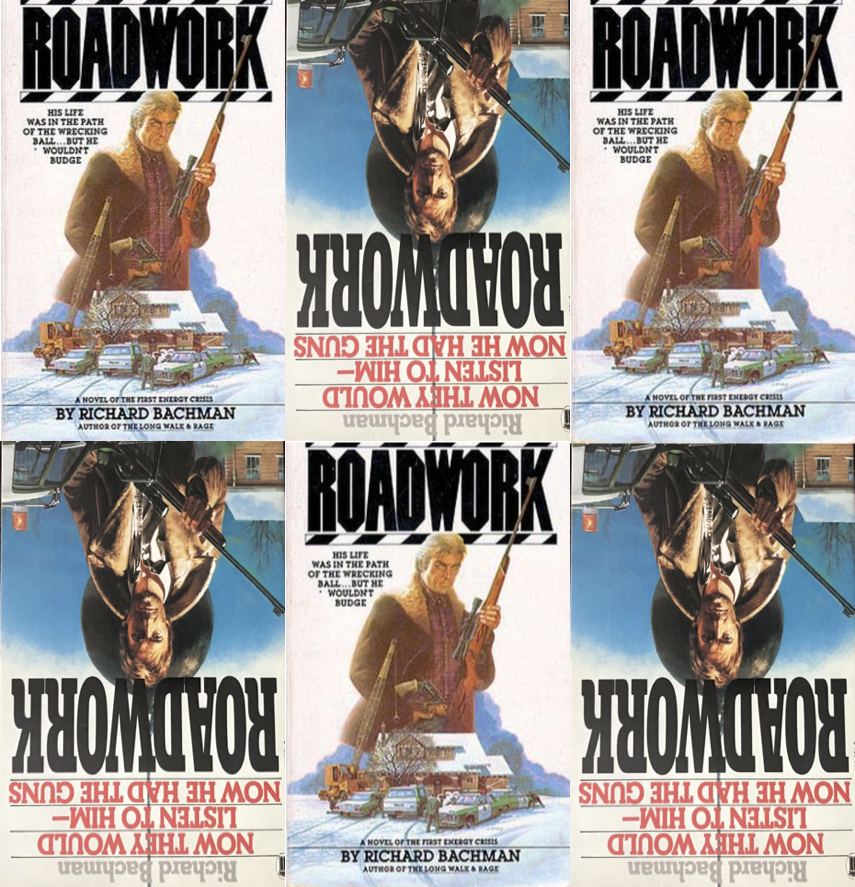
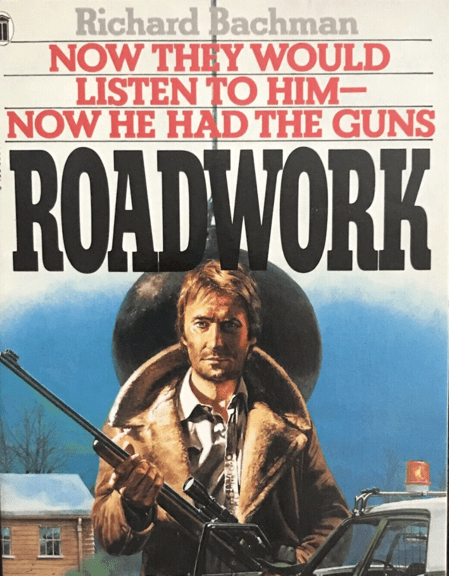
But perhaps it just seemed an homage…as is the first UK edition’s cover image bears the text (in all caps): “Now they would listen to him–now he had the guns”?

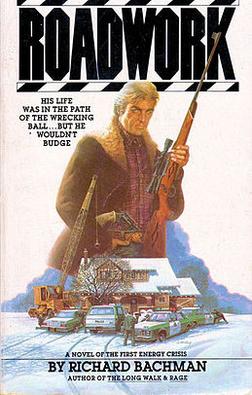
It’s funny the UK cover emphasizes the gun theme slightly more than the attendant text of its American counterpart:

“His life was in the path of the wrecking ball…but he wouldn’t budge”

Both of these covers seem to valorize Dawes and, via the (phallic) images of the gun, his masculinity. The plot that the wrecking-ball invocation so aptly captures reinforces the importance of property to masculine identity, a more specific spin on a common King theme that academics have picked up on:

Douglas Keesey argues that King’s “fictions address the problem of how one can be something other than a football player—say a writer—and still retain respect for oneself as a man” (195). Keesey’s observation that anything short of rugged masculinity may be problematic for King, reflects our larger cultural ideals of masculinity, what Marc Fasteau refers to as the “male machine.” [14] King’s response to this ideal is to people his novels with male figures who are emphatically not football players or any other version of empowered masculinity such as construction workers, Don Juans, captains of industry, etc. Instead, he offers his readers men and boys who possess many feminine characteristics, who are frequently social misfits and suffer as a result of their nature and/or social circumstances. Initially, King invokes this new masculine ideal through his critique of corrupt patriarchal institutions.

from here

A bureaucratic institution is certainly indicted by Roadwork‘s plot, but how cognizant the text is of the patriarchal significance to its corruption is less clear. Dawes is, after all, a white man of not a little privilege, and in that sense a representative of the patriarchy itself. This seems, in fact, to be in large part the aspect from which the novel’s most fundamental horror derives: that the privilege of a white man could fall victim to the system that was engineered to privilege white men, engineered by privileged white men… but does this mean Roadwork‘s plot figures the patriarchy as the enemy? Only if the bureaucracy that mindlessly enacts “progress”–in the form of a highway extension that will only further incentivize a consumption of resources driving us toward our own destruction–is shown to be the product of male pig-headedness. (I would have sworn AC/DC’s “Highway to Hell” inspired this plot concept if the 1979 release of that song didn’t seem a couple years past when King must have first drafted it.) Yet the most pig-headed male here would seem to be Dawes himself…

In our third Bachman novel we have a plot that revolves around a road, as its immediate Bachman predecessor, The Long Walk, did in a more literal way, offering a political commentary of sorts in the depiction of its dystopia. Roadwork is already explicitly political by its subtitle: “a novel of the first energy crisis.” King has been lambasting those insidious SUVs since before it was trendy:

When they went by the roadwork, [Dawes] asked Drake’s opinion.

“They’re building new roads for energy-sucking behemoths while kids in this city are starving,” Drake said shortly. “What do I think? I think it’s a bloody crime.”

King claims in a Bachman Books introduction to have written the book as a way of processing the cancer that had senselessly killed his mother, which effectively identifies the larger metaphor of the highway extension as a cancer that senselessly and undeservedly destroys Barton Dawes’ life, bearing down on him from the two directions that are the foundation of his (and most American men’s) entire existence: home and work. This highway extension is itself an “extension” of the government bureaucracy that incentivized the “senseless” extension in the first place. At the time of the energy crisis, the culture was closer to the interstate system’s origin than our current culture is to that energy crisis, but due to our current…climate of climate-change awareness, the novel’s thematic concerns–both conscious and unconscious–is still relevant.

That King-as-author has connected this climate-change cancer to his parent makes sense in light of the narrative’s use of a parent-child relationship as a focal point to channel the pain of the larger political conflict of the energy crisis. Dawes’ son Charlie died of a brain tumor. Unfortunately, this is one of the major aspects of the narrative that… doesn’t work.

To me, the Charlie backstory thread and its connection to Dawes’ motivations just did not feel well integrated. Good idea, poor execution. In theory, this is our protagonist’s primary element of chronic tension, that which is supposed to provide insight (and thereby sympathy) into the actions that appear inexplicable to those surrounding him. Charlie becomes another piece of property Dawes has lost in a way that exacerbates the conflict between Dawes and his wife:

“Mary, he was our son—”

He was yours!” she screamed at him.

In theory, the impending destruction of the house–aka the property that the property of his son grew up in–should function as an effective acute tension to raise the specter of the unresolved chronic, but the references that were supposed to elucidate his emotional connection to Charlie in a way that created sympathy in me as a reader fell flat; they felt jammed in ham-handedly like the Charlie connection was thought up after everything else was written. As in this clunky transition:

That night, sitting in front of the Zenith TV, he found himself thinking about how he and Mary had found out, almost forty-two months ago now, that God had decided to do a little roadwork on their son Charlie’s brain.

This chronic-tension element is perhaps most significantly expressed through Dawes’ inner dialogue between “Fred” and “George,” names/entities we come to find out explicitly originate with Charlie:

The two of them had fitted so well that names were ridiculous, even pronouns a little obscene. So they became George and Fred, a vaudeville sort of combination, two Mortimer Veeblefeezers against the world.

Another instance of good theory and bad execution: we’re told “names were ridiculous,” “[s]o they became [names]…” in a logical construction that contradicts itself and thus undermines the intended impact. This failure of logic seems to play out on a larger scale as there seems to be no rhyme or reason to the times that “Fred” doesn’t respond to him in his mind when George asks for him, which happens a few times, but then later Fred will just be there again. Perhaps this lack of logic is supposed to be the point, a signifier of Dawes’ mental deterioration. And perhaps that part could work if it weren’t for the other problems, such as the fact that Charlie is supposed to be the original “Fred,” yet the Fred voice in Dawes’ head in no way mimics a child’s in any way I was able to pick up on.

As a corollary, a narrative element that does work by the metrics of its own imparted logic is when Dawes moves beyond the guns he bought in the novel’s opening to another weapon, one that was not designed as such in the traditional sense (embodied by guns), and a car battery becomes instrument/trigger of destruction: 

“If I hook this up to the car battery beside me on the floor, everything goes!”

This works on a few levels: the climate-change one we’re able to feel even more viscerally in 2021, and the reversal of the metaphorical engine of Dawes’ own destruction turned on his destroyers.

Along the way, he throws out the traditional weapon(s), though only after he’s made use of them:

…he scurried back to the overturned chair and threw the rifle out the window. He picked up the Magnum and threw that out after it. Good-bye, Nick Adams.

If only it was goodbye for good…this fake name’s link to lies that might imply a critique of the Hemingway ethos and influence might be undermined by the heroism/martyrdom connected to the “stand” Dawes is ultimately able to make with them, even if he throws them out after the fact in what is, by that point, a fairly meaningless gesture.

The invocation of this fake name so close to his death links some element of Dawes’ craziness (back) to Hemingway, he who famously, as Tobias Wolff describes remembering learning of so vividly in his article, committed suicide by shotgun. Nick Adams is like a version of Hemingway’s alter ego reflecting the Fred/George reflection-of-insanity dichotomy, possibly implicating writers as generally crazy by proxy of living through alter egos (multiple layers of them in this book’s case), or at the least expressing some aspect of their own monstrousness, as academic Jeffrey Jerome Cohen has it in his “Monster Culture” analysis:

When contained by geographic, generic, or epistemic marginalization, the monster can function as an alter ego, as an alluring projection of (an Other) self.

Jeffrey Jerome Cohen, “Monster Culture (Seven Theses),” Monster Theory: Reading Culture, 1996.

The backstory/motivation thread with Charlie-George-Fred is tied up with the novel’s depiction of what might be broadly termed “insanity,” the topic of which is broached directly a few times, as we see when Dawes is firebombing the construction site: 

A semblance of sanity began to return.

The Fred-and-George dialogue reads to some degree as schizophrenic in the stereotypical sense of hearing multiple voices in one’s head, though the text itself never specifically invokes the term, and its link to the external event of Charlie’s death as its onset might not be medically sound…. This possibility as a diagnosis seems reinforced by the section near the climax where we get such an internal dialog in an experimental mode that academics might designate “postmodern”:

…i’m going ahead freddy my boy do you have anything you’d care to say at this auspicious moment at this point in the proceedings yes says fred you’re going to hold out for the newspeople aren’t you i sure am says george the words the pictures the newsreels demolition i know has only the point of visibility but freddy does it strike you how lonely this is how all over this city and the world people are eating and shitting and fucking and scratching their eczema all the things they write books about while we have to do this alone yes i’ve considered that george in fact i tried to tell you something about it if you’ll…

But, at the risk of invoking this concept again in reference to depictions of mental illness, this doesn’t work according to its own code of narrative logic: in one sense it’s written like an unfiltered internal (insane) monologue as if we are getting it directly as the character of Dawes himself is experiencing it: this is the function of the lack of punctuation and capitalization denoting the traditional distinctions between sentences. But then we also get some internal dialog tags: “says george” interspersed to intimate to the reader that Dawes still has the schizophrenic dialog going on between two voices. (This is a tag technically different from something like “freddy my boy” in which one of the voices is saying the name, a device which it seems should be enough to distinguish “fred” and “george” in the run-together dialog but would then feel even more overused if relied on exclusively…..) Dawes’ own direct experience should be able to distinguish between these two voices in a way that seems intruded upon by the “george says” type of tag–these are words that should not be in his internal monologue in the same way the other words are “in” the monologue…

So, Dawes is “driven” insane by the stripping of his property by the same institution that was supposed to uphold his right to pursue same (if we equate property with “happiness”) in conjunction with the unhealed wound of the equally senseless cosmic stripping of the property of his son (aka the propagation of his line), all exacerbated by the surrounding culture’s processing more foods than emotions (more on this final factor in Part II). Ultimately, Dawes is an individual–a white American middle-class male individual–sacrificed to/victimized by the larger system created and perpetuated by white American males. By which reading Dawes’ “stand” is a heroic if futile (more heroic for being futile?) gesture that makes him and his guns the good guys, valorizing a specific strain of masculinity. If Dawes’ emotional attachment to his son might read as more traditionally feminine, his choice that ultimately amounts to dying instead of moving to a new house also reads as more traditionally masculine, a tough-guy refusal to be pushed around. Of course, Dawes’ inability to express his feminine-coded grief (Mary is the one who both cries and grieves after Charlie’s death, and then, not coincidentally, heals) is implicated in leading to his ultimately futile projection of action-hero masculinity….

All of which is to say, while the climate-change and power-structure themes worked for me most of the time, and even if the Charlie backstory motivation thread “worked” narratively in the way it seems intended, this one lets the white guy off the hook too much for my taste, despite its best efforts to isolate the ironies of the destruction rendered in the name of progress.

-SCR