

But there’s one good thing that happens
Aerosmith, “Eat the Rich,” 1993.
When you toss your pearls to swine
Their attitudes may taste like shit
But go real good with wine
In Cujo, the materialism of the 1980s American family tears itself apart from the inside, as represented by the family dog gone mad.
Sarah Langan, “Killing Our Monsters: On Stephen King’s Magic,” LA Review of Books, July 17, 2012.
Cujo and his mindless disease-induced/rabid rage represent the materialism eating away at American families–with materialism being a form of consumption, if you will. The novel reinforces this theme in various ways, not least of which is Vic’s job at Ad Worx, which plays a central role in the plot by way of his having to leave town for work, an absence that is essential for the novel’s conceit to work, for Donna to drive out to the Cambers at all. So you–or I–could argue that if Vic hadn’t made this work trip, Tad would not have died. Which means what necessitates Vic’s work trip would also be implicated in Tad’s death, and that would be, broadly, advertising, and more specifically, an unfortunate misinterpretation of red food dye. The whole backstory necessitated by this plot device/necessity provides some interesting insights into the nature of advertising and human psychology–or more specifically the connection between these–by way of the Sharp Cereal Professor spokesperson. The importance of this figure is highlighted by the classic King tic of using a line from his own novel as an epigraph (which in the case of Cujo stands out even more since the novel only has three at the very beginning and most King novels have a lot more than that). This would be the Sharp Cereal Professor’s iconic (in the book’s world) line:
“Nope, nothing wrong here.”
One of my favorite non-King novels is Jonathan Franzen’s The Corrections (2001), which has a sequence I’ve taught across the contexts of both creative-writing and composition classes. In it, an English professor named Chip Lambert is teaching the final class of a college course he calls “Consuming Narratives”:
To test his students’ mastery of the critical perspectives to which he’d introduced them, Chip was showing a video of a six-part ad campaign called “You Go, Girl.” The campaign was the work of an agency, Beat Psychology, that had also created “Howl with Rage” for G—— Electric, “Do Me Dirty” for C—— Jeans, “Total F***ing Anarchy!” for the W—— Network, “Radical Psychedelic Underground” for E——.com, and “Love & Work” for M—— Pharmaceuticals. “You Go, Girl” had had its first airing the previous fall, one episode per week, on a prime-time hospital drama. The style was black-and-white cinema verité; the content, according to analyses in the Times and the Wall Street Journal, was “revolutionary.”
Jonathan Franzen, The Corrections. 2001.
And “revolution,” in another context, usually involves bloodshed.
Franzen highlights the irony of the shifting meanings of “revolution” when the sequence then describes as “revolutionary” and then in detail the content of this campaign, which is “revolutionary” by way of being narrative–that is, presenting a story, in scenes, one that centers on an office employee’s fight against breast cancer with the help of a particular corporation’s software (and with the especially “revolutionary” twist that the employee dies). It’s the narrative nature that makes it more seductive: to Chip’s chagrin, the students drink its Kool-Aid in its entirety. As we discuss in my composition classes, humans are generally more vulnerable to emotional rather than logical appeals, and while narratives are expected to have “logic” in terms of their plot, what they are really vehicles for is emotion. Advertisers seem to have figured this out. Chip wants his students to see the larger narrative at hand, that of the company who has produced the ad campaign’s narrative:
“Well, consider,” [Chip] said, “that ‘You Go, Girl’ would not have been produced if W—— had not had a product to sell. And consider that the goal of the people who work at W—— is to exercise their stock options and retire at thirty-two, and that the goal of the people who own W—— stock” (Chip’s brother and sister-in-law, Gary and Caroline, owned a great deal of W—— stock) “is to build bigger houses and buy bigger SUVs and consume even more of the world’s finite resources.”
Jonathan Franzen, The Corrections. 2001.
This conspicuously unnamed corporation plays a larger role in Franzen’s novel, further underscoring the theme of corporate bloodshed. But it’s advertising specifically that’s implicated in the above “Consuming Narratives” sequence, and how we consume the narratives it frames to make us feel better about our consumption.
“Consumption” is also a term for tuberculosis, which perhaps most famously reveals itself when the afflicted coughs up blood. So it’s probably not a coincidence that Chip’s brother Gary, the owner of the “W—— stock” who defines himself as a “strict materialist,” suffers from what the novel presents as another disease–clinical depression.
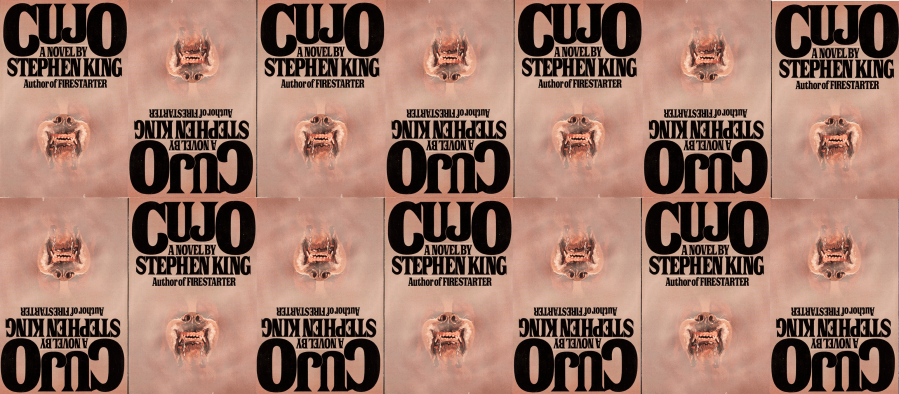
King’s Cujo links these and other iterations of “consuming narratives,” revealing the symbolism latent in the monster figures that “consume,” like vampires and zombies. Almost all of the various editions of the novel sport cover imagery emphasizing Cujo’s teeth in a way that evokes these classic monsters: a bite from Cujo is deadly in an even more terrifying way, since it is from the real-life disease of rabies. In a word, consumption is deadly. In more words, it’s deadly in all of these connected forms: getting literally bitten, getting consumed by disease, getting consumed by the desire to consume capitalist goods as well as consuming the narratives that distract you from processing that it’s your own consumption that’s eating you alive….

The Zingers’ red dye’s replication of blood freaking people out enough to cause a PR crisis (while doing no actual harm in and of itself other than frightening people via the illusion of having caused harm) could highlight the blood on the hands of the advertising industry at large, which you–or I–could also argue is the grease on the wheels of capitalism, that which it could not run without. This reading highlights the parallel between consuming in the capitalist sense and…some other senses.
“Tad? You want to eat?”
“I want to take a nap,” he said around his thumb, not opening his eyes.
“You gotta feed the machine, chum,” [Donna] said.
Donna uses this “feed the machine” expression earlier in the novel in an exchange that’s explicitly connected to an advertisement for food–or an approximation thereof, which is an important distinction since the quoted slogan itself seems to reference its own lack of substance as such:
“What does the ad say? There’s Always Room for Jell-O.”
“Are you trying to make me mad, Donna? Or what?”
“No. Go on and eat. You got to feed the machine.”
When Donna says this to Tad later, her appending the “chum” label to her son after it might then be read less as a term of endearment and more as a figurative invocation of shark bait. Workers have to feed the machine of capitalism and as such function as chum–and the plot basically shows this to be true for the white-collar family of the Trentons and the blue-collar family of the Cambers.
It seems not a coincidence, then, that of the many conspiring factors that might be implicated as ultimately responsible for the death of this innocent child, a major one is a product that can be consumed via eating–specifically a sugary breakfast cereal, more specifically Red Raspberry Zingers.
The prevalence of the color red in the novel as predominantly but not exclusively connected to blood offers another potential Carrie connection….
“The first time I looked in one of those [cereal] boxes, I thought it was full of blood.”
So what does this thematic treatment of materialism eating the family alive say about the representation and role of advertising in Cujo? If advertising frequently offers us unattainable approximations of what life is supposed to be, it’s interesting that this food product offers this approximation of the literal essence of life in a way that thematically reinforces advertising as the lifeblood of our economy–despite in many ways lacking any more substance than smoke and mirrors.
King uses the food-as-blood comparison again to both reinforce this theme and create suspense via mood when a bottle of ketchup breaks in the backseat of the Pinto:
Half a bottle of Heinz had puddled out on the powder-blue pile carpeting of the hatchback. It looked as if someone had committed hara-kiri back there.
King implicitly reinforces the power of advertising in the above passage by having a brand stand in for the general name of the item. He also inverts the food-as-body matter comparison, effectively carrying through the theme:
And . . . a man like Joe Camber surely kept a gun. Maybe a whole rack of them. What pleasure it would give her to blow that fucking dog’s head to so much oatmeal and strawberry jam!
This thought of Donna’s as she debates whether it’s “worth the risk” to make a run for the Cambers’ front door could be read as reflective of the financial risks one must take to get ahead in a capitalist system. In this thematic context, Tad’s death could be read as an indictment of this system when Donna’s taking the risk does not pay off, does not save him.
Vic’s AdWorx partner Roger comes very close to articulating Cujo’s symbolic connection to the book’s consuming themes:
“Sometimes I wonder if you understand what advertising really is. It’s holding a wolf by the tail. Well, we lost our grip on this particular wolf and he’s just about to come back on us and eat us whole.”
Essayist Eula Biss has explored the layered meanings of “consumption”:
“A metaphor is all this really is,” David Graeber writes. He means consumption, which was once the name for a wasting disease, and is now the word anthropologists use for almost everything we do outside of work—eating, shopping, reading, listening to music. Consume, he notes, is from the Latin consumere, meaning “to seize or take over completely.” A person might consume food or be consumed by rage. In its earliest usage, consumption always implied destruction.
Eula Biss. Having and Being Had. 2020.
Biss gets at the contradictory dichotomy that constitutes capitalism’s dark heart in an analysis of an IKEA slogan:
But what I like, what makes me laugh a little about “for people, not consumers,” is the implication that consumers are not people.
Eula Biss. Having and Being Had. 2020.
Which brings us to one of those classic iterations of “Consuming Narratives”: zombies. If this monster is the ultimate symbol of braindead consumers pacified by mass-produced crap, as reinforced by King bestie George Romero setting his zombie-horror classic Night of the Living Dead in a shopping mall, then the advertisers might be vampires. And now the mall itself is a version of the living dead, as played upon in the 2018 South Park episode “Do You Need Puppies?” and last year’s music video for Billie Eilish’s “Therefore I Am“…
Another device in Cujo that can be read through the lens of the novel’s advertising themes is another that is directly connected to Vic’s advertising-related absence: the “Monster Words” he writes down for Tad because he won’t be there to say them to Tad before he goes to bed. Tad has the paper with him and refers to it when they’re trapped in the car. At one point, Vic has a nightmare of Tad yelling at him that the “Monster Words don’t work,” which Tad’s death at the end essentially confirms. And why should they work–Vic made them up just to give Tad peace of mind; they have no reality beyond whatever material effects Tad’s own faith in them can generate. In this sense they illuminate the overlap of the hollow and specifically narrative-based rhetoric at the heart of religion, advertising, and politics. They–or rather, their failure–also complicate a pattern established in previous King plots, the defeat of the monster requiring a head-on/face-to-face confrontation with a verbal articulation of the monster’s evil, which Donna in essence achieves with her climactic confrontation with Cujo, but which via Tad’s death is shown to be not enough. The monster has technically been defeated, but not in time.
So in class ad-man fashion, Vic has essentially sold his own son a form of narrative snake oil via these Monster Words, which really amount to the opposite of the verbal articulation element shown to be required in previous King plots (Danny Torrance’s “false face” call out)–the critical element of this articulation is defining the monster’s true nature. The Monster Words are really the opposite of the true nature, existing to convince Tad there’s not a monster in his closet when actually, the novel seems to show, there is:
And then something happened which Vic never spoke of to anyone in the rest of his life. Instead of hearing Tad’s voice in his mind he was actually hearing it, high and lonely and terrified, a going-away voice that was coming from inside the closet.”
This happens near the end of the novel as Vic is repeating some of the Monster Words to himself, and it precipitates his putting the pieces together to drive out to Joe Camber’s. In conjunction with some of the omniscient narration and the supernatural gloss on Cujo manifesting The Dead Zone‘s Frand Dodd etc. I discussed in my last post, the Monster Words seem to demonstrate that just saying something–and even believing it–is not enough to make it true.
(The horror trope of a monster coming out of the closet also hearkens back to King’s short story “The Boogeyman” from Night Shift, which points to the general problematic treatment of queerness in King’s work.)
That Vic and Roger get to keep the Sharp account seems to validate the sincerity of their advertising rhetoric, which is troublesome. This brings us to the politics connection and thus to the novel’s requisite Nixon reference:
“But isn’t that why we’ve got our asses in a crack? They wanted to believe the Sharp Cereal Professor and he let them down. Just like they wanted to believe in Nixon, and he—”
“Nixon, Nixon, Nixon!” Vic said, surprised by his own angry vehemence. “You’re getting blinded by that particular comparison, I’ve heard you make it two hundred times since this thing blew, and it doesn’t fit!”
Roger was looking at him, stunned.
“Nixon was a crook, he knew he was a crook, and he said he wasn’t a crook. The Sharp Cereal Professor said there was nothing wrong with Red Razberry Zingers and there was something wrong, but he didn’t know it.”
The “something wrong” would be that it looks like blood, or put another way, the problem is the impression it gives of causing harm even though it’s not actually causing harm other than the stress over the impression of harm… When the SC Professor apologizes, it’s not for causing any actual harm, but “because people were frightened.”
Vic highlights an epistemological crux to constitute a moral problem–Nixon knew–making the coverup conscious, not accidental, thus more malignant/amoral. This epistemological framework is reminiscent of another Biblical narrative, the origin, or Genesis narrative, which I’ve described in the past in a way that also shows it to be a “Consuming Narrative” of sorts:
…the narrative in the first book of the Bible, the aptly titled “Genesis,” when Adam and Eve are in the Garden of Eden and everything is perfect except for that one darn tree they’re not allowed to eat the fruit from. Then yada yada yada, the serpent tempts Eve and she eats the fruit from it and gets Adam to too, and bam, they both gain *knowledge*—illustrating how the concrete object of the fruit shows the abstract concept of a transfer of knowledge. The first way this knowledge manifests is that they become aware of their nakedness, and connected to this awareness is an immediate need to cover that nakedness, which would seem to imply that knowledge is inherently connected to shame…and of course the general suffering known as the human condition.
From here.
(Side note: A post on ‘Salem’s Lot gets at another biblical “Consuming Narrative” and its potential religious/political/advertising overlaps:
Official Catholic doctrine holds that after transubstantiation, the bread and wine have actually become Jesus’s body and blood, while my understanding is that other Christian denominations (Episcopalian, Lutheran, Presbyterian and the like) maintain that the bread and wine are merely symbols of Jesus’s body and blood. This distinction is where there seems to be the most potential for commentary via the vampiric narrative: the vampire literally drinks blood, as Catholics believe themselves to be doing during what constitutes one of their most sacred sacraments (a sacrament that demands suspension of belief in the physical senses). So it’s almost like the Catholics are using the vampire narrative as a means to figure themselves in the exact opposite role of what they really are to distract from their true nature, in a spin move reminiscent to me at the moment of (Trumpian) politics–accuse someone else of doing what you yourself have done to get the heat off you.
From here.
This would be in line with the Bernaysian rhetoric first discussed in my post on The Shining here…)
In King’s Richard Bachman novel Roadwork, set when Nixon is still President, the protagonist Barton Dawes is depicted as seeing the world through the lens of advertising and how this is also an indictment of consumption in the era of the Energy Crisis. In that novel, Dawes advances a theory that treats television and its attendant advertising as well as the unnecessary things being advertised as a version of Marx’s idea of religion being the opiate of the masses, as well as the Pavlovian dog, which might offer another way to read the figure of Cujo here….
Another iconic horror narrative that embodies our consumption-centric cultural anxieties–and one that probably largely contributes to my interpretation of the larger thematic capitalist commentary latent in Donna’s “You gotta feed the machine, chum” line–is Steven Spielberg’s Jaws. This film is also of interest to me for being part of my personal genesis narrative–this is the movie my parents saw on their first date. Except it wasn’t exactly their first date in the sense that my father did not consider it a date. They worked together and had agreed to go to another co-worker’s wedding; when this turned out to entail only a ten-minute ceremony, my father, so the story goes, felt bad and offered to take my mother to dinner and a movie. The clincher for how un-date-like my father considered this outing is marked by the story’s one surviving line of dialog, my father’s to my mother as they were eating at a Mexican restaurant before going to watch people get eaten by a shark: “You got beans in your hair, bozo.”
Of course, Spielberg’s film doesn’t really show people getting eaten in as much graphic detail as we might expect today, and it doesn’t show the shark that much either, which is considered elemental to the film’s effective development of suspense but, according to the Wikipedia page, originated from a very young and inexperienced Spielberg’s hubristic insistence on filming scenes on the actual ocean instead of a simulation of it.
I brought this up last year in a creative-writing class as an example of how obstacles can create happy accidents (the Chinese character for “crisis” and “opportunity” are the same!). Some of the students had just watched Jaws in a different class. One of these was moved to comment: “I think we can all agree, the shark looks terrible.” I had also just (re)watched the film, and was taken aback: I’d thought the shark looked pretty scary when it finally popped up up on the ship’s deck. But as it was apparently such a consensus, I didn’t even say so. That same night, my cousin-in-law who’s a few years older than me was visiting, and I mentioned that we’d been talking about Jaws in class that day. When she brought up the shark looking scary before I even told her the students thought it wasn’t, I realized the difference was generational: (elder/geriatric) millennials grew up on movies with animatronics for special effects. Kids high-school age now grew up watching Marvel movies with CGI special effects instead. I cite the Jaws example as evidence that they literally see things differently than my generation does. It’s a matter of what your neural pathways were exposed to when they were still developing, how they were, in essence trained: if you grew up on animatronics the CGI stuff looks ridiculous, and vice versa. What looks fake to one generation looks real to another….
Per Lisa Cron’s Wired for Story, narratives similarly condition our brains, which is relevant to film critic Ann Hornaday’s argument that it matters that the overwhelming majority of those in charge of the stories propagated through Hollywood movies are white males (covered in a post on King’s first published Richard Bachman novel Rage). As Matthew Salesses puts it, “The way we tell stories has real consequences on the way we interpret meaning in our everyday lives.” Put another way, the narratives we consume matter.
I essentially cover this in my college rhetoric and composition courses when we take popular culture as our theme and examine how its texts both “reflect” and “shape” our culture. One clip I use to express the principle of how “pop culture inherently normalizes things” is from the show BoJack Horseman, which mentions Ellen: “dancing Ellen makes middle America less afraid of gay people,” listed as an example of the ways this power of pop culture can be used for “good.” Ellen’s a good example of how narratives in pop culture can shift; when she used the mainstream platform of her prime-time sit-com to come out, she alienated a lot of her fan base and didn’t work for years before the culture shifted enough for her to get her daytime TV show. The narrative around how “good” Ellen is has shifted again recently in light of accusations of a toxic workplace environment on the set of this show.
But before that happened, a former student of mine at the University of Houston named Jevh made an appearance on this show, relevant through the lens of “Consuming Narratives” specifically, summed up by the show’s staff thus:
Being a big fan of pranks, Ellen had Jevh and Christian on the show to talk about their creative, epic prank!
After noticing a blank wall in a local McDonald’s, Jevh and Christian decided that something needed to fill the empty space. Seeing a lack of Asian representation in pictures on other walls, Jevh and Christian figured why not them? Using their creative minds and skills, the pranksters took a photo of themselves casually enjoying burgers, put it on a poster similar to the ones in the building, and installed the creation in the empty space! After nearly two months, the poster was noticed by McDonald’s.
McDonald’s is committed to diversity and wants to reflect all of their customers, and they appreciate Jevh and Christian! Ellen delivered the amazing news that McDonald’s wants to hire the two for a marketing campaign! To pay them for the job, McDonald’s gave them each $25,000!
From here.
Maybe you can tell that by the end of this it sounds like an ad for McDonald’s… The comp class I had Jevh in happens to be the only semester I used the rhetoric of advertising as our course theme (as opposed to the broader theme of popular culture I’ve mostly used since then, which still encompasses advertising). Here we see McDonald’s turn a potential PR crisis into an opportunity, a critique into their own ad…and we’re consuming the narrative of how great and generous McDonald’s (and Ellen) is. And most of my students would eat this up, would drink this narrative Kool-Aid, and I would sound a lot like The Corrections‘ Chip teaching his class: Consider that Jevh and Christian would not be getting this money if McDonald’s did not have a product to sell, a product that is unhealthy to consume, thanks, among other things, to an infusion of high-fructose corn syrup, which also looks like blood…
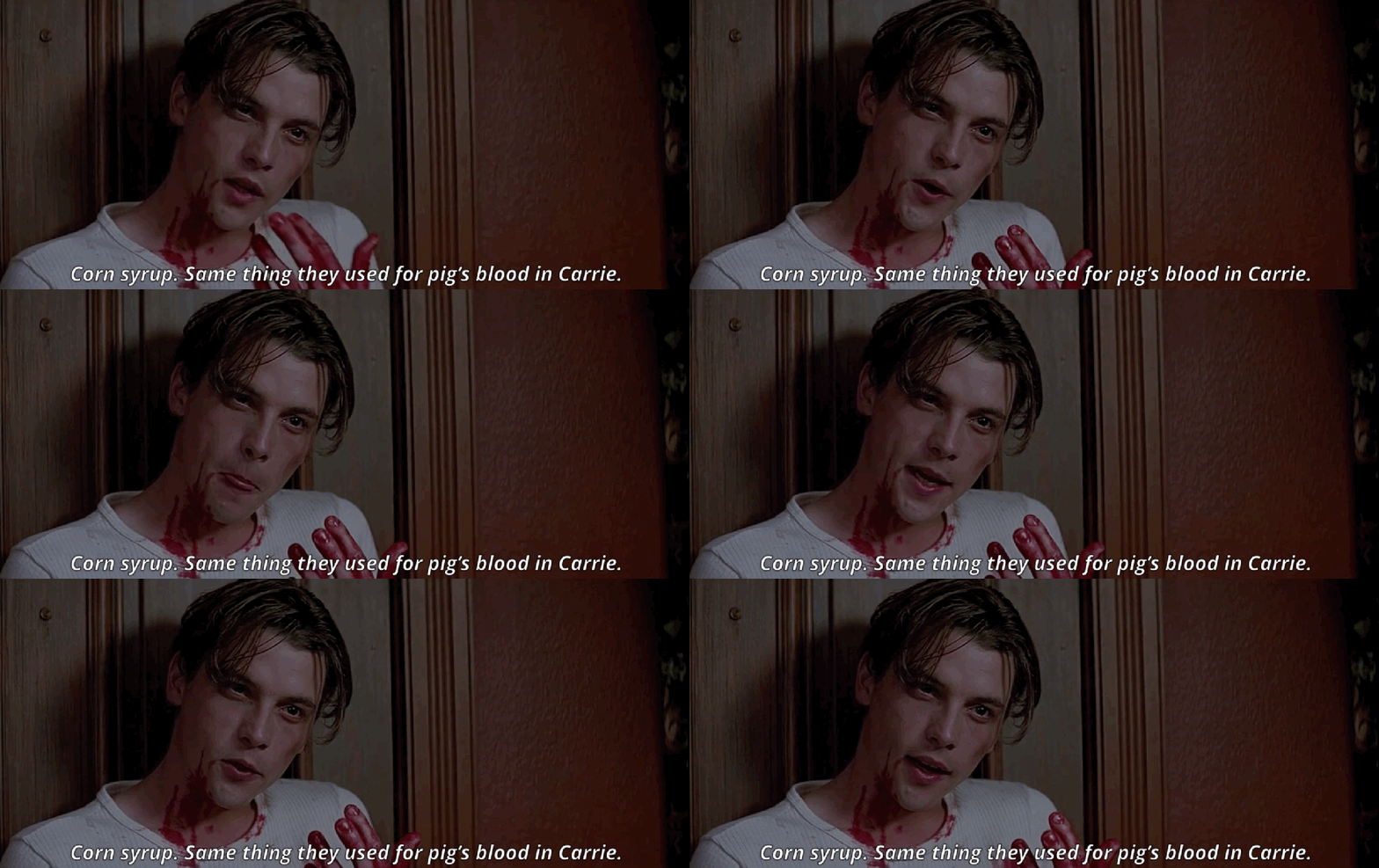
This could offer a metaphor for the more insidious nature of this segment, that it’s an advertisement in disguise: the narrative provides a cover so the viewer doesn’t realize what they’re consuming. That is, we’re consuming narratives that cover up the true nature of what we’re consuming, as well as the larger costs of that consumption.
Consider that if you are what you eat, and you eat meat, you’re dead.
In another iteration of a “Consuming Narrative” in Franzen’s The Corrections, one character, a professional chef, reflects:
She told herself a story about a daughter in a family so hungry for a daughter that it would have eaten her alive if she hadn’t run away. …
And now the time had come, according to the story that Denise told herself about herself, for the chef to carve herself up and feed the pieces to her hungry parents.
Lacking a better story, she almost bought this one. The only trouble was she didn’t recognize herself in it.
Jonathan Franzen. The Corrections. 2001.
This is reminiscent of the story Donna tells herself in coping with her husband’s career choice to peddle consuming narratives to the culture at large. Readers were upset by it, but Tad was essentially fed to his hungry parents, not consumed by Cujo.
-SCR

 Long Live The King