I have officially reached the end of my journey of reading all of Stephen King’s books chronologically, though it has repeatedly looped back on itself and looks nothing like a straight line. Ka is a wheel. Now I know.
I started consistently reading King’s books as they came out in 2017, which meant that Sleeping Beauties was the book I needed to catch up to to be able to say I have read all of his books. And so: I have read all of his books. The final volume I had to finish to achieve this feat ended up being his 2015 story collection The Bazaar of Bad Dreams. Of course King also has a 2016 book because he literally has published at least a book a year since 1977–except for, technically, 1988, but since he published three books in 1987, we shall let that pass.
The 2016 book is End of Watch, the final book of the Mr. Mercedes trilogy, which I read straight through. I might have read Bazaar before reading End of Watch but for a minor technological technicality that caused me to not have access to Bazaar in my preferred mode of audiobook consumption. Then for awhile I put off dealing with that technicality, essentially saving Bazaar so I would still have more King to read. This is exactly what The Kingcast’s co-creator Scott Wampler was doing with the Mr. Mercedes trilogy–saving it–and then he died before he could read it. So I knew I didn’t want to put off reading Bazaar for too long, because, well, you never know.
There might be something cosmic about this ordering as well; the final story in the collection, “Summer Thunder,” repeatedly refers to an apocalyptic nuclear event that occurred on June 6, which turned out to be the date I finished the book, and thus all of the books. Some might call this a coincidence; psychoanalytic pioneer Carl Jung, who died on June 6, 1961, would call it a “synchronicity,” and I have in the past year become most fixated on how King is fundamentally Jungian. Surface proof of this resides in King’s repeated invocations of Jung in his 2022 novel Fairy Tale, including a fictional nonfiction book entitled “The Origins of Fantasy and Its Place in the World Matrix: Jungian Perspectives,” while Fairy Tale’s main character Charlie also ends up publishing in an academic journal that does actually exist, The International Journal of Jungian Studies. Lisey’s Story (2006) contains the representation of the collective unconscious in the literalizing of the “myth pool” (a concept King learned about from his college English professor Burton Hatlen). And let’s not forget King’s telltale trick of inserting parentheticals in a character’s inner monologue in a way that represents intrusions from the character’s unconscious into their consciousness.
In short, Jungian concepts pervade King’s canon. He repeatedly channels tales of good versus evil, essentially telling the same story over and over with different characters plugged in. (The role of dreams in relation to these good and evil poles in The Stand is also very Jungian.) And he gets away with this because those different characters are rendered as intensely believable individuals. So his canon basically captures the idea that while all people are unique, we are also all part of a shared human experience in which our potential for transcendence resides in facing our dark sides, or to put it in Jungian terms, our shadows.
When King writes about what gets designated the “supernatural,” he is essentially writing about what could be viewed as “spiritual”–elements and phenomena that defy scientific rationality and our understanding of “reality,” or, as Rice professor of Religious Studies Jeffrey Kripal puts it in his book The Superhumanities: Historical Precedents, Moral Objections, New Realities (2025), of “a philosophy of a higher reality beyond the senses and the opinions of the merely rational mind.” Kripal has written a lot about this idea of the “supernatural” being “super natural,” as in his 2016 book The Super Natural: New Visions of the Unexplained, and his 2024 book How to Think Impossibly basically encompasses the idea that these quintessentially Kingian phenomena transcend the bounds of fiction: “From precognitive dreams and telepathic visions to near-death experiences, UFO encounters, and beyond, so-called impossible phenomena are not supposed to happen. But they do happen—all the time.”
To have read all of Stephen King’s work is to have gone through an immersive experience that makes it very believable that certain “impossible” concepts that seem to defy reality are, in fact, very possible and very realistic. This is partially due to his adept use of vivid sensory details, and partially due to certain repetitions in the subject matter: to read how King repeatedly self-inserts writer and teacher characters–in one of Bazaar’s story intros he refers to Ben Mears from his 1975 novel ‘Salem’s Lot as “[s]ome stand-in for me”–alongside his frequent deployment of phenomena like telekinesis and precognition is to become convinced that those concepts, like the writer stand-in characters, must be, to some extent, autobiographical. This was a question he was asked after a talk he gave at the University of Georgia in 1980. A little after the ten-minute mark:
Q: “Many of your characters have very special or unusual mental powers. Do you feel that you have any special or unusual mental powers?”
A: “Only when I’ve had five or six, then I feel really really mental. [Laughter.] No, I don’t think so. And some people will say well do you believe the kind of stuff that you write about and the answer is, almost. I want to, and yet at the same time I think that you have to be very hard-headed and pragmatic about it. I believe it if I’d ever seen a ghost or that sort of thing, and yet at the same time I think we’ve all had the experience of not thinking about you know um Aunt Molly for you know three or four years and then you’ll be thinking about her and the phone will ring and it’ll be her, or you’ll have a flash if something’s going to happen, and so I suspect that something is going on there. But that it’s probably uncontrollable in the sense that uh you’re not able to actually harness it the way some of the characters in the books do.”
The questioner’s phrasing of “unusual mental powers” is amusing, since surely in one sense King’s mental powers are extremely unusual. Who else can write so compellingly at such a prolific rate? King’s “harnessing” of his powers might look different than characters like Carrie’s, but I can’t get it out of my head how, before 9/11, he wrote not one but two books with a character flying a plane into a building–The Running Man (1982, but written way earlier) and Insomnia (1994). And then in Doctor Sleep (2013), there’s a specific episode to demonstrate the character Abra’s “unusual mental powers” when she, as a baby, responds to the actual occurrence of 9/11.
King’s casual denial that he has ever personally experienced phenomena like that reminded me of how Carl Jung had to keep a lid on his own personal spiritual and visionary experiences during his lifetime or put his scientific career at risk. Then later after he died, his Red Book was published, which he knew would appear to lay (i.e., scientific) readers as if it were the product of some kind of madness.
Another major Jungian aspect of King’s work is his fascination with dreams and dream worlds, which makes starting with Sleeping Beauties and ending with Bazaar of Bad Dreams the perfect points to render my reading experience a circle instead of a straight line. The covers themselves would seem to communicate a significant overlap between these texts.
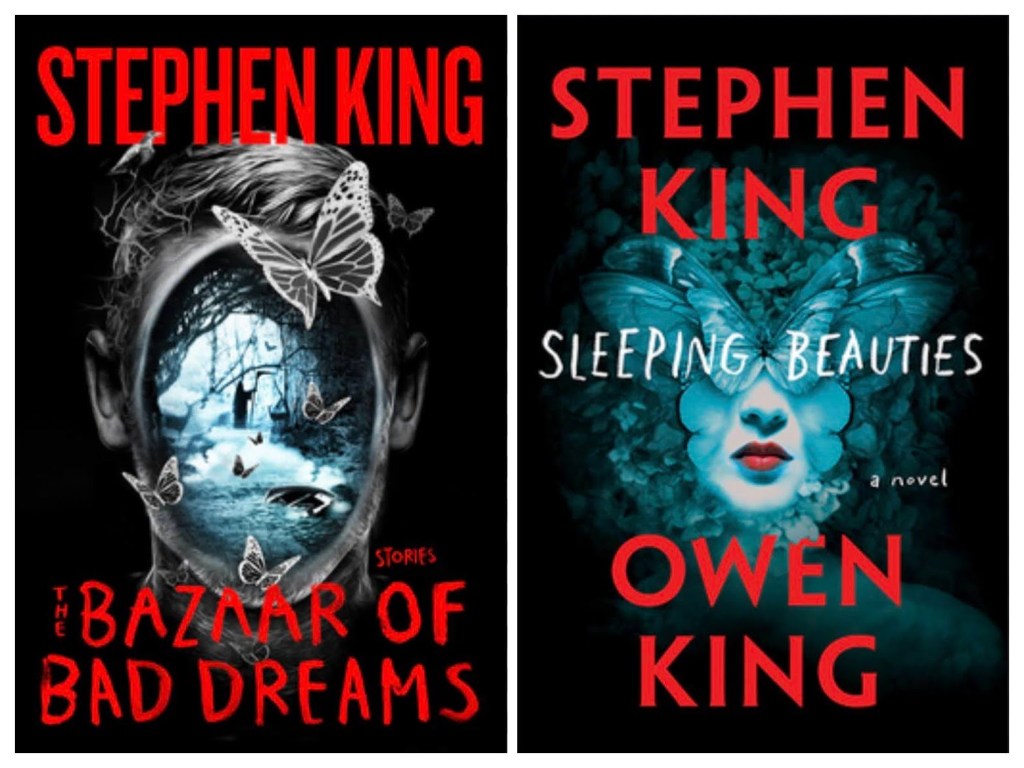
(And don’t forget about another story collection, Nightmares and Dreamscapes [1993] and the novel Dreamcatcher [2001]).
But what really makes Bazaar an absolute treat is King’s short intros for each story where he answers the question he’s always asked–where do you get your ideas? King has cracked open his own skull to show us his writerly mind at work. And what a mind it is. Such glimpses into King’s process–which he has made a habit of providing throughout his career–for me confirm that King’s work qualifies for Jung’s categorization of “visionary” art as described by literary critic Oliver Davis in the volume Post-Jungian Criticism: Theory and Practice (2003):
Jung has a view of creativity that involves self-divestiture or self-dispossession. He describes how works of what he calls “visionary” art10 are written:
These works positively force themselves upon the author; his hand is seized, his pen writes things that his mind contemplates with amazement. The work brings with it its own form . . . while his conscious mind stands amazed and empty before this phenomenon, he is overwhelmed by a flood of thoughts and images which he never intended to create and which his own will could never have brought into being. (CW 15: 73)
As King notes in the intro to “Ur,” “I’ve never been able to write stories on demand.” And his description of his process in the intro to “Batman and Robin Have an Altercation” basically amounts to a different way of saying what Jung said about work forcing itself on the author:
Sometimes a story arrives complete—a done thing. Usually, though, they come to me in two parts: first the cup, then the handle. Because the handle may not show up for weeks, months, or even years, I have a little box in the back of my mind full of unfinished cups, each protected in that unique mental packing we call memory. You can’t go looking for a handle, no matter how beautiful the cup may be; you have to wait for it to appear.
It happens that “Batman and Robin Have an Altercation” is one of my favorite stories in the Bazaar collection. It first appeared in the September 2012 issue of Harper’s, which also published his story “The Fifth Step” in 2020 before it appeared in his 2024 collection You Like It Darker. The climax of both of these stories is someone getting stabbed out of nowhere. A classic King trope, and a particular King coup that he has rendered this trope “literary.” Though perhaps to be in a literary magazine you have to maintain the “realist” line, as neither of these stories ascend into supernatural territory.
So let’s back up and see how much overlap between the literary and the supernatural this collection constitutes. Of its twenty stories, twelve were initially published elsewhere, predominantly in “literary” magazines.
“Premium Harmony” and “A Death” in The New Yorker: neither supernatural. In “Premium Harmony,” a couple who’s been arguing a lot stops at a gas station where the wife suddenly has a stroke and dies. Now the husband can finally smoke without being nagged. (King describes it as his Raymond Carver ripoff story, which makes sense, since Carver also published a lot in The New Yorker. And smoked a lot.) In “A Death,” which is set in the Old West and hearkens back to the beginning of my King journey, leading me to conclude early on that “King can grab you by the literary balls when he wants to,” a man is accused of murdering a young girl for her silver dollar; the sheriff becomes convinced the man is innocent as the man continues to insist he is, but after the man is hanged, the silver dollar turns up in his stool, proving that he was in fact guilty.
“The Dune” in Granta: supernatural. A man knows of a sand dune in which written names periodically appear; the people named die shortly thereafter.
“The Bone Church” and “Tommy” in Playboy: neither supernatural. These are actually both poems, which is unusual for King and probably unusual for Playboy. “The Bone Church” is about a platoon in the jungle during the Vietnam War that comes upon a pit full of bones and then a herd of elephants stampedes over the cliff into the pit. There is some supernatural hint here because the elephants are supposed to have all been killed by ivory hunters; the poem’s narrator has also been recounting how the deaths of his various platoon members occurred and is obviously haunted by his Vietnam experience as he recounts it years later, so this supernatural ghostly element feels more metaphorical. “Tommy” is about a hippie in the 60s who died of leukemia.
“Morality” and “That Bus Is Another World” in Esquire: neither supernatural. In “Morality” a retired reverend offers a woman a lot of money to perpetrate an intentional sin so he can experience what it feels like vicariously and she debates with her husband whether it’s worth it (they’re poor). They go through with it (the “sin” is her punching a young kid in the face on a playground) but it ultimately ends up destroying their marriage. In “That Bus Is Another World” a business executive on his way to an important presentation thinks he sees a murder on a bus–he’s not on the bus but sees it through a window. He’s running late for the very important presentation, which he decides to continue to rather than report the murder, convincing himself he didn’t see what he thought he did.
“Afterlife” in Tin House: supernatural. A man turns up in an office with a paper pusher who tells him he’s dead and that he can go through a door or go back to his life to live it again, but he won’t remember having lived it before, which means he won’t do anything differently; the man muses on the bad decisions in his life clinging to the hope that somehow this time he can do things differently, which would appear to be the cycle he goes through every time he ends up in this room. He goes back to his life to try again. (Interesting basis for a theory about The Dark Tower series ending indicating that the protagonist Roland is actually in Hell reliving the same cycle over and over.)
“Herman Wouk is Still Alive” in The Atlantic: not supernatural. In his preface King describes its inspiration as a real-life incident in which a woman drove the wrong way down a freeway for two miles with all her children in the van with her before colliding head-on with an SUV and killing almost everyone; the woman was reported to have seemed sober shortly before the accident but her blood revealed high levels of inebriation. In King’s story, the woman is in the van on a road trip with a friend whose kids are also in the van with hers. These kids have names like “Truth,” “Delight,” “Freedom,” and “Glory.” As they proceed to get drunk while on the road, the woman driving reflects on the future her kids will have in which they’ll relive the cycle she did of getting pregnant too young and not having any money. She and the friend seem to come to a tacit agreement and awareness of what she’s doing before she plows the van into a tree at a hundred miles an hour. The crash is witnessed by two elderly poets who have just come across a story in the newspaper that the writer Herman Wouk just published a new novel at age ninety. (If that detail feels random, the story has its own Wikipedia entry that explains it as related to a bet King made with his son Owen, which King doesn’t mention in the story’s preface.) King probably has more firsthand experience with poverty than most writers who publish in magazines like The Atlantic–albeit decades in his rearview at this point–but the depiction of these characters felt pretty classist. That he would have the incident witnessed by the type of writers who would publish in such magazines–i.e., literary ones–becomes an interesting choice in that context. Nobody else, including Herman Wouk himself, seems to have picked up on any classism; it won the Bram Stoker Award for the Short Story. One reviewer thinks the “trodden women” in the van are not caricatures and are written with compassion while the poets “slip toward stereotype.” The women potentially read realistically until they suddenly decide their lives–and really more specifically their children’s lives–aren’t worth living. I don’t buy it. I think this feeling is compounded by the addition of the friend also coming to this decision instead of just one character coming to it.
Side note: Among the many literary publications King perused when he edited the volume of Best American Short Stories in 2007, he singled out The Atlantic:
No need to check out The Atlantic Monthly; its editors now settle for publishing their own selections of fiction once a year in a special issue and criticizing everyone else’s the rest of the time. Jokes about eunuchs in the bordello come to mind, but I will suppress them.
“Summer Thunder” in Cemetery Dance: not supernatural, but dystopian. This is the final story in the collection. After a nuclear event that occurred on June 6 few people are left alive; the main character whose family has died processes his grief for them in the present when a dog he’s picked up and named Gandalf dies of radiation poisoning. As the main character himself develops the symptoms of radiation poisoning, he mounts his old motorcycle and rides it off a cliff. This is a vehicular-suicidal decision whose logic I can get on board with.
“Batman and Robin Have an Altercation” in Harper’s: not supernatural. This title alerts you, if unconsciously, that the story operates on multiple levels: Batman and Robin could be having an altercation with each other, or they could be, jointly, having an altercation with somebody else. It turns out that it’s both: the altercation with each other directly causes their joint altercation with somebody else, which, narratively, is very satisfying. This satisfaction is enhanced by the fact that King also described up front the two unrelated incidents he witnessed that collide in the story. In the case of this story they collide literally: the son King saw feeding his father dinner in a restaurant (King and his wife were eating at an Applebee’s. Of course.) who would not let him use a knife become passengers in the car in the almost car-crash King witnessed that in the story becomes a collision. In the story, the son’s father has Alzheimer’s and mentions something the son was previously unaware of, that he’d had an affair. The son, driving, is so surprised by this revelation that his attention wanders briefly from the road and he rear-ends a truck that cuts into his lane. The truck’s driver, whom King perceived as a “cowboy driver” in the real-life near-accident he witnessed that was one half of the story’s inspiration, is enraged and physically attacks the son. The father stabs the cowboy driver with a knife he stole from the restaurant, the knife the real-life father wanted to use that the son wouldn’t let him in the moment King witnessed that was the other half of the story’s inspiration.
Perhaps it was because I had just been asked to write a chapter on King’s use of genre tropes for an upcoming handbook and elected to focus on the Western genre that this story stood out to me. The real-life near-crash with the “cowboy driver” occurred in Sarasota, Florida, but King relocated the setting of the story to San Antonio, Texas. The son’s father “hasn’t lost all the clever ruthlessness that enabled him to rise from a no-college oilfields roughneck to an upper-middle-class jewelry merchant in San Antonio.” Here we see the influence of the Western cowboy ethos on the modern-day oil-and-gas industry also implicated in King’s description of the “gas-guzzling behemoths” in the real-life near-crash. The violence inherent in this legacy is something we tend to forget, which the father having Alzheimer’s also thematically reinforces. That the knife the father steals originates with him eating steak for his dinner also implicates the agricultural aspect of the Western cowboy legacy. The father and son are the Batman and Robin of the story’s title because it’s a recounting of the Halloween they dressed up as Batman and Robin that leads to the father referencing his affair, with the pop-culture figure of the superhero who usually defeats his foes through physical violence thus implicitly connected to this cowboy-ethos legacy.
So only two of the pieces previously published in magazines are supernatural, “The Dune” and “Afterlife.” (“Ur” was originally published as a Kindle single rather than in a magazine, so pause on that.) Those respective publications, Granta and Tin House, are definitely literary but have a much lower profile than The New Yorker, Harper’s, or The Atlantic. King might have upped–or downed?—the literary ante with the level of violence (as well as a conceit that amounts to an extended poop joke) he was able to shoehorn into these magazines, but he did not get them to exceed the boundaries of “literary naturalism.” This itself would seem to be a symptom of the epidemic Jeffrey Kripal has identified in academic humanities departments in The Super Natural with his “heartfelt plea to my colleagues to establish, or reestablish, the super as a major focus of research and conversation in the study of religion, but also within the broader currents of the humanities—the study of art, history, literature, and philosophy.”
Kripal only explicitly mentions Jung once, but part of his solution amounts to a Jungian one:
My first and most basic response to our present postcolonial and racial crises in the humanities and the larger culture, then, is basically the same one I learned in Roman Catholic spiritual direction and, subsequently, in psychoanalysis with respect to the depths of the soul, sexuality, and gender: not to deny what the unconscious (in this case, the social unconscious) reveals to you in dream and relationship, but to accept it, interpret it, talk about it, and, most of all, work with it.
If we tally the collection’s previously unpublished stories–or unpublished in magazines–we will see the ratio of supernatural to natural in these is much higher:
“Mile 81”: supernatural. Basically a version of Christine where a demon car kills people.
“Ur”: supernatural. An English teacher buys a Kindle that turns out to have access to alternate timelines (ties into The Dark Tower). He uses the knowledge he’s able to access from it to prevent a drunk driver from causing a crash that kills his girlfriend.
“Bad Little Kid”: supernatural. A man on death row for murdering a child recounts to his lawyer how this same “bad little kid,” who never ages, had appeared and caused the deaths of his loved ones throughout his life.
“Blockade Billy”: natural. A baseball player turns out to have taken on the identity of one of his murder victims.
“Mister Yummy”: straddles the line of its supernatural phenomena being a natural psychological manifestation. A dying man sees an apparition from his past before he dies.
“Obits”: supernatural. The narrator works at an online tabloid magazine akin to TMZ that trades in harmful voyeuristic gossip and finds himself with the power of actually killing the people for whom he writes cruel joke obituaries.
“The Little Green God of Agony”: supernatural. After nearly dying in a plane crash, one of the world’s richest men enlists a reverend for an exorcism to exorcise his physical pain that’s really caused by an inner demon (a literal one).
“Drunken Fireworks”: natural. Celebrating the Fourth of July, two rival neighbor families have an escalating battle of fireworks.
“Under the Weather”: natural. In the intro for this one, King observes that “stories are like dreams. Everything is deliciously clear while the process is ongoing, but all that remains when the story’s finished are a few fading traces. I sometimes think a book of short stories is actually a kind of oneiric diary, a way of catching subconscious images before they can fade away.” King noted in his intro for his 2007 Best American volume that he doesn’t “want some fraidy-cat’s writing school imitation of Faulkner,” yet this story’s premise would seem to have a literary corollary in Faulkner’s “A Rose for Emily.” This influence must have slipped into King’s unconscious, since he usually acknowledges the debt of such influences when he’s aware of them (as he acknowledged the influence of Carver on “Premium Harmony”), and of this story he says “I don’t remember how I got the idea for ‘Under the Weather,’ or how long it took, or even where I wrote it.”
The story’s main character is a Don-Draper-like ad executive whose wife is “under the weather.” As he gets in the shower while she’s still asleep, he thinks about a dream he’s had for the past five nights: “Nothing really awful happens in this dream, but in a way that’s the worst part. Because I know—absolutely, positively—that something awful will happen. If I let it.” In the dream he’s on an airplane sitting next to someone: “I know if I look at him (or her, or possibly it), I’ll see something that will turn my bad dream into a nightmare. If I look into the face of my seatmate, I may lose my mind.” When he’s leaving his Manhattan apartment building, his doorman tells him an exterminator will need to come in to address a bad smell people have been complaining about that’s probably a dead rat. (The narrator tells him that his sinuses are “wrecked” and that he can only smell coffee and his wife’s perfume.) At the office he’s working on a campaign for a Viagra-like pill; the dream crosses his mind and he thinks “there’s something close to me I don’t want to look at.” He recalls his first big success with an ad campaign when he spent the money on a trip for him and his wife; on the plane there was a moment when he looked at his sleeping wife and thought she was dead. As King noted in the intro, “this is one of those tales where it’s okay for the reader to be one step ahead of the narrator,” and by now the reader has probably figured out what’s really going on, even before the flashback exchange on the plane with his wife continues: he tells her he’d still take her on the trip even if she were dead “‘Because I wouldn’t accept it. No way would I.’” To which she replies, “‘You’d have to after a few days. I’d get all smelly.’” At this point the tension in the present derives from the narrator’s exchanges with the doorman who wants the exterminator to go into his apartment, because we know why the narrator doesn’t want him to go in there. The narrator comes close to admitting to himself what’s really going on but continues to suppress it:
…for that matter, what have I been doing for the last week?
“Keeping her alive,” I say as the elevator stops at the fifth floor. “Because I couldn’t bear for her to be dead.”
She isn’t dead, I tell myself, just under the weather. It sucks as a cutline, but for the last week it has served me very well, and in the advertising biz the short term is all that counts.
Therein we get another interesting insight into this narrator’s psyche that elevates the story beyond a mere gag: the implication of the advertising industry. If we want to judge this narrator for the level of denial he’s able to maintain about what should be an obvious truth, we have to ask how much we ourselves live in delusions cultivated by advertising, how much we have let advertising condition our “reality.” (Another detail that reinforces this aspect is when the main character informs his mentee that when advertising a drug: “‘people never like to see the prescription bottle their stuff comes in. Prescription bottles make them think of sickness.’”)
The narrator sneaks into his building through the back to avoid the doorman, then continues to talk to his dead wife where she’s lying in bed as if she’s alive.
“You can’t be dead,” I say. “That’s unacceptable.”
Nothing from Ellen.
“Do you want coffee?”
He recounts a detail to her about their aforementioned trip when she had to stop snorkeling because she was crying over the beauty she was seeing. “Now I’m the one who’s crying,” the narrator thinks, and even though he continues to talk to his dead wife as if she were alive as the story ends, that expression of emotion seems to indicate he’s crossed a significant threshold in facing the reality of the situation. The story demonstrates the function of dreams as communicating the aspects of the unconscious that we are actively fighting to keep from crossing the threshold into our conscious minds. In this sense it might be one of the collection’s most overtly Jungian stories, with the title “Under the Weather” evoking that which is under the layer of our conscious minds.
King’s description of Carver’s prose is also pretty Jungian: “Everything is on the surface, but that surface is so clear that the reader can see a living universe just beneath.”
The stories in this collection might seem simply repetitive on the surface but are really in conversation with each other on a deeper level. The collection’s penultimate story “Drunken Fireworks” with an escalating battle between neighbors setting off increasingly powerful fireworks culminates with the biggest firecracker, the “Ghost of Fury,” which both recalls the legacy of the Revolutionary War and how fireworks commemorate the destructiveness of bombs as well as anticipating how this legacy might lead to a nuclear arms race that could destroy everything, as happens in the collection’s final story–of course, the conclusion of “Drunken Fireworks” itself is that both of the neighbors’ houses end up burned down. The suicides by vehicle in “Herman Wouk is Still Alive” and “Summer Thunder” resonate with the “gas-guzzling behemoths” that are the descendants of the Western ethos of the Texas oilfield wildcatters and, like nukes, contain the potential to destroy the planet; the proliferating deadly potential of this Western ethos is also apparent in the explicitly Western-genre story in the collection being entitled “A Death” and the irony that this story actually revolves around two deaths rather than one. The also death-focused-entitled story “Obits” contains a similar device to “The Dune” in which the written word–more specifically written names–is embedded with the potential to encode and enact death in a way that expands its thematic reach as “Under the Weather” does in its implication of the advertising: when the narrator finds himself with the power to kill people by writing joke obituaries for them, the problem arises that it will also kill other people who happen to have the same name as the person the obituary was consciously intended for, underscoring the unintended and broader reach of the harm such sensationalist tabloid journalism can cause. “Afterlife” and the two pieces that straddle the line between natural and supernatural, “The Bone Church” and “Mister Yummy,” continue the collection’s prominent death themes.
As the theme of “Drunken Fireworks” is fitting to reflect on as we approach America’s 250th birthday, it’s worth noting that fifty years ago, “The Ledge,” a story from King’s first collection, Night Shift (1978), originally appeared in the bicentennial–or “bisextennial” issue of Penthouse, an artifact I came across a couple of years ago at an estate sale:
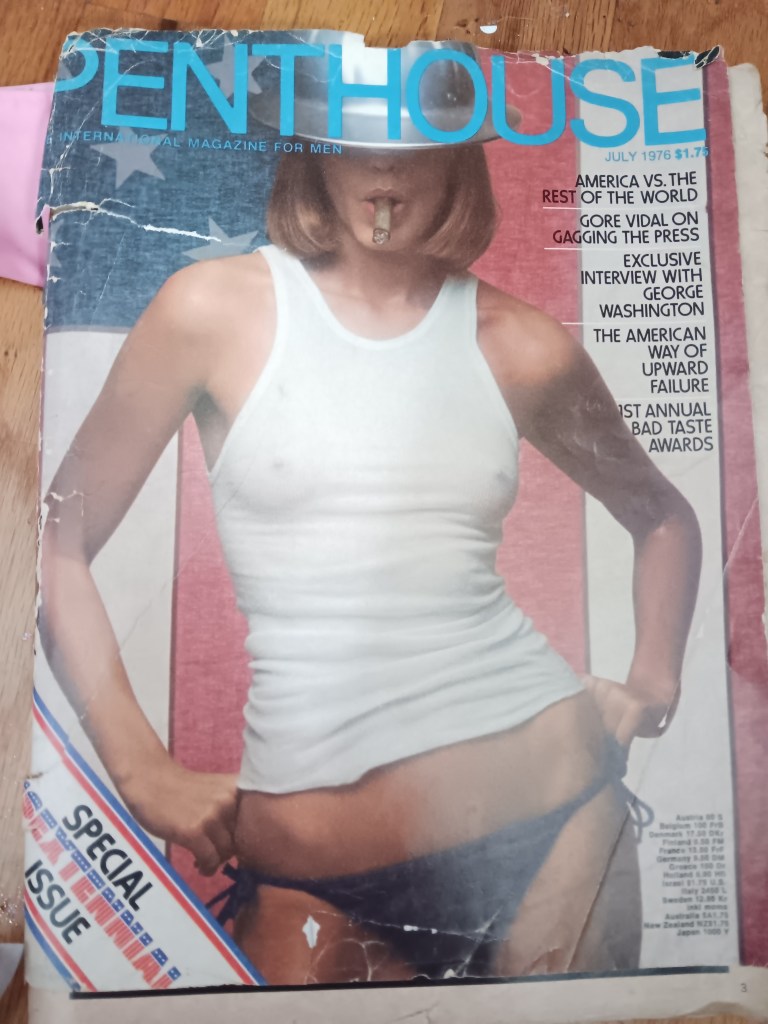
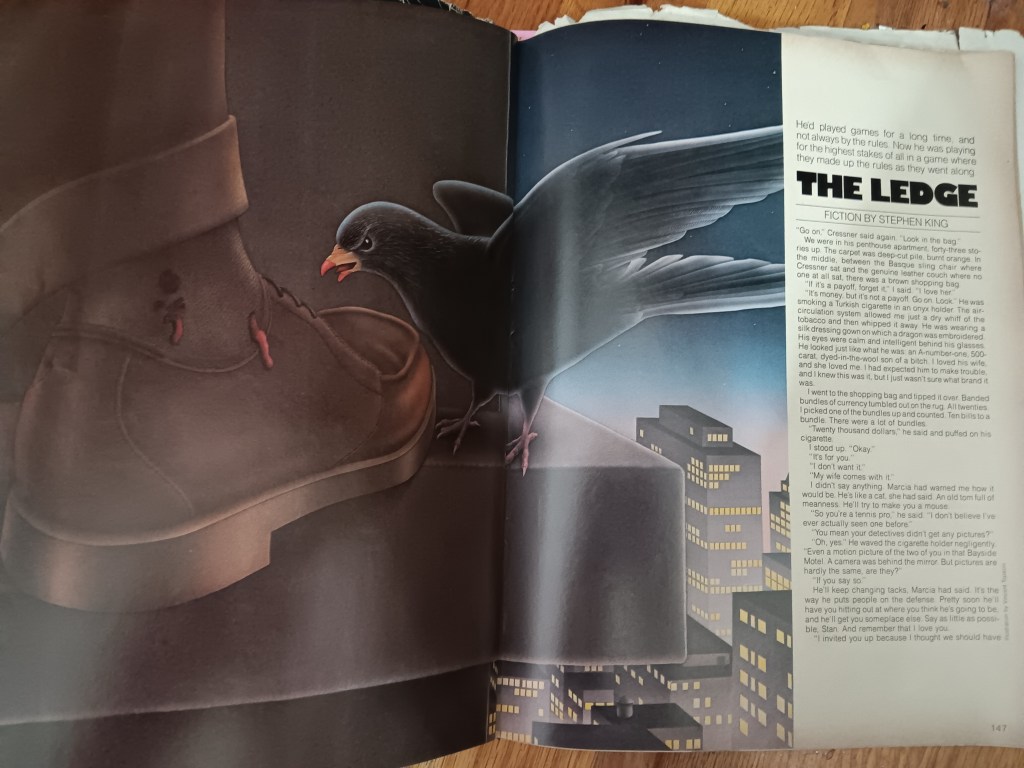
“The Ledge” is natural rather than supernatural, which I suppose elevates Penthouse‘s literary pedigree…
Of Bazaar‘s twenty stories, roughly half–eleven–were previously published in magazines. If we put two of the twenty in the ambiguous category, the score of the remaining eighteen in the battle of supernatural versus natural has natural winning out, with eleven qualifying as natural and seven as supernatural. Only two of the supernatural ones were previously published in magazines, while in the nine unpublished stories, supernatural only beats natural by one–or two since one of the two ambiguous ones was in the nine unpublished. Unsurprisingly, these statistics seem to reveal a bias in literary magazines toward the natural. And the higher ratio of natural to supernatural overall seems unusual for King but perhaps also speaks to the idea that the supernatural elements he writes about might be more natural than we’ve been inclined–or conditioned–to think.
-SCR