
The Horror Continues
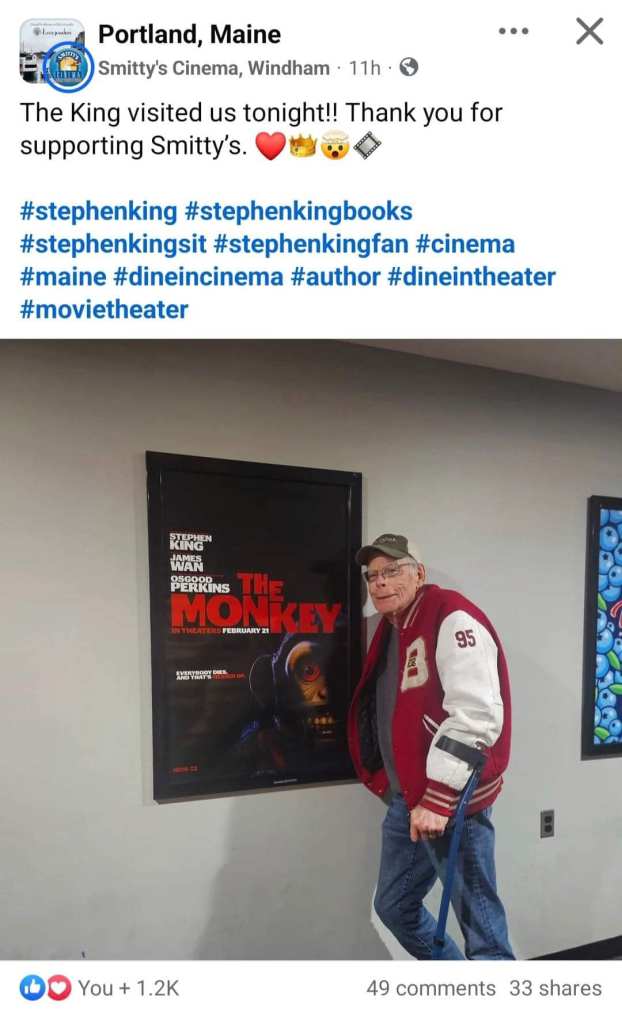
We have recently received confirmation that the next four years will be a resurgence of a dystopian nightmare. My last post mentioned Vincenzo Natali’s theory that the Trump Era played a significant role in the King Renaissance, and if that’s the case, then King won’t have to worry about his status degrading anytime soon. Not that he would have. Next year’s forthcoming adaptations include Richard Bachman titles The Long Walk and The Running Man as well as the short story under King’s name, The Monkey, which all seem apropos–the former two because of the Bachman brand’s distinctly dystopian and nihilistic flavor, and the latter because its titular figure can easily be projected onto the man who will once again be running the country.
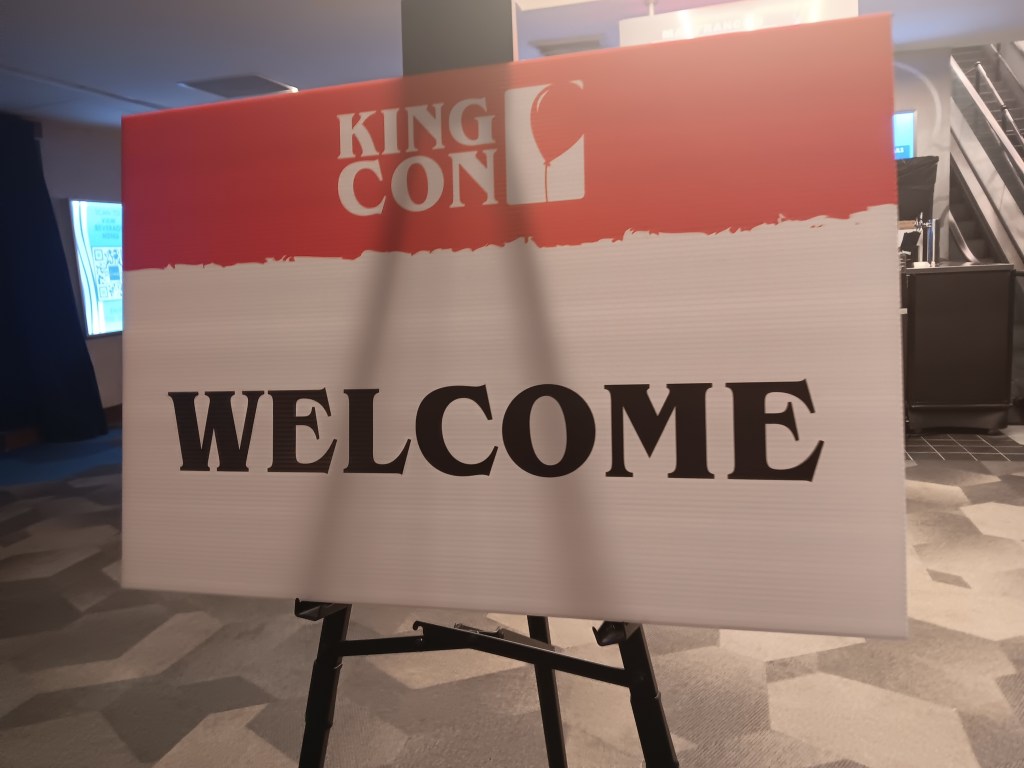
In the days leading up to an election that would have a not unprecedented outcome, an unprecedented event of sorts took place, the inaugural KingCon in Las Vegas, from October 24-26, 2024. (All of the merch lists the dates as Oct. 24-27, but in reality the event concluded on the 26th.) Las Vegas is a fitting location for such a King-themed event primarily due to its prominence in one of King’s most significant works, The Stand, as the pole to which the evil survivors of the world-ending superflu are drawn under the aegis of Randall Flagg, while the good survivors are drawn to the Magical Black Lady Mother Abagail in Boulder, CO. It was my first time in Vegas, and I was not surprised to find it the epitome of all things wrong with America in terms of consumption and excess. (And of course there’s the Trump Hotel pocking the skyline.) If we were conserving the ungodly amount of electricity this town in the middle of the desert is using in its flashing neon lights, it seems we could power human civilization for at least another thousand years.
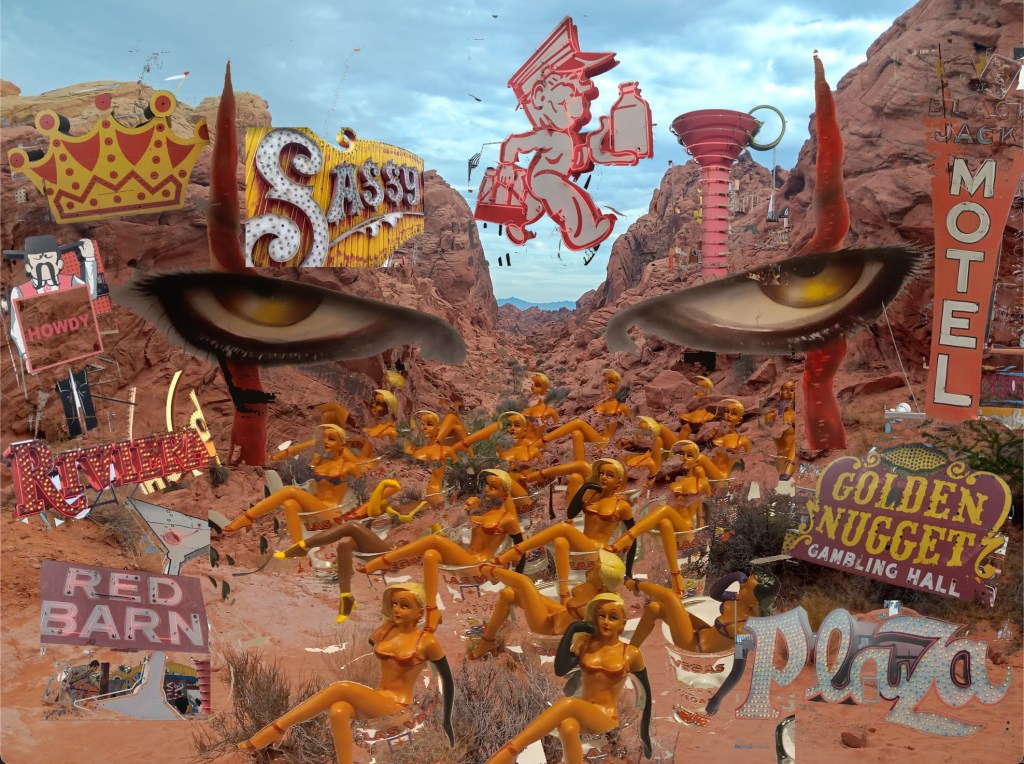
King’s deus ex machina of the literal hand of god descending to wipe out the evil population that has rallied around Flagg to resolve the plot of The Stand is one of his often-criticized endings, but it’s nonetheless a fitting commentary that that hand in the form of “crackling blue fire in the air” takes on the unmistakable air of electricity. It’s also fitting that at this point in my chronological reading I’ve just finished the electricity-centric Revival (2014).
Much has happened since my last post, including the Reality Bites house on my block being torn down, King publishing another short story collection, my article “The Disneyization of Stephen King” that was the basis of my talk at this year’s Pop Culture Association conference being published in the Journal of American Culture, the sudden death of Kingcast co-host Scott Wampler, and my being a guest on a bonus episode of the Kingcast to discuss King’s relationship to academia.
This fall semester I made fandom the basis of the elective I’m teaching at the arts high school, officially entitled Fans of Fandom, with the framework that fandom exists on a spectrum of toxic to life-saving that is represented by King’s novels Misery and The Girl Who Loved Tom Gordon, respectively.
In Misery, Paul Sheldon ruminates on the nature of parasocial relationships, which are fundamentally one-sided. Paul thinks about someone who mourns a fictional character’s death, but of course parasocial relationships can exist with real people as well, and the depth of one I had forged was driven home for me when I learned Scott Wampler had passed. This sentiment was expressed on the Kingcast Discord I have access to as a Patreon subscriber. I initially subscribed for access to the directors’ commentaries for the PCA conference adaptation roundtable, which alone was worth the money, as evidenced by the Mike Flanagan commentary’s centrality to my contributions (and Vincenzo Natali’s Trump theory).
Another development since my last post is the announcement that Flanagan is adapting Carrie into an Amazon series, and a recent bonus episode has host Eric Vespe bring his fiancé Kelsey on to discuss Flanagan’s knack for successful King adaptations. Vespe’s thesis: King and Flanagan have a shared emphasis on character development. Kelsey’s thesis: “because he is such a big FAN of the original source material…he knows what fans would want because he is one.” Kelsey recaps their discussion points about Flanagan’s key ingredients: 1) empathy and evoking emotions, 2) the fan side, 3) being a writer-director, 4) creative genius. As much as I love and respect Mike Flanagan and Carrie alike, I am not personally of the opinion that we need yet another Carrie adaptation, but it did highlight a mistaken claim I made in my last post that a King adaptation has never been directed by a woman–the 2013 Carrie was directed by Kimberly Peirce. (I would not say this is a film that vindicates King adaptations by women, but why do I have a feeling men were responsible for the absurd casting of the gorgeous Chloe Grace Moretz in the title role.) The Kingcast in fact did a bonus episode on this subject in 2021.
The Kingcast Patreon has proven valuable in other ways as well–for one, I would not have known about KingCon’s existence without it.
KingCon’s logo centralizes the red balloon that has become a sign of the presence of Pennywise, King’s most iconic villain.

This logo marries King novels and King cinematic adaptations–the novel and the 1990 miniseries associate Pennywise with balloons of all colors; it’s the 2017 adaptation, that critical text of the King Renaissance, that associates exclusively red balloons with Pennywise. Hence, a lot of the KingCon merch is the red of this balloon and logo, including, rather unfortunately, its cap:
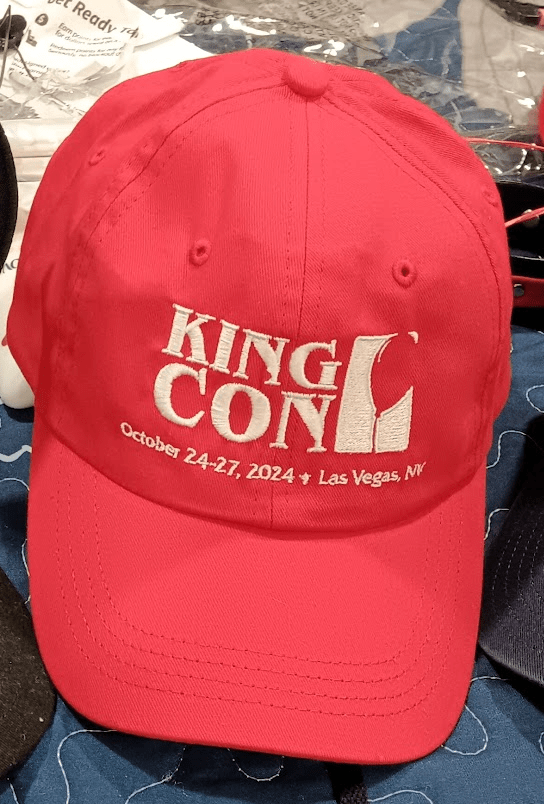
There was also a black version of this cap for sale, but when I was buying my merch in something of a frenzy at the Con registration because it was selling out very quickly, I opted for the red one without giving it much thought because it was a better representation of the Con logo. It wasn’t until after I’d bought it that I realized it was a dead ringer for a MAGA hat and that I could never wear it in public unless I wanted to be mistaken for a Trump supporter.
This was ironic in light of a statement the Con felt compelled to post on its website due to the event’s proximity to the election:
King Con Attire
Hello KingCon attendees! We are days away from the epic inaugural event that has been over a year in the making! We could not be more excited to share with you the fruits of all this work! As you know, the U.S. is deep in a very passionate political season with many holding strong opinions in all areas of the topic. To ensure that KingCon remains focused on the passions we all have in common and that bring us all together this weekend, please respect that KingCon is an apolitical space. Please refrain from wearing any attire promoting messages for or against any political candidate or party. KingCon should be a much needed, all-too-brief respite from politics.
here.
I was attending this convention as a bona fide fan, but also as a bona fide King academic scholar interested in its expression of fandom to the extent that I will likely give an academic talk on KingCon and the King fandom at the next PCA conference (which means I am a nerd on two different fronts). And so I found this statement ironic through another lens, that of Michael Blouin’s 2021 study Stephen King and American Politics, which observes that King’s work presents itself as apolitical while in reality being nothing of the sort–not just because it’s generally impossible for anything to be apolitical, but in more of a calculated appeal to the masses. (This argument of Blouin’s proved central to my own Disneyization of King thesis.) Per the pop culture/academia split, Blouin’s title didn’t come up in the post-election bonus episode released on the Kingcast Patreon, “Talking (Scared) Politics with Neil McRobert,” the host of the Talking Scared horror podcast that did an excellent pair of episodes with several different guest writers choosing a King short story to talk about earlier this year. But McRobert did pinpoint Under the Dome (2009) as a political novel of King’s, calling its antagonist Jim Rennie King’s greatest villain. Blouin has a great chapter breaking down Dome as a takedown of Bush-era politics with Rennie representing Dick Cheney. And King selected Dome as one of his picks for the top ten novels of the twenty-first century for the New York Times (I’m pretty sure he’s the only one of the fifty-three writers asked to do so that put a book of his own on their list). He’s also the writer who gets top billing.

Revival is an appropriate title to have been reading at the moment Trump was re-elected; from the Kingcast I’ve long known it has one of his darker endings (as Kingcast host Vespe has noted, their promotion of this underrated title is part of the “DNA of the show”). A dark ending, for a novel especially, is pretty rare for King in his later period. (Spoilers ahead.) Under the Dome has what’s often considered one of King’s bad endings in revealing the party responsible for the titular dome to be bullying aliens essentially treating the domed town’s residents like ants under a magnifying glass, but it’s a happy-ish ending in that the heroes convince the aliens to stop being bullies (happy-ish because most of the town dies beforehand). Revival flips the tone of the ending as it flips the role of the ants, revealing a doomed vision of an afterlife in which “Driving the humans were antlike creatures, most black, some the dark red of venous blood. When humans fell, the ant-things would lunge at them, biting and butting, until they gained their feet again.”
In the politics episode, Vespe genteely observed that we were going to be “eating a shit sandwich every day for the next four years.” This took me back to South Park‘s take on the 2004 election being between a “giant douche” and a “turd sandwich,” which seemed fitting, since South Park and its shitterations was one of this blog’s foundational comparisons to King. It’s also fitting for King’s foundation in general.
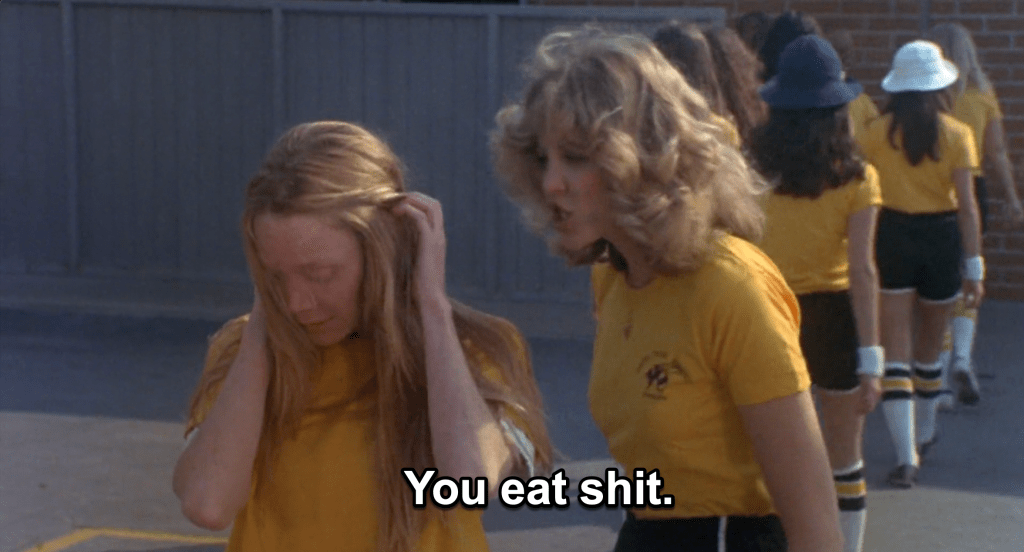
The day after the election, the student presentation in the fandom class was on the South Park fandom–on Trey Parker and Matt Stone incorporating fan art of a “ship” between characters into the show, but I noted how Matt and Trey had abstained from making their salient biting topical commentary this election season, which strikes me as a bad sign.
And speaking of signs…
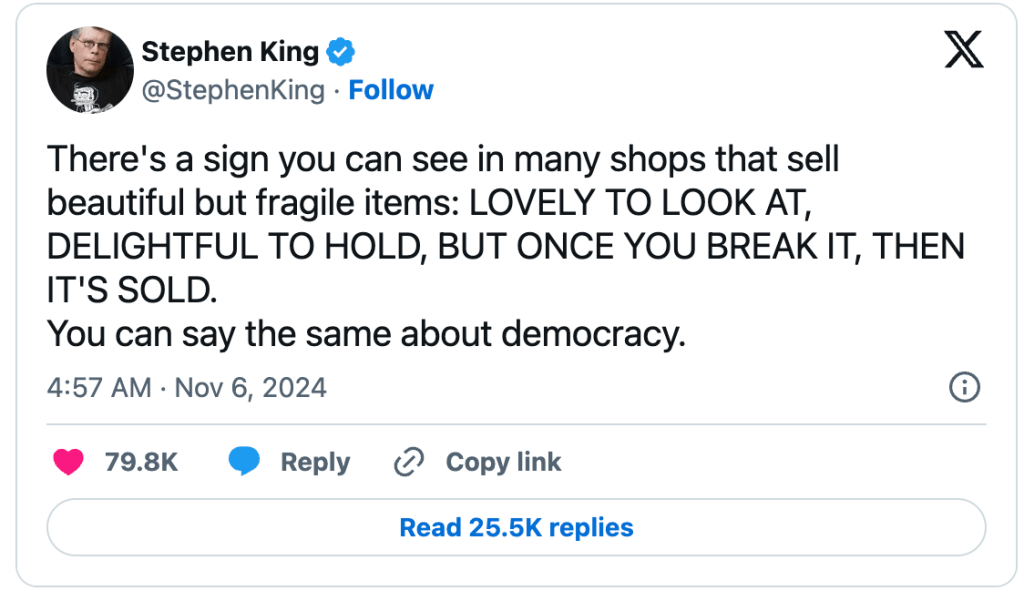
And then, King was banned from X for calling Elon Musk “the First Lady.” I’d say free speech doesn’t exist in a corporatocracy, but this turned out to be fake news.
Then King left X anyway.
The Fanhouse
Another class I’m teaching this fall is the upperclassmen advanced fiction workshop, and I made the students read two of King’s stories from his new collection You Like It Darker (and one voluntarily presented on a third!). But first, I tortured them by making them read John Barth’s “Lost in the Funhouse” (1967), mostly to emphasize the white patriarchal foundations of literary fiction and workshopping specifically developed as capitalist tools to fight communism after WWII, as discussed by Matthew Salesses in his 2021 book Craft in the Real World: Rethinking Fiction Writing and Workshopping (as discussed in my Firestarter posts). John Barth was one of the first full-time university teachers of creative writing under this new paradigm.
My last post covered mirror metaphors and the salience of Pennywise embodying individuals’ projections of fear. “Lost in the Funhouse” contains both these ingredients in a plot arc that on its most surface level would be described as a boy in the 1940s visiting Ocean City with his family, culminating with him inviting his crush into the funhouse on the beach fairgrounds.
Stepping from the treacherous passage at last into the mirror-maze, he saw once again, more clearly than ever, how readily he deceived himself into supposing he was a person. He even foresaw, wincing at his dreadful self-knowledge, that he would repeat the deception, at ever rarer intervals, all his wretched life, so fearful were the alternatives.
John Barth, “Lost in the Funhouse” (1967).
But this is a tentpole work of the postmodern movement, which means it’s overflowing with meta-commentary on the nature of fictional constructs:
The beginning should recount the events between Ambrose’s first sight of the funhouse early in the afternoon and his entering it with Magda and Peter in the evening. The middle would narrate all relevant events from the time he goes in to the time he loses his way; middles have the double and contradictory function of delaying the climax while at the same time preparing the reader for it and fetching him to it. Then the ending would tell what Ambrose does while he’s lost, how he finally finds his way out, and what everybody makes of the experience.
John Barth, “Lost in the Funhouse” (1967).
In the midst of this commentary, the funhouse becomes a metaphor for fictional constructs generally, and the larger plot arc is the boy understanding and accepting that he will become a fiction writer (and that this won’t be fun).
He wishes he had never entered the funhouse. But he has. Then he wishes he were dead. But he’s not. Therefore he will construct funhouses for others and be their secret operator – though he would rather be among the lovers for whom funhouses are designed.
John Barth, “Lost in the Funhouse” (1967).
Coinciding with the story’s opening lines–“For whom is the funhouse fun? Perhaps for lovers.”–this reveals that the surface arc and deeper arc entail a conflation of what the funhouse is “for” that ultimately reinforces the institution of literary fiction as inherently misogynist:
Ambrose understands now, but didn’t then, that his father was wondering whether he knew what the funhouse was for – specially since he didn’t object, as he should have, when Peter decided to come along too.
John Barth, “Lost in the Funhouse” (1961).
This is the context in which the funhouse is for hitting on girls, reinforced when they’re inside and see “[t]he sailor’s girl was a string-haired hussy with a loud laugh and light blue drawers…” With so much content directly commented upon, what is not commented on is what Salesses would point out is a “moral choice,” and exactly zero of the racist and misogynist comments are commented upon. If the funhouse is for guys to hit on girls, and the funhouse is the construct of fiction itself, then the construct of fiction itself is for guys to hit on girls. That the story renders fiction an inherently (white) male-centric institution from its conception is reinforced repeatedly:
Can spermatozoa properly be thought of as male animalcules when there are no female spermatozoa? They grope through hot, dark windings, past Love’s Tunnel’s fearsome obstacles. Some perhaps lose their way.
John Barth, “Lost in the Funhouse” (1967).
The white male adolescent protagonist fantasizes about marrying his crush and her validating and celebrating him as a successful writer along with the rest of the world–i.e., the white male American dream–and we’re supposed to look upon him with sympathy, in spite of, or more likely because of, lip service to an opposing interpretation that can really only be read ironically:
“Is anything more tiresome, in fiction, than the problems of sensitive adolescents?”
John Barth, “Lost in the Funhouse” (1967).
This would be an example of the “say it” trap King falls into so often where acknowledging the existence of a problem is equated with solving it. Similarly, another passage seems to acknowledge the possibility that Ambrose might be more villain than hero:
A child took things for granted because he had nothing to compare his life to and everybody acted as if things were as they should be. Therefore each saw himself as the hero of the story, when the truth might turn out to be that he’s the villain, or the coward. And there wasn’t one thing you could do about it!
John Barth, “Lost in the Funhouse” (1967).
Yet there’s no other way to read this than as a classic coming-of-age story for a white male adolescent with a meta gloss. The story treats Ambrose as hero. Teaching this story in 2024, my point is that Ambrose, and the successful white male American writer he’ll become (undeniably a stand-in for Barth himself), actually is a villain.
This hero/villain framework can be applied to the first You Like It Darker King story I assigned, “On Slide Inn Road,” which also offers a potential manifestation of fandom by way of influence: I recognized that the story had significant elements in common with Flannery O’Connor’s “A Good Man is Hard to Find” (1953) before I read King’s acknowledgment of her influence in his blurb “thinking of Flannery O’Connor” placed at the end. I had the students read the O’Connor story first (as I sometimes do anyway because of Robert Boswell using it as a prominent example of his concept of narrative spandrels, which, like “Funhouse,” uses an architectural metaphor for a fiction-related concept). Salesses encourages us to look at the implications and cultural message of the events that occur in a story, and in “A Good Man,” the grandmother’s racist (in fact MAGA-like) nostalgia is directly responsible for the chain of events that leads to the entire family’s death when a car accident puts them in the path of gun-toting criminals. Implication and message: such values are dangerous and destructive. If the criminals with the guns are the explicit villains, the grandmother is an implicit one.
King replaces the grandmother figure with a grandfather, one with a similarly problematic bent toward nostalgia for the old days, expressed initially in a racial slur and then in a love of baseball. The grandfather is, like the grandmother, responsible for the family ending up on a road they should not be on that puts them in the path of gun-toting criminals. Except instead of this leading to the family’s death, the grandfather saves the family from the criminals with a baseball bat. The story thus validates instead of indicts the grandfather’s values not only by making him the hero, but by making the object of his heroism one explicitly associated with his nostalgia (and one that functions, incidentally, as a narrative spandrel). Since King himself is a die-hard baseball fan and around the age of this grandfather figure, it’s hard not to read this character as a King stand-in of sorts. King himself would not be the type of explicit racist hurling racial slurs, but is more the implicit microaggressive kind who doesn’t think that he’s racist. Take, for instance, this story’s version of his “say it” problem, King’s attempt to point out that the grandfather’s values are problematic (with three strikes: misogyny, homophobia, and racism) that the story’s conclusion undermines by way of the grandfather’s heroism and the father’s paralysis and inadequacy: it’s the father who thinks sarcastically about the “good old days” the grandfather loves including, among other things, “the days when gay people went in fear of their lives” to highlight the homophobia, and the use of the n-word to highlight, in theory, the terrible racism of those days. The n-word does not, and in 2024 should not, be used to make this point.
A central aspect of the adolescent and future writer’s conflict in “Funhouse” is that to be a writer figure means to observe from the outside rather than actively experiencing something from the inside:
Strive as he might to be transported, he heard his mind take notes upon the scene: This is what they call passion. I am experiencing it.
John Barth, “Lost in the Funhouse” (1967).
King’s most postmodern meta-moment is when he inserts himself as a character in the Dark Tower novels that the other characters discover is writing the story they’re in, and when they’re about to meet him (in Song of Susannah) one feels “the gathering power … of Tinkerbell’s magic dust and Dumbo’s magic feather,” a moment central to my “Disneyization of King” thesis that King uses Disney to mediate his own conflict of whether his success derives from external branding (Tinkerbell’s magic dust) or his own internal writerly talent (Dumbo’s magic feather). If the other most significant aspect of my thesis is the “daddy issues” King has with Disney expressed in his frequent “Sorcerer’s Apprentice” references, then the patriarchy is reflected in his Disneyization as well.
If Trump’s successful presidential “campaign will go down as one of the most racist, sexist, and xenophobic in modern history,” then we can look at “Funhouse” as reflecting how the internal logic of fiction reflects the workings of the external world. “Funhouse” comments on the performed distance between fiction and the real world at the instance of the story’s most emblematic intersection of misogyny and racism, which go entirely uncommented upon because a racist and misogynist perspective is simply an accepted norm in the world and in fiction:
The more closely an author identifies with the narrator, literally or metaphorically, the less advisable it is, as a rule, to use the first-person narrative viewpoint. Once three years previously the young people aforementioned played Slaves and Masters in the backyard; when it was Ambrose’s turn to be Master and theirs to be Slaves Peter had to go serve his evening papers; Ambrose was afraid to punish Magda alone, but she led him to the whitewashed Torture Chamber between the woodshed and the privy in the Slaves Quarters; there she knelt sweating among bamboo rakes and dusty Mason jars, pleadingly embraced his knees, and while bees droned in the lattice as if on an ordinary summer afternoon, purchased clemency at a surprising price set by herself.
John Barth, “Lost in the Funhouse” (1967).
“Lost in the Funhouse” might as well describe my location in the King canon at this point. And if there’s something the election has reinforced about the patriarchy, it’s that we cannot escape it.
Which is fitting because…
Escape IT
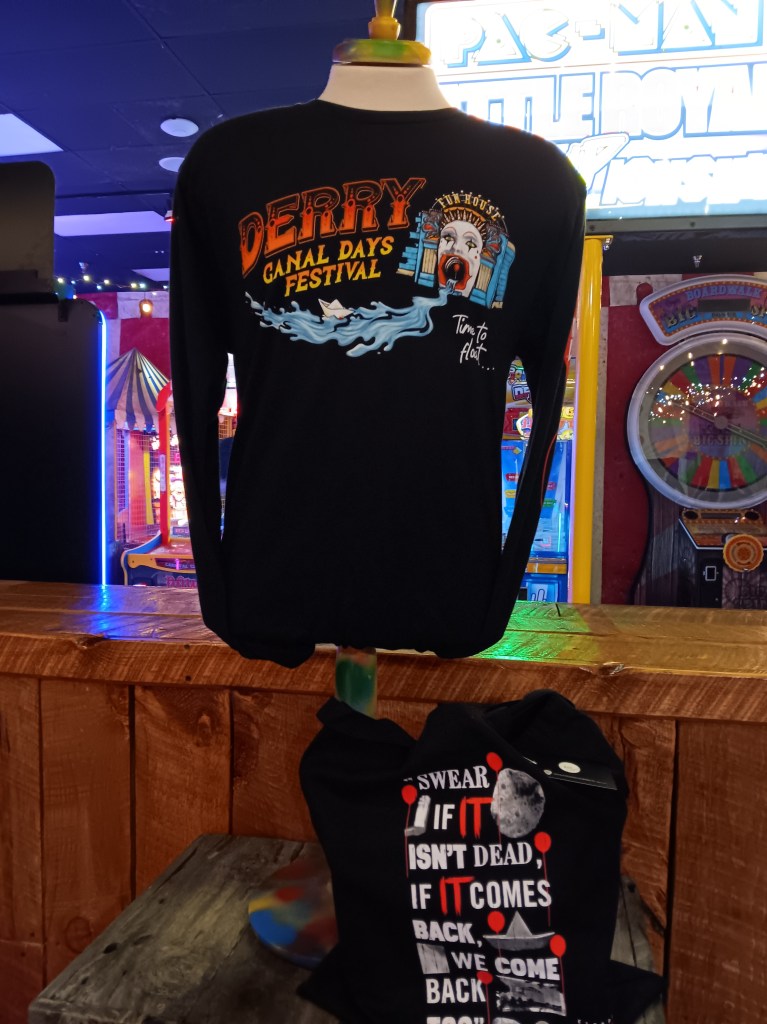
Another reason that Vegas is a good location for KingCon is a landmark that is a must-see for any diehard King fan, a destination that might well be as necessary as the King tour in Maine (the ultimate pilgrimage I still have yet to undertake)–an IT-themed escape room entitled Escape IT.
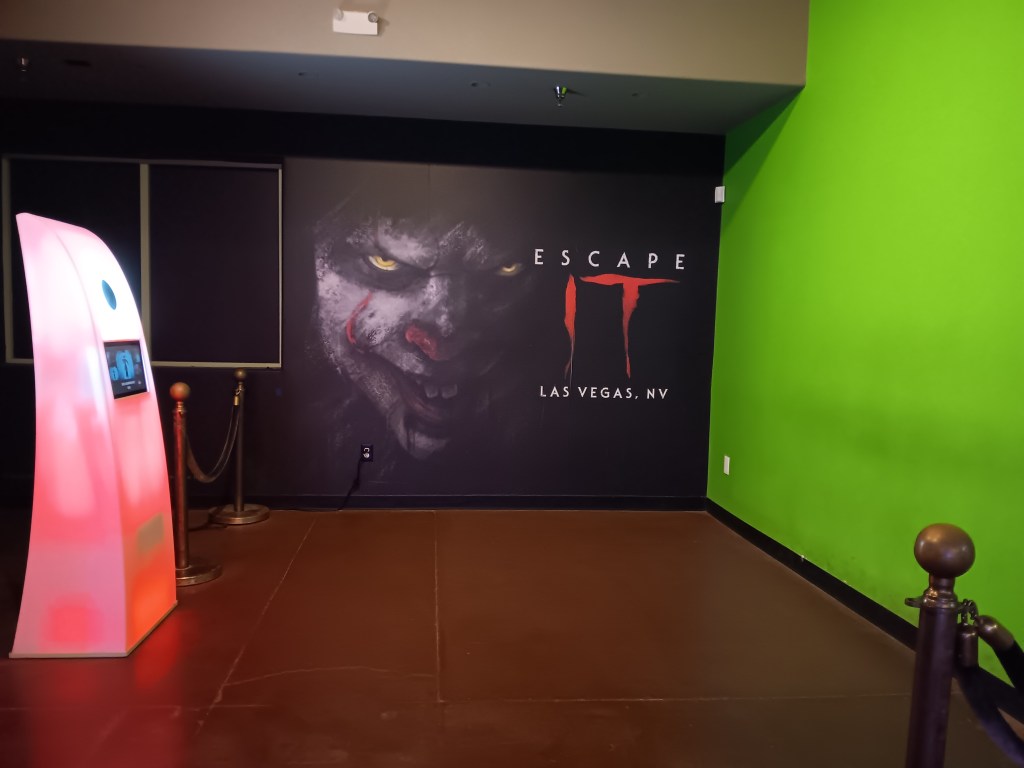
Also, the turtle, that emblem of the King cosmos that IT explicates, would seem to be a symbol for Vegas generally as well.

Escape IT alone would have made visiting Vegas for the Con worth it. As a fan, I can’t say enough good things about it. As an academic, it does make me think that I cannot escape from the racist and misogynistic intersection of the patriarchy; if Trump is key to the King Renaissance, and IT (2017) is key to the King Renaissance, maybe it’s not a coincidence that this intersection unfortunately resides in both, though in the latter it’s harder to locate. (It’s also hard for me because I love the 2017 movie.) Consider two changes this adaptation made from the book:
Number one: Pennywise kidnaps Beverly right after she stands up to and physically injures her father, which leads to a sequence in which Ben brings her back from the hypnosis of the deadlights with a version of Sleeping Beauty’s true love’s kiss. Bev is completely robbed of agency, and there’s no sequence where she’s the one to take on Pennywise with the slingshot that empowers her in the book (and the 90s miniseries, which doubles her agency by having the adult Bev do this too). Thanks to Kimberly Beal for pointing this out in our adaptation roundtable at the last PCA conference.
Number two: as argued by Kevin J. Wetmore, Jr. in his chapter “Changing Mike, Changing History: Erasing African-America in It (2017)” in The Many Lives of IT: Essays on the Stephen King Horror Franchise (2020), the 2017 film “re-centers Mike’s story on Ben [Ben takes over Mike’s role as the secret historian], and erases the novel’s and miniseries’ point that people of color often know the real history more than their white counterparts who get to choose ‘what will fade away.’”
Both these ultimately misogynist and racist changes end up giving Ben a lot more agency…also, as a side note, at the Con Vespe mentioned that they’ve only had to pull two Kingcast episodes after recording them (there are 258 episodes on the main feed at this point) and one of them was with the actor James Ransone, who plays the adult Eddie in It Chapter Two (2019), after footage emerged of him making anti-trans remarks.
If this seems like paying attention to too much nitty-gritty detail, I could argue that doing this paid off in the design of Escape IT, in which the attention to detail was impeccable.
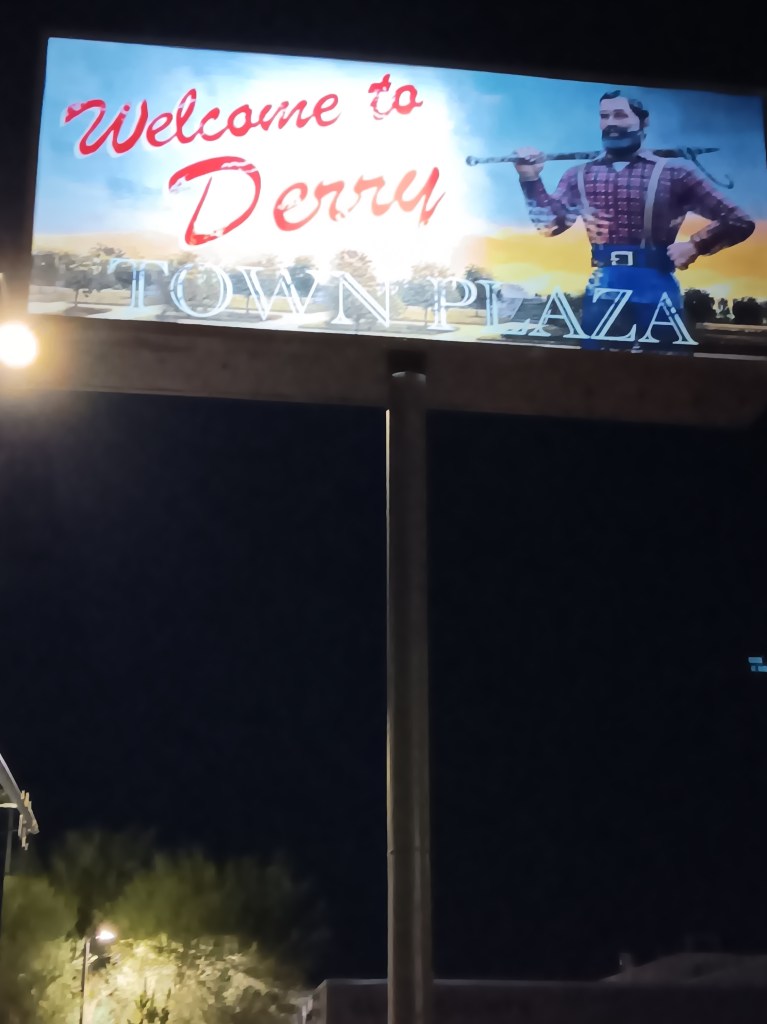
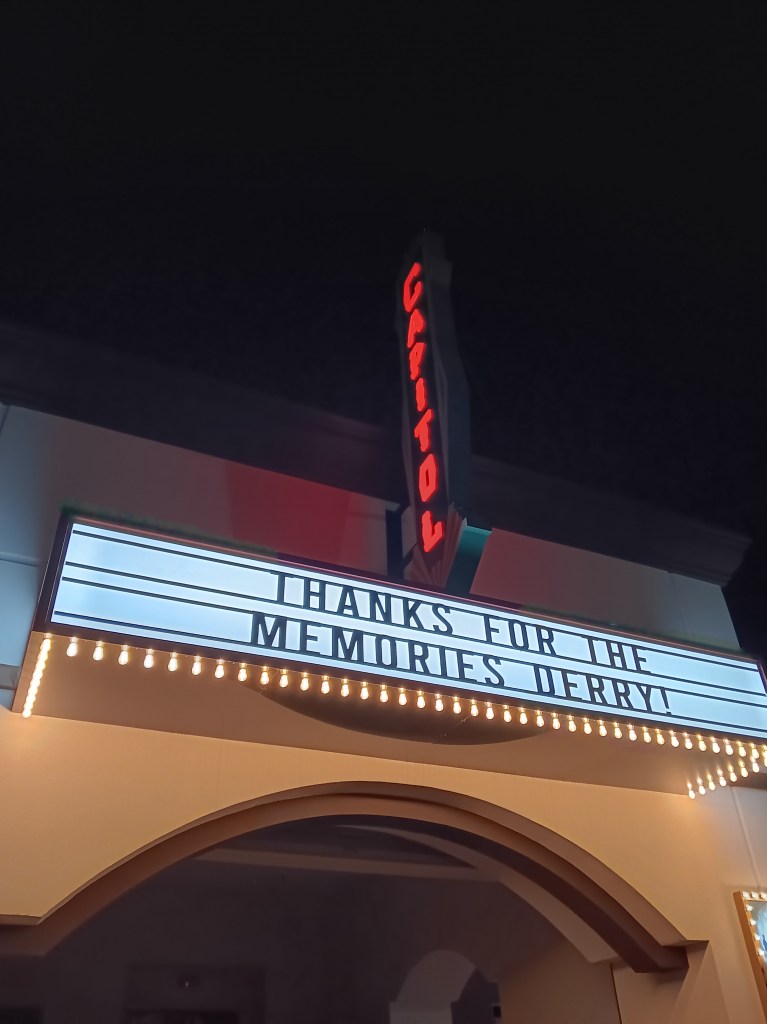
It contains two different sets of rooms, “The Sewers,” and “The Funhouse,” with the former predominantly correlating to the 2017 movie and the latter the 2019 sequel.
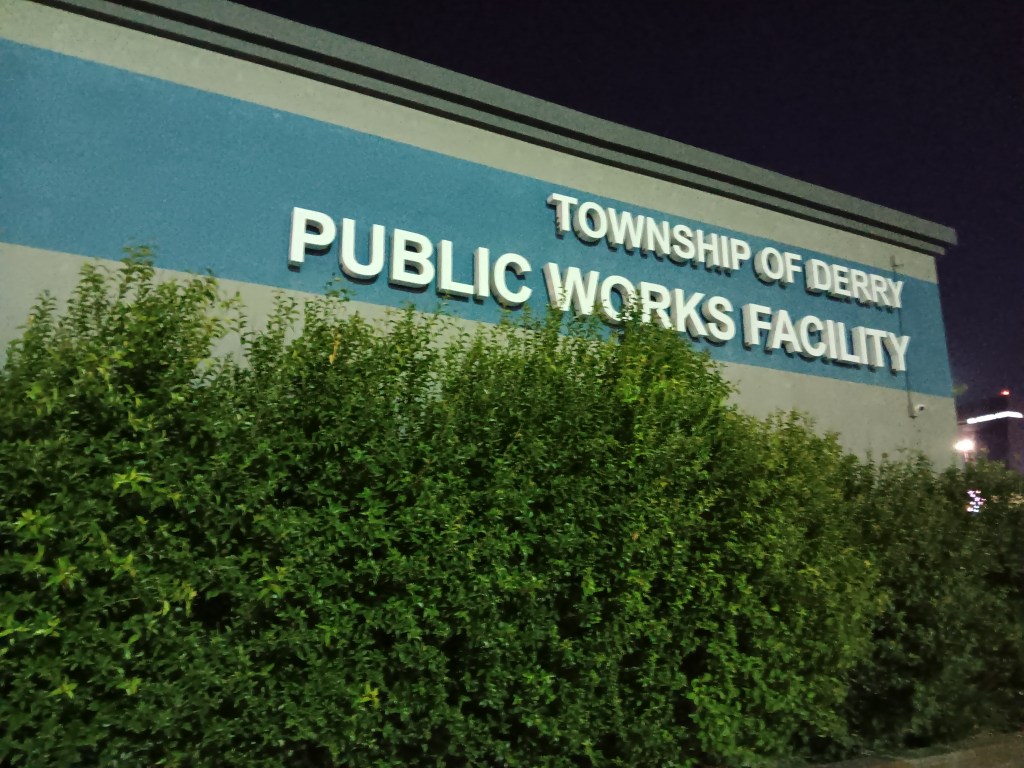
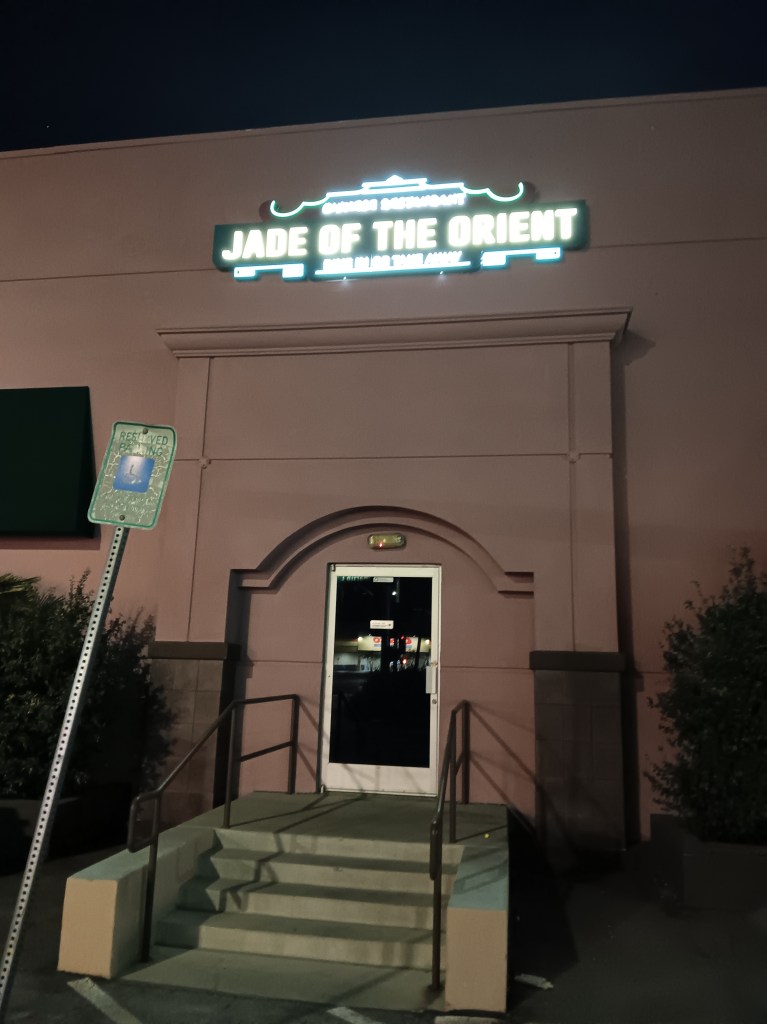
The waiting room is the arcade:

The only reservation I could get was during the first night of the Con, so I had to miss that night’s event, Kingcast host Eric Vespe interviewing actor Thomas Jane for an episode in front of a live audience. Since I had gone to the Linq Hotel to register that afternoon and procured (too much) KingCon merch, I was recognized by another attendee who was leaving Escape IT as I arrived. She said she had just done it by herself because nobody else had booked during her window (so, question mark as to why that time was unavailable when I was making my reservation the day before), and it was really hard. She ended up making it to the Kingcast recording, and I ended up doing the escape rooms with a team of other people instead of by myself. For me, missing the recording was worth the trade-off of not having to do the rooms alone–even though it also meant missing Thomas Jane entirely, who was supposed to be there all weekend but had to leave suddenly to go to a film set. For the other person, who said she’d decided to come primarily because the Kingcast was going to be there, doing the rooms alone was probably worth the trade-off of making it to the recording.
I had never done an escape room of any sort before, but had the vague understanding it was a collaborative effort to solve the puzzles to escape. If that’s true for all escape rooms, it would of course be especially thematically appropriate for IT, in which the protagonists can only defeat Pennywise by maintaining a united front–one of multiple reasons I was glad to not do Escape IT alone.
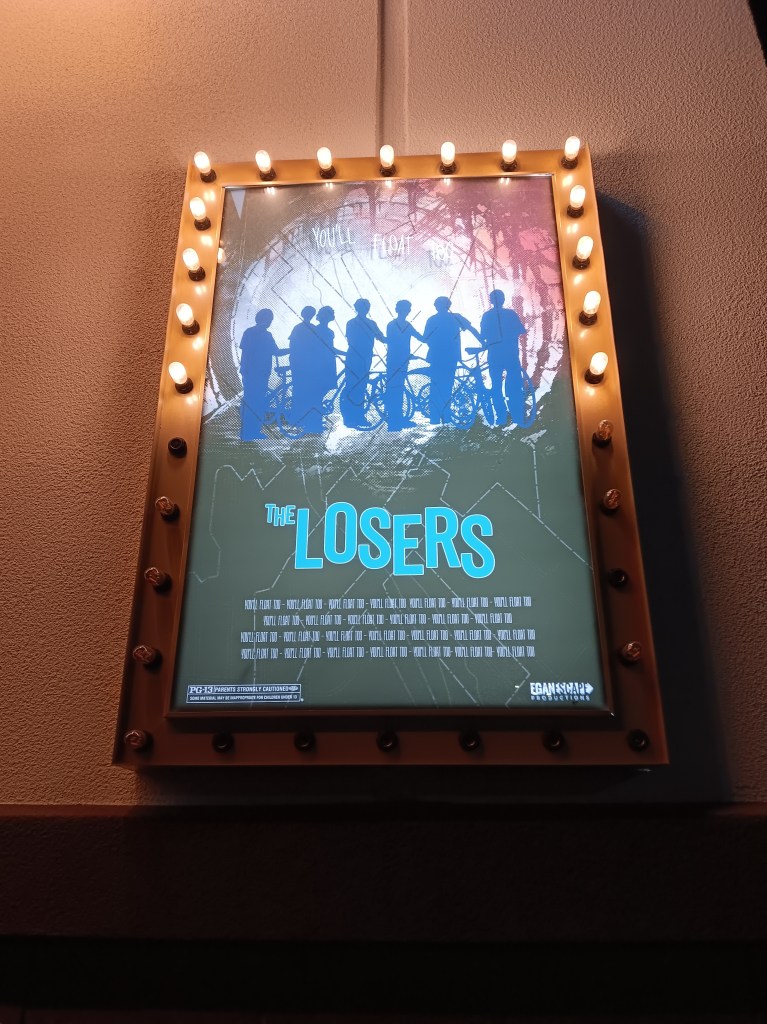
Seven is the magic number of the united front in IT, but Escape IT caps a full group at nine. In my full group was one other KingCon attendee, also recognizable from the merch she was wearing. I thought that the clues for Escape IT would be based on the content of the movies (and possibly book), but while the settings of the rooms (mostly) correlated to the movies, the puzzles involved arbitrary clues, most often to glean the combination to locks to the next room. This is another reason I am glad I was not by myself–my mind does not work this way. As we proceeded from room to room, staff members played roles through which they could nudge us toward the clues if we were having trouble finding them, starting with a Derry Public Works employee. With this staff member we rounded a bend into a sewer tunnel, at the end of which I saw Pennywise disappear past the grate blocking the other end. This did not stop me from screaming when we were standing right by that grate trying to open the door to the next room and Pennywise suddenly reappeared and jammed an arm through at us. The next set of rooms was run by an employee of Hanlon Farms, until they vanished when we entered the room that looks like Bill’s garage where the projector scene takes place…
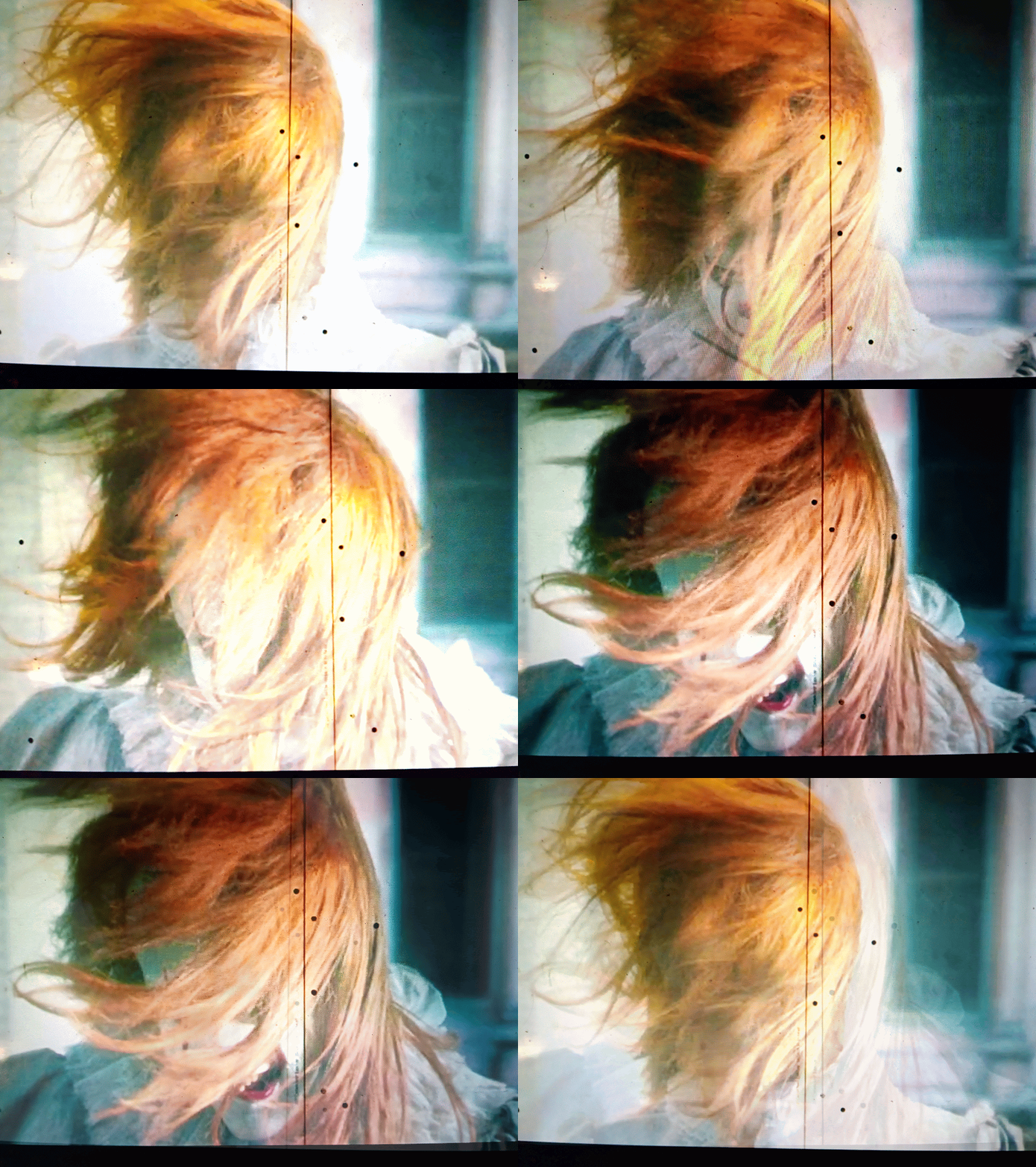
And in keeping with the horror of Pennywise crossing the threshold from 2-D to 3-D in this scene, the Pennywise actor chased us out of this room (among others). I can’t really describe how terrifying and exhilarating it was to have such an authentic-seeming Pennywise chasing you, to have it feel so real while knowing it’s not real.
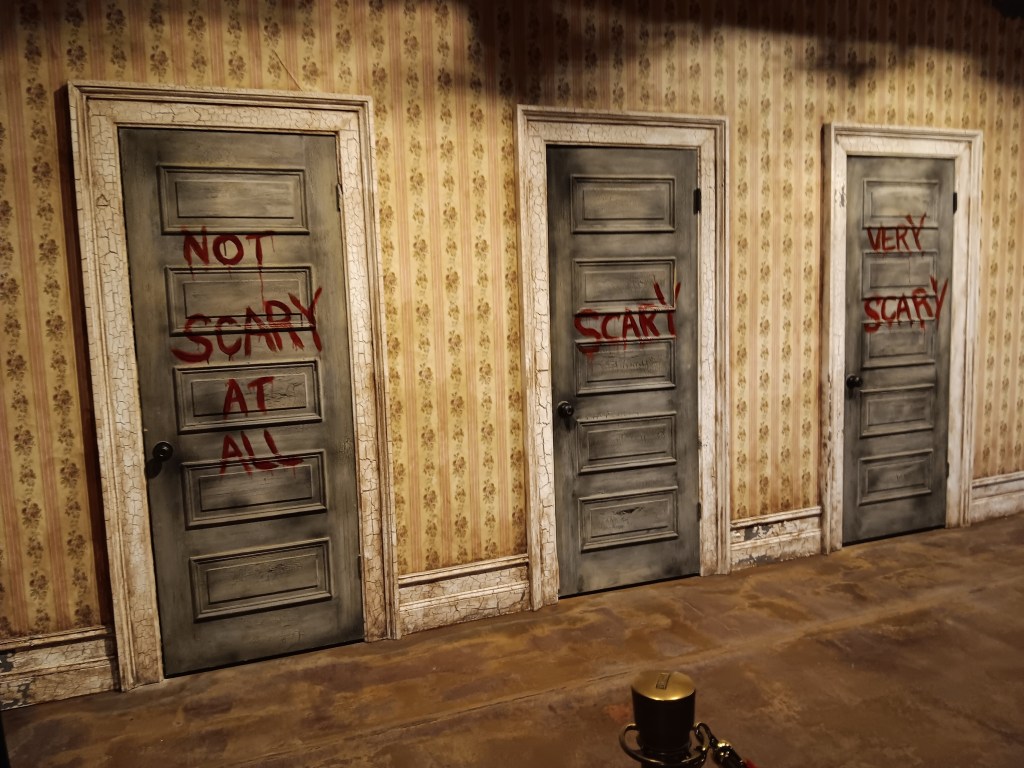
Of course we also went into the Niebolt house with the infamous door selections..
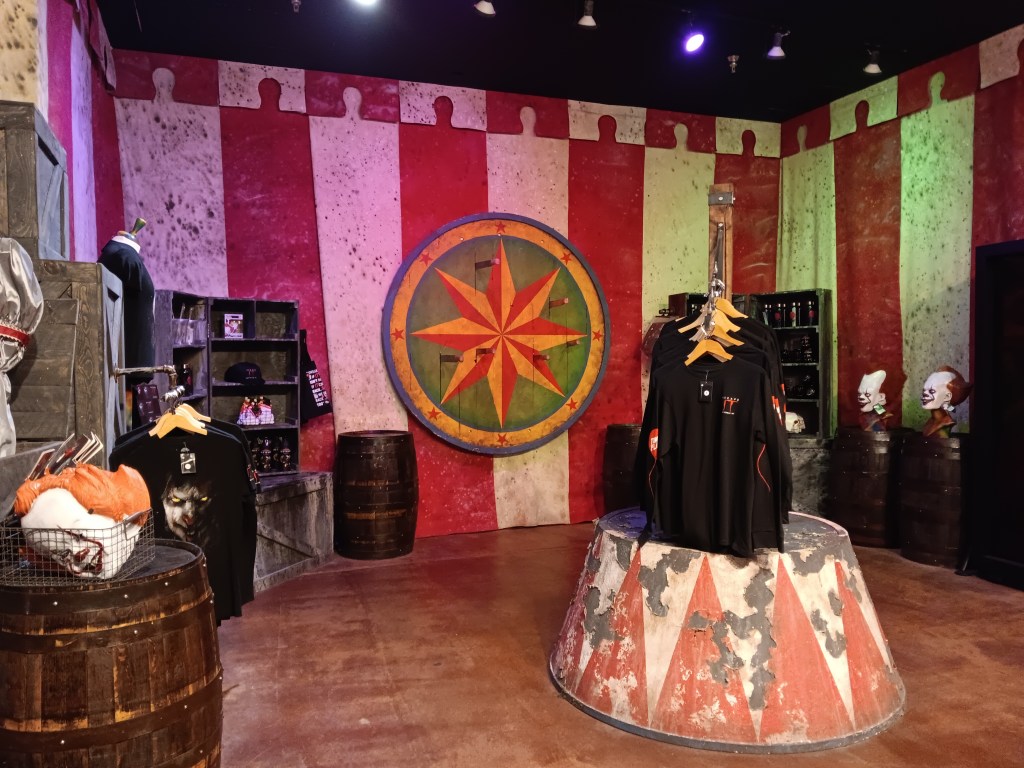
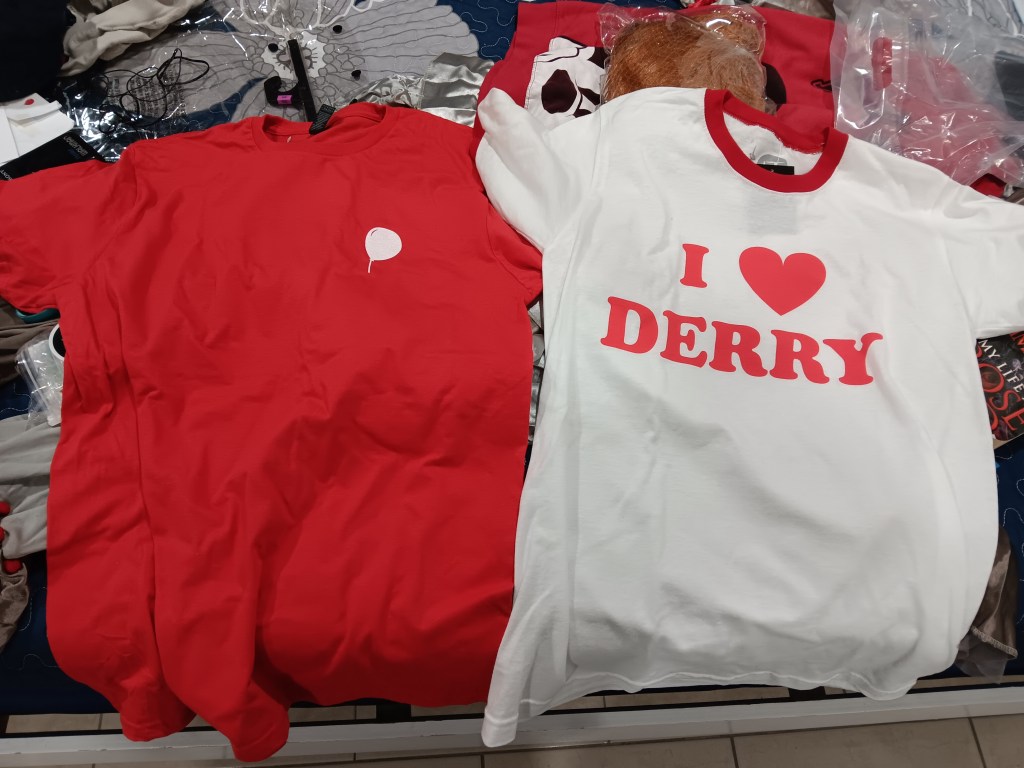
The final room in the Sewers replicates Pennywise doing the (minstrel) dance before he jumps out at Bev after he kidnaps her in the movie. Then he chases you into the gift shop.
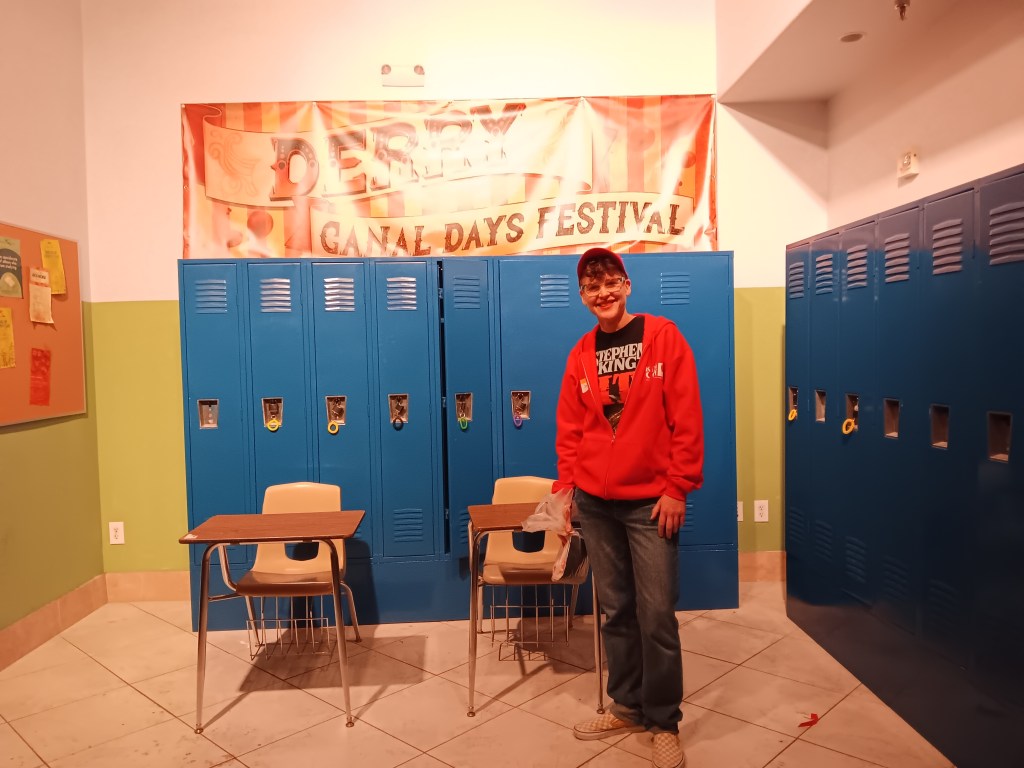
The “Funhouse” replicates stages of the second movie a little more thoroughly than the Sewers replicates the first one, starting at Jade of the Orient, including the Kersh apartment and Funhouse, and culminating in the cavern with the Spider Pennywise where we had to actually hold hands and stand in a circle shouting “Turn light into dark” like they do at the end of the second movie. (You’re pretty much trauma-bonded with your group by the end, so this didn’t even feel weird.) The funhouse part of the Funhouse rooms is a bit more involved than the funhouse setting that appears in the movie, but the mirror maze sequence is the most intense part, with strobe lighting, an actor screaming to be let out of a glass box they’re locked in, and Pennywise chasing you in circles. I have to commend the staff actors, Pennywise and otherwise. For me, it was an unprecedented immersive experience: it feels like you are in the movies! Of course, fiction itself is an immersive experience in the way it operates on the brain, but the escape room immersive experience was another layer of real v. imagined.
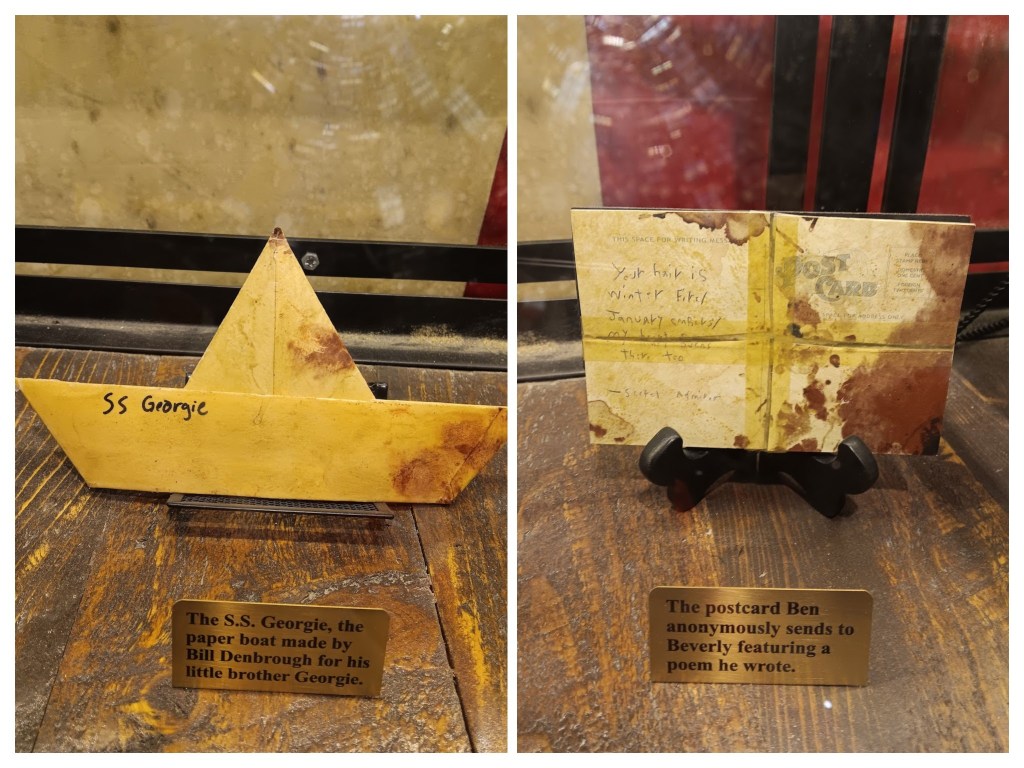
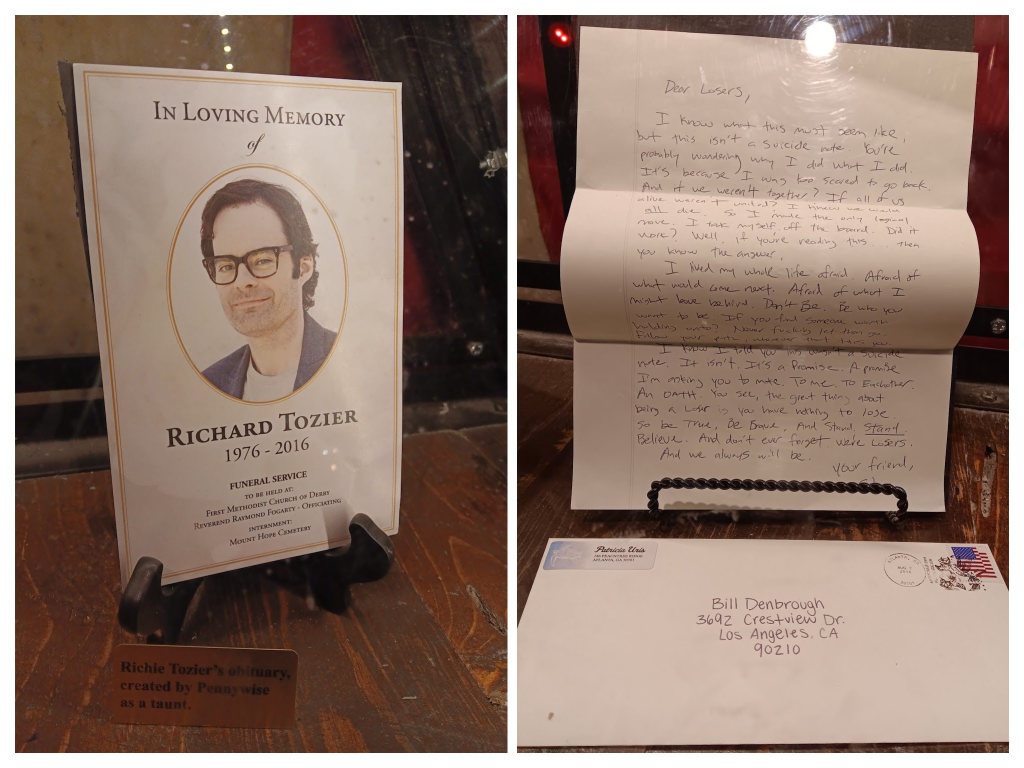
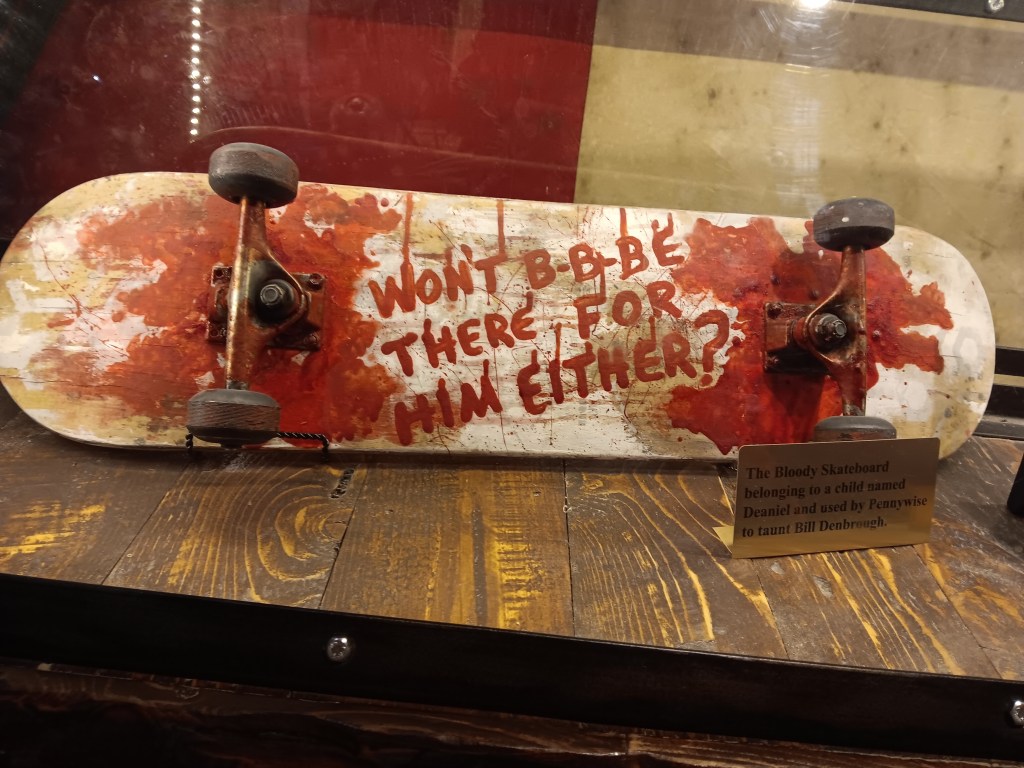
Part of the gift shop includes the “Derry Historical Museum,” which has some actual props from the movies:
In terms of how the brain operates, gleaning the clues in the rooms required an attention to arbitrary detail that I might have thought writing and literary analysis would have facilitated, but I guess at this point I’m more attuned to words than my physical surroundings. Bill Denbrough the writer is the leader of the Losers, but as a writer I was not the leader of our group, just someone carrying out the joint tasks the leader had figured out needed to be done and gave the directives for. (And there were some that none of us figured out; if a certain amount of time had passed and we still hadn’t managed to get to the next room, the door to it would just open–their bookings are in specific time slots so they have to stay on schedule.)
As it happens, the majority of the artifacts in the Derry Historical Museum have writing on them.
Hope Springs Eternal
In the 2021 documentary Pennywise: The Story of IT about the 1990 miniseries, its teleplay writer Lawrence D. Cohen (who also wrote the screenplay for the original Carrie) describes trying to describe what IT is and calling it an “inter-terrestrial being,” prompting me to wonder if that was what the letters “IT” stood for, because that had never occurred to me. Probably not officially, since that term never appears in the novel. This also made me think of IT as an “inter-textual” being, in the sense that it takes on facades from different texts (the mummy, the teenage werewolf, the creature from the black lagoon, jaws). Since a hallmark of King’s work is its intertextual references, this is yet another way that IT is the encompassing allegorical text for all of his work, and so what I find myself returning to as the most significant book in his canon. That its two adaptations have been two of the most successful ones compounds this significance: two good adaptations coming from one King work when usually a single one is hard to come by is like lightning striking twice in the same place.
“Intertextual” would technically mean King referring to his own works, but there’s a channel of influence it also invokes since his works are influenced by others: King’s work reflects that of his predecessors and his descendants’ work reflects his, which makes the mirror maze another apt metaphor for his work. There’s a mirror maze in the funhouse in Joyland (2013), in which the terms “horror house” and “funhouse” are used interchangeably for the same landmark in the titular park: horror = fun. For me, Joyland allegorically encompasses King’s canon in the sense that his work brings me joy. (The park’s ferris wheel is also a significant fixture in this novel, and the ferris wheel by the Linq Hotel hosting the convention made it a distinct fixture on the strip.)
In his KingCon Kingcast interview, the actor Thomas Jane called King a literary master that we’ll be studying in a hundred years, which, as a King scholar, is a sentiment I concur with. I’d say the three King adaptations Jane has been in, Dreamcatcher (2003), The Mist (2007) and 1922 (2017) are spread relatively evenly on the spectrum of bad to good adaptations–though as they discuss in the interview, Dreamcatcher is not necessarily a bad adaptation since it’s actually fairly reflective of the book–it’s the book that’s bad (though personally I don’t mind it).
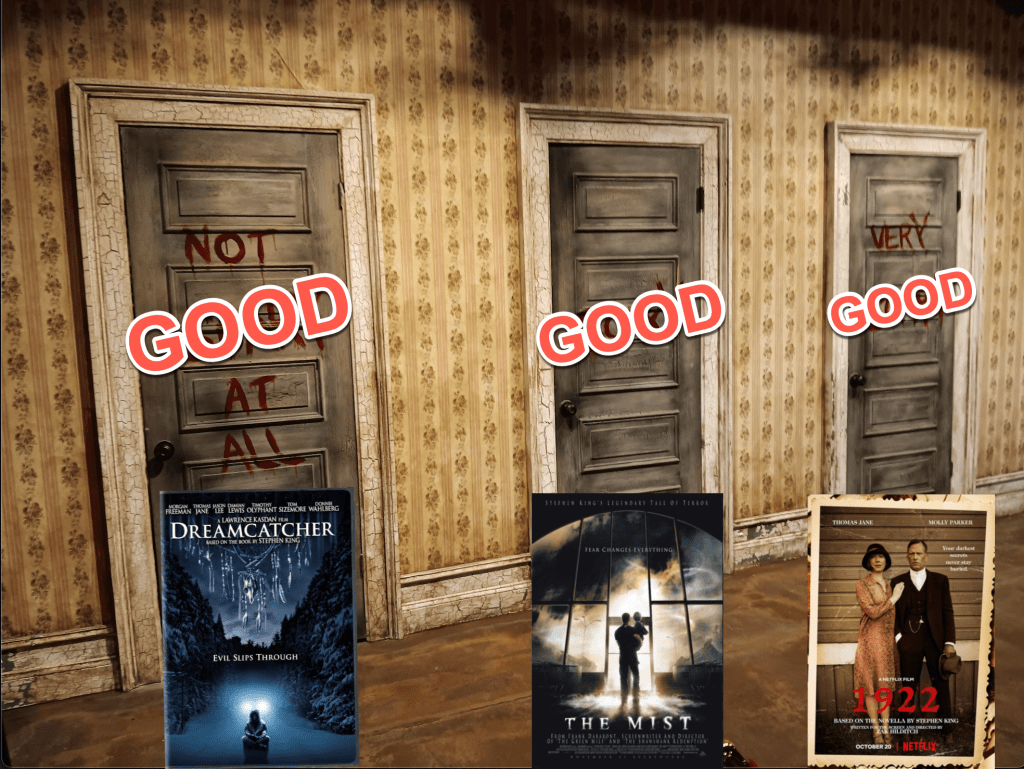
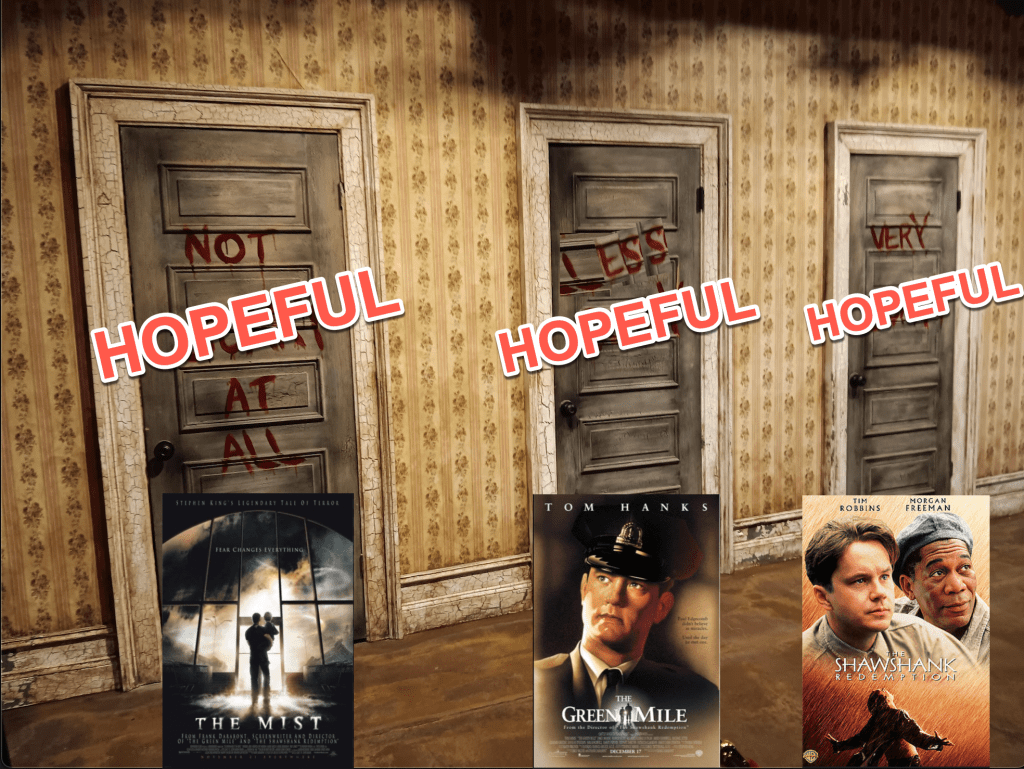
The Mist has one of the most changed endings of a King adaptation, to a super dark one–so dark that the producers (in fact, the Weinsteins), offered to double the budget if they dispensed with the dark ending, but they decided to keep the dark ending and do it with less money. That the dark ending was adapted by Frank Darabont is intriguing in light of its stark contrast to his adaptation of The Shawshank Redemption (1994), one of the most celebrated King adaptations and probably the one with one of if not the most hopeful endings. In the interim we have Darabont’s Green Mile adaptation (1999), which is not all that hopeful for the surviving characters who witness the sacrifice of a magical Black man.
Frank Darabont was a “Dollar Baby,” the program where King optioned rights to his work to emerging filmmakers for a dollar to make a short film. The Dollar Baby films were by design not to be for profit, so access to them is hard to come by, and one of the features of KingCon was to have a theater running Dollar Baby short films continuously. Unfortunately, since this was concurrent with other events, you had to prioritize, so I did not get to watch as many as I would have liked. The handful I did see were hit and miss, and the misses were more from the acting than the writing. Darabont made “The Woman in the Room” for his Dollar Baby film, and according to Wikipedia, he wasn’t happy with how it turned out, but it did lead to him getting the rights to Shawshank.
The question of hope is a pertinent one in the wake of the election. When people have asked me how I’ve felt about it, I tend to say I hadn’t gotten my hopes up in the first place, because we’ve been here before. It’s déjà vu. That happened to be a theme of one of the Dollar Babies I did see, “That Feeling,” from the Everything’s Eventual story “That Feeling, You Can Only Say What It Is In French,” which the New Yorker Classics newsletter just reposted for Halloween (horrific foreshadowing that Trump would win). Despite the acting in this one falling short, the emotional resonance of the character yelling at herself to get out of the loop of repeating events she finds herself in: “‘Change! Change one thing! Change anything!'” resonated on an individual and collective level. “‘There’s no more exquisite torture than hope,'” a character says in King’s 2023 novel Holly. The ending of Revival leaves less room for hope than Darabont’s The Mist: if the main character had hung on a little longer and not given up hope, it seems things would have turned out better. So maybe it’s not fair to classify it as “not hopeful at all.”
The presence of the three biggest King adapters at the Con also occupied a spectrum: Mick Garris was there in person, Frank Darabont’s presence was through Thomas Jane, and Mike Flanagan could not be there in person but left a video on the Con Facebook page saying he wished he could have made it. Flanagan also made special limited edition posters for Gerald’s Game that he autographed and were given out at a screening of the movie.
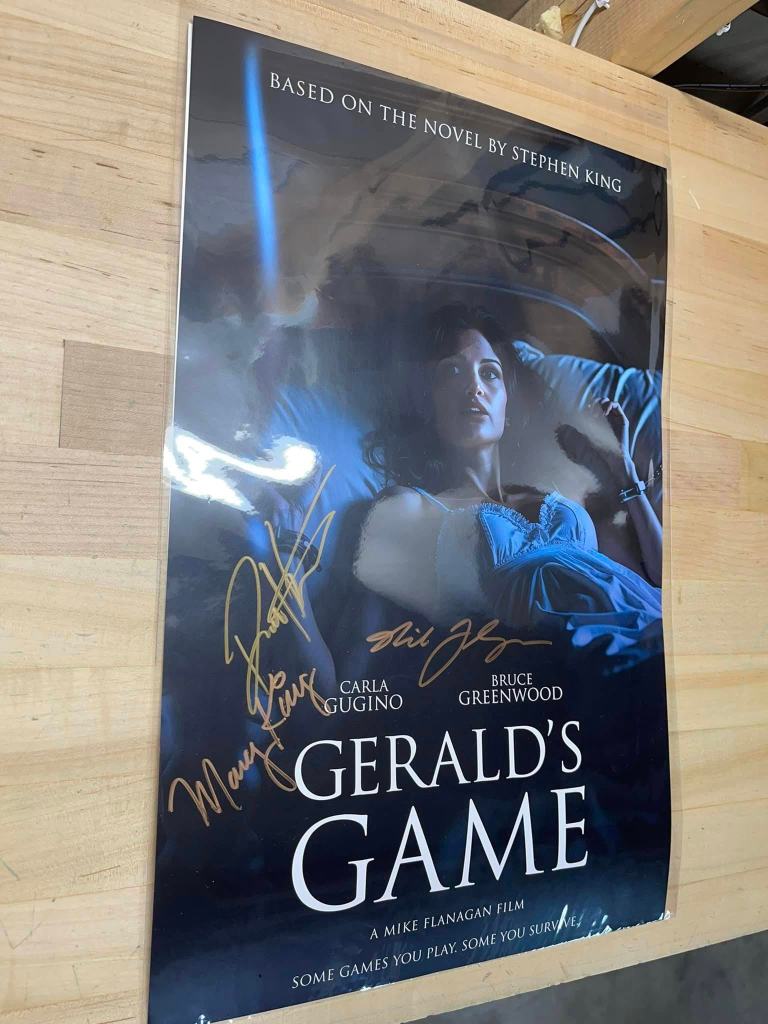
Another King adaptation that will make 2025, as Vespe put it, a banner year for King adaptations (in addition to the highly anticipated Welcome to Derry series) is Mike Flanagan’s adaptation of The Life of Chuck, which purportedly contains a message of hope despite its classification as “apocalyptic,” and which I’m pretty sure is the only thing by King that has made me cry. I found myself near tears again when Vespe was being interviewed during KingCon as a replacement for the window Thomas Jane was supposed to have a Q&A, and Vespe was describing his and Scott Wampler’s cameo in Chuck–not only because this is a way Wampler will live on (in addition to the plethora of Kingcast recordings), but because of the parallel that (SPOILER) the title character dies around the same age Scott did. “Historically I have never been a person who fears death,” Scott says in the first Kingcast episode on Revival back in 2021. “You know, I’m just like, well, you know, it’s a part of life, it’s gonna happen, whatever happens is gonna happen and frankly I’m kind of curious to find out what happens. So I’m not exactly scared of it. After reading this book, I remember specifically staying awake at night, like lying in bed and just staring at the ceiling and being like holy fuck dude, like we really don’t know. It could be anything. What if it is giant ants? I don’t want to be around fucking giant ants, dude. They sound like assholes.”
Reading Revival at this specific political moment, it’s hard not to read this novel’s bleak description of the afterlife as America’s afterlife in the wake of Trump’s reelection. Vespe calls Revival a sister book to Pet Sematary due to the likeness of their dark endings, and King has disavowed the nihilism of the latter. So here’s hoping it’s not giant ants.
-SCR
 Long Live The King
Pingback: The Long Run of 2025 King Adaptations – Long Live The King