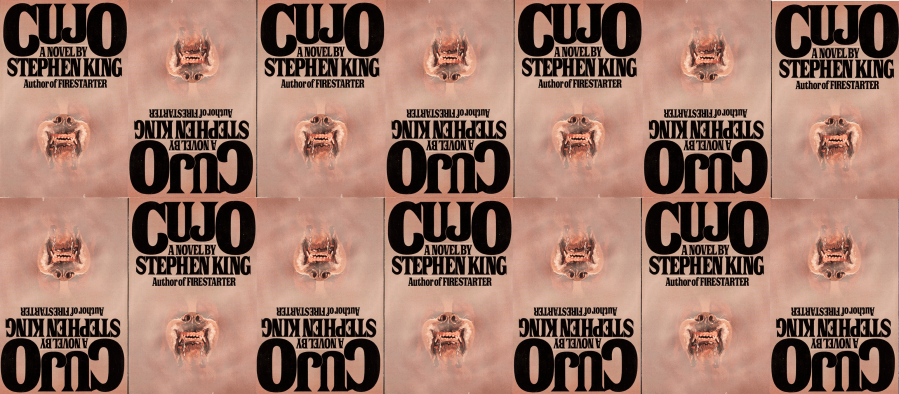
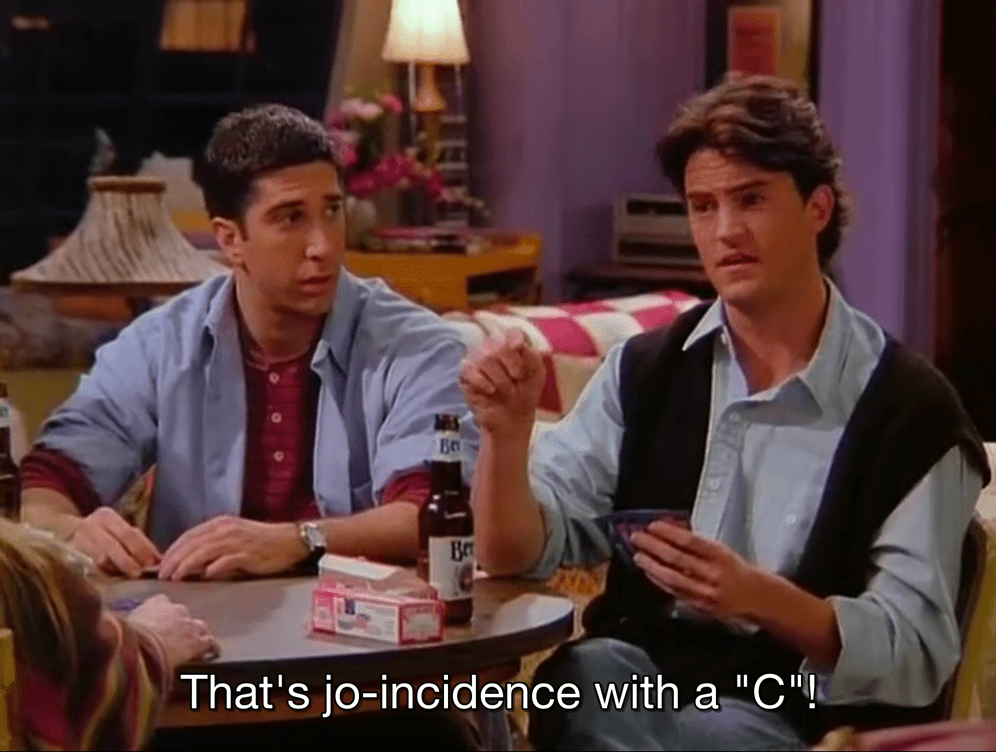
“Y’know, I never thought I’d say this about a movie, but I really hope this dog dies.”
Rachel watching Cujo in Friends 8.12, “The One Where Joey Dates Rachel”
We finally arrive in the ’80s with the publication of Cujo (1981), which has a reputation as one of Stephen King’s self-described “cocaine novels,” aka he claims he was so high on coke in the course of its composition that he can’t remember writing it. This would appear to be something of a myth, though. King biographer Lisa Rogak identifies 1979 as the year King got “hooked on cocaine” and is more specific about what King doesn’t remember:
[King] would later admit that when he did the revisions for Cujo in early 1981, he had no recollection of doing so.
Rogak, Lisa. Haunted Heart (p. 114). St. Martin’s Publishing Group. Kindle Edition.
Later in the biography Rogak describes aspects of King’s composition of this novel in enough detail that it seems to contradict a summation she makes early on in it that reinforces the myth, that King has “also spoken with regret that he couldn’t remember writing certain books, such as Cujo” (p. 2).
The novel’s omniscient opening tells us that the “monster” serial killer Frank Dodd (of The Dead Zone) returned to the town of Castle Rock in 1980, in what will be one of the hottest summers on record. Four-year-old Tad Trenton encounters this monster in his closet, but when his parents come in, they don’t see anything. The summer before, Tad’s father Vic took the family out to the mechanic Joe Camber’s on the outskirts of town to have the car worked on, and they met the Cambers’ giant but good-natured Saint Bernard, Cujo. Now, Cujo chases a rabbit into a ground cave on the Camber property, disturbing some bats and incurring a bite on his muzzle. Meanwhile, Vic’s small-time ad agency Ad Worx with his partner Roger is on the rocks after a debacle in which their biggest client, Sharp Cereal, suffered a blow to the credibility of their ad spokesman the Sharp Cereal Professor due to some food dye in their product Red Razberry Zingers made it look like kids were vomiting blood. Vic and Roger are planning a ten-day trip to try to remedy the seemingly hopeless situation as Vic entertains suspicions that his wife Donna is cheating on him.
The Cambers’ neighbor, WWII veteran and alcoholic Gary Pervier, encounters Cujo on his porch and is surprised when Cujo uncharacteristically growls at him. Donna has a threatening encounter with her lover Steve Kemp when Steve shows up at the Trenton house and doesn’t take it well when she tries to end things with him; she started the affair following discontent with the sort-of Vic’s-job-dictated move to Maine and fear of getting old (see new M. Night movie…). Meanwhile, Charity Camber, the mechanic Joe’s wife, wins five thousand dollars on a lottery ticket and starts to lay plans for a trip to visit her sister in Connecticut and take their son Brett, which she knows Joe will resist. Steve Kemp, furious at being jilted, jots a note to Vic exposing his affair with Donna. Vic advises Donna to take their Pinto that’s been acting up out to Joe Camber’s while Vic is gone, and writes down the Monster Words he recites nightly to keep the monsters out of the closet for Tad.
Charity buys a new chainfall for Joe with some of the lottery money; Cujo growls at the two men who deliver it and they consider calling Joe Camber to tell him but don’t. Vic receives Steve Kemp’s note at his office. Charity proposes the trip to Joe and wins a standoff with him after promising a trade of letting Brett go on Joe’s next hunting trip. Vic confronts Donna about the affair and she explains her fear of getting old (the confrontation keeps Vic from remembering to call Joe Camber about the Pinto). Joe Camber plans a trip with Gary Pervier while Charity is off on her trip. The morning Charity and Brett are supposed to leave, Brett sees Cujo looking very scary and abnormal, but Charity convinces him not to tell Joe or Joe won’t let them go, and they get on the bus. Cujo attacks and kills Gary Pervier at Gary’s house. Charity considers the significance of the trip for Brett seeing another way of life besides his father’s. Vic leaves with Roger for their work trip.
Joe discovers Gary’s corpse at Gary’s place, then Cujo comes up from Gary’s basement and kills Joe, too. Donna debates what to do when the Pinto starts acting up again; she decides to drive it to Joe Camber’s even though he’s not answering his phone, and she relents when Tad insists on going with her instead of staying with a babysitter. The Pinto stalls out as soon as they pull in the Cambers’ driveway, and when Donna gets out, Cujo emerges and chases her back into the car.
In Boston, Vic proposes that the Sharp Cereal Professor make a final ad appearance in which he apologizes for the Red Razberry Zingers debacle. Donna debates whether the door to the Cambers’ house is locked and if she should try to make a run for it, and she manages to get the Pinto started but it quickly stalls out again. Brett Camber calls the house to no avail, and the sound of the ringing phone agitates Cujo. Donna and Tad eat some of the little food they brought and doze in the car while Cujo stands watch. Steve Kemp enters the unlocked Trenton house and, finding it empty, trashes it.
Charity again calls the Camber house to no avail and Brett comments on Charity’s sister and her husband flaunting their money. Knowing she’s getting weaker after the first night in the car, Donna makes a run for the house after testing to see if Cujo is hiding in front of the car; he tricks her by waiting to make his move and then attacks, driving her back into the car with a bad bite in her stomach before she manages to shut the door. Vic starts to get worried when Donna doesn’t answer the phone at home, eventually calling the police, who discover the trashed house. Charity ponders but rejects the possibility of divorce.
Tad has a convulsion in the overheated car. Vic comes home and tries to piece together what happened with the police. When Sheriff Bannerman goes out to check if the missing Pinto could be at Camber’s place, Cujo attacks and kills him. Vic falls asleep and wakes hours later when Roger calls with the news that Sharp has decided to let them keep the account. Vic has a note from the police that Kemp has been arrested and Donna isn’t with him, and decides to drive out to the Cambers’ as Donna faces the fact that Tad is dying in the heat and gets out of the car. She staves off Cujo with a baseball bat that was lying in the grass, but he keeps coming at her until it splinters, and then she stabs him in the eye with it. She’s bludgeoning the dog’s corpse as Vic pulls into the driveway, and when Vic gets to Tad in the back of the car, Tad’s dead.
Donna eventually recovers and Vic and Roger are able to keep the Sharp account long enough to keep the agency afloat. Charity manages to hang on to the Camber property and they get a new dog.
The End.
In the biography, Lisa Rogak chronicles how this narrative sparked from two incidents in King’s life:
[King] got the idea for Cujo by continuing his habit of connecting two seemingly unrelated subjects. With Carrie, it was “adolescent cruelty and telekinesis.”
With Cujo, it was two incidents a couple of weeks apart. While bringing his motorcycle in for service to a mechanic located on a remote back road, his bike gave out in the yard. He called out, but instead of a human, a mammoth Saint Bernard galloped out of the garage heading straight toward him, growling all the way. The mechanic followed, but the dog continued to charge. When the dog lunged at King, the mechanic hit the dog on the butt with a massive socket wrench.
“He must not like your face,” he said, then asked Steve about the motorcycle.
Even though they were now flush, Steve and Tabby were still driving the Ford Pinto they had bought new with the $2,500 advance from Carrie, even though the car had been plagued with problems from the beginning. A couple of weeks after Steve’s run-in with the Saint Bernard, the car acted up and Steve’s wild imagination thought back to what if Tabby had driven the car to the mechanic and the dog had lunged toward her? And what if there no humans were around? Worse yet, what if the dog was rabid?
Rogak, Lisa. Haunted Heart (p. 112). St. Martin’s Publishing Group. Kindle Edition.
This constitutes another Carrie connection by way of King’s own account, in his craft memoir On Writing, of two real-life encounters, or rather two real-life people, converging for the inspiration of that novel: a high-school classmate of his who was so poor she wore the same clothes every day and who was mocked relentlessly when she finally did wear nicer clothes, and another classmate whose mother had situated a “life-sized crucified Jesus, eyes turned up, mouth turned down, blood dribbling from beneath the crown of thorns on his head” in their trailer’s living room.
In relation to Cujo, Rogak provides another illuminative quote about King’s writing process-slash-basic narrative structure/suspense-building:
“Then the game became to see if I could put them in a place where nobody will find them for the length of time that it takes for them to work out their problem.”
Rogak, Lisa. Haunted Heart (p. 113). St. Martin’s Publishing Group. Kindle Edition.
Or, as Vic considers it in the novel itself:
Why? Why had something like this been allowed to happen? How could so many events have conspired together?
One might notice a variation in King’s typical narrative approach via the lack of chapter divisions:
Cujo was an experiment for King, the first book he had written where the story was told all within the confines of a single chapter. It didn’t start out that way; he had initially envisioned the story in terms of traditional chapters. But as the story developed, along with the sense of horror, he altered his approach: “I love Cujo because it does what I want a book to do. It feels like a brick thrown through somebody’s window, like a really invasive piece of work. It feels anarchic, like a punk-rock record: it’s short and it’s mean.”
Rogak, Lisa. Haunted Heart (p. 113). St. Martin’s Publishing Group. Kindle Edition.
But something that’s definitely in keeping with King’s typical thematic patterns is his supernatural gloss on the plot’s premise, a premise that would be every bit as horrifying (if not more so?) if it had been left in the realm of what could “really” happen. The events of the novel require no supernatural element to make them “work,” as most of his other novels up to this point have in that the events necessarily could not have occurred without a supernatural cause–the telekinesis in Carrie, vampires in ‘Salem’s Lot, more telekinesis/telepathy/psychic powers in The Shining, supernatural/divine prophets of sorts in The Stand, psychic powers again in The Dead Zone, and pyrokinesis in Firestarter. Realistic-via-supernatural horror has been one of the primary distinctions between King and his pseudonymous Bachman novels, so publishing this under his own name might have necessitated this element, consciously or unconsciously, for “Brand Stephen King,” as Simon Rich dubs it in his 2018 Screening Stephen King academic study that links this Brand to “a particularly mainstream form of horror.” There’s also the fact that this is the second Castle Rock novel, though the supernatural element doesn’t seem inherently connected to this recurring King setting, or at least not any more so than other settings he uses. The first Castle Rock novel, The Dead Zone, references Carrie not as events that happened in the “real world” of its particular universe, but as a pop-culture text, and Cujo‘s setting is also Castle Rock and via the Frank Dodd/Sheriff Bannerman connections (and Dead Zone protagonist John Smith also referenced) occupies the same “reality,” which then means in the reality/world of Cujo, Carrie White exists only as a fictional figment.
At any rate, given the gaps in King’s memory he attributes to his substance abuse, the breadth of the linked elements in his multiverse is almost staggering, though perhaps less surprising if considered within the context (or confines) of the white male ego and its preference for referencing itself. The most prevalent example of this at the current moment might be this year’s Later; Cujo shares the hallmark element of what Charles Yu identifies in his review of Later, its real-life horrors reigning emotionally if not literally over its supernatural elements:
And the horrors are many. There are hints of evil from another dimension, things from “outside the world” and “outside of time.” But mostly the horrors are familiar ones. Plain old human cruelty. The loss of loved ones to disease or old age. Alzheimer’s. Also, less morbid though no less heavy: the loss of innocence. Growing up too fast. The unexplainable, the incomprehensible in our everyday lives.
From here.
This sentiment seems to echo one previously put forth in this ancient debate of the extent and/or limitations of King’s literary prowess, appearing in the LA Review of Books in 2012 (in direct response to a particular savaging of King’s quality):
But all [King’s] novels, even the stinkers, have resonance. By this I mean, his fiction isn’t just reflective of the current culture, it casts judgment. Innocent Carrie White wakes up with her period and telekinesis at the height of the women’s movement. No wonder everybody craps on her, and no wonder we’re delighted that she slaughters them all. In Cujo, the materialism of the 1980s American family tears itself apart from the inside, as represented by the family dog gone mad.
From here.
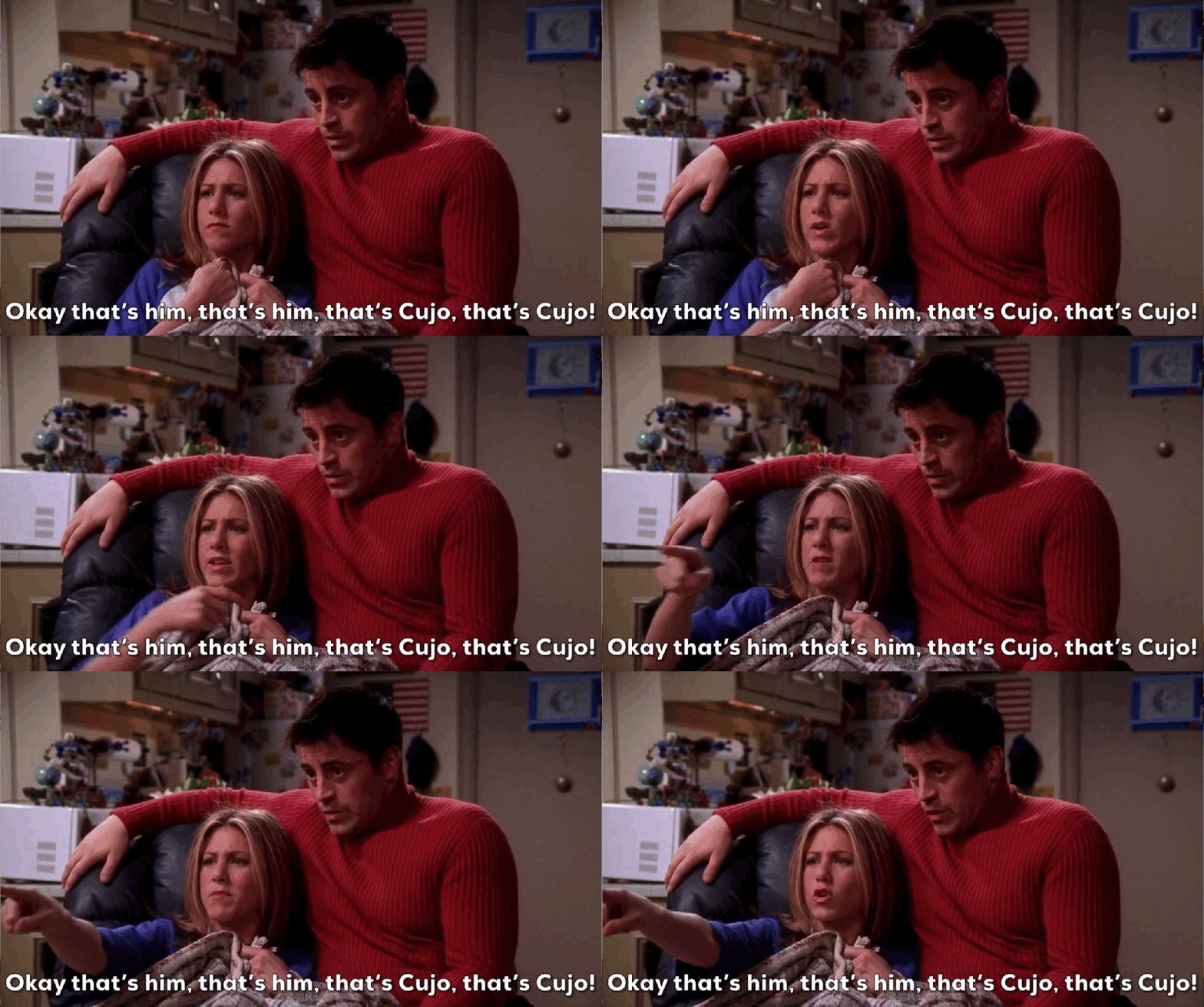
Its appearance on Friends ought to be a clear enough marker of Cujo‘s cultural caché, but for a more recent piece of evidence, I offer the personal anecdote of my new landlord greeting my (incessantly) barking chihuahua with “Hey, Cujo!”
In addition to helping the supernatural developments, the novel’s omniscient point of view helps the parallel development of the Trenton and Camber family units; the latter’s absence from the film adaptation might be evidence of the necessarily narrower scope of that media. The novel’s plot registers the interdependence of white-collar and blue-collar, with Steve Kemp a sort of wild card that–forgive me–straddles both worlds, though it’s Kemp who wears the chambray shirt that consistently makes cameos throughout King’s work, and which decidedly has a blue collar. Kemp as a character definitely comes off the worst and most overtly villainous in this narrative. Donna’s affair with him, while a demonstration of her culturally attenuated fears, at first didn’t strike me as affecting the plot materially in the way of playing a direct role in Tad’s death. But one might argue Kemp functions materially as a red herring to mislead the police, that if he hadn’t trashed the house, they might have gone looking at Cambers’ place sooner for lack of other options.
Kemp is an unequivocal douche bag, marked perhaps most overtly by the only detail I recalled from my adolescent reading of the novel–his jacking off on Donna and Vic’s bed after trashing their house–and also in other details like his refusal to shake hands with a tennis opponent if he’s lost the match. That he’s a poet does not speak well for poets, then; his side hustle, or really main one, refinishing furniture under the moniker the “Village Stripper” sexualizes him in a way that also characterizes his relationship to his other work:
…he masturbated a great deal. Masturbation, he believed, was a sign of creativity. Across from the bed was his desk. A big old-fashioned Underwood sat on top of it.
Considering he turns masturbation into a criminal offense in the one scene I remembered, Kemp as a character isn’t doing much for the reputation of the Great White Male writer (and/or connection to the Underwood typewriter), except he identifies more as a poet than a fiction writer–that his fiction-writing exclusively consists of a draft of a novel he’s “attacked badly from six different angles” reads more intensely in light of his attempted rape of Donna. His aforementioned chambray shirt and self-identifying as a poet are strongly reminiscent of Jess Rider’s character from The Stand, a character who also functions as an object of derision and whose chambray shirt becomes a demonstration of his posing as more working-class than he is, thus linking poets to posers. Kemp appears to be a poet in the same posing vein, but taken to the next level of violence and aggression, apparenty largely by virtue of his being older than Jess was; we see the personal agitation Kemp experiences in response to Donna’s jilting him being connected to his age when he discovers the “first threads of gray in his beard”; his irrational/irresponsible actions are thus linked to an almost identical anxiety to what Donna describes to Vic in articulating her reasons for getting with Kemp.
Kemp is more the villain, even, than Cujo himself, who can’t be blamed for his actions. Can King the author be blamed for letting Tad die?
Readers gave him an earful about it, and he received letters by the truck-load that criticized him for letting a child die in a book, albeit one who was innocent and simply in the wrong place at the wrong time, unlike the dozens of teenagers who were killed in Carrie, who seemingly deserved it because of their actions.
Rogak, Lisa. Haunted Heart (p. 113). St. Martin’s Publishing Group. Kindle Edition.
This echoes the “main character” Cujo himself as summed up in the novel’s conclusion:
He had never wanted to kill anybody. He had been struck by something, possibly destiny, or fate, or only a degenerative nerve disease called rabies. Free will was not a factor.
Despite one essentially (if still ultimately indirectly) killing the other, both Cujo and Tad as characters are “innocent.” For Cujo, rabies is a scientifically sanctioned form of what amounts to demonic possession–nice touch how he gets it from a bat bite, a la vampires. Tad did not call his own demise upon himself, but the actions of his parents did; readers seem to be reacting to the use of a child as a plot device. On Friends, Rachel wants the dog to die in the movie, and he does, if in a bit more dramatic fashion, but I knew the second Tad’s death was confirmed in the book that he would be resuscitated in the film version.
The way events unfold may implicate white-collar reliance on blue-collar: the ultimate coincidence facilitating the horrific scenario is the blue-collar family uncharacteristically being away on vacation. The lottery ticket that facilitates this coincidence may itself be the novel’s biggest coincidence, but it “works” because it plays on what is definitely not a coincidence, the blue-collar pursuit of the possibility of something better, which is further played out by Charity and Brett’s trip and the larger possibilities it opens up in escaping Joe and what he stands for.
In his Later review, Charles Yu also notes:
In his craft memoir, “On Writing,” Stephen King describes a moment in his process when he asks himself the “Big Questions.” The biggest of which are: “Is this story coherent? And if it is, what will turn coherence into a song?”
From here.
Reading Carrie for Toni Morrison’s Africanist presence, there were no actual black characters, but only descriptions that comparatively invoked Blackness. Black characters are almost entirely absent from Cujo as well but exist in relation to music, and manage to be fairly revealing in the limited time they take the page-stage, which I’m quoting here in full:
The cab driver was black and silent. He had his radio tuned to an FM soul station. The Temptations sang “Power” endlessly as the cab took him toward Logan Airport through streets that were almost completely deserted. Helluva good movie set, he thought. As the Temptations faded out, a jiveass dj came on with the weather forecast. It had been hot yesterday, he reported, but you didn’t see nuthin yesterday, brothers and sisters. Today was going to be the hottest day of the summer so far, maybe a record-breaker. The big G’s weather prognosticator, Altitude Lou McNally, was calling for temperatures of over 100 degrees inland and not much cooler on the coast. A mass of warm, stagnant air had moved up from the south and was being held in place over New England by bands of high pressure. “So if you gas gonna reach, you gotta head for the beach,” the jiveass dj finished. “It ain’t goan be too pretty if you hangin out in the city. And just to prove the point, here’s Michael Jackson. He’s goin ‘Off the Wall.’”
“Black and silent” is pretty much the most succinct and accurate summation one could make concerning the Africanist presence here with this weird combo of a literally silent Black body and a disembodied Black voice (or white projection of one)…despite the foundation of American music discussed in my previous post that this obliquely invokes. It seems a potential unintended coincidence that this silent presence appears behind the wheel of a car, that most critical object in this particular plot’s premise.
Charity Camber’s aspirations for a better life are ultimately futile, but we see how her sister escaped Charity’s circumstances through luck, demonstrating how Charity herself had a parallel chance for upward mobility. The “black and silent” cab driver never gets that chance. The futility Charity confronts seems to demonstrate how the illusion of the American Dream is a dangled carrot that keeps the subservient classes subservient. This tactic may be largely successful, but, as with cars, can backfire. Donna’s invocation of the “greenhouse effect” trapping the heat in the car, that most direct cause of Tad’s death, seems perversely prophetic as climate disasters advance apace and we continue to refuse to curb our emissions. From 2021, Tad’s death could be read as an indictment of consumption and its cost to future generations.
-SCR
 Long Live The King
Pingback: Cujo: Eat the Rich – Long Live The King