On the audio commentary of his own adaptation for television of The Shining (1997), King comments that “the network giveth and the network taketh away.”
Brown, Simon. Screening Stephen King : Adaptation and the Horror Genre in Film and Television, University of Texas Press, 2018. p151.
Adapt It
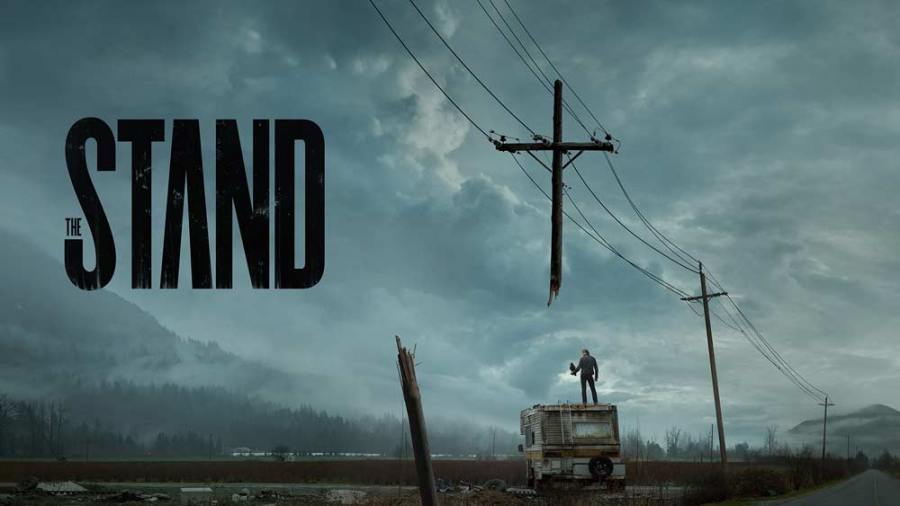
It’s hard to isolate the most culturally significant element of the 2020 adaptation of what’s arguably one of Stephen King’s most important works: The Stand. Is it that the series adapting the narrative of a superflu killing off almost all of humanity wrapped production in early March of 2020, just as a global pandemic was declared? Is it that restaging this “epic” narrative of good v. evil that’s been reiterated (reincarnated?) several times gives us a chance to rectify past mistakes? Is it that “King’s eyes and prolific hands are all over this adaptation,” including episodes penned by King’s own son, Owen? Is it that King himself penned a “new” ending for the ninth and final “coda” episode?
A further point of interest for me is how the 2020 adaptation connects the gaps between where I am in my (attempted) chronological reading of King’s work and where I am in writing about it. Finishing the novel IT (1986) not long after watching the new Stand series is an almost cosmically charged experience, or at the least an illuminating one. Both of these novels of King’s play with and question the very concept of “chronology,” and could compete for King’s most ambitious work. (Elements of their cosmos will be further threaded together via The Dark Tower series.) Other connections between these texts (and their various iterations) include:
-The phrase “‘Be true. Stand,'” is used in the 2020 series but does not appear in the novel version of The Stand. The phrase appears repeatedly in IT.
-One of IT’s main characters, Ben Hanscom, is from Hemingford Home, Nebraska, the same place as The Stand‘s Mother Abagail. Hemingford Home becomes an actual nursing home in Colorado in the 2020 Stand adaptation, with King’s cameo reduced to an appearance in an advertisement for this home on a bus stop.
-Actor Owen Teague plays Patrick Hockstetter in It (2017) and It Chapter Two (2019), and Harold Lauder in the 2020 The Stand.
-For this year’s “Stephen King Area” of the 2021 Virtual PCA/ACA Conference, both of these novels have their own individual panels with multiple talks scheduled around them (“IT Lives!” and “Standing in a Pandemic,” respectively).
-A chapter in IT is called “The Circle Closes,” which is the title of the new epilogue King appended in the ’90 Uncut iteration of The Stand, which means this phrase (slash expression of one of King’s favorite metaphysical concepts) originates with IT. (“The Circle Closes” is also the title of the highly anticipated King-penned 2020 Stand coda episode, which Part III will…circle back to.).
I discussed in a previous post how King’s first Bachman novel, Rage, explores a link between Hollywood movies and gun violence not necessarily by depicting that violence itself, but by setting certain standards of masculinity which that violence becomes an expression of. Film critic Ann Hornaday has argued that this expression of toxic masculinity is a product of the fact that the vast majority of major studio films continue to be written and directed by white men. It has now been almost seven years since Hornaday posed this somehow controversial argument. I could read the 2020 adaptation of The Stand as evidence of the entertainment industry’s general response to this problem of representation in the interim, which would be to (attempt to) treat (some of) the symptoms of the disease rather than the disease itself.
To wit, a white man is still in charge of the latest iteration of the narrative, in this case via the showrunner Benjamin Cavell, apparently in fairly constant consultation with King himself both via email and by having Owen in the writers’ room. To alleviate if not necessarily the most grotesque but perhaps the most immediately obvious symptoms of this patriarchal disease (so as to limit comment on it and thus perpetuate its continued existence), the original white-man status of several characters is updated or “upgraded” (as Cavell puts it here) to represent more minorities than were in the source material. But in 2020’s iteration of The Stand, the attempts of the white-men-in-charge to make certain minority “upgrades” ultimately represent/express something less than progress.
Cavell’s description of another IT connection in a Vanity Fair interview exchange displays the general (white) bro culture that surrounds the new adaptation and how this ultimately amounts to an extension of the culture surrounding the source material:
We also get a little shot of a turtle statue in the window of the house, and I was trying to explain to my wife what the turtle signifies. I found myself unable to explain it. It’s a cosmic power mentioned in It, it’s a presence in The Dark Tower series …
I was going to say, how did you approach that? Yeah. I tried to explain it to my wife. Well, you know, the world kind of rides on the back of a turtle. She’s like, “What?”
From here.
Wives just don’t get IT…
Networking
King obviously has a long history of adaptations, which associate professor of film and television at Kingston University, Simon Brown, positions both as successful often as a product of other trends, but also a prevalent influence on media and visual narrative consumption trends in its own right. Which brings us to another connection between The Stand and IT–the format of their initial adaptations as (wildly successful) miniseries for primetime network television, specifically for ABC. What struck me about Brown’s analysis of the adaptation in this format was how IT airing in November of 1990 meant it was benefitting from the same network having aired the first season of Twin Peaks a few months earlier, which affected not so much its appeal to viewers as the network’s own “Standards and Practices”:
However, one of the long-standing taboos of Standards and Practices, raised in 1979 when CBS adapted Salem’s Lot, was the issue of placing children in danger.
Brown, Simon. Screening Stephen King : Adaptation and the Horror Genre in Film and Television, University of Texas Press, 2018. p158.
Child endangerment being a defining component of the IT narrative meant this “taboo” had to be “relaxed” for ABC to even consider the project (Brown 159). King’s influence on and through shifting standards like these is kind of stunning when you consider the scope of the viewership and populace it reaches, even if a lot of the “explicit detail” was still removed for these television versions (Brown 162). (Of course, if it hadn’t been King the networks were willing to show increasingly graphic violence and sex for, it would have been somebody else.) Brown proceeds to outline how the success of IT beget the success of The Stand, and how King miniseries adaptations thus became as integral to 90s network television as, per my own comparison, Seinfeld.
(On a peripheral note, my favorite part of Brown’s history is how when King “was offered by ABC the chance to do whatever he wanted,” he chose to retell The Shining in miniseries form, but Stanley Kubrick would only sell him the rights back if King agreed to stop complaining about Kubrick’s adaptation (168).)
As the passage excerpted above indirectly points out, the other major network King has an extended history with is CBS. Which brings us to the 2020 Stand‘s format, appropriately updated to not just “television miniseries” but “streaming television miniseries,” for a streaming service owned by CBS (which currently the Republicans would like you to boycott). This basically means King can have his cake and eat it too (or the best of both worlds, whichever cliche you prefer) in terms of maintaining network backing and getting to show graphic violence and sex. (I don’t advise watching 2020’s version while eating.) Simon Brown notes the “‘major reduction in snot'” in 1994’s version (162); in 2020 the snot and the tube neck are back with a vengeance. (It’s too bad Brown couldn’t wait a couple more years to publish his adaptation study, since it means his discussion is missing both the new The Stand and It Chapter Two (2019).)
A major company like CBS wields increasing influence with its attendant corporate mergers, which King apparently enjoys working with because of the access it provides to the maximum number of viewers:
[King’s] argument was that to work with a cable channel “would be like publishing a major novel with a small press. I have nothing at all against either small presses or cable TV, but if I work hard over a long period of time, I’d like a shot at the largest possible audience” (1999b, xii).
Brown, Simon. Screening Stephen King : Adaptation and the Horror Genre in Film and Television, University of Texas Press, 2018. p151.
Yet King’s working with these bastions of corporate power is probably enabling the continued growth and influence of the same corporations whose corruption of the culture he often seems to be attempting to critique, The Stand serving as a primary example of such narratives. So I suppose it shouldn’t be surprising that a) CBS installed a white man at the helm of this latest adaptation and that b) this white man’s adaptation fails to escape the patriarchy’s problematic permeation of the narrative on a number of explicit and implicit levels.
The Le Guin Test
One can learn a lot about dramatic efficiency by watching King adaptations. The changes they make to their source material may reflect changes in the culture at large, and, per the network discussion above, may also support a reading/message that supports the propagation of a culture that in turn propagates/perpetuates the network model of corporate power. The changes may also reflect the pitfalls of working as a lone novelist (one whose editors appear to be afraid of him).
Narratively, one of the first things I felt watching 2020’s version was the pacing: for the superflu part, they really clip right along, and present a generally scrambled chronology. (I definitely thought I would have been confused if I hadn’t read the book.) A potentially more significant narrative and thematic adjustment is how the series minimizes the government’s role in the apocalypse–most egregiously by 1) Flagg’s boot blocking the door that lets Campion out, and 2) Stu’s friendship with his captor Doctor Dietz and his added interaction with the somehow nobly depicted General Starkey. I could probably go with #1 (oversimplifying though it may be) if it hadn’t been in conjunction with #2, which was frankly gross. There’s a shadowy element at work in the form of some rando military guy who kills Dietz and tries to kill Stu but who Stu kills instead (in lieu of killing Dietz in the original) but the show itself intimates Starkey doesn’t know who this guy is working for, letting him off the hook.
Many of the adjustments to the original storylines are “good” in intensifying dramatic/narrative conflict, but in so doing these changes often (further) exacerbate the “bad” in creating (further) problems with the adaptation’s attempts at political correctness.
Matthew Salesses discusses an example of a similar issue in his recent book on the craft of fiction (which I discussed in a post on Firestarter):
Le Guin has great intentions with [A Wizard of Earthsea], not only to take power away from the idea that violent confrontation should provide the solution to conflict, but also to center characters of color. Ged is one of the first protagonists of color in white fantasy. On the other hand, Le Guin avoids the experience of being a person of color. She puts him in a world where his race causes him zero trouble. This is a moral stance. In fact, his main problem is himself, or perhaps a darker version of himself, and his main solution to his problem is himself. This is a moral stance. The novel, intentionally or not, puts forward the idea that everything is up to free will, even for people of color, and that what stands in a person’s way is his own darkness.
This isn’t Le Guin’s intention. Her intention was to upset traditional frameworks. She says so in her afterword. But conflict has consequences for meaning. It’s not just something you put in fiction to make a story compelling. Conflict presents a worldview.
Matthew Salesses, Craft in the Real World: Rethinking Fiction Writing and Workshopping. 2021.
In other words, if the character’s race changes and nothing else changes, that reflects a white supremacist text, one that is blind to systemic injustice in its failure to recognize the material impacts of same.
In The Stand, King’s conflict expresses a similar idea about “everything is up to free will,” at least per (preeminent) King scholar Tony Magistrale’s analysis:
In The Stand, more than any other King novel, free will and moral choice are solidly within the individual’s purview; all of the major characters in this book participate directly in determining their fates.
Tony Magistrale, “Free Will and Sexual Choice in The Stand,” Extrapolation, Vol. 34, No. 1, 1993. p30.
Magistrale’s phrasing implies race has no impact on such agency, when “the individual” whose “purview” free will is in would probably more accurately be designated “the white individual.” Which means, per Salesses, the narrative inherently fails what I’ll call the Le Guin Test (even if maybe it should be called the “Salesses Test”), if, as Magistrale points out, the very principle of this agency is essentially the backbone of the entire narrative:
The shape free will takes in this book directs the narrative itself: characters are tempted by Flagg’s promise of power and pleasure and join him in the west, or choose to align themselves with the Mother Abagail’s Free Zone society at Boulder.
Tony Magistrale, “Free Will and Sexual Choice in The Stand,” Extrapolation, Vol. 34, No. 1, 1993. p31.
If what counts as “society” has effectively collapsed then its “systemic” injustice must necessarily have collapsed along with it, yet one can’t help but think that for people of color, navigating a landscape essentially reconfigured into the Wild West might still be more fraught than for white people.
Perhaps it’s the very premise’s failure of the Le Guin Test that begets more failures on this front; for instance: that the titular “stand” is taken by four white men (Stu, Glen, Larry and Ralph), five if you count Nick Andros. In 2020, these five white men become two white men (Stu and Glen), a black man (Larry), a Native American woman (Ralph turned into Ray), and a Latino man (Nick). Sounds almost diverse enough, except that white men continue to maintain the majority, and also, what turn out to be mostly the most influential/substantive character roles.
Let’s start with Nick, a character who is deaf and mute. In an instance of upping the dramatic ante, Nick’s inadvertent barroom brawl from the original narrative leads him to also become blind in one eye, while in the book his eye injury heals. Yet this partial blindness doesn’t really lead to anything else of consequence dramatically, except maybe some thematic resonance with the upping of the drama/tension of the committee’s choice to send spies to New Vegas explicitly without Mother Abagail’s permission, which she then berates Nick alone for (repeating, as she is ironically wont to, that he is her “voice”). The eye loss is intimated to be part of the cost of Nick’s refusing Flagg, which is a new sequence this character gets that to me is emblematic of a pattern that repeats itself (looping like a circle…): this is supposed to be something that strengthens the representation of a now-minority character: now-Latino Nick is shown to be virtuous when he turns down Flagg’s offer to “fix him.” (Free will!) It’s like the writers think as long as they establish the minority character as “good” they’ve done enough work, but “good” is not the same thing as “human.” (This same near-angelic transcendence plays out when Nick gently sponges the face of the now-sick man who literally punched his eye out.)
In lieu of the backstory that does a lot of humanizing work for Nick in the novel about his bonding with the father-figure who taught him to read, we get some new information about the circumstances Nick grew up in. But, problematically, everything we learn about Nick’s past is uttered from Flagg’s mouth:
“Seems to me you got dealt a real shit hand, my friend. Mom came up from where, El Salvador? Crossed the border in the trunk of a car, to give her child the life she never had, and instead you end up deaf, and broke, pounding the pavement looking for day work. …”
I’d say that yes, Nick–or rather, his 2020 update–gets dealt perhaps the biggest “shit hand” in the form of his shallow one-dimensional representation. (What amounts to Frannie’s parallel individual “stand” against Flagg in the coda episode gets a bit more of a buildup by comparison.) We see no real character struggle on Nick’s part represented, only hear it told from the white man’s mouth. It’s like we’re supposed to extrapolate Nick’s struggle from his disabilities and immigrant status–which means, in essence, that those define his identity exclusively. Nick’s character also reminds us that some of the nuance Whoopi is claiming the new version adds to Mother Abagail’s character was already in the original–Mother Abagail was always mistaken in believing Nick was the one to lead the stand. And Nick has gotten the shaft/shit hand since the beginning, the least normative of the original five white men via his disabilities, and the only one to be killed off so abruptly.
In a sprawling narrative comprised of an ensemble cast like this one, you’re not going to be able to do equal justice to all in terms of development. But in picking the backstories to condense and sacrifice, the writers seem to have axed those mostly belonging to the characters whose updates include a shift to minority/non-white-man status. One of these, the minor character of the judge, is an example of this across-the-board issue. The narrative thread for this character, who’s become a (white) woman in 2020, is cut down to bare bones: we don’t see her (or at least notice her presence) until she is agreeing to be one of the three Vegas spies, see a flash of her on the road, and don’t see the original shootout scene from the novel in which the judge is killed, just Flagg seeing the bullet hole in her head after the fact. Plot-wise, this might arguably be all you “need” to see, but the condensing means the character’s overall importance is de-emphasized, linking the shift to a woman to a decrease in importance/status.
Next, Ray as Ralph, who gets an update in gender and race. Ralph as a character reflects the ensemble cast problem as King encountered it in the novel: despite being one of the four “good” guys to go to Vegas, he is never developed. Which makes choosing his role as one of the ones to update from white man problematic in the vein of the judge’s update–by picking the least important white-man character to update, you link the updated status to a certain lack of comparative importance. And the 2020 version doesn’t seem to develop Ray’s character any more than the original Ralph was. The character’s defining minority status is treated as a stereotype, evidencing another issue that recurs in the adaptation: its writers seem to think that naming the problem is akin to solving/addressing it, as in this exchange in episode 7 when the four have started their walk to Vegas and Larry wants to know how they’re going to find safe water. The men then all look at Ray:
Ray: What, you figured the Injun girl must know the ways of the earth, at least enough to find you water you won’t shit yourselves to death?
Others [overlapping]: Can you? Yeah.
Ray [pause, grins]: Of course.
Of course? Of course? This is basically saying of course she can because she’s Native American, which is another way of saying, of course the stereotype is true.
White Hand Man
The problems of narratively managing an ensemble cast are not strictly limited to those cast members (now) repped by minorities. By all appearances, Trashcan Man is still white in 2020, and he is probably shafted second most after Nick via the slashing of his backstory and consequent flattening of his character, and he arguably plays an even larger role in the outcome of the overall action. (I was definitely getting Gollum vibes from the couple of scenes his character did get.) He’s probably the only really shafted white man, though, unless you count the Kid, who was–thank God–excised entirely, his excision part of Trash’s excised backstory.
Then there’s Flagg’s right-hand man Lloyd, still a white man in 2020. Lloyd is hardly “shafted” by way of lack of screen time, but the opposite: his conflict is amped up, and he even gets to be redeemed this time around by actively standing up to Flagg. But some of his (mostly new?) characterization baffled me: Lloyd gazes rapturously at Flagg during their initial encounter, declaring Flagg “a beautiful fella” (an assessment many would probably agree with in this version). But then once in New Vegas, Lloyd apparently gets sexually involved with Julie Lawry (who is even more nymphomatically evil than in the original), but then is unable to perform with her–but only at the impetus of her mentioning Flagg’s name. Then there’s Lloyd’s flashy wardrobe, which includes animal-print ensembles that escalate into even more flamboyant color prints. When Lloyd pops out of the car that pulls up to apprehend the three remaining good guys in the desert, his “Hi, fellas” greeting felt like he was welcoming them to the set of Queer Eye for the Straight Guy. The idea of the “performance” of masculinity for this character is also emphasized by a new sequence in which Glen Bateman, instead of challenging Lloyd from the privacy of a prison cell, does so in front of a gallery of New Vegas citizens, prompting one to yell at Lloyd to shoot Glen–though after he does, the woman who yelled at him to do it laments that it was supposed to be a “show trial, not a snuff film.” At the end of the day it’s unclear if the writers know Lloyd’s gay or not…
King has shown resistance to the idea embodied by the Le Guin Test, the idea that “diversity” needs to be considered inasmuch as it actually has a material impact; as I’ve mentioned, Sarah E. Turner notes an interview exchange in which King accuses Tony Magistrale of an “imaginative failing” for suggesting a black character might have “wounds that are particular to his racial history” (144), and I posit that the accusation evidences King’s own “imaginative failing,” the blind spots that constitute an (unconscious) white supremacist worldview. The treatment of Larry Underwood’s character in his “upgrade” further evidences the adaptation extending this same problematic worldview, even through its very attempts to “fix” it. More in Part II.
-SCR
 Long Live The King
Pingback: Good and Bad Marriages: or, Happy (Re)Birthday, Carrie! – Long Live The King