When Roger came to the neck of land that joined the Castle Rock to the mainland he was not surprised to be challenged. He had reckoned, during the terrible night, on finding at least some of the tribe holding out against the horrors of the island in the safest place.
William Golding. Lord of the Flies. 1954.
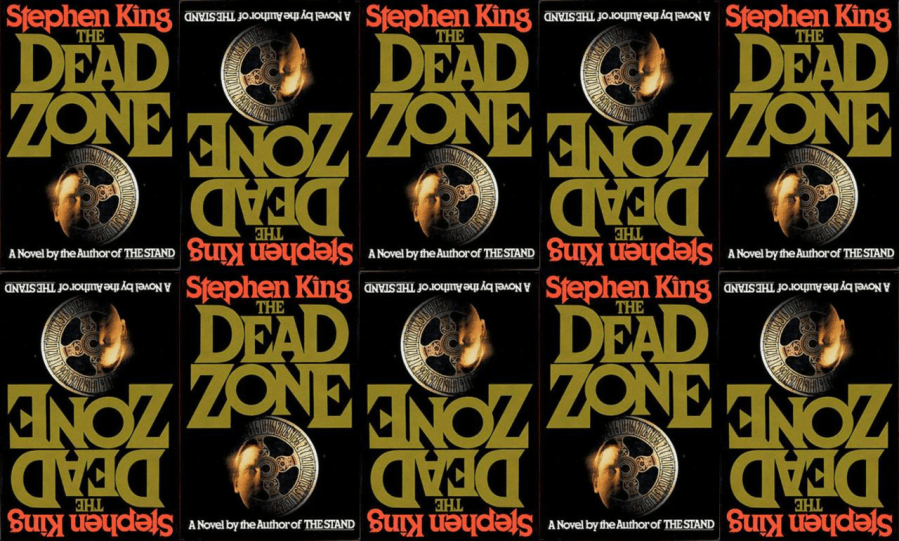
Published on August 30, 1979, Stephen King’s novel The Dead Zone might be more significant for marking the first appearance of King’s fictional creation Castle Rock than as a narrative achievement in and of itself, were it not for reading it during the 2020 election…
Prologue
In 1953, six-year-old John Smith is out skating on a pond when a bigger boy collides with him, causing him to bash his head on the ice. When he comes to, he has a premonition about one of the men helping him, telling the man not to “jump it no more” because of “the acid.” A month later the man tries to jump a car battery and it explodes in his face.
In 1955, a traveling Bible salesman named Greg Stillson pulls up to a farm; no one is home and a dog comes out, growling at him; Greg sprays it with ammonia then ends up kicking it to death when it bites his pants leg. He has a feeling he’s destined for greatness if he can keep his temper under control.
Part 1: The Wheel of Fortune
In late October of 1970, Sarah Bracknell shows up for a date at John Smith’s apartment in Cleaves Mills, Maine, and he frightens her by greeting her in a Jekyll and Hyde mask. They’re both new high-school English teachers in their first year out of college; Sarah had a toxic boyfriend right before John and hasn’t slept with John yet. When they get to the county fair, their date goes really well until John is betting on a wheel of fortune and Sarah starts to feel sick from a hot dog she ate. Getting one of his “hunches,” John plays the wheel for a growing crowd until he wins $500, then takes a sick Sarah home. She had wanted him to stay over for the first time that night, but since she’s sick, he takes a cab home, telling him she loves him for the first time right before he leaves. On its way to John’s, the cab collides head-on with a drag-racing car. Johnny’s parents Herb and Vera are notified; Vera, extremely religious, keeps ejaculating prayers and is hostile to Sarah when they meet her for the first time at the hospital and receive the news that John is in a coma. Sarah tries to pick her life back up, and a killer starts strangling women in Castle Rock, Maine. Greg Stillson recruits a greasy biker named Sonny Elliman to be his chief enforcer. Sarah stays in touch with Herb but eventually begins to date again and marries a law student; Herb goes to her wedding while Vera is off with some crazy religious people on a farm waiting for the rapture. Sarah has a baby, and the Castle Rock killer strikes again.
After four and a half years, Johnny wakes from his coma. When he touches people, he knows things about them. Herb and Vera visit and Herb tries to order Vera not to proselytize to John about his having survived to fulfill some purpose of God’s. When John touches the hand of Dr. Weizak, he gets a flash revealing that Weizak’s mother didn’t actually die during WWII like Weizak had always thought, but had gotten amnesia and was actually living in California; Weizak calls and confirms that it’s true. John has surgeries to lengthen the ligaments that shortened while he was bedridden; Sarah visits while he’s recuperating and he tells her where her lost wedding ring is. His mother stops taking her blood-pressure medication and his old principal offers him his job back. When he’s working with a physical therapist one day, he gets a flash that her house is on fire, which turns out to be true. This prompts a bunch of reporters to show up at the hospital, and Johnny gives a press conference during which one of the reporters demands he do a demonstration and hands him a medallion he has on his person; when Johnny touches it he’s able to tell the reporter’s sister died of a meth-related heart attack, and a ruckus with the agitated reporter ensues. That night John gets a call from his father that his mother’s in the hospital after having a stroke when she saw the press conference with him on the news. Weizak drives John over and she again insists God has a job for him before she dies.
As mayor of Ridgeway, New Hampshire, Greg Stillson privately assaults and threatens a youth offender for wearing an obscene t-shirt. Sarah’s husband Walt shows her the news story about Johnny’s press conference and thinks Johnny is hoaxing it for money, an idea that angers Sarah. A guy from a tabloid newspaper tracks John down at his father’s once he’s discharged from the hospital to offer him a clearly unsavory job as a magazine psychic; John insults and borderline assaults him turning it down, infuriating the guy and getting them to run a story accusing Johnny of being a fraud. Stillson runs for an open House of Representatives seat because he’s gotten photos of the supposedly unbeatable incumbent sleeping with someone who’s not his wife. Sarah comes to visit Johnny with her young son Denny when they’re vacationing nearby (sans her husband, who has political aspirations) and finally sleeps with John, saying it will be just for this one day. John is happy people think he’s a fraud because it means he’s not constantly being mailed objects to touch, but then he gets a call from a sheriff in Castle Rock about the murderer there after Dr. Weizak mentioned John’s abilities to the sheriff. John refuses to help at first, but when a nine-year-old girl is raped and murdered, he agrees to help and meets with Sheriff Bannerman, who gives him a cigarette pack they believe the killer touched. This doesn’t produce any results, but when they go to the town common (with reporters following) where one of the murders happened, John sees enough to realize the killer is Frank Dodd, one of Bannerman’s deputies. Bannerman doesn’t want to believe it at first, but they go to confront Dodd at his house where his mother tries to stop them; by the time they get to him upstairs, Dodd has cut his own throat. After the news stories about his help with the case come out, John loses his teaching job because the school board doesn’t want his notoriety.
Part II: The Laughing Tiger
Six months later, in the summer of 1976, John is living in the guest house of the wealthy Chatsworth family, tutoring their high-school-senior son Chuck, who has reading problems–specifically processing/remembering what he reads after he’s read it. This day during their lesson John tests a method he’s been waiting to try, asking Chuck unrelated questions to get his mind off the text before returning to it, and it works. Sonny Elliman accosts someone about to run a story revealing Stillson’s illegal real-estate scams.
While he’s tutoring Chuck, John develops an interest in politics and meets several politicians, including Jimmy Carter, whom he shakes hands with, inducing a premonition that Carter will win his run for the Presidency. After Chuck’s reading breakthrough, his father gives John a bonus, revealing he knows about John’s past as a psychic, and they see a clip of Stillson campaigning on the news (this is the first time John sees/hears of him); his campaign is described as “eccentric” and he presents himself as a man of the people by wearing a yellow hardhat everywhere. John thinks Stillson looks crazy, but Chatsworth, while conceding the point, predicts Stillson will appeal to the blue-collar electorate and win.
Johnny strikes up an acquaintance with the Chatsworths’ Vietnamese groundkeeper Ngo Phat, who’s in the process of applying for U.S. Citizenship; when Ngo’s class and Johnny attend a Stillson rally, Johnny ends up touching Stillson, getting a flash of Stillson taking the oath of office and some vague broader destruction that’s in the “dead zone,” the part of John’s brain that’s been damaged, leading to blank spots in his precognitive visions. Stillson senses something (as people tend to when Johnny gets flashes from them via touch) and some of his biker goons rush John, who passes out and wakes up in an interrogation room with an FBI agent who was at the rally. Ngo compares Stillson to a tiger from his village who had to be trapped and killed after he got a taste for human meat. Johnny watches the ’76 election results and sees Carter beat Ford and Stillson also win his race. Chuck puts off taking the SATs to attend Stovington Prep for a year. Johnny becomes obsessed with Stillson and looks into his history, including his stint as a rainmaker, and puzzles as to why the press hasn’t probed more into his shady real-estate deals and biker-goon bodyguards. When Johnny’s father gets remarried, Johnny sees Sarah at the wedding and meets her husband for the first time; he asks his father’s new father-in-law who served in WWI if he would go back in time and kill Hitler, and the man says he would, as does Chuck Chatsworth.
In the summer of 1977, Chuck graduates from high school, and at a gathering after the ceremony when Johnny hugs him, he sees that the place where everyone is going for their graduation party that night will burn down after being struck by lightning, trapping and killing a lot of people. Roger Chatsworth thinks the prediction is ridiculous, but Chuck says he won’t go; the two go with Johnny to the place, Cathy’s, to try to convince the owner to close but he says it’s worth too much money and claims he has lightning rods, even though when they go outside they see he doesn’t. They invite everyone to the Chatsworth’s for a party instead but only about half accept; at the party that night the news breaks that Cathy’s has burned down and several of the graduating students there were killed.
Johnny drifts to Phoenix and keeps rejecting checks from Roger Chatsworth, but Roger pays off all his medical bills. The FBI agent Johnny talked to who was looking into Stillson turns up murdered. Stillson is reelected to his House of Representatives seat. Johnny debates about assassinating Stillson. When he finds out he’s almost “run out of time,” he buys a rifle and makes his way to a Stillson gathering in Timmesdale, New Hampshire, looking visibly sick to everyone he encounters. He writes letters to his father and Sarah. He examines the space where the Stillson gathering will be and spends the night hiding in its upstairs gallery. One of Stillson’s bodyguards almost finds him the next morning but is just doing a cursory check, and misses him. When Stillson comes into the crowded gathering, Johnny stands to shoot him but Stillson ducks; Johnny gets shot by the bodyguards but still tries to get another shot off, at which point Stillson grabs a little boy in a snowsuit from someone and holds him up as a shield. Johnny doesn’t try to risk shooting him again, and thinks he’s failed. He falls down from the gallery, and when Stillson and some of the bodyguards approach him (Stillson yelling at some of them to go chase down a kid who took a picture of him holding up the baby as a shield), John grabs Stillson’s ankle and sees that everything’s changed, that Stillson won’t become president and start a nuclear war, that his political career is finished. John dies.
III: Notes from the Dead Zone
We get Johnny’s letter to his father interspersed with testimony acquired by the “Stillson Committee” looking into the attempted assassination. It turns out Johnny had found out he had a brain tumor and only a limited time to live without another operation, which he’d declined. Dr. Weizak claims that the brain tumor is not responsible for Johnny’s actions and that his letters show he was rational to the end. Sarah visits Johnny’s grave and briefly feels his hand on her neck before saying goodbye. The End.
Narrative Execution
The execution of this plot feels disjointed and jerky in ways the physicality of John’s climactic assassination attempt plays out almost comically, and which also feels like it might be King starting to write under the pressure of contract-reinforced deadlines (and possibly the influence of cocaine). According to the authority of certain t-shirts, King has trouble sticking the landing when it comes to his endings:
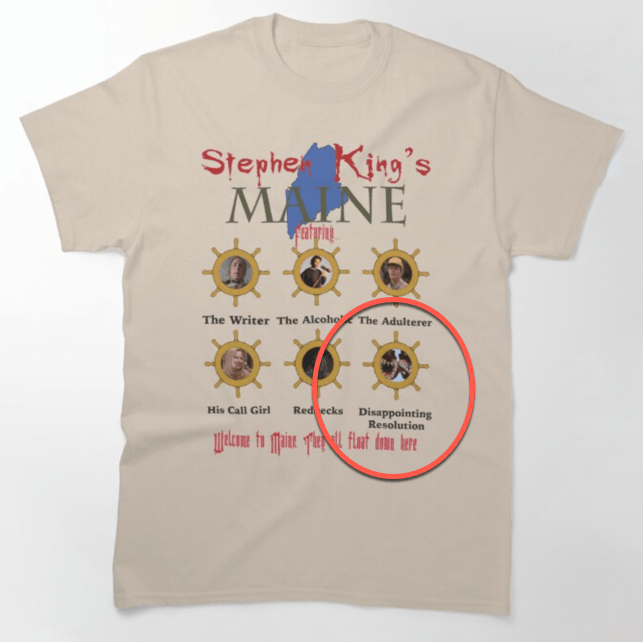
Reader dissatisfaction with King’s endings strikes me as a product of how good/immersive his books are up that point and thus a product of a double-edged sword: the better the book–that is, the more the reader is immersed in its world and characters–the better the ending has to be to satisfy. It’s like King has set such a high bar for himself in the buildup that his ending will necessarily never be able to meet it; the reader comes to love the characters and their world so much that no ending can be good enough. Any resolution is inherently “disappointing” because it means the book is over and you can no longer continue reading it… But The Dead Zone was the opposite for me: I liked the ending; it was the buildup to it that felt lacking.
Let’s start with the prologue: here we get two separate scenes focusing on two different characters. The scene we get of our protagonist John Smith seems critical to the overall narrative in showing us an early head injury that is implied to be related to why the eventual coma has the effect on him that it does in terms of his precognitive abilities. Then there’s the scene of Greg Stillson: this scene shows us the character in a way that instills a sense of foreboding about him, but unlike John’s scene, what happens in it is not technically critical to any later plot developments–it’s not like what happens here with the dog causes or has any influence on changing his actions in a pivotal way, like this is the moment he decides he has a higher calling specifically due to what happened in the scene. The other problem is that its placement implies Johnny and Stillson are going to get equal or at least comparable airtime/page counts throughout the book, but Johnny gets much more, and part of what we do end up getting about Stillson’s side doesn’t even directly involve him–like a scene of his enforcer Sonny Elliman threatening a journalist. Such scenes, like that of Stillson’s in the prologue, show us something about the character and his general trajectory, but don’t feel directly critical to the Johnny-Stillson plot–Elliman has presumably threatened many journalists, so why is this threat the one we end up getting in scene?
Stillson is not developed in any satisfying way as a human being in the scenes we do get of him or otherwise, but rather is shown to be a psychotic monster with no nuance. This could be fine for thematic purposes, highlighting the monstrousness of politicians and/or the political machine that subsumes people who have to adhere to its platforms/demands in order to be successful in politics. I am increasingly wary of narratives that humanize would-be monsters so that we end up sympathizing with them in a way that might implicitly let them off the hook (I don’t want to sympathize with Donald Trump, no matter how mean his father was to him). But the framing of Stillson we get via the prologue, if in form more than content, sets up an expectation that he’ll get more nuanced development than he does.
Yet despite the page count dedicated to him, development is a problem that extends to Johnny as well. By naming this protagonist “John Smith” with no middle name, King seems to be branding Johnny as an everyman, more cipher than individual, which a lack of character development would seem in keeping with. So there’s a technical explanation, but John’s everymanness sure is boring to read–he’s as bland as freeze-dried rations that only approximate the flavor of meat. Sarah is a plot/character device for John in that she represents the life John would have had if he hadn’t lost those 4.5 years due to the accident–her son Denny should have been his son, etc. And he was a preternaturally gifted charismatic English teacher, so the happy life he should have had is outlined to heighten the tragedy of what is precisely the sacrifice of his individuality that defines the plot’s rising action, but the sketching of all of this bent toward hokey.
This aspect combined with the extended period of time the novel covers in jerks and stutters make the overall reading experience a bit of a slog. The interest we’re told Johnny develops in politicians following his coma feels utterly contrived, something that clearly exists only because of/for the sake of the plot: Johnny’s interest in politicians seems to be due to his increased post-coma precog abilities, but it would be better if this interest had some seed in his individual character that existed apart from these abilities. His mother’s extreme religious tendencies seem to exist to introduce the idea that John has been chosen or called on by some larger/divine force to use his abilities for some larger significant purpose, but there is nothing about John independent of these abilities, nothing about his individual character, that impacts his decision to ultimately accept his calling and use them. If it’s supposed to be due to the deathbed exchange he has with his crazy religious mother about his calling, that’s not really working for me, though perhaps some might try to argue for this mother-based motivation based on the theory that Frank Dodd is a version of Hyde to Johnny’s Jekyll. The narrative basically lays the blame/motivation for Dodd’s…tendencies…at the mother’s doorstep with the descriptions of how she made him clothespin his penis when she caught him playing with it when he was young, and his invocation of her language (“nasty-fuckers”) in his direct point-of-view considerations of his crimes.
Pacing-wise, the lack of page count around Stillson is apparently due to getting a lot of stuff about Johnny that is prepping him for how to handle Stillson, but since the prologue is also focalized on Stillson, it’s implied the rising action should also revolve more around Stillson. Instead we get a long digression about Johnny’s psychic fight with another human monster: Castle Rock serial killer Frank Dodd. This plot thread is in theory supposed to be something that vindicates Johnny’s abilities and thus his decision to go through with attempting to kill Stillson, but his vision about Chuck Chatsworth and the graduation party would in theory be enough to serve this purpose. The whole Frank Dodd thread feels like it should be its own separate novel with the confrontation with Dodd as its climax; we get scenes in the killer’s point of view, but this plot thread, especially Bannerman’s relationship with Dodd, ends up feeling undeveloped and rushed. King will lean on Dodd later in his development of Castle Rock (particularly in Cujo, whose titular character/monster will be implied to be some manifestation of Dodd), and if King had leaned on Dodd more here than he does, that would also be more satisfying.
As for the ending, the setup implies two obvious outcomes for the fulcrum of Johnny’s assassination attempt on Stillson: he succeeds in killing Stillson and thus annihilating the possibility of nuclear annihilation for the world at large, or he fails and we all die in an inferno much like the one conjured by Sarah Connor’s consciousness in Terminator 2.
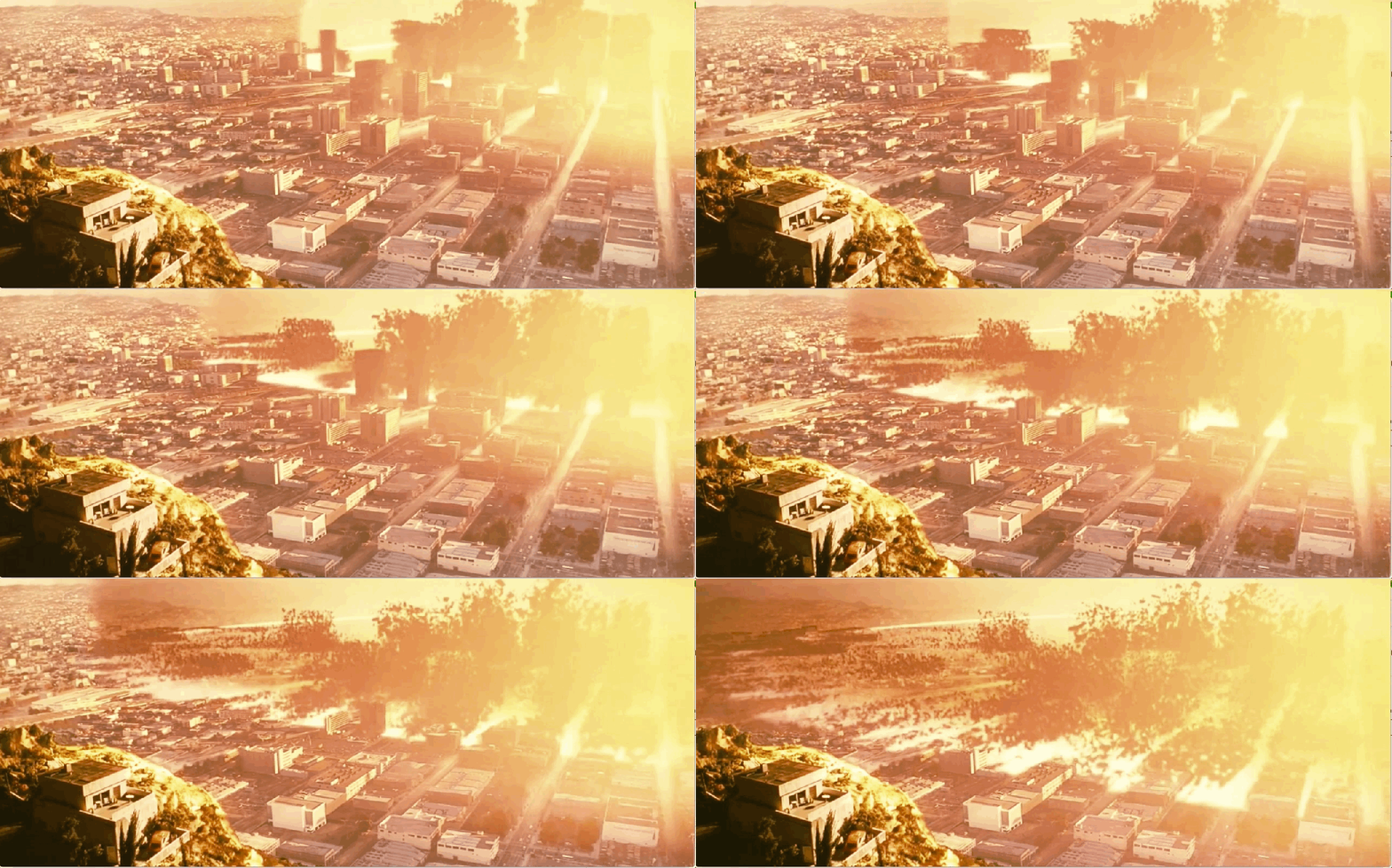
Our protagonist does die in the attempt that fails in its most immediate goal: Stillson is not killed. But the attempt itself turns out to achieve the larger goal the assassination was meant to achieve by causing Stillson to show his true colors, thus ending his political career and his chance to access the nuclear codes. So even if you don’t succeed, sometimes just trying is enough…
Of course, how heroic Johnny really is in sacrificing himself for this mission that’s supposed to serve the greater good of humanity is somewhat mitigated by the fact that he was going to die soon anyway from a brain tumor…
In John we have another significant Kingian figure, the English teacher who battles the monster(s). As a teacher, I can appreciate King’s emphasis on the importance of the teacher, and by extension of reading…
Long-suffering good humor predominated, but beneath it he could sometimes see another Chuck: sullen, worried, and scared. Plenty scared. Because it was a reader’s world, the unlettered of America were dinosaurs lumbering down a blind alley, and Chuck was smart enough to know it. And he was plenty afraid of what might happen to him when he got back to school this fall.
This lends new meaning to the term “letter jacket”…
Enter the Kingverse
It feels ironic to me that King declared The Dead Zone his “first real novel,” though his biographer’s juxtaposition of this inflated claim with another tidbit about this novel speaks volumes:
“That’s the first real novel I wrote,” [King] said. “Up until then, the others were just exercises. That’s a real novel with real characters, a real big plot and subplots.”
The Dead Zone was his first book set in Castle Rock, a town in Maine that he’s said he’s patterned after Durham and Lisbon Falls. He borrowed the name from William Golding’s Lord of the Flies, one of his favorite books as a kid. Castle Rock is the rocky part of the island where Golding’s story occurs.
Rogak, Lisa. Haunted Heart (p. 99). St. Martin’s Publishing Group. Kindle Edition.
So The Dead Zone is King’s first (published) novel to introduce the now infamous imaginary Maine town of Castle Rock. In this and other critical ways, it provides insight into King’s world-building tactics, as does its Author’s Note at the beginning:
What follows is a work of fiction. All of the major characters are made up. Because it plays against the historical backdrop of the last decade, the reader may recognize certain actual figures who played their parts in the 1970s. It is my hope that none of these figures has been misrepresented. There is no third congressional district in New Hampshire and no town of Castle Rock in Maine. Chuck Chatsworth’s reading lesson is drawn from Fire Brain, by Max Brand, originally published by Dodd, Mead and Company, Inc.
So, an interplay between the fictional and the “actual,” which the fictional Castle Rock reflects by being situated in a Maine topography both “actual” and fixed in other King novels:
“All right, Daddy,” Johnny said, almost in a whisper. “Yes. Cumberland General. I know where it is. Just above Jerusalem’s Lot. Okay. All right. Daddy …”
It’s later on, when John is tutoring Chuck, that another setting link to the Kingverse, one outside the bounds of Maine, crops up:
…the decision had already been made between Chuck and his father that he would spend a year at Stovington Prep, a good private school in Vermont.
Stovington Prep is where Jack Torrance of The Shining taught, so this is an even more direct link to that novel than the use of Stovington in general as the location of a disease-control center where Stu Redman ends up in The Stand. Of course, The Dead Zone cannot technically take place in the “same” world as The Stand, since the majority of the population of that world has already been killed off, though it seems like The Dead Zone could take place in the same world as The Shining. But this aspect is complicated by another reference:
And then, suddenly, from somewhere behind him Patty Strachan began to talk in a high hysterical voice. “It’s his fault, that guy there! He made it happen! He set it on fire by his mind, just like in that book Carrie. You murderer! Killer! You …”
The Dead Zone takes place in a world where Carrie exists as a work of fiction rather than as events that “really” happened. Which seems like an odd choice, considering the overlapping supernatural-seeming abilities these works’ protagonists share…
While I would dispute that this novel feels like it has “real characters,” King’s claim in his Night Shift foreword that if the story is good enough it will make up for such shortcomings rings true here. Stillson may not be developed, but the landscape in which such a supposedly anti-political figure could succeed definitely is:
There was also a carton of paperbacks entitled America the TruthWay: The Communist-Jewish Conspiracy Against Our United States.
Greg did better with this paperback, printed on cheap pulp stock, than with all the Bibles put together. It told all about how the Rothschilds and the Roosevelts and the Greenblatts were taking over the U.S. economy and the U.S. government. There were graphs showing how the Jews related directly to the Communist-Marxist-Leninist-Trotskyite axis, and from there to the Antichrist Itself.
The days of McCarthyism were not long over in Washington; in the Midwest Joe McCarthy’s star had not yet set, and Margaret Chase Smith of Maine was known as “that bitch” for her famous Declaration of Conscience. In addition to the stuff about Communism, Greg Stillson’s rural farm constituency seemed to have a morbid interest in the idea that the Jews were running the world.
Conspiracy theories appealing to a “rural farm constituency” that purports to be Christian, hmm…sounds familiar. Stillson’s initial occupation as a Bible/conspiracy-theory tract salesman offers an interesting overlap with John’s occupation as English teacher/tutor and King’s conception of a “reader’s world” as played out via Chuck Chatsworth. Chuck’s specific issue is not that he can’t read, but that he can’t remember/retain what he reads, which has larger thematic implications for how we “read” history and what we’ve actually learned/retained from it. King has constructed a fictional world around the pillars of our “real” one, as indicated by the references to McCarthy and other real historical figures in the above passage, and perhaps embodied more directly here in the figure of Jimmy Carter, the “fuzzy-minded Georgia cracker president of the United States” referred to by Roger Chatsworth above, and whom John himself has something of a chance in-person meeting with during his initial campaign for the Presidency, during which he shakes Carter’s hand and thereby gets a precognitive flash that Carter will win. While this meeting feels like one of the contrived absurdities that largely constitute the plot of this book, in the larger context of the Kingverse it feels symbolic of the intersection of the fictional and the “real” threads that comprise the fabric of the King cosmos in a weave rendering (rather than rending) what King would call the “capital-T Truth,” a weave more fully formed via the creation of King’s seminal setting, Castle Rock. That “Castle Rock” is a literary reference further emphasizes the reading-related themes.
-SCR
 Long Live The King
Pingback: The Dead Zone: Hot Dogs and Coke – Long Live The King
Pingback: Cujo Kills, Connects to Carrie – Long Live The King