Because I could not stop for Death –
Emily Dickinson, “Because I could not stop for Death – (479).” 1890.
He kindly stopped for me –
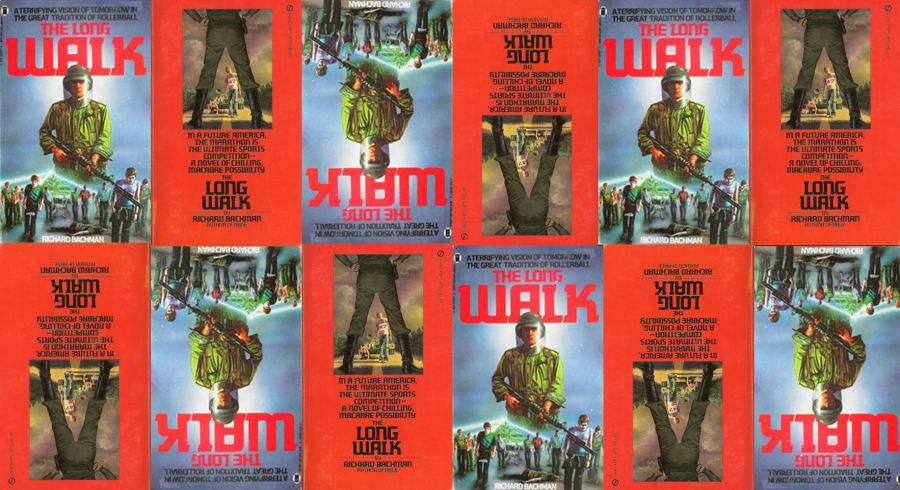
The Long Walk, published in 1979, is the second novel Stephen King put out under his pseudonym Richard Bachman but the first novel he ever wrote–or at least “completed”–back when he was in college. So perhaps it shouldn’t be surprising that it’s overrun (so to speak) with adolescent boys. As with King’s first Bachman novel, Rage, its focus is on one teenaged boy in particular, but in contrast to the former, this one is told from a close-third-person perspective instead of first. The dystopic premise here might have some promise, but as with its Bachman predecessor, the execution(s) feels clunky, and upon finishing the novel it remains difficult to get a grip on why the main character has done what he did.
The Summary
A car pulls into a lot carrying Ray Garraty, who’s come to participate in an annual race known as the Long Walk that takes place in Maine, where Garraty’s from, with ninety-nine other boys aged 18 or under from around the country. In the hour before the race begins, Garraty meets a couple of the others, including Peter McVries, as the boys check in and get their numbers one by one from the famed figure of the Major. When the Walk starts, the boys have to keep their pace above four miles per hour; their speed is monitored via computer sensor by soldiers on a “halftrack” vehicle pacing them. The participants get three warnings for rule violations like slowing down; a fourth violation within the space of an hour means they’ll be shot and killed. (Each warning is erased after an hour passes.) The boys are walking until only one of them is left alive, whose prize will be whatever his heart desires for the rest of his life, but they don’t seem to register the reality of their looming deaths until the first Walker is shot a few hours in, a boy named Curley who gets a Charlie horse.
Garraty is cheered on regularly by onlookers because he’s from Maine, and is subsumed into a group that dubs themselves the “musketeers,” which includes McVries, Art Baker, Abraham, and Olson. They’re antagonized by a boy named Barkovitch and trailed by a mysterious quiet boy named Stebbins. The second to get his “ticket” is a black boy named Ewing who gets terrible blisters from wearing sneakers. Closer to nightfall, Garraty dozes and thinks about his girlfriend Jan as well as Jimmy Owens, a friend from when he was a kid whom he played Doctor with and later hit in the face. That night, as Garraty starts to feel the possibility of going crazy, he also thinks of Freaky D’Allessio, a kid he knew who died when they were young. Several more boys get their tickets by morning. A guy named Scramm who’s married and a favorite to win–a lot of money is bet on the Long Walk–starts to get a cold he claims is allergies but steadily worsens.
When Garraty defends a trucker who’s angry at the Walkers for blocking his route, he reveals to the musketeers that his father (who was a trucker) was “Squaded” when Garraty was around five for not being “much of a Long Walk booster” and being too free with his political views. They debate about why they’re doing the Long Walk, with Stebbins, who seems to know an awful lot about the Long Walk and its history, chiming in it’s because they “‘want to die.’” McVries saves Garraty when Garraty catches a case of hysterical laughter upon seeing the first huge crowds about a hundred miles in; then McVries tells him how he got a scar on his face during a breakup with a girl after they both got summer jobs at a pajama factory and she ended up making more money than him.
That afternoon, a vendor manages to toss them some watermelon against the rules, and then it starts to storm. When Olson is about to give out, he storms the soldiers on the halftrack, and they shoot him in the gut so it takes him longer to die to discourage the others from following suit. That night Garraty has to stop to take a shit with crowds watching and thinks about people collecting it as a souvenir. The next day, Scramm is clearly dying of pneumonia, and the group collectively decides that whoever wins will do something for his pregnant wife; Scramm and another boy who’d been walking at the front the whole time with his brother take their tickets. In the afternoon Garraty has to stop due to a debilitating leg cramp, managing to start up again just in the nick of time before his final warning. He and McVries talk about getting selected for the Walk (McVries was an alternate for someone who backed out) and how Garraty’s mother and his girlfriend Jan didn’t want him to participate but are supposed to be on the Walkers’ route in Freeport to see him. McVries offers to jerk Garraty off, and Garraty seems to consider it due to McVries’ having saved his life, but then McVries backs off. Barkovitch tries to explain to Garraty that he’s not really such a bad guy shortly before he (Barkovitch) goes crazy and claws out his own throat.
Garraty makes it through another night. The next morning Stebbins baits him about seeing his mother, and Garraty blows up at McVries after trying to confess to him about how he undressed with his friend Jimmy. In Freeport, when Garraty sees his mother and Jan and holds their hands, he almost stays with them too long and gets a ticket, but McVries drags him away, saving him for the second time. The remaining Walkers make a promise that no one will help anyone else from that point on. A boy named Collie Parker manages to take one of the soldiers’ guns and tries to rally the others to mutiny, but they hesitate and Parker is shot. That night it starts to rain; they cross the New Hampshire border with ten Walkers remaining.
The next morning (the last), Stebbins confesses that he’s the Major’s bastard son who’d wanted to claim moving into the Major’s house as his prize, but says he didn’t realize the Major knew who he was all along and was just using him as a carrot to drive the other Walkers farther, which seems to have worked. Seven remaining Walkers make it into Massachusetts, and then Baker gets a bad nosebleed and takes his ticket. McVries wanders off sleeping toward the crowd and Garraty tries to help him, but McVries says it’s time and sits down. Garraty swears he’ll walk down Stebbins before realizing he can’t make it, but when he goes to tell Stebbins he’s giving up, he sees that Stebbins has turned into an old man, and then Stebbins drops dead. The Major tries to declare Garraty the winner, but Garraty runs from him toward a dark figure he sees beckoning. The End.
The Narrative Structure
Trying to remember what happens in what order plot-wise is harder for this book than most of King’s because of how monotonous this narrative is–apparently by design. The premise has a built-in timeline/narrative arc: the duration of the walking contest, with the rising action constituted by Garraty’s and the other characters’ increasing exhaustion. But that’s not enough “action” in and of itself, so we have the relationship between Garraty and McVries, with the most significant developments in the action being Garraty’s close calls to getting his ticket, and McVries then rescuing him. Garraty has three close calls, generating a clear pattern, but unfortunately the first two of these are entirely arbitrary/contrived, i.e., could have happened to any of the boys–his laughing fit and then his leg cramps. The third–wanting to stay with his mother and girlfriend–is the only one that arises from his character and/or his specific individual circumstances, and which feels more like a choice. That Garraty is the main character indicates that he will be the last one walking (the last shall be first…), though the fact that he’s from Maine and so specifically singled out by the crowds introduces another possible rationale for his being the focal character so that the conclusion is not entirely foregone (but still pretty much is).
The most appealing aspect of this novel for me is how its premise starts to achieve an allegorical resonance–the monotonous plod through the long walk of life, of having to endlessly put one foot in front of the other because life, with its endless bullshit and unexpected obstacles, is not going to stop for you. The pattern of Garraty’s close calls plays into this specifically via McVries, who saves him two out of the three times, generating a sense of indebtedness in Garraty and thematically highlighting the necessity of assistance from others and of relationships in general. Late in the game the boys decide they have to make it on their own, but the fact remains that Garraty hardly wins by himself. Then there’s the haunting conclusion of his so-called victory, the beckoning of the reaper-like figure. The book ends with Garraty still in motion.
By this point King has revealed a certain fondness for epigraphs, and here he uses them to excess even for him, with one at the beginning of every chapter, giving us eighteen total. The final chapter’s epigraph demonstrates another favorite King tic of epigraphing quotes from his own characters (though at least in this case he doesn’t have the character state the epigraph quote in the actual chapter itself, rendering it utterly superfluous), but all of the others are from real-life game shows, which, if nothing else, taught me some television history I was unfamiliar with.
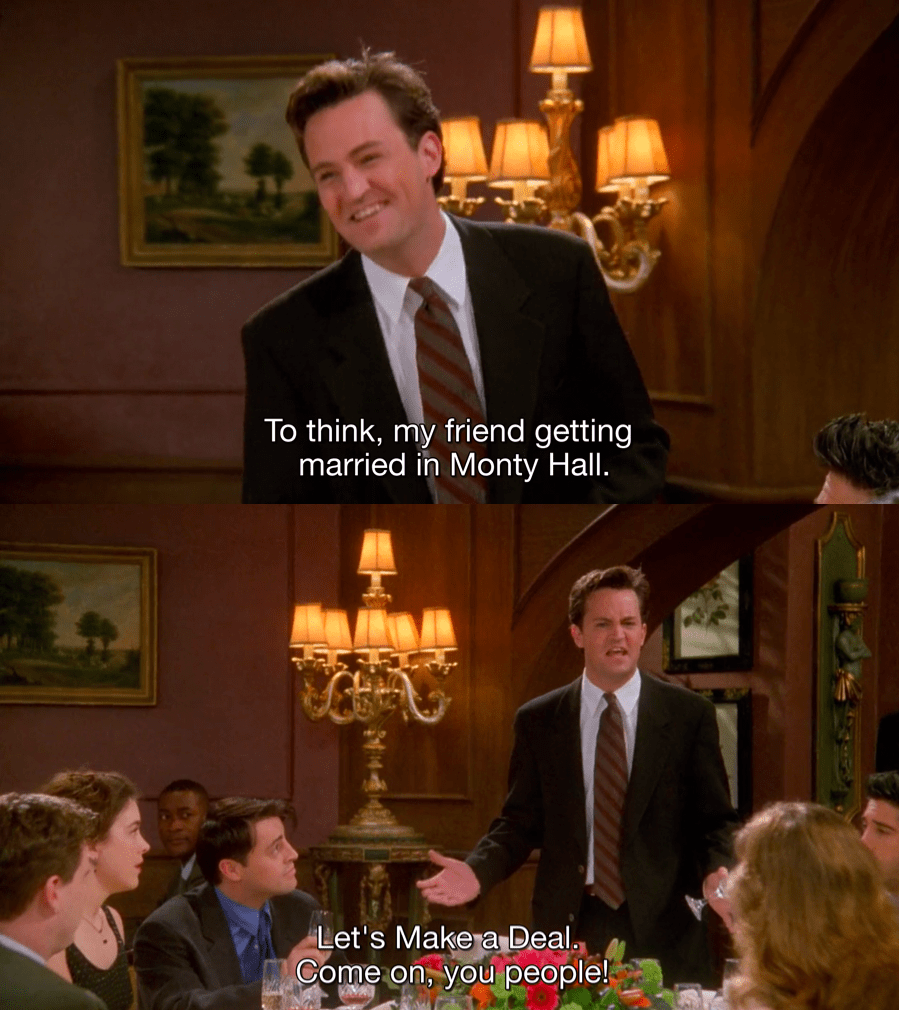
On the whole these game-show quotes seem like they would make more sense for King’s next Bachman dystopia, The Running Man (1982), the premise of which revolves around an actual game show. You can get a sense from the titles that The Long Walk is a sort of Running Man precursor, but conceptually the Long Walk is not a game show. Clunk.
The Female Presence
One of the most unappealing aspects of this novel is how entirely male-centric it is. This is not uncommon for King, but seems even more exaggerated here. The premise of Rage at least allowed some space for female characters to have some kind of presence/voice (however problematically rendered), since the class that the protagonist Charlie Decker takes hostage is not exclusively male, as the members of the titular contest are here. Of course, there should be space in Garraty’s backstory for some women, and in that space we have his girlfriend Jan and his mother, who make the briefest of appearances in the present action. It’s quite the contest in and of itself who would be the most undeveloped female character in a King/Bachman novel, but these two are up there:
. . . for the first time it seemed perfectly real and totally unnatural, and he wanted either Jan or his mother, some woman, and he wondered what in the hell he was doing and how he ever could have gotten involved.
“Some woman” just about sums it up. As per usual, these women exist exclusively for male character and/or plot development. Before we hear anything more about Jan than her name, Garraty kisses and gropes a random girl cheering him on from the sideline. Then later on, when things get more dire, Jan becomes his motivation to continue as he thinks about how much he loves her and he feels “a twinge of guilt” about the girl from earlier.
Sure, whatever.
Jan and his mother serve as vague oppositional figures, being against his participating in this contest, highlighting one of this narrative’s other major problems: just why the hell Garraty is doing this in the first place. The narrative explicitly questioning this, as it does in the above passage, does not mitigate the problem, but just calls attention to it. (A form of empty lip service as per Garraty’s “twinge of guilt”: acknowledging the problem is not the same thing as addressing/solving it.) Garraty’s father is much more developed than his mother in that this father has a whole history that connects to the politics of this dystopia and the Long Walk specifically, but the narrative never seems to connect this in any way to Garraty’s motivation to do the Long Walk. This seems like a pretty big missed opportunity, especially considering the climactic reveal revolving around paternity, i.e., Stebbins being the Major’s son. Garraty’s essentially uncoerced and unmotivated participation becomes starker in light of such comparisons as:
The novel since its publication has become a classic in its dystopian vision, the echoes of which can be found throughout popular culture (e.g. The Hunger Games, The Maze Runner).
From here.

Katniss “volunteers” as tribute, except not really, since she’s only doing it to replace her younger sister who was forcibly selected. The forcible selection reflects the overt oppression of that novel’s dystopia, and in theory I guess we’re supposed to interpret so many boys’ willingness to participate in the Long Walk (a whole application process is described; no one is being overtly “forced” to apply) as a product of glory and/or the vague grand prize of getting whatever they want, possibly representative of an even creepier form of coercion in the sense that no one realizes they’re being coerced, which definitely resonates with certain aspects of living under a capitalist so-called democracy…
The narrative takes pains to point out that none of the boys really has a concept of what they’re getting into:
“… And I don’t think I ever realized the real gut truth of what this is. I think I had the idea that when the first guy got so he couldn’t cut it anymore they’d aim the guns at him and pull the triggers and little pieces of paper with the word BANG printed on them would . . . would . . . and the Major would say April Fool and we’d all go home. Do you get what I’m saying at all?”
Garraty thought of his own rending shock when Curley had gone down in a spray of blood and brains like oatmeal, brains on the pavement and the white line. “Yes,” he said. “I know what you’re saying.”
This contributes to the allegorical aspect of life/growing up/facing mortality, but Garraty having a more specific motivation would raise the stakes and help the reader become more invested in his character.
The Africanist Presence
The only Black character in the novel is a Long Walker named Ewing, the second boy to get his ticket. Not surprisingly for a King novel, even if published under a different name, the N-word is invoked in relation to him, though by Barkovitch, who’s the closest thing to a villain apart from the Major and the soldiers on the halftrack. Ewing’s mistake is wearing sneakers for the Walk, which the “hints” in the boys’ Long Walk manuals specifically recommend against due to their causing blisters, as they do with Ewing. This novel was written before Nike became ubiquitous, and at least for me, it was surprising to hear that sneakers are supposed to be the worst thing you could wear in an essentially athletic competition like the Walk–especially since it’s never specified what kind of footwear is actually recommended or what they’re actually wearing, except for some moccasins that Stebbins is keeping in his belt for later in the walk (it’s not clear what’s on his feet before he puts these on). At any rate, Ewing chooses not to listen to the establishment’s recommendation, which might make a certain sense from a minority perspective, but the narrative proves him wrong not to have listened.
Ewing has no voice, being merely an observed casualty who never speaks to anyone. Ewing’s position as second to die instead of first might seem like it subverts the horror trope of the Black guy being the first to get killed, but from an inverted perspective, being first might have had more dignity than second:
“How tough it’s going to be for the second-to-last guy.”
“Why so tough?” McVries asked.
… “You know, to walk down everybody, absolutely everybody but that last guy. There ought to be a runner-up Prize, that’s what I think.”
The Africanist presence also appears in another form, not embodied in a character, in a way that reveals, among other things, how this dystopia resembles our “real” world:
“…Ma used to say he was her cross, but he only got into bad trouble that once. I did worse. I was a night rider for three years.”
…
“That’s a Squading offense, but I didn’t care. I was only twelve when I got into it. Ain’t hardly nothing but kids who go night-riding now, you know. Older heads are wiser heads. They’d tell us to go to it and pat our heads, but they weren’t out to get Squaded, not them. I got out after we burnt a cross on some black man’s lawn. I was scairt green. And ashamed, too. Why does anybody want to go burning a cross on some black man’s lawn? Jesus Christ, that stuff’s history, ain’t it? Sure it is.” Baker shook his head vaguely. “It wasn’t right.”
At that moment the rifles went again.
Quite a bit of wordplay here with the “cross,” “Jesus Christ,” and “history”…this overt condemnation of racism–the rifles here linking the horror and general senselessness of the Walkers’ deaths to the senselessness of the murderous violence perpetrated by the KKK–strikes me as indicative of King’s good intentions (believing himself to not be a racist but merely representing the Truth of racism’s existence and manifestations), intentions that he frequently and seemingly unintentionally undermines in other ways, such as in the marginalization of Ewing.
The Gay Stuff
I have put forth a theory that Rage‘s protagonist Charlie Decker is GAY, but The Long Walk engages with queerness a lot more explicitly. Once again we see a male figure from Garraty’s past gets more development than the females via the figure of Jimmy Owens, whom Garraty seems to think about more than gf Jan. Jan’s name is technically mentioned more, but seemingly repeated as a mindless mantra and in reference to her physical/sexual attributes rather than thinking anything substantive about her. Jan, through Garraty’s eyes, does not have what might be termed a personality.
The Truth of being a teenage boy, I’m sure.
In certain ways, Jimmy Owens is positioned in a female role. Jan is mentioned in the the text first, but Jimmy directly displaces her as Garraty walk-dozes:
Jan was gone. Her face became that of Jimmy Owens, the kid down the block from them. He had been five and Jimmy had been five and Jimmy’s mother had caught them playing Doctor’s Office in the sandpit behind Jimmy’s house. They both had boners.
In this sequence Garraty is initially thinking of his mother, who’s then displaced by Jan, connecting to Freudian themes re: the “motherfucker” that resurface throughout the text–via Jimmy telling Garraty what Jimmy’s mother looked like when he saw her naked (“hairy and cut open”), and later through Stebbins antagonizing Garraty about seeing his mother in the present action. Also, by all appearances from the description in the above ruminating/dozing sequence, Garraty and Jimmy have only looked at each other with their clothes off. But something more significant about their Doctor game is revealed later:
He thought of Jimmy Owens, he had hit Jimmy with the barrel of his air rifle, and yes he had meant to, because it had been Jimmy’s idea, taking off their clothes and touching each other had been Jimmy’s idea, it had been Jimmy’s idea.
Embarrassment/shame over this episode is the apparent reason he later hits Jimmy; after McVries relays how his girlfriend cut him with a letter opener during their breakup, Garraty wonders if Jimmy has a scar from when Garraty hit him, further heightening the romantic/non-platonic aspect of Garraty and Jimmy’s association. Appropriately then, McVries steps into Jimmy’s role in the present, and I was as shocked as Garraty at how explicit it became:
“He thinks we’re queer for each other,” McVries said, amused.
“He what?” Garraty’s head snapped up.
“He’s not such a bad guy,” McVries said thoughtfully. He cocked a humorous eye at Garraty. “Maybe he’s even half-right. Maybe that’s why I saved your ass. Maybe I’m queer for you.”
“With a face like mine? I thought you perverts liked the willowy type.” Still, he was suddenly uneasy.
Suddenly, shockingly, McVries said: “Would you let me jerk you off ?”
Garraty hissed in breath. “What the hell—”
“Oh, shut up,” McVries said crossly. “Where do you get off with all this self-righteous shit? I’m not even going to make it any easier by letting you know if I’m joking. What say?”
Garraty felt a sticky dryness in his throat. The thing was, he wanted to be touched. Queer, not queer, that didn’t seem to matter now that they were all busy dying. All that mattered was McVries. He didn’t want McVries to touch him, not that way.
“Well, I suppose you did save my life—” Garraty let it hang.
McVries laughed. “I’m supposed to feel like a heel because you owe me something and I’m taking advantage? Is that it?”“Do what you want,” Garraty said shortly. “But quit playing games.”
“Does that mean yes?”
“Whatever you want!” Garraty yelled. Pearson, who had been staring, nearly hypnotized, at his feet, looked up, startled. “Whatever you goddam want!” Garraty yelled.
McVries laughed again. “You’re all right, Ray. Never doubt it.” He clapped Garraty’s shoulder and dropped back.
Garraty stared after him, mystified.
There’s some ambiguity, but since Garraty, even though “he wanted to be touched,” then immediately “didn’t want McVries to touch him, not that way,” it does seem like he’s only open to the possibility out of a sense of indebtedness. Which seems like a copout considering the Jimmy backstory…
Basically Garraty doesn’t seem queer as characterized by the text, but rather experiencing traditional adolescent sexual confusion I’ve seen touched on (so to speak) by other apparently straight male writers. This general sexual confusion seems further reinforced by the Freudian themes surrounding Garraty’s mother, revealing a fundamental aspect of male heterosexuality in a patriarchal culture, the conundrum underscored by the lack of female character development (here and in other King novels): heterosexual males are mainly fucking females (or talking about doing so) to demonstrate their heterosexuality/sexual prowess to other males in a dynamic that becomes implicitly homosexual, or rather, constitutes a “crisis of male self-definition that throws into question the very category of male heterosexuality,” as an academic text frames it in a more extended discussion of King’s repping of queerness in ‘Salem’s Lot. This crisis is a recurring King theme.
The way queerness plays into conceptions of masculinity is further highlighted in The Long Walk by a pair of non-white characters who lack any specific individual development:
The vanguard was in plain sight: two tall, tanned boys with black leather jackets tied around their waists. The word was that they were queer for each other, but Garraty believed that like he believed the moon was green cheese. They didn’t look effeminate, and they seemed like nice enough guys . . . not that either one of those things had much to do with whether or not they were queer, he supposed. And not that it was any of his business if they were. But . . .
That’s Garraty’s unfinished thought and ellipses. Eventually it’s confirmed that these boys are not queer:
“Joe and Mike? The leather-jacket guys everybody thought was queer for each other? They’re Hopis. I think that was what Scramm was trying to tell us before, and we weren’t gettin’ him. But . . . see . . . what I hear is that they’re brothers.”
Scramm ends up taking his ticket alongside one of these mistaken queers, and his link to this pair is significant, since Scramm is the one boy who seems to have surpassed boyhood by not only marrying a woman, but impregnating her. But Scramm’s manliness/strength fails him; the favorite to win loses. And if the boys everyone took for queer are straight–or at least their closeness signifies something other than queerness: literal fraternity–then perhaps Garraty’s apparent straightness is…something else.
-SCR
 Long Live The King
Pingback: Roadwork…Doesn’t Always Work (Part I) – Long Live The King
Pingback: The Running Man for President – Long Live The King