Sex and violence
Scissor Sisters, “Sex and Violence”
Hit me with a lover, burns so bright
And one is just the other
But I couldn’t talk about it. I’ve never been able to talk about it. Until now.
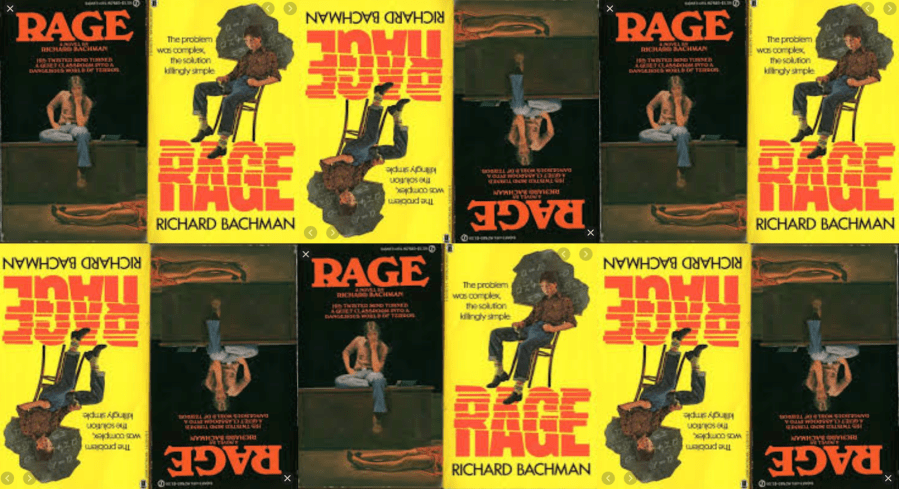
Richard Bachman. Rage. 1977.
As I mentioned in my initial post about Rage, it’s one of the earliest novels King ever wrote. And…it shows. The Freudian and Foucaultian themes raised here are disturbingly intriguing, but the vehicle by which they’re necessarily introduced–the literal and figurative execution of the plot–is generally clunky, ultimately provoking no meaningful emotions. The plot’s failure derives from a failure to develop the main character, first-person narrator Charlie Decker.
Rage feels like a more primitive, less interesting version of Carrie, and Charlie feels like a more primitive, less interesting version of Carrie–their names are even quite similar. In On Writing, King calls Carrie a “female version of Eric Harris and Dylan Klebold,” the Columbine shooters, a likeness that had definitely occurred to me. The primary logistical difference between the plots of Rage and Carrie is that Carrie uses telekinetic powers to enact violent vengeance rather than a gun (also Charlie never actually physically hurts his peers with his instrument of destruction like Carrie does; he only hurts–kills–teachers), making Rage‘s plot an entirely theoretically realistically plausible scenario while Carrie’s is supernatural. And yet Carrie is the one that feels more emotionally authentic, because of her character development, which enables the reader to not only understand her motivations but sympathize with them, that sympathy with who should be a potential villain part of the horror of the experience.
Charlie is more just annoying.
Articulating Teenagers
The book is reputed to have spurred on school shooters in a few cases, an issue that strikes me as a product of Charlie’s character development–specifically that he is characterized as a hero. Even if the development of his heroism is kind of cardboard, the fact remains. Charlie’s motivations for taking his algebra class hostage–and for murdering two teachers in order to do so–is apparently to deconstruct the veneer of civility constraining him and his peers by articulating the taboo, thus revealing the ways society has been holding them hostage, and thus freeing themselves from that societal hostage situation. I’d say Jack Torrance is presented as an antihero; Charlie Decker should be one in theory by virtue of his tactics, but is presented as a hero.
That Charlie’s peers are grateful for their hostage experience indicates that they are suffering from Stockholm syndrome, and some might try to argue that conveys that Charlie’s not actually a hero, but more villainous for convincing his hostages that he is one. But the book’s conclusion, giving us a sweeping look at the future after the day that takes up most of the timeline, goes beyond Stockholm syndrome and reinforces Charlie’s heroism, if with a sinister undertone.
A major but ultimately clunky effort on the part of the author to make Charlie relatable and sympathetic is Charlie’s weak stomach, referenced in the novel’s opening paragraph:
The morning I got it on was nice; a nice May morning. What made it nice was that I’d kept my breakfast down, and the squirrel I spotted in Algebra II.
This vulnerability is not a masculine trait, a detail that’s actually true and interesting–it’s not the confident macho types with the swagger of Clint Eastwood who are going to be driven to gun violence at school. It’s the ones who lack that who are going to be driven to it, driven to it specifically by that lack of masculinity as an attempted means of expressing that masculinity… but the stomach detail doesn’t ever feel developed to that end. And in general it’s not a bad tactic to have your character concurrently experiencing some type of relatable physical pain alongside a potentially more unrelatable emotional one, but the stomach references often feel like they were shoehorned in in a later draft.
The stomach pain is cited as a potential motivation for Charlie’s actions when he later explains why he started carrying a pipe wrench to school:
There was no one reason why I started carrying the pipe wrench to school.
Now, even after all of this, I can’t isolate the major cause. My stomach was hurting all the time, and I used to imagine people were trying to pick fights with me even when they weren’t.
Charlie says there’s not a cause that can be isolated, but we can’t exactly take what he says at face value. Over the course of the day during which the majority of the present action takes place, Charlie relays several anecdotes that are supposed to function by way of explanation for his present actions. The transition to the first of these further reveals the hand of a novice writer: when Charlie is called to the principal’s office, he happens to see a friend of his father’s there selling textbooks. This friend is sitting there only to serve as a trigger for Charlie to recall the camping trip he went on with his father and father’s friends during which he overheard his father say he’d give Charlie’s mother a “Cherokee nose job” if he caught her cheating on him. This trigger feels clunky because the friend ends up being of no consequence in the present plot, as he needs to be to justify his presence narratively in a way that doesn’t call attention to itself as solely a means to bring up the past…
This “Cherokee nose job” incident is located as an instance of formative trauma for Charlie–a trauma that is not enduring any physical violence himself, but rather hearing violence described by his father: the trauma’s vehicle is verbal. Another notable aspect of this trauma is its conflation of sex and violence, a conflation that will saturate the rest of the text. This so-called “nose job” is an act of violence enacted as vengeance for a sexual indiscretion, an act that is also supposed to replicate the sexual, as Charlie’s father explains:
“The idea was to put a [] right up on their faces so everyone in the tribe could see what part of them got them in trouble.”
This “idea” reflects another dichotomy that saturates the text: public versus private. The means by which the private becomes public is again specifically verbal–to publicize your secrets you have to say them out loud. This first anecdote from Charlie’s past is the only one that gets its own chapter that’s not relayed out loud to his hostages in Room 16. These verbal anecdotes are also somewhat clunkily transitioned to in how they’re usually prefaced with “I said:” as the ending of a chapter, with the next chapter presenting the anecdote in prose rather than dialog but understood to be spoken to the class (except for the first one).
So for these anecdotes we get, in this order:
-9 year-old Charlie on camping trip learning of Cherokee nose job
-Charlie’s parents getting together and 4 yo Charlie breaking storm windows
-12 yo Charlie getting beaten up for wearing a suit to Carol Granger’s birthday party
-17 yo Charlie unable to get it up during visit to University of Maine
-17 yo Charlie assaulting chemistry teacher with pipe wrench at school and subsequent fight with his father
That the second anecdote is the only one out of order chronologically would seem to reinforce the importance of starting with the Cherokee nose job, a specific conflation of sex and violence, since the storm window scene–the first chronologically–isn’t about sex directly, though there is a bit of a weird potentially sexualized description:
I stuffed stones into the front pockets until it must have looked like I was carrying ostrich eggs.
This anecdote invokes a motif of breaking windows, which seems related to the themes of rendering the private public by articulating the taboo–a figurative breaking of (transparent?) boundaries. Charlie’s probing–or breaking–the veneer of civil society by giving voice to that which it silences is thus deemed an inherently/necessarily violent act–but not a villainous one.
Clothes Cover and Carry Character
Three of Charlie’s anecdotes invoke clothes, which constitute another type of boundary. Clothes as related to the writing craft also come up in King’s memoir On Writing when he discusses the genesis of Carrie and two specific outcast girls he went to high school with whom he called upon when summoning her, including one he calls “Dodie”:
Her parents were interested in only one thing, and that was entering contests. They were good at them, too; they had won all sorts of odd stuff, including a year’s supply of Three Diamonds Brand Fancy Tuna and Jack Benny’s Maxwell automobile. …
Whatever the Franklins might have won, a supply of clothes for growing teenagers wasn’t part of the haul. Dodie and her brother Bill wore the same stuff every day for the first year and a half of high school: black pants and a shortsleeved checked sport shirt for him, a long black skirt, gray knee-socks, and a sleeveless white blouse for her.
The contest detail I don’t think made it into Carrie but did make it into Rage, characterizing not Charlie but one of his hostages, a boy nicknamed “Pig Pen” because he’s too poor to wear clean clothes to school. After going into quite a bit of detail about Dodie’s clothes in an anecdote whose plot pivots around them, later in the memoir, King says:
I’m not particularly keen on writing which exhaustively describes the physical characteristics of the people in the story and what they’re wearing (I find wardrobe inventory particularly irritating; if I want to read descriptions of clothes, I can always get a J. Crew catalogue).
It’s a fair warning against getting too detailed when you’re writing any description, but his offhanded aside about “wardrobe inventory” belies how much attention he does pay to clothes as a writer–not in the type of tedious detail he’s berating here, but in what they indicate about the person wearing them, as when Pip Pen’s mother makes an appearance in the crowd outside the window, “her slip hanging a quarter of an inch below the hem of her dress.” (Not to mention that clothes also become pretty important for Carrie’s character in the form of the lurid red prom dress she sews for herself.) And in Rage, King/Bachman reveals an interest in clothes as an inherently sexual element and/or a marker of sexual boundaries.
The incident when Charlie is 12 happens because of his clothes: after repeatedly mocking him for how “wonderful” he looks, Dicky Cable beats him up for wearing a corduroy suit (which his mother forced him to) to Carol Granger’s birthday party when no one else is dressed up. This incident is especially important since it comes up when Charlie later assaults his chemistry teacher:
When I did it wrong for the third time [the teacher] said, “Well, that’s just woonderful, Charlie. Woooonderful.” He sounded just like Dicky Cable. He sounded so much like him that I turned around fast to look. He sounded so much like him that I reached for my back pocket where that pipe wrench was tucked away, before I even thought. My stomach was all drawn up tight, and I thought I was just going to lean down and blow my cookies all over the floor.
Again we see King leaning on the stomach thing to make Charlie sympathetic in this situation, though to me it just feels tacked on. That we’re able to clearly connect the trigger–a verbal trigger, note–to a former childhood trauma also didn’t work for me as a means to making Charlie sympathetic here. Probably because his getting beaten up by Dicky, while having the potential to be traumatic, just felt sort of random. Dicky doesn’t beat Charlie up for anything personal or actually character-based, but for something he was forced to do by his mother, which seems designed to make him a victim and thereby evoke sympathy, but doesn’t.
The assault on his teacher is also specifically enabled because of clothes: Charlie mentions he’s able to bring the pipe wrench to school in his pants thanks to the big bulky sweaters from an aunt that cover his back pockets. And the other anecdote from when he’s 17–when he can’t get it up at the college party–involves clothes in the form of Charlie repeatedly looking up a girl’s dress; her noticing this–“‘You’ve been looking up my dress all night. What does that mean?'”–is the impetus for her to invite him to have sex with her. But by the time she’s ready, everything on Charlie’s end has “collapsed into noodledom.” Impotence that’s probably connected to the violence he then enacts with a reliably solid pipe wrench–a “stick” of some importance.
“Stick It“
Charlie wields power through his gun, but after he kills the second teacher early on, he doesn’t shoot anyone else. He wields his power verbally, and one scene that shows him enacting his mission of articulating the taboo–of getting people to say what they aren’t supposed to–is an exchange he has over the intercom with the counselor Mr. Grace in which he threatens to kill someone if Mr. Grace asks another question. Charlie interrogates Mr. Grace until he eventually trips him up and makes him ask a question–he gets Mr. Grace to say what he wasn’t supposed to. This is another instance of something that should work in theory in terms of plot helping thematic development, but doesn’t help much in practice. Charlie’s mission is hardly made sympathetic when he sounds like a five-year-old trying–successfully–to annoy his parents.
Yet Charlie’s hostages seem to appreciate his efforts to verbally expose the fraudulence of their authority figures, and through these efforts and the exchange of anecdotes they get their Stockholm syndrome. The exchange of anecdotes also illuminates what exactly that nearly titular phrase is supposed to mean:
So I said, “We haven’t finished getting it on down here yet.”
“What does that mean?”
“It means stick it,” I said.
The use of the word “stick” is important to Charlie’s characterization and to that of his nemesis, Ted Jones. Ted is the only one of Charlie’s hostages in Room 16 who considers himself a hostage and who is unwilling to “get it on” by articulating the taboo–as reinforced by his yelling at his fellow hostages and Charlie to “Shut up!” repeatedly. Charlie does needle Ted into some shameful admissions at one point, but Ted makes a point of retracting them later, and Ted’s unwillingness to participate in this articulation leads to the climax of the class attacking Ted, literally and figuratively stripping him. And the resolution: Charlie and Ted both end up in institutions. Charlie is functioning–this institution is where he’s been telling the story from, the ending reveals, so we see he is still in control of his verbal faculties–but Ted’s prognosis is that he won’t recover.
The resolution complicates the climax. King could theoretically be depicting the classmates’ turning on Ted instead of Charlie as horrific, a sort of brainwashing rendered by Charlie the villainous brainwasher, showing how a herd is best dominated/governed by language and emotional appeals rather than overt violence. Ted’s hopeless prognosis, I suppose, could be part of the horror of that depiction, but at the end it feels more like Ted can’t keep his shit together anymore specifically because of his unwillingness to reveal himself authentically via words. Then Charlie reveals to the reader that he has a secret again–the staff thinks he likes custard when he doesn’t–and “having a secret makes me feel better. Like a human being again.” But Ted is unable to even speak anymore, an apparently just punishment for his refusal to speak in the classroom that renders Ted a villain.
Ted’s been pretty clearly established as the villain long before this via his characterization as an “establishment type.” At one point we get:
[Ted’s] eyes were so clear and so straight, so frighteningly purposeful-they were politician’s eyes.
Politician = bad in this figuration, the antithesis of Charlie’s mission of using words (and bullets) to penetrate the polite veneer of society–politicians use words to construct these false edifices. And Ted, via his father, is in line to benefit from the maintenance of these edifices.
But in the first description we get of Ted, Charlie actually says he admires him. In this passage we also get a mini “wardrobe inventory” among some other relevant details:
Ted Jones … was a tall boy wearing wash-faded Levi’s and an army shirt with flap pockets. He looked very fine. I had always admired Ted, although he was never part of the circle I traveled in. He drove last year’s Mustang, which his father had given him, and didn’t get any parking tickets, either. He combed his hair in an out-of-fashion DA, and I bet his was the face that Irma Bates called up in her mind when she sneaked a cucumber out of the refrigerator in the wee hours of the night. With an all-American name like Ted Jones he couldn’t very well miss, either. His father was vice-president of the Placerville Bank and Trust.
Quite a bit going on here… Charlie’s initial admiration of the figure who becomes his nemesis might indicate that his little rampage is a response to his rejection from Ted’s circle, the circle we’re shown generally runs things, as reinforced by Sandra Cross’s anecdote about her date with Ted and how he took her to a bar where he “knew the man who runs it.” But Charlie’s not really shown to have been consistently ostracized, with his getting beaten up an isolated incident because of the suit. He also has a good friend, Joe McKennedy, a relationship I’ll come back to next time. Point for now is that there’s no developed reason Charlie should be an anti-establishment hero.
That Charlie’s teacher-murdering and hostage-taking are supposed to be heroic efforts to pierce the restrictive edifices of society erected (so to speak) by the likes of Ted Joneses (as in “keeping up with the Joneses”?) is complicated by his own invocation of a political philosophy–the “stick”:
Bright kids are like TV dinners. That’s all right. I don’t carry a big stick on that particular subject. Smart girls are just sort of dull.
I certainly learned the lesson about how you could get anyone’s number with a big enough stick. My father picked up the hardhead take, presumably planning to trepan my skull with it, but when I picked up the hatchet, he put it back.
I never saw that pipe wrench again, but what the fuck. I didn’t need that anymore, because that stick wasn’t big enough. I’d known about the pistol in my father’s desk for ten years. Near the end of April I started to carry it to school.
These two passages most directly invoke the origin of the “stick” phrase in President Theodore Roosevelt’s foreign policy framework originating from the quote “Speak softly and carry a big stick; you will go far,” which is apparently, and ironically, a West African proverb…and also publicly declared only days before the President Teddy was VP to was shot and vacated the Presidency for him, enabling him to carry out his grand vision of performing military prowess.
At its core the stick policy is one that depends on violence, or perhaps more accurately, the raising of the possibility of violence. Its proverb wording also pairs this threat of violence with the verbal–“speak softly.” In Rage the word “stick” is, unsurprisingly, also employed in a more explicitly sexual, but still violent, mode:
“I wish I had your stick, Charlie. If I had your stick, I think I’d kill her myself.”
And since “sticks” are now means to enforce power and Charlie figures his father’s pistol as a bigger stick than the pipe wrench, guns are now sticks, and guns are substituted for the penis in several passages, aka further (verbal) conflations of sex and violence:
A hooknosed junior named LaFollet St. Armand began squiring her about, and then knocked her up higher than a kite. LaFollet joined the Marines, where they presumably taught him the difference between his rifle and his gun–which was for shooting and which was for fun.
But by the time she put her hand on my shoulder, I had lost my erection. Wyatt Earp striding into the OK Corral with no sixgun.
Charlie’s formulations of the effectiveness of the big stick, rather than making him a villain by way of likening him to a politician, seem to implicate the larger network of violence Charlie and the country necessarily exist within in a way that potentially makes Charlie the victim and thereby lets Charlie off the hook for his own actions–which he essentially is at the end when he’s sent to an institution instead of prison. But by Charlie’s own logic in having applied the “politician” label to Ted, Charlie himself should be the asshole…
The stick and the clothes motifs intersect in the sub-climactic fight Charlie gets in with his father, which culminates with them threatening each other with the big sticks of everyday garage tools, a rake and a hatchet, in a classic Kingian figuration of the violence latent in the domestic. This fight essentially performs Roosevelt’s policy in culminating in the mere threat of the sticks’ use rather than their actual use… but before that in this scene, violence is enacted, most forcibly when Charlie’s father strikes Charlie in the cheek with his belt. Which is interesting because the belt is not a “stick” but a more…flaccid weapon, and in this case, ironically more successful in inflicting violence. The removal of a belt in general, which Charlie’s father has to do to hit him with it, is also implicitly sexual, marking this moment as a kind of symbolic culmination of Charlie’s conflations of sex and violence being rooted in his own sexual feelings for both of his parents.
In keeping with articulating the taboo, Charlie explicitly addresses these Freudian feelings by noting some dreams he’s had:
I’d been having some goddamn funny dreams, and it scared me, because quite a few of them were wet dreams, and they weren’t the kind that you’re supposed to wake up after with a wet sheet. There was one where I was walking through the basement of an old castle that looked like something out of an old Universal Pictures movie. There was a coffin with the top up, and when I looked inside I saw my father with his hands crossed on his chest. He was neatly decked out–pun intended, I guess–in his dress Navy uniform, and there was a stake driven into his crotch. He opened his eyes and smiled at me. His teeth were fangs. In another one my mother was giving me an enema and I was begging her to hurry because Joe was outside waiting for me. Only, Joe was there, looking over her shoulder, and he had his hands on her breasts while she worked the little red rubber bulb that was pumping soapsuds into my ass.
Quite a bit going on here as well…clothes/father/sex/violence all accounted for. Also a stick in the form of the stake in is father’s crotch. We can see, among other things, how Charlie’s father’s clothes, his Navy uniform, reflect a rigid worldview predicated on rule-following (Ted is also linked to Charlie’s father through his wearing an “army shirt” and Charlie explicitly thinking at one point that Ted could have been his father). And another influence/scapegoat is also invoked here: movies. I guess all of this is supposed to make us feel sorry for him?
The Africanist Presence: Pat Fitzgerald
Since verbal exchange is the means through which Charlie’s hostages/classmates get Stockholm syndrome, we hear from quite a few of the students in the class, though for the sake of narrative simplicity, not from nearly all of the twenty-four we’re told are in Room 16. One student who says nothing substantive but is referenced a few times as window dressing to remind us of the larger cast of the class is Pat Fitzgerald.
Pat Fitzgerald is first mentioned right after another student dismisses the guidance counselor Mr. Grace because “[a]ll he did was look up my dress and try to get me to talk about my sex life”–two traits that by this point have been explicitly attributed to Charlie–and Pat replies “‘Not that you’ve had any,'” getting a laugh. In this and a couple of other instances, the treatment of Pat as window dressing at least seems to include him as an equal in the class’s participation (minus Ted) in Charlie’s taboo articulations.
But the second time Pat Fitzgerald is referenced–the time his Blackness is overtly identified–goes beyond that. It’s when Charlie is verbally (and obnoxiously) sparring with Mr. Grace over the intercom:
“How does Ah do it?” I bawled. “Ah already tole dat dere Mr. Denber how sorry Ah is for hittin’ dat l’il girl wit dat Loosyville Sluggah. Ali wants mah poor paid shrunk! Ali wants mah soul saved an’ made white as snow! How does Ah do it, Rev’rund?”
Pat Fitzgerald, who was nearly as black as the ace of spades, laughed and shook his head.
Um, just no. If this black student in a room full of white students is laughing, it would not be because he thinks Charlie’s racist antics are actually funny. Of course, there’s no acknowledgment of that; rather, this seems to be another moment that’s supposed to show Charlie’s classmates appreciating his open defiance of traditional authorities and his thereby becoming heroic to them. But Charlie is implicitly likening his position in relation to the power structures around him as that of a slave, which I guess wasn’t obvious back in the 70s and still isn’t even obvious now, is an inherently problematic thing for a white man to do.
Sometimes in his capacity as window dressing Pat Fitzgerald just sticks out his tongue or chews his fingernails, but then there’s this:
Pat Fitzgerald’s brown hands worked on his paper plane like the sad, moving fingers of death itself.
Here it seems to be the brownness of Pat Fitzgerald’s hands specifically that is calling up the specter of death, hardly a positive association with a trait that here is inherently racialized.
Pat Fitzgerald’s final contribution, during the class’s climactic collective attack on Ted, is also race-based:
“Soul brother?” Pat Fitzgerald asked. He was smiling, whacking Ted’s bare shoulders lightly with a notebook in cadence. “Be my soul brother? That right? Little Head Start? Little free lunch? That right? Hum? Hum? Brothers? Be soul brothers?”
Here Pat Fitzgerald seems to be engaging in some verbal play of his own, sarcastically inviting Ted to be his equal in and on specifically African-American terms while emphasizing the impossibility of the premise via references to government programs that are supposed to address but mainly exacerbate systemic racism. Which might be the closest Pat Fitzgerald comes to having some type of redemptive agency and the text demonstrating some awareness of systemic racism as part of the polite society Charlie is railing against. Or might be King/Bachman invoking some vague references they associate with Blackness in a way that’s just perpetuating stereotypes…
The references to Carol Granger’s valedictorian speech might shed light on how to interpret the text’s racial consciousness:
Carol Granger raised her hand timidly. … She was smart, smart as a whip. Class president, and a cinch to speak a piece as valedictorian in June “Our Responsibilities to the Black Race” or maybe “Hopes for the Future. ” She was already signed up for one of those big-league women’s colleges where people always wonder how many virgins there are. But I didn’t hold it against her.
Except, he does hold it against her… he refers to her speech again in similar terms:
All I know for sure is that Carol was looking at him defiantly, not like a demure valedictorian-to-be due to speak on the problems of the black race.
Since these passages are both from Charlie’s point of view, they read as condescending; Carol too is an “establishment type” (though one who redeems herself) and her talking about the issue of racial inequality is figured as a kind of false performance characteristic of her class–a self-serving political move. But another student, Sandra Cross, says something that’s reminiscent of these passages about Carol’s speech, but inherently different because it’s not filtered through Charlie’s perspective:
“You try to get interested in things Politics, the school I was on the Student Council last semester but it’s not real, and it’s awfully dull. And there aren’t a lot of minorities or anything around here to fight for, or well, you know. Important things. And so I let Ted do that to me.”
Sandra has discovered the falseness of politics yet seems to have sincere good intentions herself, and her disillusionment that comes from the realization of her own powerlessness to effect any meaningful change leads her to try to have a meaningful experience via sex. This seems like another instance of not just Charlie society-blaming, but the text society-blaming… And the idea that these things are connected, that this type of disillusionment and attempting to exorcise that disillusionment and/or take back some type of power/agency via sex could be insightful, but while the text attempts to make the insight that “establishment types” only want to “help minorities” to prop themselves up, via Pat Fitzgerald it seems to be using minorities as a prop to make that and other insights, thus rendering its commentary hypocritical, at best.
Teaching Logic
The idea that Charlie’s efforts to defy polite society and traditional authorities by articulating the taboo are specifically heroic efforts is supported by the text of Rage itself, but also by the larger King oeuvre often playing out the idea, as in The Shining, that to eradicate the literal and/or figurative demon it must be faced directly in a confrontation that necessarily includes a verbal component in order to qualify as “direct.”
It’s certainly not impossible that King/Bachman could have written a character achieving these heroic efforts by way of the gun and made that character sympathetic–doing so would still be problematic, probably even more so–but Charlie is just too damn whiny for that. He likes to play the blame game, and his two primary scapegoats end up being his father and Hollywood. (In the passage about his parental sex dreams he references a B-horror-flick version of Dracula that seems to embody King’s personal formative artistic influences.) He also potentially implicates pop culture in general with his constant references to songs to describe things (the forum here attempts to track some), and this is the main things that makes his voice interesting enough to get through the book despite his lack of development. Charlie waxes poetic about the influence of movies even more explicitly:
I don’t answer any questions about what happened that morning in Room 16. But if I told them anything, it would be that they’ve forgotten what it is to be a kid, to live cheek-by-jowl with violence, with the commonplace fistfights in the gym, brawls at the PAL hops in Lewiston, beatings on television, murders in the movies. Most of us had seen a little girl puke pea soup all over a priest right down at our local drive-in. Old Book Bags wasn’t much shakes by comparison.
I’m not taking on any of those things, hey, I’m in no shape for crusades these days. I’m just telling you that American kids labor under a huge life of violence, both real and make-believe.
“Old Book Bags” being the teacher he killed whose body is in the room with them the whole time, a fact we’re reminded of only once or twice in a way that felt less like a reflection of Charlie’s callousness than clunky writing. Charlie’s cynical wisdom in general doesn’t feel earned or organic, nor does his so-called rage. It’s an interesting idea how Charlie challenges power structures in society and how they function via repression, but the narrative logic fails in that the stories he tells that are supposed to show us why he feels such an extreme need to do so ultimately don’t. The setup fails.
And the outcome fails. That Charlie’s supposed to have succeeded in actually giving his hostages a meaningful experience rather than simply traumatizing them into thinking that seems borne out by Joe McKennedy’s letter at the end saying that lots of people are still “pulling for” Charlie. That he’s depicted as successfully challenging power structures by murdering two of his teachers is highly problematic, even if he ultimately recognizes:
This thing on the floor between my feet is a classic case of misplaced aggression.
This “thing” being the teacher’s corpse…in a figuration that sounds remorseless, a form of verbal violence, even as it purports to acknowledge the actual problem. As a teacher, I have to say I find this book’s treatment of the teachers pretty offensive. King, or “Bachman,” actually gives one of the murdered teachers an epigraph for the novel as a whole:
So you understand that when we increase the number of variables, the axioms themselves never change.
-Mrs. Jean Underwood
We will see Mrs. Underwood, the algebra teacher, say this in scene in the novel before she’s killed, making its citation as an epigraph seemingly unnecessary, except for extra emphasis, which comes across as novice. I don’t think I’ve ever seen anyone else use a quote from the text itself as an epigraph for that text. Because it really makes no sense.
Another novice move is after the entire novel has been in first-person from Charlie’s point of view, suddenly at the end the text goes epistolary. We get some doctor’s report on Ted from his institution, something Charlie would not have had any access to, unlike the other text we get near the end–Joe McKennedy’s letter to Charlie. The text then switches back into Charlie’s first-person perspective after the doctor’s report. This undermines the book’s narrative logic in a way that makes the ending with Ted seem even more implausible than it already is.
The way the “logic” of Charlie’s anecdotes work to explain his actions seems to be that he’s a victim and that society is responsible, as indicated by Charlie’s vague references to losing his mind as connected to why he started carrying the pipe wrench and then the pistol to school in the first place. (Insanity doesn’t make for interesting character development, even if it’s supposed to be a product of and therefore commentary on larger (pop) cultural forces.) That Dicky Cable is located as the trigger for the assault on Mr. Carlson that led to everything else, and that Dicky Cable beat him up because of his wearing a suit, could show that Charlie’s rebellion against polite conformist–which is to say, adult–society is due to his having suffered specifically for having donned the costume/edifice of this polite society. He was punished for wearing the suit then, so now as he’s on the verge of having to enter polite society and about to have to put the figurative suit of adulthood on again, he’s…not handling it well. The logical pieces might be there, but the emotional ones are not.
The existence of this novel ultimately reminds me of David Foster Wallace saying his first novel, predicated mainly on language games, was written by a “really smart fourteen-year-old,” or the way Harper Lee’s earlier draft of To Kill A Mockingbird was pawned off as a separate book. The whole book itself is adolescent in a way that hinders instead of helps its adolescent subject matter.
-SCR
 Long Live The King
Pingback: Rage: The Queer Catcher Connections – Long Live The King