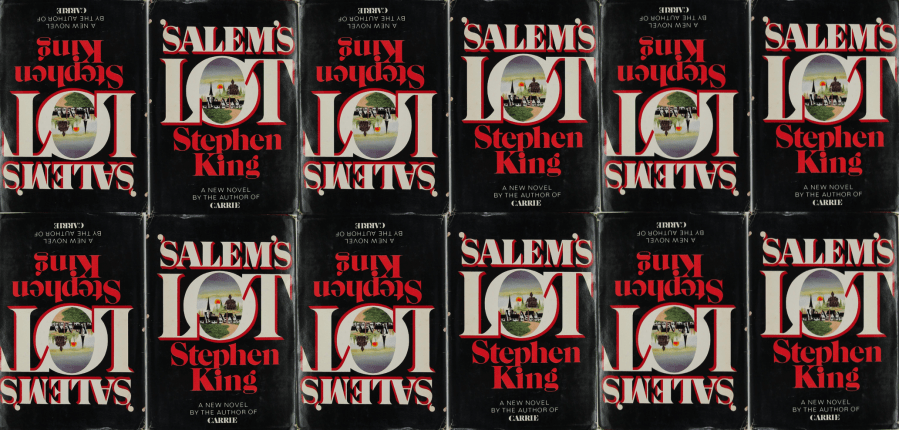
“Easy for Ben to say I’m to tell you everything. Harder to do. But I will try.”
Stephen King. “Salem’s Lot.” iBooks.
A particular pleasure of King’s older novels is when he writes a new introduction for them decades later; my ebook actually has both an introduction and an afterword written by him at some point in the 2000s. He notes the origin of ‘Salem’s Lot (1975) being Dracula (1897), which he taught in his high school classes, and the “E.C. Comics” he used to read as a kid that were pulpier and more graphically violent than Stoker’s classier and comparatively restrained blood-sucking monster. ‘Salem’s Lot thus embodies that quintessential King combo of literary and genre, high art colliding with pop culture.
King calls his second novel his “coming-out party,” seeming to refer to his allowing a sense of humor to enter into the story. But another big element of King’s “coming out” here, so to speak, is his treatment of an ensemble cast wide-ranging and disparate enough to generate the page count of the so-called doorstopper, which will become a King trademark. If Carrie is a character study of a person, then ‘Salem’s Lot is a character study of a town, and once again the elements of supernatural horror underscore the horror inherent in the natural–in this case, King’s supernatural horror provides a thematic treatment of the horrors of living in a “dead” small town deepened by references to real-life current events that reflect the larger culture and mindset of the 1970s.
King notes in his ‘Salem’s Lot intro:
More of Stoker’s characters are around at the finish of Dracula than at the end of ’Salem’s Lot, and yet this is—against its young author’s will—a surprisingly optimistic book. I’m glad. I still see all the nicks and dings on its fenders, all the scars on its hide that were inflicted by the inexperience of a craftsman new at his trade, but I still find many passages of power here. And a few of grace.
Since he doesn’t specify what exactly these “nicks and dings” are or identify the passages of grace, I’ll have to do that for him.
The Ensemble Cast: “Trash”
King mentions his mother Ruth in his ‘Salem’s Lot intro, discussing her distinction between “trash” and “bad trash”:
Quite often she would hand us a book one of us had requested, adding, “That’s trash,” in a tone that suggested she knew that the news wouldn’t stop us–might, on the contrary, actually encourage us. Besides, she knew that trash has its place.
What exact place “trash” has is something I’m interested in exploring on this blog, as portions of King’s work splendidly exemplify this principle. At any rate, “trash” is what the King boys were allowed and even encouraged to read, while “bad trash” is the stuff they were not allowed to read, with Peyton Place cited as an example of the latter (as well as Lady Chatterly’s Lover). King then goes on to conclude that he knows his mother, who died while he was working on the book, would think ‘Salem’s Lot is “trash,” but hopefully wouldn’t think it “bad trash.”
A quick word on Peyton Place: this was a popular salacious 1956 novel turned into a “wildly successful” prime-time soap opera that ran through the second half of the 60s. Wikipedia claims (citing an academic text) that “the term ‘Peyton Place’ – an allusion to any small town or group that holds scandalous secrets – entered into the American lexicon.” This is before my time. The term “Peyton Place” is one that sounded vaguely familiar, but not one I would have been able to attribute a specific meaning to, and I did not know about the novel or the TV show before reading King’s intro. Which is interesting, because I’m familiar with a fair amount of television from that era thanks to my parents, but I guess my mother would have been too young to have watched something like that in her Catholic household; it was probably about ten years too early for her demographic, something she would have watched had it been on in the late 70s instead of 60s. (And something my father wouldn’t have watched at all.) But King, as it happens, is eleven years older than my mother. While he doesn’t specifically attribute Peyton Place influence the way he does Dracula, it’s interesting that it comes up separately in both his intro and his afterword.
King’s conclusion from his intro that ‘Salem’s Lot is trash but not bad trash is called into implicit conflict in his afterword, in which he describes meeting with his editor about which of two manuscripts to move forward with in the wake of Carrie–a manuscript that he considered more serious and would eventually publish as a Richard Bachman novel, and what would become ‘Salem’s Lot. The editor, declaring ‘Salem’s Lot “Peyton Place with vampires,” convinces King that it would be better to move forward with the latter–after voicing reservations that it will brand King as a horror writer, which King, uncaring, laughs off. Call him whatever you want, as long as you pay him.
King notes that ‘Salem’s Lot remains one of his favorites due to the surprising bravery his characters turned out to demonstrate after he initially assumed that they would be no match for the vampire. But for me, the exalted bravery the characters exhibit is one of the novel’s dings, not one of the assets that waxes over them. This is primarily because the characters’ bravery does not feel like it derives from any type of organic or satisfying character development. It seems, initially, like a classic genre case of character subverted and sacrificed to plot rather than plot originating due to the characters–the evil force of this vampire descending on this town is something that happens to the characters, nothing that it seems like they particularly called down upon themselves with their own foibles. As King has it, they might be confronting and overcoming their own foibles on this path to bravery in having to confront this external force, but this is where the character development falls short.
Since a big distinction between literary and genre is the link between character and plot, the pacing of the action here becomes an expression of the shortcomings of the ensemble cast that has the potential to put us in the realm of trash. (“Bad trash,” at least according to Ruth Pillsbury King’s definition, seems to be more about lurid content than execution, Peyton Place‘s laundry list including “incest, abortion, adultery, lust and murder.” ‘Salem’s Lot only really checks two of these boxes, adultery and murder. It seems relatively tame, by today’s standards certainly, but also presumably in comparison to Peyton Place.)
On first read, I found the pacing of the book tedious, and one can probably get a sense of this from reading the summary–characters keep going back and forth to the same places talking to each other about the same things. You can certainly pinpoint escalations in the rising action, but they frequently feel jerky and disjointed, with a lack of coherence, like when the good-ole boy gang stops to stock up on some of the “old protections” at a flower shop and discovers Barlow’s anticipated their move and bought them out. Then they fight over whether they should try to procure more protections or just go confront Barlow before they decide they should go confront him and then go confront him. This is a superficial sense of action and escalation–the conflict has been drawn out by inserting an obstacle and delay before getting to the confrontation, which in theory is supposed to create suspense. But this obstacle of Barlow’s beating them to the flower punch is not shown to be of any actual consequence later–the delay this caused them in getting to the house doesn’t matter in any material way (the exact same thing would have happened at the house whether they’d gone to the flower shop first or not), and the flowers never at any point come to play a role in the action.
That the action and the character development feel equally erratic is not a coincidence, because these two elements of the craft are inextricably related.
So in terms of characters, let’s start with our main one, Ben Mears, the initially nameless “tall man” from the prologue. As we meet “Ben” officially in the opening post-prologue chapter which has circled back in time, he’s driving back to ‘Salem’s Lot in an interesting recursive loop of his later return set up in the prologue. One of the first things he notices here is some teenagers on a motorcycle, triggering this:
Memories tried to crowd in on him, memories of a more recent vintage. He pushed them away. He hadn’t been on a motorcycle in two years. He planned never to ride on one again.
We will steadily get more information about the reason he intends never to ride again: his wife Miranda was killed in a motorcycle accident when he was driving. This provides a chronic tension for Ben that would give him the opportunity for character development, but ultimately it feels like a missed opportunity. (Chronic and acute tension are craft terms I use in my fiction-writing classes that I explain in more detail here.) King leans on Ben’s chronic tension a few times as the vampire situation in the acute tension mounts, but while one might be able to see how the acute vampire situation reminds Ben in ways of his chronic situation, especially in his wanting to protect and then avenge Susan, it doesn’t feel like his character actually develops, because he barely feels like he has a character.
(I will note that I am glad the female figure formative in Ben’s chronic tension actually gets a name, unlike Tim’s ex in The Institute. But also, it’s a little weird and seemingly lazy that King’s main female character here has the same name as one of the main female characters in Carrie.)
The issue seems to be that King uses references to Ben’s chronic tension to increase tension for the plot, not the character. For example, the Miranda chronic tension comes up during a conversation between Ben and Susan once they’ve explicitly started discussing the possibility of vampires:
“I suppose I do. But it all seems more real after dark, doesn’t it?”
“Yes,” she said softly. “God, yes.”
For no reason at all he thought of Miranda and Miranda’s dying: the motorcycle hitting the wet patch, going into a skid, the sound of her scream, his own brute panic, and the side of the truck growing and growing as they approached it broadside.
But it’s not really “[f]or no reason at all” that he’s thinking of this here, obviously. The reason he’s thinking of it seems to be he’s feeling the specter of looming disaster in the gravity of what they’re about to encounter (that is, the vampires), which mirrors the deadly advancing truck from his past. But the disaster coming in the plot via the vampires won’t require anything actually that complicated on the part of Ben’s character. On the surface, yes, he has to do difficult things by maintaining his fight against Barlow while everyone around him is picked off like flies. He exhibits the bravery that apparently made King his creator so proud–but this bravery does not feel like it’s emerged from the acute situation forcing him to confront his chronic tension. There’s even a setup for more of a convergence of these tensions when Susan fights with her mother about the idea that Ben was drunk during the accident and thus potentially caused it–which apparently turns out not to be the case. If Ben didn’t cause the accident and it simply happened to him, much like the vampire situation is happening to him, I’m much less interested. It’s not even really a chronic tension if he’s not in some way responsible for it himself. At least, not a narratively strong chronic tension.
To be more narratively strong, the situation with Miranda should have more influence over one of the most critical things Ben has to do–stake Susan once she becomes a vampire. He “has” to do this for reasons that are left basically unexplained:
“Ben, had you slept with Susan? Forgive me, but—”
“Yes,” he said.
“Then you must pound the stake—first into Barlow, then into her. You are the only person in this little party who has been hurt personally. You will act as her husband. And you mustn’t falter. You’ll be releasing her.”
(The characters acting in response to vampire lore they’ve read is something I’ll go into more detail about in another post.) Ben’s staking Susan is portrayed as difficult for him on the surface:
“No,” Ben said, speaking quietly, as a man speaks a fact. “I can’t.”
“You must,” Father Callahan said. “I’m not telling you it will be easy, or for the best. Only that you must.”
“I can’t!” Ben cried, and this time the words echoed in the cellar.
But the reason Ben “can’t” (though of course he does) is ostensibly the same reason any man wouldn’t be able to do this to his lover; it does not feel specific to Ben. If we’d seen in his chronic tension that he’d failed to do something critical that needed to be done in his past, then this moment would feel more significant, but it doesn’t, because the motorcycle accident is a random thing that happened to him. The other issue is that on top of it not actually connecting to his chronic tension, it’s not even a difficult choice on the surface–he knows she’s undead, and it’s stated repeatedly that it won’t hurt her.
It’s not morally complex to fight pure evil, and so it’s really not that narratively interesting. But it also feels good to fight pure evil and have such pure and righteous moral high ground–it’s just more a sugary eating-candy high. Ironically, Ben’s direct and victorious confrontation with and eradication of Barlow is a form of escaping tough truths rather than actually facing them.
There is another element of Ben’s chronic tension (and that it’s more developed than the part connected to the female characters is something potentially unsurprising in the context of all of King’s work, but more surprising in the context of his only having published the female-centric Carrie by this point). When Ben was a boy he went in the Marsten House and saw the hanging body of Hubie Marsten open his eyes, something that’s haunted him ever since and made him more likely to believe in elements of the supernatural–and a willingness to believe is a big part of the book’s themes. This propensity toward belief is the main thing that qualifies Ben to be the one to stake Barlow (aside from his being unclean from premarital sex, apparently). But despite this, and despite the hanging body of Hubie Marsten opening its dead eyes being a great symbol for chronic tension/emotional baggage in general (the past is not dead…), I was still unsatisfied. Ben feels more brooding wounded male archetype than person–the lack of complication in his chronic tension essentially rendering him a pure if largely stoic force for good. Even Ben’s being sexually impure with Susan makes him more masculine and thus actually pure–a Hollywood hero. He’s like a hybrid John Wayne/James Dean figure, but even better–because he’s also a fiction writer. The pistol turned to pen(is). Or in this case, typewriter.
Taking into account the fact that the primary protagonists here are a fiction writer and an English teacher, we could probably indulge in some speculative psychoanalysis of the author at this point, King still having been both writer and teacher when working on this book. Matt’s role as a teacher means he can provide handy explanations of the lore that feel so heavy-handed even another character is forced to comment on it:
“Don’t underestimate him! And now, if you don’t mind, I’m very tired. I was reading most of the night. Call me the very minute the work is done.”
They left. In the hall Ben looked at Jimmy and said, “Did he remind you of anyone?”
“Yes,” Jimmy said. “Van Helsing.”
Ben’s writing about the Marsten House showcases a fiction writer’s fiction being a reflection/expression of their deepest fears and desires (their Jungian shadow selves), and the idea is hinted at that Ben’s previous books have specifically been avoiding his rather than engaging with them:
Neither Conway’s Daughter nor Air Dance hinted at such a morbid turn of mind. The former was about a minister’s daughter who runs away, joins the counterculture, and takes a long, rambling journey across the country by thumb. The latter was the story of Frank Buzzey, an escaped convict who begins a new life as a car mechanic in another state, and his eventual recapture. Both of them were bright, energetic books, and Hubie Marsten’s dangling shadow, mirrored in the eyes of a nine-year-old boy, did not seem to lie over either of them.
It’s interesting that the subject matter of Ben’s first two books appear to have no antecedents to any of the personal information we learn about him, while the book he’s writing that does confront his personal shit, he ends up destroying.
In light of King himself and what his writing the piece of fiction that is ‘Salem’s Lot potentially reveals about his shadow self, I’d say one thing would be the Romantic angle–his need to believe that good will win out over evil and the unexpected power and prevailing of the human “bravery” he vaunted in his intro. So perhaps another element of King coming out here is the emergence of the Romantic who really does believe good will win out over evil.
Going into the project, King’s conscious mind thought the vampire/monster would win, but as he let his unconscious take over in his writing process, human bravery won out. The thematic exploration of belief systems (more on this in a bit) bears out the narrative being a manifestation of King’s shadow struggle with his own beliefs. King himself notes that allowing Ben Mears to become the big bad–that is, good–man he truly wanted to be took, on King’s part, a fair amount of “courage,” and King further touts the learning to let go of his preconceptions regarding Ben’s weaknesses as a character being one of the most important battles he’s fought as a novelist. I’d say you’re being a bit dramatic there, Steve–except maybe not, because this being his first ensemble-cast novel is a pretty pivotal moment for him as a writer. His framing of this novelistic battle reveals a certain wrestling match with his ego that there will be more to say about… a kind of circle jerk wherein Ben’s bravery is a manifestation of King’s courage as a writer for making Ben brave…
Another potential instance of King’s ego wending/winding/threading its way into the novel via its twin writer and English-teacher protagonists is the explicit citing of literary passages:
Ben, a little amused, thought of Edward Albee’s line about monkey nipples.
And suddenly a line came to him from Dracula, that amusing bit of fiction that no longer amused him in the slightest. It was Van Helsing’s speech to Arthur Holmwood when Arthur had been faced with this same dreadful task: We must go through bitter waters before we reach the sweet.
Gaiety becomes hollow and brittle, as in Poe’s castle surrounded by the Red Death.
“Mark Twain said a novel was a confession to everything by a man who had never done anything.”
This last quotation is interesting in the context of the idea of what a writer’s fiction reveals about the writer, both for Ben and for King–the latter potentially more interesting due to King’s aversion to readers’ interest in his personal biography and how that has influenced his work. (Sorry-not-sorry, Steve.)
Then there are two literary-reference passages that directly invoke an epigraph for the section they appear in. The first is to horror writer Shirley Jackson:
“Do you know The Haunting of Hill House, by Shirley Jackson?”
“Yes.”
He quoted softly, “‘And whatever walked there, walked alone.’ You asked what my book was about. Essentially, it’s about the recurrent power of evil.”
Ben here is articulating both the fact that his book and King’s book are “essentially” about the same thing, and that these books’ underlying principle–“the recurrent power of evil”; “the idea that the evil that men do lives after them”–is cribbed from Jackson’s novel. Jackson is quite an important influence for King, especially for the literary v. genre debate; she is someone whose literary reputation was slow to be accepted due to her working in the horror genre, but whose prowess has come to be acknowledged and even revered, and who is regularly taught in high-school English classes now (or at least “The Lottery” seems to be). But when King was in college at the University of Maine at Orono in the late 60s, he railed against the English Department for not putting Jackson on any of their classes’ syllabi (or any other pop-culture texts, for that matter), and it would seem that on this front, at least, he’s been vindicated. I will say that the “recurrent power of evil” idea having a literary antecedent helps for me, at least, because my initial reaction to Ben’s “‘idea that houses absorb the emotions that are spent in them, that they hold a kind of…dry charge’” initially sounded pretty ridiculous on a literal level, even if it sounds good figuratively.
The second epigraph reference is to Wallace Stevens:
It made [Ben] think of that Wallace Stevens poem about the dead woman. “Let it be the finale of seem,” he misquoted. “The only emperor is the emperor of ice cream.”
Of course this particular section is named for this epigraph, but the direct invocation of these literary references that have already appeared in the epigraphs feels a bit heavy-handed for me. It feels like an English teacher explicating the relevance of the epigraphs–which in this case, since Matt Burke almost immediately puts in that this is “a poem about death,” it is, and which it also is since King was still an English teacher at the point he wrote this. But really this is work an external English teacher/reader should be doing, not something that should be directly explained by the writer. This particular instance feels like King is trying shoehorn a sliver of literary respectability into his trash pile.
Then there’s a direct reference to the E.C. Comics’ influence:
“That so?” Parkins said with no particular surprise. “Vampire, ain’t he? Just like in all the comic books they used to put out twenty years ago.”
Returning to Ben’s fiction-writing and its role in the novel, it felt like there was something more significant plot-wise going on with that book manuscript, especially in the scene where he’s hyper-sensitive when the constable wants to look at it–but then nothing happens with this. He burns his manuscript at the end and smashes the paperweight he used for it that he actually took from the Marsten House that time he went in when he was a kid, apparently symbolizing that now that he’s killed Barlow, the house has lost its power over him. But plot- and character-wise, this doesn’t really feel like enough of a payoff for as much emphasis as Ben’s manuscript gets. Again it feels like a missed opportunity for Ben’s character development, for his having finally written about this horrible thing from his past preparing him more specifically to face it in the flesh.
Another potential missed opportunity with Ben’s chronic tension relates to why he had to leave the Lot back when he was a kid. One thing I didn’t notice until second read–that is, until I knew the book ended with Ben starting a fire to eradicate the vampires–was all the references to the fire of ’51 that decimated so much of the town, and this is actually the reason Ben had to leave:
“I lived with my Aunt Cindy. Cynthia Stowens. My dad died, see, and my mom went through a…well, kind of a nervous breakdown. So she farmed me out to Aunt Cindy while she got her act back together. Aunt Cindy put me on a bus back to Long Island and my mom just about a month after the big fire.” He looked at his face in the mirror behind the soda fountain. “I cried on the bus going away from Mom, and I cried on the bus going away from Aunt Cindy and Jerusalem’s Lot.”
“I was born the year of the fire,” Susan said. “The biggest damn thing that ever happened to this town and I slept through it.”
Hmm, foreshadowing for Susan for sure. But for Ben, none of this ever comes into play or even comes up again at all. Whatever emotional baggage was generated by this childhood cycle of abandonment doesn’t visibly figure in the choices we see him make. It’s definitely cool that he’s got such a personal connection to the big fire, and him starting a version of this fire himself at the end would seem to symbolize that he’s now in control rather than a victim. It’s just ironic that this backstory isn’t developed enough to reinforce that connection or make Ben feel like a flesh-and-blood person, since he’s the one who emerges as the supposedly victorious flesh-and-blood force. It’s almost like he’s an intentional iteration of the living corpses of the turned vampires. The stuff with his mom and aunt Cindy is his real emotional baggage that the supernatural encounter with Hubie Marsten’s corpse is a narrative symbol for, but lurid descriptions of the latter are leaned on too much without developing what it’s supposed to symbolize, so it feels hollow, designed to titillate, not delve into real shit. It’s the soap-opera version of things, a brief melodramatic glimpse.
Ben is emphasized as an important–indeed, the main–character from the beginning, but as the narrative winds circuitously around the town, it’s hard to get a grip for quite awhile on who the other important characters will turn out to be. The characters who become the most critical in banding together to fight Barlow are Ben, Mark Petrie, Matt Burke, Jimmy Cody, and Father Callahan. (Susan is significant for awhile but then gets killed off so Ben can stake her.) Early on we get a couple of quick scenes of Mark, Matt, and Father Callahan; Jimmy Cody basically gets nothing. So when these characters rise to the surface in the second half of the book as the most prominent ones, it feels disjointed.
Mark is basically presented as preternaturally gifted, an adult in a boy’s body described at one point as “economical,” and doesn’t feel like a real person. Matt Burke spends the bulk of the narrative in a hospital bed reading books about vampires, and his death felt completely random and pointless and doesn’t even have a clear trigger. Jimmy Cody is the level-headed physician who basically gets no development at all, and so is easily sacrificed near the end to the forces Mark and Ben are able to overcome. Father Callahan potentially gets the most development in his arc (while still having the same problem of his arc not having enough initial setup): a priest with a drinking problem, he espouses to Matt Burke about the changing conception of evil in the Catholic church (thanks to that pesky Freud and his conception of the id), and his confrontation with Barlow is presented as a test of faith–which he fails, but with the consolation prize that Mark is let go. Callahan is then forced to drink Barlow’s blood and, rendered unclean, is thus banned from his own church; curiously, he doesn’t seem to then join the traditional ranks of the undead, but leaves town on a bus, and in the last scene we see of him, he’s demanding to buy booze–which, if he’s really been turned, he shouldn’t even be able to drink? So I’m not even sure what’s supposed to be going on with that. (King says in his intro that he figuratively sent Callahan off to the land of Nod.)
And a couple of the minor characters seemed like they deserved more airtime, especially Larry Crockett, whose capitalist greed is the chink through which Barlow penetrates the town. That Larry is also specifically mentioned in the long newspaper article at the beginning seems to set him up for more prominence than he ends up getting. He pops up fleetingly in the second half of the novel, but his being turned into a vampire happens in a way that seems too understated for his having played such a pivotal role in Barlow’s being there in the first place. Though it’s definitely interesting commentary that the man who allowed the vampire access is the man who facilitated the spread of the trailer park…
The Thematic Treatment: “But Not Bad Trash”
On second read, I found a new appreciation for the novel’s sweeping scope in its depiction of the town as an entity. It’s the character of the town that truly generates the engine of this plot rather than individual human characters.
While a handful of so-called main characters can be isolated, we get glimpses of tons more, dropping into different consciousnesses on a dime with brush strokes that further develop the panorama of the small town and its implicit horrors, like Sandy McDougal’s being driven to beat her baby and Larry Crockett’s trailer-park investment machinations. The quilt-like pastiche King weaves from these pieces to create a portrait of a small town is indisputably impressive.
The stools in front of the bar were held down by construction and mill workers, each drinking identical glasses of beer and all wearing nearly identical crepe-soled work boots, laced with rawhide.
A natural element mirroring the supernatural insidiousness of Barlow’s slow takeover of the town is the insidiousness of the gossip (not incidentally, about Barlow) that we see spreading outward in a similar manner (and I’m definitely sensing some echoes of this creepy electricity stuff in the Twin Peaks reboot):
The town has a sense, not of history, but of time, and the telephone poles seem to know this. If you lay your hand against one, you can feel the vibration from the wires deep in the wood, as if souls had been imprisoned in there and were struggling to get out.
“…and he paid with an old twenty, Mabel, one of the big ones. Clyde said he hadn’t seen one of those since the run on the Gates Bank and Trust in 1930. He was…”
“…yes, he is a peculiar sort of man, Evvie. I’ve seen him through my binocs, trundling around behind the house with a wheelbarrer. Is he up there alone, I wonder, or…”
And we get several more clipped quotes from there before this section concludes:
The wires hum. And hum. And hum.
King himself notes in one of his intros how this portrait of a dead small town having its blood slowly but steadily drained is a metaphor for the post-Vietnam America he lived in:
I saw more, as well: how Stoker’s aristocratic vampire might be combined with the fleshy leeches of the E.C. comics, creating a pop-cult hybrid that was part nobility and part bloodthirsty dope, like the zombies in George Romero’s Night of the Living Dead. And, in the post-Vietnam America I inhabited and still loved (often against my better instincts), I saw a metaphor for everything that was wrong with the society around me, where the rich got richer and the poor got welfare…if they were lucky.
Which is as good a place as any to point out Jeffrey Cohen’s monster theory tenet that vampire narratives are more prominent during Democratic administrations and zombie narratives during Republican. Night of the Living Dead was actually released in 1968, when LBJ, a Democrat, was president, and King must have written the bulk of ‘Salem’s Lot during the Republican Nixon administration, which would seem to invert Cohen’s tenet, but that tenet is generally complicated by how fast administrations turn over and how it might take the effects of their policies longer to be felt. The passage above certainly sounds like a dig at republicans, and King biographers note that, in college in the late 60s, King threw himself into political protests against Vietnam.
Especially in contrast to Carrie, direct references to Vietnam abound in ‘Salem’s Lot:
What ’salem’s Lot knew of wars and burnings and crises in government it got mostly from Walter Cronkite on TV. Oh, the Potter boy got killed in Vietnam and Claude Bowie’s son came back with a mechanical foot—stepped on a land mine—but he got a job with the post office helping Kenny Danles and so that was all right.
They walked around the War Memorial with its long lists of names, the oldest from the Revolutionary War, the newest from Vietnam, carved under the War of 1812. There were six hometown names from the most recent conflict, the new cuts in the brass gleaming like fresh wounds.
The only socially conscious priests he felt at ease with were the ones who had been militantly opposed to the war in Vietnam. Now that their cause had become obsolete, they sat around and discussed marches and rallies the way old married couples discuss their honeymoons or their first train rides.
“That doesn’t matter. It’s true.”
“Sure it is. And we won in Vietnam and Jesus Christ drives through the center of town in a go-cart every day at high noon.”
Something in her face—not stated but hinted at—made Jimmy think of the young Saigon girls, some not yet thirteen, who would kneel before soldiers in the alleys behind the bars, not for the first time or the hundredth. Yet with those girls, the corruption hadn’t been evil but only a knowledge of the world that had come too soon. The change in Susan’s face was quite different—but he could not have said just how.
He had been in Vietnam for seven months in 1968, a very hard year for American boys in Vietnam, and he had seen combat. In those days, coming awake had been as sudden as the snapping of fingers or the clicking on of a lamp; one minute you were a stone, the next you were awake in the dark. The habit had died in him almost as soon as he had been shipped back to the States, and he had been proud of that, although he never spoke of it. He was no machine, by Jesus. Push button A and Johnny wakes up, push button B and Johnny kills some slants.
This last passage is about Reggie Sawyer, and it does a surprisingly good job of at least partially humanizing someone who’s basically shown to be a monster via repeatedly beating and raping his wife after he catches her having an affair in what seems like it must be the most Peyton-Place-like sequence in the book. There is a subtle implication that his combat experience might in some way be related to his brutal treatment of his wife now. (Of course, his combat experience won’t help him much against the undead cuckolder about to take his revenge.)
The shapes of the bodies under the cover were undeniable and unmistakable, making him think of news photos from Vietnam—battlefield dead and soldiers carrying dreadful burdens in black rubber sacks that looked absurdly like golf bags.
This last passage definitely reminded me of “Autopsy Room 4,” King’s story about a Vietnam vet-turned-business titan who mistakenly winds up in a body bag after getting bitten by a poisonous paralysis-inducing snake on a golf course–another juxtaposition of body bags and golf that’s symbolic of the gulf between the conscious and subconscious, that is, the subconscious awareness of mortality masked by the comparatively silly surface things we distract ourselves with.
And, tracking an interest in JFK that popped up in Carrie and will culminate in 11/22/63, there is a fleeting Kennedy reference in the Lot that probes a different angle from the assassination and which comes up during a fight Sue has with her mother about Ben:
“These famous fellows always know people,” she said with calm certainty. “There are ways to get out of everything, if you’re rich enough. Just look at what those Kennedy boys have gotten away with.”
“Was he tried in court?”
“I told you, they gave him a—”
“You said that, Mother. But was he drunk?”
“I told you he was drunk!” Spots of color had begun to creep into her cheeks. “They don’t give you a breathalyzer test if you’re sober! His wife died! It was just like that Chappaquiddick business! Just like it!”
But we get to know that it was not “just like it,” because when we get the memories of the incident from Ben’s perspective, there’s no indication that he had been drinking–even if it would have been more interesting both for his character and for the potential political commentary here if he had, since the definitive knowledge that Ben is not guilty of this accusation leads to an implication that the Kennedys were not guilty of such things even if people think they were, and that doesn’t really seem like the point King’s trying to make here. The larger point might be about Sue’s mother’s general ignorance, but again, there’s an implication that that ignorance extends to the Kennedys…
Dazed and Malaised
A Rolling Stone article recently dissected the 1970s “malaise days” mood as exemplified by the 1977 hockey movie Slap Shot:
Fleetwood Mac’s “Rhiannon” is blasting from the radio, and she fixes her husband with a glare as toxic as the fumes rising from the mill’s smoke stacks. “Will you ever win?” Stevie Nicks asks, and there were quite a few blue-collar workers during the Nixon/Ford/Carter years who were asking themselves the same question.
The vampire metaphor captures this historical mood quite effectively, while the fleeting portraits of the different characters across the town maintain a sympathetic perspective that valorizes small-town citizens as frequently as it denigrates them. This sympathetic effect is achieved both through representations of these various characters’ interiority, but also through balancing that interiority with the external camera angles of a more distant narrator:
[Eva Miller] was a big woman, but not precisely fat; she worked too hard at keeping her place up to ever be fat. The curves of her body were heroic, Rabelaisian. Watching her in motion at her eight-burner electric stove was like watching the restless movements of the tide, or the migration of sand dunes.
But in this particular scene, the boarding-house proprietor Eva Miller is cooking alone; no one is actually there watching her. Describing her as though someone is watching her when that is patently not the case calls even more attention to the fact of her aloneness, the fact that no one is there (but the reader) to appreciate it. I’d say it’s in this type of passage, acknowledging the beauty and grace of the unacknowledged domestic labors necessary to maintain daily life and thereby elevating that daily life (while also implicitly highlighting the power of fiction to do this by indirectly referencing the reader’s position as fly-on-the-wall), that the novel achieves the grace King mentioned in his intro.
Eva Miller provides a handy narrative gateway in hosting Barlow in her basement, but also in hosting the type of mill worker represented in Slap Shot:
Her boarders had the use of the stove and the refrigerator—that, like the weekly change of linen, came with their rent—and shortly the peace would be broken as Grover Verrill and Mickey Sylvester came down to slop up their cereal before leaving for the textile mill over in Gates Falls where they both worked.
As if her thought had summoned a messenger of their coming, the toilet on the second floor flushed and she heard Sylvester’s heavy work boots on the stairs.
Such workers are the life blood of the town, as we saw in that description of them lining Dell’s bar, and now they’re slowly being picked off by a vampire. What King ends up representing through his rotation through the ensemble cast is a small-town economy at work. In the first chapter that represents “The Lot” rather than focusing on a single character (and which culminates with Ralphie Glick’s disappearance), we rotate through characters as time steadily passes through the day. We start when the town starts to come to life:
The town is not slow to wake—chores won’t wait. Even while the edge of the sun lies below the horizon and darkness is on the land, activity has begun.
So we start at 4am then move through:
-boys doing chores on a farm
-the milkman making deliveries
-Eva Miller’s boarding house (when her milk is delivered)
-a stay-at-home wife discontent with taking care of her baby
-the cemetery groundskeeper finding a dead dog
-the school-bus driver
-a boarder at Eva Miller’s (through which we learn her husband died in a sawmill accident when he fell into a shredding machine, even though he was actually an executive and not a worker)
-Mark Petrie fighting a bully on the school playground
-the guy who runs the town dump (lusting after Larry Crockett’s daughter)
-Larry Crockett (“proprietor of Crockett’s Southern Maine Insurance and Realty”)
-Sue getting her hair done
-the affair between Bonnie and Corey (a phone-company employee)
-Ben looking at the Marsten House
-Matt Burke leaving school
-Ben having dinner with Sue and her parents
-Floyd at Dell’s bar finding out about his uncle’s dead dog on the cemetery gates
-Danny and Ralphie Glick going through the woods to Mark Petrie’s
-Mabel Werts eavesdropping on the phone lines and overhearing about the dead dog
-a mysterious figure offering a sacrifice of a child
The second half of this rotation gets a lot more plot-oriented as it circles main characters and builds toward the pivotal development of Ralphie’s disappearance, while the first half seems to represent marginal characters reflecting the town’s economy at work, but both plot development and small-town-economy repping are spread through the whole thing in a pretty masterful way.
I did wonder what was being offered plot-wise by the boys on the farm in the opening sequence; they do turn up again near the end when the school bus driver also repped here is taken by vampire teens on his own bus. And a search for their last name, Griffen, reveals that the farm being repped here in a clear local small-town-economy chain–we see the boys milking cows on a farm, then the milkman delivering milk that came from the farm, then the boarding house where that milk is delivered and consumed as breakfast fuel for a slew of mill workers, and we eventually see these millworkers patronize the town bar–was devoured in its own right:
The farm, a local landmark on Schoolyard Hill, was previously owned by Charles Griffen. Griffen’s father was the owner of Sunshine Dairy, Inc., which was absorbed by the Slewfoot Dairy Corporation in 1962.
While mill workers are repped in the narrative, King rarely explicitly references the economically endangered state of local mills. The vampire narrative essentially does this work for him: playing out the literal slow but steady death of a small town once it’s penetrated by an insidious force (that has to be invited in) represents the figurative economic death of the small town via the death of its economic engines–its mills and factories. This is what a town lives or dies by: its economy. The Lot chapter outlined above does a superb job of demonstrating this principle by figuring the town as an interconnected chain of its inhabitants’ economic positions (that is, their jobs) in such a way that one can start to see the scale of potential disruption–the vampire picks off one link in the chain, and the chain is broken: pick off the farm boys and there’s no milk to deliver, and on from there. The vampire disruption echoes economic disruption–shut down the mill and disrupt those economically dependent on it, which turns out to be the whole town, because if the mill workers don’t have jobs they can’t support the rest of the economy by patronizing the bars and the hairdressers and the boarding houses…
The death of Eva Miller’s husband, who was supposedly “in line for the mill’s presidency,” also seems representative of the economic destruction of the small town, adding the layer of its destruction being at its own hand, albeit accidentally:
What had happened to him was sort of funny because Ralph Miller hadn’t touched a bit of machinery since 1952, seven years before, when he stepped up from foreman to the front office. …
…he had fallen into a shredding machine while he was talking to some visiting brass from a Massachusetts company. He had been taking them around the plant, hoping to convince them to buy in. His foot slipped in a puddle of water and son of a bitch, right into the shredder before their very eyes. Needless to say, any possibility of a deal went right down the chute with Ralph Miller. The sawmill that he had saved in 1951 closed for good in February of 1960.
And the book takes place in 1975, so this slow death has been happening for awhile.
Another sequence I noted that reflected a larger cultural and economic discontent was when Mike Ryerson was trying to bury Danny Glick but steadily falling under the spell of vampiric hypnotism:
That coffin was another waste. Nice mahogany coffin, worth a thousand bucks at least, and here he was shoveling dirt over it. The Glicks didn’t have no more money than anyone else, and who puts burial insurance on kids? They were probably six miles in hock, all for a box to shovel in the ground.
Here you can almost sense Mike trying to resist the force he senses preying on him by clinging to these concrete economic complaints–a dynamic seemingly captured in Slap Shot via the mode of exorcising economic discontent via athletics and a team unified in their anger against a larger essentially invisible force.
King also undeniably excels at suspense-building and setting a dark mood, as this sequence with Mike demonstrates. The sense of fearful anticipation is heightened by a strategic juxtaposition of mundane and creepy detail:
The sandwich was bologna and cheese, his favorite. All the sandwiches he made were his favorites; that was one of the advantages to being single. He finished up and dusted his hands, spraying a few bread crumbs down on the coffin.
Someone was watching him.
King uses that image of the mundane (bread crumbs) next to the creepy (coffin) to pivot and create an escalation of tension–Mike is just going about his normal day, enjoying his sandwich, when–boom–he very suddenly and very creepily feels himself being watched. The literal bread crumbs here are a figurative bread-crumb trail of tension.
A similar tension-building juxtaposition of mundane and creepy detail occurs when Father Callahan is hearing Ben’s confession to purify him for his confrontation with Barlow:
[Ben’s] eye fell on something in the corner of the confessional, and he picked it up curiously. It was an empty Junior Mints box, fallen from the pocket of some little boy, perhaps. A touch of reality that was undeniable. The cardboard was real and tangible under his fingers. This nightmare was real.
Another highly suspenseful sequence is the one where Ralphie Glick is taken in the woods–it’s important to note that you don’t actually see him get taken: that section concludes:
But Ralphie trembled beside him in a paralysis of fear. His grip on Danny’s hand was as tight as baling wire. His eyes stared into the woods, and then began to widen.
“Danny?”
A branch snapped.
Danny turned and looked where his brother was looking.
The darkness enfolded them.
King has noted the importance of leaving some things to the imagination. Not depicting on the page what should be in theory the scariest part of the sequence actually gives it more power.
So, ultimately, the Lot is a mixed bag, but certainly an impressive effort and play on both literary and pop cultural antecedents. King had it right–trash, but not bad trash.
-SCR
 Long Live The King
Pingback: The Father, Son, and Holy Ghost of 'Salem's Lot – Long Live The King
Pingback: The Shining: Jack Torrance’s Breakdown – Long Live The King
Pingback: Cujo Kills, Connects to Carrie – Long Live The King